Language learners as co-creators of knowledge through constructivist peer tutoring interaction
Abstract
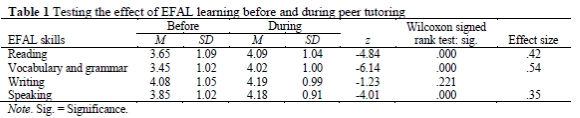
With this study we explored Grade 8 and 9 learners' perceptions and experiences of peer tutoring in learning English as a first additional language. Vygotsky's (1978) sociocultural theory, specifically the concept of scaffolding and zone of proximal development, formed the basis of our theorisation. Through the use of a concurrent mixed-methods design, we found that learners, who had received peer tutoring interventions, reported improved reading, speaking, and vocabulary/grammar ability, but not writing ability. Moreover, peer interaction increased learners' involvement in lessons allowing them to co-create knowledge with their peers. This study adds to our understanding of the potential benefits of peer tutoring for learners of English first additional language. It highlights the effects of peer tutoring as a potentially effective pedagogic strategy in the language classroom. Thus, we recommend that teachers consider introducing peer tutoring during language classes to assist learners in co-creating knowledge as they actively engage with language content presented in these classes.
constructivism; English first additional language; peer tutoring; sociocultural theory; zone of proximal development