Language learners as co-creators of knowledge through constructivist peer tutoring interaction
Abstract
With this study we explored Grade 8 and 9 learners' perceptions and experiences of peer tutoring in learning English as a first additional language. Vygotsky's (1978) sociocultural theory, specifically the concept of scaffolding and zone of proximal development, formed the basis of our theorisation. Through the use of a concurrent mixed-methods design, we found that learners, who had received peer tutoring interventions, reported improved reading, speaking, and vocabulary/grammar ability, but not writing ability. Moreover, peer interaction increased learners' involvement in lessons allowing them to co-create knowledge with their peers. This study adds to our understanding of the potential benefits of peer tutoring for learners of English first additional language. It highlights the effects of peer tutoring as a potentially effective pedagogic strategy in the language classroom. Thus, we recommend that teachers consider introducing peer tutoring during language classes to assist learners in co-creating knowledge as they actively engage with language content presented in these classes.
constructivism; English first additional language; peer tutoring; sociocultural theory; zone of proximal development
Introduction
South Africa has an estimated population of 62 million people and remains one of the most unequal societies in the world today (Roets, Kurtz & Biraimah, 2023; Statistics South Africa, 2023). The enduring legacy of colonisation and apartheid created a society in which 90% of South Africa's wealth lies in the hands of 10% of its population (Spaull, 2019). This inequality is mirrored in the South African education system, as the majority of learners continue to receive education of poor quality (Roets et al., 2023). Results from various international, regional and national studies demonstrate that South African learners perform at levels below those of their counterparts (Department of Basic Education, 2023; Mtambo & Tshuma, 2023). Several scholars argue that poor learner performance is due to a number of connected factors. These factors include disruptive educational policies and strategies applied in educational settings, such as curriculum changes and the language of learning and teaching, which favours English (Roets et al, 2023; Van der Berg, 2018). Other scholars (Fesi & Mncube, 2021; Van Staden & Bosker, 2014; Venketsamy, 2023) argue that poor academic performance is intricately linked to a complex yet connected set of circumstances that prevail in the learners' schools, homes and communities. At school level, challenges that include inadequate staffing, overcrowded classrooms, poor learning culture, poor teacher competence, a lack of parental involvement, and inadequate resources can all be associated with poor performance.
Considering the complexity of factors that affect learner performance, we explored peer tutoring as a constructivist pedagogical approach that may be introduced in South African classrooms to combat low performance. In this study, the term "peer tutoring" refers to same-age learning, and cross-age learning between a learner and a non-professional (peer) teacher (Topping, 2015). We specifically explored peer tutoring in learning English First Additional Language (EFAL), as approximately 90% of South African learners use English as language of learning and teaching from Grade 4 to university level (Mtambo & Tshuma, 2023 ; Roets et al, 2023). The majority of South African learners speak one of the nine indigenous African languages at home (isiZulu, isiXhosa, isiNdebele, Siswati, Setswana, Sepedi, Sesotho, Xitsonga and Tshivenda) (Statistics South Africa, 2023). The practice of teaching learners in a language that is not their home language has been criticised for the barriers this creates in the acquisition of literacy, which also results in underperformance in other subjects such as mathematics and physical science (Taylor & Von Fintel, 2016). In light of these challenges, it was worth exploring whether using peers as tutors could assist EFAL learners to progress in language learning. Drawing from a constructivist theory, which includes Vygotsky's sociocultural theory (SCT) (1978), peer tutoring is conceptualised as a structured, dynamic and collaborative approach to teaching and learning that encourages participation (Bowman-Perrott, DeMarín, Mahadevan & Etchells, 2016; Topping, 2015). The constructivist nature of peer tutoring provides a unique sociocultural environment that allows learners to co-construct knowledge with their peers through social interaction and collaborative learning (Vygotsky, 1978). Although research indicates that peer tutoring is effective in enhancing learning for tutees, some scholars (King, 1998; Roux, 2009; Zain, Sailin & Mahmor, 2022) caution against idealising tutor-tutee interaction. These scholars argue that since tutors are not professional teachers, they may lack the necessary expertise to scaffold and mediate learning effectively for tutees. This may result in surface-level interactions rather than providing tutees with higher-order thinking skills, which include critical thinking and the ability to apply and evaluate knowledge. Roux (2009) further notes that tutors and tutees might have different expectations regarding their roles in the tutoring relationship, which could negatively affect tutoring outcomes. Therefore, the aim with this study was to explore the role of peer tutoring in EFAL learning within the context of the benefits and challenges identified by the research. To achieve this aim, we explored the following objectives: (1) learners' perceptions of linguistic gains before and during peer tutoring; and (2) learners' experiences of peer tutoring.
Literature Review
Peer tutoring models
Peer tutoring, also known as peer-assisted learning, provides learners with individualised instruction, especially in overcrowded, urban classrooms in low-income communities (Barahona, Padrón & Waxman, 2023). Various types of peer tutoring models have been identified in the literature but we limit our discussion to the three (cross-age, same-age, reciprocal) that were used in the peer tutoring programmes that formed part of this study. Cross-age tutoring involves the pairing of learners at different grade levels, with the older learners assuming the role of tutors and the younger learners assuming the roles of tutees (Barahona et al., 2023; Robinson, Schofield & Steers-Wentzell, 2005). In this model, the relationships of the tutor and tutee do not change because the tutor can never be a tutee and the tutee can never be a tutor due to the ability levels of the partners in the pairing (Hott, Walker & Sahni, 2012). King (1997) challenges labelling cross-age tutoring as peer tutoring and asserts that this labelling is a misnomer as older learners are not peers. Despite King's (1997) view, we applied that of Topping (2015) who is of the opinion that peer tutoring occurs between individuals who are not professional teachers (peers) and who support one another in learning.
Same-age peer tutoring involves the matching of learners who are the same age when reviewing relevant work together. These learners may have varying levels of ability (Robinson et al., 2005). The reciprocal peer tutoring strategy maximises group reward as well as interdependence. This model allows learners to alternate roles between tutor and tutee by following a structured format (Bowman-Perrott, Ragan, Boon & Burke, 2023). A distinctive feature of the reciprocal tutoring strategy is that rewards are administered according to the performance of the group.
Effectiveness of peer tutoring
Research into the effectiveness of peer tutoring for tutees has been mixed with some studies indicating that it has little to no effect on academic performance (Halim, Arif & Supramaniam, 2020).
However, other studies have shown significant academic gains for tutees in various fields of study and at different grade levels (Baleni, Malatji & Wadesango, 2016; Bowman-Perrott et al., 2023; Hsia, Huang & Hwang, 2016; Tsuei, 2017). Studies that specifically examined the effect of peer tutoring on EFAL learners also produced mixed results with some indicating the effectiveness of peer tutoring and others concluding that this method of teaching provided no improvement in learner achievement (Bowman-Perrott et al, 2016; Halim et al, 2020; Jones, Ostojic, Menard, Picard & Miller, 2017). While Halim et al. (2020) found that peer tutoring was not effective in improving learners' reading comprehension, Jones et al. (2017) report gains in the reading fluency of Grade 3 learners in southwestern Ontario, Canada. However, these gains were less pronounced in the case of learners who attended schools that lacked financial and human resources. This finding highlights the need to consider tutoring effects within the context of the broader systemic inequalities that learners experience, which include the availability of school resources.
Peer tutoring encourages learners' acceptance of responsibility, which stimulates high-quality learning (Cole, 2014). This occurs by ensuring that learners are encouraged to participate in discussions, monitor their own progress and ultimately take charge of their own learning (Hsia et al., 2016). This is accomplished by the tutee asking questions or asking for guidance when errors are detected, and the tutor providing the guidance and assistance that are required (Tsuei, 2017). Therefore, tutees are able to reflect on their own performance and to make the necessary corrections based on the feedback received from the tutors (Hsai et al., 2016). Peer tutoring focuses on the active and cooperative process of knowledge construction within a social context, as proposed in Vygotsky's (1978) SCT (Cole, 2014).
Peer tutoring is also beneficial for tutors as it produces incremental gains, as characterised by specific role-taking (Bowman-Perrott et al., 2016; Topping, Campbell, Douglas & Smith, 2003). In role theory, Robinson et al. (2005) assert that when learners assume the role of a teacher, they tend to display the attributes of that role. This leads to tutors feeling and acting in a similar manner as their teachers. The expectation is that they aspire to be as competent as the teachers. This role-playing helps tutors to increase their own academic performance by enhancing their positive attitudes and bettering their performance in other subjects, even those that they are not tutoring (Robinson et al., 2005). This confirms the view of Marieswari and Prema (2016) that tutors reinforce their own learning through the process of tutoring, which relates to the constructivist assertion of learners co-constructing learning with the tutor or more knowledgeable others (Creswell & Creswell, 2018).
Theoretical Underpinnings
We used Vygotsky's (1978) constructivist perspective as the theoretical framework for our analysis as it provides the context for explaining how learners co-construct knowledge during peer tutoring interactions.
Zone of proximal development
Vygotsky (1978:86) defines the zone of proximal development (ZPD) as "the distance between the actual development level as determined by independent problem-solving and the level of potential development as determined through problem-solving under adult guidance or in collaboration with more capable peers." Two levels of development are highlighted in the above definition, which are the actual level, and the potential level (Dongyu, Fanyu & Wanyi, 2013; Ghiatäu, 2023). The actual level of development denotes those tasks that learners can complete independently and which is also referred to as achieved development. The actual development represents those mental functions that have already matured in the learner and assumes a retrospective view of development as the learner has already achieved it (Ghiatäu, 2023; Thorne & Tasker, 2013). The second level of development is arguably where most cognitive development takes place as this is the active learning zone. It is forward-looking and addresses those tasks that learners cannot do on their own but have the potential to perform with assistance from more knowledgeable peers or adults (Lantolf, Thorne & Poehner, 2015; Thorne & Tasker, 2013).
As posited by Vygotsky (1978), the ZPD is not only dependent on internal mental processes, but also on the quality and quantity of external forms of social/dialogic interaction that are in line with a learner's potential ability. These dialogic interactions between the novice and capable peers are perceived to be mutually beneficial in that the novice (tutee) obtains the necessary support and the capable peer (tutor) also benefits from the social interaction (Dongyu et al., 2013). The tutees receive both cognitive and motivational scaffolding (Mackiewicz & Thompson, 2014) which helps them to learn EFAL, while the tutors benefit through the process of learning by teaching, which reinforces their own learning (Marieswari & Prema, 2016). Cognitive scaffolding refers to a tutoring strategy through which tutees are given the opportunity to solve problems on their own through questioning, prompting, hinting, and demonstrating, which allow them to choose solutions, and to refer to previous best-practice examples (Mackiewicz & Thompson, 2014). This strategy allows learners to assume greater cognitive responsibility in the execution of tasks, which gradually leads to greater self-regulation. Self-regulation refers to the learner's ability to function autonomously and corresponds with Vygotsky's (1978) concept of mediated learning -specifically self-mediated learning (Dongyu et al., 2013; King, 1998). Motivational scaffolding entails tutors encouraging tutees and offering them affective support, which includes encouragement and praise, reinforcing learners' ownership and control, using humour, and showing empathy (Mackiewicz & Thompson, 2014). Another important consideration regarding the ZPD is that the assistance offered to learners should match their ZPD level as cognitive development only occurs when learners are confronted with tasks that lie within the ZPD (Louis, 2009).
Scaffolding
The concept "scaffolding" underlies the theory of the ZPD. Wood, Bruner and Ross (1976) introduced scaffolding in order to operationalise Vygotsky's (1978) concept of teaching within the ZPD (Mackiewicz & Thompson, 2014). Scaffolding refers to the learning and problem-solving support that the learner receives from more capable adults or peers. The support may take the form of clues, encouragement, examples and innovative ways to explain problems (Bayaga, Mtose & Quan-Baffour, 2010). This assistance is often greater at first, and lessens as learners develop the cognitive capability to complete tasks on their own or once internalisation has taken place. Therefore, cognitive development takes place as the learner completes the task within the ZPD. Once the learner has mastered the task (internalised it), it is replaced by a more advanced task to ensure continuous cognitive development (Donato, 1994; Louis, 2009). Scaffolding facilitates conceptual, procedural, strategic and metacognitive support for learners by bridging the gap between what they can do on their own (actual development) and what they can do with assistance from experts or peers (potential development) (Belland, Walker, Olsen & Leary, 2015). As Bayaga et al. (2010) suggest, scaffolding enhances learners' independence in problem-solving and cultivates an increased sense of responsibility for their own learning. Scaffolding occurs not only between experts and novices but also between peers who are engaged in the tutoring process (Ghiatäu, 2023; Mackiewicz & Thompson, 2014). Donato (1994) argues that learners can offer guided support to their peers in ways that are analogous to expert or adult scaffolding.
Methodology
We used a convergent parallel mixed-methods design to meet the aim and objectives of this study. According to this approach, qualitative and quantitative data offer distinct kinds of information, which are integrated to address research questions and to obtain an in-depth understanding of the problem (Creswell & Plano Clark, 2018). By using a mixed-methods design, we were able to minimise the limitations of using only qualitative or quantitative techniques while maximising their combined strengths.
Sampling
We used non-probability, purposive, snowball sampling to select participants who could offer in-depth information about peer tutoring and EFAL learning (Creswell & Plano Clark, 2018). The sample consisted of 137 Grade 8 and Grade 9 EFAL learners between the ages of 11 and 18 who participated voluntary in after-school, peer tutoring programmes. These peer tutoring programmes were managed and facilitated by various non-profit organisations (NPOs) that aim to assist learners in overcoming educational challenges stemming from inadequate schooling. Through the involvement of volunteers, these NPOs offer vital after-school support to learners who may not receive adequate support at school or in their home environment. Volunteers include university students from various fields of study and out-of-school young adults, who want to give back to the community through tutoring. These NPOs provide academic support through small-group peer tutoring, which promotes group work and peer interaction. This is done by assisting learners with homework exercises, and designing and administering various curriculum-aligned exercises. Learners complete these exercises during peer tutoring sessions, which allow them to revise and review work with academically stronger learners who assist the weaker ones.
Some of the observed exercises included essay writing, reading, reviewing of stories, application of grammatical rules and spelling. When learners experienced difficulties with the exercises or homework, the peer tutors would provide one-on-one assistance to provide individualised learning opportunities for these learners. The peer tutoring sessions took place in a range of locations, including a church building, university lecture hall, community centre and a school classroom. The tutoring sessions were conducted after school, twice a week (Mondays and Wednesdays or Tuesdays and Thursdays) and on Saturday mornings.
Data Collection Instruments
Data for this study were gathered through a peer tutoring and English learning questionnaire (PTEL) and through focus-group discussions (FGDs). The PTEL, designed specifically for this research, comprises three sections. Section A captures demographic information including age, gender, and home language(s).
Section B consists of a Likert-scale questionnaire assessing learners' self-perceived proficiency across four language domains (writing, reading, speaking, and grammar). Participants rated their EFAL performance before and during peer tutoring sessions on a 5-point scale ranging from 1 = very poorly, to 5 = very well. The scale comprised eight items, one for each language domain before and during tutoring. Reliability analysis demonstrated a strong internal consistency for Section B of the PTEL questionnaire (Cronbach's α = .860). Similarly, Cronbach's alpha coefficients were calculated for performance ratings before tutoring (α = .710) and during tutoring (α = .797), indicating the reliability of the PTEL in assessing learners' self-rated EFAL ability (Foxcroft & Roodt, 2009).
Section C of the PTEL features an open-ended questionnaire (OEQ) prompting learners to share their experiences of peer tutoring interactions. This section, alongside the FGDs, facilitated the collection of qualitative data. Six focus-group interviews involving 44 participants were conducted. The socially-oriented format of the FGDs allowed for data collection within the participants' social milieu, fostering a more natural environment for expressing ideas and attitudes compared to one-on-one interviews (Chilisa, 2012). Additionally, the FGD setting provided a safe space for participants to communicate ideas in the presence of peers who shared similar characteristics, such as ethnic background (Onwuegbuzie & Frels, 2015).
Data Analysis
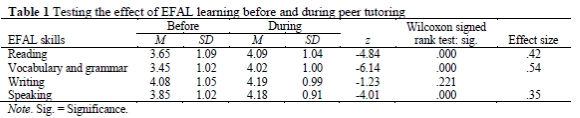
The Statistical Package for the Social Sciences (SPSS), version 25, was used to analyse quantitative data. Descriptive and inferential statistics were used to explore the impact of peer tutoring on EFAL language learning. The Wilcoxon signed rank test was used to explore the effect of peer tutoring on EFAL learning by using learners' retrospective self-rating of their language ability before and during tutoring. The Kruskal Wallis test was used to determine whether the type of peer tutoring had an effect on learner performance. These tests were chosen as the data obtained through the questionnaire was ordinal and was not normally distributed. Effect sizes were calculated for all significant effects relating to the Wilcoxon signed rank test and the Kruskal Wallis test. The effect sizes were interpreted using Cohen's (1988) proposed guidelines for effect sizes (0-0.2 = small effect, 0.3-0.4 = medium effect and 0.5 and above = large effect) (Alegre, Moliner, Maroto & Lorenzo-Valentin, 2019).
We adopted a constructivist grounded theory (CGT) approach in analysing the quantitative data, which involves an iterative process of moving between the data, initial codes, concepts and categories until ultimately arriving at a theory (Charmaz, 2006; Crossetti, Goes & De Brum, 2016; Schreiber & Martin, 2013). The grounded theory approach to data analysis involves three coding stages: open/initial coding, focused coding and theoretical coding (Strauss & Corbin, 1990). In our study, the core strategies/themes were categorised into clusters, which provided theoretical explanations (theoretical constructs) of EFAL learners' experiences at the various peer tutoring organisations.
Findings
Perceived Linguistic Gains
The quantitative results reveal that the majority (64%) of learners indicated that peer tutoring had improved EFAL learning while 5% said that it had not, 1% was uncertain and 30% did not respond to this question. The self-reported perceived linguistic improvement was further supported by the results of a paired Wilcoxon signed rank test that compared learners' self-rated language ability before and during peer tutoring. Table 1 shows that learners' perceived linguistic ability of reading, speaking, vocabulary and grammar was significantly higher during tutoring than before tutoring as shown by the high effect size for vocabulary and grammar and medium effect size for reading and speaking. No significant improvement was observed for writing before and during tutoring.
The Kruskal-Wallis test was conducted to examine the differences in EFAL performance based on the type of tutoring that learners were exposed to (reciprocal, same-age and cross-age tutoring). As shown in Table 2, no significant differences were observed between learners' self-rated perceived linguistic ability in all four language skills and the type of peer tutoring they had been exposed to. These outcomes suggest that learners' perceptions of linguistic gains were not dependant on the type of peer tutoring they had received.
Peer Tutoring is Perceived to Offer Cognitive Scaffolding
Learners reported that peers provided cognitive scaffolding by asking questions, developing tasks and providing a platform for challenging discussions. These factors offered learners the opportunity to co-construct meaning and mediate cognitive processes, as demonstrated in the following verbatim extracts. "We as peers, we communicate in English by reading and asking one another questions" (OEQ); "... by giving each other work to write; after that we mark for each other" (OEQ); "We often maybe argue about that word, about the meaning; someone else will say it's that and that, the pronunciation, until we get the correct spelling" (FGD); and "I ask my friends and then maybe they know it and we discuss it together like this" (FGD). Learners also indicated that the interaction during peer tutoring provided greater assistance than the support they had received from their teachers, as illustrated in the following extracts: "... having a study session, where we talk and learn from our peers, because sometimes teachers can explain to a learner over and over, yet the learner still leaves class totally confused" (OEQ); "The tutors, they do explain more of the words you don't understand, and they explain them better than our teachers do" (FGD); "The peer tutoring environment is the best place to be. They [tutors] give you their attention whenever you need help; they won' t give up on you until you understand. Even us peers can help each other whenever we do not understand" (OEQ); "It's a place where you get help when you don' t understand something and it's a place you can learn from others as well" (OEQ); and "f I don't understand, my tutor helps me make(s) examples and make sure that I understand. Then she/he gives me an activity to do and also encourages me to practice when [I] am at home" (OEQ). These findings underscore the constructive role of peers in supporting one another and the tutees during EFAL learning and suggest that peer interaction may be a resource for teaching learners within the ZPD.
Peer Tutoring Interaction Offers Opportunities for Motivational Scaffolding and Active Engagement Another theme that emerged from the data indicates that peer tutoring interactions provided opportunities for motivational scaffolding and active engagement. Motivational scaffolding is evident in the following extracts: "they build your self-confidence if you are going to do a speech in front of the whole class. They encourage you to do the research" (FGD); "They support you" (FGD); and "... write homework with them, like when your friend encourages you to go with them to write homework; we help each other" (FGD). Active engagement, which involves demonstrating solutions, indicating errors and providing guided instruction was evident in addressing linguistic errors. Corrective feedback was a collective activity during which learners sought feedback from their peers and also offered feedback themselves, thereby enhancing EFAL learning, as expressed in the following extracts. "I ask them [peers] to correct my mistakes" (OEQ); "I enjoy being corrected because I see that all the people who are correcting me (they) are concerned about me and my education" (OEQ); "We as peers, we help one another with English because we are not perfect, 'cause it's not our mother tongue, so we help each other; if you made an error, we help you"" (OEQ); "... correct people's mistakes and encourage them to do better next time" (OEQ); "They do not laugh at you when you make a mistake" (FGD); "Hey, ok, we speak English together, and they correct you if you say a mistake" (FGD); and "... correct you when you are wrong" (FGD).
Peer Tutoring as a Platform for English Practice and Resource Provision
The peer tutoring environment offered learners the opportunity to engage with others through group work when using EFAL. Moreover, learners were encouraged to use EFAL to develop confidence in its use, as is clear from the following extracts: "My tutors really helped me improve my English because they told me that I must use English whenever I communicate with other learners at this programme" (OEQ); "It makes me feel happy because I learn English. I know how to speak English with other people; it makes me feel happy. But other people feel that you may be pushing them to speak English because you can speak better" (FGD); "In the peer tutoring, we speak English every time, so speaking English, especially with a lot of people, helps me a lot. I am able to cope and improve my English in speaking" (OEQ); "I feel like our after-school programme offers a convenient help because we are required to speak English at all times" (OEQ); and "We talk to each other in English with the tutors and they often make jokes"" (OEQ). These excerpts suggest that the peer-tutoring environment enabled learners to cope with the demands of EFAL by encouraging the use of English. Moreover, learners reported that the peer tutoring environment offered them opportunities for reading that they were not afforded at school: "They [tutors] do give us books, reading books, on Saturday, so that we can learn English better than we do at school because we do not have time to read books. Yes, [we] do not have time to read books at school" (FGD); and "... novels, books help(s) me to learn English better" (OEQ). Through the receipt of reading material in the peer tutoring programmes, learners were able to improve EFAL skills.
Social Disconnection as a Barrier to English First Additional Language Learning
Social disconnection concerns the role that peers and tutors play in learners' experiences of EFAL learning. Although the majority of the participating learners indicated the positive role that peers played in EFAL learning, there were those who viewed peers as a barrier to EFAL learning. Some peers seemed to have a distorted view of EFAL and thus discouraged others from learning it: "My peers say that learning English is just a waste of time because you learn English and you do not understand it at all ... they say that English is not made for black people. They say English is not our mother tongue" (FGD); "My peers at school, like, I have two friends at school; when I tell them to speak English, they don't want to; they say I have pride" (FGD); "Sometimes they say you are snobbish; they judge you, laugh at you if you make a mistake; they say you are acting big in a small town" (FGD); and "When some people laugh at you, you feel ashamed and you never answer in the classroom" (FGD). Given that English is the medium of instruction in most schools in South Africa, holding the view that English should not be learnt, as it is not the mother tongue is counterproductive and may cause delays in the attainment of education. Although there was general consensus among participating learners that peer tutoring programmes offered a safe environment in which to learn, some learners indicated that tutors in the peer-tutoring milieu should be more considerate when learners make mistakes: "I wish my English tutor would not laugh at me when I do mistakes. I wish he/she would take ... and tell me alone so that I may learn" (OEQ). Public ridicule by tutors can create an unpleasant environment for learners, especially if they are already experiencing their peers as inconsiderate and disrespectful. This could result in learners' withdrawal from discussions, as shown in the following extracts. "When some people laugh at you, you feel ashamed and you never answer in the classroom" (FGD); "... some children are too scared to ask" (FGD); and "... the other thing is that you become a topic for the whole week" (FGD). Learners also noted that some tutors failed to lead by example as they deviated from what they expected from learners. While these tutors expected learners to communicate with them and each other in English, they did not always do the same. "They say you must speak English, but they do not speak English. They must cooperate. They must be the example" (FGD); and "When you try to speak your home language with them, they ... like ... 'no, don't speak your home language, we can't hear you ', even if they hear you" (FGD).
Discussion
The results of this study highlight the potential role of peer tutoring in improving learners' perceptions of their EFAL learning. Although actual language ability was not assessed in this study, learners self-reported improvement in vocabulary, grammar, reading and speaking. This finding is supported by research, which demonstrates that peer tutoring can enhance language skills (Bowman-Perrott et al., 2016; Halim et al., 2020; Jones et al., 2017). Learners' self-reported improvements resulted from practice opportunities provided by tutoring interactions. The small group or one-to-one interactions during these sessions ensured that learners were taught within their ZPD. Within this zone, tutees received tailored support while tutors reinforced their learning (Marieswari & Prema, 2016). In our investigation the self-reported linguistic gains were not limited by the specific model of peer tutoring used, nor were they limited by the methodologies employed in the various programmes. This finding is corroborated by other research that highlights substantial learning improvements among participants engaged in peer tutoring, irrespective of the tutoring model or method employed (Bowman-Perrott et al., 2016; Marieswari & Prema, 2016). This finding suggests that peer tutoring represents an effective educational approach with the potential for implementation in a broader classroom context.
Additionally, participants in this study indicated that peer tutoring provided both cognitive and motivational scaffolding. These findings are consistent with studies which demonstrate that scaffolding occurs not only between experienced educators and learners but also among peers engaged in tutoring activities. (Alegre et al., 2019; Donato, 1994; Lantolf et al., 2015; Mackiewicz & Thompson, 2014; Thorne & Tasker, 2013). Donato (1994) argues that learners can offer guided support to their peers in ways that are similar to those of experts. The participants in this study indicated that their peers were more adept at scaffolding learning compared to their teachers. This observation is consistent with Duran' s (2004) study in which instances were found where learners scaffolded learning more effectively than their teachers. Duran (2004) suggests that this phenomenon may stem from learners' heightened awareness of their classmates' learning challenges. Furthermore, given that learners encounter "new" material themselves, they might explain complex concepts using more straightforward language.
Another outcome from our study is that peer interaction facilitates corrective feedback, which creates a safe space for correcting mistakes and thus enhancing learning. Scholars (Hsia et al., 2016; Tsuei, 2017) have found that peer tutoring facilitates active engagement between tutors and tutees and encourages learners to take responsibility for their own learning. This occurs when learners are encouraged to participate in discussions, monitor their own progress and ultimately take charge of their own learning (Hsia et al., 2016). This was demonstrated when participating learners developed tasks for each other, graded these tasks and requested corrective feedback. These actions demonstrate the learners' agency in EFAL learning.
The aforementioned results should be understood in context, taking into consideration the general challenges affecting learning in South African classrooms. In this study, peer tutoring sessions were conducted in small groups or one-on-one. The Department of Basic Education aims to achieve a 30:1 learner-teacher ratio. However, the reality is that South African classrooms are at a teacher-learner ratio of 40:1, which may be as high as 70:1 (Graham, 2023; Venketsamy, 2023). Several studies have shown that overcrowded classrooms pose a barrier to learning as teachers have to spend precious time disciplining learners instead of teaching (Glaser, 2015; Marais, 2016). Teachers with large classes often report that they are unable to provide individualised instruction to support all the learners or provide comprehensive assessment of performance. Moreover, overcrowded classrooms hinder teachers from providing proper feedback, monitoring homework and identifying those learners who fall behind in their work. Teachers point out that they are unable to immediately notice when learners experience learning difficulties in large classes. This may lead to teachers focusing on learners who participate and ignoring more passive learners (Graham, 2023; Venketsamy, 2023). Thus, learners who struggle may not receive the attention they require, causing them to struggle even more in later grades. However, peers helping each other may assist teachers in ensuring that more learners are provided with effective scaffolding.
While peer tutoring could potentially benefit EFAL learning, we also identified pitfalls that should be considered when implementing peer tutoring. The negative attitude displayed by some peers discouraged learners from participating in the peer tutoring sessions, especially when these peers acted as tutors. Thus, some learners indicated that peer tutoring did not benefit their EFAL learning -especially their writing skills. Therefore, we argue that tutors should be taught how to implement peer tutoring interaction. This may enhance EFAL learning among learners as learners co-create knowledge with their peers.
Conclusions and Recommendations
Our study provides insight into the potential role of peer tutoring in scaffolding EFAL learning in low-resourced schools. However, further research is needed to assess the quantifiable academic effectiveness of peer tutoring in academic achievement. Given the current reality of overcrowded classrooms in South Africa, we recommend that teachers explore peer-based learning to maximise input during a lesson and allow learners to engage in collaborative work. Teachers should explore a hybrid instructional method, which encourages active learner participation that allows sufficient time for the teacher to facilitate the lesson. This may be in the form of small groups or pairs that include a balanced mixture of low and high academic performers in a particular subject.
Although the findings of this study highlight the positive role of peer tutors in EFAL learning, there is a need to focus on the training of tutors to avoid some of the pitfalls identified. This support should include offering training to peer tutors on how best to scaffold EFAL learning by focusing on developing higher-order thinking and problem-solving skills.
Authors' Contributions
PNNM wrote the manuscript, provided data for Table 1 and 2 and conducted all statistical analyses under supervision of GG. Both authors reviewed the final manuscript.
Notesi. This article is based on the doctoral thesis of Petronella Nondumiso Nompilo Machinana.
ii. Published under a Creative Commons Attribution Licence.
Acknowledgement
We would like to acknowledge the invaluable contributions made by all the learners who participated in this study. We also thank the programme managers and tutors of the various programmes.
References
-
Alegre F, Moliner L, Maroto A & Lorenzo-Valentin G 2019. Peer tutoring in mathematics in primary education: A systematic review. Educational Review, 71(6):767-791. https://doi.org/10.1080/00131911.2018.1474176
» https://doi.org/10.1080/00131911.2018.1474176 - Baleni LS, Malatji KS & Wadesango N 2016. The influence of peer tutoring on students' performance in a South African university. Journal of Communication, 7(1):127-133.
-
Barahona E, Padrón YN & Waxman HC 2023. Classroom observations of a cross-age tutoring mathematics program in elementary and middle schools. European Journal of Science and Mathematics Education, 11(3):515-532. https://doi.org/10.30935/scimath/12983
» https://doi.org/10.30935/scimath/12983 - Bayaga A, Mtose X & Quan-Baffour KP 2010. Social influences on the studying of mathematics by black South African learners. Problems of Education in the 21st Century, 23(1):30-40.
- Belland BR, Walker AE, Olsen MW & Leary H 2015. A pilot meta-analysis of computer-based scaffolding in STEM education. Journal of Educational Technology, & Society, 18(1):183-197.
-
Bowman-Perrott L, DeMarín S, Mahadevan L & Etchells M 2016. Assessing the academic, social, and language production outcomes of English language learners engaged in peer tutoring: A systematic review. Education and Treatment of Children, 39(3):359-388. https://doi.org/10.1353/etc.2016.0016
» https://doi.org/10.1353/etc.2016.0016 -
Bowman-Perrott L, Ragan K, Boon RT & Burke MD 2023. Peer tutoring interventions with or at-risk for emotional and behavioral disorders: A systematic review of reviews. Behavior Modification, 47(3):777-815. https://doi.org/10.1177/01454455221118359
» https://doi.org/10.1177/01454455221118359 - Charmaz K 2006. Constructing grounded theory: A practical guide through qualitative analysis. London, England: Sage.
- Chilisa B 2012. Indigenous research methodologies. Los Angeles, CA: Sage.
-
Cole MW 2014. Speaking to read: Meta-analysis of peer-mediated learning for English language learners. Journal of Literacy Research, 46(3):358-382. https://doi.org/10.1177/1086296X14552179
» https://doi.org/10.1177/1086296X14552179 - Creswell JW & Creswell JD 2018. Research design: Qualitative, quantitative, and mixed methods approaches (5th ed). Los Angeles, CA: Sage.
- Creswell JW & Plano Clark VL 2018. Designing and conducting mixed methods research (3rd ed). Los Angeles, CA: Sage.
-
Crossetti MO, Goes MG & De Brum CN 2016. Application of constructivist grounded theory in nursing research [Special issue]. The Qualitative Report, 21(13):48-53. https://doi.org/10.46743/2160-3715/2016.2610
» https://doi.org/10.46743/2160-3715/2016.2610 - Department of Basic Education 2023. PIRLS 2021: South African preliminary highlights reports. Pretoria, South Africa: Author.
- Donato R 1994. Collective scaffolding in second language learning. In JP Lantolf & G Appel (eds). Vygotskian approaches to second language research. Norwood, NJ: Ablex Publishing Corporation.
-
Dongyu Z, Fanyu & Wanyi D 2013. Sociocultural theory applied to second language learning: Collaborative learning with reference to the Chinese context. International Education Studies, 6(9):165-174. https://doi.org/10.5539/ies.v6n9p165
» https://doi.org/10.5539/ies.v6n9p165 - Duran D 2004. Tutoria entre iguales [Tutoring among equals]. Innovación Educative, 132:75-76.
-
Fesi L & Mncube V 2021. Challenges of English as a first additional language: Fourth grade reading teachers' perspectives. South African Journal of Education, 41(3):Art. #1849, 11 pages. https://doi.org/10.15700/saje.v41n3a1849
» https://doi.org/10.15700/saje.v41n3a1849 - Foxcroft C & Roodt G 2009. Introduction to psychological assessment in the South African context (3rd ed). Cape Town, South Africa: Oxford University Press Southern Africa.
-
Ghiajãu RM 2023. Sociocultural theory-based pedagogy in second language teaching and European language policies. Journal of Innovation in Psychology, Education and Didactics, 27(2):231 -240. https://doi.org/10.29081/JIPED.2023.27.2.07
» https://doi.org/10.29081/JIPED.2023.27.2.07 -
Glaser C 2015. Soweto's islands of learning: Morris Isaacson and Orlando High Schools under Bantu Education, 1958-1975. Journal of Southern African Studies, 41(1):159-171. https://doi.org/10.1080/03057070.2015.991573
» https://doi.org/10.1080/03057070.2015.991573 -
Graham MA 2023. Overcrowded classrooms and their association with South African learners' mathematics achievement. African Journal of Research in Mathematics, Science and Technology Education, 27(2):169-179. https://doi.org/10.1080/18117295.2023.2244217
» https://doi.org/10.1080/18117295.2023.2244217 -
Halim N, Arif MM & Supramaniam K 2020. Enhancing reading comprehension through metacognitive reading strategies and peer tutoring among year 7 students at a home school centre. Asian Journal of University Education, 16(1):22-31. https://doi.org/10.24191/ajue.v16i1.8981
» https://doi.org/10.24191/ajue.v16i1.8981 -
Hott B, Walker J & Sahni J 2012. Peer tutoring. Available at https://council-for-learning-disabilities.org/peer-tutoring-flexible-peer-mediated-strategy-that-involves-students-serving-as-academic-tutors/. Accessed 5 June 2018.
» https://council-for-learning-disabilities.org/peer-tutoring-flexible-peer-mediated-strategy-that-involves-students-serving-as-academic-tutors/ -
Hsia LH, Huang I & Hwang GJ 2016. Effects of different online peer-feedback approached on students' performance skills, motivation and self-efficacy in a dance course. Computers & Education, 96:55-71. https://doi.org/10.1016/j.compedu.2016.02.004
» https://doi.org/10.1016/j.compedu.2016.02.004 -
Jones G, Ostojic D, Menard J, Picard E & Miller CJ 2017. Primary prevention of reading failure: Effect of universal peer tutoring in early grades. The Journal of Educational Research, 110(2):171-176. https://doi.org/10.1080/00220671.2015.1060929
» https://doi.org/10.1080/00220671.2015.1060929 -
King A 1997. ASK to THINK-TEL WHY: A model of transactive peer tutoring for scaffolding higher level complex learning. Educational Psychologist, 32(4):221-235. https://doi.org/10.1207/s15326985ep3204_3
» https://doi.org/10.1207/s15326985ep3204_3 -
King A 1998. Transactive peer tutoring: Distributing cognition and metacognition. Educational Psychology Review, 10(1):57-74. https://doi.org/10.1023/A:1022858115001
» https://doi.org/10.1023/A:1022858115001 - Lantolf JP, Thorne SL & Poehner ME 2015. Sociocultural theory and second language development. In B van Patten & J Williams (eds). Theories in second language acquisition: An introduction (2nd ed). New York, NY: Routledge.
- Louis GW 2009. Using Glasser's Choice Theory to understand Vygotsky. International Journal of Reality Therapy, 28(2):20-23.
- Mackiewicz J & Thompson I 2014. Instruction, cognitive scaffolding, and motivational scaffolding in writing center tutoring. Composition Studies, 42(1):54-78.
-
Marais P 2016. "We can't believe what we see": Overcrowded classrooms through the eyes of student educators. South African Journal of Education, 36(2):Art. # 1201, 10 pages. https://doi.org/10.15700/saje.v36n2a1201
» https://doi.org/10.15700/saje.v36n2a1201 -
Marieswari M & Prema N 2016. Effectiveness of peer tutoring in learning English among tutors and tutees of class VIII students in Kancheepuram DT. English Language Teaching, 9(11):1-5. https://doi.org/10.5539/elt.v9n11p1
» https://doi.org/10.5539/elt.v9n11p1 -
Mtambo B & Tshuma L 2023. Intermediate Phase learner performance in English: A quantitative analysis. Reading & Writing, 14(1):a430. https://doi.org/10.4102/rw.v14i1.430
» https://doi.org/10.4102/rw.v14i1.430 -
Onwuegbuzie AJ & Frels RK 2015. Using Q methodology in the literature review process: A mixed research approach. Journal of Educational Issues, 1(2):90-109. https://doi.org/10.5296/jei.v1i2.8396
» https://doi.org/10.5296/jei.v1i2.8396 -
Robinson DR, Schofield JW & Steers-Wentzell K 2005. Peer and cross-age tutoring in math: Outcomes and their design implications. Educational Psychology Review, 17(4):327-362. https://doi.org/10.1007/s10648-005-8137-2
» https://doi.org/10.1007/s10648-005-8137-2 -
Roets L, Kurtz B & Biraimah K 2023. The impact of the racial and economic divides on access to quality education in South Africa and the United States. In N Popov, C Wolhuter, ZL de Beer, G Hilton, J Ogunleye, E Achinewhu-Nworgu & E Niemczyk (eds). Recovering education: Using the experiences and learning acquired to build new and better education systems (BCES Conference Books, Vol. 21). Sofia, Bulgaria: Bulgarian Comparative Education Society. Available at https://files.eric.ed.gov/fulltext/ED629259.pdf. Accessed 16 May 2025.
» https://files.eric.ed.gov/fulltext/ED629259.pdf -
Roux C 2009. Holistic curriculum development: Tutoring as a support process. South African Journal of Education, 29(1):17-32. https://doi.org/10.15700/saje.v29n1a229
» https://doi.org/10.15700/saje.v29n1a229 - Schreiber RS & Martin W 2013. New directions in grounded theory. In CT Beck (ed). Routledge international handbook of qualitative nursing research. New York, NY: Routledge.
-
Spaull N 2019. Equity: A price too high to pay? In N Spaull & JD Jansen (eds). South African schooling: The enigma of inequality. A study of the present situation and future possibilities. Cham, Switzerland: Springer. https://doi.org/10.1007/978-3-030-18811-5_1
» https://doi.org/10.1007/978-3-030-18811-5_1 -
Statistics South Africa 2023. Census 2022: Statistical release P0301.4. Pretoria: Author. Available at https://census.statssa.gov.za/assets/documents/2022/P03014_Census_2022_Statistical_Release.pdf. Accessed 2 May 2025.
» https://census.statssa.gov.za/assets/documents/2022/P03014_Census_2022_Statistical_Release.pdf - Strauss A & Corbin JM 1990. Basics of qualitative research: Grounded theory procedures and techniques. Beverly Hills, CA: Sage.
-
Taylor S & Von Fintel M 2016. Estimating the impact of language of instruction in South African primary schools: A fixed effects approach. Economics of Education Review, 50:75-89. https://doi.org/10.1016/j.econedurev.2016.01.003
» https://doi.org/10.1016/j.econedurev.2016.01.003 - Thorne SL & Tasker T 2013. Sociocultural and cultural-historical theories of language development. In J Simpson (ed). The Routledge handbook of applied linguistics. London, England: Routledge.
-
Topping K, Campbell J, Douglas W & Smith A 2003. Cross-age peer tutoring in mathematics with seven-and 11-year-olds: Influence on mathematical vocabulary, strategic dialogue and self-concept. Educational Research, 45(3):287-308. https://doi.org/10.1080/0013188032000137274
» https://doi.org/10.1080/0013188032000137274 -
Topping KJ 2015. Peer tutoring: Old method, new developments. Journal for the Study of Education and Development, 38(1):1-29. https://doi.org/10.1080/02103702.2014.996407
» https://doi.org/10.1080/02103702.2014.996407 -
Tsuei M 2017. Learning behaviours of low-achieving children's mathematics learning in using of helping tools in a synchronous peer-tutoring system. Interactive Learning Environments, 25(2): 147-161. https://doi.org/1080/10494820.2016.1276078
» https://doi.org/1080/10494820.2016.1276078 -
Van der Berg S 2018. What international educational evaluations tell us about education quality in developing nations [Special issue]. Education Policy Analysis Archives, 26(50): 1-14. https://doi.org/10.14507/epaa.26.3816
» https://doi.org/10.14507/epaa.26.3816 -
Van Staden S & Bosker R 2014. Factors that affect South African Reading Literacy Achievement: Evidence from prePIRLS 2011. South African Journal of Education, 34(3):Art. # 838, 9 pages. https://doi.org/10.15700/201409161059
» https://doi.org/10.15700/201409161059 -
Venketsamy R 2023. Exploring the teacher-learner ratio and its effect on invitational teaching and learning: A South African study. Journal for the Education of Gifted Young Scientists, 11(1 ):33-43. https://doi.org/10.17478/jegys.1237615
» https://doi.org/10.17478/jegys.1237615 - Vygotsky LS 1978. Mind in society: Development of higher psychological processes. Cambridge, MA: Harvard University Press.
-
Wood D, Bruner JS & Ross G 1976. The role of tutoring in problem solving. Journal of Child Psychology and Psychiatry, 17:89-100. Available at https://sachafund.wordpress.com/wp-content/uploads/2018/10/wood_et_al-1976-journal_of_child_psychology_and_psychiatry.pdf. Accessed 1 May 2025.
» https://sachafund.wordpress.com/wp-content/uploads/2018/10/wood_et_al-1976-journal_of_child_psychology_and_psychiatry.pdf -
Zain FM, Sailin SN & Mahmor NA 2022. Promoting higher order thinking skills among pre-service teachers through group-based flipped learning. International Journal of Instruction, 15(3):519-542. https://doi.org/10.29333/iji.2022.15329a
» https://doi.org/10.29333/iji.2022.15329a
Revised: 5 September 2024
Accepted: 21 February 2025
Published: 31 May 2025