Perceptions, challenges, and opportunities in the development of the Tshivenda scientific register for physical sciences
Abstract
In this article we examine the experiences in the development of a Tshivenda scientific register (TSR) for Grade 10 physical sciences (PS) teaching and learning in the Vhembe West district, Limpopo province, South Africa. The study reported on here was an interpretative qualitative study in which physical sciences teachers and senior citizens participated. Data were generated from the participants through face-to-face semi-structured interviews and diary entries. The findings show numerous challenges in the development of a TSR for physical sciences, including a lack of Tshivenda scientific terms and the absence of Tshivenda physical sciences textbooks, which can have an impact on teachers and learners' ability to implement a TSR in the teaching and learning of physical sciences. Moreover, the findings also show that the physical sciences teachers and senior citizens who participated in the study sometimes adopted English and Afrikaans scientific words for which no equivalents existed in Tshivenda. We, therefore, suggested that these challenges in the development of a TSR for physical sciences teaching are addressed so that teachers can teach learners physical sciences through the language that they know best. By so doing, learners will have the opportunity to receive their physical sciences education through the language they are familiar with. Additionally, we suggest that physical science teachers must be developed, trained and furnished with essential language skills to develop a scientific Tshivenda language register on other science topics.
challenges; development; physical sciences; senior citizens; teachers; Tshivenda scientific register
Introduction
Before the inception of democracy in 1994, only Afrikaans and English were the official languages used in South Africa. During the apartheid era these official languages were considered to be superior over any other African indigenous languages in South Africa. However, the birth of democracy in 1994 brought some changes within the government sector to redress the inequalities of the apartheid government. One of the changes stipulated in the Constitution of Republic of South Africa, 1996 (RSA, 1996b) (hereafter, the Constitution) was that 11 languages were granted official status. These included nine African indigenous languages i.e. isiNdebele, Xitsonga, Sesotho, Tshivenda, isiZulu, Swati, Setswana, Sepedi, isiXhosa and Afrikaans and English. The 11 official languages are currently used in formal and official domains including law, education and health.
In line with the Constitution (1996b), the current language policy in education in South Africa allows learners to receive better education through the language of their choice in the early years of schooling. Madavha (2024) reports that even though these official languages are recognised in the country' s constitution, English and Afrikaans are the only languages which are currently used as mediums of instruction in critical subjects like physical sciences (PS) and this has raised concerns about inclusivity and accessibility, particularly for speakers of indigenous languages.
The President of South Africa, Mr Cyril Ramaphosa, referred to language as the great transmission line which binds us to our forebears. He further reported that through our languages we understand where we come from and where we are heading. Additionally, the President is in support of mother tongue education as he mentioned that in the last few years, the government had reduced the number of public schools that were not teaching African indigenous languages from 2,500 schools to just over 460. Therefore, this shows the government's intentions to promote and preserve all official languages. As the President revealed in his address, it is promising that there is commitment towards improving the status and the implementation of African indigenous languages within public schools.
According to Department of Basic Education (DBE, RSA, 2010), the Constitution awards the same status to all official languages with none being regarded as superior to other languages. However, the Curriculum and Assessment Policy Statement (CAPS), which is currently used in schools, disregards teaching through mother tongue beyond Grade 3 and does not prescribe bilingual education. The CAPS, therefore, works against people's constitutional right and the national language policy. Rosendal and Amini Ngabonziza (2023) indicate that almost 99.4% of the population in Rwanda is proficient in Kinyarwanda, which was the language of instruction in primary schools before Rwanda gained independence in 1962, when French became the language of instruction. Presently, the medium of instruction in Rwanda was changed from French to English from Grade 4 to university, while Kinyarwanda remains the medium of instruction from kindergarten to Grade 3 (Karasenga & Nzanana 2022). Muhayimana, Kwizera and Nyirahabimana (2022) report that policymakers viewed this shift as a practical step towards equipping Rwandan students with the skills needed for entrepreneurship and innovation, both locally and globally.
According to Sheikh, Rich and Galvão (2023), Kenya's Language in Education Policy (LiEP) dictates that indigenous languages or Kiswahili should serve as the language of learning and teaching from Grades 1 to 3, transitioning to English from Grade 4 onwards, while indigenous languages remain part of the school curriculum. Kenya has 40 indigenous languages with English having higher status compared to the indigenous languages, largely influenced by its recognition as a national and international language (Sibomana, 2015). The reality is that in different countries indigenous languages are not used as the language of instruction beyond the Foundation Phase after which the transitioning is made to English as the medium of instruction, which poses challenges for both students and teachers (Sibomana, 2022).
Oyoo and Nkopodi (2020) indicate that the majority of official activity is conducted in English, with certain smaller towns and provinces also using Afrikaans. In support of Oyoo and Nkopodi (2020), Choi (2023) reports that even though South Africans speak a variety of African indigenous languages, the global dominance of English has made its way into the country's early education system. Roy-Campbell (2019) indicates that English is seen as a key factor in facilitating global mobility as well as a potent instrument for linguistic dominance and financial gains. Consequently, restricting the use of indigenous African languages in school, which creates a threat for their survival, has drawn much criticism (Liddicoat & Kirkpatrick, 2020).
The Constitution (1996b) permits learners in public schools the right to access their school education through their preferred languages. Therefore, Tshivenda, one of the African indigenous languages with official status is as good as any other language; all it needs is the opportunity and room to function and develop. According to Netshivhumbe (2022), language has a significant impact within the education system as both teachers and learners use a language as a communication tool during teachers' classroom practice. The focus of this study was on the rural area of the Vhembe West district in the Limpopo province, South Africa. The Vhembe West district is a multilingual area in South Africa, with Tshivenda being the most widely spoken language. While other languages, such as Xitsonga, are also spoken in the district, Tshivenda is the dominant language. The language of instruction in all subjects, except home language, in this rural area, is English.
While teaching in rural communities for a number of years, we have noted that PS learners receiving education in English face dual challenges - learning through English and learning physical sciences content through English. According to Leonet, Cenoz and Gorter (2020), English is the most dominant language in South African schools and African learners are forced to use English, which restricts their freedom of language choice and the variety of this nation.
Several studies have been conducted on the development of scientific language registers in African indigenous languages and the application of these registers in teacher's classroom practice
(Madavha, 2024; Netshivhumbe, 2022; Ntuli, 2022; Phalandwa, 2024). Phalandwa (2024) focused on developing Tshivenda as scientific language register for teaching agricultural sciences and reported that Tshivenda scientific language register has shown promise in shaping classroom interaction and fostering meaningful learning experiences, ultimately leading to improved performance in agricultural sciences.
Madavha (2024) focused on developing a Grade 10 PS scientific language register for teaching electricity and reported that the application of the Tshivenda scientific register (TSR) in classrooms fostered interactive and meaningful learning experiences. Netshivhumbe (2022) focused on developing and using a TSR for PS and reported that the use of the Tshivenda physical sciences scientific register (TPSSR) has shown to shape classroom interactions and discourses which are significant for meaningful learning, and resulted in improved achievement in the subject. Ntuli (2022) focused on developing the scientific language register for natural sciences in isiNdebele and its application in some classes of the Siyabuswa 2 circuit. It was found that this scientific language register for natural sciences in isiNdebele shaped classroom interactions and discourses. This was important for meaningful learning that lead to better performance in the subject.
In this article we focus on the perceptions, challenges, and opportunities in the development of a TSR. Furthermore, this study represents a significant impact on the development of a TSR. The main goal was to increase classroom interaction between teacher and learners. It was, therefore, important for us to employ a qualitative approach to address the following research questions:
• What are the challenges in the development of a TSR?
• What are the opportunities in the development of a TSR?
• What are the perceptions of teachers and senior citizens in the development of a TSR?
It was considered important to understand teachers' and senior citizens' perceptions regarding the development of a TSR for PS.
Literature Review
In the Vhembe West district, Tshivenda and Xitsonga are the two dominant indigenous languages, with Tshivenda being spoken by a larger portion of the population. During the apartheid era, schools in this district were not given the opportunity to elect the language of learning and teaching (LoLT). Moreover, it was only after the protests of 16 June 1976 and attainment of independence in 1994 that schools could choose any official language(s) as LoLT (Madima & Makananise, 2020). Madima and Makananise (2020) found that the present Language in Education Policy (LiEP) of 1997, read together with the South African Schools Act (SASA) (RSA, 1996a), allow public schools to democratically choose language(s) that should serve as medium of instruction.
According to Ezeokoli and Ugwu (2019), developing scientific language registers in indigenous languages can mitigate poor academic performance and promote cognitive development, critical thinking, and overall learning outcomes. Section 29 of the Bill of Rights as enshrined in the Constitution (RSA, 1996b) stipulates that everyone has the right to receive education in the official language of their choice in public educational institutions where that is reasonably applicable.
The use of mother tongue in South African schools remains a worrying issue (Madima & Makananise, 2020). The language policy in South African schools is directed by the principles stipulated in the Constitution (RSA, 1996b) and SASA (RSA, 1996a). Therefore, the DBE accepted the implementation of mother tongue as LoLT in the foundation phase in 1997. Leonet et al. (2020) and Omidire (2019) consider mother tongue as an important resource for learning and a good way to reduce challenges such as language barriers which learners experience when learning through English as medium of instruction.
Nxasana (2020) found that the use of an indigenous language as medium of instruction encourages parental involvement in their children's education, establishing a positive connection between the school and the home or community environment, thereby enhancing learners' overall developmental outcomes. This means that learners can perform to the best of their ability when learning through their mother tongue as there will be no need to first translate the concepts taught into their mother tongue to understand these.
According to Omidire (2020), for effective teaching and learning, interaction between teachers and learners in the classroom can be eased by means of promoting the use of mother tongue, which can also result in learner-centred lessons. The interaction within the learning environment is crucial, and such can be easily achieved if learning is facilitated by means of promoting the use of mother tongue as learners will participate fully during the learning process. In support of Omidire's (2020) statements, scholars such as Hillman, Graham and Eslami (2019) and Moody, Chowdhury and Eslami (2019) argue that mother tongue needs a space within the school education for learners to scaffold their learning. This means that the use of mother tongue within the educational environment will enable learners to be actively engaged in their learning as they will understand what they are being taught.
The language of instruction is the language used during teacher's classroom practice to teach and learn all curriculum subjects, excluding the home language subjects. Teaching and learning in some of the rural schools of the Vhembe West district is negatively affected by English as medium of instruction, particularly in subjects like physical science, leading to poor performance. Mogashoa (2017) indicates that learners who are not native English speakers experience difficulties in understanding and conceptualising physical sciences content when taught in English. Mudau and Netshivhumbe (2022) report that science demands practical activities for learners to gain knowledge and understanding of scientific concepts.
Nuangchalerm and El Islami (2018) assert that, in science subjects, teachers and learners should be able to interpret and analyse data presented in the form of diagrams and communicate such information in words, and should thus know and apply the theories which relate to such illustrations. Hence, English as medium of instruction has been identified as one of the main barriers to learning science for most South African learners (Mogashoa, 2017; Prinsloo, Rogers & Harvey, 2018).
Netshivhumbe and Mudau (2021) report that English as medium of instruction has an influence on the teaching and learning of science. They also indicate that some learners in rural schools are not fluent in English, thus finding it difficult to learn the concepts, which results in the teacher having to teach at a slower pace in order to accommodate all learners. Ngema (2016) notes that the problem is worsened if the science teachers are not proficient in English. This means that a teacher who lacks proficiency in the medium of instruction results in the learners developing anxiety and a negative attitude towards people who speak the language. It is important to understand that learners whose home language differs from the language of learning and teaching are under extreme stress (Murphy & Evangelou, 2016).
According to Netshivhumbe and Mudau (2021), teaching and learning can be effective if adequate resources are readily available in school settings. Hence, the availability of teaching aids such as textbooks to support teachers and learners in school education are crucial aspects that may enhance effective teaching and learning in schools. A study conducted by Luvhengo (2012) reveals that Tshivenda has a variety of published literature in the form of novels, poems, folklores, dramas, and short stories which are mainly written for use in schools -especially at primary and secondary levels.
The current available PS textbooks are not written in African indigenous languages like Tshivenda and this has an impact on some learners who fail to understand some of the imperative PS concepts. The unavailability of terms in Tshivenda for different subjects plays a part in it not being used as medium of instruction in schools (Madiba, 2001). In rural areas within the Vhembe West district, some teachers code-switch between English and Tshivenda (Netshivhumbe, 2018).
Murwamphida (2008) found that very few textbooks are in African indigenous language like Tshivenda compared to English textbooks. This is an indication that Tshivenda is still underdeveloped as it has inadequate resources to use in school education in the Foundation Phase (Katonga, 2017). Hence, no curriculum subjects are written in African indigenous languages except the home language subject which disadvantages the learners whose home language is not used in the textbooks.
Theoretical and Conceptual Background
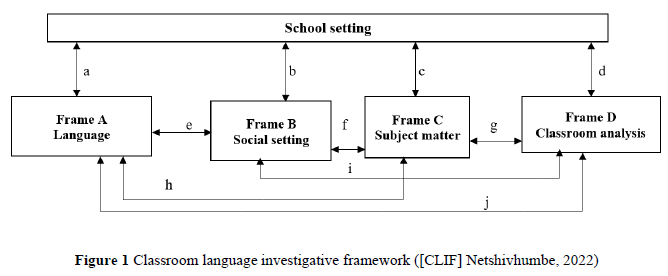
The classroom language investigative framework (CLIF) was used as the theoretical framework for this study. The CLIF mainly focuses on language used within the school background and its influence on teaching and learning. Vygotsky (1978) postulates that theoretical knowledge first appears between people on an inter-psychological plane and thereafter inside the learner on an intra-psychological plane. Therefore, the classroom practice investigative framework (Figure 1) has been used to assist with the information of knowing and understanding language used in physical science classrooms.
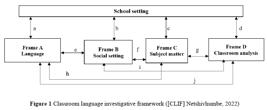
As indicated in Figure 1, the language frame is the most vital zone for understanding the teaching and learning process. In this study, Frame A involves language used by teachers in their classroom practice. Frame B (social setting) is influenced by Frame A and it includes interaction and motivation. The language that the teacher and learners use will contribute to the understanding of the subject matter.
The subject matter (Frame C) emphasises the teachers' and learners' approach to learning, experience and prior knowledge on the subject. Therefore, it is vital for teachers to re-examine the ways in which they work with every learner in the science classroom. Therefore, Frame A and Frame B result in and shape the subject matter (Frame C). Classroom language analysis is influenced by what happens in the other three frames. Therefore, if all the frames are done well, learners will be motivated and actively participate in learning the ideas of science.
Research and Methodology
Ethical Statement
We received ethical approval from the ethics review committee of the Unisa College of Education (2021/06/09/55131433/14/AM) for this study. Written informed consent was obtained from all participants prior to the start of the study.
Research Design
An interpretative qualitative research design was employed in this study. We employed the interpretative qualitative approach to seek and develop a full understanding of the influence of language from teachers and senior citizens. A qualitative approach was imperative as it enabled us to evaluate challenges, opportunities, and perceptions of participants in the developed TSR for Grade 10 PS.
Participants
Three PS teachers and five senior citizens/parents from the Vhembe West district, Limpopo province, were selected to participate in the study. Hence, the few participants in the study can be regarded as a limitation because of limited perspectives and diverse experiences. Nevertheless, through explanations offered in the data, the outcomes may be applicable to other districts across all the grades where African indigenous languages are not the medium of instruction. The participants were selected on the basis that they met the criteria, namely, were located in the Vhembe West district, their approachability and the use of Tshivenda as their home language.
Purposeful sampling was used to select PS teachers from the three selected schools from the Vhuronga 2 circuit. Written permission to conduct the research and access secondary schools in rural areas was obtained from the Limpopo Department of Education and the circuit manager of the Vhuronga 2 circuit. The participating school principals, teachers, and senior citizens also provided consent. The names of participants used in this article are pseudonyms to protect the participants' true identities.
Data Collection Tools
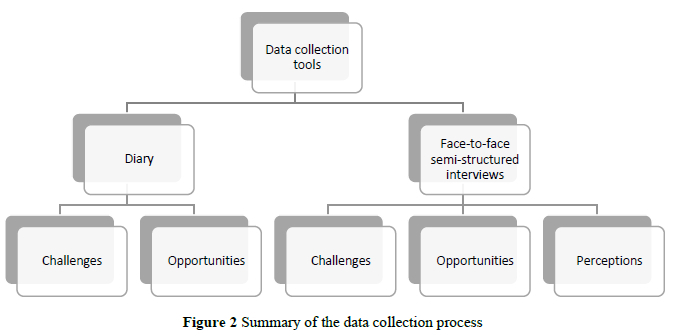
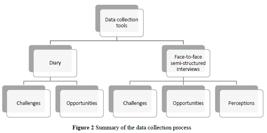
Interviews and diary entries (Figure 2) were used as data collection tools. The diary was used to record information and keep record of information acquired during the development of the TSR and data collected on the participants' perceptions on the TSR during the interviews. Three teachers and senior citizens were interviewed. The audio-recorded, face-to-face semi-structured interviews were transcribed as Microsoft (MS) Word documents, which assisted us in the analysis of the data.
Data Analysis
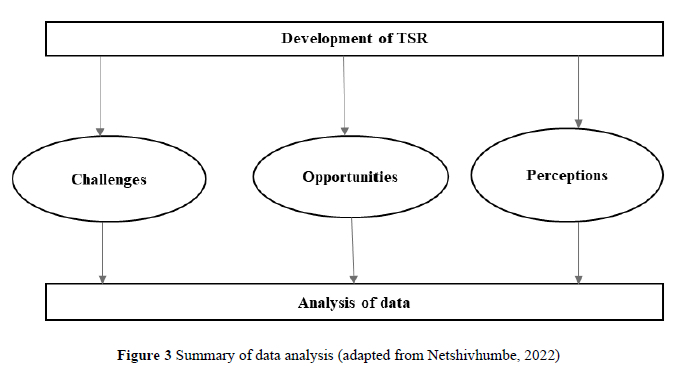
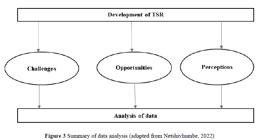
The data obtained from the participants were analysed and interpreted separately. We employed CLIF as the conceptual framework focusing on the first frame of CLIF i.e., language. This framework was important for the study as the focus was on exploring perceptions, challenges and opportunities in the development of the TSR. During the analysis, the theme identified was development of the TSR and this theme was used to analyse data collected for the study. The theme was based on the participants' responses to the set questions. The theme includes three categories i.e., challenges, opportunities and perceptions (see Figure 3).
Audio-taped interviews were transcribed verbatim to a MS Word document. After transcribing data from the recording devices, we replayed the audio recordings to check whether the transcriptions corresponded and to check whether the events answered the research questions. Hence, the transcribed data were presented to relevant participants before being considered as the final product. We focused on the three categories in the interpretation of the data. The texts in which a particular theme was displayed were highlighted in a specific colour and an MS Word document with Track Changes was used to codify the categories and characteristics of the theme. We read through the coded data to confirm the transcripts. The coded data were presented as narratives.
Results
The study results were obtained from the interviews and dairy used throughout the research process. The data presented in this section focus on the participants' challenges, opportunities and perceptions on the developed TSR. As indicated earlier, this study was guided by the following research questions:
• What are the challenges in the development of a TSR?
• What are the opportunities in the development of a TSR?
• What are the perceptions of teachers and senior citizens on the development of a TSR?
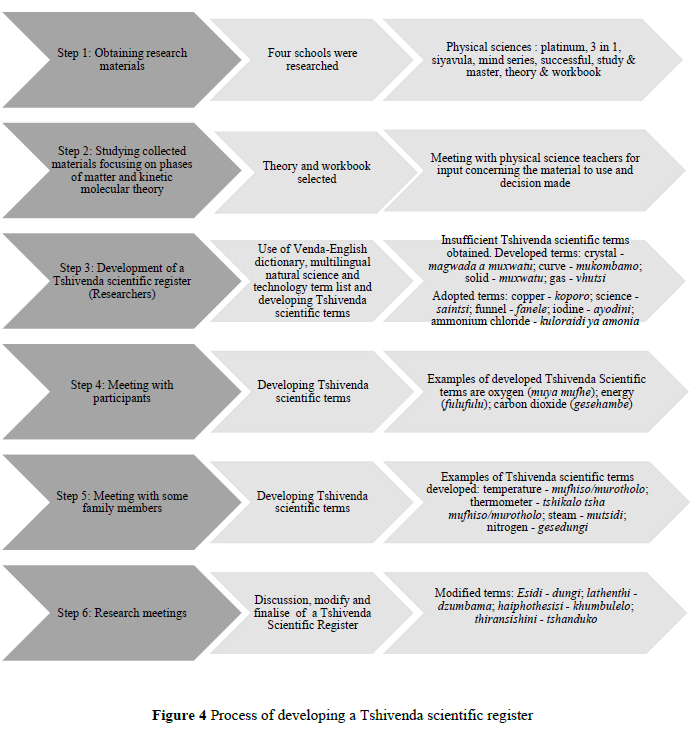
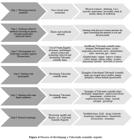
The development of a TSR had various challenges and opportunities as shown in Figure 4. The study revealed that researchers experienced challenges such as a lack of Tshivenda PS textbooks, limitations of Tshivenda scientific terms, and science concepts for which equivalents did not exist in Tshivenda. However, some opportunities such as obtaining PS textbooks from different schools, the availability of an English-Venda dictionary, multilingual natural sciences and technology term lists written in English, Afrikaans, Tshivenda and Xitsonga, existed. Additionally, we interacted with teachers, senior citizens, family and friends to assist with the development of some of the scientific terms in Tshivenda. However, we regarded some of the concepts as inappropriate such as acid - esidi (dungi), transition - lathenthi (dzumbamba) and hypothesis - haiphothesisi (khumbulelo). These concepts were modified as shown in Step 6 in Figure 4.
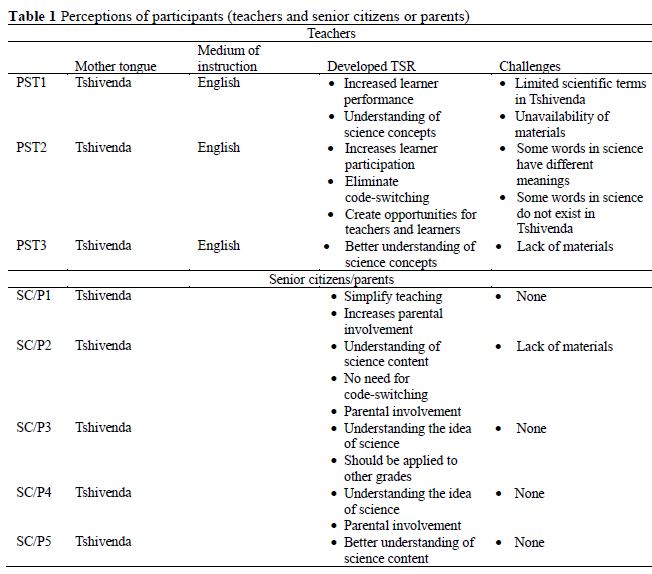
To ensure their anonymity, we used codes (Table 1) to name the study participants, for example: physical sciences teacher one = PST1, physical science teacher two = PST2, senior citizen/parent one = SC/P1, senior citizen two = SC/P2, et cetera. The perceptions of the teachers, senior citizens or parents on the developed TSR are also presented in Table 1.
Table 1 indicates that three Tshivenda speaking teachers and five SCs/parents, participated in the study. The language used as medium of instruction in the schools was English. Netshivhumbe and Mudau (2021) report that English as medium of instruction influences the teaching and learning of science. We held an individual meeting with eight participants (i.e., three teachers and five senior citizens) regarding their perceptions on a developed TSR for the teaching and learning of PS in Grade 10. This is shown by the teachers' and SCs'/parents' responses in Table 1.
From the participants' responses it is clear that they supported the developed TSR. Their perceptions were that learners could learn the ideas of science easier through an indigenous African language (i.e., Tshivenda). Their perceptions also reveal that a TSR would benefit learners as they would learn at their best and improve their performance. Additionally, a TSR will eliminate code-switching.
Discussion
Learners in South African public schools are taught in their mother tongue as medium of instruction up to Grade 3. From Grade 4 onwards, English is used as medium of instruction, but indigenous languages remain part of the school curriculum. In the Vhuronga 2 circuit of the Vhembe West district, almost 98% of the population is proficient in Tshivenda, which is the language of instruction in the Foundation Phase. Some schools in the Vhembe West district had shifted from Tshivenda to English as the medium of instruction from Grade 4 while Tshivenda remained part of the school curriculum.
Five indigenous languages, of which Tshivenda is the dominant language, are used in the Vhembe West district, but due to the Language in Education Policy of the Department of Education, English has a higher status compared to indigenous languages. This has a major impact on learners who are exposed to English at school but use their mother tongue at home. In this study we examined the challenges, opportunities and perceptions of participants regarding the developed TSR for Grade 10 PS in the Vhembe West district. Even though the TSR was developed specifically for Grade 10 PS, some of the information can be used in natural sciences and physical sciences in other grades. The study reveals that the development of a TSR in the Vhembe West district was not easy because there were scientific terms which were not available in Tshivenda and such terms were developed and others were adopted from other languages.
A study conducted by Madiba (1999) revealed that science contains many concepts for which no equivalents exist in Tshivenda. This study findings show a lack of Tshivenda scientific terms. The terms for which it was difficult to find Tshivenda equivalents in the development of the TSR were, among others, microscope, ice, volume, diffusion, thermometer, carbon dioxide, vapour, temperature, copper, nitrogen, sublimation, energy, latent, transition, evaporation, condensation, petrol, beaker, vertical axis, horizontal axis, energy, oxygen. Having limited scientific terms in Tshivenda was one of the major challenges identified in this study. However, to close this gap we reached out to friends, family, teachers and SCs to assist with the scientific terms which were difficult to develop in Tshivenda.
Several novels, poems, folklores, dramas, and short stories in Tshivenda have been published for use in schools at primary and secondary level (Luvhengo, 2012). In this study we used multilingual natural sciences and technology term list and a Venda-English dictionary for terms such as ammonium chloride - kuloraidi ya ammonia, atom - athomu, boil - vhilisa, solid - tshiomate and liquid - tshiludi. Furthermore, we had the opportunity to interact with teachers, family members and SCs who were supportive and assisted with other scientific terms throughout the research process.
According to Ezeokoli and Ugwu (2019), developing scientific language registers in indigenous languages can mitigate poor academic performance and promote cognitive development, critical thinking, and overall learning outcomes. In this study, all participating PSTs indicated that the use of a TSR would enhance teaching and learning and learners' level of participation would improve. Classroom interaction (i.e., interaction between teacher and learners, learners' interaction with physical science content and interaction between learners) would improve as they would be using their mother tongue.
According to Nxasana (2020), the use of an indigenous language as a medium of instruction can encourage parental involvement in their children' s education, establishing a positive connection between the school and the home or community environment, thereby enhancing learners' overall developmental outcomes. In the study, the participating SCs indicated that the use of a TSR would allow them to support their children's education because there would be no language barriers. SCs also perceived that this approach would be a benefit if applied across all subject instead of focusing only on PS. The use of a TSR can improve learners' critical thinking skills. Therefore, the findings of this study prove a positive correlation between the use of a TSR and classroom practice.
Conclusion and Recommendation
In this study we explored some of the challenges, opportunities and perceptions of participants in the development of a TSR for Grade 10 physical science. We answered the following research
questions:
• What are the challenges in the development of a TSR?
• What are the opportunities in the development of a TSR?
• What are the perceptions of teachers and SCs on the development of a TSR?
What are the Challenges in the Development of a TSR?
The development of TSR for teaching and learning in Grade 10 physical science was not easy as Tshivenda is an indigenous African language which is currently not used as medium of instruction from Grade 4. One of the challenges that we experienced in the development of a TSR was limited Tshivenda scientific terms readily available in the literature.
What are the Opportunities in the Development of a TSR?
We had the opportunity to interact with the SCs and some stakeholders within the education system (i.e., PSTs) who assisted in the development of some Tshivenda scientific terms. Some of the scientific terms presented in the TSR were translated and borrowed from English and Afrikaans. We also had the opportunity to obtain several Grade 10 PS textbooks which were helpful in the study.
What are the Perceptions of Teachers and Senior Citizens on the Development of a TSR?
From the teachers' perceptive, a TSR would be useful since it eliminates code-switching, will help improve classroom interaction and participation, and also increase learners' performance.
From the SCs'/parents' perceptive, a TSR would be useful as it would increase parental involvement, eliminate code-switching and allow learners to master the ideas of science in their mother tongue.
The following recommendations are made:
• We recommended that scientific terms for Tshivenda should be developed by a team including SCs, PSTs, physical science learners, physical science curriculum advisors and the Pan South African Language Board (PanSALB).
• We also recommend the expansion of Tshivenda scientific terminology and that teaching materials are prioritised.
• PS teachers must be developed, trained and furnished with essential language skills for them to develop a Tshivenda scientific language register on other science topics.
• Effort should be made to develop Tshivenda as indigenous language in such a way that it is not only recognised as official language but also included as LoLT.
• The research shows that a TSR for Grade 10 physical science can benefit parents, teachers and learners. It is, therefore, recommended that similar studies should be done across all school subjects in other grades.
Authors' Contributions
NPN and AVM co-wrote the article and attended to the revisions. Both authors reviewed the final manuscript.
Notesi. This article is based on the doctoral thesis of Ndivhuwo Prudence Netshivhumbe.
ii. Published under a Creative Commons Attribution Licence.
Acknowledgements
We would like to acknowledge the teachers and SCs from the Vhembe West district who participated in the study. Additionally, we also thank our family members and friends who assisted in the study.
References
-
Choi TH 2023. English fever: Educational policies in globalized Korea, 1981-2018. History of Education, 52(4):670-686. https://doi.org/10.1080/0046760X.2020.1858192
» https://doi.org/10.1080/0046760X.2020.1858192 -
Department of Basic Education, Republic of South Africa 2010. The status of the language of learning and teaching (LOLT) in South African public schools: A quantitative overview. Pretoria: Author. Available at https://www.education.gov.za/Portals/0/Documents/Reports/The%20Status%20of%20Learning%20and%20Teaching%20in%20South%20African%20Public%20Schools.pdf. Accessed 31 May 2025.
» https://www.education.gov.za/Portals/0/Documents/Reports/The%20Status%20of%20Learning%20and%20Teaching%20in%20South%20African%20Public%20Schools.pdf -
Ezeokoli FO & Ugwu EO 2019. Parents', teachers' and students' beliefs about the use and study of mother-tongue in the secondary schools in Akinyele Local Government Area, Oyo State, Nigeria. International Journal of Education & Literacy Studies, 7(2):82-93. https://doi.org/10.7575/aiac.ijels.v.7n.2p.82
» https://doi.org/10.7575/aiac.ijels.v.7n.2p.82 -
Hillman S, Graham KM & Eslami ZR 2019. Teachers' translanguaging ideologies and practices at an international branch campus in Qatar. English Teaching & Learning, 43(1):41-63. https://doi.org/10.1007/s42321-018-0015-3
» https://doi.org/10.1007/s42321-018-0015-3 -
Karasenga JD & Nzanana JB 2022. Quality education and the use of English language as a medium of instruction in Rwandan schools: An interpretivist study. International Journal of Educational Review, 4(1):1-12. https://doi.org/10.33369/ijer.v4i1.21426
» https://doi.org/10.33369/ijer.v4i1.21426 -
Katonga H 2017. Teacher education and indigenous epistemological discourse in integrated Science: The case of a college of education in Zambia. MIE thesis. Oslo, Norway: Oslo and Akershus University College of Applied Sciences. Available at https://oda.oslomet.no/oda-xmlui/bitstream/handle/10642/5517/Katonga.pdf?sequence=2&isAllowed=y. Accessed 31 May 2025.
» https://oda.oslomet.no/oda-xmlui/bitstream/handle/10642/5517/Katonga.pdf?sequence=2&isAllowed=y -
Leonet O, Cenoz J & Gorter D 2020. Developing morphological awareness across languages: Translanguaging pedagogies in third language acquisition. Language Awareness, 29(1):41-59. https://doi.org/10.1080/09658416.2019.1688338
» https://doi.org/10.1080/09658416.2019.1688338 -
Liddicoat AJ & Kirkpatrick A 2020. Dimensions of language education policy in Asia. Journal of Asian Pacific Communication, 30(1-2):7-33. https://doi.org/10.1075/japc.00043.kir
» https://doi.org/10.1075/japc.00043.kir -
Luvhengo N 2012. Linguistic minorities in the South African multilingual context: The case of Tshivenda. MA thesis. Makhanda, South Africa: Rhodes University. Available at https://kipdf.com/linguistic-minorities-in-the-south-african-multilingual-context-the-case-of-tshi_5ac7c1e31723dd62eb729134.html. Accessed 31 May 2025.
» https://kipdf.com/linguistic-minorities-in-the-south-african-multilingual-context-the-case-of-tshi_5ac7c1e31723dd62eb729134.html -
Madavha MK 2024. Developing grade 10 physical sciences scientific language register for teaching electricity. MEd dissertation. Pretoria, South Africa: University of South Africa. Available at https://ir.unisa.ac.za/handle/10500/31307. Accessed 31 May 2025.
» https://ir.unisa.ac.za/handle/10500/31307 -
Madiba M 1999. Multilingualism and nation-building in the "new" South Africa: Problems and issues. Language Matters, 30(1):59-81. https://doi.org/10.1080/10228199908566145
» https://doi.org/10.1080/10228199908566145 -
Madiba M 2001. Towards a model for terminology modernisation in the African languages of South Africa. Language Matters, 32(1):53-77. https://doi.org/10.1080/10228190108566172
» https://doi.org/10.1080/10228190108566172 -
Madima SE & Makananise FO 2020. The accessibility to English as a language of teaching and learning by learners of different gender in public primary schools of the Vhembe District, South Africa. Gender & Behaviour, 18(2):15274-15281. Available at https://www.researchgate.net/profile/Fulufhelo-Makananise/publication/343690454_THE_ACCESSIBILITY_TO_ENGLISH_AS_A_LANGUAGE_OF_TEACHING_AND_LEARNlNG_BY_LEARNERS_OF_DIFFERENT_GENDER_IN_PUBLIC_PRIMARY_SCHOOLS_OF_THE_VHEMBE_DISTRICT_SOUTH_AFRICA/links/5fae3c92a6fdcc9389b1fd83/THE-ACCESSIBILITY-TO-ENGLISH-AS-A-LANGUAGE-OF-TEACHING-AND-LEARNING-BY-LEARNERS-OF-DIFFERENT-GENDER-IN-PUBLIC-PRIMARY-SCHOOLS-OF-THE-VHEMBE-DISTRICT-SOUTH-AFRICA.pdf7^cf_chl_tk=0WX3yXWZwDGBws5AARuhwfCKaiAydltrw67U7lX5Zlw-1748869629-1.0.1.1-AQpuZHDeXGWbSImsxDPfiGxfaG5WZb3SEs7jEmYr6oY. Accessed 31 May 2025.
» https://www.researchgate.net/profile/Fulufhelo-Makananise/publication/343690454_THE_ACCESSIBILITY_TO_ENGLISH_AS_A_LANGUAGE_OF_TEACHING_AND_LEARNlNG_BY_LEARNERS_OF_DIFFERENT_GENDER_IN_PUBLIC_PRIMARY_SCHOOLS_OF_THE_VHEMBE_DISTRICT_SOUTH_AFRICA/links/5fae3c92a6fdcc9389b1fd83/THE-ACCESSIBILITY-TO-ENGLISH-AS-A-LANGUAGE-OF-TEACHING-AND-LEARNING-BY-LEARNERS-OF-DIFFERENT-GENDER-IN-PUBLIC-PRIMARY-SCHOOLS-OF-THE-VHEMBE-DISTRICT-SOUTH-AFRICA.pdf7^cf_chl_tk=0WX3yXWZwDGBws5AARuhwfCKaiAydltrw67U7lX5Zlw-1748869629-1.0.1.1-AQpuZHDeXGWbSImsxDPfiGxfaG5WZb3SEs7jEmYr6oY -
Mogashoa T 2017. The impact of English as language of learning and teaching in primary schools: A case study of the Gauteng province. International Journal of Educational Sciences, 17(1-3):173-179. https://doi.org/10.1080/09751122.2017.1305742
» https://doi.org/10.1080/09751122.2017.1305742 -
Moody S, Chowdhury M & Eslami Z 2019. Graduate students' perceptions of translanguaging. English Teaching & Learning, 43:85-103. https://doi.org/10.1007/s42321-018-0019-z
» https://doi.org/10.1007/s42321-018-0019-z -
Mudau AV & Netshivhumbe NP 2022. Insights into the interaction and discourse in the senior phase natural sciences classroom. International Journal of Research in Business and Social Science, 11(6):458-467. https://doi.org/10.20525/ijrbs.vlli6.1967
» https://doi.org/10.20525/ijrbs.vlli6.1967 -
Muhayimana T, Kwizera L & Nyirahabimana MR 2022. Using Bloom's taxonomy to evaluate the cognitive levels of Primary Leaving English Exam questions in Rwandan schools. Curriculum Perspectives, 42(1):51-63. https://doi.org/10.1007/s41297-021-00156-2
» https://doi.org/10.1007/s41297-021-00156-2 - Murphy VA & Evangelou M (eds.) 2016. Early Childhood Education in English for speakers of other languages. Spring Gardens, England: British Council.
- Murwamphida SC 2008. Effects of language policy in South Africa with special reference to Tshivenda: Exploring the interface between policy and practice. PhD thesis. Sovenga, South Africa: University of Limpopo.
-
Netshivhumbe NP 2018. Classroom practices of some Natural Sciences teachers of the Vhembe District, Limpopo Province. MEd dissertation. Pretoria, South Africa: University of South Africa. Available at https://www.researchgate.net/profile/Ndivhuwo-Netshivhumbe/publication/369907048_CLASSROOM_PRACTICES_OF_SOME_NATURAL_SCIENCES_TEACHERS_OF_THE/links/6432d211609c170a1304ce7a/CLASSROOM-PRACTICES-OF-SOME-NATURAL-SCIENCES-TEACHERS-OF-THE.pdf. Accessed 31 May 2025.
» https://www.researchgate.net/profile/Ndivhuwo-Netshivhumbe/publication/369907048_CLASSROOM_PRACTICES_OF_SOME_NATURAL_SCIENCES_TEACHERS_OF_THE/links/6432d211609c170a1304ce7a/CLASSROOM-PRACTICES-OF-SOME-NATURAL-SCIENCES-TEACHERS-OF-THE.pdf -
Netshivhumbe NP 2022. Developing and using the Tshivenda scientific register for Physical Science. PhD thesis. Pretoria, South Africa: University of South Africa. Available at https://uir.unisa.ac.za/server/api/core/bitstreams/5751d0cf-0432-4930-a5ec-d162bbc8ad18/content. Accessed 31 May 2025.
» https://uir.unisa.ac.za/server/api/core/bitstreams/5751d0cf-0432-4930-a5ec-d162bbc8ad18/content -
Netshivhumbe NP & Mudau AV 2021. Teaching challenges in the senior phase natural sciences classroom in South African schools: A case study of Vhembe district in the Limpopo province. Journal for the Education of Gifted Young Scientists, 9(4):299-315. https://doi.org/10.17478/jegys.988313
» https://doi.org/10.17478/jegys.988313 -
Ngema MH 2016. Factors that cause poor performance in science subjects at Ingwavuma Circuit. MEd dissertation. Pretoria, South Africa: University of South Africa. Available at https://uir.unisa.ac.za/server/api/core/bitstreams/3b54a39f-748e-4afe-a7cf-2ebe6d8a434d/content. Accessed 31 May 2025.
» https://uir.unisa.ac.za/server/api/core/bitstreams/3b54a39f-748e-4afe-a7cf-2ebe6d8a434d/content -
Ntuli TG 2022. Developing Isindebele scientific language register for natural sciences and its classroom applications in Siyabuswa 2 circuit, South Africa. PhD thesis. Pretoria, South Africa: University of South Africa. Available at https://ir.unisa.ac.za/bitstream/handle/10500/30824/Thesis_ntuli_tg.pdf7sequence=1&isAllowed=y. Accessed 30 May 2025.
» https://ir.unisa.ac.za/bitstream/handle/10500/30824/Thesis_ntuli_tg.pdf7sequence=1&isAllowed=y -
Nuangchalerm P & El Islami RAZ 2018. Comparative study between Indonesian and Thai novice science teacher students in content of science. Journal for the Education of Gifted Young Scientists, 6(2):23-29. https://doi.org/10.17478/JEGYS.2018.75
» https://doi.org/10.17478/JEGYS.2018.75 -
Nxasana S 2020. We need to stop undermining and undervaluing our indigenous language. Star, 28 February. Available at https://www.zenexfoundation.org.za/we-need-to-stop-undermining-and-undervaluing-our-indigenous-languages/news-article/. Accessed 30 May 2025.
» https://www.zenexfoundation.org.za/we-need-to-stop-undermining-and-undervaluing-our-indigenous-languages/news-article/ - Omidire F 2019. Embracing multilingualism as a reality in classrooms: An introduction. In MF Omidire (ed). Multilingualism in the classroom: Teaching and learning in a challenging context. Cape Town, South Africa: UCT Press.
-
Omidire MF 2020. Experiencing language challenges in a rural school: Implications for learners' life aspirations. Early Child Development and Care, 190(10):1619-1637. https://doi.org/10.1080/03004430.2019.1660963
» https://doi.org/10.1080/03004430.2019.1660963 -
Oyoo SO & Nkopodi N 2020. Towards a policy on teacher use of language during science teaching and learning in South Africa. Social Dynamics, 46(3):471-492. https://doi.org/10.1080/02533952.2020.1853955
» https://doi.org/10.1080/02533952.2020.1853955 -
Phalandwa OL 2024. Developing of Tshivenda scientific language register for teaching agricultural sciences. MEd dissertation. Pretoria, South Africa: University of South Africa. Available at https://ir.unisa.ac.za/handle/10500/31346. Accessed 30 May 2025.
» https://ir.unisa.ac.za/handle/10500/31346 -
Prinsloo CH, Rogers SC & Harvey JC 2018. The impact of language factors on learner achievement in Science. South African Journal of Education, 38(1):Art. # 1438, 14 pages. https://doi.org/10.15700/saje.v38n1a1438
» https://doi.org/10.15700/saje.v38n1a1438 - Republic of South Africa 1996a. South African School Act, 1996 (Act No. 84, 1996). Government Gazette, 377(17579):1-50, November 15.
- Republic of South Africa 1996b. The Constitution of the Republic of South Africa (Act 108 of 1996). Pretoria: Government Printer.
-
Rosendal T & Amini Ngabonziza JD 2023. Amid signs of change: Language policy, ideology and power in the linguistic landscape of urban Rwanda. Language Policy, 22(1):73-94. https://doi.org/10.1007/s10993-022-09624-5
» https://doi.org/10.1007/s10993-022-09624-5 -
Roy-Campbell ZM 2019. Revitalizing African languages for transformation. Contemporary Journal of African Studies, 6(1):27-45. https://doi.org/10.4314/contjas.v6i1.2
» https://doi.org/10.4314/contjas.v6i1.2 -
Sheikh F, Rich M & Galvão W 2023. Language of instruction and education policies in Kenya. Reconsidering Development, 7(1):1 -9. Available at https://pubs.lib.umn.edu/index.php/reconsidering/article/view/4569/3322. Accessed 29 May 2025.
» https://pubs.lib.umn.edu/index.php/reconsidering/article/view/4569/3322 -
Sibomana E 2015. Postcolonial language-in-education policies in Africa: The case of Kenya. Rwandan Journal of Education, 3(1):37-51. Available at https://www.ajol.info/index.php/rje/article/view/128010. Accessed 29 May 2025.
» https://www.ajol.info/index.php/rje/article/view/128010 -
Sibomana E 2022. Transitioning from a local language to English as a medium of instruction: Rwandan teachers' and classroom-based perspectives. International Journal of Bilingual Education and Bilingualism, 25(4):1259-1274. https://doi.org/10.1080/13670050.2020.1749554
» https://doi.org/10.1080/13670050.2020.1749554 - Vygotsky LS 1978. Mind in society: The development of higher psychological process. Cambridge, MA: Harvard University Press.
Revised: 18 September 2024
Accepted: 17 March 2025
Published: 31 May 2025