The moderating effect of school climate on the relationship between school belonging and delinquent behaviour in high school students
Abstract
With this study I investigated the moderating effect of school climate on the relationship between adolescents' school belonging and their delinquent behaviour. For this purpose, the relational survey method, 1 of the quantitative research methods, and the bio-ecological framework was used. The participants in the study were a total of 698 high school students, of whom 326 were female and 372 were male. The school belonging scale, delinquent behaviour scale, and school climate scale were used in the study. The IBM Statistical Package for the Social Sciences (SPSS) Amos version 25 program was used to analyse the quantitative data obtained. I applied correlation analysis and moderating analysis to determine the relationships between high school students' perceptions of school climate, their school belonging, and their delinquent behaviour. According to the research results, a significant and negative relationship exists between students' school belonging levels and delinquent behaviour. The results also show that school climate moderated the negative relationship between school belonging and delinquent behaviour. The school climate strengthens the significant negative relationship between school belonging and delinquent behaviour. Based on the findings, I suggest that educators should actively monitor and improve the psychosocial aspects of the school climate to increase students' school belonging and reduce their delinquent behaviour.
delinquent behaviour; high school students; school belonging; school climate; Türkiye
Introduction
From the middle of the 20th century school climate became a subject of research. Although no universal definition exists, it is generally accepted that school climate expresses the quality and character of social interactions shaped by norms, values, beliefs, expectations, organisational structures, and relationship patterns specific to each school (Aldridge, Fraser, Fozdar, Ala'i, Earnest & Afari, 2016). According to another definition, school climate reflects the standards, goals, values, interpersonal relations, education, teaching and leadership practices and the entire organisational structure of all individuals related to the school, such as students, teachers, school personnel and parents. It is also based on their experiences of current school life. School climate, which also determines how satisfied students are with the school, has positive or negative features. These features have various effects on all individuals in the school and the school's performance in general (Çalık & Kurt, 2010).
The positive or negative school climate also directly affects the sense of trust and risk that students feel towards the school. A positive school climate enables students to increase the importance of academic success, develop positive relationships with their friends, teachers and other people at school, comply more with school rules, pay attention to safety issues, and for families to participate more in school activities. A positive school climate is associated with improvements in students' self-esteem and self-concept, mental and physical health, academic achievement and attitudes and behaviour towards the school (Wang & Degol, 2016). It is also believed that a positive school climate is an effective risk prevention mechanism (Benbenishty, Astor, Roziner & Wrabel, 2016; Berkowitz, Glickman, Benbenishty, Ben-Artzi, Raz, Lipshtat & Astor, 2015). In this context, it is accepted that school climate constitutes a reference point for the behaviour of stakeholders in the school. At the same time, it will help students live a more positive school life by preventing them from turning to undesirable behaviour in schools.
In a negative school climate, communication between administrators and other elements of the school is poor, and students think that educators do not value and respect them. Students have low motivation towards learning, and a low level of success is expected from the students. Teacher and student morale are low and disorderly classroom environments harm school safety. From studies including variables such as student achievement, family structure and developments in attitudes and behaviour towards school, it became clear that school climate has a mediating or regulatory effect. Studies show that school climate has a strong effect on the development of the school, as well as being holistically related to the academic, emotional, and behavioural success of the students (e.g., Aldridge et al., 2016, Aldridge, McChesney & Afari, 2018; Cohen, McCabe, Michelli & Pickeral, 2009; Thapa, Cohen, Guffey & Higgins-D'Alessandro, 2013; Wang & Degol, 2016).
Literature shows that school climate affects the relations between individuals in the school, creates loyalty among students, decreases irregular behaviour, and increases academic success. It has been determined that a negative school climate is a risk factor for students, teachers, families, school administrators and other members of the school, and that an increase in violent behaviour results in students disrupting order and not obeying school rules (Aldridge et al., 2018). The studies by Ozgenel, Calıskan-Yılmaz and Baydar (2018) and Şimşek and Çöplü (2018) are examples of the limited number of studies conducted on the relationship between school climate and school attachment among high school students in Türkiye. These studies indicate that social relations at school (student-teacher, student-administrator, student-student relationships) and the factors constituting school environment (physical characteristics, support resources, perceived violence) affect students' attachment to a school.
According to the data of the Türkiye İstatistik Kurumu (2020), only 51.76% of 6,950,000 young people aged 15 to 19 (high school age), are in education in Türkiye. The rate of young people without education, and employment is 26.0%. In various studies examining the relationship between school climate and school belonging, it is stated that school environment is essential for students to connect to the school and that the school climate is a factor affecting students' engagement levels at school (Bakır Ayğar & Kaya, 2017; Bilgin & Taş, 2018; Dönmez & Taylı, 2018; Ozgenel et al., 2018). In addition, the support of friends and teachers, which is one of the elements of school climate, has a significant effect on the attachment of students to the school (Karababa, Oral & Dilmac, 2018: 269).
Given that schools are potentially powerful areas influencing adolescent behaviour, it is vital to better understand the psychosocial aspects of school climate that may be used for this purpose. Although studies on school climate have existed for many years, studies conducted in Türkiye on the effects of school climate have recently increased. The available literature shows significant relationships between school climate, school belonging and deviant behaviour. Although relationships between different variables related to school climate have been investigated, no research on the moderating effect of school climate on high school students' school belonging and delinquent behaviour has been found. This research reveals the importance of school climate in ensuring students' belonging to the school and preventing delinquent behaviour, which is also important for officials in the education system, school administrators, teachers, school counsellors, and parents.
In this research, answers were sought to the following questions:
1) Is there a significant relationship between high school students' delinquent behaviour and school belonging?
2) Does school climate moderate the interaction between students' school belonging and delinquent behaviour?
Bio-ecological Framework
The ecological perspective focuses on the interrelationship between the person and the person' s environment to understand the individuals' behaviour (Bronfenbrenner, 1979). Within the ecological approach, the school, located within the individual' s microsystem, is a vital structure that directly impacts the student' s development (Bronfenbrenner, 1979). According to the bioecological theory, the environment in which the school is located and all other external factors, including the structure of the school building, its equipment, the school' s curriculum, disciplinary practices, and the relationships between students and teachers, can affect student development (Way, Reddy & Rhodes, 2007). For all these reasons, the bioecological theory is one of the theoretical foundations in research on school climate (Wang & Degol, 2016).
Research on school climate is done in an effort to explain that each child is shaped by the multidimensional nature of the environmental contexts in which he or she lives. The fundamental perspective of the bio-ecological theory is that individual behaviour is shaped by the school environment (Koth, Bradshaw & Leaf, 2008). Studies also support the ecological systems proposition that a potential positive relationship exists between students' perspectives on school-based microsystem members and their school belonging, academic achievement levels, and behaviour (e.g., Daily, Mann, Kristjansson, Smith & Zullig, 2019; Fatou & Kubiszewski, 2018). Drawing on the ecological systems theory, this study suggests that school climate can provide an understanding of the impact of school climate on students' school belonging and irregular behaviour.
Literature Review
Sense of belonging to the school
The sense of belonging to a school is a concept that has existed in education and psychology for decades. In general, belonging refers to a relationship or connection with others. Although the definitions of school belonging differ, most researchers say that the sense of belonging to a school is that the students feel and see themselves as being accepted, respected, included in the processes and activities in the school, and supported by other individuals (such as students, teachers, administrators) in the school environment (Goodenow, 1993). A sense of belonging to a school states that students feel like essential and respected members of a school. It is one of the critical affective characteristics that students are expected to have towards their school (Sarı & Özgök, 2014). A sense of belonging to a school is essential in every age group, especially adolescents, when emotional fluctuations are experienced. Psychological acceptance and social support from teachers and friends is even more critical. When individuals feel that they belong to a community, they feel important and can trust other community members. School belonging is of critical importance for high school students. A report by the Organisation for Economic Cooperation and Development (OECD, 2019:135) reveals that one out of every three students in the world does not feel like they belong to their school, and these numbers are increasing. According to the Programme for International Student Assessment ([PISA] OECD, 2016) OECD average, 77% of socio-economically advantaged students state that they feel a sense of belonging to the school. This rate is 69% for disadvantaged students, with a difference of 8%. In Türkiye, 75% of disadvantaged students in PISA 2003 and 61% in PISA 2015 feel a sense of belonging to the school, while these rates are 76% in PISA 2003 and 63% in PISA 2015 for advantaged students. Accordingly, there has been a similar decrease in the sense of school belonging of both advantaged and disadvantaged students in Türkiye, and the difference between these two groups is preserved. Locally and internationally, this trend is a cause for concern.
Many studies have shown that school belonging is essential to students' academic, emotional, social, and behavioural experiences (Arslan & Duru, 2017; Arslan & Tanhan, 2019). A limited number of studies on high school students' belonging to school in Türkiye exist (e.g., Altınsoy & Karakaya Özyer, 2018; Arslan & Tanhan, 2019; Atabey, 2020; Demirtaş & Pehlivan, 2020; Doğan, A 2015). It has been found that when students perceive teachers and school administrators as being supportive, their satisfaction with academic programmes, and sense of belonging to the school are positively, and significantly related to their perceptions of school climate.
Delinquent behaviour
In educational institutions, students are asked to behave according to certain class and school rules. Generally, any behaviour that goes against these rules hinders educational efforts and violates school, and classroom regulations, which is considered undesirable. Factors determining the undesirable nature of behaviour depend on many variables, such as conditions and location. Delinquent behaviour exhibited in school environments has been classified as criminal/non-criminal, internalised/non-internalised, and primary and secondary criminal behaviour. These have been examined with different variables on samples from various levels of the education system (Apaydınlı, 2010; Doğan, A 2015). Delinquent behaviour may be caused by many reasons, such as family, friends, social environment, classroom or school environment, teachers, and students. Delinquent behaviour threatens adolescents' health, well-being, social relationships, and academic success and prevent them from becoming responsible adults (e.g., Aldridge et al., 2018; Weerman, Harland & Van der Laan, 2007; Welsh, 2000).
Research on the delinquent behaviour of high school students in Türkiye shows that this behaviour is related to the school (Çelik & Ereskici, 2008; Gökyer & Doğan, 2016). Teachers think that delinquent problems are related to students (Öz, 2012; Sarpkaya, 2005), and students think that delinquent problems originate from the school (Demirtaş & Pehlivan, 2020).
It has been determined that the most common undesirable behaviour in schools are disrupting the peace in the classroom, fighting, smoking, damaging school property, and threatening students (Aydın & Karaca-Çiftçi, 2016; Demirtaş & Pehlivan, 2020). Highlighting the school-related reasons for irregular behaviour brings the importance of school climate to the fore.
The relationship between school climate, school belonging, and delinquent behaviour
Students' commitment to school and avoidance of irregular behaviour are associated with school climate and school satisfaction. The quality of interpersonal relations, an essential dimension of school climate, effectively determines students' level of belonging to the school. In a school with a positive climate, close relationships are based on love and respect between students and other students and between students and teachers. Students do not want to attend a school with a negative, unpleasant, or undesirable climate or where they feel excluded.
A positive school climate increases students' sense of belonging to the school, while reducing illegal behaviour such as truancy, bullying, fighting with their friends, and opposing their teachers. Studies show that adolescents' perceptions of school climate may be related to their participation in irregular behaviour (e.g., Hopson & Lee, 2011; Klein, Cornell & Konold, 2012; Reid, Peterson, Hughey & Garcia-Reid, 2006; Welsh, 2000). In their study, Perdue, Manzeske and Estell (2009) determined that the quality of friendly relations, friend support, and aggressive behaviour towards friends are related to belonging to the school. Research results show that, in addition to preventing violence at school, factors like a positive school climate is essential for academic success, individuals' social and emotional health, security, student attendance, and high academic success (e.g., Daily et al., 2019; Klein et al., 2012; Loukas, Suzuki & Horton, 2006; Thapa et al., 2013; Way et al., 2007; Winnaar, Arends & Beku, 2018).
Research has shown that some aspects of psychosocial school climate are negatively associated with adolescents' delinquency and risky behaviour (e.g., Aldridge et al., 2018; Altınsoy & Karakaya Özyer, 2018; Apaydınlı, 2010; Aydın & Karaca-Çiftçi, 2016; Benbenishty et al., 2016; Cornell & Huang, 2016; Klein et al., 2012). Therefore, by making the school climate positive, schools may strengthen students' school belonging and contribute to a reduction and prevention of delinquent behaviour.
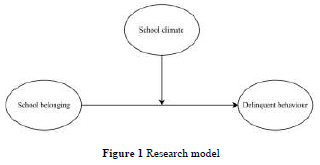
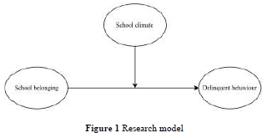
Based on this assumption, I investigated whether school climate has a moderating effect on the relationship between school belonging and delinquent behaviour. Firstly, the theoretical foundations of the study were examined. Then, the data obtained were analysed using quantitative research methods, and the results were interpreted. Within the framework of this general purpose, the research model (Figure 1) and the research hypotheses are presented below.
H0. There is no significant relationship between school belonging and delinquent behaviour.
H1. There is a negative relationship between school belonging and delinquent behaviour.
H2. School climate has a moderating effect on school belonging and delinquent behaviour.
Methods
Participants
The data were collected between October 2020 and January 2021 from students attending three different high schools in Ümraniye, İstanbul, Türkiye. According to the 2021 data of the Republic of Türkiye (T.C. Ümraniye Kaymakamlığı, 2021), there were a total of 19 high schools with 23,398 students in Ümraniye, İstanbul. Approval to conduct the study was granted by the research ethics committee of the İstanbul Sabahattin Zaim University (Date 30.09.2020/No: 2020/09).
During the data collection process, students were informed about the general purpose of the study during regular school hours and in their classrooms, and their consent was requested. Students were then given 20 minutes to complete a survey with demographic information (age, gender, and grade level) as well as the school belonging, delinquent behaviour, and school climate scales. Those who agreed to participate in the study voluntarily completed the questionnaires anonymously under the supervision of teachers or staff.
The questionnaire was distributed four times to reduce pervasive method bias (Podsakoff, MacKenzie & Podsakoff, 2012) to the 697 high school student participants, (53.3% boys and 46.7% girls). Two hundred and forty (34.4%) participants attended technical high school, 286 (41.0%) Anatolian high school and 172 (24.6%) Imam Hatip high schools. The participants were between 15 and 18 years old, with a mean age of 15.58 (SD = 0.85). It was determined that 630 (90.3%) of the participants lived with their own families and that 50.4% had at least two siblings. Most of the participants' parents had low levels of education and the financial situation of most parents was moderate.
Measure
The questionnaire consists of three different scales, namely, the delinquent behaviour scale, the school climate scale, and school belonging scale.
The delinquent behaviour scale (DBS) was developed by Apaydınlı (2010) to determine the delinquent behaviour of high school students. The scale consists of two dimensions: primary delinquent behaviour and secondary delinquent behaviours. Primary delinquent behaviour requires warning and reprimand; secondary delinquent behaviour constitutes the type of behaviour that requires punishment ranging from short-term suspension from school to more serious punishment. The scale consists of 30 five-point Likert scale items ranging from 1 (totally agree) to 5 (totally disagree). According to the confirmatory factor analysis (CFA) performed for the scale, the fit indices were determined as Chisquare (x2/d# = 3.816, comparative fit index (CFI) = 0.877, adjusted goodness-of-fit (AGFI) = 0.826, goodness-of-fit index (GFI) = 0.912, and the root mean square error of approximation (RMSEA) = 0.085. These fit index results show that the scale has a good fit. High scores on the scale indicate that students tend to display delinquent behaviour. The reliability of the DBS in this investigation was α = .853.
The school climate scale (SCS) was developed by Çalık and Kurt (2010) to define and evaluate the school climate based on students' opinions. The scale consists of three sub-dimensions and 22 items: supportive teacher behaviour, achievement-oriented and safe learning environment, and positive peer interaction. The scale is a 5-point Likert scale ranging from 1 (never) to 5 (always). According to the CFA performed for the scale, the fit indices were determined as x2/df = 4.112, CFI = 0.867, AGFI = 0.820, GFI = 0.906, and RMSEA = 0.092. These fit index results show that the scale has a good fit. The reliability of the SCS in this investigation was α = .832.
The school belonging scale (SBS) was developed by Arslan and Duru (2017) to evaluate students' school belonging. The scale comprises two sub-dimensions, namely, social acceptance and social exclusion with 10 items. All items are scored using a 4-point Likert structure ranging from 1 (almost never) to 4 (almost always). The scale was developed for secondary school students. A CFA was conducted to apply to high school students. According to the CFA performed for the scale, the fit indices were determined as x2/df = 2.814, CFI = 0.857, AGFI = 0.813, GFI = 0.902, and RMSEA = 0.085. These fit index results show that the scale has a good fit. The reliability of the SBS in this investigation was α = .866.
Results
Preliminary Analyses
In the first step, standard method variance was evaluated using Harman' s single-factor test. According to the result, the first factor explained 36.22% of the total variance, meaning that there was no standard method bias.
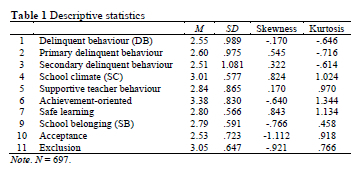
Descriptive statistics about variables are given in Table 1.
DBS, SCS, and SBS mean scores were 2.55 ± .989, 3.01 ± .577, and 2.79 ± .591, respectively, which places DBS, SCS, and SBS at a moderate level. It is clear that the variables are generally distributed according to the skewness and kurtosis values.
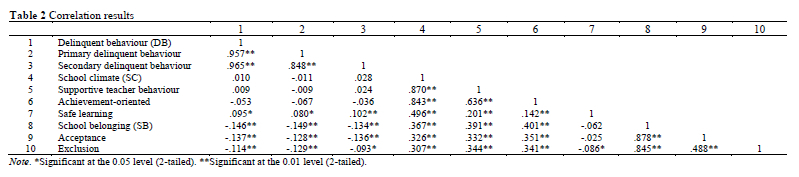
The correlation analysis shows that DBS and its sub-dimensions were negatively and statistically correlated with SB and its dimensions (r = -.146, p < 0.01; r = -.137, p < 0.01; r = -.114, p < 0.01). There was no significant relationship between DBS and SCS and its dimensions (r = .010, p > 0.05; r = .009, p > 0.05; r = -.053, p > 0.01), except for the safe learning dimension. There was a positive and significant relationship between DBS and the safe learning dimension of SC (r = .080, p < 0.05).
The correlation analyses also indicate that SC and its sub-dimensions were positively and statistically correlated with SB and its acceptance dimension (r = .401, p < 0.01; r = .391, p < 0.01), and negatively correlated with its exclusion dimension (r = -.086, p < 0.05).
Hypotheses Testing
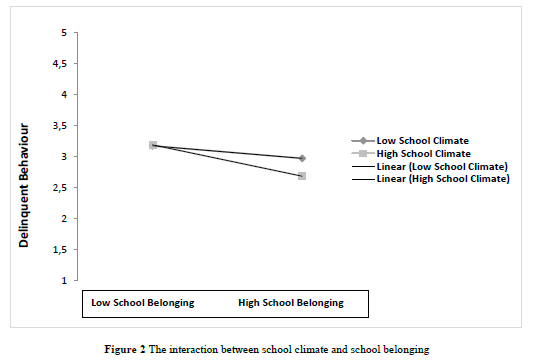
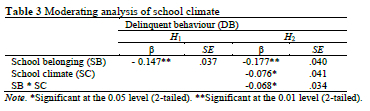
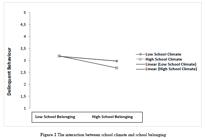
The hypotheses were tested using covariance-based structural equation modelling (CB-SEM) and IBM SPSS Amos version 25. In the first step, the normality distribution of the data was confirmed using kurtosis and skewness tests. In the second step, the factor structure was assessed by CFA. In this process, chi-square test (χ2), goodness-of-fit index (GFI), adjusted goodness-of-fit index (AGFI), comparative fit index (CFI), and root-mean-square error of approximation (RMSEA) were taken as fit indices. According to the threshold values of the fit indices, GFI and CFI values larger than .90, AGFI values larger than .85, and RMSEA values less than 0.10 were taken (Meydan & Şeşen, 2015; Sümer, 2000). The results of CFA (X2/df = .3.055, GFI = .92, AGFI = 89, CFI = .94, RMSEA = .072) revealed that the model had an acceptable goodness of fit. H1 proposes that SB is associated with DB. Table 2 reports that SB is negatively associated with DB (β = -0.147, t = -3.915, SE = 0.03, p < .01), supporting Hypothesis 1. H2 proposes that SC moderates the impact of SB on DB. Table 3 shows that the interaction term was statistically significant (β = -0.068, t = -2.34, SE = 0.03, p < .05). According to the analysis result, SC strengthens the negative relationship between SB and DB (Figure 2), hence H2 is also supported.
Discussion
With this research I aimed to investigate the regulatory effect of SC on the relationship between SB and DBs in high school students. Previous studies have addressed the correlation of SC with bullying and irregular behaviour (Aldridge et al., 2018), academic achievement (Berkowitz et al., 2015) and risky student behaviour (Cornell & Huang, 2016). In studies conducted in Türkiye on this subject, the relationship between school climate, SB and school burnout has been revealed (Kalkan & Dağlı, 2021), and SC and social media addiction have been investigated as predictors of school engagement in adolescents (Bilgin & Taş, 2018). According to the perceptions of general high school students, the relationship between school vandalism and SC (Doğan, S 2011) can be given as an example. This research differs from other research in that I investigated the moderating role of SC in the relationship between a sense of belonging to a school and DB in adolescents.
The research findings show a negative relationship between belonging to school and DB. Students who feel a greater sense of belonging to their school show less DB, which was also found in other research (Aldridge et al., 2018; Apaydınlı, 2010; Arslan & Tanhan, 2019; Doğan, A 2015; Newman, Lohman & Newman, 2007; Şimşek & Çöplü, 2018). It has been determined that a strong relationship exists between students' sense of belonging and the incidents of bullying in schools (Winnaar et al., 2018).
Studies indicate that individuals with a high level of belonging experience fewer adjustment problems and low emotional and behavioural problems with a low tendency to violence (Altınsoy & Karakaya Özyer, 2018). Students' emotional attachment to their peers, teachers, or schools prevents them from exhibiting DB. In addition, a negative relationship has been reported between SB and school problems. Studies in which the relationship between SB and behavioural problems were examined reveal that internalised and externalised behaviour problems decreased as SB increased.
Research results show that students who do not feel belonging to the school or have a weak sense of belonging are more likely to exhibit criminal behaviour, experience psychological and social problems, and engage in problematic behaviour (Allen & Kern, 2017; Arslan & Tanhan, 2019; Yıldız & Kutlu, 2015). Similarly, Gordon (2010) states that when students do not trust the environment, when their needs, such as belonging, are not met, and when they feel worthless and lonely, they may develop negative feelings towards the school and, as a result, exhibit negative behaviour.
Studies conducted in Türkiye indicate that the most important variable predicting primary and secondary DB in schools is belonging (Çalık & Kurt, 2010). A Doğan (2015) reports that SB is the most crucial variable that predicts the DB of high school students in general, and that it has predictive power (34%). Gökşen, Yükseker, Alnıaçık and Zenginobuz (2011) determined that the sense of SB predicted the primary irregularities of health vocational high school students at a low level (5%), while it predicted the secondary irregularities at a medium level (29%). When students do not trust the school environment and their needs for SB are not met, they feel worthless and lonely. Students develop negative feelings towards the school and may exhibit negative behaviour in such a situation.
According to the results of my study, SC has a moderating role in the relationship between SB and DB. Studies show that as students' perceptions of a positive SC increases, their belonging to the school increases, and students' high commitment to school also prevents their negative attitudes towards the school (Aldridge et al., 2018; Bakır Ayğar & Kaya, 2017; Demiroz, 2020; Fatou & Kubiszewski, 2018; Günalan, 2018; Huang, Xiao & Huang, 2013; Kalkan & Dağlı, 2021; Karababa et al., 2018; Koç, 2021; Serttaş & Özdemir, 2020). A good SC may increase student participation (Hamlin, 2021; Wilson Fadiji & Reddy, 2020) and it may also limit absenteeism, tardiness, school dropout, and other problems (Gregory, Cornell & Fan, 2011).
Hopson and Lee (2011) determined that a positive SC would increase students' commitment to the school, and DB such as opposing teachers, fighting with friends, and truancy would decrease to a large extent. A positive SC helps students develop a positive sense of belonging to the school by making them feel safe and believing they are treated fairly. Teachers' communication with their students based on love and respect and good relations between students increases their positive climate perceptions and commitment to the school. It has been determined that a positive SC reduces emotional and physical behaviour disorders in students (e.g., Klein et al., 2012; Loukas & Robinson, 2004). A relationship exists between school engagement and SC and positive SC also increases school engagement (Brown, 2019:323). Research findings show that a positive SC is created by students liking school, having good friends, having teachers' support, interests, and effective discipline. It can thus be said that the SC is a factor that strengthens SB and prevents DB.
Conclusion
As a result, my study shows that students who feel a greater sense of belonging to a school exhibit less DB and that SC has a moderating role in the relationship between SB and DB. In Türkiye, as in many countries, DB in the school environment is a major problem for parents, teachers, and school administrators. This research reveals the importance of SC in ensuring that students feel a sense of belonging to the school and preventing DB for school administrators, teachers, school counsellors, and parents. Effective measures should be taken to create a positive SC to strengthen students' sense of belonging to the school and prevent DB. At this point, each of the stakeholders has a separate duty. The research findings of this study should inform policymakers about educational problems, emphasise research needs and opportunities, and provide a vision for future research.
Notesi. Published under a Creative Commons Attribution Licence.
References
-
Aldridge JM, Fraser BJ, Fozdar F, Ala' i K, Earnest J & Afari E 2016. Students' perceptions of school climate as determinants of wellbeing, resilience and identity. Improving Schools, 19(1):5-26. https://doi.org/10.1177/1365480215612616
» https://doi.org/10.1177/1365480215612616 -
Aldridge JM, McChesney K & Afari E 2018. Relationships between school climate, bullying, and delinquent behaviours. Learning Environments Research, 21:153-172. https://doi.org/10.1007/s10984-017-9249-6
» https://doi.org/10.1007/s10984-017-9249-6 -
Allen KA & Kern ML 2017. School belonging in adolescents: Theory, research and practice. Singapore: Springer. https://doi.org/10.1007/978-981-10-5996-4
» https://doi.org/10.1007/978-981-10-5996-4 -
Altınsoy F & Karakaya Özyer K 2018. Liseli ergenlerde okula aidiyet duygusu: Umutsuzluk ve yalnızlık ile ilişkileri [School belonging sense for high school adolescence: The relationship with hopelessness and loneliness]. İlköğretim Online, 17(3):1751-1764. https://doi.org/10.17051/ilkonline.2018.466429
» https://doi.org/10.17051/ilkonline.2018.466429 - Apaydınlı K 2010. An investigation of the relationship between the tendency of showing delinquent behaviours and music education in general high school students (Example of the province of Ankara). MEd dissertation. Ankara, Türkiye: Gazi University.
-
Arslan G & Duru E 2017. Initial development and validation of the School Belongingness Scale. Child Indicators Research, 10:1043-1058. https://doi.org/10.1007/s12187-016-9414-y
» https://doi.org/10.1007/s12187-016-9414-y -
Arslan G & Tanhan A 2019. Ergenlerde okul aidiyeti, okul işlevleri ve psikolojik uyum arasındaki ilişkinin incelenmesi [Examining the association between school belonging, school functioning, and psychological adjustment in adolescents]. Yaşadıkça Eğitim, 33(2):318-332. https://doi.org/10.33308/26674874.2019332127
» https://doi.org/10.33308/26674874.2019332127 -
Atabey N 2020. Lise öğrencilerinin okula aidiyet duygularının yordayıcısı olarak gelecek beklentileri ve özyeterlikleri [Future expectations and self-efficacy of high school students as a predictor of sense of school belonging]. Eğitim ve Bilim, 45(201):125-141. https://doi.org/10.15390/EB.2020.8315
» https://doi.org/10.15390/EB.2020.8315 -
Aydın D & Karaca-Çiftçi E 2016. Mesleki eğitim merkezine devam eden ergenlerin kural dışı davranış düzeylerinin incelenmesi [Examining delinquent behavior levels of teenagers continuing vocational training centers]. Florence Nightingale Journal of Nursing, 24(2):97-105. Available at https://dergipark.org.tr/en/download/article-file/332687. Accessed 26 February 2025.
» https://dergipark.org.tr/en/download/article-file/332687 -
Bakır Ayğar B & Kaya A 2017. Ortaokul öğrencilerinin okul aidiyet duygusu ile okul temelli yalnızlık arasındaki ilişkide okul ikliminin aracılık rolü [The mediator role of school climate on the relationship between middle school students' sense of school membership and their school loneliness]. E-Uluslararası Eğitim Araştırmaları Dergisi, 8(1):14-27. https://doi.org/10.19160/5000201389
» https://doi.org/10.19160/5000201389 -
Benbenishty R, Astor RA, Roziner I & Wrabel SL 2016. Testing the causal links between school climate, school violence, and school academic performance: A cross-lagged panel autoregressive model. Educational Researcher, 45(3):197-206. https://doi.org/10.3102/0013189X16644603
» https://doi.org/10.3102/0013189X16644603 -
Berkowitz R, Glickman H, Benbenishty R, Ben-Artzi E, Raz T, Lipshtat N & Astor RA 2015. Compensating, mediating, and moderating effects of school climate on academic achievement gaps in Israel. Teachers College Record, 117(7):1-34. https://doi.org/10.1177/016146811511700703
» https://doi.org/10.1177/016146811511700703 -
Bilgin O & Taş İ 2018. Ergenlerde okula bağlılığın yordayıcıları olarak okul iklimi ve sosyal medya bağımlılığı [School climate and social media addiction as predictors of school engagement among adolescents]. Akdeniz Eğitim Araştırmaları Dergisi, 12(26):15-33. https://doi.org/10.29329/mjer.2018.172.2
» https://doi.org/10.29329/mjer.2018.172.2 - Bronfenbrenner U 1979. The ecology of human development: Experiments by nature and design. Cambridge, MA: Harvard University Press.
-
Brown CS 2019. The importance, and the challenges, to ensuring an inclusive school climate. Educational Psychologist, 54(4):322-330. https://doi.org/10.1080/00461520.2019.1655646
» https://doi.org/10.1080/00461520.2019.1655646 - Çalık T & Kurt T 2010. Okul iklimi ölçeği'nin (OİÖ) geliştirilmesi [Development of the school climate scale (SCS)]. Egitim ve Bilim, 35(157):167-180.
- Çelik S & Ereskici E 2008. The reason of misbehaviours of the students at vocational high schools (Ankara-Province Sample). National Education, 177:171-287.
-
Cohen J, McCabe EM, Michelli NM & Pickeral T 2009. School climate: Research, policy, practice, and teacher education. Teachers College Record, 111(1):180-213. https://doi.org/10.1177/016146810911100108
» https://doi.org/10.1177/016146810911100108 -
Cornell D & Huang F 2016. Authoritative school climate and high school student risk behavior: A cross-sectional multi-level analysis of student self-reports. Journal Youth Adolescence, 45:2246-2259. https://doi.org/10.1007/s10964-016-0424-3
» https://doi.org/10.1007/s10964-016-0424-3 -
Daily S, Mann MJ, Kristjansson AL, Smith ML & Zullig KJ 2019. School climate and academic achievement in middle and high school students. Journal of School Health, 89(3):173-180. https://doi.org/10.1111/josh.12726
» https://doi.org/10.1111/josh.12726 -
Demiroz S 2020. The relationship between secondary schools students' perceptions of school climate, their school belonging and their academic achievement. Education Reform Journal, 5(2):60-77. https://doi.org/10.22596/erj2020.05.02.60.77
» https://doi.org/10.22596/erj2020.05.02.60.77 -
Demirtaş H & Pehlivan F 2020. Devlet ortaokulu ve liselerinde yaşanan disiplin problemleri [Discipline problems at public lower secondary schools and high schools]. Mersin Üniversitesi Eğitim Fakültesi Dergisi, 16(1):166-197. https://doi.org/10.17860/mersinefd.583537
» https://doi.org/10.17860/mersinefd.583537 - Doğan A 2015. The role of sense of futility, self-esteem and sense of school belonging in secondary school students' misbehaviours. MEd dissertation. Mersin, Türkiye: Mersin University.
-
Doğan S 2011. Genel lise öğrencilerinin algilarina göre okul tahripçiliği ile okul iklimi arasindaki ilişki [The relationship between school vandalism and school climate from the point of the general high school students' perceptions]. Çağdaş Eğitim Dergisi, 36(385):24-31. Available at https://www.researchgate.net/publication/233992574_The_relationship_between_school_vandalism_and_school_climate_from_the_point_of_the_general_high_school_students'_perceptions. Accessed 25 February 2025.
» https://www.researchgate.net/publication/233992574_The_relationship_between_school_vandalism_and_school_climate_from_the_point_of_the_general_high_school_students'_perceptions -
Dönmez Ş & Taylı A 2018. Ortaokul öğrencilerinde okul iklimi, okula bağlılık ve okul yaşam kalitesi algısının incelenmesi [The examining school climate, school engagement and quality of school life perception in middle school students]. Adnan Menderes Üniversitesi Eğitim Fakültesi Eğitim Bilimleri Dergisi, 9(2):1-17. Available at https://dergipark.org.tr/tr/download/article-file/614798. Accessed 25 February 2025.
» https://dergipark.org.tr/tr/download/article-file/614798 -
Fatou N & Kubiszewski V 2018. Are perceived school climate dimensions predictive of students' engagement? Social Psychology of Education, 21:427-446. https://doi.org/10.1007/s11218-017-9422-x
» https://doi.org/10.1007/s11218-017-9422-x - Gökşen F, Yükseker D, Alnıaçık A & Zenginobuz Ü 2011. Kız teknik ve meslek liseleri kapsamlı değerlendirme notu [Comprehensive evaluation grade for girls' technical and vocational high schools]. İstanbul, Türkiye: Koç Üniversitesi Sosyal Politika Merkezi.
- Gökyer N & Doğan B 2016. Administrators' and teachers' views on causes of student misbehaviours. Fırat University Journal of Social Science, 26(1):93-105.
-
Goodenow C 1993. The psychological sense of school membership among adolescents: Scale development and educational correlates. Psychology in the Schools, 30(1):79-90. https://doi.org/10.1002/1520-6807(199301)30:1%3C79::AID-PITS2310300113%3E3.0.CO;2-X
» https://doi.org/10.1002/1520-6807(199301)30:1%3C79::AID-PITS2310300113%3E3.0.CO;2-X -
Gordon CF 2010. School belonging: An exploration of secondary students' perceptions of life at school. PhD dissertation. Seattle, WA: University of Washington. Available at https://www.proquest.com/docview/756470812?pqorigsite=gscholar&fromopenview=true&sourcetype=Dissertations%20&%20Theses. Accessed 25 February 2025.
» https://www.proquest.com/docview/756470812?pqorigsite=gscholar&fromopenview=true&sourcetype=Dissertations%20&%20Theses -
Gregory A, Cornell D & Fan X 2011. The relationship of school structure and support to suspension rates for Black and White high school students. American Educational Research Journal, 48(4):904-934. https://doi.org/10.3102/0002831211398531
» https://doi.org/10.3102/0002831211398531 - Günalan N 2018. What affects the quality of school life, the sense of school belonging and school climate of secondary school students? MEd dissertation. Aydın, Türkiye: Aydın Adnan Menderes University.
-
Hamlin D 2021. Can a positive school climate promote student attendance? Evidence from New York City. American Educational Research Journal, 58(2):315-342. https://doi.org/10.3102/0002831220924037
» https://doi.org/10.3102/0002831220924037 -
Hopson LM & Lee E 2011. Mitigating the effect of family poverty on academic and behavioral outcomes: The role of school climate in middle and high school. Children and Youth Services Review, 33(11):2221-2229. https://doi.org/10.1016/j.childyouth.2011.07.006
» https://doi.org/10.1016/j.childyouth.2011.07.006 -
Huang HM, Xiao L & Huang DH 2013. Students' ratings of school climate and school belonging for understanding their effects and relationship of junior high schools in Taiwan. Global Journal of Human Social Science Linguistics & Education, 13(3):25-32. Available at https://socialscienceresearch.org/index.php/GJHSS/article/view/100370/3555. Accessed 20 April 2020.
» https://socialscienceresearch.org/index.php/GJHSS/article/view/100370/3555 -
Kalkan F & Dağlı E 2021. The relationships between school climate, school belonging, and school burnout in secondary school students. International Journal of Contemporary Educational Research, 8(4):59-79. https://doi.org/10.33200/ijcer.878682
» https://doi.org/10.33200/ijcer.878682 -
Karababa A, Oral T & Dilmac B 2018. Ortaokul öğrencilerinde okula bağlılığın yordanmasında algılanan sosyal destek ve değerin rolü [The role of perceived social support and value in prediction of school attachment among secondary school students]. Hacettepe Üniversitesi Eğitim Fakültesi Dergisi, 33(2):269-279. https://doi.org/10.16986/HUJE.2017028440
» https://doi.org/10.16986/HUJE.2017028440 -
Klein J, Cornell D & Konold T 2012. Relationships between bullying, school climate, and student risk behaviors. School Psychology Quarterly, 27(3):154-169. https://doi.org/10.1037/a0029350
» https://doi.org/10.1037/a0029350 -
Koç A 2021. İmam hatip ortaokulu öğrencilerinin okul iklimi algıları ile okula bağlılıkları arasındaki ilişki [An investigation of the relationship between Imam Hatip Secondary School students' school climate perceptions and school engagements]. Manas Sosyal Araştırmalar Dergisi, 10(2):798-812. https://doi.org/10.33206/mjss.822914
» https://doi.org/10.33206/mjss.822914 -
Koth CW, Bradshaw CP & Leaf PJ 2008. A multilevel study of predictors of student perceptions of school climate: The effect of classroom-level factors. Journal of Educational Psychology, 100(1):96-104. https://doi.org/10.1037/0022-0663.100.1.96
» https://doi.org/10.1037/0022-0663.100.1.96 -
Loukas A & Robinson S 2004. Examining the moderating role of perceived school climate in early adolescent adjustment. Journal of Research on Adolescence, 14(2):209-233. https://doi.org/10.1111/j.1532-7795.2004.01402004.x
» https://doi.org/10.1111/j.1532-7795.2004.01402004.x -
Loukas A, Suzuki R & Horton KD 2006. Examining school connectedness as a mediator of school climate effects. Journal of Research on Adolescence, 16(3):491-502. https://doi.org/10.1111/j.1532-7795.2006.00504.x
» https://doi.org/10.1111/j.1532-7795.2006.00504.x - Meydan CH & Şeşen H 2015. Yapısal eşitlik modellemesi AMOS uygulamaları [Structural equation modeling AMOS applications] (2nd ed). Ankara, Türkiye: Detay Yayıncılık.
-
Newman BM, Lohman BJ & Newman PR 2007. Peer group membership and sense of belonging: Their relationship to adolescent behavior problems. Adolescence, 42(166):241-263. Available at https://www.researchgate.net/profile/Philip-Newman/publication/5990459_Peer_group_membership_and_sense_of_belonging_Their_relationship_to_adolescent_behavior_problems/links/55479c010cf2b0cf7acdcf21/Peer-group-membership-and-sense-of-belonging-Their-relationship-to-adolescent-behavior-problems.pdf?origin=journalDetail&_tp=eyJwYWdlIjoiam91cm5hbERldGFpbCJ9. Accessed 25 February 2025.
» https://www.researchgate.net/profile/Philip-Newman/publication/5990459_Peer_group_membership_and_sense_of_belonging_Their_relationship_to_adolescent_behavior_problems/links/55479c010cf2b0cf7acdcf21/Peer-group-membership-and-sense-of-belonging-Their-relationship-to-adolescent-behavior-problems.pdf?origin=journalDetail&_tp=eyJwYWdlIjoiam91cm5hbERldGFpbCJ9 -
Organisation for Economic Co-operation and Development 2016. PISA 2015 results: Excellence and equity in education (Vol. I). Paris, France: OECD Publishing. https://doi.org/10.1787/9789264266490-en
» https://doi.org/10.1787/9789264266490-en -
Organisation for Economic Co-operation and Development 2019. PISA 2018 results: What school life means for students ' lives (Vol. III). Paris, France: OECD Publishing. https://doi.org/10.1787/acd78851-en
» https://doi.org/10.1787/acd78851-en - Öz EZ 2012. Discipline problems of teachers, students and families observed in 2nd primary scale and investigation on opinions used in coping strategies. Master's thesis. Adana, Türkiye: Çukurova University.
-
Ozgenel M, Calıskan Yılmaz F & Baydar F 2018. School climate as a predictor of secondary school students' school attachment. Eurasian Journal of Educational Research, 78:87-116. Available at https://dergipark.org.tr/en/pub/ejer/issue/42563/512861. Accessed 20 May 2020.
» https://dergipark.org.tr/en/pub/ejer/issue/42563/512861 -
Perdue NH, Manzeske DP & Estell DP 2009. Early predictors of school engagement: Exploring the role of peer relationships. Psychology in the Schools, 46(10):1084-1097. https://doi.org/10.1002/pits.20446
» https://doi.org/10.1002/pits.20446 -
Podsakoff PM, MacKenzie SB & Podsakoff NP 2012. Sources of method bias in social science research and recommendations on how to control it. Annual Review of Psychology, 63:539-569. https://doi.org/10.1146/annurev-psych-120710-100452
» https://doi.org/10.1146/annurev-psych-120710-100452 -
Reid RJ, Peterson NA, Hughey J & Garcia-Reid P 2006. School climate and adolescent drug use: Mediating effects of violence victimization in the urban high school context. Journal of Primary Prevention, 27(3):281-292. https://doi.org/10.1007/s10935-006-0035-y
» https://doi.org/10.1007/s10935-006-0035-y -
Sarı M & Özgök A 2014. Ortaokul öğrencilerinde okula aidiyet duygusu ve empatik sınıf atmosferi algısı [The sense of school belonging and emphatic classroom atmosphere among secondary school students]. Gaziantep University Journal of Social Sciences, 13(2):479-492. https://doi.org/10.21547/jss.256833
» https://doi.org/10.21547/jss.256833 - Sarpkaya P 2005. Disciplinary problems in formal high schools and the approaches of related groups (teacher, student, administrator, parents): Aydın central district sample. PhD thesis. İzmir, Türkiye: Dokuz Eylül University.
-
Serttaş Ö & Özdemir TY 2020. Lise öğrencilerinin prososyal davranış ve öğrenci bağlılığı düzeyleri ile okul iklimi arasındaki ilişki (Malatya İli Örneği) [The relationship among high school students' prosocial behavior, commitment, and school climate (case of Malatya district)]. Elektronik Sosyal Bilimler Dergisi, 19(75):1094-1107. https://doi.org/10.17755/esosder.677201.
» https://doi.org/10.17755/esosder.677201 -
Şimşek H & Çöplü F 2018. Lise öğrencilerinin riskli davranışlar gösterme düzeyleri ile okula bağlanma düzeyleri arasındaki ilişkinin incelenmesi [The examination of the relationship between the levels of showing risky behaviors and the levels of attachment to school of high school students]. Ahi Evran Üniversitesi Sosyal Bilimler Enstitüsü Dergisi, 4(1):18-30. https://doi.org/10.31592/aeusbed.358223
» https://doi.org/10.31592/aeusbed.358223 - Sümer N 2000. Yapisal eşitlik modelleri: Temel kavramlar ve örnek uygulamalar [Structural equation modeling: Basic concepts and applications]. Türk Psikoloji Yazilari, 3(6):49-74.
-
T.C. Ümraniye Kaymakamlığı 2021. Genel eğitim durumu [General education status]. Available at http://www.umraniye.gov.tr/genel-egitim-durumu#. Accessed 25 February 2025.
» http://www.umraniye.gov.tr/genel-egitim-durumu# -
Thapa A, Cohen J, Guffey S & Higgins-D' Alessandro A 2013. A review of school climate research. Review of Educational Research, 83(3):357-385 https://doi.org/10.3102/0034654313483907
» https://doi.org/10.3102/0034654313483907 -
Türkiye İstatistik Kurumu 2020. İstatistiklerle gençlik, 2019 [Youth in statistics, 2019]. Available at https://data.tuik.gov.tr/Bulten/Index?p=Youth-in-Statistics-2019-33731. Accessed 24 February 2025.
» https://data.tuik.gov.tr/Bulten/Index?p=Youth-in-Statistics-2019-33731 -
Wang MT & Degol JL 2016. School climate: A review of the construct, measurement, and impact on student outcomes. Educational Psychology Review, 28:315-352. https://doi.org/10.1007/s10648-015-9319-1
» https://doi.org/10.1007/s10648-015-9319-1 -
Way N, Reddy R & Rhodes J 2007. Students' perceptions of school climate during the middle school years: Associations with trajectories of psychological and behavioral adjustment. American Journal of Community Psychology, 40(3-4):194-213. https://doi.org/10.1007/s10464-007-9143-y
» https://doi.org/10.1007/s10464-007-9143-y -
Weerman FM, Harland P & Van der Laan PH 2007. Misbehavior at school and delinquency elsewhere: A complex relationship. Criminal Justice Review, 32(4):358-379. https://doi.org/10.1177/0734016807311905
» https://doi.org/10.1177/0734016807311905 -
Welsh WN 2000. The effects of school climate on school disorder. The Annals of the American Academy of Political and Social Science, 567(1):88-107. https://doi.org/10.1177/000271620056700107
» https://doi.org/10.1177/000271620056700107 -
Wilson Fadiji A & Reddy V 2020. Learners' educational aspirations in South Africa: The role of the home and the school. South African Journal of Education, 40(2):Art. #1712, 13 pages. https://doi.org/10.15700/saje.v40n2a1712
» https://doi.org/10.15700/saje.v40n2a1712 -
Winnaar L, Arends F & Beku U 2018. Reducing bullying in schools by focusing on school climate and school socio-economic status [Special issue]. South African Journal of Education, 38(Suppl. 1):Art. #1596, 10 pages. https://doi.org/10.15700/saje.v38ns1a1596
» https://doi.org/10.15700/saje.v38ns1a1596 - Yıldız MA & Kutlu M 2015. An examination of the social anxiety and depressive symptoms as the predictors of school attachment among early adolescents. Mustafa Kemal University Journal of Social Sciences Institute, 12(31):332-345.
Revised: 24 October 2024
Accepted: 30 January 2025
Published: 28 February 2025