Information needs and constraints of access to educational information in the Fort Beaufort Education District
Abstract
Types of educational information needed by learners, their level of access and librarians' supportive roles in learning are pertinent to the attainment of quality education. This study seeks to identify the types of educational information needed by high school learners and the barriers of access. The study is underpinned by the jurisprudential theory of freedom of speech augmented by the theory of access to establish the reality of access. The study adopted a mixed methods approach to obtain data from 331 grade 12 learners, 29 teachers and 3 librarians. The findings reveal that information on requirements for admission into university, subjects taught at school, and career guidance were the most needed by learners. Access challenges include inadequate information resources and the absence of and/or non-functional school libraries. Recommendations include the adequate provision of educational information, information literacy education, employment of qualified librarians by education authorities as well as provision of functional school libraries and information technology tools. The study has shown a need to further examine, in a more rigorous way, the coping strategies of teachers and learners in information-poor communities.
educational information; high school learners; information access; information literacy education; information needs; information resources; information technology tools; school libraries
Introduction
Constraints of access to information is prevalent in most developing communities and countries such as Nigeria, Tanzania, Romania, Bangladesh, New Zealand, and South Africa (Akinola, Apotiade, Ogunmodede & Oyetola, 2013; Benard & Dulle, 2014; Crisan, Pavelea & Ghimbulut, 2015; Khan, SH, Hasan & Clement, 2012; Lilley, 2008; Shandu, 2014). Considering the vastness and diversity of information in this era of information explosion, it is imperative for information providers all over the world to be aware of the information needs of their patrons. To provide effective information services for users, information providers must be able to investigate and analyse user's information needs (Khan, SA & Shafique, 2011; Otoide, 2015; Shenton, 2007). Information needs, in this study, refers to facts or details required by learners for effective performance, capacity-building, and necessary satisfaction.
Information needs are responsible for individuals' drive for information seeking and access. The concern for information needs has been the motive behind every information provision and service. Therefore, librarians play supportive roles by investigating the information needs of library users in order to meet their information needs (Lippincott, 2012; Tahir, Mahmood & Shafique, 2008). Educational information is vital to learning, therefore, access to such information has become a fundamental issue in information science research. The global concern for quality education is revealed in the advocacy of "Education for All" by the United Nations (Smyth, 2000).
South Africa is reputed for wide disparity in development and is often regarded as both a first and third world country regarding information access (Molawa, 2009). Boekhorst and Britz (2004) report that a wide gap exists between rural schools and the schools in developed cities of South Africa. A report by the Department of Basic Education (DBE), Republic of South Africa (2013) reveals that the Eastern Cape recorded the lowest pass rate in the National Senior certificate examination. The report further indicates that the Fort Beaufort Education District had the lowest National Senior Certificate (NSC) examination pass rate in 2013. Prominent among the factors responsible for the poor quality of education is poor investment in school infrastructure and learning materials in the disadvantaged areas (Shandu, 2014). Yet, there is dearth of empirical studies on the state of educational information need(s) and access in the district. This study therefore seeks to fill the gaps identified by investigating the types of information needed by high school learners in the Fort Beaufort District and the challenges regarding these learners' access to educational information.
Information Needs of Secondary School Learners
This section reviews theoretical and empirical literature on information needs and constraints to information access by learners. Information needs differ among individuals, groups, cultures, and contexts. However, studies have reported similarities of needs among people performing similar tasks, and the information needs of learners are no exception. Aspects of learners' information needs as construed from Agosto and Hughes-Hassel (2006) can be explained under four basic categories: information for physical development, information for cognitive development, information for affective development and information for social development. Research on information needs of high school learners has noted that learners' primary needs are related to their academic work (Adesoye & Amusa, 2011; Akinola et al., 2013). Learners' perceptions of their information needs are, however, sometimes influenced by their cultural and social backgrounds (Udofia, 2012). The relevance of available educational information to learners is fundamental to the realisation of quality education; however, there seems to be a dearth of empirical studies on learners' information needs in South Africa.
The commitment of the South African government to information access is clearly revealed in literature and policy statements. An example of such is from the national guidelines for school library which states the following:
The overriding principles of resource provision are that each and every learner and teacher needs access to a wide range of quality resources that are age appropriate, current and relevant, and which inculcates the love of reading and encourage the enquiring mind. Furthermore, the resources including digital resources should be accessible throughout the school day and after school and administered by a knowledgeable person. (DBE, Republic of South Africa, 2012:3)
The foregoing reiterates the right of access to information determined by the Constitution of the Republic of South Africa 1996 (hereafter referred to as the Constitution), which is further emphasised in the Promotion of Access to Information Act 2 of 2000 (Office of the Presidency, 2000; Republic of South Africa, 1996). However, learners' access to information remains disturbing and the condition of education in the country quite undesirable (Equal Education, 2011; Mojapelo & Dube, 2014a, 2014b; Shandu, 2014).
The undesirable condition of educational information access by learners in South Africa has been attributed to the lack of a national policy for school libraries in the country (Hart, 2014; Mojapelo, 2015; Mojapelo & Dube, 2014a). It is an acceptable fact that school library information resources provided and accessed by learners exert significant and positive impacts on the literacy development and educational outcomes of learners. However, reports from empirical studies have revealed that school library provision and services in South Africa are grossly inadequate (Equal Education, 2011; Hart, 2014; Mojapelo, 2015; Mojapelo & Dube, 2014a; Shandu, 2014; Shandu, Evans & Mostert, 2014). The use of made-up libraries in place of proper and purposefully built library structures is a major constraint for access to educational information by high school learners in South Africa (Equal Education, 2011; Mojapelo & Dube, 2014a, 2014b; Paton-Ash & Wilmot, 2015; Shandu, 2014). Hart (2014) opines that the educational system in South Africa regarding library provision in schools still reflects the inequalities of apartheid.
Studies report that the indifference of school authorities towards school libraries is due to a lack of constitutional obligation. Since there is no provision for a position of a qualified librarian in high schools in the country, teacher-librarians, who are focussed on teaching, became library managers (Shandu, 2014). Teacher-librarians cannot substitute librarians in schools because expertise of a well-trained librarian is needed to guide and educate learners on how to identify and access information (Frantsi, Kolu & Salminen, 2002). The lack of librarians in schools is therefore a barrier to learners' access to educational information in South Africa.
The post-independent South African Curriculum Assessment Policy Statement (CAPS) was premised on rich collection of learning resources to enhance critical thinking and self-learning. However, poor infrastructure, a lack of libraries and librarians contradicts this view and continually hampers quality education in historically under-resourced schools. This situation has grave potential for social divide, poor cognitive outcome, and poor chances of gainful employment.
Theoretical Underpinning
The jurisprudential theories of freedom of speech are augmented by the theory of access to constitute the theoretical frame of this study. The theories form the bedrock of global understanding as encapsulated in the United Nation's (UN) Universal Declaration of Human Rights. The declaration has formed the bedrock of legislative enactment of member nations, of which South Africa is one. Section 32 of the South African Constitution provides right of access to information and knowledge as a basic human right. Nye (2017:para. 3) reports how the right of access to information has been integrated into libraries through the United Nations Educational, Scientific and Cultural Organization (UNESCO) Public Library Manifesto (1994), which pointedly declares that public libraries have roles to play in actualising the right of access to information. In a similar vein the world body for librarians, The International Federation of Library Associations and Institutions (IFLA) and the Committee on Freedom of Access to Information and Freedom of Expression (FAIFE) in their statement on libraries and intellectual freedom declares and affirms the UN's declaration of Universal Human Rights. The statement is emphatic in stating, among other things, that "the right to know is a requirement for freedom of thought and conscience; freedom of thought and freedom of expression are necessary conditions for freedom of access to information" (IFLA & FAIFE, 1999:para. 3).
The theory of access to any resource advocated by Ribot and Peluso (2003) argues that access is dependent on the "right" and the "ability" to benefit from the resource. The resource, in the context of this study, is educational information; "right" is the availability and accessibility of the resource, while the "ability" is the learners' capacity to access the information. Information literacy is a component of the learners' capacity to access the "right" (educational information). Ribot and Peluso's theory of access therefore provides a generic, broad base and fundamental explication in which the theory of information literacy could be grounded. Information literacy, among others, is an integral part of the ability requirement of access to information. Without requisite information literacy education and skill, learners would be unable to identify and retrieve relevant information for cognitive development and quality education.
Citizens, learners in particular, need access to information to be able to exercise their right to education. Hence, the right to education is supported by the provision of the right of access to information (Republic of South Africa, 1996). The Promotion of Access to Information Act 2 of 2000 (Office of the Presidency, 2000) also strengthens the concern for information access.
Method
The population for the study was the 2013 Grade 12 learners in the Fort Beaufort Education District. The district has 47 high schools and an estimated 1,905 Grade 12 learners (DBE, Republic of South Africa, 2013). The multi-stage sampling technique was adopted. This involved the division of the population into clusters based on a consideration of the location, previous matriculation pass rate, availability of boarding facilities and the racial element of the schools represented. In the complex forms of clusters that emanated, four clusters were constituted. A school was randomly selected from each cluster, resulting in four schools. The Raosoft sample size calculator with an error margin of 5%, a significant level of 95%, a response distribution of 50% and the estimated population of 1,905 Grade 12 learners yielded a sample size of 320 learners. The study adopted a triangulation approach (questionnaires for learners and teachers, interviews with librarians and focus group discussions among learners) to obtain data from 331 grade 12 learners, 29 teachers, and three librarians. The focus group comprised of six Grade 12 learners from each school: two from each of arts, science and commercial classes. The rationale for triangulation is that each of the approaches confirm and complement the findings of the other. Quantitative data was analysed using the statistical package for the social sciences (SPSS) software to generate descriptive statistics showing frequencies and percentages, while the qualitative data was analysed using qualitative software (ATLAS.ti 7) to generate results. Ethical clearance was obtained before data collection.
Results
Profile of the Learners' and Non-Learners' (Respondents)
Of the learner respondents 48% were male and 52% female. The respondents' socio-economic profile shows that about 41% of the learners' fathers were employed, 40% were unemployed and about 19% failed to indicate their fathers' employment status. Similarly, about 38% and 53% of the respondents' mothers were employed and unemployed respectively. About 9% failed to indicate their mothers' employment status. Educationally, the majority of the parents did not hold university degrees (about 90% and 91% for fathers and mothers respectively). About 34% of fathers and 33% of mothers did not hold Matric certificates. These facts indicate that the respondents were from low socio-economic backgrounds. About 84% of the learners speak IsiXhosa as their home language, while about 11% speak Afrikaans and 5% are English speakers. However, the majority (96.1%) preferred to access educational information in English.
About 29% of the educators were male, while 71% were female. The librarians were female; one was a teacher-librarian without training in librarianship, while the remaining two were qualified librarians manning the two public libraries in the clustered areas. Of the four schools only one school had a teacher-librarian who indicated a lack of interest in library services because of her teaching responsibilities. Furthermore, two of the schools had venues identified as libraries; none of which was functional. Some of the learners expressed that they resorted to the use of the available public libraries in the district to meet their information needs. The two public libraries situated in the district had computer systems with internet connections. However, observation and findings from the interviews with the librarians revealed that the library collection at the Alice public library was poor, while that of the Fort Beaufort District was very rich in information resources. In the same vein, few computer systems were available at the Alice public library, while the Fort Beaufort library had a substantial number of computer systems. These findings corroborate reports from previous studies about the disparity in the state of information access in rural areas as compared to urban areas in South Africa (Equal Education, 2011; Hart, 2014; Nsigwane, 2011).
Types of Information Needed by High School Learners
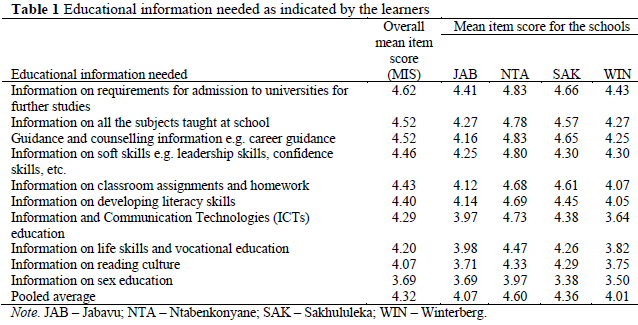
Access analysis begins with identifying the object of inquiry which is usually something of benefit (Ribot & Peluso, 2003). Udofia (2012) asserts that in order to determine the specific need of information users, the research instrument is paramount. Hence, the learners were requested to indicate the extent to which they needed the 10 items of educational information on a Likert scale of 5 to 1, (where 5 = highly needed and 1 = not needed at all). The results are presented in Table 1.
Table 1 indicates that the learner respondents were required to rate the extent to which they considered 10 groups of educational information as being needed for their education. The results show that the learners needed all the classes of educational information listed. However, information on requirements for admission into university for further studies and on subjects taught at school, followed by guidance and counselling information were rated to be highly needed with overall mean item scores of 4.62 and 4.52 respectively. Although some responded differently, the high mean item scores (pooled average of 4.32 out of 5.00 which is about 86%) revealed that the majority of learners agreed that they needed the 10 categories of information listed. This general picture applied to all the sampled schools.
When considered individually, the results for each school indicate that the respondents from all schools expressed similar educational information and information needs relating to learners' academic advancement, which received the highest mean score. This is in line with the findings by Adesoye and Amusa (2011) and Otoide (2015) that reveal that most of the respondents needed academic information, future career information and guidance information. In contrast, Udofia's (2012) findings reveal a shift in emphasis from academic information to occupational information. This, according to Udofia, may be attributable to the respondents' family backgrounds and prevailing circumstances.
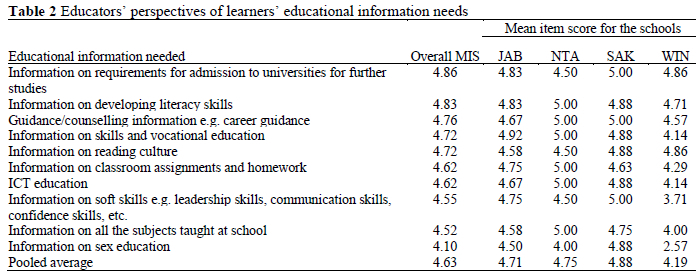
The study further sought to establish the information needed by learners from the educators' perspectives. The results are shown in Table 2.
As indicated in Table 2, the educators also perceived that all categories of the listed educational information were needed by learners. Considering the overall mean item scores ranging from 4.82 to 4.52, every category of information listed was highly needed, with the exception of information on sex education, which was indicated to be somehow needed (4.10). Besides the indecisive response of educators from one of the high schools on learners' needs for information on sex education (2.57), results across the four schools reveal that all the categories of information listed were highly needed or somehow needed. It is significant that both the learners and the non-learners responded that information on gaining admission to universities was of greatest priority to the learners.
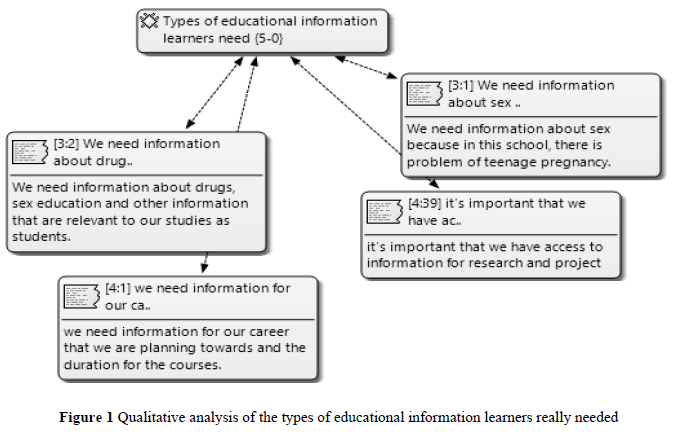
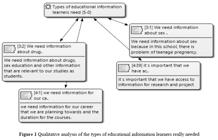
Additionally, as revealed in Figure 1, data from the focus group interviews indicates that the respondents needed information on sex education, drugs, career guidance and counselling, research and projects, as well as information on further studies. This corroborates the findings from the quantitative approach (Table 2).
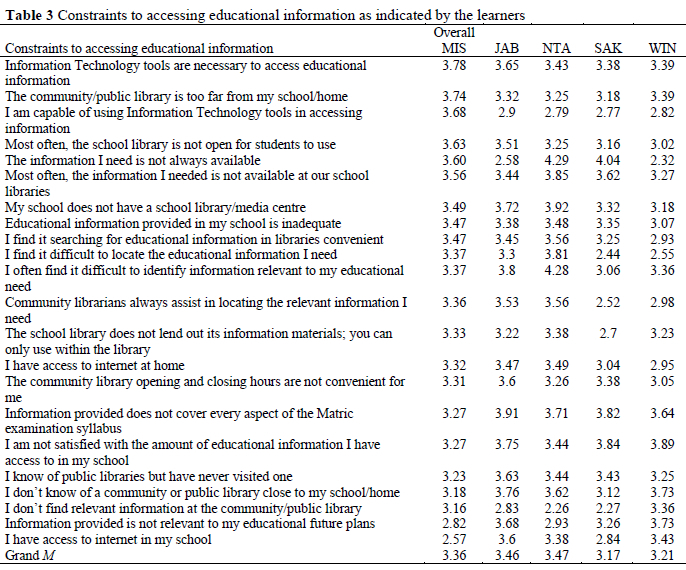
On access constraints, the overall mean item scores from Table 3 reveal that the information and communication technology tools are essential to learners' access to educational information (3.78) and indicate that learners are capable of using information technology tools to access information (3.68). ICT tools are essential to learners' access to information because the volume of information in electronic format in the information age is vast compared with print resources. Access to ICT tools plays a significant role in mediating access to information. Mdlongwa (2012) reports that ICT has not only delivered quick and efficient generation of information at schools, but also indicates positive links to learners' achievement.
As information hubs, libraries prepare learners for participation in a competitive society. Table 3 reveals that the public library is too far from learners' school/home (3.74). Besides, the school library is often (3.63) not open for learners' use and the information needed not always available (3.60). Consequently, learners' access to information was constrained by the situation of access at the school and the public library. Mart's (2003) assessment of cases on the right to receive information has established the necessity of access to information as an extension of the right to freedom of speech.
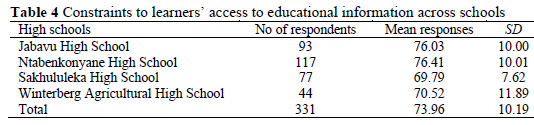
The overall mean item scores of many of the statements in Table 3 reveal learners' state of hesitancy. Such statements include "my school does not have a school library" (3.49), "educational information provided in my school is inadequate" (3.47), "I find it difficult to locate the educational information I need" (3.37) and "I find it difficult to identify information relevant to my educational needs" (3.37), among others. The 3.36 pooled averages may generally serve as an indication of learners' indifference to educational information access. The results on constraints of access were decomposed to discover variances across schools. The findings are presented in Tables 4 and 5.
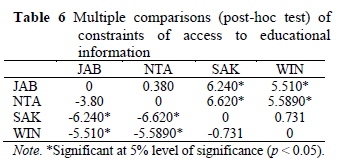
Table 5 shows a calculated F-value of 10.24 as the difference in constraints to learners' access to educational information across schools. The statistics generated from the results indicate that there is a significant difference in barriers to learners' access to educational information across schools. A post-hoc analysis to determine the trend of the difference between schools in terms of barriers to accessing educational information is shown in Table 6.
Table 6 reveals that there was a significant difference in learners' experience of barriers of access to educational information between learners from the pair of Jabavu High School and Sakhululeka High School and the pair of Jabavu High School and Winterberg Agricultural High School. Furthermore, there was a significant difference in accessing educational information between learners from Ntabenkonyane High School and Sakhululeka High School; Ntabenkonyane High School and Winterberg Agricultural High School. This finding reflects a divide in the educational system which had been reported in South Africa (Equal Education, 2011; Ndlovu, 2010; Organisation for Economic Co-operation and Development [OECD], 2013).
By implication, learners from Jabavu High School experienced more barriers to educational information access than those in Ntabenkonyane High School and Winterberg Agricultural High School. Moreover, learners from Ntabenkonyane High School experienced more barriers to accessing educational information than those in Sakhululeka High School and Winterberg Agricultural High School. Jabavu and Ntabenkonyane High Schools show challenges of "right" relating to a lack of availability and accessibility of information. Therefore, issues of "right" such as unavailability of libraries, library location, operational time, access to ICT tools and service support, etc. should be attended to at these schools. The denial of access to information is synonymous with the deprivation of the right to freedom of speech and expression. The foregoing is corroborated by Mart (2003) and Oltmann (2009).
Discussion
The agreement between learners and educators that all categories of educational information identified are needed by the learners has been established. Remarkably, information on the requirement for admission to university received the highest score from both learners and educators. This is consistent with the findings by Adesoye and Amusa (2011), Akinola et al. (2013) and Otoide (2015). The result confirms those of earlier studies that indicate that high schools should prepare learners for college or livelihood (Dice, 1958; Mochizuki, 2011; Soumeli, 2012; Wimberly & Noeth, 2005).
Results from the current study indicate that learners regard guidance and counselling as critical (highly needed) information. Dabula and Makura (2013) report the poor state of guidance and counselling in the Eastern Cape Province. This study accentuates the importance of such information to high school learners.
Furthermore, the adolescent age is characterised by a number of physical bodily developments (McNeely & Blanchard, 2009), and therefore it is important that learners have proper orientation on how to respond to these changes and avoid pitfalls (Mckay, 2004; Rosen, Murray & Moreland, 2004). The result on the extent of the need for information on sex depicts a weak recognition of the importance of this type of information. However, responses received during the focus group interviews indicate that it was highly needed due to teenage pregnancy problems in one of the schools. This agrees with Omo's (2011) report that secondary school learners need sex education in their schools.
The findings from the current study regarding the constraints of access to information by learners confirm findings from previous studies on barriers of access to information. Prominent among the access constraints is poor availability of required information. A study by Lilley (2008) reveals that barriers confronting Maori learners' access to information in New Zealand was the failure to find required information. Benard and Dulle (2014) report a lack of reference resources, audio visuals, and recreation materials in Tanzania. Pickard (2002) reveals inequality of access to electronic information among schools, learners, homes, and libraries in South Africa. Similarly, results from this study indicate the disparity in access to educational information among schools. This result mirrors the global economic divide between rich and poor communities in the context of Education for All (EFA) and the United Nations' Millennium Development Goals (MDGs).
Conclusion
The study indicates that information on requirements for admission to university, information on subjects taught at school, as well as career guidance and counselling are highly needed by the learners. Education authorities at provincial and national level should therefore ensure adequate provision of educational information resources pertaining to the immediate and future academic needs of learners. The need for provision and access to information on guidance and counselling, access to higher institutions, and readiness of learners cannot be overemphasized. The need for information on sex education supports the conclusion of a study in Nigeria (Nwalo & Anasi, 2012) that irrespective of the geographical, racial, educational and social differences, all teenage girls must have access to reproductive health education.
The jurisprudential theories and the theory of access are adamant that the denial of access to information in any part of the world is tantamount to deprivation of freedom of speech and expression. This study therefore highlights why information providers should investigate and provide for the information needs of their patrons. The study particularly sheds light on how learners' access to educational information can be investigated, evaluated and replicated in, for instance, economically disadvantaged and information-poor communities of the world. The results of the study are applicable to many developing countries since learners' access to relevant educational information empowers them to make meaningful contributions to the transformation of the society.
Recommendations
Based on the findings from this study and the suggestions from both learners and educators, it is recommended that educational authorities provide adequate educational information to high school learners. Furthermore, there is an urgent need to provide functional school libraries with information technology tools and qualified librarians to promote learners' access to education information and information literacy education in the district. This should be done within the framework informed by the jurisprudential theories of freedom of speech and expression coupled with the ideas of the theory of access and the notion of "right." Remedial actions as identified above would also be applicable in countries with similar cases. The study indicates a need to further examine the coping strategies of teachers and learners in information-poor communities.
Authors' Contributions
Dr Stella O. Oyediran-Tidings, as the lead author, was responsible for the conceptualisation, research design, instrument design, data collection, data analysis, interpretation and discussion of findings. Prof. Ezra M. Ondari-Okemwa supervised and provided guidance regarding the design and validation of the research instrument, data collection, ethical clearance and correction of write-up. Prof. Fhulu Nekwevha co-supervised the research activities as well as the manuscript development. He coordinated the design of the research instruments, discussion of findings, ensured compliance with international standard by critiquing the work, and ensuring that technical and grammatical errors were identified and corrected.
Notesi. Published under a Creative Commons Attribution Licence.
Acknowledgement
The authors acknowledge the support received from the Govan Mbeki Research and Development Centre (GMRDC) for providing financial support in the form of a supervisor-linked bursary to execute the research.
References
-
Adesoye AE & Amusa OI 2011. Investigating the information needs of sandwich and part-time students of two public universities in Ogun State, Nigeria. Library Philosophy and Practice (e-journal). 526. Available at https://digitalcommons.unl.edu/libphilprac/526/. Accessed 18 March 2015.
» https://digitalcommons.unl.edu/libphilprac/526/ -
Agosto DE & Hughes-Hassell S 2006. Toward a model of the everyday life information needs of urban teenagers, part 1: Theoretical model. Journal of the American Society for Information Science and Technology, 57(10):1394-1403. https://doi.org/10.1002/asi.20451
» https://doi.org/10.1002/asi.20451 -
Akinola JO, Apotiade JK, Ogunmodede TA & Oyetola SO 2013. A survey of the services of public libraries in meeting the information needs of post-secondary school students in some three selected public libraries in Nigeria. Greener Journal of Internet, Information and Communication Systems, 1(1):001-012. Available at https://pdfs.semanticscholar.org/04d5/1315498659584f8ef0925161c476b1aee6a6.pdf. Accessed 28 September 2019.
» https://pdfs.semanticscholar.org/04d5/1315498659584f8ef0925161c476b1aee6a6.pdf -
Benard R & Dulle F 2014. Assessment of access and use of school library information resources by secondary schools students in Morogoro Municipality. Tanzania. Library Philosophy and Practice (e-journal). Paper 1107. Available at http://digitalcommons.unl.edu/libphilprac/1107. Accessed 19 February 2015.
» http://digitalcommons.unl.edu/libphilprac/1107 -
Boekhorst AK & Britz JJ 2004. Information literacy at school level: A comparative study between the Netherlands and South Africa. South African Journal of Libraries and Information Science, 70(2):63-71. https://doi.org/10.7553/70-2-666
» https://doi.org/10.7553/70-2-666 -
Crisan C, Pavelea A & Ghimbulut O 2015. A need assessment on students' career guidance. Procedia - Social and Behavioral Sciences, 180:1022-1029. https://doi.org/10.1016/j.sbspro.2015.02.196
» https://doi.org/10.1016/j.sbspro.2015.02.196 -
Dabula P & Makura AH 2013. High school students' perceptions of career guidance and development programmes for university access. International Journal of Education Sciences, 5(2):89-97. https://doi.org/10.1080/09751122.2013.11890065
» https://doi.org/10.1080/09751122.2013.11890065 - Department of Basic Education, Republic of South Africa 2012. National guidelines for school library and information services. Pretoria: Author
-
Department of Basic Education, Republic of South Africa 2013. National Senior Certificate examination technical report 2013. Pretoria: Author. Available at https://www.gov.za/sites/default/files/gcis_document/201409/nsc-2013-technical-reportaa.pdf. Accessed 28 September 2019.
» https://www.gov.za/sites/default/files/gcis_document/201409/nsc-2013-technical-reportaa.pdf -
Dice LK 1958. Unmet needs of high school students. Educational Leadership, 16:169-175. Available at http://www.ascd.org/ASCD/pdf/journals/ed_lead/e1_195812_dice.pdf. Accessed 27 September 2019.
» http://www.ascd.org/ASCD/pdf/journals/ed_lead/e1_195812_dice.pdf - Equal Education 2011. We can't afford not to: Costing the provision of functional school libraries in South African public schools (2nd ed). Khayelitsha, South Africa: Author.
- Frantsi H, Kolu K & Salminen S 2002. A good school library. Helsinki, Finland: The School Library Association in Finland and The Finnish National Board of Education.
-
Hart G 2014. Converging paths in the drive for school libraries in democratic South Africa. Available at https://pdfs.semanticscholar.org/de4d/776783506a98f9618b634e4a9b4ebafaf9cd.pdf?_ga=2.32223226.534582161.1569567817-1764777703.1567966833. Accessed 27 September 2019.
» https://pdfs.semanticscholar.org/de4d/776783506a98f9618b634e4a9b4ebafaf9cd.pdf?_ga=2.32223226.534582161.1569567817-1764777703.1567966833 -
The International Federation of Library Associations and Institutions (IFLA) & Committee on Freedom of Access to Information and Freedom of Expression (FAIFE) 1999. IFLA statement on libraries and intellectual freedom. Available at https://www.ifla.org/publications/ifla-statement-on-libraries-and-intellectual-freedom. Accessed 13 November 2018.
» https://www.ifla.org/publications/ifla-statement-on-libraries-and-intellectual-freedom -
Khan SA & Shafique F 2011. Information needs and information-seeking behavior: A survey of college faculty at Bahawalpur. Library Philosophy and Practice. Available at https://www.researchgate.net/profile/Dr_Shakeel_Khan/publication/266373074_Information_Needs_and_Information-Seeking_Behavior_A_Survey_of_College_Faculty_at_Bahawalpur/links/5982d5c4a6fdcc8b56f592fa/Information-Needs-and-Information-Seeking-Behavior-A-Survey-of-College-Faculty-at-Bahawalpur.pdf. Accessed 27 September 2019.
» https://www.researchgate.net/profile/Dr_Shakeel_Khan/publication/266373074_Information_Needs_and_Information-Seeking_Behavior_A_Survey_of_College_Faculty_at_Bahawalpur/links/5982d5c4a6fdcc8b56f592fa/Information-Needs-and-Information-Seeking-Behavior-A-Survey-of-College-Faculty-at-Bahawalpur.pdf -
Khan SH, Hasan M & Clement CK 2012. Barriers to the introduction of ICT into education in developing countries: The example of Bangladesh. International Journal of Instruction, 5(2):61-80. Available at https://dergipark.org.tr/en/download/article-file/59739. Accessed 27 September 2019.
» https://dergipark.org.tr/en/download/article-file/59739 - Lilley SC 2008. Information barriers and Maori secondary school students. Information Research, 13(4):18.
-
Lippincott JK 2012. Information commons: Meeting millennials' needs. Journal of Library Administration, 52(6-7):538-548. https://doi.org/10.1080/01930826.2012.707950
» https://doi.org/10.1080/01930826.2012.707950 -
Mart SN 2003. The right to receive information. Law Library Journal, 95(2):175-189. Available at https://scholar.law.colorado.edu/cgi/viewcontent.cgi?referer=https://scholar.google.com/&httpsredir=1&article=1434&context=articles. Accessed 27 September 2019.
» https://scholar.law.colorado.edu/cgi/viewcontent.cgi?referer=https://scholar.google.com/&httpsredir=1&article=1434&context=articles - McKay A 2004. Sexual health education in the schools: Questions and answers. The Canadian Journal of Human Sexuality, 13(3-4):129-141.
-
McNeely C & Blanchard J 2009. The teen years explained: A guide to healthy adolescent development. Baltimore, MD: Centre for Adolescent Health, John Hopkins Bloomberg School of Public Health. Available at https://www.jhsph.edu/research/centers-and-institutes/center-for-adolescent-health/_docs/TTYE-Guide.pdf. Accessed 28 September 2019.
» https://www.jhsph.edu/research/centers-and-institutes/center-for-adolescent-health/_docs/TTYE-Guide.pdf -
Mdlongwa T 2012. Information and Communication Technology (ICT) as a means of enhancing education in schools in South Africa: Challenges, benefits and recommendations. Africa Institute of South Africa (AISA) POLICYbrief, 80:1-7. Available at http://www.ai.org.za/wp-content/uploads/downloads/2012/10/No.-80.-ICTas-a-means-of-enhancing-Education-in-Schools-in-South-Africa.pdf. Accessed 24 September 2019.
» http://www.ai.org.za/wp-content/uploads/downloads/2012/10/No.-80.-ICTas-a-means-of-enhancing-Education-in-Schools-in-South-Africa.pdf -
Mochizuki Y 2011. Career education in high schools: Focusing on "guidance in ways of being and ways of living." Japan Labour Review, 8(1):67-84. Available at https://www.jil.go.jp/english/JLR/documents/2011/JLR29_mochizuki.pdf. Accessed 24 September 2019.
» https://www.jil.go.jp/english/JLR/documents/2011/JLR29_mochizuki.pdf - Mojapelo MS 2015. A legislated school library policy : Can functional school libraries be envisioned without one? Mousaian, 33(2):36-55.
-
Mojapelo MS & Dube L 2014a. Information access in high school libraries in Limpopo Province, South Africa. South African Journal of Libraries and Information Science, 80(2):8-16. https://doi.org/10.7553/80-2-1401
» https://doi.org/10.7553/80-2-1401 - Mojapelo S & Dube L 2014b. School library development vs policy provision: Divergence or convergence? Mousaian, 32(4): 1-12.
-
Molawa S 2009. The "first" and "third world" in Africa: Knowledge access, challenges and current technological innovations in Africa. Paper presented at the First International Conference on African Digital Libraries and Archives (ICADLA-1), Addis Ababa, Ethiopia, 1 -3 July. Available at http://wiredspace.wits.ac.za/bitstream/handle/10539/8934/19%20Molawa.pdf?sequence=1&isAllowed=y. Accessed 29 September 2019.
» http://wiredspace.wits.ac.za/bitstream/handle/10539/8934/19%20Molawa.pdf?sequence=1&isAllowed=y -
Ndlovu NS 2010. Does the notion of "the digital divide" have descriptive validity in South African education? MEd thesis. Johannesburg, South Africa: University of Witwatersrand. Available at http://wiredspace.wits.ac.za/jspui/bitstream/10539/9407/1/Research%20Proj_N.S.Ndlovu_0618698K.pdf. Accessed 23 September 2019.
» http://wiredspace.wits.ac.za/jspui/bitstream/10539/9407/1/Research%20Proj_N.S.Ndlovu_0618698K.pdf -
Nsigwane GT 2011. Budgeting constraints for school libraries: A study of selected schools in Nkangala region, Mpumalanga. MLIS dissertation. Polokwane, South Africa: University of Limpopo. Available at https://pdfs.semanticscholar.org/5a79/3d5dcc3602e5e59c27bc976a91a880f88d98.pdf. Accessed 23 September 2019.
» https://pdfs.semanticscholar.org/5a79/3d5dcc3602e5e59c27bc976a91a880f88d98.pdf -
Nwalo KIN & Anasi SNI 2012. Access to and use of reproductive health information among in-school adolescent girls in Lagos State, Nigeria. Health Education Journal, 71(1):90-101. https://doi.org/10.1177%2F0017896910386525
» https://doi.org/10.1177%2F0017896910386525 -
Nye V 2017. Intellectual freedom as a human right: The library's role in a democratic society. BiD: Textos universitaris de biblioteconomia i documentació, 39. https://doi.org/10.1344/BiD2017.39.16
» https://doi.org/10.1344/BiD2017.39.16 - Office of the Presidency 2000. Act No. 2, 2000: Promotion of Access to Information Act, 2000. Government Gazette, 416(20852):1-45, February 3.
-
Oltmann SM 2009. Information access (Qualifying Paper). Bloomington, IL: Indiana University. Available at http://bpm.ils.indiana.edu/scholarship/oltmann_paper.pdf. Accessed 13 April 2015.
» http://bpm.ils.indiana.edu/scholarship/oltmann_paper.pdf -
Omo BM 2011. Perception of the senior secondary school students about teaching of sex education in secondary schools in Kaduna State. Masters of Education in Health Education thesis. Zaria, Nigeria: Ahmadu Bello University. Available at http://kubanni.abu.edu.ng/jspui/bitstream/123456789/4295/1/PERCEPTION°/o20OF°/o20THE°/o20SENIOR%20SECONDARY%20SCHOOL%20STUDENTS%20ABOUT%20TEACHING%20OF%20SEX%20EDUCATION%20IN%20SECONDARY%20SCHOOLS/20IN/20KADUNA/20STATE.pdf. Accessed 28 September 2019.
» http://kubanni.abu.edu.ng/jspui/bitstream/123456789/4295/1/PERCEPTION°/o20OF°/o20THE°/o20SENIOR%20SECONDARY%20SCHOOL%20STUDENTS%20ABOUT%20TEACHING%20OF%20SEX%20EDUCATION%20IN%20SECONDARY%20SCHOOLS/20IN/20KADUNA/20STATE.pdf -
OECD 2013. OECD Economic Surveys: South Africa 2013. Paris, France: OECD Publishing. https://doi.org/10.1787/eco_surveys-zaf-2013-en
» https://doi.org/10.1787/eco_surveys-zaf-2013-en -
Otoide PG 2015. Information needs of secondary school students in selected schools in Abraka community. International Journal of Academic Library and Information Science, 3(3):81-88. https://doi.org/10.14662/IJALIS2015.014
» https://doi.org/10.14662/IJALIS2015.014 -
Paton-Ash M & Wilmot D 2015. Issues and challenges facing school libraries in selected primary schools in Gauteng Province, South Africa. South African Journal of Education, 35(1):Art. # 1042, 10 pages. https://doi.org/10.15700/201503062342
» https://doi.org/10.15700/201503062342 -
Pickard AJ 2002. Access to electronic information resources: Their role in the provision of learning opportunities for young people. A constructivist inquiry. PhD thesis. Newcastle, England: University of Northumbria. Available at http://nrl.northumbria.ac.uk/12496/1/ThesisFinal-Full2002.pdf. Accessed 15 September 2019.
» http://nrl.northumbria.ac.uk/12496/1/ThesisFinal-Full2002.pdf - Republic of South Africa 1996. The Constitution of the Republic of South Africa (Act 108 of 1996). Pretoria: Government Printer.
-
Ribot JC & Peluso NL 2003. A theory of access. Rural Sociology, 68(2):153-181. https://doi.org/10.1549-0831.2003.tb00133.x
» https://doi.org/10.1549-0831.2003.tb00133.x -
Rosen JE, Murray NJ & Moreland S 2004. Sexuality education in schools: The international experience and implications for Nigeria (Policy working Paper Series No. 12). Available at http://www.policyproject.com/pubs/workingpapers/wps-12.pdf. Accessed 30 September 2019.
» http://www.policyproject.com/pubs/workingpapers/wps-12.pdf -
Shandu L, Evans N & Mostert J 2014. Challenges in the provision of school library services in Katlehong secondary schools. Mousaion, 32(4):13-28. Available at https://upjournals.co.za/index.php/LIS/article/view/1649/819. Accessed 21 September 2019.
» https://upjournals.co.za/index.php/LIS/article/view/1649/819 -
Shandu LZZ 2014. Challenges in the utilization and provision of school library services in Katlehong secondary schools (Gauteng province, South Africa). MLIS thesis. KwaDlangezwa, South Africa: University of Zululand. Available at http://uzspace.unizulu.ac.za:8080/xmlui/bitstream/handle/10530/1401/Challenges%20in%20the%20utilisation/20and/20provision/20of/20school/20library/20services/20in/20Katlehong/20Secondary/20Schools/20(Gauteng/20Province,/20South%20Africa)..pdf?sequence=1. Accessed 21 September 2019.
» http://uzspace.unizulu.ac.za:8080/xmlui/bitstream/handle/10530/1401/Challenges%20in%20the%20utilisation/20and/20provision/20of/20school/20library/20services/20in/20Katlehong/20Secondary/20Schools/20(Gauteng/20Province,/20South%20Africa)..pdf?sequence=1 -
Shenton AK 2007. Library suggestions and typologies of information needs. Library and Information Research, 31(98):3-15. https://doi.org/10.29173/lirg21
» https://doi.org/10.29173/lirg21 -
Smyth J (ed.) 2000. World education report 2000. The right to education: Towards education for all throughout life. Paris, France: UNESCO Publishing. Available at https://unesdoc.unesco.org/ark:/48223/pf0000119720. Accessed 30 September 2019.
» https://unesdoc.unesco.org/ark:/48223/pf0000119720 -
Soumeli LK 2012. Career counseling in secondary education: A comparative approach of guidance services between Greece and France [PowerPoint presentation]. Available at https://cica.org.au/wp-content/uploads/Career_counselling_secondary_education.pdf. Accessed 6 September 2015.
» https://cica.org.au/wp-content/uploads/Career_counselling_secondary_education.pdf -
Tahir M, Mahmood K & Shafique F 2008. Information needs and information-seeking behavior of arts and humanities teachers: A survey of the University of the Punjab, Lahore, Pakistan. Library Philosophy and Practice:1 -11. Available at https://pdfs.semanticscholar.org/e365/96394a9370f517997ad7df18d30c2e8d6a6b.pdf. Accessed 5 September 2019.
» https://pdfs.semanticscholar.org/e365/96394a9370f517997ad7df18d30c2e8d6a6b.pdf -
Udofia UI 2012. Information needs of rural secondary school adolescents in Nigeria. International Journal of Academic Research in Business and Social Sciences, 2(10):296-304. Available at http://hrmars.com/admin/pics/1190.pdf. Accessed 3 September 2019.
» http://hrmars.com/admin/pics/1190.pdf -
UNESCO 1994. UNESCO Public Library Manifesto. Available at https://unesdoc.unesco.org/ark:/48223/pf0000112122. Accessed 13 November 2018.
» https://unesdoc.unesco.org/ark:/48223/pf0000112122 -
Wimberly GL & Noeth RJ 2005. College readiness begins in middle school: Act policy report. Ames, IA: American College Testing. Available at https://files.eric.ed.gov/fulltext/ED483849.pdf. Accessed 6 September 2015.
» https://files.eric.ed.gov/fulltext/ED483849.pdf
Revised: 14 February 2019
Accepted: 27 April 2019
Published: 31 December 2019