Perceptions of Grade 10 to 12 adolescents on contextual situations that contribute to their psychosocial development challenges
Abstract
Adolescence is a complex developmental stage with challenges that affect transitioning to adulthood. The success in managing the transition depends on personal capabilities, circumstances, and support systems. Contextual situations in adolescent development are understudied in developing countries. In this qualitative study, we explored what South African Grade 10 to 12 adolescents perceived to be the factors influencing their experience of psychosocial challenges at home and at school. Participants (22 Grade 10-12 learners) completed an open-ended survey structured as a written interview. Thematic analysis of the data revealed 2 main themes: home life situations (household financial difficulties, unfavourable living conditions, time-inflexible house chores, poor parent-child relationships, lack of support from families), and school life situations (peers' inappropriate behaviour, perceptions of ineffective school leadership, teachers' low work enthusiasm and commitment, insufficient school resources, unsafe and unfavourable geographical conditions). The findings suggest a need for psychosocial intervention by school social workers at family and school levels to support adolescents in negotiating their psychosocial developmental transition to young adulthood. The departments of education, social development and health, the police services, and non-governmental organisations (NGOs) should collaborate to establish school programmes addressing learners' disruptive behaviour and school safety concerns.
adolescents; contextual situations; learners; psychosocial development challenges; public schools
Introduction
Adolescence is a critical period for all children and profoundly influences and determines how they grow into young adults. Generally, adolescence can be divided into early (11-14), middle (15-17) and late (18-21) adolescence. Adolescents may have different developmental trajectories depending on their personalities (Calder & Huda, 2013; Plenty & Mood, 2016). These developmental trajectories include transitional social roles and responsibilities, peer group relations, health-related problems, family dimensions, and socio-economic problems. Specifically, the home, school, and community environments are major life situations that influence adolescent development (Conger, Conger & Martin, 2010; Plenty & Mood, 2016). These life situations may interact in complex ways to influence adolescents' developmental trajectories. With this study we aimed to explore what South African Grade 10 to 12 adolescents perceived to be the factors influencing their experience of psychosocial challenges at home and at school.
Literature Review
Literature shows that an association exists between adolescents' home environment, like the family's low socioeconomic standing, dysfunctional family situations, culture, and family roles (George, A & Van den Berg, 2011), and psychosocial challenges such as school underperformance, mental health difficulties, and peer relationship problems that adolescents encounter during the developmental period (Letsoalo, Maoto & Chuene, 2018). These home characteristics may directly or indirectly contribute to adolescents' psychosocial development (De Wet & Odimegwu, 2017). South African studies by Danhouse and Erasmus (2020) and Makiwane and Berry (2013) suggest that poor family functioning may be a result of the breakdown in parental relationships, interparental violence, poverty, and use of substances in the household.
The socio-economic status (SES) of the family may be determined by the household income, the occupation of the breadwinner, and the parents' level of education (Hall, Richter, Mokomane & Lake, 2018). Households with a low SES may lack the finances to provide for their adolescents and be less involved in their school activities (Letsoalo et al., 2018; Mupa & Chinooneka, 2015). Other results of families' low SES within the South African context may include poor and unfavourable living conditions (Leibbrandt, Woolard, Finn & Argent, 2010) such as household overcrowding (Nkosi, Haman, Naicker & Mathee, 2019), which may affect the adolescents' psychosocial development. Moreover, parents and caregivers with low SES may be less supportive of their children's education (Vadivel, Alam, Nikpoo & Ajanil, 2023). This lack of support may also be due to parents' level of education which Christian and Sayed (2023) explain may affect their ability to assist their children with their schoolwork and that because of this, some parents do not value the education that schools offer their children. Consequently, when children are not academically supported at home it may impact their commitment to education.
The home environment plays an essential role in the adolescents' psychosocial development because, as Chapani (2021) explains, it is one place where an adolescent can learn and adopt violent behaviour, for instance, they can learn domestic abuse that they are exposed to at home and adopt it to other social settings. They may find it difficult to socially play and interact with others peacefully and may be aggressive towards other people, including their peers. Adolescents who have been physically abused or neglected by their parents or caregivers may be prone to experiencing immediate or delayed psychosocial problems related to their physical and mental health and academics (Young & Widom, 2014). The parents' or caregivers' use of substances contributes to the inability to care for and support adolescents and not being able to develop strong healthy relationships with the adolescents (Muusha, 2012). Additionally, adolescents from developing countries are expected to contribute to and are responsible for some household work, which limits and may influence their involvement in academic activities after school (Brew, Nketiah & Koranteng, 2021; Chinyoka & Naidu, 2013).
Structural issues like poverty, crime, violence, and social and economic inequalities in South Africa significantly influence how schools function, which in turn may affect adolescents' psychosocial development (Du Toit, Haag, Skeen, Sherr, Orkin, Rudgard, Marlow, Mehbratu, Steventon Roberts & Tomlinson, 2022). Considering these structural issues, schools struggle with having adequate resources, physical infrastructure, and electricity (Brew et al., 2021), which are essential resources to support adolescents' positive academic and social development. A correlation also exists between a school's poor infrastructure and the supply of electricity, and adolescents' academic achievement (Mupa & Chinooneka, 2015). Access to these resources often either influences the adolescents' positive psychosocial well-being or causes them stress (George, A & Van den Berg, 2011). The quality of learning materials, especially textbooks, is important for the academic development of any adolescent (Chingos & West, 2010) and should any materials not be available at school, adolescents may be unable to learn to their full potential, and experience distress (Maffea, 2020).
These problems within the school environment may be linked to the South African education system being expensive, ineffective, and underperforming (Naape & Matlasedi, 2020). Even though state financial funding is injected into public schools (Van Dyk & White, 2019), the shortage of resources is still an issue, which has a direct and indirect impact on adolescents' development and school performance. In addition, a lack of effective teaching to help adolescents understand the academic content is another notable issue within the South African context (Mupa & Chinooneka, 2015).
South African studies focusing on adolescents have not specifically looked at the schooling situations that contribute to the adolescents' psychosocial developmental experiences. For instance, A George and Van den Berg (2011) focused on factors that caused distress in adolescents, Timol, Vawda, Bhana, Moolman, Makoae and Swartz (2016) focused on adolescents' risk and protective factors related to risky behaviour concentrated on a school-based peer-education programme, and De Wet and Odimegwu (2017) focused on adolescents' contextual situations in relation to their mortality. Therefore, gaps in the literature necessitated this study which, within the South African context, is focused on adolescents' perceptions of home and school life situations that contribute to their psychosocial developmental challenges.
Theoretical Framework
The bioecological theory, also known as the ecological theory, is a widely used theoretical framework in studies related to human development. The theory explains how human development occurs with specific attention on the impact of the context or enduring environments (Bronfenbrenner, 1977). Through the bioecological theory, the adolescent's development is viewed as emerging from the interaction between factors related to their biology, their immediate family or community environment, and the societal landscapes. This framework was appropriate for this study as we sought to explore adolescents' perceptions of their life situations in relation to their psychosocial developmental challenges. Rosa and Tudge (2013) advocate for the use of this framework in studies such as this to investigate the environments in which adolescents spend time, their relations with others in the same environments, the personal characteristics of the adolescents, and the characteristics of those that they typically interact with. In this study we focused on the mesosystems of the bioecological theory encompassing "the relationship among major settings containing the developing person at a particular point of his or her life" (Bronfenbrenner, 1977:514), and exosystems, which comprise the microsystems in which the adolescents are not directly embedded (Bronfenbrenner, 1977).
Methodology
With this study we sought to explore South African adolescents' perceptions of their home and school life situations in relation to their psychosocial developmental challenges from a perspective of lived experiences. We aimed to explore what South African Grade 10 to 12 adolescents perceived to be the factors influencing their experiences of psychosocial challenges at home and at school.
A qualitative exploratory approach was adopted for this study to explore the perceptions of South African adolescents on how home and school life situations influence their psychosocial developmental needs. The purpose was to better understand the existing social phenomenon, social institutions, and other systems as perceived by the participants using a qualitative design (Creswell & Poth, 2018; Thomas, 2011). This design was ideal for this research as we used two different secondary schools, and the design allowed for clarification of the findings and corroboration of the data obtained.
Purposive sampling was used to recruit 22 South African adolescents attending Grades 10 to 12 at two secondary schools in Johannesburg South, Gauteng province. The participants were between 15 and 19 years old (eight males and 14 females) and voluntarily participated in the study. Additionally, the schools were intentionally chosen as they were in district 11 and the corresponding author had already established relationships with the school staff and principals. The participants were from diverse communities with formal housing, formal and informal settlements and squatter camps surrounding the two schools.
Data were collected during the called coronavirus disease (COVID-19) lockdown in 2020, which meant that access to the learners was limited. Therefore, we asked the teachers who were the heads of Grades 10, 11 and 12 to assist with the distribution of an open-ended survey, structured as a written interview, to interested adolescent learners (five learners per grade, per school). The survey included an open-ended question on how the participants perceived their home and school life situations in relation to their psychosocial development challenges. Upon completion of the survey, the learners had to return the surveys to the teachers for us to collect.
The study was approved by the non-human medical ethics committee of the University of the Witwatersrand (H20/06/16). The Gauteng Department of Education and the school principals also granted permission for the study to be conducted in the schools.
The parents or guardians of minor adolescents consented to their children participating in the study and these adolescents also gave assent to be involved in the study. Adolescents older than 18 years gave consent for their participation. Parents and participants were briefed about the study (aim, risks, benefits, voluntary participation, right to withdraw, and research process) and were assured of the confidentiality of the information they shared through the participant information sheet. The participants were also assured of anonymity in the data reporting. The contact details of a school social worker offering free counselling were provided to those who may have expressed a need for support.
Using thematic analysis, all the responses from the open-ended survey, structured as a written interview, were transferred into a transcript document. The analysis followed the procedures explained by Braun and Clarke (2013), and Creswell and Poth (2018) - initial and primary reading of the data, coding and organising themes, representing the data, and forming an interpretation of the themes.
We were guided by Lincoln and Guba' s (1985) four criteria to ensure the trustworthiness of the study (i.e., credibility, dependability, transferability, and confirmability). Credibility is described as ensuring that the interpretation, reconstruction, and representation of the research findings are congruent with and match the participants' perceptions and reality (Nieuwenhuis, 2020; Schurink, Schurink & Fouché, 2021).
Credibility confirms the consistency between the participants' perceptions and the authors' interpretation, presentation, and reporting thereof (Tobin & Begley, 2004). Purposive sampling with clear inclusion and exclusion criteria, a detailed data collection method, and participants' direct quotations in supporting the study findings were used to ensure credibility. Dependability refers to the findings being consistent and demonstrated through the implementation of the research design, keeping operational details of data collection, noting reflective considerations, a detailed account of the data analysis process and how interpretations were arrived at (Nieuwenhuis, 2020). This study was dependable because the research process was logical, traceable, and documented. Transferability refers to the extent to which study findings can be applied to other contexts. The findings in this study are transferable to other contexts because participants were somehow representing the specific context being studied and the findings applied to the context. For this study, participants were purposefully sampled. Confirmability is the degree to which the findings of the study are moulded by the participants and not by the subjectivity, bias, or interest of the researcher. An audit trail, which allows for following the decisions taken throughout the research process and confirming that the authors' interpretations are clear reflections of the study' s collected data, was kept. Direct quotations were used to support data interpretations. These strategies ensured the trustworthiness of the research study.
Findings and Discussion
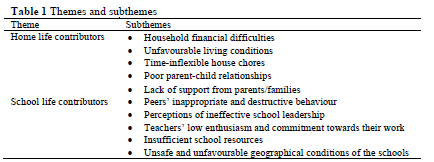
Two main themes and subthemes, presented in Table 1, emerged from the study.
Theme 1: Home Life Contributors
One of the interesting features of the adolescents' reflections was that they reported various situations within their home environments that they perceived as contributors to their psychosocial developmental challenges. These are noted below.
Household financial difficulties
Adolescents perceived their households' low financial standing as a factor that contributed to their psychosocial developmental challenges. The household income was only sufficient to meet the basic physiological needs of the adolescents and other members of the household: "My dad is our breadwinner, he's the only person who's employed and my parents aren 't financially stable. They can only provide us with [basic] things we need like food and clothes" (P1).
Participant 12 expressed that "mom is a breadwinner so [e]very little cent she gets; it must be spent on food and clothes. So, the little she earns is not enough to feed a family of five", while Participant 9 shared that "[regarding] food, my dad got retrenched and took most of his money to investments now he can't access it simply, so it is hard to make it on a daily basis."
This perception draws attention to the realities of many South African households, of which the most common sources of income were reported to be employment salaries (59.4%) and social grants (51%), with an average income for the majority working households being R3,000 to R5,000 per month (Egan, 2021; Statistics South Africa, 2021). Hall (2024) notes that 75% of children living in households headed by Black Africans lived below the upper-bound poverty line. This poverty line noted as R1,558 in 2023, allows just enough money for basic needs and essentials such as nutrition and clothing (Hall, 2024; Statistics South Africa, 2023). Based on the findings, we put forth that the adolescents' household income was within this poverty line as they reported that the income only met the basic needs of food and clothes and in some instances, was not sufficient for daily needs. Studies by Ferguson, Bovaird and Mueller (2007) and Nortje (2017) confirm that a family's low household income affects various aspects of adolescents' lives, including their psychosocial well-being.
Unfavourable living conditions
In addition to the financial difficulties experienced by the adolescents' families, unfavourable living conditions were perceived as contributing to the psychosocial developmental challenges experienced by the adolescents. Issues such as overcrowding were mentioned: "because of overcrowding, poverty at home, having to share space with other siblings" (P4) is perceived as a psychosocial developmental challenge. In addition, P16 indicated that because of sharing space, they had to switch the lights off early: "sharing a room with my younger brother and having to turn off the lights early enough ..." [is restricting adolescents] and contributes to their psychosocial developmental challenges. Many South African families live in unfavourable conditions (Leibbrandt et al., 2010) and overcrowding (i.e., more than two people in a habitable room) is a social problem that can undermine adolescents' needs like privacy (Nkosi et al., 2019). The perceptions shared by the participants suggest that they may experience difficulties negotiating space, which intrudes on their privacy and limits their individual activities.
Time-inflexible house chores
The adolescents perceived the completion of household chores as another contributor to the psychosocial developmental challenges that they experienced. For instance, parents or families expect adolescents to do household chores. "Well, as a child at home, I am expected to have [chores] and fulfil my duties, so I have to help no matter what" (P9). "My parents... believe that I'm supposed to do as they say whether I' m coming back from school tired or not, chores are chores. I feel like they don' t consider my feelings, they got this belief that they are building me to be a strong person ... " (P2). Even though the completion of these responsibilities is normal for many adolescents within the South African context and may be regarded as "building" the adolescent into a "strong person", the participants' perceptions were that these responsibilities contributed to their psychosocial developmental challenges. Chinyoka and Naidu (2013) show that the completion of household chores impacted adolescents' educational outcomes because they were expected to do the chores after school (e.g., cooking, washing dishes, cleaning, etc.) instead of attending to their homework. Although the completion of chores may be seen as a way to contribute to the family and develop adolescents' life skills, if not scheduled accordingly, chores can be time-consuming, demanding and challenging for adolescents.
Poor parent-child relationships
The adolescents reported that they were not given a voice and the freedom to participate in making decisions: "... it's because my family always thinks I'm still young and I cannot take decisions of my own" (P7). "[M]y parents are still doing things [in a] stricter way and not in a modern way where you get to sit down and talk about how things are going to work or benefit us as a family with an understanding of parent and daughter" (P2). Adolescents perceived that they might not have had the opportunity to participate in family decisions because parents and family members perceived them as "children" and inexperienced when it comes to making informed decisions. Martensen and Granholdt (2008) argue that parents may want to exert power when financial-related decisions are taken because of their financial investment. When adolescents are not engaged in family decisions, their understanding of skills and capabilities to make informed decisions about different aspects of their lives are not developed and it is likely to become one of the challenges affecting their psychosocial development.
Lack of support from parents/families
Some of the participants reflected on various ways that they perceived as inadequate support from their parents and families: "somehow, it's because I don't get enough support or motivation from my family, I end up not doing anything, but I keep quiet and still laugh along and smile" (P6). The inadequate support was, according to some participants, related to the lack of physical presence of parents and families in their lives: "because my mom has no time for me, the only thing she cares about is her boyfriend and his well-being" (P13) and "because everyone is always busy" (P20).
The findings of this study imply that the support that the adolescents received from their families was inadequate. Janssen, Elzinga, Verkuil, Hillegers and Keijsers (2021) argue that parental and family support is significant in adolescents' well-being and found that adolescents experienced more negative moods on days when they perceived their parents to be less supportive. The perception of inadequate support from their families further reveals that some adolescents maintained a façade of happiness as they felt that there was nothing they could do about the perceived inadequate support. The findings also reflect the tangible aspects of inadequate support and the physical absence of preoccupied parents leaving little room for meaningful relationships between them and the adolescents. A lack of adequate parental time is a barrier to effective parenting and often is a result of parents' busy schedules as they grapple with work pressures or look for money to use for their families (Donga, Roman, Benjamin, Sonn & Rich, 2022). Although some adolescents did not provide contextual details about the inadequate support, this factor may be linked to the low household income. Ferguson et al. (2007) conclude that the problems that often occur in low-income families include parent-child relationship difficulties, parental inconsistencies, parental stress, lack of supervision, and poor role modelling. Additionally, some adolescents felt that the focus was diverted away from them to their parents' romantic partners. This shift in the family dynamics can leave the adolescents feeling neglected and unworthy as they may perceive their needs as secondary to adult relationships.
The interplay between the perceived financial difficulties, living conditions, household responsibilities, parent-child relationships and support systems illustrates the complexity of adolescent development within the context of their home life. It is evident how adolescents perceived these factors as different microsystems, and the mesosystem (the interactions among these microsystems) as challenges affecting their psychosocial development in different ways. In addition, the parents' work environments and financial struggles had an exosystemic influence on the family as a microsystem and on the adolescents' psychosocial development (Bronfenbrenner, 1977; Donald, Lazarus & Lolwana, 2010).
Theme 2: School Life Contributors
All the adolescents perceived school conditions and the classroom environment as contributors to their psychosocial developmental challenges. Attention was drawn to various situations in the school setting, which are discussed below.
Peers' inappropriate and destructive behaviour
Perceptions about peers' inappropriate and destructive behaviour were mentioned as factors contributing to the adolescents' psychosocial developmental challenges. "Learners are corrupt, they disrespect teachers and promise to hit them, which makes things hard for [me and classmates to concentrate] and for teachers to [teach as expected]" (P2). They also shared that some of their peers were disrespectful and noisy: "I find it so offensive when learners at my age disrespect teachers or other learners and that also makes me furious [and] noisy classmates distract me from doing my schoolwork" (P5).
Some adolescents alluded to their peers' criminal behaviour, which impacted on their academic experiences. This included stealing and vandalising school property and bringing dangerous objects to school: "Some other learners tend to steal textbooks, and this leads to other learners having inadequate learning material. Some other learners vandalise the school property or infrastructure ..." (P8); "Not being safe in the school premises, learners do not know how to respect the school premise as they bring dangerous objects, and it has become a norm" (P2); causing interruptions in the classroom: "Students tend to misbehave causing unnecessary interruptions and distractions [like] during lessons [and that] results in loss of [academic] time ... " (P16); bullying others: "I experience them [being bullied] because a lot of teachers are fond of me. So, they [peers] think the teachers favour me and I don't work hard for my marks" (P15). The last comment shows signs of jealousy which lead to bullying by other learners as they believed that the teachers favoured this participant.
The above-mentioned reflections suggest that peers' behaviour is distractive, implying that public schools struggle with disciplinary problems which impact the rights of other people in the school setting (learners and teachers). The findings in our and other studies (Mthanti, 2023; Sui, Massar, Kessels, Reddy, Ruiter & Sanders-Phillips, 2021) show that violence in the school setting (i.e., physical and verbal abuse to peers and teachers, stealing textbooks and vandalising school property) is common in the South African context. Chetty (2020) found that learners slap, threaten and even throw chairs at teachers and Yang, Qin and Ning (2021) report that this has adverse consequences for teachers' professional engagement and affects their teaching. This also affects adolescents' psychosocial development as they feel unsafe and unmotivated during the learning process, which may result in increased emotional distress (Gasa, Seekings & Taylor, 2016; Lumadi, 2024). We also found that learner-to-learner bullying resulted from perceived academic success and teacher favouritism. Some of the participants were targeted and bullied, which led to physical or emotional distress. This was also found by Waters and Mashburn (2017) who explain that bullying within the school setting may be a result of teacher favouritism and adolescents' academic and social success and shortcomings. Vandalism is among the major problems in South African schools (Ncontsa & Shumba, 2013); perpetrators writing on school walls, breaking doors and windows, damaging tables and chairs and even burning down school buildings. Vandalism creates an unconducive learning environment, therefore, it is difficult for adolescents to perform to their best abilities (Lumadi, 2024). Vandalism affects adolescents' concentration, creates classroom chaos and threatens the school as a safe space for teaching and learning. In addition, vandalism causes a breakdown in social interaction and relationships among adolescents, which is essential for their psychosocial development.
Perceptions of ineffective school leadership
Adolescents perceived that ineffective school leadership contributed to the psychosocial challenges they experienced at school. They perceived that the schools were poorly managed and were struggling to support them: "I think I'm experiencing these challenges at school because of poor school governance. There is lack of support from school" (P7). Participant 2 suggested that the school principal lacked awareness of the problems faced by the adolescents: "It's because the principal is ignorant about what's happening [in the school]...." Masia Warner and Fox (2012) support the notion that a lack of or inadequate support from the school leadership and administrators contributes to the challenges that adolescents experience as they may sometimes not be willing to implement intervention plans to support adolescents. Additionally, weak school leadership, management, and administration result in unhealthy learning environments (Bush, Kiggundu & Moorosi, 2011), which may impact the adolescents' psychosocial developmental experiences.
Teachers' low enthusiasm and commitment towards their work
The participants perceived the teachers' lack of active interest and eagerness toward their work to be one of the challenges to adolescents' psychosocial challenges. Some participants mentioned teacher absenteeism during their teaching slots: ". the teachers don't come to class everyday [and] that makes us fall behind with the syllabus" (P6). In addition, ineffective teaching methods were barriers to learning: "Teachers not approaching the most effective way on teaching, they tend to teach by the book only not [engaging with learners in discussions or activities or] going deeper for us to understand it better" (P16). The participants also referred to their teachers' age: "Most of the teachers are already old at school and have taught for many years but their presence at school is hindering the arrival of new, fresher, motivated teachers who are full of purpose" (P9). Mashaba and Maile (2018:2) emphasise that "an absent teacher lowers the quality of the school experience for the students whom she/he would have taught." While reasons for the absenteeism were not explored and we acknowledge that underlying personal reasons may exist, absenteeism may be due to poor working conditions and high learner-to-teacher ratios. Mupa and Chinooneka (2015) state that teaching enthusiasm is an important trait for teachers and a lack thereof has indirect negative consequences on adolescents' psychosocial and school experiences. Teachers' enthusiasm helps adolescents feel support in terms of their autonomy, competence and social relationships (Frommelt, Schiefele & Lazarides, 2021). In support of Christian and Sayed's (2023), views we argue that due to challenging school contexts reported in this study (i.e., physical violence towards teachers, vandalism, inadequate school resources), some teachers may struggle with motivation and commitment toward teaching. In a Nigerian study it was also found that teachers tended to show less motivation if they were dissatisfied and unhappy with their working conditions (Abubakar, Inuwa & Hamma, 2018).
Insufficient school resources
Some of the adolescents were of the view that schools lacked teaching and learning resources, which affected the adolescents' learning. In turn, this becomes a psychosocial development challenge. Participant 10 mentioned the realities of the shortage of resources in her public school when comparing it to South African private schools: "In private schools, I feel like [learners] are gaining more learning access rather than the [learners in] government schools because there is a shortage of textbooks and stationery, and learning without full education information and resources results in the learner not gaining to full knowledge. " Other participants identified that internet connection in the school was an insufficient resource because only the learners who were enrolled for certain school subjects could access it: "Not having access to wi-fi as the school does not allow all learners to use wi-fi and only science learners use it" (P8). Some participants identified the lack of funding from the government to sustain schools as another challenge hampering their psychosocial development: "I think the government isn't providing enough funds to public schools to survive or be well taken care of" (P6).
The findings by Chingos and West (2010) and Maffea (2020), who argue that learning resources are crucial for adolescents' academic development and to ensure that they learn to their fullest potential with as little academic distress as possible, support the participants' perceptions. Additionally, without the learning resources (e.g. textbooks), learners are more likely to achieve lower test scores than those with access to textbooks (Chingos & West, 2010). Van Dyk and White (2019) also found that insufficient government funding results in a lack of resources in schools.
Unsafe and unfavourable geographical conditions of the schools
The selling and use of substances, and crime in the community, were some of the conditions that were perceived to contribute to the psychosocial developmental challenges of adolescents at schools. Participant 11 expressed that neighbourhood members sold drugs to adolescents, which affected their functioning at school: "... we see drug dealers every day and those drug dealers provide school learners with illegal drugs. The learners end up doing funny things during school hours whereby they laugh non-stop and end up not getting an education..." Participant 11 further explained that "drug dealers take advantage to sell drugs around the school because they know that in government schools there is no security or safety so they can do what they want." From this comment it is clear that that the schools lacked the security to provide them with a sense of safety and protection while learning. Another participant who also felt unsafe at their school was of the view that the school neighbourhood was overpopulated, resulting in the occurrence of criminal activities such as adolescents being robbed:
I don't feel safe at school because the area that side is so overpopulated and full of thieves especially these young boys that stand by the corner. Anytime they feel like entering the school and start robbing us, they do so. The security is not tight.... (P6)
The school neighbourhood and the challenges that the adolescents perceived to influence their psychosocial development cannot be viewed separately. The neighbourhoods in which the adolescents live are important social contexts that may affect the adolescents' functioning (Rosa & Tudge, 2013). A study conducted by K George (2017) echoes the above perceptions as it was conveyed that members of the community, usually the elders, contributed to the adolescents' developmental problems (i.e., drug use and alcohol) and, most of the time, they were the ones who sold the substances to the adolescents even though they were aware of them being underaged. Additionally, adolescents' drug use negatively influenced their academic work and psychosocial well-being. Chibaya and Maritz (2016) note that adolescents' drug use may lead to them engaging in high-risk behaviour such as theft, and loss of interest in their academic work.
In the school-life theme and subthemes, it was evident that adolescents perceived the school contextual factors to impact their development. Specifically, the peer group and the school were viewed as different microsystems, and the mesosystem (the interactions among these microsystems) as challenges affecting their psychosocial development differently. The peers' inappropriate and disruptive behavior such as bullying, disrespect and vandalism activities indicate how direct interactions with peers can create an unsafe school environment. In addition, the macro system of how resources are distributed by government and departments has an influence on the school as a microsystem and inevitably on the adolescents' learning and psychosocial development. The chronosystem affects the interactions among systems and influences adolescents' psychosocial development (Bronfenbrenner, 1977; Donald et al., 2010).
Implications for psychosocial intervention services at schools
From the above, it is clear that there is a need to develop various intervention programmes to address challenges that affect the adolescents' psychosocial development within their community, home, and school settings. For instance, school social workers can be engaged to provide psychosocial support to families facing financial difficulties that hinder their ability to meet basic needs of the family such as food and clothing, and that address issues of child neglect. Additionally, school social workers may also provide family preservation services when poor parent-child relationships or dysfunctional family dynamics are identified. As prevention services, parental skills training can be implemented to enhance parenting practices. To further support adolescents, individualised support such as counselling and social skills training should be made available to address the psychosocial developmental challenges that arise from their specific contextual factors. Moreover, collaboration between various stakeholders (e.g., departments of education, social development and health, the police services, and NGOs) should be encouraged. By collaborating and integrating their services, these stakeholders can establish comprehensive school programmes that address learners' behaviour and safety concerns within the family, school environment and in the broader community. We believe that if these programmes are thoughtfully implemented, they will help create a positive school ethos for adolescents to feel safe, supported and cared for.
Conclusion
In this study we explored the adolescents' perceptions of their home- and school-life situations in relation to their psychosocial developmental challenges. The findings reveal that the psychosocial developmental challenges faced by adolescents within the South African context were a result of their interactions with their home and school environments. The adolescents perceived that household financial difficulties, unfavourable living conditions, time-inflexible house chores, poor parent-child relationships, inappropriate behaviour from peers, ineffective school leadership and governance, teachers' low enthusiasm, insufficient and lack of school resources, and schools' unsafe conditions in the geographical area (e.g. crime and drug trafficking) were some of the life situations that the adolescents perceived as influencing their psychosocial development. The findings from this study confirm that the adolescents' environment plays a significant role in their perceptions about psychosocial development challenges.
Based on the findings, the following limitations and research recommendations are noted:
• Only two public schools in Gauteng, Johannesburg South, were included in the study, therefore, the findings are context-specific for public schools. The purpose of the research study was not to generalise the findings to schools at the local, regional, or national levels.
• Only adolescents in Grades 10 to 12 were included in the study, therefore, future research should sample adolescents in earlier grades for a broader understanding of adolescents' developmental psychosocial experiences.
Authors' Contributions
GK collected and analysed the data and wrote the manuscript. EP was the supervisor for the research project and reviewed the manuscript for intellectual content. Both authors reviewed the final manuscript.
Notesi. Published under a Creative Commons Attribution Licence.
Acknowledgements
I wish to express my gratitude and appreciation to Professor Elias Mpofu for his invaluable guidance and support during the development of the manuscript.
References
-
Abubakar AM, Inuwa BB & Hamma M 2018. Principal leadership style towards teachers' motivation on secondary schools in Nigeria. Advances in Social Science, Education and Humanities Research, 125:88-90. https://doi.org/10.2991/icigr-17.2018.21
» https://doi.org/10.2991/icigr-17.2018.21 - Braun V & Clarke V 2013. Successful qualitative research: A practical guide for beginners. London, England: Sage.
-
Brew EA, Nketiah B & Koranteng R 2021. A literature review of academic performance, an insight into factors and their influences on academic outcomes of students at senior high schools. Open Access Library Journal, 8:e7423. https://doi.org/10.4236/oalib.1107423
» https://doi.org/10.4236/oalib.1107423 -
Bronfenbrenner U 1977. Toward an experimental ecology of human development. American Psychologist, 32(7):513-531. https://doi.org/10.1037/0003-066X.327.513
» https://doi.org/10.1037/0003-066X.327.513 -
Bush T, Kiggundu E & Moorosi P 2011. Preparing new principals in South Africa: The ACE: School Leadership Programme. South African Journal of Education, 31(1):31-43. https://doi.org/10.15700/saje.v31n1a356
» https://doi.org/10.15700/saje.v31n1a356 -
Calder R & Huda K 2013. Adolescent girls and education: Challenges, evidence, and gaps. Pathways' Perspectives on Social Policy in International Development, 13:1 -9. Available at https://socialprotection-humanrights.org/wp-content/uploads/2017/11/13-PathwaysPerspectives-adolescent-girls-and-education-pp13-1.pdf. Accessed 20 February 2025.
» https://socialprotection-humanrights.org/wp-content/uploads/2017/11/13-PathwaysPerspectives-adolescent-girls-and-education-pp13-1.pdf -
Chapani B 2021. The impact of single parenting on adolescents' social development- Findings from Wise Owl High School in Marondera- Zimbabwe. Psychology & Psychological Research International Journal, 6(3):000290. https://doi.org/10.23880/pprij-16000290
» https://doi.org/10.23880/pprij-16000290 - Chetty D 2020. Violence against teachers at school in South Africa.
- Chibaya G & Maritz J 2016. Illicit drug use by secondary school learners: Reclaiming a life. The Social Work Practitioner-Researcher, 28(3):264-277.
-
Chingos MM & West MR 2010. Do more effective teachers earn more outside of the classroom? Programme on Education Policy and governance working (CESifo Working Paper No. 2996). Available at http://nrs.harvard.edu/urn-3:HUL.InstRepos:4460855. Accessed 21 July 2023.
» http://nrs.harvard.edu/urn-3:HUL.InstRepos:4460855 -
Chinyoka K & Naidu N 2013. Uncaging the caged: Exploring the impact of poverty on the academic performance of form three learners in Zimbabwe. International Journal of Educational Sciences, 5(3):271-281. https://doi.org/10.31901/24566322.2013/05.03.14
» https://doi.org/10.31901/24566322.2013/05.03.14 -
Christian D & Sayed Y 2023. Teacher motivation to teach in challenging school contexts on the Cape Flats, Western Cape, South Africa [Special issue]. Education Sciences, 13(2):165. https://doi.org/10.3390/educsci13020165
» https://doi.org/10.3390/educsci13020165 -
Conger RD, Conger KJ & Martin MJ 2010. Socioeconomic status, family processes, and individual development. Journal of Marriage and Family, 72(3):685-704. https://doi.org/10.1111/j.1741-3737.2010.00725.x
» https://doi.org/10.1111/j.1741-3737.2010.00725.x - Creswell JW & Poth CN 2018. Qualitative inquiry & research design: Choosing among five approaches (4th ed). London, England: Sage.
-
Danhouse MH & Erasmus CJ 2020. Family connectedness in families dealing with adolescents in conflict with the law. Social Work, 56(3):847-865. https://doi.org/10.15270/52-2-862
» https://doi.org/10.15270/52-2-862 -
De Wet N & Odimegwu C 2017. Contextual determinants of adolescent mortality in South Africa. African Health Sciences, 17(1):62-69. https://doi.org/10.4314/ahs.v17i1.9
» https://doi.org/10.4314/ahs.v17i1.9 - Donald D, Lazarus S & Lolwana P 2010. Educational psychology in social context: Ecosystemic applications in southern Africa (4th ed). Cape Town, South Africa: Oxford University Press Southern Africa.
-
Donga G, Roman NV, Benjamin F, Sonn IK & Rich E 2022. Barriers to effective parenting of adolescent children in resource-constrained communities. Social Work/Maatskaplike Werk, 58(4):459-477. https://doi.org/10.15270/58-4-1076
» https://doi.org/10.15270/58-4-1076 -
Du Toit S, Haag K, Skeen S, Sherr L, Orkin M, Rudgard WE, Marlow M, Mehbratu H, Steventon Roberts K & Tomlinson M 2022. Accelerating progress towards improved mental health and healthy behaviours in adolescents living in adversity: Findings from a longitudinal study in South Africa. Psychology, Health & Medicine, 27(Suppl. 1):14-26. https://doi.org/10.1080/13548506.2022.2108081
» https://doi.org/10.1080/13548506.2022.2108081 -
Egan P 2021. The South African consumer landscape. In J Lappeman, P Egan, G Rightford G & T Ramogase (eds). Marketing to South African consumers. Cape Town, South Africa: University of Cape Town Liberty Institute of Strategic Marketing. https://doi.org/10.15641/0-7992-2548-8
» https://doi.org/10.15641/0-7992-2548-8 -
Ferguson HB, Bovaird S & Mueller MP 2007. The impact of poverty on educational outcomes for children. Paediatrics & Child Health, 12(8):701-706. https://doi.org/10.1093/pch/12.8.701
» https://doi.org/10.1093/pch/12.8.701 -
Frommelt MC, Schiefele U & Lazarides R 2021. Teacher enthusiasm, supportive instructional practices, and student motivation in mathematics classrooms. Interdisciplinary Education and Psychology, 2(3):5. https://doi.org/10.31532/InterdiscipEducPsychol.2.3.005
» https://doi.org/10.31532/InterdiscipEducPsychol.2.3.005 - Gasa N, Seekings J & Taylor S 2016. Exposure to violence and educational progress in South Africa. Comparative Education Review, 60(3):502-529.
-
George A & Van den Berg H 2011. The experience of psychosocial stressors amongst adolescent learners. Journal of Psychology in Africa, 21(4):521-526. https://doi.org/10.1080/14330237.2011.10820492
» https://doi.org/10.1080/14330237.2011.10820492 -
George K 2017. Educators' experiences on the prevalence of drugs and intervention programs within schools in the Phoenix area. MSSc dissertation. Durban, South Africa: University of KwaZulu Natal. Available at https://www.researchgate.net/profile/Krinesha-George-2/publication/348705456_Educators_experiences_on_the_prevalence_of_drugs_and_intervention_programs_within_schools_in_the_Phoenix_area_A_Full_Dissertation/links/600bf45f92851c13fe2e03c9/Educators-experiences-on-the-prevalence-of-drugs-and-intervention-programs-within-schools-in-the-Phoenix-area-A-Full-Dissertation.pdf. Accessed 20 February 2025.
» https://www.researchgate.net/profile/Krinesha-George-2/publication/348705456_Educators_experiences_on_the_prevalence_of_drugs_and_intervention_programs_within_schools_in_the_Phoenix_area_A_Full_Dissertation/links/600bf45f92851c13fe2e03c9/Educators-experiences-on-the-prevalence-of-drugs-and-intervention-programs-within-schools-in-the-Phoenix-area-A-Full-Dissertation.pdf -
Hall K 2024. Child poverty. Available at http://childrencount.uct.ac.za/indicator.php7domain=2&indicator=98. Accessed 21 February 2025.
» http://childrencount.uct.ac.za/indicator.php7domain=2&indicator=98 -
Hall K, Richter L, Mokomane Z & Lake L (eds.) 2018. South African child gauge 2018. Cape Town, South Africa: Children's Institute, University of Cape Town. Available at http://childrencount.uct.ac.za/uploads/publications/South%20African%20Child%20Gauge%202018_Children%20Families%20and%20the%20State.pdf. Accessed 21 July 2023.
» http://childrencount.uct.ac.za/uploads/publications/South%20African%20Child%20Gauge%202018_Children%20Families%20and%20the%20State.pdf -
Janssen LHC, Elzinga BM, Verkuil B, Hillegers MHJ & Keijsers L 2021. The link between parental support and adolescent negative mood in daily life: Between-person heterogeneity in within-person processes. Journal of Youth and Adolescence, 50(2):271-285. https://doi.org/10.1007/s10964-020-01323-w
» https://doi.org/10.1007/s10964-020-01323-w -
Leibbrandt M, Woolard I, Finn A & Argent J 2010. Trends in South African income distribution and poverty since the fall of Apartheid (OECD Social, Employment and Migration Working Papers No. 101). Paris, France: Organisation for Economic Co-operation and Development. https://doi.org/10.1787/5kmms0t7p1ms-en
» https://doi.org/10.1787/5kmms0t7p1ms-en -
Letsoalo ME, Maoto RS & Chuene KM 2018. Influence of home factors on at-risk learners' academic performance in Limpopo Province, South Africa. Journal of Gender, Information and Development in Africa (JGIDA), 7(3):97-125. https://doi.org/10.31920/2050-4284/2018/v7n3a6
» https://doi.org/10.31920/2050-4284/2018/v7n3a6 - Lincoln YS & Guba EG 1985. Naturalistic inquiry. Newbury Park, CA: Sage.
-
Lumadi RI 2024. Impact of school violence on learner participation in South African secondary schools: A qualitative study. Perspectives in Education, 42(1):39-52. https://doi.org/10.38140/pie.v42i1.7255
» https://doi.org/10.38140/pie.v42i1.7255 -
Maffea J 2020. Lack of resources in classrooms. English Department: Research for Change - Wicked Problems in Our World. 38. Available at https://research.library.kutztown.edu/wickedproblems/38. Accessed 21 July 2023.
» https://research.library.kutztown.edu/wickedproblems/38 -
Makiwane M & Berry L 2013. Towards the development of a family policy for South Africa (Policy Brief, February). Available at https://hsrc.ac.za/uploads/pageContent/3337/2013febFamily%20Policy.pdf. Accessed 21 February 2025.
» https://hsrc.ac.za/uploads/pageContent/3337/2013febFamily%20Policy.pdf -
Martensen A & Granholdt L 2008. Children's influence on family decision making. Innovative Marketing, 4(4):14-22. Available at https://www.businessperspectives.org/images/pdf/applications/publishing/templates/article/assets/2404/im_en_2008_04_Martensen.pdf. Accessed 20 February 2025.
» https://www.businessperspectives.org/images/pdf/applications/publishing/templates/article/assets/2404/im_en_2008_04_Martensen.pdf -
Mashaba EK & Maile S 2018. Factors underlying teacher absenteeism in selected schools located in Tshwane West District, South Africa. International Journal of Educational Development in Africa, 4:1 -24. https://doi.org/10.25159/2312-3540/3785
» https://doi.org/10.25159/2312-3540/3785 -
Masia Warner C & Fox JK 2012. Advances and challenges in school-based intervention for anxious and depressed youth: Identifying and addressing issues of sustainability. School Mental Health, 4:193-196. https://doi.org/10.1007/s12310-012-9087-8
» https://doi.org/10.1007/s12310-012-9087-8 -
Mthanti BJ 2023. A new phenomenon of learner-on-educator-violence: A case of two secondary schools in Umlazi Township, Durban. International Journal of Research in Business and Social Science, 12(3):483-191. https://doi.org/10.20525/ijrbs.v12i3.2418
» https://doi.org/10.20525/ijrbs.v12i3.2418 -
Mupa P & Chinooneka TI 2015. Factors contributing to ineffective teaching and learning in primary schools: Why are schools in decadence? Journal of Education and Practice, 6(19):125-132. Available at https://files.eric.ed.gov/fulltext/EJ1079543.pdf. Accessed 20 February 2025.
» https://files.eric.ed.gov/fulltext/EJ1079543.pdf -
Muusha P 2012. Substance abuse by women and its effects on family cohesion in rural villages in Nkonkobe Municipality, Eastern Cape. MSW dissertation. Alice, South Africa: University of Fort Hare. Available at https://core.ac.uk/download/pdf/145053534.pdf. Accessed 20 February 2025.
» https://core.ac.uk/download/pdf/145053534.pdf -
Naape B & Matlasedi N 2020. Secondary education spending and school attendance in South Africa: An ARDL approach. Cogent Social Sciences, 6(1):1825056. https://doi.org/10.1080/23311886.2020.1825056
» https://doi.org/10.1080/23311886.2020.1825056 -
Ncontsa VN & Shumba A 2013. The nature, causes and effects of school violence in South African high schools. South African Journal of Education, 33(3):Art. #671, 15 pages. https://doi.org/10.15700/201503070802
» https://doi.org/10.15700/201503070802 - Nieuwenhuis J 2020. Analysing qualitative data. In K Maree (ed). First steps in research (3rd ed). Pretoria, South Africa: Van Schaik.
-
Nkosi V, Haman T, Naicker N & Mathee A 2019. Overcrowding and health in two impoverished suburbs of Johannesburg, South Africa. BMC Public Health, 19:1358. https://doi.org/10.1186/s12889-019-7665-5
» https://doi.org/10.1186/s12889-019-7665-5 -
Nortje MJ 2017. The effect of poverty on education in South Africa. Educor Multidisciplinary Journal, 1(1):47-62. Available at https://hdl.handle.net/10520/EJC-d872bb67d. Accessed 24 July 2023.
» https://hdl.handle.net/10520/EJC-d872bb67d -
Plenty S & Mood C 2016. Money, peers and parents: Social and economic aspects of inequality in youth wellbeing. Journal of Youth and Adolescence, 45(7):1294-1308. https://doi.org/10.1007/s10964-016-0430-5
» https://doi.org/10.1007/s10964-016-0430-5 -
Rosa EM & Tudge J 2013. Urie Bronfenbrenner's theory of human development: Its evolution from ecology to bioecology. Journal of Family Theory & Review, 5(4):243-258. https://doi.org/10.1111/jftr.12022
» https://doi.org/10.1111/jftr.12022 - Schurink WJ, Schurink EM & Fouché CB 2021. Qualitative data analysis and interpretation. In CB Fouché, H Strydom & WHJ Roestenburg (eds). Research at grass roots: For the social sciences and human services professions (5th ed). Pretoria: Van Schaik.
-
Statistics South Africa 2021. General Household Survey 2021. Pretoria: Author. Available at https://www.statssa.gov.za/publications/P0318/P03182021.pdf. Accessed 12 August 2024.
» https://www.statssa.gov.za/publications/P0318/P03182021.pdf -
Statistics South Africa 2023. National poverty lines. Pretoria: Author. Available at https://www.statssa.gov.za/publications/P03101/P031012023.pdf. Accessed 12 August 2024.
» https://www.statssa.gov.za/publications/P03101/P031012023.pdf -
Sui X, Massar K, Kessels LTE, Reddy PS, Ruiter RAC & Sanders-Phillips K 2021. Violence exposure in South African adolescents: Differential and cumulative effects on psychological functioning. Journal of Interpersonal Violence, 36(9-10):4084-4110. https://doi.org/10.1177/0886260518788363
» https://doi.org/10.1177/0886260518788363 -
Thomas G 2011. A typology for the case study in social science following a review of definition, discourse, and structure. Qualitative Inquiry, 17(6):511-521. https://doi.org/10.1177/1077800411409884
» https://doi.org/10.1177/1077800411409884 -
Timol F, Vawda, MY, Bhana A, Moolman B, Makoae M & Swartz S 2016. Addressing adolescents' risk and protective factors related to risky behaviours: Findings from a school-based peer-education evaluation in the Western Cape. SAHARA-J: Journal of Social Aspects of HIV/AIDS, 13(1):197-207. https://doi.org/10.1080/17290376.2016.1241188
» https://doi.org/10.1080/17290376.2016.1241188 -
Tobin GA & Begley CM 2004. Methodological rigour within a qualitative framework. Journal of Advanced Nursing, 48(4):388-396. https://doi.org/10.1111/j.1365-2648.2004.03207.x
» https://doi.org/10.1111/j.1365-2648.2004.03207.x -
Vadivel B, Alam S, Nikpoo I & Ajanil B 2023. The impact of low socioeconomic background on a child's educational achievements. Education Research International, 2023:1-11. https://doi.org/10.1155/2023/6565088
» https://doi.org/10.1155/2023/6565088 -
Van Dyk H & White CJ 2019. Theory and practice of the quintile ranking of schools in South Africa: A financial management perspective [Special issue]. South African Journal of Education, 39(Suppl. 1):Art. #1820, 9 pages. https://doi.org/10.15700/saje.v39ns1a1820
» https://doi.org/10.15700/saje.v39ns1a1820 -
Waters S & Mashburn N 2017. An investigation of middle school teachers' perceptions on bullying. Journal of Social Studies Education Research, 8(1):1-34. Available at https://dergipark.org.tr/en/download/article-file/307124. Accessed 19 February 2025.
» https://dergipark.org.tr/en/download/article-file/307124 -
Yang Y, Qin L & Ning L 2021. School violence and teacher professional engagement: A cross-national study. Frontiers in Psychology, 12:629809. https://doi.org/103389/psyg.2021.628809
» https://doi.org/103389/psyg.2021.628809 -
Young JC & Widom CS 2014. Long-term effects of child abuse and neglect on emotion processing in adulthood. Child Abuse & Neglect, 38(8):1369-1381. https://doi.org/10.1016/j.chiabu.2014.03.008
» https://doi.org/10.1016/j.chiabu.2014.03.008
Revised: 11 July 2024
Accepted: 7 November 2024
Published: 28 February 2025