Teacher training and language in Eswatini: Student teachers' views and practices using English and siSwati
Abstract
Studies on language use in higher education indicate that colonial languages, such as English, dominate indigenous African languages. This includes siSwati, 1 of the official languages in Eswatini where there is growing interest in research on language policy and the teaching and learning of siSwati in schools. However, research on implementing language policies in higher education, especially teacher training, is scanty. The argument arises that teachers of siSwati must be trained through the medium of siSwati. In the qualitative case study reported on here we explored the views and practices of student teachers in Eswatini using English and siSwati. We hope to contribute to existing research on language policy which has implications for trainee language teachers who are training to teach siSwati. Semi-structured interviews provided the views of 33 purposively sampled language student teachers at a teachers college in Eswatini. The study also involved classroom observations of student teachers teaching siSwati in primary school and the analysis of policy and teaching documents. Atlas.ti, a qualitative research tool, was used to manage and organise the interview and observation data. All data were thematically analysed. English as language of teaching and learning was found to be predominant, thereby marginalising the indigenous language. Some student teachers appreciated the inclusion of English, an international language, alongside their African language, siSwati, in national language policies. However, all student teachers used English and siSwati to teach siSwati at all levels in primary school. Therefore, we call for the Africanisation of language teacher education. For instance, student teachers said that understanding instruction in English as medium of instruction may not be easy. Therefore, they appealed that when lecturers speak English in a hurried tone it may worsen the position of student teachers who lack English proficiency. Based on this research we appeal for a national language policy for higher education in Eswatini and advocate for an overhaul of the teacher education curriculum, informed by Africanisation. We propose linguistically equitable policy and practice in education planning, curriculum development, in-service training and national examinations.
English and siSwati; language policies; student teachers; teacher training
Introduction
In 2011, the Swaziland Education and Training Sector Policy ([EDSEC] Ministry of Education and Training [MOET], 2011) became the first official language policy (LP) with siSwati and English as Eswatini's official languages. This policy extended the use of siSwati as medium of instruction (MOI) to Grade 4, beyond which English is the MOI. In 2018, the government of Eswatini ratified a National Education Sector (MOET, 2018) language policy with the assistance of the United Nations Children's Fund (UNICEF). This legislation mainly reiterates the EDSEC (MOET, 2011) but introduced Swazi Sign Language as another official language in Eswatini. The research problem involves the predominance of English over siSwati in the LPs (Kamwendo & Dlamini, 2016). Despite the Eswatini government's declaration that English is no longer a passing/failing subject (Sukati, 2020), the relationship between English and siSwati remains unequal in many respects in Eswatini's policies and practices (Mkhonta-Khoza & Nxumalo, 2021).
English, the language of colonial power, is the language of politics and control dominating the education system (Dlamini, BS 2020). As a result, student teachers are taught how to teach siSwati through the medium of English (Ministry of Education [MOE], 1987). Because Eswatini is almost unilingual (Mkhonta-Khoza & Nxumalo, 2021; Prah, 2016), Swati children and their English-trained siSwati teachers often share the mother tongue, siSwati. However, in practice, the English-trained siSwati teachers are expected to teach siSwati and teach it well, not necessarily in English. English training for teachers of African languages (ALs) elevates English (Wa Thiong'o, 2006) at the expense of the African language. When learners come to school with their Swatiness or Swati identity, eager to learn their language, their siSwati teachers may struggle to teach siSwati because of their English training.
With this qualitative study we set out to explore student teachers' views and practices using English and siSwati in Eswatini schools. The argument is that the teaching of siSwati should be decolonised and Africanised by using siSwati as the language of learning and teaching (LoLT) when training teachers who will teach siSwati. The main researcher's interest in language teacher education was motivated by her professional background as teacher educator attached to the siSwati Department of the Ngwane Teachers College in Eswatini. Before joining teacher education, she served as primary school teacher with language majors in English and siSwati.
Literature Review
The thematic funnel (Hofstee, 2006) broad-to-narrow (Creswell, 2015) approach to literature review, involves four themes. The first three themes report literature at international policy level: Africanisation and decolonisation; LP and literacy development; and, Africanisation of higher education (HE) in various African contexts. The final part of the third theme elaborates on the South African context. South Africa and Eswatini are members of the Southern African Customs Union (SACU) and Southern African Development Community (SADC). The two official languages of Eswatini, siSwati and English, are also official languages of South Africa. The last theme is the relationship between siSwati and English.
Africanisation and decolonisation
The notion of Africanisation has been widely explored by scholars, sometimes with diverging and converging views (Chikuvadze & Mugijima, 2024; Hungwe & Mkhize, 2022; Madondo, 2023; Zulu, 2023). The documented perspectives all inform the Africanisation agenda. For instance, some scholars conclude that the call for Africanisation is skewed towards a political rather than an academic debate (Jansen, 2023; Zulu, 2023). On the other hand, Hungwe and Mkhize (2022) conclude that Africanisation is highly debated and understated. Zulu (2023) argues that Africanisation is synonymous with internationalisation and adds that formal education is a Western concept and further questions Africans' experiences besides the colonial. Meanwhile, there is a debated relatedness between, among others, Africanisation and concepts including decolonisation, regionalisation, Pan-Africanism, indigenisation and internationalisation (Etieyibo, 2016; Ndofirepi, Mngomezulu & Cross, 2017; Zulu, 2023). Africanisation concerns culture and identity (Makgoba, 1997; Maringe, 2017). For purposes of this article, Africanisation is viewed as a resurgence of African identity; it is among processes within decolonisation - a broader term that entails the reversal of the colonial culture in African (teacher) education (Hungwe & Mkhize, 2022). Africanisation,
[m]aintains African awareness of the social order and rules by which culture evolves; fosters the understanding of African consciousness; facilitates a critical emancipatory approach to solve the problems of their lives; and produces the material and capacities for Africans to determine their own future(s). Such an educational system would result in the production of knowledge which is context relevant, effective and empowering. (Nkoane, 2002:5)
Against the sovereign influence of English, Nkoane underscores the centrality of Africanisation (to AL teacher training).
Language, the transmitter of indigenous and 21st-century knowledge and skills, is the subject of much debate in international research (Chikuvadze & Mugijima, 2024; Madadzhe, 2019; Madondo, 2023). Africanisation of the LoLT in teacher training implies that an indigenous AL, such as siSwati, is consciously used even for naming scientific and technological concepts. A counter argument is that ALs are not amenable for use in communicating technological and scientific content (Simayi & Webb, 2020; Zulu, 2023). By extension, this contention adds that some scientific concepts are culturally sensitive (taboos) (Simayi & Webb, 2020). Identity and language have significant influence because they inform language choices (Mbatha, 2016). Thus, a student whose comment motivated Mbatha's (2016) study wondered what a teacher trained only in an AL (e.g., isiZulu) could teach. In this study, based in Eswatini, we also learnt from participants, but extended LP implementation knowledge to the context of Eswatini while arguing for the use of a well-adapted MOI for literacy development in training teachers of siSwati.
Language policy and literacy development
It would be unreasonable to separate children's social and cultural worlds from their language and literacy development (Heugh, 2011a; Mngometulu & Makgabo, 2023). Despite this opinion, pre-schools in Africa, often privately owned and expensive, teach children in English (Dlamini, PA & Ferreira-Meyers, 2023; Heugh, 2011a). In fact, African education must reconsider pre-school education (Horsthemke, 2004; Vilakazi, 2000). Most learners in African countries start obtaining formal education at primary school (Heugh, 2011b) where primary school teachers usually introduce learners to formal literacy instruction. Teachers are key role-players in the implementation of sustainable "indigenous knowledge production" policies (Sebola & Mogoboya, 2020:241). For quality education to take place, teachers must be able to use an MOI relevant to the learners' sociocultural contexts.
Preparing AL teachers for using the AL as MOI may grant children their linguistic rights and enhance AL studies and results (Adamson, 2024; Miti, 2017). However, African people seem to believe the fallacy that learning in English in African schools and universities is the best model for their children's education (Alexander, 2012; Alidou, 2011). Teaching ALs through the medium of English promotes the Western language and its culture more with the result that a negative attitude towards the indigenous languages is created (Wa Thiong'o, 2006). Ngugi wa Thiong'o (2006) argues that language is an instrument of communication and it transmits culture. Communicating AL content and teaching theories in English is likely to promote more of the English culture in (student) teachers than that associated with the AL. Effective teaching practices result from training teachers in all languages of instruction and using learner-centred methods.
However, most African education systems are reluctant to engage ALs in HE (Hungwe & Mkhize, 2022; Msila, 2014). Reasons raised by university students and staff to not use ALs include globalisation, economic factors, and the lack of will or confidence (Madadzhe, 2019). As a result, teacher education in most African countries uses English as the MOI to teach AL teachers (Heugh, 2011b; Webb, 2013). Besides promoting the colonial language and its culture, training teachers who teach ALs at primary school level in English requires proficiency in the colonial language. To understand and learn the AL, student teachers must do so by first understanding the colonial MOI. English training for AL teachers may render a teacher inefficient in communicating mother-tongue instruction, resulting in poor outcomes.
Globalisation entails that a colonial language, English, is used for international communication (Bamgbose, 2011; Dlamini, SM 2020; Letsekha, 2013). English becomes the language of HE, and teacher training is then also undertaken in English. Consequently, education achievement and success are linked to English. English is also associated with prestigious social standing (Madondo, 2023). Despite this, Kaya, Kamwendo and Rushubirwa (2016) note that Africans trained using the colonial language-dominated curriculum may become ill-adapted to their workstations when deployed to serve in indigenous African communities failing to communicate effectively with the people in their AL.
Africanisation of higher education in various African contexts
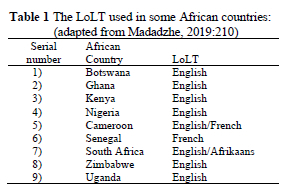
Proponents of Africanisation advocate for AL instruction in HE against the hegemonic (supreme) neocolonial influence of English (Nkoane, 2002). The linguistic reality in Table 1 suggests that not much success in Africanisation has been realised (Madadzhe, 2019; Ndille, 2018).
Justification for the predominance of English includes that English is an international language. Internationalisation extends access to HE (Chikuvadze & Mugijima, 2024) but it should not involve training AL teachers in a foreign language.
English is the LoLT in Uganda (Madadzhe, 2019; Ndofirepi et al., 2017) and one may suppose that it was through English that various forms of Africanisation as regionalisation and internationalisation were identified in Ugandan HE. These practices include programmes for academic staff pursuing their studies abroad; admission of international students; affording staff transnational joint publications; participation in international workshops and conferences; opportunities to join regional networks like the Association of African Universities (AAU) and the Inter-University Council for East Africa (IUCEA); credit transfer for tertiary students and engaging information communication technology (ICT) resources to provide services such as online learning and distance education (Ndofirepi et al., 2017). The listed opportunities in their global nature could be communicated in any designated language. Still, because teachers of ALs have to teach the subject using the indigenous language as MOI in schools, teacher training should be aligned.
Research in a mixed methods study undertaken in Ghana and Sierra Leone examined how young people perceived the revitalisation of indigenous languages (ILs) in multicultural environments. It was found that ILs were not only important in communication but also in the continuity of a cultural legacy (Adam, Thulla, Fofanah, Nyadu-Addo & Brewu, 2024). However, in addition to cultural assimilation, the study listed the dominance of foreign languages as a threat to the revivification of ILs.
With the advent of democracy, the Constitution of the Republic of South Africa, 1996, accorded official language status to nine indigenous ALs in addition to English and Afrikaans. The ALs are siSwati, isiNdebele, Xitsonga, isiXhosa, isiZulu, Setswana, Tshivenda, Sesotho, and Sepedi.
In 2002, the South African MOE developed an LP for HE (Bagwasi, 2015). The aim of the policy was "to promote multilingualism in institutional policies and practices of South African public HE institutions" (Department of Higher Education and Training [DHET], 2020:7). South African Sign Language was constituted as the 12th of South Africa's official languages in 2012. Having South African Sign language as an official language is paramount for inclusion because sign language is the first language of people with hearing impairment. The University of South Africa (UNISA) promotes all nine of South Africa's official indigenous ALs. Rhodes University's LP instructed the Department of African Languages to design strategies for language development (Bagwasi, 2015; Webb, 2013).
Webb (2013) notes minimal progress for language development in South Africa's LP with regard to a developed codification and graphisation of ALs. The Department of Basic Education's Annual National Assessment Report (2012; Webb, 2013) notes that teachers are sometimes not trained to teach ALs as subjects in the general education and training band (GET). The report adds that school managers sometimes seem to assume that an AL can be taught by anyone who speaks the language. The main concern in our study is that a colonial language is the MOI in the training of AL teachers.
In 2020 the LP framework for public HE institutions was introduced as an upgrade of the 2002 LP for HE in South Africa (MOE, 2002). The framework "seeks to address the challenge of the underdevelopment and underutilisation of official ALs in HE institutions while simultaneously sustaining the standard and utilisation of languages that are already developed" (DHET, Republic of South Africa [RSA], 2020:5). Interventions directed towards the Africanisation of the MOI in HE should consistently improve the low status of underdeveloped ALs (Bagwasi, 2015).
The relationship between siSwati and English
Currently, Eswatini has no national LP for HE (Kamwendo & Dlamini, 2016). Yet qualitative research in Eswatini identifies challenges in education LP planning and implementation (Dlamini, BS 2020; Kamwendo & Dlamini, 2016). Hence, scholars on language research registered a concern of teacher incompetence and poorly coordinated pedagogical knowledge and classroom practice in teaching siSwati in Eswatini schools (Dlamini, SM 2020; Mngometulu & Makgabo, 2023; Motsa, Bhebhe & Nxumalo, 2022). Mngometulu and Makgabo (2023) rightly argue against teachers' use of expository pedagogy in which teachers tend to teach de-contextualised language in first language classrooms. Our case study with pre-service teachers as participants is framed on Africanisation. Similarly, the context for first language learning in Africanisation is the learner's socio-cultural background, which is primarily African. LPs prescribe that language is taught as a subject/content area and used as MOI. The Africanisation of the MOI would entail acknowledging a learner's social environment and personal experiences regarding policy aspects of language learning by using siSwati as LoLT.
Meanwhile, integrating ICT in teaching siSwati is necessary for enhanced classroom practice (Mkhonta-Khoza & Nxumalo, 2021) because being an indigenous AL does not limit the teaching of siSwati to traditional or even obsolete methods and resources. When language teacher training also includes technology-based approaches in teaching ALs it may encourage creativity in student teachers.
Conceptual Framework
This study provides a new theoretical explanation using two main concepts on which the study was based: the predominance of colonial languages over indigenous ALs, and how teachers use language in the classroom.
The predominance of colonial languages over indigenous African languages Internationally, colonial languages dominate ILs (Dlamini, PA & Ferreira-Meyers, 2023; Mthombeni, 2024). The predominance of colonial languages, such as English, over indigenous ALs, affects learners adversely (Adamson, 2024; Miti, 2017). An Africanisation policy promotes and embraces all that is African, including languages.
Words used interchangeably with mother tongue include indigenous language, home language, native language, parent language, and vernacular, among others. In this study, the mother tongue, siSwati, as home language is the language of the child's family. Colonial powers using borders subdivided AL speakers to disempower and subject ALs to different colonial languages and cultures. As such, English is a second language in a country with its own local language (Nxumalo, 2022).
The issues subjected to critical evaluation were obtained from the perspectives of student teachers as second language learners of English also learning their mother tongue, siSwati, in English during teacher training. Teacher training in this study refers mainly to the experience in which a prospective teacher is formally equipped with knowledge and skills for effective instructional practice, usually in initial teacher education (ITE) (Taylor, 2016).
How teachers use language in the classroom
Language teaching is a profession. Language teaching includes using language as prescribed in the national LP for the grade level being taught. LPs may be documented as guides for language planning. A language policy forms part of the larger process of language planning (Dlamini, SM 2020; Johnson, 2011). Among widely acknowledged challenges of teaching and learning in an unfamiliar language as LoLT is unimpressive class participation demonstrated in limited classroom talk and rote memorisation (Adamson, 2024). A language problem culminates in an LP leading to language planning (Lo Bianco, 2010). For AL teachers to apply curriculum knowledge effectively in practice, the intention with the AL curriculum for ITE was that primary education should teach student teachers how to use the indigenous AL as an MOI. Like a parent, the AL teacher scaffolds language content adapting it to the learners' needs (Motsa et al., 2022).
Twenty-first century HE pedagogy engages blended learning pedagogy, which may not do away with the traditional siSwati classroom but extends it to digitalised instruction (Mkhonta-Khoza & Nxumalo, 2021; Wang, 2023). Blended learning is a teaching and learning model with the main purpose to use recent technology to stretch teaching and learning beyond the confines of the classroom (Wang, 2023). A flipped classroom (FC) is among the latest approaches recommended for teaching (siSwati) language at tertiary level (Wang, 2023). An FC means that "teachers and learners use social media as a platform to streamline the educational process" (Wang, 2023:239). Besides the motivation it has for teachers, an FC transforms classroom practice into a learner-centred model affording student teachers time for "interactive learning in a social media platform" (Wang, 2023:251). We advocate that Africanisation takes place alongside Anglicisation, prioritising indigenous ALs before English, especially in first language instruction.
Teachers are learners' role models in language learning. Language learning depends on vocabulary development supporting students working on texts, critical thinking skills and enhancing self-esteem (Dlamini, SM 2020). Children learn language by imitating seasoned speakers. Teachers should ensure that the language that learners are taught improves novice speakers' command of the language. The language teacher's use of English should also teach learners good vocabulary and acceptable semantic combinations. Teachers could schedule specific school days for IL communication and for English communication. Alongside other 21st-century means such as ICT, language communication skills (listening, speaking, reading, and writing) are central to language instruction (Dlamini, SM 2020; Nxumalo, 2022).
Methodology
The main question we sought to answer in this study was the following: What are student teachers' views and practices using English and siSwati in Eswatini schools? The first of two practical sub-questions crafted from the main research question was: What are the views of student teachers using English and siSwati in literacy teaching in Eswatini schools? The question was answered using semi-structured interviews. The second sub-question was: How do student teachers use English and siSwati in literacy teaching in Eswatini schools? Classroom observations provided answers to this question.
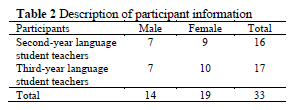
This qualitative case study was undertaken at a teachers' college training primary school teachers in Eswatini. Using the college and two primary schools enabled the observation of student teachers trained in English to teach siSwati. Purposively sampled participants comprised 16 language student teachers in their second year and 17 language student teachers in their third year. Language student teachers in the second year had done 6 weeks of teaching practice. In the third year, language student teachers had experienced 12 weeks of classroom attachment.
The language student teachers confirmed that they spoke English and siSwati, the latter being their home language. The 33 language student teachers were interviewed on the following themes:
1) practices of student teachers using English and siSwati in literacy teaching in Eswatini schools,
2) advantages of the LP in Eswatini,
3) disadvantages of the LP in Eswatini, 4) benefits experienced by student teachers trained in English to teach siSwati at primary school, 5) challenges experienced by student teachers trained in English to teach siSwati at primary school.
Using classroom observations, we explored how student teachers supported the learning of literacy in the AL, siSwati. Ten language student teachers were observed; five in each of two primary schools. Each student teacher taught a primary school grade and a siSwati lesson topic from the primary school curriculum for siSwati.
A part of the data was obtained from analysis of teaching and policy documents (Creswell, 2015), namely 10 siSwati lesson plans used in teaching for classroom observations, the National Education and Training Improvement Programme ([NETIP] The Government of the Kingdom of Eswatini, MOET, 2018), the NETIP I (MOET, 2013) and Syllabuses of the Teachers Colleges (MOE, 1987).
Atlas.ti enabled the management and organisation of the semi-structured interview and classroom observation data. Data were all thematically analysed. Case study requires a rich, thick description, but time constraints limited a richer case study experience in the field for more classroom observations. Data were, however, validated by using triangulation (Bhandari, 2023) and member checking for data confirmation (Creswell, 2015). Triangulation reduces weaknesses of qualitative research (Donkoh & Mensah, 2023). We obtained informed consent from the participants (Creswell, 2015). In reporting the findings we used (siSwati) pseudonyms to protect participants' identity.
Findings
The two objectives to achieve the purpose of this study were to: 1) determine student teachers' views on using English and siSwati in Eswatini schools; and 2) obtain student teachers' practices using English and siSwati in Eswatini schools. Informed by the objectives, two themes emerged from the data analysis:
• the predominance of English over indigenous ALs; and
• how language teachers teach literacy in the classroom.
The Predominance of English Over Indigenous African Languages
Views of student teachers using English and siSwati in Eswatini schools
English is a second and international language According to some student teachers English is a language natural to the United Kingdom acquired as a second language by native speakers of siSwati in Eswatini. Other student teachers commended the national LP of Eswatini for including English as a second official language. Most student teachers reported that Swati children often learnt English in schools as a second language but one student teacher (Kanjalo) argued that siSwati is learnt as a second language because English is overemphasised. Other student teachers regarded English as a language of the West, associated with British colonial power. For instance, a ST fondly used the common reference to English "... lwaGeorge [King George's language] ..." (Mbonge) alluding to Eswatini's colonial history with the British. King George V was Queen Elizabeth II's father; a British king who visited Eswatini during the reign of King Sobhuza II and addressed the Swati people in his language, English (interpreted), at what is now called King Sobhuza II Memorial Stadium in Nhlangano, Eswatini. Student teachers' views alluded to the power and international advantage that English commands as a language native to the British, former colonisers of Eswatini.
Many student teachers (STs) described English as an international communication tool, "English lately is regarded as a language of international communication. English is a universal language" (Nkhulumo). As an international language, "English is a lingua franca that makes a Xhosa or maybe I can say an American to be in mutual understanding with a Zulu or Swati" (Khalima). ST33 also explained that "[a] lingua franca is a language that connects other languages." English dominates indigenous ALs including isiZulu, isiXhosa and siSwati. Another ST concluded that rural Swati learners understand siSwati better but also need to learn English. "[U]sing one language, maybe siSwati would limit the learner closing opportunities for further education in universities outside the borders of Swaziland [Eswatini]. English will help the learner to communicate with other learners outside the country" (Singemaswati). The position of English as international language presents advantages and a huge challenge for teachers and LP in education.
English is an industrial language
STs highlighted the popular use of English in business transactions. They also noted that documents used in government offices were mostly in English. "English is a language called a corporate language. So, then siSwati they feel like is useless than the English which is elevated in everything" (Siyetsaba). As a result, "... English is made to dominate." Then "... job interviews ... demand credits in English" (Lisimeme). National education policies align to internationalisation promoting English as corporate language.
English is an administration, admission and entry requirement
STs felt obliged to communicate in English as soon as they entered the principal's office and expressed concern about English as admission/entry requirement in institutions of higher learning. Lisimeme stated that "... higher education admissions demand credits in English" and added that "...others are in fact not there in universities because of English." "I passed Form 5 but failed English. I had to rewrite English for 3 years before I was admitted to the college. I could not go to university." Admission into the Primary Teachers Diploma programme (PTD), in the college requires a pass in English (MOE, 1987). In spite of good results in other subjects, many applicants have been barred from accessing post-secondary education due to insufficient English proficiency.
English as medium of instruction
Regarding teaching and learning, almost all interviewees stated that English was the main MOI in Eswatini and the only MOI at the college, something others regarded as undermining siSwati. STs reported that English was also used to train teachers of siSwati. "The college encourages students to use English language even when learning siSwati" (Mbonge). On English as LoLT, Ngemfundvo elaborated that, "[w]hen a teacher is trained in the teachers colleges in Eswatini, siSwati is taught in English. All components of the siSwati curriculum no matter how cultural they are were taught in English."
Document analysis affirms the dominance of English in that 1) the first aims of teaching English and communication skills in the Syllabuses of the Teachers Colleges (MOE, 1987) prescribes English as MOI for teaching all subjects in the (PTD) programme of colleges in Eswatini, and 2) English is the language with which the subject content in the Syllabuses of the Teachers Colleges (MOE, 1987) is outlined, even the siSwati syllabus. This is a problem because "[t]his language policy presents the two official languages, siSwati and English as if they are equal whereas practically one of the languages is accorded a high status" (Tekufika). Consequently, STs concluded that because teachers of siSwati are trained in English, siSwati is marginalised.
Class participation and content comprehension are tagged on English
STs were of the opinion that participation in classes and understanding the content was not problematic for students who understood English. "When the lecturer asks questions only the few that understand English, will respond' (Sisonkhe). Emotions such as being "... afraid to break English ..." (Nkhulumo) contribute to non-participation by some STs. More so, if the lecturer speaks English in a hurried tone, some STs felt that it complicated the situation for those who lacked English competence. STs noted that conducting instruction in English cripples class participation and content comprehension.
Teacher training versus practice
STs commended the importance of teaching practice to perfect their teaching but raised the need to align (language) teacher training with practice.
"In micro-teaching, student teachers teach other student teachers who pose as school children" (Khalima). "In the schools, they (student teachers) will not teach siSwati in English. We teach siSwati in siSwati", Lokuhle observed.
"The primary school siSwati books and the games are written in the siSwati language" (Tekufika). Training teachers in English to teach siSwati is a challenge because the learners who will be taught by the ST in primary school will be emerging speakers also beginning to grasp literacy in their language.
English is used to teach siSwati
All but one ST revealed that STs mixed siSwati with English when teaching siSwati. Some STs stated that STs ended up hating siSwati because it was taught in English in teacher training. "[W]hen these teachers get to the field of teaching, they should use siSwati to teach siSwati" (Ngemfundvo). "When you train the siSwati teacher in English, she or he will master the English" (Tihloniphe). The aim of language teaching is to facilitate language competence and proficiency. Language subject matter in teacher education is two-fold, involving language content and methodology. "It becomes a challenge to teach siSwati in siSwati when trained in English" (Lavuka). Tekufika elaborated that "[t]he student teacher holds on to the English in the schools and fails to teach siSwati." Some STs said that they felt "guilty'' when using English while teaching siSwati. "7ou are training children to mix language", Lavuka observed, and added that, "[m]ost training teachers are full of English." Kwakhanya claimed that "English is simpler than siSwati where siSwati is deep. " Primary school children should learn siSwati in siSwati. Teaching siSwati should not confuse learners. Besimanje submitted that contemporary literacy instruction benefits from using mixed language pedagogy because some learners may understand one of the languages better. The intention is to teach siSwati -not mixed languages. So, teaching siSwati in English at college and in schools is contrary to linguistic Africanisation. Hence, Ngeletfu concluded that, "[a] teacher should not mix languages when teaching siSwati." Learners acquire language mostly by imitating the teacher and other language role models. If STs mix English and siSwati when teaching siSwati, learners may also end up mixing languages like the teachers.
However, the policy on language in education does not clearly state the language for teaching siSwati beyond the first four grades in Eswatini schools. It is assumed that siSwati is the MOI for teaching siSwati in schools.
Khalima suggested that if an ST is passionate about learning to teach siSwati they may have to specialise in that language and learn all subject content in siSwati. This option would co-exist parallel to that of another group learning siSwati in English in the same teacher training programme.
How Language Teachers Teach Literacy in the Classroom
How student teachers use English and siSwati in literacy teaching in Eswatini schools
siSwati teacher professionalism SiSwati lessons were prepared for the classroom observations. Teaching aids were prepared to support the delivery of siSwati content. Most STs read and prepared well in advance to be slightly more informed about siSwati subject content than the learners.
Actual classroom practice
Practice demonstrated the predominance of English in that a) STs' lesson plans for teaching siSwati included some English with translations in the siSwati orthography, and b) teachers would sometimes use English when teaching siSwati.
Findings from the classroom observations indicate that all 10 STs observed used English in teaching siSwati at all the primary school levels (grades). Using English to teach siSwati was prevalent in classroom practices of STs. For instance, while an ST used the date to introduce the siSwati lesson, English was used by the student teacher trainee and learners.
Consider the following excerpts with English translations in brackets.
Student teacher (Mdlandla): "Tingakhi namuhla?"
(What is the date today?)
Learner: "Tingu July." (It is July.)
Student teacher: "Yes." Tingu (15).
Angitsi: "Yes, sukuma" (Calling a child to the front). "Okay - ke bantfwabami. Namuhla sitofundza siSwati niyeva mosi?"
(Yes. It is the 15th. Is it? Yes, stand up. [Calling a child to the front]. Okay-then my children. Today we are going to learn siSwati, you hear me, is it?)
Class: "Yes."
Another ST (Besimanje) used English words despite trying to adhere to siSwati.
Student teacher: "Okay. Asesivuleni kupage ...lipage lemashumi la... emashumi lasitfupha nakubili. E ... e ... (stammers) nesiphohlongo. Emashumi lasitfupha nesiphohlongo. Sesivulile sonkhe? Okay. Okay. Niyatibona letitfombe leti? Okay, asesibukeni nangu wekucala."
(Okay. Let's open page ... the page of... 10s ... page 62. Eh ... eh ... (stammers) and eight. Sixty-eight. Have we all opened? Okay. Okay. Do you see those pictures? Okay, let's look at the first person.)
Evidently, STs struggled to find siSwati equivalents of some English words. Using the English words such as "yes" "fifteen" "okay" "page" "sixty-eight" to teach siSwati deprived learners of the siSwati terms for these concepts.
The NETIP I (MOET, 2013) document indicates that teachers should use both English and siSwati in their lessons. The NETIP I (MOET, 2013) indicates that language teachers engage code-mixing (the change of one language to another within the same utterance or in the same oral or written text) and code-switching (a practice in which bilinguals change between two or more languages when speaking). The document suggests that code-mixing and code-switching is cause for concern.
Mbonge creatively used a cell phone as aid in a Grade 3 siSwati lesson on colours and aroused learners' interest. Innovative ideas using technology in teaching siSwati were encouraged. However, teaching methods used to teach siSwati sometimes promoted rote memorisation and content regurgitation. In the National Education and Training Improvement Programme (The Government of the Kingdom of Eswatini, MOET, 2018), choice of teaching methods was an issue.
Language teachers are experts in their field. A language lesson is effectively and optimally taught in that language, so that learners embrace the language in its entirety. Therefore, teachers must be trained in siSwati to teach it effectively. Of concern is the contradiction that teachers of siSwati are being trained in English, but siSwati is being taught in siSwati in the schools.
Discussion
The STs indicated that English was prominent in the Eswatini policy on language in education because English is a second (official) language, an international language, and a corporate language. English dominates the education system in Eswatini (Dlamini, BS 2020; Mkhonta-Khoza & Nxumalo, 2021). Bamgbose (2011) notes that colonial languages bask in official language status in former colonies. English is the native language of the former colonial British masters. As a result, STs were of the opinion that siSwati as mother tongue, national language and transmitter of Swati culture was devalued.
STs also reported that English was an admission/entry requirement and official communication at the college. This finding echoes those in a study by Kamwendo and Dlamini (2016) on a Zimbabwean university campus in Eswatini. That (study) had language planning as theoretical lens. This research at a teacher training college highlights a need to Africanise the primary school teacher training curriculum in Eswatini.
STs in the public teachers college in Eswatini said that they learnt their AL, siSwati, in English. Within the South African context, Hungwe and Mkhize (2022) and Msila (2014) contend that African intellectuals are not eager to use ALs as MOI. According to Heugh (2011a), training AL teachers in their native languages is cheaper.
Some views were that the absence of equity in language use at the college affected participation in classes. Similarly, Adamson's (2024) study on "fear and shame" holds that unimpressive class participation among students has underlying socio-emotional factors. This study affirms Adamson's study because STs expressed emotions such as being afraid "to break English."
Meanwhile, language STs' practices demonstrated a professional aspect to literacy instruction when teaching the AL, siSwati, despite the fact that the attitudes of educated Africans towards ALs are often negative (Msila, 2014; Wa Thiong'o, 2006). STs had lesson plans, therefore, their teaching of siSwati was organised.
However, all STs were code-mixing and code-switching between English and siSwati when teaching siSwati. Learners, like their teachers, also used mixed language during the siSwati lessons. Mixing language is linguicidal (kills the language) (Etieyibo, 2016; Horsthemke, 2004). One symptom of language death is when speakers of a language fail to complete a sentence without mixing languages.
In STs' teaching, rote memorisation and content reproduction were dominant teaching methods. Recent studies by language scholars in Eswatini (Dlamini, SM 2020; Mngometulu & Makgabo, 2023; Motsa et al., 2022) also found that pedagogical content knowledge and teachers' practice were not aligned. In this study we explored the practice of pre-service teachers.
Conclusion
SiSwati and English are official languages with unequal status in Eswatini. English dominates the indigenous AL and teacher training in Eswatini is also dominated by English. The LoLT in teacher training in Eswatini is English and is also used to teach siSwati. Swati STs learn their mother tongue, siSwati, through the medium of English. Using English to train siSwati teachers affects the academic performance of some STs.
The findings suggest that in-service teaching and ITE in Eswatini are ill-aligned. STs are trained in English to teach siSwati but teach siSwati in siSwati in the schools.
Additionally, there was no identified national language policy for higher education in Eswatini. The predominance of English is a practical threat to the indigenous African language because it affects teachers, implementers of the country's language in education policies and subsequently, the learners.
We provide practical suggestions to improve teacher education, even for other practitioners of language teacher education by suggesting the following: 1) Africanise siSwati language teacher education in policy and practice, 2) update siSwati orthography, 3) support teachers of siSwati to promote the language in the classroom, and 4) marry siSwati language literacy to technology.
We call for linguistically responsive policies and practices in education planning, curriculum development, in-service training and national examinations, among others.
Recommendations for teacher education include that primary school teacher training should be focused in the teaching medium. Suggestions for further research could be on exploring views and experiences of siSwati lecturers on combining technology and traditional resources in training teachers of siSwati.
Authors' Contributions
Professor Everard Weber guided and supported me (Sellinah Nelisiwe Phiri) in completing the PhD study of which the findings are presented here.
Notesi. This article is based on the doctoral thesis of Sellinah Nelisiwe Phiri.
ii. Published under a Creative Commons Attribution Licence.
Acknowledgement
Guidance and support from the supervisor on my Doctor of Philosophy (PhD) dissertation, Professor Everard Weber, made the publication of this research article possible.
References
-
Adam D, Thulla PFY, Fofanah IM, Nyadu-Addo R & Brewu JK 2024. The perceptions of indigenous language and cultural synergy in Ghana and Sierra Leone: A cross-cultural study. E-Journal of Humanities, Arts and Social Sciences, 5(5):701-716. https://doi.org/10.38159/ehass.20245510
» https://doi.org/10.38159/ehass.20245510 -
Adamson L 2024. Fear and shame: Students' experiences in English-medium secondary school classrooms in Tanzania. Journal of Multilingual and Multicultural Development, 45(8):3275-3290. https://doi.org/10.1080/01434632.2022.2093357
» https://doi.org/10.1080/01434632.2022.2093357 -
Alexander N 2012. The centrality of the language question in post-apartheid South Africa: Revisiting a perennial issue. South African Journal of Science, 108(9/10):Art.#1443, 7 pages. https://doi.org/10.4102/sajs.v108i9/10.1443
» https://doi.org/10.4102/sajs.v108i9/10.1443 -
Alidou H 2011. Use of African languages for literacy: Conditions, factors and processes in Benin, Burkina Faso, Cameroon, Mali, Tanzania and Zambia. In A Ouane & C Glanz (eds). Optimising learning, education and publishing in Africa: The language factor: A review and analysis of theory and practice in mother-tongue and bilingual education in sub-Saharan Africa. Hamburg, Germany: UNESCO Institute for Lifelong Learning. Available at https://unesdoc.unesco.org/in/documentViewer.xhtml?v=2.1.196&id=p::usmarcdef_0000212602&file=/in/rest/annotationSVC/DownloadWatermarkedAttachment/attach_import_d4974c27-4272-4cff-9aed-41cdad1c0537%3F_%3D212602eng.pdf&locale=en&multi=true&ark=/ark:/48223/pf0000212602/PDF/212602eng.pdf#%5B%7B%22num%22%3A784%2C%22gen%22%3A0%7D%2C%7B%22name%22%3A%22XYZ%22%7D%2Cnull%2Cnull%2C0%5D. Accessed 26 June 2025.
» https://unesdoc.unesco.org/in/documentViewer.xhtml?v=2.1.196&id=p::usmarcdef_0000212602&file=/in/rest/annotationSVC/DownloadWatermarkedAttachment/attach_import_d4974c27-4272-4cff-9aed-41cdad1c0537%3F_%3D212602eng.pdf&locale=en&multi=true&ark=/ark:/48223/pf0000212602/PDF/212602eng.pdf#%5B%7B%22num%22%3A784%2C%22gen%22%3A0%7D%2C%7B%22name%22%3A%22XYZ%22%7D%2Cnull%2Cnull%2C0%5D -
Bagwasi MM 2015. Multilingual universities in South Africa reflecting society in higher education. Current Issues in Language Planning, 16(1-2):173-180. https://doi.org/10.1080/14664208.2014.992195
» https://doi.org/10.1080/14664208.2014.992195 -
Bamgbose A 2011. African languages today: The challenge of and prospects for empowerment under globalisation. In EG Bokamba, RK Shosted & BT Ayalew (eds). Selected proceedings of the 40th annual conference on African linguistics. Somerville, MA: Canadilla Proceedings Project. Available at https://www.lingref.com/cpp/acal/40/paper2561.pdf. Accessed 26 June 2025.
» https://www.lingref.com/cpp/acal/40/paper2561.pdf -
Bhandari P 2023. Triangulation in research | Guide, types, examples. Available at https://www.scribbr.com/methodology/triangulation. Accessed 27 July 2024.
» https://www.scribbr.com/methodology/triangulation -
Chikuvadze P & Mugijima S 2024. Harmonisation of higher education for sustainable development: Southern Africa Development Community experiences. E-Journal of Humanities, Arts and Social Sciences (EHASS), 5(3):205-216. https://doi.org/10.38159/ehass.2024534
» https://doi.org/10.38159/ehass.2024534 - Creswell JW 2015. Educational research: Planning, conducting, and evaluating quantitative and qualitative research (5th ed). Boston, MA: Pearson Education.
- Department of Basic Education 2012. Annual national assessment report.
- Department of Higher Education and Training, Republic of South Africa 2020. Higher Education Act (101/1997): Language Policy Framework for Public Higher Education Institutions determined in terms of section 27(2) of the Higher Education Act, 101 of 1997 as amended. Government Gazette, 664 (43860):1-20, October 30.
-
Dlamini BS 2020. An education system in contradiction: Eswatini English language non-passing or failing subject policy, critical thinking skills and thinking disposition. IOSR Journal of Humanities and Social Science (IOSR-JHSS), 25(8):47-60. https://doi.org/10.9790/0837-2508054760
» https://doi.org/10.9790/0837-2508054760 -
Dlamini PA & Ferreira-Meyers K 2023. First language instruction? Eswatini teachers' insight of the Eswatini language-in-education policy. Southern African Linguistics and Applied Language Studies, 41(2):143-157. https://doi.org/10.2989/16073614.2022.2106256
» https://doi.org/10.2989/16073614.2022.2106256 -
Dlamini SM 2020. Language policy and practice at a secondary school in Manzini: The case of teaching and learning in Form 4. PhD thesis. Durban, South Africa: University of KwaZulu Natal. Available at https://researchspace.ukzn.ac.za/server/api/core/bitstreams/18ca4cda-34ca-4841-afd3-2d08ea7a2fff/content. Accessed 25 June 2025.
» https://researchspace.ukzn.ac.za/server/api/core/bitstreams/18ca4cda-34ca-4841-afd3-2d08ea7a2fff/content -
Donkoh S & Mensah J 2023. Application of triangulation in qualitative research. Journal of Applied Biotechnology and Bioengineering, 10(1):6-9. https://doi.org/10.15406/jabb.2023.10.00319
» https://doi.org/10.15406/jabb.2023.10.00319 -
Etieyibo E 2016. Why ought the philosophy curriculum in universities in African be Africanised? South African Journal of Philosophy, 35(4):404-117. https://doi.org/10.1080/02580136.2016.1242208
» https://doi.org/10.1080/02580136.2016.1242208 -
Heugh K 2011a. Cost implications of the provision of mother-tongue and strong bilingual models of education in Africa. In A Ouane & C Glanz (eds). Optimising learning, education and publishing in Africa: The language factor: A review and analysis of theory and practice in mother-tongue and bilingual education in sub-Saharan Africa. Hamburg, Germany: UNESCO Institute for Lifelong Learning. Available at https://unesdoc.unesco.org/in/documentViewer.xhtml?v=2.1.196&id=p::usmarcdef_0000212602&file=/in/rest/annotationSVC/DownloadWatermarkedAttachment/attach_import_d4974c27-4272-4cff-9aed-41cdad1c0537%3F_%3D212602eng.pdf&locale=en&multi=true&ark=/ark:/48223/pf0000212602/PDF/212602eng.pdf#%5B%7B%22num%22%3A784%2C%22gen%22%3A0%7D%2C%7B%22name%22%3A%22XYZ%22%7D%2Cnull%2Cnull%2C0%5D. Accessed 26 June 2025.
» https://unesdoc.unesco.org/in/documentViewer.xhtml?v=2.1.196&id=p::usmarcdef_0000212602&file=/in/rest/annotationSVC/DownloadWatermarkedAttachment/attach_import_d4974c27-4272-4cff-9aed-41cdad1c0537%3F_%3D212602eng.pdf&locale=en&multi=true&ark=/ark:/48223/pf0000212602/PDF/212602eng.pdf#%5B%7B%22num%22%3A784%2C%22gen%22%3A0%7D%2C%7B%22name%22%3A%22XYZ%22%7D%2Cnull%2Cnull%2C0%5D -
Heugh K 2011b. Theory and practice - language education models in Africa: Research, design, decision-making and outcomes. In A Ouane & C Glanz (eds). Optimising learning, education and publishing in Africa: The language factor: A review and analysis of theory and practice in mother-tongue and bilingual education in sub-Saharan Africa. Hamburg, Germany: UNESCO Institute for Lifelong Learning. Available at https://unesdoc.unesco.org/in/documentViewer.xhtml?v=2.1.196&id=p::usmarcdef_0000212602&file=/in/rest/annotationSVC/DownloadWatermarkedAttachment/attach_import_d4974c27-4272-4cff-9aed-41cdad1c0537%3F_%3D212602eng.pdf&locale=en&multi=true&ark=/ark:/48223/pf0000212602/PDF/212602eng.pdf#%5B%7B%22num%22%3A784%2C%22gen%22%3A0%7D%2C%7B%22name%22%3A%22XYZ%22%7D%2Cnull%2Cnull%2C0%5D. Accessed 26 June 2025.
» https://unesdoc.unesco.org/in/documentViewer.xhtml?v=2.1.196&id=p::usmarcdef_0000212602&file=/in/rest/annotationSVC/DownloadWatermarkedAttachment/attach_import_d4974c27-4272-4cff-9aed-41cdad1c0537%3F_%3D212602eng.pdf&locale=en&multi=true&ark=/ark:/48223/pf0000212602/PDF/212602eng.pdf#%5B%7B%22num%22%3A784%2C%22gen%22%3A0%7D%2C%7B%22name%22%3A%22XYZ%22%7D%2Cnull%2Cnull%2C0%5D - Hofstee E 2006. Constructing a good dissertation: A practical guide to finishing a Master's, MBA or PhD on schedule. Sandton, South Africa: EPE.
-
Horsthemke K 2004. Knowledge education and the limits of Africanisation. Journal of Philosophy of Education, 38(4):571-587. https://doi.org/10.1111/j.0309-8249.2004.00405.x
» https://doi.org/10.1111/j.0309-8249.2004.00405.x -
Hungwe JP & Mkhize TR 2022. The Africanisation of universities in Africa: Reclamation of humanity and rationality. CRISTAL, 10(1):136-152. https://doi.org/10.14426/cristal.v10i1.487
» https://doi.org/10.14426/cristal.v10i1.487 -
Jansen J 2023. The problem with decolonisation: Entanglements in the politics of knowledge. The Journal of Modern African Studies, 61(1):139-156. https://doi.org/10.1017/S0022278X23000162
» https://doi.org/10.1017/S0022278X23000162 -
Johnson DC 2011. Critical discourse analysis and the ethnography of language policy. Critical Discourse Studies, 8(4):267-279. https://doi.org/10.1080/17405904.2011.601636
» https://doi.org/10.1080/17405904.2011.601636 -
Kamwendo GH & Dlamini NP 2016. Language planning at a cross-border university in Swaziland: The case of teaching and learning, research and institutional administration. Current Issues in Language Planning, 17(3-4):298-310. https://doi.org/10.1080/14664208.2016.1213150
» https://doi.org/10.1080/14664208.2016.1213150 - Kaya HO, Kamwendo GH & Rushubirwa L 2016. African indigenous languages in higher education. Studies of Tribes and Tribals, 14(2):121-128.
-
Letsekha T 2013. Revisiting the debate on the Africanisation of higher education: An appeal for a conceptual shift. The Independent Journal of Teaching and Learning, 8:5-18. Available at https://journals.co.za/doi/epdf/10.10520/EJC145143. Accessed 25 June 2025.
» https://journals.co.za/doi/epdf/10.10520/EJC145143 -
Lo Bianco J 2010. The importance of language policies and multilingualism for cultural diversity. International Social Science Journal, 61(199):37-67. https://doi.org/10.1111/j.1468-2451.2010.01747.x
» https://doi.org/10.1111/j.1468-2451.2010.01747.x -
Madadzhe RN 2019. Using African languages at universities in South Africa: The struggle continues. Stellenbosch Papers in Linguistics Plus, 58:205-218. https://doi.org/10.5842/58-0-843
» https://doi.org/10.5842/58-0-843 -
Madondo SH 2023. The implementation of tertiary education language policy: A case of the language policy of the University of KwaZulu-Natal Pietermaritzburg campus. MEd dissertation. Pietermaritzburg, South Africa: University of KwaZulu-Natal. Available at https://researchspace.ukzn.ac.za/server/api/core/bitstreams/e8c57f9d-67a9-45cb-9603-efbd8664fd37/content. Accessed 23 June 2025.
» https://researchspace.ukzn.ac.za/server/api/core/bitstreams/e8c57f9d-67a9-45cb-9603-efbd8664fd37/content - Makgoba MW 1997. Mokoko: The Makgoba affair: A reflection on transformation. Florida, FL: Vivlia.
-
Maringe F 2017. Transforming knowledge production systems in the new African university. In M Cross & A Ndofirepi (eds). Knowledge and change in African universities (Vol. 2). Boston, MA: Sense. https://doi.org/10.1007/978-94-6300-845-7_1
» https://doi.org/10.1007/978-94-6300-845-7_1 -
Mbatha TA 2016. Ideologies shaping language choices: Views of African students on isiZulu modules in Higher Education at the University of KwaZulu-Natal. Nordic Journal of African Studies, 25(2):146-166. Available at https://njas.fi/njas/article/view/114/107. Accessed 23 June 2025.
» https://njas.fi/njas/article/view/114/107 - Ministry of Education 1987. Syllabuses of the teachers colleges. Mbabane, Swaziland.
-
Ministry of Education 2002. Language policy for higher education. Available at https://www.dhet.gov.za/HED%20Policies/Language%20Policy%20for%20Higher%20Education.pdf. Accessed 23 June 2025.
» https://www.dhet.gov.za/HED%20Policies/Language%20Policy%20for%20Higher%20Education.pdf -
Ministry of Education and Training, The Government of the Kingdom of Swaziland 2011. The Swaziland education and training sector policy. Mbabane, Swaziland: Swaziland Government Press. Available at https://planipolis.iiep.unesco.org/sites/default/files/ressources/swazilandeducationsectorpolicy2011.pdf. Accessed 27 March 2023.
» https://planipolis.iiep.unesco.org/sites/default/files/ressources/swazilandeducationsectorpolicy2011.pdf - Ministry of Education and Training 2013. National Education and Training Improvement Plan (NETIP I). Mbabane, Swaziland.
-
Ministry of Education and Training, The Government of the Kingdom of Eswatini 2018. National education and training sector policy. Mbabane, Eswatini: Author. Available at https://www.unicef.org/eswatini/media/336/file/UNICEF-SD-Education-Sector-Policy-report-2018.pdf. Accessed 27 March 2023.
» https://www.unicef.org/eswatini/media/336/file/UNICEF-SD-Education-Sector-Policy-report-2018.pdf - Miti LM 2017. Africanisation of the study of African languages and linguistics in African universities. In M Cross & A Ndofirepi (eds). Knowledge and change in African universities (Vol. 2). Boston, MA: Sense.
-
Mkhonta-Khoza PP & Nxumalo MS 2021. ICT in language learning: Teaching and learning of the mother tongue siSwati. International Journal of Research in Humanities and Social Studies, 8(6):19-27. https://doi.org/10.22259/2694-6296.0806003
» https://doi.org/10.22259/2694-6296.0806003 -
Mngometulu TC & Makgabo C 2023. Pedagogical practices in teaching SiSwati as a first language in diverse linguistic settings. JOLT Journal of Language and Language Teaching, 11(1):1 -13. https://doi.org/10.33394/jolt.v%vi%i6567
» https://doi.org/10.33394/jolt.v%vi%i6567 -
Motsa L, Bhebhe S & Nxumalo Z 2022. Instructional strategies used in teaching SiSwati language in the Kingdom of Eswatini primary schools. International Journal of Research Publication and Reviews, 3(6):1671-1678. Available at https://www.researchgate.net/profile/Sithulisiwe-Bhebhe/publication/368837096_Instructional_Strategies_Used_In_Teaching_Siswati_Language_In_The_Kingdom_Of_Eswatini_Primary_Schools/links/63fcacc70cf1030a5657c565/Instructional-Strategies-Used-In-Teaching-Siswati-Language-In-The-Kingdom-Of-Eswatini-Primary-Schools.pdf. Accessed 23 June 2025.
» https://www.researchgate.net/profile/Sithulisiwe-Bhebhe/publication/368837096_Instructional_Strategies_Used_In_Teaching_Siswati_Language_In_The_Kingdom_Of_Eswatini_Primary_Schools/links/63fcacc70cf1030a5657c565/Instructional-Strategies-Used-In-Teaching-Siswati-Language-In-The-Kingdom-Of-Eswatini-Primary-Schools.pdf -
Msila V 2014. Africa must take pride of place in higher education. Mail and Guardian, 14 November. Available at https://mg.co.za/article/2014-11-13-africa-must-take-pride-of-place-in-higher-education/. Accessed 22 June 2025.
» https://mg.co.za/article/2014-11-13-africa-must-take-pride-of-place-in-higher-education/ -
Mthombeni ZM 2024. The development of African languages as the medium of instruction in higher education: From policy to practice. E-Journal of Humanities, Arts and Social Sciences, 5(2):100-111. https://doi.org/10.38159/ehass.2024523.
» https://doi.org/10.38159/ehass.2024523 -
Ndille RN 2018. Educational transformation in post independence Africa: A historical assessment of the Africanisation project. [Preprint]. https://doi.org/10.20944/preprints201808.0062.v1
» https://doi.org/10.20944/preprints201808.0062.v1 - Ndofirepi A, Mngomezulu B & Cross M 2017. Internationalisation, regionalization and Africanization: A critical gaze. In J Knight & ET Woldegiorgis (eds). Regionalization of African higher education: Progress and prospects. Rotterdam, The Netherlands: Sense.
- Nkoane MM 2002. Constructing knowledge through learner-centred approach. Paper presented at the University of Witwatersrand, Johannesburg, South Africa.
-
Nxumalo ZG 2022. Teacher' s experiences of teaching siSwati as a second language in urban senior secondary schools in the Lubombo region of Eswatini. International Journal of Creative Research Thoughts (IJCRT), 10(7):d845-d855. Available at https://www.researchgate.net/publication/368882896_Teacher's_Experiences_of_Teaching_siSwati_As_A_Second_Language_In_Urban_Senior_Secondary_Schools_in_the_Lubombo_Region_of_Eswatini. Accessed 21 June 2025.
» https://www.researchgate.net/publication/368882896_Teacher's_Experiences_of_Teaching_siSwati_As_A_Second_Language_In_Urban_Senior_Secondary_Schools_in_the_Lubombo_Region_of_Eswatini -
Prah KK 2016. Has Rhodes fallen? Decolonizing the humanities in Africa and constructing intellectual sovereignty. Paper presented at the Academy of Science of South Africa (ASSAF) Inaugural Humanities Lecture, Pretoria, South Africa, 20 October. Available at https://hsrc.ac.za/uploads/pageContent/7901/Has%20Rhodes%20Fallen.docx%20ASSAF%20Address%2015.2.2017.pdf. Accessed 27 June 2025.
» https://hsrc.ac.za/uploads/pageContent/7901/Has%20Rhodes%20Fallen.docx%20ASSAF%20Address%2015.2.2017.pdf - Republic of South Africa 1996. The Constitution of the Republic of South Africa (Act 108 of1996). Pretoria: Government Printer.
-
Sebola M & Mogoboya MJ 2020. Re-imagining Africanisation of sustainable epistemologies and pedagogies in (South) African higher education: A conceptual intervention. South African Journal of Higher Education, 34(6):237-254. https://doi.org/10.20853/34-6-4078
» https://doi.org/10.20853/34-6-4078 -
Simayi A & Webb P 2020. "Asibizi": Teaching human reproduction in Eastern Cape schools. In epiSTEME 8, International Conference to Review Research in Science, Technology and Mathematics Education, January 3 - 6 2020. Mumbai, India: Homi Bhabha Centre for Science Education, TIFR. Available at https://www.readkong.com/page/asibizi-teaching-human-reproduction-in-rural-eastern-3531958. Accessed 31 August 2025.
» https://www.readkong.com/page/asibizi-teaching-human-reproduction-in-rural-eastern-3531958 - Sukati Z 2020. English a passing subject here - UNESWA. Eswatini Observer.
-
Taylor N 2016. Thinking, language and learning in initial teacher education. Perspectives in Education, 34(1):10-26. https://doi.org/10.18820/2519593X/pie.v34i1.2
» https://doi.org/10.18820/2519593X/pie.v34i1.2 -
The Government of the Kingdom of Eswatini, Ministry of Education and Training 2018. The National Education and Training Improvement Programme 2018/19-2020/2021. "Improving the quality of Education in the sustainable and inclusive growth of Eswatini. " Mbabane, Eswatini: Author. Available at https://planipolis.iiep.unesco.org/sites/default/files/ressources/eswatini_netip.pdf. Accessed 3 July 2025.
» https://planipolis.iiep.unesco.org/sites/default/files/ressources/eswatini_netip.pdf - Vilakazi HW 2000. The problem of education in Africa. In P Higgs, NCG Vakalisa, TV Mda & NT Assie-Lumumba (eds). African voices in education. Lansdowne, South Africa: Juta.
-
Wang X 2023. A conceptual review on EFL teachers' motivation and engagement in flipped classrooms: A social networking platform. Language Related Research, 14(3):239-264. https://doi.org/10.29252/LRR.14.3.10
» https://doi.org/10.29252/LRR.14.3.10 - Wa Thiong'o N 2006. Decolonising the mind: The politics of language in African literature. Oxford, England: James Currey Ltd.
-
Webb V 2013. African languages in post-1994 education in South Africa: Our own Titanic? Southern African Linguistics and Applied Language Studies, 31(2):173-184. https://doi.org/10.2989/16073614.2013.815986
» https://doi.org/10.2989/16073614.2013.815986 -
Zulu P 2023. "Decolonisation" and "Africanisation" of knowledge: Politico-ideological or educational concepts? British Journal of Education, 11(1):45-53. https://doi.org/10.37745/bje.2013/vol11n14553
» https://doi.org/10.37745/bje.2013/vol11n14553
Revised: 7 October 2024
Accepted: 9 April 2025
Published: 31 August 2025