Learning statistics and probability through peer tutoring: A middle school experience
Abstract
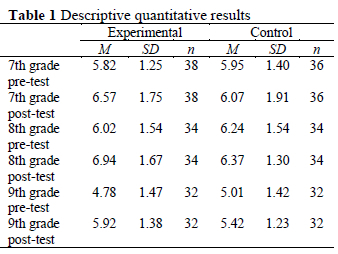
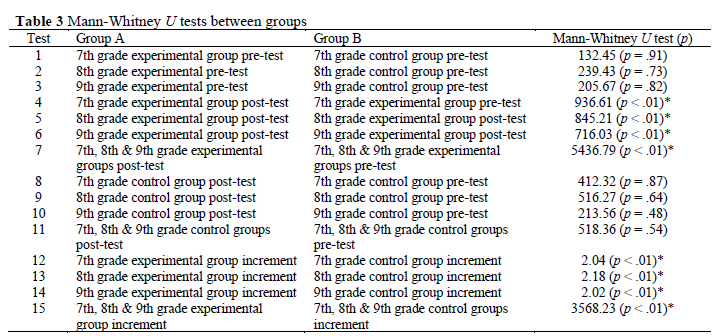
The academic effects of learning statistics and probability through peer tutoring were analysed in the research reported on here. Two hundred and eight students enrolled in Grades 7, 8 and 9 participated. Fixed- and same-age peer tutoring was implemented 3 times per week for 6 weeks. Each tutoring session lasted approximately 25 minutes. The main aims of this research were to quantify the effect of peer tutoring and to determine any differences among grades. A pre-test-post-test design was employed. Students were assigned to control or experimental conditions. Effect sizes were calculated and non-parametric statistical tests were performed. No statistically significant differences were reported in the pre-test analysis. Statistically significant improvements were reported with the implementation of the programme for all grade courses, both individually and globally (Mann-Whitney U test = 5436.79, p < .01). The reported global effect size may be considered as medium to large (Hedges' g = 0.72). The comparison among courses did not report any significant differences. It can be concluded that using peer tutoring for learning statistics and probability could be academically beneficial for middle school students.
effect sizes; non-parametric tests; peer tutoring; probability; statistics