Exploration of inclusive education practices in three South African primary schools: An interaction-based perspective
Abstract
In the study reported on here I explored how Foundation Phase teachers in 3 South African primary schools navigated the implementation of inclusive education (IE). Using Bronfenbrenner's ecological systems theory as a theoretical framework, I used transformative qualitative research to examine how teachers' interaction in the school system influenced their practices and professional development. Grounded in the Constitution of the Republic of South-Africa, 1996 and Education White Paper 6, we acknowledge challenges such as limited teacher training but emphasise the interconnectedness of teachers' experiences across various school-based ecological systems. To achieve this, we employed conveniently and purposefully selected semi-structured interviews with 16 participants (13 Foundation Phase teachers and 3 primary school principals). Data were analysed using an inductive-deductive approach. Firstly, a deductive coding frame was developed based on the 5 cycles of Bronfenbrenner's ecological systems theory. Concurrently, an inductive process was used to capture emerging intricacies in the teachers' experiences that fell outside this 1st framework. This involved a multi-stage process of data immersion and generating initial codes. Finally, the codes were arranged in potential themes, and the identified themes refined to conceptualise the interconnected nature of professional growth in inclusive settings. We aimed to explore and conceptualise the ecological influences on these teachers' practices and professional development in IE settings. This includes understanding how interaction with colleagues, leadership and the broader educational environment shaped their experiences as they navigated the complexities of inclusive practices in their classrooms. Ultimately, we highlight the importance of teacher development initiatives for the successful implementation of IE, emphasising the interconnected nature of experience and professional growth in fostering inclusive learning environments.
Bronfenbrenner' s ecological systems theory; inclusive education; interaction; professional development; South African context
Introduction/Background
Inclusive education (IE) is a global imperative, yet its implementation differs significantly in different countries. While South Africa has made commendable strides in recent years, challenges persist in ensuring that all learners have equitable access to quality education (DeMatthews, Serafini & Watson, 2021). With this study I contribute to the growing body of literature on IE by exploring the ecological influences on Foundation Phase (FP) teachers' practices in a South African context. Through a qualitative transformative research approach, existing power structures are challenged with the intention of empowering FP teachers to create more inclusive learning environments. The systemic factors that affect inclusive practices are explored by applying Bronfenbrenner's (1979) ecological systems theory. The findings of this study have broader implications for policymakers and teachers worldwide, as they highlight the importance of considering contextual factors and teacher agency when implementing IE (Cong-Lem, 2021; Li & Ruppar, 2021).
In South Africa, introducing IE has opened opportunities for all learners to access education with their peers (Department of Education [DoE], 2001; Republic of South Africa [RSA], 1996). The policy that directs IE mandates not only mere enrolment but also full participation, achievement and success for all learners. With this study I attempted to understand how FP teachers interacted with the systems in the school through the exploration and conceptualisation of the ecological influences on FP teachers' practices and professional development in IE settings. The focus lies in the growing interest in teachers' interaction in the school system and the significant impact of their experiences and implementation of IE that contributes to explain the efficacy of IE. Effective implementation of IE is crucial for learners to reach their full potential and requires of teachers to play a vital role (Besic, 2020; Nel, NM, Tlale, Engelbrecht & Nel, 2016; Subban, Bradford, Sharma, Loreman, Avramidis, Kullmann, Sahli Lozano, Romano & Woodcock, 2023). Teachers in South Africa advocate for support structures to facilitate the successful implementation of IE (Nel, NM et al., 2016).
While previous research highlights isolated challenges such as teacher training, attitudes, skills and knowledge (Donohue & Bornman, 2014; Engelbrecht, Nel, Smit & Van Deventer, 2016; Nilholm & Göransson, 2017), I focus on understanding how FP teachers interact in the school system. Examining these interactions will assist in making informed recommendations for enhancing teachers' effective implementation of IE. I argue that teachers' interactive ways in the school system are critical to the implementation of IE, as these interactions can either constrain or enable inclusive practices. Applying Bronfenbrenner' s ecological systems theory, I contend that these influences in the school system are as crucial as environmental influences on child development when exploring teacher interaction and the implementation of IE. This study, therefore, contributes to the growing body of knowledge on IE by exploring FP teachers' experiences and identifying the factors that influence their practices and professional development. By understanding these ecological influences, targeted interventions may be developed to support teachers in creating inclusive learning environments for all learners. The following research questions arose:
• How do Bronfenbrenner's ecological systems influence the IE practices of FP teachers in three South African primary schools?
• What is the role of school principals in these ecological systems to promote and support FP teachers' practices to implement IE?
Literature Review
With this review I explore existing literature on IE policy, teacher's roles and practices at national and international level. I aim to identify key challenges and gaps in knowledge that inform inclusive practices.
Inclusive education policy
In the South African context, Education White Paper 6 (EWP6) serves as a pivotal policy document guiding the principles and implementation of IE (DoE, 2001). This policy is deeply rooted in the country's constitution framework (RSA, 1996), emphasising the rights of all children and young people to not only be enrolled in a school of their choice but to actively participate in learning activities to reach their full potential. The constitutional mandate and the principles outlined in EWP6 underscore the transformative nature of IE. It goes beyond mere enrolment, aiming to create an educational environment that fosters the full engagement of all learners, irrespective of their diverse needs and abilities.
The important role that teachers play in the effective implementation of IE is recognised in the IE policy framework. Besic, Paleczek, Krammer and Gasteiger-Klicpera (2017) argue that teachers are key agents in realising inclusive practices. In the same vein, NM Nel et al. (2016) specifically argue for support structures to empower teachers to implement IE to align with the policy objectives successfully. The policy-driven approach is critical in shaping inclusive practices in schools. It sets the tone for creating an enabling and supportive environment for learners and teachers. However, the effectiveness of policy implementation depends on various factors, including the interpretation and translation of policy principles into practical strategies in the school context. Furthermore, a gap exists between policy and reality (Makoelle & Mosito, 2023).
Drawing from Bronfenbrenner' s ecological systems theory, I examined factors influencing FP teachers' implementation of inclusive practices. In addition to individual teacher characteristics, such as knowledge or training, the school environment, broader educational policies, and societal attitudes significantly shape teachers' actions (Epstein, 2018). While a supportive school culture characterised by provision and accessibility of opportunities, collaboration, professional development, and a shared commitment to inclusion can profoundly impact teachers' effective implementation of inclusive practices. A restrictive environment with inflexible policies, limited resources or negative attitudes towards diversity may hinder FP teachers' inclusive efforts. Additionally, the broader educational context, including international and national policies, curriculum guidelines and standardised assessments, may influence teachers' perceptions of IE and their willingness to adopt innovative approaches (Coles, Rodríguez-Muñiz, Mok, Ruiz, Karsenty, Martignone, Osta, Ferretti & Nguyen, 2023).
While these systemic factors create the boundaries of practice, teacher agency functions as a catalyst for change within these ecological cycles. For instance, agency enables FP teachers to extend beyond mere compliance, to intentionally navigate and sometimes contest restrictive contexts (Luong, 2024). By exercising relational agency, FP teachers may foster collaborative networks that circumvent limited school resources. Consequently, localised inclusion cultures that challenge broader institutional or societal inertia may be brought about. Furthermore, through pedagogical improvisation, FP teachers act as street-level bureaucrats (Dubois & Lotta, 2024) as they use their professional discretion to interpret and adapt inflexible curriculum guidelines that are responsive to the diverse realities in their teaching spaces. This potentially shifts the implementation of IE from a top-down mandate to a bottom-up transformation.
While South African IE policies provide a strong base, the challenge lies in translating these policy commitments (implementation) into tangible, inclusive practices in schools. The challenge, as highlighted by M Nel (2019), Sampson and Johannessen (2020), and Slee (2018), lies in moving beyond the rhetoric of policy documents to ensure meaningful and practical inclusivity. Mere policy pronouncements do not guarantee the elimination of barriers to inclusion. Therefore, a critical examination of how these policies can lead to action at the grassroots level becomes imperative. In essence, the literature on IE policy in South Africa emphasises the constitutional and policy-driven commitment to creating an inclusive educational landscape (Swilling, Musango & Wakeford, 2016).
Additionally, the literature (Burhan-Horasanli & Hart, 2024; Thomas, 2023) acknowledges the fundamental role of teachers and underscores the need for support structures to actualise the transformative goals of IE.
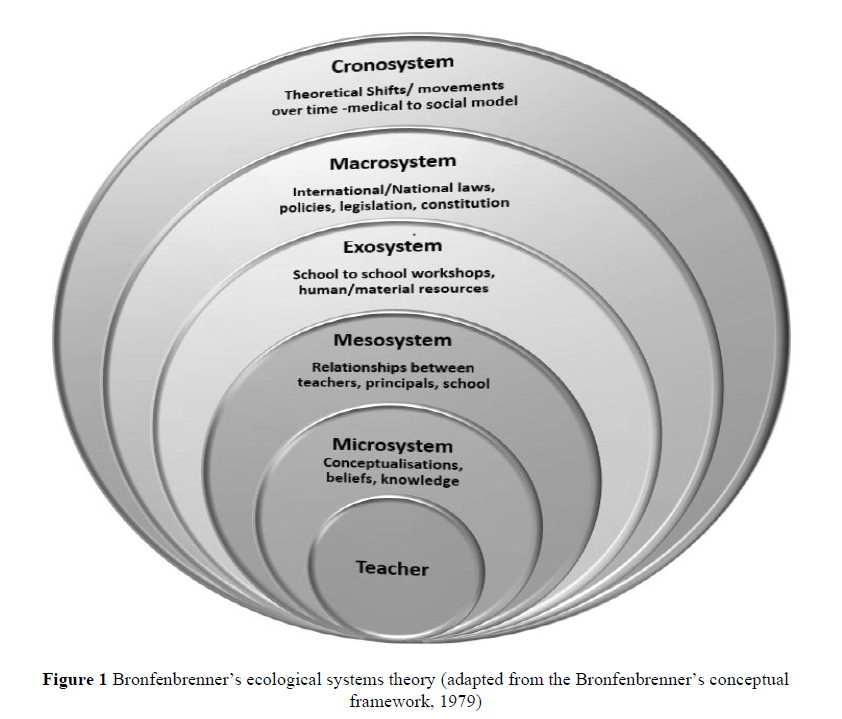
To understand FP teacher experiences in the implementation of IE in South Africa through the lens of Bronfenbrenner's ecological systems theory, the teacher assumes the central position. Although Bronfenbrenner (1979) originally conceptualised this framework to explain child development, I adapted the framework by positioning the teacher as the focal developing individual within the system as part of this complex web of interacting systems (Bronfenbrenner, 1976). At the microsystem level, the immediate interaction between the teacher and learners, and classroom dynamics, play a pivotal role in shaping inclusive practices. Moving outward to the mesosystem, the relationships and collaboration with colleagues, teaching teams, and administrators influence teachers' experiences in implementing IE. The exosystem involves the broader connections with parents/caregivers and the school administration, impacting the teacher' s professional development and practices. Furthermore, the macrosystem, consisting of institutional policies and societal attitudes, shapes the overall landscape in which the teacher operates. To understand the experiences of FP teachers, a holistic examination is needed - one that considers the intricate interplay of these ecological systems, emphasising the importance of supportive structures at various levels to enhance the effective implementation of IE (Hargreaves & Fullan, 2020).
Teacher's role in the implementation of IE Several researchers stress the importance of teachers in the implementation of IE (Mabasa-Manganyi, Mamabolo, Sepadi, Kgopa, Ndlhovu & Themane, 2022; Pozas, Letzel & Schneider, 2020). Beyond their functional role, FP teachers are increasingly understood as agents of change, whose individual and collective agency is the principal driver for transforming educational contexts (Li & Ruppar, 2021). In most educational systems, the successful implementation of IE depends heavily on the teacher' s capacity to navigate systemic constraints to support diverse learners (Miller, Wilt, Allcock, Kurth, Morningstar & Ruppar, 2022). While Finkelstein, Sharma and Furlonger (2021) outline five essential strategies (collaboration, determination of progress, instructional support, organisational practices, and socio-emotional support), these inclusive practices are activated through the teachers' agency. As Tripathi (2025) suggests, teacher agency is not simply a set of skills but a dynamic process of negotiation within the school ecosystem.
Furthermore, literature suggests that FP teachers' agency operates on a continuum ranging from restricted to transformative modes of action. While limited agency is usually characterised by compliance with top-down directives, high-level agency involves a transformative approach through which teachers proactively reshape their inclusive pedagogical contexts (Pantić, 2017). Scholars argue that at this advanced level of agency, teachers no longer conceptualise diversity as a deficit or an academic compromise, but as a professional strength (Sachs, 2016). Conceptually, this suggests that the implementation of IE is not static but moves towards a more established professional practice as teachers gain the discretionary power to navigate systemic barriers (Li & Ruppar, 2021). By exploring these varying degrees of agency, I endeavoured to understand how FP teachers move from developing to more robust inclusive implementations. Therefore, inclusive teachers do not simply execute a list of practices but embody the spirit of inclusion by intentionally and skilfully weaving these elements into the fabric of their teaching to drive meaningful change.
Instructional practices
Instructional practices encompass the multifaceted abilities that teachers demonstrate concerning the focus and delivery of instructional content (Finkelstein et al., 2021). This involves the transfer of knowledge and the strategic organisation of groups to facilitate peer-based learning. For instance, teachers may employ methodologies that promote collaborative learning environments, fostering dynamic interaction among learners. Furthermore, effective instructional practices extend to the adept development and implementation of universal design learning (Florian, 2019) ensuring that educational content is accessible and adaptable to diverse learning needs.
Organisational practices
Organisational practices encompass teachers' actions to structure and manage the classroom environment. The aim with these actions is to create an inclusive setting that caters for the diverse needs of all learners. This includes the physical setup of a classroom and the intentional facilitation of access to the learning environment for every learner. Effective organisational practices involve establishing routines, ensuring seamless transitions between tasks, adapting resources, and integrating technology to accommodate varying needs (Pozas et al., 2020). Additionally, teachers strategically position themselves to enhance visibility, ensuring that they can actively engage with and support each learner.
Social/emotional/behavioural practices Social/emotional/behavioural practices constitute a fundamental aspect of cultivating a positive classroom environment, prioritising the fulfilment of social, emotional, and behavioural needs. The implementation of these practices is imperative for fostering an inclusive and effective learning atmosphere (Pozas et al., 2020; Slee, 2018). Within this comprehensive framework, teachers employ specific strategies. They actively provide academic and emotional support by creating an environment that nurtures educational and emotional growth (Slee, 2018). Clear communication of behavioural expectations creates a structured framework for learner conduct, promoting a positive and respectful classroom culture (Pozas et al., 2020). Recognising the developmental importance of play, teachers incorporate structured play activities to enhance social interactions that contribute to the overall emotional well-being of learners (Slee, 2018). Regular and constructive teacher praise and feedback reinforce positive behaviour, motivating and fostering a culture of encouragement (Pozas et al., 2020).
Evidence-based assessments of learners' behaviour enable teachers to understand the functional aspects, which facilitate personalised interventions tailored to individual needs (Finkelstein et al., 2021). Proactive measures are taken to handle incidents of bullying and exclusion, emphasising a zero-tolerance policy for a safe and inclusive learning environment to be created (Slee, 2018). Teachers use language consciously, express appreciation, show approval, and value each learner, which foster a sense of belonging and positive self-esteem (Pozas et al., 2020). These practices collectively contribute to the holistic development of teachers, recognising the interconnected nature of their social, emotional, and behavioural well-being in the educational setting.
Determining progress in the inclusive classroom This stands as a critical facet of an inclusive classroom, where teachers engage in continued assessment and monitoring of individualised outcomes, particularly those articulated in individualised education plans (IEPs). This dynamic process encompasses the construction and implementation of IEPs, using formative assessment methods, examining content retention, and integrating of a diverse array of formal and informal assessment approaches. In the pursuit of inclusivity, teachers employ these practices to gain nuanced insight into individual development, thereby informing future evaluations and ensuring precisely tailored support for each learner (Finkelstein et al., 2021).
Specifically, this involves the construction and implementation of IEPs, where teachers actively craft and execute IEPs, ensuring a personalised and goal-oriented approach to address each learner' s unique needs (Finkelstein et al., 2021). The incorporation of ongoing formative assessment methods allows teachers to gauge real-time progress and provide timely feedback that facilitates immediate adjustment of instructional strategies (Hartle, 2022). Teachers assess the retention of previous content, ensuring that foundational knowledge is not only acquired, but retained for application in subsequent learning experiences (Mandouit & Hattie, 2023). A balanced integration of formal assessment, such as standardised tests, and informal assessments, like classroom observations, enables a comprehensive understanding of learner performance across various contexts (Popham, 2018). Through the strategic application of these practices, teachers not only navigate the complex terrain of individualised education, but also contribute to the broader objectives of inclusivity, ensuring that every learner receives tailored and effective support.
Collaboration and teamwork in the educational ecosystem
Collaboration and teamwork transcend individual teacher-learner interaction, constituting a dynamic engagement with diverse professionals across the educational spectrum. This collaborative network encompasses cooperative endeavours with fellow teachers, parents/caregivers, school principals, and various educational professionals. Effectively navigating this complex landscape involves active participation in teaching teams, fostering transparent communication with parents/caregivers, and continued professional development through knowledge exchange with peers and educational professionals (Goble & Pianta, 2022; Nilholm & Göransson, 2017).
These practices specifically encompass active participation in teaching teams. Teachers actively contribute to and collaborate with peers in teaching teams, capitalising on diverse perspectives to enhance instructional strategies and learner support (Hofkens & Pianta, 2022; Subban et al., 2023).
Establishing open and transparent communication channels with parents/caregivers is crucial for creating a collaborative partnership that supports holistic development (Epstein, 2018). Teachers engage in continuous professional development by actively learning from peers, sharing insight, and collectively addressing challenges to improve overall teaching practices (Hargreaves & Fullan, 2020). In the rapidly evolving landscape of education, effective collaboration and teamwork not only strengthen the educational experience but also contribute to the professional growth of teachers.
Consequently, the literature review highlights the importance of FP teachers in implementing IE (Epstein, 2018), emphasising the need for support structures and effective practices. However, a gap exists in understanding how FP teachers' interaction in the school system influences their experiences and the implementation of IE (Nel, M 2019; Nel, NM et al., 2016). With this study I aimed to fill this gap by exploring the ecological influences on FP teachers' practices and professional development in IE settings. By applying Bronfenbrenner's ecological systems theory, I examined how interactions at different levels of the school system impact teachers' experiences and contribute to the challenges they face in implementing IE. Furthermore, understanding these influences could potentially inform recommendations for enhancing teachers' effective implementation of IE.
Theoretical Framework: Bronfenbrenner's Ecological Systems Theory Bronfenbrenner' s ecological systems theory (Bronfenbrenner, 1979) provides a foundational framework for understanding the multi-faceted interplay of factors influencing individual development within their environment. However, for the purposes of this study, an adjusted version of this theory was employed to specifically explore the ecological influences on FP teachers' practices and professional development in IE. This adjusted model focuses on the dynamic interaction between FP teachers and their various environments as they navigate the complexities of the implementation of IE. It recognises that FP teachers are embedded in multiple interconnected systems that significantly impact their knowledge, beliefs, practices, and overall development towards inclusive pedagogies. The microsystem remains central to this adapted model, emphasising the critical role of teacher-learner interaction and classroom dynamics in shaping inclusive practices. However, the focus extends beyond the immediate classroom environment to include interaction with colleagues, school leaders, and support staff in the mesosystem (Rudasil, Snyder, Levinson & Adelson, 2018). The exosystem is conceptualised as encompassing broader institutional and community influences on teachers' work, such as school policies, district regulations, and parental involvement.
The macrosystem represents the overarching societal and cultural factors shaping the educational landscape, including national policies, economic conditions, and societal attitudes towards disability and inclusion. Finally, the chronosystem is acknowledged as the historical and cultural context within which these ecological systems evolve and interact. This dimension highlights the importance of considering the changing nature of educational policies, societal values, and technological advancements in understanding FP teachers' experiences and development in IE. By adapting Bronfenbrenner' s ecological systems theory, I offer a comprehensive framework for examining the multiple influences shaping FP teachers' practices and professional development in the context of the implementation of IE. Figure 1 demonstrates Bronfenbrenner's ecological systems theory (teacher substituted the child at the centre).
Methodology
I employed a transformative qualitative research design to explore FP teachers' conceptualisation of IE in South Africa (Creswell & Creswell, 2017; Kivunja & Kuyini, 2017). The purpose of this paradigm, as argued by Mertens (2021), is to understand and remedy power disparities and promote social justice through quality research. This paradigm was chosen because it aligns with the aims of addressing potential injustices in the implementation of IE (Charmaz, 2017). Data were collected through semi-structured interviews and focus group discussions with 16 FP teachers and three principals from three primary schools in Gauteng, South Africa. Due to the Coronavirus disease (COVID-19) restrictions, semi-structured interviews and focus groups were conducted virtually. Participants provided informed consent and data analysis followed a hybrid approach, combining inductive and deductive coding guided by an adjusted version of Bronfenbrenner' s theory of child development.
Participants Selection and Sampling Methods Participants were selected through both convenient and purposive sampling (Nyimbili & Nyimbili, 2024). Three primary schools in Gauteng, South Africa were conveniently chosen because of their proximity to my area of residence. Purposive sampling was used because I had prior knowledge of the schools, and the schools accommodate learners from diverse backgrounds. This made it possible for a rich exploration of participants' lived experiences (Mpu & Adu, 2021) in their contexts while actively implementing IE.
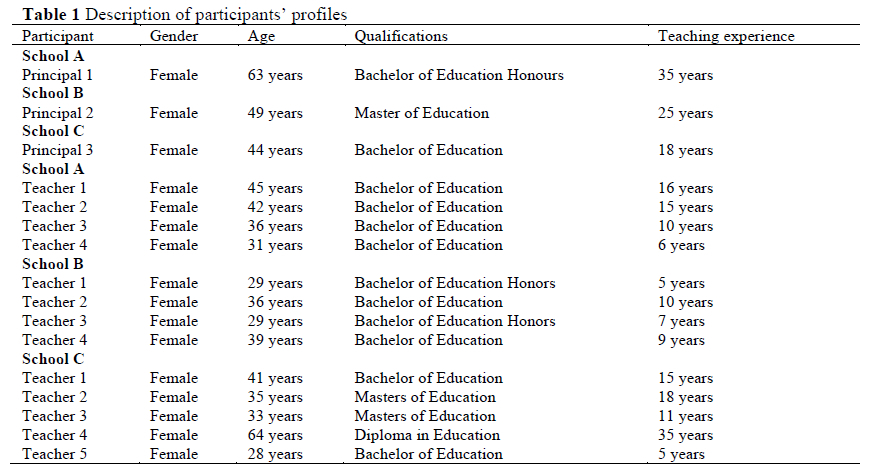
A total of 16 (three principals and 13 FP teachers) participants gave informed consent (Klykken, 2022) to participate in the study. All 16 participants had a minimum of 5 years teaching experience, with some having over 30 years. Their professional qualifications ranged from Diploma in Education (one teacher), Bachelor of Education (eight teachers and one principal) to honours (two teachers and one principal) and master's degrees in education (one principal and two teachers). The participants comprised a diverse range of ages and cultural backgrounds. The three principals, one principal from each school, were selected because of their direct involvement and leadership roles in shaping the inclusive culture of their respective schools (Mabasa-Manganyi, 2023). All the primary school principals had extensive experience in school management and claimed commitment to IE policies. Table 1 shows a visual representation of participants' biographic information.
Ethical Considerations
I adhered to ethical principles throughout the research process in this study. Prior to data collection, approval was obtained from the relevant university' s Research Ethics Committee and the Gauteng Department of Education. Permission was also secured from the principals of the primary schools after having provided them with letters of information to allow them to make informed decisions. All participants gave their consent before involvement in the study. The consent forms clearly outlined the purpose of the research, the nature of their participation and the right to withdraw from the study at any time without penalty (Denscombe, 2021). To ensure confidentiality and anonymity, pseudonyms were used in the final report for all schools and participants (Lahman, Thomas & Teman, 2023). The collected data were stored securely and access was restricted to me to protect participants' privacy. Because data were collected during the COVID-19 pandemic, semi-structured interviews and focus groups were conducted virtually through video conferencing platforms. Depending on the participants' preferences the virtual platform, MS Teams or Zoom, was used. Measures were taken to ensure a private and secure online environment for these sessions.
Data Analysis
A hybrid inductive-deductive approach was used to analyse data (Proudfoot, 2023) to show how ecological interactions shape teachers' conceptualisations of IE. The analysis revealed a spectrum of inclusivity perspectives, three distinct pedagogical shifts towards inclusivity and the ecological influences on each pedagogical shift. Data analysis progressed through the following qualitative analysis stages (Cohen, Manion & Morrison, 2017).
The first stage involved deductively coding data through Bronfenbrenner's adjusted ecological systems theory ("child" at the centre substituted by "teacher"). The adjustment was done because teachers act as fundamental IE agents in ecosystems navigation (Besic et al., 2017). In essence, the adjustment simultaneously prioritises teachers' experiences and retain systemic analysis. Using an adjusted ecological systems theory, transcripts were coded to identify system-level influences at the microsystem, mesosystem, exosystem and macrosystem (Adu, 2019). For instance, teacher-to-learner dynamics at microsystem, teacher collaboration at mesosystem, resource allocation and leadership intervention at exosystem and policy awareness at macrosystem. During the second stage an inductive five-step open coding process was followed (Cohen et al., 2017). This involved preparing data, doing initial coding and line-by-line coding, arranging codes into categories and groups, identifying themes and applying theory to explain findings (Adu, 2019). Eventually, the IE beliefs held by participants and three pedagogical shifts towards inclusivity were revealed. The third stage involved the merging of deductive system-level codes and inductive thematic codes using a joint display matrix (Guetterman, Fetters & Creswell, 2015) to map pedagogical shifts to Bronfenbrenner's ecological levels. Divergent cases arose, which were resolved through team debate, and the final decisions were documented (Motulsky, 2021).
To enhance the credibility and validity of the interpretive findings, all 16 participants were invited for a presentation and discussion of the preliminary findings during the fourth stage. The schools responded by providing representatives from each school, two teachers from Schools A and B, three teachers from School C and the three principals from each school. Two separate online focus groups (three principals and seven teachers) of between 60 to 90 minutes were conducted online. Discussions in both groups centred on findings regarding the three pedagogical shifts towards inclusivity, ecological influences and the identified systemic hurdles. Participants from both groups largely affirmed the reality of the pedagogical shifts but provided some refinements. For instance, teachers emphasised that resource constraints (exosystem) more severely limited the first shift (no/little pedagogical shift) than what was initially interpreted. The school principals explained that policy ambiguity (macrosystem), rather than awareness, was the primary challenge to the second (emerging) shift. These clarifications led to revisions involving that the exosystem influences were weighted more deeply in the trajectory mapping for Shift 1 and the theme policy awareness was rephrased as policy clarity gaps. The analysis concluded in a consolidation of pedagogical shifts towards inclusivity and their systemic causes.
Positionality of the Researcher To ensure trustworthiness of the findings, as a former teacher, my biases that could influence the study's findings were continuously checked (Reich, 2021). This was done through keeping a systematic journal (Roller, 2018) where critical reflections throughout data analysis were written down.
Findings
The findings reveal several key aspects of FP teachers' experiences and conceptualisations of IE at different levels of the ecological system. A spectrum of perspectives on inclusion was evident among participants. Some strongly supported separate schooling, while others firmly advocated for inclusive classrooms. One participant advocating for separate schooling said: "Learners with learning problems disrupt the all learners ... They belong where there are special teachers who are trained for them" (Teacher 1, School B). Those advocating for separate schooling focused on learner differences as the central factor in teaching and learning. This was shown by several participant responses: "Special teachers are trained to teach those learners, I was not trained to teach them and I do not know what to do with such learners" (Teacher 2, School B). The same sentiments were raised by a principal who said: "The department wants us to take everyone who applies, even those with physical and learning challenges. Honestly, what will we do for a child walking on a wheelchair when we do not have much space. You know, some of our classrooms are on the second floor upstairs. So, how will the learner moving on a wheelchair move there, no one will them around? Not that I want to down-play my colleagues, but, the department really needs to do inclusive education workshops and planning with us, not to just concentrate on the pass rate" (Principal 1, School C). These participants often displayed limited knowledge of IE policies, thus demonstrated deterministic beliefs about learner abilities. A principal from School A also expressed the same views by saying: "Special schools offer tailored teaching to these learners; they also have lower numbers of learners per class, but in our general classrooms learners can reach 52 and this compromises quality of teaching" (Principal 1, School A). Despite the strong sentiments held by those advocating for separate schooling, some participants showed inclusiveness through their responses.
Conversely, participants who supported inclusive classrooms emphasised content delivery and effective teaching strategies for all, rather than focusing on learner differences. Teacher 4 stated: "Itry to use different teaching methods in my class as some learners understand better when I use visual aids, others prefer to listen as I tell a story and explain concepts, others prefer to draw as I read a story, and others would engage more when I use pictorials. I try to appeal to all their five senses" (School B). This point was also raised during a focus group: "I have told myself from what I learned during training that all learners are educable, that is what White Paper 6 says. Therefore, when some of my learners get confused when I teach, I change the way of teaching. Perhaps, use a game, provide them the opportunity to learn through play or song, until they understand" (Teacher 2, School A). These participants demonstrated that they believed that teachers were able to teach all learners. Additionally, they demonstrated knowledge of IE policies. This was supported by one long-serving participant in a focus group who stated: "Of course, I trained a long time ago, during our time we never heard of inclusive education, but, thanks to our principal for organising workshops for us, it helps me to learn how I can include all learners when teaching. Some workshops are run in our school, others are between neighbouring schools, particularly, the full-service schools. It is challenging to be inclusive, I must admit, especially with our numbers of learners, but doable. Our principal allows us to bring organisations that can train us on inclusive practices. This other time I introduced one that came and did a 2-day workshop with us on working in diverse environments, it was so helpful. Some of the things we learn, I have found that I have been doing them all along out of the passion that I have about teaching, but some are new" (Teacher 4, School C). In agreement, another participant in a focus group said: "For me real teaching is about catering for all learners under your care as you teach. For me, including all learners is quality teaching and does not mean lowering the standards. Again, like my colleague, I am thankful to the buddy arrangement, that is, pairing an experienced teacher with a novice teacher, that our principal does" (Teacher 2, School B). Concurring sentiments were raised by a principal during a semi-structured interview: "Some conflate inclusion with academic compromise" (Principal 3, School C). This reasoning explains that providing quality education for all learners (inclusion) does not translate to render education less challenging or rigorous (academic compromise).
Furthermore, participants showed their awareness of barriers to learning and how these barriers should be viewed. Teacher 3 stated: "Challenges to learning are there and will always be there amongst learners, but learners themselves are not the problem. My job as a teacher is to support all learners overcome learning barriers and access education" (School A). This kind of thinking demonstrated that the teacher was inclusive and did not view challenges in learning as learners' problems, rather challenges to the teaching profession. Principal 3 raised a strategy worthy of emulation: "In my school, I pair my teachers for joint planning (newly graduated teacher with an experience teacher) to build efficacy. In this way both teachers benefit from each other. I mean, the newly qualified teacher shares the current inclusive teaching strategies, and the long-serving member shares their experiences on the tried, tested and proven methods. In this way, the pairing works well" (School C). Beyond the two distinct groups, data indicated a subgroup of participants who expressed uncertainty regarding inclusive versus separate schooling. Therefore, they could not be clearly categorised within the two main groups (separate and inclusive schooling). Some of these conflicting views were: "I really want to include all learners in my teaching, I do try to do that in my lessons, but, sometimes you see, that it is not working. These learners should be in special schools. But I do also think they deserve a fair chance, imagine if it was my child who is packed at the corner when I am paying school fees. It is not fair" (Teacher 5, School C). This was also raised by a teacher during the focus group regarding how teaching was done during COVID-19 lockdown restrictions: "In our school we have grouped learners according to abilities, now we have COVID-19, the government says school capacity should be at 50%. So, the slow learners come to school this week, and the following week is for the high performing ones (of course learners do not know that, they just know that they are in group A or B). This arrangement has made our work so easy because we know what we would be working with in a particular week. Of course, this may appear like discrimination, but it is working well for us" (Teacher 5, School C). These sentiments showed that teachers recognised that this practice, although working well for them as teachers, was discriminatory. Participants' views revealed three fundamental pedagogical shifts (little or no shift, emergent shift and established shift) towards inclusivity.
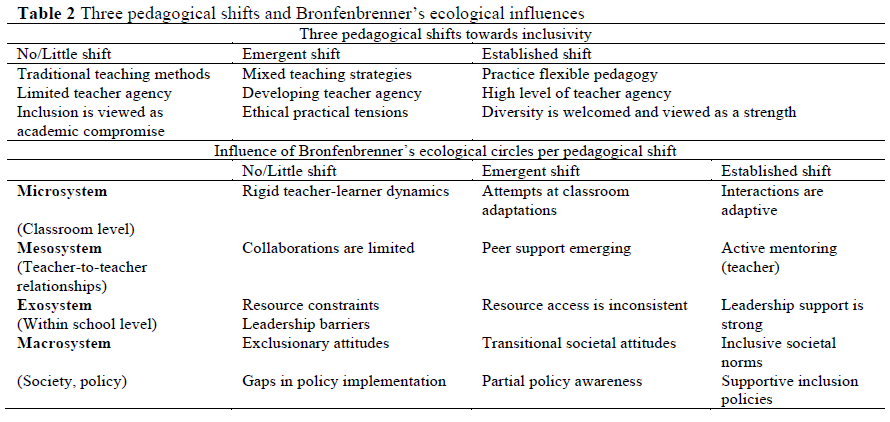
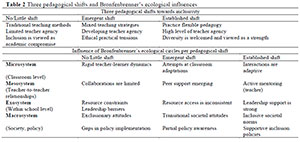
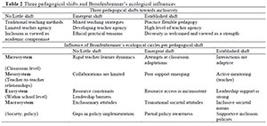
Consequently, data revealed three key pedagogical stages that FP teachers and primary school principals navigated towards inclusivity. These are: a little or no shift phase characterised by traditional approaches and limited teacher agency; an emergent shift phase marked by the incorporation of inclusive practices amid challenges; and an established shift phase demonstrating fully embracing inclusivity and effective strategies addressing challenges. I found that teacher interaction within the school system significantly influenced their experiences and the implementation of IE. By applying Bronfenbrenner' s ecological systems theory, I identified influences at different ecological levels. These are: the microsystem (teacher-learner dynamics and classroom interactions), the mesosystem (interactions with colleagues and teaching teams), the exosystem (connections with parents/caregivers and school administrators), and the macrosystem (institutional policies and broader societal attitudes). Table 2 below shows the three different pedagogical shifts towards inclusivity and the impact that Bronfenbrenner's ecological circles have on teaching practices.
Discussion
Through this study I uphold that the implementation of IE in South Africa's FP classrooms should not be viewed as an individual endeavour, but an ecological journey. The progression of teachers through three pedagogical shifts (from no shift/little shift to emergent shift to established shift) is greatly mediated by interaction across Bronfenbrenner's adjusted ecological systems. Genuine inclusion requires coherence between policy and practice. This enhances the addressing of macrosystemic contradictions, amplification of mesosystemic collaboration and customising professional development to teachers' ecological realities. Future research should track how interventions that are ecologically aligned impact learner outcomes. This has the potential of ensuring that inclusion transcends rhetoric and becomes a pedagogical transformative reality. Consequently, this study unveiled the multifaceted interplay of ecological factors that influence the implementation of IE by FP teachers. By re-centring the teacher in Bronfenbrenner's adjusted ecological systems theory, the findings demonstrate that inclusive practice is not a static trait but a dynamic progression shaped by systemic interactions.
The Influence of Ecological Systems on IE Practices With the first research question I sought to understand how ecological systems influenced FP teachers' practices. The findings reveal that these systems do not act in isolation but create a press that either propels or stalls a teacher through three pedagogical shifts.
• The Macrosystem-Microsystem Tension Education White Paper 6
While the macrosystem (EWP6) provides a transformative mandate, the microsystem (overcrowded classrooms and infrastructure gaps) often creates a reality shock that leads to a no/little shift towards inclusive pedagogy.
• Agency as a Mediator
Significantly, I found that high-level teacher agency acts as a mediator between these levels. The FP teachers who progressed to an established shift did not wait for macrosystemic changes. Unlike their counterparts, they exercised professional discretion to adapt curriculum guidelines, effectively acting as street-level bureaucrats who translate inclusive policy into inclusive classroom realities (Li & Ruppar, 2021; Tripathi, 2025).
• The Mesosystem as a Support Hub
The mesosystem, specifically peer mentoring, was identified as a fundamental booster for teacher efficacy. FP teachers who engaged in collaborative inquiry moved towards an emergent shift, whereas those isolated in their microsystems remained frustrated and prone to exclusionary practices (Davids, 2019).
The Role of School Principals in the Educational Ecosystem
In response to the second research question, I identified the school principals as chief ecological gatekeepers. Within the exosystem, the principals' leadership styles determine whether a teacher feels constrained by rigid administrative directives or empowered for innovative initiatives.
• Promoting Inclusion
Principals who foster a supportive mesosystem by establishing and supporting teaching teams and professional development loops directly enhance the established pedagogical shift. Their role involves buffering teachers from the pressures of standardised assessment (exosystem) to enable for flexibility, autonomy and learner-centred instruction (microsystem).
• Supporting Practice
Conversely, leadership (principals) that focuses solely on compliance or fail to address resource gaps reinforces a no/little shift towards inclusivity. The principal, therefore, is not just an administrator but also a systemic lever whose support (or lack thereof) dictates the sustainability of inclusive efforts (Hargreaves & Fullan, 2020).
Conclusion
With this study I support that the implementation of IE in South Africa's FP should be viewed as an ecological journey rather than an individual endeavour. The progression of FP teachers from a no/little shift to an established shift is essentially mediated by the interplay between individual teacher agency and systemic support.
Key Contributions
The study submits two significant contributions to the field of IE:
• Theoretical Adaptation
By re-centring Bronfenbrenner's theory onto the FP teacher, the study provides a robust framework to analyse how inclusive practices are not merely a personal trait, but a product of nested systems. It clarifies that an individual teacher' s shift towards an established shift or practice is dependent on the synergy between the surrounding ecological circles and their individual agency.
• The Agency-Leadership Link
Through the study I identified the school principal as the important exosystemic lever. It proves that even high-level FP teacher agency is often insufficient to sustain longterm change without active leadership support that buffers the teacher from restrictive external directives.
Recommendations and Future Research
To move beyond the policy rhetoric, the following
steps are recommended:
• Policymakers should attend to macrosystemic contradictions, such as the gap between IE directives and the lack of infrastructure funding. This has the potential to alleviate teacher frustration and no-shift towards inclusive pedagogical stances.
• Professional development should not only target FP teachers but also position school principals as active agents of inclusive leadership who are trained to foster mesosystemic collaboration (peer mentoring and teacher pairing).
• Subsequent studies should track how ecologically aligned interventions, specifically those that pair teacher agency with principal support, impact long-term teacher retention and actual learner outcomes in South African FP classrooms.
Notesi . Published under a Creative Commons Attribution Licence.
I confirm that neither Generative AI nor AI-assisted technology was used in the writing of this manuscript. This includes the conceptualisation, data collection, data analysis, drafting and editing of the text. All work was produced exclusively by a human author.
Conflict of Interest
I declare that they have no conflict of interest in the conduct or reporting of this manuscript.
Acknowledgement
I would like to express my sincere gratitude to the FP teachers and primary school principals who generously participated in this study. Their valuable contributions were instrumental in the success of this research. Additionally, I am deeply indebted to my research mentor for their invaluable guidance and support throughout this study.
References
- Adu P 2019. A step-by-step guide to qualitative data coding. New York, NY: Routledge.
-
Besic E 2020. Intersectionality: A pathway towards inclusive education? Prospects, 49(3-4): 111-122. https://doi.org/10.1007/s11125-020-09461-6
» https://doi.org/10.1007/s11125-020-09461-6 -
Besic E, Paleczek L, Krammer M & Gasteiger-Klicpera B 2017. Inclusive practices at the teacher and class level: The experts' view. European Journal of Special Needs Education, 32(3):329-345. https://doi.org/10.1080/08856257.2016.1240339
» https://doi.org/10.1080/08856257.2016.1240339 -
Bronfenbrenner U 1976. The experimental ecology of education. Teachers College Record, 78(2):1-37. https://doi.org/10.1177/016146817607800201
» https://doi.org/10.1177/016146817607800201 -
Bronfenbrenner U 1979. Contexts of child rearing: Problems and prospects. American Psychologist, 34(10):844-850. https://doi.org/10.1037/0003-066X.34.10.844
» https://doi.org/10.1037/0003-066X.34.10.844 -
Burhan-Horasanli E & Hart DO 2024. Conceptualizing reflection-for-action: Empowering teachers as agents of collaborative and collective transformation. Teaching and Teacher Education, 152:104802. https://doi.org/10.1016/j.tate.2024.104802
» https://doi.org/10.1016/j.tate.2024.104802 - Cohen L, Manion L & Morrison K 2017. Research methods in education (8th ed). London, England: Routledge.
-
Coles A, Rodriguez-Muñiz LJ, Mok IAC, Ruiz Á, Karsenty R, Martignone F, Osta I, Ferretti F & Nguyen TTA 2023. Teachers, resources, assessment practices: Role and impact on the curricular implementation process. InY Shimizu & R Vithal (eds). Mathematics curriculum reforms around the world: The 24th ICMI study. Cham, Switzerland: Springer. https://doi.org/10.1007/978-3-031-13548-4_18
» https://doi.org/10.1007/978-3-031-13548-4_18 -
Cong-Lem N 2021. Teacher agency: A systematic review of international literature. Issues in Educational Research, 31(3):718-738. https://search.informit.org/doi/10.3316/informit.190851857034060
» https://search.informit.org/doi/10.3316/informit.190851857034060 -
Charmaz K 2017. The power of constructivist grounded theory for critical inquiry. Qualitative Inquiry, 23(1):34-45.https://doi.org/10.1177/1077800416657105
» https://doi.org/10.1177/1077800416657105 - Creswell JW & Creswell JD 2017. Research design: Qualitative, quantitative, and mixed methods approaches (5th ed). Thousand Oaks, CA: Sage.
-
Davids N 2019. You are not like us: On teacher exclusion, imagination and disrupting perception. Journal of Philosophy of Education, 53(1):165-179. https://doi.org/10.1111/1467-9752.12321
» https://doi.org/10.1111/1467-9752.12321 -
DeMatthews DE, Serafini A & Watson TN 2021. Leading inclusive schools: Principal perceptions, practices, and challenges to meaningful change. Educational Administration Quarterly, 57(1):3-48. https://doi.org/10.1177/0013161X20913897
» https://doi.org/10.1177/0013161X20913897 - Denscombe M 2021. The good research guide: Research methods for small-scale social research projects (7th ed). London, England: Open University Press.
- Department of Education 2001. Education White Paper 6. Special needs education: Building an inclusive education and training system. Pretoria, South Africa: Author.
-
Donohue D & Bornman J 2014. The challenges of realising inclusive education in South Africa. South African Journal of Education, 34(2):Art. # 806, 14 pages. https://doi.org/10.15700/201412071114
» https://doi.org/10.15700/201412071114 -
Dubois V & Lotta G 2024. Street-level bureaucracy: Teaching policy (theory) in practice. In E St.Denny & P Zittoun (eds). Handbook of teaching public policy. Cheltenham, England: Edward Elgar Publishing. https://doi.org/10.4337/9781800378117.00020
» https://doi.org/10.4337/9781800378117.00020 -
Enelbrecht P, Nel M, Smit S & Van Deventer M 2016. The idealism of education policies and the realities in schools: The implementation of inclusive education in South Africa. International Journal of Inclusive Education, 20(5):520-535. https://doi.org/10.1080/13603116.2015.1095250
» https://doi.org/10.1080/13603116.2015.1095250 - Epstein J 2018. School, family, and community partnerships: Preparing educators and improving school (2nd ed). London, England: Routledge.
-
Finkelstein S, Sharma U & Furlonger B 2021. The inclusive practices of classroom teachers: A scoping review and thematic analysis. International Journal of Inclusive Education, 25(6):735-762. https://doi.org/10.1080/13603116.2019.1572232
» https://doi.org/10.1080/13603116.2019.1572232 -
Florian L 2019. On the necessary co-existence of special and inclusive education. International Journal of Inclusive Education, 23(7-8):691-704. https://doi.org/10.1080/13603116.2019.1622801
» https://doi.org/10.1080/13603116.2019.1622801 -
Goble P & Pianta RC 2022. Observation as a lever for teacher improvement. London, England: Routledge. https://doi.org/10.4324/9781138609877-REE118-1
» https://doi.org/10.4324/9781138609877-REE118-1 -
Guetterman TC, Fetters MD & Creswell JW 2015. Integrating quantitative and qualitative results in health science mixed methods research through joint displays. The Annals of Family Medicine, 13(6):554-561. https://doi.org/10.1370/afm.1865
» https://doi.org/10.1370/afm.1865 -
Hargreaves A & Fullan M 2020. Professional capital after the pandemic: Revisiting and revising classic understandings of teachers' work. Journal of Professional Capital and Community, 5(3-4):327-336. https://doi.org/10.1108/JPCC-06-2020-0039
» https://doi.org/10.1108/JPCC-06-2020-0039 -
Hartle S 2022. University student perceptions of English language study changes: Reactions to remote emergency teaching during the COVID-19 emergency. Language Learning in Higher Education, 12(2):429-451. https://doi.org/10.1515/cercles-2022-2056
» https://doi.org/10.1515/cercles-2022-2056 -
Hofkens TL & Pianta RC 2022. Teacher-student relationships, engagement in school, and student outcomes. In AL Reschly & SL Christenson (eds). Handbook of research on student engagement. Cham, Switzerland: Springer. https://doi.org/10.1007/978-3-031-07853-8_20
» https://doi.org/10.1007/978-3-031-07853-8_20 -
Kivunja C & Kuyini AB 2017. Understanding and applying research paradigms in educational contexts. International Journal of Higher Education, 6(5):26-41. https://doi.org/10.5430/ijhe.v6n5p26
» https://doi.org/10.5430/ijhe.v6n5p26 -
Klykken FH 2022. Implementing continuous consent in qualitative research. Qualitative Research, 2(5):795-810. https://doi.org/10.1177/14687941211014366
» https://doi.org/10.1177/14687941211014366 -
Lahman MKE, Thomas R & Teman ED 2023. A good ame: Pseudonyms in research. Qualitative Inquiry, 29(6):678-685. https://doi.org/10.1177/10778004221134088
» https://doi.org/10.1177/10778004221134088 -
Li L & Ruppar A 2021. Conceptualizing teacher agency for inclusive education: A systematic and international review. Teacher Education and Special Education, 44(1):42-59. https://doi.org/10.1177/0888406420926976
» https://doi.org/10.1177/0888406420926976 -
Luong PM 2024. Conceptualizing teacher agency for culturally responsive teaching in international programs at higher education levels. Vietnam Journal of Educational Sciences, 20(1):61-71. https://doi.org/10.15625/2615-8965/22410105
» https://doi.org/10.15625/2615-8965/22410105 -
Mabasa-Manganyi RB 2023. Factors influencing foundation phase rural teachers' understanding and practices in selecting inclusive teaching strategies. South African Journal of Childhood Education, 13(1):a991. https://doi.org/10.4102/sajce.v13i1.991
» https://doi.org/10.4102/sajce.v13i1.991 -
Mabasa-Manganyi RB, Mamabolo JM, Sepadi MD, Kgopa F, Ndlhovu SM & Themane M 2022. Enabling environments that South African teachers create to accommodate diversity in their classrooms: A case study on the Limpopo Province. South African Journal of Education, 42(4):Art. #2077, 10 pages. https://doi.org/10.15700/saje.v42n4a2077
» https://doi.org/10.15700/saje.v42n4a2077 -
Makoelle TM & Mosito CP 2023. Pre-service teacher preparation for inclusive teaching in South Africa. In G Boadu, G Odhiambo & P Mrandi (eds). Practices and perspectives of teaching and teacher education in Africa. Hershey, PA: IGI Global. https://doi.org/10.4018/978-1-6684-7722-9.ch001
» https://doi.org/10.4018/978-1-6684-7722-9.ch001 -
Mandouit L & Hattie J 2023. Revisiting "The Power of Feedback" from the perspective of the learner. Learning and Instruction, 84:101718. https://doi.org/10.1016/j.learninstruc.2022.101718
» https://doi.org/10.1016/j.learninstruc.2022.101718 -
Mertens DM 2021. Transformative research methods to increase social impact for vulnerable groups and cultural minorities. International Journal of Qualitative Methods, 20:1 -9. https://doi.org/10.1177/16094069211051563
» https://doi.org/10.1177/16094069211051563 -
Miller AL, Wilt CL, Allcock HC, Kurth JA, Morningstar ME & Ruppar AL 2022. Teacher agency for inclusive education: An international scoping review. International Journal of Inclusive Education, 26(12):1159-1177. https://doi.org/10.1080/13603116.2020.1789766
» https://doi.org/10.1080/13603116.2020.1789766 -
Motulsky SL 2021. Is member checking the gold standard of quality in qualitative research? Qualitative Psychology, 8(3):389-406. https://doi.org/10.1037/qup0000215
» https://doi.org/10.1037/qup0000215 -
Mpu Y & Adu EO 2021. The challenges of inclusive education and its implementation in schools: The South African perspective. Perspectives in Education, 39(2):225-238. https://doi.org/10.18820/2519593X/pie.v39.i2.16
» https://doi.org/10.18820/2519593X/pie.v39.i2.16 -
Nel M 2019. Voices from the field: Early Childhood inclusion in South Africa. Young Exceptional Children, 22(1):3-5. https://doi.org/10.1177/1096250617742599
» https://doi.org/10.1177/1096250617742599 -
Nel NM, Tlale LDN, Engelbrecht P & Nel M 2016. Teachers' perceptions of education support structures in the implementation of inclusive education in South Africa. Koers - Bulletin for Christian Scholarship, 81(3): 1-14. https://doi.org/10.19108/koers.8F3.2249
» https://doi.org/10.19108/koers.8F3.2249 -
Nilholm C & Göransson K 2017. What is meant by inclusion? An analysis of European and North American journal articles with high impact. European Journal of Special Needs Education, 32(3):437-451. https://doi.org/10.1080/08856257.2017.1295638
» https://doi.org/10.1080/08856257.2017.1295638 -
Nyimbili F & Nyimbili L 2024. Types of purposive sampling techniques with their examples and application in qualitative research studies. British Journal of Multidisciplinary and Advanced Studies, 5(1):90-99. https://doi.org/10.37745/bjmas.2022.0419
» https://doi.org/10.37745/bjmas.2022.0419 -
Pantić N 2017. An exploratory study of teacher agency for social justice. Teaching and Teacher Education, 66:219-230. https://doi.org/10.1016/j.tate.2017.04.008
» https://doi.org/10.1016/j.tate.2017.04.008 - Popham WJ 2018. Assessment literacy for educators in a hurry. Alexandria, VA: ASCD.
-
Pozas M, Letzel V & Schneider C 2020. Teachers and differentiated instruction: Exploring differentiation practices to address student diversity. Journal of Research in Special Educational Needs, 20(3):217-230. https://doi.org/10.1111/1471-3802.12481
» https://doi.org/10.1111/1471-3802.12481 -
Proudfoot K 2023. Inductive/deductive hybrid thematic analysis in mixed methods research. Journal of Mixed Methods Research, 17(3):308-326. https://doi.org/10.1177/15586898221126816
» https://doi.org/10.1177/15586898221126816 -
Reich JA 2021. Power, positionality, and the ethic of care in qualitative research. Qualitative Sociology, 44(4):575-581. https://doi.org/10.1007/s11133-021-09500-4
» https://doi.org/10.1007/s11133-021-09500-4 - Republic of South Africa 1996. Constitution of the Republic of South Africa, Act No. 108 of1996. Pretoria: Government Printer.
-
Roller M 2018. A reflection on bias in qualitative research. Quirk's Marketing Research Review, June. Available at https://rollerresearch.com/MRR%20ARTICLES/A%20reflection%20on%20bias%20in%20qual%20research-Quirks-June%202018.pdf. Accessed 28 August 2026.
» https://rollerresearch.com/MRR%20ARTICLES/A%20reflection%20on%20bias%20in%20qual%20research-Quirks-June%202018.pdf -
Rudasill KM, Snyder KE, Levinson H & Adelson JL 2018. Systems view of school climate: A theoretical framework for research. Educational Psychology Review, 30:35-60. https://doi.org/10.1007/s10648-017-9401-y
» https://doi.org/10.1007/s10648-017-9401-y -
Sachs J 2016. Teacher professionalism: Why are we still talking about it? Teachers and Teaching, 22(4):413-425. https://doi.org/10.1080/13540602.2015.1082732
» https://doi.org/10.1080/13540602.2015.1082732 -
Sampson H & Johannessen IA 2020. Turning on the tap: The benefits of using 'real-life' vignettes in qualitative research interviews. Qualitative Research, 20(1):56-72. https://doi.org/10.1177/1468794118816618
» https://doi.org/10.1177/1468794118816618 - Slee R 2018. Defining the scope of inclusive education.
-
Subban P, Bradford B, Sharma U, Loreman T, Avramidis E, Kullmann H, Sahli Lozano C, Romano A & Woodcock S 2023. Does it really take a village to raise a child? Reflections on the need for collective responsibility in inclusive education. European Journal of Special Needs Education, 38(2):291-302. https://doi.org/10.1080/08856257.2022.2059632
» https://doi.org/10.1080/08856257.2022.2059632 -
Swilling M, Musango J & Wakeford J 2016. Developmental states and sustainability transitions: Prospects of a just transition in South Africa. Journal of Environmental Policy & Planning, 18(5):650-672. https://doi.org/10.1080/1523908X.2015.1107716
» https://doi.org/10.1080/1523908X.2015.1107716 - Thomas S 2023. Transformative pedagogy leading to educational sustainability: Language teaching- learning in focus. Journal of English Language Teachers' Interaction Forum, 14(4):32-36.
-
Tripathi T 2025. Understanding teacher agency in implementing inclusive education policy: A mixed- methods study of private schools under India's right to education act. Frontiers in Education, 10:1678998. https://doi.org/10.3389/feduc.2025.1678998
» https://doi.org/10.3389/feduc.2025.1678998
Revised: 21 January 2026
Accepted: 1 April 2026
Published: 31 August 2026