Tools of the trade: Teachers' qualifications as a contributory factor towards quality teaching and learning of life sciences
Abstract
The study reported on here sheds light on the contribution of teachers' qualifications on the teaching and learning of the subject, life sciences. Life sciences teachers in 1 sub-district in the Mpumalanga province lacked the relevant qualifications and expertise to teach the subject, and that influenced learner performance in the subject. Systemic issues, such as the post provisioning model (PPM), small schools' staffing, and relevant teachers' qualifications, resulted in many life sciences teachers being regarded as underqualified and lacking expertise to teach the subject. A qualitative research design was used where a sample of 20 life sciences teachers was purposefully selected. Two focus groups and 1-on-1 interviews with 10 participants were used to source data. The findings of this research are that life sciences teachers' lack of relevant qualifications to teach the subject has led to teachers' low self-efficacy in the teaching of the subject - something that affected learner performance. I recommend in-service training and continuous professional development to empower teachers on new developments in the subject content, as well as revisiting policy for placement of teachers in schools.
learners; life sciences; performance; qualifications; teachers; teaching
Introduction
Knowledge of subject matter is imperative and positively correlates with learners' academic achievement (Aina, Olanipekun & Garuba, 2015). In this article I focus on staffing in the Further Education Training Phase (FET) in secondary schools where some of the Grade 10 to 12 life sciences teachers lacked the requisite knowledge and qualifications to teach the subject. Life sciences is one of the subjects offered in South African secondary schools from Grade 10 to 12. The reason for this study emanated from poor learner performance in life sciences, of which teacher qualifications seemed to have been one of the major causes. With the research I worked towards identifying the level of life sciences teachers' qualifications and determining how this affects the daily teaching and learning of the subject.
The context of this study was an engaged scholarship project spearheaded by a South African university aiming at teacher empowerment on life sciences content knowledge and teaching strategies. The University forged a partnership with one sub-district in the Mpumalanga province where an agreement was reached between the schools in the sub-district and the University to engage in a mutual partnership. In this partnership, the University was tasked with the responsibility of bridging the life sciences teachers' content knowledge and skills gap, while the schools were used as the sites for data collection by the university team. Learner performance in life sciences at the schools in the sub-district was very poor, even after camps had been arranged to drill these learners with possible exam questions. Most of the teachers had only a teaching diploma qualification, and just a few held Bachelor of Education (BEd) degrees.
Published literature indicates that learners perform well in questions that teachers can answer well, pinpointing that greater teacher content knowledge contributes to greater gains in learner content knowledge (Chen, Sonnert, Sadler & Sunbury, 2020). In the South African context, a study by Ferahtia, Halilat, Mimeche and Bensaci (2021) revealed teachers' lack of appropriate teaching and learning methodology in teaching the topic of evolution in life sciences because of conflicting religious views. A study by Relela and Mavura (2023) revealed that the lack of teachers' specific pedagogical content knowledge affected the teaching of life sciences. Teachers' acquisition of good teaching strategies was found to be more essential than teachers' certification (Aina et al., 2015; Ferahtia et al., 2021) in developing learners' understanding of life science content knowledge. In the study from which this article emanated, 1 focused on the lack of teachers' expertise to teach the subject; however, to a greater extent, I examined incompetence caused by a lack of relevant qualifications to teach the content of the subject.
Tidemand and Nielsen (2017) indicate that quality teaching of subject content appears to be affected by curriculum change, which comes with different teaching approaches that teachers must implement. Educational policies that teachers seemingly do not understand (Ball, 1991) may prevent quality teaching of the subject. To deal with the issue of change, T Cooper (2017) indicates the need for ongoing support from policy designers and a conducive teaching and learning environment to ensure that planned changes can be implemented effectively. Not much has been published about the role of teacher qualifications and expertise as factors that impede the effective teaching of life sciences, thus I aimed to fill the gap with this study. I am of the opinion that the need for well-qualified and continually developing life sciences teachers should extend beyond national boundaries, particularly in the context of emerging economies. News from all forms of media globally confirms that world economies are disproportionately affected by global health issues, such as infectious diseases, and environmental challenges, including biodiversity loss and climate change. Life sciences education is fundamental in preparing the next generation of researchers, health professionals, and policymakers who will tackle these issues. Teachers with up-to-date content knowledge and pedagogical skills are essential for inspiring learners to pursue careers in these fields and for equipping them with the necessary competencies to innovate and contribute to global solutions. The article is premised on the idea that more external than internal factors cause teachers' lack of relevant qualifications and expertise for quality teaching of the content of life sciences.
Emanating from the introduction presented, I sought to answer the following research question: How do teacher qualifications and expertise contribute to effective teaching of the subject of life sciences? The following sub-questions were formulated:
• What are the factors that influence teacher expertise and qualifications for the teaching of life sciences in Grades 10 to 12?
• How do teacher qualifications influence the teaching and learning of life sciences as a school subject?
• What form of interventions can be used to enhance teacher qualifications and expertise?
Literature Review
Factors influencing the effectiveness of the teaching of life sciences
One of the crises facing education in South Africa is not only the shortage of teachers in schools (Veriava, Thom & Hodgson, 2017) but also poor teacher profiles that influence curriculum implementation (Acosta, Cajas & Garnica, 2023). Teacher profiles, according to Acosta et al. (2023:528), teacher qualifications, the teaching strategies they employ, as well as the ability to be informed by policies is something which they refer to as "professional qualification." In the South African context, such a profile is weakened by the post provisioning model (PPM), a process that aims to ensure that each school is allocated the correct number of teachers (Veriava et al., 2017).
To determine the correct number of teachers for a particular school, the following factors are considered:
• The number of learners at the school.
• The number of learners with special educational needs at the school.
• The number of grades that each school caters for.
• The subjects offered by a particular school (Veriava et al., 2017:249).
Most of the PPM for small schools is not aligned with the specific needs of each school. Few teachers are allocated to many classes and subjects, even subjects that the teachers were not trained in and qualified to teach. When schools are under-staffed and the PPM leads to employing teachers with a compromised profile, such teachers experience challenges in employing effective teaching methods for the content of any school subject (Jeronen, Palmberg & Yli-Panula, 2016). Existing literature indicates that effective teaching of the subject content requires teachers to teach life sciences topics for sustainable development where current challenges are addressed (Jeronen et al., 2016; Tilbury, 2011; United Nations, 2015). Teachers, therefore, are expected to select relevant teaching methods to teach the subject (Spörhase, 2012). When life sciences is treated as a science subject by teachers, they will be able to apply science-specific methods such as collaborative, process-based and problem-based experimental learning, fieldwork and computer-assisted methods (Jeronen et al., 2016; Keselman, 2003). The above-mentioned methods of teaching promote learning and the retention of knowledge (Cooper, MD 2000; Grant, 1997).
A plethora of educational reforms introduced by departments of education forces teachers to employ teaching methods that are different from the ones they are used to (Berland, Schwarz, Krist, Kenyon, Lo & Reiser, 2016; Marco-Bujosa, McNeill, González-Howard & Loper, 2017). The effective implementation of new policies requires professional development of teachers to increase their pedagogical content knowledge (Bunch, 2013; Burgin & Daniel, 2017; Vold, 2017) as they advance in their profession. According to Burgin and Daniel (2017), normally, life sciences (LS) teachers are not well trained to deliver LS content effectively.
Teaching life sciences with or without relevant qualifications
Teachers who are professionally qualified and trained to present a school subject enhances learners' academic achievement through the adoption of teaching methods that significantly influence and improve learner performance (Akinfe, Olofinniyi & Fashiku, 2012:110). However, there have been some heated debates among scholars about the above assertion. While the work of scholars, such as Hemmings and Kay (2009), shows that teachers with high qualifications had higher self-efficacy than those with low qualifications; Yusuf and Dada's (2016:52) findings show that teachers' effectiveness in teaching can be assessed more effectively by what they do in classrooms rather than by their qualifications. The debate makes one wonder whether it is the qualification in the subject content that contributes to improved learner performance or whether using the appropriate teaching methods to deliver the subject content is what matters most. In addition, what would be the role of qualifications if teachers are battling with the implementation of new reforms that require them to teach in ways that are fundamentally different from what they were trained in (Berland et al., 2016; Marco-Bujosa et al., 2017)?
Burgin and Daniel (2017) affirm that teachers need to undergo professional development training to acquire the pedagogical content knowledge of a particular subject so that they can face the challenges posed by curriculum change. In enhancing and improving learners' performance, teachers' experience appears to play a pivotal role, that is, more teacher experience may lead to improvement in learners' performance (Yusuf & Dada, 2016). Available research alludes to the fact that teaching can only be effective when it triggers interest and performance by all learners, even those who come from disadvantaged backgrounds (Reed, 2020; Roos, 2014). This means that teachers need to apply different teaching and learning styles to cater for learner differences and to prevent deviant learner behaviour emanating from a lack of understanding of the subject matter (Reed, 2020; Shing, Saat & Loke, 2015). A recommendation was made by Yusuf and Dada (2016) that both non-professional and unqualified teachers should pursue post-graduate studies in subjects that they are teaching to improve the quality of teaching and learning. This recommendation is supported by Boyd, Lankford, Loeb, Rockoff and Wyckoff (2008) who revealed a positive correlation between improved teacher qualification and learner performance. Thus, school administrators need to know their teachers' profiles to appoint them in appropriate positions, to formulate programmes, and to advise teachers to engage in activities that will improve their classroom instruction (Acosta et al., 2023).
Bahr and Mellor (2016:17-18) recommend the following to improve teacher expertise in a subject:
• Teachers' content knowledge and how to teach it, provides a positive influence on the learners.
• Teachers' innovative, exciting, engaging, and motivating strategies, together with using a variety of teaching styles, improve learners' learning.
• Teachers are to do introspection to identify gaps in their teaching methods and work towards ameliorating shortcomings.
Theoretical Framework
The focus in this study was on teachers' lack of the requisite subject content knowledge and skills to teach LS. It is underpinned by Shulman's (1987:2) theory of pedagogical content knowledge (PCK) and Becker's (1993) human capital theory. Shulman (1987:8) explains that pedagogical content knowledge combines subject matter knowledge (what is known) with pedagogical knowledge (how to teach it), forming a unique kind of teacher knowledge.
In the teaching and learning situation, teachers apply PCK through a combination of pedagogies and subject content knowledge. For teachers to teach effectively, Shulman (1987) mentions seven knowledge bases that teachers require, namely: 1) content knowledge; 2) general pedagogical knowledge; 3) curriculum knowledge; 4) PCK;
5) knowledge of learners and their characteristics;
6) knowledge of educational contexts; and
7) knowledge of educational ends, purposes, and values (Shulman, 1987). The seven knowledge bases are discussed in detail below.
1) Content knowledge refers to teachers' knowledge of the subject matter to effectively convey the content to learners (Shulman, 1987).
2) General pedagogic knowledge refers to having a relevant teaching methodology. General PCK refers to the knowledge of concepts and strategies specific to the teaching of science (Shing et al., 2015:45).
3) Curriculum knowledge addresses policy implementation of the curriculum which went through a plethora of policy changes, and some of the LS topics have been moved to the curriculum of other grades and new content was introduced. Teachers are expected to know and understand the demands of such new policies, for example, the Curriculum and Assessment Policy Statement (CAPS) (Department of Basic Education [DBE], Republic of South Africa [RSA], 2011).
4) PCK goes beyond knowledge of the subject matter. It includes the skills and knowledge to teach the subject content, structuring it in a way for learners to understand, and providing examples where possible to make the subject content easy to understand. For example, it is expected of all science teachers to have practical skills (DBE, RSA, 2011:15) and subject content of LS as a science subject.
5) Knowledge of their learners and their characteristics is a skill that helps teachers to apply suitable teaching strategies for a particular grade/learners. When a teacher understands the learners' level of cognitive development, such a teacher will use suitable teaching and learning methods to deliver the content.
6) Knowledge of educational contexts is a way of knowing what is needed to make teaching and learning effective, for example, specific actions, materials, or capabilities that exemplify the general approach (Couch, Brown, Schelpat, Graham & Knight, 2015). In teaching LS, which requires experiments to be done, the absence of laboratories and chemicals might have a negative impact on providing enquiry-based, contextualised learning (Lewis, 2014).
7) Knowledge of educational ends, purposes and values refer to why education exists, its goals, intentions, and underlying principles (Shulman, 1987) and it warrants teachers' development of learning outcomes that will lead to the intended purpose of teaching the subject content.
Shulman (1987) further indicates that novice and prospective teachers normally lack the above-mentioned knowledge bases since PCK develops through teaching. To that end, teachers need to be engaged in professional development programmes (Minken, Macalalag, Clarke, Marco-Bujosa & Rulli, 2021) to acquire the skills and knowledge required.
Becker's (1993) human capital theory primarily proposes that investments in human capabilities - particularly education and training -enhance individual productivity and earnings, much like investments in physical capital enhance production. The author's core idea was that education increases the productivity of individuals, and hence, their value in the labour market (Becker, 1993:15-19). The link between the theory and my study is that quality teachers enhance learner performance (Hanushek & Woessmann, 2008).
Becker (1993) regards education and training as investments where individuals improve their productivity and future earnings (Becker, 1993:1621). The costs include tuition, materials, and the opportunity cost of time spent studying rather than working. It is thus important for individuals to compare the costs of education to the expected future benefits in terms of income and employment opportunities (Becker, 1993:24-30). The theory indicates that investment in schooling and training results in higher income and improved labour market outcomes (Psacharopoulos & Patrinos, 2004). This means that education enhances skills and knowledge, making workers more efficient and capable - something that is not only essential for individuals but for national economic development and innovation (Becker, 1993:14-15).
The relevance of the theory to my study is that teachers' qualifications are viewed as human capital - the better qualified the teacher, the higher their capacity to deliver effective instruction, particularly in subjects like LS. The training of teachers, in the form of professional development, boosts the quality of education provided, which enhances the human capital of students. Just as individuals invest in their education, governments and institutions should rationally invest in teacher education to maximise returns in terms of student outcomes.
Methodology
Research Approach and Design
I used the qualitative research approach to document the views of the participants, who witnessed the partnership between a South African university and a sub-district. A case study design was considered as the best approach for this study because only LS teachers from one sub-district were used as the sample for the study.
Participants and the Site of the Study
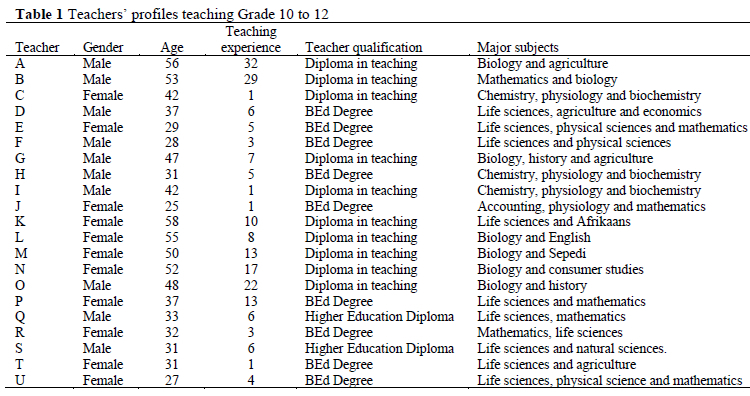
The target population for the study was 32 LS teachers from 20 schools in one of seven sub-districts in Mpumalanga. I used purposeful sampling to select the 21 teachers who were teaching LS in Grade 12 at the time of the study. The teaching experience of the sample was as follows: 12 participants had 1 to 6 years' teaching experience, three participants had 7 to 10 years' teaching experience and six participants had more than 10 years' teaching experience. One can conclude that 43% of the teachers had teaching experience of 7 years and above. At the time of the study all participants were teaching LS which was formerly known as biology. Table 1 reflects the profiles of the participants who were invited to take part in the study.
The participants' right to information was upheld through member checking, and anonymity was preserved to protect the participants' identity (Denzin & Lincoln, 2013).
Data Collection Strategies
I was granted ethical clearance to conduct the research by the ethics committee of the College of Education at the University for all components of the evaluation, and permission to conduct the research was granted by the circuit manager of the sub-district. I used two qualitative data collection strategies to collect data, namely, one-on-one individual interviews, and focus group interviews.
Firstly, two focus groups of 10 participants each were sampled for a general impression of how teachers view the contributions of teacher qualifications on the quality of teaching and learning of LS (FocusGroupTips.com, 2018). For more in-depth information, individual interviews were conducted with 20 participants. The principals of the relevant schools provided me with the names of possible participants.
Each focus group lasted about 45 minutes and comprised male and female participants (Focus group 1 = six women and four men; and Focus group 2 = five women and five men). Seemingly, there were more female than male teachers in this sub-district. The individual interviews lasted between 30 and 35 minutes. The participants' responses were recorded, transcribed, and coded. Ethics principles, such as informed consent, privacy, and confidentiality were applied to protect the identity of the participants. I developed a semi-structured interview guide, which created room for probing questions to be asked as a strategy to gain more information.
The same questions were asked in both focus groups and individual interviews.
• How qualified are you to teach LS in Grades 10-12?
• What challenges are associated with the teaching of LS?
• How often do you receive support in the form of professional development?
• How would you rate the level of your teaching and learner performance?
• How did the university partnership make you improve on your teaching?
Member checking was done after both interviews to increase the credibility and trustworthiness of the collected data. Triangulation was applied by using more than one data collection strategy, namely, focus groups and individual interviews. Information gathered from individual interviews was added to that of focus groups.
Data Analysis
According to Patton (2002), data analysis involves segmenting and taking apart the data and putting it back together to make meaning. Inductive analysis of the data was employed. The transcriptions of the focus group and individual interviews were analysed using Creswell and Poth's (2016) method of coding, which entails reducing the data or patterns to meaningful segments and assigning names to the segments. The codes were then combined into broader categories or themes. These themes are broad units of information that consist of several codes aggregated to form a common idea. Three themes emerged from this study, namely: 1) Factors that influenced teacher expertise and qualification in teaching LS in Grades 10 to 12; 2) The influence that teachers' qualifications and expertise have on the teaching and learning of the subject; and 3) Interventions needed to enhance teacher qualifications and expertise in the teaching of LS.
Findings
Theme 1: Factors that Influenced Teacher Expertise and Qualification in Teaching Life Sciences in Grades 10 to 12
Participants indicated several factors (both personal and systemic) that influenced their expertise to teach LS effectively. Ten of the 21 participants held a teaching diplomas qualification and they indicated that they were not taught some of the topics that they were teaching, so they were not qualified and did not have the expertise to teach such topics. Participants' verbatim responses to the question, "How qualified are you to teach LS in Grades 10 to 12" are provided below.
I did my diploma more than 30 years ago and the new life sciences content is more scientific with new topics - which I see now, we were not trained on these topics like evolution. So, I experience challenges when I teach the learners. (Participant A)
I do not know how to teach some topics in life sciences; when I teach I can feel that the learners do not understand me and they will always make noise or ask permission to go out, I become so frustrated. (Participant B)
The results indicate that even though all participants had a teaching qualification they majored in different subjects - some of the majors not providing teachers with the required content knowledge to teach LS.
This is my first-year teaching life sciences, [I] was chosen to teach it because the school is small and do[es] not have life sciences teachers. I majored in three subjects namely, chemistry, physiology and biochemistry (Participant C).
Teaching life sciences today one needs to have knowledge of physical science and mathematics and my major subjects are life sciences, agriculture and economics. I struggle with the chemistry part and calculations which form part of the life sciences syllabus. I normally asks [sic] our maths and physical science teachers to assist me to understand. (Participant D)
When participants were asked whether they could confidently say they had the expertise or qualifications to teach the subject, only two of the 21 participants gave a positive answer. These participants held BEd degrees and had majored in LS, physical science and mathematics.
I don't have a problem teaching the subject because I love it and majored in it at the university, together with maths and physical science, my problem is at our school we do not have resources such as chemicals and apparatus to do experiments. Life sciences is a practical subject and without the resources I teach theory only. (Participant E)
I love teaching the subject, I have no problem with content knowledge, but I do not have enough experience, this is my third year. I think I need some professional development which never took place since I started teaching the subject. (Participant F)
Fifteen of the 21 participants indicated that they lacked skills to teach the new cohort of learners who seemed to have little background about LS.
Honestly, I am unable to make learners from Grade 12 D to understand the life sciences content knowledge. I tried all I could they just don't understand. I have realised that these are the progressed learners who were pushed from one class to the other without having a clear pass, these learners are not coping, they need special attention. (Participant G)
I also have a group of learners who do not understand life sciences, but I know where the problem is coming from. My school is generally under-performing, and the school head is forcing the majority of learners to do life sciences as one of the additional subjects in all the streams.
According to the school head, life sciences is easy to pass unlike mathematics and physical sciences. (Participant H)
Theme 2: The Influence that Teachers'
Qualifications and Expertise have on the Teaching and Learning of the Subject
When participants were asked how their lack of qualifications and expertise affected their teaching of the subject, they responded as follows:
I did not major in pure life sciences. Even though I did biology in Grade 12, there are other topics that I am grappling with because I did not receive training on them at the university and my learners seem to hate the subject. (Participant C)
If you do not have the background of maths and physics you will not cope. I struggle with the chemistry part and calculations which form part of the life sciences syllabus. I normally ask our maths and physical science teachers to assist me to understand. (Participant D)
Five of the participants teaching in small schools indicated that the PPM affected staffing, and teachers were allocated to teach subjects that they had not been trained in. In relation to the issue of the PPM, one would ask whether the correct number of teachers teaching at a particular school mattered more than the teachers with the correct qualifications teaching at a school.
I am a mathematics person, and my majors are accounting, physiology and mathematics. This is my first year in teaching and I am teaching maths and life sciences because they have reduced the number of teachers according to PPM. I am teaching the subject I am learning alongside the learners; this is not good. Since the school is small, I do not even have a head of department or senior teacher who specialised in the subjects I am teaching. (Participant J)
Participants also complained about the policy changes. Some of the topics were re-arranged within the curricula for the different grades and new topics were introduced - resulting in teachers having to teach content on which they had not been trained.
Life sciences content has changed in all the grades. Since some of the topics are new to us, we are not capable of teaching them. We seldom hold workshops to master new content, and we are on our own (Participant K).
Teaching the new life sciences for me it's a problem. I got my diploma qualification long time ago and have not studied further because I have no time and money to register. I still use the old chalkboard and textbook method of teaching. (Participant L)
Theme 3: Interventions Needed to Enhance Teacher Qualifications and Expertise in Teaching Life Sciences
All participants confessed that they needed some form of intervention to improve their level of teaching the subject content because they were worried about the poor performance of their learners. They needed workshops for teachers who taught the subject for fewer years and those who taught for many years to be empowered on teaching methodology, easier ways of presenting lessons, setting of question papers, impactful workshops, and improving knowledge on scientific investigation.
Since I am new I need some form of mentoring through workshops so that I can be able to present the lesson well and be able to set quality tests (Participant C).
I need workshops to explain the new topics for me and how to teach them. I also want to know how to do experiments (Participant M).
Eleven of the participants begged for training on technology skills so that they could start infusing technology into their teaching to make their lessons more interesting.
The learners like to use their phones every time, maybe if I can use technology to teach, they will love the subject. But I do not have technology skills (Participant C).
All 21 participants seemed to value the intervention by the university team, and they wished to have a lifelong partnership with institutions of higher learning.
The department must allow university members to conduct workshops to help us with topics we do not understand (Participant M).
Universities must offer some certificates courses on life sciences which we can do part-time (Participant N).
Fifteen of the participants seemed to shun their responsibilities and wanted their subject specialists to teach the learners for them because they acknowledged that they were unable to teach due to a lack of content knowledge and teaching skills.
Our subject specialists should assist learners in class and the programmes and support given to teachers must further be extended to learners (Participant O).
Discussion
The results of this study show that the participants reported two types of factors that influenced their performance in teaching LS in Grades 10 to 12, namely personal and systemic factors. In responding to the first research question, participants reported factors that influenced teacher expertise and qualification in teaching LS as teachers' outdated qualifications, teaching out-of-field, a lack of formal subject-specific training, policy changes, a lack of departmental and peer support structures.
One of the personal factors was the outdated qualifications which, according to the participants, did not cover the revised LS content introduced in the school curriculum a few years ago. From the participants' point of view, a plethora of educational policy changes have led to the curriculum to be revised, and new topics were introduced in the LS content, for example, evolution and scientific investigations which they knew nothing about. It became evident that the lack of proper qualifications and expertise was also caused by wrong subject streams, where teachers' choice of subject groupings at the college or university where they were trained, rendered them ineffective in teaching LS as a science subject. As an example, incompatible subject streams, such as that of Participant D (LS, agriculture and economics), rendered participants ineffective in teaching the subject because there was no link between the participants' major subjects. From the participants' view, LS, as a science subject, needed to be merged with mathematics and physical science, as alluded to by Participant D, for teachers to be fit to teach LS as a professional qualification (Acosta et al., 2023). However, the results indicate the chaos that existed in the teaching fraternity, where two out of the 21 participants had the above-mentioned subject groupings, which happened to be the tools of the trade to teach the LS subject content. This notion agrees with current literature (Acosta et al., 2023; Veriava et al., 2017) that reveals the poor teacher profiles influence the teaching of LS content knowledge. This means that learners who are taught by teachers with incompatible subject streams might be affected negatively and may perform poorly. In the same vein, the learners who manage to pass the subject may not acquire the required score in LS that will enable them to pursue careers in the field of science, health and climate change. This might lead to more learners or individuals who lack the competencies to innovate and to contribute to global solutions.
Equally important is evidence that the participants did not engage in personal development. Ten of the 21 participants only held diploma qualifications and were stagnant in teaching the same content with the same methods that did not cater for learner differences and needs. This meant that only a few learners might be able to cope in such a teaching and learning environment, while some of the learners may be left unattended. The danger of not catering for learners' difference is that it might lead to low throughput rates at schools as more learners might opt to drop out. The current economic crisis compels education to produce graduates who will be able to provide solutions to educational dilemmas. Institutions of learning are also encouraged to increase the throughput rates and reduce learner drop-outs as indicated in the Sustainable Development Goals (SDGs) and goal 4, target 4.7 of the 2030 Agenda for Sustainable Development (Tilbury, 2011; United Nations, 2015).
Some teachers reported a systemic factor. They were required to teach out of field due to the PPM, forcing them to teach subjects that they were not trained for: "I majored in chemistry, physiology and biochemistry and was chosen to teach life sciences because the school is small and do[es] not have life sciences teachers." (Participant C). It became evident from this study that teachers' lack of content knowledge and skills to teach LS rendered them incompetent to do so. Veriava et al. (2017) indicate that the shortage of teachers in South African schools has detrimental effects. The situation is exacerbated by another systemic factor - policy changes and curriculum updates without corresponding upskilling. The shifting of topics between grades due to new policy changes and the introduction of new topics such as evolution in the LS curriculum rendered a huge number of teachers unqualified because these changes required of them to employ different teaching methodologies (Berland et al., 2016). More than half of the participants were not trained in some of the new LS topics introduced by the policy changes, for example, the topic of evolution contributes to almost 56 of the marks in the second LS paper. Eight participants between 47 and 58 years old complained about not having the knowledge and skills to teach the new content: "Life sciences content has changed in all the grades. Since some of the topics are new to us, we are not capable of teaching them" (Participant K). However, it became evident in this study that participants were not against policy changes but were more concerned with the unavailability of systems to ensure the effective implementation of the changed curriculum. Clearly, the teachers' content gaps created a teaching and learning environment that did not cater for learners' interest and attention, which resulted in learners disrupting classes and leaving classrooms during lessons (comment by Participant B). Such disturbances may cause learners to miss the content, which may result in poor performance. This, coupled with a lack of departmental and peer support structures in the form of professional development workshops left teachers with content gaps. Evidence prevailed that subject content knowledge gaps were not addressed at school level because the department head had no qualifications in LS (comment by Participant J) and, therefore, could not provide development in the form of content knowledge and teaching methodologies.
The findings reveal yet another systemic factor - lack of resources. This factor created a teaching and learning environment that rendered LS teachers incompetent and helpless because of a lack of chemicals and apparatus, which were needed to perform experiments. This finding is supported by Lewis (2014) who indicates that the absence of apparatus and chemicals might have a very negative impact on the teaching of science subjects (comment by Participant E).
Findings on the influence that teachers' qualifications and expertise have on the teaching and learning of the subject (research question 2) indicate that teachers who specialised in mathematics, LS and physical science had no challenges in teaching the subject: "I don't have a problem teaching the subject because I love it and majored in it at the university, together with maths and physical science'" (Participant E). This finding is in line with Becker's (1993) human capital theory which indicates that the more qualified the teacher, the higher their capacity to deliver effective instruction. It became evident that teachers who did not have mathematics and physical sciences as major subjects experienced challenges in the teaching of the chemistry section of the LS curriculum and the content dealing with calculations (comment by Participant D).
It became evident from this study that teachers who did not engage in lifelong learning could not keep abreast with new knowledge and developments in the subject and would teach the same content and use the same approach continuously. Such teachers would not be able to apply innovative teaching methodologies; they will use the old chalkboard and textbook method of teaching (comment by Participant L) which does not cater for individual learner needs. Teachers who do not keep abreast with the demands of the current educational needs are also not able to use technology in the teaching and learning process -something required by modern-day learners who are digital natives. With the advent of the Fourth Industrial Revolution, the integration and use of advanced technologies have become essential in shaping the way individuals teach and learn, but the participants in this study indicated that they lacked qualifications to enable them to apply technology in their teaching (Participant C). Lack of updated knowledge through part time study deprived teachers an opportunity to acquire knowledge and skills that will make them more efficient and capable (Becker, 1993). Such skills and knowledge might assist teachers to teach the current cohort of learners (comment by Participant G).
In as far as interventions needed to enhance teacher qualifications and expertise in teaching LS (research question 3) is concerned, the results indicate that professional development by those in authority were on top of the list (18 out of 21 teachers) of support needed by teachers to teach the LS subject effectively. The results indicate that professional development in the form of in-service training, as is supported in literature (Bunch, 2013; Burgin & Daniel, 2017; Vold, 2017), is still not fully attended to (Participant F). The results show that teachers had gaps in content knowledge and skills and would, therefore, not be able to teach the subject content effectively because of a lack of support (Cooper, T 2017). Participants with diploma qualifications (10 out of 21) confessed that they were unqualified to teach the subject based on their old qualifications and indicated that they needed to further their studies (Participant N). This finding is in line with Yusuf and Dada's (2016) assertion that both non-professional and unqualified teachers should pursue post-graduate studies to improve the quality of their teaching and learning.
New developments (in the form of policy changes) that bring new knowledge and skills, call for teachers who engage in lifelong learning to acquire relevant qualifications and expertise to teach LS. To a larger extent, participants indicated the need for support in the form of workshops to empower them on the new content and teaching methodologies. The accumulation of such knowledge and appropriate teaching methodologies for LS teaching would develop highly effective teachers (Hemmings & Kay, 2009). The results of my study reveal that teachers had lost hope and were aware that they were not able to teach the subject effectively. Participant O even went as far as asking the subject specialist to teach the learners. The comment by Participant M indicates that the situation could be alleviated through teacher support in the form of professional development programmes (Burgin & Daniel, 2017) like the one used by the university team.
The results also show that 10 of the 21 participants had the zeal to know and implement technology, not only to be on par with the fourth Industrial Revolution but to trigger learners' interest in the teaching and learning of LS (Participant C) (Jeronen et al., 2016; Keselman, 2003).
Conclusion
With this article I shed light on how teachers' lack of relevant qualifications and expertise to teach LS influenced their ability to teach the subject. Both personal and systemic factors contributed to teachers' ineffectiveness in teaching the subject. Personal factors such as teachers' outdated qualifications, teaching out of field, a lack of formal subject-specific training, policy changes, and a lack of departmental and peer support structures were discussed. In the same vein, systemic factors such as PPM policy changes, a lack of resources and support in the form of professional development were listed as contributory factors. Interventions such as in-service training and encouraging teachers to engage in lifelong learning could help solve the problem.
Based on the knowledge gained from this study I offer the following recommendations to education stakeholders:
• The Department of Education must revisit the PPM policy. Only teachers with the relevant qualifications must be allowed to teach LS.
• Policy changes must be accompanied by resources for implementing such changes.
• Teachers must be exposed to rigorous in-service training to empower them with knowledge and skills to implement changes in the curriculum.
• LS teachers must be encouraged to engage in lifelong learning to stay abreast of changes and new developments in the subject.
The limitations of the study relate to the fact that it was based on a small sample of only 21 participants from one sub-district in the Mpumalanga province. It was, therefore, not possible to generalise the findings to other provinces. I, recommend further research involving a larger sample taken from a wider geographical area.
Notesi. Published under a Creative Commons Attribution Licence.
References
-
Acosta H, Cajas D & Garnica DIR 2023. Linking teachers' profiles to their capability in curriculum implementation: Analysis of factors that shape and influence EFL classes. International Journal of Learning, Teaching and Educational Research, 22(5):518-537. https://doi.org/10.26803/ijlter.22.5.26
» https://doi.org/10.26803/ijlter.22.5.26 -
Aina JK, Olanipekun SS & Garuba lA 2015. Teacher's effectiveness and its influence on student's learning. Advances in Social Sciences Research Journal, 2(4):88-95. https://doi.org/10.14738/assrj.24.1082
» https://doi.org/10.14738/assrj.24.1082 - Akinfe E, Olofinniyi OE & Fashiku CO 2012. Teachers' quality as correlates of students academic performance in biology in senior secondary schools in Ondo State, Nigeria. Online Journal of Education Research, 1(6):108-114.
-
Bahr N & Mellor S 2016. Building quality in teaching and teacher education. Camberwell, Australia: ACER Press. Available at https://research.acer.edu.au/cgi/viewcontent.cgi?article=1025&context=aer. Accessed 20 November 2025.
» https://research.acer.edu.au/cgi/viewcontent.cgi?article=1025&context=aer -
Ball DL 1991. Implementing the "Professional Standards for Teaching Mathematics": What's all this talk about "discourse"? The Arithmetic Teacher, 39(3):44-48. https://doi.org/10.5951/AT.39.3.0044
» https://doi.org/10.5951/AT.39.3.0044 - Becker GS 1993. Human capital: A theoretical and empirical analysis, with special reference to education (3rd ed). Chicago, IL: The University of Chicago Press.
-
Berland LK, Schwarz CV, Krist C, Kenyon L, Lo AS & Reiser BJ 2016. Epistemologies in practice: Making scientific practices meaningful for students. Journal of Research in Science Teaching, 53(7):1082-1112. https://doi.org/10.1002/tea.21257
» https://doi.org/10.1002/tea.21257 -
Boyd D, Lankford H, Loeb S, Rockoff J & Wyckoff J 2008. The narrowing gap in New York City teacher qualifications and its implications for student achievement in high-poverty schools (National Bureau of Economic Research [NBER] Working Paper 14021). Cambridge, MA: NBER. https://doi.org/10.3386/w14021
» https://doi.org/10.3386/w14021 -
Bunch GC 2013. Pedagogical language knowledge: Preparing mainstream teachers for English learners in the new standards era. Review of Research in Education, 37(1):298-341. https://doi.org/10.3102/0091732X12461772
» https://doi.org/10.3102/0091732X12461772 -
Burgin X & Daniel MC 2017. Exploring English language teaching in an Ecuadorian urban secondary institution. GIST - Education and Learning Research Journal, 14:107-134. https://doi.org/10.26817/16925777.364
» https://doi.org/10.26817/16925777.364 -
Chen C, Sonnert G, Sadler PM & Sunbury S 2020. The impact of high school life science teachers' subject matter knowledge and knowledge of student misconceptions on students' learning. CBE-Life Sciences Education, 19(1):ar9. https://doi.org/10.1187/cbe.19-08-0164
» https://doi.org/10.1187/cbe.19-08-0164 -
Cooper MD 2000. Towards a model of safety culture. Safety Science, 36(2): 111-136. https://doi.org/10.1016/S0925-7535(00)00035-7
» https://doi.org/10.1016/S0925-7535(00)00035-7 -
Cooper T 2017. Curriculum renewal: Barriers to successful curriculum change and suggestions for improvement. Journal of Education and Training Studies, 5(11):115-128. https://doi.org/10.11114/jets.v5i11.2737
» https://doi.org/10.11114/jets.v5i11.2737 -
Couch BA, Brown TL, Schelpat TJ, Graham MJ & Knight JK 2015. Scientific teaching: Defining a taxonomy of observable practices. CBE-Life Sciences Education, 14(1):1-12. https://doi.org/10.1187/cbe.14-01-0002
» https://doi.org/10.1187/cbe.14-01-0002 - Creswell JW & Poth CN 2016. Qualitative inquiry & research design: Choosing among five approaches (4th ed). Thousand Oaks, CA: Sage.
- Denzin NK & Lincoln YS 2013. The landscape of qualitative research (4th ed). Thousand Oaks, CA: Sage.
-
Department of Basic Education, Republic of South Africa 2011. Curriculum and Policy Statement Grades 10-12 Life Sciences. Pretoria: Author. Available at https://www.education.gov.za/Portals/0/CD/National%20Curriculum%20Statements%20and%20Vocational/CAPS%20FET%20_%20LIFE%20SCIENCES%20_%20GR%2010-12%20Web_2636.pdf. Accessed 31 May 2023.
» https://www.education.gov.za/Portals/0/CD/National%20Curriculum%20Statements%20and%20Vocational/CAPS%20FET%20_%20LIFE%20SCIENCES%20_%20GR%2010-12%20Web_2636.pdf -
Ferahtia A, Halilat MT, Mimeche F & Bensaci E 2021. Surface water quality assessment in semi-arid region (El Hodna watershed, Algeria) based on water quality index (WQI). Studia Universitatis Babes-Bolyai Chemia, 66(1):127-142. https://doi.org/10.24193/subbchem.2021.1.10
» https://doi.org/10.24193/subbchem.2021.1.10 -
FocusGroupTips.com 2018. Focus group questionnaire fundamentals: Basic questions. Available at https://www.focusgrouptips.com/focus-group-questionnaire.html. Accessed 5 May 2024.
» https://www.focusgrouptips.com/focus-group-questionnaire.html -
Grant R 1997. A claim for the case method in the teaching of geography. Journal of Geography in Higher Education, 21(2):171-185. https://doi.org/10.1080/03098269708725423
» https://doi.org/10.1080/03098269708725423 -
Hanushek EA & Woessmann L 2008. The role of cognitive skills in economic development. Journal of Economic Literature, 46(3):607-668. https://doi.org/10.1257/jel.46.3.607
» https://doi.org/10.1257/jel.46.3.607 -
Hemmings B & Kay R 2009. Lecturer self-efficacy: Its related dimensions and the influence of gender and qualifications. Issues in Educational Research, 19(3):243-254. Available at https://www.researchgate.net/profile/Brian-Hemmings/publication/255626489_Lecturer_self_efficacy_Its_related_dimensions_and_the_influence_of_gender_and_qualifications/links/53f47a070cf2888a7490fe4c/Lecturer-self-efficacy-Its-related-dimensions-and-the-influence-of-gender-and-qualifications.pdf?_sg%5B0%5D=started_experiment_milestone&origin=joumalDetail. Accessed 15 November 2025.
» https://www.researchgate.net/profile/Brian-Hemmings/publication/255626489_Lecturer_self_efficacy_Its_related_dimensions_and_the_influence_of_gender_and_qualifications/links/53f47a070cf2888a7490fe4c/Lecturer-self-efficacy-Its-related-dimensions-and-the-influence-of-gender-and-qualifications.pdf?_sg%5B0%5D=started_experiment_milestone&origin=joumalDetail -
Jeronen E, Palmberg I & Yli-Panula E 2016. Teaching methods in biology education and sustainability education including outdoor education for promoting sustainability-A literature review [Special issue]. Education Sciences, 7(1):1. https://doi.org/10.3390/educsci7010001
» https://doi.org/10.3390/educsci7010001 -
Keselman A 2003. Supporting inquiry learning by promoting normative understanding of multivariable causality. Journal of Research in Science Teaching, 40(9):898-921. https://doi.org/10.1002/tea.10115
» https://doi.org/10.1002/tea.10115 -
Lewis DI 2014. The pedagogical benefits and pitfalls of virtual tools for teaching and learning laboratory practices in the Biological Sciences. York, England: The Higher Education Academy. Available at https://s3.eu-west-2.amazonaws.com/assets.creode.advancehe-document-manager/documents/hea/private/resources/the_pedagogical_benefits_and_pitfalls_of_virtual_tools_for_teaching_and_learning_laboratory_practices_in_the_biological_sciences_1568037252.pdf. Accessed 14 November 2025.
» https://s3.eu-west-2.amazonaws.com/assets.creode.advancehe-document-manager/documents/hea/private/resources/the_pedagogical_benefits_and_pitfalls_of_virtual_tools_for_teaching_and_learning_laboratory_practices_in_the_biological_sciences_1568037252.pdf -
Marco-Bujosa LM, McNeill KL, González-Howard M & Loper S 2017. An exploration of teacher learning from an educative reform-oriented science curriculum: Case studies of teacher curriculum use. Journal of Research in Science Teaching, 54(2):141-168. https://doi.org/10.1002/tea.21340
» https://doi.org/10.1002/tea.21340 -
Minken Z, Macalalag A, Clarke A, Marco-Bujosa L & Rulli C 2021. Development of teachers' pedagogical content knowledge during lesson planning of socioscientific issues. International Journal of Technology in Education, 4(2):113-165. https://doi.org/10.46328/ijte.50
» https://doi.org/10.46328/ijte.50 -
Patton MQ 2002. Two decades of developments in qualitative inquiry: A personal, experiential perspective. Qualitative Social Work, 1(3):261-283. https://doi.org/10.1177/1473325002001003636
» https://doi.org/10.1177/1473325002001003636 -
Psacharopoulos G & Patrinos HA 2004. Returns to investment in education: A further update. Education Economics, 12(2):111 -134. https://doi.org/10.1080/0964529042000239140
» https://doi.org/10.1080/0964529042000239140 - Reed K 2020. Deficit thinking in schools is a social justice issue. Here's why we need to do better. Lessons for SEL.
-
Relela ME & Mavuru L 2023. Life sciences teachers' Pedagogical Content Knowledge when addressing socioscientific issues in the topic evolution. International Journal of Learning, Teaching and Educational Research, 22(5):302-318. https://doi.org/10.26803/ijlter.22.5.15
» https://doi.org/10.26803/ijlter.22.5.15 - Roos V 2014. The Mmogo-method® as self-constructed visual research method to explore older people's relational experiences with young adults. Keynote presented at the 13th Advances in Qualitative Methods Conference, Edmonton, Canada, June.
-
Shing CL, Saat RM & Loke SH 2015. The knowledge of teaching - pedagogical content knowledge (PCK). MOJES: Malaysian Online Journal of Educational Science, 3(3):40-55. Available at https://mojes.um.edu.my/index.php/MOJES/article/view/12781/8206. Accessed 12 November 2025.
» https://mojes.um.edu.my/index.php/MOJES/article/view/12781/8206 -
Shulman L 1987. Knowledge and teaching: Foundations of the new reform. Harvard Educational Review, 57(1):1-23. https://doi.org/10.17763/haer.57.1.j463w79r56455411
» https://doi.org/10.17763/haer.57.1.j463w79r56455411 - Spörhase U 2012. Welche allgemeinen ziele verfolgt Biologieunterricht [What are the general objectives of Biology education?]. In U Spörhase (ed). Biologie didaktik, praxishandbuch fur die sekundarstufe I und II (5th ed). Berlin, Germany: Cornelsen Verlag.
-
Tidemand S & Nielsen JA 2017. The role of socioscientific issues in biology teaching: From the perspective of teachers. International Journal of Science Education, 39(1):44-61. https://doi.org/10.1080/09500693.2016.1264644
» https://doi.org/10.1080/09500693.2016.1264644 -
Tilbury D 2011. Education for sustainable development: An expert review of processes and learning. Paris, France: United Nations Educational, Scientific and Cultural Organization. Available at http://unesdoc.unesco.org/images/0019/001914/191442e.pdf. Accessed 5 May 2024.
» http://unesdoc.unesco.org/images/0019/001914/191442e.pdf -
United Nations 2015. Transforming our world: The 2030 Agenda for Sustainable Development. A/RES/70/1. Available at https://sustainabledevelopment.un.org/post2015/transformingourworld. Accessed 5 May 2024.
» https://sustainabledevelopment.un.org/post2015/transformingourworld -
Veriava F, Thom A & Hodgson TF 2017. Basic education rights handbook: Education rights in South Africa. Braamfontein, Johannesburg: SECTION27. Available at https://section27.org.za/resources/section-27-publications/basic-education-handbook/. Accessed 5 May 2024.
» https://section27.org.za/resources/section-27-publications/basic-education-handbook/ -
Vold ET 2017. Qualifying foreign language teachers: Is teacher training enough? International Journal of Educational Research, 82:40-53. https://doi.org/10.1016/j.ijer.2016.12.002
» https://doi.org/10.1016/j.ijer.2016.12.002 -
Yusuf HO & Dada AA 2016. Impact of teachers' qualification and experience on the performance of students in Colleges of Education in Kaduna State, Nigeria. The Online Journal of Quality in Higher Education, 3(2):52-61. Available at https://www.tojdel.net/journals/tojqih/articles/v03i02/v03i02-05.pdf. Accessed 17 November 2025.
» https://www.tojdel.net/journals/tojqih/articles/v03i02/v03i02-05.pdf
Revised: 9 May 2025
Accepted: 2 October 2025
Published: 31 December 2025