Relationship between situational determinants of teachers' perceptions of organisational politics and job satisfaction
Abstract
With the study reported on here we aimed to explore the relationship between situational determinants of teachers' perceptions of organisational politics in some public high schools in the KwaZulu-Natal province. We adopted a cross-regional survey design and convenience sampling to study teachers (n = 301) at public high schools in all 10 districts in KwaZulu-Natal, South Africa. We found that perceived organisational politics had a positive relationship to job satisfaction. Analyses of correlational and stepwise regression showed numerous significant relations between the perceptions of organisational politics and job satisfaction variables. The results of the study can be used by the Department of Basic Education to improve South African provincial school management practices for the development and retention of experienced and valuable educators.
job satisfaction; organisational politics; state-run schools; teachers' perceptions
Introduction
Worldwide, professional teacher attrition has been acknowledged as a substantial problem that requires supreme consideration (Räsänen, Pietarinen, Pyhältö, Soini & Väisänen, 2020). Professional teachers in some African countries are quitting their jobs and "to make matters worse, young adults are uninterested in choosing teaching as a career" (Toropova, Myrberg & Johansson, 2021:74). Many teachers are faced with poor working conditions, insufficient infrastructure on teaching and learning resources (Amusa & Toriola, 2013). Tshiredo (2013:10) asserts that the work of teachers in South Africa is affected by various factors, that include, inter alia, "inequalities, constant changing curriculum" and Saunderson-Meyer (2019) argues a suppression of teacher authority in the classroom as one of the factors. Consequently, teachers "are losing interest in working in public schools because political cliques appear in the school environment, 'sell teaching jobs'", and teachers instigate strikes to eliminate their colleagues (Volmink, Gardiner, Msimang, Nel, Moleta, Scholtz & Prins, 2016:118). According to some studies these factors influence some teachers to the extent that they have no option but to exit their jobs to explore other informal/formal tactics to strive for limited resources to satisfy their expectations and other needs (Saunderson-Meyer, 2019; Volmink et al., 2016). Moreover, the Ministry of Basic Education is reactively dealing with the manifestation of the ruinous organisational politics culture in public schools (Saunderson-Meyer, 2019; Volmink et al., 2016). Daskin and Tezer (2012, in Elkhalil, 2017:3) maintain that "perceived organisational politics have a lethal effect that can influence employees' behaviour, conduct, enact the work context harmony and efficacy." We sought to examine the relationship between situational determinants of teachers' perceptions of organisational politics (POPS) and job satisfaction (JSS) in public high schools in KwaZulu-Natal. Teachers play a fundamental role in nurturing and shaping the future of humans to remain competitive in a dynamic economic mainstream (Global Partnership for Education [GPE], 2020; Lamar University, 2016). We formulated a broad research question: Is there any significant relationship between POPS and the JSS of teachers in state-run schools in the districts of the KwaZulu-Natal province of South Africa?
The objectives of this article were to (1) establish the relationship between POPS and JSS and (2) establish whether the POPS variables positively and significantly predict the teachers' JSS. We formulated the following hypotheses:
• H1 Perceived organisational politics relates significantly and positively to job satisfaction of teachers.
• H2 Perceived organisational politics significantly and positively predicts teachers' job satisfaction.
In the ensuing sections, we briefly discuss the concepts "perceived organisational politics" and "job satisfaction" as well the research methodology, analysis of the findings, limitations, recommendations and conclusion.
Perceived Organisational Politics
Perceived organisational politics conceptually entails employee motivation, which is an essential tenet for the development of the organisation (Abbas & Raja, 2014; Conner, 2006; Elkhalil, 2017; Hooper, 1983). Mintzberg's (1983) defines POPS as behaviours aimed at promoting self-interest at the expense of others or organisational goals. Poon (2003) categorises antecedents of POPS as personal factors (e.g., personality characteristics, demographic factors, attitudes, needs and values); situational factors (e.g., at the job level, factors like job autonomy and job variation); and organisational level, (factors like centralisation and formalisation). Perceptions of organisational politics are influenced by four variables, namely the hierarchical level, job autonomy, formalisation and the climate of the organisation (O'Connor & Morrison, 2001:3; cf. Ferris & Kacmar 1992).
Perceived organisational politics may cause stress and conflict in the workplace (Chinomona & Mofokeng, 2016; Conner, 2006; Ferris, Fedor, Chachere & Pondy, 1989:92; Richardsen, Traavik & Burke, 2016; Swartz & Potgieter, 2017). This in turn can result in the disturbance of the usual patterns of activity or behaviour at both an individual and organisational level in terms of JSS (Ferris, Treadway, Perrewé, Brouer, Douglas & Lux, 2007; Vigoda-Gadot, 2007). Hence, Swartz and Potgieter (2017) suggest control and understanding as remedies that can regulate the connections between POPS and its effects (cf. Bodla, Danish & Nawaz, 2012; Elkhalil, 2017; Hochwarter & Treadway, 2003:558; Tlaiss, 2013). Factors such as commitment (Ferris et al., 2007; Vigoda-Gadot, 2007), political behaviour (Al-Zu'bi, 2010; Dhar, 2011), and self-efficacy (Ashforth & Lee, 1990; Jawahar, Meurs, Ferris & Hochwarter, 2008) can balance the connections between politics and work outcomes.
Job Satisfaction
Job satisfaction (JSS) exemplifies "an individual's total feeling about their job, organisation climate and the attitudes they have towards various aspects or facets of their job, as well as an attitude and perception that could consequently influence the degree of fit between the individual and the organisation" (Spector, 2008, in Lumley, Coetzee, Tladinyane & Ferreira, 2011:102). Generally, employees who are highly satisfied with their job appear to "have positive attitudes while those who are dissatisfied appear to have negative attitudes toward their job and organisation" (Mokgolo, 2008:54). These attitudes are influenced by interrelated facets of JSS such as "pay, promotion, supervision, benefits, contingent rewards, operating procedures, co-workers, the nature of the work and communication" (Spector, 1997:8). Therefore, organisations need to find ways through which they will encourage positive political behaviour, enhance employees' job satisfaction and their service spirit (Yusof, Zulkiffli, Padlee & Yusof, 2018). Different scholars (e.g. Chen, Wang, Chang & Weng, 2017; Chinomona & Mofokeng, 2016; Swartz & Potgieter, 2017) opine that POPS are associated with increased levels of turnover and decreased levels of commitment, job satisfaction, performance, and job stress.
Method
Participants
Data were collected from 350 full-time and temporarily employed teachers at state-run high schools across all 10 districts in KwaZulu-Natal through anonymous, self-administered questionnaires. A total of 301 surveys were circulated and returned, signifying a response rate of 86% - 78% from female and 22% from male participants. Most participants were full-time teachers (59%) while 41% were temporary teachers. The focus of this study was on teachers tasked to teach on a daily basis, hence school principals were excluded because they form part of the school management. Cluster probability sampling (i.e. two-stage cluster) was used to draw the sample. This selection method allowed us to create a representative sample of the high school teaching workforce while mitigating the probability for bias and addressing context-specific challenges (Morris & Nguyen, 2008; Turner, Magnani & Shuaib, 1996).
Measuring Instruments
The questionnaire survey used to gather data for this study consisted of three sections: demographic and background variables, and two other sections for the POPS and JSS scales.
Job satisfaction scale
The Job Satisfaction Scale (Spector, 1997) measures nine aspects namely: pay, promotion, supervision, fringe benefits, contingent rewards, operating conditions, co-workers, nature of the work, communication, and the overall job satisfaction. We used a 5-point response scale to measure all the variables. The scale ranged from 1 (strongly disagree) to 5 (strongly agree). The questionnaire included 12 items which the respondents answered by indicating how true the statement was. We ensured that the instrument was reliable and valid by piloting the questionnaire, linking it with the research questions, comparing it with the literature, and giving clear instructions. The Cronbach's alpha (α) for the JSS was 90.
Perceived organisational politics scale
O'Connor and Morrison (2001) assessed four facets of POPS, namely hierarchical level, job autonomy, formalisation and the climate of the organisation, and general organisational politics. The questionnaire included a set of 12 items that were of the same value and the respondents answered by indicating how true the statement was. The Cronbach's alpha (α) for the POPS was 87.
Research Procedure
We sought and obtained an approval letter from the KwaZulu-Natal provincial Department of Basic Education to conduct this study. The study adhered to all ethical guidelines for research involving humans. The Public Service Commission (PSC) upholds the Constitutional Values and Principles (CVPs) of Chapter 10, Section 195, which govern public administration. The respondents were visited at their respective schools after school hours to collect data, the sessions lasted approximately 30 to 40 minutes. All the respondents received the questionnaires and covering letters in an envelope explaining the purpose of the study guaranteeing their anonymity and the confidentiality of their responses. The return of the questionnaire was an indication of informed consent to participate in this study.
Statistical Analysis
Descriptive and inferential statistics were used to analyse data. Pearson product-moment correlations and stepwise multiple regression analyses were performed to test the study hypotheses and a cut-off point of p < 0.05 and R2 > 0.30 were also performed to measure a practical effect size of correlations (Cohen, 1992). In terms of the multiple regression analyses, we used the value of the adjusted R to define the strength of association and the overall difference of the dependent variable (JSS) that the independent variable (POPS) explained. The F-test was implemented to test the multiple coefficient correlations of (JSS) and (POPS) variable variances.
Results
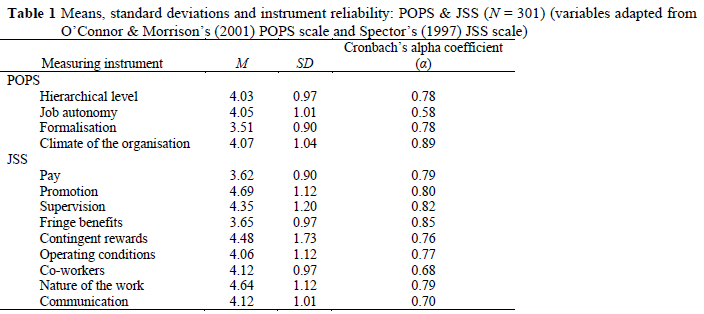
The information contained in Table 1 indicates that with the POPS, the highest mean scores were obtained on the climate of the organisation (M = 4.07; SD = 1.04), job autonomy (M = 4.05; SD = 1.01) and hierarchical level (M = 4.03; SD = 0.97) and the lowest mean score on the formalisation (M = 3.51; SD = 0.90). The standard deviations of the sub-scales were fairly similar, all ranging from 0.90 to 1.04. The mean scores of all the JSS scales ranged from 4.69 to 3.62. The sample of participants displayed the highest mean scores on promotion (M = 4.69; SD = 1.12) and the lowest scores on pay (M = 3.62; SD = 0.90). The standard deviations were fairly similar, all ranging from 0.90 to 1.73.
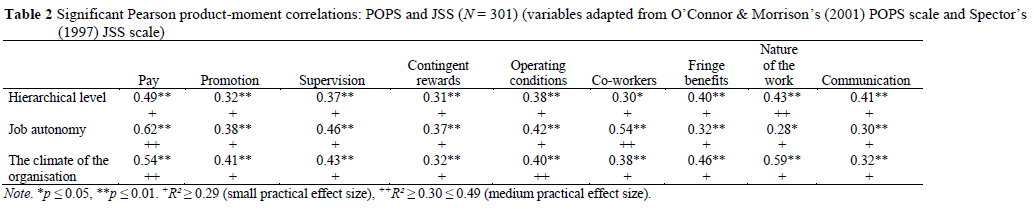
As illustrated in Table 2, significant positive relationships (p < 0.001; medium to large practical effect sizes, except for hierarchical level and coworkers, p < 0.01) were observed between all the POPS variables and JSS of teachers in the KwaZulu-Natal district schools, with the exception of the formalisation (POPS) variable.
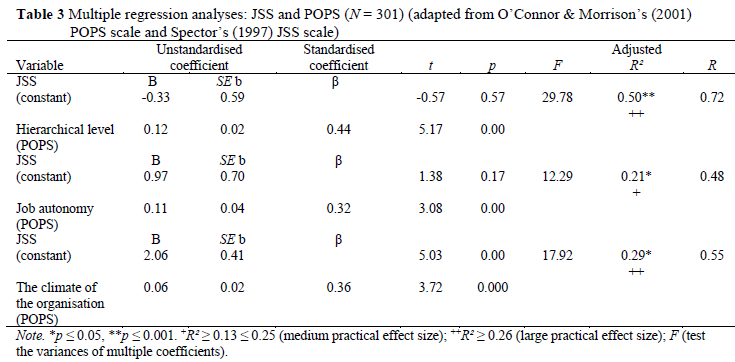
Table 3 displays that the POPS hierarchical level variable contributed significantly to the variance in the JSS (50%) (large practical effect size). Hierarchical level received the largest beta weight (β = 0.44; p < 0.001). The POPS job autonomy variable (β = 0.32; p < 0.001) positively predicted the JSS by achieving 21% (medium practical effect size) of the variance. The POPS climate of the organisation variable (β = 0.36; p = 0.001) positively predicted the JSS by gaining 29% (large practical effect size) of the variance. The variables of hierarchical level, job autonomy and the climate of the organisation are POPS drivers found in the regression analysis of JSS. In accordance with the findings mentioned above, the hypothesis was accepted.
Discussion
In this study we explored the association of POPS and JSS and whether POPS variables positively and significantly predicted JSS of teachers in the KwaZulu-Natal province of South Africa. Overall, the results suggest significant and positive relationships between POPS variables and JSS (cf. Table 2). The positive associations suggest that the respondents who were satisfied with the POPS felt more emotionally attached to their schools (organisations). These respondents were prone to stay with their own schools owing to social norms. These findings support findings of numerous scholars (see, for instance, Chinomona & Mofokeng, 2016; Chipunza & Malo, 2017; Gull & Zaidi, 2012; Hochwarter & Treadway, 2003; Khalid & Ishaq, 2015; Meisler & Vigoda-Gadot, 2014; Vigoda-Gadot, 2007; Yusof et al., 2018). It was found that POPS related strongly to JSS and also resonated with theories on POPS (Ferris et al., 1989). The results shore up the recognition that both POPS and JSS relate to individuals' attitudes towards their job. These areas of POPS may be explained as the obligations that exist between the employer and employee.
An integrated analysis of past and recent literature support the argument that POPS have the ability to indicate lower levels of job commitment, satisfaction and performance and increased levels of job tension and intention to resign. In addition, studies revealed that POPS have the potential to jeopardise an employee's work affection or enthusiasm and as such, should be minimised (Chinomona & Mofokeng, 2016; Gull & Zaidi, 2012; Hochwarter & Treadway, 2003; Khalid & Ishaq, 2015; Meisler & Vigoda-Gadot, 2014; Vigoda-Gadot, 2007; Yusof et al., 2018). No significant relationships were observed between formalisation and JSS. This suggests that POPS do not link with the respondents' JSS with the rules and procedures at their schools.
The results further explain that the respondents' POPS with regard to the hierarchical level, job autonomy and the climate of the organisation played a vital role in predicting and explaining their general satisfaction with the schools. Hierarchical level, job autonomy and the climate of the organisation are concomitant with the motivations that govern an individual's decision to remain with a school. Globally, employees attach great importance to certain working conditions and if these conditions are greatly fulfilled and harmonious with the employees' expectations, such employees are unlikely to resign from the organisation (Dhar, 2011; Martin & Roodt 2008; Shen & Xia, 2012; Swartz & Potgieter, 2017). Thus, it is incumbent to imply that teachers who were pleased with and positive about their schools' political atmosphere, often contributed toward helping their learners realise their full potential and consequently contribute to the country's economic growth (Hanushek & Wößmann, 2010; International Institute for Applied Systems Analysis [IIASA], 2008). On the contrary, Akanbi and Ofoegbu's (2013) found that POPS had detrimental effects on employees' JSS and regarding learners, such learners' cognitive skills were negatively impacted, particularly in countries whose economies were still growing. This affirms the notion that economic growth in both developed and developing countries relies, to a large extent, on the workforce whose cognitive skills have been shaped by teachers (Hanushek & Wößmann, 2010). Thus, neglecting the economic dimension of education and the teachers' JSS negatively affects the development of future generations (Chipunza & Malo, 2017) and subsequently inhibits fair competition in the global economy (Lamar University, 2016).
The main finding of this study is that JSS is a key issue. Toropova et al. (2021) assert that management cannot change an employee's affect disposition but schools (i.e. principals and teachers) can influence what they perceive in their immediate work environment. The findings reveal that teachers need a conducive work environment in order for them to stay longer at their respective schools. If teachers work in conducive school environments, they will be able to provide their learners with the necessary skills to compete in the global economy. Principals and the Ministry of Basic Education should ensure that political infighting and killings for promotions within staterun high schools are prevented and that POPS are handled with fairness and equity.
It was established that POPS positively predicts teachers' JSS, with the exception of formalisation. The findings reveal the need for state-run schools to be considered as a breeding turf for the manifestation of perilous POPS, which have adverse consequences on teachers' JSS. Generally, in the public school context, little is done to foster positive POPS. In the KwaZulu-Natal province, state-run high schools and the provincial Department of Basic Education should work together to create a conducive teaching and learning environment and combat counterproductive organisational politics influenced by self-interest. This may yield teachers' JSS, self-efficacy and retention of teachers. If negative POPS persist, a decrease in the employees' job satisfaction, involvement and working relations will be exacerbated (Chinomona & Mofokeng, 2016; Elkhalil, 2017; Tshiredo, 2013) resulting in lower levels of employee performance and higher levels of job frustration (Aneja, 2015).
Implications of the Study
The results of this study may assist state-run school management and the KwaZulu-Natal provincial Department of Basic Education to develop or implement effective and robust strategies to minimise severe POPS, improve JSS and teachers' self-efficacy in their respective schools. According to Shibiti (2019), employees who are satisfied in their on-and-off-the job environments or fair career advancement have a tendency to display higher degrees of JSS, involvement and organisational citizenship. The school and provincial management should motivate teachers to stay in their jobs by "promoting the values and principles prescribed in section 195 of the Constitution of the Republic of South Africa, 1996, without fear, favour or prejudice" (PSC, 2020:1).
A limitation of our study was that it was restricted to teachers employed in public high schools in KwaZulu-Natal. Thus, the findings cannot be generalised to other districts and provinces. We recommend a further study on two levels: firstly, to cover combined schools in the entire province of KwaZulu-Natal to establish the impact and contributing variables of POPS on JSS of teachers; and secondly, to conduct a comparative study between the entire province and schools in other provinces of South Africa. Furthermore, it is important, for instance, for researchers to focus on personalities and affiliation, and how personalities and affiliation reflect the reactions and behaviour of the teachers. Another limitation was that some teachers evaded sharing views pertaining to differential matters because of the political instability in their province, which is considered as a very sensitive aspect, although fertile for research. Notwithstanding these limitations, this study should be considered as a positive contribution to the development of a politics-free and conducive working environment in state-run high schools in South Africa.
Conclusion
The overall results of this study shed new light on how perceived organisational politics in state-run high schools in South Africa relates to teachers' levels of job satisfaction. The new knowledge emerged from this study may help the KwaZulu-Natal Department of Basic Education and others in the retention and enhancement of devoted teachers' well-being. This view agrees with Shibiti's (2019:8) finding that "satisfaction with retention factors plays an important role in explaining employees' level of links, fit and sacrifice (i.e. job embeddedness) and individuals tend to demonstrate high levels of sacrifice in both on-the-job and off-the-job environments." The result of this study are consistent with the literature that teachers in government schools are highly satisfied to stay at their schools on condition that their employer enhances and maintains a healthy organisational climate (Ampofo, Coetzer & Poisat, 2017), independence at work, fair opportunities for career growth (Chipunza & Malo, 2017; Shibiti, 2019), and champion their health and safety needs (Coetzee, Oosthuizen & Stoltz, 2016).
Authors' Contributions
Dr M.M. was responsible for the project design, conducted the statistical analyses, and wrote the manuscript. Prof. M.A. was responsible for the conceptual contributions and assisted with interpretation, formatting and technical presentation.
Notesi. Published under a Creative Commons Attribution Licence.
Acknowledgements
We would like to acknowledge all the respondents who participated in the study and the contributions made by Dr Ronny Shibiti from the University of South Africa during the finalisation of the manuscript. Also, we would like to express our sincere gratitude to the KwaZulu-Natal provincial Department of Basic Education for granting permission to conduct this study. We declare that we had no financial or personal relationships that may have inappropriately influenced our writing in this article.
References
-
Abbas M & Raja U 2014. Impact of perceived organizational politics on supervisory-rated innovative performance and job stress: Evidence from Pakistan. Journal of Advanced Management Science, 2(2):158-162. https://doi.org/10.12720/joams.2.2.158-162
» https://doi.org/10.12720/joams.2.2.158-162 -
Akanbi PA & Ofoegbu OE 2013. Influence of perception of organizational politics on job satisfaction among university workers in Oyo Town, Nigeria. European Journal of Business and Management, 5(2):162-168. Available at https://iiste.org/Journals/index.php/EJBM/article/view/3939/3997. Accessed 10 December 2020.
» https://iiste.org/Journals/index.php/EJBM/article/view/3939/3997 -
Al-Zu'bi HA 2010. A study of relationship between organizational justice and job satisfaction. International Journal of Business and Management, 5(12):102-109. Available at https://pdfs.semanticscholar.org/9fe4/05306fe20de01c36dde9b13475e6a8da1c60.pdf. Accessed 31 December 2022.
» https://pdfs.semanticscholar.org/9fe4/05306fe20de01c36dde9b13475e6a8da1c60.pdf -
Ampofo ET, Coetzer A & Poisat P 2017. Relationships between job embeddedness and employees' life satisfaction. Employee Relations, 39(7):951-966. https://doi.org/10.1108/ER-10-2016-0199
» https://doi.org/10.1108/ER-10-2016-0199 - Amusa LO & Toriola AL 2013. Dilemma of the African teacher: What exactly do teachers do? African Journal for Physical, Health Education, Recreation and Dance, 19(Suppl. 2):58-73.
- Aneja N 2015. Role of teachers in nation building. Journal of Information, Knowledge and Research in Humanities and Social, 3(1):149-152.
-
Ashforth BE & Lee RT 1990. Defensive behavior in organizations: A preliminary model. Human Relations, 43(7):621-648. https://doi.org/10.1177/001872679004300702
» https://doi.org/10.1177/001872679004300702 -
Bodla MA, Danish RQ & Nawaz MM 2012. Mediating role of perceived organizational politics in relating job characteristics to morale. African Journal of Business Management, 6(15):5185-5192. https://doi.org/10.5897/AJBM11.1246
» https://doi.org/10.5897/AJBM11.1246 -
Chen SY, Wang JY, Chang CS & Weng HC 2017. Relational model of organizational politics perception, job satisfaction, job stress, and organizational commitment in hospital nursing staff. Archives of Nursing Practice and Care, 3(3):084-093. https://doi.org/10.17352/anpc.000031
» https://doi.org/10.17352/anpc.000031 -
Chinomona E & Mofokeng TM 2016. Impact of organisational politics on job dissatisfaction and turnover intention: An application of social exchange theory on employees working in Zimbabwean small and medium enterprises (SMEs). The Journal of Applied Business Research, 32(3):857-870. https://doi.org/10.19030/jabr.v32i3.9661
» https://doi.org/10.19030/jabr.v32i3.9661 -
Chipunza C & Malo B 2017. Organizational culture and job satisfaction among academic professionals at a South African university of technology. Problems and Perspectives in Management, 15(2):148-161. https://doi.org/10.21511/ppm.15(2).2017.14
» https://doi.org/10.21511/ppm.15(2).2017.14 -
Coetzee M, Oosthuizen RM & Stoltz E 2016. Psychosocial employability attributes as predictors of staff satisfaction with retention factors. South African Journal of Psychology, 46(2):232-243. https://doi.org/10.1177/0081246315595971
» https://doi.org/10.1177/0081246315595971 -
Cohen J 1992. A power primer. Psychological Bulletin, 112(1):155-159. https://doi.org/10.1037/0033-2909.112.1.155
» https://doi.org/10.1037/0033-2909.112.1.155 -
Conner DS 2006. Human resource professionals' perceptions of organizational politics as a function of experience, organizational size and perceived independence. The Journal of Social Psychology, 146(6):717-732. https://doi.org/10.3200/SOCP.146.6717-732
» https://doi.org/10.3200/SOCP.146.6717-732 -
Dhar RL 2011. Living with organizational politics: An exploration of employees' behavior. Work, 40(2):153-164. https://doi.org/10.3233/WOR-2011-1216
» https://doi.org/10.3233/WOR-2011-1216 -
Elkhalil Y 2017. Organizational politics and employee behavior: A comparison between the U.S. and Lebanon. PhD thesis. Minneapolis, MN: Walden University. Available at https://www.proquest.com/pagepdf/1917480707?accountid=14717. Accessed 31 December 2022.
» https://www.proquest.com/pagepdf/1917480707?accountid=14717 -
Ferris GR, Fedor DB, Chachere JG & Pondy LR 1989. Myths and politics in organizational contexts. Group & Organization Studies, 14(1):83-103. https://doi.org/10.1177/105960118901400108
» https://doi.org/10.1177/105960118901400108 -
Ferris GR & Kacmar KM 1992. Perceptions of organizational politics. Journal of Management, 18(1):93-116. https://doi.org/10.1177/014920639201800107
» https://doi.org/10.1177/014920639201800107 -
Ferris GR, Treadway DC, Perrewé PL, Brouer RL, Douglas C & Lux S 2007. Political skill in organizations. Journal of Management, 33(3):290-320. https://doi.org/10.1177/0149206307300813
» https://doi.org/10.1177/0149206307300813 -
Global Partnership for Education 2020. Benefits of education. Available at https://www.globalpartnership.org/benefits-of-education. Accessed 2 December 2020.
» https://www.globalpartnership.org/benefits-of-education -
Gull S & Zaidi AA 2012. Impact of organizational politics on employees' job satisfaction in the health sector of Lahore Pakistan. Interdisciplinary Journal of Contemporary Research in Business, 4(2):156-170. Available at https://journal-archieves19.webs.com/156-170.pdf. Accessed 20 September 2019.
» https://journal-archieves19.webs.com/156-170.pdf -
Hanushek EA & Wößmann L 2010. Education and economic growth. In PL Peterson, EL Baker & B McGaw (eds). International encyclopedia of education (3rd ed., Vol. 2). Oxford, England: Academic Press. Available at http://hanushek.stanford.edu/sites/default/files/publications/Hanushek%2BWoessmann%202010%20IntEncEduc%202.pdf. Accessed 4 September 2020.
» http://hanushek.stanford.edu/sites/default/files/publications/Hanushek%2BWoessmann%202010%20IntEncEduc%202.pdf -
Hochwarter WA & Treadway DC 2003. The interactive effects of negative and positive affect on the politics perceptions-job satisfaction relationship. Journal of Management, 29(4):551-567. https://doi.org/10.1016/S0149-2063_03_00027-8
» https://doi.org/10.1016/S0149-2063_03_00027-8 -
Hooper M 1983. The motivational bases of political behavior: A new concept and measurement procedure. Public Opinion Quarterly, 47(4):497-515. https://doi.org/10.1086/268808
» https://doi.org/10.1086/268808 -
International Institute for Applied Systems Analysis 2008. Economic growth in developing countries: Education proves key. IIASA Policy Brief, 3:1-4. Available at http://www.iiasa.ac.at/web/home/resources/publications/IIASAPolicyBriefs/pb03-web.pdf. Accessed 10 December 2020.
» http://www.iiasa.ac.at/web/home/resources/publications/IIASAPolicyBriefs/pb03-web.pdf -
Jawahar IM, Meurs JA, Ferris GR & Hochwarter WA 2008. Self-efficacy and political skill as comparative predictors of task and contextual performance: A two-study constructive replication. Human Performance, 21(2):138-157. https://doi.org/10.1080/08959280801917685
» https://doi.org/10.1080/08959280801917685 - Khalid S & Ishaq S 2015. Job related outcomes in relation to perceived organizational politics. Pakistan Economic and Social Review, 53(1):133- 148.
-
Lamar University 2016. Importance of education and its impact on the economy. Available at https://degree.lamar.edu/articles/education/importance-of-education-and-its-impact-on-the-economy/. Accessed 11 November 2020.
» https://degree.lamar.edu/articles/education/importance-of-education-and-its-impact-on-the-economy/ -
Lumley EJ, Coetzee M, Tladinyane R & Ferreira N 2011. Exploring the job satisfaction and organisational commitment of employees in the information technology environment. Southern African Business Review, 15(1):100-118. Available at http://uir.unisa.ac.za/handle/10500/12003. Accessed 13 March 2017.
» http://uir.unisa.ac.za/handle/10500/12003 -
Martin A & Roodt G 2008. Perceptions of organizational commitment, job satisfaction and turnover intentions in a post-merger South African tertiary institution. South African Journal of Industrial Psychology, 34(1):23-31. https://doi.org/10.4102/sajip.v34i1.415
» https://doi.org/10.4102/sajip.v34i1.415 -
Meisler G & Vigoda-Gadot E 2014. Perceived organizational politics, emotional intelligence and work outcomes: Empirical exploration of direct and indirect effects. Personnel Review, 43(1):116-135. https://doi.org/10.1108/PR-02-2012-0040
» https://doi.org/10.1108/PR-02-2012-0040 - Mintzberg H 1983. Power in and around organizations. Englewood Cliffs, NJ: Prentice-Hall.
-
Mokgolo M 2008. Management experiencing internal changes and external pressure. Management Today, 24(2):52-55. Available at http://hdl.handle.net/10500/5705. Accessed 20 September 2019.
» http://hdl.handle.net/10500/5705 -
Morris SK & Nguyen CK 2008. The human papillomavirus vaccine in Canada. Canadian Journal of Public Health, 99(2): 114-116. https://doi.org/10.1007/BF03405456
» https://doi.org/10.1007/BF03405456 -
O'Connor WE & Morrison TG 2001. A comparison of situational and dispositional predictors of perceptions of organizational politics. The Journal of Psychology, 135(3):301-312. https://doi.org/10.1080/00223980109603700
» https://doi.org/10.1080/00223980109603700 -
Poon JML 2003. Situational antecedents and outcomes of organizational politics perceptions. Journal of Managerial Psychology, 18(2): 138-155. https://doi.org/10.1108/02683940310465036
» https://doi.org/10.1108/02683940310465036 -
Public Service Commission 2020. Chapter 10 of the Constitution of the Republic of South Africa. Republic of South Africa. Available at http://intranet.opsc.gov.za/Documents/Strategic_Plan/Strat%20Plan%202021/Document%20Pack/A%20Chapter%2010%20of%20the%20Constitution%20of%20the%20Republic%20of%20South%20Africa.pdf. Accessed 31 December 2022.
» http://intranet.opsc.gov.za/Documents/Strategic_Plan/Strat%20Plan%202021/Document%20Pack/A%20Chapter%2010%20of%20the%20Constitution%20of%20the%20Republic%20of%20South%20Africa.pdf -
Räsänen K, Pietarinen J, Pyhältö K, Soini T & Väisänen, P 2020. Why leave the teaching profession? A longitudinal approach to the prevalence and persistence of teacher turnover intentions. Social Psychology of Education, 23:837-859. https://doi.org/10.1007/s11218-020-09567-x
» https://doi.org/10.1007/s11218-020-09567-x -
Richardsen AM, Traavik LEM & Burke RJ 2016. Women and work stress: More and different? In ML Connerly & J Wu (eds). Handbook on well-being of working women. Dordrecht, The Netherlands: Springer. https://doi.org/10.1007/978-94-017-9897-6
» https://doi.org/10.1007/978-94-017-9897-6 -
Saunderson-Meyer W 2019. The root of all the rot. Available at https://www.politicsweb.co.za/opinion/the-root-of-all-the-rot. Accessed 13 March 2020.
» https://www.politicsweb.co.za/opinion/the-root-of-all-the-rot -
Shen J & Xia J 2012. The relationship between teachers' and principals' decision-making power: Is it a win-win situation or a zero-sum game? International Journal of Leadership in Education, 15(2):153-174 https://doi.org/10.1080/13603124.2011.624643
» https://doi.org/10.1080/13603124.2011.624643 -
Shibiti R 2019. Satisfaction with retention factors in relation to job embeddedness of public school teachers. SA Journal of Human Resource Management, 17(0):a1161. https://doi.org/10.4102/sajhrm.v17i0.1161
» https://doi.org/10.4102/sajhrm.v17i0.1161 - Spector PE 1997. Job satisfaction: Application, assessment, causes, and consequences. Thousand Oaks, CA: Sage.
-
Swartz L & Potgieter CA 2017. Work stress, -burnout and organizational politics: Perceptions and experience of senior managers in the South African government sector. Review of Public Administration and Management, 5(1):1-8. https://doi.org/10.4172/2315-7844.1000200
» https://doi.org/10.4172/2315-7844.1000200 -
Tlaiss HA 2013. Determinants of job satisfaction in the banking sector: The case of Lebanese managers. Employee Relations, 35(4):377-395. https://doi.org/10.1108/ER-10-2011-0064
» https://doi.org/10.1108/ER-10-2011-0064 -
Toropova A, Myrberg E & Johansson S 2021. Teacher job satisfaction: The importance of school working conditions and teacher characteristics. Educational Review, 73(1):71-97. https://doi.org/10.1080/00131911.2019.1705247
» https://doi.org/10.1080/00131911.2019.1705247 -
Tshiredo LL 2013. The impact of the curriculum change in the teaching and learning of science: A case study in under-resourced schools in Vhembe district. MEd dissertation. Pretoria, South Africa: University of South Africa. Available at https://citeseerx.ist.psu.edu/document?repid=rep1&type=pdf&doi=8aa8b76ab27346ec83eedf54f3ecbc1139a35018. Accessed 31 December 2022.
» https://citeseerx.ist.psu.edu/document?repid=rep1&type=pdf&doi=8aa8b76ab27346ec83eedf54f3ecbc1139a35018 -
Turner AG, Magnani RJ & Shuaib M 1996. A not quite as quick but much cleaner alternative to the Expanded Programme on Immunization (EPI) cluster survey design. International Journal of Epidemiology, 25(1):198-203. https://doi.org/10.1093/ije/25.1.198
» https://doi.org/10.1093/ije/25.1.198 -
Vigoda-Gadot E 2007. Citizens' perceptions of politics and ethics in public administration: A five-year national study of their relationship to satisfaction with services, trust in governance, and voice orientations. Journal of Public Administration Research and Theory, 17(2):285-305. https://doi.org/10.1093/jopart/muj018
» https://doi.org/10.1093/jopart/muj018 -
Volmink J, Gardiner M, Msimang S, Nel P, Moleta A, Scholtz G & Prins T 2016. Report of the Ministerial Task Team appointed by Minister Angie Motshekga to investigate allegations into the selling of posts of educators by members of teachers unions and departmental officials in provincial education departments. Pretoria, South Africa: Department of Basic Education. Available at https://www.gov.za/sites/default/files/gcis_document/201606/ministerialtaskteampostseducatorsreport2016.pdf. Accessed 31 December 2022.
» https://www.gov.za/sites/default/files/gcis_document/201606/ministerialtaskteampostseducatorsreport2016.pdf -
Yusof JM, Zulkiffli SNA, Padlee SF & Yusof NA 2018. The relationship between organizational politics, job satisfaction and turnover intention in the maritime-related agencies in the east coast of Peninsular Malaysia. In A Setyadharma (ed). International Conference on Economics, Business and Economic Education 2018. Dubai, United Arab Emirates: KnE Social Sciences. https://doi.org/10.18502/kss.v3i10.3188
» https://doi.org/10.18502/kss.v3i10.3188
Revised: 14 October 2021
Accepted: 3 March 2022
Published: 31 December 2022