Evaluating quality management principles in public schools in the Tshwane district towards improving performance
Abstract
The International Organization for Standardization's (ISO) 9001 quality management principles (QMPs) were initially developed for use in manufacturing industries. However, according to literature, the 7 QMPs can also be applied in public schools to improve school performance. In the study reported on here we focused on QMPs in the South African public-school context in order to explore whether there is a positive correlation between the adoption of QMPs in public schools and school performance. We investigated the problem of the lack of QMPs and failure of school management to implement QMPs in South African public schools. Data were collected in the Tshwane district, Gauteng province. A quantitative research approach was adopted to analyse the data, and a cross-sectional study stratified the random sampling method, which was used to collect data through an online, self-administered questionnaire. The findings of this study indicate that there is a positive correlation between the benefits and challenges of the 7 QMPs, implying that the adoption of these QMPs by public schools is significant and influences school performance. The study fills a void in current QMP literature and serves as a source of reference for future research in the focus area of ISO 9001 QMPs.
quality management; quality management principles; school district; school performance
Introduction
The study reported on here was conducted in the context of public schools, in particular, we evaluated the seven quality management principles (QMPs) set out by the International Organization for Standardization's (ISO) 9001 quality management system (2015), with the aim of improving school performance in the Tshwane district in the Gauteng province of South Africa. According to Fernández Díaz, Rodríguez Mantilla and Abad (2016), the implementation of the QMP model in public schools often sees an improvement in school management, the establishment of improvement teams, the evaluation of individual and group performance and the measurement of staff satisfaction. Moreover, Brinia, Poullou and Panagiotopoulou (2020) support Fernández Díaz et al. (2016) by asserting that the QMPs introduce the principles of modern administrative science to pedagogy and, therefore, their application in public schools will ensure that schools operate effectively and efficiently and achieve the expected objectives.
Multinational organisations such as the United Nations (UN) play a crucial role in the process of the formulation and implementation of education policy across diverse socio-political contexts. Therefore, the research outputs of this study contribute to one of the goals of the UN's 2030 Agenda for Sustainable Development, namely, goal four (to promote inclusive and equitable quality education for all). The UN's sustainable development goals (SDGs) consist of 17 linked goals that were developed to serve as an overall plan for peace and prosperity for all people across the world, for both current and future objectives (Apoku, 2016).
In the South African context, as outlined in Chapter 9 (Improving education, training, and innovation) of the National Development Plan 2030 (NDP), the major shortcoming of public schools is the low quality of school performance, and the main contributing factors include a lack of qualified educators, school governance body, school leadership, school support by districts and the lack of co-operation between key school stakeholders. The NDP is a white paper document developed in 2012 by the current South African government to eliminate poverty and significantly reduce inequality in South Africa by 2030 (National Planning Commission [NpC], The Presidency, Republic of South Africa [RSA], 2012). Therefore, this study contributes to both the UN's SDGs and the NDP's goals by proposing transformative interventions to improve the quality of education in the South African context.
Quality management studies by Elahi and Ilyas (2019) in Pakistan reveal a lack of studies that guide the implementation of quality management systems in public schools. Furthermore, the study on QMPs by Fernández-Cruz, Rodríguez-Mantilla and Fernández Díaz (2020) indicates that very few studies exist that confirm whether QMPs bring true changes that are sustainable over time and lead to improvement in schools.
Furthermore, Soria-García and Martínez-Lorente (2020) point out that quality management in schools had a positive effect on school performance. However, empirical evidence of QMPs having a positive effect on school performance is scarce.
Dzotsenidze (2018:118) defines a school governing body (SGB) as the school governance that comprises parents, educators, learners and school principals. This is the global trend mechanism of decentralising basic education in the development of school governance bodies for all school stakeholders to participate in school decision-making and school processes to enhance school performance.
Comparative studies by Hossain (2018:129), and Hunter and Molapo (2014:304) identified six countries (Bangladesh, India, Cambodia, Uganda, Tanzania, and Lesotho) to analyse answers to the question, "How is school governance reform changing in these countries?" In answer to this question, Hossain (2018:133) states that education reforms in Bangladesh since the 2000s has focused on SGBs, decentralised authority, and participation of school stakeholders to ensure more accountability. Hunter and Molapo (2014:304) state that from 1992 to 1996, the government of Lesotho started decentralising the education system to SGBs through developing district centres, and legalising school advisory and management committees.
Hossain (2018:137-144) further indicates that in India, the SGB approach places school principals at the heart of the supervision system, and in 1995, Cambodia introduced SGBs to the country's education system, similar to the SGB policy of India and Bangladesh, and also that in Tanzania, the SGB system has been adopted as part of a comprehensive education policy in the country. Hossain (2018:144) furthermore states that in Uganda, the SGBs have been an integral part of the basic education system since the 2000s. This practice has, however, not produced any significant outcomes because of the management committee members' limited knowledge.
The comparative analyses by Hossain (2018) and Hunter and Molapo (2014) show that the study focused on local, African and international studies. According to their statements, it is evident that the governments in these countries changed how schools are governed, as most of the countries decentralised the education system to accommodate school stakeholders. In this study, the QMP factor that advocates the engagement of school stakeholders in school decision-making is the school relationship management factor. This is because it enhances the performance of the school and its stakeholders through responding to the school opportunities and constraints related to each stakeholder and promotes a common understanding of school objectives and values among school stakeholders.
Within the South African context, Leepile (2018:2) states that the report of the Organisation for Economic Co-operation and Development (OECD) of 2015 ranked South African basic education as low performing, compared to other nations in the world. In addition, Statistics South Africa (Stats SA) issued a report in 2020 stating that the problems that public schools in South Africa still experience are the lack of resources, and the poor quality of school leadership and management. The NPC, The Presidency, RSA (2014:15) of the NDP (NPC, The Presidency, RSA, 2012) correspondingly states that several complex issues play a role in the quality of public schools, and the main problem lies in educator performance and quality management of school leadership.
Therefore, the research problem for our study was to explore the significance, if any, of QMPs in the improvement of public-school performance in the Tshwane district.
We aimed to explore how quality management can be practised in public schools, and to determine which QMPs could be employed to improve public schools' performance. The quality management system of ISO 9001 was used to identify the most significant QMPs that could improve school performance. The research question used to investigate the research problem is: What are the most significant QMPs that could improve school performance in the Tshwane district? We used descriptive research to answer the research question. Descriptive research determines or identifies the situation as it is, is aimed at casting a light on problems and is used to explain and validate findings (Saunders, Lewis & Thornhill, 2019:187).
Literature Review
The ISO is a worldwide federation of national standards body, located in Geneva, Switzerland. It came into existence in 1946 and comprises a network of the national standards institutes of 165 countries, with one member per country (Anoye, 2015). The ISO 9001 is defined as a quality management system (QMS) that is adopted by organisations to improve their systems for better quality and efficiency (Hussain, Eskildsen & Edgeman, 2020).
In the public-school context, the ISO 9001 can be adopted by school districts and school leadership to improve both the school system and individual schools' performance. Kusumah and Fabianto (2018) argue that the purpose of adopting the ISO 9001 is to make improvements to the key policy and strategic planning of organisations (Naidoo, 2022). In the public school environment, the ISO 9001 may contribute to improvement in schools when school management uses it to make decisions based on evidence that can be translated into policies.
According to section 8 (H55-H56) of the Policy Handbook for Educators (Education Labour Relations Council [ELRC], 2003), an integrated quality management system (IQMS) framework is currently being implemented in South African public schools. However, we argue that the implementation of the IQMS framework by public schools is ineffective and inefficient to produce the desired results as it does not focus on quality management to improve school performance. It should be noted that there have been no revisions of the Policy Handbook for Educators (ELRC, 2003) since the Department of Basic Education (DBE) published the document in South Africa in 2002, as it remains a white paper document. We argue that the IQMS framework currently being implemented in public schools is not in line with quality management that can be used to improve performance in public schools. This is evident as the framework shows no alignment to ISO standards such as the ISO 9001:2015 standard that we adopted to determine whether the principles of the standard were critical elements that should be employed in the implementation of the IQMS framework to improve school performance and to contribute to both the UN's SDGs 2030 and the NDP's 2030 goals by proposing transformative interventions to improve the quality of education within the South African context.
The ISO 9001's QMS is based on the seven QMPs, which, in turn, are applicable to schools (Arribas Díaz & Martínez-Mediano, 2018).
Given the importance of the ISO 9001 in the improvement of service industries (Naidoo, 2022) such as the public service sector (Rodríguez-Mantilla, Fernández-Cruz & Fernández-Díaz, 2020), it is necessary to increase the number of studies and expand the body of knowledge on it, especially in public schools. Senol and Dagli (2017) correspondingly state that, although the ISO 9001 was initially developed for manufacturing industries, it can also be used in an area such as public schooling to improve academic and non-academic morale and the productivity of educators and learners, and to deliver services of higher quality to public-school stakeholders.
In the South African context, Mamabolo, Malatji and Mphahlele (2022), Spaull (2015) and Tachie and Mancotywa (2021) found that public schools' leadership and management are generally not held accountable for how they manage school resources or how they allocate resources to school activities using quality management systems such as the ISO 9001. They also found that there was a lack of implementation of quality management systems in South African public schools and revealed that school leadership and management implemented quality management systems for monetary rewards instead of for school quality assurance.
In the same manner, in a study on quality management systems in public schools in South Africa, Shongwe and Mutambara (2023:267) revealed that the quality management system framework then implemented by public schools posed a number of challenges to school principals and educators and was largely associated with improper implementation in public schools. They further state that literature shows that the key challenges of implementing a quality management system framework in public schools were inadequate leadership by school principals, resistance by educators, a lack of resources, politicisation of performance appraisals and unpreparedness of school leadership. Furthermore, Ngema and Lekhetho (2019:758) argue that school principals lack comprehensive knowledge on how to implement a quality management system framework successfully.
We argue that quality management system frameworks are not implemented properly in public schools because they do not involve quality management, which can be used to improve performance. The reason is that the framework does not employ the ISO standards such as the ISO 9001:2015 standard and the ISO 21001:2018 (ISO, 2018) standard to determine whether the principles of the standards are critical elements to improve school performance.
Additionally, Mamabolo et al. (2022), Naidoo (2022) and Spaull (2015) reveal that school principals generally fail to manage quality management systems such as the ISO 9001 in public schools. The reason being that they are the ones responsible for managing quality in schools, and, as a result, this failure to correctly implement quality management systems in public schools has a negative impact on school performance.
The possibility of adopting the seven QMPs in public schools is supported and motivated in Chapter 3 of the South African Schools Act, 1996 (Act number (no.) 84 of 1996, RSA, 1996) on the governance and professional management of public schools. Chapter 3 states that, if any school performance management plan needs to be tested, and the head of department and district management approve the management plan, the school principals must report to the head of department, district manager and governing body on the progress made in implementing that plan.
According to Nawelwa, Sichinsambwe and Mwanza (2015:717), certain areas in schools may be outcomes of QMPs, namely excellent examination results, outstanding educator performance, and effective and efficient school leadership and management. Sfakianaki (2019:1067) states that the quality management philosophy may be able to provide a remedy for the increased pressure and demand for quality currently experienced by the education sector.
Conceptual-theoretical Framework
According to the ISO's guidelines (ISO, 2015), QMPs are defined as a set of fundamental beliefs, norms, rules, and values that are accepted as true and can be used as a basis for quality management. The seven QMPs adopted in this study to evaluate quality practices in public schools are: Factor 1: school leadership; Factor 2: evidence-based decision-making in schools; Factor 3: process approach in schools; Factor 4: engagement of school staff; Factor 5: school relationship management; Factor 6: customer focus in schools; and Factor 7: improvement of operational school activities. The variables tested in the study (the benefits and challenges of QMPs) emanate from each QMP.
The primary purpose of the ISO 9001 in this study was to assist us to achieve the following primary objective: To identify and evaluate the most significant factors of quality management principles that improve public schools' performance in the Tshwane district.
In the next section, each QMP is explained within the context of this study.
Factor 1: School leadership
Wu (2020) defines leadership as an essential element for successfully implementing quality management. Elshaer and Augustyn (2016) assert that school leadership acts as a driver of effective quality management implementation by creating goals, policies, values and systems to fulfil stakeholder requirements that lead to improved school performance. School leadership as a planning principle is linked to this study because of its features such as taking all school stakeholders into account, establishing a clear school vision, setting goals and targets for schools, providing human resources with the required resources and training, and inspiring, encouraging, and recognising individual contribution.
According to the ISO 9001 (ISO, 2015:4), the key benefits and challenges of this QMP experienced by school leadership and management are as follows.
The key benefits of school leadership in public schools include increasing the effectiveness and efficiency in meeting quality objectives; providing better coordination processes; improving communication between levels and functions; and developing and improving capabilities and staff to deliver the desired results.
The key challenges of school leadership in public schools include gaining and communicating staff buy-in when outlining the mission, vision, strategy, policies and processes; creating and sustaining shared values, fairness and ethical models for behaviour at all levels; establishing a culture of trust and integrity; encouraging an organisation-wide commitment to quality; ensuring that leaders at all levels are positive examples to staff; providing staff with the required resources, training and authority to act with accountability; and inspiring, encouraging and recognising contributions by staff.
Pan, Nyeu and Cheng (2017) state that leadership can have a significant impact on school improvement achieved by leaders, shaping the conditions that build school capacity for change. According to Moorosi and Grant (2018), leadership preparation has been identified as an important factor in the socialisation of school principals, and preparation for principalship has been found to be inadequate in many African countries. Apart from this, this deficiency has been closely linked to ineffective leadership and poor performance in many schools. Moreover, the challenges confronting newly elected principals in the southern African region have been compounded by the lack of induction training, shortage of resources and other social challenges in schools.
Factor 2: Evidence-based decision-making in schools
Jaccard (2013) defines evidence-based decision-making as effective decisions that are based on the analysis of data and information. Elshaer and Augustyn (2016) note that quality management literature indicates that quality data and informed decision-making enhance quality awareness, identify quality problems, and encourage further improvements. According to Mncube, Davies and Naidoo (2015), the more internal school stakeholders such as educators and school staff become involved in decision-making in schools, the more genuine stakeholder involvement in schools is, and the more effective the school becomes. Brinia et al. (2020) add that the concept of school stakeholders is a key element in the collective decision-making process as, within it, dynamic relationships are developed that affect decisions as a whole. Evidence-based decision-making in schools as a checking principle is linked to this study, since it supports the previous principle (school leadership), as well as school principals and management by ensuring that data and information on schools are sufficiently accurate and reliable. Furthermore, it analyses such data and information using valid methods.
According to the ISO 9001 (ISO, 2015:12), the key benefits and challenges that school leadership and management experience under this QMP are as follows.
The key benefits of evidence-based decision-making in public schools include improving decision-making processes; assessments of process performance and the ability to achieve objectives operational effectiveness, and efficiency; increasing the ability to review, challenge and change opinions and decisions; and increasing the ability to demonstrate the effectiveness of past decisions.
The key challenges of evidence-based decision-making in public schools include determining, measuring and monitoring key indicators to demonstrate the performance; the availability of required data to the relevant staff; ensuring that data and information are sufficiently accurate, reliable and secure; analysing and evaluating data and information using suitable methods; ensuring that staff are competent to analyse and evaluate data as needed; and making decisions and taking actions based on evidence.
Brinia et al. (2020) found that participatory evidence-based decision-making in schools is an essential element for ensuring an efficient and open-ended school culture. Therefore, this QMP was used in the study to guide school leadership and management in analysing school data and information when participating in decision-making in schools.
Factor 3: Process approach in schools
Rocha-Lona, Garza-Reyes and Kumar (2013) define the process approach as the steps and decisions taken towards an activity or set of related activities that accomplish specific objectives. According to Elshaer and Augustyn (2016) and Naidoo (2022), quality management scholars emphasise that the process approach and management create a culture that reduces process duplication and variance, enhances reliability, eliminates progress interruptions and, therefore, results in achieving greater performance gains.
The process approach in schools as a doing principle is linked to this study because of the results that arise when it is implemented. For example, when implemented in schools, the schools will establish a clear responsibility for managing activities, and school activities will be analysed and measured. A further example is that the principle will help to identify the interference of activities between different school functions. It will also help schools to focus on factors such as resources and methods, which, together, will improve school activities. Finally, it will help schools to evaluate risks and the consequences of activities regarding school stakeholders.
The ISO 9001 (ISO, 2015:8) asserts that the key benefits and challenges of this QMP that school leadership and management experience, are as follows.
The key benefits of following the process approach in public schools include enhancing the ability to focus efforts on key processes and opportunities for improvement; providing consistency and predictable outcomes through a system of aligned processes; optimising performance through effective process management; using resources efficiently; reducing cross-functional barriers; and enabling the organisation to provide confidence to interested parties regarding its consistency, effectiveness and efficiency.
The key challenges of the process approach in public schools include defining the objectives of the system and the processes necessary to achieve them; establishing authority, responsibility, and accountability for managing processes; understanding the organisation's capabilities; determining resource constraints prior to action; determining process interdependencies; analysing the effect of modifications to individual processes on the system as a whole; managing processes and their interrelations as a system to achieve quality objectives effectively and efficiently; ensuring that the necessary information is available to operate and improve the processes; and managing risks that may affect the outputs of the processes and overall outcomes of the quality management system.
Sahney (2016) argues that a transformational school process converts inputs into outputs, which includes teaching, learning, research, and administrative activities. Conversely, Hossain (2018) points out that significant effort has been placed on monitoring the processes within schools for maintaining the quality of outcomes. Furthermore, this shift towards outputs and participatory management ensures accountability for achieving targeted results that focus more on school quality such as teacher professionalism.
A process approach in schools advocates for the adoption of a problem-solving process that includes the steps to be followed for effectiveness and efficiency of school operations in implementing school activities. Therefore, school leadership and management will employ the steps of the problem-solving process to ensure that schools reach an agreement on the identified school problems. Aydin-Guc and Daltaban (2021) add that steps used for the problem-solving process include defining the problem in the school; analysing the root cause of the school's problems; generating school solutions; school planning and implementation; school measuring; and school standardisation.
In support of the literature discussed in the process approach in schools, Elahi and Ilyas (2019), found that this approach in schools has a significant effect on the functional and academic quality of schools.
Factor 4: Engagement of school staff
Engagement of school staff is the greatest asset and resource in an organisation and is the essence of an organisation at all levels, with full engagement that enables individual abilities to be used for the organisation's benefit (Jaccard, 2013; Stamatis, 2016). Competent, empowered and engaged staff at all levels throughout the organisation are essential to enhance an organisation's capability to create and deliver value (Arribas Díaz & Martínez-Mediano, 2018). Schlebusch (2020) asserts that public schools need to recognise and develop leadership among many kinds of individuals in order to effectively model and develop a school climate that engages staff in a shared mission that improves academic performance (Naidoo, 2022).
Engagement of school staff as a doing principle is linked to the objective of this study since it has features that, when executed in schools, the schools' human resources benefit from. Firstly, the feature benefits school educators and staff by identifying constraints to performed activities. Secondly, the human resources in schools will agree to be accountable and to fulfil individual responsibility when solving problems. Subsequently, the feature will help educators and staff to evaluate individual performance against objectives. Lastly, educators and staff in schools will feel free to share knowledge and experience, as well as being open to discuss school problems and issues.
According to the ISO 9001 (ISO, 2015:7), the key benefits and challenges of this QMP experienced by school leadership and management are as follows.
The key benefits of engaging school staff in public schools include that the staff's understanding of quality objectives improves and motivation to achieve them increases. By enhancing the involvement of staff in activities improves individual development, initiatives and creativity; staff satisfaction, trust and collaboration are enhanced, and attention to shared values and culture is increased.
The key challenges of engagement of school staff in public schools include communicating with staff to promote understanding of the importance of their individual contributions; promoting collaboration throughout the organisation; facilitating open discussion and sharing of knowledge and experience; empowering staff to determine constraints to performance and to take initiatives without fear; recognising and acknowledging staff contribution, learning and improvement; enabling self-evaluation of performance against personal objectives; and conducting surveys to assess staff satisfaction, communicate results, and take appropriate action.
In the school environment, educators and staff tend to be motivated and actively engaged in school activities if the contexts provide the conditions for the fulfilment of their psychological needs. The more educators and staff perceive that their needs are being met, the more activities will become intrinsically rewarding (Moreira, Dias, Matias, Castro, Gaspar & Oliveira, 2018).
In a study conducted in Lusaka, Zambia, Nawelwa et al. (2015) found that this QMP was mostly being practised in the Lusaka district. However, most respondents did not know the extent to which this QMP was being practised, so it was difficult to determine the effects thereof.
Factor 5: School relationship management
According to Fernández Díaz et al. (2016), communication is a key aspect in schools, and quality management considers communication to be one of the most important components in schools. School relationship management as a doing principle is linked to this study, since its features help to create good communication between schools and their stakeholders.
The ISO 9001 (ISO, 2015:15) states that the key benefits and challenges of this QMP as experienced by school leadership and management are as follows.
The key benefits of school relationship management in public schools include enhancing the performance of an organisation and its interested parties through responding to the opportunities and constraints related to each interested party; promoting a common understanding of goals and values among interested parties; and increasing the capability to create value for interested parties by sharing resources and competence and managing quality-related risks.
The key challenges of school relationship management in public schools include determining and prioritising interested party relationships that need to be managed; establishing relationships that balance short-term gains with long-term considerations; pooling and sharing information, expertise, and resources with relevant interested parties; measuring performance and providing performance feedback to interested parties, as appropriate; enhance improvement activities; establishing collaborative development and improvement activities with partners and other interested parties; and encouraging and recognising partners' improvements and achievements.
Fernández-Cruz et al. (2020), in a study conducted in Spain, found conclusive results regarding the impact of the ISO 9001 standards on educators' involvement in improving school performance, conflict resolution by the management team and communities' involvement and satisfaction with school performance. According to the study, no apparent evidence was found of the impact on the relationship among school leadership, school management and educators, and the perception of satisfaction by school stakeholders with determining school relationship management when practising quality management.
The internal stakeholders comprised staff, managers, and owners. The external stakeholders comprised suppliers, society members, government, creditors, and customers. It should be noted that, in our study, the internal stakeholders were the Gauteng Department of Education (GDE), the Tshwane West school district, school principals, educators, learners and school staff. The external stakeholders were parents, communities, and the government.
Factor 6: Customer focus in schools
Talib, Ali and Idris (2014) define customer focus as a significant mechanism used to contribute to individual job involvement. This QMP as a planning principle is linked to this study for the following reasons. Firstly, because it identifies school customer needs and expectations, whether explicit or implicit. Secondly, because it ensures that the school objectives are in tune with customer needs and expectations. According to the ISO 9001 (ISO, 2015:2), the key benefits and challenges of this QMP as experienced by school leadership and management are as follows.
The key benefits of customer focus in public schools include increasing customer value, increasing customer satisfaction, improving customer loyalty, enhancing repeat business, enhancing reputation, and expanding the customer base.
The key challenges of customer focus in public schools include recognising direct and indirect customers as those who receive value from the organisation; understanding customers' current and future needs and expectations; linking objectives to customer needs and expectations; planning, designing, developing, delivering and supporting services to meet customer needs and expectations; determining and taking action on interested parties' needs and expectations that can affect customer satisfaction; and actively managing relationships with customers to achieve sustained success.
According to Senol and Dagli (2017), learners and communities are school customers, and can be classified as internal or external customers. It should be noted that, in this study, school customers are regarded as communities, learners and parents. Ibrahim, Ab Rahman, Mohammad Yasin, Ramli and Awheda (2016) argue that schools have internal and external customers. The internal customers are those individuals or groups who directly use the services, and include the learners. The external customers are those individuals or groups who have an interest in the services, but for whom it is inappropriate to use the services directly. External customers include parents and communities (Ibrahim et al., 2016).
This QMP was used in this study for the following benefits. Firstly, it increases efficacy and efficiency when using school resources, and raises customer satisfaction. Subsequently, it improves school customer loyalty. Finally, it assists public schools in responding to its strict requirements, which leads to better use of school resources (Jaccard, 2013).
In support of the literature discussed in this QMP, in a study conducted in Pakistan, Elahi and Ilyas (2019) also found that customer focus in schools administers the relationship between the process approach in schools and functional quality.
Factor 7: Improvement of operational school activities
Vijaya Sunder (2016) defines continual improvement (CI) as a series of subtle and gradual improvements that are made over time and points out that the concept of CI comes from the Japanese term, kaizen. The term was initially developed and spread by Masaaki Imai, known as the master of CI, in 1989. Arribas Díaz and Martínez-Mediano (2018) assert that, in the school context, the starting point for the assessment of improvement objectives can be based on an initial implementation of CI. Huggins, Klar and Andreoli (2021) correspondingly state that for school leadership and management to lead CI efforts, a planned approach and knowledge of the subject matter are required. Knowledge of how to identify problems, assess outcomes and implement changes is needed.
This QMP as an acting principle is linked to this study for the following reasons. Firstly, because it provides public school educators and staff with training methods and tools for CI. Secondly, it assists public school leadership and management with setting objectives for guiding CI and providing measurement data to monitor the objectives. Lastly, it helps school leadership in recognising and acknowledging school improvements.
According to the ISO 9001 (ISO, 2015:11), the key benefits and challenges of this QMP experienced by school leadership and management are as follows.
The key benefits of improvement of operational school activities in public schools include improving process performance, organisational capabilities and customer satisfaction; enhancing focus on the root-cause investigation and determination, followed by prevention and corrective actions; enhancing the ability to anticipate and react to internal and external risks and opportunities; enhancing consideration of both incremental and breakthrough improvement; improving the use of learning for improvement; and enhancing drive for innovation.
The key challenges of improvement of operational school activities in public schools include promoting the establishment of improvement objectives at all levels; educating and training staff at all levels on how to apply basic tools and methodologies to achieve improvement objectives; ensuring that staff are competent to successfully promote and complete improvement projects; developing and deploying processes to implement improvement projects throughout the organisation; tracking, reviewing and auditing the planning, implementation, completion and results of improvement projects; and integrating improvement considerations into the development of new or modified services and processes.
According to a study by Arribas Díaz and Martínez-Mediano (2018) conducted in Spain, quality management in schools contributes to improvements of school activities through school management and evaluation of quality management systems, continuous improvement processes and management of school resources. This QMP has an impact on this study because it can be linked to the study's research problem, which advocates to explore the significance of QMPs in the improvement of public-school performance in the Tshwane district. This QMP assists school leadership and management to be ambidextrous in performing school operational activities as efficiently and effectively as possible, and has the ability to be efficient in leading and managing the changing school environment, as well as being adaptable to cope with changing demands (Van Assen, 2020). In support of the literature on this QMP, Arribas Díaz and Martínez-Mediano (2018) found that quality management in schools contributes to improvements of school activities through school management and evaluation of quality management systems, continuous improvement processes and management of school resources.
The conceptual framework of the study provides insight regarding the seven QMPs of the ISO 9001 (ISO, 2015) and clarifies how the factors are linked to this study. The factors, therefore, formed the basis for this study. Furthermore, the factors provide a synopsis of the research study conducted, and are guided by the research problem, the research question, and the research objective of the study.
Underpinning theories
The underpinning theories that guided the literature review and are discussed below were the leadership theory, decision theory, self-determination theory, and Freeman's stakeholder theory.
The leadership theory
Makgato and Mudzanani (2019:93) state that in the school context the leadership theories that help to improve school performance are task-oriented leadership theory, relationship-oriented leadership theory, path-goal leadership theory, and functional leadership theory. School leadership should adopt these leadership theories because they provide guidance on how to achieve the objectives of school leadership QMP.
Decision theory
Hansson (2005:9) asserts that the seminal works of Beik (1970), Dewey (1910), and Mintzberg, Raisinghani and Théorêt (1976) advocate for decision theories that can be applied in public schools. The decision theories include modern sequential models, and non-sequential models. School leadership should adopt these decision theories because they provide guidance on the findings of authors discussed in evidence-based decision-making QMP.
Self-determination theory
In the school setting, the self-determination theory must be adopted by school leadership to achieve the school's individual motivational objectives that are found by authors and discussed in the engagement of school staff QMP. According to Areepattamannil, Freeman and Klinger (2018), the self-determination theory is defined as a macro-theory of human motivation, emotion and development that takes interest in factors that either facilitate or forestall the assimilative and growth-oriented processes in staff. Cheng, Lu, Xie and Vongkulluksn (2020) state that self-determination theory describes that educator engagement in academic activities could be driven by two types of motivation, namely autonomous and controlled motivation. Motivation scholars emphasise that educator behaviour in schools might be driven by a combination of autonomous and controlled motivations.
Freeman's stakeholder theory
In the school environment, Freeman's stakeholder theory must be adopted by school leadership to achieve the objectives that authors have noted and discussed in the school relationship management QMP. According to the seminal work of Freeman (1984), the traditional definition of the stakeholder theory is any group or individual who can affect, or is affected by the achievement of the organisation's objectives, which includes both the internal and external stakeholders.
Methodology
Research Design
Hair, Tomas, Hult, Ringle, Sarstedt, Danks and Ray (2021) define a research design as a proposal, formation and proposed action of a study formulated to get responses to research questions. The components of the research design in this study are discussed next.
We adopted the positivism philosophy as research approach for this study because, in this context, the key components of positivism were applied. We quantitatively used accurate measurements such as reliability statistical measurements and followed quantitative techniques such as a structured online questionnaire. Furthermore, we used the Statistical Package for Social Sciences (SPSS version 26.0) software to analyse the data. As the study involved non-experimental research (Creamer, 2019) we adopted the deductive approach to theory.
We used the mono-quantitative research method as quantitative research was conducted to collect data through an online questionnaire (Saunders, Lewis & Thornhill, 2016). We used closed-ended questions based on a 5-point Likert scale in the questionnaire. The scale ranged from strongly agree to strongly disagree. We adopted the online survey strategy as we followed the positivism philosophy, which is associated with a deductive research approach. Such approach is appropriate for the use of an online questionnaire and probability sampling strategies to analyse the descriptive data (Saunders et al., 2016).
Data Collection
The data-collection technique comprised an online questionnaire survey. A self-administered, computer-aided, web-based questionnaire, for which the participating school principals distributed an online link to SGB members and school educators was used in the study. An electronic mail (email) message explaining the procedure to complete the questionnaire was also sent to respondents.
Data Analysis
We used SPSS version 26.0 software with descriptive statistics such as the mode, mean, median and standard deviation to analyse data. The data collected were then coded in a Microsoft Excel spreadsheet. Thereafter, the data were transferred into the SPSS version 26.0 software. Subsequently we interpreted and presented the data to determine the findings of this study. We adopted inferential statistics as data analysis tool in which we used statistical techniques such as the Pearson correlation coefficient.
Population and Sampling
The target population of the study was 10 public secondary schools. The target population comprised 10 school principals, 110 SGB members and 180 school educators. The population size of this study was 300 and the sample size was 169. The sample size was stratified by a sample size of respondents at a confidence level of 95% and an error margin of 5% (Research Advisors, 2006). To obtain an adequate sample size, we used the Raosoft (2004) sample size calculator.
Reliability and Validity
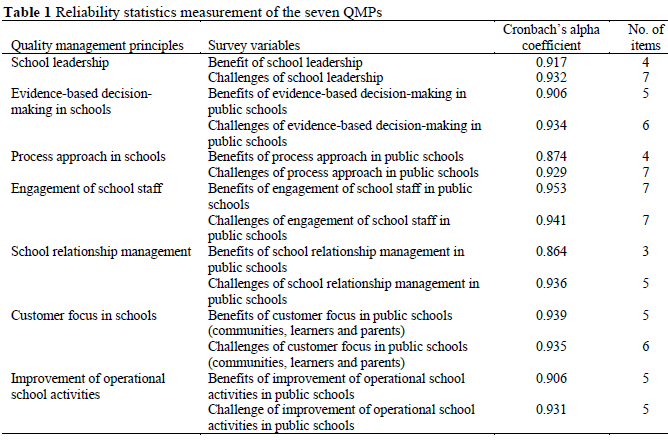
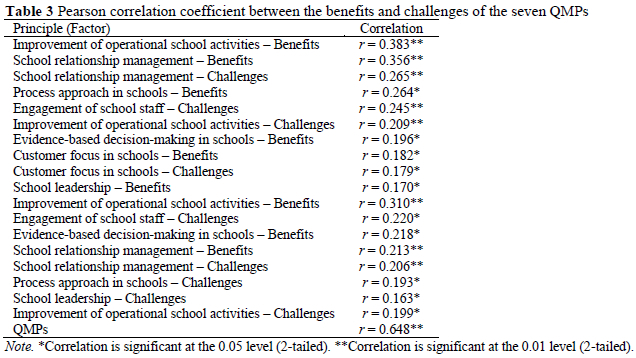
To ensure the validity and reliability of the study we used measurements used by experts to test the adopted research instrument. We adopted the construct validity measurement and face validity to prevent research instrument errors. We also employed the Cronbach's alpha coefficient to measure the reliability scale. Reliability was measured by linking the values and Cronbach's alpha coefficient. We also linked the variables of the constructs to determine whether the scale was reliable for measuring the variables of the constructs that were tested. This was achieved by the results presented in Table 1, showing that the reliability of all seven QMPs was adequate. This confirmed the accuracy of the online questionnaire and the integrity of the responses obtained. The construct validity measurement that we adopted tested the variance among the constructs of the study. This was achieved through the results presented in Table 3 to ensure that the research instrument used was accurate for the constructs of the study, and that it measured what it was intended to measure.
Ethical Considerations
Ethical clearance was obtained from the institution and the regional education department where the study was conducted.
Analysis, Results, and Findings
In this section we discuss the analysis of the data based on the statistical analysis completed and the results obtained from the online questionnaire.
Reliability Statistics Measurement of the Seven QMPs
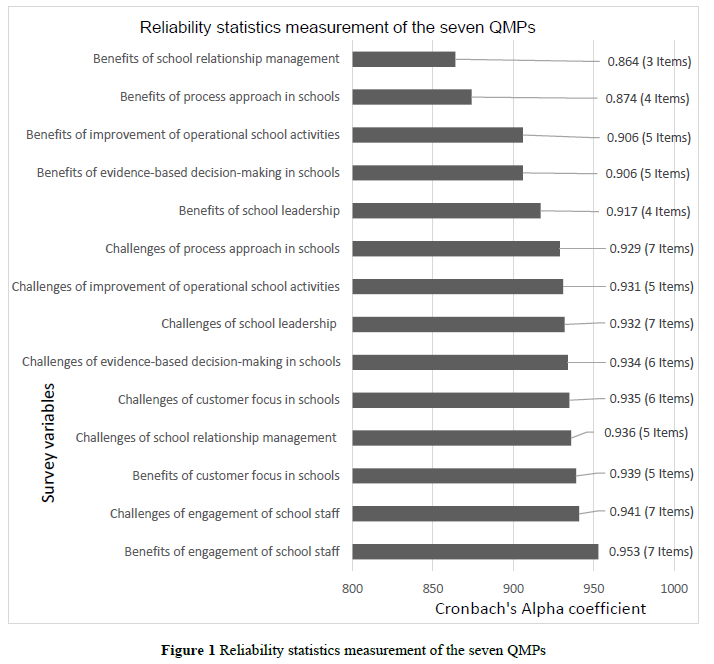
Respondents were asked to indicate their experiences of the seven QMPs (both benefits and challenges) in public schools by responding to the online questionnaire. Table 1 illustrates the respondents' responses (n = 169) on the benefits and challenges of the seven QMPs and emphasises the reliability statistics measurement of the seven QMPs to provide the importance of the benefits and challenges of the principles.
These results are presented in Figure 1 and are explained to provide a greater insight into the analysis.
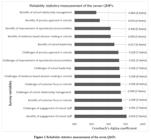
Considering the results in Table 1 and Figure 1, it is evident that the reliability of all the measured variables for the seven QMPs (benefits and challenges) can be described as varying between very good and excellent as the Cronbach's alpha coefficient was greater than 0.60 (Hair et al., 2021). As a result, the overall Cronbach's alpha coefficient displayed in Table 1 and Figure 1 confirms the reliability of the online questionnaire used to collect the data. Moreover, these results indicate that the reliability of all the variables was adequate, as it constructively contributed to answering the research question and achieving the research objective.
Descriptive Analysis for the Seven QMPs
According to Salkind (2018), descriptive statistics can be used to describe some of the characteristics of the distribution of scores that have been collected, such as the average score on one variable, or the extent to which one score differs from another.
It was evident that the mean scores of all seven QMPs (benefits and challenges) were greater than a 3 (neutral) and, according to the t-test results, the respondents rejected the null hypothesis and accepted the alternative hypothesis that the mean score was greater than 3. More importantly, it was evident that the respondents agreed with all the statements of the seven QMPs (benefits and challenges).
Based on the results of the study, the findings indicate that the majority of respondents agreed that the seven QMPs are useful and significant factors to assist school principals, SGB members and educators with improving public-school performance in the Tshwane district, as respondents generally agreed with the benefits and challenges of the factors. This aligns with Jaeger and Adair (2016) who declared that Deming (1982) identified one of the benefits of quality management as continuous improvement. The evidence of this is presented in the descriptive statistical analysis of the study on the frequency distribution of the factors. According to Sahney (2016), quality management was successfully implemented in Japan, the United States of America, and Europe with foundations of quality administration across the world in the 1970s and 1980s.
Selection of Quality Management Principles by Respondents
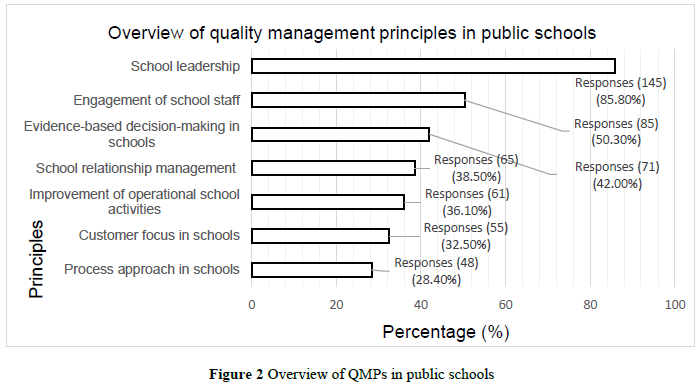
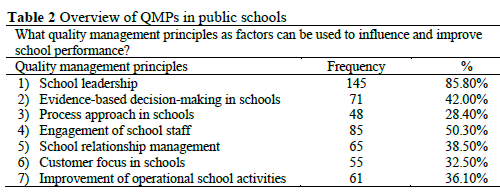
The aim with this section was to analyse the data received from respondents to identify and evaluate the significance of the seven QMPs, in order to assist us with investigating the research problem and answering the research question. Therefore, Table 2 and Figure 2 show the frequency distribution of the answers to the survey question: What QMPs as factors can be used to influence and improve school performance? as indicated in percentage values.
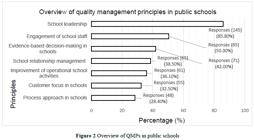
The results from Table 2 and Figure 2 further show that school leadership, followed by engagement of school staff and evidence-based decision-making in schools, contributed constructively towards answering the research question, and contributed constructively towards investigating the research problem and reaching the research objective of the study. This is supported by Jaccard (2013) who defines evidence-based decision-making as effective decisions that are based on the analysis of data and information. Sfakianaki (2019) points out that various school studies in Greece reported improvements in schools achieved through the implementation of quality management, which included performance and processes.
Inferential Statistical Analysis
According to Sarstedt, Ringle and Hair (2017), inferential statistical analysis is concerned with reaching decisions about the population based on the descriptive statistics of the sample. The aim with this section was to analyse the collected data to provide the inferential statistical analysis of the seven QMPs.
Correlation Analysis
The aim with this section was to analyse the data received from respondents (n = 169) to determine the strength of relationships between the benefits and challenges of the factors. Table 3 shows the Pearson correlation coefficient between the benefits and challenges of the factors.
The Pearson correlation coefficient (r) was used to measure the relationship between the principles (factors). Based on the Pearson correlation coefficient between the benefits and challenges of the seven QMPs in Table 3, it is evident that a good positive correlation existed between the seven QMPs. Furthermore, this inspection of the Pearson correlation coefficient reveals that the factors were significant, and explains the variance between them, either with a small effect size (from 0.163 to 0.170), medium effect size (from 0.199 to 0.209) or large effect size (from 0.310 to 0.383).
Discussion
The findings indicate that the majority of respondents agreed that the seven QMPs were useful and significant factors to assist school principals, SGB members and educators with improving public school performance in the Tshwane district, as respondents generally agreed with the benefits and challenges of the factors.
Factor 1: School Leadership
Benefits: The findings indicate that the agreement scales "Agree" and "Strongly Agree" had the highest percentages of occurrence among participants (ranging from 85.78% to 94.66%). This indicates that the majority of respondents agreed that the benefits of school leadership was a factor in improving school performance in the Tshwane district.
Challenges: The findings indicate that the agreement scales "Agree" and "Strongly Agree" were associated with the highest percentages of occurrence (ranging from 78.68% to 84.01%). This shows that the respondents agreed that the challenges of school leadership hindered improvement of school performance in the Tshwane district.
The findings on school leadership are supported by Elshaer and Augustyn (2016) who state that school leadership acts as a driver of effective quality management implementation by creating goals, policies, values and systems to fulfil stakeholder requirements that lead to improved school performance.
Factor 2: Evidence-based Decision-making in Schools
Benefits: It was found that the agreement scales "Agree" and "Strongly Agree" were related to the highest percentages of occurrence (ranging from 69.22% to 79.87%). This shows that a great number of respondents agreed that the benefits of evidence-based decision-making in schools was a factor that improved school performance in the Tshwane district.
Challenges: The findings indicate that the agreement scales "Agree" and "Strongly Agree" were associated with the highest percentages of occurrence among participants (ranging from 61.53% to 73.36%). This implies that the respondents agreed that the challenges of evidence-based decision-making in schools hindered improvement in school performance in the Tshwane district.
The findings on evidence-based decision-making in schools are supported by the study conducted by Elshaer and Augustyn (2016) who note that quality management literature indicates that quality data and informed decision-making enhanced quality awareness, identified quality problems, and encouraged further improvements.
Factor 3: The Process Approach in Schools
Benefits: It was found that the agreement scales "Agree" and "Strongly Agree" were associated with the highest percentage of occurrence (ranging from 72.77% to 76.92%). This indicates that a large number of respondents agreed that the benefits of the process approach in schools was a factor that improved school performance in the Tshwane district.
Challenges: The findings indicate that the agreement scales "Agree" and "Strongly Agree" were associated with the highest percentages of occurrence (ranging from 62.71% to 73.36%). This indicates that the respondents generally agreed that the challenges of the process approach in schools was a factor that hindered improvement of school performance in the Tshwane district.
The findings on the process approach in schools are supported by Elshaer and Augustyn (2016) who aver that quality management scholars emphasise that the process approach and management create a culture that reduces process duplication and variance, enhances reliability, eliminates progress interruptions, and, therefore, results in achieving greater performance gains.
Factor 4: Engagement of School Staff
Benefits: It was found that the agreement scales "Agree" and "Strongly Agree" were associated with the highest percentages of occurrence (ranging from 72.77% to 82.24%). This indicates that a significant number of respondents agreed that the benefits of the engagement of school staff was a factor that improved school performance in the Tshwane district.
Challenges: The findings show that the agreement scales "Agree" and "Strongly Agree" were related to the highest percentages of occurrence among participants (ranging from 69.22% to 76.32%). This indicates that the respondents mostly agreed that the challenges of engagement of school staff made it difficult to achieve improvement of performance in schools in the Tshwane district.
The findings on the engagement of school staff are supported by Arribas Diaz and Martínez-Mediano (2018) who state that competent, empowered and engaged staff at all levels throughout the organisation are essential to enhance an organisation's capability to create and deliver value.
Factor 5: School Relationship Management
Benefits: It was found that the agreement scales "Agree" and "Strongly Agree" were linked to the highest percentages of occurrence (ranging from 72.77% to 78.10%). This shows that a vast number of respondents agreed that the benefits of school relationship management was a factor that improved school performance in the Tshwane district.
Challenges: The findings showed that the agreement scales "Agree" and "Strongly Agree" were linked to the highest percentages of occurrence (ranging from 68.04% to 72.18%). This shows that the majority of respondents agreed that the challenges of school relationship management hindered the improvement of school performance in the Tshwane district.
In support of the findings on school relationship management, Dilawo and Salimi (2019:1139) state that good school relationship management and communication provide vital feedback to school management on the quality of efforts.
Factor 6: Customer Focus in Schools
Benefits: It was found that the agreement scales "Agree" and "Strongly Agree" were associated with the highest percentage of occurrence (ranging from 80.47% to 85.20%). This shows that most respondents agreed that the benefits of customer focus in schools was a factor that improved school performance in the Tshwane district.
Challenges: The findings showed that the agreement scales "Agree" and "Strongly Agree" were associated with the highest percentages of occurrence (ranging from 66.26% to 74.54%). The first variable, namely "recognising direct and indirect school customers as those who receive value from the school", was a significant challenge variable with a combined occurrence percentage of 74.54% of the scales "Agree" and "Strongly Agree." This indicates that the majority of respondents agreed that the challenges of customer focus in schools was a factor that hindered improvement in school performance in the Tshwane district.
Talib et al. (2014) supports the findings by defining customer focus as a significant mechanism used to contribute to individual job involvement.
Factor 7: Improvement of Operational School Activities
Benefits: It was found that the agreement scales "Agree" and "Strongly Agree" were linked to the highest percentage of occurrence among participants (ranging from 65.67% to 70.40%). The fourth variable, namely "improving the use of learning for improvement" was an adequate benefit variable, with a combined "Agree" and "Strongly Agree" occurrence percentage of 70.40%. This shows that most respondents agreed that the benefits of improvement of operational school activities was a factor that improved school performance in the Tshwane district.
Challenges: The findings indicate that the agreement scales "Agree" and "Strongly Agree" were linked to the highest percentages of occurrence among participants (ranging from 62.12% to 66.85%). This implies that the respondents agreed that challenges of improvement of operational school activities was a factor that made it difficult to improve school performance in the Tshwane district.
Arribas Díaz and Martínez-Mediano (2018) supports the findings by asserting that, in the school context, the starting point for the assessment of improvement objectives can be based on an initial implementation of continuous improvement.
These empirical results provide school leadership, school management and school governance with a deeper understanding of the significance of the seven QMPs that could aid in improving school performance in the Tshwane district. The results indicate that it is necessary for school leadership, school management and school governance to address the benefits and challenges of the seven QMPs, because the measured descriptive statistics confirm the reliability and validity of the online questionnaire that was used to collect the data.
Conclusion
The findings of the study show that the seven QMPs are ranked from the first position (school leadership) to the seventh position (customer focus in schools), according to their significance in improving school performance.
According to the respondents, school leadership was found to be the most significant QMP to assist with improving school performance in the Tshwane district. This is followed by evidence-based decision-making in schools, process approach in schools, engagement of school staff, school relationship management, customer focus in schools, and improvement of operational school activities. Therefore, it can be concluded that school leadership, evidence-based decision-making in schools, and the process approach in schools are the key QMPs to improve the performance in public schools in the Tshwane district.
The empirical results provide school leadership, school management and school governance, with an understanding of the significance of seven QMPs. It is, therefore, necessary for school leadership, school management, and school governance to pay attention to the benefits and challenges of the seven QMPs because the high percentages of the seven QMPs confirm the reliability and validity of the questionnaire that was used to collect the data.
The reviewed literature indicates that the seven evaluated QMPs were linked to the research problem, the research question and research objective of the study. The reviewed literature focused on the available and relevant literature on the study's content and determined the findings from local and international studies. The reviewed literature focused on the niche areas of quality management in the South African school context and the gaps identified in these areas.
The reviewed literature provided insight into how the seven QMPs may be applied in public school settings to achieve improved performance in the Tshwane district.
As other studies on quality management and the seven ISO 9001 QMPs in schools have mainly been conducted outside the borders of South Africa and Africa in general, we conclude that this research makes a significant contribution to the study of quality management and the seven ISO 9001 QMPs in the South African context.
Recommendations
We recommend that the seven QMPs be fully adopted and implemented in public schools, as the results clearly indicated that these QMPs are useful in assisting school principals, SGB members, educators, and school districts in improving school performance in the Tshwane district. Therefore, the Gauteng DBE and the Tshwane school district should ensure that the QMPs are fully utilised by the public school leadership, as they were found to be innovative principles in the school context. The literature reveals that certain European countries operate through these principles, and that these principles are enshrined in the ISO 9001 International Standardised Framework.
Future Research Studies
As the sample size of the study was 169, future research could focus on a larger sample size to present more statistically significant findings. Further to the adoption of a quantitative research instrument such as an online questionnaire, future research could use qualitative research methods such as case study research, personal interviews and focus groups. As we adopted a cross-sectional time horizon research approach in this study, it provided a solid foundation for further research to be conducted in a similar study following a longitudinal research approach where a single group of people are observed over a period of time. The study was limited to the selected public secondary schools located in the Tshwane district region. As a result, future research could focus on the remaining 51 districts in South Africa, or could be conducted in the other provinces in South Africa. As literature indicated that the practice of QMPs in schools is mainly implemented in European countries, future research could be conducted to evaluate how QMPs could improve school performance in different sub-Saharan African countries.
Authors' Contributions
BP collected and analysed the data and wrote the manuscript. SN was the supervisor and reviewed the first draft of the manuscript. BS co-supervised and reviewed the final draft of the manuscript.
Notesi. This article is based on the Master of Commerce in Business Management (Specialising in Operations Management) dissertation of Benson Phalane.
ii. Published under a Creative Commons Attribution Licence.
Acknowledgement
The authors would like to thank the GDE for granting permission to conduct this study in the selected school district, and also thank the University of South Africa (UNISA) for providing financial support, which enabled the successful completion of the study.
References
-
Anoye BA 2015. Implementation of ISO 9000 quality management system within the manufacturing and service industry of Ivory Coast. International Journal of Scientific & Technology Research, 4(12):200-215. Available at https://www.ijstr.org/final-print/dec2015/Implementation-Of-Iso-9000-Quality-Management-System-Within-The-Manufacturing-And-Service-Industry-Of-Ivory-Coast.pdf. Accessed 22 July 2021.
» https://www.ijstr.org/final-print/dec2015/Implementation-Of-Iso-9000-Quality-Management-System-Within-The-Manufacturing-And-Service-Industry-Of-Ivory-Coast.pdf -
Apoku A 2016. SDG2030: A sustainable built environment's role in achieving the post-2015 United Nations Sustainable Development Goals. In PW Chan & CJ Neilson (eds). Proceedings of the 32nd Annual ARCOM Conference, 5-7 September 2016 (Vol. 2). Manchester, England: Association of Researchers in Construction Management. Available at https://www.researchgate.net/publication/307906714_. Accessed 20 February 2019.
» https://www.researchgate.net/publication/307906714_ -
Areepattamannil S, Freeman JG & Klinger DA 2018. A qualitative study of Indian and Indian immigrant adolescents' perceptions of the factors affecting their engagement and performance in school. Social Psychology of Education, 21:383-407. https://doi.org/10.1007/s11218-017-9420-z
» https://doi.org/10.1007/s11218-017-9420-z -
Arribas Díaz JA & Martínez-Mediano C 2018. The impact of ISO quality management systems on primary and secondary schools in Spain. Quality Assurance in Education, 26(1):2-24. https://doi.org/10.1108/QAE-06-2016-0028
» https://doi.org/10.1108/QAE-06-2016-0028 -
Aydin-Guc F & Daltaban D 2021. An investigation of the use of specific problem-solving strategies by mathematics teachers in lessons. Journal of Pedagogical Research, 5(1):126-140. https://doi.org/10.33902/IPR.2021067307
» https://doi.org/10.33902/IPR.2021067307 -
Beik PH 1970. February 15, 1793: Condorcet presents his constitution to the convention. In PH Beik (ed). The French Revolution: The documentary history of Western civilization. London, England: Palgrave Macmillan. https://doi.org/10.1007/978-1-349-00526-0_33
» https://doi.org/10.1007/978-1-349-00526-0_33 -
Brinia V, Poullou V & Panagiotopoulou AR 2020. The philosophy of quality in education: A qualitative approach. Quality Assurance in Education, 28(1):66-77. https://doi.org/10.1108/QAE-06-2019-0064
» https://doi.org/10.1108/QAE-06-2019-0064 -
Cheng SL, Lu L, Xie K & Vongkulluksn VW 2020. Understanding teacher technology integration from expectancy-value perspectives. Teaching and Teacher Education, 91:103062. https://doi.org/10.1016/j.tate.2020.103062
» https://doi.org/10.1016/j.tate.2020.103062 -
Creamer EG 2019. An introduction to fully integrated mixed methods research. Thousand Oaks, CA: Sage. https://doi.org/10.4135/9781071802823
» https://doi.org/10.4135/9781071802823 - Deming WE 1982. Out of the crisis: Quality, productivity and competitive position. Cambridge, England: Cambridge University Press.
-
Dewey J 1910. How we think. Lexington, MA: D. C. Heath. https://doi.org/10.1037/10903-000
» https://doi.org/10.1037/10903-000 -
Dilawo RS & Salimi Z 2019. Understanding TQM implementation barriers involving construction companies in a difficult environment. International Journal of Quality & Reliability Management, 36(7):1137-1158. https://doi.org/10.1108/IJQRM-05-2017-0096
» https://doi.org/10.1108/IJQRM-05-2017-0096 -
Dzotsenidze N 2018. The school decentralization process in Georgia and South Africa through the lens of world culture theory: A comparative analysis. In AW Wiseman & PM Davidson (eds). Cross-nationally comparative, evidence-based educational policymaking and reform (Vol. 35). Bingley, England: Emerald Group Publishing Limited. https://doi.org/10.1108/S1479-367920180000035005
» https://doi.org/10.1108/S1479-367920180000035005 -
Education Labour Relations Council 2003. Policy handbook for educators. Centurion, South Africa: Author. Available at https://www.dhet.gov.za/Planning%20Monitoring%20and%20Evaluation%20Coordination/Education%20Labour%20Relations%20Council%20(ELRC)%20-%20policy%20handbook%20for%20educators.pdf. Accessed 30 August 2025.
» https://www.dhet.gov.za/Planning%20Monitoring%20and%20Evaluation%20Coordination/Education%20Labour%20Relations%20Council%20(ELRC)%20-%20policy%20handbook%20for%20educators.pdf -
Elahi F & Ilyas M 2019. Quality management principles and school quality: Testing moderation of professional certification of school principal in private schools of Pakistan. The TQM Journal, 31(4):578-599. https://doi.org/10.1108/TQM-11-2018-0173
» https://doi.org/10.1108/TQM-11-2018-0173 -
Elshaer IA & Augustyn MM 2016. Direct effects of quality management on competitive advantage. International Journal of Quality & Reliability Management, 33(9):1286-1310. https://doi.org/10.1108/IJQRM-07-2014-0086
» https://doi.org/10.1108/IJQRM-07-2014-0086 -
Fernández-Cruz FJ, Rodríguez-Mantilla JM & Fernández Díaz MJ 2020. Impact of the application of ISO 9001 standards on the climate and satisfaction of the members of a school. International Journal of Educational Management, 34(7): 1185-1202. https://doi.org/10.1108/UEM-10-2018-0332
» https://doi.org/10.1108/UEM-10-2018-0332 -
Fernández Díaz MJ, Rodríguez Mantilla JM & Abad MF 2016. Impact of implementation of quality management systems on internal communications and external relations at schools. Total Quality Management & Business Excellence, 27(1-2):97-110. https://doi.org/10.1080/14783363.2014.954365
» https://doi.org/10.1080/14783363.2014.954365 - Freeman RE 1984. Strategic management: A stakeholder approach. Boston, MA: Pitman.
-
Hair JF, Jr., Tomas G, Hult M, Ringle CM, Sarstedt M, Danks NP & Ray S 2021. Partial least squares structural equation modeling (PLS-SEM) using R: A workbook. Cham, Switzerland: Springer. https://doi.org/10.1007/978-3-030-80519-7
» https://doi.org/10.1007/978-3-030-80519-7 -
Hansson SO 2005. Decision theory: A brief introduction. Stockholm, Sweden: Department of Philosophy and the History of Technology, Royal Institute of Technology (KTH). Available at https://www.researchgate.net/publication/210642121_Decision_Theory_A_Brief_Introduction. Accessed 25 June 2022.
» https://www.researchgate.net/publication/210642121_Decision_Theory_A_Brief_Introduction -
Hossain M 2018. The effects of governance reforms on school supervision: An analysis of six developing and emerging economies. In AW Wiseman & PM Davidson (eds). Cross-nationally comparative, evidence-based educational policymaking and reform (Vol. 35). Bingley, England: Emerald Group Publishing Limited. https://doi.org/10.1108/S1479-367920180000035011
» https://doi.org/10.1108/S1479-367920180000035011 -
Huggins KS, Klar HW & Andreoli PM 2021. Facilitating leadership coach capacity for school leadership development: The intersection of structured community and experiential learning. Educational Administration Quarterly, 57(1):82-112. https://doi.org/10.1177/0013161X20915948
» https://doi.org/10.1177/0013161X20915948 -
Hunter C & Molapo T 2014. Current challenges and future trends for teacher training in Southern Africa: A focused look at Botswana and Lesotho. In AW Wiseman & E Anderson (eds). Annual review of comparative and international education 2014. Bingley, England: Emerald Group Publishing Limited. https://doi.org/10.1108/S1479-367920140000025018
» https://doi.org/10.1108/S1479-367920140000025018 -
Hussain T, Eskildsen JK & Edgeman R 2020. The intellectual structure of research in ISO 9000 standard series (1987-2015): A bibliometric analysis. Total Quality Management & Business Excellence, 31(11-12):1195-1224. https://doi.org/10.1080/14783363.2018.1469977
» https://doi.org/10.1080/14783363.2018.1469977 - Ibrahim MZ, Ab Rahman MN, Mohammad Yasin R, Ramli R & Awheda A 2016. Customer focus practice among skills training institutions in Malaysia and the performance of organisations. Pertanika Journal of Social Science and Humanities, 24(S):205-218.
-
International Organization for Standardization 2015. ISO 9001:2015, Quality management principles -requirements. Geneva, Switzerland: Author. Available at https://www.iso.org/standard/62085.html. Accessed 28 June 2022.
» https://www.iso.org/standard/62085.html -
International Organization for Standardization 2018. ISO 21001:2018, Educational organizations. Management systems for educational organizations - Requirements with guidance for use. Geneva, Switzerland: Author. Available at https://www.iso.org/obp/ui/en/#iso:std:iso:21001:ed-1:v1:en. Accessed 20 February 2023.
» https://www.iso.org/obp/ui/en/#iso:std:iso:21001:ed-1:v1:en -
Jaccard M 2013. The objective is quality: An introduction to quality, performance and sustainability management systems. London, England: Taylor & Francis. https://doi.org/10.1201/b16067
» https://doi.org/10.1201/b16067 -
Jaeger M & Adair D 2016. Perception of TQM benefits, practices and obstacles: The case of project managers and quality management representatives in Kuwait. The TQM Journal, 28(2):317-336. https://doi.org/10.1108/TQM-10-2014-0091
» https://doi.org/10.1108/TQM-10-2014-0091 -
Kusumah LH & Fabianto YS 2018. The differences in the financial performance of manufacturing companies in Indonesia before and after ISO 9000 implementation. Total Quality Management & Business Excellence, 29(7-8):941-957. https://doi.org/10.1080/14783363.2016.1237285
» https://doi.org/10.1080/14783363.2016.1237285 -
Leepile K 2018. Life in South Africa: Reasons for hope. Richmond, South Africa: South African Institute of Race Relations. Available at https://irr.org.za/reports/occasional-reports/files/01-2014-irr-life-in-south-africa-reasons-for-hope-final-29-08-2018.pdf. Accessed 10 March 2021.
» https://irr.org.za/reports/occasional-reports/files/01-2014-irr-life-in-south-africa-reasons-for-hope-final-29-08-2018.pdf -
Makgato M & Mudzanani NN 2019. Exploring school principals' leadership styles and learners' educational performance: A perspective from highand low-performing schools. Africa Education Review, 16(2):90-108. https://doi.org/10.1080/18146627.2017.1411201
» https://doi.org/10.1080/18146627.2017.1411201 -
Mamabolo MM, Malatji KS & Mphahlele LK 2022. The role of supervisors in the implementation of the Integrated Quality Management System in schools. South African Journal of Education, 42(1):Art. #2019, 9 pages. https://doi.org/10.15700/saje.v42n1a2019
» https://doi.org/10.15700/saje.v42n1a2019 -
Mintzberg H, Raisinghani D & Théorêt A 1976. The structure of "unstructured" decision processes. Administrative Science Quarterly, 21(2):246-275. https://doi.org/10.2307/2392045
» https://doi.org/10.2307/2392045 -
Mncube V, Davies L & Naidoo R 2015. Democratic school governance, leadership and management: A case study of two schools in South Africa. In EA Wiseman & N Popov (eds). Comparative sciences: Interdisciplinary approaches (Vol. 26). Bingley, England: Emerald Group Publishing Limited. https://doi.org/10.1108/S1479-367920140000026011
» https://doi.org/10.1108/S1479-367920140000026011 -
Moorosi P & Grant C 2018. The socialisation and leader identity development of school leaders in Southern African countries. Journal of Educational Administration, 56(6):643-658. https://doi.org/10.1108/JEA-01-2018-0011
» https://doi.org/10.1108/JEA-01-2018-0011 -
Moreira PAS, Dias A, Matias C, Castro J, Gaspar T & Oliveira J 2018. School effects on students' engagement with school: Academic performance moderates the effect of school support for learning on students' engagement. Learning and Individual Differences, 67:67-77. https://doi.org/10.1016/j.lindif.2018.07.007
» https://doi.org/10.1016/j.lindif.2018.07.007 -
Naidoo S 2022. The mediating effect of standardisation effort on standardisation and innovation to improve organisational efficiency post COVID-19. International Journal of Business Innovation and Research, 28(4):525-541. https://doi.org/10.1504/IJBIR.2020.10032320
» https://doi.org/10.1504/IJBIR.2020.10032320 -
National Planning Commission, The Presidency, Republic of South Africa 2012. Our future - make it work: National development plan 2030. Pretoria: Author. Available at https://citrusresourcewarehouse.org.za/home/document-home/government-publications/strategic-planning-documents/189-npc-national-development-plan-ndp-2030/file. Accessed 22 August 2025.
» https://citrusresourcewarehouse.org.za/home/document-home/government-publications/strategic-planning-documents/189-npc-national-development-plan-ndp-2030/file -
National Planning Commission, The Presidency, Republic of South Africa 2014. Diagnostic overview. Available at https://www.gov.za/sites/default/files/gcis_document/201409/npcdiagnosticoverview1.pdf. Accessed 20 October 2022.
» https://www.gov.za/sites/default/files/gcis_document/201409/npcdiagnosticoverview1.pdf -
Nawelwa J, Sichinsambwe C & Mwanza BG 2015. An analysis of total quality management (TQM) practices in Zambian secondary schools: A survey of Lusaka district. The TQM Journal, 27(6):716-731. https://doi.org/10.1108/TQM-06-2015-0080
» https://doi.org/10.1108/TQM-06-2015-0080 -
Ngema M & Lekhetho M 2019. Principals' role in managing teacher professional development through a training needs analysis. Problems of Education in the 21st Century, 77(6):758-773. https://doi.org/10.33225/pec/19.77.758
» https://doi.org/10.33225/pec/19.77.758 -
Pan HLW, Nyeu FY & Cheng SH 2017. Leading school for learning: Principal practices in Taiwan. Journal of Educational Administration, 55(2):168-185. http://doi.org/10.1108/JEA-06-2016-0069
» http://doi.org/10.1108/JEA-06-2016-0069 -
Raosoft 2004. Sample size calculator. Available at http://www.raosoft.com/samplesize.html. Accessed 15 April 2020.
» http://www.raosoft.com/samplesize.html - Republic of South Africa 1996. South African School Act, 1996 (Act No. 84, 1996). Government Gazette, 377(17579):1-50, November 15.
-
Research Advisors 2006. Sample size table. Available at http://www.research-advisors.com/tools/SampleSize.htm. Accessed 19 January 2021.
» http://www.research-advisors.com/tools/SampleSize.htm - Rocha-Lona L, Garza-Reyes JA & Kumar V 2013. Building quality management systems: Selecting the right methods and tools. London, England: CRC Press.
-
Rodríguez-Mantilla JM, Fernández-Cruz FJ & Fernández-Díaz MJ 2020. Factors associated with the impact of implementing quality management systems at schools: A multilevel analysis. Total Quality Management & Business Excellence, 31(13-14):1588-1604. https://doi.org/10.1080/14783363.2018.1490642
» https://doi.org/10.1080/14783363.2018.1490642 -
Sahney S 2016. Use of multiple methodologies for developing a customer-oriented model of total quality management in higher education. International Journal of Educational Management, 30(3):326-353. https://doi.org/10.1108/IJEM-09-2014-0126
» https://doi.org/10.1108/IJEM-09-2014-0126 -
Salkind NJ 2018. Exploring research (Global ed., 9th ed). Harlow, England: Pearson. Available at https://ebook.upgrisba.ac.id/ebook/komputer-informasi-referensi-umum/exploring-research/download. Accessed 28 June 2022.
» https://ebook.upgrisba.ac.id/ebook/komputer-informasi-referensi-umum/exploring-research/download -
Sarstedt M, Ringle CM & Hair JF 2017. Partial least squares structural equation modeling. In C Homburg, M Klarmann & A Vomberg (eds). Handbook of market research. Cham, Switzerland: Springer. https://doi.org/10.1007/978-3-319-05542-8_15-1
» https://doi.org/10.1007/978-3-319-05542-8_15-1 - Saunders M, Lewis P & Thornhill A 2016. Research methods for business students (7th ed). Harlow, England: Pearson.
- Saunders MNK, Lewis P & Thornhill A 2019. Research methods for business students (8th ed). Harlow, England: Pearson.
-
Schlebusch GJ 2020. Collaborative leadership and sustained learner academic performance in secondary schools: A blaming game? Africa Education Review, 17(3):74-89. https://doi.org/10.1080/18146627.2019.1635498
» https://doi.org/10.1080/18146627.2019.1635498 -
Senol H & Dagli G 2017. Increasing service quality in education: Views of principals and teachers. Eurasia Journal of Mathematics, Science and Technology Education, 13(8):4857-4871. https://doi.org/10.12973/eurasia.2017.00969a
» https://doi.org/10.12973/eurasia.2017.00969a -
Sfakianaki E 2019. A measurement instrument for implementing total quality management in Greek primary and secondary education. International Journal of Educational Management, 33(5):1065-1081. https://doi.org/10.1108/IJEM-08-2018-0245
» https://doi.org/10.1108/IJEM-08-2018-0245 -
Shongwe EM & Mutambara E 2023. The challenges experienced by school principals in the implementation of QMS performance appraisal system in schools within Mpumalanga Province, South Africa. Journal of Service Science and Management, 16:266-279. https://doi.org/10.4236/jssm.2023.163015
» https://doi.org/10.4236/jssm.2023.163015 -
Soria-García J & Martínez-Lorente ÁR 2020. The influence of culture on quality management practices and their effects on perceived service quality by secondary school students. Quality Assurance in Education, 28(1):49-65. https://doi.org/10.1108/QAE-10-2018-0112
» https://doi.org/10.1108/QAE-10-2018-0112 -
Spaull N 2015. Accountability and capacity in South African education. Education as Change, 19(3):113 -142. https://doi.org/10.1080/16823206.2015.1056199
» https://doi.org/10.1080/16823206.2015.1056199 -
Stamatis DH 2016. 10 essentials for high performance quality in the 21st century. London, England: CRC Press. https://doi.org/10.4324/9781315300283
» https://doi.org/10.4324/9781315300283 -
Statistics South Africa 2020. Education series volume VII: Children's education and well-being in South Africa, 2018. Pretoria: Author. Available at https://www.statssa.gov.za/?page_id=1854&PPN=92-01-07. Accessed 10 June 2020.
» https://www.statssa.gov.za/?page_id=1854&PPN=92-01-07 -
Tachie SA & Mancotywa NC 2021. Challenges faced by the Development Support Group in implementing the integrated quality management system in Circuit 04 schools in the Mthatha Education District. Hindawi Journals, 2021:1 -13. https://doi.org/10.1155/2021/8888539
» https://doi.org/10.1155/2021/8888539 -
Talib HHA, Ali KAM & Idris F 2014. Critical success factors of quality management practices among SMEs in the food processing industry in Malaysia. Journal of Small Business and Enterprise Development, 21(1):152-176. https://doi.org/10.1108/JSBED-10-2013-0162
» https://doi.org/10.1108/JSBED-10-2013-0162 -
Van Assen MF 2020. Empowering leadership and contextual ambidexterity - The mediating role of committed leadership for continuous improvement. European Management Journal, 38(3):435-449. https://doi.org/10.1016/j.emj.2019.12.002
» https://doi.org/10.1016/j.emj.2019.12.002 -
Vijaya Sunder M 2016. Constructs of quality in higher education services. International Journal of Productivity and Performance Management, 65(8):1091-1111. https://doi.org/10.1108/IJPPM-05-2015-0079
» https://doi.org/10.1108/IJPPM-05-2015-0079 -
Wu SJ 2020. Assessing the individual and synergistic effects of quality management practices on operations performance. International Journal of Productivity and Performance Management, 69(2):297-320. https://doi.org/10.1108/IJPPM-06-2018-0217
» https://doi.org/10.1108/IJPPM-06-2018-0217
Revised: 10 March 2025
Accepted: 9 July 2025
Published: 31 August 2025