A practical example for pre-service teachers for a more qualified sustainable development education
Abstract
The purpose of this research was to reveal the impact of sustainable development education (SDE) prepared and implemented by researchers on pre-service teachers, on the level of awareness of sustainable development, and to identify the views of pre-service teachers regarding the education they receive. The study group consisted of 59 social studies pre-service teachers studying at a state university in Turkey during the fall semester of the 2019-2020 academic year. In the research, a mixed-method approach was used, which involved the use of both quantitative and qualitative methods. The research findings indicate that after the 15-week SDE, the awareness level of pre-service teachers regarding sustainable development had increased. It was observed that pre-service teachers gained awareness about the concept of sustainable development, and they provided positive feedback on the education they had received. Based on the findings it can be said that it is important for pre-service teachers in all disciplines to gain awareness of sustainable development before beginning their teaching careers.
development; education; pre-service teacher; sustainability; sustainable
Introduction
The industrialisation movements that occurred after the 18th century, coupled with excessive population growth and rapid urbanisation, have demonstrated to us that natural resources deplete rapidly. This situation poses significant dangers to the interaction between humans and the environment. Societies' pursuit of economic growth and development has started to limit the renewal period of natural resources, leading to the emergence of hunger, poverty and inequalities (Moran & Lopez, 2016). In the last quarter of the 20th century, efforts to raise awareness about the environment started to gain traction under the concept of sustainable development with the aim of attending to economic, social, and environmental issues as a whole. With all these developments, the concept of sustainable development has paved the way for all countries in the world to prioritise environmental education and engage in international efforts to deal with existing problems (Özer, 2017).
Sustainable development is approached from a three-dimensional perspective encompassing the economy, society, and the environment and has become an action plan involving all three. Economically it entails eliminating the divide between rich and poor to achieve global economic growth. Socially it entails strengthening the relationship between society and individuals to reduce inequalities. Environmentally it entails advocating the balanced use of energy resources and the protection of natural resources (Svetlacic, Primorac & Kozina, 2016). The approach to sustainable development is aimed at utilising existing resources in the best possible way, preventing environmental pollution, ensuring the continuity of the human generation, and pursuing social equality and justice. It seeks to provide all individuals in the world with the belief and awareness through quality education (Clifford & Joseph, 2015). Education, which is considered as a tool supporting sustainable development, has become a focal point in enabling individuals to contribute to the process of sustainable development, to think creatively and be solution-oriented, to put high-level competencies into action, and to contribute to the development of individual skills (Hoffmann & Siege, 2018).
Teachers and pre-service teachers have significant responsibilities in cultivating individuals who are aware of the limitations of the natural environment and resources, capable of taking responsibility, respectful of human rights, and equipped with problem-solving skills. Furthermore, the importance of providing courses under the topic of sustainability, particularly in education faculties at the higher education level, has started to gain prominence to enable pre-service teachers, who will educate future generations, to embrace the concept of sustainable development for a more liveable world (Nasir, 2012).
Literature Review
In the mid-1990s, the term "education for sustainable development" replaced the previously widely used expression "education for the environment, about the environment, and with the environment", and is one of the outcomes of this change. Sustainable development, influenced by the thinking triggered by the "Our Common Future" report, also known as the "Brundtland Report", is a process that requires careful use of today's (environmental) resources to ensure their availability for future generations. In line with this trend, education for sustainable development can be defined as an educational process characterised by approaches and methods aimed at increasing awareness about issues related to sustainable development, such as social, political, economic and ecological topics (Leal Filho, 2015). Sustainable development education is based on experiential learning that aims to improve the environmental attitudes of individuals through behavioural change (Zhang & Wang, 2022). In addition, it has gained importance as an understanding of education that is on the agenda of states, non-governmental organisations, associations and education experts at the international level. The aim is to have information about the diversity of natural and cultural ecology and to access the products of a sustainable economy (Berryman & Sauvé, 2016).
Education for sustainable development primarily emerged as a concern within the environmental movements of the 1980s and 1990s. It was shaped by a shift towards environmental education and education for the environment, reflecting the growing awareness and importance of sustainability (Le Grange, 2007). With the United Nations adopting the 17 Sustainable Development Goals (SDGs) in 2015, education has become an indispensable vehicle for achieving sustainable development and achieving the goals, starting with an understanding of quality education, which is the fourth of the 17 goals (Mohanty, 2018). Indeed, scholars such as John Huckle and John Fien have argued that providing education for sustainable development is imperative, considering unprecedented levels of environmental degradation and social injustices (Le Grange, 2017). SDE is being considered important because it develops a rationalist and positivist perspective on humans and the environment and teaches us how to observe the problems with a solution-oriented approach. It also includes both citizenship and environmental education on the basis of society with an interdisciplinary approach (Nordén & Avery, 2021).
Two important topics have come to the fore to provide quality SDE, namely, behaviour that will be encouraged in individuals and from which they are expected to be advantaged. The first of these is to maximise individuals' cognitive development and environmental awareness through their education. The second is at the point of individuals gaining the values and attitudes of education. This is expressed as raising responsible, critical, creative and productive citizens (Laurie, Nonoyama-Tarumi, Mckeown & Hopkins, 2016).
Since SDE aims to develop and improve education opportunities for the future sustainability of world resources, it has become one of the most important issues that should be included in the curricula of higher education institutions. However, in many countries, it is first necessary to strengthen teacher education programmes to improve teachers' sustainable development knowledge and skills (Saqib, Zhang, Ou, Saqib, Majeed & Razzaq, 2020). In 2015, at the United Nations Sustainable Development Summit, the Education for Sustainable Development principles emphasised the urgency of spreading education for sustainable development to all levels of education. However, there is a need for more evidence regarding the development, outcomes, and impact of courses and educational initiatives that introduce students to sustainability competencies. Therefore, in recent years, the assessment of sustainability competencies using different tools, in various subject areas, and primarily focusing on higher education, educators, and pre-service teachers has emerged as a research field (Cebrián, Junyent & Mulà, 2021).
Theoretical Framework
With the inclusion of sustainable development at educational levels, teachers have assumed a critical role in raising knowledge, skills and awareness on the basis of a sustainable development approach in formal education. Teachers' guidance to offer innovative and creative solutions to students in solving global problems and their aim of instilling global citizen characteristics have made them critical change elements in education for sustainable development (Ferguson, Roofe & Cook, 2021). Therefore, in most countries, project-based practices and curriculum changes in SDE have started with the aim to establish new relationships between students and educators at primary, secondary and higher education levels, which will pave the way for new opportunities (Useckienè & Targamadzè, 2005).
Considering the purpose and importance of sustainable development to prevent sustainability problems an interdisciplinary approach is needed. This makes it necessary to carry out this education within a discipline that adopts an interdisciplinary approach (Gulikers & Oonk, 2019). The interdisciplinary approach has become a key concept that needs to be integrated into all curricula at all stages of education. Adopting this approach involves connecting different disciplines to one another and enriching the overall educational experience. The aim is to progressively encourage interdisciplinary thinking by moving towards learning based on real contexts and real-world problems, using appropriate methodologies (Berasategi, Aróstegui, Jaureguizar, Aizpurua, Guerra & Arribillaga-Iriarte, 2020). Taking the mutual connections between the concepts and dimensions of sustainable development (economy-environment-society) through interdisciplinary approaches is widely accepted (Rouhiainen & Vuorisalo, 2019). From this point of view, all over the world, social studies courses are best placed to carry out sustainability education because it adopts an interdisciplinary approach (Gulikers & Oonk, 2019).
The awareness of protecting natural resources and the idea of securing the future, which countries advocating a sustainable life approach take within the framework of various courses such as economy, geography and social studies courses, have brought the search for educational alliances on a global scale. Therefore, it has become a principle to provide students with the ability to think metacognitively on the course contents that reflects sustainability in each country (Kahn, 2008). The sustainable development approach aims to foster the belief and awareness that all individuals in the world should have quality education. Hence, the social studies course, which is a primary school course and includes different social science disciplines, has been seen as the most important course for providing SDE (Clifford & Joseph, 2015).
The main driving force in education for sustainable development is teachers, who are regarded as effective agents of change (Gough, 2005, cited in Mahat & Idrus, 2016; Habibah & Punitha, 2012, cited in Mahat & Idrus, 2016; Liu, 2009, cited in Mahat & Idrus, 2016). Indeed, teachers play a crucial role as facilitators of change and have a significant impact on students through all their actions and behaviour (Mahat & Idrus, 2016). That is why the studies conducted, especially with pre-service teachers, will guide them during their inservice training. In this context, we have prepared and applied SDE for pre-service teachers. The content of this education is based on the sustainable development and education course, which is among the elective courses offered in education faculties' subject knowledge elective courses. This course was included in the 2018 social studies education undergraduate programme as an elective course but was not yet actively taught during the academic period in which the application was carried out. The study was prepared in accordance with the content specified by the Yüksekögretim Kurulu (2018). SDE can be defined as a module course that offers alternative content to the mentioned elective course within the existing programme. The aim with this research was to examine the impact of SDE prepared for pre-service teachers on their awareness levels of sustainable development and to reveal their opinions regarding the education they received.
Method
Research Model
A mixed-method approach was used in this study in which quantitative and qualitative methods were used. The main purpose of using this method was to provide better explanations to help solve the problem (Creswell, 2012). The mixed method approach offers researchers more than one perspective when approaching a problem and reveals more evidence than quantitative and qualitative approaches on their own (Creswell & Plano Clark, 2007). In this research, explanatory design, one of the mixed-method designs, was used. Quantitative data were collected and analysed as the first phase. This was followed by the second phase, during which qualitative data were collected and analysed to support the data obtained in the quantitative research process (Creswell, 2012).
In the quantitative dimension of the study, the experimental research design was used without a pre-test-post-test control group. In this design, the effect of the experimental procedure is tested with a study on a single group, and the measurements of the dependent variable of the subjects are obtained by using the same subjects and the same measurement tools as a pre-test before the application and a posttest (Büyüköztürk, Cakmak, Akgün, Karadeniz & Demirel, 2010). In the qualitative method of the research, a basic qualitative research approach was used to explore explanatory quantitative data. In basic qualitative research, researchers are interested in exploring what meanings individuals attach to their experiences and in uncovering and interpreting the meanings that individuals create. Therefore, in basic qualitative research, meanings created by individuals are discovered and examined within the context of the research questions (Merriam, 2018).
Study Group
The study group for this research consisted of 59 senior pre-service social studies teachers (35 female and 24 male). They were studying in the Department of Social Studies Education at the Faculty of Education of a state university in Turkey during the fall semester of the 2019-2020 academic year. Of 82 pre-service teachers in their final year of education, 59 took the pre-test and post-test voluntarily and completed the application process and were accepted as the study group. The other 23 pre-service teachers were not included in the application process and could not benefit from the curriculum, as they did not volunteer and did not participate in the pre-test and post-test. This sampling method was preferred because it was easy to access, and provided quality, speed and practicality to the research (Yildirim & Simsek, 2013). The principle of volunteerism was taken into consideration when determining the study group. This was necessary because the SDE that we provided will continue during the education period.
Data Collection Tools
In the research, the Sustainable Development Awareness Determination Scale developed by Türer (2010) was used to determine the sustainable development awareness of social studies pre-service teachers before and after the SDE. The 5-point Likert-type scale consists of a total of 21 articles and three factors, six items in the social dimension, eight articles in the economic dimension, and seven articles in the environmental dimension. Türer (2010), who developed the scale, determined the Cronbach alpha reliability coefficient of the scale as 0.856 in the whole scale. In this study, the reliability of the scale was calculated with the Cronbach α internal consistency coefficient and the Cronbach alpha reliability coefficient; it was found to be 0.850 in the whole scale.
We prepared and used a sustainable development education interview form (SDEIF) to support what social studies pre-service teachers learned about sustainable development after SDE and what they thought about the education and their quantitative data.
Application Process
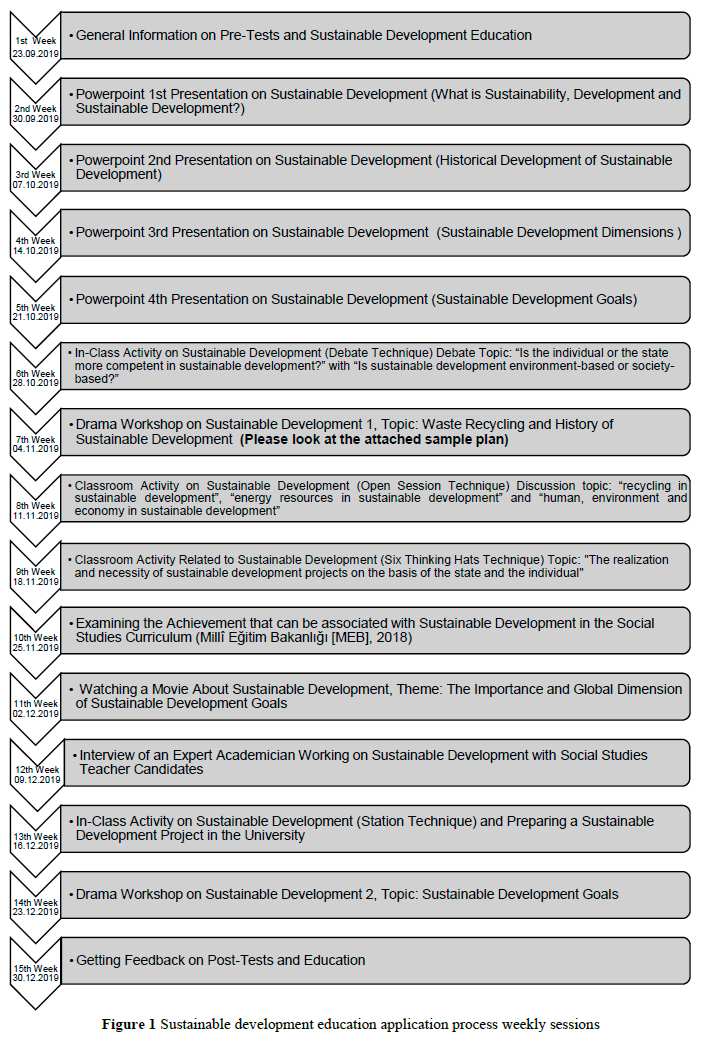
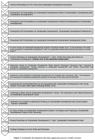
The scale applied to the pre-service teachers at the beginning of the data collection process was applied again after the SDE and pre-test and post-test scores were obtained from the pre-service teachers' responses to the scale. After the SDE, the SDEIF was applied. In the research, the weekly sessions showing the application process for the SDE presented to social studies pre-service teachers are shown in Figure 1.
Data Analysis
Before starting the analysis of the data, one-way outlier scanning was performed. The cut-off point was determined as ±3 (Raykov & Marcoulides, 2008), and analyses were carried out by excluding the 24 values outside this cut-off point. Within the scope of the research, a normality test was conducted to decide which statistical techniques would be used in the data analysis process. As a result of the Kolmogorov-Smirnov test, it was determined that the data showed normal distribution. In addition, the normality of the data was checked with the skewness-kurtosis coefficients for each group. The interval of 1 was accepted as the cut-off point for the skewness-kurtosis coefficients. Due to the normal distribution of the data, analyses were performed with parametric methods (dependent groups t-test).
After the SDE, the data obtained from the SDEIF were analysed using descriptive analysis. Accordingly, the data obtained at the end of the research were summarised and interpreted according to previously prepared themes. The purpose of
descriptive analysis is to convey the findings obtained at the end of the research to the reader in an organised and interpreted way (Yildirim & Simsek, 2013). The findings were also supported by direct quotations from the participants' responses. Codes were used to refer to the different participants, for example, PT 1 refers to the first pre-service teacher, PT 2 to the second pre-service teacher, et cetera.
Findings
The findings obtained from the measurement tools in line with the sub-problems of the research are presented in tables below.
Findings Concerning the Differences Between Pretest and Post-tests of Social Studies Pre-service Teachers for Sustainable Development Awareness
Levels
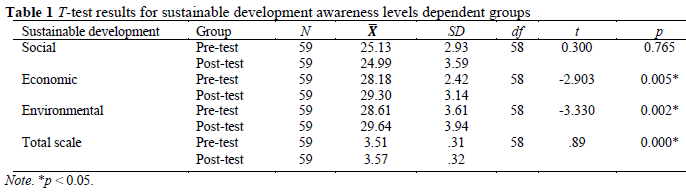
The difference between the sub-dimensions of the social studies pre-service teachers' sustainable development awareness levels in the pre-test and post-tests was analysed with the t-test for dependent groups, and the results are shown in Table 1.
The results from the total study showed a significant difference between the pre- and post-tests scores with the students' post-test scores being higher (t_(58)) = 0.89, p = 0.000). When we considered the sub-dimensions of the scale, it was determined that the pre-test and post-test scores did not show a significant difference in the social dimension (t_((58)) = 0.300, p = 0.765). However, it was determined that the pre-test (X = 28.18) and post-test scores (X = 29.30) of the awareness levels of sustainable development in the economic dimension differed significantly (t(58) = -2.903, p = 0.005). It was determined that pre-service teachers' post-test scores were higher. Likewise, in the environmental dimension, it was determined that the pre-test (X = 28.61) and post-test scores (X = 29.64) differed significantly (t_ ((58)) = -3.330, p = 0.002). It was observed that the pre-service teachers' post-test scores were higher.
Findings Regarding the Opinions of Social Studies Pre-service Teachers on Sustainable Development Education
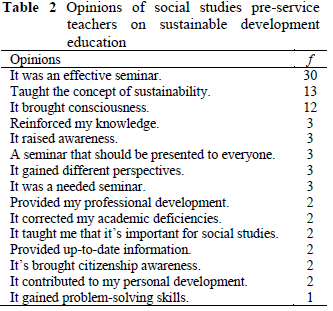
When the pre-services teachers' opinions about SDE in Table 2 are examined, we notice that from a professional point of view it provides academic knowledge, ensures development, and consolidates pre-service teachers' existing knowledge. From a personal point of view, it provides development, raises awareness, provides a multifaceted ability to view events, and provides problem-solving skills. When evaluated in general, it is possible to interpret the candidates' thoughts on SDE as positive. Some of the pre-service social studies teachers' responses were as follows:
I had some information in my head about the concept of sustainable development. But now when I talk about the concept of sustainable development, I can say the topics to talk about (PT 6).
I think it has helped me a lot. Because if I had graduated as a social studies teacher candidate without knowing sustainable development, I would have suffered a great loss (PT 13).
Thanks to this seminar, first we learned what sustainable development is, its goals, how it will affect the world in the future, its effects, the importance of sustainable development for a good life and the future. It is possible to say that it has made very important contributions especially to the teaching of social studies. (PT 58).
Findings Regarding the Necessity of Social Studies Pre-service Teachers for Social Studies Teachers to Know Sustainable Development
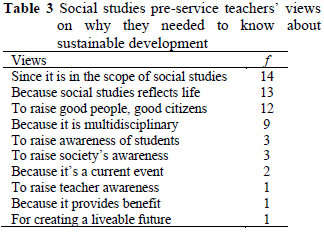
Table 3 shows that most of the participants (55) thought that social studies teachers should have knowledge about sustainable development, while four of them did not express any opinion. Some of the PT's responses were as follows:
Although it seems like a science subject, social studies teachers should also take it because it is related to subjects such as social life, environment and economy (PT 2).
Because the main purpose of the social studies teacher is to raise good citizens and he/she should have the necessary knowledge for our world (PT 42). He/she should know because there is sustainable development in the social studies course. Even though it is not discussed in detail, a social studies teacher should be informed about it (PT 58). Of course, he/she should know. Social studies is a teaching plan from life. Sustainable development will make our living conditions better (PT 53).
He/she should know. Because I think that the purpose of raising useful citizens and good people is the common goal of social studies course and SDE (PT 40).
Findings Regarding Social Studies Pre-service Teachers Thinking/Feeling/Knowing Before Sustainable Development Education
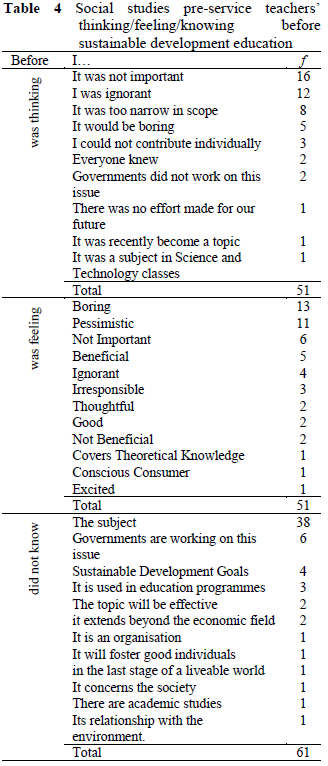
When examining the PT's thinking/feeling/knowing related to social studies before SDE in Table 4, we observe that the PT's perceptions were generally negative (I was thinking). Apart from three PTs, the same applied to the I-was-feeling category. In the I-did-not-know category, the PTs expressed a sense of unfamiliarity towards the education and its content that they had received in general. Some of the PT's responses were as follows:
I think that individuals doing something alone for nature is not enough (PT 57).
I was feeling that what I will learn about sustainable development would be beneficial (PT 11).
I didn't know that we are now in the last stage of a liveable world (PT 5).
Findings Regarding Social Studies Pre-service Teachers Thinking/Feeling/Knowing After Sustainable Development Education
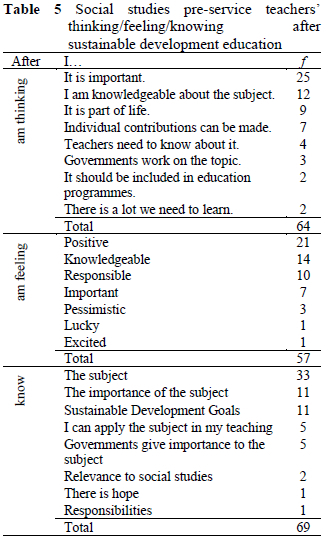
The social studies PTs' thinking/feeling/ knowing after the SDE is presented in Table 5. The PT's responses after the SDE were completely different from their responses prior to the SDE. In all three categories (thinking/feeling/knowing) all participants' responses were positive. We can thus say that, in general, the PTs in the study group experienced a positive change in their thoughts, feelings, and knowledge regarding SDE after having received the training. Their awareness about the subject had also increased. Some of their responses were as follows:
But now, I have realised that there are many things we didn't know before. I am thinking that I can provide my students with information about this topic for a better life and increase awareness in society (PT 51).
Now, as a citizen who has gained awareness about sustainable development and also as a teacher, I feel the responsibility to implement this mindset (PT 15). But now, even if one person becomes aware of this, I know that there is hope for a positive world (PT 5).
Discussion
Based on the findings of this research, the PTs' awareness regarding sustainable development education had increased as the scores on their sustainable development awareness levels were higher in the post-test. This shows that the SDE was effective.
In similar research findings, Mahat and Idrus (2016) demonstrate that exposure to and participation in the activities of the Sustainable School Environmental Award (SLAAS) Programme allowed students and teachers to gain awareness in the field of education for sustainable development. Furthermore, Sammalisto, Sundström, Von Haartman, Holm and Yao (2016) concluded that the sustainability knowledge, awareness, and actions of undergraduate students significantly changed and positively improved after having received sustainability education while completing their university studies. Kahriman Pamuk (2019) also concludes that as preschool PTs' knowledge of sustainable development increases, their attitudes towards sustainable development also increase in the same direction.
Studies that support the results of our study show the positive effect of SDE on the sustainability awareness of PTs. For instance, Klavins and Pelnena (2010) found that through a focused and distinctive sustainability course offered at their university, the knowledge, skills, and awareness of most PTs could be enhanced. We can thus conclude that PT should receive SDE training to provide more qualified sustainability education to school-aged children. In this regard, Malandrakis, Papadopoulou, Gavrilakis and Mogias (2019) emphasise that education for sustainable development should be part of all courses at all educational levels, from kindergarten to university. The literature also emphasises the importance of sustainability education in support of this knowledge. In their study, Yilmaz Findik, Bayram and Canaran (2021) found that pre-service English language teachers who had not received any training or courses on sustainable development tended to develop a one-dimensional perspective on the subject and lacked sufficient belief in its principles. Selvi, Selvi, Güven Yildirim and Köklükaya (2018) also conclude from their studies that the sustainable development awareness of PTs was not at a sufficient level due to the fact that PTs did not have sufficient knowledge about sustainable development and did not have a planned learning environment. Similarly, Ontong and Le Grange (2018) state that teachers have some understanding of sustainability issues, but these are limited and need to be elaborated on. Gökmen (2014), on the other hand, revealed in his study that PTs accessed information sources for sustainable development and education mostly from media organs such as the internet, television, print and visual media. From this point of view, it is possible to see the importance of PTs being educated in their undergraduate education by establishing relations with their own fields. In addition, Sagdig (2013) revealed that primary school teachers' understanding of sustainable development was insufficient. It is thus necessary for PTs to receive a more qualified sustainability education within the body of higher education.
We can say that the SDE that the PTs in the study group had received created a positive awareness about sustainable development. Their awareness of sustainable development increased mostly in the economic and environmental dimensions of sustainable development, the reason being dependent on the content of the education they had received. When considering the results obtained from the sub-dimensions of the sustainable development awareness levels of our and similar studies, for example, Dal (2020), it was revealed that science teachers' awareness of sustainable development mostly focused on the environmental dimension followed by the economic and social sub-dimensions. Additionally, Öztürk Demirbas. (2015) conducted a study to assess the sustainable development awareness levels of PTs. The results indicated a significant difference in the sustainable development awareness levels among PTs. In addition to these studies, Birdsall (2014), in his study to measure the level of sustainability understanding and self-awareness of PTs, found that PTs had a simple understanding of sustainability and that they could not fully reduce sustainability to a social dimension and determined that the self-awareness of PTs was not sufficiently developed. As a result of the pre-test and post-test scores of the sustainable development awareness of the PTs obtained in the research, we can say that there is no significant difference in the social dimension.
When the opinions of social studies PTs about SDE are examined, it is possible to say that the PTs who participated in the research stated that SDE was effective. We determined that the PTs said that the education they had received created consciousness and awareness about sustainable development, it was effective for their professional development, provided different perspectives for their personal development, and said that it was an education they needed. Ugras and Zengin (2019), in a study on the views of primary school PTs on education for sustainable development, concluded that the majority of primary school PTs thought that education was important for sustainable development, thus supporting the social studies PTs' thoughts about SDE. Similarly, Gökmen, Solak and Ekici (2017) revealed that PTs stated that SDE practices for SDE were beneficial and that SDE had significant benefits in the individual and social contexts. Furthermore, corroborating these study findings, Tomas, Girgenti and Jackson (2017) conducted research on PTs' attitudes towards sustainability education and its impact on their learning. Their conclusions revealed that the level of interest of PTs in sustainability had increased and that their knowledge, skills and equipment had improved after completing the education internship for sustainability. When the social studies PTs' views about the necessity of social studies teachers' knowledge about sustainable development were examined, it was seen that almost all of the PTs who participated in the research stated that social studies teachers should learn about sustainable development and process it in their classes. In support of this result, Uymaz (2021) examined the perceptions of social studies PTs about modern-day world problems and indicated that PTs stated that people should be conscious of such problems and that natural resources should be used without wasting them. Considering this result obtained by Uymaz, social studies teachers should know this subject and should practise it in their classes. Social studies should aim to raise good people and good citizens who are sensitive to today' s problems, and include the economic, social and environmental dimensions of sustainable development. It is, therefore, possible to say that it supports the findings about why social studies teachers and PTs know/do not know about sustainable development.
When the findings related to what the PTs thought, felt and knew were examined before and after the SDE, it was observed that the participating PTs' thoughts, feelings, and knowledge regarding SDE changed positively and their awareness about the subject increased after receiving the education. PTs' active participation in the application process also supports these findings. PTs indicated that, at the beginning of the application, they continuously heard about sustainability but struggled to relate it. They even mentioned that they were surprised and curious about the necessity of such a course when they learned about it. Indeed, despite their initial questioning, the fact that PTs participated actively in the entire application process, eagerly attended each new class, and gradually related the content to their own fields, can be considered successful. Especially during the seventh week, the lesson design using the drama method, where PTs experienced the process by doing and living it, contributed significantly to their awareness of sustainable development. This also shows us the contributions of PTs receiving education on sustainable development.
Richter-Beuschel and Bögeholz (2020) emphasise the significance of teachers' sustainability competencies and highlight the need to incorporate sustainability education into teacher training programmes to support the development of sustainability competencies in educators. Similarly, in a project conducted by Scherak and Rieckmann (2020), they emphasised that universities should approach the content, methods, and principles of SDE. They argue that providing education on sustainable development can be an effective trigger for encouraging individuals to start thinking about and implementing sustainable development practices. Additionally, Renta-Davids, Camarero-Figuerola and Tierno-García (2020) aimed to observe future educators' awareness of Sustainable Development Goal 4, which is about quality education, and identify the learning experiences that contribute the most to these students' awareness. The results of the research emphasise that the interests and courses taken by university students contribute to their awareness of quality education.
Conclusion
Considering the role of teachers in fostering individuals who offer creative solutions to the problems of our time, think critically, and strive for a more sustainable world order, it is crucial for PTs to be able to recognise the issues of our time, critically analyse them, and come up with creative solutions. PTs need to gain awareness, primarily about all aspects of sustainable development (such as social, political, economic, and ecological issues), and then, especially in the behavioural dimension, they need to develop themselves to become good global citizens, good parents, and effective educators in creating a better world. The courses in undergraduate education are the best placed to provide pre-service teachers with an awareness about sustainable development.
Based on the research results, considering that the applied SDE provided social studies PTs with a certain level of awareness about sustainable development, it is suggested that similar education should be offered to different branches in the faculty of education. Faculties of education may allocate space for SDE within their core courses in undergraduate programmes or provide SDE within each programme according to their specific field competencies. Moreover, the active involvement of researchers in emphasising the significance of the subject, maintaining its relevance on the agenda, and formulating more effective plans for the future plays a crucial role in accelerating the attainment of sustainable development goals.
Authors' Contributions
HA prepared the article in journal format based on his master's dissertation, "A sustainable development education suggestion for social studies preservice teachers." He wrote the literature, review, prepared the application process, collected and analysed the data, analysed the findings, structured the discussion and conclusion sections of the article. NEA supervised HA's master's study. She worked as a responsible author in the preparation of this article (literature review, implementation phase, data analysis and structuring the discussion section), editing the related master's thesis as an article (editing and presenting the findings) and preparing the referee feedback.
Notesi. This article is derived from Hüseyin Acar's master's thesis, "A sustainable development education suggestion for social studies preservice teachers", conducted under the supervision of Prof. Nadire Emel Akhan.
ii. Published under a Creative Commons Attribution Licence.
References
-
Berasategi N, Aróstegui I, Jaureguizar J, Aizpurua A, Guerra N & Arribillaga-Iriarte A 2020. Interdisciplinary learning at university: Assessment of an interdisciplinary experience based on the case study methodology [Special issue]. Sustainability, 12(18):7732. https://doi.org/10.3390/su12187732
» https://doi.org/10.3390/su12187732 -
Berryman T & Sauvé L 2016. Ruling relationships in sustainable development and education for sustainable development. The Journal of Environmental Education, 47(2): 104-117. https://doi.org/10.1080/00958964.2015.1092934
» https://doi.org/10.1080/00958964.2015.1092934 -
Birdsall S 2014. Measuring student teachers' understandings and self-awareness of sustainability. Environmental Education Research, 20(6):814-835. https://doi.org/10.1080/13504622.2013.833594
» https://doi.org/10.1080/13504622.2013.833594 - Büyüköztürk S, Cakmak EK, Akgün ÖE, Karadeniz S & Demirel F 2010. Bilimsel arastirma yöntemleri [Scientific research methods] (5th ed). Ankara, Turkey: Pegem A Publishing.
-
Cebrián G, Junyent M & Mulá I 2021. Current practices and future pathways towards competencies in education for sustainable development. Sustainability, 13(16):8733. https://doi.org/10.3390/su13168733
» https://doi.org/10.3390/su13168733 -
Clifford OE & Joseph B 2015. Social studies and human capacity building for sustainable development in Nigeria. Information and Knowledge Management, 5(12):74-78. Available at https://citeseerx.ist.psu.edu/document?repid=rep1&type=pdf&doi=9a96388dc063ccf557b15a90307947aa52bc598d. Accessed 14 July 2021.
» https://citeseerx.ist.psu.edu/document?repid=rep1&type=pdf&doi=9a96388dc063ccf557b15a90307947aa52bc598d - Creswell JW 2012. Educational research: Planning, conducting, and evaluating quantitative and qualitative research (4th ed). Boston, MA: Pearson Education.
- Creswell JW & Plano Clark VL 2007. Designing and conducting mixed methods research. London, England: Sage.
- Dal S 2020. Fen bilimleri ögretmenlerinin sürdürülebilir kalkinma farkindaliklannin ve görüs,lerinin belirlenmesi [Determination of science teacher's sustainable development awareness and views]. Master's thesis. Agri, Turkey: Agri Ibrahim Cecen University.
-
Ferguson T, Roofe C & Cook LD 2021. Teachers' perspectives on sustainable development: The implications for education for sustainable development. Environmental Education Research, 27(9):1343-1359. https://doi.org/10.1080/13504622.2021.1921113
» https://doi.org/10.1080/13504622.2021.1921113 - Gökmen A 2014. Sürdürülebilir kalkinma igin egitim: ögretmen adaylarinin tutumlari ile iliskili olan faktörler; Gazi Egitim Fakültesi örnegi [Education for sustainable development: The factors in relation to pre-service teacher's attitudes; the case of Gazi Faculty of Education]. PhD thesis. Ankara, Turkey: Gazi University.
-
Gökmen A, Solak K & Ekici G 2017. Sürdürülebilir kalkinma igin egitim: Ögretmen adaylarinin tutumlari ile iliskili olan faktörler [Education for sustainable development: The factors in relation to preservice teachers' attitudes]. Kesit Akademi Dergisi, 3(12):462-480. Available at https://dergipark.org.tr/en/download/article-file/1520394. Accessed 28 April 2021.
» https://dergipark.org.tr/en/download/article-file/1520394 -
Gulikers J & Oonk C 2019. Towards a rubric for stimulating and evaluating sustainable learning. Sustainability, 11(4):969. https://doi.org/10.3390/su11400969
» https://doi.org/10.3390/su11400969 - Hoffmann T & Siege H 2018. What is education for sustainable development (ESD)? Human Development, 1(8):1-6.
-
Kahn R 2008. From education for sustainable development to ecopedagogy: Sustaining capitalism or sustaining life? Green Theory & Praxis: The Journal of Ecopedagogy, 4(1):1 -14. https://doi.org/10.3903/gtp.2008.1.2
» https://doi.org/10.3903/gtp.2008.1.2 -
Kahriman Pamuk D 2019. Okul öncesi ögretmen adaylarinin sürdürülebilir kalkinmaya yönelik tutumlarinin incelenmesi [Investigation of preschool teacher candidates' attitudes towards sustainable development]. Turkish Journal of Primary Education, 4(2):72-84. Available at https://dergipark.org.tr/en/download/article-file/901545. Accessed 12 January 2021.
» https://dergipark.org.tr/en/download/article-file/901545 -
Klavins M & Pelnena M 2010. Concepts and approaches for the implementation of education for sustainable development in the curricula of universities in Latvia. Journal of Baltic Science Education, 9(4):264-272. Available at http://www.scientiasocialis.lt/jbse/files/pdf/vol9/264-272.Klavins_Vol.9_No.4.pdf. Accessed 31 December 2023.
» http://www.scientiasocialis.lt/jbse/files/pdf/vol9/264-272.Klavins_Vol.9_No.4.pdf -
Laurie R, Nonoyama-Tarumi Y, Mckeown R & Hopkins C 2016. Contributions of education for sustainable development (ESD) to quality education: A synthesis of research. Journal of Education for Sustainable Development, 10(2):226-242. https://doi.org/10.1177/0973408216661442
» https://doi.org/10.1177/0973408216661442 -
Leal Filho W 2015. Education for sustainable development in higher education: Reviewing needs. In W Leal Filho (ed). Transformative approaches to sustainable development at universities: Working across disciplines. Cham, Switzerland: Springer. https://doi.org/10.1007/978-3-319-08837-2
» https://doi.org/10.1007/978-3-319-08837-2 -
Le Grange L 2007. An analysis of 'needs talk' in relation to sustainable development and education. Journal of Education, 41:83-95. Available at https://journals.co.za/doi/epdf/10.10520/AJA0259479X_24. Accessed 31 December 2023.
» https://journals.co.za/doi/epdf/10.10520/AJA0259479X_24 -
Le Grange L 2017. Environmental education after sustainability. In B Jickling & S Sterling (eds). Post-sustainability and environmental education: Remaking education for the future. Cham, Switzerland: Palgrave Macmillan. https://doi.org/10.1007/978-3-319-51322-5_7
» https://doi.org/10.1007/978-3-319-51322-5_7 -
Mahat H & Idrus S 2016. Education for sustainable development in Malaysia: A study of teacher and student awareness. GEOGRAFIA OnlineTM Malaysian Journal of Society and Space, 12(6):77-88. Available at http://journalarticle.ukm.my/10314/1/9x.geografia-siupsi-mei16-Hanifah-edam1.pdf. Accessed 31 December 2023.
» http://journalarticle.ukm.my/10314/1/9x.geografia-siupsi-mei16-Hanifah-edam1.pdf -
Malandrakis G, Papadopoulou P, Gavrilakis C & Mogias A 2019. An education for sustainable development self-efficacy scale for primary pre-service teachers: Construction and validation. The Journal of Environmental Education, 50(1 ):23-36. https://doi.org/10.1080/00958964.2018.1492366
» https://doi.org/10.1080/00958964.2018.1492366 -
Millï Egitim Bakanligi 2018. Sosyal bilgiler dersi ögretim programi (ilkokul ve ortaokul 4, 5, 6 ve 7. siniflar) [Social studies course curriculum (primary and secondary school 4th, 5th, 6th and 7th grades)]. Ankara, Turkey: Author. Available at https://mufredat.meb.gov.tr/ProgramDetay.aspx?PID=354. Accessed 31 December 2023.
» https://mufredat.meb.gov.tr/ProgramDetay.aspx?PID=354 - Merriam SB 2018. A guide to qualitative research, pattern and practice (3rd ed). Translated by S Turan. Ankara, Turkey: Nobel Academic Publishing.
-
Mohanty A 2018. Education for sustainable development: A conceptual model of sustainable education for India. International Journal of Development and Sustainability, 7(9):2242-2255. Available at https://www.researchgate.net/profile/Atasi-Mohanty/publication/333133272_Education_for_sustainable_development_A_conceptual_model_of_sustainable_education_for_India/links/5cdd37d0299bf14d959cf01c/Education-for-sustainable-development-A-conceptual-model-of-sustainable-education-for-India.pdf. Accessed 31 December 2023.
» https://www.researchgate.net/profile/Atasi-Mohanty/publication/333133272_Education_for_sustainable_development_A_conceptual_model_of_sustainable_education_for_India/links/5cdd37d0299bf14d959cf01c/Education-for-sustainable-development-A-conceptual-model-of-sustainable-education-for-India.pdf -
Moran EF & Lopez MC 2016. Future directions in human-environment research. Environmental Research, 144(Pt. B):1-7. https://doi.org/10.1016/j.envres.2015.09.019
» https://doi.org/10.1016/j.envres.2015.09.019 -
Nasir VA 2012. Sürdürülebilir kalkinma igin yüksekögretim politika ve stratejileri [Higher education policy and strategies for sustainable development]. Yüksekögretim Dergisi, 2(3):137-141. Available at https://dergipark.org.tr/en/download/article-file/598533. Accessed 31 December 2023.
» https://dergipark.org.tr/en/download/article-file/598533 -
Nordén B & Avery H 2021. Global learning for sustainable development: A historical review. Sustainability, 13(6):3451. https://doi.org/10.3390/su13063451
» https://doi.org/10.3390/su13063451 -
Ontong K & Le Grange L 2018. Exploring sustainability as a frame of mind: A multiple case study. South African Journal of Education, 38(2):Art. #1459, 9 pages. https://doi.org/10.15700/saje.v38ns2a1459
» https://doi.org/10.15700/saje.v38ns2a1459 -
Özer NB 2017. Uluslararasi kuruluslann sürdürülebilir kalkinma politikalari [Sustainable development policies of international organizations]. Ankara Üniversitesi Sosyal Bilimler Dergisi, 8(2):120-149. Available at https://teav.ankara.edu.tr/xmlui/bitstream/handle/20.500.12575/53652/22808.pdf?sequence=1. Accessed 31 December 2023.
» https://teav.ankara.edu.tr/xmlui/bitstream/handle/20.500.12575/53652/22808.pdf?sequence=1 -
Öztürk Demirbas C 2015. Ögretmen adaylarinin sürdürülebilir kalkinma farkindalik düzeyleri [Sustainable development awareness levels of teachers pre-service]. Marmara Cografya Dergisi, 31:300-316. Available at https://dergipark.org.tr/tr/download/article-file/3443. Accessed 25 April 2021.
» https://dergipark.org.tr/tr/download/article-file/3443 -
Raykov T & Marcoulides GA 2008. An introduction to applied multivariate analysis first edition. New York, NY: Routledge. https://doi.org/10.4324/9780203809532
» https://doi.org/10.4324/9780203809532 -
Renta-Davids AI, Camarero-Figuerola M & Tierno-Garcia JM 2020. Assessment of the quality education awareness competence of pre-service educators using vignettes. Sustainability, 12(23):10203. https://doi.org/10.3390/su122310203
» https://doi.org/10.3390/su122310203 -
Richter-Beuschel L & Bögeholz S 2020. Knowledge of student teachers on sustainable land use issues-knowledge types relevant for teacher education. Sustainability, 12(20):8332. https://doi.org/10.3390/su12208332
» https://doi.org/10.3390/su12208332 -
Rouhiainen H & Vuorisalo T 2019. Higher education teachers' conceptions of sustainable development: Implications for interdisciplinary pluralistic teaching. Environmental Education Research, 25(12):1713-1730. https://doi.org/10.1080/13504622.2019.1657069
» https://doi.org/10.1080/13504622.2019.1657069 -
Sagdif A 2013. A closer look into Turkish elementary teachers regarding education for sustainable development. MS thesis. Ankara, Turkey: Middle East Technical University. Available at https://open.metu.edu.tr/handle/11511/22520. Accessed 31 December 2023.
» https://open.metu.edu.tr/handle/11511/22520 -
Sammalisto K, Sundström A, Von Haartman R, Holm T & Yao Z 2016. Learning about sustainability- what influences students' self-perceived sustainability actions after undergraduate education. Sustainability, 8(6):510. https://doi.org/10.3390/su8060510
» https://doi.org/10.3390/su8060510 -
Saqib ZA, Zhang Q, Ou J, Saqib KA, Majeed S & Razzaq A 2020. Education for sustainable development in Pakistani higher education institutions: An exploratory study of students and teachers' perceptions. International Journal of Sustainability in Higher Education, 21(6):1249-1267. https://doi.org/10.1108/IJSHE-01-2020-0036
» https://doi.org/10.1108/IJSHE-01-2020-0036 -
Scherak L & Rieckmann M 2020. Developing ESD competences in higher education institutions-staff training at the University of Vechta. Sustainability, 12(24):10336. https://doi.org/10.3390/su122410336
» https://doi.org/10.3390/su122410336 -
Selvi M, Selvi M, Güven Yildirim E & Köklükaya AN 2018. Ögretmen adaylarinin sürdürülebilir kalkinmaya yönelik görüslerinin incelenmesi [ Analysis of teacher candidates' views on sustainable development]. Egitim ve Toplum Arasttrmalari Dergisi, 5(1):87-104. Available at https://dergipark.org.tr/en/download/article-file/496625. Accessed 25 October 2021.
» https://dergipark.org.tr/en/download/article-file/496625 - Svetlacic R, Primorac D & Kozina G 2016. Sustainable development as a strategic guiding principles. In Z Primorac, C Bussoli & N Recker (eds). Economic and Social Development, 16th International Scientific Conference on Economic and Social Development. Book of Proceedings. Split, Croatia: Varazdin Development and Entrepreneurship Agency, Faculty of Law, University of Split.
-
Tomas L, Girgenti S & Jackson C 2017. Pre-service teachers' attitudes toward education for sustainability and its relevance to their learning: Implications for pedagogical practice. Environmental Education Research, 23(3):324-347. https://doi.org/10.1080/13504622.2015.1109065
» https://doi.org/10.1080/13504622.2015.1109065 -
Türer B 2010. Fen bilgisi ve sosyal bilgiler ögretmen adaylarinin sürdürülebilir kalkinma farkindaliklarinin belirlenmesi [Determining the sustainable development awareness of science and social studies teacher candidates]. Master's thesis. Samsun, Turkey: Ondokuz Mayis University. Available at https://acikbilim.yok.gov.tr/bitstream/handle/20.500.12812/674062/yokAcikBilim_385567.pdf?sequence=-1&isAllowed=y. Accessed 31 December 2023.
» https://acikbilim.yok.gov.tr/bitstream/handle/20.500.12812/674062/yokAcikBilim_385567.pdf?sequence=-1&isAllowed=y -
Ugras M & Zengin E 2019. Sinif ögretmeni adaylarinin sürdürülebilir kalkinma için egitim ile ilgili görüssleri [Classroom teacher candidates' views on education for sustainable development]. Journal of Theoretical Educational Science, 12(1):298-315. https://doi.org/10.30831/akukeg.442751
» https://doi.org/10.30831/akukeg.442751 -
Useckienè L & Targamadzè V 2005. Challenges of sustainable development education to higher education in Lithuania. Journal of Baltic Science Education, 2(8):68-79. Available at https://epublications.vu.lt/object/elaba:3355183/. Accessed 31 December 2023.
» https://epublications.vu.lt/object/elaba:3355183/ -
Uymaz M 2021. Sosyal bilgiler ögretmen adaylarinin günümüz dünya sorunlarina iliskin algilarinin incelenmesi [The investigation of prospective social studies teacher's perceptions about the today's world problems]. Gazi Egitim Bilimleri Dergisi, 7(1):59-79. https://doi.org/110.30855/gjes.2021.07.01.004
» https://doi.org/110.30855/gjes.2021.07.01.004 - Yildirim A & Simsek H 2013. Sosyal bilimlerde nitel arastirma yöntemleri [Qualitative research methods in social sciences] (9th ed). Ankara, Turkey: Sejkin Publishing.
-
Yilmaz Findik L, Bayram I & Canaran Ö 2021. Pre-service English language teachers' conceptions of sustainable development: A case from Turkish higher education context. International Journal of Sustainability in Higher Education, 22(2):423-456. https://doi.org/10.1108/IJSHE-06-2020-0202
» https://doi.org/10.1108/IJSHE-06-2020-0202 -
Yüksekögretim Kurulu 2018. Sosyal bilgiler ögretmenligi lisans programi [Social studies teaching undergraduate program]. Available at https://www.yok.gov.tr/Documents/Kurumsal/egitim_ogretim_dairesi/Yeni-Ogretmen-Yetistirme-Lisans-Programlari/Sosyal_Bilgileri_Ogretmenligi_Lisans_Programi09042019.pdf. Accessed 18 March 2021.
» https://www.yok.gov.tr/Documents/Kurumsal/egitim_ogretim_dairesi/Yeni-Ogretmen-Yetistirme-Lisans-Programlari/Sosyal_Bilgileri_Ogretmenligi_Lisans_Programi09042019.pdf -
Zhang Y & Wang P 2022. Detecting the historical roots of education for sustainable development (ESD): A bibliometric analysis. International Journal of Sustainability in Higher Education, 23(3):478-502. https://doi.org/10.1108/IJSHE-11-2020-0462
» https://doi.org/10.1108/IJSHE-11-2020-0462
Revised: 4 July 2023
Accepted: 6 October 2023
Published: 31 December 2023