The effectiveness of social story interventions presented with the Orff approach in acquisition of musical skills by developmentally disabled children
Abstract
In this study the effectiveness of social story (SS) interventions combined with the Orff approach in teaching musical skills to children with developmental disabilities (DD) was examined. Three middle school children - 2 girls and 1 boy with DD between 11 and 13 years old participated in the study. In this research, a single-subject with multiple-probe design with probe trials across subjects was employed. The research findings demonstrate that SS interventions combined with the Orff approach play an effective role in acquiring musical skills in children with DD. The results also show that all children could maintain and generalise their acquired musical skills. Finally, children and their families' opinions about the social validity were positive.
developmental disability; inclusion; musical skill; Orff approach; social stories
Introduction
The Diagnostic and Statistical Manual of Mental Disorders (DSM-V) classifies developmental disabilities (DD) as autism spectrum disorder, intellectual disability, speech and language disorders, physical disability, attention deficit and hyperactivity disorder (American Psychiatric Association, 2013). One of the implementations used in the education of children with DD is inclusive education through which those children are trained in general education settings with typical developing peers. According to the United Nations Educational, Scientific and Cultural Organization ([UNESCO], 2005:13), inclusion is expressed as "a process of addressing and responding to the diversity of needs of all learners through increasing participation in learning, cultures and communities, and reducing exclusion within and from education. It involves changes and modifications in content, approaches, structures and strategies, with a common vision which covers all children of the appropriate age range and a conviction that it is the responsibility of the regular system to educate all children." Jellison (2012:66) states that "[e]ven as each country clarifies inclusive education in its laws and educational policies, the fundamental premise of inclusion - equity of educational opportunity for children with disabilities - is supported worldwide." In children with DD, the quality of the education provided to them is as important as the quality of the educational environment. In addition to the fact that these children receive education in general education settings, the quality of the education offered to them is also of great importance. It is very important to implement evidence-based practices (EBP) in the education of people with DD. According to the American National Autism Center, some of the EBP include behavioural interventions, a cognitive behavioural intervention package, modelling, a parent training package, a peer training package, and story-based intervention (NAC, 2015). Social stories (SS) are among story-based interventions. SS were developed after 1991 when teacher, Carol Gray, observed a child having difficulties in physical education class (Feinberg, 2001). SS, widely used in teaching of students with special needs - mostly autistic students - attending general education classes, play a key role in introducing home and school rituals, new routines, explaining the behaviour of other people, teaching a novel academic or social skill and gaining a number of different goals-behaviour (Gray & Garand, 1993). Gray states that (1998:171) "[a] social story is a short story that adheres to a specific format and guidelines to objectively describe a person, skill, event, concept, or social situation. Most social stories are written by parents or professionals. The goal of a social story is to share relevant information. This information often includes (but is not limited to) where and when a situation takes place, who was involved, what happened, and why."
The Orff approach developed by Carl Orff and Gunild Keetman claims that people construct their musicianship by singing, playing an instrument, talking and moving (American Orff-Schulwerk Association, 2022). Children with DD should participate in music education just like their peers with normal development. Shamrock states that (1986:52) "Orff Schulwerk is often called elemental music making, meaning that the materials used in all areas should be simple, basic, natural, and close to the child's world of thought and fantasy. Although considered to be most applicable at the elementary school level, the approach has been adapted widely for use with mentally and physically handicapped children." Taking every form of personal difference into account, the Orff approach allows the child to gain a complete musical experience by employing individualised methods to meet varied learning methods of different children (Yaprak Kotzian, 2018). Different social groups have an important place in the learning process within this approach. With its structure that allows individuals at different developmental levels to work together, social sensitivities and social adaptability can be supported and strengthened (Salmon, 2016). The Orff approach accepts each individual with his/her capabilities. This increases the interest of the child with special needs in learning just like other peers. Filianou and Stamatopoulou (2013:126) describe the relationship between the Orff approach and the use of music in special education as follows: "they address the whole personality of a child, they use music; movement and speech as a unity; they offer the possibility of participation to everybody; by giving the chance to every member to benefit from whatever is necessary for him/her; they activate the basic elements of human nature; they focus on the primary elements and parameters of music; they facilitate the socialisation and integration of a child; they respect the uniqueness of a child; they support self-action through active participation."
Literature Review
SS were originally created by Carol Gray to teach social skills to students with autism. Scientific research not only focuses on high-functioning autistic children but also on students with Asperger's syndrome, students with learning difficulties, and low-functioning autistic children educated via SS (More, 2012:168). Many studies have shown that SS have positive effects on gaining new skills such as academic, self-care, game and social skills in children with DD, and in alleviating inappropriate behaviour (Acar, Tekin-Iftar & Yikmis, 2017; Adams, Gouvousis, VanLue & Waldron, 2004; Barry & Burlew, 2004; Feinberg, 2001; Hagiwara & Smith Myles, 1999; Kurt & Kutlu, 2019; Sansosti & Powell-Smith, 2006; Scattone, Tingstrom & Wilczynski, 2006). No research in which the effects of SS in gaining musical skills could be detected in the literature. A few studies were identified in which researchers analysed musical SS and in which SS were taught together with music. Researches who used musical SS generally aimed to supply children with DD with social skills (interpersonal communication, proper waiting, playing games, alleviating inappropriate behaviour, et cetera). Research outcomes concluded that musical SS can offer effective contributions (Brownell, 2002; Fees, Kaff, Holmberg, Teagarden & Delreal, 2014; Geboloğlu, 2016; Healy, 2013; Pasiali, 2004; Pektaş, 2019; Travis, 2006). Inclusion is very important in the education of DD (Batu, 2000; Donohue & Bornman, 2014; Frederickson & Cline 2009; Prinsloo, 2001). Unfortunately, a limited number of research exists on music education for individuals with DD. Music is generally used as a tool rather than for the acquisition of musical skills (Jellison & Draper, 2015). Special education is an inter-disciplinary approach and it goes without saying that music education is one of these disciplines. Darrow and Adamek (2018) state that students with DD have the right to receive a music education that meets their individual needs. However, literature shows that music teachers are generally not adequately equipped to continue music lessons with individuals with DD (Altun & Eyüpoğlu, 2018; Atterbury, 1986; Mazur, 2004). Çelik, Sarı and Yıldırım Doğru (2015), in their analysis focusing on studies between 2000 and 2013 related to music education among children with special needs in Türkiye and Europe, detected that, rather than for educational purposes, many of those studies focused on rehabilitation and therapeutic objectives. It is inevitable that a music teacher who does not have the necessary competence in special education will have difficulty with music lessons for children with DD.
A number of studies found that the Orff approach plays a crucial role in gaining musical skills such as rhythm skills, improvisation and creativity, musical ear and singing to normally developing individuals (Beegle, 2010; Mason, 2012; Moore, 1984; Tekin Gürgen, 2007; Turan, 2014; Uçal, 2003). Although Carl Orff did not
design this approach specifically for those with DD, the Orff approach in essence addresses all people (Voigt, 2013). The use of the Orff approach in music therapy was introduced by Gerturd Orff (Voigt, 2013). Examples of studies show that the Orff approach has effective results in music therapy (Bharathi, Venugopal & Vellingiri, 2019; Ghasemtabar, Hosseini, Fayyaz, Arab, Naghashian & Poudineh, 2015; Register & Hilliard, 2008). Some studies show that the Orff approach is effective in teaching musical and non-musical skills to individuals with DD (Barker, 1981; Eren, Deniz & Düzkantar, 2013; Filianou & Stamatopoulou, 2013; Kaleci, 2017; Kılıç, 2019; Persellin, 1999; Vancová & Osvaldová, 2019).
Research Aims
In light of the above it is suggested that via the Orff approach, which accepts every child in line with his/her unique skills and SS interventions, which is classified as one of the EBPs in the field of special education, a combined music education programme would allow people with DD to acquire musical skills. Because of all the reasons mentioned above, we aimed to investigate whether or not SS interventions combined with the Orff approach were helpful for children with DD to acquire musical skills. We sought to answer the following research questions: 1) Are SS interventions combined with the Orff approach effective in acquiring chained musical skills in children with DD? 2) Are SS interventions combined with the Orff approach effective in maintaining acquired chained musical skill in children with DD 4 weeks after the end of intervention process? 3) Are SS interventions combined with the Orff approach effective to help children with DD to generalise acquired chained musical skills with different settings, materials and people?, and 4) What are the views of participating children with DD and their mothers about this research?
Method
Participants
Three children (Tank, Bengü and Zeliha) participated in this research. All participants attended a full-time inclusion middle school (Grades 5 to 7) and were receiving support services from a rehabilitation centre. Tank was an 11-year-old male with DD in the fifth grade. Bengü was a 11-year-old female with DD in the fifth grade. Zeliha was a 13-year-old female with DD in the seventh grade. The following prerequisite skills were required from the participants: a) diagnosed with DD, b) imitate simple directions in musical skills for 5 minutes, such as "imitate played rhythms and beating the knee", c) understanding and following two-word instructions for 5 minutes, such as "touch the page on the tablet", d) comprehend the contents of a story read to them. None of the participants had any teaching history with SS. Prior to the research, a pilot study was conducted with another child with DD in the same inclusion programme.
Settings and Materials
The research process was conducted at the counselling unit of the school where the participants were studying. Laptop computers on which SS would be read were mounted on the table in the most convenient position from where the participants could read stories and view videos easily. Only the participant and the researcher were present in the setting. A camera and data collection forms were used to monitor data in the study. Three SSs with videos written by the first researcher according to Carol Gray's instructions were used. Another classroom at the school was used for generalisation sessions.
Experimental Design
A single-subject multiple-probe design with probe trials across subjects was employed to determine the acquisition of targeted musical skills by children with DD (Tekin-Iftar, 2012). The dependent variable in the research was the extent to which the participants could demonstrate targeted chained musical skills as expected. The independent variable was SS implementations presented on videos combined with the Orff approach. Experimental control of the study was ensured by the fact that the performance of the participant who was taught with SS increased in the daily probe data compared to the baseline data.
Response Definitions and Data Collection
The dependent variable of this study was the extent to which the participant could correctly perform the targeted chained musical skills. The chained skills were "playing the rhythm patterns shown with the tambourine", "singing a song consisting of the learned rhythm patterns by playing the tambourine" and "playing the learned rhythm patterns with body percussion."
The aim with the first skills was for the participants to be able to play three different rhythmic patterns with a tambourine. These rhythmic patterns were quarter, eighth and 16th rhythmic patterns. In the prepared SS, each rhythmic pattern was named after a fruit. Quarter rhythm - banana (meaning banana in English), eighth rhythm - elma (meaning apple in English), and the 16th rhythm - mandalina (meaning tangerine in English). With the second musical skill the aim was to teach the participants to play a song composed of the same rhythmic patterns by accompanying it with a tambourine. The aim with the third skill was for the participants to play the same rhythmic patterns with body percussion while singing the song. For the musical skills targeted to be taught in the teaching session of the study, three social stories written by the first researcher according to Carol Gray's instructions (Gray, 2015) were used. Videos for the social stories prepared by the first researcher were presented to the participants using Microsoft PowerPoint on a laptop computer in all teaching sessions. A task analysis was prepared for teaching these skills. Participant could deliver three different responses during all experimental sessions: a) correct response, b) incorrect response, and c) no response. Correct responses were when the participant started to display the steps in the analysis of the skill targeted to be taught correctly within 4 seconds (s) and completed within 5s. Incorrect responses were defined as the participant not attempting to react within 4s, failing to complete the skill analysis step within 5 s, or exhibiting an incorrect step of the skill analysis within 4s after the skills instruction had been presented. No responses were defined when the participant did not respond to the skills instruction. Participants' correct and incorrect responses were recorded on the data recording forms in each session.
General Procedure
In this research, probe intervention (baseline, daily probe), generalisation and maintenance sessions were arranged for each participant. All sessions were conducted in a one-on-one training arrangement by the first researcher. All sessions were videotaped. Prior to this research, a pilot study was conducted. The experimental process started by collecting baseline data simultaneously from all the participants. After at least five consecutive baseline sessions data stability was achieved for the first participant; the independent variable of the study was started as intervention. In this process, baseline data continued to be collected once a week with the other two participants. After the first participant performed at a level that met the criterion and stable data were obtained, the intervention was started with the second participant, and baseline data continued to be collected once a week with the third participant. After the second participant met the criterion in the dependent variable, the intervention was started with the third participant. A follow-up session was arranged with each participant 4 weeks after the end of the intervention and the retention effect of the intervention was evaluated. Generalisation pretest sessions were taken only for skill three in all participants. Each participant's ability to generalise the musical skills to different settings, different people and different materials was measured in post-test sessions for all three skills.
Baseline Probe Sessions
Baseline sessions were conducted prior to the intervention to get stable data for at least five consecutive sessions on the target behaviour with all the participants. In the baseline sessions, after the researcher prepared the necessary materials and made the environmental arrangement, the participant and the researcher sat facing each other. The researcher secured the participant' s attention (e.g., "Are you ready?'), and after receiving an affirmative response, delivered the task direction (e.g., "Tarık, look at this quarter rhythm in front of you and play it for me on the tambourine"), and waited 5s for the subject to initiate his response. Correct and incorrect responses were marked on the relevant data form. After five consecutive sessions of baseline sessions with each participant and after obtaining stable data, training was started with the first participant. Until stable data were obtained, the musical skills targeted to be taught in the study were practiced in two sessions per day for each participant on the planned days. In each probe session, three trials were conducted for the probe skills.
Daily Probe Sessions
Daily probe sessions, similar to baseline sessions, were conducted in this research. Daily probe sessions were conducted before each teaching session. The criterion was 100% correct responses for three consecutive sessions for all participants.
Teaching Sessions
Intervention sessions were conducted in the counselling unit of the school, 2 days a week, two sessions a day, and two trials in each session. Before the teaching, probe data were collected for the targeted musical skills until stable data were obtained for five consecutive sessions. After obtaining stable data in the probe sessions of the skills planned to be acquired, the first skill of the targeted chained skills was taught using SS training presented with the Orff approach. After the participant met the 100% criterion in playing the rhythm patterns shown with the tambourine, the second skill, playing and singing a song composed of the rhythm patterns learned, was started. When the participant met the 100% criterion in this skill, the third skill, playing the learned rhythm patterns with body percussion, was taught. After obtaining stable data in three consecutive sessions in all three skills, the teaching of SS training applying the Orff approach was completed. The participant and first researcher sat facing each other. The researcher secured the participant' s attention by delivering the specific attentional cue: "Tarık, today we are going to practice the quarter rhythm with you. Let's read our story. Are you ready?" The participant's affirmative response was reinforced and the researcher started to read the SS. When the story ended the researcher reinforced the participant' s listening behaviour verbally and with a snack/object. Then, the researcher asked comprehension questions, What, Why, Where, When, Who and How (5W1H), about the story. Correct responses resulted in social reinforcement. Following an incorrect or no response, the participant was given another opportunity. If the participant responded incorrectly, the researcher modelled the correct answer and the process was ended. We then continued with the setting in which the target social skill was to be performed. The researcher secured the participant' s attention by delivering the specific attentional cue, "Tarık, are you ready?", after which the researcher delivered a task direction such as: "Tarık, look at the rhythm card in front of you and tell me its name by playing." The researcher waited 5s for the participant to respond. A correct response resulted in verbal reinforcement and an incorrect or no response resulted in the participant having another opportunity, which ended the process.
Generalisation and Maintenance Sessions Generalisation data were collected to measure the generalisability of each participant' s musical skills to different environments, different people and different materials. Generalisation data were collected 1 week after the last probe session.
Except for the differences in the generalised environments, people and materials, generalisation sessions were conducted similar to the probing sessions. Maintenance sessions were collected 4 weeks after the last probe session. The data collection of maintenance sessions was implemented in the same way as the daily probe sessions.
Data Analysis
In this study three types of data were collected for the acquisition of targeted musical skills by children with DD.
Effectiveness
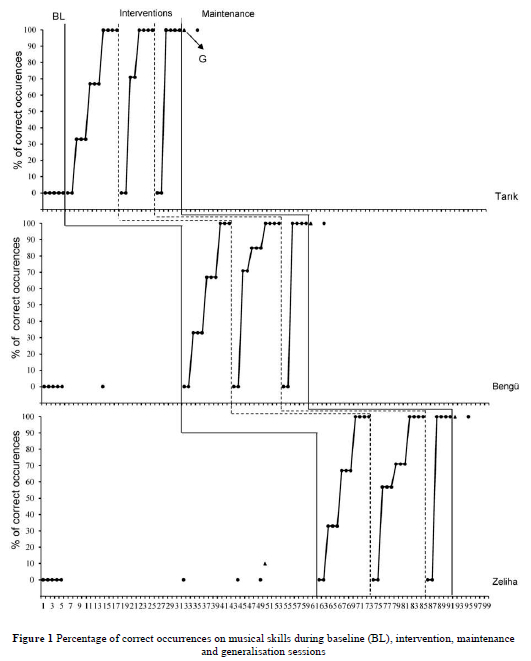
The effectiveness data were collected on a data-recording form that included the participants' responses during the response interval in the baseline, daily probe, maintenance and generalisation sessions to determine the effectiveness of the SS interventions presented with the Orff approach in teaching musical skills to children with DDs. The collected data were analysed through a graphical analysis method. The analysed data were visualised graphically (see Figure 1). A line graph consisting of baseline, daily probe, monitoring and generalisation data was prepared for each participant. The horizontal axis in the graph shows the number of sessions and the vertical axis shows the percentage of correct behaviour.
Reliability
The aim in this research was to teach children with DD musical skills through the use of SS with the Orff approach and two types of reliability data were collected: inter-observer agreement (IOA) and treatment integrity. All stages of the research were recorded on video. Treatment integrity and inter-observer reliability of the research were calculated by independent observers. Reliability data were collected for at least 30% of each experimental condition. These were selected randomly. Video analysis was carried out by independent observers who completed all data recording forms used by the researcher during the sessions. Inter-observer reliability data were calculated by using the formula (agreements/[agreements + disagreements]) x 100 (Erbaş, 2012:117). Treatment integrity data were calculated using the formula (observed implementer behaviour/planned implementer behaviour x 100) (Erbaş, 2012:126). For treatment integrity, the following behaviour was taken into consideration during training sessions: a) preparing tools and materials; b) sitting side by side with the participant; c) informing the participant and providing attentional cues; d) reading the SS to the participant; (e) reinforcing the participant's participation in the study. For treatment integrity, the following behaviour was taken into consideration during baseline, maintenance, and generalisation sessions: 1) preparing the tools and materials; 2) sitting face to face with the participant; 3) informing the participant and presenting the attentional cue; 4) presenting the target stimulus; 5) waiting for the participant to respond; 6) responding appropriately to the participant's response; 7) reinforcing the participant's participation in the study.
Social Validation
In the subjective assessment to display the social value of the research by collecting the views of children with DD and their families on the objective, method and findings of the research, participants were asked to respond to close-ended (Yes/No) and open-ended questions on a social validity form. The participants' responses were descriptively analysed and assessed.
Results
Effectiveness
Data related to the effect of the research participants' acquired chained musical skills on acquisition, maintenance and generalisation were displayed on single-line graphics (see Figure 1) which depicts baseline, intervention, maintenance and generalisation sessions.
Tar ı k
As seen in Figure 1, the percentage of correct responses to the chained skills in all sessions conducted in the baseline phase was 0%. After obtaining stable data for five consecutive sessions at baseline, the intervention phase was initiated. The chained skills were taught sequentially. Each session in Tank's intervention phase lasted approximately 5 minutes. A total of 32 sessions were conducted to teach chained skills. After the training sessions had started, it was observed that there was progress in the level and tendency of the targeted skills to be taught. The percentage of correct responses for the first skill reached 100% from the third session (33%) for the quarter rhythm skill, from the ninth session (67%) for the eighth rhythm skill, and 100% from the 15th session for the 16th rhythm skill. In the following sessions, he obtained stable data for three consecutive sessions and delivered 100% correct responses. When stable data were obtained in the first skill, the second skill was started. He exhibited 71% correct responses in the third session. From the fifth session, he reached a 100% performance level. In the following sessions, he obtained stable data for three consecutive sessions and delivered 100% correct responses. When stable data were obtained in the second skill, the third skill was started. In the third session he performed 100% in this skill. In the following sessions, he obtained stable data in three consecutive sessions and showed 100% correct responses. Intervention sessions were completed when Tarık had achieved 100% correct responses in three consecutive daily probe sessions.
Bengü
As seen in Figure 1, the percentage of correct responses to the chained skills in all sessions conducted in the baseline phase was 0%. After obtaining stable data for five consecutive sessions at baseline, the intervention phase was initiated. The chained skills were taught sequentially. Each session in Bengü' s intervention phase lasted approximately 5 minutes. A total of 40 sessions were conducted to teach chained skills. After the implementation sessions had started, it was observed that there was progress in the level and tendency of the targeted skill to be taught. The percentage of correct responses for the first skill reached 100% in the third session for the quarter rhythm skill, in the ninth session for the eighth rhythm skill, and in the 17th session for the 16th rhythm skill. In the following sessions she obtained stable data for three consecutive sessions and exhibited 100% correct responses. When stable data were obtained in the first skill, the second skill was started. In this skill she exhibited a correct response level of 71% in the third session. From the ninth session she reached 85% performance level. From the 11th session, she showed 100% performance. In the following sessions, she showed 100% correct responses in three consecutive sessions. When stable data were obtained in the second skill, the third skill was started in which she performed 100% in the third session. In the following sessions, she obtained stable data in three consecutive sessions and achieved 100% correct responses. Intervention sessions were completed when Bengü had reached 100% correct response in three consecutive daily probe sessions.
Zeliha
As seen in Figure 1, the percentage of correct responses to the chained skills in all sessions conducted in the baseline phase was 0%. After obtaining stable data for five consecutive sessions at baseline, the intervention phase was initiated. The chained skills were taught sequentially. Each session in Zeliha' s intervention phase lasted approximately 5 minutes. A total of 40 sessions were conducted to teach chained skills. After the implementation sessions started, it was observed that there was progress in the level and tendency of the targeted skills. The percentage of correct responses for the first skill reached 100% in the fifth session for the quarter rhythm skill, in the 11th session for the eighth rhythm skill, and in the 17th session for the 16th rhythm skill. In the following sessions, she obtained stable data for three consecutive sessions and exhibited 100% correct responses. When stable data were obtained in the first skill, the second skill was started. In this skill she exhibited a correct response level of 42% in the third session. From the fifth session she reached 57% and from the ninth session she reached a 71% performance level. From the 11th session, she showed a 100% performance level. In the following sessions she achieved 100% correct responses in three consecutive sessions. When stable data were obtained in the second skill, the third skill was started. She performed 100% in this skill during the third session. In the following sessions she obtained stable data in three consecutive sessions and showed 100% correct responses. The intervention sessions were completed when Zeliha reached 100% responses in three consecutive daily probe sessions.
Generalisation
In the generalisation sessions of the study, a post-test session was taken for all three skills, the pre-test session was taken only for the last skill. The other two skills for the pre-test session were not taken. In the generalisation pre-test session, none of the participants exhibited correct responses (correct response percentage: 0%) for the targeted skill (post-skill). In the post-test sessions generalisation data of the participants for different environments, different people and different materials were found to be at the level of 100% (see Figure 1). In the movement-dance step, which was the third skill, generalisation was not made with a different body, different tools and materials, and the session was conducted with only a different classroom and a different person (teacher).
Maintenance
Maintenance sessions were held 4 weeks after the end of the intervention. It was found that all participants maintained the learned skill with 100% accuracy (see Figure 1).
Social Validation
Social validity data regarding their views on the research were collected from the three participants and their mothers during interviews conducted by the first researcher.
The mothers were asked a total of eight questions - five closed-ended questions and three open-ended questions. The mothers stated that their children had displayed positive attitudes towards music lessons and musical behaviour after the education they had received. The mothers stated that they would like their children to participate in a similar study again because they thought that this study had positive effects on their children. They stated that such a study should be included in their children's education programmes. All mothers emphasised that music education made positive social and musical contributions to their children' s lives. They also expressed that they were pleased to have participated in such a study. They stated that they thought that their children would take different musical initiatives other than the skills targeted in the study and that they would like their children to participate in a similar study again on different musical skills that they had not yet learnt. All the research steps and the participants' opinions were recorded on the participant social validity form. All three participants expressed that they were pleased that a similar study allowed them to develop musically and learn something new. All participants emphasised that they would like to participate in such a study again because of its positive musical and social contributions. All the participants were able to explain in detail what they had learnt in the research. In addition, all three of them stated that they had never played the xylophone before and that they enjoyed playing it because of its timbre and the fact that they could make music by themselves. They stated that when they made the music, they expressed themselves through music in the way they wanted.
Discussion
In this research the effects of SS intervention combined with the Orff approach were analysed in terms of its role in acquiring musical skills for DD. Four weeks following the intervention session acquired skills had been maintained, and generalised to different people, materials and different settings. Additionally views related to the research were collected from children with DD and their families. The findings demonstrate that SS was effective in acquiring musical skills for children with DD. It was observed that following 4 weeks' SS interventions combined with the Orff approach were effective in maintaining the targeted musical skills instilled during the intervention sessions in all the participants. Generalisation data were found with different people, settings and materials with an accuracy level of 100% for all participants. In order to manifest the value of this study with respect to the social validity views of the children with DD and their mothers towards the research were collected as social validity data. All mothers stated that they were content with their children' s participation in the research and that this research focused on targeted musical skills for their children. They also indicated that they would support their children's participation in research related to teaching other skills. No existing research on the effectiveness of SS in acquiring musical skills was found in a review of the literature. However, research indicating that SS offered effective results in acquiring self-care skills, play skills, social skills, and decreasing maladaptive behaviour was found (Adams et al., 2004; Barry & Burlew, 2004; Feinberg, 2001; Hagiwara & Smith Myles, 1999; Olçay-Gül & Tekin-Iftar, 2016). Our research indicates that SS played an effective role in acquiring targeted musical skills by children with DD. Research was found in which SS were treated with music, but no research that focused on musical social stories aimed at acquiring musical skills could be found. Very few studies related to acquiring musical skills in children with DD through employing the Orff approach (Filianou & Stamatopoulou, 2013; Kılıç, 2019; Vancová & Osvaldová, 2019) were found. In their study Filianou and Stamatopoulou (2013) employed the Orff approach to help students with DD to acquire and make an association between body awareness and time and space. The findings of this study show that students acquired positive results in terms of cognitive, psychokinetic and social aspects and they, at the same time, exhibited a performance established upon music and movement. Vancová and Osvaldová (2019) focused on elementary level music improvisation in 16 children with DD. Their research showed that there was progress in music perception of both groups but in a trial group, there was significant improvement in intonation and singing. In our research the aim was also for children with DD to acquire musical skills using the Orff approach. As in other research (Filianou & Stamatopoulou, 2013; Kılıç, 2019; Vancová & Osvaldová, 2019) the findings of our study show that the Orff approach created effective outcomes in children with DD.
We aimed to teach musical skills to children with DD by administering a programme based on the Orff approach. In line with this goal, playing, singing and movement-dance activities were conducted as teaching activities in the research. The findings in this research are similar to those of other studies in which the effectiveness of the Orff approach on musical skills and dance education were analysed (Tekin Gürgen, 2007; Turan, 2014; Uçal, 2003). In our research, 4 weeks after the teaching sessions had ended, children with DD retained the skills that they had obtained during the teaching. The findings draw similarity with the maintenance sessions in other research (Eren et al., 2013; Kılıç, 2019; Pektaş, 2019; Schwartzberg & Silverman, 2013). We concluded that even after the end of the teaching sessions children with DD managed to generalise the skills that they had acquired to different people, materials and different settings. The findings are similar to the generalisation session findings of earlier studies (Eren et al., 2013; Hagiwara & Smith Myles, 1999; Kılıç, 2019; Schwartzberg & Silverman, 2013). Although the final goal of special education is inclusion, students with special needs attending the same school as their peers are at times stressed in expressing themselves. It is inevitable that a person, especially a child, who cannot express himself/herself comfortably may experience negative effects and difficulties. One of the most important contributions of Orff Schulwerk can be regarded as enabling social learning in different they thought that their children would take different musical initiatives other than the skills targeted in the study and that they would like their children to participate in a similar study again on different social settings (Salmon, 2020). Improvising music is one of the steps of the Orff approach. In the teaching of the third skill in the study, the improvisation step was practiced with each participant between sessions. In these one-on-one activities the researcher played melodies with a recorder while each participant played the xylophone. In these studies, which were conducted in the form of questions and answers in the form of a Rondo, the participants freely played the melodies they wanted in a do-pentatonic scale. The xylophone was used because it is one of the instruments used in the Orff approach. In the do-pentatonic scale, since the sounds were harmonised, the participants were able to freely make music without worrying about making mistakes. The participants' views related to every session of the research were collected on the prepared participant social validity forms and their views on the improvisation activities held at the break times of teaching sessions were investigated. All three participants stated that they felt that they could express themselves freely through music while making improvised music.
Limitations of the Research
The results of the study reflect the findings obtained from three participants with DD who continued inclusive education. When participants begin to acquire behaviour and skills in social stories, the directive sentences in the story are gradually removed, which is called fading. As the participants' summer vacations started, fading was not done in this study, which is another limitation of the study. Generalisation was another limitation of this research. The research was limited to rhythm, singing, movement-dance and improvisation skills.
Conclusion and Suggestion
Special education is an inter-disciplinary approach and it goes without saying that music education is one of these disciplines. Success in inclusive classrooms depends on teachers differentiating instruction effectively. This can occur when teachers continually assess students' understanding, are responsive, and enable students to acquire competence in a variety of ways (Broderick, Mehta-Parekh & Reid, 2005). Many music teachers need different methods for teaching students with special needs in their classrooms. Music teachers are mostly not able to teach music to students with DD in classes nor are they equipped to design individualized education programs (IEPs). Based on the findings and limitations of the research, the following recommendations can be made. Future research studies may be conducted in combination with social stories to help children with DD to gain different musical skills. Studies designed with a different scientifically based application other than social stories can be conducted for the acquisition of different target behaviour in music education for children with DDs. It is recommended that further research is conducted to create a guidebook for the musical skills of inclusion students.
Authors' Contributions
The article emanated from the doctoral dissertation of Doctor Didem Mutlu Karsiyakali Dogan under the supervision of Professor Jale Deniz and Professor Arzu Ozen as co-supervisor.
Notesi. Published under a Creative Commons Attribution Licence.
References
-
Acar C, Tekin-Iftar E & Yikmis A 2017. Effects of mother-delivered social stories and video modeling in teaching social skills to children with autism spectrum disorders. The Journal of Special Education, 50(4):215-226. https://doi.org/10.1177/0022466916649164
» https://doi.org/10.1177/0022466916649164 -
Adams L, Gouvousis A, VanLue M & Waldron C 2004. Social story intervention: Improving communication skills in a child with autism spectrum disorder. Focus on Autism and Other Developmental Disabilities, 19(2):87-94. https://doi.org/10.1177/10883576040190020301
» https://doi.org/10.1177/10883576040190020301 -
Altun ZD & Eyüpoğlu G 2018. Investigating views and practices of music teachers' about inclusive education. Journal of Education and Training Studies, 6(11):83-94. https://doi.org/10.11114/jets.v6i11.3466
» https://doi.org/10.11114/jets.v6i11.3466 -
American Orff-Schulwerk Association 2022. Available at http://www.aosa.org. Accessed 13 April 2022.
» http://www.aosa.org -
American Psychiatric Association 2013. Diagnostic and statistical manual of mental disorders: DSM-5 (5th ed). Arlington, VA: Author. https://doi.org/10.1176/appi.books.9780890425596
» https://doi.org/10.1176/appi.books.9780890425596 -
Atterbury B 1986. A survey of present mainstreaming practices in the Southern United States. Journal of Music Therapy, 23(4):202-207. https://doi.org/10.1093/jmt/23A202
» https://doi.org/10.1093/jmt/23A202 -
Barker CS 1981. Using Orff-Schulwerk as a method to enhance self concept in children with learning disabilities. PhD dissertation. Provo, UT: Brigham Young University. Available at https://www.proquest.com/docview/303108736?pqorigsite=gscholar&fromopenview=true&sourcetype=Dissertations%20&%20Theses. Accessed 18 February 2025.
» https://www.proquest.com/docview/303108736?pqorigsite=gscholar&fromopenview=true&sourcetype=Dissertations%20&%20Theses -
Barry LM & Burlew SB 2004. Using social stories to teach choice and play skills to children with autism. Focus on Autism and Other Developmental Disabilities, 19(1):45-51. https://doi.org/10.1177/10883576040190010601
» https://doi.org/10.1177/10883576040190010601 -
Batu ES 2000. Kaynaştırma, destek hizmetler ve kaynaştırmaya hazırlık etkinlikleri [Inclusion, support services and preparation activities for inclusion]. Ankara Üniversitesi Eğitim Bilimleri Fakültesi Özel Eğitim Dergisi, 2(4):35-15. Available at https://dergipark.org.tr/en/download/article-file/159242. Accessed 18 February 2025.
» https://dergipark.org.tr/en/download/article-file/159242 -
Beegle AC 2010. A classroom-based study of small-group planned improvisation with fifth-grade children. Journal of Research in Music Education, 58(3):219-239. https://doi.org/10.1177/0022429410379916
» https://doi.org/10.1177/0022429410379916 -
Bharathi G, Venugopal A & Vellingiri B 2019. Music therapy as a therapeutic tool in improving the social skills of autistic children. The Egyptian Journal of Neurology, Psychiatry and Neurosurgery, 55:44. https://doi.org/10.1186/s41983-019-0091-x
» https://doi.org/10.1186/s41983-019-0091-x -
Broderick A, Mehta-Parekh H & Reid DK 2005. Differentiating instruction for disabled students in inclusive classrooms. Theory Into Practice, 44(3):194-202. https://doi.org/10.1207/s15430421tip4403_3
» https://doi.org/10.1207/s15430421tip4403_3 -
Brownell MD 2002. Musically adapted social stories to modify behaviors in students with autism: Four case studies. Journal of Music Therapy, 39(2):117-144. https://doi.org/10.1093/jmt/39.2.117
» https://doi.org/10.1093/jmt/39.2.117 - Çelik P, Sarı MM & Yıldırım Doğru SS 2015. Türkiye'de ve Avrupa'da 2000-2013 yılları arasında özel gereksinimli çocuklarla ilgili yapılmış olan müzik eğitimi çalışmalarının değerlendirilmesi [Evaluation of music education activities of children with special needs in Turkey and Europe between 2000-2013]. Uluslararası Eğitim Bilimleri Dergisi, 2:10-28.
-
Darrow AA & Adamek M 2018. Instructional strategies for the inclusive music classroom. Journal of General Music Education, 31(3):61 -65. https://doi.org/10.1177/1048371318756625
» https://doi.org/10.1177/1048371318756625 -
Donohue D & Bornman J 2014. The challenges of realising inclusive education in South Africa. South African Journal of Education, 34(2):Art. # 806, 14 pages. https://doi.org/10.15700/201412071114
» https://doi.org/10.15700/201412071114 - Erbaş D 2012. Güvenirlik [Reliability]. In E Tekin-Iftar (ed). Eğitim ve davranış bilimlerinde tek denekli araştırmalar. Ankara, Türkiye: Türk Psikologlar Derneği Yayınları
-
Eren B, Deniz J & Düzkantar A 2013. The effectiveness of embedded teaching through the most-to-least prompting procedure in concept teaching to children with autism within Orff-based music activities. Educational Sciences: Theory & Practice, 13(3):1877-1885. https://doi.org/10.12738/estp.2013.3.1499
» https://doi.org/10.12738/estp.2013.3.1499 -
Fees BS, Kaff M, Holmberg T, Teagarden J & Delreal D 2014. Children's responses to a social story song in three inclusive preschool classrooms: A pilot study. Music Therapy Perspectives, 32(1):71 -77. https://doi.org/10.1093/mtp/miu007
» https://doi.org/10.1093/mtp/miu007 -
Feinberg MJ 2001. Using social stories to teach specific social skills to individuals diagnosed with autism. PhD dissertation. Alhambra, CA: California School of Professional Psychology. Available at https://www.proquest.com/docview/2759254377pqorigsite=gscholar&fromopenview=true&sourcetype=Dissertations%20&%20Theses. Accessed 18 February 2025.
» https://www.proquest.com/docview/2759254377pqorigsite=gscholar&fromopenview=true&sourcetype=Dissertations%20&%20Theses -
Filianou M & Stamatopoulou A 2013. Orff-Schulwerk in special education: A case study [Special issue]. Approaches: Music Therapy & Special Music Education, 5(2):125-131. Available at https://www.researchgate.net/publication/382211146_Orff-Schulwerk_in_Special_Education_A_Case_Study. Accessed 18 February 2025.
» https://www.researchgate.net/publication/382211146_Orff-Schulwerk_in_Special_Education_A_Case_Study -
Geboloğlu B 2016. Otizm spektrum bozukluğu olan bireylere sosyal beceri kazandırmada sosyal öykü ve müzikli sosyal öykü uygulamalarının etkililik ve verimliliklerinin karşılaştırılması [The comparison of the efficiency and effectiveness of social history and musical social story on social skill development of autism spectrum disordered individual]. PhD thesis. Konya, Türkiye: Necmettin Erbakan University. Available at https://acikerisim.erbakan.edu.tr/items/7187613b-40f6-4977-aa9c-7a1c21044a22. Accessed 28 February 2025.
» https://acikerisim.erbakan.edu.tr/items/7187613b-40f6-4977-aa9c-7a1c21044a22 -
Ghasemtabar SN, Hosseini M, Fayyaz I, Arab S, Naghashian H & Poudineh Z 2015. Music therapy: An effective approach in improving social skills of children with autism. Advanced Biomedical Research, 4(1):157. https://doi.org/10.4103/2277-9175.161584
» https://doi.org/10.4103/2277-9175.161584 - Gray C 2015. The new social story book (15th Anniversary ed). Arlington, TX: Future Horizons.
- Gray CA 1998. Social stories and comic strip conversations with students with Asperger syndrome and high-functioning autism. In E Schopler, GB Mesibov & LJ Kunce (eds). Asperger syndrome or high-functioning autism? Boston, MA: Springer.
-
Gray CA & Garand JD 1993. Social stories: Improving responses of students with autism with accurate social information. Focus on Autism and Other Developmental Disabilities, 8(1):1-10. https://doi.org/10.1177/108835769300800101
» https://doi.org/10.1177/108835769300800101 -
Hagiwara T & Smith Myles B 1999. A multimedia social story intervention: Teaching skills to children with autism. Focus on Autism and Other Developmental Disabilities, 14(2):82-95. https://doi.org/10.1177/108835769901400203
» https://doi.org/10.1177/108835769901400203 -
Healy D 2013. Using music and technology social story intervention with children with ASD. MA thesis. Cape Girardeau, MO: Southeast Missouri State University. Available at https://www.proquest.com/docview/14411085307pq-origsite=gscholar&fromopenview=true&sourcetype=Dissertations%20&%20Theses. Accessed 17 February 2025.
» https://www.proquest.com/docview/14411085307pq-origsite=gscholar&fromopenview=true&sourcetype=Dissertations%20&%20Theses - Jellison JA 2012. Inclusive music classrooms and programs. In GE McPherson & GF Welch (eds). The Oxford handbook of music education (Vol. 2). New York, NY: Oxford University Press.
-
Jellison JA & Draper EA 2015. Music research in inclusive school settings: 1975 to 2013. Journal of Research in Music Education, 62(4):325-331. https://doi.org/10.1177/0022429414554808
» https://doi.org/10.1177/0022429414554808 -
Kaleci Z 2017. Zihinsel yetersizlik gösteren bireylerin Orff çalgıları yolu ile müzik becerileri öğretimi üzerine bir inceleme [A review on the teaching of music skills by the Orff instruments technique of individuals who have mental disability]. Master thesis. Malatya, Türkiye: İnönü University. Available at https://abakus.inonu.edu.tr/items/b62d4eaa-40cb-4bd7-8837-e66a9372bb21. Accessed 28 February 2025.
» https://abakus.inonu.edu.tr/items/b62d4eaa-40cb-4bd7-8837-e66a9372bb21 -
Kılıç Y 2019. Orff yaklaşımı ile hazırlanan müzik etkinliklerinin otizm spektrum bozukluğu olan öğrencilere öğretiminde eş zamanlı ipucuyla öğretimin etkililiği [Effectiveness of teaching with simultaneous cues in teaching music activities prepared with the Orff approach to students with autism spectrum disorder]. Master's thesis. Istanbul, Türkiye: Marmara University. Available at https://avesis.marmara.edu.tr/yonetilen-tez/f61120c0-ceca-442a-8d9a-3560edf34633/orff-yaklasimi-ile-hazirlanan-muzik-etkinliklerinin-otizm-spektrum-bozuklugu-olan-ogrencilere-ogretiminde-es-zamanli-ipucuyla-ogretimin-etkililigi. Accessed 17 February 2025.
» https://avesis.marmara.edu.tr/yonetilen-tez/f61120c0-ceca-442a-8d9a-3560edf34633/orff-yaklasimi-ile-hazirlanan-muzik-etkinliklerinin-otizm-spektrum-bozuklugu-olan-ogrencilere-ogretiminde-es-zamanli-ipucuyla-ogretimin-etkililigi -
Kurt O & Kutlu M 2019. Effectiveness of social stories in teaching abduction-prevention skills to children with autism. Journal of Autism and Developmental Disorders, 49(9):3807-3818. https://doi.org/10.1007/s10803-019-04096-9
» https://doi.org/10.1007/s10803-019-04096-9 -
Mason NF 2012. The effects of Orff Schulwerk instruction on rhythmic achievement in beginning band. PhD dissertation. Lexington, KY: University of Kentucky. Available at https://www.proquest.com/docview/1506961102?porigsite=gscholar&fromopenview=true&sourcetype=Dissertations%20&%20Theses. Accessed 17 February 2025.
» https://www.proquest.com/docview/1506961102?porigsite=gscholar&fromopenview=true&sourcetype=Dissertations%20&%20Theses -
Mazur K 2004. An introduction to inclusion in the music classroom. Journal of General Music Education, 18(1):6-11. https://doi.org/10.1177/10483713040180010103
» https://doi.org/10.1177/10483713040180010103 -
Moore JLS 1984. Rhythm and movement: An objective analysis of their association with music aptitude. DEd dissertation. Greensboro, NC: University of North Carolina at Greensboro. Available at https://www.proquest.com/docview/303310046?pqorigsite=gscholar&fromopenview=true&sourcetype=Dissertations%20&%20Theses. Accessed 17 February 2025.
» https://www.proquest.com/docview/303310046?pqorigsite=gscholar&fromopenview=true&sourcetype=Dissertations%20&%20Theses -
More CM 2012. Social stories TM and young children: Strategies for teachers. Intervention in School and Clinic, 47(3):167-174. https://doi.org/10.1177/1053451211423816
» https://doi.org/10.1177/1053451211423816 -
National Autism Center 2015. Findings and conclusions: National standards project, phase 2. Randolph, MA: Author. Available at http://nationalautismcenter.org. Accessed 10 May 2017.
» http://nationalautismcenter.org - Olçay-Gül S & Tekin-Iftar E 2016. Family generated and delivered social story intervention: Acquisition, maintenance, and generalization of social skills in youths with ASD. Education and Training in Autism and Developmental Disabilities, 51(1):67-78.
-
Pasiali V 2004. The use of prescriptive therapeutic songs in a home-based environment to promote social skills acquisition by children with autism: Three case studies. Music Therapy Perspectives, 22(1):11-20. https://doi.org/10.1093/mtp/22.1.11
» https://doi.org/10.1093/mtp/22.1.11 -
Pektaş S 2019. Müzikal etkinliklere dönüştürülmüş sosyal öykü uygulamalarının gelişimsel yetersizliği olan çocuklara sosyal beceri öğretiminde etkililiği [The efficacy of social story applications turned into musical activities on children with developmental disabilities regarding social skills teaching]. PhD thesis. Malatya, Türkiye: Inönü University. Available at https://acikbilim.yok.gov.tr/bitstream/handle/20.500.12812/109764/yokAcikBilim_10242042.pdf?sequence=-1 & isAllowed=y. Accessed 17 February 2025.
» https://acikbilim.yok.gov.tr/bitstream/handle/20.500.12812/109764/yokAcikBilim_10242042.pdf?sequence=-1 & isAllowed=y - Persellin DC 1999. The effects of Orff-based music instruction on spatial-temporal task performance of young children. Texas Music Education Research, 1999:79-84.
-
Prinsloo E 2001. Working towards inclusive education in South African classrooms. South African Journal of Education, 21(4):344-348. Available at https://www.ajol.info/index.php/saje/article/view/24927. Accessed 17 February 2025.
» https://www.ajol.info/index.php/saje/article/view/24927 -
Register DM & Hilliard RE 2008. Using Orff-based techniques in children's bereavement groups: A cognitive-behavioral music therapy approach. The Arts in Psychotherapy, 35(2):162-170. https://doi.org/10.1016/j.aip.2007.10.001
» https://doi.org/10.1016/j.aip.2007.10.001 - Salmon S 2016. How the Orff approach can support inclusive music teaching. In D VanderLinde Blair & KA McCord (eds). Exceptional music pedagogy for children with exceptionalities: International perspectives. New York, NY: Oxford University Press.
- Salmon S 2020. Die Bedeutung des Orff-Schulwerks für inklusiven Musikunterricht [The significance of the Orff Schulwerk for inclusive music education]. In H Henning (ed). All inclusive?!: Aspekte einer inklusiven Musik- und Tanzpädagogik. Münster, Germany: Waxmann.
-
Sansosti FJ & Powell-Smith KA 2006. Using social stories to improve the social behavior of children with Asperger syndrome. Journal of Positive Behavior Interventions, 8(1):43-57. https://doi.org/10.1177/10983007060080010601
» https://doi.org/10.1177/10983007060080010601 -
Scattone D, Tingstrom DH & Wilczynski SM 2006. Increasing appropriate social interactions of children with autism spectrum disorders using Social StoriesTM. Focus on Autism and Other Developmental Disabilities, 21(4):211-222. https://doi.org/10.1177/10883576060210040201
» https://doi.org/10.1177/10883576060210040201 -
Schwartzberg ET & Silverman MJ 2013. Effects of music-based social stories on comprehension and generalization of social skills in children with autism spectrum disorders: A randomized effectiveness study. The Arts in Psychotherapy, 40(3):331-337. https://doi.org/10.1016/j.aip.2013.06.001
» https://doi.org/10.1016/j.aip.2013.06.001 -
Shamrock M 1986. Orff Schulwerk: An integrated foundation. Music Educators Journal, 72(6):51 -55. https://doi.org/10.2307/3401278
» https://doi.org/10.2307/3401278 -
Tekin Gürgen E 2007. Orff-Schulwerk ve Kodály Yöntemi'nin vokal doğaçlama, müziksel işitme ve şarkı söyleme becerileri üzerindeki etkileri [The effects of Orff-Schulwerk and Kodaly Method on vocal improvisation, musical audition and singing abilities]. PhD thesis. İzmir, Türkiye: Dokuz Eylül University. Available at https://acikerisim.deu.edu.tr/xmlui/bitstream/handle/20.500.12397/6861/215784.pdf?sequence=1 & isAllowed=y. Accessed 17 February 2025.
» https://acikerisim.deu.edu.tr/xmlui/bitstream/handle/20.500.12397/6861/215784.pdf?sequence=1 & isAllowed=y - Tekin-Iftar E 2012. Çoklu yoklama modelleri [Multiple probe designs]. In E Tekin-Iftar (ed). Egitim ve davranış bilimlerinde tek-denekli araştırmalar. Ankara, Türkiye: Türk Psikologlar Derneği Yayınları
-
Travis DA 2006. The effect of musical social storiesTM on target behaviors of preschool children with autism spectrum disorders: Three case studies. MMT thesis. East Langsing, MI: Michigan State University. https://doi.org/10.25335/b9zc-4t46
» https://doi.org/10.25335/b9zc-4t46 -
Turan Z 2014. Beden eğitimi öğretmen adaylarında Dalcroze ve Orff öğretim yaklaşımlarının dans temelli hareket becerisi geliştirmeye etkisi [The effect of application of teaching approach of Dalcroze and Orff in developing dancing skills of prospective physical education teachers on developing movement skills]. PhD thesis. Manisa, Türkiye: Celal Bayar Üniversitesi. Available at https://www.researchgate.net/publication/375089929_BEDEN_EGITIMI_OGRETMEN_ADAYLARINDA_DALCROZE_VE_ORFF_OGRETIM_YAKLASIMLARININ_DANS_TEMELLI_HAREKET_BECERISI_GELISTIRMEYE_ETKISI. Accessed 17 February 2025.
» https://www.researchgate.net/publication/375089929_BEDEN_EGITIMI_OGRETMEN_ADAYLARINDA_DALCROZE_VE_ORFF_OGRETIM_YAKLASIMLARININ_DANS_TEMELLI_HAREKET_BECERISI_GELISTIRMEYE_ETKISI -
Uçal E 2003. Okul öncesi müzik eğitiminde Orff öğretisinin müziksel beceriler üzerindeki etkileri [The effects of Orff's teaching on musical skills in preschool music education]. Master's thesis. İzmir, Türkiye: Dokuz Eylül University. Available at https://www.proquest.com/docview/29571455667pq-origsite=gscholar & fromopenview=true & sourcetype=Dissertations%20 & %20Theses. Accessed 17 February 2025.
» https://www.proquest.com/docview/29571455667pq-origsite=gscholar & fromopenview=true & sourcetype=Dissertations%20 & %20Theses -
United Nations Educational, Scientific and Cultural Organization 2005. Guidelines for inclusion: Ensuring access to education for all. Paris, France: Author. Available at https://unesdoc.unesco.org/ark:/48223/pf0000140224/PDF/140224eng.pdf.multi. Accessed 19 February 2025.
» https://unesdoc.unesco.org/ark:/48223/pf0000140224/PDF/140224eng.pdf.multi -
Vancová A & Osvaldová M 2019. Effects of Orff Schulwerk conception on music abilities of pupils with mental disorder. Ad Alta: Journal Of Interdisciplinary Research, 9(2):261-264. Available at https://www.magnanimitas.cz/ADALTA/0902/papers/A_osvaldova.pdf. Accessed 17 February 2025.
» https://www.magnanimitas.cz/ADALTA/0902/papers/A_osvaldova.pdf - Voigt M 2013. Orff Music Therapy: History, principles and further development [Special issue]. Approaches: Music Therapy & Special Music Education, 5(2):97-105.
- Yaprak Kotzian E 2018. Orff-Schulwerk elementer müzik ve hareket pedagojisinin temelleri [Principles of Orff-Schulwerk elemental music and movement pedagogy]. Istanbul, Türkiye: Pan Yayıncılık.
Revised: 12 April 2024
Accepted: 27 January 2025
Published: 28 February 2025