Examining the effectiveness of professional development for early years practitioners in disadvantaged communities of South Africa
Abstract
With this study we examined the challenges that impeded effective professional development (PD) provisioning and the strategies for improvement of 211 practitioners spread across 45 early childhood care and education (eCCE) centres. The main research question that guided the study was: What are the professional development needs of ECCE practitioners in disadvantaged communities of the Motheo district of South Africa? A convergent mixed methods research design was followed, with a questionnaire supplemented by semi-structured interviews. We used SPSS Version 25 to analyse the quantitative data collected. The qualitative data were analysed thematically. The main themes were arranged according to the challenges confronting the effective provision of PD to early-year practitioners and the strategies to facilitate the provision of their PD needs. An analysis of practitioners' responses revealed the challenges experienced by and the views of ECCE practitioners. These included, among others, barriers to ECCE provision such as budget constraints, lack of PD training opportunities, and fostering greater stakeholder engagement with institutions of higher learning to provide PD. We recommend the development of PD training tailored to the needs of practitioners, a partnership between government and training providers, and increased financial support for the ECCE sector to aid PD. The study provides knowledge and understanding of professional development in marginalised communities through the identification of key challenges and providing insights to inform stakeholders on training opportunities and needs.
community-based centres; community development; early years practitioners; professional development; quality training
Introduction
Studies have shown that professional development (PD) can greatly benefit early childhood care and education (ECCE) practitioners by offering a platform for them to build on previously acquired skills (Chinhara & Sotuku, 2020). Research shows that PD creates a platform for practitioners to examine and analyse their actions (Hamre, Partee & Mulcahy, 2017). Exposure to PD facilitates the discovery of new ways of delivering services while improving children's learning outcomes (Gregoriadis, Papandreou & Birbili, 2018; Russell, 2021).
Much research has been done on the link between PD and the quality of the teaching workforce (Darling-Hammond, Hyler & Gardner, 2017; Hamre et al., 2017). In Australia, Russell (2021:7) found that participation in PD programmes by ECCE workers guaranteed that participants accessed deeper levels of cognition that enabled them to perform their duties about children and their families. In Greece, Gregoriadis et al. (2018:280) studied 45 kindergarten teachers and found that the participants expressed professional fulfilment after participating in a series of PD programmes; their self-confidence had improved, and they believed that they could perform classroom functions more effectively. Siraj, Kingston and Neilsen-Hewett (2019:53) argue that when PD is well-planned and effectively executed, it facilitates closing the knowledge gaps that remain after initial practitioner training programmes.
According to Barnes (1994), a disadvantaged community is characterised by very limited or a lack of amenities available to such a community, a chronic lack of basic resources, and often a shortage of the necessary skills for advancing the quality of residents' own lives. In the South African context, synonyms for disadvantaged communities include people who suffered deprivations during the now-defunct apartheid regime, poor and rural people, grassroots communities and oppressed people (Barnes, 1994). The population often comprises mainly illiterate, unskilled, and unemployed people, and those still affected by the lingering effects of the apartheid regime (Buys, Korevaar & Stubbs, 2020; Kumpulainen, Theron, Kahl, Bezuidenhout, Mikkola, Salmi, Khumalo & Uusitalo-Malmivaara, 2016; Larey, 2018). Our study was conducted in ECCE centres in disadvantaged communities in the Motheo district, Free State province, comprising Mangaung, Mantsopa and Naledi municipalities (Goldman, 2006; Olaleye, 2010). According to Atmore, Van Niekerk and Ashley-Cooper (2012a), ECCE centres in these types of communities are likely to operate in multipurpose spaces, such as abandoned garages, inhabited homes, shipping containers, prefabricated rooms or wood or iron structures. Atmore et al.'s (2012a) study characterises disadvantaged communities as both rural and overcrowded. The ECCE centres in such disadvantaged areas have inadequate infrastructural facilities, a poorly skilled workforce, low wages/salaries, very poor or no equipment at all, few books and other learning materials, and no access to PD training facilitators. Under these conditions, it is obvious that, if practitioners are to contribute to the transformation agenda as popularised by Mezirow's (1991) transformation theory, the practitioners themselves must be transformed.
Despite these empirical revelations, we established that although studies have investigated the importance of PD for ECCE practitioners in South Africa (Atmore et al., 2012b; Harrison, 2019; Ncube, 2017), few of these studies have researched the PD needs of practitioners who worked specifically in disadvantaged communities in South Africa. Given this scenario, we assumed that a lack of empirical knowledge of the PD experiences and needs of ECCE practitioners in disadvantaged communities could result in PD programmes and policies being based on mere speculation. Therefore, we examined the challenges that impede effective PD provisioning and strategies to improve the skills of ECCE practitioners in disadvantaged communities in the Motheo district of the Free State province. The two research questions that guided the study are: What challenges confront the adequate provision of PD for ECCE practitioners in communities in the Motheo district? and What are ECCE practitioners' views on strategies to facilitate the provision of their PD needs, as guided by the study?
Literature Review
In the literature review section we highlight the significance of PD for ECCE practitioners. We also discuss the challenges impeding effective PD for ECCE practitioners and highlight some strategies to facilitate effective PD for ECCE practitioners.
Significance of PD for ECCE practitioners
Garrity, Longstreth, Linder and Potter (2019) point out that PD through which practitioners are adequately prepared becomes indispensable as the number of children with challenging behaviour increases at pre-school centres. Ncube (2017) also reports that developing empirically backed standard training programmes for the ECCE workforce will help create a mutual agenda to influence the quality of services provided at centres. Darling-Hammond et al. (2017) report that PD opportunities of high quality help create the necessary space for practitioners to share ideas and work together, enabling them to continually refine and improve their provisioning of learning and service. Gregoriadis et al. (2018) define PD as the conscious continuing development of persons providing ECCE services to equip them with the relevant skills to perform their duties to benefit children. Mitter and Putcha (2018) explain that PD is significant for equipping practitioners with the knowledge they need to succeed. Hamre et al. (2017) suggest that a well-equipped ECCE workforce would undoubtedly influence early development outcomes for children. Kashin (2020) and Siraj et al. (2019) found that an adequately skilled ECCE workforce with knowledge of child development generally offers wide-ranging benefits for the ECCE sector. Particularly, Siraj et al. (2019) claim that the PD programmes that would achieve the desired goals would result from clear knowledge of practitioners' needs.
Challenges and strategies of PD for ECCE practitioners
Studies mention constraints that may impede the PD of ECCE practitioners. Among the challenges are a shortage of qualified PD facilitators (Chinhara & Sotuku, 2020), absence of financial incentives and absence of policy guidelines (Komba & Mwakabenga, 2019), poor infrastructure at ECCE centres, a lack of follow-up support (Atmore et al., 2012b), provision of PD programmes that do not fulfil practitioners' needs (Havnes, 2018), and a shortage of PD opportunities at centres in under-resourced communities (Wei, Darling-Hammond & Adamson, 2010).
Studies also found that practitioners' effective PD depended on several strategies. Wingrave and McMahon (2016) report that PD programmes that focus directly on what practitioners do in learning content areas and the general approaches to teaching-learning will help equip practitioners more effectively. Viskovic and Visnjic Jevtic (2018) suggest that the results should inform PD programmes of empirical and data-driven analytics to provide clear information on existing gaps between the goals of ECCE, the quality of service provision, and children's behaviour. The involvement of practitioners in decision-making about their own PD seems to be a strategy in line with the transformative learning theory (Mezirow, 1991). Sanchez (2018) argues that such an approach would help ensure practitioners' commitment and increase their desire to learn. Also, Pölzl-Stefanec (2021) suggests that linking practitioner PD programmes to their everyday duties appears to motivate them to identify with such initiatives. Personalised PD programmes in collaboration with others in a learning community is another strategic approach supported by literature (Prince, 2018). Clarke and DeHaan (2020) suggest that the necessary support should be provided to practitioners who are involved in continuous and ongoing PD. Doing so would enhance practitioners' ability to retain meaningful learning and practices.
Lastly, Sutarsih and Saud (2019) suggest that the evaluation of PD programmes will equally serve as an important feedback loop for informing successes and failures and facilitating better planning in the future. For our research, we drew from the definition of PD by the National Professional Development Center on Inclusion ([NPDCI], 2008) in the United States of America (USA), which refers to continuous and ongoing PD as enabled teaching learning encounters, which are operational and provide necessary support aimed at the attainment of specialised skills, awareness and dispositions, and the adaptation of these skills in the performance of ECCE services. Therefore, it is believed that when ECCE practitioners in marginalised communities receive continuous and ongoing PD, services for young children might improve.
Theoretical Framework
Mezirow's transformative learning theory (1991) provides the theoretical foundation for the study. Mezirow (1991) uses this theory to describe how people develop and use critical self-reflection to analyse their beliefs and experiences, enabling them to change how they perceive the world. This theory has been influential in recent years. For instance, Sanchez (2018) describes transformative learning as adult learning that aims to transform problematic frames of reference to equip these adults to be reflective, open, and emotionally able to change. Mezirow (1991) believes that, for people to change their views of the world, they must face a disorienting dilemma, an experience that does not fit their current beliefs about the world. Then, they will be forced to reconsider their beliefs in order for these beliefs about this new experience to fit in with the rest of their worldview (Zhu & Li, 2019). This transformation often happens through critical reflection based on dialogue with other people. This theory offered us the necessary lenses to facilitate our understanding of the PD experiences and needs of the ECCE practitioners that we studied.
As we focused on understanding the PD needs of ECCE practitioners in disadvantaged communities, the practitioners were asked pertinent questions. We believe that PD programmes emanating from this empirical understanding of the practitioners' challenges, including the actual intervention programmes that may ensue, will facilitate the reintegration of new knowledge, skills, and perspectives into the practitioners' professional work lives. Mezirow's (1991) concept of transformative learning connects with the assumption that PD can improve ECCE practitioners' skills and impart new knowledge to benefit young children's education in marginalised communities.
Methodology
A convergent, parallel, mixed methods research design which involved the concurrent collection of quantitative and qualitative data (Ngulube & Ngulube, 2022) was used. Razali, Aziz, Rasli, Zulkefly and Salim (2019) explain that the findings and results of data from convergent, parallel, mixed methods research designs are interpreted jointly to identify the moments and points of convergence of the findings, deviations, and contradictions within the data sources.
Population and Sample Size
The target population comprised ECCE practitioners who worked at community-based centres in Bloemfontein, Botshabelo, Thaba Nchu, Ladybrand, and Dewetsdorp. The purposive sampling technique informed the selection of practitioners (n = 211) from 45 ECCE centres. Purposive sampling is a category of the non-probability sampling technique that allows researchers to select mainly members of the population that can be conveniently reached during the study period (Etikan, Musa & Alkassim, 2016:2). We selected practitioners on the basis that they were employed in community-based centres, and that they had worked as practitioners at the centres for a minimum of 2 years. This enabled us to select only practitioners with relevant experience to facilitate the smooth completion of the data collection fieldwork (Scholtz, 2021).
Instruments for Data Collection
A self-constructed early childhood professional development needs questionnaire (ECPDNQ) was used. The ECPDNQ comprised five sections. Section A consisted of items seeking practitioner demographic information. Section B contained items meant to seek information on the PD needs of the practitioners. With Section C we aimed to understand the constraints facing the effective provision of practitioner PD. In Section D we sought information on the strategies used to ensure the effective provision of early childhood PD and Section E contained open-ended questions. An interview guide informed the semi-structured one-on-one interviews. The guide consisted of seven sections, which reflected the specific objectives of the main study, namely, biographical information; establishing how the ECCE practitioners viewed their roles in the provisioning of quality ECCE services; identifying the PD opportunities available to ECCE practitioners in the Motheo district; determining how ECCE practitioners in the Motheo district interpreted their PD needs; determining the challenges that confronted the effective provisioning of PD to practitioners in communities in the Motheo district; exploring the views of ECCE practitioners on strategies that facilitate the provision of their PD needs; and any other reflections that the practitioner were prepared to share with us.
We approached the district office for a list of registered ECCE centres in the Motheo district. We used the contact numbers on the list to create a WhatsApp group or platform, which made it easier for us to reach the centre managers to negotiate the dates for our actual visits to the centres. This approach enabled the first author to avoid visiting centres at times when practitioners would have been busy with the children. An ad hoc community guide facilitated the navigation of the various communities where the ECCE centres were located.
The first author undertook the fieldwork data collection under the supervision of the second author. On arrival at each creche, I presented two letters: one to the creche manager and the other to the practitioners. I then took the time to read the contents of the letters to both the centre heads and practitioners and responded to questions by the practitioners seeking clarity. The practitioners then signed the consent form and completed the questionnaire. Twenty practitioners were interviewed, and each interview lasted for about 45 minutes. Interviews were audio recorded.
Validity, Reliability and Trustworthiness To ensure instrument validity and reliability, we piloted the instrument on a different sample of 10 ECCE practitioners that shared similar characteristics to those of the actual sample of the study. The pilot testing assisted us in evaluating the adequacy and relevance of the questionnaire items and determining the adequacy of the instrument for the actual study (Creswell & Creswell, 2018). Cronbach's alpha coefficient (Taber, 2018) was used to establish the reliability of the tool, and it was deemed reliable on the alpha coefficient of 0.94 for the internal reliability index of the instrument' s items. According to Taber (2018:1277), an instrument is judged to be reliable when the "Cronbach alpha coefficient of 0.70" or higher is obtained. To ensure qualitative trustworthiness, we aligned our procedures closely to the principles of reflexive subjectivity (Kalu, 2019:97), face validity (Earnest, 2020:78), catalytic validity (Rose & Johnson, 2020) and methodological triangulation (Noble & Heale, 2019) in generating knowledge that can be valuable and trustworthy.
Data Analysis
The responses to the questionnaire questions were captured using a Microsoft Excel spreadsheet. Then, the Statistical Package for the Social Sciences (SPSS) Version 25 was employed to enter the data for analysis. The means and standard deviation results were used to answer the relevant research sub-questions. A thematic approach (Creswell & Creswell, 2018) was used to organise and analyse the qualitative data. The organising entailed the coding of the transcripts, which gave voice to the research participants because many of the coded words were used to present the findings.
Ethical Considerations
Firstly, permission was obtained from the Free State Department of Education. Then we obtained ethical approval from the General and Human Research Ethics Committee, University of the Free State (Ethical Clearance number: UFS-HSD2022/0990/22). The first author, who visited the sites, was responsible for explaining all aspects of the research protocols and assurances, as mandated by the bodies that had provided ethics approval. Participants were informed about our commitment to ensuring that participants remained anonymous by assigning pseudonyms (P1 to P20) instead of using the participants' actual names.
Presentation of Findings
Quantitative Data
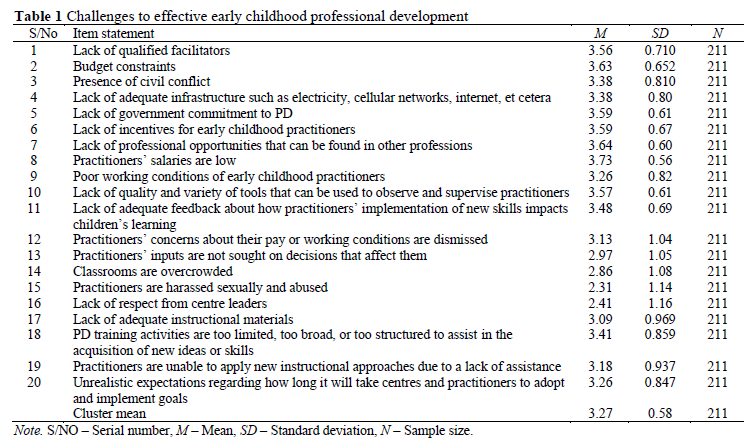
Table 1 shows the means (M) and standard deviations (SD) of the practitioners' responses about the challenges regarding the adequate provision of PD on early childhood in communities in the Motheo district. The results indicate that the respondents agreed on the following items as the challenges confronting the adequate provision of early childhood PD. These items, among others, include a lack of qualified facilitators (M = 3.56, SD = 0.710), budget constraints (M = 3.63, SD = 0.652), presence of civil conflict (M = 3.38, SD = 0.810), lack of adequate infrastructure such as electricity, cellular networks, internet, et cetera (M = 3.38, SD = 0.80), lack of government commitment to PD (M = 3.59, SD = 0.61), and lack of incentives for early childhood practitioners (M = 3.59, SD = 0.67). This is because the means of the practitioners' responses on items 1-14, 1719 and 20 were higher than the criterion mean of 2.50. On the other hand, the respondents disagreed that "harassing and abusing practitioners sexually" and "lack of respect from centre leaders" were challenges preventing the effective provision of PD for early childhood practitioners with mean ratings less than the 2.50 criterion level. The overall mean of 3.27 and the standard deviation of 0.58 indicate that the practitioners agreed that the statements in the items represented challenges preventing the effective provision of early childhood PD in communities in the Motheo district. The findings from the practitioners who were interviewed were used to corroborate some of these results.
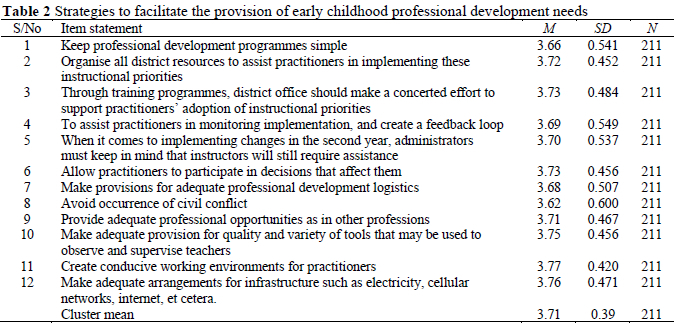
Table 2 shows the means and standard deviation of the responses of the practitioners on strategies to facilitate the provision of their PD needs. The results show that all the items had a mean rating above the criterion level of 2.5, therefore, suggesting a positive agreement with the proposed strategies. These strategies, among others, include keeping PD programmes simple (M = 3.66, SD = 0.541), organising all district resources to assist practitioners in implementing these instructional priorities (M = 3.72, SD = 0.452), the district office should, through training programmes, make a concerted effort to support practitioners' adoption of instructional priorities (M = 3.73, SD = 0.484), and to assist practitioners in monitoring implementation, and create a feedback loop (M = 3.69, SD = 0.549). Other strategies recommended were that administrators keep in mind that instructors will still require assistance in monitoring the implementation of changes in the second year, allowing practitioners to participate in decisions that affect them, providing for adequate PD logistics, avoiding civil conflict taking place, and to provide adequate professional opportunities, as in other professions. The result shows an overall mean rating of 3.71 and a standard deviation of .39, which implies that all items in Table 2 are strategies to facilitate the provision of PD needs.
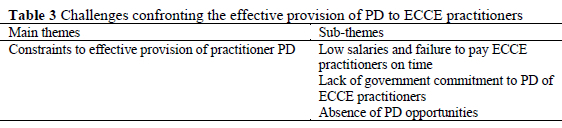
A sample of 20 participants in the semi-structured interviews responded to the two main issues that informed the sub-questions. Table 3 shows three sub-themes: 1) low salaries or failure to pay salaries; 2) lack of government commitment to PD; and 3) absence of PD opportunities. These constraints are discussed using the practitioners' verbatim responses as support.
Financial Challenges of ECCE Practitioners
Most practitioners bemoaned the meagre salaries they received and wondered how they were expected to survive on such inadequate salaries. Practitioners also mentioned that receiving their salary on time played a part in their ability to participate in any PD programmes because they could plan if they received their salaries regularly.
The salary is a challenge. It's a big one. We are trying. Remember now, I'm raised in a Christian house where they said to me, whatever opportunity that God has presented to you, take it with both hands. So, for me, salary is nothing. But I' m just here for the love of these children. (P10)
Participant 10's passion for the job in ECCE provided her with the drive to persevere. The unreasonably low salary was also a source of demotivation to participate in PD programmes. P13 expressed her opinion as follows: "I think the main challenge is the stipend. If there could be a better stipend so that the practitioners can be encouraged and enjoy those training!" Practitioners often mentioned their salaries in the interviews; they believed that it was too low and inconsistent with the number of hours they spent at the centres. Participant 19 revealed the following: "Our salary is very low for the number of hours that we work ... we get nothing in return, nothing."' P9 referred to their salary as "peanuts'" and blamed the government for the inadequate salaries of ECCE practitioners.
It seemed that the practitioners' low salaries were not the only issue. They also expressed frustration with the delays in receiving their meagre salaries. The delays were caused by poor parents not being able to pay the fees or the government failing to process payments on time.
Yes, even salary. We do have challenges with that. Sometimes we don' t get it in time because parents didn't pay or the department didn't have the money on that date (P5).
The first challenge is just because from January to March this time, we will not get payment. The department says that they realised this challenge but nothing they will do because it was last minute to hear, unfortunately (P2).
The practitioners' frustrations over the uncertainty emanated from the fact that they did not know when the next salary would be paid. These frustrations filtered through the interview data. This situation is likely to stifle planning and can be the source of a great deal of stress for employees.
Lack of Government Commitment to ECCE Practitioners' PD
The government's failure to commit to PD was the second-most frustrating aspect raised by practitioners. The practitioners clearly understood their position as pivotal in educating children in their early years. The practitioners knew that they played crucial foundational roles that tended to define the prospects of formal schooling for the children. P9's comment summarises the frustrations of the practitioners:
You know what? I' m angry for the government, I'm angry. I want to be honest. They don' t care about us. They don't think ECD [early childhood development] is very difficult. But it's difficult to hold the child's ... hands it's difficult to teach the child basic behaviour. It' s difficult to motivate young children. That child, she was using Pampers [disposable nappy], and then you train that child to move, to know how to say I want to go to the toilet. It's very difficult. But we get the peanuts. (P9)
The scenario of dejection expressed by the above participants was palpable. It is, quite honestly, unacceptable to expect childcare personnel to feel this way - knowing that the fates of children rest in the care of the practitioners at these centres. None of the practitioners interviewed had anything positive to say about the government. P13 was almost begging the government to do their part:
I want to ask if the department will give anything to practitioners so that they can have the courage for training, something like a stipend because the money that the practitioners get is too little for someone who has a family. (P13)
Lack of PD Opportunities
Life in rural and disadvantaged communities can be quite challenging, in several ways. Difficulties with communication and access to vital information is among the most serious challenges. Thus, even if practitioners were willing to participate in their own PD, they remained in the dark about where these services could be obtained. Among the many responses, the following three sum up the problem and the practitioners' situation in these communities:
My challenge is that am not hearing anything from anyone. I am not hearing about opportunities, or they are not there. Very difficult (P10). Except that there's no information regarding the training. Yeah, there's a lack of information (P14). In terms of having professional people to come and teach us, we don' t have that at all. It' s very challenging. We do things on our own. And it's bad (P19).
Mitigating the Constraints to Effective Provision of PD to Practitioners
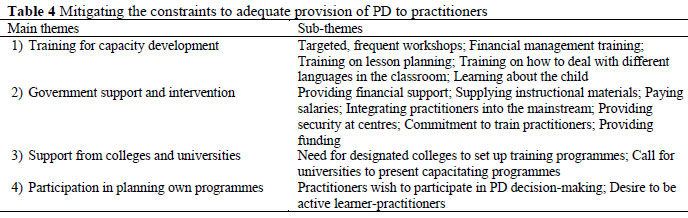
The mitigating suggestions for constraints regarding the provision of PD for ECCE practitioners are presented below.
Training for capacity development
Practitioners were very clear about their views on what they required in terms of training for capacity development. They understood the importance of frequent workshops that focused on the acquisition of skills in financial management, lesson planning and presentation. Practitioners also wished to be skilled on how to teach children in multilingual South African classrooms and learning about child development. Below are the views of three practitioners, which are representative of the opinions of the majority of practitioners who took part in the study.
What do I say? Frequent workshops, that can help a lot because with those workshops we shall be addressing the recent challenges that we see around us then there will be assessments to help us take stock (P1).
The practitioners need to be properly trained, to develop professional skills and obtain qualifications for them to have full information and be able to teach the children properly (P2). I think we must have the workshops, I don't know, workshops that can teach us how to manage the languages. They can teach us different ways to manage the children's languages (P6).
Government support and intervention
The participants were also very clear on how the government could come to their assistance. They were unanimous in their wishes on receiving financial management skills, instructional materials, salaries, practitioners being integrated into mainstream ECCE services, having security guards at centres, having opportunities for training, and funding for those who required further training. Practitioners wondered why they had been left out of the mainstream education system, and thought that it was time that they were captured on the government system without further delay. Dangerous conditions at centres were a considerable source of worry, and they wanted the government to assist by providing security guards to help protect the persons and facilities at the centres. Four practitioners shared their expectations on the government.
But sometimes we didn't get uh that support. So then if it is possible if the government or department itself can pay the salaries (P4). Government can help by taking us to training, providing those things. I think they can be more helpful by providing even leading educational toys. We don't have those things (P5).
Department must speed up the process of capturing us into their programmes, and they need to speed up the process of developing these programmes according to age differential as soon as possible. Let them not keep on postponing these things. Let them have people who are going to work with us directly and keep the time frame in mind. (P8) When it comes to these gangsters, although we know that our police officers are not enough At least if they can keep patrolling to check if there's still order in the community (P12).
Support from colleges and universities
Practitioners believed that the colleges and universities in the province had a role to play in capacitating them with relevant skills. Colleges and universities can set up specialised remedial programmes aimed at the PD of practitioners. The practitioners were of the view that this was possible if the higher education institutions in the province were willing to commit to assisting them grow and become better prepared for their roles. The practitioners commented as follows in this regard:
Okay. I think maybe if more colleges, more universities, they accept us. Yah. With less registration fees, or maybe they have a programme for us whereby they train us (P10).
We don' t have enough salaries. We don' t have money to register for courses ... so maybe institutions or universities can come up with an idea and say, okay, we are setting aside this certain amount of funds for people who are working at ECD centres to come and study with us for a period. (P14)
Participation in planning own programmes
Participating in the planning and developing their own PD programmes was one idea that all the practitioners promoted strongly. The practitioners believed that participation in decision-making about their own PD would motivate them to participate. The comment by P19 captures the views of most of the practitioners.
Yeah, I think the practitioners must get involved with their problems. Because we are the ones that face the problems. So, we must get involved with the solutions because we are the ones who are going through those things. So, we must get more knowledge on how we can help ourselves. (P19)
Discussion
In this mixed methods study we explored the constraints that impede effective PD provisioning for ECCE practitioners in the disadvantaged communities of the Motheo district. We also sought participants' views on strategies that would facilitate improvement in the PD training.
Both quantitative and qualitative findings show that practitioners who participated in our study faced numerous challenges that impeded the effective provisioning of PD. The results show that significant barriers to PD in ECCE such as budget constraints (M = 3.63, SD = 0.652), lack of government support (M = 3.59, SD = 0.61), and lack of incentives for ECCE practitioners (M = 3.59, SD = 0.67) as challenges for adequate provision of PD. Ebrahim and Clasquin-Johnson ((2024) and Komba and Mwakabenga (2019) report similar challenges to effective PD for ECCE practitioners. These authors highlight the constraints resulting from inadequate knowledge of PD, dominance of outdated PD approaches, the lack of relevant practitioner PD policies, and the incongruence between the practitioners' core duties and the PD planning and budget constraints (Ebrahim & Clasquin-Johnson, 2024:991; Komba & Mwakabenga, 2019). Within the framework of the transformative learning theory, these constraints would appear to hamper the well-established notion that emphasises the importance of the role of practitioners in aiding meaningful transformative ECCE and ensuring sustainable development in disadvantaged communities (Darling-Hammond et al., 2017; Hamre et al., 2017). If the ECCE practitioners are to live up to this professional expectations, their PD must form part of this transformative process. Practitioners realised that aiding learning for young children required skilled practitioners. Based on the practitioners' views of PD, P1 revealed that "frequent workshops can help them in addressing the challenges'" while another participating practitioner said: "I think ... we must have workshops. Workshops can teach us how to manage languages." (P6).
Furthermore, the quantitative and qualitative results and findings show similarities to the strategies proposed to mitigate the challenges impeding effective PD. Practitioners call for accessible training programmes offered by universities and colleges with reduced fee structures for those working in this field. Data from both the main and the sub-themes in Table 4 support the practitioners' requests, which also corroborate the findings of Clarke and DeHaan (2020:19) who found that workshops were the most significant and preferred PD learning style among teachers. Similarly, Sutarsih and Saud (2019:162163) note the importance of the professional learning community (PLC), while Viskovic and Visnjic Jevtic (2018:295) report that participating teachers in their study perceived workshops as the ideal form of PD learning. Finally, Wingrave and McMahon (2016) report how the early childhood teachers in their study expressed the impacts directly stemming from their participation in planned training necessary for them to meet the standard for childhood practice. According to Wingrave and McMahon (2016:718), the participants felt that their knowledge of practice, self-worth and credibility had improved because of their participation in the training programme.
The main limitation of our study was that only community-based centres registered under the Free State Department of Education participated in the study. Staff at unregistered centres did not participate in the study, although it might have added additional useful perspectives to the quality of data obtained from the practitioners in the communities. As a result, a comparative study is recommended to include unregistered centres to obtain the views and experiences of community-based practitioners.
Conclusion
The purpose of the study was to examine the challenges that impede effective PD provisioning and strategies to improve the skills of ECCE practitioners in disadvantaged communities in the Motheo district in the Free State province. In concluding this paper, we argue that our empirical data reveal that preventable impediments cripple the PD of community-based ECCE practitioners. We posit that creating an enabling environment where the practitioners are capacitated with skills would enhance their indispensable role in transforming education in rural and disadvantaged communities. The results show that ECCE practitioners in marginalised communities face significant barriers to PD, primarily due to inadequate training opportunities, limited government support, and resource constraints. Therefore, we call for greater stakeholder engagement in the provision of PD in marginalised communities.
Recommendations
Based on these conclusions, we make the following recommendations. Firstly, opportunities for the continuous participation of ECCE practitioners in relevant PD programmes are to improve their skills and confidence in their roles as practitioners; higher education institutions champion the PD of practitioners and liaise with the government to ensure that funds are available for PD.
Secondly, because the transformative learning agenda recommends active participation of learners, we recommend that practitioners participate in designing and planning their own PD programmes. We recommend that the content of the programmes should be based on practitioners' personal needs. PD programmes must make provision for the active participation of practitioners through various known approaches.
Thirdly, as context is important for successful PD programmes, we recommend that practitioners undergo PD courses and training in natural settings. Given the low salaries paid to practitioners (as confirmed by the research data), it would be logical that practitioners would be more receptive to PD training presented at their workplaces.
We recommend establishing an effective monitoring, assessment, and feedback framework. Every PD training, whatever form it takes, should be monitored over a period. Practitioners should not feel abandoned. Instead, they should feel continuously supported by experts whose guidance would remain necessary until the practitioners are confident enough to be left to work independently. Targeted assessment of how well the practitioners perform will serve as a strategy for meaningful and constructive feedback while informing areas for further attention when planning the next training programmes.
Finally we recommend the development of short courses tailored to the needs of practitioners, partnership between government and training providers, and increased financial support for the sector to facilitate practitioners' PD.
Authors' Contributions
CIO was responsible for content conceptualisation. Both NM and MMM served as study supervisors and guided CIO through every step of the study. All the authors read and agreed on the final version of the manuscript.
Notesi. Published under a Creative Commons Attribution Licence.
Acknowledgement
The research reported on here was supported by a staff study bursary from the University of the Free State.
References
-
Atmore E, Van Niekerk L & Ashley-Cooper M 2012a. Challenges facing the early childhood development sector in South Africa (Research Report). Johannesburg, South Africa: National Development Agency. Available at https://www.nda.org.za/assets/resources/CF824421-4FA0-41EE-AB69-4DB10CD0384A/Challenges-facing-ECD-Sector-in-SA-Prof-Atmore.pdf. Accessed 11 December 2025.
» https://www.nda.org.za/assets/resources/CF824421-4FA0-41EE-AB69-4DB10CD0384A/Challenges-facing-ECD-Sector-in-SA-Prof-Atmore.pdf -
Atmore E, Van Niekerk LJ & Ashley-Cooper M 2012b. Challenges facing the early childhood development sector in South Africa. South African Journal of Childhood Education, 2(1):120-139. Available at https://files.eric.ed.gov/fulltext/EJ1187223.pdf. Accessed 21 October 2025.
» https://files.eric.ed.gov/fulltext/EJ1187223.pdf -
Barnes EA 1994. Library outreach services for disadvantaged communities in South Africa. MBibl. dissertation. Johannesburg, South Africa: Rand Afrikaans University. Available at https://www.proquest.com/docview/2595133683?pq-origsite=gscholar&fromopenview=true&sourcetype=Dissertations%20&%20Theses. Accessed 11 December 2025.
» https://www.proquest.com/docview/2595133683?pq-origsite=gscholar&fromopenview=true&sourcetype=Dissertations%20&%20Theses -
Buys PJ, Korevaar JM & Stubbs GR 2020. COVID-19 and resilience through integral mission: The impact of social enablement as mission in previously disadvantaged communities in South Africa during the COVID-19 disaster. In die Skriflig, 54(1):a2663. https://doi.org/10.4102/ids.v54i1.2663
» https://doi.org/10.4102/ids.v54i1.2663 -
Chinhara H & Sotuku N 2020. Continuous professional development for inclusive ECD teachers in Chiredzi Zimbabwe: Challenges and opportunities. Scientific African, 8:e00270. https://doi.org/10.1016/j.sciaf.2020.e00270
» https://doi.org/10.1016/j.sciaf.2020.e00270 -
Clarke VS & DeHaan R 2020. Supporting continuous professional development of early childhood educators: Comparing and contrasting Jamaican and Canadian experiences (Report). Calgary, Canada: Bow Valley College. Available at https://ucalgary.scholaris.ca/server/api/core/bitstreams/29e78223-f372-4d21-812e-b85e63838d19/content. Accessed 21 October 2025.
» https://ucalgary.scholaris.ca/server/api/core/bitstreams/29e78223-f372-4d21-812e-b85e63838d19/content - Creswell JW & Creswell JD 2018. Research design: Qualitative, quantitative, and mixed methods approaches (5th ed). London, England: Sage.
-
Darling-Hammond L, Hyler ME & Gardner M 2017. Effective teacher professional development [Research brief]. Palo Alto, CA: Learning Policy Institute. Available at https://learningpolicyinstitute.org/sites/default/files/product-files/Effective_Teacher_Professional_Development_BRIEF.pdf. Accessed 22 October 2025.
» https://learningpolicyinstitute.org/sites/default/files/product-files/Effective_Teacher_Professional_Development_BRIEF.pdf -
Earnest D 2020. Quality in qualitative research: An overview. Indian Journal of Continuing Nursing Education, 21(1):76-80. https://doi.org/10.4103/IJCN.IJCN_48_20
» https://doi.org/10.4103/IJCN.IJCN_48_20 -
Ebrahim HB & Clasquin-Johnson MG 2024. Building professionalism in early childhood development in South Africa: Professional associations and unions. Early Years, 44(5):985-998. https://doi.org/10.1080/09575146.2024.2393717
» https://doi.org/10.1080/09575146.2024.2393717 -
Etikan I, Musa SA & Alkassim RS 2016. Comparison of convenience sampling and purposive sampling. American Journal of Theoretical and Applied Statistics, 5(1):1-4. https://doi.org/10.11648/j.ajtas.20160501.11
» https://doi.org/10.11648/j.ajtas.20160501.11 -
Garrity SM, Longstreth SL, Linder LK & Potter NS 2019. Early childhood education centre director perceptions of challenging behaviour: Promising practices and implications for professional development. Children & Society, 33(2):168-184. https://doi.org/10.1111/chso.12306
» https://doi.org/10.1111/chso.12306 -
Goldman I 2006. Urban-rural links in Motheo, Free State, South Africa. Bloemfontein, South Africa: Khanya -African Institute for Community-Driven Development (Khanya-aicdd). https://doi.org/10.13140/RG.2.2.14373.83683
» https://doi.org/10.13140/RG.2.2.14373.83683 -
Gregoriadis A, Papandreou M & Birbili M 2018. Continuing professional development in the Greek early childhood education system. Early Years, 38(3):271-285. https://doi.org/10.1080/09575146.2016.1265486
» https://doi.org/10.1080/09575146.2016.1265486 -
Hamre BK, Partee A & Mulcahy C 2017. Enhancing the impact of professional development in the context of preschool expansion. AERA Open, 3(4):1-16. https://doi.org/10.1177/2332858417733686
» https://doi.org/10.1177/2332858417733686 -
Harrison S 2019. Coaching and mentoring for teacher development: An overview of research and practice. In C Scutt & S Harrison (eds). Teacher CPD: International trends, opportunities and challenges. London, England: Chartered College of Teaching. Available at https://chartered.college/wp-content/uploads/2025/01/International-teacher-cpd-report.pdf. Accessed 22 October 2025.
» https://chartered.college/wp-content/uploads/2025/01/International-teacher-cpd-report.pdf -
Havnes A 2018. ECEC professionalization - challenges of developing professional standards. European Early Childhood Education Research Journal, 26(5):657-673. https://doi.org/10.1080/1350293X.2018.1522734
» https://doi.org/10.1080/1350293X.2018.1522734 -
Kalu ME 2019. How does "subjective I" influence a qualitative research question, theoretical approach and methodologies? Global Journal of Pure and Applied Sciences, 25(1):97-101. https://doi.org/10.4314/gjpas.v25i1.13
» https://doi.org/10.4314/gjpas.v25i1.13 -
Kashin D 2020. Continuous professional learning for early childhood educators: Reflective practice and collaborative inquiry. Blog post, 27 June. Available at https://tecribresearch.wordpress.com/2020/06/27/continuous-professional-learning-for-early-childhood-educators-reflective-practice-and-collaborative-inquiry/. Accessed 5 February 2023.
» https://tecribresearch.wordpress.com/2020/06/27/continuous-professional-learning-for-early-childhood-educators-reflective-practice-and-collaborative-inquiry/ -
Komba SC & Mwakabenga RJ 2019. Teacher professional development in Tanzania: Challenges and opportunities. In H Senol (ed). Educational leadership. London, England: IntechOpen. https://doi.org/10.5772/intechopen.78871
» https://doi.org/10.5772/intechopen.78871 -
Kumpulainen K, Theron L, Kahl C, Bezuidenhout C, Mikkola A, Salmi S, Khumalo T & Uusitalo-Malmivaara L 2016. Children's positive adjustment to first grade in risk-filled communities: A case study of the role of school ecologies in South Africa and Finland. School Psychology International, 37(2):121-139. https://doi.org/10.1177/0143034315614687
» https://doi.org/10.1177/0143034315614687 -
Larey DP 2018. Cultural capital of learners in disadvantaged communities: Towards improved learner achievement. PhD thesis. Bloemfontein, South Africa: University of the Free State. Available at https://scholar.ufs.ac.za/server/api/core/bitstreams/8c8ce2da-36dd-4bcc-b03c-8af38e373a1f/content. Accessed 11 December 2025.
» https://scholar.ufs.ac.za/server/api/core/bitstreams/8c8ce2da-36dd-4bcc-b03c-8af38e373a1f/content - Mezirow J 1991. Transformative dimensions of adult learning. San Francisco, CA: Jossey-Bass.
-
Mitter R & Putcha V 2018. Strengthening and supporting the early childhood workforce: Training and professional development. Washington, DC: Results for Development. Available at https://www.voced.edu.au/content/ngv:95898. Accessed 22 October 2025.
» https://www.voced.edu.au/content/ngv:95898 -
National Professional Development Center on Inclusion 2008. What do we mean by professional development in the early childhood field? Chapel Hill, NC: The University of North Carolina, FPG Child Development Institute. Available at https://npdci.fpg.unc.edu/sites/npdci.fpg.unc.edu/files/resources/NPDCI_ProfessionalDevelopmentInEC_03-04-08_0.pdf. Accessed 10 February 2022.
» https://npdci.fpg.unc.edu/sites/npdci.fpg.unc.edu/files/resources/NPDCI_ProfessionalDevelopmentInEC_03-04-08_0.pdf -
Ncube G 2017. Perceptions of Early Childhood Development practitioners regarding professionalisation. MEd dissertation. Pretoria, South Africa: University of Pretoria. Available at https://www.proquest.com/docview/2901809821?pq-origsite=gscholar&fromopenview=true&sourcetype=Dissertations%20&%20Theses. Accessed 20 October 2025.
» https://www.proquest.com/docview/2901809821?pq-origsite=gscholar&fromopenview=true&sourcetype=Dissertations%20&%20Theses -
Ngulube P & Ngulube B 2022. Are we there yet? Mixed methods research in the South African Journal of Economic and Management Sciences. Acta Commercii, 22(1):a1013. https://doi.org/10.4102/ac.v22i1.1013
» https://doi.org/10.4102/ac.v22i1.1013 -
Noble H & Heale R 2019. Triangulation in research, with examples. Evidence-Based Nursing, 22(3):67-68. https://doi.org/10.1136/ebnurs-2019-103145
» https://doi.org/10.1136/ebnurs-2019-103145 -
Olaleye OL 2010. Drought coping mechanisms: A case study of small scale farmers in the Motheo District of the Free State Province. MSc dissertation. Pretoria, South Africa: University of South Africa. Available at https://www.proquest.com/docview/3224607353?pq-origsite=gscholar&fromopenview=true&sourcetype=Dissertations%20&%20Theses. Accessed 11 December 2025.
» https://www.proquest.com/docview/3224607353?pq-origsite=gscholar&fromopenview=true&sourcetype=Dissertations%20&%20Theses -
Pölzl-Stefanec E 2021. Challenges and barriers to Austrian early childhood educators' participation in online professional development programmes. British Journal of Educational Technology, 52(6):2192-2208. https://doi.org/10.1111/bjet.13124
» https://doi.org/10.1111/bjet.13124 -
Prince CE 2018. The effect of professional learning communities on perceived teacher self-efficacy. PhD dissertation. Denton, TX: University of North Texas. Available at https://digital.library.unt.edu/ark:/67531/metadc1157537/m2/1/high_res_d/PRINCE-DISSERTATION-2018.pdf. Accessed 18 October 2025.
» https://digital.library.unt.edu/ark:/67531/metadc1157537/m2/1/high_res_d/PRINCE-DISSERTATION-2018.pdf -
Razali FM, Aziz NAA, Rasli RM, Zulkefly NF & Salim SA 2019. Using convergent parallel design mixed method to assess the usage of multi-touch hand gestures towards fine motor skills among preschool children. International Journal of Academic Research in Business & Social Sciences, 9(14):153-166. https://doi.org/10.6007/IJARBSS/v9-i14/7023
» https://doi.org/10.6007/IJARBSS/v9-i14/7023 -
Rose J & Johnson CW 2020. Contextualizing reliability and validity in qualitative research: Toward more rigorous and trustworthy qualitative social science in leisure research. Journal of Leisure Research, 51(4):432-451. https://doi.org/10.1080/00222216.2020.1722042
» https://doi.org/10.1080/00222216.2020.1722042 -
Russell A 2021. Child care staff: Learning and growing through professional development. Australia: Professional Support Coordinator Alliance. Available at https://www.earlychildhoodworkforce.org/sites/default/files/2022-05/child-care-staff-learning-and-growing-through-professional-development.pdf. Accessed 5 February 2023.
» https://www.earlychildhoodworkforce.org/sites/default/files/2022-05/child-care-staff-learning-and-growing-through-professional-development.pdf -
Sanchez BY 2018. Transformational learning: Professional learning and teachers' perspectives on professional learning communities. Journal of Education and Human Development, 7(4):1 -6. https://doi.org/10.15640/jehd.v7n4a1
» https://doi.org/10.15640/jehd.v7n4a1 -
Scholtz SE 2021. Sacrifice is a step beyond convenience: A review of convenience sampling in psychological research in Africa. SA Journal of Industrial Psychology, 47(0):a1837. https://doi.org/10.4102/sajip.v47i0.1837
» https://doi.org/10.4102/sajip.v47i0.1837 -
Siraj I, Kingston D & Neilsen-Hewett C 2019. The role of professional development in improving quality and supporting child outcomes in early education and care. Asia-Pacific Journal of Research in Early Childhood Education, 13(2):49-68. https://doi.org/10.17206/apjrece.2019.13.2.49
» https://doi.org/10.17206/apjrece.2019.13.2.49 - Sutarsih C & Saud US 2019. The implementation of professional learning community for elementary teachers. EDUCARE: International Journal for Educational Studies, 11(2): 157-168.
-
Taber KS 2018. The use of Cronbach's alpha when developing and reporting research instruments in science education. Research in Science Education, 48:1273-1296. https://doi.org/10.1007/s11165-016-9602-2
» https://doi.org/10.1007/s11165-016-9602-2 -
Viskovic I & Visnjic Jevtic A 2018. Professional development of kindergarten teachers in Croatia -a personal choice or an obligation. Early Years, 38(3):286-297. https://doi.org/10.1080/09575146.2017.1278747
» https://doi.org/10.1080/09575146.2017.1278747 - Wei RC, Darling-Hammond L & Adamson F 2010. Professional development in the United States: Trends and challenges. Dallas, TX: National Staff Development Council.
-
Wingrave M & McMahon M 2016. Professionalisation through academicisation: Valuing and developing the early years sector in Scotland. Professional Development in Education, 42(5):710-731. https://doi.org/10.1080/19415257.2015.1082075
» https://doi.org/10.1080/19415257.2015.1082075 -
Zhu X & Li J 2019. Being a teacher of holistic profession: A perspective of transformative learning. Beijing International Review of Education, 1:472-487. https://doi.org/10.1163/25902539-00102004
» https://doi.org/10.1163/25902539-00102004
Revised: 15 May 2025
Accepted: 9 July 2025
Published: 31 December 2025