South African Grade R teachers' perspectives on integrating coding and robotics in early education
Abstract
The integration of coding and robotics has emerged as a groundbreaking trend in early education. With this study we examined the perspectives of 10 South African Grade R teachers over 4 months using a participatory action research design. Through semi-structured interviews, guided classroom observations and collaborative discussion groups, we explored how teachers conceptualised and implemented coding and robotics (C) in their classrooms. Thematic analysis, informed by the technological pedagogical content knowledge framework, revealed a range of perspectives, both affirming and critical, with positive views being more prevalent. Teachers highlighted the benefits of C for fostering collaboration, creativity, critical thinking, innovation and learner enjoyment, particularly when integrated with pedagogical intent. However, concerns were raised about the possible displacement of foundational developmental practices, the risk of learner dependency on technology, and the constrained functionality of tools like the Bee-Bot. The findings underscore the importance of balanced, contextually responsive implementation. By incorporating teacher insight into practice, policy and professional development, early education practitioners may harness the transformative potential of C while safeguarding foundational developmental needs.
coding and robotics; early education; Grade R teachers
Introduction
Coding and robotics (C&R) has emerged as a prominent topic in the international and South African educational landscape (Geldenhuys & Fataar, 2021; Uğur-Erdoğmuş, 2021). Globally, C&R is recognised as essential for preparing young learners to participate in a digital and innovation-driven future (Lee & Junoh, 2019; Macrides, Miliou & Angeli, 2022; Pollarolo, Papavlasopoulou, Granone & Reikerâs, 2024). In response to these imperatives, the South African Department of Basic Education (DBE, 2025) recently introduced the C&R Curriculum and Assessment Policy Statement (CAPS) for the Foundation Phase. This national policy formalises the integration of C&R in early education and highlights the need to better understand how teachers interpret and implement this emerging area in their classrooms.
In the South African context, Grade R teachers are now expected to incorporate both unplugged and plugged-in C&R activities (DBE, 2025; Greyling, 2023). Tools such as the Bee-Bot, an educational floor robot designed to introduce young learners to fundamental coding concepts through interactive play, are frequently used to mediate these activities (Diago, González-Calero & Yáñez, 2022). However, the successful integration of such technology requires more than access to tools; it depends on teachers' knowledge, confidence and pedagogical strategies.
In this study we drew from the technological pedagogical content knowledge (TPACK) framework (Koehler & Mishra, 2005, 2009) to examine Grade R teachers' perspectives. TPACK provides an integrated lens through which to understand how teachers draw on technological knowledge (TK), pedagogical knowledge (PK), and content knowledge (CK) when engaging with new technology in the classroom. By adopting this framework, we not only explored teacher perceptions but also considered how their professional knowledge shaped their engagement with C&R.
In this article we draw on data generated during a participatory action research (PAAR) study conducted by Willemse (2023), involving 10 Grade R teachers who explored the integration of C&R into their teaching over three research cycles. To ensure a thorough and focused analysis, the findings have been thematically arranged in alignment with the research question: What are South African Grade R teachers' perspectives on integrating coding and robotics in early education? The investigation was guided by this research question, which helped to elicit the nuances of teachers' attitudes, experiences and interpretations. With the article we aim to contribute to theory and practice by advancing scholarship on early childhood technology integration through the lens of the TPACK framework, and by offering contextually grounded insight for policymakers, curriculum developers and teachers concerned with implementing C&R effectively in the Foundation Phase.
Background
Teachers' beliefs and attitudes towards integrating C&R have been investigated in several studies. For example, research shows that, while teachers are enthusiastic about C&R and recognise its benefits, they are wary of using robotics in the learning environment (Negrini, 2020; Papadakis, Vaiopoulou, Sifaki, Stamovlasis & Kalogiannakis, 2021). In one study, up to a quarter of teachers reported opposition to adopting new forms of technology in the classroom, raising concerns about how they might approach introducing C&R to young learners, if required (Papadakis et al., 2021).
To understand these concerns, it is necessary to consider the different systemic obstacles that hinder teachers from implementing educational technology, and more specifically, C&R, in the classroom. In the South African context, these include the inappropriate language of learning and teaching, overcrowded classrooms, insufficient funding, and limited access to professional development opportunities (Greyling, 2023; Papadakis et al., 2021). Furthermore, teachers' lack of experience with technology, limited access to resources, and insufficient institutional support contribute to heightened levels of uncertainty, anxiety and even fear when attempting to incorporate technology into daily instruction (Geldenhuys & Fataar, 2021; Papadakis et al., 2021; Yildirim, 2021).
Apart from subjects specifically focused on technology, teachers rarely receive adequate training in the use of tools such as coding platforms or educational robotics devices (Papadakis et al., 2021). This lack of training can lead to misconceptions about the practicality, ease of use, and applicability of C&R in early education. In addition, overt gender stereotypes regarding science, technology, engineering and mathematics (STEM) often influence both teachers' self-efficacy and their pedagogical choices in the classroom (McGuire, Mulvey, Goff, Irvin, Winterbottom, Fields, Hartstone-Rose & Rutland, 2020). These barriers result in fewer C&R resources being used in classrooms and less opportunity for learners to actively and mindfully engage in technology-based learning experiences (Papadakis et al., 2021; Yildirim, 2021). Consequently, teachers who lack confidence in their ability to use educational technology often avoid or minimise its use (Papadakis et al., 2021).
It is, therefore, imperative that teachers have access to sustained professional development opportunities that enable them to assess, design and manage technology-mediated learning experiences effectively (Geldenhuys & Fataar, 2021). Teachers frequently attempt to evaluate whether technology is developmentally appropriate without possessing a sufficient understanding of its pedagogical applications. Parette, Hourcade, Blum, Watts, Stoner, Wojcik and Chrismore (2013) found that teachers felt more confident and competent when they had received targeted training in using specific technology. This increased comfort not only improved implementation but also encouraged teachers to create developmentally appropriate and engaging learning experiences. In order to successfully integrate C&R into early learning environments, teachers must be equipped to use technology to support instruction, design meaningful technology-based activities, and understand the educational potential of C&R (Parette et al., 2013).
Although the body of international literature on the advantages of C&R in early education continues to grow (e.g. Yang, 2024; Zviel Girshin, Rosenberg & Kukliansky, 2024), there is a notable lack of empirical work in which these issues are considered from a South African perspective. With this study we aimed to address this gap by exploring Grade R teachers' perspectives on integrating C&R into their classrooms. By doing so, we contribute to the limited body of local research on technology in early education and offer insight to inform future teacher training, curriculum development, and policy implementation.
Theoretical Framework
This study is underpinned by the TPACK framework developed by Koehler and Mishra (2005), which conceptualises the types of knowledge required for effective technology integration in education. TPACK builds on Shulman's (1986) concept of pedagogical content knowledge (PCK) by introducing TK as a distinct but interrelated component. It emphasises the dynamic interaction between three core knowledge domains: TK, PK and CK. Effective integration of C&R in early education depends on teachers' ability to navigate these intersecting domains in a contextually responsive way (Koehler & Mishra, 2005, 2009).
The TPACK framework is particularly relevant to this study, as it provides a nuanced lens through which to examine how Grade R teachers engage with emerging technology like C&R. Rather than treating knowledge domains as isolated, TPACK encourages an integrative approach by highlighting the need for teachers to adapt technological tools in ways that support sound pedagogical strategies and are grounded in disciplinary content. In this way, the framework helps illuminate the challenges that teachers face and the competencies they require to integrate C&R meaningfully in early learning contexts (Santos & Castro, 2021).
Technological knowledge
TK refers to a teacher's understanding of how to use technology effectively. In the context of C&R, TK entails not only the ability to use and troubleshoot robotic devices and coding platforms, but also an understanding of the underlying principles and applications (Santos & Castro, 2021). For example, teachers must be proficient in a basic programming language and familiar with various types of educational robots. This proficiency enables them to provide learners with engaging and meaningful learning experiences. This form of knowledge is foundational, as it enables teachers to guide learners in hands-on engagement with technology rather than relying solely on scripted activities (Santos & Castro, 2021).
Pedagogical knowledge
PK involves the methods and practices of teaching and learning. It entails understanding how learners learn, best practices for instructional strategies, classroom management techniques and assessment methods (Koehler & Mishra, 2009). In the context of C&R, PK entails understanding how to design lessons that incorporate C&R in a way that improves learners' educational experiences. In C&R education in early childhood, PK involves designing scaffolded activities that align with play-based learning, incorporating group work for collaboration, and facilitating inquiry-based exploration. Teachers must also understand how to assess learning that emerges through C&R, often through observation and narrative assessment rather than standardised tests.
Content knowledge
CK refers to a teacher's mastery of the subject matter being taught (Shulman, 1986). In the context of C&R, this includes foundational concepts such as sequencing, pattern recognition, loops, conditionals, and algorithms (Greyling, 2023), as well as robotics principles like sensors, commands, and basic automation (Diago et al., 2022). However, CK in early education also extends to other integrated domains such as language and mathematics. Teachers must be able to embed C&R concepts into numeracy, storytelling, or life skills activities in developmentally appropriate ways (Willemse, 2023).
Application of Theoretical Framework to Coding and Robotics Integration
Using TPACK as a theoretical lens enabled us to examine how teachers negotiate the intersection of TK, PK, and CK when engaging with C&R. For example, a teacher may possess strong CK of early numeracy and be skilled in group-based learning strategies (PK) but feel underprepared to use Bee-Bots effectively (TK). By identifying such disconnects, the TPACK framework provides a basis for analysing where support is needed, whether through professional development, curricular guidance or access to resources.
Moreover, the framework helps contextualise broader systemic challenges identified in this study. Teachers may lack TK due to minimal training opportunities, or struggle to integrate C&R meaningfully due to resource constraints that limit the development of CK or PK in practice. Therefore, TPACK not only structures the interpretation of data but also underpins the broader goal of the study: to explore Grade R teachers' perspectives of early C&R implementation in a real-world South African classroom setting.
Methodology
We employed a qualitative research approach, drawing on PAR as its methodological framework. PAR was selected due to its emphasis on collaborative inquiry and reflective practice, which aligned with our aim to explore Grade R teachers' experiences and evolving understanding as they engaged with C&R in their classrooms. We conducted the study over a period of 4 months, spanning 10 non-consecutive weeks of structured engagement.
Ten Grade R teachers from five schools in the Tshwane South district of the Gauteng province were selected through purposive sampling. Selection was based on their availability, willingness to participate in the full duration of the study, and current teaching responsibilities in Grade R classrooms. The participants represented a range of linguistic backgrounds: one Sepedi-speaking teacher, two English-speaking teachers, and seven Afrikaans-speaking teachers. Although home language was not a selection criterion, all participants were required to be proficient in English to enable meaningful participation in collaborative activities and data generation. The teachers also varied in age and teaching experience, offering a diverse set of perspectives relevant to the study objectives.
Data were collected using three primary instruments: (1) semi-structured interviews, (2) guided classroom observations and (3) collaborative discussion groups. During observations we focused on how teachers enacted C&R concepts and how learners responded. Discussion groups provided opportunities for collective reflection and enabled the co-construction of insight. Field notes and audio recordings were used throughout, with participants' consent.
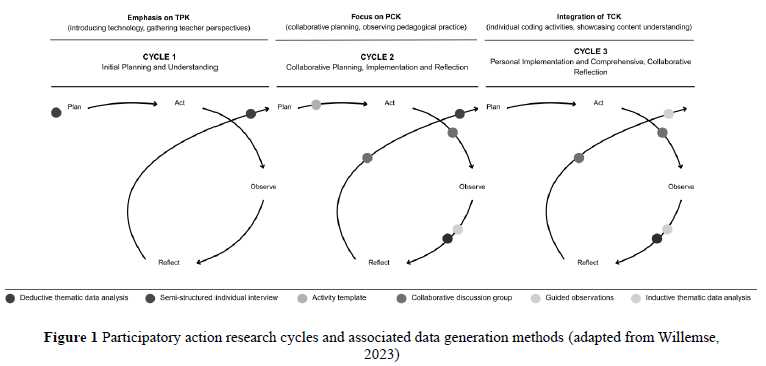
The research was structured into three PAR cycles (see Figure 1), each consisting of phases of planning, implementation, observation, and reflection. These cycles were designed to facilitate iterative learning, allowing teachers to explore, experiment with, and reflect on C&R integration in their classrooms.
Cycle 1: Initial Planning and Understanding
Teachers were introduced to the topic and provided with a booklet to assist them in understanding C&R, as none of them had prior experience with it. Each teacher participated in a semi-structured interview to discuss various aspects of technology integration in the learning environment, with a focus on learners' exposure to technology, C&R, as well as the availability and impact of teacher training opportunities in C&R. We sought to have a better understanding of the perceived impact of technology on learners' educational experiences and teachers' instructional methods. With the interview questions we also addressed the advantages and disadvantages of using technology in education, the appropriateness of introducing C&R in early grades, and the implementation of educational practices, such as the kinaesthetic-concrete-representational-abstract (KCRA) approach (Willemse, 2023).
Each interview lasted about 30 to 45 minutes guided by 16 questions designed to elicit teachers' perceptions of C&R, as well as their integration initiatives. The interview schedule was developed with reference to the literature on technology integration in early childhood education (e.g., Geldenhuys & Fataar, 2021; Papadakis et al., 2021) and was reviewed by an expert in educational technology to ensure developmental and contextual relevance. The schedule was not formally piloted but was refined iteratively during the first cycle based on feedback from participants. These interviews yielded detailed qualitative data and allowed for probing and clarification. This cycle ended with deductive data analysis.
Cycle 2: Collaborative Planning, Implementation and Reflection
The semi-structured interviews revealed that teachers knew very little about C&R. Therefore, the second cycle began with the creation of an activity template to help teachers plan for the integration of C&R in their classrooms. An observed collaborative discussion group ensued to allow the teachers to plan a lesson together. These sessions promoted collective planning, collaboration and reflection, enriching the data with diverse perspectives and shared experiences. Reflection then took place through an additional collaborative discussion group in which teachers could share their experiences and insights from the first lesson they presented. Reflection was also achieved through deductive data analysis.
Cycle 3: Personal Implementation and Comprehensive, Collaborative Reflection
Cycle 3 started with teachers planning their own activities that incorporated C&R. Observations were conducted again. During the reflection stage, another collaborative discussion group was held to elicit teachers' understanding, perceptions and perspectives throughout the 10-week research cycle. Thereafter, deductive analysis was carried out and a collaborative booklet that included all their activities was created and distributed to them.
Data Analysis
Thematic analysis was employed to examine the data, using both inductive and deductive reasoning. Braun and Clarke's (2006) six-phase framework guided the analysis process: familiarisation with data, generation of initial codes, searching for themes, reviewing themes, defining and naming themes, and producing the final report. Deductive codes were informed by the research question and TPACK framework, while inductive themes emerged from participants' natural language and reflections. Coding was completed manually, and themes were refined collaboratively with a second coder to enhance trustworthiness. Emergent themes were cross-checked by an external participant. Discrepancies were discussed collaboratively until consensus was reached, enhancing the reliability and validity of the thematic structure.
Ethical Considerations
We received ethical clearance from the University of Pretoria's Ethics Committee (EDU166/21) as well as the Gauteng DBE. All participants were fully informed of the purpose and procedures of the study, as well as their right to withdraw at any stage. Informed consent was obtained, and confidentiality was maintained by using pseudonyms to protect the participants' identities in the reporting on the empirical data.
Findings
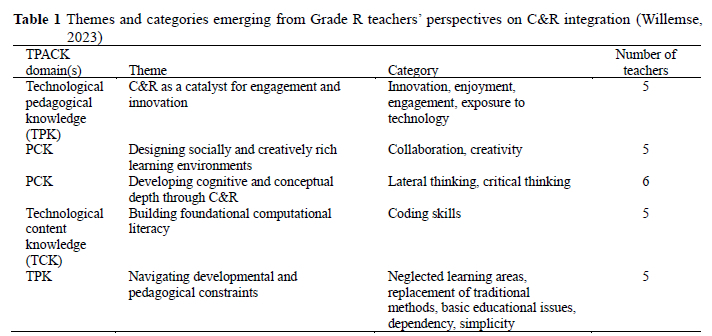
Although the findings in this study reveal a variety of perspectives on the integration of C&R in early education, most Grade R teachers expressed positive sentiments (see Table 1).
Coding and Robotics as a Catalyst for Engagement and Innovation
The introduction of C&R into Grade R classrooms was met with initial uncertainty, but as teachers began observing how learners interacted with the technology, a shared sense of its potential began to emerge. Hannah initially described C&R as "a different way of learning made available to the [learners]", noting with growing conviction that "it would open up a new area of learning.'" This realisation was not rooted in theory but in the visible shift in learners' engagement and interaction.
Teachers began to perceive C&R as more than a tool; it became a mechanism for pedagogical renewal. Susan, after observing how learners navigated challenges using the Bee-Bot, reflected that "this is a way to encourage [learners] to solve problems and think creatively and innovatively!" Mary added that C&R "speaks to the [learners] on another level, excites them and helps to let the information sink in much quicker. It makes teaching new and exciting."
What stood out most during the classroom observations was the learners' ease in adapting to digital tools. Phindile noted that "learners would respond well as many of them are already technologically adept", emphasising that any tool that differed from traditional routines "is likely to capture their attention [and] is advantageous to their learning'"
Enjoyment became a core signal for teachers that learning was occurring. Susan called C&R "an enjoyable teaching tool", while Phindile highlighted its ability to "capture learner attention, add interest and allow for learner involvement." Mary observed enthusiastic participation: "Learners participated enthusiastically, understood everything well and just really enjoyed it." Amahle echoed this view: "[C&R] makes learning fun and interesting."
Through these moments, teachers increasingly recognised the role of C&R in transforming the learning environment. The TPK domain was evident here since teachers were not just employing technology, but using it in ways that reimagined their pedagogical approach to make learning more meaningful and resonant.
Designing Socially and Creatively Rich Learning Environments
Collaboration and creativity were highlighted as core strengths of C&R integration. These qualities did not emerge in abstract but were observed through the tangible ways that learners worked together and expressed themselves during classroom activities. For instance, during group-based Bee-Bot challenges, learners often negotiated which directions to input, taking turns and adjusting based on feedback from peers. Mary recounted one such episode, noting that "it helps learners to work together in a group", while Hannah agreed that "I think it is useful in teaching [learners] about working together." These reflections underscore how C&R fostered environments conducive to peer interaction and collective problem-solving.
Such pedagogical strategies reflect teachers' developing PCK, particularly in adapting known methods like group work and project-based learning to the novel content of C&R. Teachers appeared increasingly comfortable navigating the intersection between their understanding of how learners learn (PK) and what they are expected to teach (CK), using C&R activities as an integrative medium.
Moments of creativity unfolded in similarly observable ways. In one lesson, learners were asked to design a sequence of commands to navigate the Bee-Bot through a story map. Sofia found this illuminating, stating that "it was fun to see the learners ' different creative ideas and how everyone interprets the activities." The learners approached the task from various narrative angles, integrating storytelling with coding. Mary and Hannah both commented on the surge in imaginative responses, noting that it "improves creativity" and supports "creative thinking."
These examples demonstrate how teachers drew upon and adapted their PCK to facilitate experiences that were aligned with the curriculum and creatively open ended. Teachers used their pedagogical and content knowledge to foster spaces where innovation and self-expression were not only permitted but celebrated.
Developing Cognitive and Conceptual Depth through Coding and Robotics
Teachers observed that C&R nurtured critical and lateral thinking, with these skills emerging organically through learners' interactions with activities that blended structured tasks and exploratory problem-solving. Tebogo noted: "I could see how the learners think in different ways", while Phindile remarked that "[l]earners had to use cognitive skills and find a creative solution in the game" Such feedback reflects how teachers were becoming attuned to the cognitive processes that C&R could activate when properly facilitated.
Mary highlighted the analytical dimension of C&R, stating that it "improves critical thinking, analytics and planning", pointing to the deliberate structuring of lessons that required reasoning and anticipation. Amahle added that it "encourages learners to learn the concepts in an easier way and this stays in their long-term memory", suggesting not only comprehension but retention through embodied, hands-on experience.
Maya's observation that "some of them made the connection between the grid on the chessboard and the Bee-Bot's grid" reveals a deeper conceptual transference; an understanding of spatial structure and logical progression, while Hannah affirmed that "it is useful in teaching [learners] about problem-solving."
These insights exemplify the application of PCK, as teachers strategically designed tasks and scaffolded learning to support both content mastery and cognitive engagement. By aligning pedagogy with conceptual goals in C&R, teachers effectively deepened learners' problem-solving skills and analytical thinking, embedding these competencies within foundational learning experiences.
Building Foundational Computational Literacy
Teachers also reflected on the development of procedural and algorithmic thinking. Sofia stated that "[i]t is simple tasks and steps each learner is able to learn [in] his or her own way." Mary explained that the learners had to follow "a set of steps so that the end product forms an overall image" and "the instructions had to be applied one hundred per cent correctly."
Elsa commented that C&R "supports learners to follow steps." Amahle and Maya highlighted improved task efficiency, with Amahle noting that "steps helped learners complete the task more efficiently", and Maya stated that "by following the instructions or steps, the lesson was a success." These findings reflect the TCK domain, where teachers integrate specific CK using appropriate technological tools.
Navigating Developmental and Pedagogical Constraints
While teachers generally embraced the possibilities that C&R afforded, they also voiced varied concerns that revealed how pedagogical enthusiasm was tempered by practical and developmental realities. Their reflections illustrate the nuanced challenges encountered in aligning technological tools with early childhood development priorities which is central to the TPK domain of the TPACK framework.
Phindile, drawing from her classroom observations, warned that "listening skills and gross motor skills will be compromised", voicing a fear that screen-based or device-mediated tasks might displace essential sensory and movement-based learning. She continued that "learners become passive rather than active learners", alluding to a possible erosion of kinaesthetic learning opportunities. Maya echoed this sentiment, suggesting that "the use of technology can be addictive ... and have an impact on [learners'] normal development." In this way, the teachers were not simply rejecting technology but advocating for a balanced approach that respects the holistic development of the learner.
This caution extended to concerns about pedagogical substitution. Phindile explained that "there is always [a] place for new ideas but these should not necessarily replace tried and tested methods'", suggesting that foundational pedagogies remained pivotal in Grade R settings. Susan similarly stressed that "technology cannot replace all teaching methods", reinforcing the belief that digital tools should support and not substitute core instructional strategies. These views reflected a tension between modern innovation and traditional practice, situating teachers as mediators between past wisdom and future aspirations.
The structural realities of the South African context also surfaced in the data. Hannah noted that "I think there is a place for this once other basic issues like teacher training and supply of traditional equipment [have] been met." Here, the enthusiasm for C&R is contingent upon adequate professional development and infrastructural readiness. These reflections suggest that successful TPK enactment is not merely a matter of individual capacity but is embedded in broader systemic support.
Additional concerns raised included over-dependence and superficial engagement. Tebogo remarked that "learners may not want to participate in lessons if technology aspects are not present", signalling a risk of technological dependency. Hannah questioned the longevity of learner engagement with the Bee-Bots, stating that "once its limited functions [have] been discovered and mastered ... they will quickly become bored by it." In doing so, she pointed to the need for technological tools to evolve in complexity or be supported by adaptive pedagogy to maintain learner interest.
Discussion
In this study we explored the perspectives of South African Grade R teachers on integrating C&R into early education. The findings reveal a nuanced and multifaceted understanding of C&R integration, situated within the broader TPACK framework. Teachers acknowledged the innovative potential of C&R, especially in enhancing learner engagement and classroom dynamism, core aspects of TPK, which concur with the findings of Yang, Ng and Gao (2022), who found that innovative digital practices enhance classroom interactivity and learning relevance. Teachers' reflections suggest that C&R can reimagine teaching and learning in meaningful ways, particularly when technology is used to support pedagogical intent.
This study highlights the role of C&R in enabling socially and creatively rich learning environments. Through structured tasks and open-ended activities, teachers fostered peer collaboration and learner-led exploration, aligning with Bers, González-González and Armas-Torres (2019), who emphasise creativity and social learning in early coding education. These practices demonstrate the application of PCK as teachers aligned learners' engagement with broader curriculum goals. Learners were not passive recipients of content but active constructors of meaning, using tools like Bee-Bots to navigate both physical space and abstract concepts. This engagement with creativity and collaboration underscores the value of C&R as a mediating artefact in early education.
Teachers also noted the development of higher-order thinking, such as lateral thinking, problem-solving and conceptual abstraction which are capabilities facilitated by carefully scaffolded activities. These insights align with the PCK domain, as teachers used their understanding of learner development and subject content to guide learners through increasingly complex cognitive tasks. These findings are consistent with those of Pellas (2024) who notes the role of early coding tasks in developing critical and abstract thinking in young learners.
While only two teachers explicitly emphasised the development of coding skills, their reflections revealed growing TCK, as they began to conceptualise foundational computational principles in developmentally appropriate ways. The emphasis on sequencing, logic and algorithmic thinking represents a shift in content delivery where early computational literacy can be introduced without compromising play-based pedagogy.
At the same time, the findings reveal important reservations. Teachers raised concerns about over-reliance on technology, the potential neglect of foundational developmental domains and the superficial use of tools like the Bee-Bot. These concerns point to the need for cautious and balanced implementation which are hallmarks of reflective TPK. Teachers understood that successful integration depends not just on enthusiasm, but on adaptability, context-awareness and infrastructural support. This mirrors findings by Tshidi and Dewa (2024) who caution that in implementing C&R, one must avoid displacing developmental priorities, and warn of the risks of premature substitution of traditional pedagogy.
In light of these findings, teacher training emerged as a critical area for development. Professional learning opportunities must go beyond the use of tools to include frameworks like TPACK that help teachers reflect on the intersection of technology, pedagogy and content. Van Rooyen and Callaghan (2025) reinforce this by suggesting that successful C&R integration depends on teachers' capacity to make informed, context-sensitive tool choices using the TPACK lens. Equally important are policy directives that encourage a balanced approach to technology use in early learning: one that preserves the integrity of holistic development while opening space for innovation.
This study has several limitations. Firstly, the findings are based on a small, purposive sample, which limits generalisability to other regions or educational systems. Secondly, the study was confined to the South African context; differences in infrastructure, cultural norms and curricular priorities may produce different outcomes elsewhere. Thirdly, we relied on self-reported data, which may include bias or subjectivity. Future research could benefit from incorporating mixed methods or longitudinal designs to assess the long-term developmental impacts of C&R in varied contexts.
In future studies researchers should explore the longitudinal influence of C&R on learner development, particularly in relation to foundational skills and computational thinking. Comparative research across provinces or national systems could identify contextual enablers and constraints. Including the voices of other stakeholders such as parents may yield a more comprehensive picture of how early C&R is experienced and sustained across the system.
Conclusion
In this article we explore how South African Grade R teachers perceived the integration of C&R in early education. The findings indicate that teachers recognised the potential of C&R to foster engagement, creativity, collaboration and cognitive development when aligned with pedagogical and content goals. These perspectives reflect a growing familiarity with the TPACK framework, particularly in the domains of TPK, PCK and TCK, as teachers negotiated the use of technology to support meaningful learning experiences.
At the same time, teachers expressed critical concerns regarding developmental appropriateness, the displacement of traditional teaching practices and technological overdependence. These insights underscore the importance of balancing innovation with foundational early childhood practices such as play, social interaction and motor development.
For successful integration, C&R must be embedded in well-supported teacher training programmes that develop all dimensions of the TPACK framework. Policy initiatives should advocate for holistic, context-sensitive approaches that preserve the developmental integrity of early education while equipping learners with foundational digital competencies.
Ultimately, the study affirms that the integration of C&R in early education offers significant opportunities, provided that it is implemented with intentionality, professional support, and a commitment to learners' holistic development in a technology-rich world for a technology-driven future ensuring learners' overall development and well-being.
Authors' Contributions
KW conducted the doctoral study under the supervision of RC, from which the data for this article were derived. Both authors contributed equally to the preparation and revision of the final manuscript.
Declaration of Interest
No competing interests exist.
Notesi. Published under a Creative Commons Attribution Licence.
Acknowledgement
The authors would like to acknowledge the Living Lab for Innovative Teaching at the University of Pretoria (LLITUP) for their support in the study.
References
-
Bers MU, González-González C & Armas-Torres MB 2019. Coding as a playground: Promoting positive learning experiences in childhood classrooms. Computers & Education, 138:130-145. https://doi.org/10.1016/j.compedu.2019.04.013
» https://doi.org/10.1016/j.compedu.2019.04.013 -
Braun V & Clarke V 2006. Using thematic analysis in psychology. Qualitative Research in Psychology, 3(2):77-101. https://doi.org/10.1191/1478088706qp063oa
» https://doi.org/10.1191/1478088706qp063oa -
Department of Basic Education, Republic of South Africa 2025. National Curriculum Statement (NCS) Curriculum and Assessment Policy Statement (CAPS) Foundation Phase Grade R - 3. Coding and Robotics. Available at https://www.education.gov.za/Portals/0/CD/National%20Curriculum%20Statements%20and%20Vocational/FP%20Coding%20and%20Robotics%20CAPS%20Final%202025.pdf?ver=2025-10-27-133557-637. Accessed 19 February 2026.
» https://www.education.gov.za/Portals/0/CD/National%20Curriculum%20Statements%20and%20Vocational/FP%20Coding%20and%20Robotics%20CAPS%20Final%202025.pdf?ver=2025-10-27-133557-637 -
Diago PD, González-Calero JA & Yáñez DF 2022. Exploring the development of mental rotation and computational skills in elementary students through educational robotics. International Journal of Child-Computer Interaction, 32:100388. https://doi.org/10.1016/j.ijcci.2021.100388
» https://doi.org/10.1016/j.ijcci.2021.100388 -
Geldenhuys CJ & Fataar A 2021. Foundation phase teachers' experiences of teaching the subject, coding, in selected Western Cape schools. South African Journal of Education, 41(4):Art. #1959, 9 pages. https://doi.org/10.15700/saje.v41n4a1959
» https://doi.org/10.15700/saje.v41n4a1959 -
Greyling J 2023. Coding unplugged-a guide to introducing coding and robotics to South African schools. In J Halberstadt, AA de Bronstein, J Greyling & S Bissett (eds). Transforming entrepreneurship education: Interdisciplinary insights on innovative methods and formats. Cham, Switzerland: Springer. https://doi.org/10.1007/978-3-031-11578-3
» https://doi.org/10.1007/978-3-031-11578-3 -
Koehler MJ & Mishra P 2005. What happens when teachers design educational technology? The development of Technological Pedagogical Content Knowledge. Journal of Educational Computing Research, 32(2):131-152. https://doi.org/10.2190/0EW7-01WB-BKHL-QDYV
» https://doi.org/10.2190/0EW7-01WB-BKHL-QDYV -
Koehler MJ & Mishra P 2009. What is technological pedagogical content knowledge? Contemporary Issues in Technology and Teacher Education, 9(1):60-70. Available at https://www.leamtechlib.org/p/29544/. Accessed 18 February 2026.
» https://www.leamtechlib.org/p/29544/ -
Lee J & Junoh J 2019. Implementing unplugged coding activities in early childhood classrooms. Early Childhood Education Journal, 47:709-716. https://doi.org/10.1007/s10643-019-00967-z
» https://doi.org/10.1007/s10643-019-00967-z -
Macrides E, Miliou O & Angeli C 2022. Programming in early childhood education: A systematic review. International Journal of Child-Computer Interaction, 32:100396. https://doi.org/10.1016/j.ijcci.2021.100396
» https://doi.org/10.1016/j.ijcci.2021.100396 -
McGuire L, Mulvey KL, Goff E, Irvin MJ, Winterbottom M, Fields GE, Hartstone-Rose A & Rutland A 2020. STEM gender stereotypes from early childhood through adolescence at informal science centers. Journal of Applied Developmental Psychology, 67:101109. https://doi.org/10.1016/j.appdev.2020.101109
» https://doi.org/10.1016/j.appdev.2020.101109 -
Negrini L 2020. Teachers' attitudes towards educational robotics in compulsory school. Italian Journal of Educational Technology, 28(1):77-90. https://doi.org/10.17471/2499-4324/1136
» https://doi.org/10.17471/2499-4324/1136 -
Papadakis S, Vaiopoulou J, Sifaki E, Stamovlasis D & Kalogiannakis M 2021. Attitudes towards the use of educational robotics: Exploring pre-service and in-service early childhood teacher profiles. Education Sciences, 11(5):204. https://doi.org/10.3390/educsci11050204
» https://doi.org/10.3390/educsci11050204 -
Parette HP, Hourcade JJ, Blum C, Watts EH, Stoner JB, Wojcik BW & Chrismore SB 2013. Technology user groups and early childhood education: A preliminary study. Early Childhood Education Journal, 41:171-179. https://doi.org/10.1007/s10643-012-0548-3
» https://doi.org/10.1007/s10643-012-0548-3 -
Pellas N 2024. Enhancing computational thinking, spatial reasoning, and executive function skills: The impact of tangible programming tools in early childhood and across different learner stages. Journal of Educational Computing Research, 63(1):3-32. https://doi.org/10.1177/07356331241292767
» https://doi.org/10.1177/07356331241292767 -
Pollarolo E, Papavlasopoulou S, Granone F & Reikerâs E 2024. Play with coding toys in early childhood education and care: Teachers' pedagogical strategies, views and impact on children's development: A systematic literature review. Entertainment Computing, 50:100637. https://doi.org/10.1016/j.entcom.2024.100637
» https://doi.org/10.1016/j.entcom.2024.100637 -
Santos JM & Castro RDR 2021. Technological Pedagogical content knowledge (TPACK) in action: Application of learning in the classroom by pre-service teachers (PST). Social Sciences & Humanities, 3(1):100110. https://doi.org/10.1016/j.ssaho.2021.100110
» https://doi.org/10.1016/j.ssaho.2021.100110 - Shulman LS 1986. Paradigms and research programs in the study of teaching: A contemporary perspective. In MC Wittrock (ed). Handbook of research on teaching (3rd ed). New York, NY: MacMillan.
-
Tshidi M & Dewa A 2024. The promise and peril of Coding & Robotics education in South Africa: A scoping review of teacher preparation and generative artificial intelligence's potential for delivering equity. Journal of Education, 96:140164. https://doi.org/10.17159/2520-9868/i96a08
» https://doi.org/10.17159/2520-9868/i96a08 -
Uğur-Erdoğmuş F 2021. How do elementary childhood education teachers perceive robotic education in kindergarten? A qualitative study. Participatory Educational Research, 8(2):421-434. https://doi.org/10.17275/per.21.47.8.2
» https://doi.org/10.17275/per.21.47.8.2 -
Van Rooyen A & Callaghan R 2025. Supporting choices for educational robotics tools for early childhood settings: Considerations, characteristics, and categories. Technology, Knowledge and Learning, 30:2351-2372. https://doi.org/10.1007/s10758-024-09809-3
» https://doi.org/10.1007/s10758-024-09809-3 -
Willemse K 2023. Supporting Grade R teachers to integrate coding and robotics with mathematical concepts. PhD thesis. Pretoria, South Africa: University of Pretoria. https://doi.org/10.25403/UPresearchdata.23600082
» https://doi.org/10.25403/UPresearchdata.23600082 -
Yang W 2024. Coding with robots or tablets? Effects of technology-enhanced embodied learning on preschoolers' computational thinking and social-emotional competence. Journal of Educational Computing Research, 62(4):718-740. https://doi.org/10.1177/07356331241226459
» https://doi.org/10.1177/07356331241226459 -
Yang W, Ng DTK & Gao H 2022. Robot programming versus block play in early childhood education: Effects on computational thinking, sequencing ability, and self-regulation. British Journal of Educational Technology, 53(6):1817-1841. https://doi.org/10.1111/bjet.13215
» https://doi.org/10.1111/bjet.13215 -
Yildirim B 2021. Preschool STEM activities: Preschool teachers' preparation and views. Early Childhood Education Journal, 49(2):149-162. https://doi.org/10.1007/s10643-020-01056-2
» https://doi.org/10.1007/s10643-020-01056-2 -
Zviel Girshin R, Rosenberg N & Kukliansky I 2024. Early childhood robotics: Children's beliefs and objective capabilities to read and write programs. Journal of Research in Childhood Education, 38(2):317-335. https://doi.org/10.1080/02568543.2023.2259946
» https://doi.org/10.1080/02568543.2023.2259946
Revised: 29 April 2025
Accepted: 2 October 2025
Published: 28 February 2026