Risky play in early learning centres: Insights from parents' and teachers' perspectives
Abstract
Risky play (RP) is a critical component to develop children's capacity to function optimally throughout their lives. Children's development depends on parents' and teachers' willingness to inculcate opportunities to engage in RP. Discouraging RP negatively impacts a child's development, inhibiting their ability to function well in school and the future. In this study we examined parents' and teachers' views of RP and how the home and early learning centre (ELC) environments provide opportunities for RP. The qualitative multiple-case study included teachers and parents from 3 ELCs, utilising semi-structured teacher group interviews, observations of children's outdoor play, field notes, and document analysis to generate data at ELCs. Electronic semi-structured individual interview schedules were used to generate comprehensive information from parents. Observations indicate that opportunities for RP were provided in ELCs, although only 4 of 6 RP categories were visible at the ELCs during outdoor play. The interviews indicate that parents acquiesced and teachers were in favour of RP within certain conditions. Various influencing factors seemed to be partly shaped by teachers' and parents' own childhood experiences, their knowledge of the perceived benefits of RP, as well as the perceived risks of engaging children in RP.
child/children; constraints; development; early learning centre; experiences; fear; parents; play environment; risky play; teachers
Introduction and Background
Early learning and education matter, as these equip young children with skills that will be relevant in the rest of their lives to navigate the VUCA (volatility, uncertainty, complexity and ambiguity) world that they will be contributing to in current and future workplaces and societies (Bennet & Lemoine, 2014; Eyre, 2016). For children to be capable adults and citizens of a future South African society, they need the opportunity to develop (among others) self-esteem, confidence, autonomy, independence, and problem-solving skills (Brussoni, Olsen, Pike & Sleet, 2012:3136). Therefore, their parents (as primary caregivers) and teachers (as secondary caregivers) are tasked with enabling them to develop these skills from an early age (Kvalnes, 2017:4; Little & Wyver, 2008:33). Among other development interventions, this relates to empowering these children to engage in RP in their everyday lives and context.
With this study we aimed to examine the attitudes of teachers and parents towards RP and how the pre-school children in their care were exposed to RP at home (by the parents) and in their respective ELCs. It is valuable research as it addressed a topic which is crucial to early childhood education globally - to prepare children to become healthy and contributing members of society, while also considering the cultural and unique challenges in emerging economies, offering insights that could apply to other similar contexts.
Literature Review
RP is defined as "thrilling and exciting forms of play that include some risk of physical injury" (Sandseter, 2007:247). Taking risks in play is crucial for a child's development, as it allows them to learn several skills and try different behaviour (Little & Wyver, 2008:33). The purpose of RP is to teach children how to deal with potential danger and harm and then come up with solutions themselves. Experience helps children prepare for risky activities when they participate in them. Sandseter (2007:242) identified six categories of RP, namely play with significant heights (activities where children engage in play that involves climbing on tall structures or being at elevated positions high above the ground), play including high speed (activities where children move quickly or experience rapid motion such as running, riding bicycles and/or swinging at high velocities), play with dangerous tools (activities where children use or interact with sharp or heavy tools or objects that have the potential to cause injury), play near dangerous elements (activities where children play close to elements or conditions that could pose a risk of harm such as open flames and harmful substances), rough-and-tumble play (physical play characterised by vigorous and active interactions where there is a high degree of physical contact and unpredictability such as fighting and wrestling play), and play where children may become lost or disappear (activities where children are at risk of becoming separated from their caregivers, being in dense foliage or getting lost in a large unfamiliar area). Without exposure to such situations, children grow up without opportunities to gain insight and knowledge to judge and calculate future risks through past developmental experiences with risky activities (Kvalnes, 2017:4). Children who are overprotected run the risk of developing uncertainties about their capacity to cope with unforeseen circumstances in day-to-day life (Gill, 2007:19; Lavrysen, Bertrands, Leyssen, Smets, Vanderspikken & De Graef, 2017:90).
In today's society, risk aversion is widespread due to a combination of educational practices, legal frameworks, societal norms, and recent global events like the coronavirus (COVID-19) pandemic. In global and South African contexts, education institutions are increasingly constrained by laws such as the Children's Act No. 38 of 2005 (Republic of South Africa [RSA], 2006) and the National Integrated Early Childhood Development Policy (RSA, 2015) that potentially lead to a conservative approach, avoiding activities or methods perceived as risky. According to Goldstein (2012:5), the absence of play in childhood may yield both immediate and enduring adverse effects, given that it is during this formative period that children acquire knowledge about their environment. Children must engage in activities that involve physical risk-taking. However, the opportunities for outdoor play are decreasing due to children's access to and use of technology (Doliopoulou & Rizou, 2012:145; Gill, 2007:13; Skar, Wold, Gundersen & O' Brien, 2016), adult anxieties and fears such as fears of kidnapping, traffic and perceived dangers in the child's environment (Brussoni et al., 2012; Sandberg, 2012), over-protective parenting (Kvalnes, 2017; Odenweller, Booth-Butterfield & Weber, 2014; Reed, Duncan, Lucier-Greer, Fixelle & Ferraro, 2016), children experiencing a lack of support from significant adults in their lives (Goldstein, 2012:6), modern lifestyle trends (Doliopoulou & Rizou, 2012:133; Sandberg, 2012:185) and the proximity to natural areas and places for outdoor play encapsulated in urbanisation (Sandberg, 2012:185).
Limiting children' s outdoor play would probably lead to additional dangers, like weak physical and cognitive development (Beneteau, 2017:7) and lifetime consequences (Brussoni et al., 2012:3136). Children learn various physical (Goldstein, 2012:23; Obee, Sandseter, Gerlach & Harper, 2021:104), social (Bruner, 1972; Brussoni, Gibbons, Gray, Ishikawa, Sandseter, Bienenstock, Chabot, Fuselli, Herrington, Janssen, Pickett, Power, Stanger, Sampson & Tremblay, 2015:6425; Pellegrini, Dupuis & Smith, 2007:269; Sandseter & Kennair, 2011:260), emotional (Goldstein, 2012:23; Little, Wyver & Gibson, 2011:114; Obee, Sandseter, Gerlach, et al., 2021:100) and cognitive (Goldstein, 2012:5; Jelleyman, McPhee, Brussoni, Bundy & Duncan, 2019:1; Wyver, 2017:86) skills. Their overall development is also enhanced when they take part in RP (Brussoni et al., 2015:6430; Gill, 2007:15; Sandseter & Kennair, 2011:268; Tremblay, Gray, Babcock, Barnes, Bradstreet, Carr, Chabot, Choquette, Chorney, Collyer, Herrington, Janson, Janssen, Larouche, Pickett, Power, Sandseter, Simon & Brussoni, 2015:6478).
Studies suggest that when children encounter risk or take part in RP, they acquire a range of strategies for managing such risks (Brussoni et al., 2012:3140). Little et al. (2011:114) claim that the early childhood years are when children learn how to deal with risks and acquire the skills necessary to become autonomous. Goldstein (2012:5) posits that play encompasses numerous immediate advantages, like enhancing both fine and gross motor skills and providing children with "a sense of morality."
The concept of "beneficial risk" in early childhood research is mainly focussed on risk-taking as a physical play activity in an outdoor environment (Cooke, Wong & Press, 2019; Sandseter & Kennair, 2011). Cooke et al. (2019) define beneficial risk as engaging in experiences that move people outside their comfort zone. Furthermore, beneficial risk includes outcomes that may benefit learning, development and life satisfaction. An outdoor environment provides children with more chances to participate in RP activities than an indoor environment (Little & Wyver, 2008:34). Nevertheless, this benefit is dependent on whether children can explore, try new things, and take chances in their social and physical environments (Little, Sandseter & Wyver, 2012:301). If an outdoor environment does not provide children with challenging and stimulating RP opportunities, children could develop anxiety about handling risky situations, even though they are able to do so (Sandseter & Kennair, 2011:258).
Studies show that if play conditions are not sufficiently challenging, children will engage in hazardous activities in unmanaged situations (Ball, Gill & Spiegal, 2012:17). Children become aware of the environment, as well as its possibilities and restrictions when they explore and engage in RP activities (Little et al., 2012:301). Consequently, adults must expose children to stimulating, inspiring, resourceful, yet safe outdoor environments (Little & Wyver, 2008:39). Thus, it is valuable to expose children to risky activities. Still, one should be aware of children' s safety by balancing hazardous situations and healthy risk experiences (Eager & Little, 2011).
Armitage (2012:para. 6) postulates that "taking risks" can be replaced with "making mistakes", and being able to make mistakes at a young age is critical in learning and development. Madge and Barker (2007:8) also point out that managing risk is integral to challenges in today' s business, government, and civil society. Therefore, Madge and Barker (2007:8) propose that children develop and mature into knowledgeable, capable, and experienced adults when learning to engage in risks during childhood. We may deduce that experiencing and overcoming particular challenges need to be developed as part of human life. To have opportunities and be supported to engage in potentially risky situations is critical for human development.
Two groups of caregivers that impact children's development are parents and teachers. To create opportunities for pre-schoolers to develop needed skills, these caregivers need an understanding of the advantages of different types of play for children' s development and need to maintain a positive attitude towards implementing different play strategies. Little et al. (2011:116) claim that teachers' pedagogical views directly impact whether or not they will permit and encourage children to engage in RP. Little et al. (2011:117) further assert that another contributing aspect likely to affect children' s RP is people' s attitudes and childhood experiences. Modern society has become highly focused on children' s safety. Therefore, strict risk management strategies have been put in place in children' s play environments to prevent children from getting hurt (Sandseter & Kennair, 2011:258; Stephenson, 2003:38). An exaggerated focus on the safety of children's play is problematic for physical and emotional development (Stephenson, 2003:39). Little and Wyver (2008:38) pay attention to five elements that significantly exaggerate safety and reduce the opportunities and advantages of RP - "high child-staff ratios, external regulation restricting activities, inadequate understanding of the benefits of risk-taking, poor outdoor environment, and fear of litigation." Furthermore, parents' and teachers' perceptions and views of risk will impact the RP activities that the children in their care will engage in (Niehues, Bundy, Broom & Tranter, 2015:810; Obee, Sandseter, Gerlach, et al., 2021:99; Waller, Sandseter, Wyver, Ärlemalm-Hagsér & Maynard, 2010:439). Orestes (2015:13) implies that if risk-taking is viewed as positive and valuable for children' s development, society will likely encourage young children to take risks.
Theoretical/Conceptual Framework: Study Design
The theoretical framework of Rogoff (2008), who expanded Vygotsky's (1978) socio-cultural theory was used in this study. This framework emphasises how children cultivate knowledge, change, and develop by interacting with others and the social environment through apprenticeship, guided participation, and participatory appropriation. The socio-cultural perspective purports that the ELC and home environments are cultural communities where teachers, parents and children are inextricably linked (Saracho, 2017:36). Children need the opportunity to develop life skills through RP (apprenticeship). The parents and teachers provide guidance and model behaviour at home and in the ELCs (guided participation), which supports and leads to the children's development (participatory appropriation).
A qualitative research approach (Creswell, 2014:4) from an interpretive paradigm perspective (Morgan & Sklar, 2012:73) was used to obtain parents' and teachers' actual experiences and opinions regarding the meaning, provision and approval of RP at home and the ELCs by employing a multiple case study design (Rule & John, 2011:1; Seabi, 2012:81). This design allows for an in-depth understanding of different cases, taking into account the complexity and context of the different settings.
To ensure rigour and trustworthiness of the research findings (Rule & John, 2011), the qualitative research design strategies of Johnson and Christensen (2014:563) and Patton (2002:40^1) were used. Continuous reference to the processes employed to assess trustworthiness (Di Fabio & Maree, 2012:140; Lincoln & Guba, 1985:319) was used to adhere to criteria of transferability, dependability, and confirmability.
Methodology
Ethical Considerations
The relevant research ethics committee approved the research study and written consent was obtained from all participating ELC principals, teachers, and parents from Pretoria, Gauteng. Participation in this study was voluntary. Parents and teachers of 4 to 5-year old children were invited to participate in the research study. Their inclusion was based on their willingness to participate (Yin, 2011:46) with the proviso that they could withdraw from the research study at their discretion. We emphasised protecting participants from physical and psychological harm and also maintaining their anonymity and confidentiality during this study (Du Plessis, 2016:74). Following Elias and Theron (2012:149), ethical principles were followed to ensure fairness and justice for all participants, respect their rights to privacy, confidentiality, and self-determination, promote honesty and truthfulness, and establish trustworthy relationships with them. Anonymity was ensured through the use of appropriate coding to replace the identifiers of the sites and participants (Yin, 2014:280), and ensuring that the data could not be tracked back to the respondents. All data generated from this research study will be stored for 15 years at the tertiary education institution where the research project was conducted.
Participants
The ELCs chosen as the research settings were based in Pretoria, in the Gauteng province of South Africa. One ELC was linked to an urban primary school, with two classes of approximately 20 to 24 four to five-year-old children in each class. Another ELC was an inner-city pre-primary school with one Grade R class. Sixteen 4 to 5-year-old learners were divided into two classes with a teacher-learner ratio of one to 16. This ELC was well-resourced with enough space for children to engage in RP. The last ELC was a privately-owned suburban ELC with four classes of 4 to 5-year-old learners with 16 to 18 children in each class. In addition to the quality outdoor playground, most of the equipment was imported and was of high quality.
Sites and participants were identified using convenience sampling, a type of non-probability sampling (Maree & Pietersen, 2016:198). Convenience sampling was selected since a multiple case study design was viewed as the most appropriate and participants and sites in the same geographical context that were willing to volunteer were viewed as preferential at the time (Cohen, Manion & Morrison, 2007). A selection of ELCs within a specific region in a South African province where Afrikaans and/or English were used as language of teaching and learning were approached for voluntary participation. A specific ELC was selected in each of the following settings: inner-city, suburban, and small-holding environments in order for us to be able to gauge potential differences between these contexts. Several factors were taken into account in the selection of the participants and sites; the sampling strategy needed to be relevant to the theoretical framework, generate rich data on RP, be true to real life, consider ethical aspects, and be practical regarding time and money (Nieuwenhuis, 2016:85).
Selected parents and teachers were parenting or teaching 4 to 5-year-old children at the same ELCs and could communicate in Afrikaans and/or English. The sample included both older and younger teachers with varying levels of experience. The parents represented diverse cultural backgrounds, ages, genders, races, and socio-economic statuses. A total of eight teachers and nine parents were recruited from the three ELCs. The participants in the three different ELCs consented voluntarily to participate in the study.
Data Collection and Analysis The data collection phase of the study was during the COVID-19 pandemic when the South African government had imposed social distancing as one of the regulations to curb the spread of the virus. Data generation from ELCs was only initiated when the country moved to level two of the lockdown. Face masks were worn throughout the data collection process and social distancing was applied during the interviews with the teachers and observing the teachers and children outdoors. The semi-structured individual interview schedule method was used to generate data from parents. This method eliminated any face-to-face contact while still allowing research to continue.
Various methods were used to generate data from the ELCs, the teachers and parents. Observation of teachers (primary participants) and children (secondary participants) was undertaken, utilising observation schedules for the teachers and the children based on Sandseter's (2007:239) six categories of RP grounded on perceived and actual risk. A "nonparticipant observer" strategy (Creswell, 2014:214) was adopted allowing us to focus on recording participant activity without interference. Through observation, we could "hear, see, and experience reality as participants do", resulting in vital knowledge about the unique circumstances of each participating ELC. In addition, field notes enhanced the richness of the observation schedule that was used in the outdoor observation of the teachers and the children. Photographs were taken to depict the experiences of children engaging in RP activities, as well as to corroborate the observations made. Documentation was reviewed to confirm the planning of RP activities in the teaching programme.
A semi-structured group interview (Nieuwenhuis, 2016:95) was conducted with teachers from the three ELCs through interview schedules which included predetermined questions and questions arising spontaneously. Among others, the questions focused on the teachers' views of RP, their own childhood RP experiences, their knowledge and benefits of RP, as well as the perceived risks and responsibilities of RP. Handwritten notes and audio recordings were generated during the semi-structured group interviews.
An online semi-structured individual interview schedule was used to generate data from parents enquiring about their own childhood experiences and their experiences with aspects of their children's RP. The questions for the parents were similar to those for the teachers, relating to (among others) their attitudes and personal exposure to RP, as well as the perceived benefits and risks of permitting RP at home and at ELCs.
The data were analysed using the six steps of thematic analysis described by Engelbrecht (2016:120). The data were transcribed from audio recordings, and the original ideas were noted. Data were then coded and the codes were linked by clustering them into specific themes. Based on the coded excerpts, a thematic chart was used to revise the themes. After refining and analysing the themes to create definitions, specific excerpts were analysed to identify how they related to the research questions and previous findings.
Results/Findings
Parent and Teacher Attitudes towards RP
The data show that all eight teachers and nine parents included in the study had positive attitudes towards RP. In principle the teachers seemed to be in favour of RP at home and at the ELCs. The parents were more acquiescent towards RP. The difference was that the participating parents verbalised specific caveats and conditions attached to their approval thereof, while only four of the teachers indicated conditional approval.
My heart stops beating! But I remain a straight face and praise him for being so brave and doing it so well. I -will watch him to make sure he is okay ... or I will walk away and pray he does not get hurt. (Parent)
I become too worried but I let go and see it as part of learning (Parent).
Ek is baie positief daaroor. Ek moedig dit aan. Ek raak nie bevrees of beangs as kinders 'n bietjie waag nie, want ek weet wat die impak daarvan is op hulle as kind [I am very positive about it. I encourage it. I don't get scared or anxious if the children dare somewhat because I know what the impact of it is on them as a child]. (Teacher)
The Opportunity to Engage in RP at the ELCs
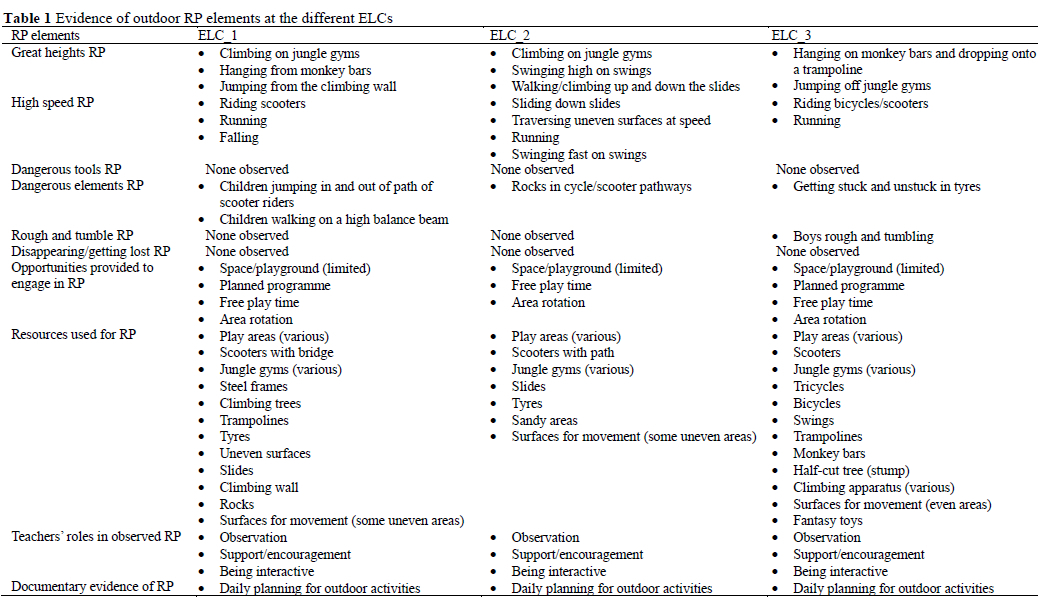
The results from the observations at the ELCs (provided in Table 1) show that elements conducive to RP were present at all participating ELCs, thereby creating environments where children could engage in RP - albeit limited. Only two of the six RP categories were observed at the three ELCs (play involving great heights and high speed play) with two more categories (play around dangerous elements and rough-and-tumble play) being observed at only one of the ELCs. Play with the possibility of disappearances or getting lost and play involving dangerous tools were not observed at any of the ELCs.
Two teachers indicated that they were of the opinion that not enough opportunity was provided for RP, while two other teachers and all eight parents thought that enough opportunities for RP were available. Time was not mentioned as a constraint by any of the respondents, although some respondents indicated that space could have been improved. In the next section we explore reasons why RP may be limited by parents and teachers.
The Risks and Responsibilities of RP Although all respondents agreed that, in principle, RP is necessary and permitted it, there was ambiguity about what RP can and should entail, how much of it and to what level it may be beneficial. The parents cited being more aware of the dangers and consequences involved in RP and injuries caused by RP. Elements that seemed to prevent parents from supporting their children in RP included feeling over-protective, avoidance of viruses and germs (e.g. COVID-19), finances, parents' emotional state, situational control and lack of knowledge around how to practically provide RP opportunities for their children. Fear, trepidation and nervousness about RP was a constant theme juxtaposed by an understanding that RP was necessary.
If I'm around to check the risk I can make a decision to allow her or not to participate in the risky outdoor play. I like to protect her too much that is what prevents me to do some of the risky activities. (Parent)
Cervical spine and head injuries, as I have worked with head injuries, para- and quadriplegic patients for 2 years (Parent).
Teachers, however, focused more on examples of the risks of not having a child regularly engage in RP, citing developmental delays, sensory integration problems, low muscle tone, passivity, struggles with relating and socialising, and emotional dysregulation as the potential risks that they dealt with.
It seemed as though the teachers were not as troubled by the risks involved in RP as much as they were fearful of being blamed or held legally accountable should a child be injured when allowed to engage in RP.
Dit is vir my partykeer moeiliker dink ek, dit hang af van ons ouderdom kindertjies ook en hoe goed. Aan die begin van die jaar is ek bietjie meer benoud want ek ken nog nie die kindertjies. Ek ken nog nie hulle vaardighede en hulle ken ook nog nie hulle eie vaardighede nie. So dan is ek so bietjie meer van haaa, maar ek keer dit nie, maar ek kyk net na 'n ander oog, staan 'n bietjie nader of eks n bietjie meer punt nader of bietjie meer benoud [It is sometimes harder for me, I think it depends on the age of our children and how good. In the beginning of the year I am more nervous because I don't know the children yet. I don't know their abilities and they don't know their own abilities. So then I am a bit more of 'haaaa', but I don't prevent it, but I look with a different eye, stand a bit closer and a bit more nervous]. (Teacher)
Dit is hoe jy leer as jy een keer geval het van 'n hoë ding af, dan gaan jy nie sommer weer so wild speel en dit gaan nie weer gebeur nie, hulle leer baie daaruit [This is how you learn once you have fallen from a high object, then you will not just play as wild and it will not happen again, they learn a lot from it]. (Teacher)
Both the parents and teachers agreed that RP needed to take place under adult supervision. Teachers felt that they were responsible for the children's well-being and needed the parents to trust and support them.
'n Mens moedig dit aan. Maar ek dink ook mens moet net eers kinders leer ken want ons het baie kinders in ons skole wat n lae interne lokus van kontrole het en wanneer jy by daai kinders kom wat geen inpulsbeheer het nie, raak dit later vir jou n vrees, want hulle kan daar inkom maar jy weet hulle het geen gedagte om te weet wat die gevaar is as hulle daar kan uitval nie, so by daai kinders moet jy n tipe van n riglyn gee jy moet in die eerste plek jou kinders ken. [One encourages it. But I also think one must first just get to know the children because we have many children in our schools that have a low internal locus of control and when you come to those children that have no impulse control then it later becomes a fear because you know they can come in, but you know they have no idea of the risks if they fall out, so with those children you have to give a type of guideline ... you need to know your children in the first place]. (Teacher)
It was clear that the support that the teachers had received from the parents, the ELC principal and each other influenced the level of RP that they were comfortable in providing. The teachers mentioned a number of aspect that enabled them to provide the needed situations to allow children develop through RP: having parents who trusted them and were willing to support rather than blame when reasonable but inevitable injuries occurred due to RP, having smaller groups of children to supervise at any one time, and supporting each other in supervision and dealing with the management of the risks.
... partykeer dink ek hulle moet net mens meer vertrou. So mens het half die ondersteuning van die ouers nodig van jy los jou kind hier en ek vat regtig totale verantwoordelikheid ... [ ... sometimes I think they must just trust us more. So we sort of need the support of parents that say you leave your child here and I will really take total responsibility (Teacher)
The results provide insight into the universal concern of balancing safety and risk. Apart from these perceived risks and responsibilities, we explored whether past childhood experiences and knowledge of the benefits of RP had an effect on parents' and teachers' attitudes towards RP.
Past Childhood Experiences
Of the eight participating teachers, six were of the opinion that they had fully engaged in RP during their childhood. One teacher had grown up in a farming context, which provided plenty of opportunities and freedom to take risks by climbing, jumping, swimming and playing with little or no supervision. Four teachers indicated that (in hindsight) they had at times taken great risks and had been hurt or injured in the process. However, they mentioned that this taught them valuable life lessons that they would not easily forget. Two indicated that they had only been observers to RP and indications were that they were more risk-averse and cautious as adults. One parent alluded to the value of having engaged in RP as a child and the value that it has had for them in adult life. The following excerpts provide examples of the teachers' childhood experiences.
... ek was baie waaghalsig. Ek het maklik van 'n dak af gespring. Op daai groot dromme so gerol en geloop [I was very daring. I easily jumped from a roof. Rolled and walked on those big drums] (Teacher).
... ons het boom geklim en ons het vanuit die home uit, het ons in damme gespring. Ons het van die binnebande wat ons opgeblaas het het ons ingeduik [We climbed trees and we jumped from the trees, we jumped into dams. Some of the tubes that we inflated ^ we dove in]. (Teacher)
I grew up in the old days, they never supervised us, we just played and yes, arms were broken and we got hurt at times (Teacher).
... we were playing with fire. ... (Teacher) ... ons het met roller blades ... ek het daar neer gepletter, my arm gehreek morsaf. Maar ek het aangehou met dit ... [... we did with rollerblades... I fell hard; broke my arm. But I kept on doing it]. (Teacher)
Seven of the parents indicated positive RP experiences, citing lots of free time for unstructured RP, using wide open fields, roofs, walls, bicycles, insects, rocks to jump, climb, walk, explore, and experiment, with some injuries occurring from time to time. Two parents indicated that they had not engaged in RP, one parent being afraid to do so and another not being allowed by their parents. The following excerpts from the surveys illustrate parents' views.
Not much, ek is steeds maar 'n bangbroekie [Not much, I'm still a scaredy-cat] (Parent).
My mother did not allow any high-risk plays - we did not really play any risky games (Parent).
[I] fell out of a tree because I wanted to he the highest. So [I] climbed a little further than my friends and the little branch couldn't take my weight and [I] got stitches. I was a very adventurous child so always tried everything and wasn' t scared of much. (Parent)
We literally played house in a tree with lovely branches - you had to know your stuff because you could easily fall out. (Parent)
... I didn't care how rough I played as long as it was fun. I got hurt at times but I just went on playing without thinking about any concerns (Parent).
...ek was 'n laatlam van drie ouer boeties, so ek het nie gewaag nie, hulle het alles gewaag. Nee, ek was n toeskouer [ I was born long after my three older brothers, so I did not take risks, they took all the risks. No, I was an observer]. (Parent)
The teachers and the parents indicated that, although RP was perceived as beneficial for children, it was different from that of their own childhood. Respondents from both groups indicated that RP had been done more freely in their childhood, was physically rougher with more natural but fewer sophisticated resources, took place more in public settings. On the other hand, current RP was more structured/guided, involved more sophisticated gadgets and equipment with more supervision in privatised settings: "In the past, children had to be creative to make their own games and entertainment - they had more freedom and less dangers involving the people around them "(Parent).
Parents indicated that they were providing a similar level of RP to their children albeit in a different manner. Two parents mentioned providing a safe private environment by creating various activities in their private home environments and providing freedom within those spaces created for RP. Even so, feelings of fear, trepidation and nervousness, which made it harder for them to allow RP, were constantly mentioned.
Knowledge and Perceived Benefits of RP
Generally, teachers seemed to be much more aware of the benefits of RP. Teachers mentioned a comprehensive list of benefits including 21 different developmental benefits that included social, emotional, physical and cognitive elements.
... dit is baie belangrik onder toesig want as n kind se liggaampie nie rêrig mooi ontwikkeld is in terme van groot motories, fyn motories, ruimtelike oriëntering dan gaan hy nie regtig die aktiwiteite kan doen nie, lees en skryf en al daai goed wat hulle in Graad 1 moet kan doen nie. So hulle moet kan boomklim, moet kan hoë apparate klim, moet kan gly, swaai en dit is alles risiko goed, jy moet by wees, kan hulle nie net los nie . dis nie altyd maklik [nie] Maar dit is belangrik, ek dink net daar moet toesig wees, iemand wat heeltyd dophou. [... it is very important under supervision, because if a child's little body does not really develop well in term of gross motor, fine motor, spatial orientation then he will not really be able to do the activities, read and write and all that stuff that they need to be able to do in Grade 1. So they must be able to climb trees, must be able to climb on high apparatus, must be able to slide, swing, and these are all high-risk things, you need to be present, you can't just leave them ... it is not always easy ... but it is important, I just think there must be supervision, someone that watches all the time]. (Teacher)
The list of benefits mentioned by the parents were much shorter, indicating 11 developmental benefits. The following examples illustrate their sentiments.
give[s] them confidence in their own abilities and teach them that with every action there is an equal reaction, they need to think about what happens when something goes wrong (Parent).
Risky play played a big part in my upbringing, cultivating self-confidence, building self-image and building trust in my own abilities. I understand risk much better, which enables me to coach and pass on risk analysis abilities (Parent).
... ouers in die jong geslag wat self nie gewaag het nie, ek dink en wat oorversigtig is vir alles, ja maak dit, sneeubal die hele effek . [. parents in the younger generation who did not take risks, I think and who are over-cautious for everything, yes makes the whole effect snowball]. (Teacher)
Discussion
The main objective of the research study was to investigate parents' and teachers' experiences and views of RP and gauge the use of RP in ELCs. Data on the five main areas that affect RP were gathered from the ELCs, teachers and parents.
The first theme is related to the parents and teachers' attitudes towards RP. The findings corroborate literature indicating that parents' perceptions (Keleş & Yurt, 2020:440; Madge & Baker, 2007:19) and teachers' views of risk (Keleş & Yurt, 2020:440; Kvalnes, 2017:3) impact the level of RP activities that children were allowed to engage in (Niehues et al., 2015:817; Obee, Sandseter, Gerlach, et al., 2021:99). The findings show that parent and teacher respondents viewed RP as necessary for children's development, which aligns with the literature (McFarland & Laird, 2018). The findings indicate that parents allowed their children to participate in RP, and that teachers were willing to engage with children in RP.
The second theme relating to the opportunity for RP at ELCs is corroborated by literature indicating that factors limiting children's RP include restrictive school environments and limited time to engage in such activities (Keleş & Yurt, 2020; McFarland & Laird, 2018; Walsh, 1993) and accompanying space limitations in urban areas (Kalpogianni, 2019).
The focus of the third area was the management of perceived risks and responsibilities of RP. Findings from this study confirm that there is an increase in adults' perceptions that they need to safeguard children from harm (Brussoni et al., 2012:3138; Einboden, Rudge & Varcoe, 2013:561) and that the supervising adults' risk perception in the situation will influence how they react to the risk-taking child. Thus, their actions of interfering, constraining, or encouraging RP would constitute factors that either detract from or contribute to the potential risk in the situation (Prince, Allin, Sandseter & Ärlemalm-Hagsér, 2013:183; Sandseter, 2009:3; Stephenson, 2003:37).
Furthermore, the environment in which children play may detract or contribute to the encouragement of RP (Gill, 2007; Obee, Sandseter & Harper, 2021; Stephenson, 2003) at home (McFarland & Laird, 2018; Obee, Sandseter, Gerlach, et al., 2021) and at the ELC (Armitage, 2012; Brussoni et al., 2015; Goldstein, 2012; Kleppe, Melhuish & Sandseter, 2017; Sandseter & Kennair, 2011).
Personal childhood experiences and perceived knowledge relating to children' s RP made up the fourth theme. This ambiguity of feeling fear, trepidation and nervousness when allowing RP that made it harder for parents and teachers to allow RP is corroborated by literature that indicates the protective tendencies of society (Keleş & Yurt, 2020:440; Kvalnes, 2017:17), and dealing with perceptions that public environments are unsafe (Kvalnes, 2017:4).
Understanding the benefits of RP constituted the fifth theme - findings are in agreement with literature indicating that children's very early access to technology (Skar et al., 2016) might have the potential for developmental delays in many areas (Brussoni et al., 2012; Eager & Little, 2011; Sandseter, 2011; Wyver, 2017).
Overall, respondents supported RP despite fears for children's safety and/or other repercussions, agreeing that proper supervision should be a requirement. Most parent respondents indicated that RP was a normal part of their childhood without many restrictions that limited them from taking risks. Had it not been for parents knowing that RP was important for children's development, many of them might have prevented their children from taking any risks in play to prevent them from getting hurt.
The teacher respondents indicated more openness to providing children with opportunities for RP due to the prioritisation of developing various life-long skills. They cited parental support as one of the biggest influences in providing these opportunities for children and finding a balance between exposing children to the necessary developmental exercises (with the inevitable accountability and responsibility that comes with such) and potentially over-protective parents. The respondents indicated that, despite the availability of created infrastructure for children to engage in RP, they would have preferred more natural opportunities and spaces for such.
Using the Rogoff framework to interpret the findings of the study, it may be deduced that children's RP apprenticeship experience in an ELC is dependent on the attitudes of the parents and teachers, as well as the opportunities provided in the ELC to engage in such play. The study shows that the children had access to infrastructure and support from parents and teachers to engage in RP (all of them indicated conditional support for RP), even though some factors affected the level of exposure they had received. This was evident in the feedback provided by the teachers, as well as the observations that indicated that not all RP categories were available and/or engaged in at the ELCs.
As stewards of the children's guided participation, parents and teachers indicated that the risks and responsibilities of providing RP potentially shaped their RP engagement with the children in part. Generally own childhood experiences and knowledge of the benefits of RP seemed to have an impact on their reactions to the perceived risks of allowing RP. This, in turn, may have an impact on the effective participatory appropriation of not only the children but also of the parents and teachers.
Although the evidence provided suggests an inter-relationship between the different elements, different aspects may carry different weightings for parents and teachers. The teachers' responses show that their knowledge of the benefits of RP seemed to be the biggest enabler in tempering their risk reactions, although their own experiences may also have played a role. The parents' own experiences seemed to play a bigger role in enabling them to manage their reactions to the risks there-of, even though their limited knowledge of the benefits of RP also played a role.
Lastly, it could be suggested that a child's apprenticeship is mostly influenced by the attitudes of their caregivers, which in turn is moderated by the parents' and teachers' own experiences, their knowledge of the benefits and impact of allowing RP (despite reservations), tempered by the perceived risks and responsibilities of allowing RP.
Conclusion
This research provides a snapshot of teachers' and parents' views and perspectives on RP in a specific South African context. It contributes to the existing literature on RP, which may assist policy and decision-makers in forging the way forward to optimise the development of children in pre-school education while considering the challenges experienced in education in the South African context and the parents' and teachers' lived experiences.
The findings offer valuable information and provide the opportunity for development of strategies that may be adapted to other educational and development settings that may inform policy and practices in early childhood education, especially in the context of emerging economies. Emerging economies such as South Africa often face unique social, development and infrastructural challenges in providing equitable RP opportunities in early education, specifically because of the wide contextual differences in socio-economic status and resources available in different provinces.
Limitations of the study include the limited access to ELCs because of the COVID-19 lockdown restrictions and legislation, as well as other concerns related to COVID-19. Parents experienced constraints regarding time and energy which impacted their willingness to be available for interviews. No observations of children engaging in RP in their home environments were undertaken. Future studies may focus on gaining a larger sample of perspectives on RP to examine more methods for identifying how parents and teachers engage to assist children's development in various socio-economic and other contexts and provinces.
Pre- and post-intervention research focussing on changes in parents' and teachers' views of RP and behaviour based thereon will also contribute to a better understanding of practice. Quantitative analysis studies may be used to investigate the inter-relationships and causalities between the different elements explored. Longitudinal studies relating to the perceived impact of RP on children' s development through life could add value, leading to the development of appropriate programmes and policy support structures for teachers and parents.
Authors' Contributions
The first author conceptualised the study and conducted the literature review and qualitative research. The second author summarised and contributed to the existing content. Both authors contributed editorially to the finalised article.
Notesi. The data supporting the study findings are available on request from the corresponding author. The data are not publicly available because it contains information that could compromise the research participants' privacy.
ii. The views expressed in this article are those of the authors and not the official position of the institutions to which they were linked at the time of the study.
iii. Published under a Creative Commons Attribution Licence.
Acknowledgements
The author(s) received no financial support for the research or authorship of this article. Partial funding for publication was received from the Akademie Reformatoriese Opleiding en Studies (AROS) and from the North-West University.
References
-
Armitage M 2012. Risky play is not a category - it's what children do. Marc Armitage Blog, 9 November. Available at https://www.marc-armitage.com/blog-archive/risky-play-is-not-a-category-its-what-children-do_111s42. Accessed 12 July 2020.
» https://www.marc-armitage.com/blog-archive/risky-play-is-not-a-category-its-what-children-do_111s42 -
Ball DJ, Gill T & Spiegal B 2012. Managing risk in play provision: Implementation guide. London, England: National Children's Bureau. Available at https://dera.ioe.ac.uk/id/eprint/8625/1/00942-2008DOM-EN.pdf. Accessed 3 June 2020.
» https://dera.ioe.ac.uk/id/eprint/8625/1/00942-2008DOM-EN.pdf -
Beneteau M 2017. Outdoor play spaces for children: An evidence review. Ontario, Canada: Peterborough Public Health. Available at https://www.peterboroughpublichealth.ca/wp-content/uploads/2018/05/2017-08-31-Outdoor-Playspaces-Evidence-Report-FINAL-1.pdf. Accessed 1 October 2019.
» https://www.peterboroughpublichealth.ca/wp-content/uploads/2018/05/2017-08-31-Outdoor-Playspaces-Evidence-Report-FINAL-1.pdf -
Bennett N & Lemoine GJ 2014. What a difference a word makes: Understanding threats to performance in a VUCA world. Business Horizons, 57(3):311-317. https://doi.org/10.1016/j.bushor.2014.01.001
» https://doi.org/10.1016/j.bushor.2014.01.001 -
Bruner JS 1972. Nature and uses of immaturity. American Psychologist, 27(8):687-708. https://doi.org/10.1037/h0033144
» https://doi.org/10.1037/h0033144 -
Brussoni M, Gibbons R, Gray C, Ishikawa T, Sandseter EBH, Bienenstock A, Chabot G, Fuselli P, Herrington S, Janssen I, Pickett W, Power M, Stanger N, Sampson M & Tremblay MS 2015. What is the relationship between risky outdoor play and health in children? A systematic review. International Journal of Environmental Research and Public Health, 12(6):6423-6454. https://doi.org/10.3390/ijerph120606423
» https://doi.org/10.3390/ijerph120606423 -
Brussoni M, Olsen LL, Pike I & Sleet DA 2012. Risky play and children's safety: Balancing priorities for optimal child development. International Journal of Environmental Research and Public Health, 9(9):3134-3148. https://doi.org/10.3390/ijerph9093134
» https://doi.org/10.3390/ijerph9093134 - Cohen L, Manion L & Morrison K 2007. Research methods in education (6th ed). London, England: Routledge.
-
Cooke M, Wong S & Press F 2019. Towards a re-conceptualisation of risk in early childhood education. Contemporary Issues in Early Childhood, 22(1):5-19. https://doi.org/10.1177/1463949119840740
» https://doi.org/10.1177/1463949119840740 - Creswell JW 2014. Research design: Qualitative, quantitative, and mixed methods approaches (4th ed). Thousand Oaks, CA: Sage.
- Di Fabio A & Maree K 2012. Ensuring quality in scholarly writing. In JG Maree (ed). Complete your thesis or dissertation successfully: Practical guidelines. Cape Town, South Africa: Juta.
-
Doliopoulou E & Rizou C 2012. Greek kindergarten teachers' and parents' views about changes in play since their own childhood. European Early Childhood Education Research Journal, 20(1):133-147. https://doi.org/10.1080/1350293X.2012.650016
» https://doi.org/10.1080/1350293X.2012.650016 - Du Plessis EC 2016. Etiese aspekte in navorsing. In I Joubert, C Kartell & K Lombard (eds). Navorsing: 'n Gids vir die beginnernavorser. Pretoria, Suid-Afrika: Van Schaik Uitgewers.
-
Eager D & Little H 2011. Risk deficit disorder. Paper presented at the Parks and Leisure Australia National Conference. Available at https://www.academia.edu/1479794/Risk_deficit_disorder?auto=download. Accessed 31 May 2025.
» https://www.academia.edu/1479794/Risk_deficit_disorder?auto=download -
Einboden R, Rudge T & Varcoe C 2013. Producing children in the 21st century: A critical discourse analysis of the science and techniques of monitoring early child development. Health, 17(6):549-566. https://doi.org/10.1177/1363459312472081
» https://doi.org/10.1177/1363459312472081 - Elias MJ & Theron LC 2012. Linking purpose and ethics in thesis writing: South African illustrations of an international perspective. In JG Maree (ed). Complete your thesis or dissertation successfully: Practical guidelines. Cape Town, South Africa: Juta.
- Engelbrecht A 2016. Kwalitatiewe navorsing: Data-insameling en-analise. In I Joubert, C Hartell & K Lombard (eds). Navorsing: ' n Gids vir die beginnernavorser. Pretoria, Suid-Afrika: Van Schaik Uitgewers.
-
Eyre D 2016. High-performance learning: How to become a world-class school. London, England: Routledge. https://doi.org/10.4324/9781315674476
» https://doi.org/10.4324/9781315674476 -
Gill T 2007. No fear: Growing up in a risk-averse society. London, England: Calouste Gulbenkian Foundation. Available at https://timrgill.files.wordpress.com/2010/10/no-fear-19-12-07.pdf. Accessed 22 November 2019.
» https://timrgill.files.wordpress.com/2010/10/no-fear-19-12-07.pdf -
Goldstein J 2012. Play in children's development, health and well-being. Brussels, Belgium: Toy Industries of Europe (TIE). Available at https://tiestorage.b-cdn.net/resources/Play-in-childrens-development-health-and-well-being-final.pdf. Accessed 17 September 2019.
» https://tiestorage.b-cdn.net/resources/Play-in-childrens-development-health-and-well-being-final.pdf -
Jelleyman C, McPhee J, Brussoni M, Bundy A & Duncan S 2019. A cross-sectional description of parental perceptions and practices related to risky play and independent mobility in children: The New Zealand State of Play Survey. International Journal of Environmental Research and Public Health, 16(2):262. https://doi.org/10.3390/ijerph16020262
» https://doi.org/10.3390/ijerph16020262 - Johnson RB & Christensen L 2014. Educational research: Quantitative, qualitative, and mixed approaches (5th ed). Thousand Oaks, CA: Sage.
-
Kalpogianni DE 2019. Why are the children not outdoors?: Factors supporting and hindering outdoor play in Greek public day-care centres. International Journal of Play, 8(2):155-173. https://doi.org/10.1080/21594937.2019.1643979
» https://doi.org/10.1080/21594937.2019.1643979 -
Keleş S & Yurt Ö 2020. "We enjoyed our childhood to the fullest": Early childhood teachers' risky play memories and risky play managements. Yaşadikça Eğitim, 34(2):438-450. https://doi.org/10.33308/26674874.2020342197
» https://doi.org/10.33308/26674874.2020342197 -
Kleppe R, Melhuish E & Sandseter EBH 2017. Identifying and characterizing risky play in the age one-to-three years. European Early Childhood Education Research Journal, 25(3):370-385. https://doi.org/10.1080/1350293X.2017.1308163
» https://doi.org/10.1080/1350293X.2017.1308163 - Kvalnes Ø 2017. Fallibility at work: Rethinking excellence and error in organizations. Norway: Palgrave Macmillan.
-
Lavrysen A, Bertrands E, Leyssen L, Smets L, Vanderspikken A & De Graef P 2017. Risky play at school. Facilitating risk perception and competence in young children. European Early Childhood Education Research Journal, 25(1):89-105. https://doi.org/10.1080/1350293X.2015.1102412
» https://doi.org/10.1080/1350293X.2015.1102412 - Lincoln YS & Guba EG 1985. Naturalistic inquiry. Thousand Oaks, CA: Sage.
-
Little H, Sandseter EBH & Wyver S 2012. Early childhood teachers' beliefs about children's risky play in Australia and Norway. Contemporary Issues in Early Childhood, 13(4):300-316. https://doi.org/10.2304/ciec.2012.13.4.300
» https://doi.org/10.2304/ciec.2012.13.4.300 -
Little H & Wyver S 2008. Outdoor play: Does avoiding the risks reduce the benefits? Australasian Journal of Early Childhood, 33(2):33-40. https://doi.org/10.1177/183693910803300206
» https://doi.org/10.1177/183693910803300206 -
Little H, Wyver S & Gibson F 2011. The influence of play context and adult attitudes on young children's physical risk-taking during outdoor play. European Early Childhood Education Research Journal, 19(1):113-131. https://doi.org/10.1080/1350293X.2011.548959
» https://doi.org/10.1080/1350293X.2011.548959 -
Madge N & Barker J 2007. Risk & childhood. London, England: The Royal Society for the encouragement of Arts, Manufactures & Commerce. Available at https://www.scribd.com/document/19608791/Risk-and-Childhood-Final-Report-2007. Accessed 8 May 2020.
» https://www.scribd.com/document/19608791/Risk-and-Childhood-Final-Report-2007 - Maree K & Pietersen J 2016. Sampling. In K Maree (ed). First steps in research (2nd ed). Pretoria, South Africa: Van Schaik.
-
McFarland L & Laird SG 2018. Parents' and early childhood educators' attitudes and practices in relation to children's outdoor risky play. Early Childhood Education Journal, 46(2):159-168. https://doi.org/10.1007/s10643-017-0856-8
» https://doi.org/10.1007/s10643-017-0856-8 - Morgan B & Sklar RH 2012. Sampling and research paradigms. In JG Maree (ed). Complete your thesis or dissertation successfully: Practical guidelines. Cape Town, South Africa: Juta.
-
Niehues AN, Bundy A, Broom A & Tranter P 2015. Parents' perceptions of risk and the influence on children's everyday activities. Journal of Child and Family Studies, 24:809-820. https://doi.org/10.1007/s10826-013-9891-2
» https://doi.org/10.1007/s10826-013-9891-2 - Nieuwenhuis J 2016. Qualitative research designs and data gathering techniques. In K Maree (ed). First steps in research (2nd ed). Pretoria, South Africa: Van Schaik.
-
Obee P, Sandseter EBH, Gerlach A & Harper NJ 2021. Lessons learned from Norway on risky play in Early Childhood Education and Care (ECEC). Early Childhood Education Journal, 49:99-109. https://doi.org/10.1007/s10643-020-01044-6
» https://doi.org/10.1007/s10643-020-01044-6 -
Obee P, Sandseter EBH & Harper NJ 2021. Children's use of environmental features affording risky play in early childhood education and care. Early Child Development and Care, 191(16):2607-2625. https://doi.org/10.1080/03004430.2020.1726904
» https://doi.org/10.1080/03004430.2020.1726904 -
Odenweller KG, Booth-Butterfield M & Weber K 2014. Investigating helicopter parenting, family environments, and relational outcomes for millennials. Communication Studies, 65(4):407-425. https://doi.org/10.1080/10510974.2013.811434
» https://doi.org/10.1080/10510974.2013.811434 -
Orestes LA 2015. The benefits of risky play and adult influence in children' s risky play. MEd dissertation. Victoria, Canada: University of Victoria. Available at https://dspace.library.uvic.ca/server/api/core/bitstreams/2e7e4d35-1c07-4994-83c6-5c478280ee01/content. Accessed 30 May 2025.
» https://dspace.library.uvic.ca/server/api/core/bitstreams/2e7e4d35-1c07-4994-83c6-5c478280ee01/content - Patton MQ 2002. Qualitative research and evaluation methods (3rd ed). Thousand Oaks, CA: Sage.
-
Pellegrini AD, Dupuis D & Smith PK 2007. Play in evolution and development. Developmental Review, 27(2):261-276. https://doi.org/10.1016/j.dr.2006.09.001
» https://doi.org/10.1016/j.dr.2006.09.001 -
Prince H, Allin L, Sandseter EBH & Ärlemalm-Hagsér E 2013. Outdoor play and learning in early childhood from different cultural perspectives. Journal of Adventure Education and Outdoor Learning, 13(3):183-188. https://doi.org/10.1080/14729679.2013.813745
» https://doi.org/10.1080/14729679.2013.813745 -
Reed K, Duncan JM, Lucier-Greer M, Fixelle C & Ferraro AJ 2016. Helicopter parenting and emerging adult self-efficacy: Implications for mental and physical health. Journal of Child and Family Studies, 25(10):3136-3149. https://doi.org/10.1007/s10826-016-0466-x
» https://doi.org/10.1007/s10826-016-0466-x - Republic of South Africa 2006. Act No. 38,2005: CHILDREN'S ACT, 2005. Government Gazette, 492(28944), June 19.
-
Republic of South Africa 2015. National Integrated Early Childhood Development Policy. Pretoria: Government Printers. Available at https://www.gov.za/sites/default/files/gcis_document/201610/national-integrated-ecd-policy-web-version-final-01-08-2016a.pdf. Accessed 31 May2025.
» https://www.gov.za/sites/default/files/gcis_document/201610/national-integrated-ecd-policy-web-version-final-01-08-2016a.pdf - Rogoff B 2008. Observing sociocultural activity on three planes: Participatory appropriation, guided participation, and apprenticeship. In K Hall, P Murphy & J Soler (eds). Pedagogy and practice: Culture and identities. London, England: Sage.
- Rule P & John V 2011. Your guide to case study research. Pretoria, South Africa: Van Schaik.
-
Sandberg M 2012. "De är inte ute så mycket": Den bostadsnara naturkontaktens betydelse och utrymme i storstadsbarns vardagsliv ["They are not outdoors that much": Nature close to home - its meaning and place in the everyday lives of urban children]. PhD thesis. Gothemburg, Sweden: University of Gothenburg. Available at https://gupea.ub.gu.se/bitstream/2077/29094/1/gupea_2077_29094_1.pdf. Accessed 9 July 2020.
» https://gupea.ub.gu.se/bitstream/2077/29094/1/gupea_2077_29094_1.pdf -
Sandseter EBH 2007. Categorising risky play-how can we identify risk-taking in children's play? European Early Childhood Education Research Journal, 15(2):237-252. https://doi.org/10.1080/13502930701321733
» https://doi.org/10.1080/13502930701321733 -
Sandseter EBH 2009. Characteristics of risky play. Journal of Adventure Education and Outdoor Learning, 9(1):3-21. https://doi.org/10.1080/14729670802702762
» https://doi.org/10.1080/14729670802702762 -
Sandseter EBH 2011. Children's risky play in early childhood education and care. Child Links, 3:2-6. Available at https://www.researchgate.net/publication/275039981_CHILDREN'S_RISKY_PLAY_IN_EARLY_CHILDHOOD_EDUCAT1ON_AND_CARE. Accessed 3 May 2020.
» https://www.researchgate.net/publication/275039981_CHILDREN'S_RISKY_PLAY_IN_EARLY_CHILDHOOD_EDUCAT1ON_AND_CARE -
Sandseter EBH & Kennair LEO 2011. Children's risky play from an evolutionary perspective: The anti-phobic effects of thrilling experiences. Evolutionary Psychology, 9(2):257-284. https://doi.org/10.1177/147470491100900212
» https://doi.org/10.1177/147470491100900212 - Saracho ON 2017. Theoretical framework of developmental theories of play. In T Waller, E Ärlemalm-Hagsér, EBH Sandseter, L Lee-Hammond, K Lekies & S Wyver (eds). The Sage handbook of outdoor play and learning. New Delhi, India: Sage.
- Seabi J 2012. Research designs and data collection techniques. In JG Maree (ed). Complete your thesis or dissertation successfully: Practical guidelines. Cape Town, South Africa: Juta.
-
Skar M, Wold LC, Gundersen V & O'Brien L 2016. Why do children not play in nearby nature? Results from a Norwegian survey. Journal of Adventure Education and Outdoor Learning, 16(3):239-255. https://doi.org/10.1080/14729679.2016.1140587
» https://doi.org/10.1080/14729679.2016.1140587 -
Stephenson A 2003. Physical risk-taking: Dangerous or endangered? Early Years, 23(1):35-43. https://doi.org/10.1080/0957514032000045573
» https://doi.org/10.1080/0957514032000045573 -
Tremblay MS, Gray C, Babcock S, Barnes J, Bradstreet CC, Carr D, Chabot G, Choquette L, Chorney D, Collyer C, Herrington S, Janson K, Janssen I, Larouche R, Pickett W, Power M, Sandseter EBH, Simon B & Brussoni M 2015. Position statement on active outdoor play. International Journal of Environmental Research and Public Health, 12(6):6475-6505. https://doi.org/10.3390/ijerph120606475
» https://doi.org/10.3390/ijerph120606475 - Vygotsky LS 1978. Mind in society: The development of higher psychological processes. Cambridge, MA: Harvard University Press.
-
Waller T, Sandseter EBH, Wyver S, Ärlemalm-Hagsér E & Maynard T 2010. The dynamics of early childhood spaces: Opportunities for outdoor play. European Early Childhood Education Research Journal, 18(4):437-443. https://doi.org/10.1080/1350293X.2010.525917
» https://doi.org/10.1080/1350293X.2010.525917 -
Walsh P 1993. Fixed equipment, a time for change. Australian Journal of Early Childhood, 18(2):23-29. https://search.informit.org/doi/10.3316/aeipt.61610
» https://search.informit.org/doi/10.3316/aeipt.61610 - Wyver S 2017. Outdoor play and cognitive development. In T Waller, E Ärlemalm-Hagsér, EBH Sandseter, L Lee-Hammond, K Lekies & S Wyver (eds). The Sage handbook of outdoor play and learning. New Delhi, India: Sage.
- Yin RK 2011. Qualitative research from start to finish. New York, NY: The Guilford Press.
- Yin RK 2014. Case study research and applications: Design and methods (5th ed). London, England: Sage.
Revised: 14 February 2025
Accepted: 23 April 2025
Published: 31 May 2025