Gratitude, school subjective well-being, and academic performance of Grade 7 learners: A Windhoek case study
Abstract
Imagine a classroom where learners not only excel academically but also radiate positivity and gratitude - qualities that research increasingly shows are as vital to success as traditional academic skills. With this study we aimed to determine the levels of gratitude, school subjective well-being, academic performance, and the relationship between these variables, among Grade 7 learners at a primary school in Windhoek, Namibia. The gratitude questionnaire (GQ-6) and the student subjective well-being questionnaire (SSWQ) were administered to 89 learners selected using voluntary response sampling. Descriptive statistics reveals high levels of gratitude and school subjective well-being, alongside average academic performance. Significant positive correlations were observed between academic performance and academic efficacy, academic performance and gratitude, and gratitude and school subjective well-being. One factor for the GQ-6 and 5 factors for the SSWQ were identified through exploratory factor analysis, while parallel analysis indicated 3 factors for the SSWQ. Academic efficacy significantly contributed to the variance in academic performance. No significant difference was found in the gratitude levels and school subjective well-being levels between boys and girls. Recommendations include providing learners with training in academic efficiency as well as learning and applying the art of gratefulness. Furthermore, the development of child-specific gratitude measurement instruments is suggested, given that gratitude may differ between adults and children. We also highlight the need for more research focused on understanding gratitude in children.
academic efficacy; academic performance; educational purpose; Grade 7 learners; gratitude; joy of learning; school connectedness; school subjective well-being
Introduction
Gratitude is an empathic emotion characterised by appreciation in response to receiving a benefit (Fritz, Armenta, Walsh & Lyubomirsky, 2019). Chen, Okereke, Kim, Tiemeier, Kubzansky and VanderWeele (2024) mention that gratitude can also be regarded as a trait when people have a general propensity to notice positive experiences and respond with grateful emotion to them (Calleja, Knight-Davidson, McVicar, Laker, Yu & Roszak-Burton, 2024). The experience and the expression of gratitude increases well-being, life satisfaction, mental health, and physical health. It also promotes positive and pro-social interaction while reducing depression and stress (Calleja et al., 2024; Chen et al., 2024; Layous & Lyubomirsky, 2014). Few studies focus on school-aged children as most gratitude measures were initially developed and validated for adults. Challenges like developmental differences in how gratitude is expressed also contributed to the hesitancy to undertake gratitude studies with children (Bono, 2017; Hussong, Langley, Thomas, Coffman, Halberstadt, Costanzo & Rothenberg, 2019). The Namibian educational context presents unique challenges, including low academic performance and limited research on non-cognitive factors that could enhance learner outcomes. Investigating gratitude and its potential benefits within this population could inform interventions aimed at improving both well-being and academic success. This research was, therefore, undertaken to shed light on the relationship between gratitude, school subjective well-being, and academic performance of Grade 7 learners. Nine objectives were formulated for this study.
The first objective was to assess the gratitude levels of Grade 7 learners. Studies found a difference in gratitude levels between male and female learners (Bono, Duffy & Merz, 2023; Neto, 2007; Petrocchi & Couyoumdjian, 2016).
The second objective was aimed at identifying differences in gratitude levels between male and female learners. Gratitude is considered a human strength associated with increased subjective well-being (Froh, Seffick & Emmons, 2008; Jans-Beken, Lataster, Peels, Lechner & Jacobs, 2018). Given the considerable amount of time children spend at school, we also explored their school subjective well-being levels.
The third objective was to determine the school subjective well-being levels of Grade 7 learners. As part of the Children's Worlds study, gender differences in the experience of subjective well-being were measured in a sample of five thousand 12-year-old learners across 16 countries. Females reported lower levels of subjective well-being than males (Kaye-Tzadok, Kim & Main, 2017).
The fourth objective was to establish a possible difference in school subjective well-being levels between male and female Grade 7 learners. Findings indicate that the Namibian education system faces challenges regarding the academic underperformance of learners (Nyambe, 2015). Namibian learners perform academically worse compared to their peers in other Southern African countries, with a high rate of school dropouts (Makuwa, 2005).
The fifth objective was to determine the average academic performance of Grade 7 learners. A study conducted with American youth revealed a positive correlation between higher levels of gratitude and favourable school experience, as well as improved academic grades (Froh, Emmons, Card, Bono & Wilson, 2011).
The sixth objective was to determine whether any relationship existed between gratitude, school subjective well-being, and academic performance of Grade 7 learners. The gratitude questionnaire used in this study was found to have one factor (McCullough, Emmons & Tsang, 2002).
The seventh objective was to determine the number of factors of the gratitude questionnaire based on Namibian data. The student subjective well-being questionnaire (SSWQ) used in this study was found to have four factors (Renshaw, 2020).
The eighth objective was to determine the number of factors of the SSWQ based on Namibian data. The factors of the SSWQ are joy of learning, school connectedness, education purpose, and academic efficacy.
The final and ninth objective was to determine which factors, among gratitude, school subjective well-being, the four factors of the SSWQ, and academic performance, accounted for the greatest variance in the selected variables of this study.
Literature Review
Researchers regard gratitude as an emotion, personality trait, moral virtue, attitude, coping mechanism and/or habit (Garg, 2024). Defined as an emotion, gratitude is a feeling that people experience when they receive something valuable from someone. Defined as a trait, gratitude is a tendency to recognise and respond to the goodness in others (Emmons, Froh & Rose, 2019; Garg, 2024). Gratitude is important to human beings as it increases overall well-being and psychological and physical health and decreases negative affect and problematic functioning on psychological, physical and relational levels (Cheng, Tsui & Lam, 2015; Juneja, 2022). Gratitude was found to be beneficial to children and learners as children's gratitude relates positively to greater life satisfaction, positive affect, altruism and mental well-being (Caleon & Ilham, 2020; Carr, Morgan & Gulliford, 2015; Obeldobel & Kerns, 2021).
Gratitude in children
According to Layous and Lyubomirsky (2014), gratitude in children lacks the consistency of the attribute as well as some of the complex cognitive and emotional aspects of adult forms of gratitude. Rothenberg, Hussong, Langley, Egerton, Halberstadt, Coffman, Mokrova and Costanzo (2017) view gratitude in children as a developing pro-social emotion. Klein (1957) holds the belief that the ability to experience gratitude exists from birth but gradually evolves into a more conscious and mature form as the child's cognitive and emotional systems mature. Nevertheless, a general search of the literature on gratitude levels in elementary school children reveals limited available data on the topic (Obeldobel & Kerns, 2021).
Hussong et al. (2019) explain that studies on children's gratitude levels are limited because existing measuring instruments do not assess the different aspects of gratitude moments and the way these aspects appear in children. In support of a developmental approach to the experience of gratitude, it seems that the uttering of a grateful response becomes higher in frequency only from middle childhood due to normal developmental processes (Emmons & Shelton, 2002). It was found that children below the age of 6 spontaneously offered a "thank you" in response to receiving candy, although it is disputed if young children understand the meaning of these words (Shoshani, De Leon Lendner, Nissensohn, Lazarovich & Aharon-Dvir, 2020).
Sin and Lyubomirsky (2009) believe that young children will just utter words of gratefulness because they are told to do so as they do not have the cognitive maturity to understand the utility of gratefulness for their lives. Rothenberg et al. (2017) suggest that parents as well as other significant adults in a child's life play an important role in teaching the child how to feel and show gratitude. Furthermore, it seems that gratitude experiences for girls and boys differ. Gordon, Musher-Eizenman, Holub and Dalrymple (2004) found that girls were generally more grateful about interpersonal relationships whereas boys were more thankful about material objects.
School subjective well-being in children
School subjective well-being can be defined as how learners emotionally experience and subjectively evaluate their school experience (Tian, Wang & Huebner, 2015; Yang, Tian, Huebner & Zhu, 2019). Available research findings focus more on global subjective well-being (Huebner, Hills, Jiang, Long, Kelly & Lyons, 2014) than context-specific well-being like school subjective well-being. School subjective well-being is important as it may lead to better academic outcomes (Steinmayr, Heyder, Naumburg, Michels & Wirthwein, 2018). Children and adolescents also spend considerable amounts of time at school. The well-being that they experience at school will thus have an impact on their global well-being (Eglitis, Miatke, Virgara, Machell, Olds, Richardson & Maher, 2024). Kaye-Tzadok et al. (2017) propose that child subjective well-being should be regarded as embedded in ecological theory, as this theory acknowledges the multi-layered influences that affect a child's well-being. Thus, child subjective well-being is intricately intertwined within various contexts (layers), including interpersonal, social-familial, or institutional (e.g. school) contexts (Sarason, Sarason & Gurung, 1997). In our study, the focus was on learners' school subjective well-being.
Well-being is defined as a combination of feeling good and functioning well, frequently experiencing positive emotions, having a feeling that one is busy developing potential while having control over life, having purpose and harnessing positive relationships (Jarden & Roache, 2023; Ruggeri, Garcia-Garzon, Maguire, Matz & Huppert, 2020). It is postulated that well-being levels in any sphere of the learner's life will most likely influence the experience of global well-being. For example, being bullied at school could lead to increased negative global subjective well-being levels. In this sense, Castelli and Marcionetti (2024) found that learners' perception of their school life correlates significantly with their overall life satisfaction. Thus, in our study, it is regarded that school subjective well-being and global subjective well-being are positively related (Izaguirre, Rodríguez-Fernández & Fernández-Zabala, 2023).
Renshaw, Long and Cook (2015) found that data regarding school-specific subjective well-being could be extracted via the factors of school connectedness, academic efficacy, joy of learning, and educational purpose (Serrão, Dias, Andrés, Bowe & Renshaw, 2024). School connectedness refers to the phenomenon where all people at school care for and feel related to each other (Kim, Carney & Hazler, 2023). Academic efficacy has to do with the evaluation of own academic behaviour as efficient and as meeting the demands of the environment (Serrão et al., 2024). Joy of learning (academic zest) refers to the experience of positive emotions and cognitions during engagement with academic tasks (Cronqvist, 2021). Educational purpose entails regarding school and academic endeavours as crucial and meaningful (Serrão et al., 2024).
Academic performance in children
Academic performance plays a crucial role in the shaping of a person's perspective on life (Steinmayr, Meiβner, Weidinger & Wirthwein, 2014). Academic performance can be defined as all those activities and efforts that the individual undertakes to acquire knowledge that makes it possible to pass through various stages in an educational institution. The acquired knowledge is often measured in intervals to gain insight into success of the performance (Carmona-Halty, Salanova & Schaufeli., 2022; Tisocco & Liporace, 2023). Better academic performance is associated with lower stress, higher self-concept, higher self-efficacy, and positive health behaviour (Eide, Showalter & Goldhaber, 2010), and is decisive for the success, well-being, and flourishing of learners, their families, the economy, and society as a whole (Almurumudhe, Mahdad, Abdulkadhim Johni & Yousefi, 2024). There is a general concern in Namibia about low academic performance in primary schools, especially in schools in informal settlements (Ipinge, 2021). The participating primary school in Windhoek uses six symbols in the academic progress reports of Grade 7 learners. The symbols and their percentages are as follows: A = 80% +, B = 70% +, C = 60% +, D = 50% +, E = 40% +, U = below 39% (C Schoonbee, pers. comm.; National Institute for Educational Development [NIED], 2018). The Grade 7 learners take promotional and non-promotional subjects. The promotional subjects are English, mathematics, German foreign language, natural science, social studies, and design-and-technology. The non-promotional subjects are life skills, religion, physical education, and arts (NIED, 2018). The promotion mark is 40% (C Schoonbee, pers. comm.; NIED, 2018).
School subjective well-being, gratitude, and academic performance in learners
Gratitude has cognitive benefits, as research has revealed that grateful people exhibit increased alertness, focus, creativity in problem-solving, and greater appreciation for learning (Chowdhury, 2019; Wilson, 2016; Wilson & Harris, 2015). Seligman, Ernst, Gillham, Reivich and Linkins (2009) found that gratitude is predictive of learner success in academic settings. Valdez, Yang and Datu (2017) identified a positive correlation between gratitude and academic performance in Filipino secondary school learners. Froh et al. (2011) found that learners who exhibit gratitude are more likely to achieve higher grades and experience greater overall well-being than learners who do not easily display gratitude. These findings point to the importance of paying attention to non-academic skills like gratitude, to improve learners' well-being, which may also enhance their academic performance (Cui, Bi, Chen, Gao, Qing, Shi & Ma, 2023).
Global subjective well-being is a measurement of subjective well-being across life domains (Renshaw, Clark, Farley, Franzmann & Yang, 2024) and is conceptualised as having emotional and cognitive properties (Toepfer, Cichy & Peters, 2012). Borrello (2005) found that higher levels of global subjective well-being promote learners' general life performance, and specifically their academic achievement. Yang et al. (2019) discovered in a study with elementary school learners in China that academic achievement positively predicted school subjective well-being.
The relationship between academic performance and subjective well-being can thus be reciprocal (Ng, Huebner & Hills, 2015).
According to Bücker, Nuraydin, Simonsmeier, Schneider and Luhmann (2018), there is a correlation between subjective well-being and academic performance, with academic achievement having a causal effect on subjective well-being, and vice versa. Additionally, gratitude exerts a positive influence on subjective well-being and overall feelings of happiness (Emmons & McCullough, 2003). Mokhtari and Mehdinezhad (2016) assert that gratitude has a positive effect on the mind of the individual as well as on social performance and academic achievement.
Theoretical Framework
This study was based on the tenets of the broaden-and-build theory of Barbara Fredrickson (2004). According to this theory, positive emotions protect the organism by providing ways of action that lead to new adaptive behaviour (Fredrickson, 2004). For example, gratitude is a positive emotion. In children, gratitude can allow a child to feel emotionally calm, stable, and balanced, which can lead the child to become more investigative and creative. This positive influence can drive changes in cognitive activity, leading to the development of more positive thought-action tendencies (Fredrickson, 2004).
Methodology
Design
A quantitative, correlational, cross-sectional design was used for this study. The quantitative approach is appropriate as it allows for objective measurement of these variables, enabling statistical analysis to identify significant relationships and patterns. A correlational design was selected because we aimed to explore associations between the variables, rather than establish causal relationships. Since the aim was to assess how gratitude and subjective well-being relate to academic performance, the cross-sectional design allows for an efficient snapshot of these relationships at a single point in time. A deductive research approach was followed to validate existing knowledge and theory regarding gratitude, school subjective well-being, and academic performance in primary school learners. The study is based on a relativist ontology, which views reality as a construct of the human mind, making it subjective and dependent on individuals' experiences at a given moment in time. Thus, living a reality of gratitude could potentially increase academic performance and school subjective well-being (Cui et al., 2023; Tian, Pi, Huebner & Du., 2016). This aligns with a constructivist epistemology, where meaning emerges through our active engagement with the realities in our world (Creswell, 2009).
Instruments
Besides a biographical questionnaire (age, gender, average academic performance), two more questionnaires were used to gather the data. The gratitude questionnaire (GQ-6) (McCullough et al., 2002) is a six-item self-report questionnaire designed to assess individual differences in the proneness to experiencing gratitude daily, with items such as "I have so much in life to be thankful for." This questionnaire has been used in studies conducted in developing countries, including the Philippines (Valdez et al., 2017) and South Africa (Jackson, Van de Vijver & Fouché, 2014). The SSWQ (Renshaw, 2020) is a 16-item, self-report, evidence-based rating scale assessing youth's school-specific well-being. The SSWQ consists of four sub-scales, namely joy of learning, school connectedness, education purpose, and academic efficacy. The scale has demonstrated strong internal reliability estimates and convergent validity with Turkish adolescents (Renshaw & Arslan, 2016) and is thus cross-culturally applicable (Serrão et al., 2024; Zadworna, Kossakowska & Renshaw, 2023). These instruments were selected because they are psychometrically sound, widely recognised, and have been shown to work across different cultural contexts, including those relevant to this study. Moreover, they align with the study objectives of exploring the relationships between gratitude, school subjective well-being, and academic performance in primary school learners.
Participants
The population of this case study consisted of elementary school learners from a mainstream public primary school in Windhoek. The selection of this particular school was based on pragmatic reasons, such as being mainstream, public, easily accessible, cost-effective, and willing to participate (Goodman, 2024; Priya, 2021; Seawright & Gerring, 2008). One hundred and fourteen Grade 7 learners (63 boys and 51 girls) were enrolled at the school at the time of the study (C. Schoonbee, pers. comm.; Education Statistics, 2023). Hashim (2010) notes that, as a rule of thumb, if a population size is up to 100, the sample should ideally include at least 80 participants. Therefore, for this study, the sample was 80 learners. Voluntary response sampling was used to invite all 114 Grade 7 learners to participate in the study. Ultimately, 89 learners (35 boys and 54 girls) chose to take part.
Ethical Considerations
Ethical clearance to conduct the study was obtained from the Department of Psychology and Social Work at the University of Namibia. Permission to collect data at the selected school was granted by the Executive Director of Education in Namibia, the Khomas Regional Director of Education, and the principal of the selected primary school (Alderson & Morrow, 2020; Reijers, Wright, Brey, Weber, Rodrigues, O'Sullivan & Gordijn, 2018). Parents of the minor learners provided permission for their children's participation, while the learners themselves assented to take part in the study (Hosely, 2021; Thourani, 2022). Anonymity of the participants was upheld as no identifying data were collected.
Data Collection
Data collection was conducted one afternoon after school, as arranged in advance with the school, the parents, and the learners. We coordinated the process to ensure that all logistical and ethical considerations were met. On the agreed day, learners were given time to refresh after their school day before being gathered in the school library. We provided clear instructions on how to complete the biographical questionnaire and the two additional learner-friendly questionnaires, the GQ-6 and the SSWQ. We remained available throughout the session to address any questions or concerns that the learners may have had. Once a learner completed their questionnaires, they were free to leave the venue. At the end of the session, we collected all the completed questionnaires to ensure the data was secure and organised for further analysis.
Data Analysis
Cronbach's alpha values were calculated for the GQ-6 and the SSWQ to ensure reliability of the scales. The Harman' s single-factor test for common method variance (CMV) was conducted using all items from these two self-report instruments, as CMV applies specifically to subjective measures. The objective measure of academic symbols was excluded from this analysis. The results reveal that the first factor accounted for 16.732% of the total variance, which is well below the commonly accepted threshold of 50%. This indicates that CMV is unlikely to have significantly biased the findings of this study. Descriptive statistics were gathered regarding some demographic variables of the participants and to establish the means for levels of gratitude, school subjective well-being, and academic performance (academic performance was calculated as the average percentage of the six promotional school subjects). Exploratory factor analysis was conducted with the GQ-6 and the SSWQ to identify the factor structure of these scales with Namibian data. Pearson correlations were extracted to determine any correlations between the variables. Regression analyses were conducted to examine (i) which factor, school subjective well-being or gratitude, exhibited the greatest variance in academic performance; and (ii) the extent to which each of the four factors of student subjective well-being accounted for the variability in academic performance and gratitude. The difference in gratitude and subjective well-being of boys and girls was calculated using the independent sample t-test.
Results
Descriptive Statistics
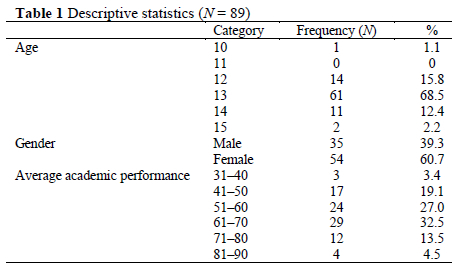
As depicted in Table 1, most of the participants (68.5%) were 13 years, 12 years (15.8%), 14 years (12.4%), 15 years (2.2%), and 10 years (1.1%) old. Of the participants, 60.7% were female and 39.3% were male. With the total academic performance, the highest total achieved (32.5%) was between 61-70%, followed by 27% of the learners achieving between 51-60%.
Reliability of the Scales
A reliability analysis was carried out with the student subjective well-being scale comprising 16 items and the gratitude scale comprising six items.
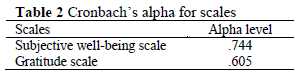
Table 2 indicates that the Cronbach alpha coefficient for the student subjective well-being scale was .74. The Cronbach alpha coefficient for the gratitude scale was found to be .49. After deleting items 3 and 6, the Cronbach alpha was found to be .6, which is still regarded as acceptable (Taber, 2018).
Factor Analysis of the Scales
Exploratory factor analysis was used to determine the factor structure loadings of items of the gratitude scale and the student subjective well-being scale. Factor analysis with the gratitude scale and data from a Namibian sample was possible as the Kaiser-Meyer-Olkin measure (KMO) of sampling adequacy value was above .6 (.641) and the Bartlett's test of sphericity was significant at .000. Principal component analysis was conducted to assess the number of components in the data. Factor extraction on the gratitude scale indicates four linear components within the data set. One of the factors indicates an eigenvalue greater than one, with an analysis of variance of 46.85% (as indicated in Table 3). All four the items loaded strongly (above .60) on the factor. A confirmatory factor analysis (CFA) was conducted to evaluate the fit of the one-factor structure of the gratitude scale (GQ-6). The model fit indices indicate an excellent fit to the data: χ2(2, N = 89) = 0.07, p = .962, CFI = 1.000, TLI = 1.154, RMSEA = .000, and SRMR = .000. These results support the validity of the one-factor structure for the gratitude scale in this sample.
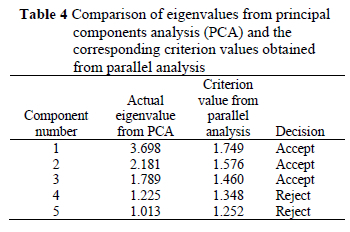
Factor extraction (principal component analysis) on the SSWQ was conducted with data from a Namibian sample as the KMO value was above .6 (.685) and the Bartlett's Test of Sphericity was significant at 0.000. Factor extraction indicated 16 linear components within the data set. Five of the factors indicated an eigenvalue greater than one, with an analysis of variance of 61.91%. As four factors are suggested by Renshaw (2020), parallel analysis (Watkins, 2000) was also conducted, which determined that three factors should be retained (see Table 4).
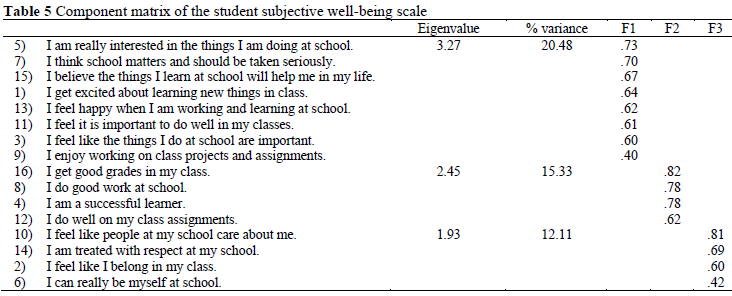
To aid in the interpretation of these three components, Varimax rotation was performed. The rotated solution revealed the presence of a simple structure, with all three components showing several strong loadings. The three-component solution explains a total of 47.92% of the variance, with Component 1 (joy and purpose of learning) contributing 20.48%, Component 2 (academic efficacy) contributing 15.33%, and Component 3 (school connectedness) contributing 12.11% (see Table 5).
An initial CFA was conducted to assess the fit of the five-factor structure of the SSWQ. However, the model was found to be inadmissible due to a non-positive definite covariance matrix of the latent variables, indicating issues such as multi-collinearity or negative variances. Given these findings, this model was deemed unsuitable for further analysis and was excluded from subsequent evaluations. A CFA was conducted to assess the model fit of the SSWQ for both the three-factor and four-factor structures. The model fit statistics for the three-factor structure were: χ2(101, N = 89) = 122.718, TLI = 0.910, CFI = 0.924, RMSEA = 0.049, SRMR = 0.077, and BIC = 3484.635. For the four-factor structure, the model fit statistics were: χ2(98, N = 89) = 108.895, TLI = 0.954, CFI = 0.962, RMSEA = 0.035, SRMR = 0.074, and BIC = 3484.279. Based on these results, the four-factor model demonstrated superior fit, as evidenced by higher TLI and CFI values, lower RMSEA and SRMR values, and a slightly lower BIC. These findings suggest that the four-factor structure provides a better representation of the data for this sample compared to the three-factor structure.
Means of the Variables
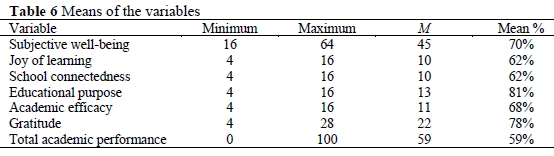
According to the data from Grade 7 learners at a primary school in Windhoek, it appears that they experienced a relatively high level of subjective well-being, as indicated by a score of 70%. As part of their subjective well-being, they rated their joy of learning and their connectedness to their school equally at 62%. Additionally, their educational purpose was rated at 81%, while their academic efficacy was at 68%. Moreover, the learners reported a level of gratitude at 78%. As for their academic performance, the average score was 59%, as shown in Table 6.
Correlations
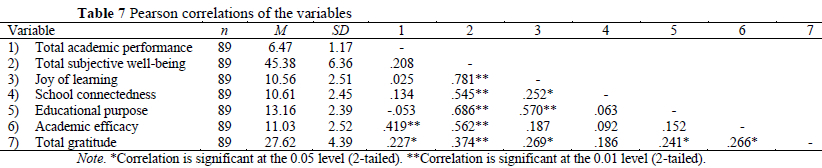
Pearson correlations were computed to assess the relationships between the variables. The results are presented in Table 7.
From the findings depicted in Table 7, a significant positive medium correlation between academic performance and academic efficacy (r = .419, p < .01) as well as a significant positive small correlation between academic performance and gratitude (r = .227, p < .05) can be seen. Moreover, a significant positive medium correlation exists between school subjective well-being and gratitude (r = .374, p < .01). Furthermore, a significant positive small correlation is evident between joy of learning and gratitude (r = .269, p < .05). A significant positive small correlation is observed between educational purpose and gratitude (r = .241, p < .05) as well as a significant positive small correlation between academic efficacy and gratitude (r = .266, p < .01).
Regression Analysis
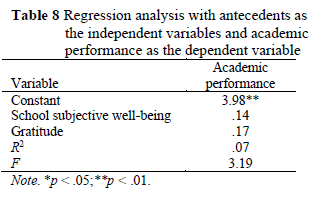
A standard multiple regression analysis was performed to test the effects of independent variables (school subjective well-being and gratitude) on academic performance. The results are presented in Table 8.
School subjective well-being and gratitude explain 7% (R2 = .07) of the variance in academic performance of Grade 7 learners in a Windhoek primary school (F = 3.19, p < .01). Standardised beta values indicate that school subjective well-being (β = .14, p > .05) and gratitude (β = .17, p = > .05) do not contribute significantly towards the variance in academic performance of the participating Grade 7 learners. It thus seems that a learner's level of school subjective well-being and gratitude does not influence the variance in academic performance much.
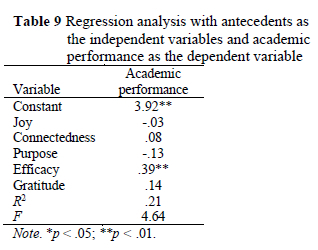
A standard multiple regression analysis was performed to test the effects of the four factors (joy of learning, school connectedness, education purpose, academic efficacy) of the independent variable "school subjective well-being" on the dependent variable "academic performance." The results are presented in Table 9.
Joy, connectedness, purpose, and efficacy explain 21% (R2 = .21) of the variance in academic performance of Grade 7 learners in a Windhoek primary school (F = 3.92, p < .01). Standardised beta values indicate that joy (β = -.03, p > .05), connectedness (β = .08, p = > .05), purpose (β = -.13, p > .05) and gratitude (β = .14, p > .05) do not contribute significantly towards the variance in total academic performance of Grade 7 learners. However, academic efficacy (β = .39, p < .01) contributes significantly towards the total academic performance of Grade 7 learners.
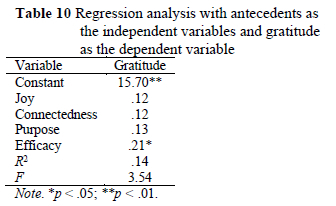
A standard multiple regression analysis was performed to test the effects of the four factors (joy of learning, school connectedness, education purpose, academic efficacy) of the independent variable "school subjective well-being" on the dependent variable "gratitude." The results are presented in Table 10.
Joy of learning, school connectedness, education purpose, and academic efficacy explain 14% (R2 = . 14) of the variance in gratitude levels of Grade 7 learners in a Windhoek primary school (F = 3.54, p < .05). Standardised beta values indicate that joy of learning (β = .12, p > .05), school connectedness (β = .12, p = > .05), and education purpose (β = .13, p > .05) do not contribute significantly towards gratitude levels of Grade 7 learners. However, academic efficacy (β = .21, p < .05) contributes significantly towards the gratitude levels of Grade 7 learners.
Independent-samples T-test
An independent-samples t-test was used to compare the mean scores of primary school boys and girls for gratitude levels. The results are depicted in Table 11.
Results from the independent-samples t-test show no statistically significant difference for the gratitude levels of male and female Grade 7 learners at a primary school in Windhoek.
An independent-samples t-test was used to compare the mean scores of primary school boys and girls for school subjective well-being levels. The results are depicted in Table 12.
Results for the independent-samples t-test show no statistically significant difference for the school subjective well-being levels for male and female Grade 7 learners at a primary school in Windhoek.
Discussion
The objectives with the study were to assess the levels of gratitude, school subjective well-being, and academic performance of Grade 7 learners at a Windhoek primary school, with the aim of determining whether a relationship existed between these variables. Additionally, we investigated whether any differences existed in gratitude and learner school subjective well-being between male and female learners. Moreover, we sought to establish the factor structure in the GQ-6 and the SSWQ based on Namibian data.
A relatively high level of gratitude (78%) was found with Grade 7 learners (Objective 1). This finding aligns with a study conducted by Guse, Vescovelli and Croxford (2019), in which high levels of gratitude were reported in a sample of South African learners. These results suggest that, even in challenging socio-economic circumstances often encountered in developing countries, children exhibit a capacity for gratitude, which may serve as a psychological strength. This supports the broaden-and-build theory of positive emotions (Fredrickson, 2004), which posits that positive emotions like gratitude can emerge even in adversity, broadening cognitive and social resources. Furthermore, the finding underscores the importance of considering developmental differences in the expression and measurement of gratitude. Wood, Froh and Geraghty (2010) caution that gratitude manifests differently in children than in adults, emphasising the need for age-appropriate measures to capture gratitude accurately. This study thus contributes to the literature by highlighting the developmental and contextual nuances of gratitude in learners, which can inform future research and interventions aimed at fostering gratitude in educational settings.
Grade 7 learners also indicated that they experienced relatively high school subjective well-being (70%) (Objective 3). This finding is surprising as Namibia is plagued by numerous social ills (Freeman & Gibson, 2020), which is expected to lower (school) subjective well-being. In a study with 12-year-old primary school learners in South Africa, researchers also found that learners reported high subjective well-being (Savahl, Adams, Isaacs, September, Hendricks & Noordien, 2015). Savahl, Tiliouine, Casas, Adams, Mekonen, Dejene, Benninger and Witten (2017) caution that due to life optimism bias (where the own life is evaluated as positive while objective well-being indicators are negative), (school) subjective well-being levels can be indicated to be higher than they actually are. These findings contribute to the theoretical understanding of school subjective well-being in developing contexts by underscoring the role of cultural and cognitive factors, such as life optimism, in shaping children' s perceptions of their well-being. Furthermore, they provide evidence for the resilience of children in challenging environments, supporting theoretical perspectives that emphasise the adaptive capacity of positive emotions in fostering well-being (Fredrickson, 2004).
Grade 7 learners experienced 62% joy with learning, 62% connectedness with the school community, 81% sense of purpose with their studies, and 68% efficacy in their studies (Objective 3). Comparing these means, it seems that learners felt a high sense of purpose with their studies. This might be the case because education is generally regarded highly in Namibia (Amukugo, Likando & Mushaandja, 2010). Namibia's unfortunate history, marked by apartheid, resulted in the denial of quality education to most of the country's inhabitants (Bunting, 2006). The denial of participation in educational opportunities in the past might still drive the Namibian psyche towards an intense focus on formal education. This aligns with theoretical perspectives on historical trauma and resilience, which suggest that communities recovering from systemic oppression often prioritise domains perceived as pathways to empowerment and socio-economic mobility (Ungar, 2008). The high sense of purpose among learners may also support theories of intrinsic motivation, which posit that individuals are more likely to derive purpose and satisfaction when they perceive education as directly linked to their future goals and opportunities (Ryan & Deci, 2000). The connection between poverty, unemployment, and lack of education in Namibia is apparent. Educated and skilled individuals, as noted by Jauch (2012), enjoy improved access to higher quality employment and increased income opportunities. These findings contribute to the literature by illustrating how socio-historical context and cultural emphasis on education can shape learners' perceptions of purpose, even in the face of ongoing systemic challenges.
Learners presented average academic performance (59%) (Objective 5). This finding is surprising since many Namibian learners struggle to perform well academically (Ipinge, 2021). As the learners in this study reported their academic performance themselves, there is, however, a possibility of skewed reporting, and therefore these results should also be interpreted with care.
A significant positive correlation was found between academic efficacy and academic performance (Objective 6). Likewise, the regression analysis indicated that, among the SSWQ factors (joy, connectedness, purpose, and academic efficacy), academic efficacy emerged as the strongest predictor of academic performance (Objective 9). Other studies confirm this relationship (Meral, Colak & Zereyah, 2012; Shkullaku, 2013), which aligns with Bandura and Wessels' (1997) self-efficacy theory, which posits that individuals' beliefs in their ability to execute tasks effectively influence their motivation, persistence, and eventual success. In the academic context, learners with high academic efficacy are more likely to approach challenges with confidence, use effective learning strategies, and persist in the face of difficulties, leading to improved academic outcomes (Zimmerman, 2000).
Furthermore, a positive correlation was observed between academic efficacy and gratitude (Objective 6). Regression analysis also indicates that among joy of learning, school connectedness, educational purpose, and academic efficacy, efficacy exerts the greatest effect on gratitude (Objective 9). Learners who are academically efficient seem to be more prone to gratefulness. In this regard, Rey (2009) found that gratitude positively correlated with general self-efficacy, academic efficacy, and control of learning beliefs. This finding contributes to the growing body of literature on the interplay between positive emotions and academic outcomes. Gratitude, as a prosocial emotion, is known to enhance resilience, social connectedness, and well-being (Froh et al., 2008). By identifying academic efficacy as a key predictor of gratitude, this study underscores the importance of fostering both emotional and cognitive resources in learners.
A positive correlation between academic performance and gratitude was also noted (Objective 6). This aligns with research by Seligman et al. (2009) who identified a positive relationship between academic performance and gratitude. Furthermore, Wilson and Harris (2015) suggest that gratitude, which can also be regarded as a positive emotion, provides cognitive benefits for individuals. This finding contributes to the literature by providing empirical evidence of the positive relationship between gratitude and academic performance in the Namibian educational context. It highlights the potential for gratitude-based interventions to improve not only learners' emotional well-being but also their academic outcomes.
A significant positive relationship was discovered between gratitude and school subjective well-being for Grade 7 learners (Objective 6). However, regression analysis revealed that school subjective well-being and gratitude did not have a significant effect on the variance in academic performance. Gratitude also demonstrates a significant positive correlation with joy of learning and educational purpose; however, it shows no significant correlation with school connectedness. In their study on Namibian primary schools, Gentz, Zeng and Ruiz-Casares (2021) found that bullying was a significant issue. Bullying can have a negative impact on the feeling of connectedness to school. Furthermore, Steeves (2017) used the SSWQ in a study and did not find correlations between gratitude and the dimensions of joy of learning, school connectedness, educational purpose, and academic efficacy. In contrast, a study by Furlong, Froh, Muller and Gonzalez (2014) found that gratitude did correlate with school connectedness. Thus, research findings regarding gratitude and (school) subjective well-being may vary in different contexts. These results contribute to the literature by highlighting the nuanced relationships between gratitude and aspects of school subjective well-being in a Namibian context. They underscore the importance of considering cultural and situational factors when examining the role of gratitude in educational settings.
No difference was found between female and male learners' levels of gratitude and (school) subjective well-being (Objectives 2 and 4). Research findings on gender differences in subjective well-being are inconclusive. Some studies found no difference (Seligson, Huebner & Valois, 2003), while others did find a difference between female and male learners' subjective well-being (Cummins, 2014). This finding suggests that gender differences in gratitude and subjective well-being may not be as pronounced in developing countries with a strong emphasis on gender equity in education.
Factor analysis indicated that the gratitude scale consisted of one factor (Objective 7). This agrees with findings of other studies (Jans-Beken, Lataster, Leontjevas & Jacobs, 2015; McCullough et al., 2002). In contrast, the factor structure of the school subjective well-being questionnaire (SSWQ) diverged from the findings of Renshaw (2020), who identified four distinct factors. Our study revealed five factors based on initial exploratory factor analysis, with items for joy of learning and educational purpose forming a combined factor, while school connectedness and academic efficacy remained as distinct factors. Parallel analysis indicated a three-factor structure, suggesting that joy of learning and educational purpose might share conceptual overlap in this context. The discrepancies in factor structures may stem from cultural or contextual differences between the Namibian and Western samples in which the SSWQ was originally validated. For instance, Namibian learners may conceptualise joy of learning and educational purpose as closely interrelated, possibly reflecting a collective emphasis on education's transformative potential in a developing country (Amukugo et al., 2010). Additionally, the relatively small sample size (N = 89) may have contributed to the inconsistency, as factor analysis is ideally conducted with larger samples (Mundfrom, Shaw & Ke, 2005).
Consequently, our study adhered to Renshaw's (2020) original four-factor structure for subsequent analyses to maintain comparability with the broader literature. These findings contribute to the theoretical understanding of school subjective well- being by highlighting the potential cultural and contextual influences on how its dimensions are perceived and measured.
Conclusion, Recommendations and Limitations
In this study, Grade 7 learners displayed high levels of gratitude and school subjective well-being, alongside average academic performance. There was a significant positive correlation observed between academic efficacy and academic performance, while gratitude showed significant positive correlations with all variables (academic performance, school subjective well-being, joy of learning, academic efficacy, educational purpose) except for school connectedness. Both gratitude and school subjective well-being did not significantly contribute to the variance in academic performance, whereas academic efficacy significantly contributed to the variance in academic performance and gratitude. Moreover, the Grade 7 learners expressed finding much purpose in their academics. No differences were found in the gratitude and school subjective well-being levels of male and female learners.
Exploratory factor analysis with Namibian data revealed one factor for the GQ-6 and five factors for the SSWQ. Parallel analysis with the SSWQ indicated three factors. Based on these findings, several recommendations are made. Firstly, teachers should assist learners to understand that a connection exists between school studies and the demands of the environment (academic efficacy), as it was found that a significant positive correlation existed between efficacy and academic performance. Teachers and learners must understand that learners' planning of mastering academic work is just as important as the work itself. A great deal of effort should, therefore, be spent on assisting learners with study programmes and study rosters.
Parents and teachers should actively promote gratitude experiences and expressions with learners, as increased gratitude levels contribute to a host of positive emotions, which enhance cognitive functioning. Lower levels of joy of learning, school connectedness, and academic efficacy, compared to educational purpose among Grade 7 learners should also be qualitatively investigated. Worldwide, little research has been conducted on gratitude and (school) subjective well-being levels of primary school learners. Thus, conducting such research in the Namibian context is essential for fostering good academic performance.
Additionally, qualitative studies should be conducted at primary school level to understand learners' perspectives on gratitude, (school) subjective well-being, and academic performance. Considering that gratitude differs in adults and learners, there is a need to develop child-friendly gratitude questionnaires.
Finally, it is vital to investigate the phenomenon of life optimism bias among children in Namibia, especially since the learners' self-reported high school subjective well-being contrasts with objective well-being indicators such as low academic performance and poor socio-economic circumstances.
In this study, several limitations were encountered. Firstly, this study was cross-sectional, with data collected once-off at a certain point in time. A longitudinal approach, with multiple data collection points over an extended period, would have been more ideal to capture developmental trends and changes in gratitude, school subjective well-being, and academic performance. Secondly, we employed a quantitative design, which limited the collection of rich descriptions that qualitative approaches offer. As a result, deeper insights into the experiences of the research participants could not be explored. Thirdly, data were collected from one urban school, selected for pragmatic reasons such as accessibility and feasibility. A more rigorous and scientifically representative case selection process would enhance the generalisability of the results beyond this specific school setting. In the fourth place, the sample was also relatively small, potentially impacting the validity of the study's findings. In the fifth place, the gratitude questionnaire that was used in this study to collect data was intended to measure gratitude in adults as child-friendly gratitude questionnaires are still in the process of development. Finally, all measurements were done via subjective self-report methods, which could introduce bias and affect the reliability of the data collected.
Authors' Contributions
CJ wrote the proposal for the study, collected all the data in the field, conducted data analysis and wrote the first draft of the article. AEES assisted in refining the proposal and assisted in obtaining ethical clearance for the study from the University of Namibia, edited the first draft and assisted with the discussion of the findings of the study. MJ conducted additional statistical analysis (factor analysis, regression analysis and independent samples t-tests), wrote up the findings, drew up all the tables and assisted with the interpretation and discussion of the findings. All authors assisted in responding to reviewer comments.
Notesi. Published under a Creative Commons Attribution Licence.
Acknowledgements
We would like to express our gratitude to the Ministry of Education in Namibia, Grade 7 learners and their parents for allowing the learners to participate in this study.
References
- Alderson P & Morrow V 2020. The ethics of research with children and young people: A practical handbook (2nd ed). Washington, DC: Sage.
-
Almurumudhe LKA, Mahdad A, Abdulkadhim Johni A & Yousefi Z 2024. The mediating role of self-esteem in the relationship between psychological capital, academic engagement, and academic procrastination with academic performance among students in Al-Diwaniyah, Iraq. Iranian Journal of Educational Sociology, 7(3): 1-9. https://doi.org/10.61838/kman.ijes.7.3.1
» https://doi.org/10.61838/kman.ijes.7.3.1 -
Amukugo EM, Likando GN & Mushaandja J 2010. Access & quality dilemma in education: Implication for Namibia's Vision 2030. Higher Education Forum, 7:101-112. Available at https://rihe-publications.hiroshima-u.ac.jp/wp/wp-content/uploads/2016/12/101732.pdf#page=101. Accessed 18 December 2025.
» https://rihe-publications.hiroshima-u.ac.jp/wp/wp-content/uploads/2016/12/101732.pdf#page=101 - Bandura A & Wessels S 1997. Self-efficacy. Cambridge, England: Cambridge University Press.
-
Bono G 2017. What don't we know about gratitude and youth. Greater Good Magazine, 15 February. Available at https://greatergood.berkeley.edu/article/item/what_dont_we_know_about_gratitude_and_youth?utm_source=chatgpt.com. Accessed 16 January 2025.
» https://greatergood.berkeley.edu/article/item/what_dont_we_know_about_gratitude_and_youth?utm_source=chatgpt.com -
Bono G, Duffy T & Merz EL 2023. Gratitude and adolescents' mental health and well-being: Effects and gender differences for a positive social media intervention in high schools. Education Sciences, 13(3):320. https://doi.org/10.3390/educsci13030320
» https://doi.org/10.3390/educsci13030320 -
Borrello A 2005. Subjective well-being and academic success among college students. PhD dissertation. Minneapolis, MN: Capella University. Available at https://www.proquest.com/docview/305361269?pqorigsite=gscholar&fromopenview=true&sourcetype=Dissertations%20&%20Theses. Accessed 17 December 2025.
» https://www.proquest.com/docview/305361269?pqorigsite=gscholar&fromopenview=true&sourcetype=Dissertations%20&%20Theses -
Bücker S, Nuraydin S, Simonsmeier BA, Schneider M & Luhmann M 2018. Subjective well-being and academic achievement: A meta-analysis. Journal of Research in Personality, 74:83-94. https://doi.org/10.1016/j.jrp.2018.02.007
» https://doi.org/10.1016/j.jrp.2018.02.007 -
Bunting I 2006. The higher education landscape under apartheid. In N Cloete, P Maassen, R Fehnel, T Moja, T Gibbon & H Perold (eds). Transformation in higher education: Global pressures and local realities. Dordrecht, The Netherlands: Springer. https://doi.org/10.1007/1-4020-4006-7_3
» https://doi.org/10.1007/1-4020-4006-7_3 - Caleon IS & Ilham NQB 2020. It is better to receive and appreciate the good than to do good: Gratitude and altruism as predictors of positive relationships and well-being in schools. In J Chen and RB King (eds). Emotions in learning, teaching, and leadership: Asian perspectives. London, England: Routledge.
-
Calleja P, Knight-Davidson P, McVicar A, Laker C, Yu S & Roszak-Burton L 2024. Gratitude interventions to improve wellbeing and resilience of graduate nurses transitioning to practice: A scoping review. International Journal of Nursing Studies Advances, 6:100188. https://doi.org/10.1016/j.ijnsa.2024.100188
» https://doi.org/10.1016/j.ijnsa.2024.100188 -
Carmona-Halty M, Salanova M & Schaufeli WB 2022. The strengthening starts at home: Parent-child relationships, psychological capital, and academic performance - a longitudinal mediation analysis. Current Psychology, 41(6):3788-3796. https://doi.org/10.1007/s12144-020-00898-8
» https://doi.org/10.1007/s12144-020-00898-8 -
Carr D, Morgan B & Gulliford L 2015. Learning and teaching virtuous gratitude. Oxford Review of Education, 41(6):766-781. https://doi.org/10.1080/03054985.2015.1119679
» https://doi.org/10.1080/03054985.2015.1119679 -
Castelli L & Marcionetti J 2024. Life satisfaction and school experience in adolescence: The impact of school supportiveness, peer belonging and the role of academic self-efficacy and victimization. Cogent Education, 11(1):2338016. https://doi.org/10.1080/2331186X.2024.2338016
» https://doi.org/10.1080/2331186X.2024.2338016 -
Chen Y, Okereke OI, Kim ES, Tiemeier H, Kubzansky LD & VanderWeele TJ 2024. Gratitude and mortality among older US female nurses. JAMA Psychiatry, 81(10):1030-1038. https://doi.org/10.1001/jamapsychiatry.2024.1687
» https://doi.org/10.1001/jamapsychiatry.2024.1687 -
Cheng ST, Tsui PK & Lam JHM 2015. Improving mental health in health care practitioners: Randomized controlled trial of a gratitude intervention. Journal of Consulting and Clinical Psychology, 83(1):177-186. https://doi.org/10.1037/a0037895
» https://doi.org/10.1037/a0037895 -
Chowdhury MR 2019. The neuroscience of gratitude and effects on the brain. Available at https://positivepsychology.com/neuroscience-of-gratitude/?utm_source=chatgpt.com. Accessed 20 January 2025.
» https://positivepsychology.com/neuroscience-of-gratitude/?utm_source=chatgpt.com - Creswell JW 2009. Research design: Qualitative, quantitative, and mixed methods approaches (3rd ed). Los Angeles, CA: Sage.
-
Cronqvist M 2021. Joy in learning: When children feel good and realize they learn. Educare, 3:54-77. https://doi.org/10.24834/educare.2021.3.3
» https://doi.org/10.24834/educare.2021.3.3 -
Cui H, Bi X, Chen W, Gao T, Qing Z, Shi K & Ma Y 2023. Gratitude and academic engagement: Exploring the mediating effects of internal locus of control and subjective well-being. Frontiers in Psychology, 14:1287702. https://doi.org/10.3389/fpsyg.2023.1287702
» https://doi.org/10.3389/fpsyg.2023.1287702 -
Cummins RA 2014. Understanding the well-being of children and adolescents through homeostatic theory. In A Ben-Arieh, F Casas, I Frenes & J Korbin (eds). Handbook of child well-being. Dordrecht, The Netherlands: Springer. https://doi.org/10.1007/978-90-481-9063-8_152
» https://doi.org/10.1007/978-90-481-9063-8_152 -
Education Statistics 2023. Education Management Information System. Khorixas, Namibia: Ministry of Education, Arts and Culture. Available at https://www.moe.gov.na/wp-content/uploads/2024/09/MoEAC-EMIS-Education-Statistics-2023.pdf?utm_source=chatgpt.com. Accessed 21 January 2025.
» https://www.moe.gov.na/wp-content/uploads/2024/09/MoEAC-EMIS-Education-Statistics-2023.pdf?utm_source=chatgpt.com -
Eglitis E, Miatke A, Virgara R, Machell A, Olds T, Richardson M & Maher C 2024. Children's health, wellbeing and academic outcomes over the summer holidays: A scoping review. Children, 11(3):287. https://doi.org/10.3390/children11030287
» https://doi.org/10.3390/children11030287 -
Eide ER, Showalter MH & Goldhaber DD 2010. The relation between children's health and academic achievement. Children and Youth Services Review, 32(2):231-238. https://doi.org/10.1016/j.childyouth.2009.08.019
» https://doi.org/10.1016/j.childyouth.2009.08.019 -
Emmons RA, Froh J & Rose R 2019. Gratitude. In MW Gallagher & SJ Lopez (eds). Positive psychological assessment: A handbook of models and measures (2nd ed). Washington, DC: American Psychological Association. https://doi.org/10.1037/0000138-020
» https://doi.org/10.1037/0000138-020 -
Emmons RA & McCullough ME 2003. Counting blessings versus burdens: An experimental investigation of gratitude and subjective well-being in daily life. Journal of Personality and Social Psychology, 84(2):377-389. https://doi.org/10.1037//0022-3514.84.2.377
» https://doi.org/10.1037//0022-3514.84.2.377 - Emmons RA & Shelton CM 2002. Gratitude and the science of positive psychology. In CR Snyder & SJ Lopez (eds). Handbook of positive psychology. New York, NY: Oxford University Press.
- Fredrickson BL 2004. Gratitude, like other positive emotions, broadens and builds. In RA Emmons & ME McCullough (eds). The psychology of gratitude. New York, NY: Oxford University Press.
- Freeman R & Gibson P 2020. Country portrait Namibia: Country portrait of the development of Namibia's social welfare and social work systems.
-
Fritz MM, Armenta CN, Walsh LC & Lyubomirsky S 2019. Gratitude facilitates healthy eating behavior in adolescents and young adults. Journal of Experimental Social Psychology, 81:4-14. https://doi.org/10.1016/j.jesp.2018.08.011
» https://doi.org/10.1016/j.jesp.2018.08.011 -
Froh JJ, Emmons RA, Card NA, Bono G & Wilson JA 2011. Gratitude and the reduced costs of materialism in adolescents. Journal of Happiness Studies, 12:289-302. https://doi.org/10.1007/s10902-010-9195-9
» https://doi.org/10.1007/s10902-010-9195-9 -
Froh JJ, Seffick WJ & Emmons RA 2008. Counting blessings in early adolescents: An experimental study of gratitude and subjective well-being. Journal of School Psychology, 46(2):213-233. https://doi.org/10.1016/j.jsp.2007.03.005
» https://doi.org/10.1016/j.jsp.2007.03.005 -
Furlong MJ, Froh JJ, Muller ME & Gonzalez V 2014. The role of gratitude in fostering school bonding. Teachers College Record, 116(13):58-79. https://doi.org/10.1177/016146811411601316
» https://doi.org/10.1177/016146811411601316 -
Garg N 2024. Gratitude research: Review and future agenda using bibliometric analysis of the studies published in the last 20 years. Asian Journal of Social Psychology, 27(4):639-656. https://doi.org/10.1111/ajsp.12621
» https://doi.org/10.1111/ajsp.12621 -
Gentz S, Zeng C & Ruiz-Casares M 2021. The role of individual-, family-, and school-level resilience in the subjective well-being of children exposed to violence in Namibia. Child Abuse & Neglect, 119(Pt. 2):105087. https://doi.org/10.1016/j.chiabu.2021.105087
» https://doi.org/10.1016/j.chiabu.2021.105087 -
Goodman SW 2024. Case study and selection. In J Cyr & SW Goodman (eds). Doing good qualitative research. New York, NY: Oxford Academic. https://doi.org/10.1093/oso/9780197633137.003.0006
» https://doi.org/10.1093/oso/9780197633137.003.0006 -
Gordon AK, Musher-Eizenman DR, Holub SC & Dalrymple J 2004. What are children thankful for? An archival analysis of gratitude before and after the attacks of September 11. Journal ofApplied Developmental Psychology, 25(5):541-553. https://doi.org/10.1016/j.appdev.2004.08.004
» https://doi.org/10.1016/j.appdev.2004.08.004 -
Guse T, Vescovelli F & Croxford SA 2019. Subjective well-being and gratitude among South African adolescents: Exploring gender and cultural differences. Youth & Society, 51(5):591-615. https://doi.org/10.1177/0044118X17697237
» https://doi.org/10.1177/0044118X17697237 - Hashim YA 2010. Determining sufficiency of sample size in management survey research activities. International Journal of Organisational Management & Entrepreneurship Development, 6(1):119-130.
-
Hosely M 2021. Informed consent: When, why, and how it's obtained. [Blog post] Advarra, 26 January. Available at https://www.advarra.com/blog/informed-consent-when-why-and-how-its-obtained/?utm_source=chatgpt.com Accessed 21 January 2025.
» https://www.advarra.com/blog/informed-consent-when-why-and-how-its-obtained/?utm_source=chatgpt.com -
Huebner ES, Hills KJ, Jiang X, Long RF, Kelly R & Lyons MD 2014. Schooling and children's subjective well-being. In A Ben-Arieh, F Casas, I Frones & JE Korbin (eds). Handbook of child well-being: Theories, methods and policies in global perspective. Dordrecht, The Netherlands: Springer. https://doi.org/10.1007/978-90-481-9063-8
» https://doi.org/10.1007/978-90-481-9063-8 -
Hussong AM, Langley HA, Thomas TE, Coffman JL, Halberstadt AG, Costanzo PR & Rothenberg WA 2019. Measuring gratitude in children. The Journal of Positive Psychology, 14(5):563-575. https://doi.org/10.1080/17439760.2018.1497692
» https://doi.org/10.1080/17439760.2018.1497692 -
Ipinge KF 2021. An investigation of factors influencing primary school learners' academic performance in informal settlement areas of Windhoek, Namibia. MEd dissertation. Pretoria, South Africa: University of South Africa. Available at https://www.proquest.com/docview/3224597309?porigsite=gscholar&fromopenview=true&sourcetype=Dissertations%20&%20Theses. Accessed 17 December 2025.
» https://www.proquest.com/docview/3224597309?porigsite=gscholar&fromopenview=true&sourcetype=Dissertations%20&%20Theses -
Izaguirre LA, Rodríguez-Fernández A & Fernández-Zabala A 2023. Perceived academic performance explained by school climate, positive psychological variables and life satisfaction. British Journal of Educational Psychology, 93(1):318-332. https://doi.org/10.1111/bjep.12557
» https://doi.org/10.1111/bjep.12557 -
Jackson LTB, Van de Vijver FJR & Fouché R 2014. Psychological strengths and subjective well-being in South African white students. Journal of Psychology in Africa, 24(4):299-307. https://doi.org/10.1080/14330237.2014.980617
» https://doi.org/10.1080/14330237.2014.980617 -
Jans-Beken L, Lataster J, Leontjevas R & Jacobs N 2015. Measuring gratitude: A comparative validation of the Dutch Gratitude Questionnaire (GQ6) and Short Gratitude Resentment, and Appreciation Test (SGRAT). Psychologica Belgica, 55(1):19-31. https://doi.org/10.5334/pb.bd
» https://doi.org/10.5334/pb.bd -
Jans-Beken L, Lataster J, Peels D, Lechner L & Jacobs N 2018. Gratitude, psychopathology and subjective well-being: Results from a 7.5-month prospective general population study. Journal of Happiness Studies, 19:1673-1689. https://doi.org/10.1007/s10902-017-9893-7
» https://doi.org/10.1007/s10902-017-9893-7 -
Jarden A & Roache A 2023. What is wellbeing [Special issue]? International Journal of Environmental Research and Public Health, 20(6):5006. https://doi.org/10.3390/ijerph20065006
» https://doi.org/10.3390/ijerph20065006 -
Jauch H 2012. Poverty, unemployment and inequality in Namibia (Working Paper -Economic Perspectives on Global Sustainability Vol. 2013, No. 02). Available at http://cmsdata.iucn.org.iucn.vm.iway.ch/downloads/temti_ep_02_2013.pdf. Accessed 28 March 2023.
» http://cmsdata.iucn.org.iucn.vm.iway.ch/downloads/temti_ep_02_2013.pdf -
Juneja JK 2022. Gratitude and it's importance. International Journal of Health Sciences, 6(S2):9721-9728. https://doi.org/10.53730/ijhs.v6nS2.7533
» https://doi.org/10.53730/ijhs.v6nS2.7533 -
Kaye-Tzadok A, Kim SS & Main G 2017. Children's subjective well-being in relation to gender - What can we learn from dissatisfied children? Children and Youth Services Review, 80:96-104. https://doi.org/10.1016/j.childyouth.2017.06.058
» https://doi.org/10.1016/j.childyouth.2017.06.058 -
Kim H, Carney JV & Hazler RJ 2023. Promoting school connectedness: A critical review of definitions and theoretical models for school-based interventions, preventing school failure. Preventing School Failure: Alternative Education for Children and Youth, 67(4):256-264. https://doi.org/10.1080/1045988X.2022.2119359
» https://doi.org/10.1080/1045988X.2022.2119359 - Klein M 1957. Envy and gratitude: A study of unconscious sources. Oxon, England: Routledge.
-
Layous K & Lyubomirsky S 2014. Benefits, mechanisms, and new directions for teaching gratitude to children. School Psychology Review, 43(2):153-159. https://doi.org/10.1080/02796015.2014.12087441
» https://doi.org/10.1080/02796015.2014.12087441 - Makuwa D 2005. The SACMEQ II project in Namibia: A study of the conditions of schooling and the quality of education (Namibia Working Report). Namibia: Ministry of Basic Education, Sport and Culture.
-
McCullough ME, Emmons RA & Tsang JA 2002. The grateful disposition: A conceptual and empirical topography. Journal of Personality and Social Psychology, 82(1):112-127. https://doi.org/10.1037/0022-3514.82.1.112
» https://doi.org/10.1037/0022-3514.82.1.112 -
Meral M, Colak E & Zereyah E 2012. The relationship between self-efficacy and academic performance. Procedia - Social and Behavioral Sciences, 46:1143-1146. https://doi.org/10.1016/j.sbspro.2012.05.264
» https://doi.org/10.1016/j.sbspro.2012.05.264 -
Mokhtari T & Mehdinezhad V 2016. Gratitude, social support and academic performance: Exploring the relationship between indicators' high school students. The Social Sciences, 11(23):5657-5662. Available at https://www.researchgate.net/publication/324900843_Gratitude_social_support_and_academic_performance_Exploring_the_relationships_between_indicators'_high_school_students. Accessed 16 December 2025.
» https://www.researchgate.net/publication/324900843_Gratitude_social_support_and_academic_performance_Exploring_the_relationships_between_indicators'_high_school_students -
Mundfrom DJ, Shaw DG & Ke TL 2005. Minimum sample size recommendations for conducting factor analyses. International Journal of Testing, 5(2):159-168. https://doi.org/10.1207/s15327574ijt0502_4
» https://doi.org/10.1207/s15327574ijt0502_4 -
National Institute for Educational Development 2018. National promotion policy guide for junior and senior secondary school phases. Namibia: Ministry of Education, Arts and Culture. Available at https://www.nied.edu.na/assets/documents/05Policies/NationalCurriculumGuide/PROMOTION_POLICY_GUIDE_SECONDARY_PHASE_2018.pdf?utm_source=chatgpt.com. Accessed 21 January 2025.
» https://www.nied.edu.na/assets/documents/05Policies/NationalCurriculumGuide/PROMOTION_POLICY_GUIDE_SECONDARY_PHASE_2018.pdf?utm_source=chatgpt.com -
Neto F 2007. Forgiveness, personality and gratitude. Personality and Individual Differences, 43(8):2313-2323. https://doi.org/10.1016/j.paid.2007.07.010
» https://doi.org/10.1016/j.paid.2007.07.010 -
Ng ZJ, Huebner SE & Hills KJ 2015. Life satisfaction and academic performance in early adolescents: Evidence for reciprocal association. Journal of School Psychology, 53(6):479-491. https://doi.org/10.1016/j.jsp.2015.09.004
» https://doi.org/10.1016/j.jsp.2015.09.004 -
Nyambe TN 2015. Primary school teachers' experiences of implementing assessment policy in Social Studies in the Kavango Region of Namibia. MEd thesis. Stellenbosch, South Africa: Stellenbosch University. Available at https://scholar.sun.ac.za/server/api/core/bitstreams/b28ba5e6-2750-4f63-9112-37d3e633d89e/content. Accessed 14 December 2025.
» https://scholar.sun.ac.za/server/api/core/bitstreams/b28ba5e6-2750-4f63-9112-37d3e633d89e/content -
Obeldobel CA & Kerns KA 2021. A literature review of gratitude, parent-child relationships, and well-being in children. Developmental Review, 61:100948. https://doi.org/10.1016/j.dr.2021.100948
» https://doi.org/10.1016/j.dr.2021.100948 -
Petrocchi N & Couyoumdjian A 2016. The impact of gratitude on depression and anxiety: The mediating role of criticising, attacking, and reassuring the self. Self and Identity, 15(2):191-205. https://doi.org/10.1080/15298868.2015.1095794
» https://doi.org/10.1080/15298868.2015.1095794 -
Priya A 2021. Case study methodology of qualitative research: Key attributes and navigating the conundrums in its application. Sociological Bulletin, 70(1):94-110. https://doi.org/10.1177/0038022920970318
» https://doi.org/10.1177/0038022920970318 -
Reijers W, Wright D, Brey P, Weber K, Rodrigues R, O'Sullivan D & Gordijn B 2018. Methods for practising ethics in research and innovation: A literature review, critical analysis and recommendations. Science and Engineering Ethics, 24:1437-1481. https://doi.org/10.1007/s11948-017-9961-8
» https://doi.org/10.1007/s11948-017-9961-8 -
Renshaw TL 2020. Student Subjective Wellbeing Questionnaire (SSWQ): Measure and user guide. Open Science Framework. Available at https://www.tyrenshaw.org/sswq/. Accessed 22 November 2022.
» https://www.tyrenshaw.org/sswq/ -
Renshaw TL & Arslan G 2016. Psychometric properties of the Student Subjective Wellbeing Questionnaire with Turkish adolescents: A generalizability study. Canadian Journal of School Psychology, 31(2):139-151. https://doi.org/10.1177/0829573516634644
» https://doi.org/10.1177/0829573516634644 -
Renshaw TL, Clark KN, Farley CD, Franzmann TK & Yang NJ 2024. Global and school-specific subjective well-being as predictors of educational outcomes. School Mental Health, 16:1052-1068. https://doi.org/10.1007/s12310-024-09684-4
» https://doi.org/10.1007/s12310-024-09684-4 -
Renshaw TL, Long ACJ & Cook CR 2015. Assessing adolescents' positive psychological functioning at school: Development and validation of the Student Subjective Wellbeing Questionnaire. School Psychology Quarterly, 30(4):534-552. https://doi.org/10.1037/spq0000088
» https://doi.org/10.1037/spq0000088 -
Rey D 2009. The relationship of gratitude and subjective well-being to self-efficacy and control of learning beliefs among college students. PhD dissertation. Los Angeles, CA: University of Southern California. Available at https://www.proquest.com/docview/304998466?pqorigsite=gscholar&fromopenview=true&sourcetype=Dissertations%20&%20Theses. Accessed 19 December 2025.
» https://www.proquest.com/docview/304998466?pqorigsite=gscholar&fromopenview=true&sourcetype=Dissertations%20&%20Theses -
Rothenberg WA, Hussong AM, Langley HA, Egerton GA, Halberstadt AG, Coffman JL, Mokrova I & Costanzo PR 2017. Grateful parents raising grateful children: Niche selection and socialization of child gratitude. Applied Developmental Science, 21(2):106-120. https://doi.org/10.1080/10888691.2016.1175945
» https://doi.org/10.1080/10888691.2016.1175945 -
Ruggeri K, Garcia-Garzon E, Maguire Á, Matz S & Huppert FA 2020. Well-being is more than happiness and life satisfaction: A multidimensional analysis of 21 countries. Health and Quality of Life Outcomes, 18:192. https://doi.org/10.1186/s12955-020-01423-y
» https://doi.org/10.1186/s12955-020-01423-y - Ryan RM & Deci EL 2000. Self-determination theory and the facilitation of intrinsic motivation, social development, and well-being. American Psychologist, 55(1):68-78.
- Sarason BR, Sarason IG & Gurung RAR 1997. Close personal relationships and health outcomes: A key to the role of social support. In S Duck (ed). Handbook of personal relationships: Theory, research and interventions (2nd ed). New York, NY: John Wiley & Sons.
-
Savahl S, Adams S, Isaacs S, September R, Hendricks G & Noordien Z 2015. Subjective well-being amongst a sample of South African children: A descriptive study. Child Indicators Research, 8:211-226. https://doi.org/10.1007/s12187-014-9289-8
» https://doi.org/10.1007/s12187-014-9289-8 -
Savahl S, Tiliouine H, Casas F, Adams S, Mekonen Y, Dejene N, Benninger E & Witten H 2017. Children's subjective well-being in Africa: A comparative analysis across three countries. Children and Youth Services Review, 80:31-40. https://doi.org/10.1016/j.childyouth.2017.06.063
» https://doi.org/10.1016/j.childyouth.2017.06.063 - Seawright J & Gerring J 2008. Case study techniques in case study research: A menu of qualitative and quantitative options. Political Research Quarterly, 61(2):294-308.
-
Seligman MEP, Ernst RM, Gillham J, Reivich K & Linkins M 2009. Positive education: Positive psychology and classroom interventions. Oxford Review of Education, 35(3):293-311. https://doi.org/10.1080/03054980902934563
» https://doi.org/10.1080/03054980902934563 -
Seligson JL, Huebner ES & Valois RF 2003. Preliminary validation of the Brief Multidimensional Students' Life Satisfaction Scale (BMSLSS). Social Indicators Research, 61:121 -145. https://doi.org/10.1023/A:1021326822957
» https://doi.org/10.1023/A:1021326822957 -
Serrão R, Dias P, Andrés A, Bowe M & Renshaw T 2024. Adolescents' school-based universal well-being screening: A validation of the student subjective wellbeing questionnaire in Portugal. School Mental Health, 16:1261-1274. https://doi.org/10.1007/s12310-024-09691-5
» https://doi.org/10.1007/s12310-024-09691-5 -
Shkullaku R 2013. The relationship between self - efficacy and academic performance in the context of gender among Albanian students. European Academic Research, 1(4):467-478. Available at https://euacademic.org/UploadArticle/33.pdf. Accessed 2 July 2023.
» https://euacademic.org/UploadArticle/33.pdf -
Shoshani A, De-Leon Lendner K, Nissensohn A, Lazarovich G & Aharon-Dvir O 2020. Grateful and kind: The prosocial function of gratitude in young children's relationships. Developmental Psychology, 56(6):1135-1148. https://doi.org/10.1037/dev0000922
» https://doi.org/10.1037/dev0000922 -
Sin NL & Lyubomirsky S 2009. Enhancing well-being and alleviating depressive symptoms with positive psychology interventions: A practice-friendly meta-analysis. Journal of Clinical Psychology, 65(5):467-487. https://doi.org/10.1002/jclp.20593
» https://doi.org/10.1002/jclp.20593 -
Steeves RMO 2017. Differential effects of gratitude and positive peer reporting interventions on student subjective wellbeing, classroom behaviour and school connectedness. PhD dissertation. Baton Rouge, LA: Louisiana State University. Available at https://www.proquest.com/docview/2674873330?porigsite=gscholar&fromopenview=true&sourcetype=Dissertations%20&%20Theses. Accessed 27 November 2025.
» https://www.proquest.com/docview/2674873330?porigsite=gscholar&fromopenview=true&sourcetype=Dissertations%20&%20Theses -
Steinmayr R, Heyder A, Naumburg C, Michels J & Wirthwein L 2018. School-related and individual predictors of subjective well-being and academic achievement. Frontiers in Psychology, 9:2631. https://doi.org/10.3389/fpsyg.2018.02631
» https://doi.org/10.3389/fpsyg.2018.02631 - Steinmayr R, Meiβner A, Weidinger AF & Wirthwein L 2014. Academic achievement. In LH Meyer (ed). Oxford bibliographies online: Education. New York, NY: Oxford University Press.
-
Taber KS 2018. The use of Cronbach's alpha when developing and reporting instruments in science education. Research in Science Education, 48:1273-1296. https://doi.org/10.1007/s11165-016-9602-2
» https://doi.org/10.1007/s11165-016-9602-2 -
Thourani A 2022. Importance of informed consent process in research & healthcare. [Blog post] Revive Research Institute, Inc, 14 June. Available at https://www.reviveresearch.org/blog/importance-of-informed-consent-process/?utm_source=chatgpt.com. Accessed 21 January 2025.
» https://www.reviveresearch.org/blog/importance-of-informed-consent-process/?utm_source=chatgpt.com -
Tian L, Pi L, Huebner ES & Du M 2016. Gratitude and adolescents' subjective well-being in school: The multiple mediating roles of basic psychological needs satisfaction at school. Frontiers in Psychology, 7:1409. https://doi.org/10.3389/fpsyg.2016.01409
» https://doi.org/10.3389/fpsyg.2016.01409 -
Tian L, Wang D & Huebner ES 2015. Development and validation of the Brief Adolescents' Subjective Well-Being in School Scale (BASWBSS). Social Indicators Research, 120:615-634. https://doi.org/10.1007/s11205-014-0603-0
» https://doi.org/10.1007/s11205-014-0603-0 -
Tisocco F & Liporace MF 2023. Structural relationships between procrastination, academic motivation, and academic achievement within university students: A self-determination theory approach. Innovative Higher Education, 48(2):351-369. https://doi.org/10.1007/s10755-022-09622-9
» https://doi.org/10.1007/s10755-022-09622-9 -
Toepfer SM, Cichy K & Peters P 2012. Letters of gratitude: Further evidence for author benefits. Journal of Happiness Studies, 13:187-201. https://doi.org/10.1007/s10902-011-9257-7
» https://doi.org/10.1007/s10902-011-9257-7 -
Ungar M 2008. Resilience across cultures. The British Journal of Social Work, 38(2):218-235. https://doi.org/10.1093/bjsw/bcl343
» https://doi.org/10.1093/bjsw/bcl343 -
Valdez JPM, Yang W & Datu JAD 2017. Validation of the Gratitude Questionnaire in Filipino secondary school students. The Spanish Journal of Psychology, 20:E45. https://doi.org/10.1017/sjp.2017.51
» https://doi.org/10.1017/sjp.2017.51 - Watkins MW 2000. Monte Carlo PCA for parallel analysis [computer software]. State College, PA: Educational & Psychological Associates.
-
Wilson J & Harris P 2015. Ripples of gratitude: The flow-on effects of practicing gratitude in the classroom environment. International Christian Community of Teacher Educators Journal, 10(1):1-12. Available at https://digitalcommons.georgefox.edu/icctej/vol10/iss1/3. Accessed 23 March 2023.
» https://digitalcommons.georgefox.edu/icctej/vol10/iss1/3 -
Wilson JT 2016. Brightening the mind: The impact of practicing gratitude on focus and resilience in learning. Journal of the Scholarship of Teaching and Learning, 16(4):1 -13. https://doi.org/10.14434/josotl.v16i4.19998
» https://doi.org/10.14434/josotl.v16i4.19998 -
Wood AM, Froh JJ & Geraghty AWA 2010. Gratitude and well-being: A review and theoretical integration. Clinical Psychology Review, 30(7):890-905. https://doi.org/10.1016/j.cpr.2010.03.005
» https://doi.org/10.1016/j.cpr.2010.03.005 -
Yang Q, Tian L, Huebner ES & Zhu X 2019. Relations among academic achievement, self-esteem, and subjective well-being in school among elementary school students: A longitudinal mediation model. School Psychology, 34(3):328-340. https://doi.org/10.1037/spq0000292
» https://doi.org/10.1037/spq0000292 -
Zadworna M, Kossakowska K & Renshaw TL 2023. Measuring subjective wellbeing in a school context: A Polish version of the student subjective wellbeing questionnaire. School Mental Health, 15(1):231-246. https://doi.org/10.1007/s12310-022-09546-x
» https://doi.org/10.1007/s12310-022-09546-x -
Zimmermann HJ 2000. An application-oriented view of modeling uncertainty. European Journal of Operational Research, 122(2): 190-198. https://doi.org/10.1016/S0377-2217(99)00228-3
» https://doi.org/10.1016/S0377-2217(99)00228-3
Revised: 20 August 2024
Accepted: 8 August 2025
Published: 31 December 2025