The effect of the 4 + 1 planned writing and evaluation model on creative writing: An action research study
Abstract
Writing is an important part of creative thinking as it is the reflection of a person's thoughts and reasoning. The aim with this study was to create a comprehensive and effective educational model that combines the teaching and practice of writing as a process and creative writing in a collaborative environment in the education of prospective language teachers. The study was designed with the convergent mixed method design. Quantitative data were obtained from the scoring of the first and final texts that the students were asked to write as part of the action plan implemented to improve the students' writing skills. Qualitative data consisted of the opinions of the participating students and the observations of the teachers who implemented the model. Through the aggregated analyses of these 2 types of data, the effect of the 4 + 1 planned writing and evaluation model (PWEM) on developing students' writing skills was determined. The results indicate that the model was useful, functional and improved the participating prospective language teachers' creative and process writing skills. The model enabled inexperienced writers to acquire metacognitive strategies, self-regulation, and self-efficacy that they would need in the writing process. This was supported by the opinions of the participating students and the observations of the teachers who implemented the model. The model may be used with any student population to help them to become self-sufficient in writing.
4 + 1 PWEM; attitude towards writing; creative writing; preservice teacher education; writing anxiety
Introduction
Writing plays a crucial role in self-expression (MacArthur, Graham & Fitzgerald, 2008) and is a long, complex, individual, and variable process (Bazerman, Graham, Applebee, Matsuda, Berninger, Murphy, Brandt, Rowe & Schleppegrell, 2017). In an academic formative and sociocultural receptive context, the rise of empirical research studies in the 1970s and 1980s (Nystrand, 2008) paved the way for process-based writing approaches which owe their inception to a seminal paper by Murray (1972, 2003). In his paper, Murray lucidly points out the reasons for teachers' dissatisfaction with the product-based writing approach and lays out the foundations of the new process approach to writing by listing its 10 implications. Four of those implications state that the text is the student's own writing, the student finds his or her own subject, uses his or her own language, and continues to produce drafts until he or she is satisfied with the writing. In implication 5, Murray (1972, 2003:6) states that "the process which produces 'creative' and 'functional' writing is the same." These implications clearly indicate that process writing is in essence creative writing.
The process approach, which received acceptance worldwide, was fully integrated into the Turkish national education system in the 2006 Milli Egitim Bakanligi (MEB) Turkish course curriculum and the 2015 MEB secondary and high school elective Authorship and Writing Skills curricula. Various studies documented the positive effects of these curricula, such as improvement in students' writing skills, spelling-punctuation skills, attitudes towards writing, and lessening of their writing anxiety (Bayat, 2014; Erdogan & Yangin, 2014; Jahin, 2012; Karatay, 2011; Karatay & Aksu, 2017; Sever & Menus., 2013).
In teaching writing, creative writing activities are used to develop students' writing skills. The basis of those activities is creative writing, a major movement in the teaching of writing, which originated in the "school and university contexts of the 19th and early 20th century and it reaches its full growth as a university discipline when graduate programs began to be offered at universities" (Kroll, 2013:246). Creative writing is not merely a technique or a type of writing course; it is "the action of writing creatively, informed by the human imagination and the creative and critical understanding of the creative writer, influenced by personal history and by culture, guided by forms and types of individual knowledge that so often do not stay within the disciplinary boundaries of colleges or universities or schools as they have been defined in the late modern period" (Harper, 2015:1). Despite its history and roots in education, the reason why creative writing is included in the form of activities in process writing is likely because process writing offers a more systematic approach with clearly identified stages compared to creative writing. Because of its more clearly structured nature teachers prefer process writing as it accommodates creative writing as well.
While doing creative writing, the information compiled in people's minds and what inspires them to write is expressed in a different mode (Kaya, 2013). If the right words, sentences and expressions are not used to transfer those uniquely formed ideas into writing to express them potently, no matter how creative thoughts may be, the intended effect will not be achieved. Therefore, two dimensions of creative writing need to be developed in students. The first is creative thought and the second is the language used in the transfer of such thought onto paper (Aksan, 1993). Thus, in doing creative writing, students practise to find original ideas and search for ways of expressing them in an eloquent style. Tompkins (1982) states that creative writing activities take away boredom from the writing process, make the process fun, develop a sense of art and artistic expression in children, expand their inner worlds and thoughts using their imagination, and help children to like reading and writing.
In the 20th century, creative writing courses were criticised by some who believed that people were born writers and that schools could only provide environments for the talent to grow (Swander, Leahy & Cantrell, 2007). As creativity is among the 21st century learning skills (Trilling & Fadel, 2009), creative writing is now considered a means of developing creativity and studies conducted to assess the effects of its incorporation into writing courses report positive outcomes (Sahin, 2019). As process and creativity are two inseparable components in writing instruction, the main issue to consider is how these two are to be taught to students to enable them to become self-sufficient writers who know how to find original ideas and express them eloquently.
Theoretical Framework
The available literature studies report on the effectiveness of process writing in writing instruction. Studies with middle and high school students report its positive effects in improving students' writing skills (Aksu, 2015; Duru & íseri, 2015; Erdogan, 2012; Görgüc, 2016; Graham & Sandmel, 2011; Kaldirim, 2014; Kapar Kuvanc, 2008; Karatosun, 2014; Özkara, 2007; Sentürk, 2009; Susar Kirmizi, 2009; Ülper, 2008).
At university level, positive effects were also reported in teaching Turkish as a foreign language as instruction on process writing and practice helped students overcome their writing anxiety, improved their attitudes towards writing, and their writing performance (Akpinar, 2007; Bagci, 2019; Ceyhan, 2014; Karatay & Ekinci, 2019).
Studies conducted with prospective language teachers reported that, in the absence of instruction on process writing, the texts had problems and that the participants experienced writing anxiety and continued having problems evaluating, improving, and editing expository and narrative texts (Temizkan, 2008; Tiryaki, 2012). In addition, problems in forming grammatical sentences, using context-appropriate transitions between paragraphs, and mechanical problems such as spelling and punctuation mistakes in sentences were found (Kan & Tiryaki, 2015).
Studies that included instruction on process writing reported positive effects on the candidate teachers' writing skills and improvement in their attitudes towards writing and writing interests (Diaz Larenas, Ramos Leiva & Ortiz Navarrete, 2017; Hamzadayi & Cetinkaya, 2011; Jahin, 2012; Karatay, 2011; Özdemir, 2014; Topuzkanamis., 2014).
These studies indicate that when writing is taught as a process, improvement is observed in the writing skills of students who are guided to acquire self-sufficiency in managing the writing process in its entirety. Although studies on teaching process writing and its effects are numerous, no study was found on the teaching of writing as a process in combination with creative writing and collaborative writing.
4 + 1 planned writing and evaluation model
Various models have been proposed to teach writing as a process (Culham, 2003; Flower & Hayes, 1981; Par, 1974; Raimes, 1983; Tompkins, 2004) to include key elements of writing such as syntax, content, the writer's process, audience, purpose, word choice, organisation, mechanics and grammar (Raimes, 1983).
One model that includes these elements in teaching writing is the 4 + 1 planned writing and evaluation model (4 + 1 PWEM) developed by Karatay (2011, 2013). The model divides writing into four main stages: 1) Preparation - finding ideas to produce a text under teacher guidance, 2) Planning - organising ideas and writing the first draft, 3) Development - reviewing to improve the text and writing the second draft and 4) Correction -editing the third draft to solve the remaining language and mechanical problems. The additional stage, + 1, is presentation in which students work on ways to make their texts visually appealing.
The model is the result of 3 years of research conducted with secondary and high school teachers who taught writing and includes three components to assess a piece of writing. The components are a scoring guide, a teacher's assessment scale and a student self-assessment scale. The scoring guide is a list of detailed criteria that are used to assign a numerical value to a desired quality in the assessment of a student's writing. The other two scales are used to assess to what extent a text satisfies those criteria from the perspectives of the teachers and students. The model differs from others in that it offers analytic assessment tools to assess the product. The assessment tools have been statistically analysed and found to be reliable. Research conducted to assess the effectiveness of the model (Alan, 2019; Bagci, 2019; Karatay, 2011; Karatay & Aksu, 2017; Yilmaz & Aklar, 2015) reports that the model had positive effects on developing students' writing skills and improving their attitudes towards writing.
Aim of the Study
To create an effective and reliable educational configuration that would include process, creative, and collaborative writing in a single practical, reliable, and easy-to-implement framework, the 4 + 1 PWEM model was employed in this action research study, in a format named the Writing Workshop. This was done to help prospective Turkish teachers become self-sufficient writers who could manage the writing process, create texts, improve the content, language and stylistic problems in their texts, correct the spelling and punctuation mistakes in their writing, improve their creative writing skills and attitudes towards writing, and overcome their writing anxiety.
To test the effectiveness of the model, the following research questions were formulated:
1) Does the model enable students to develop their creative writing skills?
2) Does the model improve the students' attitudes towards writing and lessen their writing anxiety?
3) What are the observations of the instructors regarding the effectiveness of the model?
4) What are the opinions of the students regarding collaborative writing in the model?
Method
To obtain a comprehensive picture of the model's effectiveness in developing the participants' creative writing skills, instead of making a forced choice to collect data using one paradigm over the other, both quantitative and qualitative data were collected in this study. As Hayes, Bonner and Douglas (2013) contend, quantitative research involves only the collection and analysis of numerical data and qualitative research scrutinises narrative or experiential data. The methodological framework that allows the use of these two paradigms is the mixed methods research framework which is referred to as the third methodological movement (Doyle, Brady & Byrne, 2009).
The mixed methods methodology is a viable framework for researchers who intend to conduct their research by collecting, analysing, merging and comparing quantitative and qualitative paradigms to cross-validate or corroborate findings in a single study. In this study, qualitative and quantitative data were equally important in determining the effectiveness of the model. Quantitative data were collected through the experimental method used to determine the effectiveness of the model. Qualitative data were collected at the end of the study to determine the opinions of the participating students and teachers on the effectiveness of the model. For that reason, to obtain a more complete understanding of the research problems, the convergent mixed methods design, which is one of the three core designs by Creswell and Plano Clark (2018), was used in this study.
The justification for the use of the convergent design in this study lies in the fact that equal weight is given to quantitative and qualitative data and the two sets of analysed data are combined to answer a research question.
The basic idea is to compare the two results with the intent of obtaining a more complete understanding of a problem, to validate one set of findings with the other, or to determine if participants respond in a similar way if they check quantitative predetermined scales and if they are asked open-ended qualitative questions. (Creswell & Plano Clark, 2018:100)
As we intended to employ triangulation (Denzin, 1978) which refers to "the means by which an alternate perspective is used to validate, challenge or extend existing findings" (Turner & Turner, 2009:171), the convergent design was considered ideal because "better understanding can be obtained by triangulating one set of results with another and thereby enhancing the validity of inferences" (Molina-Azorin, 2016:37).
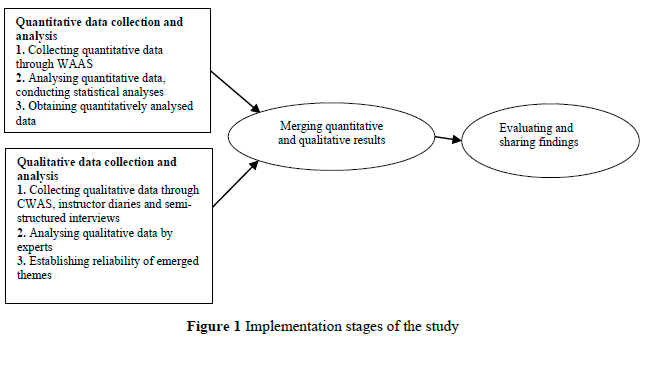
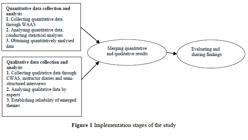
In accordance with the convergent design procedures, quantitative and qualitative data were collected in one phase - simultaneously but separately. The quantitative data were collected through a quantitative scale. The qualitative data were collected through texts written by the participants, instructor diaries, and semi-structured interviews with the participants. The data analyses were conducted separately yet concurrently at this stage. The findings were then integrated in the interpretation phase of the study as outlined by Creswell and Plano Clark (2018). The two sets of results were then merged into an overall interpretation to obtain a more complete understanding of the model's effectiveness.
Preceding the data collection process, the following four steps were followed:
1) Gathering information about the research problem from practitioners. Prior to the study, interviews were conducted with course instructors to elicit information about the methods and materials they used. It was determined that instructors employed traditional methods and activities.
2) Defining and delimiting the research problem. To base the study on actual problems to increase its potential usefulness, the students were asked to produce a piece of writing to determine the process-related and mechanical problems they experienced.
3) Carrying out a literature review. The information collected in steps 1 and 2 showed that there was a genuine need for designing an educational model that would coalesce process writing, creative writing, and collaborative writing. This prompted a literature review on how process and creative and collaborative writing could be taught in an effective educational framework.
4) Devising an action plan. A preliminary version of an educational model that included the three components mentioned in step 3 was initially designed, tested, and revised. A 10-week action plan was then prepared to improve the prospective teachers' writing skills.
Participants
The participants were 64 prospective freshman Turkish teachers (22 male and 46 female) who voluntarily participated in the creative writing activities and produced a piece of writing over 10 weeks.
Data Collection Tools
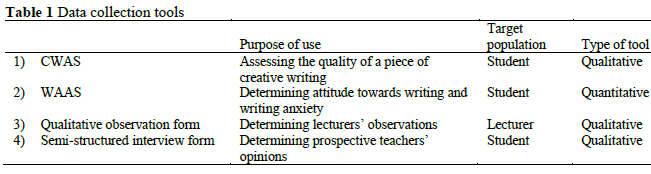
The quantitative data were collected through the writing attitude and anxiety scale (WAAS) (Karatay, 2011, 2020). The WAAS is a psychometric 5-point interval scale which consists of 24 items and four dimensions. The dimensions and the number of the items for each dimension are writing desire (8 items), attitude towards composing (5 items), attitude towards spelling and punctuation (6 items), and writing anxiety (5 items). The first three are grouped under the category, Attitudes towards Writing, while the fourth, Writing Anxiety, is a category by itself.
The qualitative data were collected through the creative writing assessment scale ([CWAS] Karatay, 2011, 2020), diaries that instructors were asked to keep, and semi-structured interviews with the participants. The CWAS has a 3-point scoring guide (1-3-5) that assessors use to score students' writing. The scale consists of four dimensions and 16 items. The dimensions are (1) originality, (2) style, (3) text structure, and (4) the mechanics (spelling, punctuation, and page layout knowledge). Each dimension has four items that assess the qualities that should exist in a piece of creative writing. The data collection tools used in this action research study are presented in Table 1.
Implementation of the action plan for data collection
In teaching the writing process, the 4 + 1 PWEM was used. Regarding the topics for writing, creative writing topics were selected, and in the assessment of the participants' texts, the CWAS was used. All writing activities were conducted in groups of four to five participants in the writing workshop.
In administering the prepared action plan, quantitative data were collected through the WAAS at the beginning and at the end of the study to determine the changes in the participants' attitudes towards writing and their writing anxiety.
Qualitative data were collected, also at the beginning and at the end of the study using the CWAS to score the texts that the participants had produced, through instructor diaries, and through semi-structured interviews with the participants to assess the effectiveness of the model. The stages of implementation are presented in Figure 1.
Determining the Reliability of the Data
In establishing the reliability of the qualitative data, each written text was scored by two field experts first, using the scoring guide of the CWAS. The data from the instructors' diaries and the interviews were also given to two field experts to seek expert opinion and to code the emergent themes. Finally, the reliability of the CWAS and the other data types were calculated using Miles and Huberman's (1994:64) formula.
The reliability of the WAAS was calculated using statistical analysis. The overall Kaiser-Mayer Olkin (KMO) reliability measurement of the scale was 0.88. The reliability of the dimensions of the scale were 0.86 for writing desire, 0.84 for attitude towards composing, 0.78 for attitude towards spelling and punctuation and 0.60 for writing anxiety. The results presented in Table 2 below show that the data were reliable.
Data Analysis
To determine the type of statistical analyses to be performed, the Kolmogorov-Smirnov test was used to determine whether the distribution of the quantitative data obtained from the WAAS and the qualitative data quantified through the CWAS differed from the normal distribution. The results show that the differences observed in the distribution of the data were insignificant. Therefore, parametric tests were used in the analysis of quantitative data. Following the recommendation by Field (2009), paired samples t-tests were performed.
The qualitative data in this study were collected from three sources. The scores were obtained through the CWAS and were subjected to paired samples t-test analysis, having calculated the mean scores, and formed the first part of the qualitative findings. The second portion of the data came from instructor diaries. The third portion was obtained from the semi-structured interviews with the participants; the interviews were conducted at the end of the study. They were recorded, transcribed and analysed by doing content analysis and the results are presented as themes.
Results
In answering the research questions, qualitative findings were used for questions 1, 4 and 5 and quantitative findings for questions 2 and 3.
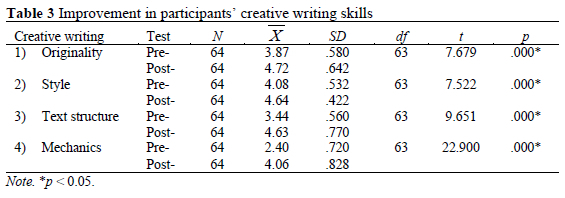
Research Question 1: Model's Contribution to the Development of Creative Writing Skills To answer this question, the data collected through the CWAS were used in assessing the extent of development in the participants' creative writing skills. The analysis of the participants' mean scores on the CWAS where 5 is the maximum score are presented under the four dimensions of the scale to show development by the participants in terms of originality, style, text structure knowledge, and mechanics such as spelling, punctuation and page layout knowledge (cf. Table 3).
Development of originality
The mean scores of the first (X = 3.87) and the final (X = 4.72) texts show a highly significant difference between week 1 and week 10 (t(63) = 7.679, p < .000). These results show that originality increased in the participants' texts.
Development of style
The participants' creative writing skills improved in terms of style as the mean scores of the first ( X = 4.08) and the final (X = 4.64) texts show a highly significant difference (t(63) = 7.522, p < .000) between week 1 and week 10.
Development of text structure knowledge
A highly significant difference was observed in the mean scores of the first (X = 3.44) and the final ( X = 4.63) texts' scores between week 1 and week 10 (t(63) = 9.651, p < .000) which indicates a significant improvement in the participants' knowledge of text structure.
Development of mechanics: Spelling, punctuation, and page layout knowledge
The mean scores of the first (X = 2.40) and the final (X = 4.06) texts reveal a highly significant difference between week 1 and week 10 (t(63) = 22.900, p < .000). Based on the test results, it was determined that a positive and significant improvement occurred in the students' spelling, punctuation, and page layout knowledge.
Research Question 2: Model's Contribution in Terms of Attitudes towards Writing and Writing Anxiety
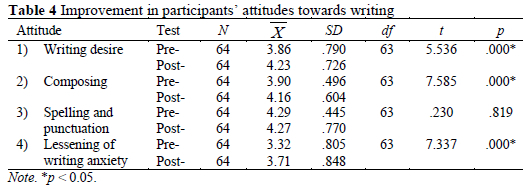
To answer this research question, the data obtained through the first four dimensions of the WAAS were used to determine to what extent improvement in the participants' attitudes towards writing took place. The pre- and post-test results are presented in Table 4.
Writing desire
The mean scores of the pre-test (X = 3.86) and post-test (X = 4.23) of the first dimension of the WAAS show a highly significant difference between week 1 and week 10 (t(63) = 5.536, p < .000). The results show a positive and significant improvement in the participants' desire to write.
Attitude towards composing
Regarding the second dimension, the mean scores of the pre-test (X = 3.90) and the post-test ( X = 4.16) also show a highly significant difference between week 1 and week 10 (t(63) = 7.585, p < .000). These results show a positive and significant improvement in the participants' attitudes towards composing.
Attitude towards spelling and punctuation
The mean scores of the pre-test (X = 4.29) and the post-test (X = 4.27) did not show a significant difference between week 1 and week 10 (t(63) = .230, p > .000). These results indicate that a change was not observed in the participants' attitudes towards spelling and punctuation which are mechanical aspects of writing.
As for the effect of the model on the participants' writing anxiety, the data obtained through the items in the WAAS that were designed to assess the changes in the participants' writing anxiety were used. The mean scores of the pre-test ( X = 3.32) and the post-test (X = 3.71) reveal a significant difference between week 1 and week 10 (t(63) = 7.337, p < .000). These results exhibit that a significant decrease occurred in the participants' writing anxiety.
Research Question 3: Instructors' Observations regarding the Effectiveness of the Model
To answer this question, content analysis of the data collected through the diary entries that the instructors were asked to make are presented under six themes that emerged, namely self-regulation, collaborative writing, writing interest and desire, students' self-sufficiently managing the writing process, creative writing skills and publishing in a fanzine.
Self-regulation
It was reported in week 1 that eight participants were not able to do writing by themselves. This finding is interesting in that, although independent writing was the only type of writing instruction the participants had received through their years of education, a significant proportion of the participants openly stated that they were still unable to write by themselves. The situation improved significantly, and, in week 4, 57 of those participants were reported to be able to write independently. Only one student was reported to experience difficulty in writing independently until the end of the study.
Collaborative writing
This theme focused on the prospective teachers' participation in the writing workshops. The observation records show that in the first 3 weeks, the prospective teachers did not participate dutifully in the activities without stating any reason. Their reluctance was in the form of passive resistance and displayed itself in their joining the activities late. When they were asked why they did so, the participants stated that they did not know how to write collaboratively. This finding is a lingering negative effect of years of doing writing individually. The students did not know much about the collaborative nature of writing; thus, they did not participate in the writing workshops. This problem disappeared in week 3.
Writing interest and desire
The observation findings in this theme signalled fluctuating results. The fluctuation stemmed from the fact that some topics were more appropriate for all students to write about while some were appropriate for one gender or the other. Because of this, an increase was observed in the participants' writing desire in weeks 2, 4, 6, 7, 8, 9 and 10 and, in weeks 1, 3, and 5 low weekly scores were reported.
Students' self-sufficiently managing the writing process
In the first 4 weeks the participants were given instruction to help them execute all steps of the writing process by themselves through the model. In weeks 1 and 2 it was reported that 56 students were not able to execute all steps of the writing process by themselves. The instruction to teach the participants how to do writing as a process, made the number to decrease steadily to 26 in week 3 and to 14 in week 4 in the diary reports. In the remainder of the research, it was reported that only one student was not self-sufficient in terms of managing the writing process in its entirety.
Creative writing skills
The analysis of the diary entries displayed a discernible improvement in the participants' creative writing skills from week 5 onwards. In week 5, problems were observed in four participants regarding being open to development, effectiveness of expression, vocabulary selection and text type knowledge. In week 6, four participants were observed to experience problems with style, not being able to provide depth in writing and writing fluency. In week 7, only one student was reported to have problems with style, not benefiting from ways of improving thinking and writing fluency. Finally, in week 10, only one participant was reported to have problems with the mechanical aspects of writing, namely, spelling, punctuation, and page layout knowledge. Starting in week 6, the low scores in the CWAS heralded continuous improvement in the participants' creative writing skills. These results show that creative writing skills improve when participants do more writing.
Publishing in a fanzine
Another factor that increased the participants' interest and desire for writing was the workshop fanzine, which included the participants' written works. The diary entries showed that the publication of the fanzine from week 4 onwards increased and strengthened the participants' interests and desires in writing, and it also led to their active participation in writing as they assumed responsibility in the process.
Research Question 4: Participants' Opinions
regarding Collaborative Writing in the Model To answer this question, the findings based on the content analysis of the semi-structured interviews are presented under six themes.
Writing process
The first theme that emerged was the writing process. In the analysis, five categories emerged, namely, development of the planning skill at the prewriting stage through 4 + 1 PWEM, ability to express self, discovering writing abilities, providing motivation, and decrease in writing anxiety through writing activities. The findings show that the model enabled the participants to discover their ability to express themselves in writing by executing all steps of the writing process. This led to an increase in their motivation to write and also led to a decrease in their writing anxiety. The participants stated that progress in these five areas continued to increase throughout the study. Twenty-nine participants reported seeing improvement in week 4; the number increased to 62 participants in week 6.
Creative writing skills
The interviews indicated improvement in the participants' creative writing skills in terms of originality, style, text type knowledge, and spelling and punctuation skills. Progressive improvement was reported in those areas. Twenty-one participants reported noticing improvement in week 5. The number reached 61 in week 10.
Collaborative writing
In terms of developing the participants' collaborative writing skills, improvement was observed in six categories, namely, developing the writing habit, correcting writing mistakes, giving feedback, providing practice opportunities for the application of theoretical knowledge, expanding writers' horizons via discussion among group members, and increasing motivation for writing. In the interviews, the participants reported that they had acquired writing skills, that the peer feedback they had received in groups expanded their horizons as writers, and that their motivation for writing increased as they put the theoretical knowledge they had learned into practice. Twenty-six participants reported that they began to see improvement in week 5. The number went up to 62 in week 7.
Writing interest and desire
The data analysis revealed three categories: increase in personal desire to write, improving attitude towards writing, and decrease in writing anxiety. The analysis shows that the model increased personal desire for writing, decreased writing anxiety and improved attitudes towards writing. In the interviews, 26 participants reported improvement in week 5. In week 10 the number reached 64.
Publishing in a fanzine
Three categories emerged in the data analysis: becoming familiar with different styles of writing, providing feedback, and providing motivation. The participants reported that the six fanzines they had prepared and published increased their motivation for writing and text type knowledge. Twenty-five participants reported seeing improvement in week 5. In week 10, the number was 64.
Recommendations Made by the Participants
As for recommendations made by the participants, there was only one category: determination of the topics by the participants. Four participants stated that they wanted to choose the topics for writing themselves by voting.
These results indicate that the model positively and significantly improved the participants' creative writing skills and their attitudes towards writing, and led to a decrease in their writing anxiety. The analyses of the diary entries and interviews also provided evidence that confirmed the effectiveness of the model.
Discussion
Process writing has a positive effect on students' language development (Sahin, 2019) and process-based writing activities play a crucial role in developing their writing skills (Aksu, 2015; Duru & iseri, 2015; Erdogan, 2012; Görgüc, 2016; Graham & Sandmel, 2011; Kaldirim, 2014; Kapar Kuvanc, 2008; Karatosun, 2014; Özkara, 2007; Sentürk, 2009; Susar Kirmizi, 2009; Ülper, 2008). Although it is possible to find studies on the positive effects of process writing, no effort has been made to develop students' creative writing skills through teaching writing as a process in a collaborative environment. Therefore, to provide an effective and reliable educational model to be used for that purpose, this study was designed to develop such an educational framework based on the 4 + 1 PWEM model. The findings show that the research objectives were successfully achieved as the participating students overcame the problems they had experienced regarding collaborative writing in the first 2 weeks of the study. Improvements began to be seen in the students' creative writing ability, originality, style, text structure, and mechanics of writing after week 6. These positive developments indicate that the model is effective as it combines process, collaboration, and creativity.
Firstly, substantial improvement was observed in the participants' creative writing skills. When this result was coupled with the qualitative data collected through diary entries and interviews, it was seen that effective use of imagination, continuous and orderly production process, motivation for writing (Barbot, Tan, Randi, Santa-Donato & Grigorenko, 2012) and regular feedback throughout the process improved the participants' creative writing skills. Similar results were obtained with different target groups (Gardiner, 2017).
Secondly, data analysis indicated considerable improvement in the participants' writing skills throughout the study. Based on the qualitative findings, it may be stated that the improvement stemmed from the practices that developed independent writing, cooperative writing, writing interest and desire in the participants, and from the effectiveness of the feedback given by the instructors. Independent writing means that the participants learned to conduct the entire writing process themselves. In addition, the collaborative and interactive writing process structured in a clear and transparent manner (Assaf, Ralfe & Steinbach, 2016; Davidson, 2007; Martin & Dismuke, 2015; Roth & Guinee, 2011) was useful in developing independent writing skills.
Prior to this study, it was proven via research (Ahraz, 2018; Balci, 2017; Karatay & Aksu, 2017; Karatosun, 2014; Selanikli, 2016) that the model improved the writing skills of students in grades 4, 5, 6, 7 and 8 who were taught writing through itself and that it helped students acquire skills, self-regulation, and self-efficacy to be able to carry out the performance and project assignments on their own. Similar results were obtained in the B1 and B2 level undergraduate students who learned Turkish as a foreign language (Alan, 2019; Çocuk & Yanpar Yelken, 2021; Karatay & Ekinci, 2019; Sentürk, 2009; Yildirim, 2018). Recently, it has been stated that the model is effective in teaching the argumentative (Demirel & Karatay, 2022) and persuasive (ipek & Karatay, 2023) essay types, which are two of the common types of academic writing needed by undergraduate students. When these data are aggregated with the observations made by the participating teachers and the opinions of the participating students, it may be stated that the 4 + 1 PWEM not only equips students with metacognitive awareness strategies about the writing process but improves their self-regulation and self-efficacy as it improves their writing skills as well.
The results also show that following the phases of instruction and practice in collaborative writing, the participants became better writers and produced better quality products. In this respect, developing cooperative writing through activities helped the participants become more qualified writers as was reported in other studies (Elola & Oskoz, 2010; Helstad & Lund, 2012; Martin & Dismuke, 2015; Noël & Robert, 2004; Storch, 2005; Yarrow & Topping, 2001).
Another important factor in teaching writing is the use of different text types. Practice in producing different types of texts increases students' motivation (Helstad & Lund, 2012). In this study, text types, such as letters, were used as they encourage active thinking in the composing stage. They also play an instrumental role in increasing students' writing interest and desire (Parker, 2010).
The findings also underline the importance of feedback. Previous studies such as by Zellermayer (1990) report teachers' reluctance to give feedback during the writing process and their considering feedback as a short-term solution and not believing in its effectiveness. In this study, the participants considered peer feedback in groups and feedback through the CWAS useful. To carry out the writing process successfully, a teacher may formulate specific goals to give feedback, use peer assessment and self-assessment in providing regular feedback, clearly manage the writing process, and help students acquire metacognitive skills in a pedagogically effective way (Gardiner, 2017; Martin & Dismuke, 2015; Myhill, Jones & Watson, 2013; Parr & Limbrick, 2010; Schuldt, 2019).
Conclusion
This study, which combined the teaching and practice of process writing with creative writing in a collaborative learning environment using the 4 + 1 PWEM model, improved the participants' attitudes towards writing and lessened their writing anxiety. In this sense, its results are similar to those of other studies (Jahin, 2012; Sahin, 2019; Swander et al., 2007).
Another contribution of this study is the finding that the publication of the participants' writings in a fanzine appeared to be a contributing factor to increase their interest and desire for writing. The active participation of the participants in the design, editing, and publication of the fanzine increased the benefits they had gained from the workshop. The contribution of the workshop fanzine in this way may also be considered a factor that enhanced the effectiveness of the model. In other words, seeing their writing in a materialised form was a great source of motivation for the participants.
With this study we confirmed the findings of previous studies conducted with prospective teachers (Diaz Larenas et al., 2017; Hamzadayi & Cetinkaya, 2011; Karatay, 2011; Özdemir, 2014; Topuzkanamis, 201 4) as it shows once again that process writing is effective in developing writing skills. It also confirms the findings of the studies conducted with pre-service teachers, which report that topics not chosen by the participants do not always create motivation to write and lead to a decrease in writing desire.
The findings of this study also support studies which report that when topics are determined by the participants, more effective learning will take place in writing instruction (Hoover, 1994; Parr & Limbrick, 2010). The recommendation made by the participants in this study to choose the topics to write about is thus supported by those studies. However, it would be useful to keep in mind that relying merely on pre-service teachers' perceptions about the writing process will not always be entirely sufficient in designing an effective learning experience for students (Martin & Dismuke, 2015). The professional knowledge and experience of instructors should also be included in the process in addition to the recommendations made by the students.
In conclusion, we reported on the results of an action research designed to develop a comprehensive and effective educational model that combines the teaching and practice of writing as a process and creative writing in a collaborative environment for prospective language teachers. This model may be used in teaching the writing process and developing the creative writing skills of all students who need to learn how to do writing by themselves.
Authors' Contributions
All work was jointly done by the authors.
Notesi. Published under a Creative Commons Attribution Licence.
References
- Ahraz S 2018. The effect of planned writing method on primary school fourth grade students' achievement in creating original texts. Master's thesis. Aksaray, Turkey: Aksaray University.
- Akpinar FB 2007. The effect of process-oriented writing instruction on writer's block, writing apprehension, attitudes towards writing instruction and writing performance. Master's thesis. Istanbul, Turkey: Marmara University.
- Aksan D 1993. Türkçenin gücü [The power of Turkish]. Ankara, Turkey: Bilgi Yayinevi.
- Aksu Ö 2015. Impact of planned writing and assessment model on preparation of performance works of eight class students. Master's thesis. Bolu, Turkey: Abant Izzet Baysal University.
- Alan Y 2019. The effect of the 4+1 planned writing and evaluation model on the writing and coherence device usage skills of students learning Turkish as a foreign language. PhD dissertation. Hatay, Turkey: Mustafa Kemal University.
-
Assaf LC, Ralfe L & Steinbach B 2016. South African teachers learning to become writers and writing teachers: A study of generative learning. Teaching and Teacher Education, 56:173-184. https://doi.org/10.1016/j.tate.2016.02.011
» https://doi.org/10.1016/j.tate.2016.02.011 -
Bagci H 2019. The effect of 4+1 planned writing and evaluation model on developing writing skills and writing self-sufficiency levels of learners of Turkish as a foreign language. Educational Policy Analysis and Strategic Research, 14(3):7-25. https://doi.org/10.29329/epasr.2019.208.1
» https://doi.org/10.29329/epasr.2019.208.1 - Balci O 2017. The effect of the 4+1 planned writing assessment model on improving 6th grade students' writing skills and attitudes towards writing. Master's thesis. Bolu, Turkey: Abant Izzet Baysal University.
-
Barbot B, Tan M, Randi J, Santa-Donato G & Grigorenko EL 2012. Essential skills for creative writing: Integrating multiple domain-specific perspectives. Thinking Skills and Creativity, 7(3):209-223. https://doi.org/10.1016/j.tsc.2012.04.006
» https://doi.org/10.1016/j.tsc.2012.04.006 -
Bayat N 2014. The effect of the process writing approach on writing success and anxiety. Educational Sciences: Theory & Practice, 14(3):1133-1141. https://doi.org/10.12738/estp.2014.3.1720
» https://doi.org/10.12738/estp.2014.3.1720 - Bazerman C, Graham S, Applebee AN, Matsuda PK, Berninger V, Murphy S, Brandt D, Rowe DW & Schleppegrell M 2017. Taking the long view on writing development. Research in the Teaching of English, 51(3):351-360.
-
Ceyhan NG 2014. Sürej-odakli yazma yaklasiminin yazma dersindeki yeri ve etkisi [The effect and place of process writing approach in writing]. Dil Dergisi, 163:46-63. https://doi.org/10.1501/Dilder_0000000206
» https://doi.org/10.1501/Dilder_0000000206 -
Cocuk HE & Yanpar Yelken T 2021. The effect of planned writing model on writing anxiety, self-efficacy and B2 Level achievement of learners of Turkish as a foreign language [Special issue]. Journal of Language and Linguistic Studies, 17(1):458-471. Available at https://search.informit.org/doi/epdf/10.3316/informit.167225249478663. Accessed 27 December 2023.
» https://search.informit.org/doi/epdf/10.3316/informit.167225249478663 - Creswell JW & Plano Clark VL 2018. Designing and conducting mixed methods research (3rd ed). Thousand Oaks, CA: Sage.
- Culham R 2003. 6+1 traits of writing: The complete guide grades 3 and up. New York, NY: Scholastic Professional Books.
-
Davidson C 2007. Independent writing in current approaches to writing instruction: What have we overlooked? English Teaching: Practice and Critique, 6(1):11-24. Available at https://files.eric.ed.gov/fulltext/EJ832129.pdf. Accessed 15 December 2020.
» https://files.eric.ed.gov/fulltext/EJ832129.pdf -
Demirel A & Karatay H 2022. 4+1 planli yazma ve degerlendirme modeli jerjevesinde gerjeklestirilen hazirliklarin yazma sürecindeki islevleri [The functions of preparatory activities within the framework of the 4+1 planned writing and evaluation model in the writing process]. Ana Dili Egitimi Dergisi, 10(1):104-118. https://doi.org/10.16916/aded.1003248
» https://doi.org/10.16916/aded.1003248 - Denzin NK (ed.) 1978. Sociological methods: A sourcebook (2nd ed). New York, NY: McGraw-Hill.
-
Díaz Larenas C, Ramos Leiva L & Ortiz Navarrete M 2017. Rhetorical, metacognitive, and cognitive strategies in teacher candidates' essay writing. Profile: Issues in Teachers' Professional Development, 19(2):87-100. https://doi.org/10.15446/profile.v19n2.60231
» https://doi.org/10.15446/profile.v19n2.60231 -
Doyle L, Brady AM & Byrne G 2009. An overview of mixed methods research. Journal of Research in Nursing, 14(2):175-185. https://doi.org/10.1177/1744987108093962
» https://doi.org/10.1177/1744987108093962 -
Duru A & Íseri K 2015. Altinci sinif ögrencilerinin yaratici yazma becerilerini gelistirmeye yönelik stratejilerin etkililiginin degerlendirilmesi [Evaluation of effectiveness of strategies for improving creative writing skills of sixth grade students]. Baskent University Journal of Education, 2(1):40-51. Available at http://buje.baskent.edu.tr/index.php/buje/article/view/22/29. Accessed 15 December 2020.
» http://buje.baskent.edu.tr/index.php/buje/article/view/22/29 -
Elola I & Oskoz A 2010. Collaborative writing: Fostering foreign language and writing conventions development. Language Learning & Technology, 14(3):51-71. Available at https://scholarspace.manoa.hawaii.edu/server/api/core/bitstreams/e291f3a7-96f9-45f1-ad51-0a83673d66f6/content. Accessed 15 December 2020.
» https://scholarspace.manoa.hawaii.edu/server/api/core/bitstreams/e291f3a7-96f9-45f1-ad51-0a83673d66f6/content - Erdogan Ö 2012. The effects of process based creative writing activities on students? Writing expression and attitude towards writing. PhD dissertation. Ankara, Turkey: Hacettepe University.
-
Erdogan Ö & Yangin B 2014. Sürej temelli yaratici yazma uygulamalarinin yazili anlatima ve yazmaya iliskin tutuma etkisi [The effects of process based creative writing activities on students' writing expression and attitude towards writing]. Abant izzet Baysal Üniversitesi, Egitim Fakültesi Dergisi, 14(1):438-459. https://doi.org/10.17240/aibuefd.2014T4.1-5000091521
» https://doi.org/10.17240/aibuefd.2014T4.1-5000091521 - Field A 2009. Discovering statistics using SPSS (3rd ed). Thousand Oaks, CA: Sage.
-
Flower L & Hayes JR 1981. A cognitive process theory of writing. College Composition and Communication, 32(4):365-387. https://doi.org/10.2307/356600
» https://doi.org/10.2307/356600 -
Gardiner P 2017. Rethinking feedback: Playwriting pedagogy as teaching and learning for creativity. Teaching and Teacher Education, 65:117-126. https://doi.org/10.1016/j.tate.2017.03.009
» https://doi.org/10.1016/j.tate.2017.03.009 - Görgüç Ç 2016. The effect of analytical writing and evaluation on writing attitude and achievement of the 6th graders. Master's thesis. Konak, Turkey: Dokuz Eylul University.
-
Graham S & Sandmel K 2011. The process writing approach: A meta-analysis. The Journal of Educational Research, 104(6):396-407. https://doi.org/10.1080/00220671.2010.488703
» https://doi.org/10.1080/00220671.2010.488703 -
Hamzadayi E & Cetinkaya G 2011. Yazili anlatimi düzenlemede akran dönütleri: Dönüt türleri, ögrenci algilari [Peer feedbacks in revision of written expressions: Feedback types, students' perceptions]. Abant izzet Baysal Üniversitesi, Egitim Fakültesi Dergisi, 11(1):147-165. Available at https://dergipark.org.tr/tr/download/article-file/16840. Accessed 15 December 2020.
» https://dergipark.org.tr/tr/download/article-file/16840 - Harper G 2015. Creative writing and education: An introduction. In G Harper (ed). Creative writing and education. Bristol, England: Multilingual Matters.
- Hayes B, Bonner A & Douglas C 2013. An introduction to mixed methods research for nephrology nurses. Renal Society of Australasia Journal, 9(1):8-14.
-
Helstad K & Lund A 2012. Teachers' talk on students' writing: Negotiating students' texts in interdisciplinary teacher teams. Teaching and Teacher Education, 28(4):599-608. https://doi.org/10.1016/j.tate.2012.01.004
» https://doi.org/10.1016/j.tate.2012.01.004 -
Hoover LA 1994. Reflective writing as a window on preservice teachers' thought process. Teacher and Teacher Education, 10(1):83-93. https://doi.org/10.1016/0742-051X(94)90042-6
» https://doi.org/10.1016/0742-051X(94)90042-6 - Ipek O & Karatay H 2023. The effect of process-genre model on the development of pre-service teachers' persuasive writing skills. Journal of Mother Tongue Education, 11(1):1 -29.
-
Jahin JH 2012. The effect of peer reviewing on writing apprehension and essay writing ability of prospective EFL teachers. Australian Journal of Teacher Education, 37(11):60-84. https://doi.org/10.14221/ajte.2012v37n11.3
» https://doi.org/10.14221/ajte.2012v37n11.3 - Kaldirim A 2014. The effect of 6+1 analytical writing and evaluation model on the sixth-grade students' writing expression skills. Master's thesis. Kütahya, Turkey: Dumlupinar University.
-
Kan MO & Tiryaki EN 2015. Problems of Turkish teacher candidates on constituting text. Mersin University Journal of the Faculty of Education, 11(2). https://doi.org/10.17860/efd.19368
» https://doi.org/10.17860/efd.19368 - Kapar Kuvanj EB 2008. The effect of creative writing techniques to students' attitudes to Turkish course and their successes in Turkish courses. Master's thesis. Konak, Turkey: Dokuz Eylul University.
-
Karatay H 2011. 4+1 planli yazma ve degerlendirme modelinin ögretmen adaylarinin yazili anlatim tutumlarini ve yazma becerilerini gelistirmeye etkisi [The effect of 4+1 planned writing and evaluation model to develop the attitudes of preservice teachers as to written expression and their writing skills]. Turkish Studies, 6(3):1029-1047. https://doi.org/10.7827/TurkishStudies.2622
» https://doi.org/10.7827/TurkishStudies.2622 - Karatay H 2013. 4+1 Planli yazma ve degerlendirme modeli [4+1 planned writing and evaluation model]. In M Özbay (ed). Yazma egitimi. Ankara, Turkey: Pegem Akademi Yayinlari.
- Karatay H 2020. Türkjenin yabanci dil olarak ögretiminde yazma egitimi [Writing education in teaching Turkish as a foreign language]. In H Karatay (ed). Tiirkqenin yabanci dil olarak ögretimi el kitabi iqinde. Ankara, Turkey: Pegem Akademi.
-
Karatay H & Aksu Ö 2017. 4+1 planli yazma ve degerlendirme modelinin 8. sinif ögrencilerinin ev ödevlerini hazirlamaya etkisi [Impact of 4+1 planned writing and evaluation model on homework preperation of 8th grade students]. Ana Dili Egitimi Dergisi, 5(2):313-335. https://doi.org/10.16916/aded.302765
» https://doi.org/10.16916/aded.302765 -
Karatay H & Ekinci Z 2019. ísbirlikli yazmanin jok dilli ögrencilerin yazma becerilerini gelistirmeye etkisi [The effect of cooperative writing on the development of writing skills of multilingual students]. Avrasya Dil Egitimi ve Arastirmalari Dergisi, 3(1):1-17. Available at https://dergipark.org.tr/tr/pub/adea/issue/46350/554606. Accessed 10 November 2020.
» https://dergipark.org.tr/tr/pub/adea/issue/46350/554606 - Karatosun S 2014. The effect of planned writing and evaluation model on enhancing 5th grade students' composition writing skills. Master's thesis. Antakya, Turkey: Mustafa Kemal University.
-
Kaya B 2013. Yaratici yazma becerisinin gelistirilmesine yönelik yapilan jalismalardan bir derleme [A compilation of studies conducted for development of the creative writing skills]. Okuma Yazma Egitimi Arastirmalari, 1(2):89-101. Available at https://dergipark.org.tr/tr/download/article-file/190692. Accessed 10 November 2020.
» https://dergipark.org.tr/tr/download/article-file/190692 - Kroll J 2013. Creative writing and education. In G Harper (ed). A companion to creative writing. West Sussex, England: John Wiley & Sons, Ltd.
- MacArthur CA, Graham S & Fitzgerald J (eds.) 2008. Handbook of writing research. New York, NY: Guilford Press.
-
Martin SD & Dismuke S 2015. Teacher candidates' perceptions of their learning and engagement in a writing methods course. Teaching and Teacher Education, 46:104-114. https://doi.org/10.1016/j.tate.2014.11.002
» https://doi.org/10.1016/j.tate.2014.11.002 - Miles MB & Huberman AM 1994. Qualitative data analysis: An expanded sourcebook (2nd ed). Thousand Oaks, CA: Sage.
- Millï Egitim Bakanligi 2006. ilkögretim Türkqe dersi (6, 7, 8. siniflar) ögretim programi [Primary education Turkish lesson (6th, 7th, 8th grades) curriculum]. Ankara, Turkey: Author.
-
Millï Egitim Bakanligi 2015. Türkqe dersi (1-8. siniflar) ögretim programi [Turkish course (grades 1-8) curriculum program]. Ankara, Turkey: Author. Available at http://web.deu.edu.tr/ilyas/ftp/turkce2015.pdf. Accessed 10 November 2020.
» http://web.deu.edu.tr/ilyas/ftp/turkce2015.pdf -
Molina-Azorin JF 2016. Editorial: Mixed methods research: An opportunity to improve our studies and our research skills. European Journal of Management and Business Economics, 25(2):37-38. https://doi.org/10.1016/j.redeen.2016.05.001
» https://doi.org/10.1016/j.redeen.2016.05.001 - Murray DM 1972. Teach writing as a process, not product. The Leaflet, 71(3):11-14.
-
Murray DM 2003. Teach writing as a process not product. In V Villanueva (ed). Cross-talk in comp theory: A reader (2nd ed). Urbana, IL: National Council of Teachers of English. Available at https://files.eric.ed.gov/fulltext/ED474209.pdf. Accessed 31 December 2023.
» https://files.eric.ed.gov/fulltext/ED474209.pdf -
Myhill D, Jones S & Watson A 2013. Grammar matters: How teachers' grammatical knowledge impacts on the teaching of writing. Teaching and Teacher Education, 36:77-91. https://doi.org/10.1016/j.tate.2013.07.005
» https://doi.org/10.1016/j.tate.2013.07.005 -
Noël S & Robert JM 2004. Empirical study on collaborative writing: What do co-authors do, use, and like? Computer Supported Cooperative Work (CSCW), 13(1):63-89. https://doi.org/10.1023/B:COSU.0000014876.96003.be
» https://doi.org/10.1023/B:COSU.0000014876.96003.be - Nystrand M 2008. The social and historical context for writing research. In CA MacArthur, S Graham & J Fitzgerald (eds). Handbook of writing research. New York, NY: The Guilford Press.
- Özdemir B 2014. The effect of analytical writing and assessment method on pre-service Turkish teachers' writing skills and attitudes towards writing. PhD dissertation. Ankara, Turkey: Gazi University.
- Özkara Y 2007. The effect of 6+1 analytic writing and evaluative model on enhancing 5th grade students' narrative writing skills. PhD dissertation. Ankara, Turkey: Gazi University.
- Par AH 1974. Pldnlt yazma sanati: Kompozisyon [The art of planned writing: Composition]. istanbul, Turkey: Minnetoglu Yayinlari.
-
Parker DC 2010. Writing and becoming [a teacher]: Teacher candidates' literacy narratives over four years. Teaching and Teacher Education, 26(6):1249-1260. https://doi.org/10.1016/j.tate.2010.03.002
» https://doi.org/10.1016/j.tate.2010.03.002 -
Parr JM & Limbrick L 2010. Contextualizing practice: Hallmarks of effective teachers of writing. Teaching and Teacher Education, 26(3):583-590. https://doi.org/10.1016/j.tate.2009.09.004
» https://doi.org/10.1016/j.tate.2009.09.004 - Raimes A 1983. Techniques in teaching writing. New York, NY: Oxford University Press.
-
Roth K & Guinee K 2011. Ten minutes a day: The impact of interactive writing instruction on first graders' independent writing. Journal of Early Childhood Literacy, 11(3):331-361. https://doi.org/10.1177/1468798411409300
» https://doi.org/10.1177/1468798411409300 -
§ahin N 2019. Türkje dersi kapsaminda gerjeklestirilen yaratici yazma uygulamalarinin ögrencilerin tutumlari üzerindeki etkisinin meta-analiz ile incelenmesi [A meta-analysis of the effect of creative writing practices carried out within the scope of Turkish language arts course on students' attitudes]. Ana Dili Egitimi Dergisi, 7(1):115-129. https://doi.org/10.16916/aded.468520
» https://doi.org/10.16916/aded.468520 -
Schuldt LC 2019. Feedback in action: Examining teachers' oral feedback to elementary writers. Teaching and Teacher Education, 83:64-76. https://doi.org/10.1016/j.tate.2019.03.020
» https://doi.org/10.1016/j.tate.2019.03.020 - Selanikli E 2016. The effect of 4+1 Planned Writing and Evaluation Model on 7th grade students' preparation of performance tasks and project assignments. Master's thesis. Bolu, Turkey: Abant Izzet Baysal University.
- Sentürk N 2009. The effect of planned writing and evaluating model on enhancing 8th grade students' expository writing skills. Master's thesis. Bolu, Turkey: Abant Izzet Baysal University.
-
Sever E & MemisA 2013. Sürej temelli yazma modellerinin ilkokul dördüncü sinif ögrencilerinin yazim-noktalama becerisine ve yazma egilimine etkisi [The effects of process-based writing models on primary school 4th grade students' spelling-punctuation skills and writing dispositions]. Karadeniz Sosyal Bilimler Dergisi, 5(9). Available at https://dergipark.org.tr/tr/pub/ksbd/issue/16222/169897. Accessed 10 November 2020.
» https://dergipark.org.tr/tr/pub/ksbd/issue/16222/169897 -
Storch N 2005. Collaborative writing: Product, process, and students' reflections. Journal of Second Language Writing, 14(3):153-173. https://doi.org/10.1016/jjslw.2005.05.002
» https://doi.org/10.1016/jjslw.2005.05.002 -
Susar Kirmizi F 2009. Türkje dersinde yaratici drama yöntemine dayali yaratici yazma çalismalannin yazmaya yönelik tutuma etkisi [The effect of creative writing activities based on creative drama method in Turkish lesson on attitude towards writing]. Yaratici Drama Dergisi, 4(7):51-68. Available at http://www.yader.org/index.php/yader/article/view/yader.2009.005/yader.2009.005. Accessed 10 November 2020.
» http://www.yader.org/index.php/yader/article/view/yader.2009.005/yader.2009.005 - Swander M, Leahy A & Cantrell M 2007. Theories of creativity and creative writing pedagogy. In S Earnshaw (ed). The handbook of creative writing. Edinburg, Scotland: Edinburgh University Press.
- Temizkan M 2008. A research on the correction and evaluation dispersions writing practices of teacher candidates. Ahi Evran University Ktrsehir Journal of Education Faculty, 9(3):49-61.
-
Tiryaki EN 2012. Üniversite ögrencilerinin yazma kaygisinin jesitli degiskenler ajisindan belirlenmesi [Determining writing anxieties of university students' from different variables]. Dil ve Edebiyat Egitimi Dergisi, 1(1):14-21. Available at http://search.proquest.com/openview/4316157e36d8b1c674ca4bbd79387d24/1?pqorigsite=gscholar&cbl=1966352. Accessed 12 November 2020.
» http://search.proquest.com/openview/4316157e36d8b1c674ca4bbd79387d24/1?pqorigsite=gscholar&cbl=1966352 - Tompkins GE 1982. Seven reasons why children should write stories. Language Arts, 59(7):718-721.
- Tompkins GE 2004. Teaching writing: Balancing product and process (4th ed). Upper Saddle River, NJ: Prentice Hall.
-
Topuzkanamis E 2014. Yazma stratejileri ögretiminin Türkje ögretmenligi birinci sinif ögrencilerinin yazma basarisina etkisi [The effect of teaching writing strategies on Turkish language teaching department freshman students' writing achievement]. Uluslararast Tiirkge Edebiyat Kültür Egitim Dergisi Sayt, 3(2):274-290. Available at https://dergipark.org.tr/tr/download/article-file/136932. Accessed 10 November 2020.
» https://dergipark.org.tr/tr/download/article-file/136932 - Trilling B & Fadel C 2009. 21st century skills: Learning for life in our times. San Francisco, CA: John Wiley & Sons.
-
Turner P & Turner S 2009. Triangulation in practice. Virtual Reality, 13(3):171-181. https://doi.org/10.1007/s10055-009-0117-2
» https://doi.org/10.1007/s10055-009-0117-2 - Ülper H 2008. The effects of teaching writing curriculum prepared in accordance with cognitive process model on student achievement. PhD dissertation. Ankara, Turkey: Ankara University.
-
Yarrow F & Topping KJ 2001. Collaborative writing: The effects of metacognitive prompting and structured peer interaction. British Journal of Educational Psychology, 71(2):261-282. https://doi.org/10.1348/000709901158514
» https://doi.org/10.1348/000709901158514 - Yildirim HC 2018. Yabanci dil olarak Türkçe ögretiminde planli yazma ve degerlendirme modelinin yazma becerisine etkisi [The effect of the planned writing and evaluation model on writing skills in teaching Turkish as a foreign language]. PhD dissertation. Ankara, Turkey: Gazi University.
-
Yilmaz M & Aklar S 2015. Planli yazma ve degerlendirme modelinin ilkögretim 5. sinif ögrencilerinin kompozisyon yazma becerilerine etkisi [The effect of planned writing and evaluation model on enhancing 5th grade students' composition writing skills] [Special issue]. Bartin Üniversitesi Egitim Fakültesi Dergisi :223-234. https://doi.org/10.14686/BUEFAD.2015USOSOzelsayi13212
» https://doi.org/10.14686/BUEFAD.2015USOSOzelsayi13212 -
Zellermayer M 1990. Teachers' development towards the reflective teaching of writing: An action research. Teacher & Teacher Education, 6(4):337-354. https://doi.org/10.1016/0742-051X(90)90026-2
» https://doi.org/10.1016/0742-051X(90)90026-2
Revised: 22 May 2023
Accepted: 9 October 2023
Published: 31 December 2023