The influence of teachers' ethics accountability system on teachers' ethics anomie behaviour
Abstract
In recent years the Chinese government and its educational administrative departments and schools have been emphasising the need to give top priority to the development of teachers' ethics, and have introduced a 1-vote veto system for teachers' ethical performance. However, the 1-vote veto system that strengthens the follow-up management of accountability results is only an expedient measure to eliminate teachers' ethics anomie behaviour. Developing and completely implementing a teacher's ethics accountability system is the fundamental policy to govern teachers' ethics anomie behaviour. To analyse the influence of the ethics accountability system on teachers' ethics anomie behaviour a questionnaire survey was conducted with 1,548 teachers in Chinese primary and secondary schools. The results show that the subject of accountability, the school's emphasis, the legal norms at the national level, and the effect of accountability results have a significant impact on teachers' ethics anomie behaviour. In order to improve the teachers' ethics accountability system and reduce teachers' ethics anomie behaviour, education administrative departments and schools should reasonably set up accountability subjects, increase schools' emphasis on accountability, enhance the operability of accountability content, and ensure the fairness of the results of accountability and the subsequent management.
accountability results; accountability subject; ethics accountability system; ethics anomie behaviour; primary and secondary school teachers
Introduction
An accountability system is a feature of the educational landscape in many countries, including the United States of America (USA), England, Australia, and Wales. Through an accountability system, governments can determine whether teachers perform according to the required standards (Mosoge & Pilane, 2014:1). Teachers' ethics is an essential quality for teachers, and teachers' ethics accountability is a part of a teachers' accountability system. The Chinese government has always attached great importance to the supervision and management of teachers' ethics and has formulated and promulgated a series of rules and regulations to improve teachers' professional ethics in recent years. In November 2018, the Ministry of Education officially issued and implemented the Guiding Opinions of the Ministry of Education on Dealing with Misconduct of College Teachers' Ethics, clearly stating its commitment to upholding ethical standards as the foremost criterion (Ministry of Education of the People's Republic of China, 2018a). It adopts a zero-tolerance policy towards ethical violations among teachers and imposes strict punishments. In 2019, the Opinions on Strengthening and Improving the Construction of Teachers ' Professional Ethics in the New Era further pointed out that in order to strengthen system construction, schools in all regions should establish and improve responsibility implementation mechanisms, and insist that accountability is adhered to strictly (Ministry of Education of the People's Republic of China, 2019).
The Chinese government, education administrative departments, and schools have always prioritised the development of teachers' professional ethics and implemented a one-vote veto system for teachers' ethics anomie behaviour. The one-vote veto system refers to the practice where teachers deemed unethical are automatically disqualified from various aspects such as annual assessments, commendations, job appointments, position reviews, and regular teacher qualifications registration. Additionally, they are prohibited from applying for higher level teaching positions for 3 years and cannot be promoted or appointed. The formulation and implementation of the one-vote veto system provides a legal guarantee for the follow-up management of the results of teachers' ethics accountability. However, a heavy fist often leads to an over-emphasis of the results of teachers' ethics accountability and its subsequent management, but other aspects of the teachers' ethics accountability system are relatively neglected, which is not conducive to the prevention and governance of teachers' ethics anomie behaviour. Although many schools in various places have implemented a teachers' ethics accountability system with a one-vote veto mechanism as the core, incidents of teachers' ethics anomie behaviour still occur from time to time, which shows that the accountability system still has some defects or deficiencies. For example, from April 2019 to the end of August 2022, the Ministry of Education publicly disclosed a total of 72 typical cases of violations of teachers' ethics. The main ethical issues involved in these cases included corporal punishment of students, sexual harassment of students, academic misconduct, paid tutoring, accepting gifts and bribes, and making erroneous statements. Therefore, exploring the teachers' ethics accountability system and its influence on teachers' ethics anomie behaviour will not only help us improve the teachers' ethics accountability system, but also help us prevent and manage teachers' ethics anomie behaviour.
Literature Review
Accountability
Accountability is derived from the word "account", which was first used in government public affairs, and was later introduced into economics, education and other fields. There is no consensus concerning the definition of this concept because "virtually every new author or editor uses his or her own concepts, conceptualizations, and frames for studying accountability" (Bovens, Goodin & Schillemans, 2014:1960). Bovens et al. define accountability as "a relational concept in another sense as well, linking agents and others for whom they perform tasks or who are affected by the tasks they perform" (Bovens et al., 2014:1965). Mulgan (2002:3) defines it as "a relationship in which one party, the holder of accountability, has the right to seek information about, to investigate and to scrutinise the actions of another party, the giver of accountability." Wiliam (2010:108), in his research on school accountability, argues that "being 'held to account' suggests there is an expectation that when a person, organization or entity is accountable, they can be expected or required to render an account of their actions (or inaction)."
Teachers' ethics accountability
Teachers' ethics accountability lies with teachers' accountability. Its scope is not as broad as that of teachers' accountability, but only for teachers' professional ethics. At present, there is not much research on teachers' ethics accountability, and only a few scholars have mentioned the connotations of teachers' ethics accountability in their research. For example, Zheng (2017:11) defines teachers' ethics accountability as a mandatory institutional constraint that school stakeholders require teachers to bear the negative consequences for their motivations and behaviour. In the research of teachers' ethics accountability, Qiao (2015:167) argues that it refers to a system of accountability in which relevant responsible subjects supervise, inquire and evaluate the performance of teachers in fulfilling their professional responsibilities according to certain rules, standards and procedures, and require them to bear the corresponding consequences. According to the definitions of accountability and professional ethics of teachers, we define teachers' ethics accountability as follows: teachers should explain to all stakeholders the ethics and behavioural codes that they should abide by, and accept rewards or punishment for the impact of their actions.
Teachers' ethics anomie behaviour
The term "anomie" originally refers to behaviour in which norms are disobeyed. Teachers' ethics anomie behaviour can be seen as a social phenomenon that is inconsistent with ethical norms (Durkheim, 1996:79). Ge (2008:5) defines teachers' ethics anomie as the behaviour or state of teachers who violate professional ethics or harm the physical and mental health of students and damage the image of teachers. W Wang (2016:8) also believes that teachers' ethics anomie behaviour refers to the abnormal behaviour in teachers' professional ethics. Although various scholars have given different definitions of the connotations of teachers' professional ethics anomie, they generally agree that it is behaviour that violates teachers' professional ethics. Therefore, in this study, teachers' professional ethics anomie is defined as a series of behaviour that does not conform to or that violate teachers' professional ethics in teachers' professional activities.
Teachers' ethics accountability system
Leithwood and Earl (2000:3) point out that an educational accountability system is composed of five dimensions: What level of accountability is to be provided? Who is expected to provide the account? To whom is the account owed? What is to be accounted for? and What are the consequences of providing an account? Mulgan (2003:13) points out that an accountability system generally includes at least three aspects: the subject of public accountability (who is accountable?), the object of accountability (whom is accountable to), and the cause of accountability (accountable for what). Hu and Li (2012:22) analysed the structure diagrams of accountability in three different development periods in the late 1980s, early 1990s and early in the 21st century and put forward the complete components of the accountability system: accountability subject, object, content, procedure, and result.
Research on the accountability system of teachers' ethics in China has been concerned with the problems existing in the current accountability system. For example, the subject of accountability is single, the content of accountability is not specific, the mechanism related to accountability is imperfect, et cetera (Wang, Y & Ma, 2019:30; Yu, 2018:115). However, most of these studies are theoretical analyses and lack the support of empirical research, so it is difficult to provide constructive suggestions for the development and optimisation of the teachers' ethics accountability system in China. In this research we hypothesise that the components of the teacher's ethics accountability system have varying degrees of influence on teachers' ethics anomie behaviour and it is expected to explore the components that have a significant impact on teachers' ethics anomie behaviour.
Conceptual Framework
Referring to the research results on the components of the accountability system in educational and administrative accountability, we attempted to divide the accountability system for teachers' ethics into five components: accountability subject, object, content, method, and result. The following section is a detailed analysis of the specific structure of teachers' ethics accountability based on these five components.
The subject of teachers' ethics accountability
The subject of accountability refers to who holds accountable? The subjects of teachers' ethics accountability can be diverse, and all the stakeholders could be subjects. In terms of accountability subjects, accountability can be divided into homogenous and heterogeneous accountability. The former refers to the accountability and supervision within the system, including students, teachers, school principals, and higher-level educational administrative departments. The latter refers to the accountability and supervision by other stakeholders outside the system, mainly including students' parents, the public, the media, et cetera (Sachs, 2001:150). Heterogeneous accountability reflects the emphasis and concern on education in the society to a certain extent.
The object of teachers' ethics accountability
The object of accountability is who is held accountable, namely, the main body who assumes responsibility (Zhou, YY 2004:42). Undoubtedly teachers, as actors in teachers' professional ethics, are the most direct objects. It is necessary to restrain and limit teachers' ethics behaviour in order to prevent the occurrence of teachers' ethics anomie. In addition, schools should also be held accountable. As a place for teachers to carry out professional activities, schools have the responsibility to supervise and manage teachers' professional ethics. If teachers have anomie behaviour, schools should also assume certain responsibilities. Therefore, schools should also be held accountable as the joint responsibility object.
The content of teachers' ethics accountability
The content of accountability refers to what the accountability is, which refers to the content and scope of accountability, and for which issues the objects should be held accountable. For teachers' ethics accountability, the content of accountability refers to teachers' professional ethics. The specific content and standards of teachers' ethics should be stipulated by relevant legal norms. For example, the Measures for Handling Behaviours of Primary and Secondary School Teachers Violating Professional Ethics (Revised in 2018) lists 10 behaviours such as harassment, corporal punishment, insulting, falsification, and unfair treatment of students as prohibited behaviour that teachers cannot violate (Ministry of Education of the People's Republic of China, 2018b). In addition to the national regulations, each region and school should have corresponding regulations to enforce teacher ethics accountability specific to their area.
The method of teachers' ethics accountability
The method of accountability refers to how the objects are held accountable. Reasonable accountability methods can better achieve the purpose of accountability, which is an important part of carrying out accountability activities. The broad sense of accountability method includes not only the procedures and steps of accountability, but also the specific methods used in each procedure or step. The narrow sense of accountability method only refers to the specific methods used in accountability. The procedures for teachers' ethics accountability include five steps: investigation and collection of evidence, evaluation, decision-making, managing the results, and accountability relief (Zheng, 2017:13). In addition, the most frequently mentioned methods of teachers' ethics accountability contain evaluation, examination and supervision of teachers' ethics.
The result of teachers' ethics accountability
The result of accountability refers to the processing results of the behaviour of the accountability object, which is a key step for the effective realisation of accountability. The purpose of teachers' ethics accountability is not only to punish but also to motivate teachers to improve their professional ethics. Therefore, the results of accountability should not be limited to punishing teachers with anomie behaviour, but also rewarding teachers with excellent ethics.
Methodology
In this study we primarily used a quantitative correlational research design to investigate the understanding of primary and secondary school teachers with regard to ethical accountability and anomie behaviour through questionnaire surveys. Subsequently, collected data were analysed and processed using the Statistical Package for Social Science (SPSS) 26.0 and Analysis of Moment Structures (AMOS) 18.0. Through this analysis, the correlation between ethical accountability and anomie behaviour among primary and secondary school teachers was examined.
The Aim of the Study
The aim with this study was to explore the factors influencing the impact of the ethical accountability system on teachers' anomie behaviour. We sought to understand the current status of ethical accountability in China, identify factors that may cause anomie behaviour, and provide a basis for the formulation of policies related to teachers' ethics accountability.
Research Questions
Our research was guided by the following research questions:
i. What is the current status of ethical accountability and anomie behaviour among teachers in Chinese primary and secondary schools?
ii. How does the ethical accountability system affect teachers' anomie behaviour?
Participants
A random sampling method was used, and primary and secondary school teachers with various professional titles and different years of teaching experience in different counties and districts in Wuhan and Xiangyang city, Hubei Province, China, were included. With the consent of the local education bureaus, the questionnaire was distributed to primary and secondary school teachers in these two cities via online methods. The respondents were requested to complete the questionnaire within a specified time frame. A total of 1,956 questionnaires were collected. After having excluded invalid questionnaires with excessively high repetition rates, 1,548 valid questionnaires were used. The respondents were classified based on their teaching age, educational level, and professional title. Among them, 204 teachers had less than 5 years' experience, 182 teachers had 6 to 10 years' experience, 140 teachers had 11 to 15 years' experience, 216 teachers had 16 to 20 years' experience, and 806 teachers had more than 20 years' experience. In terms of educational level, 141 teachers held college degrees or lower qualifications, 1,258 teachers held bachelor's degrees, and 149 teachers held masters' degrees or above. In terms of professional titles, 129 were third-level teachers, 347 second-level teachers, 565 first-level teachers and 507 senior teachers.
Ethical Considerations
As this research project was funded by the Ministry of Education, we obtained permission and strong support from the Ministry of Education, Hubei Provincial Institute of Educational Sciences, as well as the local education bureaus in Wuhan and Xiangyang. Throughout the entire research project we adhered to standard ethical considerations: all participants were informed that participation in the project was voluntary and that they could withdraw at any time if they wished. All questionnaires were anonymous, and the respondents' personal privacy was protected.
Instruments
Based on the research on teachers' ethics accountability and anomie behaviour at home and abroad, we designed the scales with reference to the relevant scales and appropriate adjustments to meet the needs of this study, using a 7-point Likert measurement. The questionnaire is divided into three parts: the first part contains demographic information; the second part is concerned with the current status of primary and secondary school teachers' ethics anomie behaviour; the third part is concerned with the current status of primary and secondary school teachers' ethics accountability.
The first part contains eight questions on the respondents' gender, age, education level, title, years of teaching experience and position, and the area where the school is located, providing the respondents' demographic information.
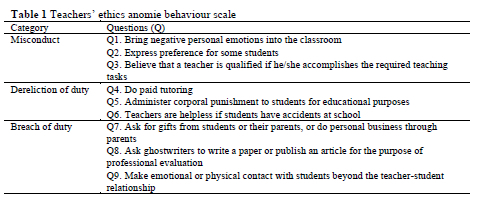
The second part contains nine questions that measure teachers' ethics anomie behaviour in three aspects: misconduct, dereliction of duty, and breach of duty (see Table 1). The design and classification of the questions are mainly based on the categorisation and description of teachers' ethics anomie behaviour categorised and designed by Cheng and Chen (2019:69). This scale was used to understand the current situation of teachers' ethics anomie behaviour in primary and secondary schools.
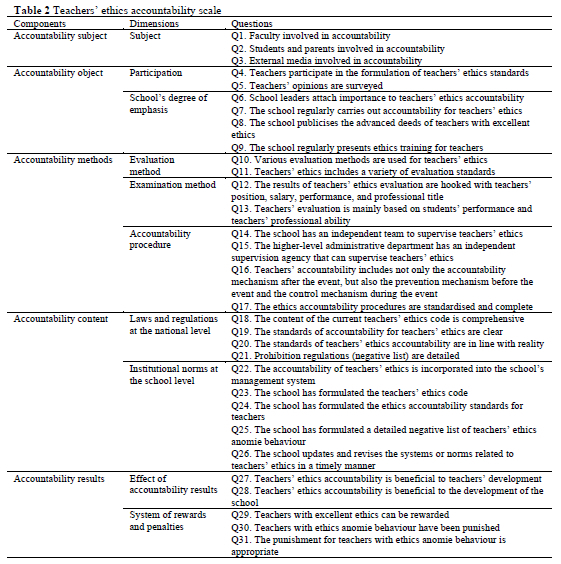
The third part of the questionnaire measures the current status of teachers' ethics accountability (see Table 2). The scale is designed with reference to the five components of teachers' ethics accountability: accountability subject, object, content, method, and result. A total of 31 questions are set in 10 dimensions, such as subject, participation, degree of school attention, evaluation method, assessment method, and so on.
To ensure the reliability of the questionnaire, a pilot study was carried out with 40 middle school teachers in Wuhan. Data from these participants were collected via "Questionnaire Star" (https://www.wjx.cn/), after which the responses were coded and analysed using SPSS 26.0. Reliability results illustrate that the Cronbach Alpha coefficients of all the subscales ranged from 0.877 to 0.963 and that the coefficient of the entire questionnaire reached 0.984. Therefore, the internal consistency reliability coefficients of the subscales and the entire questionnaire were acceptable as they were over 0.70 (Dörnyei & Taguchi, 2010).
Reliability Test
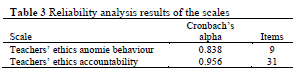
SPSS 26.0 was used to analyse the reliability of the questionnaires. The reliability analysis results of two scales are shown in Table 3.
From Table 3 it is clear that the reliability coefficients of the two scales are 0.838 and 0.956, respectively - both greater than 0.8 - indicating that the two scales have good internal consistency and can be used for further research.
Validity Test
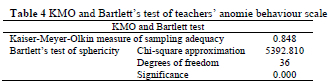
AMOS 18.0 was used to test the validity of the questionnaires, and the test results are shown in Table 4 and Table 5.
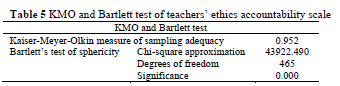
The values of the Kaiser-Meyer-Olkin (KMO) measure of sampling adequacy of both scales are 0.848 and 0.952, which are greater than 0.8, and the p-values of Bartlett's test of sphericity of both scales are significant, which indicates that the two scales pass the validity test and can be used for confirmatory factor analysis.
Confirmatory Factor Analysis
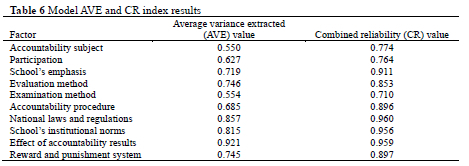
Confirmatory factor analysis was conducted on using the teachers' ethics accountability scale with AMOS 18.0 to test the validity of the model. Ten factors and 31 items of the teachers' ethics accountability scale were tested by confirmatory factor analysis (CFA). Table 6 shows that the AVE values corresponding to the 10 factors are all greater than 0.5, and CR values are all greater than 0.7. Table 7 suggests that the values of RMSEA, CFI, TLI, and the incremental fit index (IFI) all meet the standards, which indicates that the questionnaire of teachers' ethics accountability has good convergent and discriminant validity.
Results
Correlation Analysis
Correlation analysis was used to measure whether a correlation existed between the variables of teachers' ethics anomie behaviour and teachers' ethics accountability. Table 8 shows a significant positive correlation between teachers' ethics anomie behaviour and accountability subjects; a significant negative correlation between teachers' ethics anomie behaviour and participation, the school's emphasis, evaluation methods, examination methods, supervision and accountability procedures, legal norms at the national level, institutional norms at the school level, the effect of accountability results, and reward and punishment systems. Since a correlation exists between teachers' ethics anomie behaviour and all dimensions of teachers' ethics accountability, it suggests that a predictive relationship might exist between them, which can be further analysed using multiple regression.
Multiple Regression Analysis
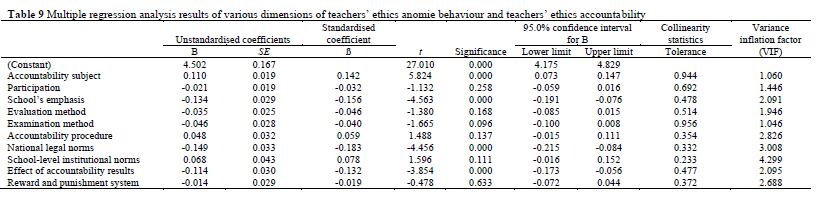
By establishing a multiple regression model, we examined the interaction between teachers' ethics anomie behaviour and various dimensions of teachers' ethics accountability. In the multiple linear regression model, teachers' ethics anomie behaviour was used as the dependent variable, and the 10 dimensions under teachers' ethics accountability were used as independent variables. Table 9 shows that the significance probabilities of the influence of accountability subjects, schools' emphasis, legal norms at the national level, and accountability results are 0.000 (p < 0.05), indicating that these four variables significantly correlated with teachers' ethics anomie behaviour. Among them, the accountability subject has a significant positive impact on teachers' ethics anomie behaviour, and the school's emphasis, legal norms at the national level, and accountability results have a significant negative impact on teachers' ethics anomie behaviour.
Discussion
The above analysis shows that the accountability subject, the school's emphasis, legal norms at the national level, accountability results and its follow-up management in the teachers' ethics accountability system had a significant impact on teachers' ethics anomie behaviour. Therefore, in order to reduce the occurrence of teachers' ethics anomie behaviour, the aspects discussed in the next section should be emphasised in the improvement of the teachers' ethics accountability system:
Starting from Teachers' Willingness and Cognition, Reasonably Set the Accountability Subjects We found that in the surveyed areas, there was only a single accountability subject for teachers' ethics, and teachers, students, parents, and external media had not become the main subjects for teachers' ethics accountability. The data shows that the subjects of teachers' ethics accountability in the USA, Australia and other countries are diversified. For example, the subjects of teachers' ethics accountability in primary and secondary schools in the USA include state governments, local school districts, teacher education certification organisations, primary and secondary schools, and parents (Wiliam, 2010:120). The subjects of accountability for teachers' ethics in Australia include education administrators in states and school districts, front-line teachers, government officials, and workers in professional teachers' institutions (Han, Liu, Lin & Wan, 2005:74). Drawing on these experiences, some Chinese scholars believe that the subjects of teachers' accountability in China should also be diversified. However, our study shows that the subject of accountability has a significant positive impact on teachers' ethics anomie behaviour, which means that the more diverse the subjects of accountability are, the more teachers' ethics anomie behaviour will result. This phenomenon can be explained as follows: the existing external teacher ethics accountability mechanism has failed to gain genuine recognition from teachers, resulting in a disconnect between the mechanism and its practical implementation. The underlying psychological mechanism is that, as part of educational system reforms, the excessive imposition of accountability subjects on teachers often creates significant psychological pressure and burdens, which may, in turn, lead to teachers' unethical behaviour. This situation indicates that if the accountability mechanism is not aligned with teachers' understanding and needs, it may have an adverse effect, ultimately undermining the professional ethics of educators.
Therefore, education administrative departments and schools should obtain teachers' approval and support before setting up diverse subjects to participate in teachers' ethics accountability. Firstly, we should help teachers establish the correct concept of accountability. At present, teachers in China have always had a misconception of accountability. They usually think that accountability is equal to supervision and punishment (Qiao & Nie, 2017:82). In the face of the addition of accountability subjects, they will think that this is to increase the supervision and punishment of their behaviour, which will naturally generate negative emotions, and may lead to the occurrence of teachers' ethics anomie behaviour. According to Ngwenya (2020:6), supervision of teachers is a collaborative enterprise which focuses on the professional development of teachers. Therefore, it is necessary to help teachers establish a correct concept of accountability, and let them realise that accountability is a management method to ensure the rights of stakeholders, rather than merely a punishment measure. Secondly, we should set up accountability subjects reasonably. When multiple accountability subjects hold teachers accountable, teachers will be paralysed, and they will not be able to respond well to all subjects resulting in accountability failure. In that case, accountability becomes a symbol, a ritual, or even a verbal service. Therefore, it is necessary to reasonably limit the scope of the accountability subjects, and avoid the disorderly accountability of multiple subjects, which will reduce the efficiency of accountability and lead to invalid accountability. Teachers' correct understanding and recognition of accountability is the premise to promote the diversification of teachers' ethics accountability subjects, and the rational setting of accountability subjects is the direction of the improvement of the current teachers' ethics accountability system.
As the Object of Joint Responsibility for Teachers' Ethics Accountability, Schools have the Obligation to Improve the Effectiveness of Teachers' Ethics Education
We found that schools' emphasis on teachers' ethics accountability had a significant negative impact on teachers' ethics anomie behaviour. The more schools regarded teachers' ethics accountability as important, the less teachers' ethics anomie behaviour will be. Although schools pay relatively much attention to teachers' ethics accountability, and regularly carry out educational activities related to teachers' ethics accountability, these education activities generally result in different problems such as mere formality, lack of pertinence, and poor operability (Fu, C & Du, 2016:15). When investigating the professional ethics of primary and secondary school teachers, W Fu (2002:146) concludes as follows: the quality of teachers' ethics behaviour mainly depends on their own ethics cultivation. Therefore, when schools carry out teachers' ethics accountability activities, they must strengthen teachers' ethics education, which is conducive to improving teachers' ethics cultivation and reducing the occurrence of teachers' ethics anomie behaviour. Firstly, education administrative departments and schools should jointly establish a case database of teachers' ethics. In the past, teachers' ethics education mostly focused on theoretical lectures in which it was difficult to arouse teachers' emotional resonance resulting in the practical effect not being positive. Therefore, we may try to establish a teachers' ethics case database, which not only records the cases of teachers with excellent professional ethics, but also the cases of teachers with anomie behaviour. In addition, in negative cases teacher's anomie behaviour, how the school managed the case, and what the basis, procedure and results of the treatment were, should be recorded in detail. In this way teachers will not only experience the guiding and motivating role of excellent teachers, but will also attach more importance to teachers' ethics through warning cases (Zhou, K 2017:74). Secondly, the activities in teachers' ethics education should be enriched. In the past, teachers' ethics education was mainly based on teachers' ethics training, but the content of the training was not valued by teachers due to the lack of pertinence and operability (Wu, 2017:52). In future practice, teachers' ethics education should be presented through various forms of activities such as psychological assistance, and teachers' communication and discussion. In addition, teachers' ethics fora could be held regularly to guide teachers to exchange and discuss successful experiences and lessons of failures, share their own difficulties and confusion at work to develop a good and harmonious work environment, which are also the inherent requirements of teachers' ethics education (Li, 2012:45). Only if teachers' ethics accountability education resonates with teachers themselves can the occurrence of teachers' ethics anomie behaviour be reduced more effectively.
Involve Teachers in the Formulation of Accountability Content and Improve the Operability of Accountability Standards We found that legal norms at the national level significantly affected teachers' ethics anomie behaviour negatively. The more comprehensive and specific the legal norms for teachers' ethics accountability were, the less teachers' ethics anomie behaviour will be. In recent years, China has successively promulgated a series of ethics codes and regulations for teachers such as the Opinions on Strengthening and Improving the Construction of Teachers' Professional Ethics in the New Era (Ministry of Education of the People's Republic of China, 2019). However, the content involved is very broad, and it lacks specific operational descriptions and thus has limited practical guidance. Therefore, the government and education administrative departments should pay attention to the following points when formulating relevant laws and regulations regarding teachers' ethics accountability. Firstly, the formulation of the laws and regulations for teachers' ethics accountability should combine top-down and bottom-up approaches. The main body that formulates the laws and regulations of teachers' ethics accountability in China is the education administrative departments, while the relevant norms of teachers' ethics in other countries are formulated by professionals in the field of education through empirical research, which has strong operability and can be better recognised by teachers (Chen, 2019:80). Therefore, the formulation of teachers' ethics accountability norms requires the participation of front-line teachers. Through this bottom-up approach, these norms may be more readily accepted by teachers and may be more manoeuvrable. Secondly, a negative list of teachers' ethics anomie behaviour should be formulated. The negative list is a clear frame of reference for teachers' behaviour, covering comprehensive and detailed prohibitions (Liu, 2020:93). The role of teachers' ethics norms is not only to guide teachers' behaviour, but to also provide a strong basis for teachers' ethics accountability. Furthermore, the negative list can restrict teachers' behaviour and protect their legal rights, so that teachers' ethics accountability may be achieved. There are rules to follow, and rewards and punishments are well founded (Chen, 2019:81). In short, only with specific and operable norms of accountability for teachers' ethics can the occurrence of teachers' ethics anomie behaviour truly be reduced.
Ensure the Fairness of the Evaluation of Teachers' Ethics, and Improve the Satisfaction of the Results of Teachers' Ethics Accountability
We found that accountability results and subsequent management had a significant negative impact on teachers' ethics anomie behaviour. The more satisfactory the results of accountability and its subsequent management are, the less ethics anomie behaviour will be. Generally speaking, the content of accountability determines the method of accountability, which determines the results of accountability (Si, Jin & Peng, 2015:77). Therefore, in order to obtain a fair and just accountability result, the fairness of the accountability method must first be guaranteed. In order to ensure the fairness of the accountability method, two certifications are required when holding teachers accountable. In the evaluation process, the evaluation content should be comprehensive and methods should be flexible; in the dismissal system, the standards and procedures should be specified in detail, which fully reflect the impartiality of teachers' ethics accountability (Serafini, 2005:13). At present, there is bias in the assessment of teachers' ethics in China. The weight of students' academic achievements are overemphasised in the performance of teachers' ethics. The evaluation method will inevitably lead to one-sidedness in the results of accountability and subsequent management, which is not conducive to the formation of a good atmosphere of accountability for teachers' ethics. It may lead teachers to pay more attention to improving students' academic achievements, while ignoring the original performance of teachers' ethics (Ooghe & Schokkaert, 2016:380). Therefore, in order to ensure the fairness of teachers' ethics accountability results and subsequent management, education administrative departments and schools need to improve the existing evaluation methods, integrate teachers' ethics quality, sense of responsibility, and other indicators into the evaluation system to promote the implementation of accountability for teachers' ethics with a rational and fair evaluation method to ensure the fairness of accountability results and follow-up management.
Conclusion
In recent years, the educational administrative departments in the Chinese government and schools have emphasised the need of top priority to teachers' ethics and morality construction, and have implemented an accountability system for teachers' ethics centred on a one-vote veto system. However, incidents of teachers' ethics anomie behaviour still occur from time to time, which indicates that China's current teacher ethics accountability system is still flawed or inadequate in some respects. Therefore, we used a questionnaire survey and data analysis methods to analyse the current status of teacher accountability and their ethics anomie behaviour in Chinese primary and secondary schools, as well as the mutual influence between them.
With this research we divided the teachers' ethics accountability system into five components: accountability subject, object, content, method, and result. Teachers' ethics anomie behaviour was divided into three types: misconduct, dereliction of duty and breach of duty. A questionnaire survey was adopted to understand the current situation regarding the ethics accountability system and ethics anomie behaviour of primary and secondary school teachers. On this basis, we discussed the influence of the teachers' ethics accountability system on teachers' ethics anomie behaviour. We found that problems such as a lack of diversity of accountability subjects, incomplete legal norms, low teacher participation, and an unreasonable reward and punishment system existed. Furthermore, we found that the subject of accountability, the school's emphasis, the legal norms at the national level, and the effect of accountability results have a significant impact on teachers' ethics anomie behaviour. Finally, some countermeasures and suggestions were put forward to improve the teachers' ethics accountability system in primary and secondary schools. This study provides reference for the optimisation and improvement of the teachers' ethics accountability system in primary and secondary schools in China, and it is also helpful to prevent and reduce teachers' ethics anomie behaviour.
Authors' Contributions
YY conceptualised the topic and collected data for the research. JC analysed the data, wrote the draft and revised the manuscript. Both authors reviewed the final version of the manuscript.
Notesi. Published under a Creative Commons Attribution Licence.
Acknowledgement
This research was funded by the general project of pedagogy of the National Social Science Foundation of China in 2019, "Research on teachers' ethics anomie behaviour and professional ethics construction of primary and secondary school teachers from the perspective of organizational ethics" (BEA190114).
References
- Bovens M, Goodin RE & Schillemans T 2014. The Oxford handbook of public accountability. Oxford, England: Oxford University Press.
- Chen L 2019. 如何完善我国教师职业道德规范?--基于对五个国家教师职业道德规范的质性内容分析 [[How to improve the professional ethics of teachers in China?-Based on the qualitative analysis of the professional ethics of teachers in five countries]. Jiaoyu ke xueyan jiu, (2):74-81.
- Cheng H & Chen Y 2019. 超越纵容默许与重拳出击:师德失范行为治理的对策研究 [Beyond tolerance and attack severely: A study on the countermeasure of the governance of teachers' moral misconduct]. Zhong guo jiao yu xue kan, (02):64-69.
- Dörnyei Z & Taguchi T 2010. Questionnaires in second language research: Construction, administration, and processing (2nd ed). New York, NY: Routledge.
- Durkheim É 1996. Suicide: A study in sociology. Beijing, China: The Commercial Press.
-
Fu C & Du S 2016. 论当前师德教育的困境与超越--基于教师道德学习阶段性特质的反思 [On the dilemma and transcendence of teacher moral education: A reflection based on the phased characteristics of teachers' moral learning]. Jiao shi jiaoyuyan jiu, 3:13-17+66. https://doi.org/10.13445/j.cnki.t.e.r.20160603.017
» https://doi.org/10.13445/j.cnki.t.e.r.20160603.017 - Fu W 2002. 教师职业道德教育指南 [Guidelines for professional ethics education for teachers]. Beijing, China: Higher Education Press.
- Ge YY 2008. 教师职业道德失范的制度分析[The system analysis of teachers' professional ethics anomie]. PhD dissertation. Shanghai, China: East China Normal University.
- Han Y, Liu W, Lin Y & Wan J 2005. 澳大利亚中小学教师评价政策的转向及其影响 [The shift in teacher evaluation policy in primary and secondary schools in Australia and its implications]. Quan qiu jiao yu zhan wang, 34(11):71-75.
- Hu C & Li G 2012. 西方问责制研究及其借鉴 [Literature review on the Western accountability research]. Chung Nan Ta Hsueh Hsueh Pao, 3:21-25.
-
Leithwood K & Earl L 2000. Educational accountability effects: An international perspective. Peabody Journal of Education, 75(4):1-18. https://doi.org/10.1207/S15327930PJE7504_1
» https://doi.org/10.1207/S15327930PJE7504_1 - Li C 2012. 态度改变理论与师德教育创新 [Theory of attitude change and innovation of teachers' professional ethic education]. Wai guo zhong xiao xue jiao yu, 9:41-46.
-
Liu L 2020. 编制师德师风负面清单应遵循的基本原则 [The basic principles that should be followed in compiling the negative list of teachers' ethics and style] [Special issue]. Si xiang li lun jiao yu, 2:91-95. https://doi.org/10.16075/j.cnki.cn31-1220/g4.2020.02.015
» https://doi.org/10.16075/j.cnki.cn31-1220/g4.2020.02.015 - 中华人民共和国教育部 [Ministry of Education of the People's Republic of China] 2018a.
-
教育部关于高校教师师德失范行为处理的指导 意见 [Guiding opinions of the Ministry of Education on dealing with misconduct of college teachers' ethics]. Available at https://www.gov.cn/zhengce/zhengceku/2018-12/31/content_5443905.htm. Accessed 28 August 2022.
» https://www.gov.cn/zhengce/zhengceku/2018-12/31/content_5443905.htm - 中华人民共和国教育部 [Ministry of Education of the People's Republic of China] 2018b.
-
中小学教师违反职业道德行为处理办法(2018年修订) [Measures for handling behaviours of primary and secondary school teachers violating professional ethics (Revised in 2018)]. Available at http://www.moe.gov.cn/srcsite/A10/s7002/201811/t20181115_354924.html. Accessed 28 August 2022.
» http://www.moe.gov.cn/srcsite/A10/s7002/201811/t20181115_354924.html - 中华人民共和国教育部 [Ministry of Education of the People's Republic of China] 2019.
-
关于加强和改进新时代师德师风建设的意见 [Opinions on strengthening and improving the construction of teachers' professional ethics in the new era]. Available at http://www.moe.gov.cn/srcsite/A10/s7002/201912/t20191213_411946.html. Accessed 28 August 2022.
» http://www.moe.gov.cn/srcsite/A10/s7002/201912/t20191213_411946.html -
Mosoge MJ & Pilane MW 2014. Performance management: The neglected imperative of accountability systems in education. South African Journal of Education, 34(1):Art. # 834, 18 pages. https://doi.org/10.15700/201412120947
» https://doi.org/10.15700/201412120947 -
Mulgan R 2002. Accountability issues in the new model of governance (Discussion Paper No. 91). Available at https://openresearch-repository.anu.edu.au/bitstream/1885/41701/3/No91Mulgan.pdf. Accessed 28 August 2022.
» https://openresearch-repository.anu.edu.au/bitstream/1885/41701/3/No91Mulgan.pdf -
Mulgan R 2003. Holding power to account: Accountability in modern democracies. New York, NY: Palgrave Macmillan. https://doi.org/10.1057/9781403943835
» https://doi.org/10.1057/9781403943835 -
Ngwenya VC 2020. School-based supervision enhances the professional development of teachers. South African Journal of Education, 40(3):Art. #1744, 10 pages. https://doi.org/10.15700/saje.v40n3a1744
» https://doi.org/10.15700/saje.v40n3a1744 -
Ooghe E & Schokkaert E 2016. School accountability: Can we reward schools and avoid pupil selection? Social Choice and Welfare, 46(2):359-387. https://doi.org/10.1007/s00355-015-0917-0
» https://doi.org/10.1007/s00355-015-0917-0 - Qiao H 2015. 中、美、英三国中小学师德问责制比较研究 [A comparative study on the moral accountability of primary and secondary schools in China, the United States and the United Kingdom]. Jiamusi da xue she hui ke xue xue bao, 33(05):167-169.
- Qiao H & Nie X 2017. 韩国中小学师德问责制内容、特点及启示 [The content, characteristics and enlightenment of teacher ethics accountability system in primary and secondary schools in South Korea]. Jiao xue yu guan li, 34:80-83.
-
Sachs J 2001. Teacher professional identity: Competing discourses, competing outcomes. Journal of Education Policy, 16(2):149-161. https://doi.org/10.1080/02680930116819
» https://doi.org/10.1080/02680930116819 -
Serafini F 2005. Taking on the National Board for Professional Teaching Standards: Alignment, recognition and representation. Current Issues in Education, 8(21). Available at http://cie.asu.edu/ojs/index.php/cieatasu/article/view/1603. Accessed 28 August 2022.
» http://cie.asu.edu/ojs/index.php/cieatasu/article/view/1603 -
Si L, Jin Y & Peng J 2015. 学 术 问 责 法 律 规 范 体 系 的 构 建 [The construction of a legal normative system for academic accountability]. Xian dai jiao yu guan li, 6:76-80. https://doi.org/10.16697/j.cnki.xdjygl.2015.06.004
» https://doi.org/10.16697/j.cnki.xdjygl.2015.06.004 - Wang W 2016. 中小学教师职业道德失范研究 [Research on the abnormality of the primary and middle school teachers' professional ethics]. Master's thesis. Zhenjiang, China: Jiangsu University.
- Wang Y & Ma X 2019. 论我国义务教育问责制实施困境及其破解思路 [On the dilemma of the implementation of the accountability system of compulsory education in China and its solution ideas]. Jiao yu ke xue yan jiu, (09):29-35.
-
Wiliam D 2010. Standardized testing and school accountability. Educational Psychologist, 45(2):107-122. https://doi.org/10.1080/00461521003703060
» https://doi.org/10.1080/00461521003703060 - Wu ZL 2017. 中小学骨干教师师德培训的问题、原因及改善 对策 [On problem, reason and improve strategy of middle and primary schools backbone teacher ethics training]. 教育科学 [Educational Sciences], 33(4):49-54.
- Yu H 2018. 推进我国问责体系建设的几点思考 [A few thoughts on promoting the construction of China's accountability system]. hei long jiang she hui ke xue, (06):113-116.
- Zheng H 2017. 师德问责制的理论探讨 [Theoretical discussion on teacher ethics accountability]. Jiao xue yu guan li, 2017(30):11 -13.
- Zhou K 2017. 美国职前教师专业伦理教育的途径与趋向 [Approaches and tendency of pre-service teacher professional ethics education in America]. Quan qiu jiao yu zhan wang, 46(11):67-75.
- Zhou YY 2004. 行政问责制的内涵及其意义 [The connotation and significance of administrative accountability system]. LILUN YUGAIGE, 4:41-43.
Revised: 2 September 2024
Accepted: 9 January 2025
Published: 28 February 2025