Reimagining academic writing in higher education in the age of artificial intelligence
Abstract
The emergence of generative artificial intelligence (GenAI) has created significant challenges for institutions of higher learning. While some academics have embraced GenAI, others have been reluctant for several reasons, including compromised assessment methods and the potential erosion of students' critical thinking and scientific or academic writing skills. Drawing on personal lecturing experience, I reflect on the vulnerability of current academic writing assessment in the face of GenAI. This article aims to offer an alternative perspective on the teaching and assessment of academic writing, which may pave the way for the integration of GenAI into higher education teaching and assessment. It seeks to sustain the ongoing debate on GenAI integration in higher education, a discussion largely visible on platforms such as LinkedIn. A contribution of this nature is critical and a duty of all teachers.
academic integrity; academic writing; artificial intelligence in education; AIE
Introduction
Point of Departure
The introduction of generative artificial intelligence (GenAI) has left institutions of higher learning in a quandary. Some academics have welcomed GenAI without reservations, while others have been more cautious in dealing with GenAI - especially with regard to undergraduate studies. Regarding postgraduate studies, there is no agreement on whether students should or should not be allowed to use GenAI to do research. This is especially the case in countries such as South Africa, where master's and doctoral qualifications are still largely examined through written dissertations and theses, in contrast to viva voce, which is largely conducted in the Global North. The most important issue is the lack of clarity on how to handle the potential unethical use of GenAI by postgraduate students. In other words, how do universities, especially those that assess only written research, safeguard their higher qualifications? Will such universities finally yield and allow written work created using GenAI, or will they buffer their assessment methods by adding oral assessments, for instance?
Rationale
This article is a reflection on teaching and assessment. In 2024, I taught academic literacy to a group of Bachelor of Education Honours students at a higher education institution in South Africa. The course consisted of three main components, namely library skills, academic reading, and academic writing. Although these skills are intertwined, equally significant, and all aim to cultivate and improve students' academic literacy proficiency, the urgent focus in this article is on academic writing. In the academic writing segment, the course objectives guided students to produce their first and final essays on a prescribed topic. Feedback was provided on the first draft before the submission of the final essay. However, irrespective of these guided efforts, some worrying practices were noted in some of the students' writing. Such practices involve the unethical use of GenAI, which I term the artificial-intelligence pandemic (AIP) and define as the overreliance on and misuse of GenAI writing-assistance tools and software.
From personal experience, AIP is characterised by
• written assignments that are "perfect" or too good to be a reflection of students' writing ability;
• students' assignments addressing very similar aspects of the given topic;
• incorrect use of articles (a, an, the);
• overuse of certain jargon or vocabulary in students' submissions;
• in-text citations without page numbers; and
• missing punctuation after linking phrases or connectors.
Listening to colleagues, some of whom have conducted workshops for students and staff on the use of GenAI and academic integrity, AIP is seemingly a common occurrence in many subjects at my institution and, possibly, across institutions of higher learning globally, which has necessitated various preventative interventions. There is concern among scholars that AIP may lead to stagnant critical thinking, which means that, as academics, we have a bigger responsibility to guide students to ensure that the use of GenAI tools does not prevent or present a hurdle to their learning but, in fact, contributes to it. This article is in response to this very responsibility.
Problem Statement and Guiding Question(s)
The wide accessibility of information, initially enhanced by the emergence of the printing press around the late 1400s and early 1500s, and the internet revolution that started in 1969, has had a tremendous impact on the sharing and replication of ideas. Regrettably, it is partly responsible for the unethical adoption and dissemination of original ideas, commonly known as plagiarism. Similarly, the introduction of GenAI in recent years has further exacerbated such concerns and revived the debate on academic integrity. The generative nature of GenAI and its ability to replicate human tasks, such as academic writing, pose serious challenges, as this means that it can easily be manipulated or used unethically to complete academic tasks. Although GenAI can also be used positively and efficiently, the threats it poses have raised many concerns and questions among academics about the relevance of the current assessment approaches and the value of formal education. One of these questions, which I attempt to answer in this article, is the following: What does the introduction of GenAI mean for academic writing in undergraduate and postgraduate studies?
Aims and Objectives
The debate on GenAI and academic integrity in the education sector as a whole gained prominence in 2022 with the introduction of ChatGPT, an artificial intelligence (AI) chatbot (Botes, Dewaele, Colling & Teuber, 2025). Since then, there has been a concerted effort from higher education stakeholders to understand this new phenomenon. In South Africa, the rise of the debate on GenAI in education (GenAIE) has resulted in several calls for contributions to academic journals on the role of GenAI in shaping the higher education mandate. The attempts to understand and integrate GenAI while safeguarding the integrity and value of higher education have necessitated the pooling of newly created knowledge, the sharing of practice, and the debating of potential practical and theoretical interventions. There is an immediate and obvious need for ongoing debate, which could potentially culminate in tangible and sustainable practices and interventions. This article is part of this ongoing debate on GenAIE. I hope to contribute to the pool of knowledge and practice that can be used or adopted contingently and towards theoretical or hypothetical GenAI integration strategies and integrity interventions. I propose potential interventions in the form of strategies and models that could be adopted to integrate AI into academic writing pedagogy and assessment.
Methodology
Reflective Framework
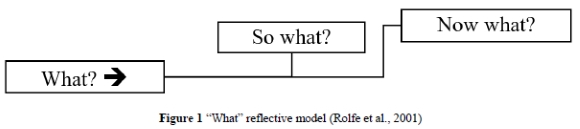
As indicated previously, I draw inspiration from my teaching and assessment experiences as an educator in higher education. Such reflection considers the potential integration of GenAI into academic written work, the adaptation of academic written tasks into the GenAI era, and the relevance of academic writing skills in the post-plagiarism era. My experience with written academic assessments is examined using Rolfe, Freshwater and Jasper's (2001) "What" model of reflection (see Figure 1).
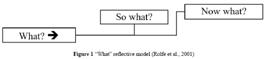
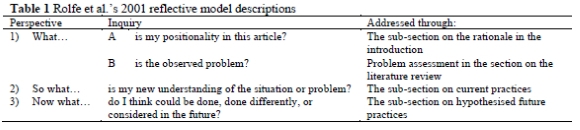
Using Rolfe et al.'s (2001) model, I sought to address the guiding questions from the three "what" perspectives outlined in Table 1.
In the next section, perspective 1B (What is the observed problem) is addressed. In this section, I discuss some of the current challenges threatening the integrity of written assessment as well as the value of higher education.
Literature Review: Problem Assessment
The introduction of GenAI tools such as ChatGPT has raised the alarm in higher education institutions. In response, multiple interventions have been proposed and implemented. These include extensive and continuous internal and cross-institutional academic integrity workshops and seminars aimed at educating students and academic staff about the dangers of GenAI and ways to leverage it. Although these are great and necessary initiatives, we need to reflect and ask ourselves whether these interventions are effective and sufficient. In my view, it may still be too early to tell. However, the use of tools such as Turnitin bears testimony to the reality that the educational approach does not always succeed, and that we may need to revisit our approaches to teaching and assessing academic writing with the intention to not only enhance students' academic writing skills, but also to safeguard the integrity of our assessment.
The precarious academic integrity debate
Plagiarism remains a relevant and critical topic deliberated by institutions of higher learning (Baron, 2024). The emergence of Artificial Intelligence (AI), defined as the data-collating computer codes capable of imitating human intelligence and performing substantial tasks more quickly and with minimum effort, has raised many economic and ethical concerns and anxiety in higher education institutions (HEIs). The revolutionising impact of GenAI in the education sector - the technological advance which continues to evolve at a speedy rate - is a double-edged sword. In the education sector, AI's efficiency is accompanied by a number of notably worrisome aspects that directly affect academic writing and the business of teaching and learning overall. In particular, these entail the generation of supposed written assessments, without or with very little input from students (Munnik & Noorbhai, 2024), which may affect students' ability to read and synthesise academic texts and draw conclusions.
AI-generated responses may also deprive students of opportunities to develop a variety of essential academic skills, such as reading and reflection. This concern is also noted by Munnik and Noorbhai (2024), who argue, for instance, that students may easily lose their note-taking skills owing to readily accessible paraphrasing GenAI websites. One could argue further that lost or underdeveloped note-taking skills could hamper students' learning, as the GenAI paraphrasing websites exempt students from obtaining deeper learning through thorough engagement with relevant texts.
Another well-noted downside associated with the rapid development of GenAI and the introduction of new writing assistance tools such as ChatGPT, Gemini, and many others is the new form of plagiarism, AI-giarism, which is essentially the copying and pasting of GenAI-papers with content produced fully using GenAI (GenAI ghostwriting) (Drisko, 2025; Khalaf, 2025). To highlight the pervasiveness of AI-giarism, Drisko (2025) and Singh (2023) make reference to the Study.com survey (2023), which found that 890 of 1,000 higher education students had used GenAI to complete their academic assessments.
Apart from the risks associated with the new GenAI inventions, a somewhat ironic upside is the revived academic integrity debate among scholars, which has seen increased or emerging publications on the topic. In addition to the proposed measures for the prevention and detection of potential plagiarism, these publications also present extensive discussions on assessment, including ways to AI-proof tasks and ways in which GenAI can be leveraged to ease the burden of teachers' assessment design and grading.
Spanning centuries, the plagiarism pandemic, as evidenced by the presence of plagiarism and similarity detection tools such as Turnitin and the university plagiarism policies, continues to be a serious challenge at HEIs. "This coincides with the rapid development of GenAI and new technologies that are quickly moving beyond the internet" (Eaton, 2021:9).
GenAI detection tools' reliability and trustworthiness: A failed experiment?
In addition to the HEIs' initiatives designed to counter the unethical use of AI, several GenAI detection tools intended to detect and flag AI-generated texts have been introduced. However, similar to the AI-awareness initiatives, the effectiveness, reliability, and trustworthiness of such tools have come under heavy scrutiny. The lack of trust in AI-detection tools partly emanates from the very generative nature of AI-writing tools such as ChatGPT, which enables them to formulate pieces of writing without copying the exact words or structure of the content of the source (Baron, 2024). Furthermore, students using similar prompts or questions may receive different results (Baron, 2024).
Ultimately, what these sentiments imply is that copied and pasted ChatGPT content, for example, may easily traverse a plagiarism detector undetected, as the content comes across as new. It also means that in spite of similar prompts being used, responses received could show no traces or evidence of students copying from one source. Baron (2024:153) put these scenarios through a series of tests to "demonstrate just how easy it is to overcome the traditional detection mechanism (Turnitin) that is commonplace in thousands of universities and schools." The findings are reported in his 2024 study, "Are AI detection and plagiarism similarity scores worthwhile in the age of ChatGPT and other generative AI?" The key findings from this study reveal that 1) one can plagiarise relatively easily without being flagged by Turnitin, and 2) the rate at which GenAI advances makes it increasingly difficult to distinguish between authentic or human-produced and AI-generated text.
In a comparable (evaluation) study, Elkhatat, Elsaid and Almeer (2023) found that although the tested ChatGPT versions 3.4 and 5 could identify the AI-generated content, they were not as accurate on human-written texts and falsely identified them as machine-written content. Similarly, Drisko (2025) points out that the original text generated by ChatGPT poses a challenge for GenAI or plagiarism detectors, as the generated content does not exist in the databases that form part of the detection mechanism.
Furthermore, GenAI detectors can easily be bypassed to a certain extent through mere paraphrasing (Drisko, 2025; Weber-Wulff, Anohina-Naumeca, Bjelobaba, Foltýnek, Guerrero-Dib, Popoola, Sigut & Waddington, 2023). Alternatively, one may launder the text by generating content with ChatGPT, having Copilot rewrite it in another style, and finally passing the result through Gemini for refinement before using QuillBot to enhance it. Furthermore, the GenAI detectors' reliability has been associated with more superior paid versions (Anil, Saravanan, Singh, Shamim, Tiwari, Lal, Seshatri, Gomaz, Karat, Dwivedi, Varthya, Kaur, Satapathy, Padhi, Gaidhane, Patil, Khatib, Barboza & Sah, 2023), which are not accessible to some academic staff.
Giray (2024) also warns of a new phenomenon involving AI-detection tools that falsely flag human-written academic papers, resulting in unfair accusations that threaten the careers and credibility of researchers. Specifically, non-native English speakers seem to be at the receiving end of this bias owing to their unique writing styles and varying contexts (Giray, 2024). Consequently, compared to native speakers of English, these scholars contend with harsh and unfair criticism, which silences voices from different contexts and downplays certain contributions (Giray, 2024).
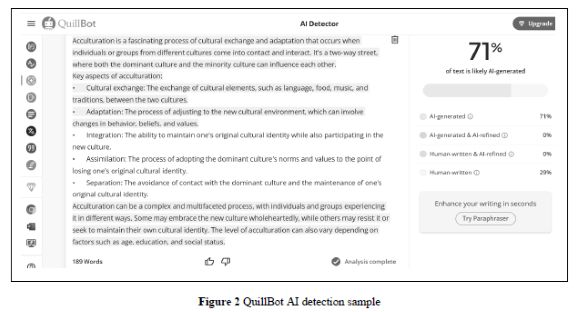
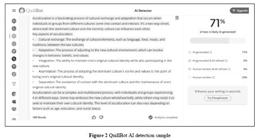
I reflected on the deliberated findings on AI-detection tools through a simple experiment, which revealed the inconsistencies and unreliability of AI-detection tools. For this experiment, a freely accessible QuillBot AI detector was used. A prompt, "acculturation", was captured on Gemini AI, and the response (definition only) was copied and pasted to the QuillBot AI detector. The detector, shown in Figure 2, only managed to flag 71% of the content as AI-generated, and the remaining 29% was flagged as human-written text.
In conclusion, the literature on GenAIE confirms the threat posed by the introduction of GenAI writing-assistance tools. It is also clear that no single, or even a combination of the current policing and educational interventions, has the potential to eradicate AI use and plagiarism (AI-giarism). Weber-Wulff et al. (2023) thus sternly conclude that, owing to the untrustworthiness of AI-detection tools - such as ZeroGPT, Check For AI, Writer, Compilatio, Writeful GPT Detector, Content at Scale, Turnitin, Crossplag, PlagiarismCheck, DetectGPT, OpenAI Text Classifier, Go Winston, GPT-2 Output Detector Demo, and GPTZero - these tools must not be used in academic settings. One may argue further that they should not even be used in or by publishing houses. These realities have placed written assessments and academic writing on life support. The question then becomes, So what? In the next section, a proposal to reimagine academic writing through contingent and long-term GenAI integration interventions is discussed.
Discussion: Re-imagining Academic Writing Teaching and Assessment
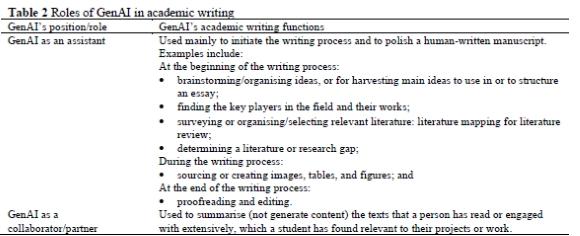
While AI-giarism poses a serious threat in the higher education context, it is equally significant to note that we live in the GenAI era and that there is no going back. Therefore, the positives of GenAI, which have the potential to enhance individuals' academic writing skills, must be leveraged. However, such features and functions should not replace one's thinking and reasoning capabilities or critical thinking skills, which are essential to succeeding in life. Currently, it appears that at least two trajectories can be followed in the context of postgraduate academic writing. The first entails the use of GenAI with limitations and slight policing, and the second one is the liberal approach, which permits the use of GenAI to a wider extent. Both approaches are represented in Table 2.
In the next subsections, I contextualise and exemplify these approaches in terms of the state of readiness of higher education.
Keeping the Written Assessments' Life-support
Machine On: Current Practices
Contingent GenAI integration strategies
"Let's be honest: the five-paragraph essay is on life support" (Nel, 2025:para. 5). It is only a matter of how long we can hold on to it or prolong its existence. However, it is also understandable that it may be impractical to expect a sudden shift from the current academic writing teaching and assessment practices to the GenAI collaborative ones for several reasons. These reasons include socio-economic inequalities, which dictate access to advanced technology, and inefficient institutional support, such as the lack of premium subscriptions or unlimited access to GenAI tools such as ChatGPT. Nel (2025:para. 1) notes the following:
The debate in universities has moved from 'Should we allow AI?' to 'How do we teach with it -ethically, critically, and effectively?' For language lecturers and academic literacy specialists, this shift is both daunting and exhilarating. It challenges us to rethink academic writing in ways that embrace AI as both collaborator and disruptor.
Given the present obstacles, how can we safeguard the integrity of written tasks while preparing for a full transition to GenAI-enhanced academic writing? In my view, the greatest conundrum regarding GenAI use in higher education is deciding the extent to which it can be used. As previously discussed and demonstrated, certain challenges exist in distinguishing between GenAI and human-written content, and with the increasing rate at which GenAI develops (Drisko, 2025), limits on its use should be instituted for the time being. Without such limits, misuse is inevitable. I therefore propose that, for the time being, GenAI should be limited to its role as an assistant (see Table 2) until the GenAI wave has stabilised, there is a better understanding of GenAI by all the stakeholders in the HEIs, and the AI-detection tools have improved their accuracy. Of course, over time and with more GenAI awareness and education, the list may expand.
As an assistant, GenAI may be used at the beginning of a research project or postgraduate academic writing to help structure a coherent and persuasive argument. It may further assist with finding relevant and impactful literature in a field of study. This is a valuable function, as millions of articles are published annually (Zhao, Kingston & Ginsberg, 2025). It may be overwhelming for students to decide which texts to include or exclude in their writing or research. GenAI may also be used constructively to determine or confirm existing research gaps, saving students valuable time in finding a gap manually. During the writing, GenAI could be used to generate illustrations and other supporting visual material, such as graphs and images. Towards the completion of the project or writing, proofreading and editing tools such as QuillBot and academic journals' digital editing platforms can aid in refining the manuscript to improve its readability. These proofreading and editing tools are especially useful for individuals who are not native speakers of English. They are also cost-effective and efficient with quick turnaround times.
Although these are relatively ethical approaches to using AI, the use of such tools, for any of the proposed functions, should be acknowledged accordingly, following each institution's GenAI referencing guidelines.
Contingent GenAI policing strategies
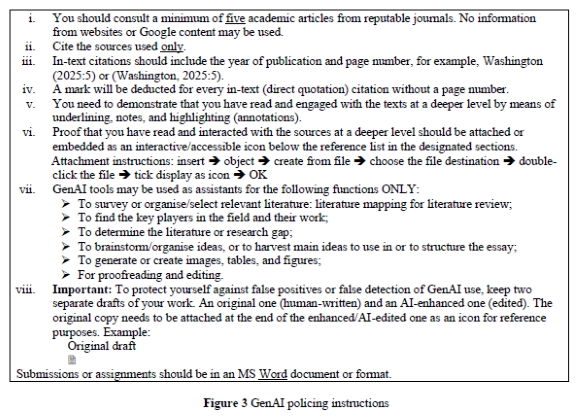
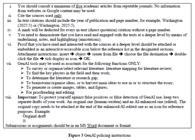
Where policing is concerned, several measures can be implemented to monitor the unethical use of GenAI. In my teaching and assessments, for instance, I have experimented with the instructions outlined in Figure 3. Although such instructions cannot guarantee that students will not use AI unethically, I believe that they may foster a sense of responsibility and accountability, acting as safety nets to some extent. Policing may also keep students alert, as there is a possibility that they may be found out if they use GenAI unethically or not as prescribed by the instructor.
The downside of this policing approach is that it is a time-consuming activity, a resource that could be better spent on grading or other essential commitments. Therefore, from a more liberal perspective, it is worth considering what would happen if we suddenly did not need to worry about policing students' use of GenAI. What if we stopped viewing GenAI as a foe but rather as a partner? What would academic writing resemble, and what would the benefits be? Answers to these questions are provided in the next sub-section.
Switching Off the Written Assessments' Life-support Machine and Letting Go: Hypothesised Future Practices
The strategies discussed above, which could be perceived as the contingent interventions formulated in an attempt to prolong and potentially preserve written assessments, do not warrant an AI-proof future of assessment in higher education.
This is because GenAI is developing at the speed of light. What works today may not work tomorrow. Furthermore, GenAI can produce scientifically written texts, which are equally as good as those by humans or even better. Now, so what? I share Nel's (2025 :para. 7) sentiment that
[o]ur students are already engaging with AI. The pivotal question is whether we will guide them towards becoming thoughtful, ethical users - or futilely try to outmanoeuvre the bots. Academic writing is evolving, shaped by new tools, new habits, and new expectations. It's time our teaching evolved alongside it - not by resisting change, but by reimagining what meaningful writing looks like in a digital, multilingual, and increasingly AI-aware world.
In response to recent calls to reimagine academic writing in the AI age, academics at several universities have begun experimenting with innovative approaches in which GenAI is perceived as a collaborator (Nel, 2025). In this article, I hypothesise and propose the Reimagined Academic Writing Process (RAWP).
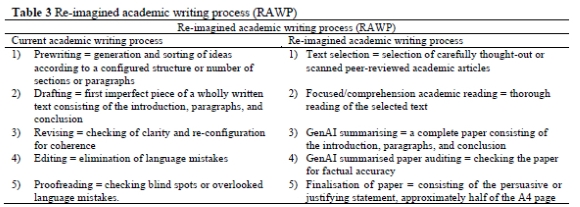
The process was inspired by GenAI's summarising prowess and entails five steps. The proposed process is a statement to say that there is no need to fix what is not broken. If GenAI tools can summarise texts into concise, high-quality reviews, why work against them and not alongside them? Furthermore, if GenAI tools are capable of saving us time and labour necessary to produce almost similar summaries, why insist on doing things the hard way and in a more time-consuming manner? In considering these questions, a comparison between the current academic writing process and the proposed one is done (see Table 3) to demonstrate how GenAI can be infused into or become a collaborator in academic writing.
The RAWP can be described as follows:
1) Phase 1 of the RAWP plays a crucial role in determining the envisioned final piece of writing or literature review.
2) Phase 2 aims to ensure that students are fluent in their fields of study or know the subject very well.
3) Phase 3 entails GenAI prompting. Here, one needs to carefully tell GenAI what kind of a summary they need. That is, a narrative, scoping, or integrative review summary.
4) Phase 4 entails ensuring that the generated summary aligns with what an individual had in mind and wanted. If it does not, the prompts may need to be adjusted and refined.
5) Phase 5 consists of a concluding justification statement, which is a standalone paragraph that echoes the entire argument summarised by an AI tool. It replaces the conclusion summarised by AI. The statement should not divert from the summarised content. Furthermore, the student's voice should be bold and highlighted by the use of personal pronouns such as I am, and others (I am of the view that..., for instance). Lastly, the statement should respond to the question: What are your views, and what informs them?
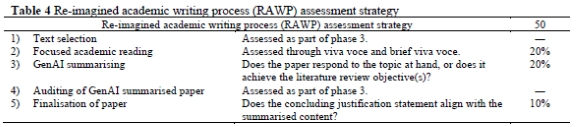
At the undergraduate and honours levels, the RAWP would ideally be assessed using the strategy in Table 4. The key difference between the two assessment processes is that, while the current process perceives the final piece of a written text as the amalgamation of several skills - namely academic reading, information synthesis, academic writing skills, and editing and proofreading skills -the proposed process does not. The RAWP assesses academic reading separately, as the generated summary is not precisely an indication that satisfactory engagement with the selected texts has occurred to enhance a student's subject or field knowledge. The last part of RAWP is also assessed separately, as it aims to test and enhance a student's ability to evaluate, critique, analyse, contrast, and justify.
At master's and doctoral levels, the assessment strategy outlined in Table 4 would not apply. The adoption of the RAWP at these levels would require the modification or a complete overhaul of the current postgraduate research assessment methods. In South Africa, the majority of universities, if not all, follow an assessment approach that requires students to submit a written dissertation or thesis to be examined by at least two appointed academics. The current approach would need to be changed to include oral examination. Consequently, students would also need to be trained in oral academic communication. This type of training can be undertaken at the undergraduate level through oral assessments and at the postgraduate level, where students present the written sections of their dissertations or theses to their supervisors on a monthly basis. Alternatively, departments or faculties may establish monthly postgraduate seminars in which students present their work. Such an approach would help prepare students for the ultimate oral examination.
The RAWP presents several crucial benefits:
a) Less time spent by instructors policing or checking the authenticity of drafts;
b) Potentially improved or minimised time spent completing the qualifications. Imagine students spending half the time completing literature reviews, as opposed to the usually longer periods;
c) Potentially improved postgraduate throughput and minimised drop-out rates;
d) Subject mastery, as students will be spending more time reading for comprehension or reading meaningfully, as opposed to rushed superficial reading due to limited time and pressure to make progress or complete qualifications or assignments at the stipulated time;
e) Improved reasoning or critical thinking skills;
f) Promotion of inclusion of research, especially of non-native speakers of English;
g) Increased supervision capacity as supervisors would be able to supervise many students because of less time spent correcting language errors; and
h) Overall, a fulfilling postgraduate experience for the students and the supervisors.
Finally, it is important to state that the proposed process is not meant to substitute the teaching of academic writing. Instructors will still be expected to teach academic writing because, apart from AI-assisted literature reviews, students will be expected to communicate their findings in writing.
On Academic Integrity
Academic writing is a challenging task for various reasons (Khalifa & Albadawy, 2024). Therefore, many would consider the AI-assisted academic writing direction favourably. However, the benefits of GenAI do not exempt the technology from ethical and integrity concerns. Botes et al. (2025) note, for example, that the idea of GenAI adoption in academic writing has been a highly contested issue characterised by divergent views. Firstly, although AI-assisted summarising may potentially result in fewer hallucinations than unlimited text generation, it is still important to audit the content and the references. Secondly
[a] major ethical concern revolves around intellectual property rights and copyright ownership. Many systems require users to confirm that they hold the copyright for uploaded content ... This practice raises serious copyright concerns, especially because the intended use of these materials by AI service providers often remains unclear in their terms of service . [M]ost of these require the transfer of some intellectual property rights to the service providers, insisting that the user confers the rights to use the material for further training of the systems. For the user to do so, they would have to hold this specific right, which is not normally granted to users . To mitigate intellectual property infringement risks, users should use only services that do not require the transfer of intellectual property rights. (Bjelobaba, Waddington, Perkins, Foltýnek, Bhattacharyya & Weber-Wulff, 2025:6-7)
Briefly, in the context of academic writing, considerations of academic integrity can be described in terms of transparency, auditing, and copyright awareness.
Conclusion
GenAI is here to stay (Botes et al., 2025). As academics, we can accept and embrace this reality as the new normal and subsequently design courses and assessments that reflect this change. Alternatively, we can continue to fight a 50/50 battle against the highly evolving technology by constantly and stressfully thinking of ways to make our teaching relevant and our assessment AI-proof. Whichever option we decide to embrace, it is equally important to ask ourselves, constantly, whether we are preparing our students for the future or whether we are holding them back in attempts to maintain the status quo.
Notesi. Published under a Creative Commons Attribution Licence.
References
-
Anil A, Saravanan A, Singh S, Shamim MA, Tiwari K, Lal H, Seshatri S, Gomaz SB, Karat TP, Dwivedi P, Varthya SB, Kaur RJ, Satapathy P, Padhi BK, Gaidhane S, Patil M, Khatib MN, Barboza JJ & Sah R 2023. Are paid tools worth the cost? A prospective cross-over study to find the right tool for plagiarism detection. Heliyon, 9:e19194. https://doi.org/10.1016/j.eliyon.2023.e19194
» https://doi.org/10.1016/j.eliyon.2023.e19194 -
Baron P 2024. Are AI detection and plagiarism similarity scores worthwhile in the age of ChatGPT and other Generative AI? SOTL in the South, 8(2):151-179. https://doi.org/10.36615/sotls.v8i2.411
» https://doi.org/10.36615/sotls.v8i2.411 -
Bjelobaba S, Waddington L, Perkins M, Foltýnek T, Bhattacharyya S & Weber-Wulff D 2025. Maintaining research integrity in the age of GenAI: An analysis of ethical challenges and recommendations to researchers. International Journal for Educational Integrity, 21:18. https://doi.org/10.1007/s40979-025-00191-w
» https://doi.org/10.1007/s40979-025-00191-w -
Botes E, Dewaele JM, Colling J & Teuber Z 2025. Initial indications of generative AI writing in linguistics research publications. [Preprint]. https://doi.org/10.31234/osf.io/4yvbp_v1
» https://doi.org/10.31234/osf.io/4yvbp_v1 -
Drisko JW 2025. AIgiarism: Computer generated text, plagiarism, and how to address it in teaching. Journal of Teaching in Social Work, 45(1):1-15. https://doi.org/10.1080/08841233.2024.2433795
» https://doi.org/10.1080/08841233.2024.2433795 - Eaton SE 2021. Plagiarism in higher education: Tackling tough topics in academic integrity. Santa Barbara, CA: Bloomsbury Libraries Unlimited.
-
Elkhatat AM, Elsaid K & Almeer S 2023. Evaluating the efficacy of AI content detection tools in differentiating between human and AI-generated text. International Journal for Educational Integrity, 19:17. https://doi.org/10.1007/s40979-023-00140-5
» https://doi.org/10.1007/s40979-023-00140-5 -
Giray L 2024. The problem with false positives: AI detection unfairly accuses scholars of AI plagiarism. The Serials Librarian, 85(5-6):181-189. https://doi.org/10.1080/0361526X.2024.2433256
» https://doi.org/10.1080/0361526X.2024.2433256 -
Khalaf MA 2025. Does attitude towards plagiarism predict aigiarism using ChatGPT? AI and Ethics, 5(1):677-688. https://doi.org/10.1007/s43681-024-00426-5
» https://doi.org/10.1007/s43681-024-00426-5 -
Khalifa M & Albadawy M 2024. Using artificial intelligence in academic writing and research: An essential productivity tool. Computer Methods and Programs in Biomedicine Update, 5:100145. https://doi.org/10.1016/j.cmpbup.2024.100145
» https://doi.org/10.1016/j.cmpbup.2024.100145 -
Munnik JB & Noorbhai H 2024. Artificial intelligence (AI) in psychology: A commentary on Al's emerging role and the ensuing conversation. South African Journal of Psychology, 54(1):130-137. https://doi.org/10.1177/00812463231223427
» https://doi.org/10.1177/00812463231223427 -
Nel M 2025. AI, technology, and academic writing: Writing our way into the future. South African Association for Language Teaching Newsletter, April. Available at https://saalt.org.za/ai-technology-and-academic-writing-writing-our-way-into-the-future/. Accessed 31 December 2025.
» https://saalt.org.za/ai-technology-and-academic-writing-writing-our-way-into-the-future/ - Rolfe G, Freshwater D & Jasper M 2001. Critical reflection in nursing and the helping professions: A user's guide. Basingstoke, England: Palgrave Macmillan.
-
Singh M 2023. Maintaining the integrity of the South African university: The impact of ChatGPT on plagiarism and scholarly writing. South African Journal of Higher Education, 37(5):203-220. https://doi.org/10.20853/37-5-5941
» https://doi.org/10.20853/37-5-5941 -
Study.com 2023. ChatGPT in the classroom. Available at https://study.com/resources/chatgpt-in-the-classroom. Accessed 15 January 2025.
» https://study.com/resources/chatgpt-in-the-classroom -
Weber-Wulff D, Anohina-Naumeca A, Bjelobaba S, Foltýnek T, Guerrero-Dib J, Popoola O, Sigut P & Waddington L 2023. Testing of detection tools for AI-generated text. International Journal for Educational Integrity, 19:26. https://doi.org/10.1007/s40979-023-00146-z
» https://doi.org/10.1007/s40979-023-00146-z -
Zhao Y, Kingston N & Ginsberg R 2025. The death and rebirth of research in education in the age of AI: Problems and promises. ECNU Review of Education:1 -24. https://doi.org/10.1177/20965311251367053
» https://doi.org/10.1177/20965311251367053