Teachers' attitudes to learning techniques in secondary school education: The case of Montenegro
Abstract
The goal of the research reported on here was to identify teachers' attitudes towards rational learning techniques in secondary schools in Montenegro. In this research study, we used factor analysis to identify the factors uniting the key learning techniques that teachers use and to find possible differences in teachers' attitudes to the selected variables. The research sample included 185 secondary school teachers in Montenegro. The results show that learning techniques from the teachers' point of view included the cognitive engagement of students, connecting knowledge and memorising, separating the essential content from the irrelevant, and contrasting/associating in relation to the learning content. Depending on the subject taught at school, the differences in the teachers' attitudes were identified for the factors of memory and connecting, and separation of the essential from the irrelevant. The differences in the teachers' number of years for the factors of students' cognitive engagement and contrasting and association were also identified. The results of our research have great application value as they refer to the permeation of different techniques, as well as to the key areas in which teachers can significantly contribute to teaching-learning techniques.
learning techniques and strategies; secondary school; teacher
Introduction
Modern conditions and societal development require a change in learning principles, and it has become essential that students are trained for active learning and learning with understanding (Bugg & McDaniel, 2012; McCormick, Dimmitt & Sullivan, 2013; McNamara, 2004; Schmidt & Marzano, 2015). The most important element in this process is students' self-activation. As education moves away from the mere accumulation of knowledge, there has been a need to integrate new information into the existing knowledge systems and to constructively change the structure of knowledge. Thus, mostly within the framework of the constructivist paradigm, the issues are experiential and cooperative learning, and the need to develop and promote creativity, metacognition, critical thinking and independence in learning (Cindric, Miljkovic & Strugar, 2010; Matijevic & Radovanovic, 2011; Ormrod, 2014, 2017; Schunk, 2014; Terhart, 2001; Wang & Seepho, 2017; Willingham, 2008). Therefore, assessment should also involve comprehensive observation of students, their work, an analysis of their attitudes, creativity, cooperating ability, aptitude to solve problem situations, etc., and not only on testing or reproductive examinations, i.e. correct and incorrect answers (Zorić, 2015:296).
By means of their teaching, teachers should facilitate and support their students' learning processes. Teachers' competences are irreplaceable in the context of the development of children's individuality and self-control (Jelić & Calović Nenezić, 2019). While respecting the assumptions about the need to activate students' learning, the question is raised about how to do this, and which methods and specific processes are mostly used by teachers when teaching. We focused on that issue in our research. We empirically determined the specific procedures that teachers used to facilitate students' learning, i.e. the specific techniques used to prepare students for the rational learning process in secondary school. A teacher's task is to facilitate learning - especially in the context of learning based on constructivist paradigms (the development of desirable and predicted competences and outcomes).
At a global level, we cannot ignore the need to improve learning competencies. The focus on learning outcomes based on key competencies also means questioning the teaching and learning processes, which is specifically demonstrated in the competence of learning how to learn.
In this article we elaborate on 10 learning techniques. We chose these techniques because they connect important segments for rational and effective learning, for example more effective memorisation, the selection of the essential over the irrelevant, and better organisation of learning material.
In the scope of education internationalisation, the initiation of the Programme for International Student Assessment ([PISA] OECD, 2000) and the definition and selection of competencies (DeSeCo) of the Organisation for Economic Co-operation and Development (OECD), played the key role (OECD, 2005). The question of how students learn is unavoidable. It is certain that the use of good learning strategies helps students to learn, and that teaching using strategies is possible (Hamman, Berthelot, Saia & Crowley, 2000). The following are mentioned for more effective learning in the learning corpus: identifying what students know about a subject along with what they should know; their selection of relevant information; more effective use of time for reading; and taking control of their own learning process (Slavin, 2018). This list of potential skills for more effective learning tends to increase, and knowing and using different learning strategies and techniques help make these processes more optimal and learning more effective. First of all, we analyse the relationship between strategies and techniques for a more precise definition of learning techniques.
The term "learning strategies" covers a wide range of activities. Rebecca L. Oxford (2011, 2017) defines them as specific actions taken by a student to make learning easier, faster, more interesting, effective, controlling and applicable. Similarly, Gonny Schellings (2011) recognises learning strategies as a combination of certain goal-oriented activities that students use to improve their learning. According to her, different terms (for example, methods, techniques or skills) are used to describe the activities that are considered to represent a learning strategy. Learning strategies are plans directed towards achieving a certain goal - they must thus contain a concretisation of the questions of what to do, and when and how to do it, in order to achieve a certain goal (Snowman, McCown & Biehler, 2009).
The function of learning strategies is to get the participants cognitively engaged (direct their attention to important aspects of the material), to think and process information at a deeper level (to link, organise and reorganise) and to regulate and supervise their learning (monitor and correct) (Hamman et al., 2000). Strategies besides thinking (the cognitive aspect) include beliefs, understanding, and the transfer of new knowledge and skills (Weinstein, Husman & Dierking, 2000). Learning strategies must be observed in the narrower and wider sense. In the wider approach, learning strategies are integrated with techniques or, as some authors call them, learning tactics (Howard-Rose & Winne, 1993; Winne & Perry, 2000). Learning strategies are, in many studies on teaching and learning, an unavoidable segment (Alexander, 2006; Mohammadi, Birjandi & Maftoon, 2015; Niemivirta, 1996; Pintrich, 2004; Pintrich & De Groot, 1990; Pintrich & Schunk, 2002; Schraw & Dennison, 1994; Seker, 2016; Wang & Seepho, 2017; Weinstein & Hume, 1998; Weinstein & Mayer, 1986; Winne & Hadwin, 1998; Zimmerman, 1994).
Besides the strategies listed in the literature, the term "pattern of learning" also appears. This implies united cognitive and affective strategies, metacognitive regulation, conceptions and orientations in learning (Vermunt, 2005).
Learning techniques are specific tools for making a certain plan (Derry, 1989); tools that bring one closer to a certain goal (Snowman et al., 2009), i.e. efficient instruments or approaches to certain material (Dunlosky, Rawson, Marsh, Nathan & Willingham, 2013; Vuckovic, 2010). The term "learning tactic" also appears in the literature. This refers to none other than a certain technique (such as memorising or noting), which students uses to reach a direct goal, for example, understanding a certain concept (Snowman et al., 2009). Learning tactics are specific techniques, such as underlying mnemonics of summing up, as strategies combine several tactics (Pavlin-Bernardic & VlahoviC-Stetic, 2019). Hence, tactics or techniques are concrete learning instruments or tools.
Theoretical Framework
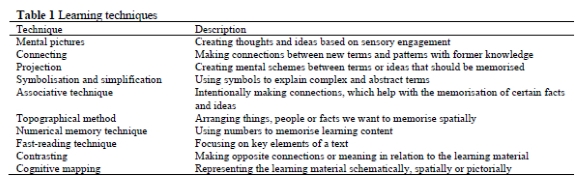
A summary of the techniques and their features is given in Table 1. For each technique that we analysed and considered, we provide a detailed description. Besides the fact that this classification brings a significant number of techniques together in one place, it also synthesises several elements that contribute to rational learning. First of all, it refers to more effective memorising, and then to the distinguishing of more important things from less important ones in the structure of the learning material.
Mental pictures refer to ideas in the mind created on the basis of external sensory stimuli (Suzic, 2005). It is important to focus thinking on key parts of the teacher's presentation or key parts in the text. The problem is that we sometimes deal with thoughts more than we follow an idea in a text. It is important to find fulcrums for efficient memorisation by creating mental pictures to which focusing attention is related.
Connecting - one usually connects new knowledge with prior experience as it is not possible to add something to nothing in our minds (Vud, 1996). One of the most important indicators of how much we can learn about something is how much we already know about it (Schmidt & Marzano, 2015). Knowledge about a certain object, i.e. former knowledge, enables easier incorporation of information because students have developed schemes (Slavin, 2018). Teachers are the ones who need to create links, i.e. to purposefully connect new knowledge with students' existing knowledge (Bruning, Schraw, Norby & Ronning, 2004).
Projections create aids in the students' memory enabling them to see patterns between terms and ideas. Projection can be related to certain objects. For example, if there is a building, a monument or an object close to the school that the students can see through the classroom window, it is desirable to link their projection of the logical connection between the key concepts they remember to the object they can see through the window. In that way, that object can serve as support to recall what they have learned (Suzić, 2005). This creates a basis for memory by linking certain images with specific objects.
Symbolisation and simplification are techniques that are particularly helpful to remember abstract ideas. Three important rules should be kept in mind in this process: the naturalness of the symbolisation - the terms should be presented in their natural environment (we represent sport with a ball or Olympic rings); simplification - paying attention to the content of a certain idea and looking for the simplest way to represent it; and using different symbols for static and dynamic ideas (Vud, 1996).
Associative technique - information will be easily remembered if we retain it through associations or connecting it to our prior knowledge. Associations can have a different basis, for example, similarity, opposition, nearness, distance and strangeness. We can sometimes associate an odour with an event. Experiments that explain classical conditioning carried out by the Russian psychologist, Ivan Pavlov (1849-1936), show an association with food caused by sound stimuli (Vulfolk, Hjuz & Volkap, 2014).
Topographic technique refers to the spatial memorisation of things or events. Unlike projection, which is closer to the virtual world, this technique is closer to real space. Another name for this technique is the loci method, which, according to Anita Vulfolk (Vulfolk et al., 2014), is classified under mnemonics. The essence of the loci method (from the Latin, locus, meaning place) is choosing a familiar location that serves as a hook that is used to hang memories (Vulfolk et al., 2014).
Numerical memory technique refers to the use of numbers as a support to memorise the material for learning. This technique may be used in several ways: the numerical classification of text, the designation of numbers, numbers as words, number decomposition and grouping numbers (Semorie, 1978). This technique can be useful to memorise content needs to be learned by heart.
Learning techniques should help with focusing attention, memorising content and supervising understanding with students. The fast-reading technique can also be used for this purpose. Memorisation efficiency is increased with speed reading, although it might seem to be quite the opposite at first. Students' memory efficiency is increased if they can distil the main message from a certain paragraph, or follow the next paragraph and thus connect that particular text (Suzic, 2005; Suzic, Jelic & Milivojac, 2013). Contrasting may be used for efficient memorisation, which involves that teachers use unusual associations, i.e. select opposite meanings or contrasts to the content being studied (Suzic, 2005).
Cognitive mapping, as a technique, is founded on the schematic, spatial or pictorial representation of the learning material. It was designed by Tony and Barry Buzan (2005). Text can be presented in different ways, such as mind maps, concept maps, knowledge maps and concept networks. It has been confirmed that if a teacher provides a knowledge map to the students after a certain lesson, this increases their attention on and the retention of the given content (Nesbit & Adesope, 2006; O'Donnell, Dansereau & Hall, 2002).
It is certain that, in an empirical sense, it is hard to find a line between strategies and techniques (Salovaara, 2005). Research also confirms that the use of learning strategies and skills correlates with better success in examinations, and the retention of students at higher levels of education (Cavilla, 2017; McCormick et al., 2013; Robbins, Lauver, Le, Davis, Langley & Carlstrom, 2004). Based on a review of several sources focused on the field of learning techniques (Ormrod, 2008; Slavin, 2018; Snowman et al., 2009; Sternberg & Williams, 2010; Vulfolk et al., 2014), we reached the following conclusions:
• Learning pattern is the widest term.
• Learning strategies is a term that is wider than learning techniques.
• Learning strategies are directed in two directions -memorising and understanding certain content. The same goes for learning techniques.
• Techniques are tools in the service of certain strategies.
• The terms "learning technique" and "learning tactic" are often used interchangeably.
Research Context
Despite the fact that teachers in Montenegro are not unfamiliar with the concept of key competencies, the achievements of students in the PISA tests,i in which Montenegro has thus far participated in six cycles (2006, 2009, 2012, 2015, 2018, 2022), still show that Montenegro students remain far below the OECD's averageii in all three areas examined in the PISA: reading, mathematics and science. The results of the 2018 PISA testing in Montenegro were only significantly better than those of 2015 in the area of mathematics. In reading, progress was evident in the first cycles of testing, and in science, the trend did not change. The difference compared to the OECD average in 2018 is still very large, which indicates that students in Montenegro lag behind the OECD average in reading and natural science subjects by almost 2 years, and slightly less in mathematics (Visser, Kovac-Cerovic & SOFRECO, 2022). Montenegro is one of the countries where young people spend the most time learning (students dedicate a total of 50 hours a week to learning: 26 hours in school and 24 hours outside of school). However, it is evident that students need to master effective learning techniques and strategies (Nikolić-Vučinić, Mrvaljević, Nikolić, Tomić, Bulatović, Durković, Vujović, Paljević-Šturm, Backović, Vučinić & Šćekić, 2019).
Secondary education in Montenegro is carried out in 53 schools, of which 49 are public institutions, in which education is free. Secondary education (ages ranging from 15 to 19 years old, Grades 1-4) is acquired in general secondary schools (gymnasiums), vocational secondary schools, mixed-type secondary schools, educational centres and art schools. Secondary education is optional. Students enter secondary school after completing 9 years of primary school, i.e. when they turn 15 (European Commission, 2024).
Methodology
The goal with our research was to identify teachers' attitudes towards rational learning techniques in secondary schools in Montenegro. Taking the permeation of different techniques into account, our intention during the research was to construct an initial instrument and determine the factors that bring together certain techniques that teachers use in their work. As the learning techniques largely permeate each other (we have explained the principles of association and focusing attention), and are made up of a series of segments that we explain through several indicators in the scale of learning techniques for teachers (SLTT) instrument, we chose the procedure of factor analysis. This statistical procedure is appropriate because it enabled us to discover factors among the multitude of defined segments within different techniques. We conceived the SLTT instrument, whereby, for each technique, we defined many separate assertions. Factor analysis, therefore, enabled us to group them into a smaller number of harmonised and connected components. The second part of the study was directed towards determining potential differences in teachers' attitudes towards the implementation of learning techniques in relation to the following variables: the number of years the teacher has been teaching, the grade in which the teaching is performed, the type of school (general or vocational secondary school), and the pedagogical education of teachers and their advanced training. The following hypotheses are proposed:
Hypothesis 1: Different factors determine rational learning techniques from the teachers' points of view.
Hypothesis 2: There is a difference in the teachers' attitudes based on the type of school (general or vocational secondary school).
Hypothesis 3: There is a difference in the teachers' attitudes based on the subject taught.
Hypothesis 4: There is a difference in the teachers' attitudes based on the number of years the teacher has been teaching.
Hypothesis 5: There is a difference in the teachers' attitudes based on the grade in which the teaching is performed.
Hypothesis 6: There is a difference in the teachers' attitudes based on the teachers' level of didactic-methodological education.
Participants
The research sample included 185 respondents who were teachers in secondary schools in the towns of Niksic, Tivat, Herceg Novi, Budva, Kolasin, Savnik and Zabljak in Montenegro. Of the total number of respondents, 51.9% were from general secondary schools and 48.1% were from vocational secondary schools. In Montenegro, general secondary education is gymnasium education, which is aimed at enabling students to acquire the necessary knowledge, skills, competences and habits needed for accomplishments in science, technology, culture and art in order to continue their education, develop critical opinions, independence and responsibility, support understanding, tolerance and solidarity, respect differences, etc. (European Commission, 2024). Vocational schools, on the other hand, aim to prepare students for the workplace and enable them to continue studying at university level. The objective of vocational education is to enable students to acquire knowledge and develop skills, as well as vocational and key competences that respond to the demands of the modern society and market economy, and allow students to participate as equal participants in the labour market (European Commission, 2024). With regard to the grade in which teaching is performed, a significant percentage of teachers (68.6%) did not teach in only one grade (first, second, third or fourth grade of secondary school), but in a combination of grades. The distribution of respondents according to teaching area was as follows: 27.5% were in language teaching (native tongue - 13%, foreign languages - 14.5%); the same percentage (27.5%) applied to teachers teaching vocational subjects; the natural sciences with mathematics and informatics (computer science) is represented by 22.8% (11.4% for science, chemistry and biology, and the same percentage for mathematics and informatics). A slightly lower percentage of respondents (22.2%) taught social sciences and physical education (17.3% and 4.9%, respectively). Regarding the number of years the teachers have been teaching, 34.6% of the respondents had up to 10 years of work experience; 43.8% had between 11 and 25 years of service; and 21.6% had more than 25 years' experience. Most respondents (62.7%) had received pedagogical-didactic education at university level while 29.7% did not acquire these competences in their initial education. An upgrade to pedagogical-didactic knowledge at seminars or in-service training was acquired by 74.6% of the participating teachers.
Instrument and Procedure
The SLTT instrument is a self-constructed instrument. The tool has been conceived based on researched literature in this area. We thoroughly studied each of the learning techniques in Table 1 in theory. For each technique, we defined a certain number of assertions in the SLTT instrument. The instrument was anonymously applied to obtain answers that were as objective as possible - self-evaluation of teachers. The respondents estimated every given assertion on a 5-point scale (1 - I never do it that way; 2 - I mostly don't do it that way; 3 - I sometimes do it that way; 4 - I mostly do it that way; 5 - I always do it that way).
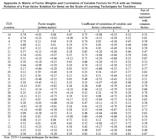
For factor analysis, we determined the reliability of the tools. Cronbach's alpha coefficient demonstrated a high reliability of the tool (α = 0.94). Thirty items from the SLTT instrument were subjected to principal component analysis (PCA) in version 20.0 of the Statistical Package for the Social Sciences (SPSS). Before conducting PCA, the suitability of the data for analysis was assessed. In order to check whether a set of the given data was suitable for factor analysis, we tested whether the value of the indicators from the Kaiser-Meyer-Olkin (KMO) measure of sampling adequacy was equal to or higher than 0.6 and whether the value of the Bartlett's test of sphericity indicators was significant, i.e. had a significance level of 0.05 or lower (Pallant, 2009). For the SLTT instrument, the KMO indicator was 0.890, and Bartlett's indicator was significant (p = 0.000), so factor analysis was justifiable. The items with the highest factor weights enabled us to give meaning to each component factor (see Appendix A: Pattern and structure matrix). We named the given factors in relation to the content of some assertions, taking into account those assertions that have the highest factor saturations.
Results
The result of implementing the abovementioned criteria is an empirical method that explains learning techniques based on four factors (components).
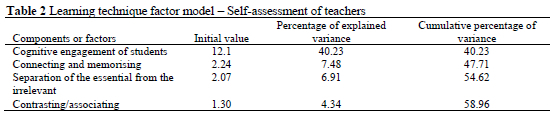
An analysis of the main components revealed the presence of four components (factors), which explains 58.96% of the variance (see Table 2). Based on the scree plot (Catell, 1966, as cited in Pallant, 2009), the existence of a breaking point behind the fourth component was determined. We, therefore, decided that further research would include four components (factors). The contribution of the first component was 40.23%, the second was 7.48%, the third was 6.91% and the fourth was 4.34%. For easier interpretation of these Components, an Oblimin rotation was performed. The rotated solution shows that separated components have significant factor weights (from 0.39 to 0.82). An overview of all the factor saturations - saturations of single items with key factors in the rotated matrix - is given in Appendix A.
Statistically Significant Differences In Teachers' Attitudes Considering The Type Of School, Subject Taught, Years Of Service, Grade In Which The Teaching Is Performed, As Well As Teachers' Pedagogical-didactic Education
We started from the assumption that there was a difference in the self-assessment of teachers based on the type of school, subject taught, number of years' teaching, the grade in which the teaching is performed, as well as the teachers' pedagogical-didactic education. Differences have been identified in the attitudes of teachers, depending on the subject they teach - more precisely the area of teaching - as well the number of years they have been teaching.
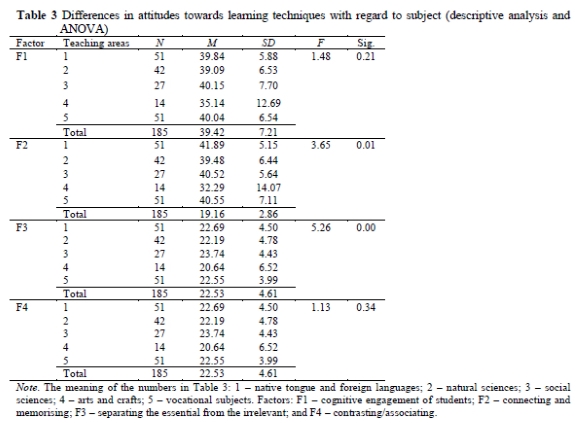
Statistically Significant Differences In Teachers' Attitudes Based On The Subject Taught We divided the subjects into five groups: native tongue and foreign languages, natural sciences, social sciences, arts and crafts, and vocational subjects. Table 3 shows the values given in descriptive statistics and variance analysis.
From Table 3 we see statistically significant differences in the attitudes of teachers with regard to the subject taught, more precisely, the teaching area. Differences were identified with the second factor, referring to connecting and memorising (F = 3.65; p = 0.01) and with the third factor, separating the essential from the irrelevant (F = 5.26; p = 0.00).
From both separated factors, significant differences were at the level of 0.01. Later, we applied multiple comparisons in the scope of the listed factors and, with regard to the subject taught, we obtained the following results:
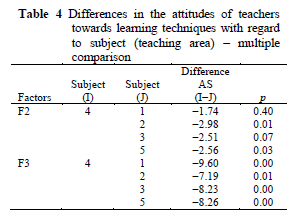
For the second factor, connecting and memorising, we identified significant differences in the attitudes of the teachers teaching subjects in the natural sciences and subjects in the field of arts and crafts (difference of arithmetic mean: -2.98; p = 0.01), as well as between the orientation of teachers teaching vocational subjects with regard to arts (difference of arithmetic mean: -2.56; p = 0.03).
Significant differences in the teachers' answers were identified with the factor separating the essential from the irrelevant. These were in the field of native tongue and foreign languages, compared to arts and crafts (difference in arithmetic mean: -9.60; p = 0.00); between the attitudes of teachers of natural sciences and of arts and crafts (difference in arithmetic mean: -7.19; p = 0.01); between the social sciences, and arts and crafts (difference in arithmetic mean: -8.23; p = 0.00); and between vocational subjects, and arts and crafts (difference in arithmetic mean: -8.26; p = 0.00).
On the basis of the given results, i.e. the previously mentioned difference in the arithmetic mean, we may conclude that language teachers and teachers of natural sciences, compared to teachers in the fields of arts and crafts, were more focused on separating or selecting more important from less important content and ideas. The same conclusion is valid for the social and vocational subjects, compared to arts and crafts. Taking the nature of the content from the abovementioned areas into account, i.e. the fact that the material was mostly verbal in character, the result that highlights the given differences between some teaching areas can be considered positive.
Differences In The Attitudes Of Teachers Towards Learning Techniques With Regard To The Number Of Years In Teaching (Descriptive Statistics And ANOVA)
We started from the assumption that there was a difference in teachers' attitudes based on the number of years they have been teaching. We classified the given answers into three categories according to teachers' number of years in teaching as follows: up to 10 years, from 11 to 25 years, and more than 25 years of teaching service.
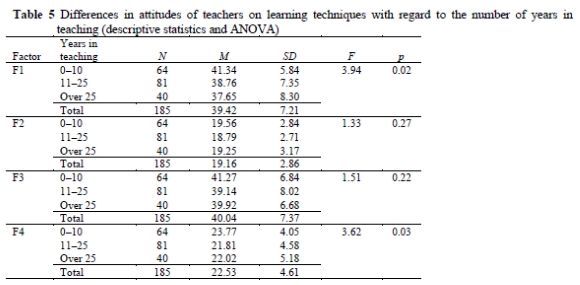
Based on the results presented in Table 5, we reached a conclusion about statistically significant differences with regard to work experience in teaching (F = 3.94 and Ρ = 0.02 for the separated factor cognitive engagement of students; F = 3.62 and Ρ = 0.03 for the factor, contrasting and associating). Hence, the assumption about potential differences in the attitudes of teachers towards rational learning techniques in secondary school depending on the number of years the teacher has been in teaching was confirmed. If we compare the results that we obtained for the different subjects with the above-mentioned finding regarding the number of years the teachers have been teaching, we reached the conclusion that the differences were caused by a variety of factors.
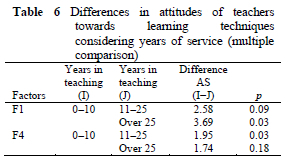
We applied multiple comparisons regarding the number of years spent teaching within the separated factors. The given values are presented in Table 6.
By applying multiple comparisons in the statistical processing, we determined that there was a statistically significant difference for cognitive engagement of students which was between the attitudes of teachers with up to 10 years' experience in teaching and those who have been teaching for over 25 years (difference in arithmetic mean: 3.69; p = 0.03). For the factor, contrasting/ associating, a difference was identified between teachers with up to 10 years' experience relative to the group of teachers with between 11 and 25 years' experience (difference in arithmetic mean: 1.95; p = 0.03) (Table 6).
It is obvious that teachers' experience is a very important factor to overcome a lack of book learning, i.e. it has a positive effect on the presentation of content by mapping key concepts and connecting that with what has been learned before. We may say that it was expected that differences in the attitudes of teachers would be identified between those with the most experience (over 25 years) and other teachers. In our case, it was the first category of teachers with up to 10 years' teaching experience.
The fourth factor was contrasting with associating. In this regard we saw a difference in the attitudes of teachers, but was, conditionally speaking, between the least and moderately experienced teachers. It is certain that contrasting with associating is extremely important, primarily, for remembering certain content. In that sense, professional experience can be a significant tool in teachers' hands (relating to the enthusiasm of those who are younger and who succeed in finding adequate examples, associations and unusual relations in order to motivate students to remember certain content for a longer period of time).
Discussion
The given learning technique factor model, from the teacher's point of view, includes the following factors: cognitive engagement of students, connecting and memorising, separation of the essential from the irrelevant, and contrasting/associating.
We called the first factor, which explains 40.23% of the variance, the cognitive engagement of students. In this component, we identified elements referring to several different techniques: symbolisation with simplification elements, mental pictures, projection, associating and cognitive mapping. The assertions referring to cognitive mapping had high factor weights (0.74, 0.74, 0.70 and 0.68). As it is necessary to select the key concepts on the basis on which the map will be structured for the needs of representing any teaching unit or the whole textbook, this technique also helps students to develop the ability to analyse and separate what is important and essential in the material.
Based on the individual assertions that contain this factor, we can conclude that it brings together many techniques, although not all of them participate equally. It is encouraging that teachers recognise the importance of different procedures applied within different subjects (which is evident from the structure of our sample). It is especially important for the strategic directing of students in learning.
We called the second factor connecting and memorising. It covered 7.48% of the explained variance. Connecting new knowledge with prior experience provides students with contextual knowledge. It is important to know the context of the students' prior knowledge so that they can acquire new knowledge, which is independent of the teaching area. Teachers should keep in mind that, only by fitting information into students' existing mental schemes, are the memory systems corresponding to long-term memory activated.
We called the third factor separating the essential from the irrelevant. The percentage of the explained variance was 6.91%. Differentiating the main idea from less important information usually represents a challenge to students. Finding and determining the key ideas require connecting with former knowledge and systematising knowledge. Teachers should, therefore, help students by stimulating them and doing exercises with them. Particularly useful determinants would be to guide students to formulate questions about paragraphs, transform headings into questions, make summaries of chapters, and practise the skill of focusing. Separating the main and most important ideas raises learning to a higher level (Huffman & Spires, 1994).
We called the fourth factor contrasting/associating. This was the factor with the lowest percentage of explained variance (4.34%). The use of contrasts, opposite connections or meanings, sometimes even absurd examples, is justifiable for students to memorise material in a more effective way. We emphasise that this separated factor is an integral part not only of memorising and connecting, but also of separating the essential from the irrelevant and the cognitive engagement of students.
The nature of all teaching areas undoubtedly influenced teachers taking different sides with regard to learning techniques, more precisely the connecting and memorising separated factor. Disregarding the fact that there are different ways of storing visual and verbal performances (symbolic and analogue code), it is certain that content memorising is conditioned by an understanding of the material or, speaking from the perspective of the teacher, by the way it is designed. If we keep that in mind, the previous result is encouraging. Teachers of the group of art subjects, compared to teachers of vocational subjects, or the natural sciences, undoubtedly have to present the content in different ways or encourage their students to memorise the content differently.
Based on the given results (Table 4), i.e. the previously mentioned difference in the arithmetic mean, it can be concluded that language teachers and teachers of natural sciences, compared to teachers from the fields of arts and crafts, were more focused on separating or selecting more important from less important content and ideas. The same conclusion is valid for the social and vocational subjects, compared to arts and crafts. Taking the nature of the content from the above-mentioned areas into account, i.e. the fact that the material is mostly verbal in nature, the result that highlights the given differences between some teaching areas can be considered positive.
The results we present here formed part of a larger research project, which, in addition to examining learning techniques from the teachers' perspectives, encompassed students' attitudes towards the strategies and techniques they employed in learning. In the previous segment, the importance of distinguishing essential from non-essential information was confirmed by the results. On the other hand, we provide some indicative data regarding students (the sample included 480 high school students from Montenegro), which we cannot fully present due to the scope of the work. More than half of the students we surveyed (55.8%) mainly or always memorised the material. An interesting finding was that 40.2% of students never sketched or drew the material they were learning. A significant number of students (59.8%) never or rarely reviewed the notes that they took during class. Also, 43.4% of students were not inclined to rephrase paragraphs, or at least do so infrequently. In other words, students did not appear to practise distinguishing key elements of the material, formulating questions for paragraphs, and identifying main ideas to elevate learning to a higher level. These results serve as a further incentive for teachers to pay attention to the aspect of distinguishing the essential from the non-essential, as research has confirmed that it was more effective than mere repetition or reproduction (Bugg & McDaniel, 2012).
Students' cognitive engagement and contrasting and associating were singled out as the main causes of the differences in attitudes with regard to the number of years spent in teaching. It is certain that the number of years a teacher has been teaching affects very important segments that are integral to students' cognitive engagement, such as providing support in mastering new concepts, focusing attention and activating existing cognitive structures. We also concluded that teachers with more experience recognised elements that would enable students to create support for their own memory, and beyond that, for understanding certain content. It has been proven that creating contrasts, as well as associative techniques, help them with that.
The results of students tested within the PISA 2022 cycle show lower performance compared to those of 2018. The results from the PISA 2018 cycle indicate that half of the students achieved results below level 2, meaning that almost half of the students were functionally illiterate. The main finding from the 2015 cycle shows a dominant focus on content and knowledge reproduction, leading to clear recommendations that students need to master effective learning techniques (Nikolic-Vucinic et al., 2019). In other words, active student participation in activities that will cognitively engage them at different levels is necessary. Considering this, the factor of students' cognitive engagement becomes even more significant. Since a difference has been shown between teachers with different lengths of teaching experience, there is a need to provide support to teachers so that they can teach students using appropriate learning techniques. In our research, which, as mentioned, included both teachers and students, we found that 41.9% of respondents absolutely could not wait for the class to end, while 59.6% of respondents always or mostly had such an attitude. It is alarming that 56.3% of respondents did not know how to begin studying, while 45.6% of students could not wait to finish studying. These are just some of the results that further confirm the importance of students' cognitive engagement and the use of techniques that will provide them with more rational learning. In this sense, teachers are particularly obliged to provide all kinds of learning support through various techniques in their teaching: by creating associations and contrasts, and simplifying, designing and connecting content. In this regard, all the mentioned techniques may be useful tools, and the obtained factors delineate areas where teachers may focus more on teaching for more effective learning. The findings in our research indicate that special attention should be paid to the area of distinguishing between relevant and irrelevant information, and students' cognitive engagement.
Conclusion
By using factor analysis, we selected four factors that bring together the different learning techniques presented in Table 1. We named the separate factors as follows: cognitive engagement of students, connecting and memorising, separating the essential from the irrelevant and contrasting and associating. The content of the separated factors shows the permeation of the techniques and their conditional separation. That is particularly evident with the first separated factor - cognitive engagement of students - which explains 40.23% of the variance, and which combines five different techniques (mental pictures, projection, symbolisation and simplification, associating, and cognitive mapping). The complexity of this factor was also confirmed through statistically significant differences in the attitudes of teachers based on the number of years they have been teaching. The second factor, covering 7.48% of the explained variance, is connecting and memorising. This factor was named according to the content of the assertions, primarily those referring to the technique of connecting, and then the numerical technique of memorising, and symbolisation and simplification. With this factor, we confirmed statistically significant differences in the self-assessment of teachers depending on the subject in which they taught learning techniques to the students. The chosen variable of academic subject also indicates the presence of differences in the self-assessment of teachers with regard to the third factor, separating the essential from the irrelevant, with the percentage of the explained variance being 6.91%. The given factor unites the assertions that refer to stimulating students to formulate questions about paragraphs, transform headings into questions, summarise a chapter, etc., hence, referring to the main, essential ideas relative to less important information. Contrasting/ associating is the fourth and final factor. It explains 4.34% of the variance. In determining statistically significant differences relating to the teachers' number of years teaching, differences were confirmed. Contrasts and associations enable more effective memorisation, and the content of the assertions that refer to these techniques (contrasting and associating) has proven to be a good basis for naming this factor. This factor confirms the fact that the selection of techniques is only conditional, because the assertions that refer to contrasts and associations are also an integral part of the other three factors: cognitive engagement of students, connecting and memorising and separating the essential from the irrelevant. In comparison to the selected variables for identifying statistically significant differences in the self-assessment of teachers (type of school, subject taught, years of teaching experience, and pedagogical-didactical education), along with the years of teaching experience, statistically significant differences in the teachers' attitudes were identified, based on the subject or nature of the teaching area within which the teacher taught learning techniques to students. It is interesting that the selected differences in teaching areas are typical for the factors connecting and memorising and separating the essential from the irrelevant. These are different factors compared to those selected regarding experience in teaching: cognitive engagement of students and contrasting/associating. These differences point us to the necessity of selecting the most important factors - the components of rational learning techniques by students and testing the differences according to the previously mentioned variables. Taking the selected differences in the attitudes of teachers into account, it is logical to assume that the analysis would provide an even more complete overview of the factors that crucially determine learning from the students' and teachers' perspectives.
Recommendations
With this study we paid special attention to learning techniques, which represent effective tools for learning. This segment forms a significant part of our theoretical elaboration because learning techniques are most often mentioned in the literature only incidentally alongside learning strategies. Furthermore, classification of techniques and their specified explanations in the literature are rarely highlighted, while their significance, along with strategies for student achievement, are emphasised. The question of learning techniques, in addition to extensive theoretical elaboration, has received adequate methodological support through the application of sophisticated procedures such as factor analysis, as well as the construction of a scale for examining learning techniques from the teacher' s perspective. Standardising the instrument, which has shown high reliability, allows for its wider use for scientific purposes. With our research we identified aspects in which teachers' attitudes differed, which may serve as a starting point for future research. Some of the recommendations for possible future implementation in schools follow.
The obtained research results may stimulate a broader educational community to approach the issue of how students learn in a more systematic manner. It is important to recognise that teachers will use different pedagogical approaches to teach different grades. The reason being that content increases as students advance to higher grades. Thus, teachers will use different strategies and techniques to cover the increase of content effectively. Possible future research should ensure theoretical and methodological selectivity. The research confirmed differences in teachers' attitudes towards different teaching domains, particularly with regard to aspects related to distinguishing essential from non-essential content, and memory and content integration. Future research could focus on examining the effectiveness of specific techniques in concrete subjects and, based on that, develop programmes to adopt learning strategies and techniques.
Limitations
We must keep in mind that the participating teachers estimated the assertions for the chosen rational learning techniques on a scale. We think that the objectivity of the given results would be significantly improved by the systematic observation of teachers, which would give the research a longitudinal character. A significant addition to those results could be provided by students concerning their attitudes towards the use and benefits of the learning techniques elaborated on. In a research sense, it was challenging to choose a sophisticated statistical procedure such as factor analysis. On the other hand, this procedure enabled us to select the most important components for the rational learning techniques under study.
Authors' Contributions
SCN, MJ and VZ were responsible for data collection and the first draft of the manuscript; SCN conducted all statistical analyses. MJ and SCN contributed to the conceptualisation of the study. All authors contributed to the analysis and writing of the manuscript and all authors reviewed the final manuscript.
Notesi. The PISA study monitors the achievement of students aged between 15 years and 3 months and 16 years and 2 months - students in either the ninth grade of primary school or the first grade of secondary school.
ii. For example, the results of the 2022 PISA testing were worse compared to 2018 in all three domains. The best result in 2018 was in mathematics (430 points), while in the 2022 cycle, Montenegrin students scored 406 points (the OECD average for mathematics in 2022 was 472). In the area of reading, the OECD average was 476, while Montenegro scored 405, marking a clear decline from the 421 achieved in the 2018 cycle, and also from the best result of 427 in 2015. In the area of science, the OECD average was 485, while Montenegro scored 403, which is a weaker result compared to the 2018 cycle when the score was 415.
iii. Published under a Creative Commons Attribution Licence.
References
Literature Review
- Alexander PA 2006. Psychology in learning and instruction. Upper Saddle River, NJ: Pearson.
- Bruning RH, Schraw GJ, Norby MM & Ronning RR 2004. Cognitive psychology and instruction (4th ed). Columbus, OH: Merrill.
-
Bugg JM & McDaniel MA 2012. Selective benefits of question self-generation and answering for remembering expository text. Journal of Educational Psychology, 104(4): 922-931. https://doi.org/10.1037/a0028661
» https://doi.org/10.1037/a0028661 - Buzan T & Buzan B 2005. Mape uma: Briljantno razmisljanje [Mindmaps: Brilliant thinking] (2nd ed). Beograd, Serbia: Finesa.
-
Cavilla D 2017. The effects of student reflection on academic performance and motivation. SAGE Open, 7(3):1-13. https://doi.org/10.1177/2158244017733790
» https://doi.org/10.1177/2158244017733790 - Cindrić M, Miljković D & Strugar V 2010. Didaktika i kurikulum [Didactics and the curriculum]. Zagreb, Croatia: IEP-D2.
- Derry SJ 1989. Putting learning strategies to work. Educational Leadership, 46(4):4-10.
-
Dunlosky J, Rawson KA, Marsh EJ, Nathan MJ & Willingham DT 2013. Improving students' learning with effective learning techniques: Promising directions from cognitive and educational psychology. Psychological Science in the Public Interest, 14(1):4-58. https://doi.org/10.1177/1529100612453266
» https://doi.org/10.1177/1529100612453266 -
European Commission 2024. Upper secondary and post-secondary non-tertiary education 2024. Available at https://eurydice.eacea.ec.europa.eu/national-education-systems/montenegro/upper-secondary-and-post-secondary-non-tertiary-education. Accessed 21 August 2025.
» https://eurydice.eacea.ec.europa.eu/national-education-systems/montenegro/upper-secondary-and-post-secondary-non-tertiary-education -
Hamman D, Berthelot J, Saia J & Crowley E 2000. Teachers' coaching of learning and its relation to students' strategic learning. Journal of Educational Psychology, 92(2):342-348. https://doi.org/10.1037/0022-05663.92.2.342
» https://doi.org/10.1037/0022-05663.92.2.342 -
Howard-Rose D & Winne PH 1993. Measuring component and sets of cognitive processes in self-regulated learning. Journal of Educational Psychology, 85(4):591-604. https://doi.org/10.1037/0022-0663.85A591
» https://doi.org/10.1037/0022-0663.85A591 - Huffman LE & Spires HA 1994. Effects of explicit instruction in note taking on sixth graders' lecture comprehension and attitudes toward notetaking. Reading Improvement, 31(2):72-76.
-
Jelić M & Čalović Nenezić S 2019. Influences of preschool on the development of self-control in preschool children in Montenegro. South African Journal of Education, 39(Suppl. 2):Art. #1627, 9 pages. https://doi.org/10.15700/saje.v39ns2a1627
» https://doi.org/10.15700/saje.v39ns2a1627 - Matijević M & Radovanović D 2011. Nastava usmjerena na ucenika [Student-centered teaching]. Zagreb, Croatia: Školske Novine.
-
McCormick CB, Dimmitt C & Sullivan FR 2013. Metacognition, learning, and instruction. In I Weiner, WM Reynolds & G Miller (eds). Handbook of psychology (2nd ed). Hoboken, NJ: Wiley. https://doi.org/10.1002/9781118133880.hop207004
» https://doi.org/10.1002/9781118133880.hop207004 -
McNamara DS 2004. SERT: Self-Explanation Reading Training. Discourse Processes, 38(1):1-30. https://doi.org/10.1207/s15326950dp3801_1
» https://doi.org/10.1207/s15326950dp3801_1 -
Mohammadi M, Birjandi P & Maftoon P 2015. Learning strategy training and the shift in learners' beliefs about language learning: A reading comprehension context. SAGE Open, 5(2):1-11. https://doi.org/10.1177/2158244015579726
» https://doi.org/10.1177/2158244015579726 -
Nesbit JC & Adesope OO 2006. Learning with concept and knowledge maps: A meta-analysis. Review of Educational Research, 76(3):413-148. https://doi.org/10.3102/00346543076003413
» https://doi.org/10.3102/00346543076003413 - Niemivirta M 1996. Motivational-cognitive components in self-regulated learning. Paper presented at the 5th International Conference on Motivation, Landau, Germany, 26-29 March.
-
Nikolic-Vučinić A, Mrvaljević I, Nikolić O, Tomić V, Bulatović V, Durković N, Vujović A, Paljević-Šturm D, Backović S, Vučinić I & Sćekić D 2019. Rezultati studije PISA 2015:1preporuke za obrazovne politike [PISA 2015 results and recommendations for education policies]. Podgorica, Montenegro: UNICEF Crna Gora i Ministarstvo prosvjete Crne Gore. Available at https://www.unicef.org/montenegro/media/8676/file/MNE-media-MNEpublication500.pdf. Accessed 25 August 2025.
» https://www.unicef.org/montenegro/media/8676/file/MNE-media-MNEpublication500.pdf -
O'Donnell AM, Dansereau DF & Hall RH 2002. Knowledge maps as scaffolds for cognitive processing. Educational Psychology Review, 14(1):71 -86. https://doi.org/10.1023/A:1013132527007
» https://doi.org/10.1023/A:1013132527007 -
Organisation for Economic Co-operation and Development 2000. Measuring student knowledge and skills: The PISA 2000 assessment of reading, mathematical and scientific literacy. Paris, France: OECD Publishing. https://doi.org/10.1787/9789264181564-en
» https://doi.org/10.1787/9789264181564-en -
Organisation for Economic Co-operation and Development 2005. The definition and selection of key competencies. Executive summary. Paris, France: OECD Publishing. Available at https://www.dpsgs.org/pdf/OECD_Key_competencies.pdf. Accessed 25 August 2025.
» https://www.dpsgs.org/pdf/OECD_Key_competencies.pdf - Ormrod J 2008. Educational psychology: Developing learners (6th ed). Upper Saddle River, NJ: Pearson Education.
- Ormrod JE 2014. Human learning (6th ed). Boston, MA: Pearson.
- Ormrod JE 2017. How we think and learn: Theoretical perspectives and practical implications. Cambridge, England: Cambridge University Press.
- Oxford RL 2011. Teaching and researching: Language learning strategies. Harlow, England: Pearson Longman.
- Oxford RL 2017. Teaching and researching language learning strategies: Self-regulation in context. New York, NY: Routledge.
- Pallant J 2009. SPSS prirucnik za preživljavanje: postupni vodič kroz analizu podataka pomocu SPSS-α za Windows (version 15) [SPSS survival manual: A step-by-step guide to data analysis using SPSS for Windows (version 15)]. Beograd, Serbia: Mikro Knjiga.
-
Pavlin-Bernardić N & Vlahović-Štetić V 2019. Kognitivni aspekti samoregulacije ucenja [Cognitive aspects of self-regulated learning]. In V Vizek-Vidovic & I Marusic (eds). Kompetencija uciti kako uciti: Teorijske osnove istrazivanja u hrvatskom kontekstu. Zagreb, Croatia: Institut za drustvena istrazivanja u Zagrebu. Available at https://idiprints.knjiznica.idi.hr/861/1/Kompetencija%20U%C4%8Diti%20kako%20u%C4%8Diti.pdf. Accessed 26 August 2025.
» https://idiprints.knjiznica.idi.hr/861/1/Kompetencija%20U%C4%8Diti%20kako%20u%C4%8Diti.pdf -
Pintrich PR 2004. A conceptual framework for assessing motivation and self-regulated learning in college students. Educational Psychology Review, 16(4):385-407. https://doi.org/10.1007/s10648-004-0006-x
» https://doi.org/10.1007/s10648-004-0006-x -
Pintrich PR & De Groot EV 1990. Motivational and self-regulation learning components of classroom academic performance. Journal of Educational Psychology, 82(1):33-40. https://doi.org/10.1037/0022-0663.82.L33
» https://doi.org/10.1037/0022-0663.82.L33 - Pintrich PR & Schunk DH 2002. Motivation in education: Theory, research and applications (2nd ed). Columbus, OH: Merill Prentice Hall.
-
Robbins SB, Lauver K, Le H, Davis D, Langley R & Carlstrom A 2004. Do psychosocial and study skill factors predict college outcomes? A meta-analysis. Psychological Bulletin, 130(2):261-288. https://doi.org/10.1037/0033-2909.130.2.261
» https://doi.org/10.1037/0033-2909.130.2.261 -
Salovaara H 2005. Achievement goals and cognitive learning strategies in dynamic contexts of learning. PhD dissertation. Oulu, Finland: University of Oulu. Available at https://oulurepo.oulu.fi/bitstream/handle/10024/34380/isbn951-42-7763-5.pdf?sequence=1&isAllowed=y. Accessed 18 August 2025.
» https://oulurepo.oulu.fi/bitstream/handle/10024/34380/isbn951-42-7763-5.pdf?sequence=1&isAllowed=y -
Schellings G 2011. Applying learning strategy questionnaires: Problems and possibilities. Metacognition and Learning, 6:91 -109. https://doi.org/10.1007/s11409-011-9069-5
» https://doi.org/10.1007/s11409-011-9069-5 - Schmidt RA & Marzano RJ 2015. Recording and representing knowledge: Classroom techniques to help students accurately organize and summarize content. West Palm Beach, FL: Learning Sciences Marzano Center.
-
Schraw G & Dennison RS 1994. Assessing metacognitive awareness. Contemporary Educational Psychology, 19(4):460-475. https://doi.org/10.1006/ceps.1994.1033
» https://doi.org/10.1006/ceps.1994.1033 - Schunk DH 2014. Learning theories: An educational perspective (6th ed). Greensboro, NC: Pearson.
-
Seker M 2016. Scenario-based instruction design as a tool to promote self-regulated language learning strategies. SAGE Open, 6(4): 1-11. https://doi.org/10.1177/2158244016684175
» https://doi.org/10.1177/2158244016684175 - Semorie AM 1978. I vi mozete imati superpamcenje [You also can have super memory]. Beograd, Serbia: Izdanje Autora.
- Slavin RE 2018. Educational psychology: Theory and practice (12th ed). Upper Saddle River, NJ: Pearson Education.
- Snowman J, McCown R & Biehler R 2009. Psychology applied to teaching (12th ed). Boston, MA: Houghton Mifflin.
- Sternberg RJ & Williams WM 2010. Educational psychology (2nd ed). Upper Saddle River, NJ: Pearson.
- Suzić N 2005. Pedagogija za XXI vijek [Pedagogy for the 21st century]. Banja Luka, Bosnia and Herzegovina: TT-Centre.
-
Suzić N, Jelić V & Milivojac A 2013. Separating the relevant from the irrelevant: The SRI learning model. SportLogia, 9(2):59-67. https://doi.org/10.5550/sgia.130902.en.001S
» https://doi.org/10.5550/sgia.130902.en.001S - Terhart E 2001. Metode poucavanja i učenja: Uvod u probleme metodicke organizacije poucavanja i ucenja [Methods of teaching and learning: Introduction to problems of methodological organization of teaching and learning]. Zagreb, Croatia: Educa.
-
Vermunt JD 2005. Relations between student learning patterns and personal and contextual factors and academic performance. Higher Education, 49(3):205-234. https://doi.org/10.1007/s10734-004-6664-2
» https://doi.org/10.1007/s10734-004-6664-2 -
Visser M, Kovač-Cerović T & SOFRECO 2022. Analiza sektora obrazovanja 2015-2020 [Education sector analysis 2015-2020]. Podgorica, Montenegro: UNICEF Crna Gora i Ministarstvo prosvjete Crne Gore. Available at https://www.unicef.org/montenegro/media/22586/file/ESA%20%20CG°/o20verzija.pdf. Accessed 27 August 2025.
» https://www.unicef.org/montenegro/media/22586/file/ESA%20%20CG°/o20verzija.pdf -
Vucković D 2010. Razvoj strategija učenja verbalnog gradiva u osnovnoj školi [Strategy development of learning verbal contents in primary school]. Nasa Škola, 1-2:37-67. Available at https://www.researchgate.net/publication/334896735_Razvoj_strategija_ucenja_verbalnog_gradiva_u_osnovnoj_skoli. Accessed 14 August 2025.
» https://www.researchgate.net/publication/334896735_Razvoj_strategija_ucenja_verbalnog_gradiva_u_osnovnoj_skoli - Vud E 1996. Trening uma i pamćenja [Training of the mind and memory]. Beograd, Serbia: IP Babun.
- Vulfolk A, Hjuz M & Volkap V 2014. Psihologija u obrazovanju [Psychology in education]. Belgrade, Serbia: Clio.
-
Wang S & Seepho S 2017. Facilitating Chinese EFL learners' critical thinking skills: The contributions of teaching strategies. SAGE Open, 7(3):1-9. https://doi.org/10.1177/2158244017734024
» https://doi.org/10.1177/2158244017734024 - Weinstein C & Mayer R 1986. The teaching of learning strategies. In M Wittrock (ed). Handbook of research on teaching (3rd ed). New York, NY: Macmillan.
-
Weinstein CE & Hume LM 1998. Study strategies for lifelong learning. Washington, DC: American Psychological Association. https://doi.org/10.1037/10296-000
» https://doi.org/10.1037/10296-000 -
Weinstein CE, Husman J & Dierking DR 2000. Self-regulation interventions with a focus on learning strategies. In M Boekaerts PR Pintrich & M Zeinder (eds). Handbook of self-regulation. San Diego, CA: Academic Press. https://doi.org/10.1016/b978-012109890-2/50051-2
» https://doi.org/10.1016/b978-012109890-2/50051-2 -
Willingham DT 2008. Critical thinking: Why is it so hard to teach? Arts Education Policy Review, 109(4):21 -32. https://doi.org/10.3200/aepr.109A21-32
» https://doi.org/10.3200/aepr.109A21-32 -
Winne PH & Hadwin AF 1998. Studying as self-regulated learning. In DJ Hacker, J Dunlosky & AC Graesser (eds). Metacognition in educational theory and practice. Hillsdale, NJ: Lawrence Erlbaum Associates. https://doi.org/10.4324/9781410602350-19
» https://doi.org/10.4324/9781410602350-19 -
Winne PH & Perry NE 2000. Measuring self-regulated learning. In M Boekaerts PR Pintrich & M Zeinder (eds). Handbook of self-regulation. San Diego, CA: Academic Press. https://doi.org/10.1016/b978-012109890-2/50045-7
» https://doi.org/10.1016/b978-012109890-2/50045-7 - Zimmerman BJ 1994. Dimensions of academic self-regulation: A conceptual framework for education. In DH Schunk & BJ Zimmerman (eds). Self-regulation of learning and performance: Issues and educational applications. Hillsdale, NJ: Erlbaum.
- Zorić V 2015. Konstruktivisticka psihologija kao pozadina odnosa saznanja i jezika kod Johna Deweyja [Constructivist psychology as the background of the relationship of cognition and language with John Dewey]. In I Gruić (ed). Zbornik radova sa medunarodne naučne konferencije Učiteljskog fakulteta Sveucilista u Zagrebu, Istrazivanje paradigmi djetinjstva, odgoja i obrazovanja, II simpozij Dječji jezik i kultura. Opatija, Croatia: Učiteljski fakultet Sveučilišta u Zagrebu.
Revised: 22 February 2025
Accepted: 30 June 2025
Published: 31 August 2025