Group career development of rural learners through group-based career construction counselling: Intervention research
Abstract
The aim with this research was to explore the influence of group-based career construction counselling on learners' career development in a rural school. Convenience and purposive non-probability sampling were used to select a group of 15 Grade 9 learners aged between 14 and 18 to participate in the study. An interpretive paradigm (drawing from the constructivist worldview) underpinned the study. Data were generated by employing multiple qualitative sources, including pre- and post- intervention semi-structured group interviews, documents in the form of collages and timelines compiled by participants, the researcher's reflective journal and the career interest profile. A non-linear iterative, thematic analysis process was conducted to identify themes that emerged from the datasets. The findings reveal that group-based career construction counselling enhances learners' career development in a rural school by facilitating the addressing of subject choices early in Grade 9 as a key element in children's career development. Moreover, such intervention offers numerous benefits to young learners, including enhanced self- and career awareness. In future research it should be considered assessing the value of career construction counselling in the changing world of work to benefit learners' career development in the 21st century and beyond.
career construction counselling; career development; group career counselling; interpretive paradigm; intervention; rural learners; thematic analysis
Introduction
The Fourth Industrial Revolution (4IR) has set in with digitisation and automation, which will ultimately shape the nature of career choices, career development, and career counselling practices in the future (Hirsch, 2018; Xing, Marwala & Marwala, 2018). Clearly, this era presents a challenge, more than ever, to promote career development in schools through which learners should be assisted to understand the impact of the 4IR on career choice including, but not limited to job displacement, automation and artificial intelligence (AI) replacing certain jobs making some careers obsolete. Through recognition of these challenges and implementing strategies to address them, schools can better prepare learners for prosperous and meaningful careers in the 4IR era. The lack of career guidance and education support in South African schools, despite its inclusion in the subject, life orientation, is a grave concern that led us to investigate the extent to which group-based career and life construction counselling can be facilitated to promote the career development of Grade 9 learners in rural schools in particular. Smit, Wood and Neethling (2015) maintain that life orientation is not taught effectively in South African schools, even though it is currently the only opportunity that learners have to receive career education. Most teachers provide only limited information on the careers that are available to learners. The socio-economic adversity in South Africa today restricts career guidance in under-resourced schools to the mere provision of career information and limits career counselling services to what Smit et al. (2015) describe as a one-size-fits-all approach that denies learners the opportunity to engage in critical and creative thinking on overcoming the financial and social barriers that may limit their career choices.
Whereas career development involves an ongoing series of activities designed to support people to explore, establish, achieve, make meaning, and experience fulfilment in their career-lives, career guidance and education aim to provide pertinent career information to help individuals make well-informed decisions along their professional trajectory (Maree, 2020). However, currently, activities related to career guidance aimed at promoting learners' career development are conducted haphazardly by different agents in different contexts and are not managed well in schools.
Theoretical Framework
Super's life-span, life-space career development theory
Donald Super's (1957, 1990) life-span, life-space theory views a career as a dynamic process that evolves over time. Super emphasises the reciprocal influence between the person and the environment in building the person's self-concept, and he argues that self-concept is a product of complex interaction among a number of factors, including physical and mental growth, personal experiences, environmental characteristics, and stimulation (Leung, 2008). Building on Super's (1990) premise, we explored how Grade 9 learners in a rural setting experienced group-based career construction counselling to build meaningful careers as part of their physical and mental growth process.
In each stage of their development (growth, exploration, establishment, maintenance, and disengagement), people need to accomplish certain tasks and assume specific roles played out in real-life theatres, including the home, school, workplace, and community (including child, student, leisurite, citizen, worker, spouse or partner, parent, homemaker, and pensioner) to successfully manage the vocational developmental tasks that are socially expected at any given chronological stage (Leung, 2008; Niles & Harris-Bowlsbey, 2017). Managing children's career development progresses dynamically through sequential life stages in which different tasks must be accomplished. Failure to do so hampers their self-concept, which may result in difficulties with making career decisions later in life (Kidd, 2007; Schreuder & Coetzee, 2016).
The role of career guidance and counselling is to address people's concerns over a lifetime of development during which people undergo situational and personal changes. However, for the purpose of this article, we only focus on the exploration phase (adolescence from age 14-24). The main goal of this stage is crystallisation, which is defined as "developing a clear and stable vocational self-concept reflecting one's preferences for occupational fields and ability levels" (Hartung, 2013:94). Through crystallisation, individuals gather information about themselves and various occupations to learn more about the world of work and determine what kind of work they might pursue.
People's perceptions about careers and employment patterns have changed significantly with the realisation that they can hold multiple jobs and careers instead of remaining in one job throughout their lives (Roythorne-Jacobs & Mensele, 2016). They are also able to acquire new skills and attitudes required by the new careers in the highly competitive job market. There has been a shift away from modernism towards a postmodern approach that emphasises the role of counsellors as co-constructors of clients' career stories through dialogue. This approach is valued for its recognition of psychological, political, social, and economic cultures during the counselling process.
Savickas career construction theory
Savickas' career construction theory (Savickas, 2013, 2019) posits that people construct their own lives and careers by identifying (imposing meaning on) their vocational (work-related) behaviour and numerous experiences in the workplace (Maree, 2010). One's career unfolds as one makes choices and develops a narrative or story of one's life by using past memories (i.e. early recollections or childhood memories), present experiences, and future aspirations to produce a meaningful career story (Hartung, 2007). From a career construction perspective, individuals' careers are not made up of scores on inventories or tests, or the opinions of employers or families, but are constructions that individuals make by themselves. Individuals' careers are thus potentially regarded as a central part of their lives, and the career becomes the construction of meaning within a unique social context (Maree, 2010).
Career construction theory (Savickas, 2019) views the self from three perspectives, namely actor, agent, and author in the career development process (Savickas, 2013). Individuals begin their career construction as children (actors), become agents and direct actions in adolescence, and finally become authors who explain the actions they direct in adulthood (Niles & Harris-Bowlsbey, 2017). To assist clients in (re-)authoring their story, Savickas (2012) applies the concept of life designing, which involves four phases: constructing, deconstructing, reconstructing, and co-constructing. Construction starts with small stories called micro-narratives, which help counsellors to see how clients organise their view of themselves, their identity, and their career. Together, the counsellor and the client reconstruct the micro-narrative into one that has positive outcomes and emphasises the strengths of the client. In co-construction, a macro-narrative emerges from many micro-narratives; the client and the counsellor develop a tentative portrait of the client's life and a theme of the client's career prospects, and the client becomes ready to face the challenges of applying for work and entering the world of work (Nystul, 2017).
Maree (2013) describes career construction as a process through which career counsellors assist people to face unique challenges inherent in choosing appropriate careers and scripting career and life stories for themselves. Career construction counselling (Savickas, 2019) aims to promote people's narratability, autobiographicity, career adaptability, intentionality, and activity to facilitate forward movement in their career-lives.
Narratability
In career construction, people are given the opportunity to narrate (construct) their own stories so that they can understand themselves better and organise and make sense of their life experiences within their particular familial, social, historical, and cultural contexts. When individuals tell their career stories, they produce a narrative, which is essentially their own view of their career. Career construction counsellors listen to their clients' narratives, or the storylines thereof, and identify their vocational personality styles (abilities, needs, values, interests, and other traits characterising a person's self-concept), career adaptability (coping mechanisms), and life themes to help them construct meaning from their lives and build their own life-career stories (Schreuder & Coetzee, 2016). Di Fabio and Maree (2013) further contend that career construction counsellors should focus more on their clients' subjective interpretations of the facts they reveal in connection to their unique story modalities, rather than solely on the objective facts obtained from them.
Autobiographicity
Communication between the client and the counsellor is instrumental in helping them formulate stories in their own words and map their subjective identities. In so doing, individuals engage in personal dialogue to examine their past and present experiences to help them better understand and draw on their own life themes, vocational personality, and adaptability resources (Savickas, 2015). Doing so can be used to prompt clients to re-author their own life-career stories and enhance their experience of work as a meaningful context for development (Hartung, 2007).
Career adaptability: Career construction counselling aims to bring about change in individuals' lives by increasing their career adaptability through incorporating the four Cs, namely concern, control, curiosity, and confidence (Ginevra, Magnano, Lodi, Annovazzi, Camussi, Patrizi & Nota, 2018). Savickas and Porfeli (2012) describe the four Cs as career adaptability resources or psychological strengths that influence self-regulation in coping with tasks, transitions, and traumas. Concern implies being optimistic about life within a particular time perspective, and thus helps individuals look ahead and prepare for what might come next. Control "enables individuals to become responsible for shaping themselves and their environment to meet what comes next by using self-discipline, effort and persistence" (Savickas & Porfeli, 2012:663). Curiosity (individuals' tendency to explore their environment) is critical for career exploration. Lastly, confidence refers to one's capacity to stand by one's own aspirations and objectives, even in the face of adversity (Neureiter & Traut-Mattausch, 2017).
Intentionality: From a constructivist perspective, careers are constructed by engaging in activities and reflecting on the outcomes. The counsellor and the client should concentrate on meaning-making through intentional processes in the ongoing construction to enable clients to validate what they consider important in their lives (Savickas, Nota, Rossier, Dauwalder, Duarte, Guichard, Soresi, Van Esbroeck & Van Vianen, 2009).
Activity: Engaging in various activities provides individuals with an opportunity to gain insight into their personal abilities, talents, and interests (Savickas & Pouyaud, 2016). Interacting with people from whom they receive feedback helps them formulate new selves and identities, re-interpret their life themes, and ultimately write new life stories. Thus, activity helps clients to turn actions into meaningful behaviour (Savickas, 2012).
Savickas et al. (2009) maintain that, due to the interconnectedness of different life domains, we can no longer speak of career development or vocational guidance; instead, we should envision life trajectories in which people progressively design and build their own lives, including their work careers. The question, "What am I going to do with my life?", should be answered not only by adolescents but by everyone as they negotiate major transitions in their lives. This question prompts people to identify things that make life truly worthwhile. Thus, in career construction counselling, people are assisted in making decisions regarding their career lives, rather than counsellors deciding for them. They can then realise that they have the potential to control their own lives. Patton (2005:22) affirms that "we are in an era of do-it-yourself career management where individuals are being challenged to play a greater role in constructing their own career development." Career counsellors should, therefore, use the cultural resources that clients bring to the consulting room to co-construct action plans and help them move forward (Maree, 2013).
Group career counselling
Group counselling can be defined as a process in which group members with particular challenges related to their careers, including but not limited to self-discovery and exploration, choosing a career trajectory, balancing academics and extracurricular activities, balancing family expectations, financial constraints, and language barriers, come to counselling to share their challenges (problems), hoping for positive outcomes (Maree & Magere, 2023). These problems may emanate from different sources such as the home, school, or friends. The group leader focuses on different people and their problems, after which the group members attempt to help one another under the group leader's guidance (Jacobs, Schimmel, Masson & Harvill, 2016). The group leader should be a professionally trained counsellor who is capable of creating a climate of trust, openness, responsibility, and interdependency through interactive counselling. Esposito, Ribeiro, Gonçalves and Freda (2017:392) use the concept, "mirroring", as a "metaphor that allows each member of the group not as an opaque surface, but as a human reflecting mirror who elaborates what is shared in the group setting and absorbs and reflects it in a more meaningful way." The group members may thus learn something about themselves from the effects that they have on one another.
Group guidance was essential in this study, as it provides an effective means to deliver the career construction intervention programme in a group format. This approach helps participants make informed career decisions, with Grade 9 considered a critical stage for career and subject choices (Maree, 2022b; Maree & Magere, 2023). We are aware that the term, "group guidance", within a school context applies to small groups of learners who can fit into ordinary classrooms characterised by cohesiveness and the sharing of personal concerns (as is the practice in many South African schools at the time of this study) (Mahlangu, 2011). It is worth noting that, within such contexts, learners receive help on a regular scheduled basis, while individual counselling would be recommended for people experiencing specific psychological problems that the general information alone will not resolve (Shechtman & Kiezel, 2016). The difference between group career counselling and group guidance lies in the goals thereof. Group counselling focuses on growth, development, enhancement, prevention, self-awareness, and removing blockages to growth, while group guidance focuses on the mere provision of information (Corey, 2013).
Aim of the Research
The aim with this research was to explore the influence of group-based career construction counselling on learners' career development in a rural school. We administered qualitative group-based career counselling intervention to 50 Grade 9 learners from a typically rural setting (Lubombo Secondary School in the Ehlanzeni district) to enable them to make informed career decisions. The intervention programme was implemented in collaboration with the life orientation teacher to ensure that it was not regarded as an isolated programme outside the school curriculum and the school subject, life orientation.
We investigated the following (explorative) research questions:
i. What were the main differences between learners' pre- and post-intervention themes and sub-themes?
ii. How did group-based career construction intervention by means of the conduits of narratability, career adaptability, and intentionality influence learners' career development?
Research Methodology
Research Setting and Participants
Two types of non-probability sampling, namely purposive and convenience sampling, were employed to select a group of Grade 9 participants, the only Grade 9 class from Lubombo Secondary School in the Ehlanzeni district, which falls under the Mpumalanga Department of Education, where the second author was employed as Deputy Chief Education Specialist (DCES) for career guidance (at the time of the study). The class consisted of 50 learners during the first encounter with them, but the number gradually diminished to 15. This was due to participants having withdrawn from the process since the study took much longer to complete due to the national coronavirus disease (COVID-19) lockdown. All participants in the group were from the same ethnic group and spoke the same home language, were in Grade 9 at the time of the study, and were located in a typical low socio-economic rural community where sheer poverty was a daily reality. This probably explains why their level of English proficiency was extremely low.
Research Paradigm
The paradigm underpinning this study draws from the interpretivist/constructivist worldview, which emphasises the importance of understanding human interactions within their social, historical, political, and cultural contexts. This perspective underscores the importance of recognising human interactions within their idiosyncratic contexts, especially in rural settings where learners face numerous distinctive challenges and opportunities. The aim with the research was thus to investigate how career (construction) counselling interventions can be applied successfully and meaningfully within these unique contexts to promote learners' career development.
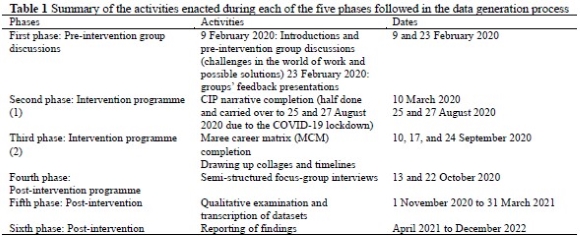
Qualitative Data Generation and Analysis Process In this study, qualitative data were gathered by employing pre-intervention group discussions, post-intervention semi-structured focus-group interviews, observations and documents (career interest profile [CIP], collages, timelines, and research journal). A multi-phase sequential approach was followed to explain sequentially how the career construction intervention processes unfolded, which summarises the five phases followed in the data generation process (see Table 1).
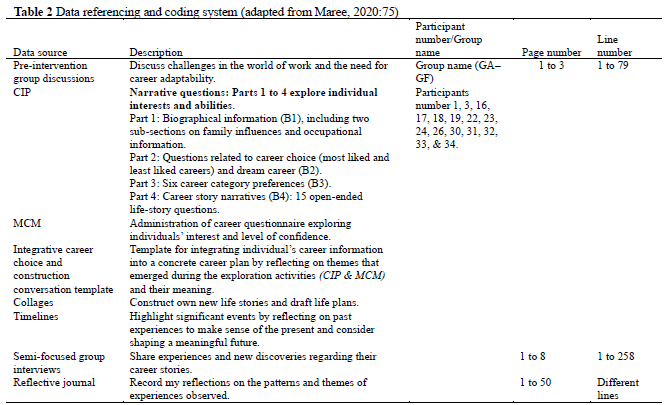
The data referencing and coding system is presented in Table 2.
Data Analysis and Interpretation
For the purpose of this study, the steps recommended by Creswell (2014) for identifying and refining data codes were employed.
Quantitative data analysis
While this research was primarily qualitative, the use of the MCM inventory as a source of data generation to assess the participants' interests and their level of confidence to follow certain careers necessitated the inclusion of this section of the quantitative analysis. The participants' responses derived from this test were helpful in making inferences regarding their level of career development based on the assessment of their career interests and skills confidence (Maree & Taylor, 2016). By way of deductive analysis, the four dimensions of the career adaptabilities scale (CAAS) were used to look for evidence in the participants' narratives regarding their level of concern, curiosity, confidence, and control.
Qualitative data were analysed in six steps (Creswell, 2014).
Step 1: Get a sense of the whole: Read all datasets carefully and make notes on ideas coming to mind.
Step 2: Generate initial codes from the data: Create labels using pseudonyms and identify meanings from the participants' responses.
Step 3: Group similar codes: Make a list of major and minor codes, discarding redundant codes to a smaller manageable number.
Step 4: Compare codes for duplication: Divide similar codes into columns and recode others to fit descriptions.
Step 5: Refine the codes: Go back to the data, check whether any new codes emerged and identify specific quotes supporting the codes. Step 6: Collapse codes into themes or categories: Provide a summary by interpreting the coded themes into findings.
Data Triangulation
Data triangulation was achieved by applying inductive and deductive analysis through the MCM questionnaire and the integrative career choice and construction conversation template employed to merge prominent themes that emerged from the CIP narratives relating to the participants' interest and level of confidence in specific careers. Through the inductive-deductive processes, we had to move back and forth, examining the data sources until comprehensive themes were established, while deductively, we revisited data sources to verify whether emergent themes supported each other or whether we needed more additional information (Creswell, 2014).
Triangulation was further enhanced by conducting follow-up semi-structured focus-group interviews with participants to allow them to comment on the identified themes and patterns to verify truthful representation (Cohen, Manion & Morrison, 2018).
Ethical Considerations
Written approval was obtained from the Ethics Committee of the Faculty of Education at the University of Pretoria. Strict adherence to ethical standards in planning and conducting the research was maintained throughout.
Findings (Results)
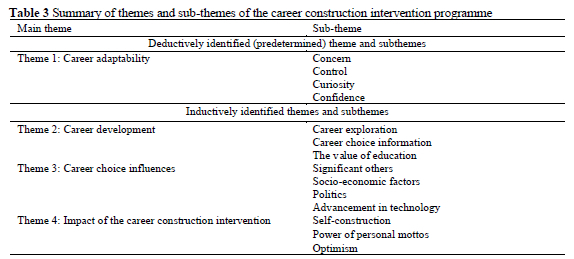
The main themes and sub-themes that were identified are summarised in Table 3 (below). Here, we drew on the view that no matter how hard we tried purely inductive (or deductive) studies were found (Bernard & Ryan, 2010:107). Therefore, it seems safe to say that our approach to data analysis in this study can best be described as inductive-deductive. Three themes emerged inductively following thematic data analysis, namely career development, career choice influences, and the impact of the intervention on the participants' career development. The fourth theme, career adaptability, and its four sub-dimensions emerged deductively through evidence sought from the participants' responses. These themes are discussed below. Where necessary, we used direct quotations expressed by the different participants for purposes of clarity.
Deductively Identified (Pre-determined) Theme and Subthemes
Theme 1: Career adaptability
The theme, "career adaptability", and its four sub-themes are summarised below, followed by a brief description of each sub-theme, with relevant examples quoted verbatim from the participants' responses, which were generated through different data sources.
Career adaptability refers to psychological strengths that influence self-regulation in coping with tasks, transitions, and traumas by incorporating the four Cs, namely concern, control, curiosity, and confidence (Ginevra et al., 2018).
Concern
As a person, you must clarify your own goal in time to follow till you achieve it (goal). I have learned not to listen to my friends when they give bad advice, because you end up doing nothing with your life (goal setting, self-exploration, and discovery). (F, IP34)
Control
I have learned that I have to believe in myself, trust myself, have confidence. I realised that I don't have to live my life to please other people. I have to live my life truthful, love myself just the way I am. (F, IP18)
Curiosity
I would like to find out more about and become good at practical work like using my own hands (B, IP23, 4).
Confidence
I am kind and I am a go-getter, willing to take risks. If I do something wrong, I can face the consequences (B,IP18,4) (participant express that she is always willing to take risks).
Inductively Identified Themes and Subthemes
Theme 2: Career development
In this study, the term "career development" is defined as "the total constellation of psychological, sociological, economic and chance factors that combine to shape or influence the career of any given individual over the lifespan" (Schreuder & Coetzee, 2016:95).
Below, we provide relevant examples quoted verbatim from the participants' responses, which were generated through different data sources.
[Value of] career exploration
I discovered that my favourite careers are accounting, social work, teacher, and animal doctor (veterinarian) because I love teaching some people, working with numbers, taking care of some people, and cos I love animals (B, IP3, 2).
[Relevance of] subject choices
The importance of relevant subject combinations in Grade 9 for certain career options seemed to be a serious challenge for most participants before the intervention programme. Some of them seemed to be confused when asked to state their dream careers, the careers they liked most, and those they liked least in the CIP. For this reason, some would list careers that contradict the subjects not liked, while others would repeat the same careers they liked most as the careers they liked least, which suggests that they did not understand that subject choice was one of the most significant factors impacting their ability to choose a particular career.
I won't take mathematics and natural sciences even though I want to be in a career where I can help people who are sick; share my knowledge on health with other people bcos [sic] I don't want to see other people suffer pain. (B, IP24,2)
Career information
I have gained because when I was in Grade 8, I did not know what I wanted to become but now I feel confident because I am aware of my capabilities, that's why I have chosen software engineering because I like working with computers and after teaching us about the different careers and the pamphlets you gave us, I also made my own research, now understand that it entails developing and maintain software systems and application. (G, IP34, 2, 34-42)
Value of education
I want to finish my studies and achieve my goal cause [sic] I want to get a degree that will make me a happiest person. Education is the key to successfully [sic], working hard you a [sic] better person tomorrow, life is a changer of things. (E, IP34)
Theme 3: Career choice influences
The third theme represents the participants' perceptions regarding the influence of significant others, socio-economic factors, politics, and technological advancement in career decisions.
Role of significant others
My mother inspires me; she is not a quitter, she's a fighter. And my sister: she always keeps on going whether it is good or bad (B, IP31, 4).
My mother, my soccer team, Mr X, they have made me the person I am and now I am a better person because of them they are my role models (B, IP34, 4).
Socio-economic factors
You have to have more qualifications and if you are not privileged coming from a poor family you won't have money to go to university (A, GA, 1, 5-6).
Politics
If you want a job you have to have connections with people who will help you get the job. Therefore, there will always be unemployment (GA, 3-4, 1).
Advancement in technology
They increasingly use technology (machines) instead of hiring people to work (GA, 2, 1).
Theme 4: Impact of the career construction intervention
The fourth theme represents the participants' views on the benefits of having participated in the career construction intervention programme.
Self-construction
I will really try to work hard and improve myself so that I can become what I want in life (F, IP16).
Power of personal mottos (narratives)
Don't let your past describe your future (B, IP33).
Wisdom through experience (B, IP18).
Optimism
I learned that I have reason to believe in myself, trust myself and have confidence (F, IP18).
Experience of life orientation lessons
To a certain extent it [life orientation lessons] does help you understand yourself..., but in terms of careers it (LO) is not assisting us well because it does not provide us with careers information (G, IP33, 7, 201-203).
Discussion
In this section, we discuss our research findings and compare them to the existing literature on group-based career construction counselling and its effectiveness in enhancing the career development of learners in rural areas.
The aim with this research was to explore the influence of group-based career construction counselling on learners' career development in a rural school. Two research questions were posed:
Explorative questions:
i. What were the main differences between learners' pre- and post-intervention themes and sub-themes?
ii. How did group-based career construction intervention by means of the conduits of narratability, career adaptability, and intentionality influence learners' career development?
These two questions are addressed successively below.
What were the Main Differences between Learners' Pre- and Post-intervention Themes and Sub-themes?
Several notable differences between the pre- and post-intervention themes and sub-themes were demonstrated through the participants' comments and behaviour as they progressed through the stages of the intervention. Themes and sub-themes that emerged during the pre-intervention group discussions include a lack of information on career fields and self-awareness (self- and career identity), hopelessness and despair, insecurity, and inadequate self-knowledge. The participants' comments indicated that most of them did not understand that, in addition to the socio-economic factors raised, their interests, abilities, weaknesses, and personality traits also played a vital role in the career-choice and decision-making process; as a result, they struggled to set clear career goals. They also displayed a lack of understanding of the connection between subject combination and career choice as critical determinants for their future career trajectories as they transitioned from the General Education Band (Grades R-9) to the Further Education and Training Band (Grades 10-12).
The themes and sub-themes generated during the post-intervention semi-structured interviews revealed a remarkable improvement in the participants' career development, which was evident through their increased self- and career information and their enhanced ability to set clear, achievable goals. This followed the participants' exposure to the processes of choosing a career through which they explored their career preferences, skills, capabilities, and shortcomings. In addition, participants' comments at the end of the intervention displayed a clear understanding of the impact of subject choice on their career aspirations. This finding is supported by the literature reviewed in this study stating that the ability to enter particular careers is strongly influenced by specific subject combinations as a prerequisite for those careers (Maketekete, 2022; Naidoo, Visser, De Wet, Rabie, Van Schalkwyk, Boonzaier, De Bruin, Shirley & Venter, 2019; Streicher, 2021).
How did Group-based Career Construction Intervention by Means of the Conduits of Narratability, Career Adaptability, and Intentionality Influence Learners' Career Development?
By engaging in the career construction intervention programme, the participants demonstrated improved narratability, which was evident in their ability to create new identities in relation to their career trajectories. As part of a lifelong self-construction process, most participants used their narrative abilities to express their innermost thoughts and feelings more clearly (narratability), and eventually their sense of identity, capacity for making informed decisions, sense of purpose (intentionality), and their sense of hope for the future were enhanced.
The identified post-intervention sub-themes include improved self-efficacy, self- and career exploration, and adaptability skills, which could also be seen in the participants' deeper understanding of who they were, their self-motivation, their life themes, hope for a bright future, and increased control over adverse circumstances that could impede their career goals.
Deductively Identified Theme and Sub-themes
How did the intervention influence the learners' career adaptability?
The intervention bolstered the participants' adaptability by improving the four dimensions (competencies) regarded by Savickas (2016, 2019) as resources and adjustment techniques utilised by individuals when facing change related to planning and career choice decisions.
The intervention also increased the participants' curiosity to share their aspirations while engaging in a range of exploratory behaviour that revealed information about themselves such as their personalities and desired careers. Self- and career exploration enabled them to become more adaptable and connect their personal lives with the world of work (i.e. manage career transitions). Subsequently, the increased level of confidence became evident in the participants' determination to achieve their career goals, regardless of what the future could bring, as indicated by Savickas and Pouyaud (2016).
Inductively Identified Themes and Sub-themes
Career development
The intervention helped participants acquire more constructive attitudes (A) and beliefs (B) as well as enhanced competencies (C) to broaden their careers and improve their adaptive and coping behaviour (Hartung, 2011; Hartung & Cadaret, 2017; Maree, Cook & Fletcher, 2018; Savickas, 2019). Most of the participants in our study displayed a willingness as well as the capacity to take control of their own lives and clarify and enact their goals for the future as well as a willingness to draw on potential strengths and manage weaknesses that could impact their career decisions. Research has shown that group-based career counselling designed specifically for the South African context can be effective in enhancing high school learners' career development and promote career decision-making. This assertion is confirmed by Miles and Naidoo (2017) who examined the effect of a group-based career intervention programme on the career decision-making of high school learners from diverse socio-economic backgrounds and found that their career maturity and decision-making skills had increased. In another group-based life design intervention study with unemployed youth (also in South Africa), Maree (2022b) found that the participants displayed positive change in their career lives, had improved self-understanding, and had a broadened life perspective. Similarly, the participants in our study were surprised by how substantially their self-perception had changed after participating in the various activities of the career construction intervention. The four sub-themes emerged inductively under the career development theme and are discussed briefly below.
Career exploration
The participants' explorative engagement in various activities allowed them to gain in-depth knowledge and insight into their interests and abilities, relating them to their desired careers in order to make informed career decisions. Several studies have highlighted the importance of promoting career development at early stages in individuals' lives (between the ages of 14 and 24). This was the age of the participants in our study at the time of the intervention; a stage during which individuals explore the self and different vocational options and acquire the keystones of career adaptability (Hartung, Porfeli & Vondracek, 2008; Savickas, 2019). The positive influence of career exploration resonates with Super's (1957, 1990) career development model in which he emphasises the importance of an exploration stage (also called the crystallisation stage) as a critical stage in which individuals accomplish certain tasks (Hartung, 2013; Kidd, 2007; Schreuder & Coetzee, 2016). The study participants also expressed their excitement as they worked on (for instance) the collages and the timelines through which they explored their desired careers, set goals, highlighted potential obstacles and explained how they would overcome them.
Career choice information
Since each career field has unique requirements and duties associated with specific professions (Nong, 2016; Ogilvy, Nonaka & Konno, 2014; Rooth, Seshoka, Steenkamp & Mahuluhulu, 2011), appropriate career-choice knowledge and understanding can help individuals construct their career lives more adequately by identifying career fields that are in line with their interests and abilities. Based on the participants' responses regarding their career preferences, it became clear that most of them struggled to make appropriate career decisions because they did not know what the different career fields entailed or which personalities (values, interests, and abilities) were associated with the different careers. The findings in this study are congruent with that of Savickas (2016, 2019) and Savickas and Pouyaud's (2016) argument for a career construction paradigm as an intervention that will assist clients in designing their lives for the 21st century and concentrate on identity, adaptability, and life stories instead of personality and scores.
Career choice influences
Significant others
Following the implementation of the career intervention programme in this study, all participants identified the influence of significant others as a contributing factor in individuals' career decision-making process. This finding concurs with the finding of Previarzya and Asmarany (2023). Significant others include friends or peers, family members, teachers, and role models, who were repeatedly mentioned by all 15 participants as people they looked to for advice when faced with difficulties relating to different types of decision-making, including career choices. This finding is in line with Cook (2015) who conducted a similar study using a group-based intervention programme and found that interactions with other individuals can help to support the development of individual identities based on the assumption that, while participants narrate their own stories, they tend to hear their own voices and the voices of others, and in the process they are able to construct their own lives and pave their own careers (Cochran, 1997, 2007; Savickas, 2015, 2019).
Socio-economic factors
Most participants in our study revealed that they were compelled by circumstances to pursue their career aspirations on their own because they had never received any form of advice on career and/or subject choice from their parents. This suggests that there is a need to capacitate parents from disadvantaged backgrounds in preparing their children for their future career prospects, as it can be unfair to expect of them (parents) to provide meaningful career development support to which they themselves have never been exposed.
Impact of the career construction intervention
Bolstered self-construction
Participating in the career construction intervention sessions enabled most participants in our study to use storytelling to explore their interests and abilities, discover their strengths and weaknesses, and set their career goals. As a result, most of them showed increased levels of self-understanding, growth, and the capacity to make informed career decisions. This finding is consistent with Maree's (2022a) assertion that comprehending the relationship between people's life purpose and their related career preferences requires addressing their needs so that they may experience a sense of purpose and meaning in their careers. Moreover, there were indications that learners had, to some extent, also begun to clarify some of their existential questions as well. This finding is consistent with those of Briddick, Sensoy-Briddick and Savickas (2018) and Santilli and Hartung (2022) who assert that, as people begin to explore the self, they learn more about themselves and the circumstances in their environments, which empowers them to make critical life decisions. Our findings also provide some evidence of the effectiveness of the constructivist career counselling approach employed in this study, which places an emphasis on understanding people's values and their deepest motivations (Maree & Morgan, 2012; Sharf, 2013). Through the intervention, most of the participants were able to examine their own unique life-career narratives, which enabled them to create meaningful work lives, make decisions, and develop coherent career plans, which was evident in one participant's comments during the semi-structured interviews.
Optimism
Participants consistently portrayed a strong sense of optimism about their future goals as they advanced through different stages of the intervention, which was evidenced from their enhanced self-control and high confidence. Within the context of this study, optimism refers to the ability to remain positive and optimistic in the face of severe adversity (Stagman-Tyrer, 2014). These findings corroborate Maree's (2019) conclusions regarding the value of life-design counselling (based on career construction counselling) in fostering people's career resilience. Maree (2019) further contends that individuals' capacity for success in the workplace is reflected in how well they can adapt to significant changes in their work environment.
Limitations of the Research Study
The following factors were considered limitations in our study. Firstly, the data in the study were gathered from a small group constituting 15 participants from a low socio-economic rural background; thus, it is questionable whether the results would have been the same if the research was done in a different socio-economic setting. Secondly, the generalisability of the study was limited by the participants' purposeful (non-random) sampling, which could have been generalised to other circumstances had it been a randomised-controlled study involving much larger and more diverse populations. Thirdly, due to a lack of funding and inadequate resources (lack of computers and access to the internet at the research site), manual copies of the CIP and the MCM inventories were used, which raises questions whether the findings would have been the same if the online version had been used. In the fourth place, the participants' low proficiency in the English language also raised uncertainties about whether the intervention would have yielded the same or different results if participants had used their home language to express their insights in their responses. In the fifth place, although rigorous quality assurance criteria were followed to enhance the credibility and trustworthiness of our study, the subjective nature of the qualitative data used in this study necessitated a subjective analysis and interpretation (i.e. themes and findings that emerged from the data sources were influenced by the researchers' interpretations rather than imposed before data generation); as such, the findings could be interpreted differently by other researchers.
Recommendations for Practice, Policy, and Future Practice
Firstly, career construction counselling should be introduced by appointing school counsellors in public secondary schools to provide career counselling as part of enhancing the career guidance programme that is currently in place in the South African education system. In so doing, learners should know where to find help whenever they needed it. While great strides have been made to include topics such as "career choices, the self/personal well-being and the world of work" in the life orientation curriculum (Grades 7-12), the current approach has not been effective in promoting the learners' career development, as (at best) it only provides general career information, rather than equipping learners with the skills to navigate future career and life trajectories. Secondly, we call for an urgent need for in-service training programmes through the retraining, reskilling or upskilling of life orientation teachers so that they may be able to manage the delicacies in this subject as it extends beyond the classroom content to the life realities that learners face in their daily lives. Thirdly, practitioners wishing to practice group-based interventions in educational contexts similar to this study should consider creating opportunities for additional one-on-one sessions where participants can freely express their thoughts and feelings and ask questions which might have been challenging in a group context. These sessions can be conducted on a regular basis, weekly, bi-weekly, monthly, quarterly, or bi-monthly depending on the complexity of the challenges experienced and the desired goals set by individuals. More frequent sessions may be used for pressing matters (weekly or bi-weekly) while consistent support for ongoing development would generally require less frequent sessions (monthly or quarterly). One-on-one sessions could be helpful in overcoming challenges such as insecurity and low self-esteem, anxiety, mistrust, difficulty sharing personal experiences, as well as facilitators' competence in managing group dynamics such as dominance and passivity usually experienced in group counselling contexts. In the fourth place, given that career development is a process that progresses through stages, career interventions should be introduced as early as Grades 7 to 9 as it is a critical stage for self- and career exploration which prepares learners for subject choice and future career prospects as they venture through Grades 10 to 12 and beyond.
Future research
Further research should explore how the use of digital platforms influence career decision-making in order to meet the needs of the unpredictable, fast-changing world of work. These would include the use of social media applications such as LinkedIn, Facebook, Instagram, X, Telegram; Microsoft Office applications like Teams, Zoom, Skype, Meet, as well as online career resources including assessments that could be offered through links and different sites. Moreover, future research interventions need to focus on how learners with special educational needs (such as disabilities and intellectual impairment) can be supported to access career guidance and counselling services, as they are currently excluded or receive little attention in this regard. Lastly, future research should focus on the indigenisation of career counselling to heed the call in previous research that socio-cultural and economic backgrounds must be taken into consideration, since it can be challenging to share certain traumatic experiences within certain contexts.
Policymakers
Advanced pre-service training for life orientation teachers to become career development practitioners as they are responsible for the provision of career guidance to learners within the South African context (guided by the competency framework for career development practitioners in South Africa) is essential. Secondly, closer collaboration between stakeholders at primary, secondary, as well as tertiary training level is key in this regard. The number of hours allocated to life orientation per week should be increased to enable teachers to cover all topics fairly without compromising any of them. In addition, researchers have recommended updating and modernising the subject content to incorporate modules on postmodern career counselling, which is necessary to meet the job transition needs dictated by the 21st century. More specifically, increasing the number of hours devoted to career development is essential. Lastly, it is essential that career counselling services at no cost to parents and learners should be accessible in every public secondary school. Professional school-based counsellors will not only take care of learners' career educational needs but also their psychosocial needs. Lastly, involving and communicating with parents and other caretakers regularly in matters related to career development should be fostered and advanced at all levels.
Conclusion
The style of intervention exemplified here can enhance our understanding of the value of the integrative qualitative-quantitative approach to career counselling on learners in desolate contexts similar to that in our study. This kind of approach could help career counsellors address the career counselling needs of large numbers of vulnerable learners that badly need our help. More particularly, the approach can enable career counsellors to, for instance, expose disadvantaged learners to avant garde career vocational guidance intervention programmes and bolster the provision of opportunities that could help these learners obtain adequate self- and career knowledge (advance their psychological self as social actor). Moreover, the intervention could help learners "act in accord with self-determined plans, rooted in decisions, choice, and goals" (McAdams, 2010:177), thereby promoting their psychological self as motivated agent (McAdams, 2013) (career development). Lastly, the intervention could be used to facilitate self- and career construction counselling by bolstering learners' psychological self as autobiographical author (clarify their narrative identity, that is, "an internalized and evolving story of the reconstructed past and imagined future that aims to provide life with unity, coherence, and purpose" (McAdams, 2010:179). It is only by promoting the three layers of their psychological self that learners are enabled to clarify their future career aspirations, enhance their career decision-making abilities, and, ultimately, clarify and craft express, viable mission and vision statements. Interventions of this nature will, of course, also promote learners' knowledge of different career fields, which is necessary to guide their subject combinations from Grades 10 to 12.
Sequel to this Research
In September 2023, the primary researcher arranged a hybrid follow-up event to assess the long-term impact of the research on the participants' career development through a group-based career construction counselling intervention. The organising and coordination of this event took a significant amount of time and effort, mainly due to the challenges of aligning participants' schedules. However, we managed to successfully recruit nearly all of the original study participants.
The outcomes of the follow-up intervention were both enlightening and inspiring. Overall, the feedback received from the participants confirmed that the participants had greatly benefited from the intervention. To be more specific, all the learners provided evidence of having clarified their career choices and were either pursuing further education or participating in enrichment courses to enhance their prospects of gaining admission to their desired fields of study.
Authors' Contributions
TNM and JGM co-wrote the manuscript. TNM conducted the intervention with the participants. Both authors reviewed the final manuscript.
Notesi. This article is based on the doctoral thesis of Thembelihle Nancy Mahlalela.
ii. Published under a Creative Commons Attribution Licence.
Acknowledgements
We thank the participants for participating in the study. We also thank the language and technical editors for their editing of the text.
References
- Bernard HR & Ryan G 2010. Analyzing qualitative data: Systematic approaches. Thousand Oaks, CA: Sage.
-
Briddick WC, Sensoy-Briddick H & Savickas S 2018. Career construction materials: The story of a career development curriculum in a Turkish school. Early Child Development and Care, 188(4):478-489. https://doi.org/10.1080/03004430.2017.1423483
» https://doi.org/10.1080/03004430.2017.1423483 - Cochran L 1997. Career counseling: A narrative approach. Thousand Oaks, CA: Sage.
- Cochran L 2007. The promise of narrative counselling. In K Maree (ed). Shaping the story: A guide to facilitating narrative career counselling. Pretoria, South Africa: Van Schaik.
- Cohen L, Manion L & Morrison K 2018. Research methods in education (8th ed). New York, NY: Routledge.
-
Cook AV 2015. Exploring learners' management of career-related transitions through career and self-construction. PhD thesis. Pretoria, South Africa: University of Pretoria. Available at https://www.proquest.com/openview/23f8fb3ad0ab4d7600b4ae7413406569/1?cbl=2026366&diss=y&pq-origsite=gscholar. Accessed 16 April 2025.
» https://www.proquest.com/openview/23f8fb3ad0ab4d7600b4ae7413406569/1?cbl=2026366&diss=y&pq-origsite=gscholar - Corey G 2013. Theory and practice of counseling and psychotherapy (9th ed). Belmont, CA: Thomson Brooks/Cole.
- Creswell JW 2014. Research design: Qualitative, quantitative, and mixed methods approaches (4th ed). Thousand Oaks, CA: Sage.
- Di Fabio A & Maree JG 2013. Career construction and life design: Heralding a new beginning to career counselling in the 21st century. In A Di Fabio & JG Maree (eds). Psychology of career counselling: New challenges for a new era. Hauppauge, NY: Nova Science.
-
Esposito G, Ribeiro AP, Gonçalves MM & Freda MF 2017. Mirroring in group counseling: Analyzing narrative innovations. Small Group Research, 48(4):391-419. https://doi.org/10.1177/1046496417697149
» https://doi.org/10.1177/1046496417697149 -
Ginevra MC, Magnano P, Lodi E, Annovazzi C, Camussi E, Patrizi P & Nota L 2018. The role of career adaptability and courage on life satisfaction in adolescence. Journal of Adolescence, 62:1 -8. https://doi.org/10.1016/j.adolescence.2017.11.002
» https://doi.org/10.1016/j.adolescence.2017.11.002 - Hartung PJ 2007. Career construction: Principles and practice. In K Maree (ed). Shaping the story: A guide to facilitating narrative career counselling. Pretoria, South Africa: Van Schaik.
- Hartung PJ 2011. Career construction: Principles and practice. In K Maree (ed). Shaping the story: A guide to facilitating narrative career counselling. Rotterdam, The Netherlands: Sense.
- Hartung PJ 2013. The life-span, life-space theory of careers. In SD Brown & RW Lent (eds). Career development and counselling: Putting theory and research to work (2nd ed). Hoboken, NJ: John Wiley & Sons.
-
Hartung PJ & Cadaret MC 2017. Career adaptability: Changing self and situation for satisfaction and success. In K Maree (ed). Psychology of career adaptability, employability and resilience. Cham, Switzerland: Springer. https://doi.org/10.1007/978-3-319-66954-0_2
» https://doi.org/10.1007/978-3-319-66954-0_2 -
Hartung PJ, Porfeli EJ & Vondracek FW 2008. Career adaptability in childhood. The Career Development Quarterly, 57(1):63-74. https://doi.org/10.1002/j.2161-0045.2008.tb00166.x
» https://doi.org/10.1002/j.2161-0045.2008.tb00166.x -
Hirschi A 2018. The fourth industrial revolution: Issues and implications for career research and practice. The Career Development Quarterly, 66(3):192-204. https://doi.org/10.1002/cdq.12142
» https://doi.org/10.1002/cdq.12142 - Jacobs EE, Schimmel CJ, Masson RL & Harvill RL 2016. Group counselling: Strategies and skills (8th ed). Boston, MA: Cengage Learning.
- Kidd JM 2007. Career counseling. In H Gunz & M Peiperl (eds). Handbook of career studies. Thousand Oaks, CA: Sage.
- Leung SA 2008. The big five career theories. In JA Athanasou & R Van Esbroeck (eds). International handbook of career guidance. Dordrecht, The Netherlands: Springer.
- Mahlangu V 2011. Dilemma of school districts in managing career counseling in South Africa. Journal of Emerging Trends in Educational Research and Policy Studies, 2(4):239-245.
-
Maketekete TK 2022. An exploration of secondary school learners' career-related needs: Perspectives from Grade 9 learners and teachers in three low-income communities in Soweto. MA thesis. Stellenbosch, South Africa: Stellenbosch University. Available at https://scholar.sun.ac.za/server/api/core/bitstreams/699de8b8-ea08-44b9-ab23-89f9f599d446/content. Accessed 11 April 2025.
» https://scholar.sun.ac.za/server/api/core/bitstreams/699de8b8-ea08-44b9-ab23-89f9f599d446/content -
Maree JG 2010. Brief overview of the advancement of postmodern approaches to career counseling. Journal of Psychology in Africa, 20(3):361-367. https://doi.org/10.1080/14330237.2010.10820387
» https://doi.org/10.1080/14330237.2010.10820387 - Maree JG 2013. Counselling for career construction: Connecting life themes to construct life portraits: Turning pain into hope. Rotterdam, The Netherlands: Sense.
-
Maree JG 2019. Career construction counselling aimed at enhancing the narratability and career resilience of a young girl with a poor sense of self-worth. Early Child Development and Care, 190(16):2646-2662. https://doi.org/10.1080/03004430.2019.1622536
» https://doi.org/10.1080/03004430.2019.1622536 -
Maree JG 2020. Innovating counseling for self- and career construction: Connecting conscious knowledge with subconscious insight. Cham, Switzerland: Springer. https://doi.org/10.1007/978-3-030-48648-8
» https://doi.org/10.1007/978-3-030-48648-8 -
Maree JG 2022a. Rekindling hope and purpose in resource-constrained areas during COVID-19: The merits of counselling for career construction. South African Journal of Science, 118(5/6):Art. #13091. https://doi.org/10.17159/sajs.2022/13091
» https://doi.org/10.17159/sajs.2022/13091 -
Maree JG 2022b. The outcomes of a mixed-methods, innovative group life design intervention with unemployed youths. International Journal for Educational and Vocational Guidance, 22:667-687. https://doi.org/10.1007/s10775-021-09514-y
» https://doi.org/10.1007/s10775-021-09514-y -
Maree JG, Cook AV & Fletcher L 2018. Assessment of the value of group-based counselling for career construction. International Journal of Adolescence and Youth, 23(1):118-132. https://doi.org/10.1080/02673843.2017.1309324
» https://doi.org/10.1080/02673843.2017.1309324 -
Maree JG & Magere GM 2023. The influence of group career construction counselling on Tanzanian high school students' career decision-making difficulties. International Journal of Adolescence and Youth, 28(1):20-35. https://doi.org/10.1080/02673843.2023.2190809
» https://doi.org/10.1080/02673843.2023.2190809 -
Maree JG & Morgan B 2012. Toward a combined qualitative-quantitative approach: Advancing postmodern career counselling theory and practice. Cypriot Journal of Educational Sciences, 7(4):311-325. Available at https://repository.up.ac.za/bitstream/handle/2263/40968/Maree_Toward_2012.pdf?sequence=1&isAllowed=y. Accessed 9 April 2025.
» https://repository.up.ac.za/bitstream/handle/2263/40968/Maree_Toward_2012.pdf?sequence=1&isAllowed=y -
Maree JG & Taylor N 2016. Development of the Maree Career Matrix: A new interest inventory. South African Journal of Psychology, 46(4):462-476. https://doi.org/10.1177/0081246316641558
» https://doi.org/10.1177/0081246316641558 -
McAdams DP 2010. The problem of meaning in personality psychology from the standpoints of dispositional traits, characteristic adaptations, and life stories. Japanese Journal of Personality, 18(3):173-186. https://doi.org/10.2132/personality.18.173
» https://doi.org/10.2132/personality.18.173 -
McAdams DP 2013. The psychological self as actor, agent, and author. Perspectives on Psychological Science, 8(3):272-295. https://doi.org/10.1177/1745691612464657
» https://doi.org/10.1177/1745691612464657 -
Miles J & Naidoo AV 2017. The impact of a career intervention programme on South African Grade 11 learners' career decision-making self-efficacy. South African Journal of Psychology, 47(2):209-221. https://doi.org/10.1177/0081246316654804
» https://doi.org/10.1177/0081246316654804 -
Naidoo AV, Visser M, De Wet M, Rabie S, Van Schalkwyk I, Boonzaier M, De Bruin G, Shirley L & Venter C 2019. A group-based career guidance intervention for South African high school learners from low-income communities. In JG Maree (ed). Handbook of innovate career counselling. New York, NY: Springer. https://doi.org/10.1007/978-3-030-22799-9
» https://doi.org/10.1007/978-3-030-22799-9 -
Neureiter M & Traut-Mattausch E 2017. Two sides of the career resources coin: Career adaptability resources and impostor phenomenon. Journal of Vocational Behaviour, 98:56-69. https://doi.org/10.1016/jjvb.2016.10.002
» https://doi.org/10.1016/jjvb.2016.10.002 - Niles SG & Harris-Bowlsbey JA 2017. Career development interventions (5th ed). Upper Saddle River, NJ: Pearson.
- Nong TW 2016. The impact of career guidance (CG) for career choice (CC) in the secondary schools in Sepitsi Circuit in Lebowakgomo district, Limpopo province. Master's dissertation. Sovenga, South Africa: University of Limpopo.
- Nystul MS 2017. Introduction to counselling: An art and science perspective (5th ed). Los Angeles, CA: Sage.
-
Ogilvy J, Nonaka I & Konno N 2014. Toward narrative strategy. World Futures, 70(1):5-18. https://doi.org/10.1080/02604027.2014.875718
» https://doi.org/10.1080/02604027.2014.875718 - Patton W 2005. A postmodern approach to career education: What does it look like? Perspectives in Education, 23(2):21-28.
-
Previarzya RS & Asmarany AI 2023. The relationship of self-efficacy and career decision-making in the 12th grade high school student. American Journal of Multidisciplinary Research & Development, 5(6):118-122. Available at https://www.ajmrd.com/wp-content/uploads/2023/06/K56118122.pdf. Accessed 1 April 2025.
» https://www.ajmrd.com/wp-content/uploads/2023/06/K56118122.pdf - Rooth E, Seshoka A, Steenkamp S & Mahuluhulu S 2011. Focus Life Orientation: Learner's book. Grade 10. Cape Town, South Africa: Maskew Miller Longman.
- Roythorne-Jacobs H & Mensele C 2016. Introduction to career counselling and guidance in the workplace. In M Coetzee (ed). Career counselling in the workplace: A manual for career development practitioners (3rd ed). Cape Town, South Africa: Juta.
-
Santilli S & Hartung PJ 2022. Using my career story to foster reflective capacity, hope, and narrative change. Cypriot Journal of Educational Science, 17(5):1441-1452. https://doi.org/10.18844/cjes.v17iSI.1.6673
» https://doi.org/10.18844/cjes.v17iSI.1.6673 -
Savickas ML 2012. Life design: A paradigm for career intervention in the 21st century. Journal of Counseling & Development, 90(1):13-19. https://doi.org/10.1111/j.1556-6676.2012.00002.x
» https://doi.org/10.1111/j.1556-6676.2012.00002.x - Savickas ML 2013. Career construction theory and practice. In SD Brown & RW Lent (eds). Career development and counseling: Putting theory and research to work. Hoboken, NJ: John Wiley & Sons.
- Savickas ML 2015. Life design counseling manual. Ravenna, OH: Author.
-
Savickas ML 2016. Reflection and reflexivity during life-design interventions: Comments on Career Construction Counseling. Journal of Vocational Behaviour, 97:84-89. https://doi.org/10.1016/jjvb.2016.09.001
» https://doi.org/10.1016/jjvb.2016.09.001 - Savickas ML 2019. Designing a self and constructing a career in post-traditional societies. Keynote address at the 43rd International Association for Educational and Vocational Guidance Conference, Bratislava, Slovakia, 11-13 September.
-
Savickas ML, Nota L, Rossier J, Dauwalder JP, Duarte ME, Guichard J, Soresi S, Van Esbroeck R & Van Vianen AEM 2009. Life designing: A paradigm for career construction in the 21st century. Journal of Vocational Behavior, 75(3):239-250. https://doi.org/10.1016/jjvb.2009.04.004
» https://doi.org/10.1016/jjvb.2009.04.004 -
Savickas ML & Porfeli EJ 2012. Career Adapt-Abilities Scale: Construction, reliability, and measurement equivalence across 13 countries. Journal of Vocational Behavior, 80(3):661-673. https://doi.org/10.1016/jjvb.2012.01.011
» https://doi.org/10.1016/jjvb.2012.01.011 -
Savickas ML & Pouyaud J 2016. Concevoir et construire sa vie: Un modèle général pour l'accompagnement en orientation au xxie siècle [Life design: A general model for career intervention in the 21st century]. Psychologie Française, 61(1):5-14. https://doi.org/10.1016/j.psfr.2013.11.003
» https://doi.org/10.1016/j.psfr.2013.11.003 - Schreuder AMG & Coetzee M 2016. Careers: An organisational perspective (5th ed). Cape Town, South Africa: Juta.
- Sharf RS 2013. Applying career development theory to counseling (6th ed). Belmont, CA: Cengage Learning.
-
Shechtman Z & Kiezel A 2016. Why do people prefer individual therapy over group therapy? International Journal of Group Psychotherapy, 66(4):571-591. https://doi.org/10.1080/00207284.2016.1180042
» https://doi.org/10.1080/00207284.2016.1180042 -
Smit S, Wood L & Neethling M 2015. Helping learners think more hopefully about life after school: The usefulness of participatory visual strategies to make career education more contextually relevant. Perspectives in Education, 33(3):121-140. Available at https://repository.nwu.ac.za/bitstream/handle/10394/21034/2015Helping_learners.pdf?sequence=1. Accessed 26 March 2025.
» https://repository.nwu.ac.za/bitstream/handle/10394/21034/2015Helping_learners.pdf?sequence=1 -
Stagman-Tyrer D 2014. Resiliency and the nurse leader: The importance of equanimity, optimism, and perseverance. Nursing Management, 45(6):46-50. https://doi.org/10.1097/01.NUMIA.0000449763.99370.7f
» https://doi.org/10.1097/01.NUMIA.0000449763.99370.7f -
Streicher C 2021. Feasibility and acceptability of the self-directed Career Guidance Project for Grade 9 learners in the Cape Winelands. MA thesis. Stellenbosch, South Africa: Stellenbosch University. Available at https://scholar.sun.ac.za/server/api/core/bitstreams/3dc6c1a4-c008-4d42-a177-fb470c7e917f/content. Accessed 26 March 2025.
» https://scholar.sun.ac.za/server/api/core/bitstreams/3dc6c1a4-c008-4d42-a177-fb470c7e917f/content - Super DE 1957. The psychology of careers: An introduction to vocational development. New York, NY: Harper & Row.
- Super DE 1990. A life-span, life-space approach to career development. In SD Brown & L Brooks (eds). Career choice and development: Applying contemporary theories to practice (2nd ed). San Francisco, CA: Jossey-Bass.
-
Xing B, Marwala L & Marwala T 2018. Adopt fast, adapt quick: Adaptive approaches in the South African context. In NW Gleason (ed). Higher education in the era of the fourth industrial revolution. Gateway East, Singapore: Palgrave Macmillan. https://doi.org/10.1007/978-981-13-0194-0
» https://doi.org/10.1007/978-981-13-0194-0
Revised: 21 October 2024
Accepted: 14 December 2024
Published: 31 May 2025