Enhancing science teaching: Continuing professional development programmes for improving curriculum implementation
Abstract
In the research reported on here, we focused on enhancing science teaching through continuing professional development (CPD) programmes. We explored the views of Grade 10 science teachers on CPD as an intervention, using an exploratory research design and a qualitative approach, based on the participatory reflection and action method. Data were collected from 12 life sciences teachers through semi-structured interviews and lesson observations, both before and after a CPD workshop. We found that many science teachers, especially in rural areas, struggled to implement the curriculum effectively due to a lack of support and mentorship. We suggest that CPD programmes could help address these challenges, but they must be designed to meet teachers' specific needs and equip them with the skills to deliver the curriculum effectively. The findings reveal that CPD programmes helped teachers implement the curriculum more effectively, particularly when they collaborated during training. We recommend that CPD programmes be tailored to address teachers' challenges and propose a model to guide the design of effective CPD interventions for science teachers.
continuing professional development; curriculum challenges; curriculum changes; curriculum implementation; intervention workshop; science teachers
Introduction and Background
Teachers should possess the knowledge and teaching skills needed to implement the curriculum, which is a core aspect of their duties. However, countries such as Japan, Portugal, New Zealand, Wales, and South Africa have experienced significant challenges due to frequent curriculum changes. In sub-Saharan Africa, Tanzania faced difficulties after adopting a new science curriculum (Gouëdard, Pont, Hyttinen & Huang, 2020). In South Africa, post-apartheid curriculum reforms aimed at addressing past educational inequities posed challenges for teachers, including the need for effective retraining (Ogunniyi & Mushayikwa, 2015). Despite government efforts, these issues persist.
Gumede and Biyase (2016) state that teachers in South Africa often complain about curriculum designs, insufficient instructional support, an inadequate timeframe, and resource shortages as factors that hinder effective curriculum implementation. Repeated transformations have increased the problems faced by teachers, as they have not received support from school management, governing bodies, and educational authorities (Adu & Ngibe, 2014). Therefore, repeated transformations have not entirely addressed the challenges.
With this research, we sought to assist science teachers through continuing professional development (CPD) programmes intended to mitigate the challenges and enhance classroom practices. The study proves that inadequate support can hamper teachers' ability to deliver effective instruction. Teachers' content knowledge and instructional methods are strengthened when they participate in professional development and mentorship. Teachers exchange ideas and skills among themselves, thereby promoting their professional growth and improving curriculum implementation through collaborative CPD programmes.
We address two primary research questions in this article:
1) What challenges do science teachers face in curriculum delivery?
2) How can CPD programmes help them overcome these challenges?
Our adoption of the socio-constructivist learning theory framework accentuates the importance of collaboration among teachers during CPD programmes. This approach allows teachers to exchange knowledge and skills, which promotes individual professional development and curriculum implementation. The research findings led to the development of a model designed to address curriculum challenges and enhance science teachers' curriculum implementation.
Literature Review
To deliver and implement education curricula that prioritise skills, application, and problem-solving, many countries have transformed their curriculum (Maharajh, Nkosi & Mkhize, 2016). In developed countries such as Japan, Portugal, and New Zealand, teachers have raised their voices against challenges in curriculum implementation (Gouëdard et al., 2020). For example, the United States of America undertook curriculum changes in science and mathematics in the 1970s to reinforce national security, although these transformations sparked concerns (Maharajh et al., 2016). Likewise, teachers in South Africa face several challenges in delivering curriculum content effectively, despite the government' s efforts to reduce them.
Continuous curriculum transformations in South Africa
Since 1994, several curriculum changes have been implemented in South Africa, and teachers, including those in science, have persistently raised concerns about the changes, indicating poor training, vague language, multifaceted design, insufficient support, and a shortage of time for implementation (Ngobeni, Chibambo & Divala, 2023). Consequently, teachers were stressed and confused, which contributed to learners' underperformance in some schools. Research by Mendy and Madiope (2020) indicates that continuous changes to the curriculum have negatively impacted its implementation. Teachers are required to adapt and implement the new curricula even though they did not participate in the planning process and were not provided with adequate training (Ngobeni et al., 2023). The introduction of the Curriculum Assessment Policy Statement (CAPS), designed for Grades R-12, aimed to streamline the curriculum, ensure the effective conveyance of scientific knowledge, and address challenges raised by teachers (Department of Basic Education [DBE], 2011). Yet teachers still struggled due to a lack of resources, including textbooks and practical materials, an insufficient number of qualified teachers, and overcrowded classrooms (Netshivhumbe & Mudau, 2021).
Lack of content knowledge
A significant issue facing teachers, particularly science teachers, is a lack of content knowledge. Letshwene and Du Plessis (2021) argue that both content knowledge and pedagogical content knowledge (PCK) are crucial for teacher confidence and mastery of their subject. However, many science teachers in primary schools hesitate to teach science due to limited subject matter knowledge (SMK) and PCK (Alebous, 2021). Ogunniyi and Mushayikwa (2015) note that inadequate conceptual knowledge among teachers is one of the most significant challenges for teacher education in South Africa. Teachers who teach outside their areas of expertise face major challenges, including insufficient subject knowledge and difficulty with lesson planning (Mizzi, 2013). This can lead to a lack of confidence, which in turn affects their ability to teach effectively (Netshivhumbe & Mudau, 2021).
Poor teacher education
Many science teachers enter the workforce without having completed critical aspects of their pre-service training, particularly in scientific inquiry and process skills. These traditionally trained teachers often lack the skills necessary for learner-centred teaching and practical investigations. This deficiency is then passed on to their learners, perpetuating the cycle of inadequate science education (Bantwini, 2015). Du Plessis and Mestry (2019) state that teachers' insufficient training leads them to rely mostly on textbooks and chalkboard teaching and the ineffective use of science equipment. Maharajh et al. (2016) note that science is inherently a practical subject, but many teachers lack the training and experience to conduct practical experiments or promote inquiry-based activities. The shift toward outcomes-based pedagogy has compounded this issue.
The impact of continuous professional development (CPD) on curriculum implementation
South African science education can be improved by enhancing teacher quality and developing effective CPD programmes (Almuntasheri, 2020). CPD can significantly impact curriculum implementation, although the challenges vary across countries (Khan, 2021). Research reveals that effective CPD programmes can foster progressive changes in teachers' professional careers (Obilana, 2023). For a science curriculum to be effectively delivered, CPD must address the needs of science teachers by concentrating on pedagogical knowledge, teaching strategies, and science literacy (Gore, Lloyd, Smith, Bowe, Ellis & Lubans, 2017). CPD programmes should incorporate all components of the curriculum to ensure that teachers are well-equipped to engage with learners in scientific understanding. Dyosini (2024) finds that CPD supports diverse learners, pedagogical strategies, teacher wellness, and helps transition from mentees to mentors.
Almuntasheri (2020) finds that CPD programmes are vital tools for improving the quality of science education because teachers who participate in such programmes are better equipped to challenge and scaffold learners' thinking, thereby enhancing the learning experience. The National Survey of Science and Mathematics Education also found improved outcomes for high school science teachers who received substantial CPD (Banilower, Smith, Malzahn, Plumley, Gordon & Hayes, 2018).
Paterson, Keevy and Vally (2024) show that CPD is a tool for improving both classroom instruction and teacher quality. Therefore, CPD can be an important instrument for improving both classroom instruction and learners' academic performance.
CPD programmes are designed to enhance teachers' professional skills and knowledge (Gomba, 2019). CPD is a continuous process that includes training, practice, feedback, and follow-up support. However, the evaluation of CPD programmes is essential, as it provides feedback on the intervention' s success and helps determine whether further development is necessary (Khan, 2021). By fostering professional growth through CPD, teachers can improve their classroom practices, reduce the challenges of implementing a new curriculum, and ultimately improve academic outcomes for learners.
Theoretical Framework
The theoretical framework underpinning this article is based on the socio-constructivist theory of learning, developed by Lev Vygotsky (1978). Vygotsky believes that knowledge is constructed in a social context through interaction with others (El-Deghaidy, Mansour, Aldahmash & Alshramrani, 2015). This theory emphasises the expansion of knowledge through collaboration, making it particularly relevant for science teachers participating in a CPD programme. This theoretical framework was chosen because science teachers can enhance their knowledge and skills through CPD workshops. In the workshops, teachers collaborate with colleagues, share experiences, and develop new understandings of teaching. It is important to note that, in this context, teachers are viewed as learners who build on prior knowledge, receive feedback, and revise their practices (El-Deghaidy et al., 2015).
During CPD workshops, teachers form communities of practice, wherein they share knowledge and explore their existing perceptions of teaching and learning. This collaborative environment enables them to construct new ideas and enhance their teaching competencies (Fung, 2000). The socio-constructivist approach promotes cognitive engagement through social interaction, in which teachers' classroom practices evolve within a supportive context that allows time for reflection and revision (El-Deghaidy et al., 2015).
Research Methodology
We employed an exploratory research design and used the participatory reflection and action (PRA) method to gain a new understanding and develop theories (Akhtar, 2016). An interpretive paradigm was chosen because it enables participants to express themselves through both words and actions (McLeod, 2017). It further facilitates an understanding of how individuals shape and maintain their social world (Neuman, 2017). This qualitative, multiple-case study focused on 12 Grade 10 life sciences teachers from selected secondary schools in the Ngwaritsi circuit in the Limpopo province of South Africa, with the aim of exploring how CPD programmes can assist science teachers in curriculum implementation.
Data were collected through semi-structured interviews and lesson observations before and after the CPD programme, which served as an intervention. These methods provided qualitative insight into the teachers' experiences and perceptions. The data collected were transcribed, coded, and analysed to capture participants' real experiences. Empirical research techniques were used to document teachers' thoughts on CPD programmes and their impact on curriculum delivery.
The CPD workshop, designed and based on initial data, involved collaboration among teachers, with one researcher serving as a facilitator and mentor. After the workshop, additional interviews and observations were conducted to assess the programme' s effectiveness. The findings were compared with existing literature and theoretical frameworks to validate the results, confirming that the CPD programme had a positive impact on improving curriculum implementation.
Selection of Participants
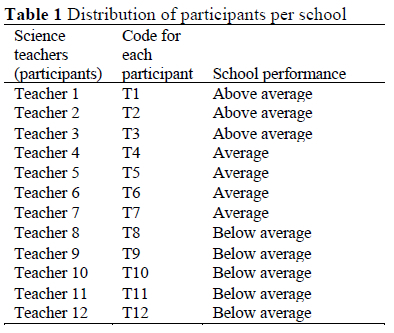
Twelve secondary schools in the Ngwaritsi circuit were purposefully selected and grouped into three categories based on the schools' Grade 12 learners' performance in the National Senior Certificate (NSC) examination: three secondary schools with above average performance, four secondary schools with average performance, and five secondary schools with below average performance.
As shown in Table 1, 12 secondary schools represented the larger population. One Grade 10 life sciences teacher from each of the 12 secondary schools in the Ngwaritsi circuit of the Sekhukhune South district, Limpopo province, was selected for the study.
Semi-structured Interviews and Lesson Observation
Data were collected using semi-structured interviews lasting 30 minutes with each participant (Grade 10 science teachers teaching life sciences), i.e., interviews conducted before and after the intervention at their respective schools. This approach enabled data collection and analysis of participants' intellectual processes, feelings, and views on specific topics. The approach also allows for the investigation of private and sometimes sensitive matters (Denscombe, 2014). Furthermore, we observed 45-minute lessons presented by each participant. Direct classroom observation occurs when a researcher carefully observes specific behaviour in a structured setting, such as a classroom (Price, Jhangiani, Chiang, Leighton & Cuttler, 2017). The lesson presentations were divided into two parts (i.e., pre-observation and post-observation). Semi-structured interviews and pre-lesson observations took place before the intervention (CPD workshop). Semi-structured interviews and post-lesson observations were also conducted after the CPD workshop.
Data Analysis and Interpretation
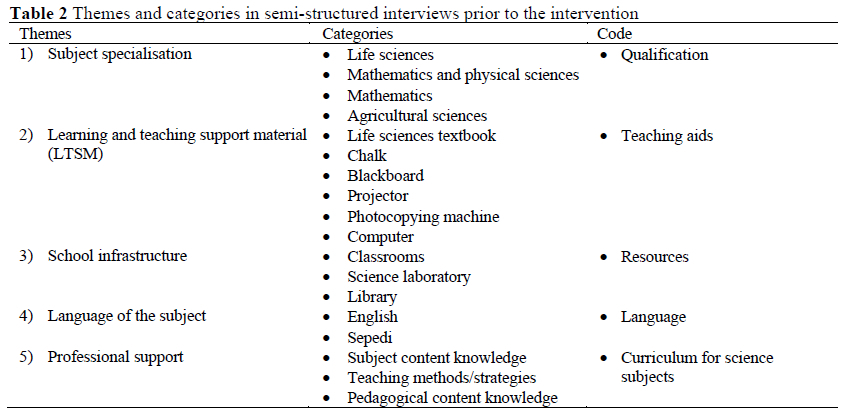
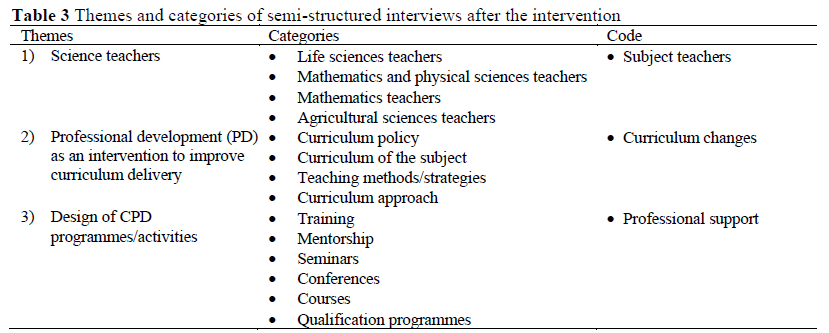
According to Letshwene and Du Plessis (2021), interpreting data for analysis assists the researcher in drawing conclusions from the collected and analysed data, thereby comparing the findings with those of other researchers. The analysis of data collected from all semi-structured interviews is presented as themes and categories. These themes should not be considered independent or definite but are intended to be adjunct or imbricate. Interviews were transcribed and grouped under thematic headings, as indicated in Tables 2 and 3. As outlined in Table 2, five themes emerged from the empirical data, while three were derived from it (Table 3).
The themes and supporting categories derived from the semi-structured interviews with the participants after the intervention are summarised in Table 3. The empirical findings reveal participants' views on CPD programmes as interventions and how these had improved their curriculum implementation and mitigated their curriculum challenges.
Interpretation of data from semi-structured interview (prior) themes
Five themes were derived from the analysis of data collected through the semi-structured interviews prior to the intervention.
Theme 1: Subject specialisation The teaching of life sciences requires of teachers to specialise and have relevant qualifications. Some schools do not have teachers specialising in their subject, leading to a misconception that teachers can teach any other science subject. This is incorrect as subject content and curricula differ. Teachers teaching outside their area of specialisation face challenges such as a lack of confidence and poor content knowledge (Mizzi, 2013; Netshivhumbe & Mudau, 2021), which hinders effective implementation of the curriculum. It was very clear that participants who did not specialise in teaching life sciences struggled to teach and present lessons in the subject. Many of them taught only the topics they were comfortable with, which hampered learners' academic performance.
However, all participants teaching in their area of specialisation reported encountering challenges in teaching the subject. The participants stated the following:
Ha! Lots of problems, I teach in an overcrowded classroom coupled with no teaching resources (T3). Yes, many challenges are there in life sciences. For example, I did not specialise in the subject, therefore, I have limited content knowledge (T8).
Theme 2: Learning and teaching support material (LTSM)
For effective delivery of the science curriculum, learning and teaching support materials (LTSM) should be provided to both teachers and learners. The participants identified a lack of learning and teaching support materials as one of the challenges. All participants reported that their delivery of the life science curriculum was hampered by a lack of LTSM, including projectors, computers, and science kits. The CAPS was introduced to address the challenges that teachers faced in implementing the Revised National Curriculum Statement (RNCS); however, this aim was not achieved, particularly in rural schools. Du Plessis and Mestry (2019) and Maharajh et al. (2016) attribute the non-availability of LTSM as one of the challenges that teachers encountered in the delivery of the CAPS curriculum. Adeniran (2020) notes that among the challenges faced by teachers in rural schools was the unavailability of LTSM. It was obvious that all the participants only used chalk, a blackboard, and a life sciences textbook. This is insufficient in the science classrooms, particularly when the subject requires practical experiments.
Life sciences is more theoretical with many terminologies and vocabularies. It is difficult to get the exact words for the learners in Sepedi. I find it difficult to explain the meaning to them in Sepedi.
There are not enough LTSM to assist us, such as scientific dictionaries. (T9)
Du Plessis and Mestry (2019) argue that underqualified science teachers rely solely on textbooks for teaching and avoid conducting practical investigations with the learners, despite having access to laboratories at their schools. However, many schools in rural areas lack laboratories. The participants' schools lacked laboratories and other teaching materials. "There are insufficient teaching resources such as, a science laboratory, internet, etc." (T4).
Theme 3: School infrastructure School infrastructure, which includes laboratories, classrooms, libraries, and administrative offices, is crucial for the effective delivery of curricula. Many rural schools lack basic infrastructure, which affects the quality of the science education. Participants reported that laboratories and libraries were essential for the effective teaching and delivery of the science curriculum. However, they lacked the infrastructure needed to conduct practical investigations or experiments with students. The life sciences CAPS curriculum emphasises a learner-centred approach, which is particularly relevant in a subject that involves scientific inquiry. Some study participants lacked the skills to conduct practical experiments, even with school laboratories. Almuntasheri (2020) found that science teachers lacked sufficient skills to interact with learners in science-based inquiry settings. This highlights the need for improved infrastructure and support for rural schools in implementing the CAPS curriculum. "We do not have a laboratory to perform practicals. There are some contents I do not understand myself; I lack a strategy to teach some contents" (T6).
Theme 4: Professional support South African schools have experienced continuous curriculum reforms, and teachers are expected to implement these changes. Adu and Ngibe (2014) report that science teachers complained about many factors that hindered them from delivering the curriculum effectively, such as a lack of content and pedagogical knowledge. Letshwene and Du Plessis (2021) mention that a lack of content knowledge was a major problem for teachers when a new curriculum was introduced for implementation. Alebous (2021) and Ogunniyi and Mushayikwa (2015) also conclude that a crucial problem that South African teachers face is limited conceptual knowledge of the subject they teach. All study participants indicated that they needed support to effectively implement the subject curriculum, particularly in subject content knowledge (SCK) and teaching methods, with some noting that they did not receive any support.
No support! Whenever I attended a workshop is only content based, and it only took place in year 2016. We do need workshops to assist us because we do not have many workshops (Tl).
I need support on how to explain and teach the learners to understand the vocabularies and terminologies. Again, there are some topics that are problematic to me. I will need content workshop (T9).
I will need on the strategies to teach English second language learners, also I need more content knowledge in organising practical investigation (TlO).
The participants also said that they required support that met their expectations, and that they should contribute to the design of the planned professional support for them (El-Deghaidy et al., 2015). The participants indicated that they struggled with learners whose mother tongues differed from the medium of instruction. Hence, they needed support for the types of teaching strategies that can assist them.
Interpretation of data from semi-structured interview themes after the intervention Unlike in the prior interview themes, we extracted three themes from the analysis of data collected from the interviews after the intervention. The discussion of these themes provides answers to the research questions raised in this article and justifies the choice of the theory applied in the study.
Theme 1: Science teachers Science teachers, who specialise in the subject and possess relevant qualifications, teach life sciences. However, many teachers who teach this subject in secondary school did not specialise in it. Almuntasheri (2O2O) indicates that many science teachers lack competency to teach the subject due to factors such as non-specialisation, non-mastery of the concepts, and non-fluency in the medium of instruction. Research by Netshivhumbe and Mudau (2O2l) found that many South African science teachers who taught outside their area of speciality had below-basic content knowledge. Findings from this study reveal that most participants who taught the subject (both those who specialised in it and those who did not) indicated a need for support. We agree with Ogunniyi and Mushayikwa (2Ol5), who argue that teachers need motivation and support given their many challenges.
After the CPD activities, each participant expressed their views regarding the CPD workshop. They were all appreciative and declared that the intervention assisted them, unlike other CPD workshops they had attended.
The intervention was so helpful to me personally=(T5).
The intervention was highly superb. Highly educative and rich in knowledge, especially working together with colleagues (T7).
El-Deghaidy et al. (2Ol5) report that teachers were concerned about the type of CPD workshop offered to them, as many did not meet their expectations. The data gathered in this study made it clear that all participants were satisfied with the nature of the intervention programme. The participants reported that they had learnt a great deal from one another during the intervention programme. Findings from the study reveal that the interaction among the participants helped them exchange and share ideas, knowledge, and skills. A participant stated as follows: "The intervention programme was well planned. I learnt from other colleagues. I saw the advantage of working and sharing views together" (T9).
This revelation resonated with Vygotsky's socio-constructivist theory of learning, which underpinned this study and indicates that knowledge is broadened and improved whenever individuals interact and collaborate in a setting. Participants in the study reported increased productivity when working collaboratively and interacting with one another during the CPD workshop, where they gained and shared ideas and knowledge. According to Vygotsky (1978), knowledge is constructed in a social context, where learning occurs through interaction with others in the local environment (El- Deghaidy et al., 2Ol5).
In addition, we found that participants' perceptions of CPD activities helped improve their PCK, teaching methods, and teaching strategies. A national survey of science and mathematics education reports that science teachers' outcomes improved after receiving substantial CPD support (Banilower et al., 2Ol8). It became clear from the study findings that participants' (teaching outside of their area of specialisation) confidence and content knowledge in the subject had improved significantly in the teaching of life sciences. Thus, we agree with Shah, Khan and Ahmed (2Ol5) who state that many teachers perceived the CPD activities as advantageous in improving their professionalism and curriculum implementation.
Theme 2: Continuing professional development as an intervention to improve curriculum delivery Curriculum changes in a specific country affect how the curriculum is delivered. Several factors can drive curriculum changes in any country, including economic, social, cultural, and political changes (Maharajh et al., 2016); other factors include PCK, teaching methodology, and learners' performance (Adu & Ngibe, 2014). Spaull (2013) notes that curriculum changes in countries often lead teachers to struggle to deliver their subject curriculum effectively, particularly in rural areas. Challenges include limited resources, PCK, and teaching methods, which affect teachers' ability to teach their subjects effectively.
Research has proven that teachers experience progressive professional changes after undergoing a CPD intervention programme (Gore et al., 2017). Nevertheless, each participant in the study expressed satisfaction with the CPD intervention programme they had undergone, as it had improved their professionalism and curriculum delivery.
The participants were enthusiastic about the CPD programme arranged for them as an intervention workshop. In this regard, the participants commented as follows:
I learnt lots of things, and I saw an improvement in my classroom during my lesson presentation to my learners (T2).
The intervention worked very effectively because it addresses my problems in the subject (T4). CPD programme is very essential for all science teachers, more importantly for those who don't specialise in the subject they teach because they struggle (T8).
We found that South African teachers demonstrated confidence, employed a variety of teaching strategies, and improved their SCK during lesson presentations. The DBE and the Department of Higher Education and Training emphasise the importance of CPD programmes for improving curriculum delivery. Hence, the ministers launched an Integrated Strategic Planning Framework for Teacher Education and Development to strengthen CPD activities (DBE, Republic of South Africa [RSA], 2015). Researchers like Almuntasheri (2020) believe that CPD is crucial for teachers facing curriculum changes.
Theme 3: CPD programme/activities design Professional support for teachers is crucial for improving curriculum delivery. Various types of support, include traditional activities like workshops, reformed activities like mentoring, and peer PD like peer teaching (El-Deghaidy et al., 2015). Science teachers have requested the presentation of CPD programmes to help them implement the curriculum, but they often don't receive positive feedback or input before the programme is designed. Teachers design CPD programmes, yet many fail to tackle their curriculum challenges.
CPD will definitely have a positive impact in the subject curriculum delivery if the design of the CPD programme is planned in such a way that it caters for our challenges and problems (T7).
According to my view as a science teacher, CPD will have a positive impact in my subject curriculum if it is well planned and we are consulted before any CPD programme is designed for us (T8).
According to a research report by El-Deghaidy et al. (2015), teachers suggested that the most effective CPD programmes were self-initiated, including professional discussion, peer observation and informal networking. In these CPD programmes, teachers would work collaboratively to address their challenges by sharing skills, knowledge, and ideas. Although the teachers were not ignorant or lacking formal knowledge of their profession, they needed to deepen their prior knowledge to enhance their professionalism, primarily due to constant curriculum changes.
Summary, Recommendations, and Conclusion
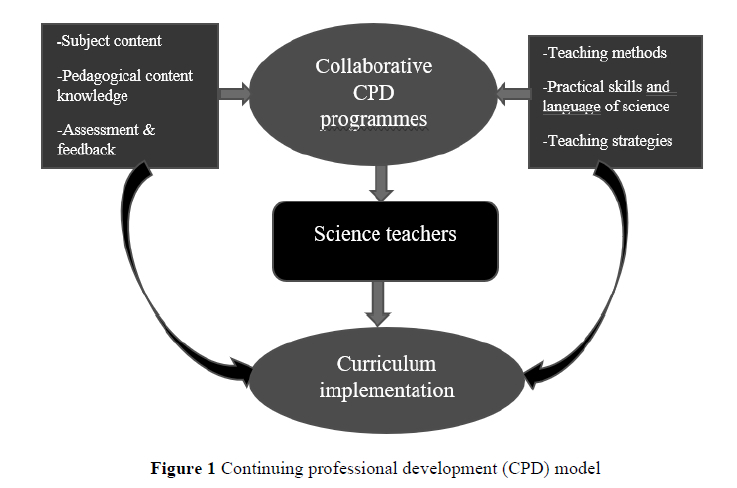
In this article, we identified the challenges that affected science teachers' ability to implement the curriculum effectively. In addition, we found that the PD programme, as an intervention, improved science teachers' implementation of the science curriculum. The participants indicated that they were satisfied with the CPD intervention programme (see Figure 1), because it contributed positively to improving their curriculum delivery in the subject. Moreover, they said they had acquired more knowledge and skills, which assisted them professionally and boosted their confidence in the classroom. In addition, the study revealed that participants perceived CPD activities as instrumental in enhancing their PCK, SCK, and teaching methods. For instance, teachers reported gaining confidence in explaining complex life sciences concepts, using a wider range of instructional strategies, and integrating more interactive approaches in their lessons after attending the CPD workshops. The participants indicated that collaborating in an organised CPD intervention workshop in a particular environment helped them exchange skills and knowledge. This statement upholds the premise of social constructivism, which underpinned this study. The teachers who specialised in life sciences and those who did not all worked together during the CPD workshop to improve their PCK and teaching strategies in the subject.
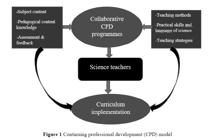
To design an effective and productive CPD programme to improve science teachers' curriculum implementation, we developed a model (an input-based solution) that includes all the components necessary to develop a CPD intervention aimed at helping teachers and reducing their challenges in implementing the curriculum.
In the CPD programme intervention model, the term "input" refers to all curriculum components: subject content, PCK, assessment and feedback, practical skills, and the language of science and teaching strategies. All contribute to the collaborative CPD programme. These components address the challenges identified by the science teachers. Therefore, it is crucial to incorporate all the components into the design and planning of a CPD programme for teachers. In addition, the CPD programme should be designed collaboratively, with teachers working together with other colleagues and the programme organiser, i.e., the subject adviser, who will serve as a facilitator and mentor. The knowledge and skills that science teachers acquire during the CPD programme will improve their curriculum implementation.
In conclusion, if science teachers received professional support and guidance throughout their careers, their classroom practices would improve, and they would deliver better lessons by implementing subject content more effectively. The learners will ultimately benefit from the expertise of a skilled, knowledgeable teacher who has engaged in continuous, effective PD.
Authors' Contributions
AAO collected and analysed the data and wrote 70% of the manuscript, including the theoretical framework. ECDP wrote sections of the introduction and the literature review and reviewed the final manuscript.
Notesi . This article is based on a doctoral thesis by Aderemi Adesoji Obilana.
ii. Published under a Creative Commons Attribution Licence.
References
-
Adeniran SA 2020. Influence of teaching and learning resources on student's performance in senior secondary schools in Gusau Local Government, Zamfara State. The Eurasia Proceedings of Educational & Social Sciences, 18:124-131. Available at https://dergipark.org.tr/en/download/article-file/1427486. Accessed 4 August 2026.
» https://dergipark.org.tr/en/download/article-file/1427486 -
Adu EO & Ngibe NCP 2014. Continuous change in curriculum: South African teachers' perceptions. Mediterranean Journal of Social Science, 5(23):983-989. https://doi.org/10.5901/mjss.2014.v5n23p983
» https://doi.org/10.5901/mjss.2014.v5n23p983 -
Akhtar MI 2016. Research design. In Research in social science: Interdisciplinary perspectives.https://doi.org/10.2139/ssrn.2862445
» https://doi.org/10.2139/ssrn.2862445 -
Alebous TM 2021. The extent to which teachers of science subjects use virtual scientific laboratories during coronavirus pandemic: The reality & hope. Journal for the Education of Gifted Young Scientists, 9(3):193-206. https://doi.org/10.17478/jegys.972540
» https://doi.org/10.17478/jegys.972540 -
Almuntasheri S 2020. The impact of professional development on dialogic teaching for science teachers in Saudi Arabia. Science Journal of Education, 8(1):8-13. https://doi.org/10.11648/j.sjedu.20200801.12
» https://doi.org/10.11648/j.sjedu.20200801.12 -
Banilower ER, Smith PS, Malzahn KA, Plumley CL, Gordon EM & Hayes ML 2018. Report of the 2018 NSSME+. Chapel Hill, NC: Horizon Research. Available at https://horizon-research.com/NSSME/wp-content/uploads/2019/02/Report_of_the_2018_NSSME_Front_Matter.pdf. Accessed 31 May 2023.
» https://horizon-research.com/NSSME/wp-content/uploads/2019/02/Report_of_the_2018_NSSME_Front_Matter.pdf -
Bantwini BD 2015. Analysis of the state of collaboration between natural science school district officials and primary school science teachers in South Africa. Journal of Baltic Science Education, 14(5):586-598. Available at https://files.eric.ed.gov/fulltext/EJ1427258.pdf. Accessed 3 August 2026.
» https://files.eric.ed.gov/fulltext/EJ1427258.pdf - Denscombe M 2014. The good research guide for small- scale social research projects (5th ed). Maidenhead, England: Open University Press.
- Department of Basic Education 2011. National Curriculum Statement Grade R-12. Curriculum and Assessment Policy Statement (CAPS). Pretoria, South Africa: Author.
-
Department of Basic Education, Republic of South Africa 2015. Professional learning communities-A guideline for South African schools. Pretoria, South Africa: Author. Available at https://www.education.gov.za/Portals/0/Documents/Publications/Professional%20Learning %20Communities%20A%20guideline%20for%20South%20African%20NEW.pdf?ver=2019-02-05-122319-727. Accessed 4 August 2026.
» https://www.education.gov.za/Portals/0/Documents/Publications/Professional%20Learning %20Communities%20A%20guideline%20for%20South%20African%20NEW.pdf?ver=2019-02-05-122319-727 -
Du Plessis P & Mestry R 2019. Teachers for rural schools - a challenge for South Africa [Special issue]. South African Journal of Education, 39(Suppl. 1):Art. #1774, 9 pages. https://doi.org/10.15700/saje.v39ns1a1774
» https://doi.org/10.15700/saje.v39ns1a1774 -
Dyosini TP 2024. Professional development of teachers: Perceptions and challenges of foundation phase teachers. South African Journal of Childhood Education, 14(1):a1572. https://doi.org/10.4102/sajce.v14i1.1572
» https://doi.org/10.4102/sajce.v14i1.1572 -
El-Deghaidy H, Mansour N, Aldahmash A & Alshramrani S 2015. A framework for designing effective professional development: Science teachers' perspectives in a context of reform. Eurasia Journal of Mathematics, Science & Technology Education, 11(6): 1579-1601. https://doi.org/10.12973/eurasia.2015.1424a
» https://doi.org/10.12973/eurasia.2015.1424a -
Fung Y 2000. A constructivist strategy for developing teachers for change: A Hong Kong experience. Journal of In-Service Education, 26(1):153-167. https://doi.org/10.1080/13674580000200108
» https://doi.org/10.1080/13674580000200108 -
Gomba GKB 2019. Challenges faced by educators in the implementation of Continuing Professional Teacher Development (CPTD): Gauteng Province. In RB Monyai (ed). Teacher education in 21st century. London, England: IntechOpen. https://doi.org/10.5772/intechopen.84836
» https://doi.org/10.5772/intechopen.84836 -
Gore J, Lloyd A, Smith M, Bowe J, Ellis H & Lubans D 2017. Effects of professional development on the quality of teaching: Results from a randomised controlled trial of Quality Teaching Rounds. Teaching and Teacher Education, 68:99-113. https://doi.org/10.1016/j.tate.2017.08.007
» https://doi.org/10.1016/j.tate.2017.08.007 -
Gouëdard P, Pont B, Hyttinen S & Huang P 2020. Curriculum reform: A literature review to support effective implementation (OECD Working Paper No. 239). Paris, France: Organization for Economic Cooperation and Development. https://doi.org/10.1787/efe8a48c-en
» https://doi.org/10.1787/efe8a48c-en - Gumede V & Biyase M 2016. Education reform and curriculum transformation in post-apartheid South Africa. Environmental Economics, 7(2):69-76.
-
Khan MS 2021. Continuing Professional Development for strengthening teachers' classroom performance in teachers' training colleges. Sylhet, Bangladesh: Government Teachers Training College. https://doi.org/10.13140/RG.2.2.34172.77447
» https://doi.org/10.13140/RG.2.2.34172.77447 -
Letshwene MJ & Du Plessis EC 2021. The challenges of implementing the Curriculum and Assessment Policy Statement in accounting. South African Journal of Education, 41(Suppl. 2):Art. #1978, 10 pages. https://doi.org/10.15700/saje.v41ns2a1978
» https://doi.org/10.15700/saje.v41ns2a1978 -
Maharajh LR, Nkosi T & Mkhize MC 2016. Teachers' experiences of the implementation of the Curriculum and Assessment Policy Statement (CAPS) in three primary schools in KwaZulu Natal. Africa's Public Service Delivery & Performance Review, 4(3):371-388. https://doi.org/104102/apsdpr.v4i3.120
» https://doi.org/104102/apsdpr.v4i3.120 -
McLeod S 2017. Qualitative vs quantitative. Available at https://www.simplypsychology.org/qualitative-quantitative.html. Accessed 20 December 2021.
» https://www.simplypsychology.org/qualitative-quantitative.html -
Mendy J & Madiope M 2020. Curriculum transformation: A case in South Africa. Perspectives in Education, 38(2):1-19. https://doi.org/18820/2519593X/pie.v.38.i.2.01
» https://doi.org/18820/2519593X/pie.v.38.i.2.01 -
Mizzi D 2013. The challenges faced by science teachers when teaching outside their specific science specialism. Acta Didactica Napocensia, 6(4):1 -6. Available at https://files.eric.ed.gov/fulltext/EJ1053677.pdf. Accessed 30 July 2026.
» https://files.eric.ed.gov/fulltext/EJ1053677.pdf -
Netshivhumbe NP & Mudau AV 2021. Teaching challenges in the senior phase natural sciences classroom in South African schools: A case study of Vhembe district in the Limpopo province. Journal for the Education of Gifted Young Scientists, 9(4):299-315. https://doi.org/10.17478/jegys.988313
» https://doi.org/10.17478/jegys.988313 - Neuman WL 2017. Social research methods: Qualitative and quantitative approaches. Harlow, England: Pearson.
-
Ngobeni NR, Chibambo MI & Divala JJ 2023. Curriculum transformations in South Africa: Some discomforting truths on interminable poverty and inequalities in schools and society. Frontiers inEducation, 8:1132167. https://doi.org/10.3389/feduc.2023.1132167
» https://doi.org/10.3389/feduc.2023.1132167 - Obilana AA 2023. Exploring and improving curriculum implementation through Continuing Professional Development programmes of Grade 10 science teachers: A multiple-case study. PhD thesis. Pretoria, South Africa: University of South Africa.
-
Ogunniyi MB & Mushayikwa E 2015. Teacher education in South Africa: Issues and challenges. In B Adegoke & A Oni (eds). Teacher education systems in Africa in the digital era. Dakar, Senegal: Council for the Development of Social Science Research in Africa. Available at https://www.researchgate.net/publication/280877387. Accessed 19 December 2021.
» https://www.researchgate.net/publication/280877387 -
Paterson A, Keevy J & Vally Z 2024. Systems analysis of the national performance management system for TVET lecturers in South Africa [Special issue]. Journal of Vocational, Adult and Continuing Education and Training, 7(2):98-119. https://doi.org/10.14426/jovacet.v7i2.420
» https://doi.org/10.14426/jovacet.v7i2.420 - Price PC, Jhangiani R, Chiang IA, Leighton DC & Cuttler C 2017. Research methods in psychology(3rd American ed). Washington, DC: Press Books Publications.
-
Shah FH, Khan UA & Ahmed I 2015. The impact of Continuous Professional Development (CPD) program on Teachers' Professional Development in Pakistan. FWU Journal of Social Sciences, 9(1):99-105. Available at https://www.sbbwu.edu.pk/journal/Journal%20June%202015/12.%20The%20Impact%20of%20Continuous %20Professional%20%20Development.pdf.Accessed 29 July 2026.
» https://www.sbbwu.edu.pk/journal/Journal%20June%202015/12.%20The%20Impact%20of%20Continuous %20Professional%20%20Development.pdf -
Spaull N 2013. South Africa 's education crisis: The quality of education in South Africa 1994-2011. Johannesburg, South Africa: Centre for Development & Enterprise. Available at http://www.section27.org.za/wp-content/uploads/2013/10/Spaull-2013-CDE-report-South-Africas-Education-Crisis.pdf. Accessed 20 December 2021.
» http://www.section27.org.za/wp-content/uploads/2013/10/Spaull-2013-CDE-report-South-Africas-Education-Crisis.pdf - Vygotsky LS 1978. Mind in society: The development of higher psychological processes. Cambridge, MA: Harvard University.
Revised: 10 September 2025
Accepted: 24 February 2026
Published: 31 August 2026