Teachers and school administrators' perceptions of characteristics of an effective school: A study of Anatolian high schools (exam-based entrance high schools) in Turkey
Abstract
The aim of the research reported on here was to determine the perceptions of school administrators and teachers working at Anatolian high schools on the characteristics of effective schools. The determined perceptions of teachers and administrators were important for creating more efficient educational domains by sharing leadership among stakeholders in education management. We used the Relational Survey Model to study a group composed of teachers and school administrators working at Anatolian high schools in the Ankara province of Turkey. The sample for this research consisted of 300 teachers selected through proper sampling from within the population. Data obtained from participants using the Effective School Scale were tested by t-test and one-way ANOVA. A significant difference was found between the views of school administrators and teachers regarding the effectiveness of Anatolian high schools in the Ankara province. This study found that the school administrators deemed the Anatolian high schools of Ankara to be a lot more effective than the teachers thought they were. As a conclusion, suggestions for increasing the effectiveness of schools are presented.
Anatolian high school; effective school; school administrators; teacher
Introduction
Schools of the 21st century must be effective and productive institutions. Criteria for determining the effectiveness of an institution were (1) professional leadership; (2) shared vision and goals; (3) a learning environment; (4) emphasis on teaching and learning; (5) purposeful teaching; (6) high expectations; (7) positive reinforcement; (8) monitoring progress; (9) pupil rights and responsibilities; (10) home-school partnership; and (11) a learning organisation (Sammons, Hillman & Mortimore, 1995). Nowadays, students are required to take an active stance throughout the learning process, which is crucial for and an important requirement of generating an informed society (Gökdag Baltaoglu & Güven, 2019). Today's schools have a basic function that is summarised under the following five headings: technical; human social; political; cultural; and educational (Abdurrezzak, 2015). In this context an effective or successful school can be defined as a school that achieves its objectives at a high level (Şişman, 2004). An effective school philosophy is based on ensuring that all learners can experience meaningful learning without misconceptions. The characteristics of an effective school can be summarised as follows: teacher's leadership reflected by important initiatives in the quality of instruction; a comprehensive instructional focus; creation of a secure and moderate climate in education and training; and the belief that all students can be taught at a minimum level (Kaplan, 2008).
An effective school is a contemporary educational and teaching environment that serves as the highest level of individual and community education and satisfies all training. The school administrator is responsible for creating an effective education and training environment in the schools where teaching activities take place (Baştepe, 2009). Effective schools are student-centred, they offer rich academic programmes and opportunities to develop learning, have an open climate, professional interaction, in-service training, shared leadership, and family and community participation (Baştepe, 2004).
Being an effective school does not mean having more resources, but it does mean achieving better results with the available resources (Helvaci & Aydoğan, 2011). Many factors contribute to a school's effectiveness, and some of the most important are the following: school administrators and their assistants; teachers; students; mothers and fathers (parents); school climate and culture; education and training programmes; environment; physical structure of the school; educational technology; and the process of education and training (Şişman, 1996). The effectiveness of a school depends on its efficiency and educational orientation (Helvaci & Aydoğan, 2011; Yagiz, 2016).
School governance is the single most important factor in education, being the backbone of the school climate. However, it seems as if school governance often faces apparently insurmountable challenges (Xaba, 2011). Proper leadership from administrators is required to achieve success and efficiency. The leadership role of the school administrator is of great importance in the establishment of an effective school. As instructors, school administrators should develop a vision that clearly articulates the reason for the school's existence and explains its education and training policy; this vision should then be communicated to all school staff. Administrators in effective schools are those who possess planning skills, are able to listen effectively, motivate staff, take responsibility, and possess strong communication skills (Gcelu, 2019).
The effective school administrator should explain to the students what the goals of their lessons and the purpose of their education are so that they know what is expected from them. The administrator should make it possible for sharing of information among teachers and administrators so the teachers can develop cognitively and professionally. At the same time, teachers should improve themselves by participating in in-service training activities. An effective teacher is a teacher who constantly renews his/her level of knowledge (Tarhan, 2008). With this study we aimed to research Anatolian High School teachers' and administrators' perceptions of effective schools as Anatolian high schools are regarded as average schools according to the high schools' entrance exam.
Literature Review
The term "effective schools" relates to an educational movement and body of research which examines school-based factors that positively influence learning outcomes in K-12 schools. Effective schools research has been widely adopted by school districts worldwide (Wikipedia, 2019).
Some studies have been conducted on the effectiveness of schools in Turkey. The level of effectiveness of current schools, that is to say the "effective state school characteristic", needs to be determined for schools to form the basis of improvements and the development of policies. Aslan (2014) and Biltekin (2013) investigated the current gaps and needs in Turkish schools and proposed the structures needed to fulfil the purpose of our educational institutions. Limited studies have been done at Anatolian high schools despite their important place in our country, and, therefore, it is necessary to focus on these institutions. Anatolian high schools are schools in the second order based on achievement high school entrance exam results in Turkey.
In effective schools, administrators spend most of their time in the teaching environment. Since they are instructors, some of their administrative tasks are transferred to a deputy, which allows them to focus more on the educational and training problems. It is thus important for effective schools to share the total work among stakeholders for both effective educational facilities and effective educational management systems (Biltekin, 2013; Özden, 2010).
The realisation of goals in education is possible through the introduction of effective teaching processes. Since the teacher constitutes the main element in teaching, it is expected that the teacher will display some basic characteristics. Effective teachers are well versed in field knowledge, have high levels of general culture, can communicate effectively, and are able to use examples and guides (Ihtiyaroglu, 2014a, 2014b). Kaplan's (2008) research shows that there is a close link between effective schools and effective teachers. Teachers working in effective schools are supported by the school administrators and they interact with other teachers, thus working in collaboration. They share the teaching strategies that they apply in their courses and they also have a good relationship with the students in their classroom. Schools that have strong principal leadership are predicted to develop effective school management because they are supported by various aspects, such as the application of technology, school culture, information systems and developed organisations (Sunaengsih, Anggarani, Amalia, Nurfatmala & Naelin, 2019).
Çubukçu and Girmen (2006), Lezotte (2001), MacGilchrist, Myers and Reed (2004), Rutter, Maughan, Mortimore and Ouston (1979), Sunaengsih et al. (2019) and Zigarelli (1996) have conducted studies determining effective school characteristics. They argue that the characteristics of effective schools are administrators sharing responsibilities among stakeholders, effective teachers innovating their technological-pedagogical content knowledge, a positive school climate, and the technological equipment that schools hold.
Polatcan and Cansoy (2018) emphasise the following as the characteristics of efficient schools: enabling continuous vocational development of teachers, strengthening cooperation between the school and its community, the necessity of creating a common goal and vision at the school, and creating physical environments aimed at quality student learning. Cole, Waldrop, D'Auria and Garner (2006) used the social cognitive theory and the role of social learning for treating childhood obesity. They found the theory useful for effective school domains. Stockard and Lehman (2004) highlight teachers' job satisfaction as one of the most important characteristics for effective schools.
On the other hand, the Institute for Educational Leadership, Coalition for Community Schools and National Association of School Psychologists (2020:1-2) determined nine elements for effective school community partnerships to address student mental health, physical health, and overall wellness:
1. A leadership team comprised of school and community stakeholders.
2. Assets and needs assessment to address student health and wellness, and a framework for results.
3. A designated person at the school to lead the coordination of school-community partnerships.
4. Clear expectations and shared accountability for the school and community partners.
5. High-quality health and wellness services that leverage school and community resources.
6. Ongoing comprehensive professional development for all school leaders, staff, and community partners.
7. A detailed plan for long-term sustainability.
8. Regular evaluation of effectiveness through a variety of measures.
9. Communication plan to share progress and challenges.
Johnson, Johnson and Johnson (2018) state that an ineffective school climate causes low student achievement and low test scores due to little learning taking place. They also state that reform efforts could be in the form of new textbooks, changes in administrative duties, linking teacher evaluations to test scores, funding charter schools, or contracting the operation of public schools to privatised management. Maier, Daniel, Oakes and Lam (2017) define effective school characteristics as equitable, high-quality education to all young people. They concluded that well-implemented community schools lead to improvement in student and school outcomes and contribute to meeting the educational needs of low-achieving students in high poverty schools.
In other research it was stated that principals are essential to improving student achievement and narrowing persistent achievement gaps between students in underserved communities and their economically advantaged peers (Espinoza & Cardichon, 2017). Just as Günal and Demirtaşli (2016) state in their research, instructional leadership is the most effective school dimension for the relationship between effective school characteristics and student achievement.
In this study we investigated Anatolian high school teachers' and administrators' perceptions of effective schools, because Anatolian high schools are regarded as average schools according to the high schools' entrance exam. The research question for this study was: "How often did the school administrators and teachers working in Anatolian high schools reach the level of effective schools?"
Methodology
Research Design
This research was designed to determine how often school administrators and teachers working in Anatolian high schools reached the level of effective schools, as determined by the dimensions defined within this study. The survey model was used in this study. Survey models are research approaches that describe the past or current situation as it exists (Karasar, 2004).
Population and Sample
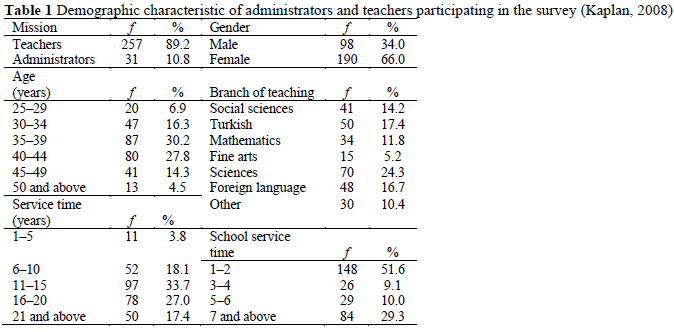
The total population in this research included 63 administrators and 987 teachers from 21 Anatolian high schools in the Yenimahalle (five), Keçiören (five) and Çankaya (11) districts of the Ankara province. The selected sample consisted of 269 teachers and 31 school administrators chosen by specified sampling from the schools. The criteria for inclusions as participants were voluntary participation and having worked at a high school in the determined districts. The demographic characteristics of administrators and teachers who participated in the survey are presented in Table 1.
Data Collection
A survey was conducted to gather data from administrators and teachers working at Anatolian high schools in the Ankara province that were included in the research sample. The data were collected using the Effective School Scale of Balci (1993) - a 36-item Likert-type scale used to describe the schools at which the participants were working in terms of effective school characteristics. The survey consisted of two parts. In the first part, five groups of questions gathered teachers' personal information (gender; age; branch of teaching; total service time; length of service at the current school). The second part focused on the two dimensions of creating an effective school as perceived by the school administrators and teachers. On the survey response form, the number of items in terms of dimensions was split unevenly - administrators (12) and teachers (24).
Because the teachers and administrators participated voluntarily in the study, the response rate was 100%. The surveys were distributed and collected from teachers and administrators in the same way.
Data Analysis
Statistical analysis of the data obtained from the survey was done using the Statistical Package for the Social Sciences (SPSS) program. By means of the questions directed to the participants, their gender, age, branch of teaching, total service time and duration of service at the current school were determined. In the interpretation of the data these personal characteristics were taken as independent variables and the 36 items of the scale were taken as dependent variables. The t-test, one-way ANOVA was used.
With regard to ethics, all participants were informed that they could complete the survey in their own time. They were also informed that their names and the schools' names would be kept confidential. In order to enhance reliability of the study, another researcher was asked to give an unbiased opinion about the study, based on some revisions that were made. A limitation of the study was that only one school type was investigated in the study.
Results/Findings
In this section we present the pertinent results gained from analysis of the data obtained from the survey.
Anatolian High Schools' Effective Attributes and Differences between Attendees' Personal
Characteristics and Evaluating Effective School Dimensions
These differences between Anatolian high schools' existing level of effective school characteristics and the personal characteristics of the participants in the effective school dimension were examined. The extent of effective school characteristics of Anatolian high schools was determined by the participants' evaluations of their schools according to the effective school dimensions. The statistical analyses and interpretations of the participants' perceptions on effective schools are given below. In the analysis, 95% probability of different perceptions are indicated with a *.
The Participants' Perceptions about the Contribution of the School Administrators to Effective School Access
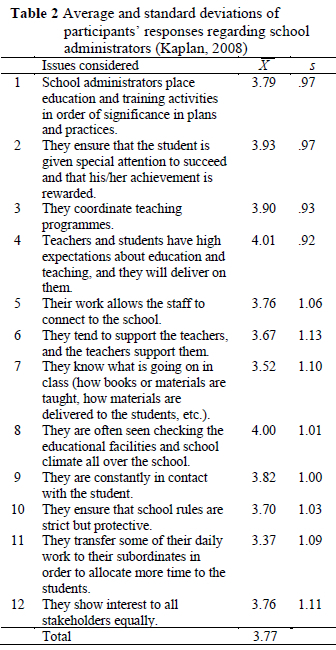
The views of the participants about the contribution of school administrators to effective school access and attendance are given in Table 2.
According to the information in Table 2, item 11 scored the lowest average. The teachers who participated in the research rated the administrators in the schools as less successful and less effective in transferring certain jobs to their subordinates. The results of this research are in line with the results that Balci (1991) published in an Effectiveness Survey of primary schools in Turkey. It can thus be deduced that the school administrators attached more importance to managerial leadership than to instructional leadership, as the school administrators refused to transfer certain jobs to their subordinates.
According to item 4 under the heading, "School administrators in this school", the teachers and students had high expectations of school administrators and insisted that these expectations be met. It can be considered as a positive feature that staff members had high expectations of school administrators.
As is evident from Table 2, all the respondents had a largely positive opinion of school administrators, based on the answers to the 12 items on school administrators.
An independent t-test was conducted to determine whether gender made a meaningful difference in the participants' opinions on school administrators. The t-test results are presented in Table 3.
According to these results, there was no general gender-based opinion difference about school administrators. The participant's gender, which was one of the effective school dimensions, was not a determining factor in evaluating school administrators and the schools participating in the research. The 98 male and 190 female teachers participating in the research had similar opinions about the school administrators. The results from Bactepe's (2002) study show that teachers' perceptions of school effectiveness did not differ according to gender variables, and do not support the results of our research. In both studies gender did not have any meaningful influence on the participants' opinions about effective school characteristics.
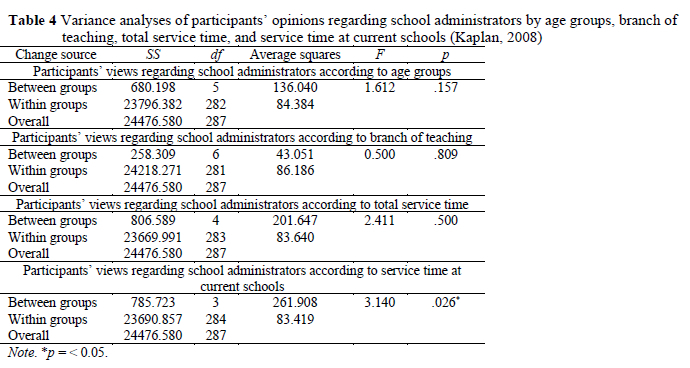
The results of the one-way ANOVA that are presented in Table 4 were used to determine whether there was a meaningful difference in the opinions of the participants about the school administrators according to different age groups, branch of teaching, total service time, and service time at the current schools.
According to these results, the different age groups did not have different views about school administrators. The participant teachers in each age group held almost the same opinion about the school administrators. Regarding the different branches of teaching, there was also no significant difference in the opinions of the teachers about the school administrators. In other words, participant teachers from every teaching branch who participated in the research shared virtually the same perceptions about school administrators. Differences in total service time (number of years teaching) also did not have any significant effect on the opinions of the teachers about the school administrators.
In the last instance we found that the teachers with different years of service at their current schools had differing views on school administrators. The service periods where the greatest differences were found were those of the groups with 1 to 2 years and 5 to 6 years of service at their current schools. No statistically significant differences were found with regard the other service times.
Participants' Views on Teachers' Contribution to Effective Schools and Academic Achievement
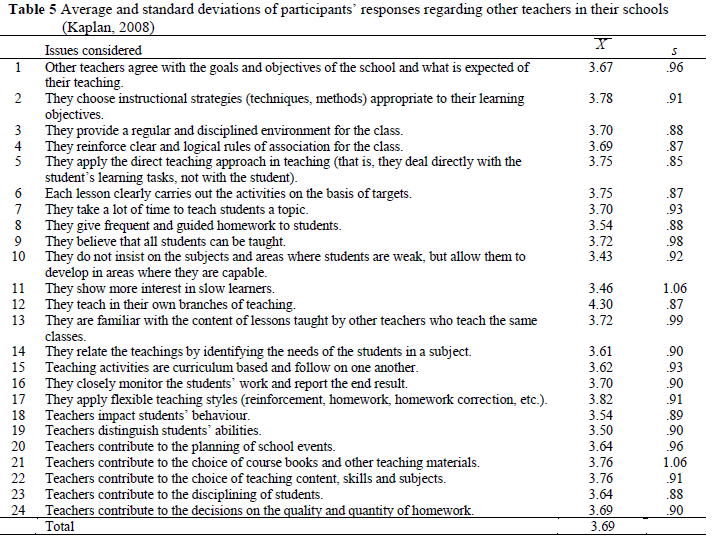
Table 5 contains a summary of the opinions of the teachers who participated in the survey regarding the other teachers at their schools, and of the latter's contributions to effective schooling.
The results in Table 5 indicate the answers given to the lowest average 10 subjects according to the responses given by the participating teachers and school administrators regarding other teachers at the schools. Accordingly, teachers who participated in the research rated their colleagues as not being sufficiently effective in supporting students in matters in which they were likely to be incompetent. The results from Balci's (1991) Effectiveness Survey of primary schools in Turkey were in line with the results from our study.
According to the results, the 12th item had the highest average, which can be interpreted as indicating that there was no teacher misallocation in Anatolian high schools in the central districts of Ankara and that teachers from each branch of teaching were employed. According to Balci (1991), this must mean that teachers are appropriately deployed.
Looking at the second part of the research on teachers (as indicated in Table 5), the most common teacher behaviour (according to teachers' and administrators' perceptions) seemed to be in line with teacher behaviour in effective schools in general. This result is similar to the research done by Şişman (1996) in primary schools in Eskişehir. Teachers apply flexible teaching styles, they choose appropriate teaching strategies for learning purposes, and they apply a direct teaching approach.
An independent t-test was conducted to determine whether there was a significant difference in the opinions of teachers and administrators who participated in the survey regarding their colleagues. The t-test results are presented in Table 6.
According to the results in Table 6, there seemed to be no gender-based opinion difference in the teacher dimension in general. In other words, the participants' gender was not a determining factor in this research.
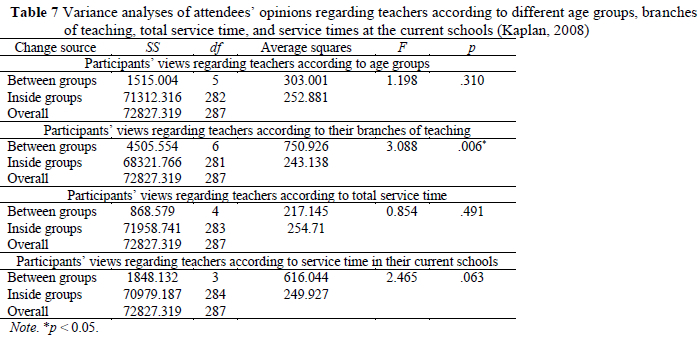
With the one-way ANOVA analysis we tried to determine whether there was a meaningful difference between the views of the participants regarding the teachers, according to the different factors (age groups; branches of teaching; total service time; service time at their current school).
The results are presented in Table 7.
The above results show that teachers from different age groups did not have different opinions on teacher dimensions. In other words, age appeared to have no decisive influence on the views of the school administrators and teachers participating in the research. This result differs from that of Balci (1991) who conducted an effective school survey and found that the ages of the teachers influenced their perceptions of effective teaching and the needs of the students. In the teacher dimension, it was determined that there were statistically different opinions between teachers involved in the different branches of teaching. When considering these branches, we found that participants from other branches of teaching (physical education, religion, culture and ethics) and fine arts held different opinions. Furthermore, we found that opinions did not differ according to the teachers' total length of service.
Finally, there was no difference in opinions based on the length of service periods in the schools where the participants were currently employed. However, the /i-value should be considered here, since it was quite close to the level of error at 0.05.
Differences Between the Opinions of the Administrators and Teachers about the Effectiveness of Anatolian High Schools in Ankara
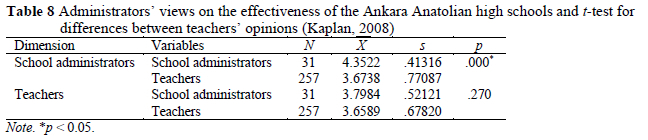
A t-test was conducted to determine whether there was a difference between the opinions of the school administrators and teachers regarding the grades of the Anatolian high schools in the Ankara province, and whether these schools had the characteristics of an effective school. The t-test results are presented in Table 8.
When we examined the values in Table 8, we found a difference between the attitudes of administrators and the teachers for the school administrator dimension, since the p-value determined for this dimension was smaller than 0.05. When the arithmetic means of the two groups were examined, the administrators of schools were found to be more effective than teachers. Furthermore, examining the opinions of school administrators and teachers regarding the teacher dimension revealed that there was no significant difference; the p-value was 0.270 > 0.05.
While the views of the school administrators on achieving effective school characteristics in Anatolian high schools in the Ankara province had a higher average, the teacher dimension differed. That is, school administrators deemed themselves to be more effective at providing effective schooling than teachers did.
When the teachers' answers were examined, the school administrators were seen to be the strongest proponents of creating an effective school dimension, and teachers simply followed their leadership. In other words, according to the teachers, school administrators were much more effective than other teachers. In general, school administrators seemed to consider their own schools to be more effective than did teachers.
Discussion, Conclusion and Suggestions
In this section, the results obtained from our research are discussed and a number of suggestions are made. Based on the participants' opinions, it seems that an effective managerial dimension is required to create effective schools in the Anatolian high schools in the Ankara province. The school administrators and teachers who were involved in this study considered school administrators to be effective enough. This is important because the managerial dimension is one of the most important dimensions of an effective school. According to Arslantaş and Özkan (2014), an effective school administrator should identify the common aims of the school, determine the teaching objectives, contribute to the stakeholders, understand the school's objectives and guide them to be expressed in the school's activities.
School administrators and teachers who participated in this research assessed the adequacy of other teachers in their schools, based on how these teachers performed at the Anatolian high schools where they worked. In the past, educational activities were at the centre of the duties of day-school schools. It can be argued that because schools are so influential, effective management needs to be at their core to ensure that educational goals are implemented effectively. The ability of schools to carry out their expected functions is of course determined by effective management. The most important component of an effective school is a team of effective administrators (Çubukçu & Girmen, 2006; Gökçe & Kahraman, 2010; Kuşaksiz, 2010; Yilmaz, 2006). According to Balci (1993), whether a school - the centre of all educational organisations - is influential in achieving its pre-determined goals largely depends on the effectiveness of the administrators who are responsible for the activities of the school and the education and training programme. For this reason, it is the school administrator' s responsibility to plan all kinds of activities at the school, to make decisions on the spot, to implement them and to follow up on the results. It is commonly understood that the effectiveness of a school is directly proportional to the effectiveness of its administrators (Arslantaş & Özkan, 2014).
The research reported on here has shown that school administrators are the most effective dimension of Anatolian high schools in the Ankara province, and that there was much room for development with respect to the teacher dimension. Helvaci and Aydoğan (2011) highlight in their research that effective schools are achieved on the basis of effective teaching processes such as students-centred, inquiry and argumentation-based processes. According to Helvaci and Aydoğan (2011), the most important part of an effective school is the education and training process. In this context, education and training environments must be conducive to providing effective teaching and learning and they must make use of educational technology. The school should also have a good physical structure to achieve educational effectiveness. In addition, school principals should be equipped with the necessary knowledge, skills and attitudes to achieve teaching leadership.
The results from this study show that there was no difference between participants' perceptions in terms of gender, age, branch of teaching, or duration of teaching service. Teachers and administrators who participated in the research seemed to have similar opinions about the school administrator dimension. On the other hand, teachers with different service periods differed in their opinions of the school administrators in their current schools. The service life groups where a significant difference was noted were the groups with 1 to 2 years and 5 to 6 years of teaching experience. The reason proposed for this is that when participants started a new service period, their expectations decreased for the first 1 to 2 years, only to increase again after the teachers have gained some experience (5-6 years). Gökçe and Kahraman (2010) state in their research that teachers' expectations for efficiency increased with the number of years of teaching experience.
The participants' gender in general, age groups, total period teaching and the length of time at the current school were not determining factors for evaluating the effectiveness of teachers in their schools. However, when looking at teachers, teachers from different branches of teaching held statistically different opinions. This difference emerged between participants from the branches of physical education, religion, culture and ethics (grouped as other in the survey), and participants from the branch of fine arts. Some research studies determined that teachers' perceptions of school effectiveness did not differ significantly according to gender, marital status, education status or duration of service (Abdurrezzak, 2015; Memduhoglu & Karataş, 2017). In other words, these studies' results were not dependent on gender, marital status, education status or duration of service. The opposite, namely that gender had an effect on teachers' perceptions of effectiveness, was also found in certain other studies (Akan, 2007; Kaya, 2015; Keleş, 2006; Kuşaksiz, 2010; Türker, 2010; Yildirim Duranay, 2005). In other words, the results on effective school characteristics differed according to the factor of teachers' gender.
The diverse findings of the studies mentioned above show similarities with and deviations from the findings in our study. Furthermore, student motivation can be improved by including less theoretical knowledge in foreign languages, science and mathematics, and focusing more on applications by students. In other words, when the student's motivation for the lesson is high, teacher motivation and effective school perception may also be high (Memduhoglu & Karataş, 2017).
When the opinions of the teachers about their school administrators were examined, it appeared that the teachers found the administrators to be generally effective. The average of teachers' opinions about their teaching colleagues in the same school indicated that they found them to be effective at the desired level. From the teachers' perspective, the performance of students can be improved by identifying their weak spots, not focusing on weak subjects and areas, nurturing their development in areas where they are capable, and by showing more interest in slow learners. The results obtained in our study were similar to those of previous studies (Alamdar, 2015; Balci, 1993; Baştepe, 2002; Çubukçu & Girmen, 2006; Helvaci & Aydoğan, 2011; Lezotte, 2001; Rutter et al., 1979; Sammons et al., 1995; Şişman, 1996; Toprak, 2011; Zigarelli, 1996). In these studies, the teachers stated that they found their administrators effective, they also stated that they found their colleagues' technological-pedagogical content knowledge appropriate. These studies also highlighted that every individual could learn due to the organisation of teaching domains according to students' academic levels.
The school administrators and teachers who participated in our study held similar (teacher performance) and different (school efficiency) views. School administrators found schools to be more effective than did the teachers, but there was no significant difference between the opinions of school administrators and teachers about the performance of teachers. Teachers again generally had lower perceptions regarding the effectiveness of schools as, in their opinions, the schools where they worked did not display effective school characteristics at the expected level. This result is similar to the findings of studies conducted by Oral (2005) and Yildirim Duranay (2005). Their research also state the effective school characteristics at the expected level. However, various other studies determined that teacher's perceptions of effective schools were at a high level (Abdurrezzak, 2015; Akan, 2007; Ayik & Ada, 2009; Keleç, 2006; Kuşaksiz, 2010). Teachers' perceptions of effective schooling may be related to the variability of the environment, organisational culture, and the climate in the schools (Memduhoglu & Karataş, 2017). Based on the views of the school administrators and teachers who participated in the study, we determined that the development of the subjects presented in these environments may be useful for achieving effective reading.
Our study also showed that the most important dimension of an effective school was the education and training process. In this context, education and training environments should enhance teaching and learning while also catering for the characteristics of an effective school. Schools should also be designed and organised with teaching and learning materials in mind. Anatolian high schools need to be equipped with good physical resources to be able to support effective schools. In addition, school administrators must have the necessary knowledge, skills and attitudes in the field of teaching leadership to direct teachers towards creating effective schools.
Some suggestions on how to create effective schools (taken from various studies) include proper leadership in school management; positive changes in the lives of teachers and students; the reflection of such changes in the processes of education and teaching. Successful schools have some distinctive and superior characteristics when compared to other schools in terms of their structural, cultural, educational, and content-based characteristics. They have features that distinguish them from other schools, which are predominantly due to the leadership of school administrators that reflects the quality enhancement initiative, the comprehensive instructional focus, the regular and safe moderate climate formation in education and training, and the belief that all students can learn at a minimum level. With effective schooling, concepts such as power, authority and hierarchy are greatly reduced. This strengthens the school staff by allowing them to cooperate, to define roles, to share work and strength, to work together, to create an environment where student and parent satisfaction grows, and to continue developing.
Finally, some suggestions for future research about effective schools. Since this research was limited to Anatolian high schools in Ankara, Turkey, future research may investigate Anatolian high schools located in other Turkish provinces as well. The research can also be made more comprehensive by studying the perceptions of parents and students in addition to those of teachers and administrators. The same research methodology could be applied to all kinds of Anatolian high schools (Anatolian Fine Arts, Anatolian Teacher high schools, etc.), as well as to science high schools, social science high schools, sports high schools and private high schools.
Authors' Contributions
The first author greatly contributed to the entire research - more so than the co-authors.
Notesi. This article was derived from a 2008 thesis, "Levels of effectiveness characteristics in Anatolian high schools (Ankara case)", at the Gazi University, Graduate School of Educational Sciences, Educational Sciences, Educational Administration under supervision of Füsun Kaplan.
ii. Published under a Creative Commons Attribution Licence.
References
- Abdurrezzak S 2015. Etkili okul ve okul liderligine ilişkin ögretmen algilarinin incelenmesi [Examining teachers' perceptions on effective school and school leadership]. MEd thesis. Sivas, Turkey: Sivas Cumhuriyet Üniversitesi.
- Akan D 2007. Degiçim sürecinde ilkögretim okullarinm etkili okul özelliklerine sahip olma düzeyleri (Erzurum ili örnegi) [Levels of effectiveness of primary schools in the process of change (The case of Erzurum Province)]. PhD dissertation. Erzurum, Turkey: Ataturk University.
-
Alamdar S 2015. Akademik baçanyi etkileyen faktörlerin etkili okul kavrami baglaminda incelenmesi [Analysing the elements affecting academic success in the context of effective school concept]. MEd thesis. Ankara, Turkey: Ankara University. Available at https://dspace.ankara.edu.tr/xmlui/bitstream/handle/20.500.12575/32271/Selin%2520ALAMDAR_YLT.pdf?sequence=1&isAllowed=y. Accessed 30 November 2021.
» https://dspace.ankara.edu.tr/xmlui/bitstream/handle/20.500.12575/32271/Selin%2520ALAMDAR_YLT.pdf?sequence=1&isAllowed=y -
Arslantaç HI & Özkan M 2014. Ögretmen ve yönetici gözüyle etkili okulda yönetici özelliklerinin belirlenmesi [Defining qualities of school administrators in effective schools from teachers and administrators point of view]. International Journal of Social Science, 26(2):181 -193. https://doi.org/10.9761/JASSS2295
» https://doi.org/10.9761/JASSS2295 -
Aslan Ş 2014. Anadolu liselerinde etkili okul kavraminin yönetici ve ögretmen algilarina göre degerlendirilmesi (Batman ili örnegi) [The evaluation of effective school concept according to directors' and teachers' perception in Anatolian High Schools (Batman Province example)]. MEd thesis. Gaziantep, Turkey: Zirve University. Available at https://acikbilim.yok.gov.tr/bitstream/handle/20.500.12812/705745/yokAcikBilim_10057826.pdf?sequence=-1&isAllowed=y. Accessed 30 November 2021.
» https://acikbilim.yok.gov.tr/bitstream/handle/20.500.12812/705745/yokAcikBilim_10057826.pdf?sequence=-1&isAllowed=y -
Ayik A & Ada Ş 2009. Ilkögretim okullarinda oluçturulan okul kültürü ile okullarin etkililigi arasindaki ilişki [The relationship between the effectiveness of schools and the school culture which is created in primary schools]. Gaziantep Üniversitesi, Sosyal Bilimler Dergisi, 8(2):429-446. Available at http://dergipark.org.tr/tr/download/article-file/223549. Accessed 2 September 2019.
» http://dergipark.org.tr/tr/download/article-file/223549 -
Balci A 1991. Egitim yönetiminde kuram ve araştirma [Theory and research in educational administration]. Ankara Üniversitesi Egitim Bilimleri Fakültesi Dergisi, 24(2):735-746. Available at https://dspace.ankara.edu.tr/xmlui/bitstream/handle/20.500.12575/46451/6099.pdf?sequence=1&isAllowed=y. Accessed 6 September 2019.
» https://dspace.ankara.edu.tr/xmlui/bitstream/handle/20.500.12575/46451/6099.pdf?sequence=1&isAllowed=y - Balci A 1993. Etkili okul: Kuram, uygulama, ve araştirma [Effective school: Theory, practice, and research]. Ankara, Turkey: Erek Ofset Matbaasi.
- Baştepe I 2002. Normal ve taşimali egitim yapan resmi ilkögretim okul yönetici, ögretmen ve sekizinci sinif ögrencilerinin okul (örgütsel) etkililik algilari [The school effectiveness perceptions of administrators, teachers and the eighth grade students in public normal and transported elementary schools]. PhD dissertation. Ankara, Turkey: Ankara University.
- Baştepe I 2004. Etkili okul ve nitelikleri [Effective school and its qualifications]. Çagdaş Egitim Dergisi, 315:33-39.
-
Baştepe I 2009. Etkili okulun egitim-ögretim süreci ve ortami boyutlarinin nitelikleri [The qualities of education process and medium dimensions of effective school]. Elektronik Sosyal Bilimler Dergisi, 8(29):76-83. Available at https://dergipark.org.tr/en/download/article-file/70123. Accessed 30 November 2020.
» https://dergipark.org.tr/en/download/article-file/70123 -
Biltekin T 2013. Ortaögretim okullarindaki ögretmenlerin etkili okul algilari (Kayseri ili örnegi) [Effective school perceptions of secondary school teachers (Kayseri Province)]. MEd thesis. Kayseri, Turkey: Erciyes University. Available at https://tez.yok.gov.tr/UlusalTezMerkezi/tezDetay.jsp?id=3JiX8XdhfvVVr5803M7tGQ&no=iLTKVHU4amx1O2oZWyoSsQ. Accessed 30 November 2021.
» https://tez.yok.gov.tr/UlusalTezMerkezi/tezDetay.jsp?id=3JiX8XdhfvVVr5803M7tGQ&no=iLTKVHU4amx1O2oZWyoSsQ -
Cole K, Waldrop J, D'Auria J & Garner H 2006. An integrative research review: Effective school-based childhood overweight interventions. Journal for Specialists in Pediatric Nursing, 11(3):166-177. https://doi.org/10.1111/j.1744-6155.2006.00061.x
» https://doi.org/10.1111/j.1744-6155.2006.00061.x -
Çubukçu Z & Girmen P 2006. Ortaögretim kurumlarinin etkili özelliklerine sahip olma düzeyleri [Levels of effectiveness characteristics in secondary schools]. Sosyal Bilimler Dergisi, 8(16):121-136. Available at https://dergipark.org.tr/en/download/article-file/843732. Accessed 30 November 2021.
» https://dergipark.org.tr/en/download/article-file/843732 -
Espinoza D & Cardichon J 2017. Investing in effective school leadership: How states are taking advantage of opportunities under ESSA. Palo Alto, CA: Learning Policy Institute. Available at https://files.eric.ed.gov/fulltext/ED606815.pdf. Accessed 30 November 2021.
» https://files.eric.ed.gov/fulltext/ED606815.pdf -
Gcelu N 2019. The effectiveness of stakeholder collaboration in preventing learner pregnancy in secondary schools in the Eastern Cape, South Africa: Implications for leadership. South African Journal of Education, 39(3):Art. #1650, 8 pages. https://doi.org/10.15700/saje.v39n3a1650
» https://doi.org/10.15700/saje.v39n3a1650 -
Gökçe F & Kahraman PB 2010. Etkili okulun bileşenleri: Bursa ili örnegi [Components of an effective school: A sample from Bursa]. Uludag Üniversitesi Egitim Fakültesi Dergisi, 23(1):173-206. Available at https://dergipark.org.tr/en/pub/uefad/issue/16691/173480. Accessed 30 November 2021.
» https://dergipark.org.tr/en/pub/uefad/issue/16691/173480 -
Gökdag Baltaoglu M & Güven M 2019. Relationship between self-efficacy, learning strategies, and learning styles of teacher candidates (Anadolu University example). South African Journal of Education, 39(2):Art. #1579, 11 pages. https://doi.org/10.15700/saje.v39n2a1579
» https://doi.org/10.15700/saje.v39n2a1579 -
Günal Y & Demirtaşli RN 2016. A pathway to educational accountability: The relationship between effective school characteristics and student achievement. Universal Journal of Educational Research, 4(9):2049-2054. https://doi.org/10.13189/ujer.2016.040915
» https://doi.org/10.13189/ujer.2016.040915 -
Helvaci MA & Aydoğan I 2011. Etkili okul ve etkili okul müdürüne ilişkin ögretmen görücleri [A study on the perceptions of teachers on the qualities of effective school and school principal]. Uşak Üniversitesi Sosyal Bilimler Dergisi, 4(2):41 -60. Available at https://dergipark.org.tr/en/download/article-file/202373. Accessed 30 November 2021.
» at https://dergipark.org.tr/en/download/article-file/202373 -
Ihtiyaroglu N 2014a. Ögrenci algilarina göre ögretmen, ögrenci ve ögretim etkinliginde kalite ölçütleri [Students' perspectives to quality standards of teacher, student and teaching activity]. Ordu Üniversitesi Sosyal Bilimler Enstitüsü Sosyal BilimlerAraştirmalan Dergisi, 4(10):33-39. Available at https://dergipark.org.tr/en/download/article-file/273511. Accessed 30 November 2021.
» https://dergipark.org.tr/en/download/article-file/273511 -
Ihtiyaroglu N 2014b. Ögretmen algilarina göre ögretmen, ögrenci ve ögretim etkinliginde kalite ölçütleri [Teachers' perspectives to quality standards of teacher, student and teaching activity]. Sosyal Bilimler Enstitüsü Dergisi, 1(2-3):30-42. Available at https://dergipark.org.tr/en/download/article-file/160460. Accessed 30 November 2021.
» https://dergipark.org.tr/en/download/article-file/160460 -
Institute for Educational Leadership, Coalition for Community Schools and National Association of School Psychologists 2020. Nine elements of effective school community partnerships to address student mental health, physical health, and overall wellness. Available at https://www.nasponline.org/documents/Research%20and%20Policy/Advocacy%20Resources/Community%20Schools%20White%20Paper_Jan_2016.pdf.. Accessed 30 August 2020.
» https://www.nasponline.org/documents/Research%20and%20Policy/Advocacy%20Resources/Community%20Schools%20White%20Paper_Jan_2016.pdf -
Johnson WL, Johnson AM & Johnson JW 2018. The three generations of effective schools research. Paper presented at the annual meeting of the Science Teachers Association of Texas (STAT), Fort Worth, TX, 1 -3 November. Available at https://files.eric.ed.gov/fulltext/ED598314.pdf. Accessed 30 November 2021.
» https://files.eric.ed.gov/fulltext/ED598314.pdf - Kaplan HF 2008. Anadolu liselerinin etkili okul olma özelliklerini karşilama düzeyi (Ankara ili örnegi) [Levels of effectiveness characteristics in anatolian high schools (Ankara Province example)]. MEd thesis. Ankara, Turkey: Gazi University.
- Karasar N 2004. Bilimsel araştirma yöntemi: Kavramlar, ilkeler, teknikler [Scientific research method: Concepts, principles, techniques]. Ankara, Turkey: Nobel Yayin Dagitim.
-
Kaya Y 2015. Okul paydaşlannin görüşlerine göre etkili okul geliştirme (Şahinbey ilçesi örnegi) [Effective school development according to the views of school stakeholders (The case of Şahinbey)]. MEd thesis. Gaziantep, Turkey: Hasan Kalyoncu University. Available at http://openaccess.hku.edu.tr/xmlui/bitstream/handle/20.500.11782/1169/Okul%20Payda%c5%9flar%c4%b1n%c4%b1n%20G%c3%b6r%c3%bc%c5%9flerine%20G%c3%b6re%20Etkili%20Okul%20Geli%c5%9ftirme%20%28%c5%9eahinbey%20%c4%b0l%c3%a7esi%20%c3%96rne%c4%9fi%29.pdf?sequence=1&isAllowed=y. Accessed 30 November 2021.
» http://openaccess.hku.edu.tr/xmlui/bitstream/handle/20.500.11782/1169/Okul%20Payda%c5%9flar%c4%b1n%c4%b1n%20G%c3%b6r%c3%bc%c5%9flerine%20G%c3%b6re%20Etkili%20Okul%20Geli%c5%9ftirme%20%28%c5%9eahinbey%20%c4%b0l%c3%a7esi%20%c3%96rne%c4%9fi%29.pdf?sequence=1&isAllowed=y -
Keleş B 2006. Ilkögretim okullarinin etkili okul özelliklerine sahip olma dereceleri hakkinda ögretmen görüşleri (Çorum ili örnegi) [Teachers' opinions on to what extend primary schools posses effective school properties (Çorum city sample)]. MEd thesis. Ankara, Turkey: Gazi University. Available at https://tez.yok.gov.tr/UlusalTezMerkezi/tezDetay.jsp?id=XCwZVNEwpuJRNgsokwnKIQ&no=9QLxy839BzdSMlSoyIZ1Mg. Accessed 30 November 2021.
» https://tez.yok.gov.tr/UlusalTezMerkezi/tezDetay.jsp?id=XCwZVNEwpuJRNgsokwnKIQ&no=9QLxy839BzdSMlSoyIZ1Mg -
Kuşaksiz N 2010. Ögretmen görüşlerine göre ilkögretim okullarinin etkili okul özelliklerine sahip olma düzeyleri (Üsküdar ilçesi örnegi) [The levels of primary schools that have effective school characteristics according to teachers' views (The example of Üsküdar district)]. MEd thesis. Konya, Turkey: Selçuk University. Available at http://acikerisimarsiv.selcuk.edu.tr:8080/xmlui/bitstream/handle/123456789/6542/264359.pdf?sequence=1&isAllowed=y. Accesses 30 November 2021.
» http://acikerisimarsiv.selcuk.edu.tr:8080/xmlui/bitstream/handle/123456789/6542/264359.pdf?sequence=1&isAllowed=y -
Lezotte LW 2001. Revolutionary and evolutionary: The effective schools movement. Available at http://www.effectiveschools.com/downloads/RevEv.pdf. Accessed 6 September 2019.
» http://www.effectiveschools.com/downloads/RevEv.pdf - MacGilchrist B, Myers K & Reed J 2004. The intelligent school (2nd ed). London, England: Sage.
-
Maier A, Daniel J, Oakes J & Lam L 2017. Community schools as an effective school improvement strategy: A review of the evidence. Palo Alto, CA: Learning Policy Institute. Available at https://files.eric.ed.gov/fulltext/ED606765.pdf. Accessed 30 November 2021.
» https://files.eric.ed.gov/fulltext/ED606765.pdf -
Memduhoglu HB & Karatas E 2017. Ögretmenlere göre çaliştiklan okullar ne kadar etkili? [How effective are the schools where they work, according to teachers?]. Egitim Bilimleri Araştirmalari Dergisi, 7(2):227-244. Available at https://www.researchgate.net/profile/Erdem-Karatas-2/publication/328730737_Ogretmenlere_Gore_Calistiklari_Okullar_Ne_Kadar_Etkili/links/5bdebfbd92851c6b27a5b5bf/Oegretmenlere-Goere-Calistiklari-Okullar-Ne-Kadar-Etkili.pdf. Accessed 6 August 2019.
» https://www.researchgate.net/profile/Erdem-Karatas-2/publication/328730737_Ogretmenlere_Gore_Calistiklari_Okullar_Ne_Kadar_Etkili/links/5bdebfbd92851c6b27a5b5bf/Oegretmenlere-Goere-Calistiklari-Okullar-Ne-Kadar-Etkili.pdf -
Oral Ş 2005. Ilkögretim okullarinin etkili okul kavrami açisindan degerlendirilmesi: Batman ili örnegi [The assessment of primary schools from the angle of effective school concept: The example of Batman Province]. MEd thesis. Diyarbakir, Turkey: Dicle University. Available at http://acikerisim.dicle.edu.tr/xmlui/bitstream/handle/11468/2949/%C4%B0lk%C3%B6%C4%9Fretim%20okullar%C4%B1n%C4%B1n%20etkili%20okul%20kavram%C4%B1%20a%C3%A7%C4%B1s%C4%B1ndan%20de%C4%9Ferlendirilmesi%20Batman%20ili%20%C3%B6me%C4%9Fi.pdf?sequence=1&isAllowed=y. Accessed 30 November 2021.
» http://acikerisim.dicle.edu.tr/xmlui/bitstream/handle/11468/2949/%C4%B0lk%C3%B6%C4%9Fretim%20okullar%C4%B1n%C4%B1n%20etkili%20okul%20kavram%C4%B1%20a%C3%A7%C4%B1s%C4%B1ndan%20de%C4%9Ferlendirilmesi%20Batman%20ili%20%C3%B6me%C4%9Fi.pdf?sequence=1&isAllowed=y - Özden Y 2010. Egitimde yeni degerler: Egitimde dönüşüm [New values in education: Transformation in education] (8th ed). Ankara, Turkey: Pegem A Yaymlan.
-
Polatcan M & Cansoy R 2018. Türkiye'de etkili okul araştirmalari: Ampirik araştirmalann analizi [School effectiveness research in Turkey: A review of empirical studies]. Sakarya University Journal of Education, 8(3):8-24. https://doi.org/10.19126/suje.370352
» https://doi.org/10.19126/suje.370352 - Rutter M, Maughan B, Mortimore P & Ouston J 1979. Fifteen thousand hours: Secondary schools and their effects on children. Somerset: Open Books.
-
Sammons P, Hillman J & Mortimore P 1995. Key characteristics of effective schools: A review of school effectiveness research. London, England: Office for Standards in Education (OFSTED). Available at https://files.eric.ed.gov/fulltext/ED389826.pdf. Accessed 30 November 2021.
» https://files.eric.ed.gov/fulltext/ED389826.pdf - Şişman M 1996. Etkili okul yönetimi. Ilkokullarda bir araştirma [Effective school management. A study in primary schools]. MEd dissertation. Eskiçehir, Turkey: Eskisehir Osmangazi University.
- Şişman M 2004. Ögretim liderligi [Instructional leadership]. Ankara, Turkey: Pegem A Yayincilik.
-
Stockard J & Lehman M 2004. Influences on the satisfaction and retention of 1st-year teachers: The importance of effective school management. Educational Administration Quarterly, 40(5):742-771. https://doi.org/10.1177/0013161X04268844
» https://doi.org/10.1177/0013161X04268844 -
Sunaengsih C, Anggarani M, Amalia M, Nurfatmala S & Naelin SD 2019. Principal leadership in the implementation of effective school management. Mimbar Sekolah Dasar, 6(1):79-91. https://doi.org/10.17509/mimbar-sd.v6i1.15200
» https://doi.org/10.17509/mimbar-sd.v6i1.15200 -
Tarhan S 2008. Ilkögretim okullarindaki ögretmenlerin etkili okul algilari [The effective school perceptions of teachers who work in primary schools]. MEd thesis. Istanbul, Turkey: Beykent University. Available at https://tez.yok.gov.tr/UlusalTezMerkezi/tezDetay.jsp?id=y0HVUYMVOS_oQ9UhxK4JOA&no=Fm8XSe_-u4h6O8PO6cpPHg. Accessed 30 November 2021.
» https://tez.yok.gov.tr/UlusalTezMerkezi/tezDetay.jsp?id=y0HVUYMVOS_oQ9UhxK4JOA&no=Fm8XSe_-u4h6O8PO6cpPHg -
Toprak M 2011. Ilkögretim okullarinda görev yapan ögretmenlerin okul etkililigine ilişkin görücleri: (Adiyaman ili örnegi) [Primary school teachers' views on school effectiveness: (Case of Adiyaman Province)]. MEd thesis. Elazig, Turkey: Firat University. Available at https://acikerisim.firat.edu.tr/xmlui/bitstream/handle/11508/16598/285887.pdf?sequence=1&isAllowed=y. Accessed 30 November 2021.
» https://acikerisim.firat.edu.tr/xmlui/bitstream/handle/11508/16598/285887.pdf?sequence=1&isAllowed=y -
Türker Y 2010. Ilkögretim okullarinin etkililik düzeyleri ile örgüt sagligi arasindaki ilişki [The relation between primary schools' effectiveness level and organizational health]. MEd thesis. Antalya, Turkey: Akdeniz University. Available at https://tez.yok.gov.tr/UlusalTezMerkezi/tezDetay.jsp?id=i5uPAVcU2qq1lUaY1HfxYQ&no=ZJqIfoQTgkJePvHF9_zT2g. Accessed 30 November 2021.
» https://tez.yok.gov.tr/UlusalTezMerkezi/tezDetay.jsp?id=i5uPAVcU2qq1lUaY1HfxYQ&no=ZJqIfoQTgkJePvHF9_zT2g -
Wikipedia 2019. Effective schools. Available at https://en.wikipedia.org/wiki/Effective_schools. Accessed 23 August 2020.
» https://en.wikipedia.org/wiki/Effective_schools -
Xaba MI 2011. The possible cause of school governance challenges in South Africa. South African Journal ofEducation, 31(2):201-211. https://doi.org/10.15700/saje.v31n2a479
» https://doi.org/10.15700/saje.v31n2a479 -
Yagiz MS 2016. Ilkokullarin etkili okul özelliklerine sahip olma düzeylerinin incelenmesi [Investigation of the levels of primary schools that have effective school characteristics]. MEd dissertation. Gaziantep, Turkey: Hasan Kalyoncu University. Available at http://openaccess.hku.edu.tr/xmlui/handle/20.500.11782/1181. Accessed 30 November 2021.
» http://openaccess.hku.edu.tr/xmlui/handle/20.500.11782/1181 -
Yildirim Duranay P 2005. Ortaögretim kurumlarinin etkili okul özelliklerini karşilama düzeyleri (Izmir örnegi) [Level of secondary school effectiveness (Izmir example)]. MEd thesis. Denizli, Turkey: Pamukkale University. Available at http://acikerisim.pau.edu.tr/xmlui/bitstream/handle/11499/2989/P%c4%b1nar%20Y%c4%b1ld%c4%b1r%c4%b1m%20Duranay.pdf?sequence=1&isAllowed=y. Accessed 30 November 2021.
» http://acikerisim.pau.edu.tr/xmlui/bitstream/handle/11499/2989/P%c4%b1nar%20Y%c4%b1ld%c4%b1r%c4%b1m%20Duranay.pdf?sequence=1&isAllowed=y -
Yilmaz V 2006. Ilkögretim okullarinin etkili okul özelliklerine sahip olma düzeyleri (Düzce ili örnegi) [Degree of primary school's effective school characteristics: Düzce case]. MEd dissertation. Bolu, Turkey: Abant Izzet Baysal Üniversitesi. Available at https://tez.yok.gov.tr/UlusalTezMerkezi/tezDetay.jsp?id=IDA0oHmyqQraVzv3jZgySA&no=n6VrtJjccnd4Dtt2UrYGrQ. Accessed 30 November 2021.
» https://tez.yok.gov.tr/UlusalTezMerkezi/tezDetay.jsp?id=IDA0oHmyqQraVzv3jZgySA&no=n6VrtJjccnd4Dtt2UrYGrQ -
Zigarelli MA 1996. An empirical test of conclusions from effective schools research. The Journal of Educational Research, 90(2):103-110. https://doi.org/10.1080/00220671.1996.9944451
» https://doi.org/10.1080/00220671.1996.9944451
Revised: 6 October 2020
Accepted: 19 November 2020
Published: 30 November 2021