Exploring the effects of principals' distributed leadership practices on learners' learning achievement as mediated by teachers' commitment
Abstract
The aim of the study reported on here was to explore the effects of principals' distributed leadership (DL) practices on learners' learning achievement as mediated by teachers' commitment. In the study we employed survey data with a sample size of 603 learners from 8 technical and vocational education training schools in Eritrea. The proposed model of this study was tested through multiple regression analyses and structural equation modelling using teachers' commitment as a mediator. The findings of this study show that distributed leadership practices have a positive and significant effect on teachers' commitment and an indirect effect on learners' learning achievement. The results also show that teachers' commitment has a partial mediation effect. Moreover, the variance test analysis reveals the effect of distributed type of leadership practices by school principal determined by school type, size, location, and ownership.
distributed leadership; learners' learning achievement; principals' leadership; teachers' commitment; technical and vocational education training schools
Introduction
Contemporary educational reforms place school leadership at the centre of their policy agenda. At the same time, researchers agree on school leadership's contribution to the execution of almost all initiatives targeted at school improvement and learners' learning achievement (Pont, Nusche & Moorman, 2008; Seashore Louis, Dretzke & Wahlstrom, 2010). Many scholars have contributed to the documentation of successful leadership practices that can improve learning practice and learners' achievement (Leithwood, Seashore, Anderson & Wahlstrom, 2004; Seashore Louis et al., 2010; Spillane, 2005). Among different types of educational leadership, distributed leadership (DL) has attracted the attention of many researchers, policy developers, and professionals (Harris, 2013b; Jambo & Hongde, 2020; Leithwood, Mascall, Strauss, Sacks, Memon & Yashkina, 2007; Lumby, 2016; Spillane, 2005; Williams, 2011). DL is often regarded as an optimal type of school leadership to improve learning achievement by a school principal (Harris, 2013a; Klar, Huggins, Hammonds & Buskey, 2016). Literature emphasises that DL has a significant and positive effect on school improvement and learners' learning achievement (Leithwood & Jantzi, 2006). However, the effects of principals' DL practices depend on the organisational context of schools (Leithwood et al., 2004)
According to Spillane (2006), a distributed type of leadership is a social distribution of leadership functions over leaders, followers, and characteristics of their situation. From a distributed standpoint, the main role of the principal is to share direction and guidance, to build follower capacity, to involve followers in the decision-making process, enabling them to take initiative, motivate followers, acknowledge followers' ability (Duif, Harrison, Van Dartel & Sinyolo, 2013; Leithwood, Harris & Hopkins, 2020; Yilmaz & Beycioğlu, 2017), and to share power with followers (Dampson, Havor & Laryea, 2018; Harris, 2013a; Pont et al., 2008).
While a few empirical studies have attempted to explore the effects of principals' DL practices on learners' achievement via teachers' commitment (Jambo & Hongde, 2020; Leithwood & Jantzi, 2006; Ross & Gray, 2006), scholars and professionals do not regard these studies as convincing (Diamond & Spillane, 2016; Harris, 2013a). Some of these studies contain methodological and population gaps as the qualitative approach with small sample sizes (Leithwood et al., 2007; Tian, 2016; Tian, Risku & Collin, 2016; Timperley, 2009) and very limited cultural and educational contexts (Tian, 2016) were used in most. Furthermore, they include practical-knowledge gaps and do not provide clear guidance regarding best practices (Anderson, Moore & Sun, 2009). Harris (2013b) argues that it is challenging to identify a link between the DL and learners' learning achievement without relating the model of a study with learning methods.
According to Sun and Leithwood (2015), the qualitative approach was used in most previous studies on the relationship between teachers' commitment and learning outcomes. As such, many scholars have suggested further statistical investigation of DL and its effect on learners' learning outcomes and teachers' commitment as mediator (Bennett, Harvey, Wise & Woods, 2003; Diamond & Spillane, 2016; Jambo & Hongde, 2020; Leithwood et al., 2007; Sun & Leithwood, 2015; Tian, 2016). Hence, it is important and productive to empirically examine the effects of principals' DL practices on learners' learning achievement as mediated by teachers' commitment. Furthermore, due to the issues of accountability, complexity of principal work, dynamics of technology, economic and political changes, it is timely, necessary and beneficiary for schools to employ DL practice for better learning achievement (Naicker & Mestry, 2013). With this study we add to the knowledge on DL and thus expand the existing literature on the topic. Furthermore, strategies are recommended whereby the relationship between principles' DL practices and learning achievement can be optimised. Teachers' commitment is considered as mediator in this relationship.
Research Objectives and Hypotheses
The objectives with this study were: (i) to explore the effect of principals' distributed leadership practices (PDLP) on learners' learning achievement (SLA) as mediated by teachers' commitment (TC) in technical and vocational education training (TVET) schools in Eritrea, (ii) to empirically examine the impact of PDLP on TC, and (iii) to identify the influence of demographic variables on the correlation between PDLP and SLA. To achieve and scrutinise the above-mentioned objectives, we focused on the following three questions: (i) After controlling the demographic characteristics, does PDLP indirectly and significantly affect SLA through TC? (ii) After controlling demographic characteristics, does PDLP have a positive and significant effect on TC? (iii) Are there group differences in terms of the respondent' s demographic factors on the link between PDLP and SLA?
Based on the above research objectives, we formulated and articulated three hypotheses (i.e, H1, H2, and H3) to explore the effects of PDLP on SLA as mediated by TC. These are presented as follows: Hypothesis 1 (H1): After controlling the demographic characteristics, PDLP has a significant and indirect effect on SLA (Jambo & Hongde, 2020; Leithwood et al., 2007). Hypothesis 2 (H2): After controlling the demographic characteristics, there is a direct, positive and significant relationship between PDLP and TC (Alenezi, 2019; Du, 2013; Hulpia & Devos, 2009; Wu, Wu & Wu, 2013). Hypothesis 3 (H3): After controlling the demographic characteristics, PDLP does not have a significant and direct effect on SLA when TC is added into the model as a third variable (Ross & Gray, 2006).
Literature Review
The current available literature on educational leadership shows that the school principal greatly affects the success of a school (Harris, 2013b; Leithwood et al., 2004; Tian, 2016). School principals can facilitate and empower DL in a school through interaction and by influencing processes (Day, Sammons, Hopkins, Harris, Leithwood, Gu, Brown & Kington, 2009; Spillane, 2005; Tian, 2016). Similarly, a principal is essential in enabling teachers to be committed to the realisation of learners' learning outcome improvement (Lin, 2014). Literature suggests that principals' leadership practices from a distributed viewpoint should focus on capacity building (Leithwood & Sun, 2012) and on activities related to the main objectives of the school in order to influence followers' knowledge, practice and motivation (Spillane, 2005; Yilmaz & Beycioğlu, 2017). Besides, involving followers in decision-making (Copland, 2003; Law, Galton & Wan, 2010; Naicker & Mestry, 2013), delegating and sharing power through the school structure (Hargreaves & Fink, 2012) and inspiring a shared vision (Bush & Glover, 2003; Day & Sammons, 2016; Grant, Gardner, Kajee, Moodley & Somaroo, 2010) have been proven to be effective leadership practices that positively affect TC and learners' achievement.
TC refers to the teachers' level of belonging and determination shown to the school. This can be a commitment to teaching, the school, the learners, or change (Sun, 2015). Literature defines organisational commitment as a robust belief by members in their organisational objectives and values, and enthusiasm to make significant efforts on behalf of their organisation (Agarwal, DeCarlo & Vyas, 1999). This type of organisational commitment cannot be affected by teachers' personal concerns and aspirations. Commitment to learners refers to teachers' diligence to provide additional effort to support their learners to achieve better learning and develop good relationships with them to encourage lifelong learning (Nir, 2002; Sun & Leithwood, 2015). Likewise, in this study, TC implies commitment of teachers to the school and the learners.
TC to the school and the learners has a direct and significant correlation with individual and collective learning outcomes (Sun, 2015; Sun & Leithwood, 2015). Previous studies assert that highly committed employees have higher retention rates and lower absenteeism (Mowday, Porter & Steers, 2013). Of note, PDLP increases TC (Du, 2013; Hulpia & Devos, 2009). The work by Alenezi (2019) shows that PDLP has a significant and positive effect on TC and self-efficacy. Some literature empirically emphasise that DL has a positive effect on teachers' job satisfaction and commitment (Wu et al., 2013). Their framework for DL includes participative decision-making, autonomy, team sharing, economic and emotional exchange, and capacity building.
SLA is the main objective of schools which indicates either poor or satisfactory performance of learners. Scholars use SLA to measure school achievement, effectiveness of leadership practice, or learners' engagement (Anderson et al., 2009; Hulpia & Devos, 2009; Köksal, 2013; Malechwanzi & Hongde, 2018; Pascarella, Wolniak, Seifert, Cruce & Blaich, 2005). Measuring SLA using cumulative grade point average (CGPA) and test scores is a common approach (Basri, Alandejani & Almadani, 2018). In comparison, some scholars have suggested measuring SLA using an alternative style that also provides for the effect on learners' attitudes and traits in addition to cognitive (CGPA) outcomes (Ali, Zhou, Hussain, Nair & Ragavan, 2016). A review study conducted by Person and his colleagues has identified three measures of SLA that are frequently used by researchers. Their study shows that researchers were able to measure SLA by designing variables that gauged attitude (self-esteem, self-efficacy and fairness), behaviour (trait, self-control, and self-discipline), and cognitive performance (knowledge and skills) measured by CGAP or test scores (Person, Moiduddin, Hague-Angus & Malone, 2009).
Proposed Model of the Study
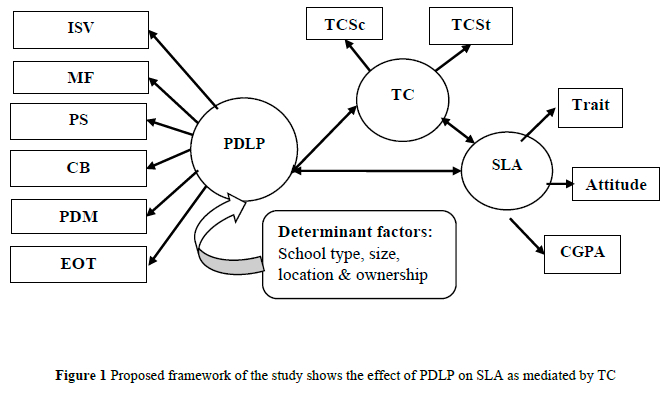
This empirical study is based on a combination of theoretical models of the Spillane (2005) leader-plus and practice-centred aspect, Leithwood's planned alignment model (Leithwood et al., 2007), and modified duality agency model (Tian, 2016). Based on these models, we designed a conceptual framework for DL (cf. Figure 1) that guided us to examine the effects of PDLP on SLA as mediated by TC. Six constructs were considered as principals' essential behavioural practices of DL. These are inspiring a shared vision, motivating followers, power-sharing, capacity building, participative decision-making, and enabling others to act. TC was used as a mediator variable.
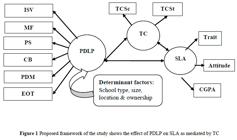
The model proposed in this study displays that the path encompassing direct and indirect effects (correlation) can be applied to hypothesise and test schools' PDLP effects. The direct effect indicates that PDLP has a statistically significant effect on TC and SLA, while the indirect effect indicates that there is a mediation effect of TC on the link between PDLP and SLA. The determinant factors refer to the essential features of the organisational context that determine the effectiveness of PDLP and TC in schools (Leithwood et al., 2004). Our study was conducted at TVET schools in Eritrea and a combined measure of PDLP derived from previous research on DL practices was used. SLA was measured using learners' acquired traits, attitudes, and standardised course completion test scores obtained from the record office of each school. In this study we examined PDLP and TC according to learners' perceptions. TC was measured through the enthusiasm of teachers to make a significant effort on behalf of their organisation and diligence to provide additional effort to support their learners to achieve better learning.
Method
In this quantitative research study, we applied structural equation modelling to investigate the link between PDLP and SLA as mediated by TC. In this section we discuss the sample design, data collection procedures and instrumentation, and data analysis techniques.
Population and Sampling
This study was conducted at eight TVET schools in Eritrea, which included a population of approximately 1,525 final year learners in 2019. Stratified random sampling was applied to select individuals from the target population. The Corbetta (2003) standard formula was applied in this study. Specifically, N = Z2 P(1-P)/M2, according to the formula, the sample size was (1.96)2(0.05) (0.05)/(0.05)2 = 384.16. However, the target population of this study was heterogeneous, and there was sampling error (Kothari, 2004). Therefore, to decrease the sampling error, we increased the sample size to 42% (650) of the target population. Thus, the sample size was categorised into eight strata using a computer research randomiser application. A proportional allocation method was employed to make the sample size more representative and reliable. Hence, each school' s sample size was identified and presented as follows: School 1 (n1) population per sample size was 35/15, School 2 (n2) = 202/86, School 3 (n3) = 479/204, School 4 (n4) = 200/85, School 5 (n5) = 149/64, School 6 (n6) = 59/25, School 7 (n7) = 203/86, and School 8 (n8) = 198/85.
The majority of participants were from School 3 (33.5%), followed by School 2 (13.3%).
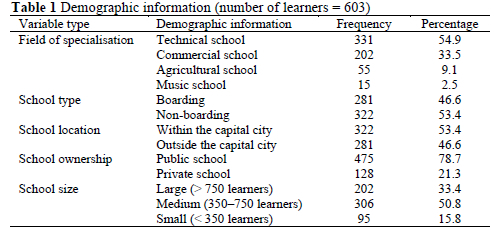
Respondent classification based on the specialisation field showed that technical schools' participants accounted for the highest percentage (54.9%) followed by commercial schools (33.5%). There were wide differences in terms of school type, size, location, and ownership (cf. Table 1). In terms of ownership, most participants were from public schools (78.7%) followed by those from private schools (21.3%). Most participants were also from medium schools (50.8%) followed by large schools (33.4%). Respondents from TVET boarding schools located outside the country' s capital city accounted for 46.6% whereas, 53.4% of participants were from non-boarding TVET schools located within the capital city.
Data Collection and Instrumentation
The study was conducted in Eritrea, which is situated in East Africa. The Eritrean TVET intermediate level consists of five technical schools (one private), one commercial school, an agro-technical school (private), and a music school. The study was only conducted once approval was granted by the examination committee of the School of Education at the Huazhong University of Science and Technology. Written permission was obtained from the Ministry of Education (MOE), the department of TVET, and the cooperation of the principals of the eight TVET schools. We distributed the questionnaire to learners in their respective classrooms during regular school time. All learners were informed about the purpose of the study, that their participation was voluntary, and that they could terminate participation during any part of the survey. Participants were older than 18 years and all gave written consent for participation.
The data gathering in the study was guided by a structured questionnaire designed by the researchers. Six hundred and fifty survey questionnaires in paper format were distributed and collectively administrated by the first author from 15 June to 15 September 2019 (Kumar, 2011). The response rate was 92.7% (603), and these questionnaires were properly completed and suitable for analysis. This sample size is double the threshold value recommended by Field (2005); thus, it was practical and rational to conduct this study.
The survey used in this study has 49 questions arranged into four parts. These are demographic characteristics of respondents (7 items), PDLP (24 items), TC (10 items), and SLA (8 items). Except for the first part of the questionnaire, all items employed a 5-point Likert scale. This scale included the following response choices with their degree of agreement (1 strongly disagree, up to 5 strongly agree). CGPA is calculated out of four points in TVET schools in Eritrea. For the purpose of this study, the cumulative GPA scores were converted into a 5-point Likert scale: less than 0.8 = very poor, 0.81 to 1.60 = poor, 1.61 to 2.40 = average, 2.41 to 3.20 = good, and 3.21 to 4 = excellent. This empirical study measured SLA through self-reported measures of learners' acquired traits (α =.791) and attitudes (α =.811) in addition to the learners' CGPA scores, which were acquired from the record offices of the respective schools. In this study, questions related to the SLA measures were developed based on other studies. An example of the questions asked about acquired traits is: "I do possess better skills to accomplish my future career" (M = 4.09, SD = .877, loading = .845) and for acquired attitude "School leadership has a considerable effect on my course completion and graduation" (M = 3.95, SD = .875, loading = .805).
Data Analysis
The statistical package for the social sciences (SPSS 21) and the analysis of a moment structure (AMOS 21) were used to analyse the survey results. The descriptive analysis or statistics of each item and their scales were determined through the mean and the standard deviation (SD). Using the Cronbach alpha coefficient, the reliability of each scale was tested. Exploratory factor analysis (EFA) was employed to measure the validity of primary constructs. An ANOVA test was conducted to examine the effect of controlling variables. The correlation between variables was assessed, and the linear regression approach and path analysis were applied as a causal mediation analysis to address our questions. A common factor analysis model (CFA) and goodness of fit were used to determine whether the data supported the theoretical model.
Results
Reliability
In this study, we measured three variables: PDLP, TC, and SLA. Cronbach's alpha was applied to estimate the internal consistency of the three constructs (PDLP, TC, and SLA). The value of the coefficients were above the threshold value of 0.7, which implied that they were consistent and reliable scales (Cronbach, 1951). The SPSS results returned constructs of PDLP (.823), TC (.870), and SLA (.907).
Exploratory Factor Analysis (EFA)
The validity of the scales measuring the three constructs was determined by EFA. Items with a loading of less than 0.514 on the relevant constructs were removed and the number of parameters in the survey was reduced to 42. These were item 2 from power-sharing (PS), item 1 from EOT, and four items from TC. According to Kline (2011), sample size and stability estimation should be placed between 20:1 and 5:1 (Kline, 2011); based on this recommendation, the ratio of the sample size of the study to parameters was reported as 14:1. Furthermore, the factor loading of variables reported by varimax rotation ranged from 0.515 to .860. The factor structure of the study that explained 71.64% of the total variance was created to measure PDLP had an indirect effect on SLA through TC. The Kaiser Meyer Olkin (KMO) value was found to be .925, at a p-value of less than .05. This result asserted that the scale had sampling adequacy and a unidimensional structure. The empirical result reported from SPSS showed that PDLP and TC were statistically significant and had a positive correlation with SLA that exhibited criterion-related cogency and validity.
Descriptive Statistics
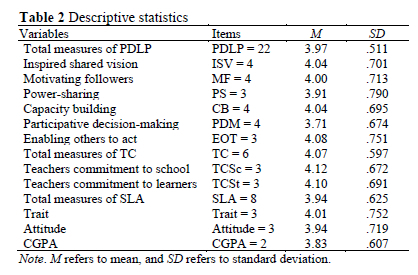
In this study, all the construct variables had a sum of 11 parameters and assessed using descriptive statistics. The SPSS report showed that the PDLP mean score was 3.97 (SD = .511), based on the 5-point Likert scale (cf. Table 2). The total measure of TC and SLA mean scores was 4.07 (SD = .597) and 3.94 (SD =.625) respectively. These results exhibit a small deviation and homogeneous scores in construct variables of this study.
ANOVA Test
This subsection describes the investigation of the third research question in our study. A one-way analysis of variance (ANOVA) test was performed to determine the role of demographic factors in the case of the PDLP and TC scores and these factors were controlled in further analyses. The empirical results of homogeneity and post-hoc tests showed that the organisational characteristics of schools such as school type (F = 43.32; 49.67, p = .000), school size (F = 23.4; 22.80, p = .000), school location (F = 43.32; 49.67, p = .000), and school ownership (F = 4.94; 12.84, p = .000) were statistically significant at a p-value less than 0.05. These results show that the population variance across all levels were unequal and that they did not satisfy the assumptions of homogeneity of variance. Thus, the demographic characteristics of the study had a potential influence on PDLP and TC. In this study, school size had more than two groups. To examine their significant difference, we used Tukey HSD multiple comparisons. The post-hoc test reports show a statistical difference between the groups that responded to the survey and except for small sized schools (p = .908), all large and medium sized schools differed significantly (p = .000).
Pearson Correlation Analysis Results
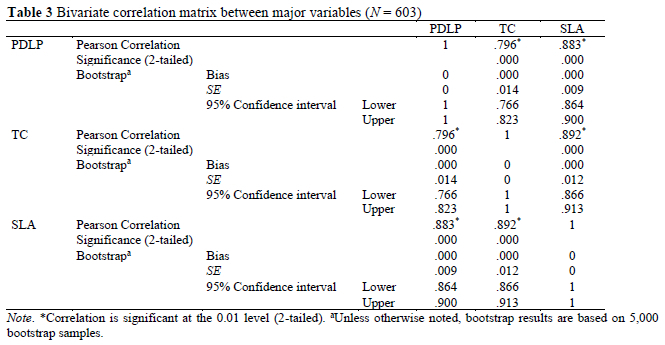
The Pearson correlation coefficient analysis was conducted to analyse the relationship between variables. Analysis of covariance was used to control the demographic variables in order to determine the true influence of PDLP and TC. Likewise, after controlling the demographic characteristics, the Pearson correlation coefficient analysis using the bootstrapping method (5,000 samples) revealed a positive correlation between the latent variables (cf. Table 3). The strongest correlation was observed between TC and SLA (.892) at a significance level of less than 0.01.
Multiple Regression and Path Analysis Results
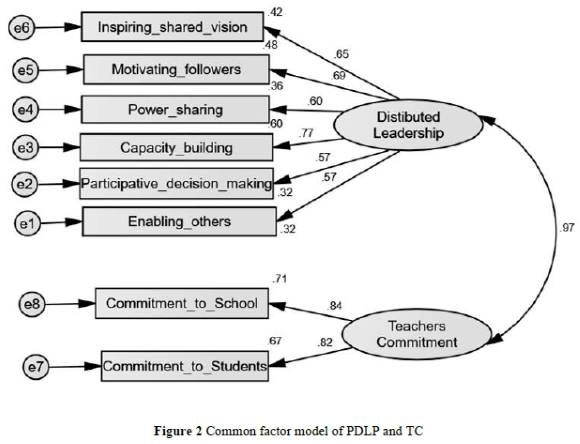
In this subsection we explore Research Questions 1 and 2. In this study, regression analysis was conducted based on Baron and Kenny's (1986) procedures. The first analysis was performed to identify the link between PDLP and TC. The results show that TC was regressed on the total measures of PDLP. Also, PDLP established a direct effect on TC (ß = .796, p-value less than .001) and accounted for 63.3% of the total variance of TC. In the next step of analysis, it was determined whether TC was a statistical predictor of SLA. The results of the second analysis show that SLA was regressed on TC and revealed a direct effect (ß = .892; p < .001). TC accounted for 79.6% of the total variance of SLA. In the final step, the effect of PDLP on SLA after TC was added as the model' s mediator, was explored. The results indicate regression coefficient reduced from 1.02 to 0.41. But still, PDLP continued to be a significant predictor of SLA. In addition to Baron and Kenny' s regression analysis procedures, we used the path analysis of structural equation modelling (SEM) to examine the nature of the mediated relationship in the study. Initially, the relationship between PDLP and TC was determined using the common factor model (CFM); then we employed path analysis to examine the mediation effect of TC on the link between PDLP and SLA. The diagram of the CFM is shown in Figure 2.
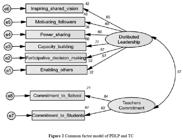
The measurement model fit statistics for the CFM were assessed through absolute model fit index (AMFI) and comparative fit index (CFI). AMFI implies that the p-value connected to the chi-square is non-significant (above 0.05). This indicates that there is no significant difference between the observed variances and covariance (Hair, Black, Babin, Anderson & Tattham, 2006). Contrariwise, chi-square increases when the sample size increases; the probability level rises when the observed variables surge and incline to be statistically significant (Khine, 2013). To address the above-mentioned problem, it is recommended to examine AMFI using the goodness-of-fit index (GFI) and adjusted goodness of fit index (AGFI) with the value greater than .95. Likewise, the value of standardised root-mean-square residual (SRMR) should be less than .05, and this indicates the accuracy of a better model fit. The value of root-mean-square error approximation (RMSEA) should be less than .05. According to Khine (2013), this shows good fit with a confidence level at 95% of the sampling error which adjusts the propensity of chi-square with large sample size and more variables. On the other hand, CFI is used to measure the hypothesised model of this study with the assumption that all observed variables are uncorrelated. Off course, CFI is a commonly and widely used test of model fit and the value should be greater than .95 to indicate a good fit of the model.
The data show that the model fits well, and the p-value (.263) associated to the chi-square was not significant (22.5), and had 19 df. Based on Khine's (2013) suggestions, the values of GFI (.991) and AGFI (.982) indicate a more optimal level of model fit. The value of RMSEA (017) showed very low variance and covariance was not described by the theoretical model, and the accuracy of residuals of the model (SRMR = .010) reflects an acceptable level of fit (Khine, 2013). In addition, the comparative fit index (CFI = .998) and the Tuckey-Lewis Index (TLI = .997) show good model fit. Based on these standards, the study exhibited a closer model fit and the obtained sample data of the population were acceptable. Moreover, the model of the study established positive and significant regression weights, correlation and squared multiple correlations between the main variables.
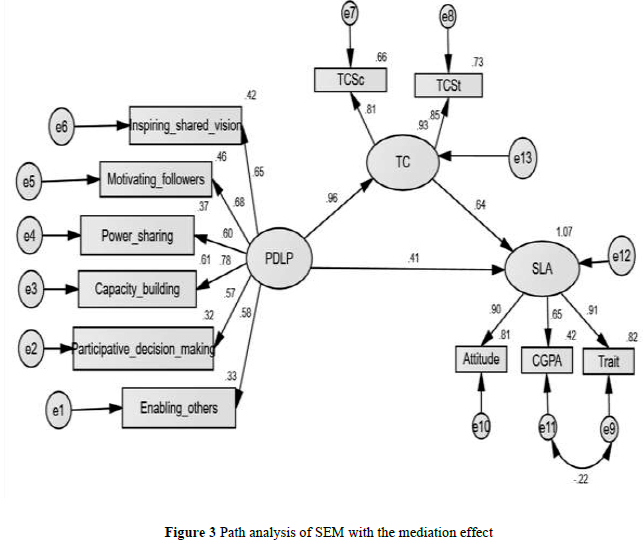
Meanwhile, the path analysis of SEM was employed to explore the effects of PDLP on SLA as mediated by TC in terms of acceptable cause-effect variables and their indicators. The diagram of path analysis of SEM of the study is shown in Figure 3
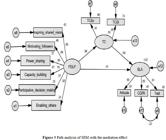
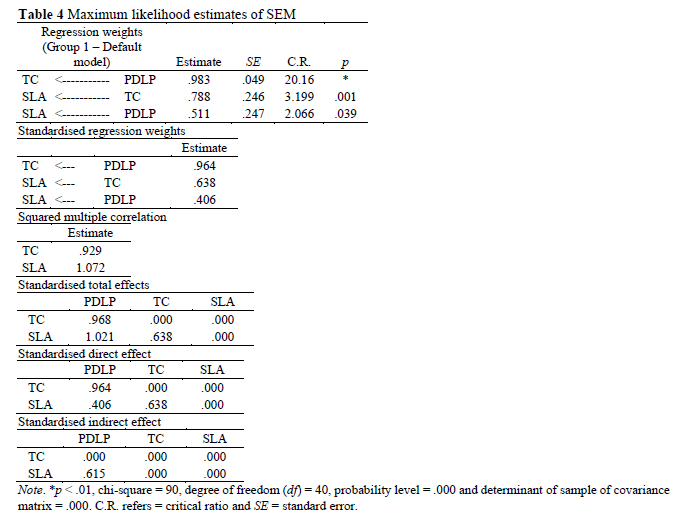
The data's overall fit shows that the model fits well, and the p-value (.000) attached to the chi-square was significant (90.7) and had 40 df. The model fit reported GFI = .973, AGFI = .956, RMSEA = .046, SRMR = .011, CFI = .988, and TLI = .983. These standards show that the model used in this study fit the data well which indicates that it was possible to evaluate the anticipated model with the null hypothesis. Besides, the path analysis of the study established positive and significant regression weights, correlation, squared multiple correlations, as well as the direct and indirect effects between the main variables of the study. The detailed results are depicted in Table 4.
Hypothesis Testing Results
The results of hypotheses testing shown in Figure 3 and Table 4 indicate that the indirect effect of PDLP (.615) on SLA is the product of the direct and significant effect of PDLP on TC (.964) as well as the direct and significant effect of TC on SLA (.638). The result show that TC had a partial mediating effect in the model, but it was statistically significant. Hence, Hypothesis 1 was supported. Correspondingly, Figure 3 and Table 4 show that the link between PDLP and TC was positive and significant (.968, p < 0.001), therefore, Hypothesis 2 was also supported. Figure 3 and Table 4 display that the relationship between PDLP and SLA is direct and statistically significant (.406, p-value is less than 0.05), thus, Hypothesis 3 is rejected.
Discussion
DL as a prevalent concept faces a scarcity of empirical evidence on its best application and effectiveness (Jambo & Hongde, 2020; Tian, 2016; Tian et al., 2016). Although many scholars and professionals have focused their attention on understanding the best route for its application and effectiveness, few relevant studies on DL exist. Therefore, the aim of this study was to examine the effects of PDLP on SLA as mediated by TC. The findings related to demographic characteristics indicated that organisational context such as school type, school location, school size, and school ownership were statistically significant for explaining SLA and which confirmed that they were determinant factors of PDLP (Leithwood et al., 2004). Findings of our study strengthen the claim by Leithwood et al. (2004) who state that organisational situation is one of the three crucial features of successful and effective school leadership.
We determined that DL was practiced more and was more effective at non-boarding schools than at boarding schools, at schools located within the capital city rather than outside the capital city, at large and medium schools rather than at small schools, and in public rather than private schools. These results also confirm the claims of Tian and Williams who note that PDLP and its effect depends on the socio-cultural context (Tian, 2016; Williams, 2011). Furthermore, the obtained results indicate that school principals who practice the DL approach are likely to have a significant and positive effect on SLA through TC. After controlling the demographic information, this effect would increase in schools by 1 SD, which would improve SLA in TVET schools in Eritrea by .615 SDs. The findings of this study support the claim of Jung Lin who notes that the school principal is essential at enabling teachers to be committed in the realisation of SLA (Lin, 2014). Similarly, an increase in PDLP by 1 SD would also increase TC by .964 SDs. These empirical results confirm the claims of scholars who state that PDLP has a significant and positive effect on TC (Alenezi, 2019; Du, 2013; Hulpia & Devos, 2009; Wu et al., 2013). Of equal importance is the findings related to the third hypothesis which exhibits that PDLP had a positive, direct, and significant effect on SLA when TC as a third variable was added into the model. This empirical evidence is incongruent with the claims of Ross and Gray (2006) who state that principal leadership practice did not have a direct and significant link with SLA.
Conclusion
Based on the empirical evidence currently available, it seems fair to conclude that PDLP has a positive, significant, and indirect effect on SLA via TC. The study extended the scope of knowledge on the best practices of the principals' DL and its effect on TC and SLA. The obtained results allow us to understand the predictor of TC and SLA in the sociocultural situation and the TVET schooling system of Eritrea. Cross-validation techniques were applied as a methodological input to enrich the existing gap of empirical evidence of PDLP in an educational context. On the basis of empirical findings of our study it is clear that the new model developed in this study can be used as a guiding principle of school leadership by practitioners at TVET schools in Eritrea. Specifically, for practitioners and scholars, it is crucial to acknowledge the potential contribution of PDLP and TC on SLA because they form a portion of the ongoing professional issues in school leadership. For better learning achievement, school principals should lead the school and inspire followers with a shared vision (Grant et al., 2010), involve followers in the decision-making process, share power, motivate, enable them to act, and pay attention to followers' CB. Moreover, this study shows that TC mediated the relationship between PDLP and SLA, which indicates that principals should focus on teachers by diligently practicing DL at their schools to enhance TC to learners and the school. Furthermore, we propose a suggestion for policy makers on the reform of professional development of principals to promote TC in schools. To enhance and produce competent and democratic citizens and to address the social concerns of "economic creativity and sustainability, ecological survival and fundamental human rights" (Hargreaves & Fink, 2008:239), nations should pay attention to PDLP to achieve TC for better SLA.
Implication for Future Research
Although the findings of the study advocate that the developed model fits the data on the population from which the sample was obtained, other models could fit the data equally or potentially better than this model. In this study we mainly focused on the examination of the mediating effect of one facet of PDLP, namely TC, on the link between PDLP and SLA. Nonetheless, PDLP has many characteristics that contribute to and affect SLA, such as teachers' self-efficacy, teachers' job satisfaction, and teachers' leadership. Equally, our model constitutes TC as a commitment to school and learners. However, TC also includes a commitment to teaching and change. Likewise, scholars should add these two commitments to teaching and change in the model to investigate the mediating effect of TC on the link between PDLP and SLA. In this study we explored the effect of PDLP on SLA as mediated by TC according to learners' perspectives, while we suggest future studies can be performed by accounting for the perceptions of teachers and principals. Furthermore, we examined four participant demographics that were determined to have a conditional effect on SLA. In fact, SLA has many controlling factors; thus, future studies in this area may include school resources, learners' engagement and parents' level of education and economic status (Malechwanzi & Hongde, 2018; Pont et al., 2008).
Authors' Contributions
Dr Daniel Jambo Ghirmai administrated the questionnaire and wrote the article; Prof. Lei Hongde conceptualised and developed the instruments. Both authors conducted all statistical analyses and reviewed the final manuscript.
Notesi. This article is based on the doctoral thesis of Daniel Jambo Ghirmai.
ii. Published under a Creative Commons Attribution Licence.
Acknowledgement
We would like to express our sincere gratitude to the Huazhong University of Science and Technology, School of Education, learners and principals' of TVET schools in Eritrea, the editor in-chief, administrative and publishing editor of the South African Journal of Education (SAJE) as well as anonymous reviewers for their ardent support in the publishing of this article.
References
-
Agarwal S, DeCarlo TE & Vyas SB 1999. Leadership behavior and organizational commitment: A comparative study of American and Indian salespersons. Journal of International Business Studies, 30(4):727-743. https://doi.org/10.1057/palgrave.jibs.8490836
» https://doi.org/10.1057/palgrave.jibs.8490836 -
Alenezi AF 2019. Northern Border Üniversitesi öğretim elemanlarının dağıtımcı liderlik uygulamaları ve akademik iyimserliği arasındaki ilişki [The relationship between distributed leadership practices and academic optimism among faculty members in Northern Border University]. Pegem Eğitim ve Öğretim Dergisi, 9(1):61-90. https://doi.org/10.14527/pegegog.2019.003
» https://doi.org/10.14527/pegegog.2019.003 -
Ali F, Zhou Y, Hussain K, Nair PK & Ragavan NA 2016. Does higher education service quality effect student satisfaction, image and loyalty? A study of international students in Malaysian public universities. Quality Assurance in Education, 24(1):70-94. https://doi.org/10.1108/QAE-02-2014-0008
» https://doi.org/10.1108/QAE-02-2014-0008 - Anderson SE, Moore S & Sun J 2009. Positioning the principals in patterns of school leadership distribution. In K Leithwood, B Mascall & T Strauss (eds). Distributed leadership according to the evidence. New York, NY: Routledge.
- Baron RM & Kenny DA 1986. The moderator-mediator variable distinction in social psychological research: Conceptual, strategic, and statistical considerations. Journal of Personality and Social Psychology, 51(6):1173-1182.
-
Basri WS, Alandejani JA & Almadani FM 2018. ICT adoption impact on students' academic performance: Evidence from Saudi universities. Education Research International, 2018:1240197. https://doi.org/10.1155/2018/1240197
» https://doi.org/10.1155/2018/1240197 - Bennett N, Harvey JA, Wise C & Woods PA 2003. Desk study review of distributed leadership. Nottingham, England: NCSL/CEPAM.
-
Bush T & Glover D 2003. School leadership: Concepts and evidence. Nottingham, England: National College for School Leadership. Available at https://dera.ioe.ac.uk/id/eprint/5119/14/dok217-eng-School_Leadership_Concepts_and_Evidence_Redacted.pdf. Accessed 28 February 2023.
» https://dera.ioe.ac.uk/id/eprint/5119/14/dok217-eng-School_Leadership_Concepts_and_Evidence_Redacted.pdf -
Copland MA 2003. Leadership of inquiry: Building and sustaining capacity for school improvement. Educational Evaluation and Policy Analysis, 25(4):375-395. https://doi.org/10.3102/01623737025004375
» https://doi.org/10.3102/01623737025004375 - Corbetta P 2003. Social research: Theory, methods and techniques. London, England: Sage.
-
Cronbach LJ 1951. Coefficient alpha and the internal structure of tests. Psychometrika, 16(3):297-334. https://doi.org/10.1007/BF02310555
» https://doi.org/10.1007/BF02310555 -
Dampson DG, Havor FM & Laryea P 2018. Distributed leadership an instrument for school improvement: The study of public senior high schools in Ghana. Journal of Education and e-Learning Research, 5(2):79-85. Available at https://files.eric.ed.gov/fulltext/EJ1173265.pdf. Accessed 28 February 2023.
» https://files.eric.ed.gov/fulltext/EJ1173265.pdf -
Day C & Sammons P 2016. Successful school leadership. Reading, England: Education Development Trust. Available at https://eric.ed.gov/?id=ED565740. Accessed 28 February 2023.
» https://eric.ed.gov/?id=ED565740 - Day C, Sammons P, Hopkins D, Harris A, Leithwood K, Gu Q, Brown E & Kington A 2009. The impact of school leadership on pupil outcomes: Final report. London, England: DCSF.
-
Diamond JB & Spillane JP 2016. School leadership and management from a distributed perspective: A 2016 retrospective and prospective. Management in Education, 30(4):147-154. https://doi.org/10.1177/0892020616665938
» https://doi.org/10.1177/0892020616665938 - Du NN 2013. The influence of distributed leadership on teacher organisational commitment: Initial evidence from Vietnam. Annual Review of Education, Communication, and Language Sciences, 10:69-90.
- Duif T, Harrison C, Van Dartel N & Sinyolo D 2013. Distributed leadership in practice: A descriptive analysis of distributed leadership in European schools. In L Moos & P Hatzopoulos (eds). School leadership as a driving force for equity and learning. Comparative perspective. EPNoSL Project, Del. 4.
-
Field A 2005. Factor analysis using SPSS (Lecture note). Available at https://www.Statisticshell.com/docs/factor.pdf. Accessed 30 December 2019.
» https://www.Statisticshell.com/docs/factor.pdf -
Grant C, Gardner K, Kajee F, Moodley R & Somaroo S 2010. Teacher leadership: A survey analysis of KwaZulu-Natal teachers' perceptions. South African Journal of Education, 30(3):401-119. https://doi.org/10.15700/saje.v30n3a362
» https://doi.org/10.15700/saje.v30n3a362 - Hair J, Black W, Babin B, Anderson R & Tattham R 2006. Multivariate data analysis (6th ed). Upper Saddle River, NJ: Pearson Prentice Hall.
-
Hargreaves A & Fink D 2008. Distributed leadership: Democracy or delivery? Journal of Educational Administration, 46(2):229-240. https://doi.org/10.1108/09578230810863280
» https://doi.org/10.1108/09578230810863280 - Hargreaves A & Fink D 2012. Sustainable leadership (Vol. 6). Hoboken, NJ: John Wiley & Sons.
-
Harris A 2013a. Distributed leadership: Friend or foe? Educational Management Administration & Leadership, 41(5):545-554. https://doi.org/10.1177/1741143213497635
» https://doi.org/10.1177/1741143213497635 - Harris A 2013b. Distributed school leadership: Developing tomorrow's leaders. London, England: Routledge.
-
Hulpia H & Devos G 2009. Exploring the link between distributed leadership and job satisfaction of school leaders. Educational Studies, 35(2):153-171. https://doi.org/10.1080/03055690802648739
» https://doi.org/10.1080/03055690802648739 -
Jambo D & Hongde L 2020. The effect of principal's distributed leadership practice on students' academic achievement: A systematic review of the literature. International Journal of Higher Education, 9(1 ):189-198. https://doi.org/10.5430/ijhe.v9n1p189
» https://doi.org/10.5430/ijhe.v9n1p189 -
Khine MS (ed.) 2013. Application of structural equation modeling in educational research and practice. Rotterdam, The Netherlands: Sense. https://doi.org/10.1007/978-94-6209-332-4
» https://doi.org/10.1007/978-94-6209-332-4 -
Klar HW, Huggins KS, Hammonds HL & Buskey FC 2016. Fostering the capacity for distributed leadership: A post-heroic approach to leading school improvement. International Journal of Leadership in Education, 19(2):111-137. https://doi.org/10.1080/13603124.2015.1005028
» https://doi.org/10.1080/13603124.2015.1005028 - Kline RB 2011. Principles and practice of structural equation modeling (3rd ed). New York, NY: Guilford Press.
-
Köksal N 2013. Competencies in teacher education: Preservice teachers' perceptions about competencies and their attitudes. Educational Research and Reviews, 8(6):270-276. https://doi.org/10.5897/ERR12.197
» https://doi.org/10.5897/ERR12.197 - Kothari CR 2004. Research methodology: Methods and techniques. New Delhi, India: New Age International.
- Kumar R 2011. Research methodology: A step-by-step guide for a beginner (3rd ed). New Delhi, India: Sage.
-
Law E, Galton M & Wan S 2010. Distributed curriculum leadership in action: A Hong Kong case study. Educational Management Administration & Leadership, 38(3):286-303. https://doi.org/10.1177/1741143209359714
» https://doi.org/10.1177/1741143209359714 -
Leithwood K, Harris A & Hopkins D 2020. Seven strong claims about successful school leadership revisited. School Leadership & Management, 40(1):5-22. https://doi.org/10.1080/13632434.2019.1596077
» https://doi.org/10.1080/13632434.2019.1596077 -
Leithwood K & Jantzi D 2006. Transformational school leadership for large-scale reform: Effects on students, teachers, and their classroom practices. School Effectiveness and School Improvement, 17(2):201-227. https://doi.org/10.1080/09243450600565829
» https://doi.org/10.1080/09243450600565829 -
Leithwood K, Mascall B, Strauss T, Sacks R, Memon N & Yashkina A 2007. Distributing leadership to make schools smarter: Taking the ego out of the system. Leadership and Policy in Schools, 6(1):37-67. https://doi.org/10.1080/15700760601091267
» https://doi.org/10.1080/15700760601091267 - Leithwood K, Seashore K, Anderson S & Wahlstrom K 2004. Review of research: How leadership influences student learning. New York, NY: The Wallace Foundation.
-
Leithwood K & Sun J 2012. The nature and effects of transformational school leadership: A meta-analytic review of unpublished research. Educational Administration Quarterly, 48(3):387-423. https://doi.org/10.1177/0013161X11436268
» https://doi.org/10.1177/0013161X11436268 -
Lin YJ 2014. Teacher involvement in school decision making. Journal of Studies in Education, 4(3):50-58. https://doi.org/10.5296/jse.v4i3.6179
» https://doi.org/10.5296/jse.v4i3.6179 -
Lumby J 2016. Distributed leadership as fashion or fad. Management in Education, 30(4): 161-167. https://doi.org/10.1177/0892020616665065
» https://doi.org/10.1177/0892020616665065 -
Malechwanzi J & Hongde L 2018. The relation between college resources and learning outcomes: Considering the mediating effects of student engagement. Croatian Journal of Education, 20(3):903-937. https://doi.org/10.15516/cje.v20i3.2979
» https://doi.org/10.15516/cje.v20i3.2979 - Mowday RT, Porter LW & Steers RM 2013. Employee-organization linkages: The psychology of commitment, absenteeism, and turnover. New York, NY: Academic Press.
-
Naicker SR & Mestry R 2013. Teachers' reflections on distributed leadership in public primary school in Soweto. South African Journal of Education, 33(2):Art. #715, 15 pages. https://doi.org/10.15700/saje.v33n2a715
» https://doi.org/10.15700/saje.v33n2a715 -
Nir AE 2002. School-based management and its effect on teacher commitment. International Journal of Leadership in Education, 5(4):323-341. https://doi.org/10.1080/13603120210134616
» https://doi.org/10.1080/13603120210134616 - Pascarella ET, Wolniak GC, Seifert TAD, Cruce TYM & Blaich CF 2005. Liberal arts colleges and liberal arts education: New evidence on impacts. ASHE Higher Education Report, 31(3):1-148.
- Person AE, Moiduddin E, Hague-Angus M & Malone LM 2009. Survey of Outcomes Measurement in Research on Character Education Programs (NCEE 2009-006). Washington, DC: National Center for Education Evaluation and Regional Assistance.
-
Pont B, Nusche D & Moorman H 2008. Improving school leadership (Vol. 1). Paris, France: OECD Publications. Available at https://www.oecd.org/education/school/44374889. Accessed 9 October 2016.
» https://www.oecd.org/education/school/44374889 -
Ross JA & Gray P 2006. School leadership and student achievement: The mediating effects of teacher beliefs. Canadian Journal of Education, 29(3):798-822. https://doi.org/10.2307/20054196
» https://doi.org/10.2307/20054196 -
Seashore Louis K, Dretzke B & Wahlstrom K 2010. How does leadership affect student achievement? Results from a national US survey. School Effectiveness and School Improvement, 21(3):315- 336. https://doi.org/10.1080/09243453.2010.486586
» https://doi.org/10.1080/09243453.2010.486586 -
Spillane JP 2005. Distributed leadership. The Educational Forum, 69(2):143-150. https://doi.org/10.1080/00131720508984678
» https://doi.org/10.1080/00131720508984678 - Spillane JP 2006. Distributed leadership. San Francisco, CA: Jossey-Bass.
-
Sun J 2015. Conceptualizing the critical path linked by teacher commitment. Journal of Educational Administration, 53(5):597-624. https://doi.org/10.1108/JEA-05-2013-0063
» https://doi.org/10.1108/JEA-05-2013-0063 -
Sun J & Leithwood K 2015. Leadership effect on student learning mediated by teacher emotions. Societies, 5(3):566-582. https://doi.org/10.3390/soc5030566
» https://doi.org/10.3390/soc5030566 - Tian M 2016. Distributed leadership in Finnish and Shanghai schools. PhD thesis. Jyväskylä, Finland: Jyväskylä University.
-
Tian M, Risku M & Collin K 2016. A meta-analysis of distributed leadership from 2002 to 2013: Theory development, empirical evidence and future research focus. Educational Management Administration & Leadership, 44(1):146-164. https://doi.org/10.1177/1741143214558576
» https://doi.org/10.1177/1741143214558576 - Timperley H 2009. Distributing leadership to improve outcomes for students. In K Leithwood, B Mascall & T Strauss (eds). Distributed leadership according to the evidence. New York, NY: Routledge.
-
Williams CG 2011. Distributed leadership in South African schools: Possibilities and constraints. South African Journal of Education, 31(2): 190-200. https://doi.org/10.15700/saje.v31n2a421
» https://doi.org/10.15700/saje.v31n2a421 -
Wu PL, Wu HJ & Wu PC 2013. Incremental validity of the distributed leadership scale. Asian Journal of Management Science and Education, 2(1):5-18. Available at http://www.ajmse.leena-luna.co.jp/AJMSEPDFs/Vol.2(1)/AJMSE2013(2.1-01).pdf. Accessed 28 February 2023.
» http://www.ajmse.leena-luna.co.jp/AJMSEPDFs/Vol.2(1)/AJMSE2013(2.1-01).pdf -
Yilmaz AI & Beycioğlu K 2017. Distributed leadership behaviours among elementary school teachers. International Journal of Pedagogies & Learning, 12(1): 41-61. Available at https://files.eric.ed.gov/fulltext/ED577252.pdf. Accessed 28 February 2023.
» https://files.eric.ed.gov/fulltext/ED577252.pdf
Revised: 23 February 2022
Accepted: 14 July 2022
Published: 28 February 2023