The relationship between school principals' leadership styles, organisational climate and organisational depression
Abstract
The aim with the study reported on here was to examine the relationship between school principals' leadership styles, the organisational climate of the school, and the teachers' perceived organisational depression levels. The sample of the study consisted of 311 teachers from schools located in the central districts of Malatya, Türkiye, selected using the stratified random sampling method. The research was quantitative and was designed using a relational model. The school principal leadership styles scale, school climate scale, and organisational depression scale were used in the research, and the data were analysed using the structural equation model (SEM). The findings show that the leadership styles exhibited by school principals were positively related to school climate and negatively related to organisational depression. A negative relationship was found between teacher perceptions of school climate and organisational depression. In addition, teacher perceptions of school climate had a mediating effect on the relationship between school principals' leadership styles and teacher perceptions of organisational depression. We recommend maintaining a positive organisational climate to reduce organisational depression. This study highlights the importance of fostering a positive organisational climate as a strategy to mitigate organisational depression in schools. We suggest that future research should apply this framework to different sample groups, comparing results across various related variables, to deepen the understanding of these dynamics and their implications for educational settings.
leadership styles; organisational depression; school climate; school principal; structural equation model; teacher
Introduction
A leader is defined as a person who thinks outside the box and leads by being at the forefront, guiding those who follow (Hunt, 1991). The origin of the word "leader" is the word "lead" in English, which means to direct and lead; the word "dux" in Roman, "hegemon" in Greek and "governor" in Latin (Temiz, 2016:6). Leadership, on the other hand, is the process by which an individual willingly and deliberately influences other individuals to structure relationships and activities in an organisation (Yukl, 2002).
Leadership is very important in directing and organising the relationships that should be established by people living together. In educational organisations, leaders need to ensure the highest level of coordination among all the components of the organisation in order to achieve organisational goals (Bakkalbaşi, 2017:448). One of the most important features of effective leaders is the ability to create a positive working environment within an organisation so that employees can perform their duties more effectively (Eroğluer & Yilmaz, 2015). A positive atmosphere in a school will contribute to an increase in the performance and morale of the school staff and the quality of education will improve (Alpay, 2019; Bulach & Malone, 1994; Freiberg, 1998). In the literature, this environment is defined as the organisational climate.
Organisational climate in educational organisations can be positive or negative. While turnover, depression and professional burnout are less common in organisations with a positive climate, these negative effects are more common in organisations with a negative climate (Kuruca Özdemir, 2018). The findings in studies by Bai (2014), Grayson and Alvarez (2008), Ladyong (2014) show that a positive organisational climate would have similar results.
Considering the future effects of education, it is an important prerequisite for teachers to be happy in business life to create a happy society (Aytaç, 2021). It is important to understand the organisational climate, teachers' perceptions of the organisation and principals' leadership styles in order to achieve organisational goals (Alga, 2017). These components are critical in educational organisations as they will affect the quality of education in all countries (Duran, 2023). Taking cognisance of teachers' perceptions of the organisation and its employees can ensure the positive use of educational, social, economic and cultural resources because this level of perception will determine the frequency of organisational activities (Ince & Gül, 2005). The fact that studies examining the relationship between school principals' leadership styles, organisational climate and perceived levels of organisational depression are limited, exposes the gap that this study intends to bridge.
Theoretical Framework
This study was grounded in transformational, transactional, and laissez-faire leadership theories (Bass, 1985) and organisational climate theory (Wallace, Hunt & Richard, 1999). The significance lies in exploring how these leadership styles influence teachers' perceptions of organisational depression and school climate, offering valuable insight into the psychological and professional well-being of educators (Avolio, Walumbwa & Weber, 2009; Cohen, J 2006). By examining these relationships, the aim of this study was to contribute to the literature on educational leadership and organisational health by providing new empirical evidence and theoretical insights.
Leadership involves the leader's capacity to direct individuals towards predetermined goals by ensuring interaction between them (Güney, 2007:357). According to Bush (2007), leadership is an influencing process based on values and beliefs that brings vision to a school. Many different definitions and classifications of leadership exist. Between 1940 and 1960, behavioural theory, which emphasises the importance of leader behaviour in leadership, and between 1960 and 1980, the situational theory, which requires the leader to act in accordance with the situation, were prominent (Kelly, 2018). Since the early 1980s, the most prominent leadership styles have been considered as transformational, transactional and laissez-faire (Bass, 1990). In this study, transformational, transactional and laissez-faire leadership styles are analysed.
Burns (1978) was the first to use the concept of transformational leadership in the literature. However, Bass (1985) was the first person to adopt transformational leadership as a theory. Burns (1978) considers transformational leadership as the process of revealing the available energy by interacting with employees, while Bass (1985) views it as maintaining management skills in line with the vision determined by establishing effective communication among employees.
Transformational leadership is also the ability to bring new vision to an organisation by improving its culture and strategies (Daft, 2005).
In educational organisations, transformational leaders are those who convince the members of the organisation that they can do much more than they are doing (Eren, 2008). The principal-teacher interaction within a school setup is essential as it defines the framework for collaboration and influences the overall school climate; such clarity fosters an environment where teachers feel valued and supported, ultimately enhancing their effectiveness and satisfaction. Moreover, articulating this interaction allows for better alignment of leadership strategies with teachers' needs, promoting a more cohesive approach to achieving educational goals.
The transactional leadership style is adopted by those who try to maintain the current order against organisational change, particularly in educational settings (Bass, Avolio, Jung & Berson, 2003). In schools, these leaders typically emphasise established procedures and practices, relying on a traditionalist structure that upholds past positive methods (Tengilimoglu, 2005). By motivating teachers to exceed their previous performance levels, transactional leaders aim to enhance engagement and promote desired behaviour among staff members (Den Hartog, Van Muijen & Koopman, 1997). This approach can be effective in maintaining consistency in teaching standards and achieving short-term academic goals.
Laissez-faire leadership is a style that allows employees, including teachers, to work independently with less managerial authority (Doğan, 2001). In the context of educational organisations, leaders who adopt this style often refrain from making clear decisions regarding their staff, thereby enabling teachers to assume greater responsibility for their work (Hoy & Miskel, 2010). While this approach can foster creativity and innovation among educators, it may also lead to challenges in accountability and coherence within the school environment if not managed effectively.
The concept of organisational climate has attracted the attention of educational researchers and practitioners since the 1960s as understanding its dynamics is crucial for enhancing the quality of education through improved relationships among teachers, administrators, students, and parents (Çetinkaya & Koşar, 2022; Şişman, 2014). Significantly, organisational climate reflects the current features of an organisation and the effects of these features on the behaviour of employees (Halis & Uğurlu, 2008).
Researchers of organisational climate generally adopt different approaches in defining it (Genç & Karcioğlu, 2000). According to Wallace et al. (1999), organisational climate has six dimensions: the importance of the job, management support, the sense of professional unity, cooperation, the sense of trust, and uncertainty and conflict. However, Taymaz (2011) combines the dimensions of organisational climate under three sub-categories, namely, individual characteristics, organisational characteristics, and environmental characteristics.
Although many studies have been conducted on organisational climate, research on school climate in educational organisations comes first in terms of its significance and relevance (Yilmaz, K & Altinkurt, 2013). While school climate provides a view of how things go in a school and the outcomes of events, it also distinguishes the school from other schools (Aydin, 2010). In other words, school climate is the environment of the school and reflects the schools' values and beliefs (Cohen, J 2006).
Depression is generally understood as a psychological disorder (Baltaş & Baltaş, 1998). Bilchik (2000) states that depression is a disease in which the individual' s desire and pleasure to live is lost. Instead, pessimistic thoughts about the future and intense regrets about the past take over, and physiological symptoms such as sleep, appetite, and sexual reluctance are experienced. As a result of depression, individuals lose their self-esteem and may become alienated from themselves (Elma, 2003). A depressed individual may stop communication with their social environment and may withdraw from their work, which can lead to organisational depression (Sezer, 2011). Organisational depression is a situation in which organisational employees do not have any foresight about the future and give up their efforts (Bilchik, 2000). The cause of organisational depression is dissatisfaction with working conditions and work (Baltaş & Baltaş, 1998). Unrecognised and untreated depression may cause great personal harm to the individual and may result in loss of time, money and production for the workplace (Yilmaz, A & Ekici, 2003).
In educational organisations, teachers may experience long-term intense stress due to factors such as failure, complaints from stakeholders, distancing from ideals, and decreased communication. Stress resulting from factors such as these may cause organisational depression in teachers (Sezer, 2011). In the context of this study, depression and stress are closely related as long-term intense stress experienced by teachers can lead to organisational depression, diminishing their motivation and engagement in the workplace. This relationship underscores the importance of addressing stressors in educational environments to prevent the onset of depression and enhance overall organisational well-being.
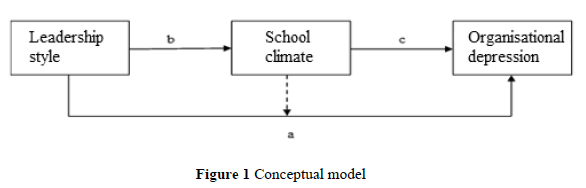
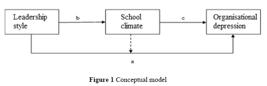
In this study, the following hypotheses were developed to examine the relationships between school principals' leadership styles, school climate, and organisational depression. A theoretical model (see Figure 1) was created and tested in line with these hypotheses.
Path A hypotheses
H1: School principals' transformational leadership styles predict teachers' perceptions of organisational depression negatively and significantly.
H2. School principals' transactional leadership styles predict teachers' perceptions of organisational depression negatively and significantly.
H3. School principals' laissez-faire leadership styles predict teachers' perceptions of organisational depression negatively and significantly.
Path B hypotheses
H4: School principals' transformational leadership styles predict teachers' perceptions of school climate positively and significantly.
H5. School principals' transactional leadership styles predict teachers' perceptions of school climate positively and significantly.
H6. School principals' laissez-faire leadership styles predict teachers' perceptions of school climate positively and significantly.
Path C hypotheses
H7: Teachers' perceptions of school climate predict their perceptions of organisational depression negatively and significantly.
Mediation effect hypotheses
H8: Teachers' perceptions of school climate have a mediating effect on the relationship between the school principals' transformational leadership styles and teachers' perceptions of organisational depression.
H9: Teachers' perceptions of school climate have a mediating effect on the relationship between school principals' transactional leadership styles and teachers' perceptions of organisational depression.
H10: Teachers' perceptions of school climate have a mediating effect on the relationship between school principals' laissez-faire leadership styles and teachers' perceptions of organisational depression.
Methodology
Model of the Research
A relational research model, which aims to investigate the existence and degree of covariance between two or more variables, was used in this study (Cohen, L, Manion & Morrison, 2007). Structural equation modelling (SEM) was used to examine the relationships between variables in this relational study (Fraenkel & Wallen, 2003). In this context, the relationships between the school principals' leadership styles, school climate, and organisational depression variables were examined using SEM. SEM is a statistical method that analyses the relationships between variables in order to test hypotheses in scientific research (Hoyle, 1995).
The theoretical foundation for this study included transformational, transactional, and laissez-faire leadership styles, along with organisational climate theory, highlighting their impact on teachers' well-being and organisational depression (Avolio et al., 2009; Bass, 1985). The aim with the proposed model was to clarify the relationships among these leadership styles, school climate, and organisational depression, informed by existing research in the field (Aytaç, 2021; Duran, 2023). Within the scope of the theory and similar research results, hypotheses regarding the relationships between school principals' leadership styles, school climate, and organisational depression variables were developed. To test the model developed in the study (see Figure 1), path analysis was conducted using the observed variables within the SEM framework.
Population and Sample
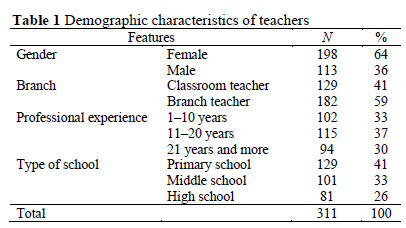
The population and universe for this research were 8,500 teachers working in the central districts of the Malatya province (one of the eastern provinces in Türkiye) in the 2021 to 2022 academic year. The sample of the study consisted of 311 teachers selected from the population using simple random sampling. In simple random sampling, all participants have an equal chance of selection, and in practice, all units are listed and randomly selected (Dawson & Trapp, 2001). The inclusion and exclusion criteria for the population were clearly defined. For instance, including only teachers from schools in a specific region is crucial for validity of the study. As L Cohen et al. (2007) points out, a clear definition of the population is necessary to draw generalisable conclusions; a sample taken from only a specific group may not lead to broad generalisations. In this study, teachers were selected from a defined population using the stratified random sampling technique, which directly aligns with the requirements of the research investigating the relationship between school principals' leadership styles, school climate, and teachers' perceptions of organisational depression. Information on the demographic characteristics of the teachers in the sample is given in Table 1.
From Table 1 it is clear that 64% (198) of the teachers were female and 36% (113) male; 41% (129) were classroom teachers and 59% (182) were branch teachers. There was a near equal distribution of professional experience among the participants (33% [102] with 1-10 years, 37% [115] with 11-20 years, and 30% [94] with 21 years or more experience). Of these teachers, 41% (129) worked at primary schools, 33% (101) at middle schools, and 26% (81) at high schools.
Data Collection Tools
Care was taken to ensure that the scales used in data collection were suitable for the purposes of the research. Scales suitable for the criteria such as the number of items in the scale, usefulness and clarity, and total score availability were preferred. In this context, the following were used: the personal information form, the school principal's leadership style scale, the school climate scale, and the organisational depression scale. Several key factors were considered in selecting the scales for data collection to ensure their appropriateness for the research objectives. Firstly, the personal information form was designed to collect comprehensive demographic data and relevant background information, confirmed by its clarity and thoroughness, facilitating accurate data collection regarding participants' characteristics. The school principal's leadership style scale was chosen for its ability to assess various leadership dimensions, supported by prior studies demonstrating its effectiveness in capturing important aspects of leadership behaviour that influence school climate and organisational health. The school climate scale was selected based on its proven validity and reliability in previous research, effectively reflecting key components of school climate, including safety, relationships, and teaching practices. The organisational depression scale was deemed suitable due to empirical evidence showing its capacity to accurately measure depressive symptoms in an organisational contexts which is crucial for identifying areas of concern within school settings. Lastly, the validity and reliability values of each scale were meticulously reviewed to ensure that they met the necessary psychometric standards, with all scales demonstrating acceptable levels of validity and reliability coefficients, confirming their consistency across different administrations. The survey instruments were initially prepared to be easy to read and mark, ensuring that they represented the population as accurately as possible (Frippiat & Marquis, 2010). Furthermore, a guideline was created to confirm that teachers' participation was voluntary and that their personal information would be securely stored (Schonlau, Fricker & Elliott, 2002).
School principal's leadership style scale
This scale was developed by Akan, Yildirim and Yalçin (2014) and is used to determine teacher perceptions of school principal's leadership styles. The scale consists of three sub-dimensions and a total of 35 items. The sub-dimensions of the scale are transformational leadership (20 items), transactional leadership (seven items), and laissez-faire leadership (eight items). Each item in this tool could be rated using a Likert-type scale: (1) "strongly disagree", (2) "disagree", (3) "moderately agree", (4) "agree", and (5) "strongly agree." Through the confirmatory factor analysis conducted in this research, it was determined that the values of goodness of fit were: X2/SD = 2.76, NNFI = 0.96, RMSEA = 0.75, GFI = 0.90, and CFI = 0.95. These values fall
within acceptable limits (Çokluk, Şekercioğlu & Büyüköztürk, 2012; Kline, 2016).
School climate scale
This scale was developed by Canli, Demirtaş and Özer (2018) and consists of five sub-dimensions, with a total of 23 items. It is used to identify how teachers perceive the climate of their school. Each item in the scale may be rated in a Likert-type fashion as (1) "never", (2) "rarely", (3) "sometimes", (4) "mostly", and (5) "always." Through the confirmatory factor analysis in research, it was determined that the values of goodness of fit were: x2/SD = 2.34, NNFI = 0.95, RMSEA = 0.65, GFI = 0.91, and CFI = 0.95. Again, these values are within acceptable limits (Çokluk et al., 2012; Kline, 2016).
Organisational depression scale
This scale was developed by Sezer (2011) in order to determine teacher's perceptions of organisational depression. The scale consists of 42 items in one dimension. Answers in the scale are graded in a Likert fashion with five points for the highest answer and one point for the lowest answer. A total score is taken from the scale. The confirmatory factor analysis conducted in the research determined that the values of goodness of fit were: X2/SD = 2.21, NNFI = 0.95, RMSEA = 0.72, GFI = 0.90, and CFI = 0.95. These values are within acceptable limits (Çokluk et al., 2012; Kline, 2016).
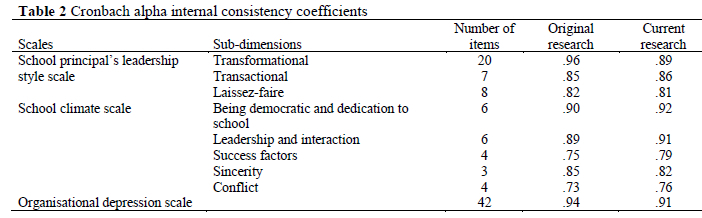
The sub-dimensions of the scales, number of items, and Cronbach' s alpha reliability coefficients from both the original and current study are presented in Table 2.
Based on Table 2, the Cronbach alpha coefficient in this study was calculated as .89 for transformational leadership, .86 for transactional leadership and .81 for laissez-faire leadership from the sub-dimensions of the school principals' leadership styles scale.
In the sub-dimensions of the school climate scale, the internal consistency coefficient was found to be democratic and commitment to school, .92, leadership and interaction, .91, achievement factors, .79, sincerity, .82 and conflict, .76. The internal consistency coefficient of the organisational depression scale was determined as .91.
Data Analysis
Prior to data analysis, an analysis of missing data and outliers was conducted. To ensure the integrity and robustness of the dataset, missing data analysis and extreme value analysis were performed before data analysis. These procedures are essential for identifying any gaps in the data that could impact the validity of the results and for detecting outliers that might skew the findings. Preliminary examination of the data forms showed that two participant forms were incomplete and incorrect, and the z scores of five participant forms exceeded the limit of -3 to +3. Thus, these forms were excluded from the data set. Analyses were carried out on data collected from 304 forms. The Statistical Package for the Social Sciences (SPSS) 22.0 and Analysis of Moment Structures (AMOS) 23 software packages were used in the analysis of the data.
The skewness and kurtosis coefficients were examined within the scope of univariate normality assumptions and were found to show a normal distribution between +1 and -1 (Çokluk et al., 2012). Tolerance and variance inflation factor (VIF) values were examined within the scope of multivariate normality. Variables with a VIF value below 10 and a tolerance value above 0.2 are considered free from multicollinearity (Field, 2005). Tolerance and VIF values were calculated for the variables of transformational leadership (.58; 1.87), transactional leadership (.62; 1.66), laissez-faire leadership (.63; 1.64), school climate (.49; 1.67), and organisational depression (.51; .72). In line with these values, the data set has univariate and multivariate normal distribution with no multicollinearity problems.
SEM was used in two stages as measurement model and structural model (Bayram, 2016). In the measurement model, latent variables are defined and relations between all variables with a defined direction are calculated (Sümer, 2000). In this study, the analyses of the measurement model (confirmatory factor analysis) and the structural model were carried out separately. According to Jöreskog (1973), general structural equation models consist of two components. The first component, referred to as the "measurement model", defines the connections between observed and latent variables using confirmatory factor analysis. The second component, referred to as the "structural model", connects latent variables using simultaneous equality systems. The estimation of model parameters is carried out using maximum likelihood estimation.
The seven hypotheses (H1-H7) regarding the significance of the model and the three hypotheses (H8-H10) regarding the significance of mediation effects in the model were tested. In testing the mediation effect, the direct effects between the exogenous variable (independent-exogenous) and the endogenous variables (dependent-endogenous) were examined. Another variable can mediate the effect of a variable on another variable (Meydan & Şeşen, 2015).
The mediation effect occurs when the independent variable indirectly affects the dependent variable with at least one mediator variable (Preacher & Hayes, 2008). Bootstrap analysis was performed for the mediation test of school climate. Regarding the influence of the mediator variable, Baron and Kenny (1986) suggest taking certain predetermined criteria into account. These are as follows: (1) the effect of the independent variable on the dependent variable should be significant (Path A), (2) the effect of the independent variable on the mediating variable should be significant (Path B), (3) the effect of the mediating variable on the dependent variable should be significant (Path C), and (4) when the mediating variable is added to the model, the effect of the independent variable on the dependent variable may decrease or disappear completely. If the effect between the independent variable and the dependent variable becomes meaningless, it is interpreted as a full mediation effect, and if the significance decreases, it is interpreted as a partial mediation effect. The most commonly employed method, maximum likelihood (ML), was used to estimate the model's parameters. ML is applied when the observed variable values in the model follow a normal distribution.
Researcher Positionality
As researchers we have different perspectives shaped by our backgrounds in education and academic research. One of us had practical experience as a teacher, which provided a deeper understanding of school environments, while the other focused on academic studies related to school leadership and management. These distinct viewpoints may have influenced the direction of our research. Our teaching experience helped us grasp school leadership and climate, while our academic perspective enabled us to examine these topics in greater depth. However, both points of view come with their own advantages and limitations in the research process. Over time, our positionalities may evolve, and we might actively engage in reflexivity to continuously reassess our thoughts and perceptions.
Results
In this section, the research hypotheses were tested through path analysis, one of the measurement models, and SEM types. The findings obtained from the analyses are presented below.
Descriptive Statistics
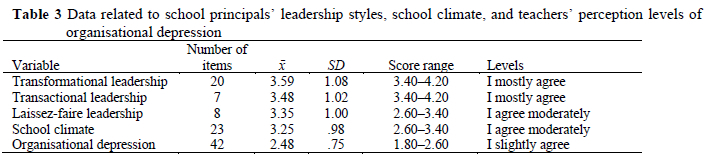
The descriptive statistics obtained are presented in Table 3.
The values in Table 3 show that the teachers mostly agreed with the statements in the transformational leadership sub-dimension of the school principal leadership styles scale = 3.59; ,SD = 1.08), and mostly agreed with the statements on the sub-dimension of transactional leadership (x = 3.48; SD = 1.02), and agreed with the statements in the laissez-faire leadership sub-dimension at a moderate level x = 3.35; SD = 1.00).
Teachers agreed with the statements on the school climate scale at a moderate level according to the average point value of x = 3.25 (SD = .98).
Teachers agreed less with the statements in the organisational depression scale at a mean score of X = 2.48 (SD = .75).
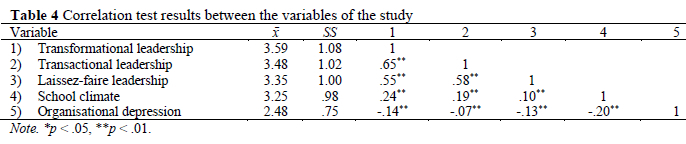
Table 4 shows the results of the simple correlation test conducted to determine whether there was a significant relationship between the variables of teacher perceptions of school principals' leadership styles, school climate, and organisational depression.
The result in Table 4 show that the relationships between the transformational, transactional, and laissez-faire leadership styles, school climate, and organisational depression variables are significant. Considering level and direction, there is a positive and low-level relationship between transformational leadership and the school climate variable (R = .24); a negative and low-level relationship between transformational leadership and the organisational depression variable (R = -.14); a positive and low-level relationship between the transactional leadership and the school climate variable (R = .19); a negative and low-level relationship between the variable of transactional leadership and organisational depression (R = -.07); and a positive and low-level relationship between the transformational leadership and the school climate variable (R = .24). A negative and low-level relationship (R = -.14) between the transformational leadership and the organisational depression variable as well as a low-level relationship (R = -.20) between school climate and organisational depression are shown.
Measurement Model Regarding the Variables of the Study
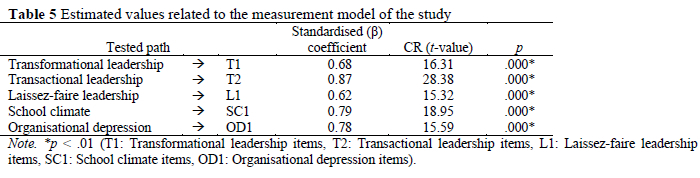
Before starting a path analysis, the measurement models of the scales to be used in the path analysis should be analysed with the help of CFA. All paths between the latent and observed variables in the measurement model were analysed. In the measurement model, the data from the scales used in the research were analysed together, resulting in goodness of fit values of = 1251.04, degrees of freedom (df) = 309, and a chi-square to degrees of freedom ratio (X2/df) of 4.04. Additionally, the following fit indices were calculated: CFI = 0.90, SRMR = 0.05, and RMSEA = 0.075. According to these findings, it can be said that the data fit of the measurement model is at a good level. Estimated values for the measurement model of the study are presented in Table 5.
The data in Table 5 indicate that the standardised (β) coefficient values for the dimensions in the measurement model range from .62 to .87 with t-values varying between 15.32 and 28.38. All scales and their dimensions are statistically significant. Therefore, it can be concluded that the measurement model demonstrates an adequate level of fit.
Analysis of Findings Regarding the Research Model
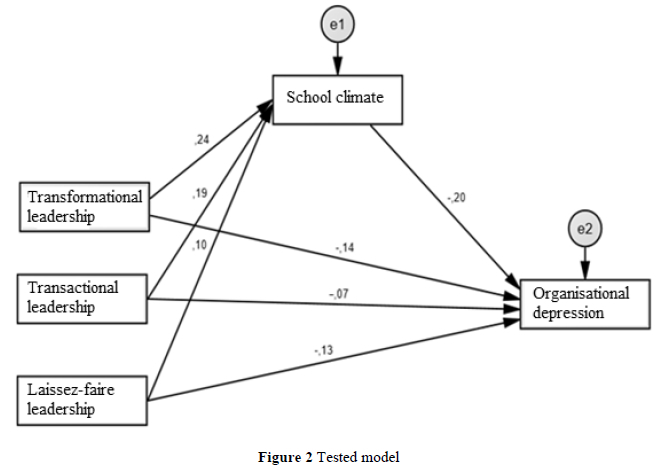
The model created based on the theoretical model of the research is shown in Figure 2.
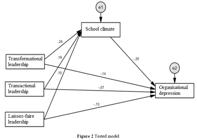
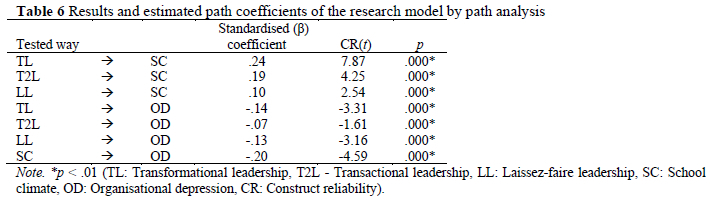
The results of the analysis of this model, the values of the standardised regression coefficients and the significance of the regression coefficients are presented in Table 6.
Table 6 shows that the t-values of the model vary between 7.87 and -4.59. If t-values for direct effects are greater than ±1.96, there is a significant effect. All paths between the variables in this research model are, therefore, significant. Accordingly, all three leadership styles had a positive effective on school climate: transformational (β = .24; t = 7.87), transactional (β = .19; t = 4.25), and laissez-faire (β = .10; t = 2.54). In addition, all three had a negative effect on organisation depression (transformational β = -.14; t = -3.31, transactional β = -.07; t = -1.61, and laissez-faire β = -.13; t = -3.16). School climate also affected organisational depression negatively (β = -.20; t = -4.59).
The goodness of fit values of the model obtained as a result of the analyses were calculated as X2 = 22.44 SD = 5 and X2/SD = 4.48, GFI = .94, AGFI = .90, CFI = .94, and SRMR = .054. According to the fit indices of the model, it may be said that the fit indices of all values were at an acceptable level.
Examining the Mediation Effect in the Research Model
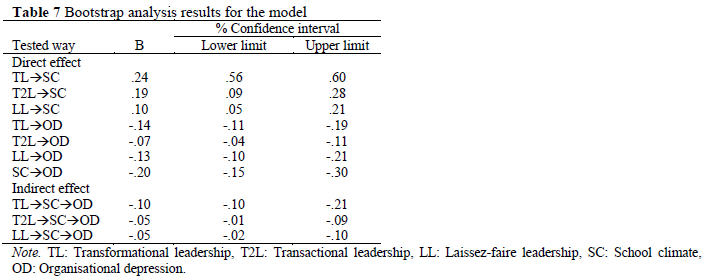
While interpreting the results of the path diagrams drawn in the model regarding the eighth, ninth, and 10th hypotheses, direct, indirect, and total effects were used. Bootstrap analysis was performed to examine the significance of these effects. The paths tested, along with their corresponding lower and upper-limit values, are shown in Table 7.
The path coefficients of the tested paths and the lower and upper-limit values of these coefficients in the 95% confidence interval are shown in Table 7. In this context, the lower and upper limits of all roads in the final model did not include the zero value and all roads were significant. Accordingly, the final three hypotheses of the study have been proven. Teachers' perceptions of school climate have a mediating effect on the relationship between school principals' transformational leadership styles and teachers' perceptions of organisational depression (H8); there is a negative relationship between school principals' transactional leadership styles and teacher's perceptions of organisational depression (H9); teachers' perceptions of school climate play a mediating role in the negative relationship between school principals' laissez-faire leadership styles and teachers' perceptions of organisational depression (H10).
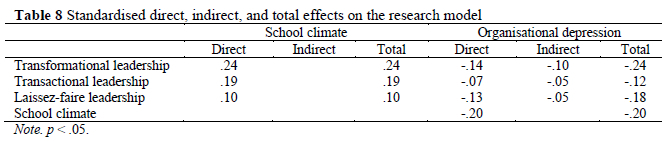
The standardised direct, indirect, and total effects for the variables in the research model are shown in Table 8.
When the direct effects on the research model are examined, the transformational leadership style affects the school climate (.24) and perceptions of organisational depression (-.14). The transactional leadership style affects the school climate (.19) and perceptions of organisational depression (-.07). The laissez-faire leadership style affects the school climate (.10) and perceptions of organisational depression (-.13). Perceptions of school climate also affect teachers' perceptions of organisational depression (-.20).
Moving to the indirect effects, Table 8 demonstrates that all three leadership styles had an indirect effect on teacher's perceptions of organisational depression (-.10 for transformational, -.05 for transactional, and -.05 for laissez-faire).
An examination of the total effects again shows that all three leadership styles affected teachers' perceptions of organisational depression (-.24 for transformational, -.12 for transactional, and -.18 for laissez-faire).
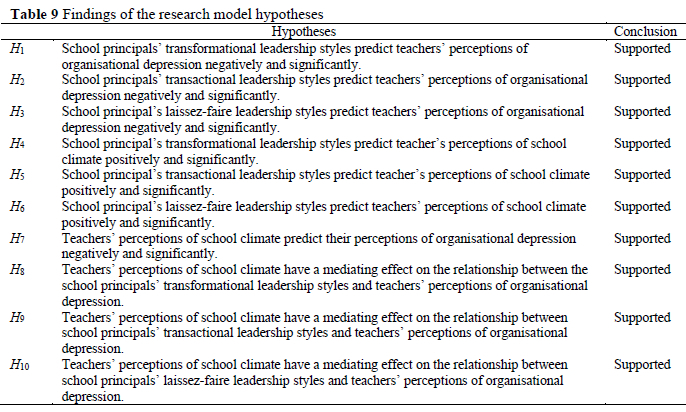
The findings on the hypotheses in this research are summarised in Table 9.
From an analysis of findings presented in Table 9, it is clear that all hypotheses formulated for this study were supported.
Discussion
With this research we found that teachers mostly perceived school principals as transformational leaders and hardly as follow-up leaders.
Teachers perceived that the laissez-faire leadership style was less prevalent than other leadership styles. This result is similar to results obtained by Arokiasamy, Abdullah, Ahmad and Ismail (2016), Cemaloglu (2007), Eğriboyun (2015), Göksal (2017), Karabağ Köse and Güçlü (2017), Kiriş (2016), Rukmani, Ramesh and Jayakrishnan (2010), Talebloo, Basri, Asmiran and Hassan (2015), and Yazici and Akyol (2017). Each of these studies show that teachers perceived school principals as more transformational leaders, and less as transactional or laissez-faire leaders. Conversely, Bakan, Erşahan, Büyükbeşe, Doğan and Kefe (2015), Kiymaz (2020), and Ling and Ling (2012), confirmed that school principals were mostly perceived as being laissez-faire leaders, and less as transactional or transformational leaders. The findings align with those of Yazici and Akyol (2017) and others, indicating that teachers predominantly perceived school principals as transformational leaders. However, this contrasts with the perspectives of Bakan et al. (2015) and Kiymaz (2020) who found that principals were often viewed as laissez-faire leaders, suggesting that perceptions of leadership styles may vary based on contextual factors within different educational settings.
The results of this research also demonstrate that teachers had moderate perceptions of their school climates. Similarly, study findings by Alpay (2019), Avşar (2019), Gündogan and Koçak (2017), Kahveci, Gülay and Avci (2018), and Tepe and Yilmaz (2020) show that the school climate of teachers was at a moderate level. In contrast, research conducted by Cherubini (2008), and Eryilmaz and Altin Gülova (2014) indicate that organisational climate is perceived at a low level. The findings suggest that teachers perceive their school climates at a moderate level, aligning with studies by Alpay (2019) and others, whereas contrasting research by Cherubini (2008) and Eryilmaz and Altin Gülova (2014) indicates a lower perception of organisational climate, highlighting the variability in perceptions on school climate across different studies.
Another result obtained from this research is that teachers experienced low levels of organisational depression. Papastylianou, Kaila and Polychronopoulos (2009) and Toytok and Uçar (2018) found that teachers perceived organisational depression at a low level. However, Akman (2015), Akman and Abasli (2016), Bakan et al. (2015), Biernat, Piątkowska and Rozpara (2022), Feighner and Boyer (1991), Sağir (2015), Sağir, Göksoy and Aslan (2018), and Sun, Buys and Wang (2013), proved that teachers perceived organisational depression at a moderate level.
In addition, our research reveals that the relationships between school principals' transformational, transactional and laissez-faire leadership styles and the variables of perceived school climate and organisational depression were significant according to teacher perceptions. When the level and direction of these relationships are examined, a positive and low-level relationship between the transformational, transactional and laissez-faire leadership styles and the school climate variable is evident. For this reason, school principals' leadership styles should be considered when organisations want to reduce organisational depression levels and create more positive perceptions of school climate. Since education is the focal point of the development in every country, these variables should be taken into account to ensure the educational, social, economic and cultural development of the countries. Gültekin (2012) and Şen and Yaşlioğlu (2010) state that a positive and significant relationship exists between the perception of school principals' leadership styles and the perception of school climate. Tahaoğlu (2007) disclosed a positive and highly significant relationship between leadership styles and organisational climate. Other studies also prove that the perception of transformational leadership positively affects the organisational climate (Ayik & Diş, 2015; Hitt & Keats, 1992; Jung, Chow & Wu, 2003; Leithwood, Jantzi & Steinbach, 1999; Ronneberg, 2000).
Our research shows a negative low-level relationship between the three leadership styles (transformational, transactional, and laissez-faire) and the organisational depression variable. Similarly, Demir (2019), Keleş (2016), Smith (2008), and Toytok and Uçar (2018) confirm a significant relationship between the leadership styles displayed by school principals and the perception of organisational depression. Atwater and Carmeli (2009), Demir (2018) and EK Lee and Ji (2018) reveal that positive leadership behaviour increases the effects of leaders on employees and reduces negative effects such as organisational depression that may take place in the organisation. Contrary to the results in our study, Besse, Howard, Gonzalez and Howard (2015) conclude that no direct relationship exists between leadership and organisational depression.
Finally, this research reveals a negative and low-level relationship between school climate and organisational depression according to teacher perceptions. However, Cerit (2008), Demerouti, Bakker and Bulters (2004), Keleş (2016), JC Lee, Chen and Xie (2014), and Lerner and Henke (2008), state that significant relationships exist between organisational climate and perceptions of organisational depression, and that closed organisational climates may cause organisational depression. While our research indicates a negative and low-level relationship between school climate and organisational depression, this contrasts with the findings by Cerit (2008) and others, who emphasise significant connections between organisational climate and depression, suggesting that our results may reflect unique contextual factors that warrant further exploration.
Conclusion
The results of our research show that the participating teachers perceived their school administrators as predominantly transformational leaders. The other leadership styles, transactional and laissez-faire, were perceived least. It was also concluded that teacher perceptions of the school climate were moderate, and that they experienced low levels of organisational depression.
Another result from this research is that the relationships between the three leadership styles and the variables of perceived school climate and organisational depression were significant according to teacher perceptions.
While teachers' perceptions of transformational, transactional, and laissez-faire leadership styles affected their perceptions of school climate positively, these leadership styles negatively affected teacher perceptions of organisational depression. Furthermore, teachers' perceptions of school climate negatively affected their perceptions of organisational depression.
All the proposed hypotheses in this research were supported. For Path A, H1 posited that school principals' transformational leadership styles negatively and significantly predict teachers' perceptions of organisational depression, and H2 similarly supported this prediction for transactional leadership styles. H3 indicated that laissez-faire leadership styles negatively and significantly predict perceptions on organisational depression. For Path B, H4 proposed that transformational leadership styles positively and significantly predict teachers' perceptions of school climate, H5 proposed the same for transactional leadership styles, and H6 proposed this for the laissez-faire leadership styles as well. For Path C, H7 posited that teacher perceptions of school climate negatively and significantly predict their perceptions of organisational depression. Lastly, the mediation hypotheses, H8, H9, and H10, suggested that teachers' perceptions of school climate mediate the relationships between transformational, transactional, and laissez-faire leadership styles and their perceptions of organisational depression.
The findings suggest that fostering a positive organisational climate can effectively reduce organisational depression among teachers, emphasising the importance of transformational leadership styles in shaping perceptions of school climate. Additionally, further research involving diverse sample groups and exploring related variables is recommended to deepen understanding of the relationships between leadership styles, school climate, and organisational depression. Furthermore, it is recommended that professional development programmes for school leaders incorporate training on transformational leadership practices to enhance their effectiveness in fostering a positive school climate and mitigating organisational depression among teachers. Based on the results of the research, it is recommended that school leaders should provide a positive organisational climate to reduce organisational depression.
Authors' Contributions
RÖ designed the research, and collected and analysed the data. He wrote the findings and discussion. YVY wrote the abstract, introduction, background, and the theoretical framework. Both authors reviewed the final version of the article.
Notesi. Published under a Creative Commons Attribution Licence.
References
-
Akan D, Yildinm I & Yalçin S 2014. Okul müdürleri liderlik stili ölçeğinin geliştirilmesi (OMLSÖ) [Developing a school principle as leadership style scale]. Elektronik Sosyal Bilimler Dergisi, 13(51):392-415. https://doi.org/10.17755/esosder.28743
» https://doi.org/10.17755/esosder.28743 - Akman Y 2015. The relationship between organizational depression, work motivation and work engagement. In VII. International Turkey Educational Research Congress Proceedings Book. 28-31 May 2015. Kötekli, Türkiye: Muğla Sitki Koçman University.
- Akman Y & Abasli K 2016. Investigation of teachers' depressive school perceptions in terms of various variables. Hitit University Journal of Social Sciences Institute, 9(2):1111-1124.
-
Alga E 2017. The effect of perceived leadership styles on employee burnout in organizations. Pamukkale University Journal of Institute of Social Sciences, 28:98-124. https://doi.org/10.5505/pausbed.2017.63383
» https://doi.org/10.5505/pausbed.2017.63383 - Alpay MU 2019. Examining the leadership styles of secondary school administrators in terms of school climate. MEd dissertation. Uşak, Türkiye: Uşak University.
-
Arokiasamy ARA, Abdullah AGK, Ahmad MZ & Ismail A 2016. Transformational leadership of school principals and organizational health of primary school teachers in Malaysia. Procedia - Social and Behavioral Sciences, 229:151-157. https://doi.org/10.1016/j.sbspro.2016.07.124
» https://doi.org/10.1016/j.sbspro.2016.07.124 -
Atwater L & Carmeli A 2009. Leader-member exchange, feelings of energy, and involvement in creative work. The Leadership Quarterly, 20(3):264-275. https://doi.org/10.1016/j.leaqua.2007.07.009
» https://doi.org/10.1016/j.leaqua.2007.07.009 -
Avolio BJ, Walumbwa FO & Weber TJ 2009. Leadership: Current theories, research, and future directions. Annual Review of Psychology, 60:421-449. https://doi.org/10.1146/annurev.psych.60.110707.163621
» https://doi.org/10.1146/annurev.psych.60.110707.163621 - Avşar D 2019. The effect of school climate on the level of work alienation. MEd dissertation. Istanbul, Türkiye: Istanbul Sabahattin Zaim University.
- Aydin M 2010. Education management. Ankara, Türkiye: Hatipoğlu Publications.
- Ayik A & Diş O 2015. Examining the relationship between school administrators' transformational leadership roles and organizational climate. AU Journal of Education, 8(3):337-359.
- Aytaç MS 2021. Examining the relationship between school administrators' leadership styles and teachers' perceptions of organizational happiness according to teachers' perceptions: Şanliurfa Case. MEd dissertation. Şanliurfa, Türkiye: Harran University.
-
Bai N 2014. The relationship between school organizational climate and physical education teachers' burnout (Case study: Ramian-Iran). European Journal of Experimental Biology, 4(1):600-602. Available at https://www.primescholars.com/articles/the-relationship-between-school-organizational-climate-and-physical-education-teachers-burnout-case-study-ramianiran.pdf. Accessed 21 May 2025.
» https://www.primescholars.com/articles/the-relationship-between-school-organizational-climate-and-physical-education-teachers-burnout-case-study-ramianiran.pdf -
Bakan I, Erşahan B, Büyükbeşe T, Doğan IF & Kefe I 2015. The relationship between transformational and transactional leadership and teachers' burnout levels. International Journal of Economics and Administrative Studies, 7(14):201-222. https://doi.org/10.18092/ijeas.48129
» https://doi.org/10.18092/ijeas.48129 -
Bakkalbaşi IO 2017. Yönetim biliminin doğuşu ve ilk temsilcileri hakkinda bir tartişma [A discussion about the emergence and first representatives of management science]. Marmara Üniversitesi iktisadi ve Idari Bilimler Dergisi, 39(2):429-450. https://doi.org/10.14780/muiibd.384135
» https://doi.org/10.14780/muiibd.384135 - Baltaş A &Baltaş Z 1998. Depression and ways of coping. Istanbul, Türkiye: Remzi Bookstore.
-
Baron RM & Kenny DA 1986. The moderator-mediator variable distinction in social psychological research: Conceptual, strategic, and statistical considerations. Journal of Personality and Social Psychology, 51(6):1173-1182. https://doi.org/10.1037/0022-3514.51.6.1173
» https://doi.org/10.1037/0022-3514.51.6.1173 - Bass BM 1985. Leadership and performance beyond expectations. New York, NY: Free Press.
-
Bass BM 1990. From transactional to transformational leadership: Learning to share the vision. Organizational Dynamics, 18(3):19-31. https://doi.org/10.1016/0090-2616(90)90061-S
» https://doi.org/10.1016/0090-2616(90)90061-S -
Bass BM, Avolio BJ, Jung DI & Berson Y 2003. Predicting unit performance by assessing transformational and transactional leadership. Journal of Applied Psychology, 88(2):207-218. https://doi.org/10.1037/0021-9010.88.2.207
» https://doi.org/10.1037/0021-9010.88.2.207 - Bayram N 2016. Introduction to structural equation modeling. Amos applications (3rd ed). Istanbul, Türkiye: Ezgi Publishing House.
-
Besse R, Howard K, Gonzalez S & Howard J 2015. Major depressive disorder and public school teachers: Evaluating occupational and health predictors and outcomes. Journal of Applied Biobehavioral Research, 20(2):71 -83. https://doi.org/10.1111/jabr.12043
» https://doi.org/10.1111/jabr.12043 -
Biemat E, Piątkowska M & Rozpara M 2022. Is the prevalence of low physical activity among teachers associated with depression, anxiety, and stress? International Journal of Environmental Research and Public Health, 19(14):8868. https://doi.org/10.3390/ijerph19148868
» https://doi.org/10.3390/ijerph19148868 - Bilchik GS 2000. Organizational depression. Hospitals & Health Networks, 74(2):34-38.
- Bulach C & Malone B 1994. The relationship of school climate to the implementation of school reform. ERS Spectrum, 12(4):3-8.
- Burns JM 1978. Leadership. New York, NY: Harper and Row.
-
Bush T 2007. Educational leadership and management: Theory, policy and practice. South African Journal of Education, 27(3):391-406. Available at https://sajoumalofeducation.co.za/index.php/saje/article/view/107/29. Accessed 10 May 2025.
» https://sajoumalofeducation.co.za/index.php/saje/article/view/107/29 -
Canli S, Demirtaş H & Özer N 2018. Okul iklimi ölçeğinin geçerlik ve güvenirlik çalişmasi [A validity and reliability study for the school climate scale]. llkögretim Online, 17(4):1797-1811. https://doi.org/10.17051/ilkonline.2019.506842
» https://doi.org/10.17051/ilkonline.2019.506842 - Cemaloglu N 2007. Examining the leadership styles of school administrators in terms of different variables. Turkish Journal of Educational Sciences, 5(1):73-114.
- Cerit Y 2008. The effect of primary school principals' service-oriented leadership behaviors on teachers' burnout. Educational Management in Theory and Practice, 55:547-570.
-
Çetinkaya I & Koşar D 2022. Ögretmenlerin örgüt iklimine ilişkin görüşleri: Bir durum çalişmasi [Teachers' views on organizational climate: A case study]. Gazi Üniversitesi Gazi Eğitim Fakültesi Dergisi, 42(2):1605-1639. https://doi.org/10.17152/gefad.1109136
» https://doi.org/10.17152/gefad.1109136 -
Cherubini L 2008. Teacher-candidates' perceptions of school climate: A mixed methods investigation. Journal of Teaching and Learning, 5(2):39-54. https://doi.org/10.22329/jtl.v5i2.157
» https://doi.org/10.22329/jtl.v5i2.157 -
Cohen J 2006. Social, emotional, ethical, and academic education: Creating a climate for learning, participation in democracy, and well-being. Harvard Educational Review, 76(2):201-237. https://doi.org/10.17763/haer.76.2.j44854x1524644vn
» https://doi.org/10.17763/haer.76.2.j44854x1524644vn - Cohen L, Manion L & Morrison K 2007. Research methods in education. London, England: Routledge.
- Çokluk Ö, Şekercioğlu G & Büyüköztürk Ş 2012. Multivariate statistics SPSS and LISREL applications (2nd ed). Ankara, Türkiye: Pegem Academy Publications.
- Daft RL 2005. The leadership experience (3rd ed). Mason, OH: Thomson Learning.
- Dawson B & Trapp RG 2001. Basic and clinical biostatistics (3rd ed). New York, NY: Lange Medical Books.
-
Demerouti E, Bakker AB & Bulters AJ 2004. The loss spiral of work pressure, work-home interfere and exhaustion: Reciprocal relations in a three-wave study. Journal of Vocational Behavior, 64(1):131-149. https://doi.org/10.1016/S0001-8791(03)00030-7
» https://doi.org/10.1016/S0001-8791(03)00030-7 -
Demir S 2018. The relationship between psychological capital and stress, anxiety, burnout, job satisfaction and job involvement. Eurasian Journal of Educational Research, 75:137-154. https://doi.org/10.14689/ejer.2018.75.8
» https://doi.org/10.14689/ejer.2018.75.8 -
Demir S 2019. Lider-üye etkileşiminin öğretmen stres, tükenmişlik ve depresyonu üzerindeki rolü [The role of leader-member interaction in teacher stress, burnout, and depression]. Aegean Journal of Education, 20(1):291-304. https://doi.org/10.12984/egeefd.512319
» https://doi.org/10.12984/egeefd.512319 -
Den Hartog DN, Van Muijen JJ & Koopman PL 1997. Transactional versus transformational leadership: An analysis of the MLQ. Journal of Occupational and Organizational Psychology, 70(1):19-34. https://doi.org/10.1.2044-8325.1997.tb00628.x
» https://doi.org/10.1.2044-8325.1997.tb00628.x - Doğan S 2001. Vision-based leadership. Istanbul, Türkiye: SeçilOfset.
- Duran T 2023. Factors affecting teachers' performance: A phenomenological study. MEd dissertation. Istanbul, Türkiye: Marmara University.
- Eğriboyun D 2015. Ortaöğretim okullarinda görev yapan yönetici ve ögretmenlerin liderlik uygulamalari ve iş doyumu algilari arasindaki ilişki [The relation between leadership's behaviors and job satisfaction perceptions of the administrators and teachers who are charged in secondary education schools]. Gaziantep University Journal of Social Sciences, 14(1):241-275.
- Elma C 2003. Alienation of primary school teachers from work Ankara province example. MEd dissertation. Ankara, Türkiye: University of Ankara.
- Eren E 2008. Organizational behavior and management psychology. Istanbul, Türkiye: Beta Publishing and Distribution.
- Eroğluer K &Yilmaz Ö 2015. The effect of ethical leadership behavior on perceived organizational climate: Mediating role of work loneliness. Journal of Business Research Turk, 7(1):280-308.
- Eryilmaz I & Altin Gülova A 2014. The effect of organizational climate on perceived organizational policy: A research in the public sector. Manisa Celal Bayar University Journal of Social Sciences, 15(4):155-176.
- Feighner JP & Boyer WF 1991. The diagnosis of depression. New York, NY: John Wiley & Sons.
- Field A 2005. Discovery statistics using SPSS. New York, NY: Sage.
- Fraenkel JR & Wallen NE 2003. How to design and evaluate research in education (5th ed). New York, NY: McGraw Hill.
- Freiberg HJ 1998. Measuring school climate: Let me count the ways. Educational Leadership, 56(1):22-26.
-
Frippiat D & Marquis N 2010. Web surveys in the social sciences: An overview. Population, 65(2):285-312. Available at https://shs.caim.info/joumal-population-2010-2-page-285?lang=en. Accessed 10 May 2025.
» https://shs.caim.info/joumal-population-2010-2-page-285?lang=en - Genç N & Karcioğlu F 2000. The power of organizational climate, the example of Aşkale Cement. Istanbul, Türkiye: Karizma Publishing.
- Göksal GY 2017. Teachers' views on the level of transformational leadership of school administrators (The Case of Bozdoğan District of Aydin Province). MEd dissertation. Denizli, Türkiye: Pamukkale University.
-
Grayson JL & Alvarez HK 2008. School climate factors relating to teacher burnout: A mediator model. Teaching and Teacher Education, 24(5):1349-1363. https://doi.org/10.1016/j.tate.2007.06.005
» https://doi.org/10.1016/j.tate.2007.06.005 - Gültekin C 2012. The effect of school administrators' leadership styles on school climate: The case of the Anatolian side of Istanbul Province. MEd dissertation. Istanbul, Türkiye: University of Maltepe.
-
Gündoğan A & Koçak A 2017. Öğretmen adaylarinin okul iklimi algilari ile akademik öz-yeterlik inançlari arasindaki ilişkinin incelenmesi [The relationship between the school climate perceptions and academic self-efficacy beliefs of prospective teachers]. Sakarya University Journal of Education, 7(3):639-657. https://doi.org/10.19126/suje.33326
» https://doi.org/10.19126/suje.33326 - Güney S 2007. Management and organization. Ankara, Türkiye: Nobel Publication Distribution.
- Halis M & Uğurlu ÖY 2008. Organizational climate in the light of current studies. Journal of Business, Power, Industrial Relations and Human Resources, 10(2):101-123.
- Hitt MA & Keats BW 1992. Strategic leadership and restructuring: A reciprocal interdependence. In RL Phillips & JG Hunt (eds). Strategic leadership: A multiorganizational-level perspective. Westport, CT: Quorum Books.
- Hoy W & Miskel K 2010. Egitimyonetimi [Education management]. Translated by S Turan. Ankara, Türkiye: Nobel Publication.
- Hoyle RH (ed.) 1995. Structural equation modeling: Concepts, issues, and applications. Thousand Oaks, CA: Sage.
- Hunt JG 1991. Leadership: A new synthesis. Newbury Park, CA: Sage.
- Ince M & Gül H 2005. A new paradigm in management: Organizational commitment. Konya, Türkiye: Çizgi Kitabevi.
- Jöreskog KG 1973. Analysis of covariance structures. In PR Krishnaiah (ed). Multivariate analysis--III; proceedings. New York, NY: Academic Press.
-
Jung DI, Chow C & Wu A 2003. The role of transformational leadership in enhancing organizational innovation: Hypotheses and some preliminary findings. The Leadership Quarterly, 14(4-5 ):525-544. https://doi.org/10.1016/S1048-9843(03)00050-X
» https://doi.org/10.1016/S1048-9843(03)00050-X - Kahveci G, Gülay SS & Avci T 2018. Examining the relationship between teachers' levels of organizational narcissism and their perceptions of school climate. Journal of Education As You Live, 32(2):1-15.
- Karabağ Köse E & Güçlü N 2017. The relationships between school principals' leadership styles, participation in decision making in schools and organizational learning. Black Sea Journal of Social Sciences, 9(2):209-224.
- Keleş E 2016. Organizational depression in high schools according to teachers' opinions. MEd dissertation. Van, Türkiye: Van Yüzüncü Yil University.
- Kelly R 2018. Constructing leadership 4.0: Swarm leadership and the fourth industrial revolution. Cham, Switzerland: Springer.
- Kiriş B 2016. The relationship between the transformational leadership characteristics of school principals and teachers' professional self-esteem according to teacher perceptions. MEd dissertation. Samsun, Türkiye: Ondokuz Mayis University.
- Kiymaz C 2020. Perceptions of high school teachers about the leadership behaviors of school principals (Acipayam special). MEd project. Denizli, Türkiye: Pamukkale University.
- Kline RB 2016. Principles and practice of structural equation modeling (4th ed). New York, NY: Guilford Press.
- Kuruca Özdemir E 2018. Nurses' perceptions of organizational climate and psychological empowerment. MEd dissertation. Ankara, Türkiye: Hacettepe University.
- Ladyong BL 2014. Organizational climate and teachers' work motivation: A case study of selected schools in Prachinburi, Thailand. Scholarly Journal of Education, 3(5):52-57.
-
Lee EK & Ji EJ 2018. The moderating role of leader-member exchange in the relationships between emotional labor and burnout in clinical nurses. Asian Nursing Research, 12:56-61. https://doi.org/10.1016/j.anr.2018.02.002
» https://doi.org/10.1016/j.anr.2018.02.002 -
Lee JC, Chen CL & Xie SH 2014. The influence of school organizational health and occupational burnout on self-perceived health status of primary school teachers. Procedia - Social and Behavioral Sciences, 116:985-989. https://doi.org/10.1016/j.sbspro.2014.01.332
» https://doi.org/10.1016/j.sbspro.2014.01.332 - Leithwood K, Jantzi D & Steinbach R 1999. Changing leadership for changing times. Berkshire, England: McGraw-Hill Education.
-
Lerner D & Henke RM 2008. What does research tell us about depression, job performance, and work productivity? Journal of Occupational Andean Environmental Medicine, 50(4):401 -410. https://doi.org/10.1097/JOM.0b013e31816bae50
» https://doi.org/10.1097/JOM.0b013e31816bae50 -
Ling S & Ling M 2012. The influence of transformational leadership on teacher commitment towards organization, teaching profession, and student learning in secondary schools in Miri, Sarawak, Malaysia. EDUCARE: International Journal for Educational Studies, 4(2):155-178. Available at https://joumals.mindamas.com/index.php/educare/article/view/254/253. Accessed 6 May 2025.
» https://joumals.mindamas.com/index.php/educare/article/view/254/253 - Meydan CH & Şeşen H 2015. Structural equation modeling AMOS applications. Ankara, Türkiye: Detay Publishing House.
-
Papastylianou A, Kaila M & Polychronopoulos M 2009. Teachers' burnout, depression, role ambiguity and conflict. Social Psychology of Education, 12(3).295-314. https://doi.org/10.1007/s11218-008-9086-7
» https://doi.org/10.1007/s11218-008-9086-7 -
Preacher KJ & Hayes A 2008. Asymptotic and resampling strategies for assessing and comparing indirect effects in multiple mediator models. Behavior Research Methods, 40(3).879-891. https://doi.org/10.3758/BRM.40.3.879
» https://doi.org/10.3758/BRM.40.3.879 -
Ronneberg JS 2000. The urban school leader as change agent. Case studies of three urban school principals. PhD dissertation. Minneapolis, MN. University of Minnesota. Available at https://www.proquest.com/docview/304607496?pqorigsite=gscholar&fromopenview=true&sourcetype=Dissertations%20&%20Theses. Accessed 6 May 2025.
» https://www.proquest.com/docview/304607496?pqorigsite=gscholar&fromopenview=true&sourcetype=Dissertations%20&%20Theses - Rukmani K, Ramesh M & Jayakrishnan J 2010. Effect of leadership styles on organizational effectiveness. European Journal of Social Sciences, 15(3). 365370.
-
Sağir M 2015. Öğretmenlerin örgütsel depresy on ve mesleki tükenmişlik düzeyleri arasindaki ilişki [The relationship between teachers' perceptions for organizational depression and professional burnout levels]. Turkish Journal of Education, 4(3).29-42. https://doi.org/10.19128/turje.181133
» https://doi.org/10.19128/turje.181133 -
Sağir M, Göksoy S & Aslan H 2018. Okulda örgütsel depresyon [Organizational depression in school]. Kahramanmaraş Sütçü Imam Üniversitesi Sosyal Bilimler Dergisi, 15(1).55-68. Available at https.//dergipark.org.tr/tr/download/article-file/473180. Accessed 5 May 2025.
» https.//dergipark.org.tr/tr/download/article-file/473180 - Schonlau M, Fricker RD, Jr & Elliott MN 2002. Conducting research surveys via e-mail and the web. Santa Monica, CA. Rand.
- Şen Y &Yaşlioğlu M 2010. A study to determine the effect of transformational leadership on the organizational climate that supports innovation. Journal of the Year of Management, 21(66).97-117.
-
Sezer S 2011. Developing the Organizational Depression Scale and determining its psychometric properties. Journal of Business-Power Industrial Relations and Human Resources, 13(1).39-50. https://doi.org/10.4026/1303-2860.2011.0163.x
» https://doi.org/10.4026/1303-2860.2011.0163.x - Şişman M 2014. Organizations and cultures. Ankara, Türkiye: PegemA Publishing.
- Smith S 2008. Leadership's effects on employee health, well-being. Occupational Hazards, 70(8):18-19.
- Sümer N 2000. Structural equation models: Basic concepts and sample applications. Turkish Psychology Writings, 3(6):49-74.
-
Sun J, Buys N & Wang X 2013. Depression in employees in privately owned enterprises in China: Is it related to work environment and work ability? International Journal of Environmental Research and Public Health, 10(4):1152-1167. https://doi.org/10.3390/ijerph10041152
» https://doi.org/10.3390/ijerph10041152 - Tahaoğlu F 2007. The effect of leadership roles of primary school principals on organizational climate: Gaziantep province example. MEd dissertation. Gaziantep, Türkiye: University of Gaziantep.
-
Talebloo B, Basri RB, Asmiran SB & Hassan A 2015. Teachers' perceptions on transformation leadership based on demographic differences. Middle-East Journal of Scientific Research, 23(6):1105-1113. https://doi.org/10.5829/idosi.mejsr.2015.23.06.22201
» https://doi.org/10.5829/idosi.mejsr.2015.23.06.22201 - Taymaz H 2011. School management for primary and secondary school principals. Ankara, Türkiye: PegemA Publishing.
- Temiz E 2016. The servant leadership of primary school administrators teachers' opinions on characteristics. MEd dissertation. Gaziantep, Türkiye: University of Gaziantep.
- Tengilimoğlu D 2005. A field study for detecting the leadership behavior features in public and private sector organizations. Electronic Social Sciences Journal, 4(14):1-16.
-
Tepe N & Yilmaz G 2020. Ögretmenlerin okul iklimi algilarinin yordayicisi olarak okul yöneticilerinin toksik liderlik davranişlari [Toxic leadership behaviours of school administrators as predictor of teachers' school climate perceptions]. OPUS International Journal of Society Researches, 15(25):3360-3381. https://doi.org/10.26466/opus.667320
» https://doi.org/10.26466/opus.667320 -
Toytok EH & Uçar L 2018. Okul yöneticilerinin kullandiklari güç türleri ve örgütsel depresyon: Bir ilişkisel tarama modeli [The power types that are used by school administrators and the organizational depression: A correlational screening model]. Ekev Academi Dergisi, 22(76):109-126. Available at https://dergipark.org.tr/en/download/article-file/2561368. Accessed 1 May 2025.
» https://dergipark.org.tr/en/download/article-file/2561368 -
Wallace J, Hunt J & Richards C 1999. The relationship between organisational culture, organisational climate and managerial values. International Journal of Public Sector Management, 12(7):548-564. https://doi.org/10.1108/09513559910305339
» https://doi.org/10.1108/09513559910305339 -
Yazici AŞ & Akyol B 2017. Okul müdürlerinin liderlik davranişlari ile öğretmen özerliği arasindaki ilişki [The relationship between leadership behaviors of school principals and autonomous behaviors of teachers]. Uluslararasi Eğitim Bilimleri Dergisi, 4(10):189-208. https://doi.org/10.16991/INESJOURNAL.1365
» https://doi.org/10.16991/INESJOURNAL.1365 -
Yilmaz A & Ekici S 2003. Örgütsel yaşamda stresin kamu çalişanlarnin performansina etkileri üzerine bir araştirma [A study on the effects of stress on the performance of public employees in organizational life]. Yönetim ve Ekonomi Dergisi, 10(2):1-19. Available at https://dergipark.org.tr/en/download/article-file/145834. Accessed 31 May 2025.
» https://dergipark.org.tr/en/download/article-file/145834 -
Yilmaz K & Altinkurt Y 2013. Örgütsel iklim ölçeğinin Türkçeye uyarlanmasi: Geçerlik ve güvenirlik çalişmasi [Adaptation of organizational climate scale to Turkish: The validity and reliability study]. Trakya University Journal of Education, 3(1):1-11. Available at https://dergipark.org.tr/tr/download/article-file/200351. Accessed 1 May 2025.
» https://dergipark.org.tr/tr/download/article-file/200351 - Yukl G 2002. Leadership in organizations (5th ed). Upper Saddle River, NJ: Prentice Hall.
Revised: 30 January 2025
Accepted: 7 April 2025
Published: 31 May 2025