Artificial intelligence as a catalyst for self-directed learning in an open and distance e-learning (ODeL) university in South Africa
Abstract
In this study I explored how artificial intelligence (AI) can foster self-directed learning (SDL) in an open and distance e-learning (ODeL) university in South Africa. In accompanying rapid technological progress, AI provides opportunities for personalised learning, adaptive feedback and independent learning experiences. I adopted a qualitative research approach, conducted semi-structured interviews with 4 academics, and held a virtual focus group discussion with 10 fourth-year B.Ed. students who had been purposively sampled from a South African ODeL university. Data were analysed through thematic analysis. The findings reveal that AI enhances SDL in ODeL environments by providing personalised feedback, increasing engagement, and improving skills such as language acquisition and self-evaluation. However, concerns such as the risk of over-dependence on AI, instances of academic dishonesty and inaccuracies of AI-produced content necessitate a cautious approach to its implementation. The research emphasises that AI should be used as a supplementary resource rather than a replacement for educators. It serves as a tool to enrich learning experiences, although we should address its potential drawbacks to ensure fair and effective use in ODeL contexts.
artificial intelligence; learner autonomy; open and distance e-learning (ODeL); personalised feedback; personalised learning; self-directed learning; student engagement
Background
Self-directed learning (SDL) is a crucial component of adult education and is increasingly important in contemporary education environments, particularly in open and distance e-learning (ODeL) frameworks. SDL emphasises the importance of learner independence, accountability and intrinsic motivation. It enables individuals to identify their learning needs, find appropriate resources, engage in learning activities and assess their outcomes independently (Gibbons, 2002; Knowles, 1975). SDL has its roots in Tough's work from 1971 and has developed into an essential skill for adults, recognised as necessary for success in the 21st century (Morris, 2019). SDL is crucial in ODeL as it empowers students with limited direct instructional support. With asynchronous learning and physical distance, students take greater responsibility for their education. Research indicates that technology integration enhances SDL by providing access to resources, organising learning plans, and enabling self-evaluation (Wang, C, Li & Bonk, 2024). However, while technology-enhanced SDL holds considerable promise, it also requires additional support to address challenges such as students' and academics' varying levels of digital literacy and the availability of resources (Boyer, Edmondson, Artis & Fleming, 2014; Monib, Qazi & Mahmud, 2025).
The emergence of generative AI presents groundbreaking opportunities for enhancing SDL in ODeL environments. Generative AI refers to AI systems that are capable of producing original content, such as text, images and simulations, through advanced machine-learning methods (Feuerriegel, Hartmann, Janiesch & Zschech, 2024; Lim, Gunasekara, Pallant, Pallant & Pechenkina, 2023). Technologies such as Chat Generative Pre-trained Transformer (ChatGPT), Claude, and Gemini offer features such as instant information retrieval, personalised feedback and customised learning paths (Baidoo-Anu & Owusu Ansah, 2023; Lin, 2024). Research indicates that generative AI has the potential to serve as an intelligent personal tutor by assisting students with goal-setting, resource identification, personalised learning plan development and progress tracking (Preiksaitis & Rose, 2023). ChatGPT, in particular, enhances SDL by enabling students to explore topics independently, promoting reflection practices and fostering critical thinking (Rasul, Nair, Kalendra, Robin, De Oliveira Santini, Ladeira, Sun, Day, Rather & Heathcote, 2023). However, integrating generative AI into teaching and learning also poses several challenges. Significant concerns regarding accuracy, ethical use, accessibility and user proficiency persist (Chan & Hu, 2023; Perkins, Furze, Roe & MacVaugh, 2024).
AI has significantly changed educational practices by offering tools for personalised learning, immediate feedback and adaptable learning experiences (Bond, Khosravi, De Laat, Bergdahl, Negrea, Oxley, Pham, Chong & Siemens, 2024; Zawacki-Richter, Marín, Bond & Gouverneur, 2019). AI-driven technology such as learning analytics, intelligent chatbots and generative models are essential for addressing the limitations of traditional teaching methods (Akgun & Greenhow, 2022). AI enhances personalised ODeL learning, improving students' experiences. However, challenges such as ethical considerations, digital literacy, and equitable access in under-resourced areas must be addressed (Kim, Yu, Detrick & Li, 2025; Nyaaba, Wright & Choi, 2024).
ODeL systems improve access to education but face challenges, such as diminished interaction and the necessity for self-motivation. AI can address these issues by offering personalised and adaptive learning experiences (Bozkurt & Sharma, 2023). Generative AI can simulate one-on-one tutoring, adapt to individual
learning preferences and provide instant feedback, thereby ultimately enhancing student engagement and motivation (Fariani, Junus & Santoso, 2023; Kasneci, Sessler, Küchemann, Bannert, Dementieva, Fischer, Gasser, Groh, Günnemann, Hüllermeier, Krusche, Kutyniok, Michaeli, Nerdel, Pfeffer, Poquet, Sailer, Schmidt, Seidel, Stadler, Weller, Kuhn & Kasneci, 2023). ODeL is essential for expanding access to education in South Africa, however, its effectiveness is limited by issues related to infrastructure, high drop-out rates, and varying levels of student readiness for SDL (Mtebe & Raisamo, 2014).
Integrating AI in South African ODeL institutions can provide scalable solutions for SDL, particularly for underserved communities, by bridging the digital divide and improving access to educational materials in remote areas. Nonetheless, effective implementation must address issues related to digital access, equity and the cultural relevance of AI tools (Rambe & Moeti, 2017).
AI enhances personalised learning and engagement in ODeL by tailoring content to individual student performance and providing interactive support through chatbots (Hamilton, Wiliam & Hattie, 2023). In SDL environments, AI helps maintain motivation and guides learners toward achieving their goals (Mohamed, Shaaban, Bakry, Guillén-Gámez & St^elecki, 2025). With this research I explored the potential of AI to improve SDL skills among South African ODeL students, focusing on both the benefits and challenges associated with its integration.
Problem Statement
The rapid integration of AI in education has transformed learning environments by providing opportunities for personalised learning, immediate feedback and increased student engagement (Pillai, R, Sivathanu, Metri & Kaushik, 2024; Szabó & Szoke, 2024). However, at ODeL institutions, where students are expected to exhibit high levels of SDL, the role of AI as a facilitator of SDL needs further examination. This is particularly important in South Africa where socio-economic disparities and digital divides create additional challenges for implementing AI technology in education (Spaull & Van der Berg, 2020). As defined by Knowles (1975), SDL emphasises the learner's ability to take the initiative, set learning objectives, and independently evaluate outcomes. While AI tools, such as chatbots and generative AI platforms have shown potential to enhance learner independence and cognitive engagement (Anggoro & Pratiwi, 2023; Pillai, J & Pillai, 2023), concerns about excessive dependence on technology and the possible erosion of learner agency persist (Jin, Im, Yoo, Roll & Seo, 2023). Moreover, the lack of empirical research examining the alignment of AI-driven interventions with the theoretical foundations of SDL in ODeL contexts highlights a significant research gap.
In South Africa, ODeL universities serve a range of often underrepresented demographics, necessitating innovative teaching methods to address students' specific needs. However, the effectiveness of AI in fostering SDL competencies - such as goal-setting, self-monitoring, and critical thinking - remains poorly understood, particularly in resource-limited environments (Agonács & Matos, 2021). Additionally, ethics considerations, digital literacy concerns and the risk of fewer face-to-face interactions complicate the integration of AI into educational settings even further (Ma, 2023; Wang, ZQ & Ayibuen, 2023). With this study I explored how artificial intelligence (AI) can enhance SDL at a South African ODeL university. I examined the experiences of both academics and students to identify opportunities, challenges, and implications for equitable education in the Global South.
Theoretical Framework
A theoretical framework is essential for any study because it provides a structured approach to understanding and addressing the research problem (Grant & Osanloo, 2014). It serves as a foundation that aligns the study objectives, research methodology and results analysis and ensures consistency (Anfara & Mertz, 2015). I adopted two complementary frameworks in this study -Knowles' theory (1975) and Garrison's SDL model (1997) - to explore how AI can transform SDL in the ODeL context.
Self-directed learning theory
Knowles' SDL theory (1975), which views learning as a process in which individuals actively identify their learning needs, set objectives, find resources, implement strategies and evaluate outcomes, is at the core of this study. SDL emphasises independence, self-regulation and active participation, which are important qualities in ODeL, where students independently shape their educational journeys (Knowles, 1975; Tough, 1971). The main principles of SDL theory are learner autonomy, self-regulation, goal-oriented learning and resource utilisation. (Boyer et al., 2014; Garrison, 1997; Knowles, 1975). A key aspect of SDL is that autonomy enables students to choose their education paths, which requires them to select tools, strategies and resources that align with their objectives (Knowles, 1975). AI technologies may enhance this autonomy by providing personalised resources and approaches, thereby boosting students' potential to succeed in ODeL environments (Szabó & Szoke, 2024). Self-regulation involves actively monitoring and adjusting learning strategies to achieve desired outcomes. This concept is crucial in online education, for which immediate instructor feedback may not be available. AI tools, such as intelligent tutoring systems, provide real-time feedback, track progress and suggest strategies to improve self-regulation (Agonács & Matos, 2021; Pillai, J & Pillai, 2023). SDL encourages students to set clear, measurable objectives. AI-driven platforms can assist in defining and tracking these objectives, thereby fostering a more focused learning path (Bin-Hady, Al-Kadi, Hazaea & Ali, 2023). These systems support students' progress by enabling a structured approach to their education. Successful SDL depends on effectively utilising various resources. Generative AI and adaptive learning systems expand access to personalised, on-demand materials, which enhance critical thinking and problem-solving skills (Szabó & Csépes, 2023). Together, these principles provide a strong framework for leveraging AI to enhance SDL, which aligns well with the emphasis on learner independence and adaptability of ODeL.
Garrison's model of self-directed learning
Garrison's (1997) model builds on Knowles' (1975) theory of SDL by emphasising three key dimensions: self-management, self-monitoring, and motivation. These aspects contribute to understanding student engagement in autonomous learning. Self-management refers to students' abilities to plan and organise their learning. Additionally, AI technologies, such as intelligent tutoring systems, help reduce cognitive load by assisting with scheduling and providing access to resources. This support helps students to focus more on mastering the content (Morris, 2019). Self-monitoring involves reflection practices that assess progress and adjust strategies. AI tools enhance this process by offering performance analytics and personalised feedback, which promote critical thinking and continuous improvement (Li & Bonk, 2025). Motivation drives students to start and persist in their educational endeavours. AI systems enhance motivation through gamified learning experiences, personalised encouragement and tailored prompts that foster engagement and resilience (Li & Bonk, 2025; Morris, 2019). Garrison's model provides a framework for understanding the operational, cognitive, and motivational factors influencing SDL in online and distance education (ODeL) contexts. Although it was developed before the advent of AI, it offers valuable insights for exploring AI' s transformative potential in enhancing SDL.
Integrating AI into SDL frameworks enhances learner independence, engagement, and accessibility by providing support for goal-setting, adaptive feedback, and interactive educational tools (Baidoo-Anu & Owusu Ansah, 2023; Lin, 2024; Preiksaitis & Rose, 2023). AI-enhanced tutoring systems and learning analytics create personalised and structured learning experiences that align with the emphasis of the SDL theory on self-regulation and adaptability (Brookfield, 2009; Morris & Rohs, 2023; Yilmaz, Yurdugül, Karaoglan Yilmaz, Şahin, Sulak, Aydin, Tepgeç, Müftüoglu & Oral, 2022). Although AI fosters inclusivity and student-centred approaches, addressing ethical considerations, data privacy, and digital literacy is crucial to ensure responsible implementation (Firat, 2023; Perkins et al., 2024). This study was guided by the framework in the exploration of AI' s role in promoting SDL in ODeL. Integrating Knowles' SDL theory with Garrison's model aligns the study objectives with technology-mediated learning. This foundation highlights AI' s transformative educational potential, empowering students to control their learning journeys. Garrison's model reinforces Knowles' SDL theory through three key dimensions: self-management, self-monitoring, and motivation, which explain student engagement in autonomous educational experiences.
Research Methodology
An interpretivist framework was adopted for this study to investigate the personal experiences of participants regarding the use of AI in SDL within an open distance e-learning (ODeL) institution (Creswell & Poth, 2018). A phenomenological design was employed to capture the lived experiences of students and academics concerning the role of AI in enhancing SDL (Van Manen, 2016). I followed a qualitative methodology, gathering detailed narratives to understand complex educational phenomena (Denzin & Lincoln, 2018; Merriam & Tisdell, 2016). A purposive sampling method was used to select four academics and 10 fourth-year Bachelor of Education (B.Ed.) students with prior AI experience in ODeL contexts (Palinkas, Horwitz, Green, Wisdom, Duan & Hoagwood, 2015). Data collection included semi-structured interviews with academics, allowing flexibility in exploring their perspectives (Bryman, 2016), and virtual focus group discussions with students to encourage interactive feedback (Krueger & Casey, 2015). For coding purposes, the participants were labelled Academic Participants (AP 1-4) and Student Participants (SP 1-10). Data were analysed using thematic analysis following (Braun & Clarke, 2006) guidelines, which revealed patterns related to personalised learning, engagement, and learner autonomy. I adhered to ethical considerations, including obtaining ethics clearance from the University of South Africa (UNISA), ensuring informed consent, and protecting participant confidentiality (Orb, Eisenhauer & Wynaden, 2001).
While I adopted a qualitative design grounded in interpretivism and phenomenology, where the aim was depth of understanding rather than statistical generalisability (Creswell & Poth, 2018; Van Manen, 2016), I acknowledge the importance of expanding the participant base in future research to broaden applicability across diverse ODeL contexts. The sample of four academics and 10 fourth-year B.Ed. students was purposively selected to yield rich, context-specific insights into AI-enhanced SDL, aligning with the guidance of Palinkas et al. (2015) on information-rich cases in qualitative inquiry.
Future studies could benefit from incorporating larger, more diverse samples, including students from multiple disciplines, institutions, and educational levels, as well as academics with varying digital literacy profiles. This would enhance the transferability of findings (Lincoln & Guba, 1985) and facilitate a comparative analysis of Al's role in various teaching and learning contexts. A mixed-methods approach could also provide complementary quantitative evidence to assess the broader impact of AI on SDL, as suggested by C Wang et al. (2024) in their study on AI-assisted writing.
Expanding the participant pool would not only strengthen the robustness of emerging themes but also address current limitations related to representativeness and variation in AI use across socio-economic and infrastructural divides, particularly in under-resourced regions. As Ng, Leung, Chu and Qiao (2021) and Rambe and Moeti (2017) argue, equitable access and contextual relevance are crucial for the integration of AI in African higher education. Thus, future research should explore cross-institutional and cross-cultural perspectives to develop a more inclusive and generalisable understanding of Al's transformative potential in ODeL environments.
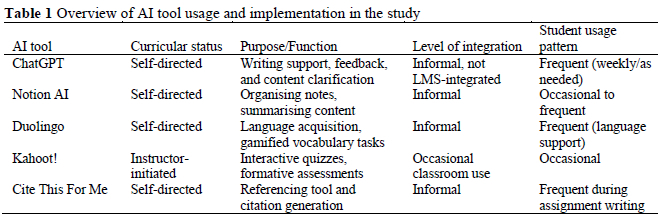
In this study I explored how AI tools were used in a South African ODeL context, revealing that most tools, such as ChatGPT, Notion AI, and Cite This For Me, were accessed independently by students as SDL aids rather than being formally integrated into the curriculum or learning management systems (LMS). While Duolingo and Kahoot! were used occasionally for language practice and assessment, no formal training was provided, and both students and academics relied on self-taught proficiency. The frequency of use varied, reflecting high learner autonomy. However, the findings highlight the need for institutional support to guide the ethical, effective, and structured integration of AI in ODeL learning environments.
Table 1 summarises the AI tools most commonly used by participants in the study, highlighting their curricular status, purpose, level of integration, and patterns of student usage.
Findings
The findings of this study are presented according to the key themes that emerged from the data analysis. These themes reveal the significant role of AI in enhancing SDL in ODeL environments. During the interviews and focus group discussions, participants referred to a variety of AI tools they had used in their learning or teaching contexts. Among these, ChatGPT and Notion AI emerged as the most used tools due to their ability to provide personalised feedback, assist with academic writing, and support conceptual understanding. Kahoot! was frequently used by students for interactive quizzes and self-assessment, while Duolingo was cited primarily by students seeking to enhance their English language proficiency through gamified learning experiences. The emphasis on these tools reflects their accessibility, user-friendliness, and relevance to promoting SDL in an ODeL environment. Clarifying the prominence and function of each tool helps contextualise the findings and demonstrates their varied contributions to fostering learner autonomy and engagement.
Theme 1: Al-driven Personalisation and Feedback for Learning
The findings indicate the ability of AI to enhance SDL in ODeL settings. Participants reported that AI-driven customisation and immediate feedback foster a more student-centred educational environment. AI-enabled tools provide students with personalised educational experiences by adapting to their learning needs, styles and preferences. For instance, AI can adjust the difficulty level of tasks, recommend learning materials based on a student's interests and provide alternative explanations to suit different learning styles. These tools empower students to take control of their studies: "For me, ChatGPT has helped adjust the level of difficulty of the assessment activities, which kept me motivated and made the learning experience less overwhelming. The content and tasks are explained simply with several possible answers and examples'" (SP3).
Participants reported that AI tools inspired curiosity and motivated them to take charge of their learning: "Using an AI-driven tool felt like having a personal mentor guiding me through complex topics. It made learning enjoyable and less intimidating" (SP6).
AI tools also addressed engagement barriers that are common in ODeL settings: "AI fosters a sense of connection and support, which is often missing in distance education. Students feel less isolated when they receive real-time feedback and tailored support" (AP3).
Li, Wang and Bonk (2024) argue that AI, particularly generative tools such as ChatGPT, inspire students to become more self-directed by sparking their curiosity and encouraging active participation in their learning journey.
Academics acknowledged that personalised learning facilitates greater student autonomy: "AI tools, ChatGPT and Notion AI, allow us to focus on developing higher-order thinking skills in students since the technology handles the routine and foundational elements of learning" (AP2).
This perspective reflects the global shift toward autonomous learning in which sociocultural factors often determine the extent of independence in SDL.
Participants appreciated AI's ability to provide instant, actionable feedback, which they perceived as helpful in identifying errors and adjusting their understanding of content: "With AI, you receive immediate feedback after submitting your quiz, and this made me realise my mistakes right away. It feels like you have a personal tutor available 24/7" (SP7). While this perception suggests that AI may support aspects of self-regulated learning such as self-monitoring, I did not directly assess formal self-regulation processes (e.g., goal setting, strategy use, or reflection) through structured instruments.
This immediacy enabled students to promptly identify their strengths and weaknesses, reinforcing self-assessment and continuous improvement. An academic observed that real-time feedback boosted students' confidence and engagement: "Students are less reliant on waiting for us to mark their scripts or submissions. They are empowered to review, reflect, and revise their assignments, which leads to deeper learning outcomes" (AP4).
Receiving real-time feedback was a recurring theme. Students found the immediate responses from AI systems invaluable for understanding their mistakes and making quick progress, while academics highlighted AI' s efficiency:
Whenever I answered a question, the system told me immediately if I was right or wrong and explained why. This helped me understand the concepts faster (SP8).
AI reduced the time it takes to provide feedback, allowing students to learn from their errors without delay. This is critical in maintaining their interest and confidence (AP4).
Xu, Liu, Xu, Chen and Yue (2024) refer to this benefit of AI by asserting that real-time feedback enhances engagement and academic achievement. Real-time feedback encourages students to learn from their errors in a low-stakes environment, ultimately improving their performance.
The data highlighted the effect of several AI-powered tools and systems in creating a personalised and engaging learning environment. Intelligent tutoring systems guided students through complex tasks: "The intelligent tutors effectively replicate what I would do in a virtual class with the students, offering targeted explanations and scaffolding" (AP3).
AI-powered education tools such as adaptive learning platforms and intelligent tutoring systems have been widely acknowledged as enablers of SDL. These technologies dynamically adjust learning materials, pacing and assessment according to individual learner needs: "The CiteThisForMe platform recommended resources relevant to my interests and gaps in knowledge, which motivated me to explore and learn further on my own" (SP4).
Academics emphasised the role of AI in fostering self-awareness in students: "Students can now track their progress and identify areas for growth without waiting for teacher intervention. This is empowering and aligns with the principles of SDU" (API).
These findings align with those of Katiyar, Shukla, Chawla, Singh, Singh and Husain (2024), which highlight AI's ability to adapt to individual performance data and to provide targeted content recommendations and feedback that optimises learning.
An academic emphasised the need for synergy between AI technologies and human educators:
"Personally, I think the best results will come when AI and us as lecturers work together. While AI provides data-driven insights and personalised support, we as human educators bring empathy and understanding that technology cannot replicate" (AP2).
The findings highlight that AI-powered personalised learning enhances SDL by tailoring learning to meet individual needs, boosting engagement, and supporting continuous learning. However, addressing ethical concerns, ensuring equitable access, and fostering collaboration between academics and AI are essential to effective and balanced implementation.
Theme 2: Al-enhanced Engagement and Motivational Support
AI tools were found to significantly increase student engagement and motivation by providing an interactive and dynamic learning environment. Participants reported that AI-enabled platforms offered a more engaging and user-friendly interface than traditional ODeL methods, which are often more passive: "The Duolingo made learning feel more like a game, and it kept me motivated to keep going even when the material was difficult" (SP5).
AI's ability to adapt learning content to students' individual learning paths kept students engaged. The system catered to their needs and interests, making learning more relevant and personalised.
AI tools were consistently described as creating more engaging and interactive learning experiences than traditional ODeL methods, which often lack dynamism. Both academics and students highlighted how AI' s adaptive capabilities catered to individual needs and fostered sustained interest and active participation:
AI tools made the course feel alive. I wasn't just reading text; I was interacting with the content. It made me want to keep learning (SP2).
The integration of AI transformed the virtual classroom by enabling real-time, interactive sessions. Students were visibly more engaged, asking questions and participating more actively (AP3).
AI-powered platforms were praised for their ability to tailor learning content to individual students' progress, strengths and weaknesses. This personalised approach was seen as a key driver of motivation and engagement, as students felt supported in their unique journeys:
The AI knew what I was struggling with and provided extra examples and explanations in those areas. It felt like having a tutor that understood me personally (SP6).
AI helps identify where each student stands academically. It ensures that no one is left behind, which keeps students motivated (AP1).
Supporting literature, such as Kamalov, Santandreu Calonge and Gurrib (2023), corroborates these findings and emphasises the role of AI in enhancing engagement through individualised learning experiences.
Several participants indicated that the gamified elements of AI platforms made learning more enjoyable and less intimidating. This was especially appreciated by students who traditionally found certain subjects challenging: "AI made learning feel more like a game and kept me motivated to keep going even when the material was difficult" (SP3).
Gamification strategies, such as earning badges or completing challenges, contributed to a competitive yet supportive learning atmosphere.
Participants also noted that AI technology addressed common challenges in ODeL environments, such as feelings of isolation and lack of engagement. The interactive nature of AI tools created a sense of connection and community among students: "Even though I was studying alone at home, the AI made me feel like I was part of something bigger. It was like having a virtual classroom" (SP10).
This finding resonates with Almasri (2024), who reports that AI fosters a sense of belonging in virtual learning spaces. AI has notably improved student engagement and motivation in ODeL environments through personalised and interactive learning experiences. However, addressing ethical and practical challenges is essential to fully realise its potential. The findings highlight AI' s ability to enhance SDL and drive academic success in South African higher education.
Theme 3: Support for Independent Learning and Learner Autonomy
The result of the study show that AI enhances students' ability to take ownership of their learning - a key aspect of SDL. AI tools foster autonomy and self-regulation by offering adaptive learning paths and resources based on individual progress.
Participants reported that AI-driven tools helped them set learning goals, track their progress and independently find resources that addressed their needs. This feature contributed to students developing important SDL skills, such as time management and self-monitoring: "The AI technology nudges students towards becoming more self-reliant and independent, which is exactly what we want in an ODeL environment. It removes some of the pressure on lecturers while empowering students" (AP1).
The results of the study highlight that AI enhances SDL by fostering learner independence through tailored learning pathways, personalised resources, and goal-tracking mechanisms. Academics agreed that AI technology helped students become self-reliant: "With AI, students are guided toward setting their learning goals and managing their time more effectively. This is vital in the ODeL context, where autonomy is crucial" (AP3).
Students highlighted the ability of AI tools to provide immediate feedback and facilitate resource discovery: "The Kahoot and ChatGPT I normally use for my modules help me understand complex concepts by suggesting additional resources" (SP5).
Reports of interaction between students and AI tools revealed varying degrees of student agency. While many students used AI to enhance their autonomy, some expressed concerns about over-reliance on AI, which could potentially undermine SDL. Regarding support for student agency, SP2 reflected on the balance AI offers: "Any AI tool doesn't just give me answers - it prompts me to think critically and make decisions about the next steps in my study process'" (SP2).
Conversely, SP7 raised concerns about dependency: "Sometimes I feel I am relying too much on the AI for answers instead of thinking things through myself. It is a fine line between help and dependency."
The emergence of generative AI tools introduces new dynamics for fostering autonomy. These tools, which are capable of language translation, content creation and interactive assistance, enhance access to resources but also pose challenges regarding the balance of control between students and technology.
AP4 reflected on challenges about exercising control: "With GenAI [generative AI] tools, the concern is whether students are truly learning or simply following AI' s lead without deep engagement with the material" (AP4).
In the discussions, learner autonomy in AI-mediated environments emerged as a multifaceted concept that involved self-regulation, critical thinking, decision-making, collaboration and reflection: "AI tools help me track my progress, and the reminders keep me on track with my studies" (SP4).
SPl referred to critical thinking: "The AI does not just give answers - it asks questions that challenge me to think more deeply" (SP1).
Regarding decision-making, AP2 observed: "Students are learning to navigate their studies by choosing what resources to use and when" (AP2).
On collaboration and communication, SP9 shared: "AI forums and discussion prompts have helped me engage more actively with my peers in group projects" (SP9).
On reflection and metacognition, SP10 reflected: "The AI tool encourages me to review my mistakes and reflect on how I can improve, which has been very helpful" (SP10).
The findings also reveal that AI supports autonomy and SDL. AI-enabled platforms were reported to encourage students to take more responsibility for their learning. AI empowered students to engage with content at their convenience, offering flexible study schedules and on-demand resources:
With AI, I could study at any time and still get the same quality of teaching. It felt like I was in control of my education (SP9).
Students seem more autonomous. They don't just wait for the lecturer to guide them - they explore resources and try to solve problems independently (AP2).
This increased autonomy aligns with the findings of Sullivan, Kelly and McLaughlan (2023), who highlight the role of AI in promoting student-led learning. The findings highlight the necessity of a balanced approach, in which AI is a facilitator that does not overshadow the students' active role. While AI tools significantly enhance SDL, their use must be guided to avoid overdependence, to ensure students retain control over their educational experiences: "AI is not a replacement for effort; it is a tool to enhance the effort students are already putting in" (AP1).
These findings suggest that, while AI has substantial potential to support learner autonomy, its implementation in ODeL contexts requires thoughtful integration to maximise its benefits and mitigate challenges.
Theme 4: Development of Language and Cognitive Skills
A notable finding relates to AI' s role in improving students' language skills, especially for those who use English as a second language. Participants reported that certain AI tools, such as language processing applications, improved their comprehension, writing and overall communication skills. This feature indirectly boosted their confidence and ability to engage more actively in their studies: "The AI helped me with grammar corrections and sentence structures, which made me more confident in writing my assignments" (SP1).
The study reveals that AI tools enhance students' language and cognitive skills in an ODeL context. Both academics and students acknowledged the effect of AI on improving language proficiency, especially for students who used English as a second language, fostering critical thinking and supporting personalised learning strategies.
AI tools such as grammar checkers, writing assistants and GenAI platforms were highlighted as instrumental in improving students' comprehension, writing and communication skills. These tools not only enhanced students' language abilities but also boosted their confidence to engage more effectively in their academic work. Students reported that AI-assisted tools assisted with grammar and writing skills and significantly reduced language barriers, thereby making academic tasks less daunting: "ChatGPT helps me with grammar corrections and sentence structures, which made me more confident in writing my assignments" (SP6).
AI tools provided feedback and scaffolding. Participants valued AI' s ability to provide immediate, personalised feedback: "I am convinced that AI allows students to refine their writing through iterative corrections, which fosters both language improvement and a deeper understanding of their work" (AP3).
GenAI platforms, such as ChatGPT, emerged as transformative tools in language learning. These tools provide students with opportunities for personalised and interactive language practice that support the development of necessary language skills.
Participants emphasised that GenAI tools provided interactive and engaging content that offered various activities tailored to individual needs. One participant commented as follows on the opportunities offered by GenAI: "Using AI for language tasks has been a game-changer. I can draft essays and get instant feedback, which helps me improve my writing" (SP8).
Academics highlighted the importance of engaging critically with AI feedback: "It's important for students to reflect on AI-generated suggestions, distinguishing between useful guidance and potential errors. This process enhances both critical thinking and cognitive awareness" (AP4).
AI tools also improved cognitive skills by enabling students to organise their learning more effectively and focus on understanding complex concepts. Regarding cognitive support for learning, students recognised AI's ability to identify core content and retain previously learned material: "Using AI helped me break down and understand complex concepts, which makes studying less overwhelming" (SP2).
AI tools were seen as promoting learning efficiency and time management: "AI reduces the time spent searching for resources, allowing me to focus more on studying and preparing for tests" (SP4).
Participants highlighted the importance of integrating reflection practices and collaborative learning with AI use. Structured reflection on AI feedback was noted as a means to deepen learning. Regarding reflection practices, SP9 commented: "After using AI, I spend time reflecting on the suggestions and try to understand why certain changes were recommended. This has helped me learn better" (SP9).
The findings demonstrate that AI tools can significantly enhance language and cognitive skills in an ODeL environment by providing tailored feedback, improving efficiency and fostering critical thinking. However, the findings also highlight the need for balanced integration, to ensure that students maintain agency and develop reflective and collaborative skills alongside AI assistance.
Theme 5: Concerns about Al-related Challenges
While AI provides various advantages, participants voiced concerns about over-reliance on technology, academic dishonesty, and its impact on critical thinking and social interaction. They questioned the reliability of AI-generated information and raised ethical issues regarding using tools like ChatGPT in SDL within online and distance education environments. Both academics and students expressed concern about excessive dependence on AI, which could hinder students' development of SDL skills, critical thinking and problem-solving abilities: "We must be cautious about students becoming overly dependent on AI. It' s a helpful tool, but students still need to develop their critical thinking and problem-solving skills without always relying on AI" (AP2).
Students admitted that the ease of accessing AI-generated content sometimes discouraged them from exploring additional resources independently: "AI provides quick answers, but I sometimes feel I am not learning as much as I should because I rely on it too much" (SP5).
Concerns were raised about the reliability of AI-generated content. AI hallucination - where AI systems produce incorrect or misleading information - was highlighted as a significant challenge. This posed challenges for students, especially those with limited background knowledge, as they found it difficult to verify the accuracy of AI-generated content: "We must be cautious about students becoming overly dependent on AI. It' s a helpful tool, but students still need to develop their critical thinking and problem-solving skills without always relying on AI" (SP1).
An academic pointed out that students with limited subject knowledge struggled to differentiate between accurate and erroneous information: "Students often accept AI-generated responses at face value, which can be dangerous when the content is misleading or incorrect" (AP4).
A student commented: "Sometimes, the answers from ChatGPT seem convincing, but when I check with other sources, I realise they are wrong" (SP8).
Both students and academics identified issues relating to ethics and academic integrity, such as plagiarism, intellectual property violations and the risk of students using AI tools to complete assignments dishonestly. An academic and student emphasised:
I must caution that AI tools should be used responsibly. Students must understand that using AI to generate essays or bypass their work undermines their academic integrity (AP3).
I know some of my fellow students use AI to write their essays, which is unfair to those trying to learn honestly (SP7).
Participants believed that over-reliance on AI could limit students' ability to think critically and creatively. An academic and student stated:
While AI can assist in learning, it cannot replace the cognitive processes involved in critical thinking and creativity, which are essential for meaningful learning (AP1).
I feel like I am losing my ability to analyse or interpret information deeply because AI gives me ready-made answers (SP4).
AI tools were regarded as potentially diminishing opportunities for meaningful interactions between students and instructors and peer-to-peer collaboration. An academic's view was echoed by a student:
AI tools cannot replicate the typical communication and collaboration that happens in face-to-face/virtual interactions (AP2). Since I started using AI for my studies, I have noticed I do not discuss ideas with my classmates as much as I used to (SP6).
Participants identified several challenges, including concerns about the potential for AI to limit student agency: "There is a fine line between using AI as a helpful guide and allowing it to dictate the learning process. It is important to maintain control over my learning" (SP7).
Academics also reported challenges regarding implementation, such as ensuring equitable access and addressing the digital divide: "Not all students have the same level of access to AI tools, which can widen existing inequalities in education" (AP3).
An academic and student remarked: We need to ensure that AI complements, rather than replaces, human interaction. It's a tool, not a substitute for academics (AP4).
AI tools are useful, but I worry about becoming too dependent on them and losing my critical thinking skills (SP8).
Academics echoed these concerns and advocated for balanced integration: "AI should be used as a supplement, not a replacement, for teaching or instructor. Students need guidance on how to use these tools responsibly and ethically" (AP4).
These perspectives align with Humble (2019) and Selwyn (2019), who emphasise that AI should support, not replace, human educators. Furthermore, ethics considerations, such as maintaining academic integrity, must be prioritised to ensure that AI enhances rather than undermines SDL.
The dual role of students as both independent and dependent students emerged as a point of ambivalence. While AI tools facilitated autonomy, there were concerns about over-reliance on these technologies. Some participants expressed apprehension about becoming overly dependent on AI for learning tasks: "There's always the fear that relying too much on AI might weaken my ability to think independently" (SP7).
Regarding balancing agency and support, academics emphasised the need to strike a balance: "AI should be a tool to enhance learning, not replace critical thinking. Students must remain active agents in their education" (AP1).
While AI tools such as ChatGPT offer significant benefits for enhancing SDL, these findings reveal critical challenges that need to be addressed. Ensuring responsible use of AI, fostering critical thinking and creativity and maintaining opportunities for social interaction and ethical academic practices are essential for optimising the integration of AI in education.
Discussion
In this study I explored the role of AI in SDL within an open distance e-learning (ODeL) university in South Africa. Underpinned by Garrison's SDL model (1997) and Knowles' SDL theory (1975), I examined how AI enhanced learner autonomy, motivation, and engagement. The findings indicate that AI facilitates personalised learning by tailoring instruction to meet individual needs, supporting goal setting, and providing adaptive feedback (Knowles, 1975; Szabó & Csépes, 2023). AI-driven analytics and intelligent tutoring systems foster self-management and self-monitoring, reduce cognitive load, and promote continuous learning (Li & Bonk, 2025; Morris, 2019). Moreover, AI tools can enhance motivation through gamified learning experiences and interactive features (Li & Bonk, 2025; Morris, 2019). Immediate feedback, a vital component of self-regulated learning, significantly aids in developing essential critical thinking skills (Szabó & Szoke, 2024). However, there are concerns about the potential overreliance on AI. Excessive dependence may undermine learner autonomy, diminish critical thinking skills, and stifle creativity in problem-solving (Agonács & Matos, 2021). While AI has been shown to enhance engagement (Pillai, J & Pillai, 2023), educators must ensure that students develop independent learning skills alongside the support of AI (Liu & Ma, 2024). Additional challenges emerge from reduced social interaction and ethical considerations, as overreliance on AI might hinder the collaborative abilities essential for effective teamwork (Wang, ZQ & Ayibuen, 2023). A balanced approach integrating AI with human interaction is recommended (Ma, 2023) to preserve collaborative skills.
While I acknowledge concerns about academic dishonesty, a deeper ethical consideration arises in the context of student assessment and the limitations of current AI plagiarism detection tools. GenAI systems, such as ChatGPT, can produce sophisticated, human-like responses that are difficult to distinguish from student-authored work, posing challenges for upholding academic integrity ((Kasneci et al., 2023; Perkins et al., 2024). Existing plagiarism detection tools are not always reliable in identifying AI-generated content, leading to potential false positives or undetected misconduct (Sullivan et al., 2023). This necessitates a rethinking of assessment design to prioritise reflective, process-driven, and collaborative tasks. Furthermore, integrating AI ethics and digital literacy into curricula can help students make responsible decisions when engaging with AI tools (Ng et al., 2021).
Although AI can potentially transform SDL in ODeL environments, careful implementation is key to addressing possible drawbacks. Future research should focus on enhancing AI literacy, fostering critical thinking, and integrating collaborative learning strategies to promote AI's responsible and equitable educational use. Understanding and effectively leveraging AI and AI literacy is essential in today's AI-driven landscape (Ng et al., 2021). Furthermore, cultivating critical thinking allows students to evaluate information provided by AI and make informed decisions critically. These skills are vital in SDL, where learners are responsible for directing their educational journeys.
Conclusion
The findings highlight how AI can enhance SDL in ODeL by promoting learner independence, motivation, and participation through personalised learning experiences and intelligent tutoring systems. AI provides tailored educational experiences that reduce cognitive strain and increase perseverance by supporting goal-setting, self-regulation, and critical thinking. However, concerns about dependency on technology and decreased interpersonal interactions emphasise the importance of educators managing AI as a supplement to active learning. It is essential to balance AI-driven education with traditional teaching methods to prioritise teamwork and critical reasoning. To make these insights more actionable for institutions, I recommend implementing structured AI literacy programmes that guide students and staff on the responsible and ethical use of GenAI tools. Additionally, institutions should consider revising assessment strategies to include reflective, process-oriented, and collaborative tasks that are less susceptible to AI misuse. Clear institutional policies and support structures are also essential to ensure equitable access and digital readiness. While I do not propose a new theoretical model, this study extends Garrison's (1997) and Knowles' (1975) SDL frameworks by contextualising them within AI-enhanced ODeL environments. This application demonstrates how GenAI can impact self-management, self-monitoring, and learner motivation, thereby laying the groundwork for future theoretical refinements in AI-mediated self-directed learning.
Although a new theoretical model was not introduced, the study makes a meaningful contribution by extending existing SDL theories, particularly Garrison's (1997) and Knowles' (1975) frameworks, into the emerging context of AI-enhanced ODeL environments. The findings demonstrate how AI tools influence key SDL dimensions such as autonomy, self-monitoring, and motivation in novel ways, particularly through personalised feedback, adaptive learning, and engagement-driven design. This theoretical extension provides a foundation for future research to refine or develop hybrid models that better capture the dynamics of AI-mediated SDL, especially in digitally unequal contexts like the Global South (Agonács & Matos, 2021; Morris, 2019). Future studies should explore the ethical integration of AI, promote AI literacy, and develop collaborative frameworks that combine technology with human engagement to enhance the benefits of AI.
Notesi. Published under a Creative Commons Attribution Licence.
References
-
Agonács N & Matos JF 2021. Learner agency in distance education settings: Understanding language MOOC learners' heutagogical attributes. In S Hase & LM Blaschke (eds). Unleashing the power of learner agency. EdTech Books. Available at http://edtechbooks.org/up/MOOC. Accessed 28 March 2025.
» http://edtechbooks.org/up/MOOC -
Akgun S & Greenhow C 2022. Artificial intelligence in education: Addressing ethical challenges in K-12 settings. AI and Ethics, 2:431-440. https://doi.org/10.1007/s43681-021-00096-7
» https://doi.org/10.1007/s43681-021-00096-7 -
Almasri F 2024. Exploring the impact of artificial intelligence in teaching and learning of science: A systematic review of empirical research. Research in Science Education, 54(5):977-997. https://doi.org/10.1007/s11165-024-10176-3
» https://doi.org/10.1007/s11165-024-10176-3 - Anfara VA, Jr. & Mertz NT (eds.) 2015. Theoretical frameworks in qualitative research (2nd ed). Thousand Oaks, CA: Sage.
-
Anggoro KJ & Pratiwi DI 2023. University students' perceptions of interactive response system in an English language course: A case of Pear Deck. Research in Learning Technology, 31:2944. https://doi.org/10.25304/rlt.v3L2944
» https://doi.org/10.25304/rlt.v3L2944 -
Baidoo-Anu D & Owusu Ansah L 2023. Education in the era of generative artificial intelligence (AI): Understanding the potential benefits of ChatGPT in promoting teaching and learning. Journal of AI, 7(1):52-62. https://doi.org/10.61969/jai.1337500
» https://doi.org/10.61969/jai.1337500 -
Bin-Hady WRA, Al-Kadi A, Hazaea A & Ali JKM 2023. Exploring the dimensions of ChatGPT in English language learning: A global perspective. Library Hi Tech. https://doi.org/10.1108/LHT-05-2023-0200
» https://doi.org/10.1108/LHT-05-2023-0200 -
Bond M, Khosravi H, De Laat M, Bergdahl N, Negrea V, Oxley E, Pham P, Chong SW & Siemens G 2024. A meta systematic review of artificial intelligence in higher education: A call for increased ethics, collaboration, and rigour. International Journal of Educational Technology in Higher Education, 21:4. https://doi.org/10.1186/s41239-023-00436-z
» https://doi.org/10.1186/s41239-023-00436-z -
Boyer SL, Edmondson DR, Artis AB & Fleming D 2014. Self-directed learning: A tool for lifelong learning. Journal of Marketing Education, 36(1):20-32. https://doi.org/10.1177/0273475313494010
» https://doi.org/10.1177/0273475313494010 - Bozkurt A & Sharma RC 2023. Challenging the status quo and exploring the new boundaries in the age of algorithms: Reimagining the role of generative AI in distance education and online learning. Asian Journal of Distance Education, 18(1):i-viii. https://doi.org/10.5281/zenodo.7755273
-
Braun V & Clarke V 2006. Using thematic analysis in psychology. Qualitative Research in Psychology, 3(2):77-101. https://doi.org/10.1191/1478088706qp063oa
» https://doi.org/10.1191/1478088706qp063oa -
Brookfield SD 2009. Self-directed learning. In R Maclean & D Wilson (eds). International handbook of education for the changing world of work: Bridging academic and vocational learning. Dordrecht, Netherlands: Springer. https://doi.org/10.1007/978-1-4020-5281-1_172
» https://doi.org/10.1007/978-1-4020-5281-1_172 - Bryman A 2016. Social research methods (5th ed). Oxford, England: Oxford University Press.
-
Chan CKY & Hu W 2023. Students' voices on generative AI: Perceptions, benefits, and challenges in higher education. International Journal of Educational Technology in Higher Education, 20:43. https://doi.org/10.1186/s41239-023-00411-8
» https://doi.org/10.1186/s41239-023-00411-8 - Creswell JW & Poth CN 2018. Qualitative inquiry & research design: Choosing among five approaches (4th ed). Thousand Oaks, CA: Sage.
- Denzin NK & Lincoln YS (eds.) 2018. The Sage handbook of qualitative research (5th ed). Thousand Oaks, CA: Sage.
-
Fariani RI, Junus K & Santoso HB 2023. A systematic literature review on personalised learning in the higher education context. Technology, Knowledge and Learning, 28(2):449-476. https://doi.org/10.1007/s10758-022-09628-4
» https://doi.org/10.1007/s10758-022-09628-4 -
Feuerriegel S, Hartmann J, Janiesch C & Zschech P 2024. Generative AI. Business & Information Systems Engineering, 66:111 -126. https://doi.org/10.1007/s12599-023-00834-7
» https://doi.org/10.1007/s12599-023-00834-7 -
Firat M 2023. How ChatGPT can transform autodidactic experiences and open education. [Preprint]. https://doi.org/10.31219/osf.io/9ge8m
» https://doi.org/10.31219/osf.io/9ge8m -
Garrison DR 1997. Self-directed learning: Toward a comprehensive model. Adult Education Quarterly, 48(1):18-33. https://doi.org/10.1177/074171369704800103
» https://doi.org/10.1177/074171369704800103 - Gibbons M 2002. The self-directed learning handbook: Challenging adolescent students to excel. San Francisco, CA: Jossey-Bass.
-
Grant C & Osanloo A 2014. Understanding, selecting, and integrating a theoretical framework in dissertation research: Creating the blueprint for your "house". Administrative Issues Journal, 4(2):4. https://doi.org/10.5929/2014.4.2.9
» https://doi.org/10.5929/2014.4.2.9 -
Hamilton A, Wiliam D & Hattie J 2023. The future of AI in education: 13 Things we can do to minimize the damage (Working paper). https://doi.org/10.35542/osf.io/372vr
» https://doi.org/10.35542/osf.io/372vr - Humble ÁM 2019. Methodological thinking in qualitative research: Concepts and cases. California: Sage.
-
Jin SH, Im K, Yoo M, Roll I & Seo K 2023. Supporting students' self-regulated learning in online learning using artificial intelligence applications. International Journal of Educational Technology in Higher Education, 20(1):37. https://doi.org/10.1186/s41239-023-00406-5
» https://doi.org/10.1186/s41239-023-00406-5 -
Kamalov F, Santandreu Calonge D & Gurrib I 2023. New era of artificial intelligence in education: Towards a sustainable multifaceted revolution [Special issue]. Sustainability, 15(16):12451. https://doi.org/10.3390/su151612451
» https://doi.org/10.3390/su151612451 -
Kasneci E, Sessler K, Küchemann S, Bannert M, Dementieva D, Fischer F, Gasser U, Groh G, Günnemann S, Hüllermeier E, Krusche S, Kutyniok G, Michaeli T, Nerdel C, Pfeffer J, Poquet O, Sailer M, Schmidt A, Seidel T, Stadler M, Weller J, Kuhn J & Kasneci G 2023. ChatGPT for good? On opportunities and challenges of large language models for education. Learning and Individual Differences, 103:102274. https://doi.org/10.1016/j.lindif.2023.102274
» https://doi.org/10.1016/j.lindif.2023.102274 -
Katiyar N, Shukla A, Chawla N, Singh R, Singh SK & Husain MF 2024. AI in autonomous vehicles: Opportunities, challenges, and regulatory implications. Educational Administration: Theory and Practice, 30(4):6255-6264. https://doi.org/10.53555/kuey.v30i4.2373
» https://doi.org/10.53555/kuey.v30i4.2373 -
Kim J, Yu S, Detrick R & Li N 2025. Exploring students' perspectives on Generative Al-assisted academic writing. Education and Information Technologies, 30:1265-1300. https://doi.org/10.1007/s10639-024-12878-7
» https://doi.org/10.1007/s10639-024-12878-7 - Knowles M 1975. Self-directed learning: A guide for learners and teachers. Cambridge: Cambridge University Press.
- Krueger RA & Casey MA 2015. Focus groups: A practical guide for applied research (5th ed). Thousand Oaks, CA: Sage.
-
Li Z & Bonk CJ 2025. Self-directed language learning with Duolingo in an out-of-class context. Computer Assisted Language Learning, 38(3):569-591. https://doi.org/10.1080/09588221.2023.2206874
» https://doi.org/10.1080/09588221.2023.2206874 -
Li Z, Wang C & Bonk CJ 2024. Exploring the utility of ChatGPT for self-directed online language learning. Online Learning, 28(3):157-180. Available at https://files.eric.ed.gov/fulltext/EJ1446866.pdf. Accessed 25 September 2024.
» https://files.eric.ed.gov/fulltext/EJ1446866.pdf -
Lim WM, Gunasekara A, Pallant JL, Pallant JI & Pechenkina E 2023. Generative AI and the future of education: Ragnarök or reformation? A paradoxical perspective from management educators. The International Journal of Management Education, 21(2):100790. https://doi.org/10.1016/j.ijme.2023.100790
» https://doi.org/10.1016/j.ijme.2023.100790 -
Lin X 2024. Exploring the role of ChatGPT as a facilitator for motivating self-directed learning among adult learners. Adult Learning, 35(3):156166. https://doi.org/10.1177/10451595231184928
» https://doi.org/10.1177/10451595231184928 - Lincoln YS & Guba EG 1985. Naturalistic inquiry. Newbury Park, CA: Sage.
-
Liu G & Ma C 2024. Measuring EFL students' use of ChatGPT in informal digital learning of English based on the technology acceptance model. Innovation in Language Learning and Teaching, 18(2):125-138. https://doi.org/10.1080/17501229.2023.2240316
» https://doi.org/10.1080/17501229.2023.2240316 -
Ma T 2023. The influence of ChatGPT on autonomous learning for college students. Lecture Notes in Education Psychology and Public Media, 25:172-179. https://doi.org/10.54254/2753-7048/25/20230708
» https://doi.org/10.54254/2753-7048/25/20230708 - Merriam SB & Tisdell EJ 2016. Qualitative research: A guide to design and implementation (4th ed). San Francisco, CA: John Wiley & Sons.
-
Mohamed AM, Shaaban TS, Bakry SH, Guillén-Gámez FD & Strzelecki A 2025. Empowering the faculty of education students: Applying AI's potential for motivating and enhancing learning. Innovative Higher Education, 50:587-609. https://doi.org/10.1007/s10755-024-09747-z
» https://doi.org/10.1007/s10755-024-09747-z -
Monib WK, Qazi A & Mahmud MM 2025. Exploring learners' experiences and perceptions of ChatGPT as a learning tool in higher education. Education and Information Technologies, 30:917-939. https://doi.org/10.1007/s10639-024-13065-4
» https://doi.org/10.1007/s10639-024-13065-4 -
Morris TH 2019. Self-directed learning: A fundamental competence in a rapidly changing world. International Review of Education, 65(4):633-653. https://doi.org/10.1007/s11159-019-09793-2
» https://doi.org/10.1007/s11159-019-09793-2 -
Morris TH & Rohs M 2023. The potential for digital technology to support self-directed learning in the formal education of children: A scoping review. Interactive Learning Environments, 31(4):19741987. https://doi.org/10.1080/10494820.2020.1870501
» https://doi.org/10.1080/10494820.2020.1870501 -
Mtebe JS & Raisamo R 2014. Investigating students' behavioural intention to adopt and use mobile learning in higher education in East Africa. International Journal of Education and Development using Information and Communication Technology, 10(3):4-20. Available at https://www.leamtechlib.org/p/148476/?nl=1. Accessed 23 September 2025.
» https://www.leamtechlib.org/p/148476/?nl=1 -
Ng DTK, Leung JKL, Chu SKW & Qiao MS 2021. Conceptualizing AI literacy: An exploratory review. Computers and Education: Artificial Intelligence, 2:100041. https://doi.org/10.1016/j.caeai.2021.100041
» https://doi.org/10.1016/j.caeai.2021.100041 -
Nyaaba M, Wright A & Choi GL 2024. Generative AI and digital neocolonialism in global education: Towards an equitable framework. [Preprint arXiv:2406.02966]. https://doi.org/10.48550/arXiv.2406.02966
» https://doi.org/10.48550/arXiv.2406.02966 -
Orb A, Eisenhauer L & Wynaden D 2001. Ethics in qualitative research. Journal of Nursing Scholarship, 33(1):93-96. https://doi.org/10.1111/j.1547-5069.2001.00093.x
» https://doi.org/10.1111/j.1547-5069.2001.00093.x -
Palinkas LA, Horwitz SM, Green CA, Wisdom JP, Duan N & Hoagwood K 2015. Purposeful sampling for qualitative data collection and analysis in mixed method implementation research [Special section]. Administration and Policy in Mental Health and Mental Health Services Research, 42(5):533-544. https://doi.org/10.1007/s10488-013-0528-y
» https://doi.org/10.1007/s10488-013-0528-y -
Pillai J & Pillai K 2023. Accuracy of generative artificial intelligence models in differential diagnoses of familial Mediterranean fever and deficiency of Ínterleukin-1 receptor antagonist. Journal of Translational Autoimmunity, 7:100213. https://doi.org/10.1016/j.jtauto.2023.100213
» https://doi.org/10.1016/j.jtauto.2023.100213 -
Pillai R, Sivathanu B, Metri B & Kaushik N 2024. Students' adoption of Al-based teacher-bots (T-bots) for learning in higher education. Information Technology & People, 37(1):328-355. https://doi.org/10.1108/ITP-02-2021-0152
» https://doi.org/10.1108/ITP-02-2021-0152 -
Perkins M, Furze L, Roe J & MacVaugh J 2024. The Artificial Íntelligence Assessment Scale (AÍAS): A framework for ethical integration of generative AI in educational assessment [Special issue]. Journal of University Teaching and Learning Practice, 21(6). https://doi.org/10.53761/q3azde36
» https://doi.org/10.53761/q3azde36 -
Preiksaitis C & Rose C 2023. Opportunities, challenges, and future directions of generative artificial intelligence in medical education: Scoping review. JMIR Medical Education, 9:e48785. https://doi.org/10.2196/48785
» https://doi.org/10.2196/48785 -
Rambe P & Moeti M 2017. Disrupting and democratising higher education provision or entrenching academic elitism: Towards a model of MOOCs adoption at African universities. Educational Technology Research and Development, 65(3):631-651. https://doi.org/10.1007/s11423-016-9500-3
» https://doi.org/10.1007/s11423-016-9500-3 -
Rasul T, Nair S, Kalendra D, Robin M, De Oliveira Santini F, Ladeira WJ, Sun M, Day I, Rather RA & Heathcote L 2023. The role of ChatGPT in higher education: Benefits, challenges, and future research directions. Journal of Applied Learning & Teaching, 6(1):41-56. https://doi.org/10.37074/jalt.2023.6.1.29
» https://doi.org/10.37074/jalt.2023.6.1.29 - Selwyn N 2019. Should robots replace teachers? AI and the future of education. San Francisco, CA: John Wiley & Sons.
-
Spaull N & Van der Berg S 2020. Counting the cost: COVÍD-19 school closures in South Africa and its impact on children. South African Journal of Childhood Education, 10(1):a294. https://doi.org/10.4102/sajce.v10i1.924
» https://doi.org/10.4102/sajce.v10i1.924 -
Sullivan M, Kelly A & McLaughlan P 2023. ChatGPT in higher education: Considerations for academic integrity and student learning. Journal of Applied Learning & Teaching, 6(1):31-40. https://doi.org/10.37074/jalt.2023.6.1.17
» https://doi.org/10.37074/jalt.2023.6.1.17 -
Szabó F & Csépes I 2023. Constructivism in language pedagogy. Hungarian Educational Research Journal, 13(3):405-417. https://doi.org/10.1556/063.2022.00136
» https://doi.org/10.1556/063.2022.00136 -
Szabó F & Szoke J 2024. How does generative AI promote autonomy and inclusivity in language teaching? ELT Journal, 78(4):478-488. https://doi.org/10.1093/elt/ccae052
» https://doi.org/10.1093/elt/ccae052 - Tough A 1971. The adult's learning projects: A fresh approach to theory and practice in adult learning. Toronto, Canada: Ontario Ínstitute for Studies in Education.
- Van Manen M 2016. Phenomenology of practice: Meaning-giving methods in phenomenological research and writing. New York, NY: Routledge.
-
Wang C, Li Z & Bonk C 2024. Understanding self-directed learning in AÍ-assisted writing: A mixed methods study of postsecondary learners. Computers and Education: Artificial Intelligence, 6:100247. https://doi.org/10.1016/j.caeai.2024.100247
» https://doi.org/10.1016/j.caeai.2024.100247 - Wang ZQ & Ayibuen B 2023. Beyond ChatGPT: Possible value and traps of GPT-4 application in future university teaching. Modern Distance Education, 3:3-11.
-
Xu H, Liu J, Xu X, Chen J & Yue X 2024. The impact of AI technology adoption on operational decision-making in competitive heterogeneous ports. Transportation Research Part E: Logistics and Transportation Review, 183:103428. https://doi.org/10.1016/j.tre.2024.103428
» https://doi.org/10.1016/j.tre.2024.103428 -
Yilmaz R, Yurdugül H, Karaoglan Yilmaz FG, Şahin M, Sulak S, Aydin F, Tepgeç M, Müftüoglu CT & Oral Ö 2022. Smart MOOC integrated with intelligent tutoring: A system architecture and framework model proposal. Computers and Education: Artificial Intelligence, 3:100092. https://doi.org/10.1016/j.caeai.2022.100092
» https://doi.org/10.1016/j.caeai.2022.100092 -
Zawacki-Richter O, Marín VI, Bond M & Gouverneur F 2019. Systematic review of research on artificial intelligence applications in higher education -where are the educators? International Journal of Educational Technology in Higher Education, 16:39. https://doi.org/10.1186/s41239-019-0171-0
» https://doi.org/10.1186/s41239-019-0171-0
Revised: 11 June 2025
Accepted: 31 July 2025
Published: 24 November 2025