YouTube channels as teacher interfaces for teaching life sciences
Abstract
Teacher interfaces are online points/spaces where teachers interact with their learners through technology. Standardised and unstandardised interfaces have dominated YouTube channels at the expense of a semi-standardised interface that allows individual self-reflection and critique with accountability. Despite this tension, life sciences teachers have not yet optimised their teaching performance. The purpose of this study was to examine the YouTube channels used by selected teachers in the teaching of Grade 10 life sciences. Undergirded by the pragmatic paradigm and the mixed-method approach, we employed the natural-driven curriculum rationale. Participatory action research, involving 1-on-1 semi-structured interviews, focus group discussions, document reviews, and YouTube reviews/observations, was applied to collect data from 20 purposively and snowball sampled participants, which were then thematically analysed. The findings/results indicate that the dominance of these 2 interfaces has generated tension between them that needs to be addressed by a semi-standardised interface. It is for this tension that we examined YouTube channels. A semi-standardised teacher interface concentrates on actions, beliefs behind the actions, and the consequences/outcomes of using YouTube channels. Therefore, we recommend applying a semi-standardised teacher interface that promotes self-reflection/critique, thus addressing personal and natural needs.
life sciences; semi-standardised; standardised; teacher interface; unstandardised; YouTube channel
Introduction
On 14 February 2005, Steve Chen, Chad Hurley, and Jawed Karim invented a website to share, upload, and view online videos known as YouTube. The three members were former employees of the American e-commerce company, PayPal (Putri & Sari, 2020). They developed YouTube to help ordinary people share their subjective personal videos everywhere (Mthembu & Khoza, 2024). These subjective personal videos are uploaded without necessarily going through academic peer review processes. Teachers, among other end users, have used YouTube personal videos as their teaching user interfaces. Although it was developed to help ordinary end users share personal videos, not for teaching, we study the utilisation of YouTube channels/videos to imply a more strategic, creative, and effective application of YouTube videos for the teaching of life sciences. In other words, in this study, the term "utilisation" refers to the strategic application of YouTube videos or user interfaces beyond what they were developed for (Khoza, 2025c). Teacher user interfaces are online points/spaces where teachers interact with their learners through technology. User interfaces are divided into hardware (machines/tools), software (material that carries information and works in conjunction with hardware), and ideological-ware (ideologies/theories) (Makumane, Nkohla & Khoza, 2024). Teacher user interfaces are standardised (content-driven), unstandardised (outcomes-driven), and/or semi-standardised (needs-driven) to a limited extent.
However, the contestation between content-driven and outcomes-driven YouTube user interfaces that compromise a needs-driven user interface seems to be the concern. YouTube videos have also been used as user interfaces to teach biology (life sciences) and have been affected by this contestation. As a result, YouTube videos have been used as user interfaces for survival rather than tools for the truth/objective reality about teaching life sciences to achieve a one hundred percent (100%) performance or pass rate all the time. For this reason, we examined the utilisation of YouTube channels or videos as user interfaces for teaching life sciences/biology. The findings/results of this study may be useful to life sciences teachers, learners, policymakers, curriculum specialists, educational technologists, departments of education, higher education institutions (HEIs), et cetera. We address the following research questions:
• How do teachers utilise YouTube channels/videos as user interfaces to teach life sciences?
• Why do teachers utilise YouTube channels/videos as user interfaces to teach life sciences in particular ways? The main objectives of this study were:
• To examine how YouTube channels/videos are utilised as user interfaces to teach life sciences.
• To investigate the reasons for utilising YouTube channels/videos as user interfaces in the teaching of life sciences in particular ways.
In the next sections, we present a literature review, a natural-driven curriculum rationale (NDCR), the research design with methodology, findings/results, discussion of findings/results, and the conclusion with educational implications.
Literature Review
Some examples of hardware user interfaces are personal computers, laptops, and cellular phones, to name a few. YouTube is an example of a software user interface that works on the examples of hardware listed above. Some examples of ideological-ware are automation of the Third Industrial Revolution (3IR), digitalisation of the Fourth Industrial Revolution (4IR), personalisation of the Fifth Industrial Revolution (5IR), and other theories (Sarfraz, Sarfraz, Iftikar & Akhund, 2021). The 3IR automation began with the development of mainframe computing, the semiconductor (the 1960s), the personal computer (PC) (1970s and 1980s), and the internet (1990s), promoting automation models through technology. The 4IR digitalisation began at the turn of the 21st century with big data (BD), the Internet of Things (IoT), artificial intelligence (AI), and robotic technology, to name a few. The 5IR personalisation was accelerated by the coronavirus disease (COVID-19) pandemic in 2020. A posthumanism ideology influences the personalisation (Du Preez, Le Grange & Simmonds, 2022).
Posthumanism is an ideological position in which the world is viewed as an interconnected entity of all species, influenced by user interfaces to produce actions and outcomes based on their unique intelligence. It focuses on static, environmental, and dynamic needs of all beings. User interfaces are developed in the form of a theory or technical resource to address these needs. User interfaces may be mimicked from various species.
For example, lions hunt as a strong team because they are social cats, but when the prey has been caught, the lions eat an individual. The same applies when humans practice an outcomes-driven ideology, where collaboration and group work take place. Learners may work in groups, but when they write an examination, each learner writes as an individual.
However, when we look at leopards, they work as individuals in both hunting and eating. This may be aligned with a content-driven ideology where learners work as individuals to complete their work faster than in a group. This suggests a need for a posthumanism ideology of the curriculum to be driven by "curriculum-as-lived, curriculum as complicated conversation, and currere (the autobiographical method of curriculum inquiry)" (Du Preez et al., 2022:2) to address teaching and learning needs. Curriculum-as-lived is what teachers and learners experience practically in the classroom. It should be an ongoing self-reflection and conversation on teaching and learning issues to produce new natural user interfaces for survival.
Although user interfaces assist humans in addressing their needs, they are mostly superficially used without end users knowing their truths/objective realities (Makumane et al., 2024). For example, end users rely on the red YouTube icon as a user interface to address their needs. This happens without necessarily knowing the truth about how the motherboard, central processing unit (CPU), graphical processing unit (GPU), random access memory (RAM), storage device, et cetera, were positioned when YouTube was developed or utilised. In other words, teachers as end users use YouTube to teach life sciences without knowing its truth/objective reality. Those who are closer to the truth about user interfaces become joyful because they fit and survive better in the spaces and time dominated by those user interfaces (Prakash, Stephens, Hoffman, Singh & Fields, 2021; Sarfraz et al., 2021).
The issue of utilising YouTube as a user interface for fitness and survival applies to theories or approaches because they are also developed by their founders as user interfaces, based on their ideologies, in the same way as digital technology (Khoza, 2025a; Nkohla, 2025). The utilisation of YouTube in teaching is content-driven (standardised), outcomes-driven (unstandardised), and/or needs-driven (semi-standardised) (Khubayi, Ncisana & Mtshali, 2024; Mthembu & Khoza, 2024). On the one hand, YouTube is standardised (content-driven) when published and prescribed for a specific subject, discipline, or profession. It is designed based on a particular subject syllabus where the subject content is cognitively mastered by learners and assessed through summative assessment. In turn, user interfaces are standardised through the automation process of the 3IR to drill learners with specific subject, discipline, or profession content.
On the other hand, YouTube is unstandardised (outcomes-driven) when it is informally published for everyone, with everyday knowledge used to facilitate the achievement of learning outcomes within diverse or general groups (Nkohla, 2025; Shoba, 2021). It is dominated by peer assessment, where learners critique one another as part of constructing knowledge that assists them in achieving learning outcomes (Putri & Sari, 2020; Ramulumo & Mnguni, 2023).
However, YouTube channels/videos used in teaching lack designs that are based on learners' self-reflection and critique, with needs (needs-driven) values and accountability (Mthembu & Khoza, 2024; Waghid, Y 2019). For example, if YouTube channels/videos for teaching life sciences are needs-driven, they start with reflective questions where learners must reflect on their life sciences experience. They utilise formative assessment before and while learners are watching the videos.
Over the years, YouTube has become an effective educational user interface connecting academics, teachers, and researchers worldwide. It provides interesting, knowledgeable, and engaging content, adding a new dimension to education by making it innovative and creative (Sharma, Bhatt, St Martin, Abid, Bloomquist, Chemaly, Dandoy, Gauthier, Gowda, Perales, Seropian, Shaw, Tuschl, Zeidan, Riches & Shah, 2021). Utilising YouTube has fostered user-generated content in science education to be used in professional contexts (Morcillo, Czurda, Geipel & Robertson-Von Trotha, 2019). This is achieved through instructional and tutoring videos, filmed lectures, and talks that present school and university teaching material. YouTube science videos consist of various visual and verbal modes like stills, moving images, text, spoken language, sounds, animations, and graphics, a much more complex communication system than text only (Boy, Bucher & Christ, 2020). It has been proven to be immensely beneficial in the teaching of life sciences if teachers know and understand the underpinning approaches (content-driven, outcomes-driven, and/or needs-driven) (Chindongo, 2021; Khubayi et al., 2024). However, there is still limited conclusive evidence that the use of YouTube videos consistently produces learners who pass life sciences with 100% (marks/outcomes). As a result, Khoza (2023) recommends more interrogation of the natural-driven approach as a higher identity that extends YouTube user interface identities. YouTube user interface identities have been revolutionised by the utilisation of AI such as Chat Generative Pre-trained Transformer (ChatGPT) (developed by Samual Alterman in November 2022), DeepSeek (developed by Liang Wenfeng in July 2023), and others. AI makes it possible to have AI-generated teachers to present videos on behalf of human teachers (personalisation). The personalisation process implies that when users of interfaces utilise them, they should come closer to the truth of the user interfaces and ideologies of the founders, if the aim is to advance them or produce new ones. This suggests that knowing the truth of user interfaces and their founders' ideologies graduates or advances them to another level.
Life sciences, also known as biology, is the study of life processes and living organisms and is divided into many sections. For example, the Grade 10 life sciences curriculum in South Africa is divided into different sections, namely the basic units of life, the chemistry of life, cell division, plant and animal tissue, support and transport systems in plants, support systems in animals, transport systems in animals, biospheres to ecosystems, biodiversity and classification, and history of life on Earth. In the teaching of these sections, other countries like Turkey have introduced virtual reality (VR) and augmented reality (AR) applications for biology, which have developed rapidly in recent years (Arslan, Kofoðlu & Dargut, 2020). What seems to be important with regard to biology in the Netherlands is systems thinking, the ability to abstractly reason about systems, which fosters learners' coherent understanding of biology (Gilissen, Knippels, Verhoeff & Van Joolingen, 2020). Systems thinking drives VR, AR, YouTube videos, and other digital technologies. Systems thinking addresses the philosophical "why" questions of teaching biology using digital technology, like that of NDCR (Khoza, 2025a).
Theoretical Framework: Natural-driven Curriculum Rationale (NDCR)
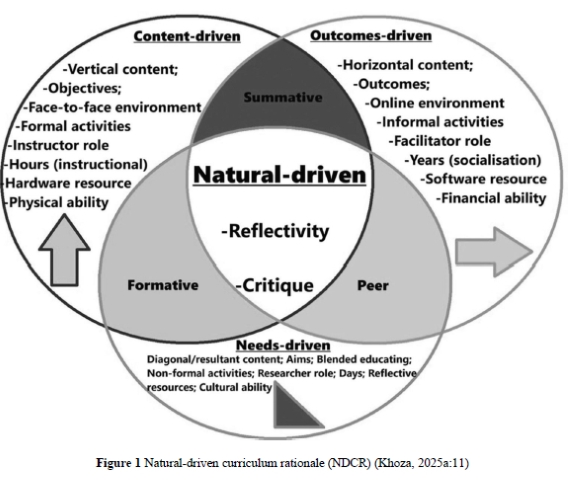
NDCR is based on content-driven, outcomes-driven, and needs-driven principles (Figure 1), connected by formative, peer, and summative assessment.
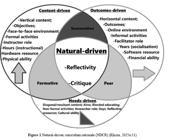
Eight curriculum concepts underpin each of the principles. For example, suppose a content-driven (standardised) principle must be used to teach life sciences. In that case, teachers should first search and define each of the eight concepts prescribed in the curriculum to address the "what" descriptive questions. In other words, what should the prescribed vertical content, objectives, face-to-face environment, formal activities, instructor role, instructional time, YouTube hardware, and learners' physical ability be? For an outcomes-driven (unstandardised) principle, teachers address the "how" operational questions. These questions should be about how learners construct content to achieve learning outcomes, how teachers facilitate informal or socialisation activities, et cetera. For a needs-driven (semi-standardised) principle, teachers address the "who" personal questions through self-reflection on individual content, aims, blended learning, non-formal activities, researcher role, reflective time with resources, and cultural ability. In turn, these principles contribute towards addressing the "why" philosophical questions of NDCR through ongoing reflection and critique with accountability.
The preceding explanation of the NDCR and its constituent rationales offers a valuable framework for examining the curriculum user interfaces present in YouTube channels for teaching life sciences. By examining how these user interfaces emphasise content, outcomes, or individual needs, we can categorise them according to the different NDCR principles. Furthermore, the specific curriculum concepts associated with each rationale within the NDCR, such as the nature of content, learning environment, and the role of the instructor, can serve as analytical lenses through which to interpret the underlying ideological assumptions within the selected South African curriculum studies publications. Ultimately, this framework allows us to systematically examine the diverse perspectives on curriculum design and implementation advocated within the life sciences curriculum in the South African context.
Research Design and Methodology
In this study, we used a pragmatic paradigm to examine and understand how and why selected life sciences teachers use YouTube channels/videos in teaching life sciences in particular ways. The pragmatic paradigm as a worldview arises from personal needs (reasoning) behind actions (content-driven), situations (nature), and consequences (outcomes-driven) that underpin them (Mthembu & Khoza, 2024). Pragmatism is a philosophical position that bases its research on individual, unique needs that may be addressed through qualitative or quantitative approaches or both. A pragmatic paradigm was suitable for this study because it allows one to examine multiple YouTube channels or videos for the teaching of life sciences to improve teachers' performance.
The integration of qualitative and quantitative methods, informed by the philosophical tradition of pragmatism, was central to the study. We made an informed decision not to adhere strictly to a singular methodological framework, as the mixed-methods pragmatic approach enabled us to draw on the strengths of diverse methods to gain a fuller understanding of complex educational phenomena. As Dube, Nkomo and Apadile-Thokweng (2024) argue, pragmatism in educational research is underpinned by a concern for practical outcomes and real-world relevance. It recognises that knowledge is both constructed and grounded in experience, a perspective that aligns well with the goals of this study.
Hence, the study was guided by the pragmatic paradigm as it offered methodological flexibility to support the integration of qualitative and quantitative research. According to Creswell and Creswell (2023); Johnson, Onwuegbuzie and Turner (2007), pragmatism should be chosen for its utility to address the research questions at hand, rather than conforming to rigid philosophical dogma. This paradigm is especially suited to educational research where the goal is often to understand and resolve complex, real-world problems. In our case, the examination of user interfaces called for both theoretical insight and empirical grounding. Le Grange and Du Preez (2023) contend that colonial and post-colonial frameworks, neoliberal and transformative paradigms (believed to be ideological influences on the South African curriculum), are well documented, and understanding how these are realised in academic literature requires a flexible, pluralistic methodological stance.
Although qualitative data dominate this study, we also used the NDCR framework to examine the phenomenon (quantitative approach language). A combination of qualitative and quantitative approaches produces a mixed-method approach that combines various quantitative and qualitative research elements (Creswell & Creswell, 2018; Govender & Khoza, 2024). Examining a phenomenon implies one reality, while qualitative data suggest multiple realities. This combination favours a pragmatic paradigm with a mixed-method approach (Cohen, Manion & Morrison, 2018). This approach was suitable for this study because it supports a pragmatic paradigm in its strength of addressing the individual, unique needs of both researchers and participants. The practicality of a mixed-methods approach is mostly facilitated by a participatory action research (PAR) design, which can transform researchers and participants to solve their real-life challenges and improve their teaching performance through four stages (Cohen et al., 2018; Makumane et al., 2024). PAR consists of planning, action, observation, and reflection stages that may improve teaching and learning situations.
The first two stages address the first operational research question, which starts with "how", through the use of documents and YouTube review or observation. The second two stages address the second philosophical question, which starts with "why", through one-on-one semi-structured interviews and focus group discussions. PAR has two cycles in this study, according to which data collection was conducted twice.
In addressing the first research question, documents and YouTube videos used by the participants were formally reviewed/observed twice. This method produced quantitative data based on the frequency of the principles of the NDCR. Document and YouTube video reviews are important because they present recorded and published facts about what participants use in real-life situations. Furthermore, focus group discussions and one-on-one semi-structured interviews were each conducted twice for approximately 1 hour per session. The two sessions were used to accommodate those who were shy when they were with other participants (semi-structured interviews) and those who were shy when there were no other participants (focus group discussions). This process was applied with the 20 participants (teachers) (Mthembu & Khoza, 2024). Purposive and snowball sampling were used to select 20 life sciences teachers from selected schools in Durban Central, South Africa. Four teachers met at a general teacher workshop held in Durban. The four teachers were asked to refer us to other life sciences teachers who also incorporate YouTube channels or videos in their teaching.
The participants' (P1-P20) autonomy and confidentiality were protected through the use of a letter of informed consent, which specified the following (adopted from the ethics guidelines of the University of KwaZulu-Natal):
• The nature and purpose of the study;
• The identity and institutional association of the researchers and their contact details;
• The fact that participation was voluntary;
• The confidentiality with which participants' responses would be treated;
• Any limits on confidentiality which might apply;
• The use of pseudonyms to maintain anonymity where necessary;
• The fact that participants were free to withdraw from the study at any time without any negative or undesirable consequences to themselves;
• The nature of any limits and/or benefits that participants might receive due to their participation in the study.
Guided Thematic Analysis
The guided thematic analysis was used for data analysis to combine themes generated from the NDCR with other themes generated from the data (grounded for a qualitative approach). Guided analysis involves determining themes before the collection of data, and modifying those pre-determined themes (from the NDCR a priori for the quantitative approach) through interaction with data (Cohen et al., 2018; Mthembu & Khoza, 2024). Pre-determined categories were framed using the NDCR principles as themes; these themes were negotiated and refined to accommodate those emerging from the data. Graphs are used to present results for the quantitative data. The principles of validity and trustworthiness were taken into consideration (Makumane et al., 2024).
Validity and Trustworthiness
Validity and trustworthiness are addressed in terms of external validity and transferability. Applicability is ensured by providing sufficient details of the relevant context or the real-world context. Reliability and dependability address the question of consistency, which was established in this study, quoting the research participants' responses. The extent to which the data reflected the participants' perspectives and experiences relates to the confirmability of the study. It is through this particular criterion that researcher biases are eschewed. The truth value of the findings needed to be established to ensure its credibility (truth value -audit trail and tape recorder) (Khoza, 2020).
Findings/Results and Discussions
The findings/results of this study are divided into two parts. In the first part, we present graphs that display the answers to the research questions (from semi-structured interviews, focus group discussions, documents, and YouTube reviews/observations). The graphs are followed by a discussion of the findings/results based on three guided themes (standardised utilisation of YouTube as a content-driven user interface, unstandardised utilisation of YouTube as an outcomes-driven user interface, and semi-standardised utilisation of YouTube as a needs-driven user interface) generated through NDCR and theorising the way forward along the natural truth/objective reality.
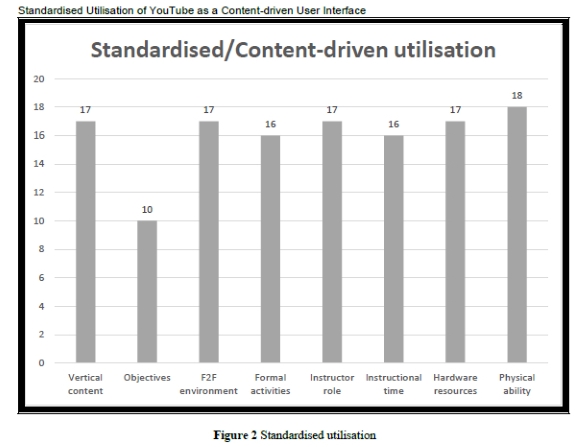
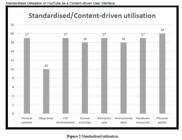
The findings/results reveal a dominance of a standardised utilisation of YouTube channels/videos in the teaching of life sciences/biology. More than 50% (10) of the participants applied all the concepts that underpin a standardised (content-driven) utilisation of YouTube channels (Figure 2). Seventeen of the 20 participants used YouTube channels to teach prescribed content or school knowledge (vertical content). Vertical content is a driver of a standardised utilisation of digital technology where teachers drill learners to cognitively master the content to reproduce it during summative assessment (Bernstein, 1999; Hoadley, 2018; Shoba & Khoza, 2022). Summative assessment, as a grading stage of learners, assists teachers in establishing whether they have achieved their teaching objectives (short-term goals) (Khoza & Mpungose, 2022). The same 17 participants assumed their role as instructors and used face-to-face (F2F) environments because learners did not have enough hardware resources to use YouTube. Only 10 teachers defined teaching objectives when teaching life sciences using YouTube channels. Sixteen of the participants used YouTube channels/videos for formal activities and instructional time prescribed by the Department of Basic Education (DBE) of South Africa. Eighteen of the participants used YouTube channels only for learners without disabilities (physical ability to access their F2F classes). This was just business as usual because they used YouTube channels/videos in the same way as other technology, such as overhead projectors with transparencies.
The participants used YouTube channels to teach "practical investigations, animal/plant tissues, cell support, plant transport systems, mitosis, the history of life on Earth, the cell cycle, the chemistry of life ... " (P1). The following YouTube channels were some of those used by the participants:
Dr Becky, Khan Academy, and Bozeman Science https://www.youtube.com/watch?v=I84skRsDO4M (P10).
Since the beginning of my teaching career, I have always preferred to use Mindset Learn Xtra Live. Their lessons are aligned with CAPS [Curriculum and Assessment Policy Statements], and most importantly, it is teachers with high levels of experience conducting these sessions. https://www.youtube.com/watch?v=lZjpGUZfskw&list=PLOaNAKtW5HLRVviGcDRDLzfezhqXdLygU. (P2)
MissAngler...https://www.youtube.com/watch?v=4u8nC8BAq9s&Hst=PLmblW4mMXmlelMkPWiki-K8yMPK7Aig (P14 and others).
The participants used the YouTube channels/videos because they believed that they had the following benefits:
Learners are more focused and interested when learning with YouTube rather than textbooks. They interact more, including those who do not usually participate in the classroom (P11).
... increased understanding of content. Confidence in learners to answer as we engage in the classroom. Lastly, learner attendance during the session was improved (P12).
... even the low-performing learners enjoy the lessons if they are visual, because they can engage better if I ask them questions after the videos (P13). It is fast, convenient, and allows flexible learning, open-ended learning, and collaborative working. It challenges critical thinking skills (P15).
There is more interaction throughout the lesson. It helps the learners to think more critically and allows them to engage in discussions after watching the videos. They can listen and jot down their notes, which makes them less dependent on their teacher....saves time and allows more time for assessment, which is crucial in the learning process. (P16)
... YouTube is a method of teaching that keeps learners attentive for the whole lesson. They do not lose concentration halfway through. They engage with questions that are asked. They can also download the videos and re-watch them at their convenience for remedial purposes.... (P20 and others)
These findings/results suggest that the participants passively used YouTube channels as user interfaces without any query or them knowing the creators (Steve Chen, Chad Hurley, and Jawed Karim). They did not establish the ideologies of the presenters of the videos. Learning is about the alignment of individuals' needs and ideologies that underpin user interfaces (Fields, Hoffman, Prakash & Singh, 2018; Makumane et al., 2024). The participants treated YouTube channels as if they were providing the truth about teaching and helping them achieve good results. Even if this was not the case, they continued to use them indiscriminately. Critiquing the videos/channels that they used based on their ideologies could help the participants understand how YouTube videos are produced and uploaded for their learners, so that they could have first-hand information (Zuma, Khoza & Sokhulu, 2022). This may bring them closer to the truth of YouTube channels/videos based on their teaching ideologies. They may also become aware of the personalisation process of the 5IR that has revolutionised YouTube user interfaces through AI.
For example, while YouTube videos are permanently available online, the participants treated them as if they were only available during the prescribed instructional time for learners. They were used as teaching aids (only supporting teachers in the classroom) instead of teaching resources (user interfaces) that could help learners learn anywhere, even in their living rooms, as they did during the lockdowns of COVID-19 (Makumane, Khoza & Zuma, 2022; Mashinini, 2020). The participants claimed that "it also saves time and we get more time to do activities based on the content they have learnt" (P1 7). This seemed to suggest the opposite of the claim because it would be better if learners were given the videos to review at home and reflect on what they had experienced before they came to school, which could develop their critical thinking (AlDahdouh, 2018; Anderson & Rivera-Vargas, 2020). "It is fast ... challenges critical thinking skills" (P15). It would be complicated for the participants to promote critical thinking using videos produced by other teachers based on their ideologies. Critical thinking is a function of self-reflection and critique with accountability to be closer to the truth about such a user interface (Khoza, 2025b; Waghid, Y 2019). In this case, participants were unable to produce videos and create channels as user interfaces for critical thinking based on self-reflections of their unique needs (Blair & Guan, 2021; Kim & Kim, 2021; Le Grange, 2017).
This was evident when academics learnt to self-reflect and critique with accountability to produce and create videos and channels during the lockdowns of COVID-19 to complete the 2020/2021 academic year/calendar (Khoza & Mpungose, 2022; Shoba & Khoza, 2022). Other academics advanced their videos using Kaltura resources to produce interactive videos with assessment activities such as quizzes (Govender & Khoza, 2024). Although the standardised system promotes passive learners, it assists them in acquiring new school knowledge that they may not acquire from their families/communities.
The notion of passive learners (end users of user interfaces) may sound negative, but in practice, learners gain new (simple to more complex) knowledge. They may not understand the concepts that they memorise, but knowing them as songs (repeated over time) may develop strong knowledge, of which they will start to understand the meaning. Although end users of user interfaces may not produce new user interfaces through the acquired school knowledge because they do not understand the ideologies of the developers of the user interfaces they use, they can survive well with the user interfaces produced by others in their profession. For example, the participants survived well with YouTube channels or videos and theories on life sciences developed by others.
In turn, such school or prescribed knowledge generates specific values aligned with their professions. In other words, these are professional-based values. However, even desirable generated values are not quantifiable in terms of the knowledge (prescribed content) that generated them. This suggests that YouTube videos are useful in teaching, learning, assessment, and research if users self-reflect and critique with accountability based on standardised and unstandardised utilisation (Branch, 2020; Branch & Lee, 2020; Waghid, Z & Waghid, 2016).
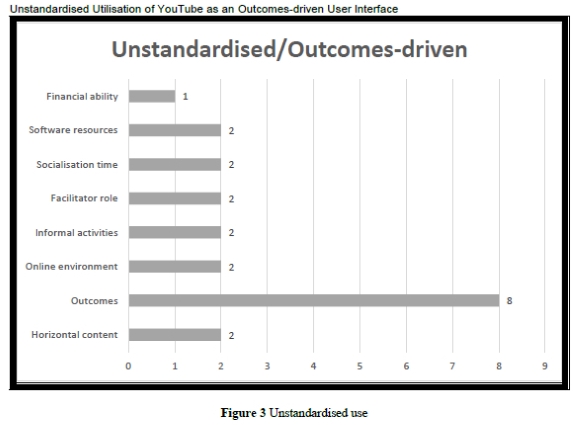
The findings/results (Figure 3) reveal that only two of the 20 participants used horizontal content (everyday knowledge) (Bernstein, 1999; Makumane et al., 2022), the online environment, the informal environment, the facilitator role, socialisation time, and software resources as the underpinning concepts of using YouTube channels/videos. Only eight of the 20 participants used learning outcomes to drive the use of YouTube. Only one of the 20 participants defined their learners through financial abilities.
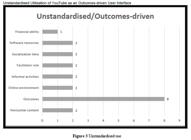
The findings/results (Figure 3) reveal that although eight of the 20 participants defined learning outcomes (learner goals) as the drivers of an unstructured utilisation of YouTube channels/videos, they did not support them with other relevant concepts. Relevant concepts are mostly produced by the cognitive levels of Benjamin Bloom's taxonomies. The cognitive levels of Bloom's taxonomy are knowledge or remembering, comprehension or understanding, application or applying, analysis or analysing, synthesis or evaluating, and evaluation or creating. Each level has specific keywords that are equitably used to construct relevant learning outcomes achieved through everyday knowledge. For example, knowledge or remembering has keywords such as define, name, describe, arrange, and list. Comprehension or understanding has keywords such as associate, clarify, classify, and construct. Application or applying has keywords such as apply, complete, assess, and calculate. Analysis or analysing has keywords such as analyse, compare, deduce, and contrast. Synthesis or evaluating has keywords such as argue, assemble, categorise, develop, compile. Evaluation or creating has keywords such as conclude, judge, evaluate, grade, discriminate. These keywords are observable or measurable from learners' actions to help teachers understand the levels of achieved learning outcomes.
This suggests that the participants did not allow learners to socialise to promote collaborative spaces for learning through constructing knowledge based on everyday knowledge (Bernstein, 1999; Hoadley, 2018; Shoba, 2021). Although they claimed that YouTube "...allows flexible learning, allows open-ended learning, allows collaborative working. " (P15), no evidence supported the claims. Promoting collaborative spaces was challenging for the participants because they needed enough relevant resources (user interfaces) for learners, and they faced some challenges. For example, their schools were under-resourced, and they shared "devices, teachers, classes, office administrators, limited internet connection..." (PI). They further elaborated that "most learners come from disadvantaged backgrounds and cannot afford smartphones and data bundles to access ready-made videos ... " (P8).
Collaborative spaces are important if the purpose of teaching and learning is to promote socialisation skills that address societal needs and the "how" question, also known as the operational questions of learning (Branch & Lee, 2020; Shoba & Khoza, 2022). Although collaborative spaces promote active learners, they may not give learners strong foundations for their courses and may need strong reflective spaces (Christopoulos & Sprangers, 2021; Sokhulu, 2021).
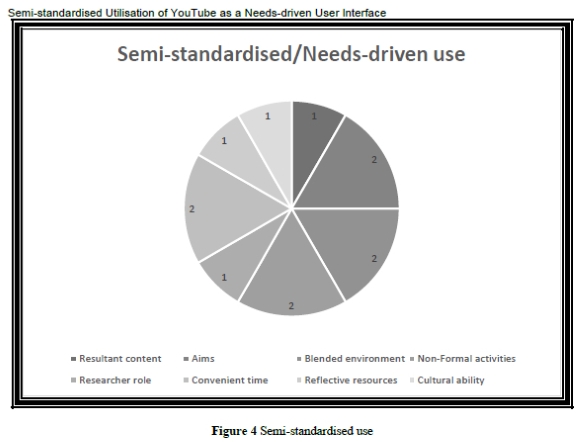
The findings/results (Figure 4) reveal that only two of the 20 participants defined and used teaching aims, blended environments, non-formal activities, and convenient times. Only one participant used resultant content, cultural abilities, researcher role, and reflective resources as the concepts of using YouTube channels.
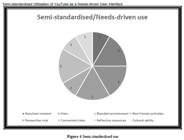
The findings/results suggest that the participants denied learners self-reflective spaces that helped them understand their unique needs and values (personal identity) (Ilonga, Ashipala & Tomas, 2020; Khoza, 2023). Self-reflection and critique assist individuals to address the "who" personal questions of education through intended aims (long-term goals) and formative assessment (Khoza, 2025b). Some of the reasons why participants used YouTube channels/videos were the following:
I started when I saw that there are topics that learners fail, no matter how many hours or extra lessons I do with them ... (P19).
... YouTube with my Grade 12 classes was done during extra tuition, usually afternoon classes that commenced at 16:00. During these sessions, I came to a realisation that my learners were able to grasp content, hence I decided to do the same with my Grade 10 during their Saturday tuition.... (P12)
... learners are struggling with understanding plant and animal tissues, and I couldn't simplify things for them ... (P3).
... YouTube for summarising lessons ... YouTube to show colourful pictures of the phenomenon ... (P4).
These accounts suggest that the use of YouTube channels was triggered by static (standard topics), dynamic (Grade 12 afternoon and Grade 10 Saturday classes), and environmental (summarising/colourful pictures) factors since the participants did not reflect on their experiences before using them. Experiences consist of actions, outcomes of the actions, and reasons or beliefs behind them (Morgan, 2014). These are mind functions that consist of unconscious (static body functions), subconscious (dynamic permanent memory that stores every experience), and conscious (environmental reasoning power) thoughts. Self-reflection and critique are the processes of interrogating conscious thoughts to guide the subconscious mind to produce new actions that assist individuals in understanding their identities (needs and values) (Khumalo, Shoba & Khoza, 2023). In turn, this improves existing user interfaces or produces new ones based on accountable self-reflection and query.
However, even after the few participants (Figure 4) reflected with their learners to optimise the actions, they could not control the outcome to achieve a 100% pass rate. This suggests that they still missed something that really or naturally controlled the outcomes to become what they needed. Khoza (2025a) proposes interrogating natural laws/forces around the optimised individual actions if outcomes are naturally driven to control them as a way forward.
Theorising the Way Forward Along the Natural Truth/Objective Reality
On the one hand, the majority of participants applied the standardised utilisation of YouTube channels or content-driven videos. The main purpose of teaching is to cognitively drill learners with subject-prescribed/vertical content to reproduce when they are replicatively assessed. Summative assessment is used to establish what the learners have not cognitively mastered after learning has taken place. Although the system mostly favours passive learners who may recall the prescribed learnt content, learners naturally use the content to generate individual, unique values even if they forget where/when they acquired the content that produced those values.
On the other hand, a minority of participants applied the unstandardised utilisation of YouTube channels or outcomes-driven videos. The main purpose of learning is to construct horizontal/everyday knowledge through learning activities to be used to achieve learning outcomes. Teachers facilitate learning through learning activities where learners learn in groups and interact through peer assessment. Learners are applicatively assessed to establish how they achieved the skills through learning. Although the system mostly favours active learners who may address social needs with everyday knowledge, learners naturally use everyday knowledge to generate individual, unique values. However, as active as they may be, they may still not achieve 100% outcomes (pass rate).
However, even if teachers applied the semi-standardised (needs-driven) utilisation of YouTube channels/videos, not all learners or none of the learners achieved a 100% pass rate. This seems not to be achievable even if learners self-reflect before learning to understand their needs and values based on their strengths. Although learners may not achieve 100%, they can associatively and interpretively use prescribed and/or everyday knowledge to address their individual, unique needs and generate values even if they may not remember where/when they acquired such knowledge (Fennell & Simpson, 2021; Khoza, 2023). The same applies to individual unique values, where no one can quantify the content that produced those values. This suggests that even if teachers optimise their teaching actions, they should know that they do not have control over outcomes because they are naturally driven. They should learn to optimise their actions and accept the consequences of those actions.
Concluding with Educational Implications
Becoming aware of individual unique actions, their consequences/outcomes, and the reasons or beliefs behind them seems to be a way forward for teachers and learners if outcomes are naturally driven beyond their control. This awareness may be generated better through accountable self-reflection and query, since this may assist with understanding individual unique needs, habits, and values (personal identity). Therefore, the frames of self-reflection for the use of YouTube channels/videos for life sciences should be standardised (content-driven), unstandardised (outcomes-driven), semi-standardised (needs-driven), and natural-driven approaches. Although these frames may be useful in integrating YouTube channels/videos in teaching, research, and learning, teachers and learners should know that they may still not produce 100% performance/outcome because they are survival user interfaces. They do not give them the truth about how they can teach learners so that all learners in their classes achieve 100%, and quantify the values generated by each element of what is taught. In other words, learners learn according to their levels of experience, where they can naturally, associatively, and/or interpretively address their learning needs.
Therefore, this suggests that holders/inventors of the truths or objective realities cannot share the truths with end users 100%. They can only share the truths as survival user interfaces because they do not have abilities to do so. For example, suppose teachers invented a theory (a theory of passing their subject without studying) to be followed by learners so that they can apply it to any desired outcome or consequence. Learners may heavily rely on applying the theory to give them 100% or a pass mark without studying. Even if they do not achieve the desired outcomes after applying it, as evidence that the theory is not working, they may continue to follow it to impress the teachers who invented it. In other words, they may continue to believe in it, being connected to the groups of people who share the same beliefs about the theory, even if they do not know the truth about it. It becomes a user interface for membership in those groups.
Authors' Contributions
SBK wrote the introduction, literature review, findings/results, and discussions, and reviewed the final manuscript. ZLM wrote the theoretical framework, research design and methodology, conclusion, and reviewed the final manuscript.
Notesi. Published under a Creative Commons Attribution Licence.
References
-
AlDahdouh AA 2018. Jumping from one resource to another: How do students navigate learning networks? International Journal of Educational Technology in Higher Education, 15:45. https://doi.org/10.1186/s41239-018-0126-x
» https://doi.org/10.1186/s41239-018-0126-x -
Anderson T & Rivera-Vargas P 2020. A critical look at educational technology from a distance education perspective. Digital Education Review, 37:208-229. Available at https://diposit.ub.edu/server/api/core/bitstreams/e75eeb73-1cbb-491c-842d-e4ae22845b53/content. Accessed 30 November 2025.
» https://diposit.ub.edu/server/api/core/bitstreams/e75eeb73-1cbb-491c-842d-e4ae22845b53/content -
Arslan R, Kofoðlu M & Dargut C 2020. Development of augmented reality application for biology education. Journal of Turkish Science Education, 17(1):62-72. https://doi.org/10.36681/tused.2020.13
» https://doi.org/10.36681/tused.2020.13 -
Bernstein B 1999. Vertical and horizontal discourse: An essay. British Journal of Sociology of Education, 20(2):157-173. Available at https://lchc.ucsd.edu/mca/Paper/JuneJuly05/BernsteinVerHor.pdf. Accessed 30 November 2025.
» https://lchc.ucsd.edu/mca/Paper/JuneJuly05/BernsteinVerHor.pdf -
Blair E & Guan S 2021. Exploring the landscape of postgraduate supervision in the UK. In I Huet, T Pessoa & F Sol Murta (eds). Excellence in teaching and learning in higher education: Institutional policies, research and practices in Europe. Coimbra, Portugal: Coimbra University Press. https://doi.org/10.14195/978-989-26-2134-0
» https://doi.org/10.14195/978-989-26-2134-0 -
Boy B, Bucher HJ & Christ K 2020. Audiovisual science communication on TV and YouTube. How recipients understand and evaluate science videos. Frontiers in Communication, 5:608620. https://doi.org/10.3389/fcomm.2020.608620
» https://doi.org/10.3389/fcomm.2020.608620 -
Branch R 2020. Reducing sepsis prevalence in acute-care hospitals: System design and usability barriers IT professionals need to overcome. PhD dissertation. Colorado Springs, CO: Colorado Technical University. Available at https://www.proquest.com/docview/2454674849?porigsite=gscholar & fromopenview=true & sourcetype=Dissertations%20 & %20Theses. Accessed 30 November 2025.
» https://www.proquest.com/docview/2454674849?porigsite=gscholar & fromopenview=true & sourcetype=Dissertations%20 & %20Theses - Branch RM & Lee H 2020. Collaborative learning: Patterns of student perceptions of the contributions of other team members during a group project. Journal of Higher Education Theory and Practice, 20(7):11-16.
-
Chindongo IC 2021. Teachers' pedagogical beliefs on the use of YouTube videos for teaching and learning Grade 9 Life Science concepts. MEd dissertation. Johannesburg, South Africa: University of Johannesburg. Available at https://www.proquest.com/docview/2800163094?pq-origsite=gscholar & fromopenview=true &sourcetype=Dissertations % 20 & %20Theses. Accessed 30 November 2025.
» https://www.proquest.com/docview/2800163094?pq-origsite=gscholar & fromopenview=true &sourcetype=Dissertations % 20 & %20Theses -
Christopoulos A & Sprangers P 2021. Integration of educational technology during the Covid-19 pandemic: An analysis of teacher and student receptions. Cogent Education, 8(1):1-27. https://doi.org/10.1080/2331186X.2021.1964690
» https://doi.org/10.1080/2331186X.2021.1964690 - Cohen L, Manion L & Morrison K 2018. Research methods in education (18th ed). New York, NY: Routledge.
- Creswell JW & Creswell JD 2018. Research design: Qualitative, quantitative, and mixed methods approaches (5th ed). London, England: Sage.
- Creswell JW & Creswell JD 2023. Research design: Qualitative, quantitative, and mixed methods approaches (6th ed). London, England: Sage.
-
Dube B, Nkomo D & Apadile-Thokweng M 2024. Pragmatism: An essential philosophy for mixed methods research in education. International Journal of Research and Innovation in Social Science, 8(3):1001-1010. https://doi.org/10.47772/IJRISS.2024.803073
» https://doi.org/10.47772/IJRISS.2024.803073 -
Du Preez P, Le Grange L & Simmonds S 2022. Re/thinking curriculum inquiry in the posthuman condition: A critical posthumanist stance. Education as Change, 26:1 -20. https://doi.org/10.25159/1947-9417/11460
» https://doi.org/10.25159/1947-9417/11460 -
Fennell J & Simpson TL 2021. A Polanyian rationale for a liberal arts core curriculum. Theory and Research in Education, 19(1):19-39. https://doi.org/10.1177/1477878521996237
» https://doi.org/10.1177/1477878521996237 -
Fields C, Hoffman DD, Prakash C & Singh M 2018. Conscious agent networks: Formal analysis and application to cognition. Cognitive Systems Research, 47:186-213. https://doi.org/10.1016/j.cogsys.2017.10.003
» https://doi.org/10.1016/j.cogsys.2017.10.003 -
Gilissen MGR, Klippels MCPJ, Verhoeff RP & Van Joolingen WR 2020. Teachers' and educators' perspectives on systems thinking and its implementation in Dutch biology education. Journal of Biological Education, 54(5):485-196. https://doi.org/10.1080/00219266.2019.1609564
» https://doi.org/10.1080/00219266.2019.1609564 -
Govender RG & Khoza SB 2024. First-hand user experience: Can Kaltura video come to the rescue of Moodle during/post COVID-19? African Identities, 22(3):536-553. https://doi.org/10.1080/14725843.2022.2082376
» https://doi.org/10.1080/14725843.2022.2082376 - Hoadley U 2018. Pedagogy in poverty: Lessons from twenty years of curriculum reform in South Africa. New York, NY: Routledge.
-
Ilonga A, Ashipala DO & Tomas N 2020. Challenges experienced by students studying through Open and Distance Learning at a Higher Education Institution in Namibia: Implications for strategic planning. International Journal of Higher Education, 9(4): 116-127. https://doi.org/10.5430/ijhe.v9n4p116
» https://doi.org/10.5430/ijhe.v9n4p116 -
Johnson RB, Onwuegbuzie AJ & Turner LA 2007. Toward a definition of mixed methods research. Journal of Mixed Methods Research, 1(2): 112-133. https://doi.org/10.1177/1558689806298224
» https://doi.org/10.1177/1558689806298224 -
Khoza SB 2020. Students' habits appear captured by WhatsApp. International Journal of Higher Education, 9(6):307-317. https://doi.org/10.5430/ijhe.v9n6p307
» https://doi.org/10.5430/ijhe.v9n6p307 -
Khoza SB 2023. Can teachers' identities come to the rescue in the Fourth Industrial Revolution? Technology, Knowledge and Learning, 28(2):843-864. https://doi.org/10.1007/s10758-021-09560-z
» https://doi.org/10.1007/s10758-021-09560-z -
Khoza SB 2025a. Curriculum rationale as witnessed by scholarly publications to the rescue of educating. In SB Khoza, MA Makumane & CB Mpungose (eds). Curriculum development and evaluation: Curriculum components in action (Vol. 24). Leiden, The Netherlands: Brill. https://doi.org/10.1163/9789004717992
» https://doi.org/10.1163/9789004717992 -
Khoza SB 2025b. Curriculum vision as a tool to the rescue of Prof M: A life history study. African Identities, 23(4):1228-1260. https://doi.org/10.1080/14725843.2024.2397510
» https://doi.org/10.1080/14725843.2024.2397510 -
Khoza SB 2025c. Industrial Revolution to the rescue of postgraduate supervision curricula with user interfaces [Special issue]. African Perspectives of Research in Teaching and Learning, 9(5):519-530. https://doi.org/10.70875/v9i5article4
» https://doi.org/10.70875/v9i5article4 -
Khoza SB & Mpungose CB 2022. Digitalised curriculum to the rescue of a higher education institution. African Identities, 20(4):310-330. https://doi.org/10.1080/14725843.2020.1815517
» https://doi.org/10.1080/14725843.2020.1815517 -
Khubayi FL, Ncisana L & Mtshali TI 2024. Investigating the effectiveness of using YouTube videos as an alternative learning media for Grade 11 life sciences learners. E-Journal of Humanities, Arts and Social Sciences, 5(6):1001-1014. https://doi.org/10.38159/ehass.20245616
» https://doi.org/10.38159/ehass.20245616 -
Khumalo SM, Shoba ME & Khoza SB 2023. Individual dynamics for effective implementation of mainstream English curriculum at a school for the deaf. International Journal of Research in Business and Social Science, 12(2):440-457. https://doi.org/10.20525/ijrbs.v12i2.2337
» https://doi.org/10.20525/ijrbs.v12i2.2337 -
Kim S & Kim HC 2021. The benefits of YouTube in learning English as a second language: A qualitative investigation of Korean freshman students' experiences and perspectives in the U.S [Special issue]. Sustainability, 13(13):7365. https://doi.org/10.3390/su13137365
» https://doi.org/10.3390/su13137365 - Le Grange L 2017. Contemporary curriculum theories and their influence on teaching and learning. In L Ramrathan, L Le Grange & P Higgs (eds). Education studies for initial teacher development. Cape Town, South Africa: Juta.
-
Le Grange L & Du Preez P 2023. Curriculum studies in the posthuman condition/posthuman curriculum. South African Journal of Higher Education, 37(5):60-77. https://doi.org/10.20853/37-5-5985
» https://doi.org/10.20853/37-5-5985 -
Makumane MA, Khoza SB & Zuma S 2022. Vaccine education to the rescue of students in the COVID-19 revolution. International Journal of Research in Business and Social Science, 11(10):328-340. https://doi.org/10.20525/ijrbs.v11i9.2216
» https://doi.org/10.20525/ijrbs.v11i9.2216 -
Makumane MA, Nkohla MB & Khoza SB 2024. Decolonising educational technology in a pragmatic curriculum: A systematic review. South African Journal of Higher Education, 38(3):131-149. https://doi.org/10.20853/38-3-6357
» https://doi.org/10.20853/38-3-6357 -
Mashinini V 2020. COVID-19 and National University of Lesotho: Experiences and challenges. International Journal of Education and Research, 8(9):157-180. Available at https://www.ijern.com/journal/2020/September-2020/12.pdf. Accessed 30 November 2025.
» https://www.ijern.com/journal/2020/September-2020/12.pdf -
Morcillo JM, Czurda K, Geipel A & Robertson-Von Trotha CY 2019. Producers of popular science web videos - between new professionalism and old gender issues. [Preprint]. https://doi.org/10.48550/arXiv.1908.05572
» https://doi.org/10.48550/arXiv.1908.05572 -
Morgan DL 2014. Pragmatism as a paradigm for social research. Qualitative Inquiry, 20(8):1045-1053. https://doi.org/10.1177/1077800413513733
» https://doi.org/10.1177/1077800413513733 -
Mthembu B & Khoza SB 2024. YouTube video approaches to the rescue of learning English language in higher education in selected African countries. South African Journal of Higher Education, 38(3):29-45. https://doi.org/10.20853/38-3-6365
» https://doi.org/10.20853/38-3-6365 -
Nkohla MB 2025. Chronicling digital teaching at a South African historically disadvantaged comprehensive university: Navigating institutional culture for agricultural sciences academics. African Identities:1-19. https://doi.org/10.1080/14725843.2024.2439412
» https://doi.org/10.1080/14725843.2024.2439412 -
Prakash C, Stephens KD, Hoffman DD, Singh M & Fields C 2021. Fitness beats truth in the evolution of perception. Acta Biotheoretica, 69(3):319-341. https://doi.org/10.1007/s10441-020-09400-0
» https://doi.org/10.1007/s10441-020-09400-0 - Putri E & Sari FM 2020. Indonesian EFL students' perspectives towards Learning Management System software. Journal of English Language Teaching and Learning, 1(1):20-24.
-
Ramulumo M & Mnguni L 2023. A qualitative comparison of the intended curriculum ideologies of STEM subjects in South Africa. Curriculum Perspectives, 43(2):145-155. https://doi.org/10.1007/s41297-023-00205-y
» https://doi.org/10.1007/s41297-023-00205-y -
Sarfraz Z, Sarfraz A, Iftikar HM & Akhund R 2021. Is COVID-19 pushing us to the fifth industrial revolution (Society 5.0)? Pakistan Journal of Medical Sciences, 37(2):575-591. https://doi.org/10.12669/pjms.37.2.3387
» https://doi.org/10.12669/pjms.37.2.3387 -
Sharma A, Bhatt NS, St Martin A, Abid MB, Bloomquist J, Chemaly RF, Dandoy C, Gauthier J, Gowda L, Perales MA, Seropian S, Shaw BE, Tuschl EE, Zeidan AM, Riches ML & Shah GL 2021. Clinical characteristics and outcomes of COVID-19 in haematopoietic stem-cell transplantation recipients: An observational cohort study. The Lancet Haematology, 8(3):e185-e193. https://doi.org/10.1016/S2352-3026(20)30429-4
» https://doi.org/10.1016/S2352-3026(20)30429-4 - Shoba ME 2021. Theorising teachers' experiences of teaching reading in the African context. In KG Fomunyam & SB Khoza (eds). Curriculum theory, curriculum theorising, and the theoriser: The African theorising perspective. Leiden, The Netherlands: Brill.
-
Shoba ME & Khoza SB 2022. Professionalising socialisation for pragmatic e-curriculum to the rescue of South African universities. In J Olivier, A Oojorah & W Udhin (eds). Multimodal learning environments in Southern Africa: Embracing digital pedagogies. Cham, Switzerland: Palgrave Macmillan. https://doi.org/10.1007/978-3-030-97656-9_7
» https://doi.org/10.1007/978-3-030-97656-9_7 -
Sokhulu LH 2021. Students' experiences of using digital technologies to address their personal research needs during the COVID-19 lockdown. African Identities, 19(4):436-452. https://doi.org/10.1080/14725843.2020.1801384
» https://doi.org/10.1080/14725843.2020.1801384 -
Waghid Y 2019. Quality, dissonance and rhythm within higher education. South African Journal of Higher Education, 33(3):1-7. https://doi.org/10.20853/33-3-3569
» https://doi.org/10.20853/33-3-3569 -
Waghid Z & Waghid F 2016. Examining digital technology for (higher) education through action research and critical discourse analysis. South African Journal of Higher Education, 30(1):265-284. https://doi.org/10.20853/30-1-562
» https://doi.org/10.20853/30-1-562 -
Zuma S, Khoza SB & Sokhulu LH 2022. Representation of e-learning ideological-ware resources in COVID-19 articles [Special edition]. Alternation, 39(2022):79-115. https://doi.org/10.29086/2519-5476/2022/sp39a5
» https://doi.org/10.29086/2519-5476/2022/sp39a5
Revised: 5 August 2025
Accepted: 30 November 2025
Published: 30 November 2025