Scientific work independence to support the implementation of science integrated learning at various education levels
Abstract
With the research reported here, we specifically aim to develop application products of scientific work independence instruments through science integrated learning (SIL) for various education levels (elementary schools, junior high schools, senior high schools, and universities). The SIL model was applied in learning to determine specific indicators for scientific work independence following learners' development through the application of the research and development methodology. Product testing was conducted in elementary schools, junior high schools, senior high schools, and universities. Based on the research results, SIL V1.0 App, an acronym for science integrated learning application, was developed based on mobile apps in the form of Android applications that may be installed on devices with Android operating systems (OS). The scientific work independence instrument was developed based on Piaget' s theory, which states that the level of independence at each stage of scientific work is based on the development of children' s learning psychology. The scientific work independence application has precise boundaries because it is adjusted to children's psychological development. The differences in learning independence levels occur because of the age difference.
application; independence; Piaget's theory; science integrated learning
Introduction
Educational innovation in the digital era requires application products with high applicability to strengthen the application of technology in learning. Education at various levels is facilitated by various applications so that the distance between educators and learners does not constrain learning. Application products are considered to have high applicability for learning when they have advantages that similar products do not, are easy to use, and their specifications meet the needs of learners (Muhammad, Aseere, Chiroma, Shah, Gital & Hashem, 2021; Nouwen, Clycq, Struyf & Donche, 2022). The products developed may not only be used in learning but may also have economic value if users have high interests - the product is a solution to learning problems (Hollands & Escueta, 2020). Innovative learning products have a wide range of applications at various levels of education (elementary schools, junior high schools, senior high schools, and universities) and follow children's learning needs.
Children have different learning needs at different ages. Piaget's theory emphasises that children's cognitive skills develop gradually at different age ranges. Forcing learning activities on children may potentially disrupt their psychological development (Winstanley, 2021). Children' s way of thinking differs according to age. Qualitatively, children are different from adults. Piaget mentioned several stages of the development of children's intellectual skills. Different stages of child development affect the ability to understand knowledge. The application of learning theory to determine the standard of children' s abilities is needed for age-appropriate learning needs to be mapped. The study of the development of learning independence in this research is based on different age levels. Learning independence is measured individually and not in groups, and Piaget' s theory is used to study individual learning.
The research problem was how scientific work independence could be applied at various education levels through science integrated learning (SIL). The SIL model integrates aspects of biology, physics, and chemistry to understand the concept under study. The level of concept integration depends on the basic competencies taught. Science integration in Indonesia is based on a predetermined basic competency level, which varies for elementary schools, junior high schools, senior high schools, and universities. There is an urgent need for standardisation of the measurement of scientific work independence, therefore, through this research, we developed a common or standardised application to assess scientific work independence. Scientific work independence refers to learners' independence of scientific work as measured by their ability to design, carry out and evaluate experiments in science learning. Scientific work requires standardised criteria to determine readiness to make discoveries in science learning (Parmin, Sajidan, Ashadi & Sutikno, 2017; Wei, Jiang & Gai, 2022). Scientific work independence is not explicitly stated as an aptitude test for science learners or day-to-day assessment but is required for all education levels. Indicators of scientific work independence are developed from the difficulty of discovery in science, which is adjusted to the level of education. The higher the level of knowledge, the more complex the learning. The more difficult the concept, the more difficult the challenge to understand the concept. The level of difficulty in understanding scientific concepts at university level is more difficult than at elementary, junior high, and senior high school levels. The ability to do scientific work is easier to observe in learning that applies strategies aimed at scientific work (Plaisance, Michaud & McLevey, 2021). SIL is a learning model that is aimed towards independent scientific work. The SIL model was chosen for this research because learners' learning activities lead to independence in conducting experiments. The learning model, with the syntax of scientific work independence, was chosen to be applied to train scientific work independence.
We specifically aim to develop application products of scientific work independence instruments through SIL for various education levels (elementary schools, junior high schools, senior high schools, and universities). The product was developed based on the different learning independence levels following the children' s way of learning. The SIL model was applied in learning to determine specific indicators for scientific work independence following learners' development. We also aim to find instruments for the standard application of scientific work independence for various levels of education. The intention was for this research product to have high applicability that can be commercialised.
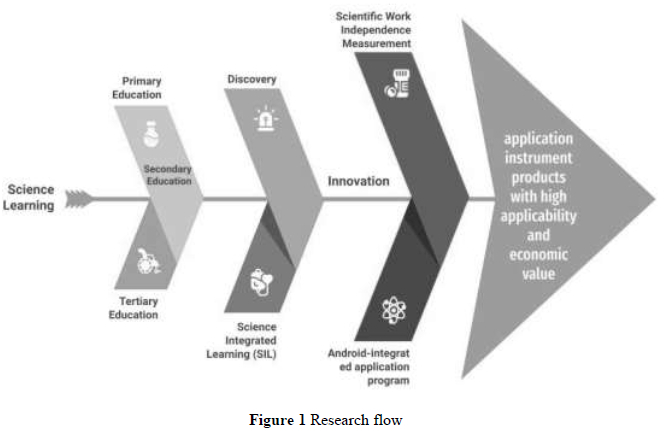
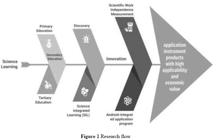
Measurement of scientific work independence is needed in science learning. Based on preliminary results, standardisation of scientific work independence instruments needs to be developed urgently through research. Our research was conducted to develop a scientific work independence instrument appropriate for elementary, junior high, senior high schools, and university education levels through application programmes. The instrument for measuring scientific work independence was developed from learning activities at each stage in the SIL model. The research development process is presented in Figure 1.
The elementary, junior high, and senior high school science learning analysis was carried out to measure learners' scientific work independence. Scientific work independence is not an aptitude test for science learners or day-to-day assessment, but is required for learners at all education levels. Scientific work independence is needed in face-to-face and online science learning through discovery activities in the laboratory and outdoors. The value of dynamic scientific concepts evolves as discoveries are published. The application of scientific strategies to discover new concepts through experiments is applied in the learning of science, thus making discovery activities important. Preliminary research and literature studies did not yield a standard instrument for scientific work independence appropriate for education levels. The SIL model was used because it contains learning activities in all syntaxes aimed at scientific work independence. The SIL model can be applied to various education levels by modifying the learning difficulty. The mapping of learners' learning activities were observed using a learning model (Chhabra & Warn, 2019; Ke & Chang, 2021; Kopper, Karkare, Paffenroth & Apelian, 2020).
Novelty value learning innovations in this study are new products in the form of scientific work independence instruments at different levels of education. Products were developed digitally using an Android-integrated application programme.
Consideration should be given to developing mobile learning media using Android-based mobile learning technology (Haryanto & Billah, 2020). This statement is backed by the prevalence of mobile devices, which are now preferred by the general population (Liu, Horton, Lee, Kang, Rosenblum, O'Hair & Lu, 2015), the rise in the number of learners who own Android devices, and the expectation that this number will continue to rise over time. This is one reason why the article should interest global readers. The results of the development in this study are not limited to learning, but because of the urgent need of a broad target audience, the product is expected to have economic value. The final product is a guidebook with an international standard book number (ISBN) and is subjected to copyright. Products in the form of guidebooks are presented in electronic and printed format. Electronic products are distributed free of charge for teachers to download and use. The product will be disseminated through the Perkumpulan Pendidik IPA Indonesia (PPII) professional organisation. This organisation is a strategic partner in this research because it has a network of cooperation between science education study programmes at undergraduate, postgraduate, and doctoral levels. It comprises teachers and lecturers from various education levels.
Literature Review
Science or natural science is studied at elementary, junior high, senior high schools, and university. Both face-to-face and online modern science learning require strengthening scientific work independence. Online learning in Indonesia has big challenges because most teachers and learners are not used to it. When learning remotely during the pandemic, learners learnt science less than optimally because they were used to being accompanied by teachers directly in class. Independent learning is the main problem in remote learning because teachers could guide learners directly in class but the learners had to study theory and do experiments on their own at home. This learning independence is in accordance with the principle of building concepts independently as in constructivist learning. Science learning cannot be limited to ordinary scientific work and needs an independence-oriented scientific process. Science is not limited to scientific work activities. Independence in carrying out scientific work is also necessary for learners to become used to learning independently without being continuously accompanied by a teacher. For learners to learning, they require independent scientific activities that use the surrounding environment as a laboratory. A research finding shows that scientific work independence was developed in South Africa (SA) by providing learners with opportunities to find learning resources in the environment. Based on this finding, we used SA as an example as the necessity of scientific knowledge for advancement has long been acknowledged in here (Sooryamoorthy, 2013). Juan, Reddy, Zuze, Namome and Hannan (2016) studied South African learners' interests in reading about science in their free time. At the high school level in Indonesia, teachers expect learners to carry out scientific work activities independently. As many science learning resources exist in the learners' living environment, they need to acquire independent learning skills. This shows commitment to science beyond what is required in school courses, and we believe that it forms part of scientific work independence. Learners who liked science were 21% more inclined to read about it outside of class. That number is small if we also consider that SA excels in many science fields, such as astronomy, ecology, environmental science, natural sciences, and plant and animal sciences (Sooryamoorthy, 2013). Scientific work independence is adjusted to the learners' level of development and must be done in an integrated manner (Parmin, Sajidan, Ashadi, Sutikno & Maretta, 2016; Roehrig, Dare, Ring-Whalen & Wieselmann, 2021; Wei, 2020).
In a preliminary study we analysed the assessment of scientific work in schools through discussions with the PPII administrators and found that scientific work independence was assessed using different instruments. Science teachers and lecturers apply the indicators and methods of measuring scientific work independence differently. Juan et al. (2016), who researched learners' scientific attitudes in SA, suggest that schools should create regulations emphasising teachers' critical role in influencing learner attitudes towards science and ensuring that approaches are used to promote positive attitudes, which include scientific work independence. Regulations require of teachers to apply science in the learners' lives as indicated in lesson plans.
Digitisation of science learning tools is needed because the dynamic nature thereof requires applicable tools. Science learning tools presented with information technology provide easy access for learning not being restricted by distance and time (Abdullah, Al-Ayyoub, AlRawashdeh & Shatnawi, 2023; Yeh, Tsai, Tsai & Chang, 2019). The application of science learning instruments can implement existing application programmes by considering high applicability (Rapanta, Botturi, Goodyear, Guàrdia & Koole, 2021). The main consideration in developing application products was done after having analysed similar products. The development of instruments integrated with Android devices has the advantage of being easy to operate and are attractive and interactive (Buluma & Walimbwa, 2021; Papastergiou & Mastrogiannis, 2021; Pumptow & Brahm, 2021). Applications that can be used in developing learning products must be easy to operate on mobile apps in the form of Android applications (Syaifudin, Funabiki, Kuribayashi & Kao, 2021; Ünver & Bakour, 2020). Each science has its own characteristics, so it must be adjusted to develop learning application products. Science emphasises the discovery process through scientific work activities. Essential applications are developed to make it easy to access accurate data.
Pannen (2001) developed scientific work independence from the concept of learning independence in which learners carry out learning activities independently by using various existing learning resources to achieve learning goals. Scientific work independence is scientific work carried out in indoor and outdoor laboratories in science learning (Parmin, Sajidan, Ashadi, Sutikno & Fibriana, 2017). Learning theory becomes a construction in measuring differences in learning independence based on learners' psychological development (Tahar & Enceng, 2006). The construction referred to in this article is the need for reference to the learning theory of learner development to measure learning independence. The older the learner, the higher their learning independence. Various studies found that implementing learning independence in elementary education still requires a prominent teacher to guide scientific work activities. In learning activities in high schools, the role of teachers in guiding scientific work becomes less. In contrast, lecturers play a small role in students' scientific work at university level. This opinion is in accordance with Parmin, Sajidan, Ashadi, Sutikno, et al. (2017) that learning independence is influenced by factors such as age and level of education. The higher the level of education, the more independent learning can be expected.
The characteristics of elementary and high school learners differ due to age and learning methods. Learners at elementary school are still highly dependent on the teacher for science learning (Nguyen, Tran & Nguyen, 2021). High school learners are more curious about science and they start to use various learning resources independently but still require the teacher's assistance (Romine, Sadler & Wulff, 2017). Skills in using various learning resources through discovery activities encourage learners to develop independent learning (Ceglie & Settlage, 2016). Different ways of learning require learning tools tailored to the level of education so that the knowledge gained is tiered and interrelated. The selection of learning strategies in which educators may change the learning experience in stages may be used as continuous learning activities.
The SIL model is a science learning strategy with scientific work independence activities that can be adapted to the learners' development level. The SIL model, a modification of the open inquiry model, was developed by Parmin, Sajidan, Ashadi and Sutikno (2017). This model was developed using Borg and Gall's development method which was tested for validity and feasibility by learning experts. The SIL model includes exploration, concept integration, experimentation, analysis, action, and reflection. The advantage of the SIL model is that it contains learning activities aimed at scientific work independence. Implementing the SIL model for developing elementary school learners' learning independence still depends on the teachers' assistance (Kurniawan, Nurlailah & Muh, 2021). Applying the SIL model to high school learners impacts learners' skills in finding solutions to the learning problems (Qoeroti, 2018). The SIL model uses inquiry or discovery-based learning. The level of independence in discovery activities was compared for learners at elementary school, junior high school, senior high school, and university levels. The main disadvantage of research on the SIL model is that a standardised instrument for measuring scientific work independence for all education levels does not exist.
Practical, easy-to-use, and interesting learning tools can be developed using application programmes. Combining online applications like Jotform or Google Forms will produce a digital application. Learning product applications are easy to implement when integrated through Android (García-Peñalvo & Conde, 2015; Trabelsi, Al Matrooshi, Al Bairaq, Ibrahim & Masud, 2017). Various existing application programmes may be used to develop digital educational instruments (Lin & Miettinen, 2019). The development of instruments for mobile devices should include interesting and interactive features. Instruments developed with information technology have easy access for distribution through communication networks and even social media (Papadakis, Alexandraki & Zaranis, 2022). In order to advance access by users application programmes are used for the development of scientific work independence.
Theoretical Framework
Piaget' s theory underlies the development of criteria for the level of independence of scientific work. To use Piaget's theory we did not examine social approaches in learners but rather in individual work. According to this theory, knowledge is built according to the learners' development based on age. Different levels of education make the level of independence of scientific work different. This theory was used because of the relationship between children' s scientific work independence and age. As age differences result in different learning needs in children, the demands of learning activities cannot be equated (Bergling, 1999; Piaget, 1954). The theoretical framework was built on the difference in the maturity of children' s thinking - the more mature the way of thinking, the more independent the children' s ability in scientific work. Scientific work independence is built on the concept of independent learning. Children learning independently are driven by curiosity.
The information processing theory acts as a reference in building a theoretical framework because knowledge will be more readily transferred when there is a desire to understand what is being taught (Lamnina & Chase, 2021). The importance of independent scientific work must be considered because of enforced online learning conditions, a combination of online and face-to-face learning, and face-to-face learning. Science concepts are easy to teach, but practical skills from scientific work cannot be learned like scientific theories. In learning science, Indonesian learners have weak scientific work skills, while they do not struggle mastering concepts. The basic theory of learning science is a combination of theory and practice. The truth of science is more easily conveyed through practical results (Van Diggelen, Doulougeri, Gomez-Puente, Bombaerts, Dirkx & Kamp, 2021).
With this research we aimed to do the following: (1) to develop application products of scientific work independence instruments through SIL for various education levels (elementary schools, junior high schools, senior high schools, and universities) and (2) to find the standard application of scientific work independence instruments for various levels of education.
Methodology
Research Design and Procedure
In this study we applied the research and development methodology referred to by Borg and Gall (1989). The method has detailed stages, so it is suitable for developing new products with high applicability at elementary school, junior high school, senior high school, and university levels. This design was chosen because of its function of developing selective learning tools in steps that are easy to implement. The research stages included preliminary studies, research planning, design development, small-scale product testing, revision of small-scale test results, large-scale product testing, revision of large-scale test results, dissemination, and implementation of the final product. All research stages were carried out to obtain scientifically justifiable results. The resulting product is valid and suitable for use and distribution.
The preliminary study was conducted by analysing the assessment of the scientific work independence by teachers and lecturers in learning science at each level of education. The exploration of the preliminary study was carried out by analysing various research findings published in journals. Research planning was arranged from the preliminary study by preparing the equipment needed for product development. Design development was carried out by analysing existing initial products for testing new products.
Data Collection
Small-scale product testing was conducted with 10 elementary, junior, and senior high school learners and 10 university students. Large-scale product testing was conducted on four different target groups: fifth graders in elementary school, eighth graders in junior high school, 11th graders in high school, and science education students. All large-scale product testing targets were in Semarang City, considering costs, time, and the pandemic. Experts in science learning evaluation and information technology learning validated the products. Dissemination and implementation of products on a wide scale involved PPII.
The scientific work independence application instrument created and developed is based on mobile apps in the form of an Android application compatible with devices running the Android operating system. This application was named KEJALI Apps, an acronym for Kemandirian Kerja Ilmiah Aplikasi. As a design concept for developing KEJALI Apps, a choice of education levels developed through SIL is available on the home page. Each level of education was developed using an online form provider application such as Jotform or Google Forms and then bundled into one complete application known as KEJALI Apps.
The scientific work independence instrument was validated by experts on education evaluation, science education, and experts in learning application programme development. KEJALI Apps is the result of the system development in this research and thus the property of researchers. The application was developed to make it easier for teachers to measure learners' scientific work independence. The application has been validated by a learning media expert from the Faculty of Mathematics and Natural Science, Universitas Negeri Semarang. The expert validated the application by completing the form available at https://bit.ly/validasiSIL. The result of the validation was r count > r table (2-sided test with significance value of 0.05). Based on these results, the developed application was declared valid. Data on the applicability of scientific work independence instruments are presented at three levels of education.
Data Analysis
Learners' scientific work independence was analysed using a descriptive technique by calculating each group' s average score, which was presented as a graph of the level of scientific work independence. This application was developed by the researchers and is not a modification of an existing application.
Results and Discussion
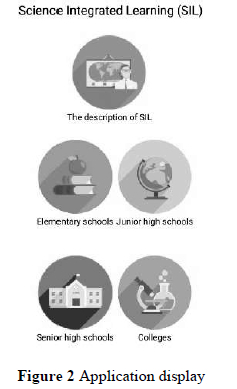
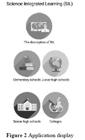
The developed Android application, which may be downloaded at https://bit.ly/aplikasiSILV1, has five features shown in Figure 2.
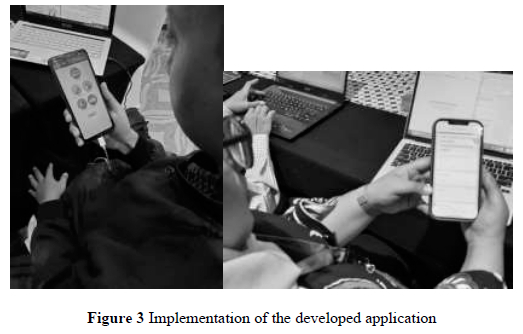
The application was implemented on a wide scale involving PPII, as is shown in Figure 3.
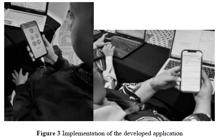
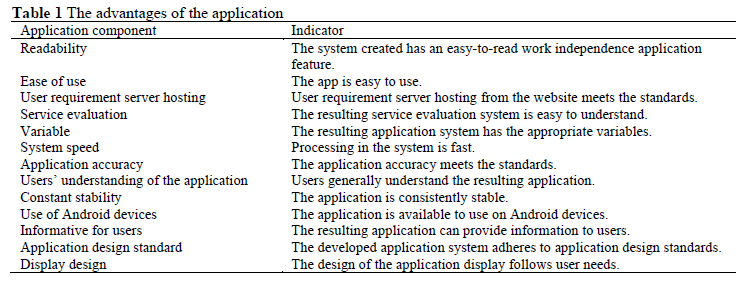
After the implementation, the users completed a questionnaire regarding the experience in Google Forms at https://bit.ly/instrumenaplikasikemandirian. Based on the questionnaire results, several advantages of the developed application are presented in Table 1.
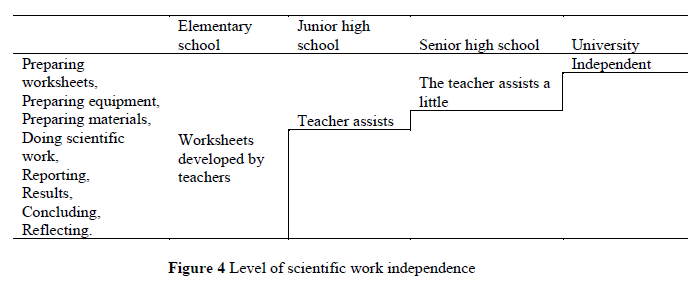
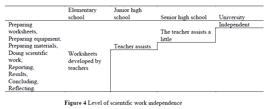
The information in Table 1 shows that the application can be easily implemented on Android devices to help teachers measure the learning independence of learners at different education levels. After measuring and determining learners' learning independence using the application, teachers can choose an appropriate learning model to improve it. Therefore, the application contributes to and supports SIL implementation at various education levels. The results of developing scientific work independence in elementary schools, junior high schools, high schools, and universities to support the implementation of the integrated learning science model are shown in Figure 4.
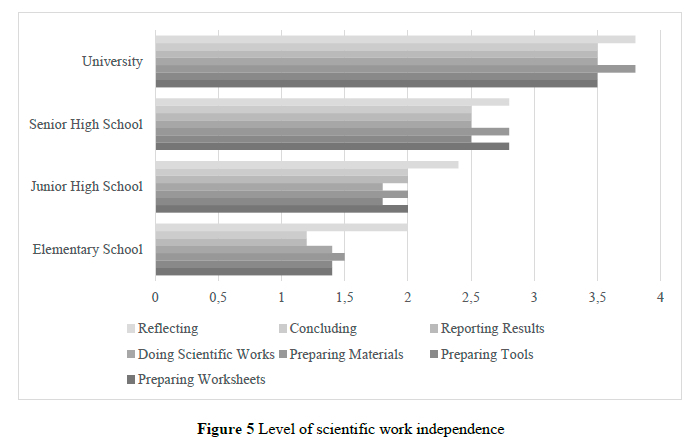
The results of scientific work independence measurements through science learning for learners in elementary, junior high schools, senior high schools, and universities are shown in Figure 5.
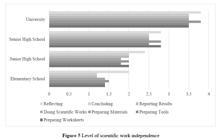
Figure 4 shows that the score for seven indicators of scientific work independence in elementary school learners was still below 2, which means that they were still weak. The higher the level of education, the higher the ability for independent scientific work. This data means that as science teachers teach at increasingly higher education levels, learners must be given greater opportunities and confidence in carrying out scientific work independently. Learners in higher education must be able to apply their skills to discover science concepts with a high level of difficulty in a more complex manner. Teachers in elementary schools still assist learners in scientific work activities. Teachers' involvement begins to decrease at the junior high school level and so on until university education level.
As a development design concept, the home page of SIL V1.0 Apps presents an opening screen. The next screen presents five menu choices: a description of SIL, elementary schools, junior high schools, senior high schools, and universities. Each level of work independence evaluation was done using Google Forms. The evaluation results of learners' work independence were stored on the Android server. The resulting Android application was simple to use and easy to access. Installing it on Android device allows users to enjoy scientific work independence application services. Learning activity applications can be used widely when they are easily accessible and provide in learners' needs (Broadbent, Panadero & Fuller-Tyszkiewicz, 2020; Jeon, 2022).
Scientific work in the form of experiments for elementary school learners is difficult or impossible to carry out during online learning. Learners at elementary school level are entirely dependent on the teacher when preparing practice materials, implementing, reporting, and reflecting. Piaget' s learning theory explains that, between the ages of 7 to 12, logical thinking about physical objects only begins to develop (Da Rocha Costa, 2019; Liang & Dong, 2022; Winstanley, 2023). At this age, children cannot yet solve problems independently. Practice is a learning activity that requires skills to apply systematic work and procedures; children of elementary school age cannot practice alone without being accompanied by a teacher. The learners' scientific work independence at this basic level requires full assistance from the teacher. This result aligns with Juan et al. (2016) who researched South African learners, emphasising teachers' critical role in influencing learners' attitudes towards science. The attitude in question is scientific work independence. In online learning, teachers are not present in person, so learning science through scientific activities requires innovation in experiment activities (Abdull Mutalib, Md. Akim & Jaafar, 2022; Nighojkar, Plappally & Soboyejo, 2021; Sistermans, 2020). Teachers may choose to simulate practice through videos, and learners follow work procedures by viewing and listening to these. Practical independence in children of 7 to 12 years old may be developed in face-to-face learning by providing them the opportunity to try in all stages of experiments.
Children aged 12 years and above can think abstractly by manipulating ideas without relying on concrete manipulation. Curiosity in children of this age impacts the desire to try. Providing opportunities to learn may foster an urge in children to study science seriously (Alghamdi & Malekan, 2020; Wan, 2021). Teachers in junior high schools can take advantage of children' s desire to try through practice. Assistance is still required as children's desire to try may not be followed by an attitude of prudence. Teachers must begin to allocate roles to children to foster scientific work independence. Children of 12 years and above cannot compile practice worksheets for scientific work; the task is still carried out by the teacher. Providing opportunities and to trust children to work independently impacts children' s confidence in doing scientific work. In online learning, teachers are not present in person, so learning science through scientific activities requires innovation in practice activities (Abdull Mutalib et al., 2022; Nighojkar et al., 2021; Sistermans, 2020). In the application that we developed we combined online provider applications in Google Forms, making it interesting and easy to use. The development of scientific work independence instrument uses application programmes that can be easily accessed remotely by users. The application, combined with Google Forms, provides opportunities for learners to work independently with confidence. Learners' confidence during learning may be an interesting topic to be researched in the future.
Scientific work independence appears in earnest in children aged 14 years and above. Indonesian children at this age are in high school. With a bit of guidance from the teacher, children of this age can carry out scientific work. Children of 14 years and above can be given the authority to develop themselves. It is good enough for the teacher to provide practice goals, while children can prepare supporting tools to reflect on their own. The psychology of children who tried because of intense curiosity can be developed by providing opportunities to explore their abilities. According to South African research by Juan et al. (2016), science education may benefit from understanding how attitudes are formed as well as the associated behaviour. The ability to recognise self-strength in learning is grown to carry out discovery activities in science learning (Lu, Smith, Hong, Lin & Hsu, 2023). The encouragement to do scientific work independently requires motivation from the teacher so that children are confident of gaining something from the practice.
Learners can fully implement the SIL model syntax at university. Lecturers explain the purpose of scientific work, and students with advanced thinking abilities may translate them into worksheets. The freedom of scientific work given to students is not limited to testing concepts but can be directed to discoveries (Naidoo, 2017). Psychologically, students can think complexly to develop a plan of discovery from studying literature. Learning science online or face-to-face is not an obstacle for students unless practices require laboratory equipment which is unavailable outside the laboratory. The lecturers' courage in providing broad opportunities for students to work independently is essential capital in preparing competent college graduates.
Conclusion
Scientific work independence application at various education levels, which refers to Piaget' s theory, has more precise boundaries because it is adjusted to children' s psychological development. Differences in learning independence levels occur because of age differences. Teachers must still accompany elementary school learners in scientific activities in class while learners in junior high and senior high schools are starting to prepare scientific work plans and prepare reports independently. At university level, the teachers' role becomes less because students may plan and report on scientific work independently. The application of the SIL model, which has a learning orientation to scientific work independence, needs to be adjusted to the children' s psychological development. An important strategy by educators to develop children' s scientific work independence is to provide opportunities and confidence to try during learning activities.
Authors' Contributions
P, ENS and YNI contributed equally to the design and implementation of the research, to the analysis of the results and to the writing of the article.
Notesi. Published under a Creative Commons Attribution Licence.
References
-
Abdullah M, Al-Ayyoub M, AlRawashdeh S & Shatnawi F 2023. E-learningDJUST: E-learning dataset from Jordan University of Science and Technology toward investigating the impact of COVID-19 pandemic on education. Neural Computing and Applications, 35:11481-11495. https://doi.org/10.1007/s00521-021-06712-1
» https://doi.org/10.1007/s00521-021-06712-1 -
Abdull Mutalib AA, Md. Akim A & Jaafar MH 2022. A systematic review of health sciences students' online learning during the COVID-19 pandemic. BMC Medical Education, 22:524. https://doi.org/10.1186/s12909-022-03579-1
» https://doi.org/10.1186/s12909-022-03579-1 -
Alghamdi AKH & Malekan M 2020. Correction to: Saudi science teachers' perceptions of the cultural factors influencing elementary students' science learning. Cultural Studies of Science Education, 15:1169. https://doi.org/10.1007/s11422-020-10003-x
» https://doi.org/10.1007/s11422-020-10003-x -
Bergling BM 1999. Extending facet design to such complex psychological structures as Piaget's theory. Quality and Quantity, 33:13-26. https://doi.org/10.1023/A:1004305702227
» https://doi.org/10.1023/A:1004305702227 - Borg WR & Gall MD 1989. Educational research: An introduction (5th ed). New York, NY: Longman.
-
Broadbent J, Panadero E & Fuller-Tyszkiewicz M 2020. Effects of mobile-app learning diaries vs online training on specific self-regulated learning components. Educational Technology Research and Development, 68:2351-2372. https://doi.org/10.1007/s11423-020-09781-6
» https://doi.org/10.1007/s11423-020-09781-6 -
Buluma A & Walimbwa M 2021. Blended learning pedagogy and the development of digital competences among teacher trainees in a predominantly face-to-face teacher education program. SN Social Sciences, 1:87. https://doi.org/10.1007/s43545-021-00090-0
» https://doi.org/10.1007/s43545-021-00090-0 -
Ceglie RJ & Settlage J 2016. College student persistence in scientific disciplines: Cultural and social capital as contributing factors. International Journal of Science and Mathematics Education, 14:169-186. https://doi.org/10.1007/s10763-014-9592-3
» https://doi.org/10.1007/s10763-014-9592-3 -
Chhabra JPS & Warn GP 2019. A method for model selection using reinforcement learning when viewing design as a sequential decision process. Structural and Multidisciplinary Optimization, 59:1521-1542. https://doi.org/10.1007/s00158-018-2145-6
» https://doi.org/10.1007/s00158-018-2145-6 -
Da Rocha Costa AC 2019. An agent-oriented account of Piaget' s theory of interactional morality. AI & SOCIETY, 34:649-676. https://doi.org/10.1007/s00146-018-0804-1
» https://doi.org/10.1007/s00146-018-0804-1 -
García-Peñalvo FJ & Conde MA 2015. The impact of a mobile personal learning environment in different educational contexts. Universal Access in the Information Society, 14:375-387. https://doi.org/10.1007/s10209-014-0366-z
» https://doi.org/10.1007/s10209-014-0366-z -
Haryanto A & Billah A 2020. Establishing an android-based integrated sciences glossary for junior high school students. Journal of Physics: Conference Series, 1567:042014. https://doi.org/10.1088/1742-6596/1567/4/042014
» https://doi.org/10.1088/1742-6596/1567/4/042014 -
Hollands F & Escueta M 2020. How research informs educational technology decision-making in higher education: The role of external research versus internal research. Educational Technology Research and Development, 68:163-180. https://doi.org/10.1007/s11423-019-09678-z
» https://doi.org/10.1007/s11423-019-09678-z -
Jeon J 2022. Exploring a self-directed interactive app for informal EFL learning: A self-determination theory perspective. Education and Information Technologies, 27:5767-5787. https://doi.org/10.1007/s10639-021-10839-y
» https://doi.org/10.1007/s10639-021-10839-y -
Juan A, Reddy V, Zuze TL, Namome C & Hannan S 2016. Does it matter whether students enjoy learning science? Exploring student attitudes towards science in South Africa (HSRC Policy Brief, 8). Pretoria, South Africa: Human Sciences Research Council. Available at https://hsrc.ac.za/uploads/pageContent/7535/HSRC%20Policy%20Brief%2008%20-%20Student%20Attitudes_PRESS.pdf. Accessed 31 December 2024.
» https://hsrc.ac.za/uploads/pageContent/7535/HSRC%20Policy%20Brief%2008%20-%20Student%20Attitudes_PRESS.pdf -
Ke BS & Chang YCI 2021. A model-free subject selection method for active learning classification procedures. Journal of Classification, 38:544-555. https://doi.org/10.1007/s00357-021-09388-3
» https://doi.org/10.1007/s00357-021-09388-3 -
Kopper A, Karkare R, Paffenroth RC & Apelian D 2020. Model selection and evaluation for machine learning: Deep learning in materials processing. Integrating Materials and Manufacturing Innovation, 9:287-300. https://doi.org/10.1007/s40192-020-00185-1
» https://doi.org/10.1007/s40192-020-00185-1 -
Kurniawan B, Nurlailah & Muh AS 2021. Pengaruh implementasi model pembelajaran science integrated learning (SIL) berbasis keterampilan belajar dan berinovasi 4C terhadap hasil belajar IPA dengan kovariabel kemandirian belajar [The effect of implementing the science integrated learning (SIL) learning model based on 4C learning skills and innovation on science learning outcomes with learning independence as a covariate]. Jurnal Pendidikan Dasar Flobamorata, 2(2):192-201. https://doi.org/10.51494/jpdf.v2i2.366
» https://doi.org/10.51494/jpdf.v2i2.366 -
Lamnina M & Chase CC 2021. Uncertain instruction: Effects on curiosity, learning, and transfer. Instructional Science, 49:661-685. https://doi.org/10.1007/s11251-021-09557-2
» https://doi.org/10.1007/s11251-021-09557-2 -
Liang H & Dong X 2022. Enhancing cognitive ability through a VR serious game training model mixing Piaget's epistemological methodology and Lumosity concept. The Visual Computer, 38(9-10):3487-3498. https://doi.org/10.1007/s00371-022-02552-9
» https://doi.org/10.1007/s00371-022-02552-9 -
Lin H & Miettinen R 2019. Developing policy instruments: The transformation of an educational policy intervention. Journal of Educational Change, 20:57-77. https://doi.org/10.1007/s10833-018-9335-2
» https://doi.org/10.1007/s10833-018-9335-2 -
Liu M, Horton L, Lee J, Kang J, Rosenblum J, O'Hair M & Lu CW 2015. Creating a multimedia enhanced problem-based learning environment for middle school science: Voices from the developers. Interdisciplinary Journal of Problem-Based Learning, 8(1):80-91. https://doi.org/10.7771/1541-5015.1422
» https://doi.org/10.7771/1541-5015.1422 -
Lu YY, Smith TJ, Hong ZR, Lin HS & Hsu WY 2023. Exploring the relationships of citizens' scientific interest and self-understanding to their learning enjoyment and self-efficacy in science. Current Psychology, 42:15475-15487. https://doi.org/10.1007/s12144-022-02785-w
» https://doi.org/10.1007/s12144-022-02785-w -
Muhammad AN, Aseere AM, Chiroma H, Shah H, Gital AY & Hashem IAT 2021. Deep learning application in smart cities: Recent development, taxonomy, challenges and research prospects. Neural Computing and Applications, 33:2973-3009. https://doi.org/10.1007/s00521-020-05151-8
» https://doi.org/10.1007/s00521-020-05151-8 -
Naidoo K 2017. Capturing the transformation and dynamic nature of an elementary teacher candidate' s identity development as a teacher of science. Research in Science Education, 47:1331-1355. https://doi.org/10.1007/s11165-016-9550-x
» https://doi.org/10.1007/s11165-016-9550-x -
Nguyen CK, Tran HT & Nguyen MLT 2021. The interpersonal problem-solving measure for elementary school students: Development and preliminary evaluation in a third grade student sample. Journal of Rational-Emotive & Cognitive-Behavior Therapy, 39:14-34. https://doi.org/10.1007/s10942-020-00361-4
» https://doi.org/10.1007/s10942-020-00361-4 -
Nighojkar A, Plappally A & Soboyejo WO 2021. Animated concept-in-context maps as a materials science learning resource in an online flipped classroom. MRS Advances, 6:351-354. https://doi.org/10.1557/s43580-021-00069-2
» https://doi.org/10.1557/s43580-021-00069-2 -
Nouwen W, Clycq N, Struyf A & Donche V 2022. Correction to: The role of work-based learning for student engagement in vocational education and training: An application of the self-system model of motivational development. European Journal of Psychology of Education, 37(3):901-902. https://doi.org/10.1007/s10212-021-00564-y
» https://doi.org/10.1007/s10212-021-00564-y - Pannen P 2001. Kemandirian dalam pembelajaran [Independence in learning]. Jakarta, Indonesia: Universitas Terbuka (PAU-PPAI-UT).
-
Papadakis S, Alexandraki F & Zaranis N 2022. Mobile device use among preschool-aged children in Greece. Education and Information Technologies, 27(2):2717-2750. https://doi.org/10.1007/s10639-021-10718-6
» https://doi.org/10.1007/s10639-021-10718-6 -
Papastergiou M & Mastrogiannis I 2021. Design, development and evaluation of open interactive learning objects for secondary school physical education. Education and Information Technologies, 26:2981-3007. https://doi.org/10.1007/s10639-020-10390-2
» https://doi.org/10.1007/s10639-020-10390-2 - Parmin, Sajidan, Ashadi & Sutikno 2017. Implementasi model science integrated learning (SIL) [Implementation of science integrated learning (SIL) model]. Semarang, Indonesia: CV. Swadaya Manunggal.
-
Parmin, Sajidan, Ashadi, Sutikno & Fibriana F 2017. Science integrated learning model to enhance the scientific work independence of student teacher in indigenous knowledge transformation. Jurnal Pendidikan IPA Indonesia, 6(2):365-372. https://doi.org/10.15294/jpii.v6i2.11276
» https://doi.org/10.15294/jpii.v6i2.11276 -
Parmin, Sajidan, Ashadi, Sutikno & Maretta Y 2016. Preparing prospective teachers in integrating science and local wisdom through practicing open inquiry. Journal of Turkish Science Education, 13(2):3-14. https://doi.org/10.36681/
» https://doi.org/10.36681/ -
Piaget J 1954. The construction of reality in the child. Translated by M. Cook. New York, NY: Basic Books. https://doi.org/10.1037/11168-000
» https://doi.org/10.1037/11168-000 -
Plaisance KS, Michaud J & McLevey J 2021. Pathways of influence: Understanding the impact of philosophy of science in scientific domains. Synthese, 199:4865-4896. https://doi.org/10.1007/s11229-020-03007-1
» https://doi.org/10.1007/s11229-020-03007-1 -
Pumptow M & Brahm T 2021. Students' digital media self-efficacy and its importance for higher education institutions: Development and validation of a survey instrument. Technology, Knowledge and Learning, 26:555-575. https://doi.org/10.1007/s10758-020-09463-5
» https://doi.org/10.1007/s10758-020-09463-5 - Qoeroti B 2018. Penerapan model pembelajaran Science Integrated Learning (SIL) untuk meningkatkan keterampilan problem solving siswa kelas XI MIPA SMA [Application of the Science Integrated Learning (SIL) learning model to improve problem solving skills of class XI MIPA high school students]. Bachelor of Education Biology Education Study Program thesis. Surakarta, Indonesia: Sebelas Maret University.
-
Rapanta C, Botturi L, Goodyear P, Guardia L & Koole M 2021. Balancing technology, pedagogy and the new normal: Post-pandemic challenges for higher education. Postdigital Science and Education, 3:715-742. https://doi.org/10.1007/s42438-021-00249-1
» https://doi.org/10.1007/s42438-021-00249-1 -
Roehrig GH, Dare EA, Ring-Whalen E & Wieselmann JR 2021. Understanding coherence and integration in integrated STEM curriculum. International Journal of STEM Education, 8:2. https://doi.org/10.1186/s40594-020-00259-8
» https://doi.org/10.1186/s40594-020-00259-8 -
Romine WL, Sadler TD & Wulff EP 2017. Conceptualizing student affect for science and technology at the middle school level: Development and implementation of a Measure of Affect in Science and Technology (MAST). Journal of Science Education and Technology, 26:534-545. https://doi.org/10.1007/s10956-017-9697-x
» https://doi.org/10.1007/s10956-017-9697-x -
Sistermans IJ 2020. Integrating competency-based education with a case-based or problem-based learning approach in online health sciences. Asia Pacific Education Review, 21:683-696. https://doi.org/10.1007/s12564-020-09658-6
» https://doi.org/10.1007/s12564-020-09658-6 -
Sooryamoorthy R 2013. Scientific collaboration in South Africa. South African Journal of Science, 109(5/6):Art.#a0016, 5 pages. https://doi.org/10.1590/sajs.2013/a0016
» https://doi.org/10.1590/sajs.2013/a0016 -
Syaifudin YW, Funabiki N, Kuribayashi M & Kao WC 2021. A proposal of advanced widgets learning topic for interactive application in Android Programming Learning Assistance System. SN Computer Science, 2:172. https://doi.org/10.1007/s42979-021-00580-1
» https://doi.org/10.1007/s42979-021-00580-1 - Tahar I & Enceng 2006. Hubungan kemandirian belajar pada pendidikan jarak jauh [The relationship between independent learning and learning outcomes in distance education]. Jurnal Pendidikan Terbuka dan Jarak Jauh, 7(2):91 -101.
-
Trabelsi Z, Al Matrooshi M, Al Bairaq S, Ibrahim W & Masud MM 2017. Android based mobile apps for information security hands-on education. Education and Information Technologies, 22:125-144. https://doi.org/10.1007/s10639-015-9439-8
» https://doi.org/10.1007/s10639-015-9439-8 -
Ünver HM & Bakour K 2020. Android malware detection based on image-based features and machine learning techniques. SN Applied Sciences, 2:1299. https://doi.org/10.1007/s42452-020-3132-2
» https://doi.org/10.1007/s42452-020-3132-2 -
Van Diggelen MR, Doulougeri KI, Gomez-Puente SM, Bombaerts G, Dirkx KJH & Kamp RJA 2021. Coaching in design-based learning: A grounded theory approach to create a theoretical model and practical propositions. International Journal of Technology and Design Education, 31:305-324. https://doi.org/10.1007/s10798-019-09549-x
» https://doi.org/10.1007/s10798-019-09549-x -
Wan ZH 2021. Correction to: Exploring the effects of intrinsic motive, utilitarian motive, and self-efficacy on students' science learning in the classroom using the expectancy-value theory. Research in Science Education, 51:661. https://doi.org/10.1007/s11165-019-09891-z
» https://doi.org/10.1007/s11165-019-09891-z -
Wei B 2020. An exploratory study of teacher development in the implementation of integrated science curriculum. Research in Science Education, 50:2189-2206. https://doi.org/10.1007/s11165-018-9768-x
» https://doi.org/10.1007/s11165-018-9768-x -
Wei B, Jiang Z & Gai L 2022. Examining the nature of practical work in school science textbooks: Coverage of the diversity of scientific methods. Science & Education, 31(4):943-960. https://doi.org/10.1007/s11191-021-00294-z
» https://doi.org/10.1007/s11191-021-00294-z -
Winstanley MA 2021. A psychological theory of reasoning as logical evidence: A Piagetian perspective. Synthese, 199:10077-10108. https://doi.org/10.1007/s11229-021-03237-x
» https://doi.org/10.1007/s11229-021-03237-x -
Winstanley MA 2023. Stages in theory and experiment. Fuzzy-structuralism and Piagetian stages. Integrative Psychological and Behavioral Science, 57:151-173. https://doi.org/10.1007/s12124-022-09702-7
» https://doi.org/10.1007/s12124-022-09702-7 -
Yeh HY, Tsai YH, Tsai CC & Chang HY 2019. Investigating students' conceptions of technology-assisted science learning: A drawing analysis. Journal of Science Education and Technology, 28:329-340. https://doi.org/10.1007/s10956-019-9769-1
» https://doi.org/10.1007/s10956-019-9769-1
Revised: 28 August 2024
Accepted: 7 October 2024
Published: 28 February 2025