Influence of National Senior Certificate Examinations on classroom practice: Experienced teachers' pedagogical choices in teaching chemical equilibrium
Abstract
Learners who pass the South African National Senior Certificate (NSC) physical sciences examination generally show a weak conceptual understanding of chemistry at university. This inconsistency was investigated by examining strategies used in the teaching of chemical equilibrium in schools. A combination of on-site observations, journaling and teacher interviews was used in a survey of 4 teachers in 3 well-resourced schools whose learners regularly achieve good results in the subject. In this article we argue that, whereas the study reported on here revealed a high degree of consistency in basic concept teaching approaches calculated to help learners pass the NSC examination, focus on the examination comes at the expense of in-depth exploration of concepts. We found that Grade 12 chemistry teachers value learners' success in the NSC examination more than their understanding of concepts and ability to use those concepts beyond the examination. Reasons for, as well as consequences of this strategic choice were identified and are discussed.
curriculum and assessment policy statements; good matriculation results; high-stakes examinations; instructional strategy; multiple case study; National Senior Certificate; poor conceptual development; teaching chemistry
Introduction and Background
Over the years we have noted a striking inconsistency among first year physical sciences university students. Students have generally shown weak conceptual understanding of chemistry at university whereas they would have passed and even excelled in the South African National Senior Certificate (NSC) physical sciences examination as shown by the pass rates in the NSC diagnostic reports analysis of the Department of Basic Education ([DBE], Republic of South Africa [RSA], 2019, 2020). There has also been some improvement in recent years in the quality of NSC passes in physical sciences among South Africans entering university seen from the entrants' matriculation transcripts, although these improved results are of little real value for further study in the discipline (Spaull, 2013). In particular, chemical equilibrium, which is a core concept in chemistry, has been consistently found to be quite difficult to learn (Piquette & Heikkinen, 2005). As chemistry education lecturers at a South African institution of higher learning, we have observed that students' ability to recall standard definitions, principles and procedures in the topic of chemical equilibrium is consistently well developed. This is expected as selection for the courses requires a good pass in physical sciences in the NSC examinations. Moreover, chemical education practitioners are continuing to research around this topic and some have recently reported on efforts to design or implement researched and hopefully effective and relevant strategies to teach this topic or specific aspects of it globally (Ganasen & Shamuganathan, 2017; Nurhasanah, Azar & Ulianas, 2020; Sahara, Subarkah & Rahmatullah, 2019). Many more have reported on identified learner, student or teacher conceptions (Aini, Fitriza, Gazali & Mawardi, 2019; Cheung, Ma & Yang, 2009; Eny & Wiyarsi, 2019; Ganaras, Dumon & Larcher, 2008; Jusniar, Effendy, Budiasih & Sutrisno, 2020; Karpudewan, Treagust, Mucerino, Won & Chandrasegaran, 2015; Turányi & Tóth, 2013; Ulinnaja, Subandi & Muntholib, 2019) to name a few. With the diagnostic studies, results have mainly shown commonly known alternate conceptions and understanding. Difficulties associated with this topic tend to be consistent through the years, and do not seem to be comprehended and addressed fully. In South Africa, whereas the topic forms part of any high school chemistry curriculum and despite good NSC grades in chemistry, most of our second-year university students over the past 7 years have not been able to display a coherent understanding of basic chemical equilibrium principles. Awareness of this contradiction between NSC results and conceptual understanding led to the study reported on in this article. Following on Kolobe and Hobden (2019), we seek to establish the link, if any, between teaching strategies and poor conceptual foundation observed at post-high school in the physical sciences teaching programme, by unpacking high performing and experienced high school teachers' perspectives.
Several studies have reported on the preparedness of South African (SA) university entrants in chemistry subsequent to undergoing and passing the NSC examinations (Potgieter & Davidowitz, 2010, 2011; Potgieter, Davidowitz & Mathabatha, 2008). The studies mainly focus on deficiencies in the knowledge and skills bases of university entrants in order to offer them adequate support. However, not many studies indicate what foundational chemistry content and skills university entrants have, nor do they explain how and why only those aspects were developed at school level. Turányi and Tóth (2013) found no significant difference between university students' secondary education misunderstandings in Hungary. This article informs countries which use high-stakes examination results for benchmarking achieved cognitive levels on how a narrow focus on such examinations may lead to the said deficiencies in the conceptualisation of key topics such as chemical equilibrium.
Following on Kolobe and Hobden (2019), we focused on the contradiction between satisfaction of NSC requirements and lack of key competences in chemistry. We sought to understand how the subject is taught in high school in order to develop appropriate remedial pedagogical and academic support strategies at university level. We focused on the teaching of chemical equilibrium because it covers many aspects of the teaching and learning of chemistry. The main research question was: What factors in the teaching of chemical equilibrium at school level do teachers find essential to enable their learners to pass NSC chemistry (Physical Sciences Paper II in the NSC examination) examinations while lacking specific subject matter knowledge (Alexander, Kulikowich & Schulze, 1994) with specific reference to the chemical equilibrium topic? It is argued that the school leaving NSC examinations are of high stakes in that they are of large scale, external to the school, and their outcomes have serious consequences for stakeholders (Howie, 2012). These stakeholders include matriculants, schools, communities, and teachers involved in preparing candidates for these examinations. High-stakes testing has been debated, since its origins, in many countries like China, the United States of America (USA) and Britain. In South Africa (SA), the NSC school leaving examinations for public schools, administered by the education department, are so far the only high-stakes examinations. The results of the NSC have been the only mode of determining university admissions. This study was part of a broader research project on the instructional contexts within which the teaching of chemical equilibrium is located (Kolobe, 2017; Kolobe & Hobden, 2019). The topic is treated in the final year and examined in the main paper. It has been found to be one of the challenging topics in the chemistry paper (i.e. Physical Sciences Paper II).
A multiple case study design - drawing on the Instructional Context framework (Turner & Meyer, 2000) - of four experienced physical sciences teachers in three well-resourced schools that consistently achieved good results in the NSC physical sciences examinations was chosen as the most appropriate way of answering the focus research question. The framework and how it was deployed in this study are discussed in detail in Kolobe and Hobden (2019).
Literature Review
The teaching of chemical equilibrium
Scholars agree that "the traditional approach" to teaching chemical equilibrium cannot promote conceptual understanding thereof. However, despite research-based recommendations, teachers continue to use methods that marginalise the understanding of chemical equilibrium. Literature suggests that, for the development of conceptual understanding, chemical equilibrium concepts should be presented in a particular sequence -starting with reversible reactions that do not go to completion. Strategies that actively engage learners, both cognitively and visually, are required. They include practical activities, simulations, worksheets, visual representations, analogies, and diagrams (Ganasen & Shamuganathan, 2017; Ghirardi, Marchetti, Pettinari, Regis & Roletto, 2014; Nurhasanah et al., 2020; Van Driel & Graber, 2002; Yildirim, Kurt & Ayas, 2011). Group activities, such as the jigsaw approach, have also been recommended (Doymus, 2008). Strategies that prevent alternative conceptions, such as teaching the equilibrium law and introducing simpler rules on what happens to the system when equilibrium is disturbed, are crucial (Ghirardi et al., 2014; Ghirardi, Marchetti, Pettinari, Regis & Roletto, 2015; Mavhunga & Rollnick, 2013; Van Driel & Graber, 2002). Such advice is, however, generally ignored, as chemical equilibrium lessons and the NSC examination focus on application of Le Chatelier's principle (LCP), which engenders confusion, while undermining the holistic understanding of the topic (DBE, RSA, 2018; Wheeldon, Atkinson, Dawes & Levinson, 2012).
The fact that chemical reactions do not go into completion, resulting in all species being ever present in solution, makes it difficult for learners to appreciate dynamics at the sub-microscopic and macroscopic levels, yet this is a critical feature of chemical equilibrium. Davenport, Leinhardt, Greeno, Koedinger, Klahr, Karabinos and Yaron (2014) recommend the use of the majority and minority (M & M) strategy, which entails helping learners understand the observed (macroscopic) systems at different times by determining species that are in majority and/or minority (i.e. at sub-microscopic level).
The assessment of chemical equilibrium
Whereas learner performance in NSC examinations is very important in determining the matriculant's path after high school, controversy shrouds the credibility of NSC results and the education system in general. Basic education in SA has been troubled by rapid changes in the formal curriculum (Hugo, Jack, Wedekind & Wilson, 2010). Various studies since 1997 have investigated how teachers cope with changes in curricular statements and related assessment policies. Most have indicated challenges faced by teachers in implementing the different curricula, such as a lack of support from the Department of Education (DoE) (Rogan & Aldous, 2005) and teacher inability to implement the new curriculum (Makgato & Mji, 2006; Taylor & Vinjevold, 1999). However, research has also shown that physical sciences examination questions have not changed to reflect changes in official curriculum and related examination policy (Nakedi, Taylor, Mundalamo, Rollnick & Mokeleche, 2012). This encourages teachers to maintain approaches that have previously helped learners pass examinations.
The high likelihood of fraud poses a serious threat to examination credibility in SA. NSC examinations are very important as they constitute the basis of critical decisions relating to school ranking, teacher and principal recognition, acceptance of learners into tertiary institutions, school funding, and so forth. Given that the NSC examination draws on both continuous and summative assessment, temptation among teachers to alter continuous assessment marks increases exponentially, leading to learners obtaining marks they do not deserve and being admitted into university programmes in which they are not competent (Spaull, 2013). Similar practices, at a global level, are echoed elsewhere. If testing is of high stakes, teacher and learner responses have been to counter its effects in the form of curriculum narrowing, cheating and excessive preparation, to name a few (Berliner, 2011; Dulfer, Polesel & Rice, 2013; Morgan & Sfard, 2016). Teachers have also reported the high levels of stress brought about by the pressures of meeting the demands of testing procedures and maintaining the performance levels of schools and teachers (Gonzalez, Peters, Orange & Grigsby, 2017; Morgan & Sfard, 2016) and that high-stakes testing also leaves the disadvantaged even more at a loss. These are the learners who's enrolments in schools are gradually increasing, and yet are less likely to perform well and highly likely to experience ineffective teaching and learning, filled with drilling, memorisation and mainly operating at the level of recall (Morgan & Sfard, 2016). The interpretation made here is that as much as such learners may score high in their exit level school exams, this might not adequately prepare them for learning at tertiary level. Moreover, the tests do not necessarily determine most of the skills school leavers may have, as they are mainly of the pen and paper type, focusing mainly on linguistic and theoretical aptitudes.
Progression to higher education
Generally, SA students seldom complete their degrees in time (Manik, 2015). This confirms findings that, whereas NSC results indicate otherwise, students enter tertiary institutions ill prepared mentally and cognitively to cope with tertiary educational demands. Ultimately, therefore, falsified NSC examination results may also be to blame for learners' ill-advised career path choices (Moodley & Singh, 2015). Hughes, Garibay, Hurtado and Eagan (2013) found that engineering students, in an American university, were influenced by both student and instructional aspects to complete, within record time or leave the programme. Student characteristics include self-efficacy, academic preparation, attitudes towards the field while instruction factors have to do with lecturing, norm-referenced grading, and individual activities. The two sides seem interlinked in that student factors are developed pre-tertiary and if they are not in place at tertiary, then the instructional demands of tertiary education become a serious problem. Slabbert and Friedrich-Nel (2015) found that inadequately-prepared medical sciences students at the Central University of Technology benefited from an extended programme. They also found that the programme also developed their emotional intelligence. The instructional approach was altered in order to cater for students that otherwise would not have completed their intended programme. The challenge comes when matriculation results falsely put university entrants in a category that implies that they are ready for tertiary level cognitive demands, while in actual fact they are not (Spaull, 2013). These decisions are based only on the marks obtained in the NSC examination.
Interpretive framework
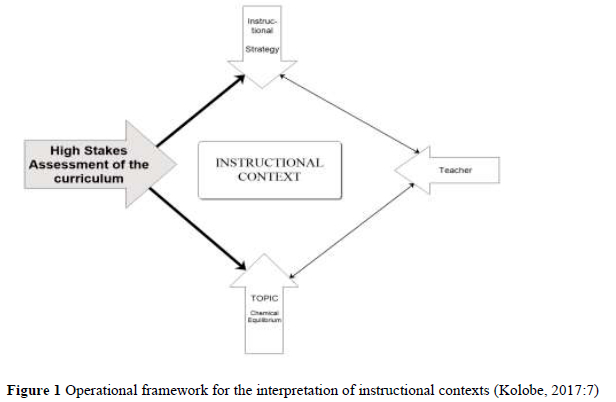
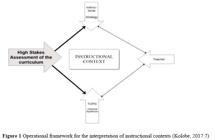
The theoretical framework closest to the focus of this article is "classroom instructional contexts" (Kolobe, 2017; Kolobe & Hobden, 2019; Turner & Meyer, 2000). Four aspects - teacher, learner, content area, and instructional strategies -influence instructional contexts. The framework allows for studying any combinations of these aspects, and even only one of them can be studied. In our study, focus was on the particular science topic taught, since literature supports the idea that learning and teaching demands depend on the topic (Mavhunga & Rollnick, 2011). In the context of this study, the topic was taught by teachers who consistently produced good physical science learner results over a number of years. Among the topics that they taught is chemical equilibrium, an abstract and complex topic that involves most aspects of chemistry teaching. Although chemical equilibrium weighs heavily in the NSC examination, learners generally perform badly in it (DBE, RSA, 2018, 2019, 2020). The simplified and imbalanced framework with a focus on teacher-created instructional contexts and the nature of the interactions between the components of the framework is provided in Figure 1 below. It demonstrates that all four aspects are driven by curriculum assessment.
Research Design and Methodology
This was a triangulated multiple case research study in which qualitative data were obtained using open-ended one-on-one pre-teaching interviews, classroom observations, and reflective journals. A questionnaire was used to gather information about the participants' educational background and career paths. Interviews on how teachers planned to teach chemical equilibrium lasted between 30 and 45 minutes. The interview protocol used was guided by the model for capturing Pedagogical Content Knowledge (PCK) (Loughran, Berry & Mulhall, 2006; Loughran, Mulhall & Berry, 2004) highlighting teacher perceptions about their own teaching. More questions were added to these PCK prompts to adequately address all research questions with emphasis on instructional contexts, framing this study. Less-structured classroom observations, eight to 10, 30 to 50-minute lesson observations were conducted per teacher. This was done throughout the time that they taught the chemical equilibrium topic. One researcher sat at the back of the classroom, video recorded the lessons and took field notes, focusing mainly on teacher actions and their interactions with the learners as well as the content (Bell, 2010; Foster, 2006). Interviews and classroom observations were captured electronically, transcribed verbatim and then coded using NVivo 10. Teachers were also asked to record decisions made during their planning and after teaching each lesson in a notebook. Reflective questions were given to guide this journaling process. Data were generated mainly from March to May, when the teachers taught the topic, according to the official curriculum schedule. This with exception of one teacher, who shuffled the schedule and taught in January instead. His reflection sessions, usually done through journaling by other teachers, were done as interviews. Deductive and then inductive analysis guided by the constructs of the Instructional Contexts theory, Figure 1, was done to determine interactions between the teacher and the other three components from the different data sources. The findings were triangulated with what the teachers were observed doing in the classroom while teaching the topic, i.e. their instructional strategy.
Selecting the Cases
Four teachers and four classes in three schools offering English Home Language and located in the Mangaung Municipality of the Free State province were purposively and conveniently selected (Merriam, 2009) because they consistently produced high numbers of good passes in physical sciences over a 5-year period. The teachers were given pseudonyms of Thato, Lisa, Jane and Percy. Only Thato had a diploma qualification in secondary education. His physical sciences (i.e. physics and chemistry) content was equivalent to first-year university level. Lisa, Jane and Percy had their first degrees in pure sciences and later pursued educational certificates or diplomas to help them become qualified physical sciences teachers. Percy was at university Level 1, Jane at Level 2 and Lisa at Level 3 chemistry training. The lowest level of experience teaching Grade 12 physical sciences, and, therefore, the chemical equilibrium topic, was 5 years for Percy. All teachers had experience in the marking of Senior Certificate examinations except for Jane who taught at the same school as Lisa and they planned together.
Findings
The instructional strategies used in the four cases are presented below.
Thato's Teaching
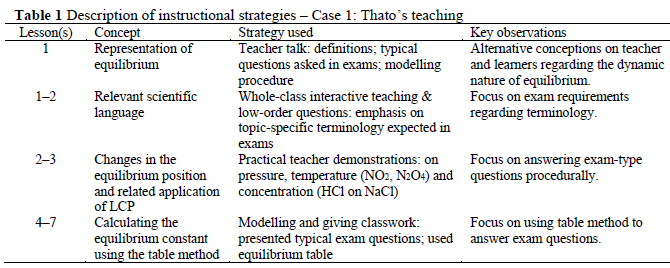
Thato divided the topic into four main components: representation of equilibrium; relevant scientific language; changes in the equilibrium position, and related application of LCP; and calculating the equilibrium constant using the table method. Details of his four strategies are provided in Table 1. His approach in all four aspects was openly examination oriented, based on helping learners answer related examination questions. In class, he showed his learners how each question was marked in the examination, and explained to me how he helped his learners to know the procedures required in the examination, which he found challenging for learners.
Interviewer: How did you address the learners' difficulties during the lesson?
Thato: ... Using the pencil, they must write formula for Kc. Kc equals to the product over the reactants. And if the equation is given, they must substitute that value and leave it like that because they have already achieved one mark. (Thato, post-observation interview)
Thato used the assessment methods normally used in the examinations to familiarise the learners with the examination requirements on this topic. He attempted to demonstrate how to handle the practical activities that are normally examined. In class I observed Thato perform a number of these demonstrations and provided learners with the exact wording they should use when reporting observations:
You will be given a statement like "... consider the following reversible reaction in a sealed container Now it goes back to equilibrium because equilibrium must occur in a closed system. That 'sealed' shows that there is no air that escapes or any substance. Also, you must be aware [that] for the instruction they (i.e. examiners) will use a pitch-black pen, to make you aware that that is an instruction. (Thato, classroom observation)
Drawing on his experience as an examination marker, Thato incorporated commonly examined practical activities, related examination questions and practical tips to prepare the learners to pass the examinations. He provided them with similar questions and demonstrated how to answer these by giving classwork of similar questions and then doing corrections either on the board or verbally, and then asking learners to write their observations in their classwork books. One aspect he mentioned was that learners were expected to state what they would observe in the examined practical activities scenario.
Interviewer: What do you intend the learners to know about each concept?
Thato: You must make the learners to identify, all the time, they must make their observation. They must be able to find the disturbing factor, when you are talking about concentration, because they cannot just mention and say an increase in temperature and all those things but they must identify the disturbing factor. (Thato, pre-observation interview)
I observed Thato having such interactions in his class where he asked learners for their observations. However, he drilled the learners to report these observations in specific ways. Thato's instructional context was thus neither influenced by the nature of the topic nor was the instructional strategy deemed suitable for the topic. On the contrary, his approach was closely aligned with the typical examination requirement pattern used in the NSC chemistry equilibrium questions.
Why Thato taught this way
Thato taught this way because he believed that this was the best way to get most of his learners to pass the physical sciences examination with good marks.
Interviewer: What teaching strategies/procedures do you intend to use when teaching this topic? Any particular reason(s) for choosing that procedure? Thato: I use learner-centred methods and conceptual change teaching methods. I teach in a way that helps learners answer examination questions, spending time doing practice questions and practical demonstrations of experiments. I do this to familiarise the learners with these questions. Ma 'am, I want to see myself really making learners to get 100%. They must not get 30% and then say they have passed. But I'd like to improve the subject.... (Thato, pre-observation interview)
Thato singled out calculation of the equilibrium constant as one of the most difficult aspects in this topic. He focused solely on calculations thereof and used only the table method to calculate the equilibrium constant. He based four of his seven lessons on teaching how to calculate the equilibrium constant on frequently asked examination questions. In each question, he repeated the same steps, always emphasising the need to practice the procedure.
Thato said that he did not follow the DBE work schedule because it did not afford him adequate time to prepare his learners for the NSC examination. He, therefore, taught the topic earlier than recommended. While he claimed that he motivated his learners to follow science-oriented careers and that his approach promoted meaningful and relevant learning, this was not evident in his teaching. The examination assessment of chemical equilibrium and his beliefs about what made learners pass the examination formed key features of the instructional context that he created. This showed that passing the examination and following procedural steps needed for marking, was virtually his sole concern in teaching chemical equilibrium.
Lisa's Teaching
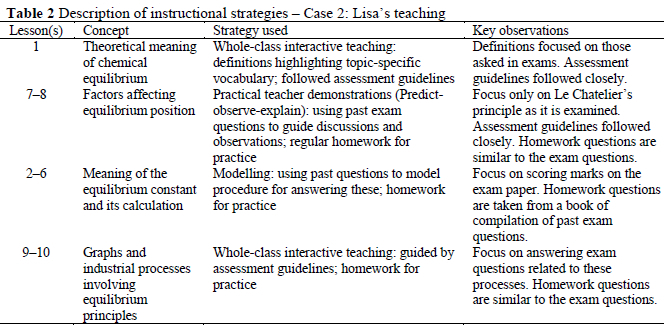
Lisa followed the sequence of the four main components of the chemical equilibrium topic as given in the curriculum: the theoretical meaning of chemical equilibrium; factors affecting equilibrium position; the meaning of the equilibrium constant and its calculation; graphs and industrial processes involving equilibrium principles. These are described in more detail in Table 2. Lisa prioritised completing tasks set in both the assessment guidelines and the curriculum and modelling how to do this. She insisted that learners follow the procedures that she modelled. She used an old prescribed text-specific compilation of questions, arranged in terms of chapters of that textbook. The chapter questions are referred to as "Think Tanks." Lisa gave daily homework of problem tasks similar to the ones she modelled in the classroom. She frequently reminded learners of examination techniques:
So, you first have to calculate the concentration, please you have to show this. You can't just have values [...] you weren't supplied with. You have to show, any value that you use, where you get it from. So, the number of mol here is? (Teacher continues asking questions for each step and writing on the board) ... So now I can go back and substitute. (Lisa, lesson observation)
Lisa indicated to the learners that they could learn the procedure without any understanding of the chemistry involved. She highlighted the key aspects of the procedure instead of trying to give meaning to what they were doing.
Why Lisa taught that way
Lisa believed that the effective teaching of chemical equilibrium was mainly about emphasising important principles by frequently repeating them and showing learners (i.e. modelling) how to respond to different kinds of examination questions. While Lisa informed us that the questions were worded for the previous National Curriculum Statements (NCS) examinations (DoE, 2006) and having prepared candidates for the recently implemented CAPS examinations, Lisa still found this compilation relevant and effective for teaching and preparing her learners for examinations. Interestingly, one of the questions asked in their journals was: "Why is it important for learners to know the concept you intend teaching today?" To this question, Lisa's response was always "exams'" Furthermore, Lisa's responses to the guiding journal question "What is (are) the concept(s) to be taught in this lesson?", Lisa's responses were focused on skills listed in the examination guidelines. These include things like "how to apply equilibrium concentrations in Kc calculation; using Le Chatelier's principle to explain how different changes to equilibrium affect equilibrium position; interpretation of graphs", to name a few. One did not observe mention of helping learners make connections between different concepts, for instance. However, she was aware that learners consistently struggled to holistically understand chemical equilibrium and that her "recipe" (strategy) did not always help them answer questions correctly.
Interviewer: Are there any difficulties or limitations, from your school, yourself or the learners, that you encounter when teaching any of the concepts you mentioned? Please also explain how this becomes a limitation. Lisa: So, they battle to understand that at equilibrium, how do those amounts compare to the initial amounts? Also, they have a problem to understand that at equilibrium, those amounts remain constant at equilibrium, even though there's constant change, the concentrations remain constant, so they battle with that. Then the learners who learn off by heart, because they do not spend enough time really trying to grasp the content, they can do straight-forward questions. You know? Like this is the amount at equilibrium, or this is the recipe we taught you, and they can apply it. But the moment they get a variation, they're lost. (Lisa, pre-observation interview)
Lisa believed that learners needed to have procedural knowledge of calculating the equilibrium constant and to understand what the calculated value meant to manage novel situations. When teaching though, she did not mention the other possible ways of doing the calculation to which she had alluded in the interview. On the contrary, she indicated the pressure she experienced when teaching chemical equilibrium due to insufficient time and the difficulty associated with understanding some aspects of the topic.
I don't think it's a problem, you know, according to the department [DBE], except that, we haven't managed, ever to follow the time schedule. We are always behind.... No, apart from not having enough time, no.... It's just time. We all would like more time. (Lisa, pre-observation interview)
Thus, Lisa's teaching of this topic was influenced by being under pressure to finish the topic in the allocated time even when she felt that learners still did not understand certain aspects of concepts. This feeling of being pressed for time and her awareness of the difficulty of this topic could also explain why Lisa modelled answers to examination-type problems. So, Lisa's created instructional context was greatly influenced by examination content and assessment methods as well as time allocated to the topic. Furthermore, she had mastered the art of getting her learners to pass well, over the years, despite limited understanding of concepts. This shows that focus on the final examination puts the teacher under pressure to teach in a particular way.
Jane's Teaching
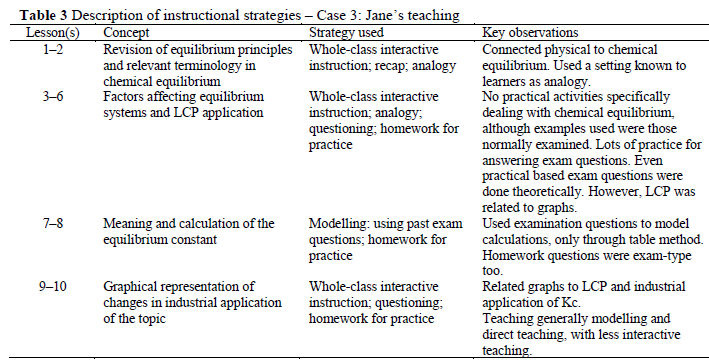
Jane's instructional strategy comprised four key stages: revision of equilibrium principles and relevant terminology in chemical equilibrium; factors affecting equilibrium systems and LCP application; the meaning and calculation of the equilibrium constant; and graphical representation of changes in industrial application of the topic.
These are described in more detail in Table 3. She began the topic by using an analogy to represent the equilibrium principle.
Now, I'm gonna [going to] give you a story, and unfortunately I can't take credit for this story. Let's say we are at Mimmosa Mall (puts up a slide), and there is two floors in Mimmosa Mall. If you go in the entrance down by Wimpy, there are two of my favourite shops that are close to each other. At the bottom you have Mugg & Bean that have the best muffins on earth. Ok? And upstairs you've got Red Pepper that has the best sushi on earth. So, for me, depending on what mood I am in, those are my two favourite shops in the world, ok? Coffee and muffins at Mugg & Bean, sushi at Red Pepper. They are separated by an escalator. So, let's pretend we are in that area of Mimmosa Mall, and on a specific day - it's a slow day - on the first floor, Mugg & Bean there are only seven people. At Red Pepper, they must have a special on and there are 12 people. Red Pepper upstairs. So, seven people at Mugg & Bean, 12 people at the sushi bar at Red Pepper upstairs. And if we look at the escalator, at any given time, there are always, two people on the down escalator, and two people on the up escalator. So, it doesn't matter when you look at the scenario, there will always be seven people at Mugg & Bean, 12 people at Red Pepper, two people on the down escalator and two people on the up escalator. Alright, and there has been a storm and nobody's coming in or out, nobody's travelling. So, we can say that Mimmosa Mall has become a...? (Learners all together shout "Closed system"). (Jane, lesson observation 1)
She also gave two examples of physical equilibrium to demonstrate the principle. Then she modelled examples of the phenomenon by solving related examination-type questions, and then gave similar problems for homework, from which she selected a few and checked on the board for corrections the next day. The questions used were similar to those that Lisa used. They were teaching at the same school and planned their teaching together.
When teaching the calculation of the equilibrium constant, Jane adjusted her teaching methods and focused on strategic ways of answering examination-type questions. She gave learners homework of similar problems for further practice. The next day, she modelled the activities that the learners could not successfully complete as homework. She frequently resorted to her analogy whenever she identified some conceptual challenges. For example, the number of people on the escalators always remained two to signify equal reaction rates.
Why Jane taught that way
Jane said that her choice of teaching strategy was influenced by difficulties faced by learners in understanding and interpreting graphs and calculating the equilibrium constant.
I think the graphs, you'll see as we go through the lesson, we do touch on the graphs fairly early. But the actual interpretation of the graphs we leave until they've done pretty much all the theory. [...] Because the girls tend to find that the trickiest section is the graph interpretation. So, I definitely do all the theory first before we move on to that. (Jane, pre-observation interview)
Jane taught how to use graphical representations in two different places, to explain chemical equilibrium concepts right at the beginning of her teaching and for changes in equilibrium position, a few lessons later. She asked many questions dealing with concentration-time or reaction rate time graphs to show learners how to determine which factor had been changed and to explain the different changes. She indicated that she changed her sequencing of concepts in relation to what learners found difficult to learn: "The Kc calculations ... the learners find it problematic ... " (Jane, pre-observation interview). Knowing the consistency and nature of examination questions as well as common learning difficulties within this topic, Jane adjusted her instructional approach when dealing with the calculation of Kc. As much as she knew that her approach was not the most effective for learning, she still taught procedure and mastering answering examination questions correctly. Jane pinned the challenge on the way in which questions were asked in the examination paper, which she believed was seldom straight forward. Having identified this challenge faced by learners, Jane found it best to teach this as a procedure, using several examples.
But jah, the conversion and the use of a table, to convert your information can be quite problematic. We give them quite a formulaic way of doing things, which is not always best, but it helps them to basically remember what steps to follow. So, when we set a table like this for the conversions, we make sure that we do it the same way every time. So that they are familiar with it. (Jane, pre-observation interview)
At times she told the learners how many marks were allocated to the questions. She literally matched the steps to the marks awarded. She was observed using homework for learners to practise answering similar questions:
I'm gonna give you your homework, I'm gonna give you the whole whack of homework that ummmm . will probably only be due after . the long weekend or after the long 3 weekends (learners laugh and she gives them a list of questions to do) ... Ladies, whatever you do with that, finish Think Tank 16.1 please! Okay, you finish that. That one gives you a lot of experience using Le Chatelier to explain the changes that occur. So, finish Think Tank 16.1 please (repeats the questions to be done) ... as well as, and this work I am giving you now you can't do yet because you haven't yet done the theory. (Jane, lesson observation 6)
Jane's instructional context was influenced by all four aspects of instructional context: her knowledge of the nature of the topic (teacher), what is difficult for learners to understand (teacher); her own subject matter knowledge as a teacher; curriculum assessment requirements (content); and instructional strategy. She believed that learners needed to understand the topic in order for them to pass the examination. She employed some of the recommended teaching methods, such as using an analogy and linking the macroscopic physical equilibrium to the target topic of chemical equilibrium. She also changed the sequence from that given in the curriculum document (i.e. CAPS), in an attempt to cater for her learners' difficulties identified over the years. She also modelled answering examination questions for the benefit of learners who had not understood.
Percy's Teaching
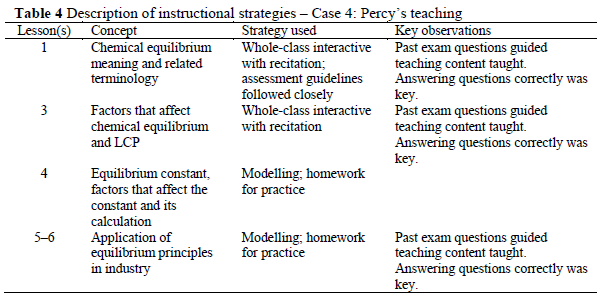
Percy broke down the chemical equilibrium topic into four key components: chemical equilibrium meaning and related terminology; factors that affect chemical equilibrium and LCP; equilibrium constant, factors that affect the constant and its calculation; and the application of equilibrium principles in industry. These are described in more detail in Table 4. The sequence that Percy followed was similar to that given in the official curriculum document. Percy's main strategy was direct teaching using PowerPoint presentations for definitions of key items, modelling how to respond to typical examination questions and asking low-order questions. When teaching meaning and related terminology, he used a series of PowerPoint slides with the title "Important Definitions." The specific terms that Percy defined were "open system; closed system; reversible reaction; dynamic equilibrium; and chemical equilibrium" only. Looking at the examination guidelines that Percy worked from, the following specifications were given under this topic: "Explain what is meant by: Open and closed systems; A reversible reaction; Dynamic equilibrium. " What Percy addressed in class was mainly what was expected of the learners to master in order to pass the examination. So, Percy gave these as definitions, without necessarily teaching the topic and highlighting these important instances and related terms. All questions used by Percy, for both teaching and homework, were examination-type questions sourced from past examination papers.
He kept emphasising that the learners should do as he does. For instance, this is how he worked out equilibrium constant for a reaction between nitrogen monoxide and bromine.
Percy: And then lastly, to get my concentrations at equilibrium, remember yesterday we did this, (teacher writes on the smartboard, below the table c = n/v) concentration is equal to mol divided by? Learners: Volume.
Percy: Volume. What mol? My mol at equilibrium. Mol at equilibrium, divided by volume. So, if we do that, 0 comma 0 2, divided by point 2 5, get point 8 mol per cubic decimetre (teacher then moves to a slide that has all values for equilibrium). Point 0 7 5 divided by point zero 2 5 gives me 0.3 mol.dm-3, and for our products as well. And now that is what we 're looking for, concentrations at equilibrium. You can put it in, write it in (learners copy this into their books). Now Phalatsi, a question like this, just normal calculations like this, 6 marks.
Learner: (whistles in horror). What? Percy: What? So, it's easy marks by the way. But you have to follow my method (points at the table on the slide). My method, my method. You learnt that the hard way now Makhetha (directing a repeating learner). Use my method.
Learner: ijooooo!
Percy: It's similar to the textbook, but you just find that the textbook explains it a bit more. But it also doesn't always use exactly the same one. I'll show you mine works every time again. Next example, (puts up a slide) listen carefully what I want you guys to do. (Percy, classroom observation)
So, Percy's lessons followed the mode of presentation of needed definitions, routine modelling of exam-related questions and homework for practice, despite some aspects being overwhelming to the learners. They had to learn them according to Percy.
Why Percy taught that way
Percy's teaching of chemical equilibrium was largely influenced by his knowledge of examination requirements. He used assessment guidelines to get what learners were expected to know in order to pass the examination. As he stated: "So we basically stick very closely to our requirements that they receive, the exam guidelines" (Percy, pre-observation interview). I observed Percy get his "important definitions" for the chemical equilibrium topic from the same guidelines. He used the same document to inform the learners about what they needed to know and the extent to which they needed it. He also regularly updated learners on their progress. Percy used his NSC examination marking experience to inform the learners of the marking criteria for different types of questions on chemical equilibrium.
Interviewer: So, in each case, what is it that you find important for the learners to learn/know? Percy: Well, we tell them what is important for the exam, so we focus on the exam questions . you'll find that I give PowerPoint presentations in the class to focus on and highlight specific definitions. And then we actually focus on exam questions. Working from the exam questions I' ll show them exactly how to work out and then we'll repeat by doing exam questions, from the textbook. (Percy, pre-observation interview)
This is what I observed in Percy's classes, as shown in the previous section. Percy insisted that learners only used one method to calculate the equilibrium constant.
Please! First thing that I'm gonna show you is to fill in the table, after filling in the table I'm gonna give you an example, which you're gonna complete and I'm gonna help you to complete it, before I give you homework. And yes, there is a lot of homework because I didn't give it for today. So yesterday, we started again with that, please make sure when you draw it, this is very important, look at this, your labels is to the side, right? And then, for your first reactant there's a column. (Percy, classroom observation)
Percy trained his learners to master only this method as it was required in the examination.
Percy kept the learners focused on their progress in relation to the work schedule. He also anticipated shortage of time even before he started teaching this topic: "Well you see the problem is time, time is the limiting factor, so we can't really stand still and re-do" (Percy, pre-observation interview). His strategy to teach this challenging topic was thus seriously influenced by the limited time available. For instance, he avoided fully addressing learners' difficulties understanding the topic because if he did, he would likely not cover everything that needed to be covered. This could explain why Percy taught procedure, said he "drilled" his learners and insisted that they adhered to only one procedure. The instructional context he created was, therefore, solely concerned with curriculum assessment of the chemical equilibrium topic. Believing that learners needed only to pass examinations, he prioritised helping them master examination expectations.
Discussion
The teachers who constituted the cases examined here focused on NSC assessment and taught accordingly. Their teaching was influenced by the examination guidelines supplied by DBE, the compiled topic specific past examination questions, their experience as examination markers, and fellow science teachers at other schools. An in-depth look at the content covered showed that the focus was on examination preparation, with an aim to score marks, as highlighted by scholars such as Berliner (2011), Dulfer et al. (2013), and Morgan and Sfard (2016). Jane differed from the others in that she changed the sequence of concepts which was more likely to improve understanding of the topic (Ghirardi et al., 2015). Her instructional strategy was, therefore, to some extent, also influenced by the nature of the teacher knowledge and of the content (Kolobe & Hobden, 2019; Turner & Meyer, 2000). By focusing solely on these four aspects, these teachers neglected other concepts that make up the topic of chemical equilibrium (Bodner, 1980; Cheung, 2009). The bulk of the instructional contexts created by Thato, Lisa and Percy were focused on extreme preparation for the examinations characterised by drilling and memorisation (Berliner, 2011). According to Berliner, learning in this manner is limited and very few skills are developed. High-stakes status examinations for example, force teachers to want to maintain their statuses ... puts them under lots of pressure to perform.
With the seemingly persistent difficulties within this topic, it is understandable why teachers would resort to helping learners master ways of responding to the commonly asked examinations questions. The focus for teachers and learners has moved away from conceptual understanding to facility with examination questions. High-stakes testing has been and continues to be a problem for years and in many countries, for example, China, the USA and the United Kingdom (UK). The consequences thereof being limited learner experiences, limited critical skills development, limited opportunities to excel in things that are not examined and limiting the building of solid foundations of any concepts. Research shows the effect of high-stakes testing using repeated question types, as impacting on instruction in different ways. For example, there is limited coverage of concept assessments as question types are repeated to the point where they can be predicted, and in addition there are deficiencies in the learner experiences in terms of exposure to different scenarios. Teachers have altered their pedagogy toward preparation for predictable examination problem types.
In all four cases, teacher beliefs regarding what makes effective teaching were very similar and were based on the need to prepare learners for the NSC examination (Gonzalez et al., 2017). All four teachers believed that learners learned best if they were exposed to what was examined and were given a chance to practise it (Berliner, 2011; Morgan & Sfard, 2016). They also believed that continuous practice of routine problems benefited learners, especially if they did not understand the concepts. All four teachers believed that limiting the content to routine problems and drilling learners on examination techniques catered for the limited time available for teaching the topic for high-stakes testing (Gonzalez, Peters, Orange & Grigsby, 2017). Teachers generally felt that there was little time to address learning difficulties while also preparing the learners to pass the examinations. This is why they also only taught those chemical equilibrium concepts/aspects which were commonly focused on in the examination and did not necessarily take time to ensure that the basic principles of the topic form the foundation of their teaching.
In this study we argue that intense focus on examination success, while succeeding in its short-term goal, is undermining the possibilities of deeper conceptual learning. With the nature of examination questions hardly changing (Nakedi et al., 2012), teachers know what always works with regard to performance in the examinations. It is, therefore, ironic that candidates handle this topic poorly even though similar questions are asked yearly (DBE, RSA, 2018, 2019, 2020). Teachers believe that this is because there is not enough time to teach everything and to address learning difficulties and that the assessment does not require conceptual understanding, but mastery of routine.
As has been argued in this article, with regard to the topic of chemical equilibrium, a foundation of flawed content exists. This draws attention to both the failure of teachers to teach for conceptual understanding and the failure of the NSC assessment to measure adequately the conceptual foundation in chemistry. It appears that learners can pass and subsequently be selected for university courses with good procedural understanding but inadequate conceptual understanding of critical topics. Consequently, the status and nature of examinations need to be addressed so that there is more effective alignment between the desired published curriculum and the instruction happening in the classroom, and this should be evident in the assessment of learning done. Currently, only the curriculum seems to be changing while the assessment does not persuade teachers to change instruction. If that can be achieved, then higher-education institutions will be able to build on quality learning at the basic education level. This is, however, less likely to be possible when there is so much public pressure to measure the effectiveness of basic education and of specific schools by means of NSC examinations pass rates only. This is likely to apply to any country with a high-stakes examination culture regardless of socio-economic development status since, as a general principle, the testing of a concept is highly likely to influence how it is taught and learnt, rather than the intended outcomes and related instructions.
Through this study the obsession with pass rates in the NSC and how this was distorting the teaching of chemistry, was highlighted. It was argued that this examination obsession has longterm negative consequences for the teaching and learning of physical science.
Authors' Contributions
LK conceptualised and wrote the article based on her PhD research. PH assisted with conceptualisation, editing and reviewing of the article.
Notesi. Published under a Creative Commons Attribution Licence.
References
-
Aini FQ, Fitriza Z, Gazali F & Mawardi 2019. First-year university students' understanding of chemical equilibrium. Journal of Physics: Conference Series, 1280:032018. https://doi.org/10.1088/1742-6596/1280/3/032018
» https://doi.org/10.1088/1742-6596/1280/3/032018 -
Alexander PA, Kulikowich JM & Schulze SK 1994. How subject-matter knowledge affects recall and interest. American Educational Research Journal, 31(2):313-337. https://doi.org/10.3102/00028312031002313
» https://doi.org/10.3102/00028312031002313 - Bell SE 2010. Visual methods for collecting and analysing data. In I Bourgeault, R Dingwall & R De Vries (eds). The Sage handbook of qualitative methods in health research. London, England: Sage.
-
Berliner D 2011. Rational responses to high stakes testing: The case of curriculum narrowing and the harm that follows. Cambridge Journal of Education, 41(3):287-302. https://doi.org/10.1080/0305764X.2011.607151
» https://doi.org/10.1080/0305764X.2011.607151 -
Bodner GM 1980. On the misuse of Le Chätelier's principle for the prediction of the temperature dependence of the solubility of salts. Journal of Chemical Education, 57(2):117-119. https://doi.org/10.1021/ed057p117
» https://doi.org/10.1021/ed057p117 -
Cheung D 2009. The adverse effects of Le Chätelier's principle on teacher understanding of chemical equilibrium. Journal of Chemical Education, 86(4):514-518. https://doi.org/10.1021/ed086p514
» https://doi.org/10.1021/ed086p514 -
Cheung D, Ma HJ & Yang J 2009. Teachers' misconceptions about the effects of addition of more reactants or products on chemical equilibrium. International Journal of Science and Mathematics Education, 7:1111-1133. https://doi.org/10.1007/s10763-009-9151-5
» https://doi.org/10.1007/s10763-009-9151-5 -
Davenport J, Leinhardt G, Greeno J, Koedinger K, Klahr D, Karabinos M & Yaron DJ 2014. Evidence-based approaches to improving chemical equilibrium instruction. Journal of Chemical Education, 91:1517-1525. https://doi.org/10.1021/ed5002009
» https://doi.org/10.1021/ed5002009 - Department of Basic Education, Republic of South Africa 2018. National Senior Certificate 2017 Diagnostic Report Part 1. Pretoria: Author.
- Department of Basic Education, Republic of South Africa 2019. National Senior Certificate 2018 Diagnostic Report Part 1. Pretoria: Author.
- Department of Basic Education, Republic of South Africa 2020. Report on the 2019 National Senior Certificate Diagnostic Report Part 1. Pretoria: Author.
-
Doymus K 2008. Teaching chemical equilibrium with the jigsaw technique. Research in Science Education, 38:249-260. https://doi.org/10.1007/s11165-007-9047-8
» https://doi.org/10.1007/s11165-007-9047-8 -
Dulfer N, Polesel J & Rice S 2013. Senate Inquiry into the Effectiveness of the National Assessment Program - Literacy and Numeracy (NAPLAN). Parramatta, Australia: Whitlam Institute. Available at https://citeseerx.ist.psu.edu/document?repid=rep1&type=pdf&doi=aad853b66a9a2f042e8b49ca1e54feea3afe4c7d. Accessed 31 December 2022.
» https://citeseerx.ist.psu.edu/document?repid=rep1&type=pdf&doi=aad853b66a9a2f042e8b49ca1e54feea3afe4c7d -
Eny HA & Wiyarsi A 2019. Students' chemical literacy on context-based learning: A case of equilibrium topic. Journal of Physics: Conference Series, 1397:012035. https://doi.org/10.1088/1742-6596/1397/1/012035
» https://doi.org/10.1088/1742-6596/1397/1/012035 - Foster P 2006. Data collection. In R Sapsford & V Jupp (eds). Data collection and analysis (2nd ed). London, England: Sage.
-
Ganaras K, Dumon A & Larcher C 2008. Conceptual integration of chemical equilibrium by prospective physical sciences teachers. Chemistry Education Research and Practice, 9:240-249. https://doi.org/10.1039/B812413M
» https://doi.org/10.1039/B812413M -
Ganasen S & Shamuganathan S 2017. The effectiveness of physics education technology (PhET) interactive simulations in enhancing matriculation students' understanding of chemical equilibrium and remediating their misconceptions. In M Karpudewan, ANM Zain & AL Chandrasegaran (eds). Overcoming students' misconceptions in science: Strategies and perspectives from Malaysia. Gateway East, Singapore: Springer. https://doi.org/10.1007/978-981-10-3437-4
» https://doi.org/10.1007/978-981-10-3437-4 -
Ghirardi M, Marchetti F, Pettinari C, Regis A & Roletto E 2014. A teaching sequence for learning the concept of chemical equilibrium in secondary school education. Journal of Chemical Education, 91(1):59-65. https://doi.org/10.1021/ed3002336
» https://doi.org/10.1021/ed3002336 -
Ghirardi M, Marchetti F, Pettinari C, Regis A & Roletto E 2015. Implementing an equilibrium law teaching sequence for secondary school students to learn chemical equilibrium. Journal of Chemical Education, 92(6):1008-1015. https://doi.org/10.1021/ed500658s
» https://doi.org/10.1021/ed500658s -
Gonzalez A, Peters ML, Orange A & Grigsby B 2017. The influence of high-stakes testing on teacher self-efficacy and job-related stress. Cambridge Journal of Education, 47(4):513-531. https://doi.org/10.1080/0305764X.2016.1214237
» https://doi.org/10.1080/0305764X.2016.1214237 -
Howie S 2012. High-stakes testing in South Africa: Friend or foe? Assessment in Education: Principles, Policy & Practice, 19(1):81-98. https://doi.org/10.1080/0969594X.2011.613369
» https://doi.org/10.1080/0969594X.2011.613369 -
Hughes BE, Garibay JC, Hurtado S & Eagan K 2013. Examining the tracks that cause derailment: Institutional contexts and engineering degree attainments. Paper presented at the American Educational Research Association annual meeting, San Francisco, CA, 27 April - 1 May. Available at https://www.heri.ucla.edu/nih/downloads/AERA-2013-Engineering-Completion.pdf. Accessed 31 December 2022.
» https://www.heri.ucla.edu/nih/downloads/AERA-2013-Engineering-Completion.pdf - Hugo W, Jack M, Wedekind V & Wilson D 2010. The state of education in KwaZulu-Natal: A report for KZN Treasury. Pietermaritzburg, South Africa: School of Education and Development, University of KwaZulu-Natal.
-
Jusniar J, Effendy E, Budiasih E & Sutrisno S 2020. Misconceptions in rate of reaction and their impact on misconceptions in chemical equilibrium. European Journal of Educational Research, 9(4):1405-1423. https://doi.org/10.12973/eu-jer.9.4.1405
» https://doi.org/10.12973/eu-jer.9.4.1405 -
Karpudewan M, Treagust DF, Mocerino M, Won M & Chandrasegaran AL 2015. Investigating high school students' understanding of chemical equilibrium concepts. International Journal of Environmental & Science Education, 10(6):845-863. https://doi.org/10.12973/ijese.2015.280a
» https://doi.org/10.12973/ijese.2015.280a - Kolobe L 2017. Teaching Chemistry under the magnifying glass: Cases of experienced teachers teaching chemical equilibrium. PhD thesis. Durban, South Africa: University of KwaZulu-Natal.
-
Kolobe L & Hobden P 2019. Instructional contextual contestations in the teaching of chemical equilibrium: A multiple-case study. African Journal of Research in Mathematics, Science and Technology Education, 23(2): 169-180. https://doi.org/10.1080/18117295.2019.1631553
» https://doi.org/10.1080/18117295.2019.1631553 - Loughran J, Berry A & Mulhall P 2006. Understanding and developing science teachers' pedagogical content knowledge. Rotterdam, The Netherlands: Sense.
-
Loughran J, Mulhall P & Berry A 2004. In search of pedagogical content knowledge in science: Developing ways of articulating and documenting professional practice. Journal of Research in Science Teaching, 41(4):370-391. https://doi.org/10.1002/tea.20007
» https://doi.org/10.1002/tea.20007 -
Makgato M & Mji A 2006. Factors associated with high school learners' poor performance: A spotlight on mathematics and physical science. South African Journal of Education, 26(2):253-266. Available at http://www.sajournalofeducation.co.za/index.php/saje/article/view/80/55. Accessed 31 December 2022.
» http://www.sajournalofeducation.co.za/index.php/saje/article/view/80/55 -
Manik S 2015. 'As a person you need help every now and then' : Accessing students' support needs in a higher education environment. South African Journal of Higher Education, 29(3):101-117. Available at https://journals.co.za/doi/epdf/10.10520/EJC176233. Accessed 31 December 2022.
» https://journals.co.za/doi/epdf/10.10520/EJC176233 -
Mavhunga ME & Rollnick M 2011. The development and validation of a tool for measuring topic specific PCK in chemical equilibrium. In C Bruguière, A Tiberghien & P Clément (eds). Ebook proceedings of the ESERA 2011 conference: Science learning and citizenship. Lyon, France: European Science Education Research Association. Available at https://repositorium.sdum.uminho.pt/handle/1822/19553. Accessed 31 December 2022.
» https://repositorium.sdum.uminho.pt/handle/1822/19553 -
Mavhunga E & Rollnick M 2013. Improving PCK of chemical equilibrium in pre-service teachers. African Journal of Research in Mathematics, Science and Technology Education, 17(1-2):113-125. https://doi.org/10.1080/10288457.2013.828406
» https://doi.org/10.1080/10288457.2013.828406 - Merriam SB 2009. Qualitative research: A guide to design and implementation. San Francisco, CA: Jossey-Bass.
-
Moodley P & Singh RJ 2015. Addressing student dropout rates at South African universities [Special edition]. Alternation, 17:91-115. Available at https://openscholar.dut.ac.za/bitstream/10321/1648/1/Moodley_Alt_Special%20Edition_No17_2015.pdf. Accessed 31 December 2022.
» https://openscholar.dut.ac.za/bitstream/10321/1648/1/Moodley_Alt_Special%20Edition_No17_2015.pdf -
Morgan C & Sfard A 2016. Investigating changes in high-stakes mathematics examinations: A discursive approach. Research in Mathematics Education, 18(2):92-119. https://doi.org/10.1080/14794802.2016.1176596
» https://doi.org/10.1080/14794802.2016.1176596 -
Nakedi M, Taylor D, Mundalamo F, Rollnick M & Mokeleche M 2012. The story of a physical science curriculum: Transformation or transmutation? African Journal of Research in Mathematics, Science and Technology Education, 16(3):273-288. https://doi.org/10.1080/10288457.2012.10740745
» https://doi.org/10.1080/10288457.2012.10740745 -
Nurhasanah, Azhar M & Ulianas A 2020. Validity and practicality of chemical equilibrium module based on structured inquiry with three levels representation for students grade XI of senior high school. Journal of Physics: Conference Series, 1481:012084. https://doi.org/10.1088/1742-6596/1481/1/012084
» https://doi.org/10.1088/1742-6596/1481/1/012084 -
Piquette JS & Heikkinen HW 2005. Strategies reported used by instructors to address student alternative conceptions in chemical equilibrium. Journal of Research in Science Teaching, 42(10):1112-1134. https://doi.org/10.1002/tea.20091
» https://doi.org/10.1002/tea.20091 -
Potgieter M & Davidowitz B 2010. Grade 12 achievement rating scales in the new National Senior Certificate as indication of preparedness for tertiary chemistry. South African Journal of Chemistry, 63:75-82. Available at https://www.ajol.info/index.php/sajc/article/view/123721. Accessed 31 December 2022.
» https://www.ajol.info/index.php/sajc/article/view/123721 -
Potgieter M & Davidowitz B 2011. Preparedness for tertiary chemistry: Multiple applications of the Chemistry Competence Test for diagnostic and prediction purposes. Chemistry Education Research and Practice, 12:193-204. https://doi.org/10.1039/C1RP90024B
» https://doi.org/10.1039/C1RP90024B -
Potgieter M, Davidowitz B & Mathabatha SS 2008. Preparedness for tertiary chemistry: Issues of placement and performance of academic development programmes. South African Journal of Higher Education, 22(4):861-876. Available at https://journals.co.za/doi/epdf/10.10520/EJC37470. Accessed 31 December 2022.
» https://journals.co.za/doi/epdf/10.10520/EJC37470 -
Rogan J & Aldous C 2005. Relationships between the constructs of a theory of curriculum implementation. Journal of Research in Science Teaching, 42(3):313-336. https://doi.org/10.1002/tea.20054
» https://doi.org/10.1002/tea.20054 -
Sahara R, Subarkah CZ & Rahmatullah S 2019. The making electronic modules visualization chemical equilibrium process based on predict-observe-explain. Journal of Physics: Conference Series, 1402:055035. https://doi.org/10.1088/1742-6596/1402/5/055035
» https://doi.org/10.1088/1742-6596/1402/5/055035 -
Slabbert R & Friedrich-Nel H 2015. Extended curriculum programme evolution: A road map to academic success? South African Journal of Higher Education, 29(1):45-59. Available at https://journals.co.za/doi/epdf/10.10520/EJC172799. Accessed 31 December 2022.
» https://journals.co.za/doi/epdf/10.10520/EJC172799 -
Spaull N 2013. South Africa's education crisis: The quality of education in South Africa 1994-2011. Johannesburg, South Africa: Centre for Development & Enterprise. Available at https://section27.org.za/wp-content/uploads/2013/10/Spaull-2013-CDE-report-South-Africas-Education-Crisis.pdf. Accessed 31 December 2022.
» https://section27.org.za/wp-content/uploads/2013/10/Spaull-2013-CDE-report-South-Africas-Education-Crisis.pdf - Taylor N & Vinjevold P (eds.) 1999. Getting learning right: Report to the President' s Education Initiative Research Project. Johannesburg, South Africa: Joint Education Trust.
-
Turányi T & Tóth Z 2013. Hungarian university students' misunderstandings in thermodynamics and chemical kinetics. Chemistry Education Research and Practice, 14:105-116. https://doi.org/10.1039/C2RP20015E
» https://doi.org/10.1039/C2RP20015E -
Turner JC & Meyer DK 2000. Studying and understanding the instructional contexts of classrooms: Using our past to forge our future. Educational Psychologist, 35(2):69-85. https://doi.org/10.1207/S15326985EP3502_2
» https://doi.org/10.1207/S15326985EP3502_2 -
Ulinnaja H, Subandi & Muntholib 2019. High school students' mental models on chemical equilibrium. Journal Pendidikan Sains, 7(2):58-64. https://doi.org/10.17977/jps.v7i2.13324
» https://doi.org/10.17977/jps.v7i2.13324 - Van Driel JH & Graber W 2002. The teaching and learning of chemical equilibrium. In JK Gilbert, O De Jong, R Justi, DF Treagust & JH Van Driel (eds). Chemical education: Towards research-based practice. Norwell, MA: Kluwer Academic.
-
Wheeldon R, Atkinson R, Dawes A & Levinson R 2012. Do high school chemistry examinations inhibit deeper level understanding of dynamic reversible chemical reactions? Research in Science & Technological Education, 30(2):107-130. https://doi.org/10.1080/02635143.2012.692362
» https://doi.org/10.1080/02635143.2012.692362 -
Yildirim N, Kurt S & Ayas A 2011. The effect of the worksheets on students' achievement in chemical equilibrium. Journal of Turkish Science Education, 8(3):44-58. Available at http://repository.bilkent.edu.tr/bitstream/handle/11693/21794/The%20effect%20of%20the%20worksheets%20on%20students%27%20achievement%20in%20chemical%20equilibrium.pdf?sequence=1&isAllowed=y. Accessed 31 December 2022.
» http://repository.bilkent.edu.tr/bitstream/handle/11693/21794/The%20effect%20of%20the%20worksheets%20on%20students%27%20achievement%20in%20chemical%20equilibrium.pdf?sequence=1&isAllowed=y
Revised: 25 June 2020
Accepted: 17 February 2022
Published: 31 December 2022