Perceptions of English language learning and teaching: Implications for social justice in Chivi district primary schools, Zimbabwe
Abstract
In this study we critically investigated English as the language of learning and teaching (LoLT) in the Chivi district (Zimbabwe) and the implications of its use as the LoLT for social justice education. Data were collected through semi-structured interviews, focus-group interviews, observation and document analysis. The results show that social justice education is achievable when both learners and teachers have equal access to the language of their choice in teaching and learning. The findings further reveal that English as the language of instruction is considered to be a threat to people's culture and identity. With this study we contribute to the existing body of knowledge by advocating for social justice within the education system in the Chivi district of Zimbabwe.
critical investigation; culture; English; implications; indigenous languages; language of learning and teaching; learners; perceptions; social justice education; teachers; transitional submersion
Introduction and Background
The use of English as the language of learning and teaching (LoLT) at Grade 3 level is under-researched in Zimbabwe, particularly in the Chivi district. Studies on English as the LoLT (Chimhenga & Chivhanga, 2013; Dube & Ncube, 2013; Muchenje, Goronga & Bondai, 2013; Shizha, 2007; Sithole, 2016; Siwela, 2018; Trudell, 2016) were conducted in Zimbabwe, however, none of them focused on Grade 3. In addition, little attention was given to how English as the LoLT reflected or impeded education for social justice. This is despite the presence of rich and relevant literature on social justice education (Bell, 2016; Gale & Densmore, 2000; Nelson, Creagh & Clarke, 2012).
Indigenous languages (ILs) not being the LoLT in the Chivi district is a topical issue in as far as social justice education is concerned. This is because ILs are spoken by 99% of the population and English as a home language is spoken by only 1% of the Zimbabwean population (Bureau of Democracy, Human Rights and Labor, 2012). As if this were not enough, the education language policy in Zimbabwe (Zimbabwe, 2019) states that English should be the LoLT from Grade 3 onwards. This has compromised social justice education because young learners have experienced the early retirement of their heritage languages (ILs), thereby exposing them to transitional submersion. Shona, Ndebele and Shangani, which are the local (indigenous) languages spoken in the Chivi district, have been replaced by English as the LoLT, which is a second language for learners and the majority of teachers.
Previous studies on English as the LoLT were macro in nature, that is, they focused on English as the LoLT across the school curriculum from Grades 1 to 7 or from Forms 1 to 4 (Harris, 2011; Owu-Ewie & Eshun, 2015; Trudell, 2016). Other studies concentrated on the use of English as the LoLT for specific subjects, for example in science, mathematics or social studies at both primary school and secondary school level (Bacha, 2011; Buttaro, 2014; Cholakova, 2015; Paauw, 2009). We approached the issue of English as the LoLT which creates bias towards social justice education in Grade 3 from a micro point of view as the literature is largely silent on this. The reason might be that the concept of social justice education was ill-conceived due to the policy shift in the language of education which occurred in 2015 (Ministry of Primary and Secondary Education, 2016; Zimbabwe, 2019). The policy shift dictates the introduction of English as the LoLT, starting from Grade 3 instead of Grade 4 as stated in the 1987 Education Act (Zimbabwe, 1987). As a result, the capacity to foster social justice education within the school system has been compromised.
This study builds on Mashuro's (2021) study, "The use of English as a language of instruction and its implications on social justice in primary schools in Chivi District, Zimbabwe: A critical investigation." Mashuro's (2021) study specifically dealt with the problems that Grade 3 learners faced when using English as the LoLT at the expense of their heritage language. Mashuro (2021) tried to determine whether disregarding ILs as the LoLT by replacing them with English promoted social justice education practice or malpractice, as language cannot be separated from culture, identity and integrity (Das, 2016:152; Said, 2011).
Literature Review
Perceptions of learners about English as the LoLT
Literature discusses the attitudes of learners who use English as the LoLT. Ntshangase (2011:18-19) concludes that in South Africa the implications of learning in English for a learner whose mother tongue is neither English nor Afrikaans are devastating when the learner is expected to switch to English as the language of learning. This also applies to learners in the Chivi district who are introduced to English as the LoLT in Grade 3 after using their heritage language as the LoLT in the early childhood development (ECD) stage and in Grades 1 and 2. This switch affects these young learners negatively because they struggle to internalise the new language and subject content. The dramatic shift from the mother tongue to a new language - English in this case - is cause for concern. Schaefer (2010:8) argues that anybody being introduced to a new culture for the first time is likely to experience culture shock. To this end, social justice practices in education at primary school level where the LoLT is not the learners' mother tongue are mythically conceived.
In their qualitative study on Grades 1 to 7 learners in Zimbabwe, Muchenje et al. (2013) comment on learners' views on English as the LoLT. One learner in their study said that occasionally he was reluctant to read the charts and textbooks because they were not written in his home language (Muchenje et al., 2013), which is reflective of the idea that learners prefer and want to use their own language when learning. Although Muchenje et al. (2013) focused on primary school learning, we only focus on Grade 3. However, the studies are similar in that they are critical of the LoLT used in Zimbabwe. Both are of the view that English as the LoLT is a challenge in the Zimbabwean education system. There should be a vigorous study on the LoLT being used across schools in Zimbabwe in order to produce a lasting solution to the policy on language of education.
Furthermore, Erling, Adinolfi and Hultgren (2017:34) and Klapwijk and Van der Walt (2016:77) assert that learners hold the view that policies on English medium instruction contribute to keeping learners from non-affluent backgrounds from learning English. Poor children from non-affluent backgrounds are not accorded the opportunity to study English outside of the classroom, and the school environment is not conducive to developing their home languages. Most Grade 3 learners in the Chivi district come from non-affluent backgrounds, as a result, it is difficult for them to engage in English at home. Most parents are illiterate and cannot procure reading material for their children to study in English on their own. Mlay (2010:100) argues that some rural parents lack educational awareness, and that they cannot afford to purchase supplementary reading materials in addition to paying school fees. The introduction of English as the LoLT in Grade 3 within the district is actually a form of gate keeping. This is because learners from affluent backgrounds have the relevant skills and a better opportunity to study English outside of the classroom. They thus have greater access to the resources needed to further their English when compared to their non-affluent counterparts. Consequently, an unequal environment is created and the gap between learners is further amplified. In this context, social justice is compromised in the education system within schools in the Chivi district.
Derakhshan and Karimi (2015:2) reveal that the learner's first language has an effect on the acquisition of a second language. Therefore, the use of English as the LoLT at primary school level in the Chivi district is a disadvantage. This is because understanding subject matter delivered in a second language is problematic. To substantiate Derakhshan and Karimi's (2015) view, Alebaid (2021) argues that second language learners intermingle their first language with the second language. While ILs are a pillar in communicating academic content, they tend to play a peripheral role in the Chivi district. To that effect, social injustice is rife in the education system.
Learners do not only perceive English as the mandatory LoLT in terms of expanding their knowledge, but also in terms of granting them employment opportunities and access to further studies (Erling et al., 2017:38; Hann, Timmis, Alkhaldi, Davies, Troncoso & Yi, 2014:10;
Pennycook, 2001:81). This implies that learners prefer English as the LoLT as it is based on the belief that English proficiency guarantees one a prestigious occupation or job opportunity, and entry into higher education. This means that after ordinary level (Form 4) life is determined by having passed high school in English, be it to secure a job or to further one's education. Nevertheless, numerous studies have revealed that mother tongue instruction bears positive academic results for learners (Babaci-Wilhite, 2013; Brock-Utne, 2014:10) and can, therefore, enhance a learner's academic achievement. Thus, the current situation in primary schools in the Chivi district where Grade 3 learners use English as the LoLT demonstrates a need for social justice in the education sector.
Hopkyns (2014) warns that in the United Arab Emirates (UAE), while English can produce the benefits of Western cultures, it is an infamous partner. This is because the introduction of English has become a threat to several home languages and cultures (Badry, 2011:85; Pan & Seargeant, 2012). Consequently, it can be surmised that English can be a source of language attrition and cultural demise. In the UAE, Arabic is the dominant language and cultural influence. However, the introduction of English has introduced some challenges within its communities (Hopkyns, 2014). Al-Issa and Dahan (2011:3) concur that the key function of English is for UAE citizens to finally do away with Arabic as the mode of communication in their social activities and in the education system. The introduction of English as the LoLT undermines learners' home language, which then has negative consequences for both local languages and the cultures they portray. The emphasis on English as the LoLT leads to language death and cultural erosion, thereby giving English a dominant role in the education sector and within the social aspects of the community. This is because losing a language is losing both one's culture and identity (Said, 2011:191). The fact that local languages are not the LoLT in primary schools in the Chivi district implies that learners are gradually losing their culture and identity. This is in line with the view of the critical theorist, Carnoy (Drysdale, 1975), who postulates that this exchange of languages is a metaphor for colonialism, i.e., the annexation by and control of one nation by another occurs when English replaces the local languages (Ani, 1994:xxvii). Thus, Western cultural behaviour dominates developing countries and their cultures and to this effect, the LoLT becomes a threat. This means that the replacement of local languages with English as the LoLT is akin to social injustice.
It is clear that English affects people's identity and the way they think and talk. One respondent in a UAE study revealed that English affected learners to the extent that everything they think, write and speak is in English, which causes them to think like foreign people (Hopkyns, 2014:10). The previously noted perception of learners' positive regard of English as the LoLT points to the denigration of heritage languages in education which ultimately hampers learners' social justice, thus becoming a form mental colonisation of learners. Chimhenga and Chivhanga (2013:59) postulate that people relegate their heritage languages to second-class status in comparison to English. Their identity and ways of thinking and viewing the world are affected negatively and to a great extent. Ntshangase (2011:11) highlights the role of language in cognitive functioning, and that language is a vital thinking tool. However, problems emanate when people think in their heritage languages and communicate in a second language. Contextually, learners in Zimbabwe's education system (particularly in primary schools in the Chivi district) speak Shona, Ndebele and Shangani. This means that they think in these languages but use English when it comes to speaking and writing. Building on the idea that heritage languages are an integral part of people's culture and identity, English as the LoLT can be regarded as a threat to culture and identity. The use of English as the LoLT in the education system is a dangerous practice as it actually shows learners that their ILs are not as important as English (Badry, 2011:85).
Perceptions of teachers regarding English as the LoLT
Owu-Ewie (2013:68) found that teachers agree that learners grasp concepts faster when they use their home languages as compared to using a LoLT that is not their mother tongue. These teacher sentiments about English as the LoLT convey that local languages should be given first preference as the language of instruction. The primary languages of learners should be espoused, as they are advantageous to them when learning. Ochshom and Garcia (2007:16) argue that although literacy in a second language is a difficult task, for English second language speakers to overcome English language barriers, their mother tongue should not be ignored in teaching. This implies that early immersion in English as the LoLT for Grade 3 learners in primary schools in the Chivi district is a manifestation of social justice malpractice within the education sector. It would be more advantageous if learners were allowed to continue learning in local languages as their LoLT. These heritage languages could assist them in learning to read and write in English with ease, since second language learning is impacted by mother tongue learning (Derakhshan & Karimi, 2015). The teachers' abrupt shift to English as medium of instruction in Grade 3 causes confusion and anxiety, and learners experience cultural shock (Sadovnik & Coughlan, 2016:84; Schaefer, 2010:8).
In another qualitative study by Dube and Ncube (2013) which focused on Ndebele as an IL in Zimbabwe, teachers established that heritage languages were being crippled by limiting them to lower grades. It has become illegal to use ILs as LoLT in the higher grades of primary and secondary schools (Zimbabwe, 2019). To make matters worse, the Zimbabwean education system does not regard English as a foreign language, but equates it to ILs that are undervalued by curriculum designers (Dube & Ncube, 2013). These barriers prevent ILs from becoming the LoLT, and limit their use to lower grades (ECD to Grade 2). These strategies are meant to maintain a status quo but have in fact violated the right to linguistic diversity and the desire for social justice in education. Given this background, we aim to contribute to the creation of a conducive learning environment where ILs are recognised in the school curriculum in Zimbabwe.
Although the acquisition of English proficiency by Grade 3 learners in order for them to be able to communicate on a global scale is a positive future goal, the question arises whether the teachers who are mandated to teach these learners are competent in teaching in English. In his study, Buttaro (2014) found several grammatical errors and spelling mistakes in lesson delivery, through a cross-check of teachers' work. Instructions for learners written on chalkboards and lesson charts contained spelling mistakes and grammatical errors. Thus, the teachers' lack of English proficiency compromises the Grade 3 learners' quality of education to a large extent. It is against this background that a critical analysis of English as the LoLT was undertaken to determine how its influence may facilitate social justice in education. Therefore, the research question of this study is: Does the choice of English as the LoLT at the expense of local languages place learners at an advantage or at a disadvantage?
Positive views about English as the LoLT were echoed in Shizha's (2007) qualitative research study, where he argues that teachers perceive local languages, African children's stories and parental experiences as lacking and ill-informed, while English and other Western languages are regarded as enriched and capable of enhancing learning experiences (Shizha, 2007). These attitudes are a testimony to the colonial mentality where the imposition of English as the LoLT propagated the devaluation of local languages, and because of this, the cultural products of developed countries were allowed to "invade" less developed countries and dominate local cultures (Drysdale, 1975). The notion that ILs are lacking is a colonial mentality. Africans in Zimbabwe have been conditioned to believe that their local languages cannot deliver quality education.
Regarding communication breakdowns and the difficulties that both learners and teachers face during lesson delivery, in a study conducted in India and Ghana, Erling et al. (2017:13) established that the LoLT used hindered communication. In both countries, some teachers had problems communicating in English during lesson delivery, consequently English communication was fragmented and code-switching was rife (Erling et al., 2017).
These problems are a result of avoiding home language in educational instruction. The Indian and Ghanaian study should be an eye-opener to the global education fraternity and should be used as a point of consideration for the promotion of ILs as the LoLT. The findings of Erling et al. (2017) indicate that effective communication in the classroom is very important. Freire (1978:99) comments that to limit communication is to reduce people to the status of objects - and doing so is the goal of oppressors, not liberators. In accordance with Freire's (1978) comments, it should be questioned why English is the LoLT in primary schools in the Chivi district when it hinders effective classroom dialogue.
Across the globe, when unpacking teachers' perceptions of English as the LoLT, it was revealed that a communication breakdown between teachers and learners is a common feature in most linguistically diverse classrooms (Dávila & Linares, 2020). This is because classroom environments are usually multicultural in nature. Therefore, a teacher who is proficient in a particular language is not always competent at communicating with learners who are proficient in languages that are different from the teacher's home language. In this context, language barriers are problematic for both teachers and learners. Dávila and Linares' (2020) study involved a Spanish teacher who taught non-Spanish-speaking learners. The Spanish teacher had problems when using Spanish to teach native English, French and speakers of other languages. However, our study was conducted in a linguistic environment where Ndebele, Shangani and Shona are spoken by both teachers and learners, but it is still expected that teaching and learning should take place in English. The emphasis on the use of English as the LoLT impedes social justice education practices.
In a qualitative study conducted in Zambia, Ndeleki (2015:iv) established that teachers associated the use of ILs with an inferiority complex, while the use of English enjoyed high status because English was considered to be the language of the elite. In other words, Ndeleki's (2015) study associates ILs with learners who have low self-esteem, while gaining proficiency in English assimilates learners into an elite group. The study by Ndeleki (2015) focused on ILs as the mode of instruction in Grades 1 to 4 in private primary schools, whereas in our study we explored English as the LoLT in Grade 3 in rural public primary schools in Zimbabwe. However, the two studies are similar in that they attempt to determine whether or not social justice education is practiced when using unfamiliar languages as the mode of instruction, particularly in the early years of schooling. The assumptions of this study are that Grade 3 learners are too young to be divorced from their mother tongue, which they still need to master. Therefore, the introduction of English to Grade 3 learners may impact on their linguistic abilities. Zimbabwe's current language policy does not liberate learners, especially at Grade 3 level. Rather, it is an instrument of exploitation seeking to erase learners' identity which is represented by their heritage language, and a means of assimilating them into English-speaking society which is portrayed as being elite and possessing better future outcomes. To this end, the teachers' perceptions of English as the LoLT points to social justice malpractice within the education system.
In his research paper about a study conducted in Lebanon, Bacha (2011:1324) established that those teachers stressed the importance of a learner's cultural background in learning, especially where a foreign language was being acquired. This implies that learners in lower grades can communicate easier in local languages and grasp new concepts better in these languages than they do in a second language. In accordance with this view, a study conducted in the United States of America by Ochshom and Garcia (2007:16) established that teachers believed that engaging learners in reading by using their mother tongue extensively enhanced reading achievement. Proficiency in the mother tongue is advantageous for understanding other languages and for learning new concepts. Having a sound background of a mother tongue is likened to possessing cultural linguistic capital, which is necessary when dealing with schoolwork for better educational achievement (Sadovnik & Coughlan, 2016:84). The fact that learners are exposed to foreign and unfamiliar languages in Grade 3 or 4 in countries like Ghana, Zambia and Zimbabwe, infers that learners are deprived of the opportunity to use their home language for learning (Owu-Ewie & Eshun, 2015:72) and that they lack the cultural capital needed for their English-based educational environment. This deprivation is the genesis of a differentiated curriculum where education assists in maintaining and legitimising an unequal and divided society (Haralambos & Holborn, 2013:73). Therefore, with this qualitative research we seek to expose the disadvantages of imposing English as the LoLT by the Zimbabwean Ministry of Education who seeks to improve instructional practice in primary schools in the Chivi district.
Theoretical Framework
This study was embedded in Pierre Bourdieu's (1977) theory of education as cultural reproduction. As a Neo-Marxist, Bourdieu's critical theory emanates from the conflict perspective (Giddens & Sutton, 2013:415). The Bourdieuan theory is suitable for this study through the application of its three assumptions, namely: cultural capital, cultural shock, and symbolic violence (Sadovnik & Coughlan, 2016:84).
In this study, English is regarded as the cultural capital that is reproduced through the school system where ILs are marginalised. The perceptions of learners and teachers who use English as the LoLT, and its implications for social justice are explored using the lens of the Bourdieuan theory, since it critiques the organisation of the education system in any given society.
Methodology
This study was informed by a qualitative research approach, and a phenomenological research strategy was used for data generation. Participant views were heard and gathered while participants were in their respective places of residence and work. We interacted with participants in their natural environments, and discussed their lived experiences of using English as the LoLT in Grade 3 (Cohen, Manion & Morrison, 2011:18; Creswell & Plano Clark, 2010:42). The data collection methods in tandem with the phenomenology research design used in this study were face-to-face, semi-structured interviews, focus-group interviews, observation, and document analysis. These were appropriate methods because the lived experiences of participants who used English as the LoLT in Grade 3 in the Chivi district could be fully explored. Thematic analysis was used to analyse the generated qualitative data.
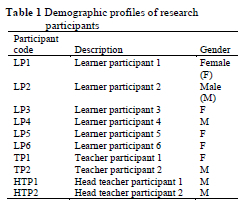
The target population for this research study consisted of 1,200 Grade 3 learners and 36 teachers; the total target population thus being 1,236. Through school authorities we had access to classroom records in order to gather enrolment statistics in two rural schools that were selected as research sites. Classroom records such as progress record books were used to select learners for participation. Of the 36 qualifying teachers, four were selected to participate in the study. All four were experienced in teaching at primary school level and the majority had 2 or more years of teaching experience. Twelve Grade 3 learners from a population of 1,200 were selected to take part in the study. All of the participants were purposively sampled due to their information richness and accessibility (Chisaka, 2013:12; Hanlon & Larget, 2011:5). Before learner participants contributed to this study, we sought parental consent. Consent and assent forms were signed to grant permission to work with the learners. Table 1 below summarises the demographic details of participants for this study.
Findings
The findings from this study are presented under two major themes: (i) English as a panacea for social justice education practices, and (ii) English as an impediment to social justice education practices.
English as a Panacea for Social Justice Education Practices
English as an instrument for global communication
Through the exploration of participants' views on English as the LOLT, it was indicated during the interviews that English was a global language of communication as it assisted learners in interacting with the rest of the world. LP3 had this to say: "I think the use of English in teaching and learning will enable us to communicate with everybody in the world, especially those who cannot speak our local languages?"
English as the language of employment opportunities
Discussions from both semi-structured and focus-group interviews conducted revealed that the participants held a high regard for English and viewed it as the language of job opportunities after completing school. It is a key factor to learners' future and their economic well-being. This implies that English proficiency ensures that learners get good-paying jobs. This explanation from TP1 agrees with these findings: "7he use of English in teaching is good because the explanation is clear [when used] to understand concepts. This will help learners to master English further in employment. English is the language of employment opportunities. "
English as a language for further education
Participants widely perceived English as a language that is instrumental for further education. This implies that English is the language of education. LP6 explained: "English language is useful for us when we approach further education""
English as an Impediment to Social Justice
Education Practices
English as a threat to one's culture and identity The use of English as the LoLT is a threat to learners' culture and identity. Most participants were in unanimous agreement that English had the capacity to pose a threat to one's culture and identity. In substantiating this, HTP2 commented: "To some extent English may be a disadvantage. For example, it is common knowledge that within one's language we attach his or her culture and identity. So using English as the LoLT tends to affect one's culture""
Widespread teacher-learner incompetency in English
The interviews revealed that teacher and learner incompetency in English existed in the Chivi district. Most participants remarked that they often had oppressive moments with English during teaching and learning. Observation field notes revealed that code switching was often used during lesson delivery. Document analysis indicated a number of grammatical errors from learners' written exercise books and the teachers' classroom records. LP4 remarked as follows: "Our problem is that we are incompetent in [the] English language. So we end up speaking home languages even [when] the lesson demands us to communicate in [the] English language."
School curriculum is elitist
It was discovered that the school curriculum was dominated by English with very little in the way of curricula and support material offered in ILs. For example, textbooks, charts and fliers were in English. The remarks from HTP1 are consistent with this finding: "English language is the one which dominate[s] in curriculum literature as well as in teaching and learning."
Promotion of monolingualism
The interviews revealed the prevalence of monolingualism. In essence, participants alluded to the gradual death of heritage languages within the Chivi district since they were not promoted in teaching and learning. TP2 commented:
You see, certainly there is one language which tends to be more equal or important than others here. This is because the majority of the subjects do affiliate to English, yet the majority of the learners do not speak English together with their teachers.
Discussion of Findings
Theme 1 underscored English as a panacea for social justice education practices, and it surfaced through participant exploration of the sub-theme, English as an instrument for global communication.
Teachers and learners agreed that the use of English as the LoLT was an advantage for learners, because it allowed them to interact with the rest of the world (Buttaro, 2014; Shizha, 2007). The majority of participants from the two selected schools indicated that the use of English was justified because it expanded the learners' linguistic environment, and allowed them to integrate into world systems because they were able to communicate in English which was the dominant global language. When discussing English as the language of employment opportunities, we discovered that the participants had a high regard for English as it was regarded as the language needed for job opportunities after school. The participants' views echoed the sentiments in literature that English is instrumental for learners' future economic well-being. In other words, the participants saw justice in using English as the LoLT in Grade 3 in the Chivi district because mastery of the English language was regarded as guaranteeing prestigious job opportunities (Erling et al., 2017:38). Under the sub-theme, English as a language for further education, the findings reveal that most participants regarded the use of English as the LoLT from Grade 3 upwards as fair because they widely perceived English as being instrumental for further education (Pennycook, 2001:81).
When discussing the second theme, English as an impediment to social justice education practices, and the sub-theme, English as a threat to one's culture and identity, most participants unanimously agreed that English as the LoLT was a threat to learners' culture and identity. Participants felt that English had the capacity to erode their culture and identity (Badry, 2011:85; Hopkyns, 2014; Pan & Seargeant, 2012). The participants indicated that they were alienated from their heritage languages as custodians of their culture and identity. To this end, the use of English as the LoLT at Grade 3 level was an impediment for learners who wanted to excel in their academic work. When exploring widespread teacher and learner competency in English, the findings indicate a need to address teachers' and learners' use of English in diverse learner classrooms where English is the medium of instruction. Most participants remarked that they often experienced difficulty in using English as the LoLT (Buttaro, 2014; Erling et al., 2017:13; Ochshom & Garcia, 2007:16). The use of English as LoLT was not beneficial as it hampered learner performance in the classroom. To this effect, English can be identified as an impediment to social justice practices in the education system. Most participants agreed with the sentiment that the school curriculum was elitist and was dominated by English (Tackie-Ofusu, Mahama, Vandyck, Kumador & Toku, 2015). Very little was offered in ILs and document analysis confirmed that wall charts, textbooks, exercise books, and other support material were in English. The exclusion of ILs in the production of learning materials within a district where the majority of the population were IL speakers, speaks volumes about the lack of social justice within the education system. Furthermore, the findings reveal that the promotion of monolingualism within the school education system is rife. Participants described the linguistic environment in the Chivi district as monolinguistic (Phillipson, 2008:251) and inferred the death of the district's heritage languages, Shona, Ndebele and Shangani. The death of linguistic diversity is a recipe for social justice malpractice.
Conclusion
With this study we aimed to reflect on the views of Grade 3 learners and their teachers on using English as the LoLT, and its implications for social justice education practices in primary schools in the Chivi district. To a lesser degree, there is justification for the use of English as the mode of instruction in Grade 3, since it prepares learners to become effective communicators on a global scale. In addition, a mastery of English enhances learner opportunities to get high-paying and prestigious jobs (Erling et al., 2017:13) after completing their ordinary levels. Despite this positive aspect, there is still widespread social injustice in the education system because the use of English as the LoLT in the district is a threat to the learners' culture and identity. Through the interviews and observations it became evident that the participants viewed the school curriculum as being elitist, and that many teachers and learners were not competent in using English as the LoLT. In short, participants communicated a lack of linguistic diversity in the primary schools in the district. This implies that English as the LoLT is a source of social injustice malpractice in the education sector of Zimbabwe, particularly within primary schools in the Chivi district.
Authors' Contributions
KM generated the research data and contributed to the codification of 70% of the manuscript. LGH contributed in analysing the data, presenting data and the formulation of themes in which the collected data were to be presented and discussed. Both authors reviewed the final manuscript.
Notesi. This article is based on the doctoral thesis of Khama Mashuro.
ii. Published under a Creative Commons Attribution Licence.
References
-
Alebaid MY 2021. The effects of first language on the learning of English as a second language. Multi-Knowledge Electronic Comprehensive Journal for Education and Science Publications, 44. Available at https://www.mecsj.com/uplode/images/photo/The_Effects_Of_First_Language_On_The_Learning_Of_English_.pdf. Accessed 28 February 2025.
» https://www.mecsj.com/uplode/images/photo/The_Effects_Of_First_Language_On_The_Learning_Of_English_.pdf - Al-Issa A & Dahan LS 2011. Global English and endangered Arabic in the United Arab Emirates. In A Al-Issa & L Dahan (eds). Global English and Arabic: Issues of language, culture, and identity. Oxford, England: Peter Lang.
- Ani M 1994. Yurugu: An African-centred critique of European cultural thought and behaviour. Asmara, Eritrea: Africa World Press.
-
Babaci-Wilhite Z 2013. Local languages of instruction as a right in education for sustainable development in Africa. Sustainability, 5(5):1994-2017. https://doi.org/10.3390/su5051994
» https://doi.org/10.3390/su5051994 -
Bacha NN & Bahous R 2011. Foreign language education in Lebanon: A context of cultural and curricular complexities. Journal of Language Teaching and Research, 2(6):1320-1328. https://doi.org/10.3390/jltr.2.6.1320-1328
» https://doi.org/10.3390/jltr.2.6.1320-1328 - Badry F 2011. Appropriating English: Language in identity construction in the United Arab Emirates. In A Al-Issa & L Dahan (eds). Global English and Arabic: Issues of language, culture, and identity. Oxford, England: Peter Lang.
- Bell LA 2016. Theoretical foundation for social justice education. In M Adams, LA Bell, DJ Goodman & KY Joshi (eds). Teaching for diversity and social justice (3rd ed). New York, NY: Routledge.
- Bourdieu P 1977. Cultural reproduction and social reproduction. In J Karabel & AH Halsey (ed). Power and ideology in education. New York, NY: Oxford University Press.
-
Brock-Utne B 2014. Language of instruction in Africa -The most important and least appreciated issue. International Journal of Educational Development in Africa, 1(1):4-18. https://doi.org/10.25159/2312-3540/2
» https://doi.org/10.25159/2312-3540/2 -
Bureau of Democracy, Human Rights and Labor 2012. Country reports on human rights practices for 2011 - Zimbabwe. Available at https://2009-2017.state.gov/j/drl/rls/hrrpt/2011humanrightsreport/index.htm?dlid=186257#wrapper. Accessed 23 April 2020.
» https://2009-2017.state.gov/j/drl/rls/hrrpt/2011humanrightsreport/index.htm?dlid=186257#wrapper - Buttaro L 2014. Social justice and linguistic human rights in dual language programmes. International Journal of Case Method Research and Application, 26(2):119-135.
- Chimhenga E & Chivhanga S 2013. Language planning in Zimbabwe: The use of indigenous languages (Shona) as a medium of instruction in primary schools. IOSR Journal of Human and Social Science, 12(5):58-65.
- Chisaka BC 2013. The qualitative research paradigm. In MT Mukabeta, S Hamandishe & C Nzombe (eds). Action research: Practical ideas for educational practice. Harare, Zimbabwe: Save the Children.
-
Cholakova M 2015. "The influence of the English language in a multilingual and a monolingual environmet - A comparative approach". International Journal of English Language Teaching, 3(4):35-78. Available at https://eajournals.org/ijelt/wp-content/uploads/sites/57/2015/06/The-Influence-Of-The-English-Language-In-A-Multilingual-And-A-Monolingual-Environmet-%E2%80%93-A-Comparative-Approach.pdf. Accessed 28 February 2025.
» https://eajournals.org/ijelt/wp-content/uploads/sites/57/2015/06/The-Influence-Of-The-English-Language-In-A-Multilingual-And-A-Monolingual-Environmet-%E2%80%93-A-Comparative-Approach.pdf - Cohen L, Manion L & Morrison K 2011. Research methods in education (7th ed). London, England: Routledge.
- Creswell JW & Plano Clark VL 2010. Designing and conducting mixed methods research (2nd ed). London, England: Sage.
- Das AK 2016. Language: The flesh and blood of our culture. International Journal of English Language, Literature and Humanities, 1(5):152-156.
-
Dávila LT & Linares RE 2020. English as a second language: Teachers' perceptions of care in an anti-immigrant climate. International Multilingual Research Journal, 14(4):355-369. https://doi.org/10.1080/19313152.2020.1747164
» https://doi.org/10.1080/19313152.2020.1747164 -
Derakhshan A & Karimi E 2015. The interference of first language and second language acquisition. Theory and Practice in Language Studies, 5(10):2112-2117. https://doi.org/10.17507/tpls.0510.19
» https://doi.org/10.17507/tpls.0510.19 - Drysdale RS 1975. Education as cultural imperialism by Martin Carnoy. The School Review, 84(1):147-151.
-
Dube L & Ncube B 2013. Language policy and linguistic rights in post-colonial Zimbabwe: The case of IsiNdebele. Greener Journal of Social Sciences, 3(5):249-255. Available at https://pdfs.semanticscholar.org/1bdb/0fe744ca2c4443e82ec2189765fcd6b369d6f.pdf. Accessed 28 February 2025.
» https://pdfs.semanticscholar.org/1bdb/0fe744ca2c4443e82ec2189765fcd6b369d6f.pdf -
Erling EJ, Adinolfi L & Hultgren AK 2017. Multicultural classrooms: Opportunities and challenges for English medium instruction in low and middle income contexts. Reading, England: Education Development Trust. Available at https://files.eric.ed.gov/fulltext/ED586989.pdf. Accessed 28 February 2025.
» https://files.eric.ed.gov/fulltext/ED586989.pdf - Freire P 1978. Pedagogy of the oppressed. New York, NY: Penguin Books.
- Gale T & Densmore K 2000. Just schooling: Exploration in the cultural politics of teaching. Buckingham, England: Open University Press.
- Giddens A & Sutton PW 2013. Sociology (7th ed). Cambridge, England: Polity Press.
- Hanlon B & Larget B 2011. Samples and populations. Madison, WI: Department of Statistics, University of Wisconsin-Madison.
-
Hann N, Timmis I, Alkhaldi AA, Davies B, Troncoso CR & Yi Y 2014. The impact of English on learners ' wider lives. London, England: British Council. Available at https://www.teachingenglish.org.uk/sites/teacheng/files/pub_E085%20Impact%20of%20English%20on%20learners'_A4_web_FINAL.pdf. Accessed 28 February 2025.
» https://www.teachingenglish.org.uk/sites/teacheng/files/pub_E085%20Impact%20of%20English%20on%20learners'_A4_web_FINAL.pdf - Haralambos M & Holborn M 2013. Sociology: Themes and perspectives (8th ed). London, England: HarperCollins.
- Harris PG 2011. Language in schools in Namibia: The missing link in educational achievements. Windhoek, Namibia: The Urban Trust of Namibia.
-
Hopkyns S 2014. The effects of global English on culture and identity in the UAE: A double-edged sword. Learning and Teaching in Higher Education: Gulf Perspectives, 11(2):5-24. https://doi.org/10.18538/lthe.v11.n2.197
» https://doi.org/10.18538/lthe.v11.n2.197 -
Klapwijk N & Van der Walt C 2016. English-plus multilingualism as the new linguistic capital? Implications of university students' attitudes towards languages of instruction in a multilingual environment. Journal of Language, Identity & Education, 15(2):67-82. https://doi.org/10.1080/15348458.2015.1137475
» https://doi.org/10.1080/15348458.2015.1137475 -
Mashuro K 2021. The use of English as a language of instruction and its implications on social justice in primary schools in Chivi District, Zimbabwe: A critical investigation. PhD thesis. Pretoria, South Africa: University of South Africa. Available at https://uir.unisa.ac.za/bitstream/handle/10500/28181/thesis_mashuro_k.pdf?sequence=1 & isAllowed=y. Accessed 28 February 2025.
» https://uir.unisa.ac.za/bitstream/handle/10500/28181/thesis_mashuro_k.pdf?sequence=1 & isAllowed=y - Ministry of Primary and Secondary Education 2016. Curriculum framework for primary and secondary education 2015-2022. Harare, Zimbabwe: Author.
-
Mlay N 2010. The influence of the language of instruction on students' academic performance in secondary schools: A comparative study of urban and rural schools in Arusha-Tanzania. Master of Philosophy in Comparative and International Education thesis. Oslo, Norway: University of Oslo. Available at https://www.duo.uio.no/bitstream/handle/10852/30505/Masterxthesisx2010.pdf?sequence=2 & isAllowed=y. Accessed 28 February 2025.
» https://www.duo.uio.no/bitstream/handle/10852/30505/Masterxthesisx2010.pdf?sequence=2 & isAllowed=y - Muchenje F, Goronga P & Bondai B 2013. Zimbabwe's language policy in education and the 'silenced voices': A case study of Nyanja/Chewa speaking pupils from Porta and Kintyre Primary Schools in Zvimba, Zimbabwe. Academic Research International, 4(2):500-511.
-
Ndeleki B 2015. Teachers' perceptions on the use of local languages as medium of instruction for grades 1-4 in selected private schools of Lusaka. Master of Education in Literacy and Learning dissertation. Lusaka, Zambia: University of Zambia. Available at https://dspace.unza.zm/server/api/core/bitstreams/fc53b99d-af5e-4ff0-94ab-49a5584cb609/content. Accessed 28 February 2025.
» https://dspace.unza.zm/server/api/core/bitstreams/fc53b99d-af5e-4ff0-94ab-49a5584cb609/content -
Nelson K, Creagh T & Clarke J 2012. Social justice and equity issues in higher education context: Literature analysis and synthesis: Development of a set of social justice principles. Available at http://www.safeguardingstudentlearning.net/wp-content/uploads/2012/05/OLT_MSLE_Project-Literature-Analysis_June12draft3.pdf. Accessed 28 February 2025.
» http://www.safeguardingstudentlearning.net/wp-content/uploads/2012/05/OLT_MSLE_Project-Literature-Analysis_June12draft3.pdf -
Ntshangase ND 2011. The impact of learning in English on the cognitive development of second language learners of English. Master's thesis. Richards Bay, South Africa: University of Zululand. Available at https://uzspace.unizulu.ac.za/server/api/core/bitstreams/499c9a9d-3f4f-44c7-adf6-3a6f03c65205/content. Accessed 28 February 2025.
» https://uzspace.unizulu.ac.za/server/api/core/bitstreams/499c9a9d-3f4f-44c7-adf6-3a6f03c65205/content - Ochshom S & Garcia M 2007. Learning about the workforce: A profile of early childhood education in New York City, community and school-based centres. New York, NY: City of New York Press.
- Owu-Ewie C 2013. The language policy of education in Ghana in perspective: The past, the present and the future. Language and Linguistics, 3(2):53-72.
-
Owu-Ewie C & Eshun ES 2015. The use of English as medium of instruction at the upper basic level (Primary four to Junior High School) in Ghana: From theory to practice. Journal of Education and Practice, 6(3):72-82. Available at https://files.eric.ed.gov/fulltext/EJ1083758.pdf. Accessed 28 February 2025.
» https://files.eric.ed.gov/fulltext/EJ1083758.pdf -
Paauw S 2009. One land, one nation, one language: An analysis of Indonesia's national language policy. University of Rochester Working Papers in the Language Sciences, 5(1):2-16. Available at https://citeseerx.ist.psu.edu/document?repid=rep1&type=pdf&doi=3c38dfac2720502fbc7cf5e8dda4eda4aa2d751c. Accessed 28 February 2025.
» https://citeseerx.ist.psu.edu/document?repid=rep1&type=pdf&doi=3c38dfac2720502fbc7cf5e8dda4eda4aa2d751c -
Pan L & Seargeant P 2012. Is English a threat to Chinese language and culture?: The 'threat' of English in China might be balanced by the promotion of Chinese language and culture. English Today, 28(3):60-66. https://doi.org/10.1017/S0266078412000302
» https://doi.org/10.1017/S0266078412000302 -
Pennycook A 2001. English in the world/The world in English. In JW Tollefson (ed). Power and inequality in language education. Cambridge, England: Cambridge University Press. Phillipson R 2008. Lingua franca or lingua frankensteinia? English in Eureopean integration and globalisation. World Englishes, 27(2):250-267. https://doi.org/10.1111/j.1467-971X.2008.00555.x
» https://doi.org/10.1111/j.1467-971X.2008.00555.x - Sadovnik AR & Coughlan RW 2016. Sociology of education: A critical reader (3rd ed). New York, NY: Routledge.
- Said FFS 2011. "Ahyaanan I text in English 'ashaan its ashal'": Language crisis or linguistic development? The case of how Gulf Arabs perceive the future of their language, culture and identity. In A Al-Issa & L Dahan (eds). Global English and Arabic: Issues of language, culture, and identity. Oxford, England: Peter Lang.
- Schaefer RT 2010. Sociology: A brief introduction (9th ed). New York, NY: McGraw-Hill.
-
Shizha E 2007. Critical analysis of problems encountered in incorporating indigenous knowledge systems in science teaching by primary school teachers in Zimbabwe. Alberta Journal of Educational Research, 53(3):302-319. https://doi.org/10.11575/ajer.v53i3.55295
» https://doi.org/10.11575/ajer.v53i3.55295 - Sithole A 2016. Bilingualism, dealing with bilingualism in Zimbabwean classrooms. Harare, Zimbabwe: DP Print Media.
-
Siwela TD 2018. English as a second language in learning environmental science in Zimbabwean primary schools. PhD thesis. Pretoria, South Africa: University of South Africa. Available at https://uir.unisa.ac.za/bitstream/handle/10500/25820/thesis_siwela_td.pdf. Accessed 28 February 2025.
» https://uir.unisa.ac.za/bitstream/handle/10500/25820/thesis_siwela_td.pdf -
Tackie-Ofusu V, Mahama S, Vandyck ESTD, Kumador DK & Toku NAA 2015. Mother tongue usage in Ghanaian pre-schools: Perceptions of parents and teachers. Journal of Education and Practice, 6(34):81-87. Available at https://files.eric.ed.gov/fulltext/EJ1086075.pdf. Accessed 28 February 2025.
» https://files.eric.ed.gov/fulltext/EJ1086075.pdf - Trudell B 2016. The impact of language policy and practice on children's learning: Evidence from Eastern and Southern Africa. Nairobi, Kenya: UNICEF Eastern and Southern Africa.
- Zimbabwe 1987. Education Act, The statute law of Zimbabwe. Harare: Government Printers.
-
Zimbabwe 2019. Education Amendment Act, 2019 [Act 15-2019]. Harare: Government Printers. Available at https://www.veritaszim.net/sites/veritas_d/files/EDUCATION%20AMENDMENT%20ACT%2C%202019%20%5B%20Act%2015-2019%5D_0.pdf. Accessed 28 February 2025.
» https://www.veritaszim.net/sites/veritas_d/files/EDUCATION%20AMENDMENT%20ACT%2C%202019%20%5B%20Act%2015-2019%5D_0.pdf
Revised: 23 August 2024
Accepted: 10 February 2025
Published: 28 February 2025