The relationship between mathematics anxiety, motivation to learn and attitudes towards mathematics among school students
Abstract
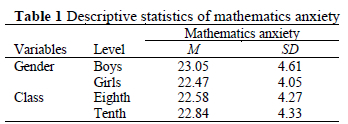
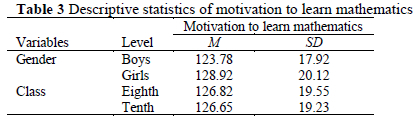
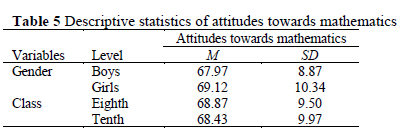
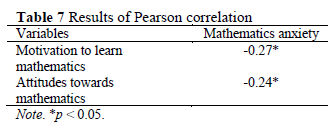
The main purpose of the study reported on here was to examine the relationship between mathematics anxiety, motivation to learn mathematics, and students' attitudes towards the subject. We also investigated whether differences in mathematics anxiety, learning motivation, and attitudes towards mathematics existed due to gender or class. The Fennema-Sherman mathematics anxiety scale, the motivation towards science-learning questionnaire, and the attitudes towards mathematics inventory were completed by 880 secondary school students. In this study, the descriptive correlational approach was used to analyse the study data descriptive statistics. The 2 coefficients, ANOVA and Pearson correlation, were used. The mean score for mathematics anxiety among boys was higher than for girls, with no difference due to class. The mean score for motivation to learn mathematics was higher among girls than boys, with no difference in the mean score for motivation to learn due to class. No differences were found in the mean scores of attitudes towards mathematics due to gender or class. Finally, the results show a negative relationship between mathematics anxiety and motivation to learn mathematics, but no negative relationship between mathematics anxiety and attitudes towards mathematics was found. We recommend that other variables related to mathematics anxiety, such as academic self-efficacy or achievement goal orientation should be studied.
attitudes towards mathematics; mathematics anxiety; motivation to learn; school students