The relationship between mathematics anxiety, motivation to learn and attitudes towards mathematics among school students
Abstract
The main purpose of the study reported on here was to examine the relationship between mathematics anxiety, motivation to learn mathematics, and students' attitudes towards the subject. We also investigated whether differences in mathematics anxiety, learning motivation, and attitudes towards mathematics existed due to gender or class. The Fennema-Sherman mathematics anxiety scale, the motivation towards science-learning questionnaire, and the attitudes towards mathematics inventory were completed by 880 secondary school students. In this study, the descriptive correlational approach was used to analyse the study data descriptive statistics. The 2 coefficients, ANOVA and Pearson correlation, were used. The mean score for mathematics anxiety among boys was higher than for girls, with no difference due to class. The mean score for motivation to learn mathematics was higher among girls than boys, with no difference in the mean score for motivation to learn due to class. No differences were found in the mean scores of attitudes towards mathematics due to gender or class. Finally, the results show a negative relationship between mathematics anxiety and motivation to learn mathematics, but no negative relationship between mathematics anxiety and attitudes towards mathematics was found. We recommend that other variables related to mathematics anxiety, such as academic self-efficacy or achievement goal orientation should be studied.
attitudes towards mathematics; mathematics anxiety; motivation to learn; school students
Introduction
Many young learners in primary and secondary schools often consider mathematics as the most difficult subject. Mathematics also has the lowest pass rate of all subjects. However, it does not mean that this difficulty in learning mathematics indicates low intelligence as many gifted learners and high achievers experience the same struggle. Thus, timely recognition and remedial assistance are essential to prevent students from sliding into low achievement.
Mathematics learning is a broad area, open for more research. However, the attention of many researchers in the field of educational psychology has been particularly drawn to the aspects of emotion and intelligence. For example, Cheng and Su (2012) and WH Huang (2011) found mathematics anxiety to be one of the foremost emotional factors, and Kiili (2005) linked it to learning performance. Sharma and Gopal (2010) quoted Martinez's argument that anxiety was the greatest impediment to the mathematics learning process.
The main objective with this study was to determine the relationship between mathematics anxiety, motivation to learn mathematics and attitudes towards mathematics. The results of previous studies show a negative correlation between mathematics anxiety, motivation to learn mathematics and attitudes towards mathematics. The results of other studies also show differences in mathematics anxiety, motivation to learn mathematics and attitudes towards mathematics according to some demographic variables such as gender and class.
Literature Review
Mathematics anxiety
As seen in the literature, mathematics anxiety is determined, defined, and studied in five main ways. Firstly, some researchers regard it from an emotional or affective framework. Accordingly, it is defined as a state of distress, triggered by mathematical incentives (Trujillo & Hadfield, 1999). The intensity of the reported distress differs greatly from mild apprehension to intensely emotional reactions such as fear, panic, shame, or disgrace to loathing and detesting the subject (Jenβen, Möller & Roesken-Winter, 2020; Swars, Daane & Giesen, 2006).
A second approach is to view mathematics anxiety from a physiological perspective rather than an emotional one. X Luo, Wang and Luo (2009), for example, describe physiological responses as similar to those observed in fight or flight mode, including increased heart rate, sweating, and shortness of breath. From this research perspective, the body mounts a hormonal stress response to a threat assessment activated by mathematical incentives. A third group of researchers has classified mathematics anxiety as performance anxiety, where the possibility and fear of failure provoke concern and apprehension (Trujillo & Hadfield, 1999), while a fourth group argue that anxiety is triggered by fear of failure and has examined the relationship between examination/test anxiety and mathematics anxiety. Finally, although Bursal and Paznokas (2006) and Olson and Stoehr (2019) stress the relationship between anxiety and fear of failure, they suggest that simply thinking about mathematics without actually having to solve a problem may induce mathematics anxiety for some individuals (Hembree, 1990).
Eysenck, Derakshan, Santos and Calvo (2007) and Wigfield and Meece (1988) define the two dimensions of mathematics anxiety as cognitive and affective. The cognitive dimension is categorised as "worry" or fear and apprehension about low performance in mathematical learning activities and the consequent adverse reactions. The measurement of the affective dimension relies on students' reports of their feelings towards mathematics-related activities ranging from unease and apprehension, tension, and dislike to fear and dread. Given the differing perceptions and features of the two mathematics anxiety dimensions, it is argued that the links between students' motivational beliefs and mathematics anxiety are not constant (Henschel & Roick, 2017).
Hadfield and McNeil (1994) suggest a model of mathematics anxiety centred on three key aspects: environmental, intellectual, and personal. The environment refers to classroom matters, parental pressure, and the perception of mathematics as an inflexible set of rules. The intellectual variables include a disparity of learning approaches, insecurity, and a lack of confidence. Personality factors comprise hesitance to ask questions in class, and a lack of self-confidence. The benefits of this threefold construct lie in the consideration of a number of often interrelated issues.
The relationship between mathematics anxiety, motivation to learn mathematics, and attitudes towards mathematics have been examined in several studies with inconsistent results. (Alliman-Brissett, 2006; Kim, Park & Cozart, 2014; Luo, W, Ng, Lee & Aye, 2016; Peixoto, Sanches, Mata & Monteiro, 2017; Schnell, Tibubos, Rohrmann & Hodapp, 2013; Sutter-Brandenberger, Hagenauer & Hascher, 2018; Zhou & Urhahne, 2013). In these studies a correlation was found between the mathematics anxiety felt by students and motivational beliefs to learning mathematics. Durrani and Tariq (2009) found a negative relationship between mathematics anxiety and attitudes towards mathematics.
Gender differences in mathematics anxiety have also been examined in various studies with inconsistent results. The results of some studies (Ashcraft, 2002; Baloglu & Koçak, 2006; Else-Quest, Hyde & Linn, 2010; Hopko, Mahadevan, Bare & Hunt, 2003; Woodart, 2004; Yüksel-Sahin, 2008) show that the level of mathematics anxiety among females is higher than among males. The results of a few studies (Abed & Alkhateeb, 2001; Sandman, 1979) show that the level of mathematics anxiety among males is higher than among females. While the results of other studies (Birgin, Baloglu, Çatlioglu & Gürbüz, 2010; Frenzel, Pekrun & Goetz, 2007; Huang, X, Zhang & Hudson, 2019; Ma & Xu, 2004; Newstead, 1998) show no gender differences in the level of mathematics anxiety.
As for the differences in mathematics anxiety according to class, the results of some studies (Hopko et al., 2003; McCarthy, 1986) show no differences in the level of mathematics anxiety according to the age, while Rambow (2008) shows that older students show a higher level of mathematics anxiety compared to younger students.
Motivation
Motivating science learning is now a matter of global discussion and concern due to the strong association between students' attitudes and performance in the sciences (Williams & Williams, 2011). Research that specifically focuses on student motivation towards science records a strong correlation between motivation and performance (Atta & Jamil, 2012; Chow & Yong, 2013).
Bandura, in his social cognitive theory (2005), describes motivation as a state of internal stimulation that directs and sustains the individual' s goal-oriented performance. The theory defines science-learning motivation as an internal state that stimulates, focuses, and sustains science-learning behaviour (Glynn, Taasoobshirazi & Brickman, 2009). Motivation to learn is not simple, but it consists of a number of forms and characteristics (Glynn & Koballa, 2006). It is a multi-constituent construct, consisting of different categories and qualities: intrinsic and extrinsic motivation, extrinsic relevance to personal goals, self-determination, self-efficacy, and test or assessment anxiety, which are regarded as fundamental constructs of a child' s self-regulatory system that develops his/her general motivation to learn and achieve (Schunk, 2001). These qualities represent dimensions of students' overall motivation to learn science (Chow &Yong, 2013; Glynn et al., 2009).
Based on the constructionist theory, according to Mintzes, Wandersee and Novak (1998) and Von Glasersfeld (1998), students play an active role in constructing new knowledge. This is evident when they recognise valuable and significant learning tasks and use active learning strategies to integrate existing knowledge with new skills and models. In contrast, if students find that the learning task is invaluable, they will resort to memorisation (Pintrich & Schunk, 1996). The importance of students' learning objectives is also demonstrated by Von Glasersfeld (1998); students were motivated to build their learning and knowledge based on learning values and strategies. Pintrich and Schunk (1996) define motivation as the process of activating and sustaining objective-focused activity, while Pintrich, Marx and Boyle (1993) reiterate the important roles of students' learning objectives, the values of science learning, and self-efficacy in inducing students' construction and reconstruction of their science concepts.
Simply put, mathematically qualified students who perceive a conceptual task as worthwhile, will make persistent efforts and participate in any conceptual modification process. From a motivational theory perspective, it is obvious that students' motivation for learning is governed by self-efficacy, the dominant force in individual goalsetting, task value, and the learning environment. A combination of the constructivist learning and motivation theories clearly illustrates the components of students' motivation to learn science; its value, learning strategies, student's learning aims, and the learning environment are all important motivational factors in science learning (Brophy, 2004; Pintrich & Schunk, 1996).
In several studies gender differences in mathematics motivation have been examined with inconsistent results. Some studies (Eccles, Wigfield, Harold & Blumenfeld, 1993; Ganley & Lubienski, 2016; Guo, Parker, Marsh & Morin, 2015; Kurtz-Costes, Rowley, Harris-Britt & Woods, 2008; Meece, Glienke & Burg, 2006) show that the level of mathematics motivation among males is higher than among females, while a few other studies (Halat, 2006) show no gender differences in the level of mathematics motivation.
Attitudes
As a construct in mathematics education, attitude has been defined and redefined in several research studies (Di Martino & Zan, 2010; Hannula, 2002). Aiken (1970) defines attitude as either a positive or negative response, inclination, or tendency, learned by the individual, as a reaction to a person, situation, object, or concept. Similarly, Neale (1969) refers to attitude towards mathematics as the individual' s like or dislike of the subject, being inclined to participate in or to evade mathematics, being convinced of mathematical ability or of being hopeless; a conviction that mathematics was either useful or useless. This definition was broadened by Ma and Kishor (1997) who added students' affective reactions, as easy/difficult and important/unimportant, and students' positive or negative emotional affinity with mathematics (Zan & Di Martino, 2007). Mayes, Chase and Walker (2008) illustrate that students' lack of interest and low performance were the results of their negative attitudes towards mathematics, while Evans (2007) found evidential indications of students' positive attitudes towards mathematics resulting in positive achievements. Aiken (1970) found no strong association between attitudes and mathematics achievements, while Tapia and Marsh (2004) found that a student' s confidence and enjoyment of mathematics, as well as anxiety or view of mathematics as useless, have been significant inferences of their attitudes towards mathematics.
According to Mohammadpour (2012), students' attitudes towards mathematics result in whether the individual regards it as a pleasant and indispensable asset for school success and an achievement of professional career objectives. Kiwanuka, Van Damme, Van den Noortgate, Anumendem, Vanlaar, Reynolds and Namusisi (2017) found that students' attitudes towards the value and importance of mathematics were associated with mathematical aptitude and capability. Hemmings, Grootenboer and Kay (2011) found a predictor of students' performance, accomplishment, and attitude towards mathematics in their preceding attitude and success. Similarly, Mata, Monterio and Peixoto (2012) emphasise the influence of having a positive attitude on accomplishment and average in mathematics.
Gender differences in attitudes towards mathematics have been examined in various studies with inconsistent results. The results of some studies (Linn & Hyde, 1989) show that females show more negative attitudes towards mathematics than males, while the results of a few studies (Nicolaidou & Philippou, 2003) show no gender differences in attitudes towards mathematics.
Theoretical Framework
Anxiety, in general, is a state of tension experienced by individuals, affecting cognitive processes. Therefore, stress and anxiety affect academic achievement negatively. Mathematics anxiety is a common phenomenon at all stages of school education and students' attitudes towards mathematics are negative, as indicated by the results of some studies. In this study we addressed variables that mainly affect mathematics learning. The results of other studies (Al-Fawal & Khair, 2018; Jajiga, 2017) show a relationship between mathematics anxiety and academic achievement. We provide some solutions and suggestions for educators in the academic field to help them solve the problem of mathematics anxiety, which should pave the way for new research in this field.
High levels of mathematics anxiety, low mathematic motivation, and negative attitudes towards mathematics negatively affect students, leading to lower academic achievement and failed personal success. The variables in our study, mathematics anxiety, motivation to learn mathematics, and attitudes towards mathematics, have not been sufficiently researched in Arabic studies in Jordan, and this indicates the importance of this study. The mathematics anxiety that students feel and how it affects students' learning motivation and attitudes towards mathematics is an important issue that must be emphasised. In this study we examined the correlation between mathematics anxiety, motivation to learn mathematics, and attitudes towards mathematics among school students in Jordan. Therefore, we sought to answer the following questions (Q):
Q1: Does the level of mathematics anxiety differ according to the variables of gender and class?
Q2: Does the level of motivation to learn mathematics differ according to the variables of gender and class?
Q3: Does the level of attitudes towards mathematics anxiety differ according to the variables of gender and class?
Q4: Does a relationship exist between mathematics anxiety, motivation to learn mathematics, and attitudes towards mathematics among school students in Jordan?
Methodology
Study Sample
A descriptive-correlative approach was used in this study as it was the most appropriate method to achieve the study objectives. A total of 880 secondary school students completed the Fennema-Sherman mathematics anxiety scale, the motivation towards sciences learning questionnaire, and the attitudes towards mathematics inventory. Of the 880 participants, 375 (42.6%) were boys and 505 (57.4%) girls; 405 (46%) were in the eighth grade, and 475 (54%) were in the 10th grade. All participants in the study sample were from government schools in the Directorate of Education and Learning of the First Zarqa district in Zarqa Governorate.
The Fennema-Sherman Mathematics Anxiety Scale (FSMAS)
The FSMAS developed by Fennema and Sherman (1976) consists of 12 items to measure mathematics anxiety, using a 5-point Likert scale; the reliability measure using the test-retest of the FSMAS was 0.87. The Cronbach alpha of the FSMAS in this study was 0.80.
The Motivation Towards Sciences Learning Questionnaire (MTSLQ)
The MTSLQ developed by Tuan, Chin and Shieh (2005), consists of six subscales: self-efficacy (seven items, α = 0.78), active learning strategies (eight items, α = 84), science learning value (five items, α = 0.66), performance goal (four items, α = 0.79), achievement goal (five items, α = 0.78), and learning environment stimulation (six items, α = 0.69). The MTSLQ items are measured on a 5-point Likert scale. The Cronbach alpha of the MTSLQ was 0.89. The Cronbach alpha of the MTSLQ in this study was 0.84.
Attitudes Towards Mathematics Inventory (ATMI)
The ATMI was developed by Lim and Chapman (2013). It consists of four subscales: enjoyment of mathematics (five items), motivation to do mathematics (four items), self-confidence in mathematics (five items), and perceived value of mathematics (five items). The ATMI items are measured on a 5-point Likert scale. The Cronbach alpha of the ATMI was 0.93. In this study, the Cronbach alpha of the ATMI was 0.78.
Data Collection and Analysis
After selecting the study sample, we administered the study instruments to the sample in normal classroom conditions. In order to maintain objectivity, we did not seek help from the mathematics teachers. We clarified the purpose of the study and stressed that the students' answers would be anonymous and solely used for scientific research. We explained how to respond to the study instruments. Following data collection, SPSS was used in the analysis. To answer the first three study questions, descriptive statistics and two-way ANOVA tests were used, with the Pearson correlation coefficient to answer the fourth question. In this study, the significance level (α = 0.05) was adopted.
Results
Q1: Does the Level of Mathematics Anxiety Differ According to the Variables of Gender (Boys and Girls) and Class (Eighth and Tenth)?
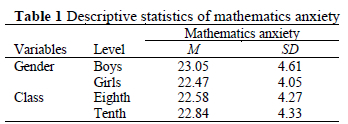
The results are shown in Tables 1 and 2.
The results of the two-way ANOVA test (F = 3.926, p = 0.05) show the mean score of mathematics anxiety among boys (M = 23.05) as higher than that among girls (M = 22.47). There was no difference in the mean score of mathematics anxiety due to class.
Q2: Does the Level of Motivation to Learn Mathematics Differ According to the Variables of Gender or Class?
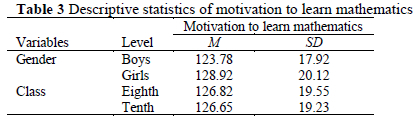
The results are shown in Tables 3 and 4.
The two-way ANOVA test results (F = 15.361, p = 0.05) show that the mean score of motivation to learn mathematics was higher among girls (M = 128.92) than among boys (M = 123.78). There were no differences due to class.
Q3: Does the Level of Attitudes Towards Mathematics Differ According to the Variables of Gender or Class?
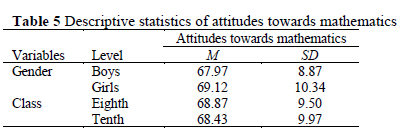
The results are shown in Tables 5 and 6.
The results of the two-way ANOVA test show no difference in the mean score of attitudes towards mathematics due to gender or class.
Q4: Does a Relationship Exist between
Mathematics Anxiety, Motivation to Learn
Mathematics, and Attitudes Towards Mathematics
Among School Students in Jordan?
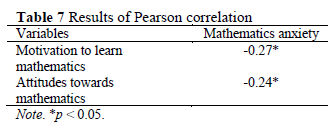
The results are shown in Table 7.
The results of the Pearson correlation show a negative relationship between mathematics anxiety and motivation to learn mathematics (r = -0.27, p = 0.05) and a negative relationship between mathematics anxiety and attitudes towards mathematics (r = -0.24, p = 0.05).
Discussion
The results related to the first question show that the level of mathematics anxiety was higher for boys (M = 23.05) than it was for girls (M = 22.47). We attribute this result to boys' weak interest in mathematics and inattention, although the subject requires students to pay full attention and perseverance. Consequently, this negligence leads to a high level of mathematics anxiety and a lower level of academic achievement. No difference in the level of mathematics anxiety due to students' class was found as students in both grades appeared to feel the same level of mathematics anxiety. In addition, the students in the eighth and 10th grade were equally affected by the internal and external circumstances and environment. Some previous studies (Reavis, 1987) show that the level of mathematics anxiety among boys was higher than it was among girls, although other studies (Baloglu & Koçak, 2006; Else-Quest et al., 2010; Van Mier, Schleepen & Van den Berg, 2019; Yüksel-Sahin, 2008) show that it was higher among girls than boys.
The results related to the second question show that the level of motivation to learn mathematics was higher for girls (M = 128.92) than for boys (M= 123.78). We attribute this result to the fact that girls spend more time at home, while boys are allowed to pursue other interests and spend more time outside the home. This difference encourages girls to use their free time to study and solve problems in mathematics, which increases their learning motivation. In addition to the economic and social changes in Jordanian society, more girls seek to study and their motivation towards learning and studying mathematics has increased since it requires more time indoors and holds the possibility of job opportunities in the future. Some male students may turn to professional careers, although many prefer to enter other, less demanding fields, and thus their motivation towards learning in general, and mathematics in particular, is reduced.
These results show no differences in the level of motivation to learn mathematics due to class. This may again result from the similarity of the school environment in which students in the eighth and 10th grades are together in the same place, with the same teachers, curriculum content, activities, the form of transactions, and everything contained in this environment. In addition, the same level of educational guidance and instruction is provided to these students. Thus, all directions and instructions become part of students' general behaviour, helping them to perform their duties and responsibilities. These instructions also urge students to fully participate in the educational process, especially in mathematics, and thus to achieve the goals of the educational institution to which they belong. The results of some studies (Ganley & Lubienski, 2016; Yoon, Eccles & Wigfield, 1996) show that the level of motivation among girls was higher than among boys, although other studies (Frenzel, Goetz, Pekrun & Watt, 2010; Guo et al., 2015; Rodríguez, Regueiro, Piñeiro, Estévez & Valle, 2020) show the opposite.
The results related to the third question show no difference in attitudes towards mathematics due to gender. This result comes from exposing students to the same curriculum in mathematics, classroom environment, and teaching methods. All students thus have equal learning opportunities given that knowledge is the first component of the elements of attitude. In addition, male and female students are mature enough to accept and understand the educational material. The results of some studies (Alenezi, 2008; Batool, Akhter & Kalsoom, 2020; Farooq & Shah, 2008; Kaur, 2017) also show no differences in attitudes towards mathematics due to gender.
Similarly, there were no differences in attitudes towards mathematics due to class. This result is due to the fact that all students were at the same level (upper basic), stage, age, and similar social family backgrounds and environment; all of them studied in the same public schools under the same conditions.
The results related to the last question show a negative relationship between mathematics anxiety and students' attitudes towards mathematics. That is, the more students' mathematics anxiety increases, the greater the negative effects on their attitudes towards the subject become. The students whose attitudes were negative towards mathematics expressed a higher level of mathematics anxiety. The more positive their attitudes towards mathematics were, the lower the level of mathematics anxiety was.
Anxiety is considered as an indispensable component or contributory factor to attitude. The higher the level of anxiety among students in a subject, the greater the negative effect on their attitude towards this subject. This relationship explains why some studies suggest addressing mathematics anxiety in the context of attitudes towards mathematics. Also, the attitudes towards mathematics scales includes items reflecting the students' anxiety in expressing their attitudes towards mathematics.
Meece, Wigfield and Eccles (1990) aimed to identify the predictors of adolescents' mathematics anxiety in both enrolment and performance, using expectancy-value and self-efficacy theory to gauge motivation towards achievement. In their study, assessment of several influential factors (previous grades, ability perception, performance expectation, value perception) were evaluated in relation to students' levels of mathematics anxiety. The results indicate that the strongest direct effects on students' mathematics anxiety levels were current performance expectations, followed by their perception of the importance of mathematics. The results also illustrate the significance of efficacy-related judgments in the prediction of students' mathematics anxiety, and that the effect of past performance on anxiety was mediated by the student's perception of his/her mathematics capabilities.
Erdogan, Kesici and Sahin (2011) examined the relationship between mathematics anxiety, achievement motivation, and social comparison among high school students. The results show a negative relationship between mathematics anxiety and achievement motivation. Yildirim (2011) examined the relationship between self-efficacy, intrinsic motivation, anxiety, and mathematics achievement among school students. The results show a negative relationship between anxiety, intrinsic motivation, and mathematics achievement.
Despite the broad agreement on the association between students' mathematics anxiety and motivational beliefs, reports of experiential conclusions differ widely regarding the strength and direction of the correlation. Kim et al. (2014) and Zhou and Urhahne (2013), for instance, found the correlation between the mathematics anxiety felt by students and their motivational beliefs to be moderately negative, while other researchers including W Luo et al. (2016), Peixoto et al. (2017), and Sutter-Brandenberger et al. (2018) found it as relatively small to negligible. Alliman-Brissett (2006) and Schnell et al. (2013) report that the correlation was small to negligibly negative or even a positive correlation. Lauermann, Eccles and Pekrun (2017) states that a key contributory factor in these inconsistencies and contradictions was the fact that different motivational constructs, e.g. value or competence beliefs, were used in reporting distinctive effects on students' mathematics anxiety, without differentiating between the different motivational constructs.
The researchers stressed the vital importance of unravelling or extricating the links between mathematics anxiety and different motivational constructs to facilitate future discussion on the fundamental mechanism of these links and put in place effective approaches and stratagems for the alleviation of mathematics anxiety. Schunk (2000) points out that the combination of computational and problem-solving skills requires competence for positive mathematics results, challenging a high level of task difficulty. High achievement motivation can produce mathematics anxiety. However, highly achievement-motivated students are exposed to a higher degree of task difficulty but are more impeded by external factors. For example, high achievers, facing high-level task difficulty under positive conditions, are more susceptible to possible failure stress than low achievers with lesser stress and lower achievement motivational demands (Kukla, 1972; Weiner & Kukla, 1970).
Behaving responsibly as students is a priority for achieving success. Highly achievement-motivated mathematics students need to be particularly competent and capable in numerology, calculation, and problem-solving in order to reduce mathematics anxiety; lower achievement motivation is responsible for students' low motivation and achievement (Katz, 1967; Weiner & Kukla, 1970).
According to Briley (2012) and Swars, Hart, Smith, Smith and Tolar (2007), students with a strongly positive attitude towards mathematics generally felt less anxiety, suggesting that attitude and anxiety could be active constituents of students' mathematics learning. It has also been found that students with a low anxiety level are usually more confident about learning mathematics. Haciomeroglu (2017) examined the relationship between mathematics anxiety and attitudes towards mathematics among elementary school students. The results show a negative association (r = -0.17).
In light of this study and its findings, we suggest the need to pay attention to the issue of mathematics anxiety among school students and to work to provide the necessary support to reduce it. Although we focused on the negative impact of mathematics anxiety on students' achievements in particular, which profoundly impacts students' attitudes towards mathematics, the results of this study are equally applicable to academic achievement in general. We recommend assigning educational counsellors, in cooperation with mathematics teachers, to provide remedial support to overcome mathematics anxiety by holding meetings to assist students in reducing their levels of anxiety. Mathematics teachers should take into account the individual differences between students, in a way that is commensurate with their different abilities, focusing on developing students' positive attitudes towards mathematics by introducing them to the importance of the subject in their lives.
Conclusion
The main objectives of this study were to examine the relationship between mathematics anxiety, motivation to learn, and attitudes towards mathematics. We aimed to identify any significant differences in mathematics anxiety, motivation to learn, and attitudes towards mathematics due to gender and class among school students in Jordan. The results of the two-way ANOVA test show that the mean score for mathematics anxiety among boys was higher than for girls, with no difference due to class. The mean score for motivation to learn mathematics was higher among girls than among boys, with no difference in the mean score for motivation due to class. The score also shows no difference in the mean scores of attitudes towards mathematics by gender or class. The results of the correlation coefficient show a negative relationship between mathematics anxiety and motivation to learn mathematics (r = -0.27), and a negative relationship between mathematics anxiety and attitudes towards mathematics (r = -.24). This research could form the basis for future studies examining the relationship between mathematics anxiety and other variables such as mathematics competence or student-teacher relationship.
Authors' Contributions
AM and AG wrote the literature review and discussion sections. OA collected the data. All authors reviewed the final version of the article.
Notesi. Published under a Creative Commons Attribution Licence.
References
-
Abed AS & Alkhateeb HM 2001. Mathematics anxiety among eighth-grade students of the United Arab Emirates. Psychological Reports, 89(1):65-66. https://doi.org/10.2466/pr0.2001.89.1.65
» https://doi.org/10.2466/pr0.2001.89.1.65 -
Aiken LR, Jr 1970. Attitudes toward mathematics. Review of Educational Research, 40(4):551-596. https://doi.org/10.3102/00346543040004551
» https://doi.org/10.3102/00346543040004551 -
Alenezi DF 2008. A study of learning mathematics related to some cognitive factors and to attitudes. PhD thesis. Glasgow, Scotland: University of Glasgow. Available at https://theses.gla.ac.uk/333/1/2008_Aleneziphd.pdf . Accessed 31 December 2025.
» https://theses.gla.ac.uk/333/1/2008_Aleneziphd.pdf - Al-Fawal M & Khair H 2018. The relationship between Mathematics anxiety, achievement and attitude towards it: A field study in the schools of Latakia Governorate. Tishreen University Journal for Research and Scientific Study, 53(3):195-207.
-
Alliman-Brissett A 2006. Factors associated with African American adolescents' math career-self-efficacy. PhD dissertation. Minneapolis, MN: University of Minnesota. Available at https://www.proquest.com/docview/305304206?pqorigsite=gscholar&fromopenview=true&sourcetype=Dissertations%20&%20Theses. Accessed 31 December 2025.
» https://www.proquest.com/docview/305304206?pqorigsite=gscholar&fromopenview=true&sourcetype=Dissertations%20&%20Theses -
Ashcraft MH 2002. Math anxiety: Personal, educational, and cognitive consequences. Current Directions in Psychological Science, 11(5):181-185. https://doi.org/10.1111/1467-8721.00196
» https://doi.org/10.1111/1467-8721.00196 - Atta MA & Jamil A 2012. Effects of motivation and parental influence on the educational attainments of students at secondary level. Academic Research International, 2(3):427-431.
-
Baloglu M & Koçak R 2006. A multivariate investigation of the differences in mathematics anxiety. Personality and Individual Differences, 40(7):1325-1335. https://doi.org/10.1016/j.paid.2005.10.009
» https://doi.org/10.1016/j.paid.2005.10.009 -
Bandura A 2005. Social cognitive theory: An agentive perspective. Psychology: The Journal of the Hellenic Psychological Society, 12(3):313-333. https://doi.org/10.12681/psy_hps.23964
» https://doi.org/10.12681/psy_hps.23964 -
Batool T, Akhter S & Kalsoom T 2020. Exploring gender differences in attitudes toward mathematics at secondary level in Pakistan. Journal of Business and Social Review in Emerging Economics,6(2):587-596. https://doi.org/10.26710/jbsee.v6i2.1157
» https://doi.org/10.26710/jbsee.v6i2.1157 -
Birgin O, Baloglu M, Çatlioglu H & Gürbüz R 2010. An investigation of mathematics anxiety among sixth through eighth grade students in Turkey. Learning and Individual Differences, 20(6):654-658. https://doi.org/10.1016/j.lindif.2010.04.006
» https://doi.org/10.1016/j.lindif.2010.04.006 -
Briley JS 2012. The relationships among mathematics teaching efficacy, mathematics self-efficacy, and mathematical beliefs for elementary pre-service teachers. Issues in the Undergraduate Mathematics Preparation of School Teachers, 5:1-13. Available at https://files.eric.ed.gov/fulltext/EJ990482.pdf. Accessed 31 December 2025.
» https://files.eric.ed.gov/fulltext/EJ990482.pdf -
Brophy J 2004. Motivating students to learn (2nd ed). New York, NY: Routledge. https://doi.org/10.4324/9781410610218
» https://doi.org/10.4324/9781410610218 -
Bursal M & Paznokas L 2006. Mathematics anxiety and preservice elementary teachers' confidence to teach mathematics and science. School Science and Mathematics, 106(4):173-180. https://doi.org/10.1111/j.1949-8594.2006.tb18073.x
» https://doi.org/10.1111/j.1949-8594.2006.tb18073.x -
Cheng CH & Su CH 2012. A Game-based learning system for improving student' s learning effectiveness in system analysis course. Procedia -Social and Behavioral Sciences, 31:669-675. https://doi.org/10.1016/j.sbspro.2011.12.122
» https://doi.org/10.1016/j.sbspro.2011.12.122 -
Chow SJ & Yong BCS 2013. Secondary school students' motivation and achievement in combined science. US-China Education Review B, 3(4):213-228. Available at https://files.eric.ed.gov/fulltext/ED542966.pdf. Accessed 31 December 2025.
» https://files.eric.ed.gov/fulltext/ED542966.pdf -
Di Martino P & Zan R 2010. 'Me and math's': Towards a definition of attitude grounded on students' narratives. Journal of Mathematics Teacher Education, 13(1):27-48. https://doi.org/10.1007/s10857-009-9134-z
» https://doi.org/10.1007/s10857-009-9134-z - Durrani N & Tariq V 2009. Relationships between undergraduates' mathematics anxiety and their attitudes towards developing numeracy skills and perceptions of numerical competence. In Proceedings of ICERI2009 Conference. Valencia, Spain: IATED.
-
Eccles J, Wigfield A, Harold RD & Blumenfeld P 1993. Age and gender differences in children's self-and task perceptions during elementary school. Child Development, 64(3):830-847. https://doi.org/10.1.1467-8624.1993.tb02946.x
» https://doi.org/10.1.1467-8624.1993.tb02946.x -
Else-Quest NM, Hyde JS & Linn MC 2010. Cross-national patterns of gender differences in mathematics: A meta-analysis. Psychological Bulletin Journal, 136(1):103-127. https://doi.org/10.1037/a0018053
» https://doi.org/10.1037/a0018053 -
Erdogan A, Kesici S &Sahin I 2011. Prediction of high school student's mathematics anxiety by their achievement motivation and social comparison. ilkögretim Online, 10(2):646-652. Available at https://www.researchgate.net/publication/265197111_Prediction_of_High_School_Students%27_Mathematics_Anxiety_by_Their_Achievement_Motivation_and_Social_Comparison. Accessed 31 December 2025.
» https://www.researchgate.net/publication/265197111_Prediction_of_High_School_Students%27_Mathematics_Anxiety_by_Their_Achievement_Motivation_and_Social_Comparison -
Evans B 2007. Student attitudes, conceptions, and achievement in introductory undergraduate college statistics. The Mathematics Educator, 17(2):24-30. Available at https://files.eric.ed.gov/fulltext/EJ841563.pdf. Accessed 31 December 2025.
» https://files.eric.ed.gov/fulltext/EJ841563.pdf -
Eysenck MW, Derakshan N, Santos R & Calvo MG 2007. Anxiety and cognitive performance: Attention control theory. Emotion, 7(2):336-353. https://doi.org/10.1037/1528-3542.7.2.336
» https://doi.org/10.1037/1528-3542.7.2.336 - Farooq MS & Shah SZ 2008. Students' attitude towards mathematics. Pakistan Economic and Social Review, 46(1):75-83.
-
Fennema E & Sherman JA 1976. Fennema-Sherman Mathematics Attitudes Scales: Instruments designed to measure attitudes toward the learning of mathematics by females and males. Journal for Research in Mathematics Education, 7(5):324-326. https://doi.org/10.5951/jresematheduc.7.5.0324
» https://doi.org/10.5951/jresematheduc.7.5.0324 -
Frenzel AC, Goetz T, Pekrun R & Watt HM 2010. Development of mathematics interest in adolescence: Influences of gender, family, and school context. Journal of Research on Adolescence, 20(2):507-537. https://doi.org/10.1111/j.1532-7795.2010.00645.x
» https://doi.org/10.1111/j.1532-7795.2010.00645.x -
Frenzel AC, Pekrun R & Goetz T 2007. Girls and mathematics-"hopeless" issue? A control-value approach to gender differences in emotions towards mathematics. European Journal of Psychology of Education, 22(4):497. https://doi.org/10.1007/bf03173468
» https://doi.org/10.1007/bf03173468 -
Ganley CM & Lubienski ST 2016. Mathematics confidence, interest, and performance: Examining gender patterns and reciprocal relations. Learning and Individual Differences, 47:182-193. https://doi.org/10.1016/j.lindif.2016.01.002
» https://doi.org/10.1016/j.lindif.2016.01.002 - Glynn SM & Koballa TR, Jr 2006. Motivation to learn in college science. In JJ Mintzes & WH Leonard (eds). Handbook of college science teaching. Arlington, VA: National Science Teachers Association Press.
-
Glynn SM, Taasoobshirazi G & Brickman P 2009. Science Motivation Questionnaire: Construct validation with nonscience majors [Special issue]. Journal of Research in Science Teaching, 46(2):127-146. https://doi.org/10.1002/tea.20267
» https://doi.org/10.1002/tea.20267 -
Guo J, Parker PD, Marsh HW & Morin AJS 2015. Achievement, motivation, and educational choices: A longitudinal study of expectancy and value using a multiplicative perspective. Development Psychology, 51(8):1163-1176. https://doi.org/10.1037/a0039440
» https://doi.org/10.1037/a0039440 -
Haciomeroglu G 2017. Reciprocal relationships between mathematics anxiety and attitude towards mathematics in elementary students. Acta Didactica Napocensia, 10(3):59-68. https://doi.org/10.24193/adn.10.3.6
» https://doi.org/10.24193/adn.10.3.6 - Hadfield OD & McNeil K 1994. The relationship between Myers-Briggs personality type and mathematics anxiety among preservice elementary teachers. Journal of Instructional Psychology, 21(4):375-384.
-
Halat E 2006. Sex-related differences in the acquisition of the van hiele levels and motivation in learning geometry. Asia Pacific Education Review, 7(2):173-183. https://doi.org/10.1007/BF03031541
» https://doi.org/10.1007/BF03031541 -
Hannula MS 2002. Attitude towards mathematics: Emotions, expectations and values. Educational Studies in Mathematics, 49(1):25-46. https://doi.org/10.1023/A:1016048823497
» https://doi.org/10.1023/A:1016048823497 -
Hembree R 1990. The nature, effects and relief of mathematics anxiety. Journal for Research in Mathematics Education, 21(1):33-46. https://doi.org/10.5951/jresematheduc.21.1.0033
» https://doi.org/10.5951/jresematheduc.21.1.0033 -
Hemmings B, Grootenboer P & Kay R 2011. Predicting mathematics achievement: The influence of prior achievement and attitudes. International Journal of Science and Mathematics Education, 9:691-705. https://doi.org/10.1007/s10763-010-9224-5
» https://doi.org/10.1007/s10763-010-9224-5 -
Henschel S & Roick T 2017. Relationships of mathematics performance, control and value beliefs with cognitive and affective math anxiety. Learning and Individual Differences, 55:97-107. https://doi.org/10.1016/j.lindif.2017.03.009
» https://doi.org/10.1016/j.lindif.2017.03.009 -
Hopko DR, Mahadevan R, Bare RL & Hunt MK 2003. The Abbreviated Math Anxiety Scale (AMAS): Construction, validity, and reliability. Assessment, 10(2):178-182. https://doi.org/10.1177/1073191103010002008
» https://doi.org/10.1177/1073191103010002008 -
Huang WH 2011. Evaluating learners' motivational and cognitive processing in an online game-based learning environment. Computers in Human Behavior, 27(2):694-704. https://doi.org/10.1016/j.chb.2010.07.021
» https://doi.org/10.1016/j.chb.2010.07.021 -
Huang X, Zhang J & Hudson L 2019. Impact of math self-efficacy, math anxiety, and growth mind-set on math and science career interest for middle school students: The gender moderating effect. European Journal of Psychology of Education, 34:621-640. https://doi.org/10.1007/s10212-018-0403-z
» https://doi.org/10.1007/s10212-018-0403-z - Jajiga M 2017. Mathematics anxiety and its relationship to achievement among secondary school students. Al-Hikma Journal for Educational and Psychological Studies, 9: 60-70.
-
Jenβen L, Möller R & Roesken-Winter B 2020. Shame: A significant emotion in preservice primary school teachers' mathematics education. Paper presented at the 14th International Congress on Mathematical Education, Shanghai, China, 12-19 July. Available at https://www.researchgate.net/profile/Lars-Meyer-Jenssen/publication/339213977_Shame_A_significant_emotion_in_preservice_primary_school_teachers'_mathematics_education/links/5e448593299bf1cdb924d6dd/Shame-A-significant-emotion-in-preservice-primary-school-teachers-mathematics-education.pdf. Accessed 31 December 2025.
» https://www.researchgate.net/profile/Lars-Meyer-Jenssen/publication/339213977_Shame_A_significant_emotion_in_preservice_primary_school_teachers'_mathematics_education/links/5e448593299bf1cdb924d6dd/Shame-A-significant-emotion-in-preservice-primary-school-teachers-mathematics-education.pdf - Katz I 1967. The socialization of academic motivation in minority group children. In D Levine (ed). Nebraska Symposium on Motivation (Vol. 15). Lincoln, NE: University of Nebraska Press.
-
Kaur K 2017. Gender differences in the attitude towards mathematics of ninth class adolescents of Chandigarh. International Journal of Research in Humanities and Social Sciences, 5(3):77-81. Available at https://www.raijmr.com/ijrhs/wp-content/uploads/2017/11/1IRHS_2017_vol05_issue_03_12.pdf. Accessed 31 December 2025.
» https://www.raijmr.com/ijrhs/wp-content/uploads/2017/11/1IRHS_2017_vol05_issue_03_12.pdf -
Kiili K 2005. Digital game-based learning: Towards an experiential gaming model. The Internet and Higher Education, 8(1):13-24. https://doi.org/10.1016/j.iheduc.2004.12.001
» https://doi.org/10.1016/j.iheduc.2004.12.001 -
Kim CM, Park SW & Cozart J 2014. Affective and motivational factors of learning in online mathematics courses. British Journal of Educational Technology, 45(1): 171-185. https://doi.Org/10.llll/j.1467-8535.2012.01382.x
» https://doi.Org/10.llll/j.1467-8535.2012.01382.x -
Kiwanuka HN, Van Damme J, Van den Noortgate W, Anumendem DN, Vanlaar G, Reynolds C & Namusisi S 2017. How do student and classroom characteristics affect attitude toward mathematics? A multivariate multilevel analysis. School Effectiveness and School Improvement, 28(1): 1-21. https://doi.org/10.1080/09243453.2016.1201123
» https://doi.org/10.1080/09243453.2016.1201123 -
Kukla A 1972. Attributional determinants of achievement related behavior. Journal of Personality and Social Psychology, 21(2):166-174. https://doi.org/10.1037/h0032244
» https://doi.org/10.1037/h0032244 -
Kurtz-Costes B, Rowley SJ, Harris-Britt A & Woods TA 2008. Gender stereotypes about mathematics and science and self-perceptions of ability in late childhood and early adolescence. Merrill-Palmer. Quarterly, 54(3):386-409. https://doi.org/10.1353/mpq.0.0001
» https://doi.org/10.1353/mpq.0.0001 -
Lauermann F, Eccles JS & Pekrun R 2017. Why do children worry about their academic achievement? An expectancy-value perspective on elementary students' worries about their mathematics and reading performance. ZDM, 49(3):339-354. https://doi.org/10.1007/s11858-017-0832-1
» https://doi.org/10.1007/s11858-017-0832-1 -
Lim SY & Chapman E 2013. Development of a short form of the attitudes toward mathematics inventory. Education Studies in Mathematics, 82:145-164. https://doi.org/10.1007/s10649-012-9414-x
» https://doi.org/10.1007/s10649-012-9414-x -
Linn MC & Hyde JS 1989. Gender, mathematics, and science. Educational Researcher, 18(8):17-27. https://doi.org/10.3102/0013189x018008017
» https://doi.org/10.3102/0013189x018008017 -
Luo W, Ng PT, Lee K & Aye KM 2016. Self-efficacy, value, and achievement emotions as mediators between parenting practice and homework behavior: A control-value theory perspective. Learning and Individual Differences, 50:275-282. https://doi.org/10.1016/j.lindif.2016.07.017
» https://doi.org/10.1016/j.lindif.2016.07.017 - Luo X, Wang F & Luo Z 2009. Investigation and analysis of mathematics anxiety in middle school students. Journal of Mathematics Education, 2(2):12-19.
-
Ma X & Kishor N 1997. Assessing the relationship between attitude toward mathematics and achievement in mathematics: A meta-analysis. Journal for Research in Mathematics Education, 28(1):26-47. https://doi.org/10.2307/749662
» https://doi.org/10.2307/749662 -
Ma X & Xu J 2004. Determining the causal ordering between attitude toward mathematics and achievement in mathematics. American Journal of Education, 110(3):256-280. https://doi.org/10.1086/383074
» https://doi.org/10.1086/383074 -
Mata ML, Monterio V & Peixoto F 2012. Attitudes towards mathematics: Effects of individual, motivational, and social support factors. Child Development Research, 2012:1 -10. https://doi.org/10.1155/2012/876028
» https://doi.org/10.1155/2012/876028 -
Mayes R, Chase PN & Walker VL 2008. Supplemental practice and diagnostic assessment in an applied college algebra course. Journal of College Reading and Learning, 38(2):7-30. https://doi.org/10.1080/10790195.2008.10850306
» https://doi.org/10.1080/10790195.2008.10850306 - McCarthy WF 1986. The self-directedness and attitude towards mathematics of younger and older undergraduate mathematics students. PhD dissertation. New York, NY: Syracuse University.
-
Meece JL, Glienke BB & Burg S 2006. Gender and motivation. Journal of School Psychology, 44(5):351-373. https://doi.org/10.1016/J.JSP.2006.04.004
» https://doi.org/10.1016/J.JSP.2006.04.004 -
Meece JL, Wigfield A & Eccles JS 1990. Predictors of math anxiety and its influence on young adolescents' course enrolment intentions and performance in mathematics. Journal of Educational Psychology, 82(1): 60-70. https://doi.org/10.1037/0022-0663.82.1.60
» https://doi.org/10.1037/0022-0663.82.1.60 - Mintzes J, Wandersee JH & Novak JD (eds.) 1998. Teaching for understanding: A human constructivist view. San Diego, CA: Academic Press.
-
Mohammadpour E 2012. Factors accounting for Mathematics achievement of Singaporean eighth-graders. The Asia-Pacific Education Researcher, 21(3):507-518. Available at https://www.researchgate.net/profile/Ebrahim-Mohammadpour-2/publication/235679797_Factors_Accounting_for_Mathematics_Achievement_of_Singaporean_Eighth-Graders/links/02e7e51544e7a68792000000/Factors-Accounting-for-Mathematics-Achievement-of-Singaporean-Eighth-Graders.pdf. Accessed 31 December 2025.
» https://www.researchgate.net/profile/Ebrahim-Mohammadpour-2/publication/235679797_Factors_Accounting_for_Mathematics_Achievement_of_Singaporean_Eighth-Graders/links/02e7e51544e7a68792000000/Factors-Accounting-for-Mathematics-Achievement-of-Singaporean-Eighth-Graders.pdf - Neale DC 1969. The role of attitudes in learning mathematics. The Arithmetic Teacher, 16(8):631-640.
-
Newstead K 1998. Aspects of children's mathematics anxiety. Educational Studies in Mathematics, 36:53-71. https://doi.org/10.1023/A:1003177809664
» https://doi.org/10.1023/A:1003177809664 -
Nicolaidou M & Philippou G 2003. Attitudes towards mathematics, self-efficacy and achievement in problem solving. In MA Mariotti (ed). European research in Mathematics education III. Pisa, Italy: University of Pisa. Available at http://www.dm.unipi.it/~didattica/CERME3/proceedings/Groups/TG2/TG2_nicolaidou_cerme3.pdf. Accessed 31 December 2025.
» http://www.dm.unipi.it/~didattica/CERME3/proceedings/Groups/TG2/TG2_nicolaidou_cerme3.pdf -
Olson AM & Stoehr KJ 2019. From numbers to narratives: Preservice teachers experiences' with mathematics anxiety and mathematics teaching anxiety. School Science and Mathematics, 119(2):72-82. https://doi.org/10.1111/ssm.12320
» https://doi.org/10.1111/ssm.12320 -
Peixoto F, Sanches C, Mata L & Monteiro V 2017. "How do you feel about math?": Relationships between competence and value appraisals, achievement emotions and academic achievement. European Journal of Psychology of Education, 32(3):385-405. https://doi.org/10.1007/s10212-016-0299-4
» https://doi.org/10.1007/s10212-016-0299-4 -
Pintrich PR, Marx RW & Boyle RA 1993. Beyond cold conceptual change: The role of motivational beliefs and classroom contextual factors in the process of conceptual change. Review of Educational Research, 63(2):167-199. https://doi.org/10.3102/00346543063002167
» https://doi.org/10.3102/00346543063002167 - Pintrich PR & Schunk DH 1996. Motivation in education: Theory, research and applications. Englewood Cliffs, NJ: Prentice Hall.
-
Rambow DJ 2008. The relationship between emotional and social competence of math instructors and math anxiety levels of adult students enrolled in college mathematics courses. PhD dissertation. La Verne, CA: University of La Verne. Available at https://www.proquest.com/docview/304375693?pqorigsite=gscholar&fromopenview=true&sourcetype=Dissertations%20&%20Theses. Accessed 31 December 2025.
» https://www.proquest.com/docview/304375693?pqorigsite=gscholar&fromopenview=true&sourcetype=Dissertations%20&%20Theses -
Reavis PS 1987. Mathematics anxiety and the relationship between attitude, sex, ethnicity and achievement in mathematics in three high school curriculum tracks. PhD dissertation. Tucson, AZ: University of Arizona. Available at https://repository.arizona.edu/bitstream/handle/10150/184306/azu_td_8805525_sip1_m.pdf?sequence=1. Accessed 31 December 2025.
» https://repository.arizona.edu/bitstream/handle/10150/184306/azu_td_8805525_sip1_m.pdf?sequence=1 -
Rodríguez S, Regueiro B, Piñeiro I, Estévez I & Valle A 2020. Gender differences in mathematics motivation: Differential effects on performance in primary education. Frontiers in Psychology, 10:3050. https://doi.org/10.3389/fpsyg.2019.03050
» https://doi.org/10.3389/fpsyg.2019.03050 - Sandman RS 1979. Factors related to mathematics anxiety in the secondary school. Paper presented at the Annual Meeting of the American Educational Research Association, San. Francisco, CA, 8-12 April.
-
Schnell K, Tibubos AN, Rohrmann S & Hodapp V 2013. Test and math anxiety: A validation of the German Test Anxiety Questionnaire. Polish Psychological Bulletin, 44(2):193-200. Available at https://yadda.icm.edu.pl/cejsh/element/bwmeta1.element.ojs-issn-0079-2993-year-2013-volume-44-issue-2-article-dfdd88b6-9a4f-3b89-9691-5b49d824364f. Accessed 31 December 2025.
» https://yadda.icm.edu.pl/cejsh/element/bwmeta1.element.ojs-issn-0079-2993-year-2013-volume-44-issue-2-article-dfdd88b6-9a4f-3b89-9691-5b49d824364f - Schunk DH 2000. Learning theories: An educational perspective (3rd ed). Upper Saddle River, NJ: Merrill/Prentice Hall.
- Schunk DH 2001. Social cognitive theory and self-regulated learning. In BJ Zimmerman & DH Schunk (eds) Self-regulated learning and academic achievement: Theoretical perspectives (2nd ed). Mahwah, NJ: Lawrence Erlbaum Associates.
-
Sharma R & Gopal M 2010. Synergizing reinforcement learning and game theory-new direction for control. Applied Soft Computing, 10(3):675-688. https://doi.org/10.1016/j.asoc.2009.10.020
» https://doi.org/10.1016/j.asoc.2009.10.020 -
Sutter-Brandenberger CC, Hagenauer G & Hascher T 2018. Students' self-determined motivation and negative emotions in mathematics in lower secondary education-Investigating reciprocal relations. Contemporary Educational Psychology, 55:166-175. https://doi.org/10.1016/j.cedpsych.2018.10.002
» https://doi.org/10.1016/j.cedpsych.2018.10.002 -
Swars S, Hart LC, Smith SZ, Smith ME & Tolar T 2007. A longitudinal study of elementary pre-service teachers' mathematics beliefs and content knowledge. School Science and Mathematics, 107(8):325-335. https://doi.org/10.1111/j.1949-8594.2007.tb17797.x
» https://doi.org/10.1111/j.1949-8594.2007.tb17797.x -
Swars SL, Daane CJ & Giesen J 2006. Mathematics anxiety and mathematics teacher efficacy: What is the relationship in elementary preservice teachers? School Science and Mathematics, 106(7):306-315. https://doi.org/10.1949-8594.2006.tb17921.x
» https://doi.org/10.1949-8594.2006.tb17921.x - Tapia M & Marsh GE, II 2004. An instrument to measure mathematics attitudes. Academic Exchange Quarterly, 8(2):16-22.
- Trujillo KM & Hadfield OD 1999. Tracing the roots of mathematics anxiety through in-depth interviews with preservice elementary teachers. College Student Journal, 33(2):219-232.
-
Tuan HL, Chin CC & Shieh SH 2005. The development of a questionnaire to measure student's motivation towards science learning. International Journal of Science Education, 27(6):639-654. https://doi.org/10.1080/0950069042000323737
» https://doi.org/10.1080/0950069042000323737 -
Van Mier HI, Schleepen TMJ & Van den Berg FCG 2019. Gender differences regarding the impact of math anxiety on arithmetic performance in second and fourth graders. Frontiers in Psychology, 9:2690. https://doi.org/10.3389/fpsyg.2018.02690
» https://doi.org/10.3389/fpsyg.2018.02690 -
Von Glasersfeld E 1998. Cognition, construction of knowledge, and teaching. In MR Matthews (ed). Constructivism in science education: A philosophical examination. Dordrecht, The Netherlands: Kluwer Academic. https://doi.org/10.1007/978-94-011-5032-3
» https://doi.org/10.1007/978-94-011-5032-3 -
Weiner B & Kukla A 1970. An attributional analysis of achievement motivation. Journal of Personality and Social Psychology, 15(1):1-20. https://doi.org/10.1037/h0029211
» https://doi.org/10.1037/h0029211 -
Wigfield A & Meece JL 1988. Math anxiety in elementary and secondary school students. Journal of Educational Psychology, 80(2):210-216. https://doi.org/10.1037/0022-0663.80.2.210
» https://doi.org/10.1037/0022-0663.80.2.210 - Williams KC & Williams CC 2011. Five key ingredients for improving student motivation. Research in Higher Education Journal, 12:1 -23.
- Woodart T 2004. The effects of math anxiety on post-secondary developmental students as related to achievement, gender, and age. Virginia Mathematics Teacher, Fall:7-9.
-
Yoon KS, Eccles JS & Wigfield A 1996. Self-concept of ability, value, and academic achievement: A test of causal relations. Paper presented at the Annual Meeting of the American Education Research, New York, NY, 8-12 April. Available at http://education-webfiles.s3-website-us-west-2.amazonaws.com/arp/garp/presentations/eccles96o.pdf. Accessed 31 December 2025.
» http://education-webfiles.s3-website-us-west-2.amazonaws.com/arp/garp/presentations/eccles96o.pdf -
Yildirim S 2011. Self-efficacy, intrinsic motivation, anxiety and mathematics achievement: Findings from Turkey, Japan and Finland. Necatibey Faculty of Education Electronic Journal of Science and Mathematics Education, 5(1):277-291. Available at https://www.ajindex.com/dosyalar/makale/acarindex-1423909571.pdf. Accessed 29 December 2025.
» https://www.ajindex.com/dosyalar/makale/acarindex-1423909571.pdf -
Yüksel-Sahin F 2008. Mathematics anxiety among 4th and 5th grade Turkish elementary school students. International Electronic Journal of Mathematics Education, 3(3):179-192. https://doi.org/10.29333/iejme/225
» https://doi.org/10.29333/iejme/225 - Zan R & Di Martino P 2007. Attitude toward mathematics: Overcoming the positive/negative dichotomy. The Montana Mathematics Enthusiast, Monograph, 3:157-168.
-
Zhou J & Urhahne D 2013. Teacher judgment, student motivation, and the mediating effect of attributions. European Journal of Psychology of Education, 28(2):275-295. https://doi.org/10.1007/s10212-012-0114-9
» https://doi.org/10.1007/s10212-012-0114-9
Revised: 7 March 2025
Accepted: 19 June 2025
Published: 31 December 2025