The consistency of the Teele Multiple Intelligence Inventory (TIMI) scale with children's preferences in investigating the intelligence areas of preschool children
Abstract
The study reported on here was conducted to examine the consistency of the views of children and teachers in predicting the multiple intelligence areas of children at the end of the education programme provided in an enriched class based on multiple intelligence practices in a pre-school education institution. Using the pre-test-education-post-test experimental method, we applied the relational pattern to investigate the relationship between the 2 variables. The sample group of this study consisted of 34 children aged 5 to 6 years, 17 in the experimental and 17 in the control group. As data collection tools, the TIMI Inventory developed by Teele (1992) and an application (colour-bead system) containing assessments of the children's preferences were applied. The findings obtained in this study show that in 7 of the 17 children, the intelligence/skills area revealed by the evaluations of their preferences was similar to the results of the TIMI Inventory.
early childhood; early intervention; multiple intelligences
Introduction
Individuals' differences in their learning and perception style, speed and capacity, problem-solving abilities, and reasoning and intellectual skills have drawn the attention of scientists in the last century, and research has focused on the characteristics of intelligence, skills and abilities. Recent studies have ruled out the single and integrated understanding of intelligence and demonstrated that intelligence has a complicated structure consisting of a combination or interaction of various talents and skills. This complex structure is also being studied by many researchers (Carroll, 1997; Cattell & Horn, 1978; Franzen, 2000; Gardner, 2011; Sari, 2019; Shearer, 2004; Wilinski & Kupracz, 2020).
Based on these views, the theory of multiple intelligences was put forward by Howard Gardner in 1983, suggesting that each individual has different degrees in various domains of intelligence. The theory soon attained a wide scope of application in the field of education and was redefined by many theorists (Armstrong, 2000; Taspinar, 2005).
Intelligence is shaped by hereditary abilities, personal experiences, and environmental components. Binet and Simon (1915) and Wechsler (1991) have developed tests that evaluate intelligence as an inborn unchangeable phenomenon as it was regarded for centuries. However, some scientists, such as Feuerstein (1990), Piaget (1965) and Vygotsky (1987), have revealed the variable features of intelligence.
Although the theory of multiple intelligences is discussed among educational scientists from various aspects, there is consensus that this new understanding can provide valuable insights into the learning-teaching process as it emphasises the learners' different abilities and interests and considers their individual characteristics (Izci, Kara & Dalaman, 2007).
Literature Review
Along with studies on the integration of multiple intelligences theory with learning and teaching processes, researchers have focused on the effects of intelligence types on learning. In this regard, it was agreed that the concept of emotional intelligence introduced by Goleman (1995), and the concept of moral intelligence introduced by Altan (2001), should be added to the theory of multiple intelligences. As a result, the importance of determining and evaluating individuals' multiple intelligence domains has drawn attention to the importance of early intervention on this issue (Bumen, 2005; Silver, Strong & Perini, 2000).
Enriching the environment in teaching activities makes the subject easier to understand and motivates the learners and also contributes to the process of identifying children with different types of intelligence and talent. In this context, supporting the educational environment with activities that serve different types of intelligence, will, on the one hand, enable children to view the subject of the activity from different aspects, and on the other hand, will enable teachers to identify children with special abilities and determine their area of intelligence/skill (Basbay, 2000; Campbell & Campbell, 1999). The most prominent point in the theory of multiple intelligences is that intelligence is not unchangeable, and it is a matter of pluralism. The theory argues that individuals have the ability to relatively develop all areas of their intelligence (Gardner, 2011).
In cases where meaningful learning does not occur, the acquired information is forgotten in a short time. In this case, effective learning does not take place. The multiple intelligence approach lays the groundwork for meaningful learning as it details the child in terms of various areas such as verbal/linguistic, logical/mathematical, visual/spatial, bodily/kinaesthetic, music/rhythm, social, self-directed, and nature (Cetin & Akar-Vural, 2019; Koyuncuoglu & Kaya, 2020).
Theoretical/Conceptual Framework
As one of the important functions of education is to identify and maximise learners' talents, applying multiple intelligence activities can further set forth and enhance these talents. The earlier these talents are identified, the greater the impact of education can be on improving them (Yavuz, 2001). Similarly, De Milander, Schall, De Bruin and Smuts-Craft (2020) state that impulsivity and orientation could not be personally prevented during childhood. In addition, studies show that the psychological counselling service is very limited even for primary school children in determining the special abilities of children (Joubert & Hay, 2020). In this context, educators play a key role in identifying these talents, making evaluations based on children's preferences, and, if necessary, restructuring the evaluation process.
Along with studies on the integration of the multiple intelligences theory with learning and teaching processes, researchers have focused on the effects of intelligence types on learning, suggesting that identifying, evaluating, and improving multiple intelligence talents have a profound impact on an individual's life (Franzen, 2000; Gok, 2006). Based on this, with this study we aimed not only to examine the consistency of children-teachers in determining and predicting multiple intelligence areas in the preschool period but also to investigate the effects of applying multiple intelligence activities on predicting children's intelligence/talent.
We sought to answer the following questions:
1) Is it possible to make evaluations regarding children's intelligence/ability areas based on their activity preferences?
2) What is the consistency between the results of evaluating children's intelligence/ability areas based on their activity preferences and the TIMI Multiple Intelligence Inventory?
3) Is there any difference concerning the TIM results between the experimental group where the evaluations were based on children's preferences and the control group where the evaluations were only based on teacher estimates?
Finally, it should be emphasised that multiple intelligence activities is a topic that concerns not only educators and researchers but also parents and childcare providers.
Method
Research Model
In this research, a combination of the relational method, which is one of the descriptive research types, and the experimental method was used. The relational method is used to examine whether there is a relationship and/or consistency between two or more variables. This study was designed as relational since we examined the consistency between evaluations based on children's activity preferences and the TIMI results. This study was also conducted with an experimental design as the TIMI Inventory was applied both before and after the evaluations based on the children's activity preferences.
A post-test experimental method design with experimental and control groups was used to apply an independent variable to a randomly selected group and observe its effects on the dependent variable. A descriptive case study, which is one of the case-study approaches, was used to estimate the intelligence areas of the children as a result of evaluations based on the children's activity preferences among the multiple intelligence practices that they were offered.
Study Groups
The participants in this study were 34 pre-school children aged 5 to 6 years (mean age: 65 months), all of whom were attending the same school, yet in different classes. The children were divided into two groups: the experimental group (n = 17) and the control group (n = 17).
Data Collection Tools
As a data collection tool, the TIMI Inventory was used. The inventory was applied by teachers after short instruction in an enriched educational environment based on the multiple intelligences theory. Evaluation practices based on the children's activity preferences were also used to collect data.
The TIMI multiple intelligence inventory
The TIMI Multiple Intelligence Inventory developed by Teele (1992) was used as a data collection tool. The TIMI was developed by Sue Teele in 1992 to investigate the dominant intelligence areas of children and youths in both levels of primary education, high school, and university. The inventory is used to identify seven intelligence domains, including verbal-linguistic (V-L), logical-mathematical (L-M), visual-spatial (V-S), musical-rhythmic (M-R), kinaesthetic-bodily (K-B), personal-introspective (P-I) and interpersonal-social (I-S).
The validity study of the TIMI investigated whether the pictures used in the inventory actually represented the specified intelligence area, and the reliability study of the inventory included a test-retest application. In her reliability study, Teele (1992) concluded that all intelligence domains of the TIMI were significant at the .01 level.
In Turkey, the validity of the inventory was investigated in several studies conducted by Gögebakan (2003), Oklan-Elibol (2000), Oklan-Elibol and Tugrul (2001), Ozdemir (2006) and Terzioglu (2005). The pictures of the inventory were expertised and accepted as valid. As a result of the reliability study conducted by Ozdemir (2006), the relationship between the test-retest results of the inventory was significant at the level of 0.01.
Evaluations based on children's activity preferences
Designed by the researchers to be used in a classroom environment, each of the multiple intelligence areas was marked with a colourful marker. For instance, the L-M intelligence area was marked with a blue marker. If a child were engaged in the activities of this area, (s)he would place a blue bead into the jar allocated to him/her when (s)he was done with the activities, indicating that this child had spent time in the L-M area. The children were instructed to place a bead into their jar as they would finish the activities of any specific area. However, the bead needed to be the same colour as the area that they marked. For instance, green represented the domain of I-S intelligence. A child engaged in this domain activity would place a green bead into his/her jar after completing the activity.
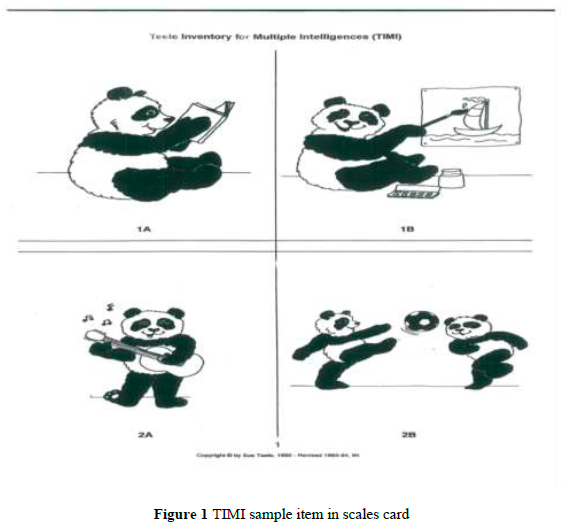
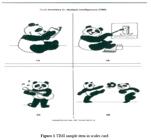
At the end of this research, two experts (PhD specialists of early childhood education and educational science) counted the beads in each child's jar: the colour of the beads would determine the areas that the child had preferred to be engaged in, and the number of the beads would determine how long the child had spent in any specific area. After evaluating the multiple intelligence areas based on the children's activity preferences, the TIMI Multiple Intelligence Inventory was applied. A sample item is shown in Figure 1.
Procedure
Before this study, a classroom was equipped with supporting materials necessary for multiple intelligence practices in early childhood. The classroom was designed and organised based on five expert opinions to meet the multiple intelligence practice needs. The experts were selected as early childhood educators, assessment and evaluation specialists and educational sciences specialists.
These materials - prepared based on the theory of multiple intelligences - were new for the learners and during the data collection process, the learners were engaged in various activities using the materials, for example, visual arts activity, creative drama activity, mechanical games. The materials in each area of multiple intelligences were introduced to the children during the first 2 weeks of this study. Later on, the process of activity preference, where the children could choose their own activities, was initiated. The structured activity periods - within the scope of free activity - were applied 2 days a week for 30 minutes each and lasted for 12 weeks. Without any instructions from their teachers, the children were allowed to participate in any activity of their own preference. The activities that they opted to participate in would produce study data for us. The children in the control group were asked to complete their structive activities in an unstructured environment.
The month-long data collection process included the colourful-bead technique, which enabled us to evaluate the activity preferences of the children in the study group.
The data collection process consisted of the following stages:
1) Preparation of an enriched class based on multiple intelligence practices
2) Providing training for children to participate in their preferred activities
3) Performing the practices and applications
4) Application of the TIM Multiple Intelligence Inventory
As the last stage of the evaluation process, the classroom teachers were asked to complete a form for each child in the study group to investigate their intelligence areas according to the priority order of the children's activity preferences. The study groups of children are shown in Figure 2-4.
Data Analysis
The results of the TIMI Inventory and the evaluation results of the activity preferences of the children obtained using the colour-bead technique were analysed, and for each child, four dominant intelligence areas were determined and ranked from the highest to the lowest. Then, the consistency between TIMI results and the teachers' evaluations of the multiple intelligence areas based on the activity preferences of the children was examined.
The children in the control group were asked to complete their routine activities without being involved in multiple intelligence practices. Upon completing these structive activities, teachers -based on their personal opinions - made predictions of the children's intelligence. The TIMI Inventory was also applied to the control group so that the children' s activity preferences on determining their intelligence/skills could be compared to the teachers' estimates.
Results
The results of the TIMI Multiple Intelligence Inventory and the evaluations based on the children's activity preferences were analysed by two experts (PhD specialists of early childhood education assessment and evaluation specialists and educational science), and (f) frequency distributions and percentage values were calculated.
The Results of the TIMI Multiple Intelligence Inventory and Distribution of Children's Dominant Areas of Multiple Intelligences
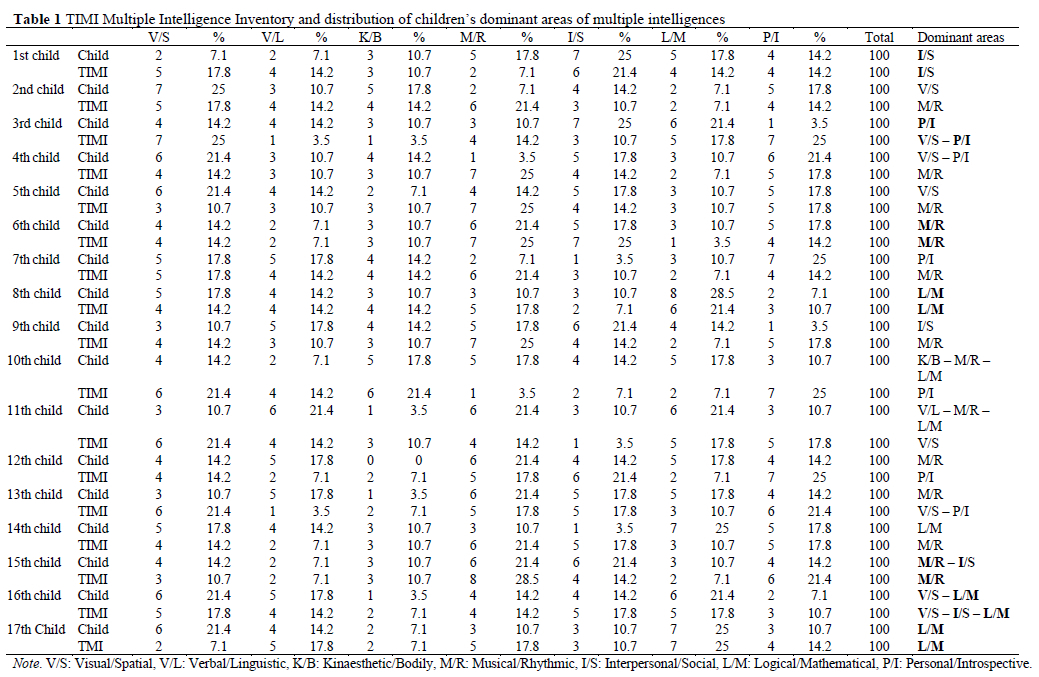
Table 1 presents the data regarding the TIMI Inventory applied to children and the evaluations based on the activity preferences of the children using the colourful-bead system. Among the results of the two types of evaluations presented in the same column, those intelligence areas that were the same according to both the TIMI and the child's activity preferences are indicated in bold print.
According to the results, the multiple intelligence area(s) of the first, third, sixth, eighth, 15th, 16th, and 17th children were the same in both evaluation types. For instance, the first child's intelligence area was predominantly interpersonal/social intelligence according to the results of the child's activity preferences. Similarly, the results of the TIMI Inventory revealed that the dominant intelligence area of the child was interpersonal/social intelligence.
Evaluating Their Activity Preferences and the TIMI Inventory
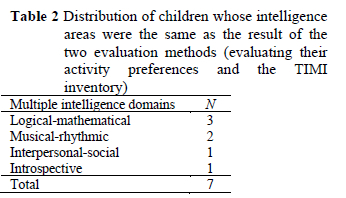
As presented in Table 2, when the results of the evaluations of the children's activity preferences were compared with those of the TIMI inventory, it can be concluded that evaluating the activity preferences correctly estimated the dominant intelligence areas of seven of the 17 children. These included three children in L-M, two children in M-R, one child in I-S, and one child in the introspective domain, from the highest to the lowest, respectively.
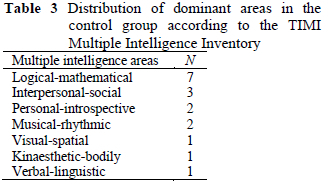
Table 3 shows the results of the intelligence area distributions of the 17 children in the control group according to the TIMI scale. According to Table 3, seven of the children in the control group were dominant in L-M intelligence skills, three in I-S, two in P-I, two in M-R, one in V-S, one in K-B, and one in the V-L intelligence domain.
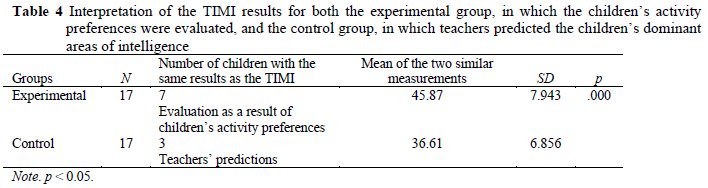
Table 4 presents the data regarding the assessment results of multiple intelligences for the children in the experimental and control groups. Analysing the evaluation results of both groups concerning the TIMI results shows that the predictive level rate of the children in the experimental group, where the evaluations were based on the children' s activity preferences, was higher compared to the control group, in which evaluations were based on the teachers' opinions of the children' s dominant areas of intelligence.
Discussion
Research based on the study conducted by Gardner (2009) in which intelligence/talent types are divided into eight domains, show that one type of intelligence is dominant in each individual and that this dominant intelligence type has a direct impact on the individual's profession and all other situations in life (Batdi, 2017). Due to this prominent impact, it is important to determine and strengthen the dominant intelligence area at an early age. Moreover, identifying the potential dominant intelligence areas of children is crucial in determining their educational skills and detecting their strengths and weaknesses in the learning process. In this context, our study significantly contributes to the literature as it enables professionals to recognise the developmental aspects of children's intelligence/talent areas at an early age.
The findings show that both self-evaluation and the TIMI Inventory had the same results in seven of the 17 children in the experimental group. In other words, the TIMI Inventory results regarding the dominant intelligence area(s) of seven children were consistent with the self-assessment results. The intelligence areas of these seven children with common results in both measurement techniques (Child Preliminary Assessment and the TIMI) were as follows: L-M (three children), M-R (two children), I-S (one child), and personal (one child). Many studies have reported that estimating these intelligence/talent areas is relatively easier than other areas such as introspective. Gardner (2009), Mitchell and Kernodle (2004) and Tarman (2002) have reported that P-I intelligence is an easily observable type of intelligence, especially because the L-M and P-I intelligence types are important indicators of professional success and a high level of performance. Furnham and Fukumoto (2008) and Goodnough (2001) have reported that the most predictable intelligence areas are the V-L and L-M areas. It has also been reported that the L-M intelligence type is an easily measurable area in determining the intelligence profile due to its quantitative structure that can be measured by numbers (Bellanca, 1997; Bumen, 2005). Similarly, in our study, children with these intelligence/talent types were able to demonstrate their intelligence/talent areas more easily than other children in the evaluations based on their activity preferences.
Analysing the evaluation results of both the experimental and control groups regarding the TIMI results shows that the predictive level rate of the children in the experimental group, where the evaluations were based on the children's activity preferences, was higher compared to the control group, in which evaluations were based on the teachers' opinions of the children's dominant areas of intelligence. Based on these data, the findings suggest that the activities that enable assessment of the children's intelligence/talent areas based on their preferences may be effective in predicting similar results with the TIMI.
It is very important for individuals to be able to identify their intelligence/talents. Leo Tolstoy was dropped out of school due to academic failure, Walt Disney was fired by newspaper publishers for being clumsy, Frank Winfield Woolworth was dismissed from the drapery shop for having weak perception, Isaac Newton' s teachers called him the most unsuccessful student in primary school, and Albert Einstein was expelled from school for being stupid (Atik, 2007; Byers & Bourgoin, 1998). The most important reason behind all the negative experiences of these geniuses of science and art was that their talents were not correctly detected and identified by their environment although these and similar scientists and artists were highly talented and gifted in specific areas. It is in this context that our study significantly contributes to the scientific literature to enable individuals to demonstrate and identify their own intelligence/talents at a very young age.
The study results reveal that among the 17 children in the experimental group, the highest number falls in the category of the L-M intelligence (seven children). The order continues as follows: I-S (three children), P-I (two children), M-R (two children), V-S (one child), K-B (one child), and V-L (one child). However, most of the previous studies that investigated multiple intelligence domains report different results.
Franzen (2000) report that 5th, 6th, and 7th-grade students perceived themselves as the strongest in social and natural intelligence and the weakest in the area of V-L intelligence. As a result of analysing more than 4,000 answer papers by Teele (1997), dominant intelligence areas of the children were determined according to their grade levels, two of which were V-L intelligence and personal-intrinsic intelligence. In his study with 192 students from the 7th to the 12th grade, Chan (2001) reported that social intelligence and introspective intelligence were the two intelligence areas with the highest average scores. Therefore, there seems to be no pluralistic priority among intelligence/talent areas.
Keating (1980) and Renzulli and Reis (1991) state that if an individual with talent and creativity below the average is provided with favourable conditions and is encouraged to perform at a high level, such individual can demonstrate superior performance. Thus, they have emphasised that it is easier to discover the intelligence/talents of an individual under fortified conditions. They also highlight that it is more accurate to talk about "people with an outstanding performance" rather than "gifted people."
Theorists such as Horn (1985) and Piaget (1965) have indicated that intelligence, in fact, is a whole set of multi-skills by suggesting that many skills, such as sensation, perception, compliance, balancing, communicating, reacting, and thinking, are components of intelligence.
Our study on determining multiple intelligence areas of individuals at very young ages, especially aims to serve the development of these areas in the early period. This study coincides with the definition and explanation of intelligence by researchers like Woodcock (1990) who emphasise the constantly changing feature of intelligence and try to demonstrate the importance of developing and supporting the dominant intelligence area in accordance with the theory of multiple intelligences.
In their studies with university students, Shalk (2002), Uysal and Eryilmaz (2006), Yenice and Aktamis (2010), Ozden (2014) and Zorlu and Zorlu (2019) report that while the students studying elementary school teaching were weak in visual, musical, and naturalistic areas of multiple intelligences, and those studying social science teaching were weak in visual, social, and naturalistic domains, they were all successful in other intelligence areas. The fact that "social", "L-M", and "M-R and V-L" areas of multiple intelligences were the most dominant areas in the Faculties of Education, Engineering, and Art and Design, respectively, shows that the dominant area of intelligence has a major impact on students' professional preferences and life skills. From this point of view, our study, with which we aimed to determine the intelligence/talent area of children through evaluating their own activity preferences, significantly contributes to the literature, and it can help structure educational processes, including innovations and integrating similar techniques into the children' s curriculum.
In their studies, Hoerr (2000), Saban (2005, 2009), and Temiz (2007) state that children are more prone to certain intelligence areas from a young age and upon attending school, they prefer to engage in practices that address their intelligence areas. According to Hamurcu (2002), by the age of 11 to 12, children already develop certain attitudes about certain areas and topics that appeal to them; thus, it is important to identify and support these areas.
It was observed that the classroom teachers, who were determined that the methods and techniques they preferred were not reflected in the dominant intelligence areas, paid attention to the learning status of the learners and the content of the subject. Accordingly, teachers' diversification of activities for multiple intelligence areas also facilitate the determination of children' s intelligence areas (Sari, 2019).
The determination of multiple intelligence areas helps teachers enhance their teaching techniques using different tools and developing strategies beyond traditional teaching methods (Karakoc & Sezer, 2007). In his research, Mehta (2002) evaluated children's learning processes according to their multiple intelligence areas and concluded that by configuring learning environments, teachers could identify and strengthen the areas in which children are weak; hence, helping children progress in those areas.
Recent studies focus on the effects and outcomes of determining the intelligence areas of learners on their academic success (Akamca & Hamurcu, 2005; Geng & Arslan, 2020; Gok, 2006; Koklu, 2020; Liefländer & Bogner, 2018; Ongoren & Sahin, 2008; Oral & Oner, 2005; Tugrul, 2003). Our study is original research as it suggests evaluating 5 to 6-year-old children's activity preferences to identify their dominant area(s) of multiple intelligences. Bowen and Roth (2007), Okur, Yalcin-Ozdilek and Sezer (2013) state that qualitative research approaches could be used besides quantitative research in determining multiple intelligence areas of children. They also emphasise that a case study would be the most suitable approach in the initial stage to have a deeper investigation of the topic.
All these studies demonstrate that intelligence areas can be identified at an early age as it plays a prominent role in an individual' s social, educational, and professional aspects of life. All these results draw attention to the importance of determining the intelligence area of an individual in life, and likewise, the necessity and consistency of predicting the intelligence areas of children at an early age and supporting the teachers in this regard.
Conclusion and Further Suggestions
Our research was a preliminary study to identify the dominant areas of intelligence in children. It emphasises the necessity and importance of offering various educational practices to children and providing them with rich training environments to enable them to explore all their intelligence areas from early childhood.
Various methods and techniques are used to identify and evaluate children. However, the methods in which children are evaluated based on their own abilities are scarce in the literature. In order for each child to be evaluated according to his or her own development, it is essential to use a portfolio.
Classrooms and learning centres should be constantly updated concerning multiple intelligence categories to ensure learners' active engagement in various practices that further enhance their development.
Our study also serves to identify gifted children as it sheds light on the individualised evaluation of talents in each of the multiple intelligence domains.
In future studies, the relationship between multiple intelligence domains and higher-level thinking skills can be examined. The impact of enriched classes on children' s thinking skills based on multiple intelligence areas can be examined in experimental settings.
Teachers, on the other hand, need to use appropriate teaching approaches for learners with different intelligence types. Teachers specialising in particular skills training (e.g., ballet/dance, strategy games, guitar/music, chess, tennis, swimming and mechanical vehicle invention) need to integrate these skills into the curriculum.
Authors' Contributions
All authors contributed to the writing of the article, provided data for the tables, and conducted all statistical analyses. All authors reviewed the final manuscript.
Notesi. Published under a Creative Commons Attribution Licence.
References
- Akamca G & Hamurcu H 2005. The effects of multiple intelligence theory based teaching on students' science achievement, attitudes and retention. Hacettepe University Journal of Education Faculty, 28:178-187.
-
Altan MZ 2001. Intelligence reframed: Multiple intelligences for the 21st century. Howard Gardner. TESOL Quarterly, 35(1):204-205. Available at https://www.researchgate.net/proffile/Mustafa-Altan-2/publication/264255235_Intelligence_Reframed_Multiple_Intelligences_for_the_21st_Century_Howard_Gardner/links/5d49596e92851cd046a5a3e8/Intelligence-Reframed-Multiple-Intelligences-for-the-21st-Century-Howard-Gardner.pdf. Accessed 31 December 2022.
» https://www.researchgate.net/proffile/Mustafa-Altan-2/publication/264255235_Intelligence_Reframed_Multiple_Intelligences_for_the_21st_Century_Howard_Gardner/links/5d49596e92851cd046a5a3e8/Intelligence-Reframed-Multiple-Intelligences-for-the-21st-Century-Howard-Gardner.pdf - Armstrong T 2000. Multiple intelligences in the classroom. Alexandria, VA: Association for Supervision and Curriculum Development.
- Atik YS 2007. Evaluation of teaching methods applied to gifted students in primary education. Master's thesis. Izmir, Turkey: Dokuz Eylul University.
- Basbay A 2000. Are the course definitions and in-class activities of the lessons within the scope of classroom teaching program and primary education program and in-class activities reflective of the features of multiple intelligence theory? Master' s thesis. Ankara, Turkey: Hacettepe University.
-
Batdi V 2017. The effect of multiple intelligences on academic achievement: A meta-analytic and thematic study. Educational Sciences: Theory & Practice, 17(6):2057-2092. https://doi.org/10.12738/estp.2017.6.0104
» https://doi.org/10.12738/estp.2017.6.0104 - Bellanca J 1997. Active learning handbook for the multiple intelligence classrooms. Arlington Heights, IL: IRI/Skylight Training and Publishing.
- Binet A & Simon T 1915. A method of measuring the development of the intelligence of young children. Chicago, IL: Chicago Medical Book.
-
Bowen GM & Roth WM 2007. The practice of field ecology: Insights for science education. Research in Science Education, 37:171-187. https://doi.org/10.1007/s11165-006-9021-x
» https://doi.org/10.1007/s11165-006-9021-x - Bumen N 2005. The theory of multiple intelligence at school (3rd ed). Ankara, Turkey: Pegem A Publishing.
- Byers PK & Bourgoin SM (eds.) 1998. Encyclopedia of world biography (2nd ed). Detroit, MI: Gale Research.
- Campbell L & Campbell B 1999. Multiple intelligences and student achievement: Success stories from six schools. Alexandria, VA: Association for Supervision and Curriculum Development.
- Carroll JB 1997. The three-stratum theory of cognitive abilities. In DP Flanagan, JL Genshaft & PL Harrison (eds). Contemporary intellectual assessment: Theories, tests, and issues. New York, NY: The Guilford Press.
-
Cattell RB & Horn JL 1978. A check on the theory of fluid and crystallized intelligence with description of new subtest designs. Journal of Educational Measurement, 15(3):139-164. https://doi.org/10.1111/j.1745-3984.1978.tb00065.x
» https://doi.org/10.1111/j.1745-3984.1978.tb00065.x - Cetin Y & Akar-Vural R 2019. Multiple approaches to understanding: Multiple intelligence theory. International Journal of Social Humanities Sciences Research, 6(43):3143-3152.
-
Chan DW 2001. Assessing giftedness of Chinese secondary students in Hong Kong: A multiple intelligences perspective. High Ability Studies, 12(2):215-234. https://doi.org/10.1080/13598130120084348
» https://doi.org/10.1080/13598130120084348 -
De Milander M, Schall R, De Bruin E & Smuts-Craft M 2020. Prevalence of ADHD symptoms and their association with learning-related skills in Grade 1 children in South Africa. South African Journal of Education, 40(3):Art. #1732, 7 pages. https://doi.org/10.15700/saje.v40n3a1732
» https://doi.org/10.15700/saje.v40n3a1732 - Feuerstein R 1990. The theory of structural cognitive modifiability. In BZ Presseisen (ed). Learning and thinking styles: Classroom interaction. Washington, DC: National Education Association.
- Franzen RJ 2000. Self perceptions of multiple intelligences among students from a middle school in the Midwest. Dissertation Abstracts International, 61(01):82.
-
Furnham A & Fukumoto S 2008. Japanese parents' estimate of their own and their children's multiple intelligences: Cultural modesty and moderate differentiation. Japanese Psychological Research, 50(2):63-76. https://doi.org/10.1111/j.1468-5884.2008.00362.x
» https://doi.org/10.1111/j.1468-5884.2008.00362.x - Gardner H 1983. Frames of mind: The theory of multiple intelligence. New York, NY: Basic Books.
- Gardner H 2009. Birth and the spreading of a "meme". In JQ Chen, S Moran & H Gardner (eds). Multiple intelligences around the world. San Francisco, CA: John & Wiley and Sons.
- Gardner H 2011. Frames of mind: The theory of multiple intelligences. New York, NY: Basic Books.
-
Genf H & Arslan E 2020. Okul öncesi dönem focuklarmm joklu zekä alanlari ile jevreye karsi tutumlarinin incelenmesi [Investigating pre-school children's attitudes towards environment through multiple intelligences]. Manas Sosyal Arastirmalar Dergisi, 9(2):719-730. Available at https://www.researchgate.net/publication/340900223_Okul_Oncesi_Donem_Cocuklarinin_Coklu_Zeka_Alanlari_ile_Cevreye_Karsi_Tutumlarinin_Incelenmesi. Accessed 31 December 2022.
» https://www.researchgate.net/publication/340900223_Okul_Oncesi_Donem_Cocuklarinin_Coklu_Zeka_Alanlari_ile_Cevreye_Karsi_Tutumlarinin_Incelenmesi -
Gögebakan D 2003. How students' multiple intelligences differ in terms of grade level and gender. M.Sc. thesis. Ankara, Turkey: Middle East Technical University. Available at https://open.metu.edu.tr/handle/11511/13755. Accessed 31 December 2022.
» https://open.metu.edu.tr/handle/11511/13755 - Gok D 2006. The effect of the sound and light unit prepared according to multiple intelligence theory on student achievement, recall levels, attitudes towards science, and teacher and student views. Master' s thesis. Kötekli, Turkey: Mugla University.
- Goleman D 1995. Emotional intelligence: Why it can matter more than IQ. New York, NY: Basic Books.
-
Goodnough K 2001. Multiple intelligences theory: A framework for personalizing science curricula. School Science and Mathematics, 101(4):180-193. https://doi.org/10.1111/J.1949-8594.2001.tb18021.x
» https://doi.org/10.1111/J.1949-8594.2001.tb18021.x - Hamurcu H 2002. Effective attitudes in science education. Journal of Educational Researches, 8:144-152.
- Hoerr TR 2000. Becoming a multiple intelligences school. Alexandria, VA: Association for Supervision and Curriculum Development.
- Horn JL 1985. Remodelling old models of intelligence. In BB Wolman (ed). Handbook of intelligence: Theories, measurements and applications. New York, NY: Wiley.
- Izci E, Kara A & Dalaman F 2007. Investigation of classroom students in terms of multiple intelligence theory. Pamukkale University Journal of Education Faculty, 21(1):1-14.
-
Joubert C & Hay J 2020. Registered psychological counsellor training at a South African faculty of education: Are we impacting educational communities? South African Journal of Education, 40(3):Art #1840, 9 pages. https://doi.org/10.15700/saje.v40n3a1840
» https://doi.org/10.15700/saje.v40n3a1840 - Karakoc I & Sezer A 2007. Primary Education II. The effect of multiple intelligence applications on academic achievement in teaching of geography subjects in grade social studies course. Journal of Turkey Social Researches, 11(2):9-20.
-
Keating DP 1980. Four faces of creativity: The continuing plight of the intellectually underserved. Gifted Child Quarterly, 24(2):56-61. https://doi.org/10.1177/001698628002400203
» https://doi.org/10.1177/001698628002400203 - Koklu S 2020. An examination of pre-school education program and preschool teacher's manual according to multidimensional theory of intelligence. Master' s thesis. Nicosia, Cyprus: Near East University.
-
Koyuncuoglu A & Kaya Z 2020. 6. Sinif fen bilimleri ders kitabinin coklu zekä kurami acisindan incelenmesi [An analysis of 6th grade science textbook in terms of multiple intelligence]. Agri Ibrahim Çeçen Üniversitesi Sosyal Bilimler Enstitüsü Dergisi, 6(1):19-45. https://doi.org/10.31463/aicusbed.676683
» https://doi.org/10.31463/aicusbed.676683 -
Liefländer AK & Bogner FX 2018. Educational impact on the relationship of environmental knowledge and attitudes. Environmental Education Research, 24(4):611-624. https://doi.org/10.1080/13504622.2016.1188265
» https://doi.org/10.1080/13504622.2016.1188265 -
Mehta S 2002. Multiple intelligences and how children learn: An investigation in one preschool classroom. M.Sc thesis. Blacksburg, VA: Virginia Polytechnic Institute and State University. Available at https://vtechworks.lib.vt.edu/bitstream/handle/10919/32137/Sonia_Thesis.pdf?sequence=1&isAllowed=y. Accessed 31 December 2022.
» https://vtechworks.lib.vt.edu/bitstream/handle/10919/32137/Sonia_Thesis.pdf?sequence=1&isAllowed=y -
Mitchell M & Kernodle M 2004. Using multiple intelligences to teach tennis. Journal of Physical Education, Recreation & Dance, 75(8):27-32. https://doi.org/10.1080/07303084.2004.10607286
» https://doi.org/10.1080/07303084.2004.10607286 - Oklan-Elibol F 2000. Evaluation of six age group children attending kindergarten according to multiple intelligence theory. Master' s thesis. Ankara, Turkey: Hacettepe University.
- Oklan-Elibol F & Tugrul B 2001. Determining the types of intelligence that six-year-old children are strong and comparing the preference of children with the views of families. The Journal of Hacettepe University Child Development and Education, 1(4-5):35-45.
- Okur E, Yalcin-Ozdilek S & Sezer B 2013. Examining of multiple intelligence due to some variables. Journal of Kastamonu Education, 21(2):737-758.
- Ongoren H & Sahin A 2008. The effects of multiple intelligence theory based teaching on students' science achievements. Journal of Pamukkale Education Faculty, 23:24-35.
- Oral B & Oner M 2005. Application of multiple learning theory with full learning support to science teaching. Paper presented at the XIV Congress of National Education Sciences, Denizli, Turkey, 2830 September.
- Ozdemir B 2006. The role of multiple intelligence theory in the learning process of children aged 4-6 years. Master's thesis. Qanakkale, Turkey: Canakkale Onsekiz Mart University.
- Ozden Y 2014. Teaching and learning. Ankara, Turkey: Pegem A Publishing.
- Piaget J 1965. The moral judgment of the child. New York, NY: Free Press.
-
Renzulli JS & Reis SM 1991. The reform movement and the quiet crisis in education. Gifted Child Quarterly, 35(1):26-35. https://doi.org/10.1177/001698629103500104
» https://doi.org/10.1177/001698629103500104 - Saban A 2005. Çoklu zeka teorisi ve egitim [Multiple intelligence theory and education]. Ankara, Turkey: Nobel Publishing.
-
Saban A 2009. Content analysis of Turkish studies about the multiple intelligences theory. Educational Sciences: Theory & Practice, 9(2):859-876. Available at https://files.eric.ed.gov/fulltext/EJ847783.pdf. Accessed 31 December 2022.
» https://files.eric.ed.gov/fulltext/EJ847783.pdf - Sari M 2019. Reflection of classroom teachers' intelligence fields on preferred teaching methods and techniques. Master's thesis. Konya, Turkey: Necmettin Erbakan University.
-
Shalk AC 2002. A study of the relationship between multiple intelligences and achievement as measured by Delaware Student Testing Program (DSTP) scores in reading, mathematics, and writing. PhD dissertation. Wilmington, OH: Wilmington College. Available at https://www.proquest.com/docview/252137368?pq-origsite=gscholar&fromopenview=true. Accessed 31 December 2022.
» https://www.proquest.com/docview/252137368?pq-origsite=gscholar&fromopenview=true -
Shearer B 2004. Multiple intelligences theory after 20 years. Teachers College Record, 106(1):2-16. https://doi.org/10.1111/j.1467-9620.2004.00312.x
» https://doi.org/10.1111/j.1467-9620.2004.00312.x - Silver HF, Strong RW & Perini MJ 2000. So each may learn: Integrating learning styles and multiple intelligences. Alexandria, VA: Association for Supervision and Curriculum Development.
- Tarman S 2002. Applicability of multiple intelligence theory in high school programs. Paper presented at the Contemporary approaches to education of 2000s symposium, Istanbul, Turkey, 8-9 June.
- Taspinar M 2005. Teaching method from theory to practise (2nd ed). New York, NY: Plenum Press.
- Teele S 1992. Teaching and assessment strategies appropriate for the multiple intelligences. Riverside, CA: University of California.
- Teele S 1997. The multiple intelligences school. Redlands CA: Citrograph Printing.
- Temiz N 2007. The theory of multiple intelligence in school and classroom. Ankara, Turkey: Nobel Publishing.
- Terzioglu EC 2005. Examining the social development and intelligence areas of 5-6 year old children attending schools that apply and do not implement the project approach. Master's thesis. Ankara, Turkey: Hacettepe University.
- Tugrul B 2003. Recognizing and evaluating the child. In M Sevinc (ed). New approaches at early childhood education and development. Ankara, Turkey: Publishing of Morpa Culture.
- Uysal E & Eryilmaz A 2006. A study on multiple intelligence dimensions found by self-evaluation of seventh and tenth grade students. Hacettepe University Journal of Education Faculty, 30:230239.
- Vygotsky LS 1987. The collected works of L. S. Vygotsky (Vol. 1). New York, NY: Plenum Press.
- Wechsler D 1991. Manual for the Wechsler intelligence scale for children - Third edition (WISC-III). San Antonio, TX: Psychological Corporation.
-
Wilinski A & Kupracz L 2020. A comparative study of the multiple intelligence profiles of first-year IT students and employed graduates. Informatics in Education, 19(3):491-517. https://doi.org/10.15388/infedu.2020.22
» https://doi.org/10.15388/infedu.2020.22 -
Woodcock RW 1990. Theoretical foundations of the Wj-R measures of cognitive ability. Journal of PsychoeducationalAssessment, 8(3):231-258. https://doi.org/10.1177/073428299000800303
» https://doi.org/10.1177/073428299000800303 - Yavuz KE 2001. The theory of multiple intelligence and it's applications. Ankara, Turkey: Special Ceceli Schools Publishing.
- Yenice N & Aktamis H 2010. Examination of multiple intelligence areas of elementary teacher candidates according to demographic characteristics. Turkish Science Education, 7(3):86-99.
- Zorlu Y & Zorlu F 2019. Examination of science teacher candidates' multiple intelligence areas and learning styles and styles: A relational research. YYU Journal of Education Faculty, 16(1):49-78.
Revised: 27 July 2021
Accepted: 28 October 2021
Published: 31 December 2022