Teachers' and teacher educators' perceptions of self-directed learning: Are we on the same page?
Abstract
Self-directed learning (SDL) is a process with many benefits, which include fostering learner-centred learning. Yet, literature frequently reports discrepancies between theory and practice regarding pedagogical approaches to facilitate active, learner-centred learning. The problem is that the extent, as well as the nature of the discrepancies between teachers' and teacher educators' understanding and knowledge of SDL and the strategies for its implementation in educational practice, remains unclear. In this article we report on research in which we analysed and compared teachers' and teacher educators' knowledge and understanding of SDL. High school teachers from the Northern Cape province in South Africa (n = 100) and teacher educators from a South African university (n = 9) participated. Using an online questionnaire we explored participants' knowledge and understanding of SDL. The questionnaire was included in the first phase of a more extensive longitudinal design-based research study, which was aimed at introducing and acquainting teachers in the Northern Cape to and with the principles and process of SDL. Content analysis, underpinned by constructivist theories about knowledge, learning and meaning-making, was applied to the data. The findings and results indicate that teachers had different perceptions of SDL than teacher educators. These discrepancies limited teachers' application of SDL in practice and confirmed gaps between teacher educators' theoretical preparation of student teachers for SDL and teaching practice. The implication is that teacher educators need to conduct further research to develop and improve strategies to bridge the theory-practice divide and support current and future teachers to be and to become increasingly more self-directed as facilitators of learning.
constructivist learning; graduate attributes; lifelong learning; Northern Cape; pedagogical approach; self-directed learning; South Africa; teacher education; theory-practice divide
Introduction and Background
The schooling context of South African education is complex and beleaguered by many challenges. These challenges include the imbalance in allocation of resources to, and divergent management of the education departments in each of the country's nine provinces (Baxter & Ehren, 2023). Such challenges are experienced in the Northern Cape province - where learners' academic achievement has been decreasing alarmingly over the past few years (Hartnack & Vale, 2022; Msibi, 2023). A ministerial task team investigating the implementation of mathematics, science and technology (MST) in the Northern Cape note that "there is a wide concern about the competence levels of MST teachers", delivery of these subjects lacks strategical guidance and management, and that "advisory services and in-service support are inadequate in the province" (Department of Basic Education, Republic of South Africa, 2013:16-17). Incompetent or inadequately trained teachers, together with a lack of support, therefore, contribute to poor learner achievement in the province (Hendriks & Dunn, 2021:5). Professional development opportunities for teachers to improve their competency are, however, limited (Baxter & Ehren, 2023). Consequently, the onus often rests on teachers to learn self-directedly and to set and develop their own learning opportunities to improve their performance as educators.
Self-directed learning (SDL) is viewed as a "tool for lifelong learning" (Boyer, Edmondson, Aris & Fleming, 2014:20) and is widely researched in higher education contexts. Yet, Sebatana and Dudu (2022) report that South African teachers are often unfamiliar with this concept. Therefore, if teachers could be introduced to or familiarised with the principles and process of SDL in a meaningful manner, they might adopt and apply it as a tool for their own lifelong learning and professional development. When an official from the Northern Cape Department of Education approached one of the teacher educators (or "lecturers") at the university where this study was conducted, requesting their assistance in supporting teachers in their province, the same argument applied. However, a persistent problem reported in the literature is the theory-practice divide between teachers' and teacher educators' understanding and knowledge of SDL, and how it could or should be implemented in practice. The nature of these discrepancies remains unclear, which was the problem investigated in this study and provided the purpose for this article.
The core concepts relevant to this study are elucidated next, followed by an outline of the theoretical framework that underpinned this research, the methods employed, and the findings and results of the investigation.
Literature Review
SDL as a desired graduate teacher attribute is discussed first, followed by a brief report on the theory-practice divide between teacher preparation and practice in South African schools. Subsequently, the role of teacher educators in bridging this divide is explained.
Self-directed learning as a desired attribute for graduate student teachers
Continuous transformation of education, including the shift towards a more learner-centred approach and focus on 21 st-century skills has necessitated that teachers adapt pedagogical approaches to keep students engaged in their teaching-learning process and make learning more meaningful or relevant (Liu, 2024; Turiano & Oñate, 2024). Botha and Reyneke (2020:232) explain that SDL can support "the independent kind of teacher that the modern, dynamic context demands, not the kind that would easily fall back into the comfort of traditional teaching." SDL is an approach that fosters learner-centred learning (Pokhrel, Sharma, Poudel, Sharma & Luitel, 2024) and several other benefits as part of the learning process, including developing skills and competencies such as personal responsibility, self-motivation, independence, self-discipline, learner autonomy, self-confidence, determination and persistence (Du Toit-Brits & Blignaut, 2023:141). Teachers who use and implement SDL approaches, therefore, unlock these benefits for themselves (in a personal-professional capacity), as well as for their learners (Mentz & De Beer, 2020). Abou Said and Abdallah (2024:443) concur, referring to Knowles' (1975) description of SDL as a process and subsequently stating that SDL offers opportunities for teachers "to improve their knowledge in line with their professional identities" in adherence to and alignment with curricular prerequisites. For the reasons indicated in this paragraph, SDL is often adopted as a desired graduate attribute for student teachers.
The North-West University (NWU) in South Africa, as one example, unequivocally includes SDL as a desired attribute for all their graduate students by including it as follows in their teaching and learning strategy: "[s]elf-directed and lifelong learners, who are able to work independently, utilise resources effectively, and exercise initiative" (NWU, 2023:15). The NWU asserts that SDL prepares students for a range of life and employment challenges in the 21st century (2023:3) and have prioritised the implementation and application of SDL as part of the innovative teaching-learning design across its programmes (2023:7, 10). In the Faculty of Education at the NWU, where student teachers are prepared for their future careers as educators, SDL is also one of the "key strategic drivers of teaching and learning" (NWU, 2022:8). Based on these stipulations, it follows that lecturers at the NWU are expected to be well versed in the principles and process of SDL. Teacher educators at this university, therefore, seemed well positioned to assist Northern Cape teachers in exploring and adopting SDL for their own professional development. Despite these teacher educators' expertise, literature persistently reports that what is taught at university and what is needed in practice are not always aligned (Gravett, 2012).
Theory-practice divide between pre-service teacher preparation and school contexts
Several arguments contribute to the debate on the theory-practice divide in teacher preparation. On the one hand, Van Vuuren (2020:1) argues that student teachers' practical experiences in schools "do not match the high standards set in the theoretical component" of first-rate pre-service teacher education programmes. On the other hand, teachers in practice often believe teacher education programmes are too theory-based and do not sufficiently prepare student teachers for the reality of the teaching profession, especially in complex educational contexts such as those experienced in South Africa (Gravett, 2012). Echoing Van Vuuren's (2020) argument, Petersen (2024) attributes high levels of novice teacher attrition from the profession to the theory-practice divide - in other words, student teachers are often unprepared for the realities of teaching practice. Adding to this dilemma is the finding by Du Toit and Petersen (2023) that student teachers are often unaware of this theory-practice divide, which can amplify its impact if they are unprepared to face the challenges associated with this divide. The magnitude of this divide, particularly in aspects such as discrepancies in how SDL is viewed, has been explored only to a limited extent. Delineating the nature of such theory-practice divides will inform teacher educators' planning and decision-making in overcoming or ameliorating its impact for their students.
Innovation is vital to keep up with educational evolution and changes in the world, and the same is true for teacher education (Turiano & Oñate, 2024). Tertiary institutions offering teacher education, therefore, used a variety of tactics to bridge - or at least ameliorate - the perceived theory-practice divide (De Beer & Gravett, 2020:328). Teacher educators play a significant role in expanding students' awareness of and preparation for bridging this divide (Du Toit & Petersen, 2023).
The role of teacher educators in preparing (future) teachers for practice
Teacher educators are responsible for developing student teachers' conceptual knowledge and pedagogical understanding but must also facilitate the process of and guide students on their journey to becoming teachers (Botha & Reyneke, 2020; Gravett, 2012; Raju & Geleta, 2023; Turiano & Oñate, 2024). Liu (2024) notes that teachers must be prepared to facilitate problem-solving and inquiry, that their learning must be transferable and meaningful, and that collaboration and SDL are necessary in this process. In SDL, rather than merely coaching and assessing, educators serve as "motivators, need analysts, counsellors, organizers, and facilitators" (Pokhrel et al., 2024:239). Teacher educators must create opportunities for students' self-direction in both their theoretical learning and in preparation for their teaching practice in the real world (Botha & Reyneke, 2020). Through similar efforts from teacher educators, student teachers are enabled to create clear connections between theory and practice, extending opportunities for them to envision ways to transfer what they have learned into real-world educational situations.
Pre-service teacher programmes are, however, not the full extent of teacher education. Lifelong learning and SDL are critical in enabling teachers to keep up with educational, societal and technological change, offering opportunities for individualised professional development (Abou Said & Abdallah, 2024). Confirming its value, Sebotsa, De Beer and Kriek (2021:170) refer to SDL as "the nuts and bolts of teacher professional development." This is true for teachers in practice, but also for teacher educators, who prepare future teachers for the profession (Gravett, 2012). Both these groups must adopt and apply SDL to take ownership of their continuous learning and professional development, as part of their efforts to keep up with educational evolution and global changes and challenges (Abou Said & Abdallah, 2024; Liu, 2024; Turiano & Oñate, 2024).
Teacher educators (certainly at the NWU) are expected to be cognisant of and effectively apply SDL in their practice. However, teachers' familiarity with SDL is often less than what researchers expect (Sebatana & Dudu, 2022) and "educators still struggle to define it and appreciate its importance" (Dahal & Bhat, 2023:104), indicating a theory-practice divide in teacher preparation. The purpose with this study was to determine the nature of and extent to which the same divide existed between NWU teacher educators and teachers in the Northern Cape with regard to SDL. This had to be determined before we could continue with supporting teachers in developing an appreciation of the importance of SDL in our extended longitudinal teacher development study in that province. Therefore, the question that needed to be explored was: To what extent do teachers and teacher educators share a common understanding and knowledge of SDL and the strategies for its implementation in educational practice? In other words, we needed to determine to what extent teachers and teacher educators were "on the same page" regarding their knowledge, understanding, and appreciation of the value of SDL and strategies for its application, in other words, the nature of the theory-practice divide.
Constructivism as Theoretical Framework
Constructivism, drawing from the seminal work of Piaget (1977), asserts that knowledge is actively constructed by (lifelong) learning through an active, mental process of development (Gray, 1995). Although constructivism is categorised by some scholars (Fosnot & Perry, 2005; Larochelle & Bednarz, 1998) as a learning theory, or theory of "meaning making" (Richardson, 2003:1623), Thompson (2000:415) argues that it is a "model of knowing" that may assist in building a theory of learning.
Teacher educators are expected to continually reflect on and research educational content, approaches and practices and in this process, they continually construct and adapt their knowledge and understanding in their field (Anagün, 2018; Richter, Brunner & Richter, 2021; Von Glasersfeld, 2005). Fosnot (1989) and Piaget (1977) assert that meaning-making occurs when we (for example, as teacher educators) are faced with a new experience that challenges our existing way of thinking. Accordingly, Morris (2024:239) views learning in SDL as an "interpretive, and active process of meaning-making" that is underpinned by constructivism. To restore balance, we must adjust our thought processes by incorporating new insights into what we already know. In other words, people construct new (present) learning on their existing foundation of (historical) knowledge and experiences to enable them to make meaning (or sense) thereof (Morris, 2024). If this process proves insufficient, we restructure our existing understanding by modifying it to accommodate new insights, ultimately reaching a more advanced level of thinking.
Comprehension about the contexts that future teachers will come across in the South African schooling landscape should contribute to their understanding and inform their practice of preparing student teachers (Buttler, 2020; Fourie & Fourie, 2015). Teacher educators at the NWU are deeply aware of the value of SDL in constructing and supporting lifelong learning and professional development. In the extended current project, teacher educators intended to explore and possibly increase Northern Cape teachers' knowledge, understanding and use of SDL. However, considering the critical importance of foundational knowledge as a point of departure for further knowledge construction or development in constructivism (Abou Said & Abdallah, 2024; Pokhrel et al., 2024; Von Glasersfeld, 2005), it was important to gain insight into the participants' prior knowledge. In other words, how did teacher educators' and teachers' knowledge and understanding of SDL compare at the onset of the project?
Methods
We wanted to explore and compare teacher educators' knowledge and understanding of SDL to that of teachers in the Northern Cape. We report here on foundational findings and results from the first phase of a larger design-based (in progress) research study to develop and support the pedagogical content knowledge (PCK) and skills of teachers in the Northern Cape through the introduction of SDL principles. The larger investigation included a range of both qualitative and quantitative data collection and analysis methods for data collected over a number of years. The study was conducted in the interpretivist (constructivist) paradigm, which includes "a subjectivist epistemology, a relativist ontology, a naturalist methodology, and a balanced axiology" (Kivunja & Kuyini, 2017:33). We strove to understand what participants were thinking and experiencing, or how they were making meaning of (or interpreting) their lived world. For the current report, the focus was on teachers' and teacher educators' perceptions, experiences and interpretations of SDL in their praxis or lived worlds. Teacher development sessions were held at four sites in three Northern Cape educational districts. Nine teacher educators and 100 teachers (who gave consent) completed a Google Forms questionnaire to determine these two groups' conceptualisation of SDL.
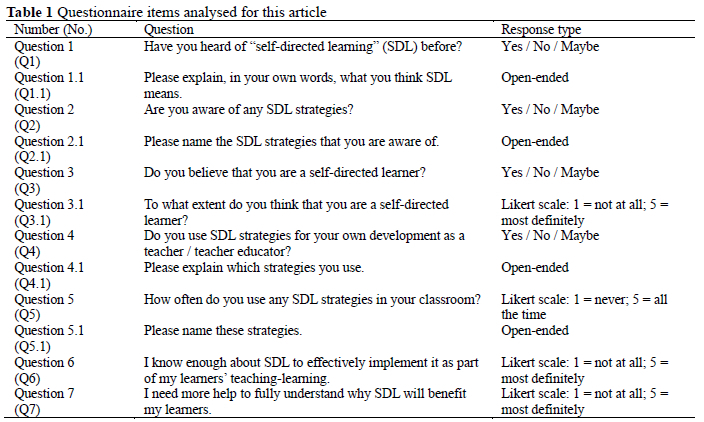
The Google Forms questionnaire included 28 questions. However, in this article we only report on data from a subset of 13 items. The data set used for this article included a combination of open-ended and closed questions, as outlined in Table 1. In several instances, closed (quantitative) questions were followed by open-ended (qualitative) questions for clarification and deeper explanations of preceding responses, for example, Q1 and Q1.1, or Q3, Q3.1 and Q3.2 (Table 1).
The items in Table 1 were analysed and triangulated to compare teachers' and teacher educators' conceptualisation (knowledge, understanding and perceived application) of SDL, enabling us to determine the nature of differences (or the theory-practice divide) in this regard. Results from the analyses of closed questions are presented visually as graphs. Data were analysed through content analysis (Nieuwenhuis, 2007) to investigate similarities and differences between the responses of the teachers and the teacher educators regarding their knowledge and understanding of SDL.
Findings and results from this research would support the researchers in the larger study to understand the extent of the alignment between the perceptions of SDL principles of teachers in the Northern Cape and those of teacher educators. These insights can then be used to refine the longitudinal approaches in the larger study to support teachers in the Northern Cape to become increasingly self-directed in their own professional development and teaching practice, and the application of SDL principles therein.
Findings, Results and Discussion
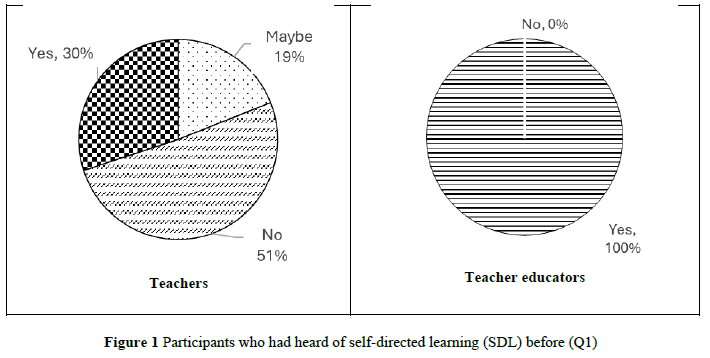
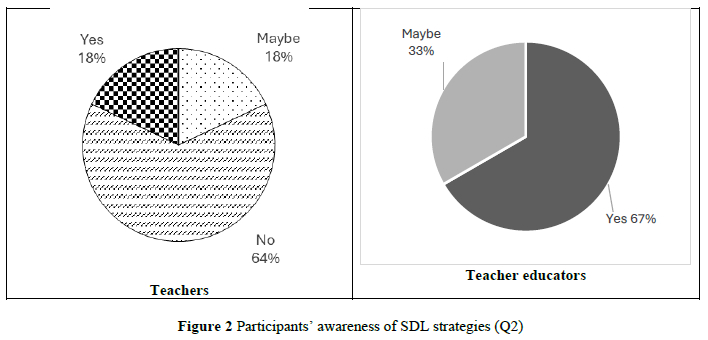
The findings and results of the data analysis and interpretation, based on the selected questions from the Google Forms questionnaire (outlined in Table 1), are presented here. Figure 1 depicts the teachers' and teacher educators' responses to Q1 (whether they had heard of SDL before), and Figure 2 shows whether they had heard of strategies for SDL before (Q2).
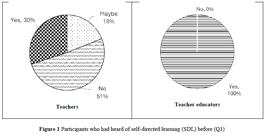
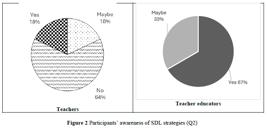
While all teacher educators had heard of SDL before, almost half of the participating teachers in the Northern Cape (51%) had not heard of SDL before, with only 30% indicating familiarity with the term (Figure 1, Q1). This finding resonates with Makokotlela's (2022) study where primary school teachers in Limpopo were not familiar with the concept of SDL. Even more (64%) teachers indicated that they were not aware of any SDL strategies (Figure 2, Q2), which seems to correspond to their responses in Q1 (Figure 1). Although all teacher educators indicated that they were familiar with the term "SDL" (Figure 1), only 67% of them were aware of SDL strategies (Figure 2). These results confirm a misalignment between teachers' and teacher educators' knowledge of the concept of SDL and SDL strategies. The results further show that, although teacher educators knew what SDL was, not all of them were knowledgeable about SDL to the extent that they were cognisant of strategies that supported its implementation. A possible explanation may be that teacher educators seem to remain strongly rooted in their traditional identity as knowledge providers, favouring a one-way transmission of knowledge that reflects their comfort with conventional teaching methods (Nasri, 2019).
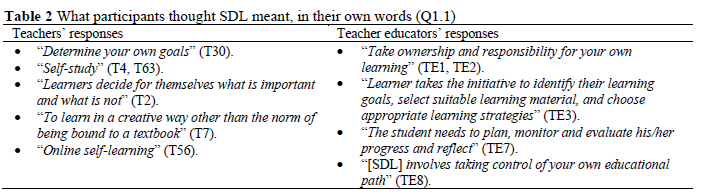
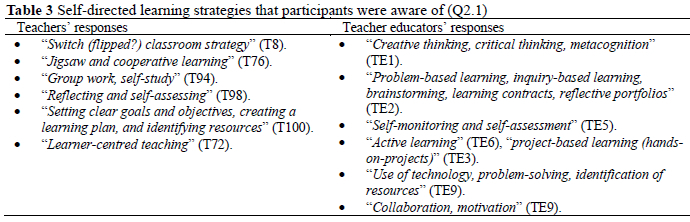
Q1.1 and Q2.1 provided deeper insight and more detail to elucidate the responses that participants provided to Q1 and Q2 (Table 1). The following verbatim responses were recorded from teachers and teacher educators: Firstly, examples of teachers' and teacher educators' responses to Q1.1 (Table 2: what participants thought SDL meant) are presented, followed by some examples of teachers' and teacher educators' responses to Q2.1 (Table 3: SDL strategies that they were aware of). Participants were randomly numbered to support anonymous reporting of these findings. For example, T19 refers to Teacher no. 19, and TE7 refers to teacher educator 7.
Teacher educators' responses to what they thought SDL meant (Table 2) reflected aspects of the definition of SDL as defined in literature, where setting one's own goals (Robinson & Persky, 2020), taking responsibility for learning by identifying resources (Knowles, 1975), and evaluating one's learning through self-reflection (Bishara, 2021) is key in the learning process. Although some teachers did mention goal setting as a characteristic of SDL, many of them accentuated the role of the "self and learning on one's own as key to SDL (Table 2), which are in line with descriptions by Hewitt-Taylor (2001). Teachers' responses seemed to reflect a superficial understanding of SDL, often equating it to independent study (Table 2). This interpretation was common but oversimplifies the concept. Many teachers may, therefore, not fully recognise the broader applicability and process dimensions of SDL, such as planning, goal setting, self-monitoring, and seeking help when needed. Therefore, they underestimated the potential value that SDL could have for their own professional development, as well as for their learners' learning. A similar trend was seen in a study by Porter and Freeman (2020) who explored the benefits of SDL-focused development, emphasising that educators often overlooked its potential to improve their teaching effectiveness and learner outcomes.
Teacher educators' responses (Table 3) indicate that they were able to name a few well-known SDL strategies that are often referenced and discussed in literature, such as problem-based learning (Robinson & Persky, 2020), active learning (Loeng, 2020) and self-monitoring (Shannon, 2008). The few teachers who did respond that they were aware of SDL strategies (Figure 2, Q2) mentioned cooperative learning (Johnson & Johnson, 2019) and learner-centred learning (Morris, Bremner & Sakata, 2025) in response to Q2.1, which are both recognised strategies associated with SDL. However, teachers' association of SDL strategies with the "self was still prevalent (Table 3). This prevailing misconception, that SDL is (only) an individual activity or process, is also often reported by other scholars (Guglielmino, Gray, Arvary, Asen, Goldstein, Kamin, Nicoll, Patrick, Shellabarger & Snowberger, 2009:13).
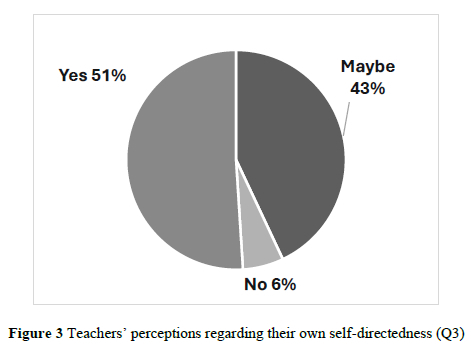
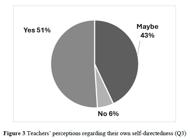
While not indicated with a graphic representation of data, all participating teacher educators believed that they were self-directed learners. It emerged that 51% of the participating teachers believed that they were self-directed, 6% did not think that they were, and 43% were unsure (Figure 3). It is interesting to note the discrepancy between teachers' responses to Q1 (Figure 1) and Q3 (Figure 3). While half of the teachers had not heard of SDL before, their responses to Q3 indicate that many of them believed that they were self-directed learners. This relatively positive self-perception of teachers regarding their own self-directedness concurs with a study by Golightly (2025), who found that geography teachers perceived that they had high SDL skills, as well as with findings from Geduld and Ehlers (2023) where participants mentioned engaging in SDL strategies similar to those mentioned by the participants in this study.
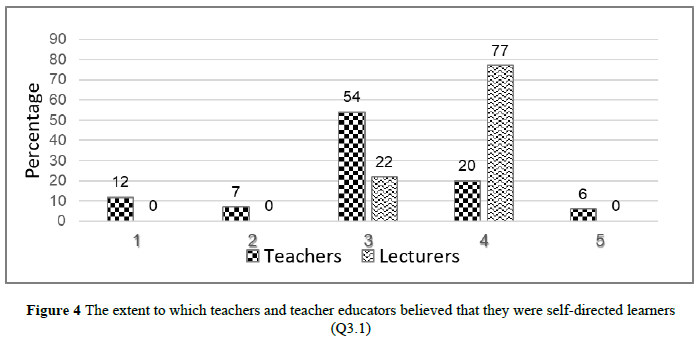
In the follow-up question to Q3, we asked participants to indicate to what extent they thought that they were self-directed learners (Q3.1). A Likert scale (1 = not at all and 5 = most definitely) (Table 1) was provided in the questionnaire. Both sets of participants' responses to Q3.1 are presented in Figure 4.
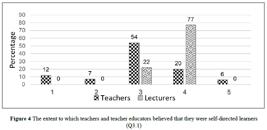
It is noteworthy that most teacher educators who had heard of SDL and most of whom knew SDL strategies (and therefore were more knowledgeable about what SDL entailed), indicated Likert categories 3 (22%) and 4 (77%), with none of them viewing themselves as "most definitely" being self-directed learners (Figure 4). In contrast, 6% of the teachers regarded themselves as "most definitely" being self-directed learners, with the modal category being category 3 (54%) (Figure 4). The results show that the majority of teachers, therefore, seemed to be unsure whether they were self-directed learners. While teachers often rated their SDL skills positively, evidence suggests discrepancies between their self-perceptions and their actual practices in promoting SDL. The gaps are attributed to limited PCK and challenges in translating theoretical knowledge into classroom strategies (Karlen, Hirt, Jud, Rosenthal & Eberli, 2023).
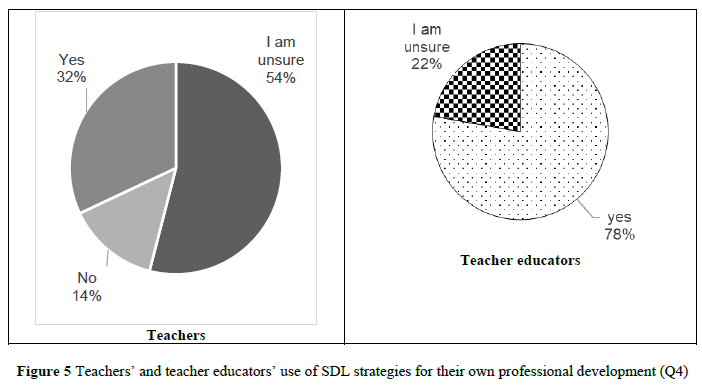
In a subsequent item on the questionnaire the participants were asked whether they were using SDL for their own professional development as teachers or teacher educators (Figure 5). There was a notable difference in the responses from teachers and teacher educators. Most teachers (54%) were unsure whether they used SDL strategies for their development as teachers, with only about a third (32%) of teachers responding positively ("yes"). On the other hand, most of the teacher educators (78%) indicated that they did use SDL strategies for their own development as teacher educators (Figure 5).
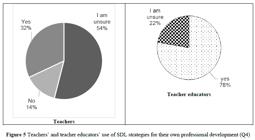
In the qualitative follow-up question (Q4.1), with which we aimed to gain a deeper understanding of the participants' responses, we asked them to explain which strategies they used for their own professional development. When delving into the responses from the teachers who responded positively to Q4, it seems as if most of them misinterpreted the question, with responses such as "peer learning" (T6), "baseline and diagnostic approach" (T15), "cooperative learning and jigsaw" (T76), "group work" (T42) and "blended learning" (T76) provided as responses to Q4.1. These responses referred to teaching strategies that they may have used in their classrooms, and were not related to personal, self-directed professional development. Two teachers did, however, mention responses that were evident of SDL for their own professional development: "I enrolled in short courses" (T17) and "setting goals for myself" (T86). Both responses illustrate some SDL strategies that these teachers used for their own development as teachers (Wermke, 2011).
A similar phenomenon was observed among teacher educators, where only two of the seven teacher educators who responded positively ("yes") (Figure 5) mentioned strategies that they used for their own development as lecturers. Teacher educator TE1 answered, "I am constantly thinking about my thinking processes while solving problems, and critically and creatively set assignments for students. This involves being a lifelong learner as a teacher educator, looking for and finding new resources", which also incorporates elements of metacognition (Okoro & Chukwudi, 2011). Another teacher educator (TE5) responded: "I often use self-directed learning strategies for professional development, such as setting goals for improving teaching methods, exploring new research in their field, participating in workshops and conferences, and engaging in reflective practice to enhance my teaching effectiveness"
Most of the other teacher educators referred to "problem-based learning and project-based learning strategies", "[h]elping students set clear, achievable learning objectives for themselves and guiding them in tracking their progress", "[o]ffering a variety of learning materials, including books, articles, online resources, and tools, to support independent learning", which rather involved teaching-learning strategies than implanting SDL strategies for own development as teacher educators.
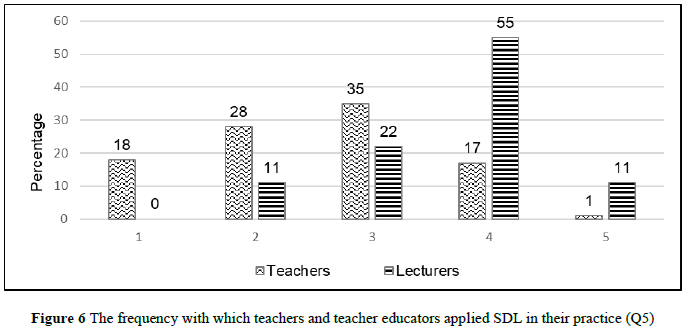
With a subsequent set of questions in the questionnaire (Q5 and Q5.1) we explored whether and how frequently teachers applied SDL strategies in their practice (i.e. in their classrooms), and if they did, which ones they used. A Likert scale with five categories: 1 = never; 2 = seldomly (once or twice a semester); 3 = Sometimes (about once a month); 4 = Frequently (about once a week) and 5 = All the time (almost every day) was used to enquire about this frequency (for Q5). The results for teachers and teacher educators are shown in Figure 6. These results show a slight variation in the responses of teachers and teacher educators. Most teachers reported that they used SDL strategies never (18%), seldom (28%) or sometimes (35%), while the modal interval for the teacher educators was frequently (55%) (Figure 6).
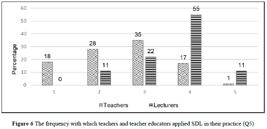
Again, a follow-up question (Q5.1) elicited qualitative responses to clarify those for Q5, to which participants were asked to name the SDL strategies that they used in their classes. It is worth mentioning that almost half of the teachers left this question unanswered. Strategies mentioned by most of the teachers who did respond, include "group work" (T93, T94), while a few others mentioned "direct teaching" (T6), "technology" (T2), "collaborative learning" (T67, T72), "cooperative learning and jigsaw" (T76), and some teachers indicated "goal setting" (T90, T100). These answers portray some of the strategies corresponding to literature but again reflect a fairly superficial understanding of SDL strategies (Makokotlela, 2022).
Teacher educators mentioned that they applied SDL strategies such as "active learning, investigative strategies, problem-solving, metacognitive strategies, communication skills, reflecting" (TE1), "inquiry-based learning, problem-based learning" (TE2), "setting learning goals: helping students set clear, achievable learning objectives for themselves and guiding them in tracking their progress" (TE5), "thinking maps, Bloom, six hats, questioning" (TE7), "use of technology, motivation, time management" (TE9). The responses for Q5 and findings from analysing Q5.1, therefore, align with and confirm the pattern identified in previous questions, that teacher educators were much more knowledgeable and aware of SDL and its associated uses and strategies, and used it more often than teachers did in practice.
This pattern is indicative of a significant divide between teacher preparation (in theory, at university) and teacher practice (in classrooms in the Northern Cape). It aligns with the argument of scholars such as Du Toit and Petersen (2023:3), who report that "[b]ridging the theory-practice divide is an ongoing and pivotal concern in teacher preparation programmes." The implication is that efforts to develop and support teachers' SDL in practice must be expanded to engender this critical skill and strategies for its optimal application in South African education.
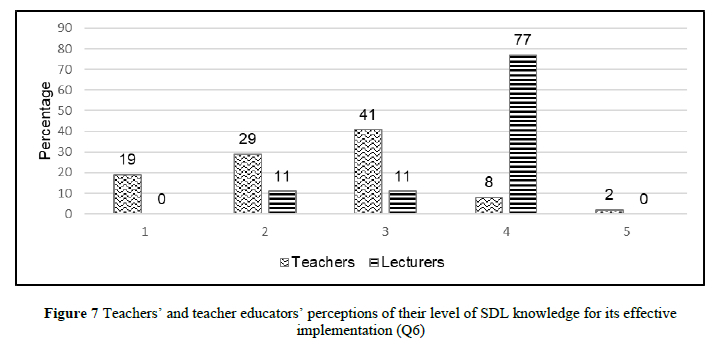
The need to expand support for teachers' SDL is not a one-sided plight - in other words, it is not something that researchers want to "do to" or "experiment with on" teachers. Increasingly, teachers themselves are becoming aware of their need for developing and applying SDL in their own lives, as part of their professional development and in their practice, as described (for example) by Sebotsa et al. (2021:189). For this reason, with some of the questionnaire items we also explored this side of the argument. In Q6 participants were presented with an opportunity to add their voice to this discussion, when they could respond to the statement, I know enough about SDL to effectively implement it as part of my learners' teaching-learning, using a 5-point Likert scale (1 = not at all, and 5 = most definitely). With this question we intended to explore educators' own perceptions of their need for SDL. Teachers' and teacher educators' responses are presented in Figure 7.
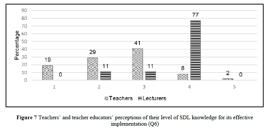
Most teacher educators (77%) indicated that they felt adequately informed about SDL to incorporate it in their teaching-learning practices, with responses averaging a score of 4 on the provided Likert scale (Figure 7). However, none of the teacher educators selected "most definitely" as their response, which implies their understanding of SDL being a continuous and lifelong process - in other words, one can never know "everything and stop learning" (Boyer et al., 2014; Robinson & Persky, 2020). In contrast, most teachers rated their level of SDL knowledge for its effective implementation between 1 and 3 (89%), while 10% of teachers expressed a higher level of confidence, selecting scores of 4 or 5 (Figure 7). When comparing these responses to the previous results, most teachers were overconfident about their SDL knowledge for implementation, as most of them indicated that they did not fully understand what it was or what it entailed (Figures 1, 2, 3 and 4). This implies that any teacher development endeavours towards enhancing teachers' SDL would have to be carefully planned to ameliorate teachers' beliefs about their own SDL knowledge and competence.
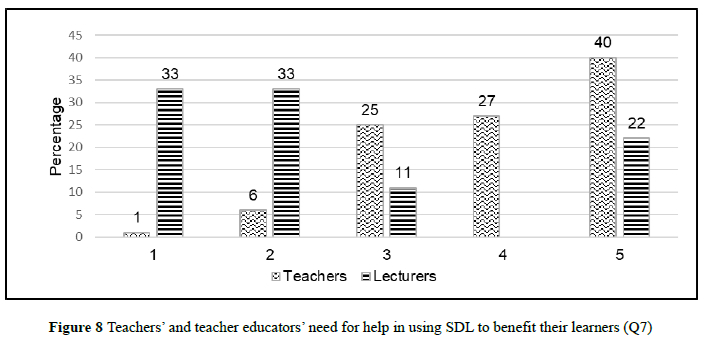
Using a similar Likert scale, the intention with Question 7 was to give participants an opportunity to voice their need for help to fully understand why SDL would benefit their learners or students (Q7). Figure 8 clearly shows that teachers acknowledged their need for help in using SDL to benefit their learners. Their responses to Q7 seemed to indicate that teachers believed that SDL was more suited for learners than for teachers themselves, a common misconception, as pointed out by Du Toit-Brits (2019) when she claims that educators' positive expectations of students result in more efforts by students. Consequently, students (or learners) take control of their own learning. Unsurprisingly, compared against the patterns from teacher educators' responses on previous questions, most lecturers believed that they needed little or no help in this regard (rating the question 1, 2 or 3 (77%) in Figure 8). Still, two teacher educators acknowledged that they "most definitely" needed help in using SDL to benefit their students (Figure 8), emphasising the need for lifelong learning in teacher education (Kilag, Malbas, Miñoza, Ledesma, Vestal & Sasan, 2024).
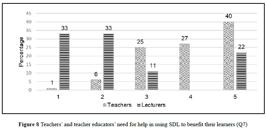
Figures 7 and 8 should be considered together or complement each other: if one does not know enough about SDL to successfully implement it as part of the teaching-learning process (Figure 7), then, by implication, one needs more help to fully understand how SDL will benefit one's learners (Figure 8).
In view of some interesting, although contradictory responses from teachers across data sets and questionnaire items, in the next section we focus on a comparison of teachers' responses to questions 1, 2, 3 and 4 (Table 1) to provide a more comprehensive conclusion for our current investigation. This comparison provides a deeper understanding of teachers' perception of themselves as self-directed learners.
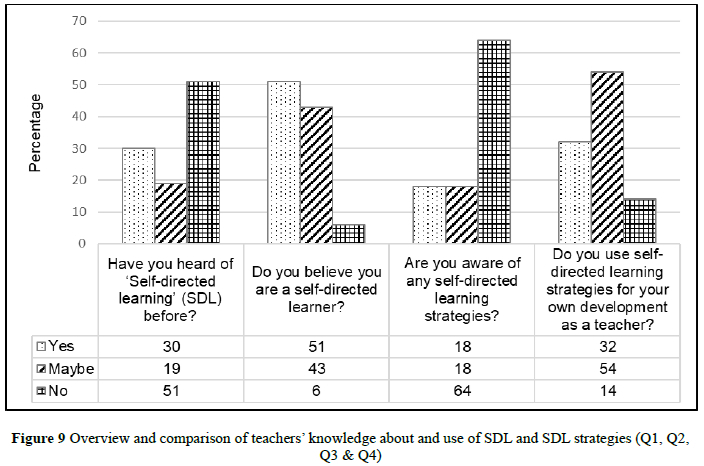
Although less than a third of teachers (30%) had heard of SDL before, 51% indicated that they believed that they were self-directed learners (Figure 9). Sixty-four per cent of teachers were not aware of SDL strategies, yet only 14% responded that they did not use any SDL strategies for their own development as teachers, with 32% of teachers stating that they were using SDL strategies, and 54% indicated that they were unsure whether they used it for their own development as teachers (Figure 9). This comparative analysis indicates that the participating teachers were not always metacognitively aware of their strengths and weaknesses (Bulut, 2018).
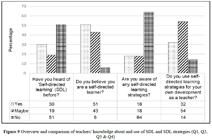
The findings from this study resonate with those of a study by Geduld (2017) who discovered that while many teachers advocated for developing SDL skills, they often lacked the practical knowledge and strategies needed to foster these skills effectively. In a later study, Geduld and Sikwanga (2020) also found a discrepancy between teachers' perceptions of how they developed SDL strategies in class and their actual teaching practices. Although teachers in that study reported that they motivated learners to take responsibility for their own learning, and asked "deep" questions, the traditional "talk-and-chalk" approach and transmission was still evident in their classrooms. Anagün (2018) concludes that teachers' perceptions about their proficiencies in facilitating 21st-century skills and their capability of managing constructivist learning environments may not be evident in their praxis.
Conclusion
In this study we found significant differences between teachers' and teacher educators' cognisance and application of SDL. The findings and results confirm gaps between teacher educators' theoretical preparation of student teachers for SDL and the extent to which teachers used SDL in their practice. Although existing literature acknowledges a theory-practice divide in relation to teachers' and teacher educators' knowledge and perceptions of SDL, our study provides deeper insight into the nature of this divide. The findings indicate that, for this specific group of teachers in the Northern Cape, the discrepancy between their perceived SDL competencies and their actual implementation in the classroom may be largely attributed to limited PCK. This suggests a need to prioritise the development of teachers' PCK to effectively support their understanding and implementation of SDL strategies in their teaching practices.
Another notable difference that emerged from the data is that teacher educators appeared to demonstrate greater metacognitive awareness of their own strengths and limitations compared to teachers. While most teacher educators recognised their understanding of SDL as part of an ongoing, lifelong learning process, many teachers appeared overly confident in their perceived knowledge of SDL and its practical application. This overestimation highlights the importance of carefully designed teacher development initiatives that not only build knowledge and skills related to SDL but also address and recalibrate teachers' beliefs about their own SDL competence and its value as part of lifelong learning.
By developing and supporting opportunities to foster SDL for not only student teachers but also teachers-in-practice, universities (teacher educators) can support teachers' personal and professional development while enhancing their skills and capacity for continuous self-improvement. Effective professional development opportunities should be designed to actively involve and engage pre-service and in-service teachers in identifying their own professional developmental learning needs and creating tailored learning experiences to address them. Unlike traditional "one-shot" and "one-size-fits-all" workshops, impactful professional development provides sustained, diverse, and extensive opportunities that foster teachers' growth as reflective, lifelong learners. Active learning opportunities, where teachers can directly engage with and apply new knowledge, strategies and concepts related to SDL will significantly enhance the effectiveness of professional development initiatives. Teacher educators must continue to explore and conduct further research to develop and improve strategies to bridge the reported theory-practice divide and support current and future teachers in being and becoming increasingly more self-directed in their professional development and as facilitators of learning.
The implication is that more research is needed to explore ways to develop and strengthen teachers' knowledge and application of SDL principles - for their own professional development, as well as for implementation in their practice. Similarly, despite participating teacher educators at the NWU reporting that they had extensive knowledge regarding SDL, they still required continuous support to enhance their SDL abilities and its application. These two sets of research should not be designed or implemented in isolation, though. To reduce or bridge the theory-practice divide in teacher preparation, the "sets" of teacher development for SDL should be collaborative and concurrently designed.
Authors' Contributions
Both authors contributed to the manuscript - both contributed to the data collection, ADT wrote the bulk of the background and literature review while AR mainly analysed the data.
Notesi. Published under a Creative Commons Attribution Licence.
Acknowledgements
We are grateful to the Northern Cape Department of Education for permission to contribute to teacher development opportunities in this province.
References
-
Abou Said S & Abdallah W 2024. Enhancing lifelong learning and professional growth: Exploring the role of self-directed learning for university educators. Journal of Adult and Continuing Education, 30(2):439-462. https://doi.org/10.1177/14779714241236282
» https://doi.org/10.1177/14779714241236282 -
Anagün ŞS 2018. Teachers' perceptions about the relationship between 21st century skills and managing constructivist learning environments. International Journal of Instruction, 11(4):825-840. Available at https://files.eric.ed.gov/fulltext/EJ1191700.pdf. Accessed 16 October 2025.
» https://files.eric.ed.gov/fulltext/EJ1191700.pdf -
Baxter J & Ehren M 2023. Factors contributing to and detracting from relational trust in leadership: The case of primary schools in South Africa. Frontiers in Education, 8:1004575. https://doi.org/10.3389/feduc.2023.1004575
» https://doi.org/10.3389/feduc.2023.1004575 -
Bishara S 2021. The cultivation of self-directed learning in teaching mathematics. World Journal on Educational Technology: Current Issues, 13(1):82-95. https://doi.org/10.18844/wjet.v13i1.5401
» https://doi.org/10.18844/wjet.v13i1.5401 -
Botha C & Reyneke EM 2020. 'WIL goes POP': The role of a professional orientation programme in addressing the apprenticeship of observation in first-year Bachelor of Education students. In J De Beer, N Petersen & HJ van Vuuren (eds). Becoming a teacher: Research on the work-integrated learning of student teachers (NWU Self-Directed Learning Series Vol. 4). Cape Town, South Africa: AOSIS Books. https://doi.org/10.4102/aosis.2020.BK215.08
» https://doi.org/10.4102/aosis.2020.BK215.08 -
Boyer SL, Edmondson DR, Artis AB & Fleming D 2014. Self-directed learning: A tool for lifelong learning. Journal of Marketing Education, 36(1):20-32. https://doi.org/10.1177/0273475313494010
» https://doi.org/10.1177/0273475313494010 -
Bulut I 2018. The levels of classroom and pre-school teachers' metacognitive awareness. Universal Journal of Educational Research, 6(12):2697-2706. https://doi.org/10.13189/ujer.2018.061201
» https://doi.org/10.13189/ujer.2018.061201 -
Buttler T 2020. Disrupting my teaching practices: A teacher educator living as a contradiction. Studying Teacher Education, 16(2):222-239. https://doi.org/10.1080/17425964.2020.1758654
» https://doi.org/10.1080/17425964.2020.1758654 -
Dahal A & Bhat N 2023. Self-directed learning, its implementation, and challenges: A review. Nepal Journal of Health Sciences, 3(1):102-115. https://doi.org/10.3126/njhs.v3i1.63277
» https://doi.org/10.3126/njhs.v3i1.63277 -
De Beer J & Gravett S 2020. A hybrid model building on prolepsis for effective practice teaching in pre-service life sciences teacher education. In J De Beer, N Petersen & HJ van Vuuren (eds). Becoming a teacher: Research on the work-integrated learning of student teachers (NWU Self-Directed Learning Series Vol. 4). Cape Town, South Africa: AOSIS Books. https://doi.org/10.4102/aosis.2020.BK215.11
» https://doi.org/10.4102/aosis.2020.BK215.11 -
Department of Basic Education, Republic of South Africa 2013. Investigation into the implementation of maths, science and technology. Available at https://www.gov.za/sites/default/files/gcis_document/201409/maths-and-science-investigation-implementationa.pdf. Accessed 30 January 2025.
» https://www.gov.za/sites/default/files/gcis_document/201409/maths-and-science-investigation-implementationa.pdf -
Du Toit A & Petersen N 2023. Reimagining work-integrated learning excursions to decrease the theory-practice divide. In N Petersen, A du Toit, E Mentz & RJ Balfour (eds). Innovative curriculum design: Bridging the theory-practice divide in work-integrated learning to foster Self-Directed Learning (NWU Self-Directed Learning Series Vol. 12). Cape Town, South Africa: AOSIS Books. https://doi.org/10.4102/aosis.2023.BK426.01
» https://doi.org/10.4102/aosis.2023.BK426.01 -
Du Toit-Brits C 2019. A focus on self-directed learning: The role that educators' expectations play in the enhancement of students' self-directedness. South African Journal of Education, 39(2):Art. #1645, 11 pages. https://doi.org/10.15700/saje.v39n2a1645
» https://doi.org/10.15700/saje.v39n2a1645 -
Du Toit-Brits C & Blignaut JH 2023. Learning, teaching, and assessment methodologies in distance education research: A meaningful self-directed learning approach. In FR Aluko & D Coetzee (eds). Does distance education in the developing context need more research? Building practice into theory (Vol. 1). Hatfield, South Africa: Emerging Scholars Initiative (ESI) Press. Available at https://www.oerafrica.org/system/files/2024-02/volume-1researching-distance-educationebook2023.pdf. Accessed 17 October 2025.
» https://www.oerafrica.org/system/files/2024-02/volume-1researching-distance-educationebook2023.pdf - Fosnot CT 1989. Enquiring teachers, enquiring learners: A constructivist approach for teaching. New York, NY: Teachers College Press.
- Fosnot CT & Perry RS 2005. Constructivism: A psychological theory of learning. In CT Fosnot (ed). Constructivism: Theory, perspectives, and practice (2nd ed). New York, NY: Teachers College Press.
-
Fourie E & Fourie U 2015. As educators of teachers, where and when do our responsibilities end? Journal of Social Sciences, 42(3):247-257. https://doi.org/10.31901/24566756.2015/42.03.06
» https://doi.org/10.31901/24566756.2015/42.03.06 -
Geduld B 2017. Personal and contextual influences on township school learners' motivations and self-regulated learning. Africa Education Review, 14(2):122-139. https://doi.org/10.1080/18146627.2017.1291279
» https://doi.org/10.1080/18146627.2017.1291279 -
Geduld B & Ehlers L 2023. Primary school teachers' perceptions of their self-directed learning skills and use of practices that promote self-regulated learning. Education and New Developments, 1:489-493. https://doi.org/10.36315/2023v1end110
» https://doi.org/10.36315/2023v1end110 -
Geduld BW & Sikwanga HS 2020. Juxtaposing South African and Namibian teachers' perceptions and teaching practices to develop self-regulated learning: Do they practise what they preach? Perspectives in Education, 38(2):138-154. https://doi.org/10.18820/2519593X/pie.v38.i2.09
» https://doi.org/10.18820/2519593X/pie.v38.i2.09 -
Golightly A 2025. The relationship between a set of selected variables characterizing FET phase South African geography teachers and their self-directed learning abilities. South African Geographical Journal, 107(3):283-300. https://doi.org/10.1080/03736245.2024.2372258
» https://doi.org/10.1080/03736245.2024.2372258 -
Gravett S 2012. Crossing the "theory-practice divide": Learning to be(come) a teacher. South African Journal of Childhood Education, 2(2):1-14. Available at https://files.eric.ed.gov/fulltext/EJ1187395.pdf. Accessed 13 October 2025.
» https://files.eric.ed.gov/fulltext/EJ1187395.pdf -
Gray A 1995. "The road to knowledge is always under construction": A life history journey to constructivist teaching. MEd thesis. Saskatoon, Canada: University of Saskatchewan. Available at https://harvest.usask.ca/items/30f191e1-cc49-4693-aa93-d56866da5ad5. Accessed 13 October 2025.
» https://harvest.usask.ca/items/30f191e1-cc49-4693-aa93-d56866da5ad5 - Guglielmino L, Gray E, Arvary K, Asen J, Goldstein D, Kamin F, Nicoll M, Patrick N, Shellabarger K & Snowberger D 2009. Self-directed learners change our world: SDL as a force for innovation, discovery, and social change. International Journal of Self-Directed Learning, 6(1): 11-30.
-
Hartnack A & Vale B 2022. School dropout: Context counts/2022. Claremont, South Africa: Zero Dropout. Available at https://zerodropout.co.za/school-dropout-context-counts/. Accessed 15 February 2024.
» https://zerodropout.co.za/school-dropout-context-counts/ -
Hendriks CJ & Dunn GF 2021. Factors that influence learners' performance in grade 12 Accounting: A case study in the Northern Cape. KOERS - Bulletin for Christian Scholarship, 86(1):1-14. https://doi.org/10.19108/KOERS.86.1.2508
» https://doi.org/10.19108/KOERS.86.1.2508 -
Hewitt-Taylor J 2001. Self-directed learning: Views of teachers and students. Issues and Innovations in Nursing Education, 36(4):496-504. https://doi.org/10.1046/j.1365-2648.2001.02001.x
» https://doi.org/10.1046/j.1365-2648.2001.02001.x -
Johnson DW & Johnson RT 2019. The impact of cooperative learning on self-directed learning. In E Mentz, J De Beer & R Bailey (eds). Self-directed learning for the 21st century: Implications for higher education (NWU Self-Directed Learning Series Vol. 1). Cape Town, South Africa: AOSIS. https://doi.org/10.4102/aosis.2019.BK134.02
» https://doi.org/10.4102/aosis.2019.BK134.02 -
Karlen Y, Hirt CN, Jud J, Rosenthal A & Eberli TD 2023. Teachers as learners and agents of self-regulated learning: The importance of different teachers competence aspects for promoting metacognition. Teaching and Teacher Education, 125:104055. https://doi.org/10.1016/j.tate.2023.104055
» https://doi.org/10.1016/j.tate.2023.104055 -
Kilag OKT, Malbas MH, Miñoza JR, Ledesma MMR, Vestal ABE & Sasan JMV 2024. The views of the faculty on the effectiveness of teacher education programs in developing lifelong learning competence. European Journal of Higher Education and Academic Advancement, 1(2):92-102. Available at https://pdfs.semanticscholar.org/c609/ba78993a514896920d012fcabf6499ad1c92.pdf. Accessed 10 October 2025.
» https://pdfs.semanticscholar.org/c609/ba78993a514896920d012fcabf6499ad1c92.pdf -
Kivunja C & Kuyini AB 2017. Understanding and applying research paradigms in educational contexts. International Journal of Higher Education, 6(5):26-41. https://doi.org/10.5430/ijhe.v6n5p26
» https://doi.org/10.5430/ijhe.v6n5p26 - Knowles MS 1975. Self-directed learning: A guide for learners and teachers. New York, NY: Association Press.
- Larochelle M & Bednarz N 1998. Constructivism and education: Beyond epistemological correctness. In M Larochelle, N Bednarz & J Garrison (eds). Constructivism and education. Cambridge, England: Cambridge University Press.
-
Liu WC 2024. Preparing teachers for the changing future (2014-2018). Educational Research for Policy and Practice, 23:381-394. https://doi.org/10.1007/s10671-023-09328-5
» https://doi.org/10.1007/s10671-023-09328-5 -
Loeng S 2020. Self-directed learning: A core concept in adult education. Education Research International, 2020(1):3816132. https://doi.org/10.1155/2020/3816132
» https://doi.org/10.1155/2020/3816132 -
Makokotlela MV 2022. Self-directed learning in primary schools in Limpopo province. South African Computer Journal, 34(2):107-119. https://doi.org/10.18489/sacj.v34i2.1099
» https://doi.org/10.18489/sacj.v34i2.1099 -
Mentz E & De Beer J 2020. A Cultural-Historical Activity Theory gaze at teacher professional development to enhance self-directed learning and its transfer to the classroom. In E Mentz & R Bailey (eds). Self-directed learning research and its impact on educational practice (NWU Self-Directed Learning Series Vol. 3). Cape Town, South Africa: AOSIS Books. https://doi.org/10.4102/aosis.2020.BK206.07
» https://doi.org/10.4102/aosis.2020.BK206.07 -
Morris TH 2024. Four dimensions of self-directed learning: A fundamental meta-competence in a changing world. Adult Education Quarterly, 74(3):236-254. https://doi.org/10.1177/07417136231217453
» https://doi.org/10.1177/07417136231217453 -
Morris TH, Bremner N & Sakata N 2025. Self-directed learning and student-centred learning: A conceptual comparison. Pedagogy, Culture & Society, 33(3):847-866. https://doi.org/10.1080/14681366.2023.2282439
» https://doi.org/10.1080/14681366.2023.2282439 - Msibi T 2023. Northern Cape Matric Results.
-
Nasri NM 2019. Self-directed learning through the eyes of teacher educators. Kasetsart Journal of Social Sciences, 40:164-171. https://doi.org/10.1016/j.kjss.2017.08.006
» https://doi.org/10.1016/j.kjss.2017.08.006 - Nieuwenhuis J 2007. Analysing qualitative data. In K Maree (ed). First steps in research. Pretoria, South Africa: Van Schaik.
- North-West University 2022. Faculty of Education teaching, learning and assessment plan second semester 2022.
-
North-West University 2023. NWU Teaching and Learning Strategy 2021-2025. Available at https://www.nwu.ac.za/sites/www.nwu.ac.za/files/files/i-governance-management/policy/2023/8P_8_TLA/TL-Strategy-approved-by-Council-16-Nov-2023.pdf. Accessed 14 November 2024.
» https://www.nwu.ac.za/sites/www.nwu.ac.za/files/files/i-governance-management/policy/2023/8P_8_TLA/TL-Strategy-approved-by-Council-16-Nov-2023.pdf - Okoro CO & Chukwudi EK 2011. Metacognitive strategies: A viable tool for self-directed learning. Journal of Educational and Social Research, 1(4):71-76.
-
Petersen NT 2024. Unveiling first-year student teachers' experiences: An excursion programme rooted in playful learning for active and critical learning. In IC Chahine & L Reddy (eds). Educators' work-integrated learning experiences. Cham, Switzerland: Springer. https://doi.org/10.1007/978-3-031-65964-5_8
» https://doi.org/10.1007/978-3-031-65964-5_8 - Piaget J 1977. The development of thought: Equilibration of cognitive structures. Translated by A Rosin. New York, NY: Viking.
-
Pokhrel M, Sharma L, Poudel MP, Sharma L & Luitel S 2024. Empowering students through a self-directed learning pedagogy in mathematics education. Communications on Applied Nonlinear Analysis, 31(1):238-252. https://doi.org/10.52783/cana.v31.409
» https://doi.org/10.52783/cana.v31.409 -
Porter BD & Freeman MK 2020. Experienced outcomes of a self-directed professional development program. The Professional Educator, 43(1):36-47. Available at https://files.eric.ed.gov/fulltext/EJ1276207.pdf. Accessed 9 October 2025.
» https://files.eric.ed.gov/fulltext/EJ1276207.pdf -
Raju TS & Geleta TO 2023. The beliefs of university teachers about the applicability of adult learning principles and their influence on their professional practices in Ethiopia. Seybold Report Journal, 18(07):36-52. Available at https://seybold-report.com/wp-content/uploads/2023/09/Temesgen-Olj-rev2.pdf. Accessed 26 November 2024.
» https://seybold-report.com/wp-content/uploads/2023/09/Temesgen-Olj-rev2.pdf -
Richardson V 2003. Constructivist pedagogy. Teachers College Record, 105(9):1623-1640. https://doi.org/10.1177/016146810310500906
» https://doi.org/10.1177/016146810310500906 -
Richter E, Brunner M & Richter D 2021. Teacher educators' task perception and its relationship to professional identity and teaching practice. Teaching and Teacher Education, 101:103303. https://doi.org/10.1016/j.tate.2021.103303
» https://doi.org/10.1016/j.tate.2021.103303 -
Robinson JD & Persky AM 2020. Developing self-directed learners. American Journal of Pharmaceutical Education, 84(3):847512. https://doi.org/10.5688/ajpe847512
» https://doi.org/10.5688/ajpe847512 -
Sebatana MJ & Dudu WT 2022. Enhancing Grade 10 physical science teachers' self-directedness in implementing blended problem-based learning. Science Education International, 33(4):427-437. https://doi.org/10.33828/sei.v33.i4.11
» https://doi.org/10.33828/sei.v33.i4.11 -
Sebotsa T, De Beer J & Kriek J 2021. Self-directed learning: A sine qua non in in-service teacher education. In E Mentz, D Laubscher & J Olivier (eds). Self-Directed Learning: An imperative for education in a complex society (NWU Self-Directed Learning Series Vol. 6). Cape Town, South Africa: AOSIS Books. https://doi.org/10.4102/aosis.2021.BK279.07
» https://doi.org/10.4102/aosis.2021.BK279.07 -
Shannon SV 2008. Using metacognitive strategies and learning styles to create self-directed learners. Institute for Learning Styles Journal, 1(1):14-28. Available at https://www.auburn.edu/academic/cla/ilsrj//Journal%20Volumes/Fall%202008%20Volume%201%20PDFs/Metacognitive%20Strategies%20and%20Learning%20Styles.pdf. Accessed 8 October 2025.
» https://www.auburn.edu/academic/cla/ilsrj//Journal%20Volumes/Fall%202008%20Volume%201%20PDFs/Metacognitive%20Strategies%20and%20Learning%20Styles.pdf - Thompson PW 2000. Radical constructivism: Reflections and directions. In LP Steffe & PW Thompon (eds). Radical constructivism in action: Building on the pioneering work of Ernst von Glasersfeld. London, England: RoutledgeFalmer.
-
Turiano AA & Oñate RV 2024. Transformative education in pre-service teacher training: Experiences and impact. In ZB Pambuko, M Setiyo, CBE Praja, A Setiawan, F Yuliastuti, L Muliawanti & VS Dewi (eds). Proceedings of 5th Borobudur International Symposium on Humanities and Social Science (BISHSS 2023) (Vol. 856). Paris, France: Atlantis Press. https://doi.org/10.2991/978-2-38476-273-6_71
» https://doi.org/10.2991/978-2-38476-273-6_71 -
Van Vuuren HJ 2020. The journey of becoming a professional teacher: Policy directives and current practices. In J De Beer, N Petersen & HJ van Vuuren (eds). Becoming a teacher: Research on the work-integrated learning of student teachers (NWU Self-Directed Learning Series Vol. 4). Cape Town, South Africa: AOSIS Books. https://doi.org/10.4102/aosis.2020.BK215.01
» https://doi.org/10.4102/aosis.2020.BK215.01 - Von Glasersfeld E 2005. Introduction: Aspects of constructivism. In CT Fosnot (ed). Constructivism: Theory, perspectives, and practice (2nd ed). New York, NY: Teachers College Press.
-
Wermke W 2011. Continuing professional development in context: Teachers' continuing professional development culture in Germany and Sweden. Professional Development in Education, 37(5):665-683. https://doi.org/10.1080/19415257.2010.533573
» https://doi.org/10.1080/19415257.2010.533573
Revised: 2 September 2025
Accepted: 26 September 2025
Published: 24 November 2025