Application of biometric fingerprinting to encourage the active involvement of student teachers in lectures on differentiated instruction
Abstract
The aim of this article was to establish whether a biometric fingerprint device can be used to accurately record and improve active class participation of student teachers when attending lectures on the application of differentiated instruction. Quantitative and qualitative approaches were used to collect data. In the quantitative study a student-teacher class (n = 180) of a university in South Africa participated during the second and third semesters of the academic year. The quantitative data consisted of the number of student teachers' active participations recorded using a biometric fingerprint device and data from the second and third semesters were compared. Results were obtained from the calculated number of active participations for which student teachers were rewarded "class bucks" for quality comments. Although class bucks were awarded in both the second and third semesters, the number of student teachers who were actively involved in discussions increased by 18% in the third semester (when biometric fingerprint scanning was implemented). After the completion of their training course, a qualitative approach followed, where participants (n = 36) reflected (through responses to open-ended questions) that they still desired more practice and examples to help them create differentiated activities. It was evident that more activities for practical experiences should be created where student teachers could use various forms of assessment, adjust content, select suitable methods and media, create a suitable learning environment, and identify their learners' learning barriers and learning preferences to create and apply differentiated activities in the classroom.
active participation; biometrics; differentiated instruction; student teachers; training
Introduction
In South Africa, a developing country with abject poverty, students enter higher education with diverse needs; low English language skills levels; insufficient teaching and learning resources; and a lack of confidence to actively engage in class (Banya, 2005; Lauder, Brown & Ashton, 2008). These challenges are bound to seriously hamper students' progress if academic institutions are unable to provide sufficient resources; measure and monitor class attendance and participation vs. absenteeism; identify positive patterns of high commitment, academic self-discipline, and active (and interactive) class participation vs. negative patterns of low commitment (Lee, Kelly & Edwards, 2006). Adding to these challenges, lecturers teach a diverse student corps and large classes where student teachers attend lectures as passive receivers of content with limited interactive class engagement.
Chylinski (2010) and Sautter (2007) argue that active class participation in a differentiated class setting is considered significant for enhancing students' interest and their ability to understand, apply, and retain content. Tomlinson (2015) concurs, emphasising the importance of significant training in how to implement differentiated instruction. In addition, Gregory and Chapman (2007) found that once qualified and trained in differentiated instruction, most teachers still opt to use teacher-centred methods. Holz and Lessing (2002) elaborate by stating that lecture-centred instruction could contribute to the inability of most student teachers to create differentiated learning activities for their classes once they have qualified as teachers.
Furthermore, Delisle (2015) points out that student teachers do not always experience the reality of large class sizes, lack of planning time and resources, and a loaded workload during their teacher training sessions. Hence, to assist students in staying motivated, they could spend a longer period at practical teacher training sessions to experience and solve the challenges they might encounter once they qualify as teachers. On the other hand, Tomlinson (2015) argues that differentiated instruction is not about large class sizes and a lack of resources, but the ability to adapt to limitations, and present content and tasks in ways that respond to the interests and needs of learners. Therefore, to improve the education system over time, student teachers not only need training on applying differentiated instruction, but should also be able to continuously adapt to education and technology changes and stay abreast of learners' needs and interests.
Lomofsky and Lazarus (2001) indicate that most teachers feel unprepared and inadequately trained to include learners in differentiated instruction. Williams (2007) adds that teachers who are not well equipped to apply differentiated instruction can fail to include learners with learning barriers in class activities, simply because they lack the skills to do so. Moreover, Williams, Olivier and Pienaar (2009) emphasise the need for effective teacher training on how to adjust content, manage examination-driven curricula, and create differentiated activities and assessment methods according to the diverse learning needs of learners. Most teachers are currently not effectively trained to create effective, differentiated teaching activities (Hall, Vue, Strangman & Meyer, 2014).
In my experience, student teachers tend to be passive receivers of content when attending lectures on differentiated instruction. To ensure that they do not experience the same situation in their classes once they have qualified as teachers, they need to experience and engage in active participation activities so that they are confident to apply these methods in their own teaching.
In response to the need for effective teacher training in differentiated instruction, I therefore decided to enhance such student-teacher training and to encourage student teachers' active class participation by using an extrinsic reward tool. Various studies have indicated contradicting findings concerning the effects of rewards (extrinsic motivation) on students' intrinsic motivation, behaviour, and the enhancement of their interest in the subject matter. Frey and Jegen (2001) and Lepper, Greene and Nisbett (1973) argue that rewards were found to have a detrimental effect on intrinsic motivation. On the other hand, Eisenberger, Pierce and Cameron (1999) and Gagné and Deci (2005) point out that under positive conditions extrinsic rewards could enhance students' intrinsic motivation. Considering the advantages and disadvantages of an extrinsic motivation tool, I concluded that rewards could increase student teachers' extrinsic and intrinsic motivation.
Therefore, incentives were employed which included "class bucks" (a reward system) and a cost-effective biometric fingerprint device (connected to a uniquely designed software programme) that could record additional marks for the contribution of noteworthy comments related to the topic discussed during lectures. With this incentive, it was hoped that all student teachers would engage actively in the lectures on how to create effective differentiated activities and be able to apply successful differentiated instruction in their classes after the completion of their training course.
The aims of this research were
• to determine the effect of using a biometric fingerprint device on active class participation during student teachers' training sessions on how to apply differentiated instruction, and
• to identify the shortcomings in the differentiated instruction training sessions presented to student teachers.
In answering the research questions, data was generated from a quantitative and a qualitative data analysis to formulate the findings and recommendations of this study.
Background and Theoretical Foundation
The evolving need for educational, political, and social transformation, and the rapid changes in the digital world are changing the environment of basic and higher education in developing counties (Heitor & Horta, 2012). South African teachers teach a diverse population whose needs are not always addressed, and this results in poor academic performance (Botha, 2002). Furthermore, their learners grow up in diverse socio-economic environments, speak different home languages (11 official languages), face various learning abilities and disabilities, and have different personal interests (Rock, Gregg, Ellis & Gable, 2008).
Despite the South African inclusion policy of 2001 (Department of Education, 2001), which emphasises the application of differentiated teaching and learning methods to meet the diverse needs of a multicultural population, not much has changed in teaching practice. The reason could be connected to the complexity of creating differentiated learning and teaching activities in a supportive learning environment where learners hail from disadvantaged circumstances with differences in values and beliefs, and, to crown it all, are socially excluded (Chataika, Mckenzie, Swart & Lyner-Cleophas, 2012).
The objectives of differentiated instruction are to employ a variety of flexible learner-centred teaching methods; create a supportive learning environment; make physical modifications to the classroom; modify the curriculum; use differentiated assessment procedures; and apply various supportive teaching strategies (Smit & Humpert, 2012; Tomlinson, 2005).
The importance of differentiated instruction is emphasised in the teaching theory for effective learning based on Vygotsky's (1978) zone of proximal development (Levy, 2008). According to Vygotsky (1978), the knowledge and skills that students acquire should be slightly above their existing ability. In addition, Bourdieu's theory of social capital for teachers (Bourdieu, 1977) postulates that teachers should share information with colleagues and learn from one another when creating differentiated activities. Teachers should also develop the ability to create differentiated activities and be well informed about their learners' needs by gathering additional information from the learners' parents and observations made by learners' teachers from previous grades (Tomlinson, 1999). This is done to ensure that teachers are well informed about their learners' learning disabilities, strengths and challenges and that all learners progress academically (Chapman & King, 2005). Lawrence-Brown (2004) adds that differentiated lessons should provide for learners' interests and cognitive abilities and set different expectations for individual learners (regarding their strengths and challenges) so that all can be successful in learning.
Since the 1990s teachers have been trained and encouraged to present teaching material according to learners' learning preferences, including visual, kinaesthetic and auditory learning activities (Tomlinson, 2015). However, this has meant that gifted learners have not always been challenged to enhance their academic performance in a differentiated learning environment (Delisle, 2015). Goodwin (2008) elaborates, stating that in teaching practice it may be difficult to implement differentiation in a heterogeneous classroom. Willis and Mann (2000) also state that teachers experience differentiated instruction negatively as it requires more lesson planning and longer instruction time than a traditional lesson. Despite these negative experiences, research by Tomlinson (2015) positively indicates that, with sustained support, teachers can develop the necessary attitudes and skills to provide differentiated instruction that is both diverse and academically rich.
For training teachers effectively to apply successful differentiated instruction in schools, the learning environment in higher education should aim to ensure that student teachers acquire and develop the required skills and knowledge (Johnson, 2009:11). The sharing and application of effective examples (demonstrations by the lecturer, students' own practical examples, mock classes, toolkits, tricks of the trade, and others) could contribute in developing student teachers' skills and knowledge. Fox, Vos and Geldenhuys (2007) believe that effective teacher training can be enhanced by encouraging active student-teacher involvement in the learning process. Teaching student teachers in large classes contributes to the development of passive receivers of knowledge and an inability to discuss and exchange ideas on multi-cultural aspects encountered in teaching practice (Nawaz, Pervaiz, Korrani & Azhar-ud-din, 2009:164). This could prevent student teachers from acquiring sufficient knowledge and experience on how to apply differentiated instruction in their classes once they have qualified as teachers.
I posit that ineffective student-teacher training in differentiated instruction could be linked to student teachers' attendance in large classes where they are mere passive receivers of content. In such classes students are often too preoccupied with their own thoughts to participate in discussions and the application of differentiated instruction. Therefore, to encourage active participation during lectures, a tangible incentive, class bucks (the same size as a South African paper note, bearing a dollar image) were created as a reward for quality comments and additional marks recorded for each class buck issued (De Jager, 2013), using a cost-effective and time-saving biometric fingerprint device as identification method when recording marks.
The biometric fingerprint device
Biometric verification is not new. Centuries ago, people living in the Nile region compared a combination of physiological characteristics such as scars, height, and eye colour to identify a person (Aström, 2007). Champod and Margot (1996) processed the first computerised algorithm of fingerprints, and by 2001 the probabilities of false match rates in fingerprints could be evaluated using an electronic device (Prabhakar, Pankanti & Jain, 2003). The fingerprint device not only forms part of the requirement for development in the modern world to identify human beings, but it can also be used to record students' marks accurately (Gills, 2005:2).
Despite the innovative use of a biometric device and the convenience in terms of data tracking, some individuals might have been concerned about their individual privacy and the security of the data collected. Therefore, students' fingerprints were voluntarily captured with their consent. Although none of the participants objected, it is important to keep in mind that this might have contributed to students' lack of participation.
Various approaches such as Clicker tools; PollEverywhere.com; Plickers.com; flashcards; Breakout Groups/Family Feud Gameshow style and others could have been used to collect some of the data. However, in this study the biometric finger-print device, connected to a unique software programme that automatically records extra student marks, was used to save time when marks were recorded, record marks accurately, record student teachers' class attendance, and encourage them to actively participate in lectures aimed at developing teaching skills in differentiated instruction.
Research Design
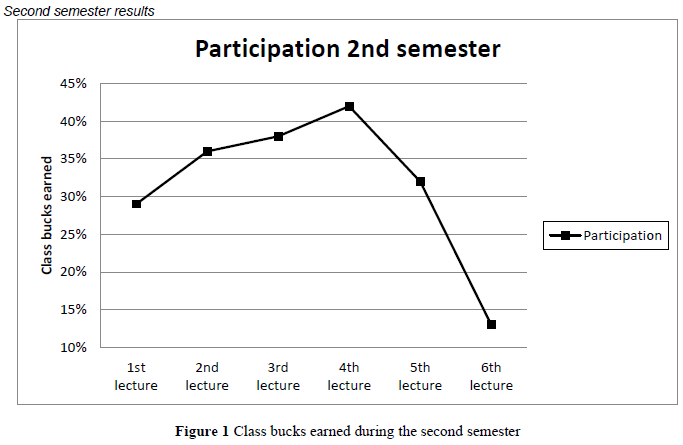
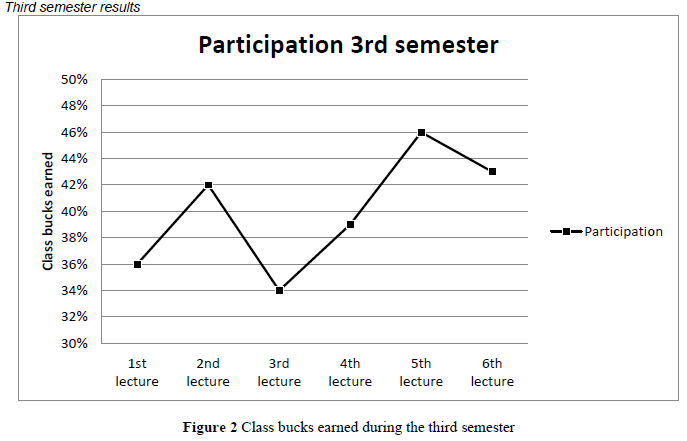
Quantitative and qualitative approaches were used to collect data. The sample in the quantitative study consisted of a class of first-year student teachers (n = 180) who participated in the research during the second and third semesters of the academic year. The quantitative data consisted of the number of student teachers' active participations recorded using the biometric fingerprint device and the compared results from the second and third semesters. Results were obtained from the calculated number of active participations for which student teachers were rewarded class bucks for quality comments (see Figures 1 and 2). The quantitative research approach was used to establish whether the use of a biometric fingerprint device could record and encourage student teachers' active participation in lectures aimed at learning how to create differentiated activities. The results of the second and third semester were recorded and compared. In addition, all participants were requested to complete open-ended questions (qualitative approach) at the end of their academic course. Twenty percent (n = 36) of these responses were then sampled, using a distribution of student teachers' approaches by selecting the first 12 from the top, 12 from the middle and 12 from the bottom of the pile of responses. This was important for gaining student teachers' reflections on their training experiences in differentiated instruction and to find possible ways of improving teacher training in the creation and applying differentiated instruction.
Procedure in Collecting Quantitative Data
Student teachers were encouraged during both semesters to be involved in class activities where they were taught how to create and apply differentiated instruction. Active participation in these lectures was rewarded with class bucks. I designed class bucks (each the same size as a South African paper bank note and bearing a dollar image). Student teachers who contributed quality comments during class discussions and activities were awarded a class buck, which equalled five marks (1%) that were added to the term assignment mark of the student teacher concerned. Student teachers' quality comments included discussions, ideas, examples and possible assessment questions when constructing differentiated activities for their majors. Although it was difficult to establish the level of student teachers' creative and critical thinking in this study, the lecturer awarded class bucks according to noteworthy student teacher comments and discussions on how to construct differentiated activities during lectures. As the lecturer was the only one rewarding student teachers for quality comments, she could observe expressions of critical and creative thinking by students from discussions. There was no limit for the total number of rewards that an individual could earn in a lesson period. At the end of the second semester the lecturer manually recorded and calculated the number of active participations in class.
The third semester was selected to record data as it was the last semester in which student teachers attended all classes before they commenced with their examinations in the fourth semester. During the third semester, student teachers' personal information (name, student number, cell number, address, etc.) as well as a scanned fingerprint image were captured on the data system. After each lecture, every student teacher who received class bucks for active participation in class handed his/her class bucks back to the lecturer and swiped his/her fingers on the biometric device, which automatically added five marks (1%) to his/her marks. At the end of the third semester, the class-buck percentages were calculated at the press of a button on the computer.
During both semesters student teachers were encouraged to be involved in class activities by rewarding them with class bucks for active participation. The difference was that during the third semester the biometric fingerprint device was applied to automatically record active participation on the data system.
The recorded numbers of student teachers who were awarded class bucks for active lecture participation during the second and third semesters were compared. The comparison of the number of active participations during lectures was done to establish whether the accurate recording of active participation in large classes could improve student teachers' engagement in lectures. The importance of active engagement is emphasised in this study as student teachers are encouraged to ask questions and engage in discussions to improve their own understanding of how to create and apply differentiated activities.
The class activities where student teachers had to actively engage to earn class bucks included the identification of student teachers' learning barriers using diagnostic, formal and informal assessment techniques; the application of various teaching methods and strategies; and the creation and application of differentiated learning activities. For example, during lectures student teachers had to do the following:
• Create and instruct a differentiated lesson for a Grade 4 geography class with the following objective: "Every learner must be able to identify the provinces of South Africa on a map."
• Engage in class discussions to show that they could identify learners' learning barriers by discussing the possible observed characteristics of learning barriers.
• Indicate in group discussions how they would determine their learners' readiness level, challenges and strengths, and classify them in groups according to their academic performance (delayed [0-50%], average [51-70%] and gifted [71-100%] learners) without revealing this to them (confidentiality).
• Create three differentiated learning activities for a Grade 4 class, namely an activity for the delayed learners, one for the average learners, and another for the gifted learners. For example:
Activity 1 (for the delayed learners): Provide a drawn map of South Africa and instruct the learners to colour in the various provinces with specific colours (green = North-West Province, yellow = Gauteng Province, etc.).
Activity 2 (for the average learners): Instruct them to colour the provinces in specific colours and write the names of the provinces on the map. Activity 3 (for the gifted learners): Colour, write the names of the provinces, and insert (and name) the rivers and small towns in these provinces on the map.
Because of the stigma connected to terms "delayed," "average" and "gifted," learners should never know that the teacher classified them accordingly. Each learner should be given the option to choose one of the three activities. To ensure that the gifted learner does not choose simplified activity 1 (which consists mostly of lower-order thinking questions) intended to be selected and completed by the delayed learner, specific maximum marks are allocated to each activity. For example, a learner who chooses activity 3 for the gifted learner (higher-order thinking questions) can achieve the maximum marks of 100% while for the average learner (activity 2 - combination of higher order and lower order questions), a maximum of 70% can be achieved, and for the delayed learner (activity 1) a maximum of 50%. Learners are therefore left with the option to select one of the three activities that would suit their learning styles and ensure that they achieve academic success.
Throughout the first-year course, the student teachers were individually encouraged to actively practice the creation of differentiated activities in their majors and voluntarily present their activities to the rest of the class, using the necessary media, methods, and strategies (visual aids, models, experimentation, etc.) to support their activities. At the end of the academic year, student teachers were divided into groups of four and instructed to complete an assignment, creating three differentiated activities for any content subject of their choice, to present the activities to the rest of the class, and to submit the written assignment for lecturer assessment.
Qualitative Data
Qualitative data was collected to identify the shortcomings in the differentiated instruction training sessions of student teachers. The following open-ended questions were posed to first-year student teachers after the completion of the lectures on differentiated instruction at the end of the third semester.
• Question 1: Did the class bucks and the fingerprint device recording encourage your active participation in lectures? Give reasons for your answer.
• Question 2: Are you able to create differentiated activities? If not, why do you experience a lack of readiness?
• Question 3: Do you learn more when actively involved in the lesson, from peer presentations and discussions, creating differentiated activities on your own, or from feedback of your lecturer? Please give reasons for your answer.
• Question 4: Reflect (metacognition) and indicate how you want to be trained to create and apply differentiated activities successfully?
• Question 5: What suggestions can you make on how to train student teachers to create differentiated activities successfully?
These questions were posed, not only to identify what student teachers still did not understand about the application of differentiated instruction, but also for me to reflect on my lectures. Reflection enabled me to revisit concepts that were unclear.
Data Analysis, Results and Discussion
Quantitative Data
The collected quantitative data from the second semester is reflected in Figure 1.
The results show that only 29% (n = 52) earned class bucks for the first lecture. I also detected that 37% of the student teachers were absent from the first lecture. The low attendance in respect of the first lecture could have been related to poverty (i.e. not enough money for transport from outlying areas to campus). By the second lecture, class attendance improved (money for transport was available) and active class participation increased to 36% (n = 65). By the third lecture active class participation had risen to 38% (n = 68). The high participation may be linked to student teachers' awareness of the test scheduled for the subsequent period. After the written test, at the fourth lecture, student teachers' active class participation increased to 42% (n = 76). This may be because they were anxious to receive feedback on the written tests and poor test marks may have motivated them to actively participate in class to improve their marks by earning class bucks.
The fifth and sixth lectures indicated that student teachers' active participation attendance had gradually dropped to 56% (n = 101). This could be connected to the upcoming recess, and the fact that students living far away from the campus had already left for home. It follows that active participation could also be related to class attendance.
It was interesting that class attendance for the first lecture in both semesters was the same, probably due to student teachers experiencing financial constraints regarding transport. In comparing the results of the first lecture, participation (36% [n = 65]) was surprisingly higher in comparison with the results in the second semester (29%). The reason may be that student teachers were motivated to attend lectures as they were aware that a fingerprint device would be used to capture and record their attendance and active participation. During the second lecture, student teachers' active involvement in class discussions increased to 42% (n = 76), which might be linked to some of the students experiencing the use of the new technology as exciting. The increase in active participation may also be contributed to the additional percentage that was immediately added to their marks. Immediate feedback/results are important to inform student teachers where they stand and at the same time models the value of timely feedback which they should apply to their own learners once qualified as teachers. The participation in the third lecture of the third semester dropped to 34% (n = 42), which may be connected to the fact that a campus sports day had been arranged for that same day and not all student teachers attended the class.
By the fourth lecture of the third semester active class participation had improved to 39% (n = 70). The increase could possibly be related to student teachers who were intrinsically and extrinsically motivated by the ability of the class-buck tool to help them improve their marks.
Lecture five showed the highest number of class bucks awarded, namely 46% (n = 83). It could be an indication that student teachers realised that their chances to gain extra marks were running out; that they were more comfortable to participate in class discussions; that they were motivated to participate; or that the lecture content was more interesting to them. Amazingly, regardless of the upcoming recess, active class participation in lecture six dropped only slightly to 43%.
When comparing the results for active student participation during the second and third semesters, the effect of the fingerprint device was notable, as active class participation improved by 18%. I also noted that most of the class bucks were awarded to student teachers who were failing their course at that stage, and student teachers with percentages above 70%. This may be because those student teachers who were failing the course used the active class participation incentive to improve their marks, while those averaging above 70% most probably wanted to raise their marks to the level of a distinction (75%). Additionally, student teachers might have experienced the class as interesting and engaging and were more inclined to participate in their other classes as well.
Given the improved active participation in class, it was important to establish whether student teachers were sufficiently trained and able to apply differentiated instruction in their classes. Open-ended questions were posed of which the most frequent answers are quoted below.
Question 1: Did the class bucks and the fingerprint device recording encourage your active participation in lectures? Justify your answer.
Yes, the recording of extra marks inspired me to focus more in class and participate. No, I always attend lectures and always participate in discussions.
Most of the participants (n = 32) felt that the allocation and recording of marks encouraged them to participate in class and group discussions. Nevertheless, seven student teachers said that it did not affect them at all, as they always attended lectures and participated actively in class.
Question 2: Are you able to create differentiated activities? If not, why do you experience a lack of readiness?
I am not clear on how to create my own differentiated activities for a lesson. It is easy when the lecturer assists me. I am not sure, but when we work in groups, I am more confident about creating my own activities. I am able to create differentiated activities. It is difficult to find ideas that are relevant to my subject in order to create such activities.
Although some indicated that they were able to create differentiated activities, the majority of participants were not confident about creating activities on their own and needed the support of their friends and of the lecturer. Working collaboratively is considered valuable for student teachers, as they could develop their own styles and confidence in creating differentiated activities over time.
Question 3: Do you learn more when actively involved in the lesson and from peer presentations and discussions on how to create differentiated activities? Please give reasons for your answer.
I learned more when I actually created my own activities.
When I ask questions in class, I can correct my mistakes.
When we do group work, I am able to find ideas for a lesson and create differentiated activities with the help of my friends.
I learn from students' presentations of their differentiated activities a lot in class. Our presentations in class provided me with ideas on how to create various activities, which I can use and change to fit my subject content.
The presentations and questions asked in class enabled me to think more creatively when designing my own differentiated activities.
All participants wanted to be involved in either peer discussions during group work or to observe examples of the differentiated lessons presented by their peers in order to acquire ideas for possible activities. The majority indicated that they needed their peers to support them with ideas and they wanted to ask questions in class. This might be because their peers could inspire them to be creative, or because they saw it as an easy way out, or because they were not always able or willing to think creatively and innovatively.
Question 4: Reflect (metacognition) and indicate how you want to be trained to create and apply differentiated activities successfully?
Allow us to practice these activities on a regular basis.
Provide us with more examples that are based on our subject content.
Provide practical situations where we have to teach our classes encountering learning barriers. Teach us how to select different teaching methods and strategies that can be used to teach in a differentiated class.
Provide more examples of how content can be broken down into smaller and simpler sections that learners can understand, until the lesson objectives are met.
Allow us to participate in practical activities in class, to identify the possible different learning styles and learning barriers of learners and the lecturer should guide us in doing so, as mentor teachers do not always know how to create differentiated activities.
Mentor teachers should be well-trained to assist student teachers during practical teaching on how to create differentiated activities.
Most of the participants suggested that student teachers should be provided with more examples of differentiated activities and be given more opportunities to practice these activities in class. Further
more, responses showed that student teachers needed more training on how to select suitable teaching methods, interesting topics, and visual and other supporting media, as well as more support from lecturers and well-informed mentor teachers on how to create differentiated activities in accordance with diverse learning styles.
Question 5: What suggestions can you make on how to train student teachers to create differentiated activities successfully?
Allow us to practice the creation of these activities on a regular basis.
Provide us with more examples on differentiated activities and give us more opportunities to practice these activities in classrooms.
We should practice on how to use practical examples, lesson topics of interest to the learners, and pictures to illustrate unclear content. Provide more examples of how content can be broken down into smaller and simpler sections that the learners can understand, until the lesson objectives are met.
We should get practical opportunities in class to identify the different learning styles and learning barriers of their learners and be guided by the lecturer in doing so, as teachers do not always know how to create differentiated activities.
Mentor teachers should be well trained to assist student teachers during practical teaching on how to create differentiated activities.
Responses showed that student teachers needed more training on how to select suitable teaching methods, interesting topics, and visual and other supporting media, and needed more support from lecturers and well-informed mentor teachers on how to create differentiated activities in accordance with learners' different learning styles.
The findings from the data, the literature review, and my practical experience in a school for learners with special education needs informed the recommendations below on how to train student teachers to implement differentiated learning activities in the classroom.
Recommendations
The demand for an educated, skilled workforce in the emerging economy of a developing country demands various ways to motivate student teachers to attend classes and participate in class. A biometric fingerprint device was therefore used not only to capture student teachers' personal information and fingerprint characteristics, but to encourage them to attend lectures on differentiated instruction, and to participate in class discussions.
Effective teacher training and active class participation of student teachers in differentiated instruction are requirements of an inclusive education system. Although the fingerprint device and class bucks were initially used to encourage class participation during student teachers' training in the application of differentiated instruction, it also showed numerous other advantages for the lecturer. For example, it saved time in recording active participation marks (as the lecturer did not need to record them manually), marks were available on the system immediately, which encouraged student teachers to become more involved in class discussions in order to improve their marks, and it provided the lecturer with an auditable track record of student teachers' attendance and participation. This strategy was an accurate, automatic, time-saving way of recording and tracking both the student teachers' class attendance and the class bucks they earned (for active participation).
Although the biometric fingerprint device along with the class bucks successfully encouraged and recorded active participation when learning how to apply differentiated instruction, the provision of practical application opportunities cannot be ignored. Therefore, all participants had to individually compile three differentiated activities for any subject of their choice. These activities were first voluntarily presented and discussed in class and finally all participants' activities were evaluated by three examiners and feedback was given to individual student teachers on how to improve their differentiated activities. Theory and practice can never function in isolation.
While I trained student teachers on how to create differentiated activities, I found that most student teachers were still not able to create their own differentiated activities for their classes during practical teaching. The reason could be linked to the study that showed that most student teachers who did attend class were passive receivers of content (68%) while only 32% participated actively in class discussions. As stated above, the low attendance in respect of the first lecture of the second semester could have been related to poverty (i.e. not enough money for transport from outlying areas to campus). Only 12% of student teachers were not able to attend the first lecture of the third semester, which may have been the result of better financial planning or simply because the student teachers knew that their class attendance would be recorded with a digital device during the entire third semester. Based on Bourdieu's theory of social capital for teachers (Bourdieu, 1977), student teachers should interact with their peers in class, and share ideas and discourse to create or modify their own differentiated activities. The sharing and application of successful case studies (demonstrations by the lecturer, students' own practical examples, mock classes, toolkits, tricks of the trade, and others) of differentiated learning activities can be considered a key element of student teachers' training. It is therefore important that a social and immersive learning environment should be created during training sessions where student teachers can share creative ideas and information with their peers and generate ideas on how to create their own differentiated activities for their major subjects. To determine whether student teachers are on the right track, there should be frequent class presentations where peers and lecturers can critique or learn from student teachers' presentations on differentiated activities.
During the training sessions student teachers should learn how to identify learners' barriers to learning. A basic teaching principle can be used to teach student teachers how to start creating differentiated learning activities. Keeping learners' diverse learning preferences, strengths, learning disabilities and their social contexts in mind, three differentiated learning activities can be created for a class: an activity for delayed learners, one for the average learners and another for gifted learners. The successful implementation of differentiated instruction methods is also dependent on the support of an expert in the field, well trained teacher mentors, and the knowledge of parents and other members of the community.
Conclusion
The research intended to find a solution in addressing the challenges of teaching large classes, student absenteeism, and inactive participation in a developing country with abject poverty. Therefore, the aim of this article was to establish whether a biometric fingerprint device could be used to accurately record and improve active class participation of student teachers when attending lectures on how to apply differentiated instruction.
Student teachers were motivated with class bucks in both the second and the third semesters. The fingerprint device was used for the first time at the beginning of the third semester, and student teachers who had earned class bucks had to swipe their fingerprints to automatically add five marks (1%) to their semester marks. Student teachers could now view their marks immediately, whereas in the second semester they had to wait until the end of the term for the lecturer to capture all the extra marks earned through class bucks.
The effect of using the fingerprint device in the third semester to improve active participation was compared to the second-semester results where the device was used. The research findings indicate that active class participation did improve when using the fingerprint device and class bucks. Additionally, student teachers' feedback was valuable as the open-ended questions revealed that training should focus on active student teacher involvement in various assessment techniques that can be employed to determine learners' strengths, challenges, and interests. From the data analysis it became clear that the participants in this study needed more practice and examples to help them create differentiated activities. It was identified that more meaningful engagement activities for practical experiences should be created where student teachers could employ mock classes, toolkits, tricks of the trade, and others that they have learnt during their lectures.
Follow-up interviews using purposive sampling of high, average and low achievers could contribute to obtaining a deeper understanding of the study.
Notesi. Published under a Creative Commons Attribution Licence.
References
- Aström P 2007. The study of ancient fingerprints. Journal of Ancient Fingerprints, 1:2-3.
- Banya K 2005. Globalisation and higher education policy changes. In J Zajda (ed). International handbook on globalisation, education and policy research: Global pedagogies and policies. Dordrecht, The Netherlands: Springer.
-
Botha RJ 2002. Outcomes-based education and educational reform in South Africa. International Journal of Leadership in Education, 5(4):361-371. https://doi.org/10.1080/13603120110118831
» https://doi.org/10.1080/13603120110118831 - Bourdieu P 1977. Outline of a theory of practice. Translated by R Nice. Cambridge, England: Cambridge University Press.
- Champod C & Margot PA 1996. Computer assisted analysis of minutiae occurrences on fingerprints. In J Almog & E Springer E (eds). Proceedings of the International Symposium on Fingerprint Detection and Identification. Kiryat HaMemshala, Jerusalem: Israel National Police.
- Chapman C & King R 2005. Differentiated assessment strategies: One tool doesn't fit all. Thousand Oaks, CA: Corwin Press.
-
Chataika T, Mckenzie JA, Swart E & Lyner-Cleophas M 2012. Access to education in Africa: Responding to the United Nations Convention on the Rights of Persons with Disabilities. Disability & Society, 27(3):385-398. https://doi.org/10.1080/09687599.2012.654989
» https://doi.org/10.1080/09687599.2012.654989 -
Chylinski M 2010. Cash for comment: Participation money as a mechanism for measurement, reward, and formative feedback in active class participation. Journal of Marketing Education, 32(1):25-38. https://doi.org/10.1177%2F0273475309335586
» https://doi.org/10.1177%2F0273475309335586 -
De Jager T 2013. Guidelines to assist the implementation of differentiated learning activities in South African secondary schools. International Journal of Inclusive Education, 17(1):80-94. https://doi.org/10.1080/13603116.2011.580465
» https://doi.org/10.1080/13603116.2011.580465 -
Delisle JR 2015. Differentiation doesn't work. Education Week, 34(15):28, 36. Available at http://www.edweek.org/ew/articles/2015/01/07/differentiation-doesnt-work.html. Accessed 14 April 2017.
» http://www.edweek.org/ew/articles/2015/01/07/differentiation-doesnt-work.html -
Department of Education 2001. Education White Paper 6. Special needs education: Building an inclusive education and training system. Pretoria, South Africa: Author. Available at https://wcedonline.westerncape.gov.za/Specialised-ed/documents/WP6.pdf. Accessed 29 November 2019.
» https://wcedonline.westerncape.gov.za/Specialised-ed/documents/WP6.pdf -
Eisenberger R, Pierce WD & Cameron J 1999. Effects of reward on intrinsic motivation-Negative, neutral, and positive: Comment on Deci, Koestner, and Ryan (1999). Psychological Bulletin, 125(6):677-691. Available at https://www.researchgate.net/profile/Judy_Cameron2/publication/12712630_Effects_of_reward_on_intrinsic_motivation_-_Negative_neutral_and_positive_Comment_on_Deci_Koestner_and_Ryan_1999/links/54bd6c190cf218da9391b130/Effects-of-reward-on-intrinsic-motivation-Negative-neutral-and-positive-Comment-on-Deci-Koestner-and-Ryan-1999.pdf. Accessed 23 November 2019.
» https://www.researchgate.net/profile/Judy_Cameron2/publication/12712630_Effects_of_reward_on_intrinsic_motivation_-_Negative_neutral_and_positive_Comment_on_Deci_Koestner_and_Ryan_1999/links/54bd6c190cf218da9391b130/Effects-of-reward-on-intrinsic-motivation-Negative-neutral-and-positive-Comment-on-Deci-Koestner-and-Ryan-1999.pdf - Fox TD, Vos NB & Geldenhuys JL 2007. The experience of cross-cultural peer teaching for a group of mathematics learners. Pythagoras, 65:45-52.
-
Frey BS & Jegen R 2001. Motivation crowding theory. Journal of Economic Surveys, 15(5):589-611. https://doi.org/10.1111/1467-6419.00150
» https://doi.org/10.1111/1467-6419.00150 -
Gagné M & Deci EL 2005. Self-determination theory and work motivation. Journal of Organizational Behavior, 26(4):331-362. https://doi.org/10.1002/job.322
» https://doi.org/10.1002/job.322 -
Gills BK 2005. André Gunder Frank: 'Prophet in the wilderness' (1929-2005). Available at https://www.networkideas.org/wp-content/uploads/2017/09/Andre_Gunder_Frank.pdf. Accessed 6 December 2016.
» https://www.networkideas.org/wp-content/uploads/2017/09/Andre_Gunder_Frank.pdf - Goodwin B 2008. What makes for a good teacher? Changing Schools, 58(7):6-8.
- Gregory GH & Chapman C 2007. Differential instructional strategies: One size doesn'tfit all (2nd ed). Thousand Oaks, CA: Corwin Press.
-
Hall T, Vue G, Strangman N & Meyer A 2014. Differentiated instruction and implications for UDL implementation. Wakefield, MA: National Center on Accessing the General Curriculum. Available at http://aem.cast.org/about/publications/2003/ncac-differentiated-instruction-udl.html. Accessed 1 December 2016.
» http://aem.cast.org/about/publications/2003/ncac-differentiated-instruction-udl.html -
Heitor M & Horta H 2012. Opening-up higher education in emerging economies: Autonomy and integrity on the rise of globalization. International Journal of Chinese Education, 1(2):196-234. https://doi.org/10.1163/22125868-12340004
» https://doi.org/10.1163/22125868-12340004 - Holz T & Lessing A 2002. Aid to the teacher to identify the learner with ADHD in the classroom: A literature study. Educare, 31(1_2):236-250.
- Johnson P 2009. The 21st century skills movement. Educational Leadership, 67(1): 11.
-
Lauder H, Brown P & Ashton D 2008. Globalisation, skill formation and the varieties of capitalism approach. New Political Economy, 13(1):19-35. https://doi.org/10.1080/13563460701859678
» https://doi.org/10.1080/13563460701859678 - Lawrence-Brown D 2004. Differentiated instruction: Inclusive strategies for standards-based learning that benefits the whole class. American Secondary Education, 32(3):34-62.
-
Lee D, Kelly KR & Edwards JK 2006. A closer look at the relationships among trait procrastination, neuroticism, and conscientiousness. Personality and Individual Differences, 40(1):27-37. https://doi.org/10.1016/j.paid.2005.05.010
» https://doi.org/10.1016/j.paid.2005.05.010 -
Lepper MR, Greene D & Nisbett RE 1973. Undermining children's intrinsic interest with extrinsic rewards: A test of the "overjustification" hypothesis. Journal of Personality and Social Psychology, 28(1):129-137. Available at https://www.researchgate.net/profile/Mark_Lepper/publication/281453299_Undermining_Children%27s_Intrinsic_Interest_with_Extrinsic_Reward_A_Test_of_the_Overjustification_Hypothesis/links/56107d6b08aec422d115589b/Undermining-Childrens-Intrinsic-Interest-with-Extrinsic-Reward-A-Test-of-the-Overjustification-Hypothesis.pdf. Accessed 8 November 2019.
» https://www.researchgate.net/profile/Mark_Lepper/publication/281453299_Undermining_Children%27s_Intrinsic_Interest_with_Extrinsic_Reward_A_Test_of_the_Overjustification_Hypothesis/links/56107d6b08aec422d115589b/Undermining-Childrens-Intrinsic-Interest-with-Extrinsic-Reward-A-Test-of-the-Overjustification-Hypothesis.pdf -
Levy HM 2008. Meeting the needs of all students through differentiated instruction: Helping every child reach and exceed standards. The Clearing House: A Journal of Educational Strategies, Issues and Ideas, 81(4):161-164. https://doi.org/10.3200/TCHS.81.4.161-164
» https://doi.org/10.3200/TCHS.81.4.161-164 -
Lomofsky L & Lazarus S 2001. South Africa: First steps in the development of an inclusive school system. Cambridge Journal of Education, 31 (3):303-317. https://doi.org/10.1080/03057640120086585
» https://doi.org/10.1080/03057640120086585 -
Nawaz T, Pervaiz S, Korrani A & Azhar-ud-din 2009. Development of academic attendance monitoring system using fingerprint identification. International Journal of Computer Science and Network Security, 9(5):164-168. Available at http://citeseerx.ist.psu.edu/viewdoc/download?doi=10.1.1.458.8526&rep=rep1&type=pdf. Accessed 6 November 2019.
» http://citeseerx.ist.psu.edu/viewdoc/download?doi=10.1.1.458.8526&rep=rep1&type=pdf -
Prabhakar S, Pankanti S & Jain AK 2003. Biometric recognition: Security and privacy concerns. IEEE Security & Privacy, 1:33-12. https://doi.org/10.1109/MSECP.2003.1193209
» https://doi.org/10.1109/MSECP.2003.1193209 -
Rock ML, Gregg M, Ellis E & Gable RA 2008. REACH: A framework for differentiating classroom instruction. Preventing School Failure: Alternative Education for Children and Youth, 52(2):31-47. https://doi.org/10.3200/PSFL.52.2.31-47
» https://doi.org/10.3200/PSFL.52.2.31-47 -
Sautter P 2007. Designing discussion activities to achieve desired learning outcomes: Choices using mode of delivery and structure. Journal of Marketing Education, 29(2):122-131. https://doi.org/10.1177%2F0273475307302014
» https://doi.org/10.1177%2F0273475307302014 -
Smit R & Humpert W 2012. Differentiated instruction in small schools. Teaching and Teacher Education, 28(8):1152-1162. https://doi.org/10.1016/j.tate.2012.07.003
» https://doi.org/10.1016/j.tate.2012.07.003 - Tomlinson CA 1999. The differentiated classroom: Responding to the needs of all learners. Alexandria, VA: Association for Supervision and Curriculum Development.
-
Tomlinson CA 2005. Grading and differentiation: Paradox or good practice? Theory Into Practice, 44(3):262-269. https://doi.org/10.1207/s15430421tip4403_11
» https://doi.org/10.1207/s15430421tip4403_11 -
Tomlinson CA 2015. Differentiation does, in fact, work. Education Week, 34(19):26, 32. Available at http://www.edweek.org/ew/articles/2015/01/28/differentiation-does-in-fact-work.html. Accessed 11 April 2017.
» http://www.edweek.org/ew/articles/2015/01/28/differentiation-does-in-fact-work.html - Vygotsky LS 1978. Mind in society: The development of higher psychological processes. Cambridge, MA: Harvard University Press.
- Williams E, Olivier T & Pienaar C 2009. A model to revitalize teacher competence. Acta Academica, 41(4):195-217.
- Williams EE 2007. Inclusive education: A training model for in-service teachers. DEd thesis. Port Elizabeth, South Africa: Nelson Mandela Metropolitan University.
-
Willis S & Mann L 2000. Differentiating instruction: Finding manageable ways to meet individual needs. Curriculum Update. Available at http://www.ascd.org/publications/curriculum-update/winter2000/Differentiating-Instruction.aspx. Accessed 13 April 2017.
» http://www.ascd.org/publications/curriculum-update/winter2000/Differentiating-Instruction.aspx
Revised: 31 January 2019
Accepted: 22 May 2019
Published: 31 December 2019