Deconstructing pre-service teachers' perceptions of assessment in initial teacher education
Abstract
With this study we explored 1st-year pre-service teachers' (PSTs') perceptions of assessment in an initial teacher education programme at a South African public university. Data were generated through a cross-sectional survey completed by 221 1st-year PSTs during an orientation programme held approximately 2 months after university entry, at a stage when participants had had only limited exposure to formal coursework on assessment. Descriptive analysis of closed items and thematic categorisation of open-ended responses showed that most participants associated assessment with tests, marks and the measurement of performance. Few understood assessment as formative, reflective or participatory. Interpreted through the apprenticeship of observation, the findings suggest that prior schooling experiences and a performance-oriented assessment culture continued to shape PSTs' early conceptions of assessment. The study contributes to scholarship on assessment literacy by showing how inherited views of assessment may constrain the development of assessment as pedagogy. We argue for deliberate teacher education interventions that foreground formative assessment, feedback literacy and critical reflection on prior schooling experiences.
apprenticeship of observation; assessment literacy; assessment pedagogy; formative assessment; initial teacher education; pre-service teachers
Introduction
Internationally, assessment is increasingly treated as central to educational quality, accountability and learner progress, which places growing pressure on teachers to be assessment literate (Meijer, Baartman, Vermeulen & De Bruijn, 2023; Pastore, 2023). Contemporary scholarship suggests that assessment literacy extends beyond the technical ability to design and score tasks; it also includes the capacity to interpret evidence, give useful feedback, make fair judgements and integrate assessment meaningfully with teaching and learning (DeLuca & Bellara, 2013; Popham, 2009). For initial teacher education (ITE), this means that pre-service teachers (PSTs) need to understand assessment not only as a means of measuring achievement, but also as a pedagogical process that can support participation, reflection and improvement.
Yet, PSTs do not enter teacher education as blank slates. Their prior experiences of schooling may already have shaped powerful assumptions about what is regarded as assessment and what it is for. In South Africa, where schooling is often experienced through performance pressures and the high-stakes National Senior Certificate, students may associate assessment primarily with tests, marks and certification rather than with formative support for learning (Howie, 2012; Mentz & Lubbe, 2021). Against this backdrop, we investigated first-year PSTs' perceptions of assessment at entry into ITE. We argue that many begin their programmes with simplified conceptions of assessment and limited understanding of its pedagogical role, and we consider how teacher education might respond to the gap between inherited perceptions of assessment and more learning-oriented assessment practice.
Problem Statement
Despite growing recognition of the importance of assessment literacy in teacher education, relatively little is known about how first-year PSTs in the South African context initially understand assessment upon entering ITE programmes. This is a significant concern because student teachers may bring deeply embedded assumptions about assessment shaped by prior schooling experiences into higher education, including a possible overemphasis on testing, marks, and performance. If such assumptions remain unexamined, they may limit the development of a more expansive understanding of assessment as pedagogy and contribute to the persistence of a theory-practice gap in teacher education. The problem addressed in this study is, therefore, the limited knowledge of how first-year PSTs conceptualise assessment at the point of entry into teacher education, and what these early perceptions may imply for the development of assessment literacy in ITE programmes. Against this background, the purpose with the study was to explore first-year PSTs' perceptions and basic understanding of assessment at the beginning of their tertiary education journey.
Research Questions
The study was guided by four questions: How do first-year PSTs define and understand assessment at the beginning of ITE? What purposes do they attribute to assessment in teaching and learning? To what extent do their responses reflect narrow, summative conceptions or broader understandings of assessment as pedagogy? What do these early perceptions imply for the development of assessment literacy in ITE programmes?
Literature Review
Assessment literacy: An essential competency for teachers
Assessment literacy refers to the knowledge, skills, and understanding necessary for teachers to design, implement, interpret, and use assessment to enhance learners' learning (Popham, 2009). This competency includes the ability to create valid and reliable assessment, accurately understand and apply assessment results, and use these results to guide instruction, provide constructive feedback, and support learners' progress (Annandale & Reyneke, 2020). Teachers who possess assessment literacy understand that assessment can never be reduced to standardised measurement and classroom testing (Pastore, 2023) but should be viewed as tools for learning that must be leveraged to foster learners' academic growth (Popham, 2009).
Moreover, assessment literate teachers recognise the need for and the value of using a range of assessment approaches, including formative (ongoing) and summative (final) assessment, to gather dependable evidence of learner achievement and to use that evidence productively in support of learning (Stiggins, 1991). Chan and Luk (2022) echo DeLuca and Bellara (2013) to acknowledge the ethical responsibility that teachers bear in using assessment results fairly and constructively, aimed at promoting learner growth rather than merely assigning grades. Consistent with Stiggins (1991), Cochran-Smith (2023) conceptualises assessment literacy from a socio-cultural perspective, maintaining that it encompasses not only cognitive skills but also reflective and ethical dimensions that form part of a teacher's professional identity as it develops over time. This perspective underscores the value of collaborative, contextually grounded professional development in cultivating assessment literacy. In relation to supporting learner development, Kilic and Saglam (2023) emphasise the importance of involving students in self-assessment practices that enable them to take ownership of their learning and strengthen their reflective abilities.
Building on this foundation, DeLuca and Bellara (2013) broaden the concept of assessment literacy by including teachers' self-efficacy in designing and interpreting assessment. They contend that assessment literacy extends beyond the technical ability to construct and score assessment tasks and entails aligning assessment practices with instructional purposes and the diverse needs of learners. Their findings point to a notable gap in ITE, with many teachers feeling insufficiently prepared to apply assessment principles effectively.
The views of scholars such as Atjonen, Kontkanen, Ruotsalainen and Pöntinen (2024), Brown (2017), and Lutovac and Flores (2022) introduce another dimension to assessment literacy, connecting it to teachers' conceptions of assessment (CoA). They assert that teachers' perspectives on assessment - whether they view it as a tool for accountability, improvement, or learner empowerment - affect how they use assessment to support learning. Their research suggests that teachers with a stronger understanding of assessment literacy are more likely to use assessment in ways that inform teaching and promote learner success.
Overall, assessment literacy is more than technical competence; it combines ethical, reflective and instructional capabilities that enable teachers to use assessment to support learning. This underscores the need for ITE programmes to develop strong assessment literacy and to investigate barriers that shape PSTs' understanding of assessment and assessment pedagogy (Annandale & Reyneke, 2020; Botha, 2020). In this study, the culture of assessment in South African basic schooling and Lortie's apprenticeship of observation (AoO) were used as lenses through which first-year PSTs' perceptions were examined.
Theoretical Framework: The Apprenticeship of Observation (AoO)
This study is framed by Lortie's (1975) concept of the apprenticeship of observation (AoO), used here as an analytical lens for interpreting PSTs' perceptions of assessment. The AoO suggests that prolonged exposure to schooling shapes prospective teachers' assumptions about teaching, learning and assessment. For first-year students entering ITE, this lens helps explain why assessment is often understood in narrow terms, such as tests, marks and formal examinations. The students' prior experiences of school assessment are likely to have influenced the beliefs and expectations they bring into teacher education.
The AoO has been widely used in teacher education research to explain taken-for-granted understanding that PSTs bring into professional preparation. At the same time, it should not be treated as wholly deterministic: later scholarship suggests that prior observation interacts with biography, context, teacher education experiences and opportunities for critical reflection rather than fixing future practice in a simple way (Botha, 2020).
This qualification is important because today's student populations and schooling contexts are highly diverse. Recent critiques, therefore, caution against using the AoO as the sole explanation for PSTs' perceptions. Even so, it remains a useful heuristic for understanding how earlier schooling experiences may shape what PSTs recognise as normal or successful teaching and assessment, provided that those experiences are interpreted in context rather than assumed to operate uniformly (Brunker, 2024; Mehta & Datnow, 2020; Smagorinsky & Barnes, 2014).
Within the South African context, the AoO is particularly relevant because schooling occurs in a system where the National Senior Certificate (NSC) functions as a high-stakes school-leaving examination and where assessment outcomes often carry strong symbolic and practical value (Howie, 2012; Mentz & Lubbe, 2021). Such conditions may encourage learners to associate assessment primarily with certification, marks and progression rather than with formative support for learning. The argument here is not that all PSTs share identical experiences or perceptions, but rather that prior exposure to dominant school assessment practices may influence the assumptions they bring into teacher education and may initially dispose them towards summative CoA. In this sense, the AoO is useful for explaining why PSTs may initially privilege summative forms of assessment and may struggle to recognise assessment as a pedagogical process that can also support learning. This creates a challenge for teacher educators, who must work not only to build theoretical and practical knowledge of assessment, but also to help students question inherited assumptions formed through years of observing and experiencing schooling. Research on teacher assessment literacy and teacher education similarly points to the need for more explicit development of assessment understanding, rather than assuming that such understanding is already in place (Hung & Wu, 2024; Kanjee & Mthembu, 2015).
Building on Lortie's (1975) concept, we proceed from the view that PSTs enter teacher education with prior perceptions of assessment practices shaped by their experiences as learners. These perceptions may constrain their early understanding of assessment literacy, especially where assessment is equated mainly with summative judgement. However, because such perceptions are also shaped by context, we adopted a second lens alongside the AoO: the culture of assessment in South African schooling. Taken together, these two lenses provide a basis for exploring how first-year PSTs understand assessment, and how that understanding may reflect personal educational histories and the broader systemic conditions of schooling in South Africa.
The culture of assessment in the South African basic schooling environment The culture of assessment in South African basic schooling is shaped by a highly formalised curriculum and assessment system in which progression and certification are closely tied to measurable performance. From the early grades onwards, learners' achievement is monitored through school-based assessment, while performance in the final years of schooling is strongly directed towards the NSC examination at the end of Grade 12. Within such a context, assessment may easily come to be associated primarily with marks, promotion and examination performance rather than with its formative role in supporting learning (Annandale & Reyneke, 2020; Howie, 2012; Mentz & Lubbe, 2021).
This context matters for students entering university, and especially for PSTs. Having progressed through a schooling system in which assessment is often experienced as performance-oriented, many first-year students may enter higher education with limited experience of assessment as a dialogic, reflective and developmental process. By locating PSTs' perceptions within the combined lenses of South African schooling culture and the AoO, we sought to illuminate the contextual influences that may shape their early understanding of assessment.
Methodology
This study formed part of a larger assessment project in the Faculty of Education at a South African university, for which ethical clearance and gatekeeper permission had already been obtained. The purpose of our study was to explore first-year PSTs' assessment perceptions and baseline assessment literacy to inform curriculum design within ITE.
The research site was selected on grounds of accessibility and feasibility and may, therefore, be described as a case of convenience site selection. The university was also contextually appropriate because it offers established ITE programmes across three campuses and enrols students from diverse school backgrounds. This heterogeneity was important for the study because it reflects the uneven realities of contemporary South African schooling and cautions against treating the AoO as a uniform influence on PSTs' perceptions.
Data were generated through a cross-sectional survey completed by 221 first-year PSTs during an orientation programme held approximately 2 months after entry to university, when participants had had only limited exposure to formal coursework on assessment. The survey included closed and open-ended items. Closed items were analysed descriptively, while short narrative responses were thematically categorised to illuminate participants' understanding of assessment. The qualitative component, therefore, served to elaborate the survey findings rather than constituting a separate qualitative phase.
The target population comprised approximately 2,500 first-year PSTs across the university's three campuses. Participation was voluntary, and 221 students took part, representing approximately 8.8% of the population. Nearly half of the participants had completed Grade 12 in the preceding year, suggesting that many had moved directly from school into higher education and were still drawing on relatively recent experiences of school assessment.
Although the study drew on quantitative and qualitative data, its primary orientation was descriptive and exploratory. The inclusion of open-ended items strengthened the trustworthiness of the findings by allowing patterns in the structured responses to be compared with participants' own brief explanations and examples.
Ethical clearance for the study was obtained as part of the larger first-year experience project (NWU-00479-17-A2). An external recruiter informed potential participants about the purpose of the study and assured them of voluntary participation and that they could withdraw at any time they chose. Confidentiality and anonymity were protected by removing identifying information from the dataset and reporting findings in aggregate form.
Careful consideration of trustworthiness was achieved by engaging deeply with the dataset and conducting thematic analysis. Dependability was reinforced by providing a clear and detailed account of the research methodology and analytical steps. To improve confirmability, interpretations were regularly cross-verified with the data, and comprehensive descriptions of the context and participants bolstered the transferability of the results.
Findings
Quantitative Analysis of PSTs' Perceptions of ssessment (N = 221)
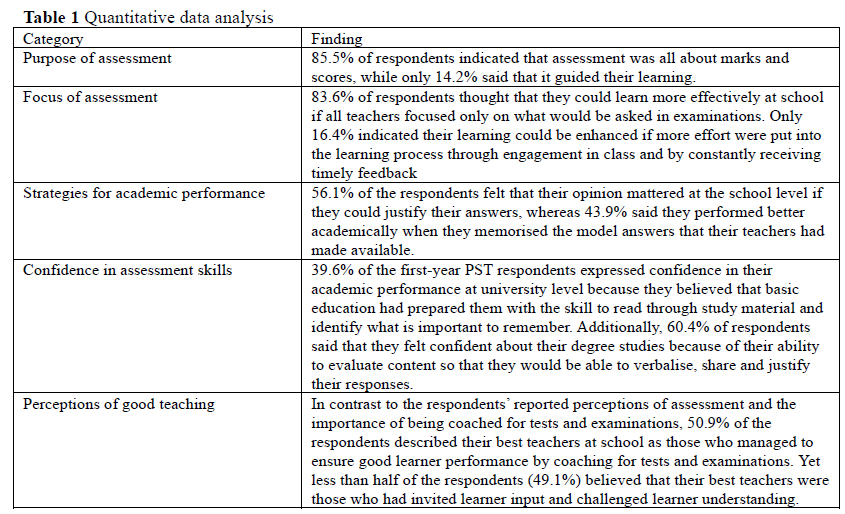
Table 1 below presents a summary of the multiple-choice survey items and highlights the tension between traditional, performance-driven views of assessment and more pedagogical conceptions. The quantitative data suggest that many participants associated assessment primarily with marks, tests and the measurement of learning, with much weaker recognition of formative, reflective and participatory dimensions of assessment.
These patterns suggest that students emerging from basic education may perceive assessment largely through the lens of performance and accountability, which reinforces the need for ITE programmes to broaden CoA as pedagogy.
Responses to the open-ended questions were analysed and grouped into thematic categories that reflect the dominant ways in which participants conceptualised assessment.
Qualitative Findings: Supporting the Quantitative Data
The qualitative responses largely confirmed the quantitative patterns by emphasising testing, understanding and marks, while references to formative, collaborative or self-regulatory uses of assessment remained limited.
Theme 1: Definition of assessment
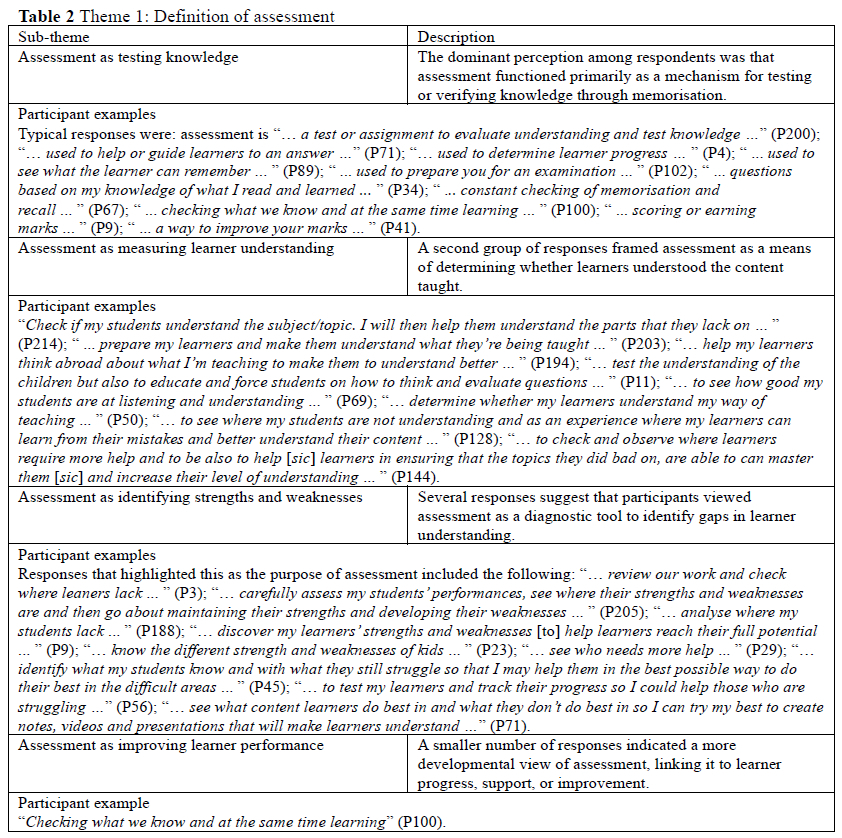
Consistent with the quantitative findings, participants' responses (see Table 2) to the open-ended question revealed four recurring ways of defining assessment, indicating the dominant conceptions through which first-year PSTs appeared to understand the term.
Theme 2: Purpose of assessment
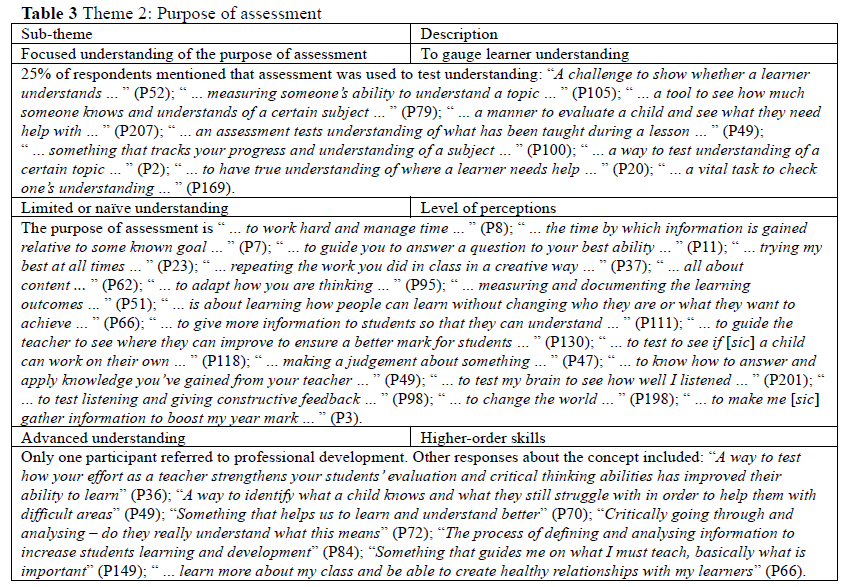
Although more than half of the participants demonstrated a focused individualised understanding of what they regarded as the primary purpose of assessment, a notable finding was the substantial number of participants who displayed a naïve and limited level of assessment literacy that would need to be explicitly addressed in such programmes.
Only a very small number of students reflected higher-order thinking in their perceptions of the purpose of assessment. Illustrative examples of participant responses, which expand the thematic analysis, are presented in Table 3.
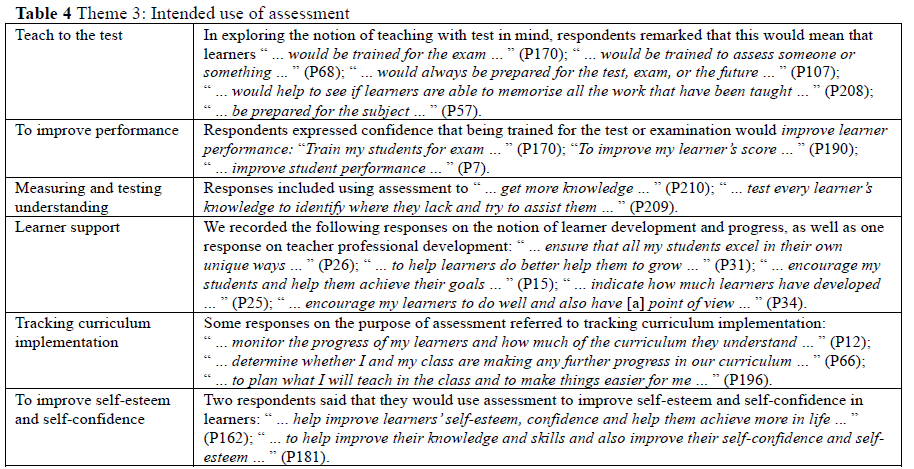
Theme 3: Intended use of assessment
As PSTs who have just embarked on teacher education, the participants were asked what they would use assessment for in practice. Four prominent sub-themes were identified from their responses and are presented in Table 4.
Discussion
The data suggest that South African PSTs remain strongly influenced by performance-driven schooling practices and by the AoO, with many entering ITE with narrow views of assessment that require explicit engagement.
In relation to the first research question, the findings show that many first-year PSTs entered ITE with narrow and largely performance-oriented CoA. Most participants associated assessment with tests, marks, checking understanding and judging achievement, while far fewer participants reflected an understanding of assessment as an ongoing pedagogical process. This supports earlier research indicating that PSTs often begin teacher education with underdeveloped assessment literacy, especially in relation to the broader educational purposes of assessment (DeLuca & Bellara, 2013; Popham, 2009).
Regarding the second research question, participants primarily attributed the purpose of assessment to measuring learner understanding and documenting performance. Although some respondents recognised that assessment could reveal learning gaps or inform teaching, relatively few referred to feedback, learner participation or the use of assessment to improve learning. Their responses were, therefore, more closely aligned with assessment of learning than with assessment for learning or assessment as learning.
With reference to the third research question, the data suggest that summative conceptions remained dominant. The limited mention of self-assessment, peer assessment and ongoing feedback is especially significant because it indicates that assessment was often viewed as something done to learners by teachers rather than as a process in which learners participated actively. Similar concerns have been raised in the assessment literacy literature, where PSTs are frequently found to privilege grading and performance measurement over formative, dialogic and learner-centred practices (Stiggins, 1991; Xu & Brown, 2016).
These findings are readily interpreted through Lortie's (1975) AoO. Having encountered assessment largely as tests, examinations and teacher judgement during their own schooling, participants appear to have carried those experiences into teacher education.
The findings thus support the view that PSTs do not enter ITE as blank slates, but with assumptions shaped by prolonged exposure to certain assessment practices (Darling-Hammond, 2006; Greenwalt, 2014).
The findings should also be situated within the South African schooling context, where curriculum coverage pressures, accountability demands and the high-stakes nature of the NSC may encourage learners to associate assessment primarily with marks, progression and examination preparation (Howie, 2012; Mentz & Lubbe, 2021). In this regard, participants' responses appear to reflect not only individual schooling histories, but also a broader culture of performance-oriented assessment.
In response to the fourth research question, the findings suggest that these entry-level perceptions may constrain the development of robust assessment literacy unless ITE programmes explicitly engage them. If assessment continues to be understood mainly as measurement and judgement, PSTs may struggle to regard it as integral to pedagogy, feedback and learner development. This has implications for teacher professional identity, because assessment literacy is part of becoming a reflective and pedagogically responsive teacher (Cochran-Smith, 2023).
At the same time, the results should not be regarded as evidence of a uniform deficit. A small but noteworthy group of participants did show some awareness that assessment could inform teaching and identify learner support needs. This suggests variation in the cohort and supports critiques of overly deterministic readings of the AoO. Even so, the dominant pattern remains one of narrow and mainly summative understanding of assessment, underscoring the need for teacher education programmes to challenge inherited assumptions and create opportunities for more formative, participatory and reflective engagement with assessment.
Implications for ITE
The findings underscore the responsibility of ITE programmes to engage PSTs explicitly in the development of assessment literacy. If students enter university with inherited assumptions shaped by prior schooling, teacher education cannot assume that broader understanding of assessment will emerge through coursework alone.
ITE programmes should, therefore, create structured opportunities for PSTs to surface and critique the assumptions they already hold about assessment. Reflective activities such as assessment autobiographies, guided comparison of school and university assessment practices, and structured discussion of assessment experiences may help students recognise how prior schooling continues to shape their professional thinking.
A further implication is the need to foreground formative assessment and feedback literacy within teacher education curricula. Teacher educators need to model how assessment can be used to diagnose learner needs, adapt instruction, provide actionable feedback and support learner participation, rather than functioning only as a terminal judgement.
Assessment literacy also needs to be scaffolded across campus-based learning and practice-based experiences. A more coherent programme-level approach, in which planning, teaching, assessment and reflection are treated as interconnected dimensions of practice, may help PSTs move beyond a theory-practice divide and develop more confident, pedagogically grounded uses of assessment.
Taken together, these implications suggest that developing PSTs' assessment literacy requires deliberate programme design, not simply the inclusion of assessment content in isolated modules.
Conclusion
This study contributes to scholarship on PSTs' perceptions of assessment by showing how early CoA are shaped by prior schooling experiences and by the broader culture of performance-oriented assessment in South African schooling. The findings indicate that many first-year PSTs entered ITE with relatively narrow understandings of assessment, associating it mainly with testing, marks, the measurement of achievement and the judgement of performance, rather than with feedback, learner participation and the support of learning. Although a small number of participants showed some awareness of assessment as a means of identifying learner needs, broader understanding of assessment as an ongoing pedagogical process was far less evident.
Interpreted through the AoO, these findings extend theoretical discussions of assessment literacy by illustrating how inherited assumptions about assessment may shape, and at times, constrain PSTs' engagement with a more sophisticated understanding of assessment as pedagogy. The study therefore reinforces the view that assessment literacy does not develop in a neutral or context-free manner, but is mediated by the beliefs, experiences and expectations that students bring with them into ITE. In this respect, the findings help to explain why summative and teacher-controlled views of assessment may persist even when more formative and learner-centred approaches are promoted in higher education.
From a practical perspective, the study highlights the need for teacher education programmes to engage these assumptions early and deliberately if PSTs are to develop more reflective, formative and learner-centred approaches to assessment. If such assumptions remain unexamined, they may continue to shape how PSTs interpret assessment theory and enact assessment practice, thereby contributing to the persistence of a theory-practice gap. The findings thus point to the importance of creating structured opportunities within ITE for students to question prior experiences of assessment, encounter alternative practices and develop a more expansive understanding of assessment in relation to teaching and learning.
Overall, the study suggests that strengthening PSTs' assessment literacy is not only a curriculum matter, but also a professional and policy concern. More coherent attention to assessment across schooling and teacher education may help to support more responsive, developmental and learning-oriented assessment practices in schools. In the longer term, this may contribute not only to teachers being prepared better, but also to classroom practices in which assessment is used more purposefully to promote learner growth and meaningful educational engagement.
Limitations of the Study and Suggestions for Further Research
The study was limited to a single institution and to a relatively small number of the first-year cohort. Further research could extend the inquiry to other teacher education settings and explore longitudinally how assessment perceptions shift across coursework and teaching practice.
Authors' Contributions
Both authors contributed to data generation, conceptualisation and writing of the article and a review of the final manuscript.
NotesPublished under a Creative Commons Attribution Licence.
References
-
Annandale M & Reyneke EM 2020. The effect of skinny cow condition on first-year students' expectation of assessment and feedback. PerLinguam, 36(2):45-56. https://doi.org/10.5785/36-2-949
» https://doi.org/10.5785/36-2-949 -
Atjonen P, Kontkanen S, Ruotsalainen P & Pöntinen S 2024. Pre-service teachers as learners of formative assessment in teaching practice. European Journal of Teacher Education, 47(2):267-284. https://doi.org/10.1080/02619768.2024.2338840
» https://doi.org/10.1080/02619768.2024.2338840 -
Botha C 2020. The impact of the apprenticeship of observation on preservice teachers' perceptions of teaching. Journal of Education, 81:50-64. https://doi.org/10.17159/2520-9868/i81a03
» https://doi.org/10.17159/2520-9868/i81a03 -
Brown GTL 2017. The future of assessment as a human and social endeavor: Addressing the inconvenient truth of error. Frontiers in Education, 2:3. https://doi.org/10.3389/feduc.2017.00003
» https://doi.org/10.3389/feduc.2017.00003 -
Brunker N 2024. Learning to teach without an apprenticeship of observation: From home education to initial teacher education. The Australian Educational Researcher, 51: 1291-1309. https://doi.org/10.1007/s13384-023-00640-w
» https://doi.org/10.1007/s13384-023-00640-w -
Chan CKY & Luk LYY 2022. A four-dimensional framework for teacher assessment literacy in holistic competencies. Assessment & Evaluation in Higher Education, 47(5):755-769. https://doi.org/10.1080/02602938.2021.1962806
» https://doi.org/10.1080/02602938.2021.1962806 -
Cochran-Smith M 2023. What's the "problem of teacher education" in the 2020s? Journal of Teacher Education, 74(2):127-130. https://doi.org/10.1177/00224871231160373
» https://doi.org/10.1177/00224871231160373 -
Darling-Hammond L 2006. Constructing 21st-century teacher education. Journal of Teacher Education, 57(3):300-314. https://doi.org/10.1177/0022487105285962
» https://doi.org/10.1177/0022487105285962 -
DeLuca C & Bellara A 2013. The current state of assessment education: Aligning policy, standards, and teacher education curriculum. Journal of Teacher Education, 64(4):356-372. https://doi.org/10.1177/0022487113488144
» https://doi.org/10.1177/0022487113488144 -
Greenwalt KA 2014. Frustrated returns: Biography, parental figures and the apprenticeship of observation. Curriculum Inquiry, 44(3):306-331. https://doi.org/10.1111/curi.12048
» https://doi.org/10.1111/curi.12048 -
Howie S 2012. High-stakes testing in South Africa: Friend or foe? Assessment in Education: Principles, Policy & Practice, 19(1):81-98. https://doi.org/10.1080/0969594X.2011.613369
» https://doi.org/10.1080/0969594X.2011.613369 -
Hung CS & Wu HK 2024. High school science teachers' assessment literacy for inquiry-based science instruction. International Journal of Science Education, 46(7):621-642. https://doi.org/10.1080/09500693.2023.2251657
» https://doi.org/10.1080/09500693.2023.2251657 -
Kanjee A & Mthembu J 2015. Assessment literacy of foundation phase teachers: An exploratory study. South African Journal of Childhood Education, 5(1):142-168. https://doi.org/10.4102/sajce.v5i1.354
» https://doi.org/10.4102/sajce.v5i1.354 -
Kilic D & Saglam N 2023. The use of self-assessment in improving pre-service teachers' professional development. Science Insights Education Frontiers, 19(2):3057-3071. https://doi.org/10.15354/sief.23.or436
» https://doi.org/10.15354/sief.23.or436 - Lortie DC 1975. Schoolteacher: A sociological study. Chicago, IL: University of Chicago Press.
-
Lutovac S & Flores MA 2022. Conceptions of assessment in pre-service teachers' narratives of students' failure. Cambridge Journal of Education, 52(1):55-71. https://doi.org/10.1080/0305764X.2021.1935736
» https://doi.org/10.1080/0305764X.2021.1935736 -
Mehta J & Datnow A 2020. Changing the grammar of schooling: An appraisal and a research agenda. American Journal of Education, 126(4):491-198. https://doi.org/10.1086/709960
» https://doi.org/10.1086/709960 -
Meijer K, Baartman L, Vermeulen M & De Bruijn E 2023. Teachers' conceptions of assessment literacy. Teachers and Teaching, 29(7-8):695-709. https://doi.org/10.1080/13540602.2023.2190091
» https://doi.org/10.1080/13540602.2023.2190091 -
Mentz E & Lubbe A (eds.) 2021. Learning through assessment: An approach towards self-directed learning (NWU Self-Directed Learning Series Vol. 7). Cape Town, South Africa: AOSIS. https://doi.org/10.4102/aosis.2021.BK280
» https://doi.org/10.4102/aosis.2021.BK280 -
Pastore S 2023. Teacher assessment literacy: A systematic review. Frontiers in Education, 8:1217167. https://doi.org/10.3389/feduc.2023.1217167
» https://doi.org/10.3389/feduc.2023.1217167 -
Popham WJ 2009. Assessment literacy for teachers: Faddish or fundamental? Theory Into Practice, 48(1):4-11. https://doi.org/10.1080/00405840802577536
» https://doi.org/10.1080/00405840802577536 - Smagorinsky P & Barnes ME 2014. Revisiting and revising the apprenticeship of observation. Teacher Education Quarterly, 41(4):29-52.
- Stiggins RJ 1991. Assessment literacy. Phi Delta Kappan, 72(7):534-539.
-
Xu Y & Brown GTL 2016. Teacher assessment literacy in practice: A reconceptualization. Teaching and Teacher Education, 58:149-162. https://doi.org/10.1016/j.tate.2016.05.010
» https://doi.org/10.1016/j.tate.2016.05.010
Revised: 26 May 2026
Accepted: 13 July 2026
Published: 31 August 2026