Factors influencing teachers' level of digital citizenship in underdeveloped regions of China
Abstract
In digital times, new demands for higher levels of digital citizenship (DC) have aroused concern. Based on the study reported on here, we propose that 4 predictive factors, i.e., internet self-efficacy, internet attitudes, internet use behaviour and demographic characteristics affect teachers' level of DC in underdeveloped regions of China. From 21 different provinces, 240 primary teachers in underdeveloped regions in China participated in this quantitative research. The description, significance, correlation, and structural equation modelling (SEM) were statistically performed and analysed. We concluded the following: 1) The average score for DC is low and its 5 dimensions score differently with the highest being the ethical element and the lowest being networking agency and critical perspective; no statistically-significant differences exist for gender, school types, teaching subject and professional rank in predicting DC, but do exist for birth-era, suggesting that young teachers have a higher level of DC. 2) Internet self-efficacy, internet attitudes and internet use behaviour are positively correlated with DC. 3) In the SEM test, internet use behaviour acts as a mediator in the research model; internet self-efficacy is the major determinant of DC, followed by internet use behaviour and internet attitudes. The results were analysed and recommendations to promote teachers' high-level DC in underdeveloped regions are proposed.
Chinese teachers; digital citizenship; internet attitudes; internet self-efficacy; internet use behaviour
Introduction
In order to comprehensively improve digital competence and educate citizens to become qualified in global competitiveness, scholars worldwide have over the past decade been concerned with issues related to digital citizenship (DC) in the field of education (Choi, Cristol & Gimbert, 2018; Gleason & Von Gillern, 2018; Isman & Gungoren, 2013; Kara, 2018). The European Union (EU) proposed a digital competence framework as an epistemological tool to cultivate qualified digital citizens (Carretero, Vuorikari & Punie, 2017; Vuorikari, Punie, Carretero Gomez & Van den Brande, 2016). DC can be defined as "the ability of a person to participate positively, critically and competitively in the digital environment, based on skills of effective communication and development" (Ovcharuk, 2020:12). This also concerns the practice of social participation with the ability to protect and respect themselves and others (Jones & Mitchell, 2016; Kim, M & Choi, 2018). The term "DC" has many interpretations in diverse cultural contexts. In this research, we argue that DC is considered as an ability and tendency to use digital technology ethically, effectively, widely, critically and socially.
In a globalised and networked society, the classroom teacher should be responsible for guiding and preparing digital citizens, which has become an important purpose of education (Choi et al., 2018; Kim, M & Choi, 2018). As members of online communities, teachers' behaviour greatly impact schools and society, since they model DC for learners whose behaviour is often learned through observation (Bandura, 2001). In technology-aided learning environments, for one, "teachers have the most direct responsibility to educate and guide learners in digital citizenship" (Kim, M & Choi, 2018:156). Moreover, learners are inclined to a teacher-directed approach (i.e., important points are presented in a lesson; learners copy teachers' notes, etc.), which contributes to learners' use of technology for learning, affective engagement, and behavioural engagement (Ogbuanya & Efuwape, 2018). This shows that teachers play critical roles in the learners' digital learning processes.
Outwardly, a digital divide exists between the cities and rural areas in China. For instance, Ting (2015) illustrates that due to unbalanced urban and rural development, teachers' use of information technology in underdeveloped areas of China are mainly faced with problems such as weak motivation, the lack of operational skills and teaching experience, limited time and frequency, et cetera. Since improved access or usage of information and communication technology among underdeveloped areas is essential to education equity (Yang, Zhu & MacLeod, 2018), it is of great importance to understand what the status quo of DC is and how the level of DC can be improved among teachers in underdeveloped regions of China.
Promoting DC seems to be a field which is growing in importance for educational institutions (Arredondo Trapero, Vázquez Parra & González Martinez, 2020), which presumes that we need to explore what factors can help to improve the digitalisation of teachers' professional skills. We explain that DC unfolds from the perspective of psychology, behaviour and individual differences. Specifically, psychological factors, such as internet self-efficacy that focuses on individuals' perceptions of the degree that they can successfully accomplish online (Eastin & LaRose, 2000; Kim, Y & Glassman, 2013), and internet attitudes that refers to the perception for the benefits and drawbacks that internet brings to society and to life (Joyce & Kirakowski, 2015), have been acknowledged as important traits predicting the growth of people's digital knowledge, ability, and thoughts (Ke & Xu, 2017; Livingstone & Helsper, 2010). In addition, behaviour can be shaped by self-efficacy and attitudes in accordance with social cognitive theory (Bandura, 1978, 2012) and theory of planned behaviour (Ajzen, 1991), respectively. Empirical studies have shown a correlation between intense behaviour of network usage with a higher level attitudinal gains of pre-service teacher candidates with regard to the use of technology in supporting instruction (Bahr, Shaha & Benson, 2004). Some researchers also aim to investigate the importance of demographic characteristics, such as gender, age, years of teaching experience, subject, et cetera on DC (Choi et al., 2018; Nasah, DaCosta, Kinsell & Seok, 2010). Thus, we assume that DC might be varied with increased psychological factors, internet use behaviour and different demographic characteristics. (see details in section on the research hypotheses).
In light of the above, we employed internet self-efficacy, internet attitudes, internet use behaviour, and demographic characteristics as the predictive factors of this study. Administrative areas in China are roughly divided into cities (i.e., provincial capital, vice-provincial cities, prefecture-level city, county-level cities), counties, towns, and villages. For the purposes of this study, we selected Chinese teachers working in underdeveloped counties, towns, and villages as our target population, instead of those working in advanced cities. The research questions were as follows:
1) What is the status of DC among teachers in selected county, town, and village schools?
2) What are the relationships among the predictive and outcome factors when determining DC?
3) To what extent do the predictive factors affect teachers' proficiency as digital citizens?
Whereas most studies in the field of DC are conducted in a predominantly Western context, few such studies exist in modern emerging countries such as South Africa and China (Jin, Yunxiang, Hao, Xingyun & Jinping, 2018; Takavarasha, Cilliers & Chinyamurindi, 2018; Xu, Yang, MacLeod & Zhu, 2019). In advanced economies, diverse cultures and education-oriented communities (Skinner, 2017), there are similarities in an increased focus on e-education and on closing the digital divide/digital inequality that exists in these two countries (Cassells & Dlamini, 2019; Peixin, Dongyu & Ying, 2019). It is meaningful to highlight the restrictive nature or constraints imposed by lower dimensions of DC and to clarify whether the above four predictive factors affect their levels of DC in China.
The questionnaire method belongs to quantitative research methodology, which advocates strategic sampling based on mathematical models, theories and hypotheses pertaining to phenomena (Franz, Worrell & Vögele, 2013; Given, 2008). By using questionnaires and mathematical statistics, this research aims to establish and validate the influence mechanism model of teachers' level of DC in theory, which improves and supplements DC model in underdeveloped areas. The proposed DC model will inspire such countries as South Africa, with similar cultural backgrounds as China. In practice, based on statistical results, we propose rational and appropriate ways to promote the growth of DC among teachers in underdeveloped areas from the perspective of teachers themselves and the administrative department of education/ government.
Literature Review
The concept of DC is constantly developing, which not only involves providing exciting new arenas and opportunities (Jones & Mitchell, 2016) but also causes a series of social problems, such as network fraud, network violence, et cetera (Jin et al., 2018). Thus, we should find ways to increase citizens' civic participation, master digital technology well and reduce negative online behaviour. The concept of DC comprises three conceptual categories, i.e., civic engagement/participation, digital literacy and ethical issues. The specific classification and elaboration are discussed below.
Civic engagement/participation
There have been a number of attempts to define DC from the viewpoint of civic engagement/participation (Kahne, Lee & Feezell, 2013; Smith, 2013; Vanfossen, 2006). Western scholars have examined three domains of online participatory culture that are associated with different kinds of civic or political activity (Kahne et al., 2013). These are: 1) politics-driven participation such as entering into online dialogues or blogging about a political issue (Raoof, Zaman, Ahmad & Al-Qaraghuli, 2013; Shah, McLeod & Lee, 2009); 2) interest-driven participation, such as talking about topics of local concern, organising gaming clans, and creating entertainment-related petitions (Earl & Schussman, 2008; Kahne et al., 2013); 3) friendship-driven participation that means day-to-day interactions that individuals have with peers through social media. Recently, one DC framework consisting of five factors was proposed (Choi, Glassman & Cristol, 2017) and has given this study great inspiration. These factors include internet political activism, technical skills, local/global awareness, critical perspective, and networking agency. It should be noted that internet political activism regarding politics-driven participation relates to "taking action to challenge the status quo and reclaiming democratic processes for social justice" (Choi et al., 2018:152). Meanwhile, teachers may think that involvement in internet political activism is strongly determined by critical perspectives on political and social issues (Choi et al., 2018). Owing to the difference in culture and ideology related to the West, politics-driven participation is not applicable in the Chinese context. Thus, local/global awareness and networking agency were extracted in accordance with the first category.
Digital literacy
Earlier studies on digital literacy (Ferrari, 2012; Ng, 2012; Van Deursen, Van Dijk & Peters, 2012) lay the foundation for exploring DC. For instance, Ferrari (2012) considers digital competence as a combination of information skills, communication skills, content-creation skills, safety skills, and problem-solving skills on the numerous devices used for online communication, which are technically-oriented (Van Deursen, Helsper & Eynon, 2016). Actually, the digital literacy framework comprises more than one's technical abilities to operate digital devices. It involves advanced cognitive (such as critical and creative thinking) and socio-emotional literacies (such as mindsets and attitudes) needed to live better in the knowledge and information era (Eshet, 2012; Helsper & Eynon, 2013; Van Deursen et al., 2016). Stated thus, technical skills, and critical perspective were formed according to this category.
Ethical issues
This forms an integral part of existing research into the DC framework. Scholars highlight the importance of an ability and inclination to use digital technology safely, responsibly, and ethically (Jin et al., 2018; Kim, M & Choi, 2018; Law, Chow & Fu, 2018). In the DC research of Choi et al. (2017), the hypothetical DC theoretical model comprises four categories: digital ethics, media and information literacy, participation/engagement, and critical resistance. It is unfortunate that digital ethics was not extracted in the process of data validation partly, which can be attributed to the possibilities that the respondents did not answer truthfully about these included items and the fact that ethical decisions on internet behaviour are different from non-internet behaviour (Choi et al., 2017). On the other hand, online safety and security, the ethical use of electronic information and sharing information online have been considered part of socio-emotional digital literacy (Porat, Blau & Barak, 2018). In the SAFE framework by M Kim and Choi (2018:159), "ethics for the digital environment" was also incorporated in DC (the other three elements were self-identity, online activity, as well as digital environment fluency). So, ethical quality was examined on the basis of the third category.
In this regard, DC includes the five dimensions: ethical quality, technical skills, local/global awareness, critical perspective, and networking agency, which were identified as central to the above three categories of DC. Specifically, ethical quality is associated with responsibilities, obligations, and etiquette online, such as respect for others, resisting and resist engaging in cyber-bullying, obedience to the political order, being responsible for own behaviour (Kim, M & Choi, 2018). The second factor, technical skills, refers to basic digital information knowledge and technological operation skills. The third dimension is local/global awareness, which involves an ability to search/obtain information regarding social, political, economic, and cultural issues at local, national, and global levels through the internet, and then to locate them into thinking (Choi et al., 2018). The fourth critical perspective refers to the level of regarding the information of the internet critically. As a kind of high-level skill (Brown, 2018), it is essential to use the internet to challenge the status quo and injustice, and allows for exploring, comparing, exchanging and augmenting ideas (Choi et al., 2017). The last dimension, networking agency, derives from interest-driven and friendship-driven participation, which means providing a wide range of opportunities for interpersonal communication and a new space for broadening social relations.
Research Hypotheses
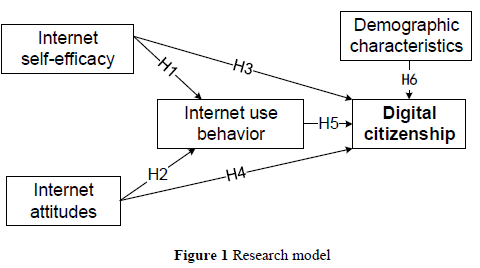
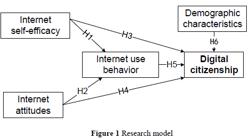
In the study, psychological factors (i.e., internet self-efficacy as well as internet attitudes), internet use behaviour and demographic factors are used to predict DC and its sub-dimensions. In order to solve the research questions stated in the introduction, we present our research hypothesis in accordance with the extant literature. The research model with the six proposed hypotheses is shown in Figure 1.
Psychological factors and DC
The current literature emphasises psychological factors, such as internet self-efficacy and internet attitudes when predicting the level of DC or its dimensions. Firstly, internet self-efficacy focuses on what people believe they can accomplish online (Eastin & LaRose, 2000). Although the existing literature indicates that positive digital literacy significantly affects self-efficacy (Prior, Mazanov, Meacheam, Heaslip & Hanson, 2016), few studies of this kind exist. Most empirical studies in which this was reported are internet self-efficacy that contributes to the level of DC (Choi et al., 2018; Hatlevik, Throndsen, Loi & Gudmundsdottir, 2018), contending that computer and information literacy are more pronounced with increased internet use self-efficacy. Therefore, we propose Hypothesis 1 as follows.
H1: Internet self-efficacy is positively associated with DC.
Secondly, internet attitude refers to the perception of what the network brings to society and to life (Chou, Chou & Chen, 2016; Joyce & Kirakowski, 2015; Morse, Gullekson, Morris & Popovich, 2011). The support and attitudes of teachers play a crucial role in the success of initiatives to implement technology in educational programmes (Teo, Lee & Chai, 2008). A study clarifies a direct linkage between a desire for computer proficiency and DC, which could help bridge the gap caused by the digital divide (Shelley, Thrane, Shulman, Lang, Beisser, Larson & Mutiti, 2004). Other findings indicate that college students' attitudes toward the internet positively impact their DC and its dimensions, such as respect for oneself/others, and educate yourself/ connect with others (Al-Zahrani, 2015). The insights of the internet improve the quality of an individuals' DC. Therefore, we propose Hypotheses 2 as follows:
H2: Internet attitude is also significantly and positively related to DC.
Psychological factors and internet use behaviours
According to the social cognitive theory (Bandura, 1978, 2012), self-efficacy beliefs influence the degree to which people think optimistically and take action for behaviour they set for themselves. Likely, teachers with high computer self-efficacy will be motivated to learn more about modern teaching and learning technologies (Paraskeva, Bouta & Papagianni, 2008). Therefore, teachers with greater self-efficacy tend to have stronger internet intensity. Thus, we propose Hypothesis 3 below.
H3: Internet self-efficacy is significantly and positively related to internet use behaviour. The theory of planned behaviour (Ajzen, 1991) proposes that the extent to which one' s attitude, perceived subjective norm and perceived behavioural control are contributory factors toward the intention of behaviour and then the actual behaviour. Findings also show that internet attitudes pose a significant, positive effect towards internet use behaviour including frequency, intensity and purpose (Cheung & Huang, 2005; Duggan, Hess, Morgan, Kim & Wilson, 2001; Porter & Donthu, 2006; Prior et al., 2016). Based on this, we know that individuals who highly value the internet, tend to devote much time to daily internet use, since they feel it will benefit their life and studies. Thus, we propose Hypothesis 4 below.
H4: Internet attitude is significantly and positively related to internet use behaviour.
Internet use behaviour and DC
Internet use behaviour refers to individuals devoting time to participate in the practical experience of the internet. Gil de Zúñiga, Jung and Valenzuela (2012) reveal that the frequency of social networking sites (SNS) use contributes to civic participation in the Unites States. In comparison with lower levels of technology use, college students with higher levels of daily technology use are more inclined to protect themselves and others online (Al-Zahrani, 2015). For teachers, their participation in SNS have implications on professional identity, active engagement in online activities and classroom management effectiveness (Cheng & Chen, 2018; Kimmons & Veletsianos, 2015). Therefore, it can be argued that the level of DC varies with SNS experience and daily technology use. Thus, we propose Hypothesis 5 below.
H5: Internet use behaviour contributes positively to DC.
Demographic characteristics and DC
Demographic characteristics such as gender, age, socioeconomic status and use access affect people's experience of online use (Livingstone & Helsper, 2010; Porter & Donthu, 2006; Sieverding & Koch, 2009). Some teacher-related demographic factors such as years of teaching experience, school level, teaching subject, professional rank, and quality of professional preparation are also used to examine teachers' perception of educational activities (Choi et al., 2018; Wei & Zhou, 2019). We clarify whether statistically significant differences exist among demographic characteristics in DC. Thus, we propose Hypothesis 6 as follows. H6: An individual teacher's demographic characteristics correlates significantly with his/her DC.
Methodology
Participants
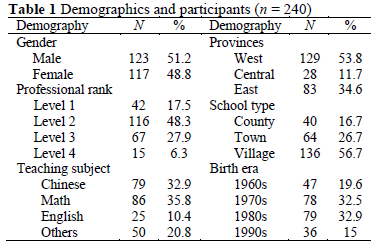
An online questionnaire was administered to test our research model. In order to ensure a wide representativeness of the data, the stratified sampling method was used. The return rate of valid responses was 86%. Participants' demographic characteristics are shown in Table 1. our samples were uniform and even in gender, professional rank, teaching subjects, school type and birth era. Besides, with reference to the distribution of teachers in underdeveloped regions of China, the proportion of teachers in the west provinces is the largest, followed by central and east provinces. The sample characteristics in the study roughly corresponded to the typical teacher profile regarding provinces in underdeveloped regions in China. In total, 240 primary teachers in underdeveloped regions in China participated in this study. The participants came from 21 provinces in China.
Procedures
The data were collected from November 2018 to February 2019 using a structured self-report questionnaire. The original English version was translated into Chinese and then re-translated into English to ensure the reliability and validity of the items. Questionnaires were distributed through the links generated by Star Questionnaire Software and returned directly to the researchers. We ensured that the questionnaire was answered voluntarily and anonymously. A test fee was given to each participant after they had completed the questionnaire, and those who completed the questions in under 240 seconds were excluded from the study.
Measures
Internet self-efficacy
The teachers' perceptions of self-efficacy in using the internet was measured by referring to the internet self-efficacy scale (Kim, Y & Glassman, 2013). Sample items were: "I can offer other people important and interesting information by posting on the internet", "I can improve my own well-being through the use of internet", and "I can use the internet to find good information about topics that are important to me." Cronbach's alpha coefficient was 0.89.
Internet attitudes
We measured teachers' internet attitudes based on the concepts proposed by Joyce and Kirakowski (2015). Through revising and deleting some items, three representative items were as follows: "The use of the internet is enhancing our standard of living", "The internet makes a positive contribution towards society", and "The internet is responsible for many of the good things we enjoy." Cronbach's α for internet attitudes was 0.79.
Internet use behaviour
People's daily use of the internet was delineated into the following categories. social networking/personal involvement, obtaining information, entertainment/shopping, commerce/financial services and education and training. We adopted these five aspects to measure the degree to which participants engaged in internet use. The internal consistency of the scale was 0.81.
Demographic characteristics
The survey obtained information on teachers' demography information such as gender, birth era (BE), professional rank, teaching subject and school type. These characteristics are often used to investigate teachers' perceptions and behaviours in educational research.
Digital citizenship
In total, 25 items were used to measure teachers' level of DC. The scale comprised five dimensions as mentioned in the literature review section. Ethical quality was adopted from Al-Zahrani (2015) and M Kim and Choi (2018). The other dimensions were mainly based on Choi et al. (2017). In this study, Cronbach's alpha coefficients for each dimension ranged from 0.86 to 0.93, and that of the whole instrument was 0.94. The results of the confirmatory factor analysis of this DC scale indicate acceptable fit indices (Kline, 2015): X2 = 672.50, df= 267, X2/df = 2.52, root mean square residual (RMR) = 0.079, RMSEA = 0.08, TLI = 0.90, and CFI = 0.91.
For the measures above, participants responded to each item on a five-point Likert scale (ranging from 1 = strongly disagree to 5 = strongly agree), except for the items on internet use behaviour. This was rated on a four-point scale (1 = never, 2 = sometimes, 3 = often, 4 = very frequently), which was later converted into 1.25, 2.5, 3.75, and 5, respectively. In addition, the dimension "critical perspective in DC" was set in reverse, and these items were converted into positive scores for convenient calculation.
Data Analysis
For the three research questions presented in the Introduction, we adopt different statistical methods. In response to the first questions, descriptive statistics were used to estimate the means and standard deviation for each factor. For the second question, correlation analyses and significance tests were employed using SPSS 22.0. This step was mainly predictive and exploratory to eliminate the non-significant factors in the research model (see Figure 1). Besides, the SEM, which is built on a certain theoretical basis, lends itself well to the analysis of data for inferential purposes. By incorporating both unobserved (i.e. factor) and observed items, it not only can estimate the errors in the measurement process, but also evaluate the reliability and validity of the measurement (Byrne, 2016; Kline, 2015). Given these highly desirable characteristics, SEM is suitable to be performed to confirm the third question in this research with AMOS 22.0.
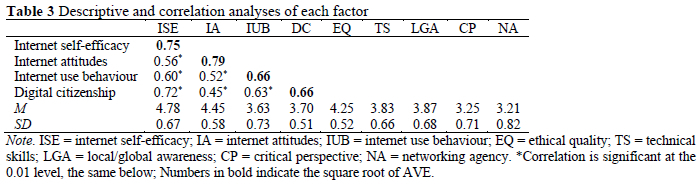
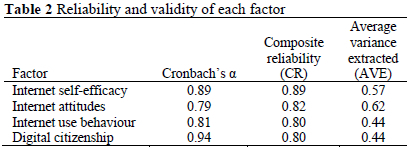
The reliability and convergent and discriminant validities of the four consecutive factors were assessed. Each factor loading was significant and higher than the recommended value of 0.50, except for the third item from internet attitude, which was 0.48. The results in Table 2 show that most of the AVE values of the factors (except for internet use behaviour and DC, which was 0.44) exceed 0.50 and the CR values exceed 0.80. In addition, the results in Table 3 indicate that the bold square root of the AVE values was greater than the correlations between the factors, confirming respectable discriminant validity. As for the specific measures for each item of factors, please see Appendix A.
Current Status and Group Differences
Table 3 shows the means, standard deviations, and inter-correlations of the latent factors. As expected, the Pearson correlation analysis confirmed that participants' internet self-efficacy, internet attitudes and internet behaviour were positively correlated with level of DC. Significant correlation coefficients ranged between 0.45 and 0.72.
Regarding the mean score of the factors, participants' ISE was in the highest level (M = 4.78), followed by IAs (M = 4.45). Internet use behaviour and DC were lower (M = 3.63 and M = 3.70, respectively). Of the five dimensions of DC, ethical element scored highest (M = 4.25), and the lowest were NA (M = 3.21) and CP (M = 3.25), which are noteworthy.
We then compared the level of DC of males and females using an independent t test, and compared the level of DC among other demographic characteristics using an F test. The results show no statistically significant differences between males and females, or between the different school types, teaching subject, and professional ranks. Nevertheless, it states that the level of DC differed according to teachers' age, and these differences were statistically significant. Specifically, those born in the 1960s and 1970s had significantly lower scores than those born in the 1990s. Therefore, the BE factor was incorporated into the structural equation model.
Hypotheses and Mediating Test
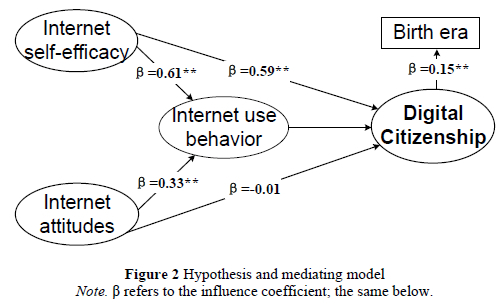
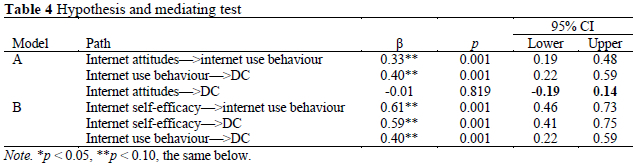
The mediating model fit depicted in Figure 2 was acceptable: X2 = 1711, df = 728, X2/df = 2.351, RMSEA = 0.075, incremental fit index (IFI) = 0.857, TLI = 0.846, and CFI = 0.856. This shows that each hypothesised path is significantly positive (p < 0.01), except that for "IAs → the level of DC," which was not significant (β = -0.01, p = 0.819). (The original model drawn by AMOS is presented in Appendix B.)
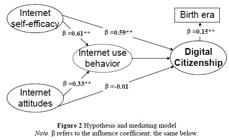
We then employed the bias-corrected bootstrap method to test the mediating effect of the factor "internet use behaviour." In total, 3,000 samples were extracted from the sample data (n = 240) through repeated random sampling, and the 2.5th and 97.5th percentiles used to establish 95% bias-corrected CIs.
If the bootstrap 95% CI contains 0, it means that the effect of the path is insignificant and vice versa. According to this standard, the path "IAs → DC" is insignificant, since 0 is contained in the interval (-0.19, 0.14). Therefore, as seen in Table 4, in model A, internet use behaviour acts as a complete mediator for IAs and DC. In model B, IUB plays a partly mediating role between ISE and DC.
Analysis of Effect Coefficient
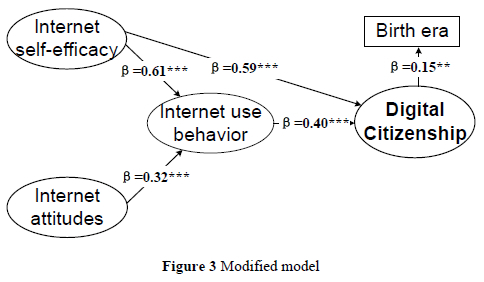
Subsequently, we modified the model by deleting the insignificant path and referring to the modification index. The final modified model is presented in Figure 3 (The original model drawn by AMOS is presented in Appendix C). The final SEM suggests better model fit: X2 = 1711, df = 729, X2/d/ = 2.348, RMSEA = 0.075, TLI = 0.846, IFI = 0.858, and CFI = 0.856. The square of the multivariate coefficients (R2) is the joint explanatory variance of the independent factors to internal dependent factors. Figure 3 shows that the model explains 81% of the variance in DC and 48% of the variance in internet behaviour.
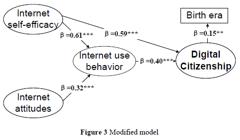
Regarding the influence coefficient, ISE was significantly associated with DC (β = 0.59). Furthermore, ISE and IAs were significantly and positively related to IUB (β = 0.61 and 0.32, respectively), and IUB contributes positively to DC (β = 0.40). For demographic characteristics, BE has a direct positive impact on the level of DC (β = 0.15).
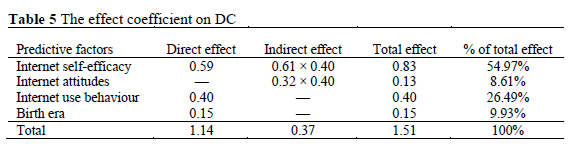
The effects of the factors on the level of DC are summarised in Table 5. Among the predictive factors of the level of DC, the total influence of ISE on DC (β = 0.83) is the greatest, accounting for 54.97%, followed by IUB, IAs and BE. Note that the impact of ISE (54.97%) and IUB (26.49%) in the model totals more than 80%, demonstrating powerful implications for this teachers' group.
Conclusion and Discussion
In this research, we propose new DC dimensions: EQ, TSs, LGA, CP, and NA in accordance with three conceptual categories, i.e., civic engagement/participation, digital literacy and ethical issues. By employing four factors: ISE, IAs, IUB and demographic characteristics to predict the level of DC, this research answers the three questions raised in the introduction: Firstly, average overall score of DC is low and younger teachers tend to have higher score in DC. Secondly, ISE, IAs and IUB are positively correlated with DC. Thirdly, ISE and IUB can greatly impact enhancing the level of the teachers' knowledge of DC, whereas the level of DC cannot be predicted by IAs directly.
In this research we focus on DC in underdeveloped regions that have not attracted special attentions and thus, has theoretical contributions in localising DC dimensions and DC influence mechanism model, which are suitable for such specific cultural contexts as underdeveloped regions in China and digital technology-deficient areas in South Africa. There are also implications in cultivating and promoting teachers to become informed and active digital citizens in practice. The following suggestions that relate to the main conclusions are proposed.
An Overall Low Level of DC, especially Critical Perspectives and Networking Agency According to the statistical result in the section on current status and group differences, we understand that the average score of DC is 3.70 whereas the full score is 5. We found that teachers scored differently for the five dimensions, with the lowest scores obtained for NA (M = 3.21) and CP (M = 3.25), which corresponds with Choi et al. (2017) stating that these two factors can be more difficult to attain since they are complex, advanced and actions-oriented abilities. From the lowest score of NA, we know that rural Chinese teachers are less likely to use network digital devices to share resources, communicate and cooperate with others and participate in online community interaction. This might be attributed to the fact that Chinese teachers prefer to socialise offline rather than online now, but this phenomenon may change with more and more network access and participation. On a cautionary note, however, as Jackson, Von Eye, Barbatsis, Biocca, Zhao and Fitzgerald (2003) note, misuse of the internet may result in privacy leaks and misinformation resulting from the unreliability of information. At this point, teachers' ability to think analytically and critically about the range of information to which they are exposed on the internet is of great importance.
Older Teachers Deserve More Attention regarding DC
In this research we compared group differences among demographic characteristics, i.e., gender, BE, school type, teaching subject and professional rank, in terms of DC, and found that teachers born in the 1990s scored significantly higher than those born in the 1960s to 1980s. This can be attributed to two reasons: 1) young teachers have more extensive access to the internet. A study has reported that years of access significantly impact internet use intensity (Livingstone & Helsper, 2010). It can, therefore, be assumed that it is easier to rely on the network when exposed to it for a longer period. 2) pre-service teachers and newly-qualified teachers tend to be younger and have more opportunities to be assessed and trained (Gudmundsdottir & Hatlevik, 2018; Lázaro-Cantabrana, Usart-Rodríguez & Gisbert Cervera, 2019). Hence, teachers inexperienced in internet technology deserve more attention to keep abreast with new changes in digital educational technology. On the other hand, such teachers should adopt a more flexible mindset to understand their digitally-savvy learners in terms of communicating, sharing, exchanging and creating knowledge (Labbas & Shaban, 2013).
Opportunities to Explore the Positive
Consequences of Digital Learning
This study reveals that psychological factors, i.e., ISE (β = 0.83) and IAs (β = 0.13) impact DC. A previous study has shown that gender, computer experience and general computer attitudes had a positive impact on computer integration in the classroom (Hermans, Tondeur, Van Braak & Valcke, 2008). Findings in Georgina and Hosford (2009) and Hollandsworth, Donovan and Welch (2017) also indicate the need to enhance teachers' technology literacy through pedagogical practice and communication skills. Jantjies and Joy (2016) reported that recently in South Africa, even though teachers in urban and rural schools attach great importance to using technologies such as mobile learning to enhance a diversely linguistic classroom, they still faced the challenge of their own inability to use technology in such classrooms effectively and properly. Thus, the department of education should try to offer teachers in underdeveloped regions more support and adequate training to explore the positive consequences of digital learning.
More Funds and Infrastructure Should be Invested in the Underdeveloped Regions
Internet use behaviour is the major intermediary factor in the DC model, accounting for 26.32%. Income and infrastructure are important approaches in providing internet use to education and in shaping the digital divide (Quibria, Ahmed, Tschang & Reyes-Macasaquit, 2003). Nevertheless, both China and South Africa have unequal investment in education. For example, there are significant differences in the level and quality of education between urban and rural areas in China (Zhen & Wenjun, 2019), while in South Africa, there is inequality in inter-ethnic education (Sayed & Ahmed, 2008). It is, therefore, essential to provide sufficient funds and network infrastructure to historically disadvantaged schools - especially those underserved and under-equipped schools in rural areas, as well as no-fee-paying schools (Mestry, 2018). When it comes to teachers' IUB, it is acknowledged that high-quality access (e.g., convenient access locations, fast connectivity, and more powerful digital devices) facilitates greater use and enhances self-efficacy or skills (e.g., encouraging confidence, exploration, and learning) (Facer & Furlong, 2001). Similarly, we believe guaranteed, secure internet access is directly related to constructive use of the internet in teaching. In sum, there is a need to establish an exclusive fund for digital infrastructure construction to promote teachers' IUB in poorer regions.
Limitations and Directions for Future Research
This study was limited in the following aspects. Firstly, the sample size was only 240 and not large enough. We will correspondingly expand the sample size and try to compare teachers in underdeveloped regions and advanced cities in China and other countries, to determine the gap between them and to put forward more practical countermeasures. Secondly, we focused on the confirmatory questions, but neglected the DC issue from the perspective of the teachers themselves. Therefore, in order to verify and generate theory more convincingly, we should add interview and observation methods to reinforce the research. Hence, a mixed-methods research methodology can be employed in which confirmatory and exploratory questions can be proposed and answered simultaneously.
Authors' Contributions
YYL wrote the manuscript. All authors conducted the statistical analyses and reviewed the final manuscript.
Notesi. Published under a Creative Commons Attribution Licence.
Acknowledgement
This work was supported in part by the National Natural Science Foundation of China under Grant 61906174, and in part by the China Postdoctoral Science Foundation under Grant 2020M672275.
References
-
Ajzen I 1991. The theory of planned behavior. Organizational Behavior and Human Decision Processes, 50(2):179-211. https://doi.org/10.1016/0749-5978(91)90020-T
» https://doi.org/10.1016/0749-5978(91)90020-T -
Al-Zahrani A 2015. Toward digital citizenship: Examining factors affecting participation and involvement in the Internet society among higher education students. International Education Studies, 8(12):203-217. https://doi.org/10.5539/ies.v8n12p203
» https://doi.org/10.5539/ies.v8n12p203 -
Arredondo Trapero FG, Vázquez Parra JC & González Martinez MJ 2020. Digital citizenship approach and teacher profile. Education in the Knowledge Society, 21:1-11. https://doi.org/10.14201/eks.20954
» https://doi.org/10.14201/eks.20954 - Bahr DL, Shaha SH & Benson LF 2004. Preparing tomorrow's teachers to use technology: Attitudinal impacts of technology-supported field experience on pre-service teacher candidates. Journal of Instructional Psychology, 31 (2):88-97.
-
Bandura A 1978. Self-efficacy: Toward a unifying theory of behavioral change. Advances in Behaviour Research and Therapy, 1(4):139-161. https://doi.org/10.1016/0146-6402(78)90002-4
» https://doi.org/10.1016/0146-6402(78)90002-4 -
Bandura A 2001. Social cognitive theory: An agentic perspective. Annual Review of Psychology, 52:126. https://doi.org/10.1146/annurev.psych.52.1.1
» https://doi.org/10.1146/annurev.psych.52.1.1 -
Bandura A 2012. On the functional properties of perceived self-efficacy revisited. Journal of Management, 38(1):9-44. https://doi.org/10.11770149206311410606
» https://doi.org/10.11770149206311410606 - Brown M 2018.数字素养的挑战:从有限的技能到批判性思维方式的跨越 [The challenge of digital literacy: Beyond narrow skills to critical mindsets]. 中国远程教育, 4:42-53.
- Byrne BM 2016. Structural equation modeling with AMOS: Basic concepts, applications, and programming (3rd ed). New York, NY: Routledge.
-
Carretero S, Vuorikari R & Punie Y 2017. Dig Comp 2.1: The Digital Competence Framework for Citizens with eight proficiency levels and examples of use, EUR 28558 EN. https://doi.org/10.2760/38842
» https://doi.org/10.2760/38842 -
Cassells L & Dlamini NN 2019. Educating digital citizens through curricular incorporation: A South African solution to information poverty. International Journal of Information Communication Technology Education, 15(3):11-29. https://doi.org/10.4018/IJICTE.2019070102
» https://doi.org/10.4018/IJICTE.2019070102 -
Cheng YH & Chen YC 2018. Enhancing classroom management through parental involvement by using social networking apps. South African Journal of Education, 38(Suppl. 2):Art. #1427, 14 pages. https://doi.org/10.15700/saje.v38ns2a1427
» https://doi.org/10.15700/saje.v38ns2a1427 -
Cheung W & Huang W 2005. Proposing a framework to assess Internet usage in university education: An empirical investigation from a student's perspective. British Journal of Educational Technology, 36(2):237-253. https://doi.org/10.1111/j.1467-8535.2005.00455.x
» https://doi.org/10.1111/j.1467-8535.2005.00455.x -
Choi M, Cristol D & Gimbert B 2018. Teachers as digital citizens: The influence of individual backgrounds, internet use and psychological characteristics on teachers' levels of digital citizenship. Computers & Education, 121:143-161. https://doi.org/10.1016/j.compedu.2018.03.005
» https://doi.org/10.1016/j.compedu.2018.03.005 -
Choi M, Glassman M & Cristol D 2017. What it means to be a citizen in the internet age: Development of a reliable and valid digital citizenship scale. Computers & Education, 107:100-112. https://doi.org/10.1016/j.compedu.2017.01.002
» https://doi.org/10.1016/j.compedu.2017.01.002 -
Chou HL, Chou C & Chen CH 2016. The moderating effects of parenting styles on the relation between the internet attitudes and internet behaviors of high-school students in Taiwan. Computers & Education, 94:204-214. https://doi.org/10.1016/j.compedu.2015.11.017
» https://doi.org/10.1016/j.compedu.2015.11.017 -
Duggan A, Hess B, Morgan D, Kim S & Wilson K 2001. Measuring students' attitudes toward educational use of the Internet. Journal of Educational Computing Research, 25(3):267-281. https://doi.org/10.2190/GTFB-4D6U-YCAX-UV91
» https://doi.org/10.2190/GTFB-4D6U-YCAX-UV91 - Earl J & Schussman A 2008. Contesting cultural control: Youth culture and online petitioning. In WL Bennett (ed). Civic life online: Learning how digital media can engage youth. London, England: The MIT Press.
-
Eastin MS & LaRose R 2000. Internet self-efficacy and the psychology of the digital divide. Journal of Computer-Mediated Communication, 6(1): JCMC611. https://doi.org/10.1111/j.1083-6101.2000.tb00110.x
» https://doi.org/10.1111/j.1083-6101.2000.tb00110.x - Eshet Y 2012. Thinking in the digital era: A revised model for digital literacy. Issues in Informing Science and Information Technology, 9(2):267-276.
-
Facer K & Furlong R 2001. Beyond the myth of the 'cyberkid': Young people at the margins of the information revolution. Journal of Youth Studies, 4(4):451-469. https://doi.org/10.1080/13676260120101905
» https://doi.org/10.1080/13676260120101905 -
Ferrari A 2012. Digital competence in practice: An analysis of frameworks. Luxembourg: Publications Office of the European Union. https://doi.org/10.2791/82116
» https://doi.org/10.2791/82116 -
Franz A, Worrell M & Vögele C 2013. Integrating mixed method data in psychological research: Combining Q methodology and questionnaires in a study investigating cultural and psychological influences on adolescent sexual behavior. Journal of Mixed Methods Research, 7(4):370-389. https://doi.org/10.1177/1558689813483368
» https://doi.org/10.1177/1558689813483368 -
Georgina DA & Hosford CC 2009. Higher education faculty perceptions on technology integration and training. Teaching and Teacher Education, 25(5):690-696. https://doi.org/10.1016/j.tate.2008.11.004
» https://doi.org/10.1016/j.tate.2008.11.004 -
Gil de Zúñiga H, Jung N & Valenzuela S 2012. Social media use for news and individuals' social capital, civic engagement and political participation. Journal of Computer-Mediated Communication, 17(3):319-336. https://doi.org/10.1111/j.1083-6101.2012.01574.x
» https://doi.org/10.1111/j.1083-6101.2012.01574.x - Given LM (ed.) 2008. The Sage encyclopedia of qualitative research methods (Vol. 1). Los Angeles, CA: Sage.
- Gleason B & Von Gillern S 2018. Digital citizenship with social media: Participatory practices of teaching and learning in secondary education. Educational Technology & Society, 21(1):200-212.
-
Gudmundsdottir GB & Hatlevik OE 2018. Newly qualified teachers' professional digital competence: Implications for teacher education. European Journal of Teacher Education, 41(2):214-231. https://doi.org/10.1080/02619768.2017.1416085
» https://doi.org/10.1080/02619768.2017.1416085 -
Hatlevik OE, Throndsen I, Loi M & Gudmundsdottir GB 2018. Students' ICT self-efficacy and computer and information literacy: Determinants and relationships. Computers & Education, 118:107119. https://doi.org/10.1016/j.compedu.2017.11.011
» https://doi.org/10.1016/j.compedu.2017.11.011 -
Helsper EJ & Eynon R 2013. Distinct skill pathways to digital engagement. European Journal of Communication, 28(6):696-713. https://doi.org/10.1177/0267323113499113
» https://doi.org/10.1177/0267323113499113 -
Hermans R, Tondeur J, Van Braak J & Valcke M 2008. The impact of primary school teachers' educational beliefs on the classroom use of computers. Computers & Education, 51(4):1499-1509. https://doi.org/10.1016/j.compedu.2008.02.001
» https://doi.org/10.1016/j.compedu.2008.02.001 -
Hollandsworth R, Donovan J & Welch M 2017. Digital citizenship: You can't go home again. TechTrends, 61(6):524-530. https://doi.org/10.1007/s11528-017-0190-4
» https://doi.org/10.1007/s11528-017-0190-4 -
Isman A & Gungoren OC 2013. Being digital citizen. Procedia - Social and Behavioral Sciences, 106:551 -556. https://doi.org/10.1016/j.sbspro.2013.12.063
» https://doi.org/10.1016/j.sbspro.2013.12.063 -
Jackson LA, Von Eye A, Barbatsis G, Biocca F, Zhao Y & Fitzgerald HE 2003. Internet attitudes and Internet use: Some surprising findings from the HomeNetToo project. International Journal of Human-Computer Studies, 59(3):355-382. https://doi.org/10.1016/S1071-5819(03)00069-7
» https://doi.org/10.1016/S1071-5819(03)00069-7 -
Jantjies M & Joy M 2016. Lessons learnt from teachers' perspectives on mobile learning in South Africa with cultural and linguistic constraints. South African Journal of Education, 36(3):Art. # 1274, 10 pages. https://doi.org/10.15700/saje.v36n3a1274
» https://doi.org/10.15700/saje.v36n3a1274 - Jin Y, Yunxiang Z, Hao Y, Xingyun H & Jinping Z 2018. 国际数字公民教育研究的现状、热点及前沿 [The research status, hotspot issues and research frontiers analysis of digital citizenship education]. 开放教育研究, 24(6):49-59.
-
Jones LM & Mitchell KJ 2016. Defining and measuring youth digital citizenship. New Media & Society, 18(9):2063 -2079. https://doi.org/10.1177/1461444815577797
» https://doi.org/10.1177/1461444815577797 -
Joyce M & Kirakowski J 2015. Measuring attitudes towards the Internet: The general Internet Attitude Scale. International Journal of Human-Computer Interaction, 31(8):506-517. https://doi.org/10.1080/10447318.2015.1064657
» https://doi.org/10.1080/10447318.2015.1064657 -
Kahne J, Lee NJ & Feezell JT 2013. The civic and political significance of online participatory cultures among youth transitioning to adulthood. Journal of Information Technology & Politics, 10(1):1 -20. https://doi.org/10.1080/19331681.2012.701109
» https://doi.org/10.1080/19331681.2012.701109 - Kara N 2018. Understanding university students' thoughts and practices about digital citizenship: A mixed methods study. Educational Technology & Society, 21(1):172-185.
-
Ke D & Xu S 2017. A research on factors affecting college students' digital citizenship. In Proceedings of the 2017 International Conference of Educational Innovation through Technology (EITT). New York, NY: IEEE Press. https://doi.org/10.1109/EITT.2017.23
» https://doi.org/10.1109/EITT.2017.23 - Kim M & Choi D 2018. Development of youth Digital Citizenship Scale and implication for educational setting. Educational Technology & Society, 21(1):155-171.
-
Kim Y & Glassman M 2013. Beyond search and communication: Development and validation of the Internet Self-efficacy Scale (ISS). Computers in Human Behavior, 29(4):1421-1429. https://doi.org/10.1016/j.chb.2013.01.018
» https://doi.org/10.1016/j.chb.2013.01.018 -
Kimmons R & Veletsianos G 2015. Teacher professionalization in the age of social networking sites. Learning, Media and Technology, 40(4):480-501. https://doi.org/10.1080/17439884.2014.933846
» https://doi.org/10.1080/17439884.2014.933846 - Kline RB 2015. Principles and practice of structural equation modelling (4th ed). New York, NY: The Guilford Press.
- Labbas R & Shaban AE 2013. Teacher development in the digital age. Teaching English with Technology, 13(3):53-64.
-
Law N, Chow SL & Fu KW 2018. Digital citizenship and social media: A curriculum perspective. In J Voogt, G Knezek, R Christensen & KW Lai (eds). Second handbook of information technology in primary and secondary education. Cham, Switzerland: Springer. https://doi.org/10.1007/978-3-319-53803-7_3-2
» https://doi.org/10.1007/978-3-319-53803-7_3-2 -
Lázaro-Cantabrana J, Usart-Rodríguez M & Gisbert Cervera M 2019. Assessing teacher digital competence: The construction of an instrument for measuring the knowledge of pre-service teachers. Journal of New Approaches in Educational Research, 8(1):73-78. https://doi.org/10.7821/naer.2019.1.370
» https://doi.org/10.7821/naer.2019.1.370 -
Livingstone S & Helsper E 2010. Balancing opportunities and risks in teenagers' use of the internet: The role of online skills and internet self-efficacy. New Media & Society, 12(2):309-329. https://doi.org/10.1177/1461444809342697
» https://doi.org/10.1177/1461444809342697 -
Mestry R 2018. The role of governing bodies in the management of financial resources in South African no-fee public schools. Educational Management Administration & Leadership, 46(3):385-400. https://doi.org/10.1177/1741143216665838
» https://doi.org/10.1177/1741143216665838 -
Morse BJ, Gullekson NL, Morris SA & Popovich PM 2011. The development of a general Internet attitudes scale. Computers in Human Behavior, 27(1):480-489. https://doi.org/10.1016/j.chb.2010.09.016
» https://doi.org/10.1016/j.chb.2010.09.016 -
Nasah A, DaCosta B, Kinsell C & Seok S 2010. The digital literacy debate: An investigation of digital propensity and information and communication technology. Educational Technology Research and Development, 58(5):531-555. https://doi.org/10.1007/s11423-010-9151-8
» https://doi.org/10.1007/s11423-010-9151-8 -
Ng W 2012. Can we teach digital natives digital literacy? Computers & Education, 59(3):1065-1078. https://doi.org/10.1016/j.compedu.2012.04.016
» https://doi.org/10.1016/j.compedu.2012.04.016 -
Ogbuanya TC & Efuwape BM 2018. Technology-aided learning environment: An investigation into electrical/electronics students' instructional preferences, attitude and approaches to learning. South African Journal of Education, 38(Suppl. 2):Art. #1535, 16 pages. https://doi.org/10.15700/saje.v38ns2a1535
» https://doi.org/10.15700/saje.v38ns2a1535 -
Ovcharuk OV 2020. СУЧАСНІ ПІДХОДИ ДО РОЗВИТКУ ЦИФРОВОЇ КОМПЕТЕНТНОСТІ ЛЮДИНИ ТА ЦИФРОВОГО ГРОМАДЯНСТВА В ЄВРОПЕЙСЬКИХ КРАЇНАХ [Current approaches to the development of digital competence of human and digital citizenship in European countries]. Information Technologies and Learning Tools, 76(2):1-13. https://doi.org/10.33407/itlt.v76i2.3526
» https://doi.org/10.33407/itlt.v76i2.3526 -
Paraskeva F, Bouta H & Papagianni A 2008. Individual characteristics and computer self-efficacy in secondary education teachers to integrate technology in educational practice. Computers & Education, 50(3):1084-1091. https://doi.org/10.1016/j.compedu.2006.10.006
» https://doi.org/10.1016/j.compedu.2006.10.006 - Peixin Q, Dongyu W & Ying H 2019. 数字鸿沟:教育信息化2.0时代的新数字鸿沟 [Digital divide: New digital divide in the Education Informatization 2.0 Era]. 教育现代化, 6(80):131-135.
-
Porat E, Blau I & Barak A 2018. Measuring digital literacies: Junior high-school students' perceived competencies versus actual performance. Computers & Education, 126:23-36. https://doi.org/10.1016/j.compedu.2018.06.030
» https://doi.org/10.1016/j.compedu.2018.06.030 -
Porter CE & Donthu N 2006. Using the technology acceptance model to explain how attitudes determine Internet usage: The role of perceived access barriers and demographics. Journal of Business Research, 59(9):999-1007. https://doi.org/10.1016/j.jbusres.2006.06.003
» https://doi.org/10.1016/j.jbusres.2006.06.003 -
Prior DD, Mazanov J, Meacheam D, Heaslip G & Hanson J 2016. Attitude, digital literacy and self efficacy: Flow-on effects for online learning behavior. The Internet and Higher Education, 29:91-97. https://doi.org/10.1016/j.iheduc.2016.01.001
» https://doi.org/10.1016/j.iheduc.2016.01.001 -
Quibria MG, Ahmed SN, Tschang T & Reyes-Macasaquit ML 2003. Digital divide: Determinants and policies with special reference to Asia. Journal of Asian Economics, 13(6):811-825. https://doi.org/10.1016/S1049-0078(02)00186-0
» https://doi.org/10.1016/S1049-0078(02)00186-0 -
Raoof JK, Zaman HB, Ahmad A & Al-Qaraghuli A 2013. Using social network systems as a tool for political change. International Journal of Physical Sciences, 8(21):1143-1148. https://doi.org/10.5897/IJPS2013.3897
» https://doi.org/10.5897/IJPS2013.3897 -
Sayed Y & Ahmed R 2008. Education decentralization in South Africa: Equity and participation in the governance of schools. Paper commissioned for the Education for ALL (EFA) Global Monitoring Report 2009, "Overcoming Inequality: Why governance matters." Available at https://citeseerx.ist.psu.edu/viewdoc/download?doi=10.1.1.424.3056&rep=rep1&type=pdf. Accessed 12 December 2021.
» https://citeseerx.ist.psu.edu/viewdoc/download?doi=10.1.1.424.3056&rep=rep1&type=pdf -
Shah DV, McLeod JM & Lee NJ 2009. Communication competence as a foundation for civic competence: Processes of socialization into citizenship. Political Communication, 26(1):102-117. https://doi.org/10.1080/10584600802710384
» https://doi.org/10.1080/10584600802710384 -
Shelley M, Thrane L, Shulman S, Lang E, Beisser S, Larson T & Mutiti J 2004. Digital citizenship: Parameters of the digital divide. Social Science Computer Review, 22(2):256-269. https://doi.org/10.1177/0894439303262580
» https://doi.org/10.1177/0894439303262580 -
Sieverding M & Koch SC 2009. (Self-)evaluation of computer competence: How gender matters. Computers & Education, 52(3):696-701. https://doi.org/10.1016/j.compedu.2008.11.016
» https://doi.org/10.1016/j.compedu.2008.11.016 - Skinner R 2017. Modern South Africa in world history: Beyond imperialism. London, England: Bloomsbury Academic.
-
Smith A 2013. Civic engagement in the digital age. Washington, DC: Pew Research Center's Internet & American Life Project. Available at https://core.ac.uk/download/pdf/30677017.pdf. Accessed 30 November 2021.
» https://core.ac.uk/download/pdf/30677017.pdf -
Takavarasha S, Cilliers L & Chinyamurindi W 2018. Navigating the unbeaten track from digital literacy to digital citizenship: A case of university students in South Africa's Eastern Cape province. Reading & Writing, 9(1):a187. https://doi.org/10.4102/rw.v9i1.187
» https://doi.org/10.4102/rw.v9i1.187 -
Teo T, Lee CB & Chai CS 2008. Understanding preservice teachers' computer attitudes: Applying and extending the technology acceptance model. Journal of Computer Assisted Learning, 24(2):128-143. https://doi.org/10.1111/j.1365-2729.2007.00247.x
» https://doi.org/10.1111/j.1365-2729.2007.00247.x - Ting P 2015. "新数字鸿沟"下城乡教育实质公平问题探究 [Exploring the issue of substantive fairness between urban and rural education in the "new digital divide"]. 教育理论与实践, 35(28):16-19.
-
Van Deursen AJAM, Helsper EJ & Eynon R 2016. Development and validation of the Internet Skills Scale (ISS) [Special issue]. Information, Communication & Society, 19(6):804-823. https://doi.org/10.1080/1369118X.2015.1078834
» https://doi.org/10.1080/1369118X.2015.1078834 -
Van Deursen AJAM, Van Dijk JAGM & Peters O 2012. Proposing a survey instrument for measuring operational, formal, information, and strategic Internet skills. International Journal of Human-Computer Interaction, 28(12):827-837. https://doi.org/10.1080/10447318.2012.670086
» https://doi.org/10.1080/10447318.2012.670086 -
VanFossen PJ 2006. The electronic republic? Evidence on the impact of the Internet on citizenship and civic engagement in the U.S. International Journal of Social Education, 21(1):18-43. Available at https://files.eric.ed.gov/fulltext/EJ782130.pdf. Accessed 22 November 2021.
» https://files.eric.ed.gov/fulltext/EJ782130.pdf -
Vuorikari R, Punie Y, Carretero Gomez S & Van den Brande G 2016. DigComp 2.0: The digital competence framework for citizens. Update Phase 1: The conceptual reference model. EUR 27948 EN. Luxembourg: Publications Office of the European Union. https://doi.org/10.2791/607218
» https://doi.org/10.2791/607218 -
Wei Y & Zhou S 2019. Are better teachers more likely to move? Examining teacher mobility in rural China. The Asia-Pacific Education Researcher, 28(2):171-179. https://doi.org/10.1007/s40299-018-0423-0
» https://doi.org/10.1007/s40299-018-0423-0 -
Xu S, Yang HH, MacLeod J & Zhu S 2019. Interpersonal communication competence and digital citizenship among pre-service teachers in China's teacher preparation programs. Journal of Moral Education, 48(2):179-198. https://doi.org/10.1080/03057240.2018.1458605
» https://doi.org/10.1080/03057240.2018.1458605 -
Yang HH, Zhu S & MacLeod J 2018. Promoting education equity in rural and underdeveloped areas: Cases on computer-supported collaborative teaching in China. Eurasia Journal of Mathematics, Science and Technology Education, 14(6):2393-2405. https://doi.org/10.29333/ejmste/89841
» https://doi.org/10.29333/ejmste/89841 - Zhen Y & Wenjun Z 2019. 南非学校与我国农村义务教育学校经费对比研究[A comparative study on the funds of South African schools and rural compulsory education schools in China]. 世界教育信息,12:66-70.
Revised: 31 July 2020
Accepted: 19 September 2020
Published: 30 November 2021