Student's perceptions of bilingual teaching of geography: A case study - the Republic of Serbia
Abstract
As our classrooms become more heterogeneous due to migration, education, geography and bilingualism have become the creators of international needs. Through a closed-ended questionnaire we sought to examine quantitative information about the advantages of teaching geography bilingually. With this research we studied 5 secondary schools in Serbia where geography was presented bilingually. The lack of similar research and the freshness of this learning model led us to the subject for the article, which is based on revealing the motives and preferences of students for this type of teaching. Using comparison with standard teaching in the mother tongue as method, the interest of students in bilingual teaching was determined. We also investigated the possibility of applying didactic-methodical principles for organising study without time limiting learning. A certain number of students found language competencies, more diversity in the teaching process and significant individual work activities as a step towards academic and personal achievement - almost as an employment advantage. This justifies the aim with our study by emphasising the benefits and the need to study geography bilingually.
bilingual teaching; content and language integrated learning (CLIL); education; geography; the Republic of Serbia
Introduction
As a part of modern society we are affected by the media, migration, an increase in tourism, et cetera, which is known as globalisation. Education is regarded as an integral part of the globalising world in which the successful individual must be equipped to deal with increased social and/or ethnic diversity or learn to value a broad range of people and cultures (Ball, Dworkin & Vryonides, 2010). Accordingly, education is increasingly tied in with the needs of the competitive labour market (Ball et al., 2010). Studying geography helps us understand where globalisation may lead (University of the People, 2023). Therefore, bilingual geography lessons should support the awareness of community and global responsibility (Biederstädt, 2010). In order to understand spatial relations as crucial in geography, it is necessary to have insight into the interactions that are prevalent in and between regions (Cox, Elen & Steegen, 2018), because, whatever discipline, subject and content may be, it requires instructional language for the delivery and spread (Sehar, Alwi & Shaiq, 2020).
The Council of Europe promotes learning and the use of foreign languages by young people as an important tool in promoting intercultural relations, maintaining ethnic and social unity, and developing positive values (Council of Europe, 2001:10). In cooperation with the European Commission for Languages and the Republic of Serbia, a decision was made in 2000 on the compulsory learning of two foreign languages in schools, which represents bilingual education. In 2004, the education system was enriched with a bilingual curriculum (Zivkovic, 2013).
The focus with this study was to determine the benefits of gaining geographical knowledge through bilingual teaching, with an emphasis on the influence of the acquisition of L2 (L2 refers to students' second or non-native language). The main goal was to determine whether learning a language through a non-language subject offered greater opportunities for a more diverse application of didactic-methodical principles, without disrupting the geography curriculum and knowledge. We hypothesised that L2 and the time spent on learning a non-language subject did not affect the quality of knowledge acquisition. In this regard, Golay (2005) points out that bilingual geography was not intended to affect L2 modules in any way, as there was no risk to language learning even though the emphasis was on geographical content. In order not to get into such a situation, Polish educational regulations provide a clear definition of bilingual education and learning content subjects, with the exception of Polish, the history of Poland, and the geography of Poland (Czura & Papaja, 2013). In order for bilingual classes to achieve real credibility, the same curriculum must be implemented as in regular classes in the Serbian language, which is equally important in a German bilingual education system (Golay, 2005).
The aim of the research was to determine students' views on bilingual geography teaching. Their attitudes and experiences are brought to the fore, holding as one of the starting hypotheses that attitude is one of the essential factors that shape the speed, expertise and achievement of L2 learning (Liu & Laohawiriyanon, 2013), with the strongest response regarding the relevance of foreign language for the respondents' future plans. However, it remains unclear whether motivational differences are the result of or a driver of bilingual teaching (Mearns, De Graaff & Coyle, 2020).
Literature Review
Unlike traditional foreign language teaching, which requires an intensive and long-term commitment of students and often ends in poor results because students are not always motivated, learning another foreign language through a non-language subject allows students to see the results of their work faster (Pasuljevic Shimwell, 2018). This opinion is confirmed by Colin Baker, who points out the difference between language knowledge and its use (Baker, 2001). In some of Gondová's (2013) research it has been shown that students learn better when their focus of learning is on something else, in this case it is geographical content, and not just learning the language itself (Kordíková & Brestenská, 2022). It could be said that in this type of teaching students waste little time by just "chatting geographically" (Drexel-Andrieu, 1993:181).
Wolff and Otwinowska-Kasztelanic (2010) regard bilingual education in Poland as a means of enhancing the level of competence in L2 (Czura & Papaja, 2013). The use of the mother tongue (L1) is actively discouraged in Dutch bilingual education, except for the first few months. Results illustrate that bilingual students often surpass (mother tongue students) and that no negative effects on Dutch, geography and history were found (Oattes, Fukkink, Oostdam, De Graaff & Wilschut, 2022).
Butt (2002) notes that the language used to teach geography is particularly important, especially when it comes to spatial concepts, techniques, and skills. Language is a medium for learning geography and should, therefore, be the main focus in the planning and preparation of lessons. Because of the complexity of the language situation, the majority of South African teachers do not teach in their mother tongue or that of their learners, which requires serious attention in an attempt to improve competencies (Innes, 2012). In learning geography in a bilingual way, mere rote learning of geographical terminology takes on a new meaning and students become aware of particular and specialist meanings of words such as "space", "city", "environment", and "communications" related to geography and everyday use (Butt, 2002:209).
Bilingualism can be viewed from two perspectives: either as an obligation if one moves to an environment where a different language than your native language is spoken (to make it easier and faster to become part of the community), or as a result of a conscious decision taken during regular education to master another language in order to use it proficiently and fluently both in and outside your country (Zaparucha, 2007). More Europeans opt for optional or elite bilingualism, which is a conscious decision by a person to become bilingual and experience the advantages that will result from such a decision (De Mejia, 2013).
Most geography learners in South African schools study the subject in English, which is not their native language. Students struggle to understand different concepts and content of geography and find it difficult to complete activities in English, which slows down the development of concepts and skills in geography (Golightly & Van der Westhuizen, 2017). This is an example of learning a non-language subject through a non-native language, which shows that they need a special bilingual textbook, which would link the local language with English (or any other foreign language).
New social and political circumstances necessitate being bilingual. In 2017, approximately one third of all learners in Germany were from a migration background. Looking at the research, those children mostly expected such bilingual lessons to be more interesting with more effective team work (Repplinger & Budke, 2018).
Julijana Vuco (2006) defines bilingual education as education with a goal to ensure that students speak two languages at the end of their schooling and to be familiar with the cultures represented by these languages (Vuco, 2006). On the other hand, bilingual teaching, which is the subject of our research, is a rather personal choice for mastering and has positive effects. The latter is more in line with the European model of bilingual teaching. The proximity of the borders of other countries within Europe and the increased mobility and communication of the majority of the population became much easier after the opening of the internal European borders in 1992 (Admiraal, Westhoff & De Bot, 2006).
In this article, bilingual education refers to the need, possibility and ability of an individual to master certain content, geography, in this case, through a foreign language. It is facultative at its core and should not be limited to bilingual communities. The ultimate goal is to contribute to scientific dissemination through the skills of geographical thinking and critical observation through a foreign language. After all, geography is a comprehensive and universal science, and language expands it even more. In this way, geography has never been more interesting than this. Bilingual teaching and learning certainly enables greater application of acquired knowledge where content and language are spread together and misunderstandings are reduced.
An analysis of questionnaires on bilingual classes in Poland has shown the skills formed during geography classes with the emphasis on quicker retention of notions by repeating them in two languages (Piotrowska, 2007). The experience of learning bilingually involves work unknown to monolingual students and results in the acquisition of long-term knowledge (Desforges & Jones, 2004). In German bilingual education, Irene Drexel-Andrieu, has shown that students are more attentive and concentrate more (Drexel-Andrieu, 1993) as this type of teaching increases concentration (Böker, Hillerich, Kaeseler, Lammers & De Lange, 2012). These authors also confirm that disciplinary problems with students were rarely experienced during the course, as the focus was entirely on the content of the class and there was no time for any interference (Böker et al., 2012).
Research by Lazarevic (2022) in Serbia regarding teachers' reflections and attitudes towards bilingual teaching relates to our research. Since there are no textbooks for English bilingual classes in Serbia, most concerns were directed towards teachers' personal efforts during preparation for classes. Teachers pointed out that students mostly worked on their own, searched for key words or wrote summaries. The essence was knowledge, therefore it was important that teachers confirmed that they gave precedence to content over language. In some instances students experienced difficulties to cover the material in Serbian; learning in a foreign language would certainly be an additional burden (Lazarevic, 2022).
Theoretical Framework
The Serbian education system started applying bilingual teaching in 2004/2005 and it has become increasingly significant with more and more interested students (Loncar, 2017). The Ministry of Education, Science and Technological Development of the Republic of Serbia (2015) supports bilingual teaching allowing for at least 30%, and at most 45% of the total number of lessons per year, particularly in natural sciences subjects, to be conducted in a foreign language.
Bilingual teaching involves the teaching of certain subjects in Serbian and a foreign language, which needs to be congruent with the core curriculum imposed by the Ministry of Education, Science and Technological Development. Students learn the same scope and according to the same criteria as other students who study these subjects in Serbian only. Bilingual classes are presented only in secondary schools in Serbia (known as Grammar schools or Gymnasiums).i Insufficient financial resources and inconsistency of legal regulations are a consequence of a lack of bilingual textbooks. The study of content in bilingual classes is conducted through textbooks in the native language (Serbian), which teachers adjust to the students' knowledge level and the curriculum, according to the students' L2.
The most common model of bilingual teaching in Serbia is CLIL (content and language integrated learning). The acronym "CLIL" was first used in 1994 at the University of Jyväskylä in Finland by David Marsh (Hanesová, 2015). With both a political and educational purpose, it was promoted by the European Commission and the Council of Europe with the aim to promote language learning and economic development in a European context (Gabillon, 2020). David Marsh, a leading expert on bilingualism provides the following definition of CLIL: "Content and language integrated learning is a generic term and refers to any educational situation in which an additional language and, therefore, not the most widely used language of the environment is used for the teaching and learning of subjects other than language itself (Papaja, 2008:31). It implies a dual focus in the learning of content and language, which happens simultaneously, representing a unique model of integrated teaching methodologies (Ioannou-Georgiou & Pavlou, 2011). Students benefit from this type of interaction by connecting different concepts which helps them to reach a higher level of studying in general (Marsh, 2000). What makes it special is that CLIL is content driven, which broadens the language learning experience (Coyle, Hood & Marsh, 2010). Lazarevic (2022) also states this in her paper and points out that content has priority over language.
Our research covered geography classes presented two times per week for 3 years (except the fourth grade). Equally important, foreign language courses (in which geography was taught) were presented in two to four classes per week in all 4 years, (Mitrovacka Gimnazija, n.d.). The difference in the ratio of the number of hours in L2 classes depends on the course that the students attend; whether it is a course in social-linguistic or natural-mathematical sciences. After graduating from secondary school, students receive an International diploma. Students in French classes (Secondary school "Svetozar Markovic") receive a certificate from the French Embassy in Serbia. It allows everyone to continue their education abroad. In addition to French (the first foreign language) classes, students have additional classes with a French lecturer (1 hour per week for students in the first, second and third grades). This school and a secondary school, "Pirot", (which was part of this research), have been awarded the Label France Education plaque for the quality of bilingual teaching in French, (LabelFrancÉducation, 2023).
Geography explains the interaction between human activities and natural systems, but no one geographical factor is more important than any other. Mountains are no more important than deserts or rivers than rainforests. Different geographical features are dominant on different parts of the planet, which determine what people can and cannot do. In a way, this shows that geography determines and limits us (Marshall, 2019). Consequently, teaching geography has never been more challenging (Chang & Kidman, 2019). A person (student) could easily be involved in the socio-economic community with acquired practical skills. Prompted by globalisation, many academic institutions offer international degree programmes (Klein & Solem, 2008). Using two languages during the teaching of a non-linguistic subject, bilingual teaching itself sets the limits and feasibility of teaching methods, forms and techniques, which at the same time, should not (must not) differ from the traditional use thereof (Byca, 2011).
An important aspect of the system is the didactic and methodical apparatus that teachers have at their disposal. As Simeunovic indicates (2004), teaching should be designed to be more attractive and interesting to students, must be exciting, must stimulate creativity, and must be fun (Simeunovic, 2004). Relatedly, carefully selected photos have a role to play in delivering stimulus material initiating conversation and speaking skills (Zaparucha, 2009). This confirms the research by Van Kampen, Admiraal and Berry (2018), confirming that not only CLIL but the core of bilingual teaching is more interactive and dialogically enriching than teaching in a native language (Mahan, Brevik & Odegaard, 2021).
Relevant learning and working techniques, as well as language skills, are taught in an integrated way in bilingual geography classes, which geography teachers rarely choose to apply in a regular geography course in their native language. This approach, with a wider choice of didactic-methodical skills is certainly the biggest advantage of the bilingual teaching of geography (Biederstädt, 2010).
Methodology
By using a standard, closed-ended questionnaire, the research was conducted with students of fiveii (of a total of seven)iii secondary schools (Grammar schools) in Serbia in bilingual classes during the 2019/2020 year, with 290 students from first to fourth grades. The research was conducted in the same period in all five schools without influencing the teaching and learning process or overburdening students with teaching content. Initially, the main condition to participate in the survey was for students to study geography through bilingual teaching. The languages covered in this research were English (69.7%), German (15.9%) and French (14.5%), but the questionnaire that the respondents completed was in their mother tongue. The questions in the questionnaire focussed on the students' observations of attending bilingual classes. All students completed the questionnaires in person. Data analyses were done by using statistical software known as the Statistical Package for the Social Sciences ([SPSS] 20), comparisons with similar research, and are presented through ANOVA, t-test, Pearson and Spearman correlations. We designed the questionnaire in accordance with the set hypotheses and with reference to similar research. In cooperation and with the approval of the school authorities, the questionnaire was distributed in person. By method of comparison, the results were brought in line with research on similar topics and further discussion.
The questionnaire consists of three parts with different orientations and views. The first questions are on the students' biographical information and their choice to attend a bilingual class. The focus in the remainder of the questionnaire is directed at the process of bilingual teaching and students' preferences. The third group of questions refers to students' affinities with and interest in the study of geography.
Results and Discussion
Most of the respondents were girls (61.4%), but this did not have a significant impact on the results. Most of the participants had not previously been part of bilingual teaching (75.9%), while 21.7% of students had attended primary schools of this type where they have had similar bilingual experiences. Sympathy for a foreign language is confirmed by the fact that 70.3% of students found the use of a foreign language more interesting and secure.
Students' reasons and motivation for taking the bilingual course were a love of a foreign language (22.1%) and the possibilities of further education abroad (7.6%). They chose one or more answers in order of importance. In the cumulative relationship, which includes a choice of multiple answers, the strongest motive was selected as a new one and separate answer. In total (cf. Table 1), 48.62% of students enrolled in a bilingual class due to a love for language, while 16.55% of students regarded the advantages of continuing their education abroad. We found similar results in a study by Pasuljevic Shimwell (2018), where the decisive reason for enrolling students in the CLIL class for almost half of the students (42.59%) was the successful mastery of French. We found that the younger respondents were motivated by good recommendations by relatives and friends, while the sample showed a greater focus on employment and career advancement in the higher grades. A smaller sample of secondary school seniors (fourth grade) does not depict a complete picture, although in absolute and relative values it shows the determination of elements of potential movement, which reveals new tasks for further research. Regardless of good opportunities of going abroad, it could also have the opposite effect, because it worsens the problem of the emigration of young people (brain drain), which is a long-standing problem in Serbia. However, it would be good to reduce the number of young people leaving the country. One of the steps to limit such emigration, is a greater focus on material about national topics in geography. Labour mobility is another area where bilingualism is a personal asset that can be exploited to advance one' s career and economic outcomes. The assumptions are similar to the results in Bernard, Finnie and St-Jean (2008), namely, that bilingual Canadians were more likely to migrate for economic reasons than other Canadians (Canadian Heritage, 2016).
Comparing the five schools in the Republic of Serbia based on the cities with different population numbers and regions in which they were located, we noted differences in why students selected and were motivated to take the bilingual class.iv We have already mentioned the affinity with a foreign language as the primary motive, while students from "larger" cities showed a tendency to going abroad for further education. Therefore, the differences were particularly visible in Schools 1 and 2 (schools are in the same, larger city) and Schools 3, 4, 5 (in three smaller cities).
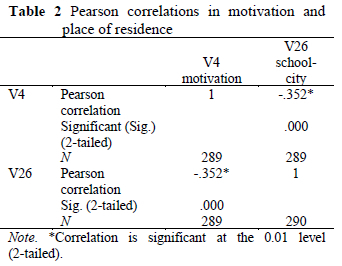
The negative correlation (cf. Table 2) in this case (-.352) means that students from bigger cities had a stronger desire to go abroad, while students from smaller towns choose the bilingual class because of competences in language and opportunities for better and safer employment.
The social environment in which a student grows up, (a sociological factor with its historical heritage), indicates the differences in the perception of professional goals. However, the finding is in line with Andelka Milic (1971:210) who found the "influence of family in urban and rural areas on the choice of occupation, in fact, the school the child will attend." The differences shown certainly open new avenues for further research among bilingual classes in geographical regions with different traditional values and social family structures.
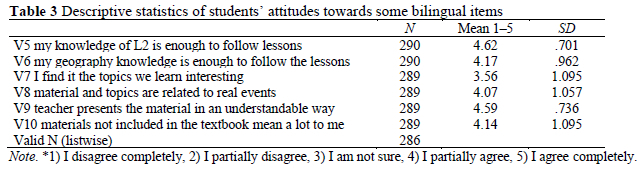
Language as primary factor for choosing a bilingual class is represented in Table 3. Students claimed that they were satisfied with the language skills (previously acquired) to attend class (71%), while 46.2% of students fully agreed that prior knowledge of geography was required in order to be able to follow lessons in a foreign language.
Students found the topics partially interesting (cf. Table 3), while they highly valued the connection of the material with real events (4.07/5). Teachers' commitment has long been recognised as a key factor in capturing the essence of a subject. Students evaluated the didactic-methodical characteristics of the teacher positively. More than 70% of students believed that the teacher presented the material in an understandable way (4.59/5).
Bearing in mind that students study geography from regular books in their mother tongue, students indicated that they learnt easier if the teacher provided material not included in the textbook. More than half of the students agreed that this type of additional literature made learning easier for them (cf. Table 3). Similar research in South Africa can be related to the research topic in this article. Golightly and Muniz (2013) investigated problem-based learning (PBL), enhancing student learning by providing constructive learning experiences and developing several attributes, such as communication skills, problem-solving skills, and self-directed learning. The results of our study show that students find additional literature desirable. Compared to Golightly and Muniz's (2013) research, it is not surprising that most respondents agreed that problem-based learning could help them become independent, lifelong learners (Golightly & Muniz, 2013).
Most students agreed on the knowledge of a foreign language and the positive evaluation of the teachers' presentation. Despite the fact that they were not interested in topics that they studied (cf. Table 3), and great disagreement was expected (1.095) in this regard, the students still agreed about the significance of material not included in the textbooks (cf. Table 3) knowing that it helped them achieve results.
With regard to the different types of teaching, the foreign language and native language were not always used equally. In three separate questions students assessed the dominance of language use (choosing L1, L2 or equally). From the student surveys it became clear the mother tongue was more dominant in the processing of new lessons (40.3% of students' responses) and assessment tests (43.4% of students' responses). The foreign language was more significant in repeating lessons (30.3% of students' response). It is a type of formative control that allows teachers to check students' knowledge when practising with the teacher to make learning more effective. The students connected, compared and set up new connections and relationships with previously learnt content. Within this phase, it is necessary to actively involve all students by applying the principles that are characteristic for this procedure (Romelic, 2006). Throughout the process students recognised the role of the teacher, and they showed it with high values in the survey (4.59/5).
Additional material (not included in the textbook), which was mainly based on material in a foreign language as a supplement and explanation of the lesson, with an adequate accompanying vocabulary, was often used by the participating students. The additional material used in the teaching unit was used more in schools than at home.
It should be mentioned that students can only follow the content in the textbook in the native language, therefore, writing in a notebook is crucial. One of the main tasks of writing should be considered - repeating and memorising new words, determining and developing lexical and grammatical habits and skills (Raicevic & Vlajkovic Bojic, 2017). Compared to other subjects, 56.9% of participating students used notebooks in geography as in other subject, while 31% of students indicated to using it more compared to other subjects.
According to a large proportion of students who rated their knowledge of language and geography highly, 26.9% of students believed that they needed less time to master the geography material compared to that of other subjects. About 40.7% of respondents indicated that they spent the same time to learn geography as for other subjects. However, 13.8% of students pointed out that they needed more time to learn geography than other non-bilingual material. These were probably the same students who were not interested in the topics (15.5%). It is thus not surprising that the students described the pace of lecture presentation (92.1%) as well as the amount of material presented (73.8%) appropriate and acceptable. Using dependent samples of the t-test, we considered that the measures were in some way correlated. In our study the score for quantity (t) was 9.665, and its probability .000. The results clearly show that the time required for learning still differed for students who had previously attended bilingual classes, considering that they had mastered the techniques of learning material and improved learning skills. The mutual influence would certainly be more significant, because only 21.7% of the surveyed students had previously attended some level of bilingual teaching. Accordingly and according to the usual effort required to master the material that students mentioned in our research, we agree with the results by Meyerhöffer and Dreesmann (2019) who refute the common concern that bilingual teaching might negatively affect the acquisition of content knowledge or that students would not be able to express knowledge in their mother tongue, as well as the ultimate advantage for students who had previously attended bilingual classes (Meyerhöffer & Dreesmann, 2019).
Although students did not report difficulties in their work, some contextual cues may be used by them in an effort to understand the input material (Coetzee-Lachmann, 2007). In this way Böker et al. (2012) state that the learning process is systematically improved and enriches individual progress in student learning. Students in our study were of the opinion that the content and teaching in the L2 where their mother tongue was not used were not insurmountable.
Interest and the appeal of the teaching in conjunction with the commitment of teachers, affect the ranking of geography in relation to other subjects. None of the participating students ranked geography as the most appealing subject. More than half the students ranked geography in third to fifth place (53.4%); 19.3% of the students ranked geography in second place and 19% of the students ranked geography lower than fifth place. In a study by Sack and Peterson (1998), students were least interested in geography and Kizilcaoglu (2010) states that students considered active learning and practical skills as very desirable in a professional career. Wilmot and Dube (2015) indicate that geography has a favourable position in the South African school curriculum as there is an increase in the number of learners enrolled for geography as one of their subjects in the National Senior Certificate examination. In South Africa, geography is the fifth most popular school subject of choice in Grades 10 to 12 (3,800 learners of a total of 10,221 writing the National Senior Certificate examination in 2015) (Wilmot, 2018).
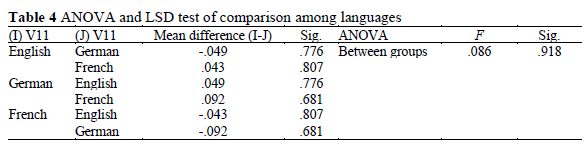
The choice of a foreign language in which geography is taught bilingually has no statistical significance. The one way ANOVA test (cf. Table 4) highlights that there were no differences in the ranking of geography among students taking the subject in English, German or French.
In Table 4 the value F represent the relationship between the two variances (time for learning versus foreign languages). Its value is small (.086) as is the significance thereof (.918). This confirms that an equal amount of time was spent learning in any of the foreign languages. The differences in preference of foreign language were statistically insignificant as there were no differences among students who attended bilingual geography classes in English, German or French. The only possible reason could be the higher number of English language students in the survey; 69.7% of students studied geography in Serbian-English.
The fact that the choice of a foreign language did not affect the quality of teaching, ranking of the subject or even time spent on learning the material, gives insight into the results of the analysis of the Multiple Comparison Post Hoc (LSD) Test. The mean difference in Table 4 presents the differences between compared languages and the significance of these differences. Obtained values confirm that there were no significant differences between languages.
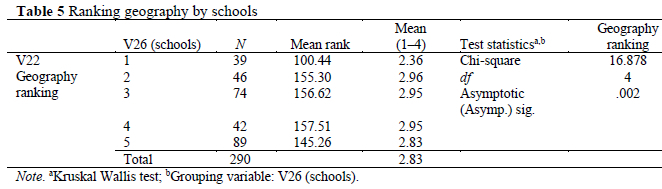
However, the role of the teacher has had the greatest influence on the ranking of geography in relation to other subjects. According to the Kruskal Wallis test (cf. Table 5), the role of teachers as a factor for ranking subjects was statistically significant (.002). The smallest deviation of the arithmetic mean rank was recorded by the results of the students at Secondary school 1 (Secondary school "Svetozar Markovic", Nis), while the students of Secondary school 4 (Secondary school "Pirot", Pirot) showed the highest rise in distribution scores. Table 5 shows the number of respondents in each of the schools and the average ranks of the dependent variable, which, in this case, is the ranking of geography. The average value (mean) for ranking geography was 2.83/4, which means that the majority of students placed geography between third and fifth place.
Table 5 provides the measure (chi-squares) and its significance (asymp. sig.). The value of the chi-square is high (X2 = 16.878) and it is statistically very significant, 0.002- (<- 0.05-0.01). This confirms that there were significant differences in the ranking of geography between the schools in which the survey was conducted, which can certainly be subsumed under the teachers' influence.
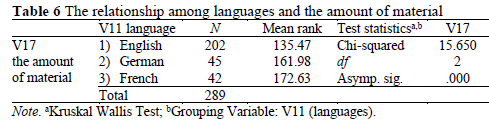
Language was found to be significant in the amount of material that the teachers presented (cf. Table 6). Chi-squared (X2 = 15.650) has a high value and significance (.000). The results we obtained matched the ANOVA test (F = 7.336; Sig. .001) and this shows that there was a significant difference among the students studying in the three languages and the amount of material presented. An important fact is the ratio of the number of students among languages. However, it should be kept in mind that in all schools English was compulsory as first foreign language for all students regardless of the language combination in which they attended geography classes. The amount of material available in English, compared to other foreign languages, as well as its availability and presence on the internet and in the media should also be taken into account.
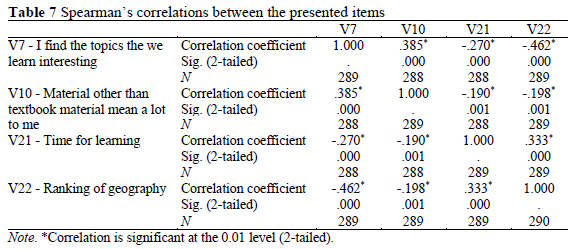
Spearman's rank correlation coefficient (cf. Table 7) has the best indicator in scale data, with the assumption that students who study more achieve better results in tests. In accordance with the measurement of Spearman's correlation levels, students who were interested in topics highly valued the additional material that the teachers provided (.385). The negative correlation between students who were interested in topics and the time for learning and the ranking of the subject means that students who were more interested in themes spent less time to master the material (-.270), and they ranked geography higher (-.462) than other subjects.
There is a mutual relationship between language and non-linguistic content. Banegas, Poole and Corrales (2020) highlight the connection between motivation and language learning in language-driven CLIL, finding that students perceived that they developed their language skills (speaking, reading, listening and writing) because they found the topics and material relevant (Banegas et al., 2020).
Conclusion
The influence of geography is undeniable. The non-native language through which geographical content was studied bilingually was irrelevant, while the intention and motive for studying geography as a foreign language was confirmed by this research. The results confirm that there was a difference in the time that it takes a student to learn. To make it easier to follow their lessons, teachers also offered additional material. The additional material and the difficulties that teachers encountered did not restrict progress, and it seemed that teaching in a foreign language was more interesting compared to the mother tongue (70:30). A great number of students (73.8%) were of the opinion that the amount of material was appropriate. Bilingualism has also proven to be a good example for the application of new teaching approaches and didactic-methodical principles.
The lack of textbooks for bilingual teaching makes students and teachers work harder, and active learning might improve the chance of long-term retention of knowledge. However, it does not seem to influence learning and the amount of material, however, geography is not regarded as one of the three most interesting subjects in school. The question of why and how geography ceased to be interesting to students now arises.
Although the attitudes of students attending bilingual classes were mostly positive and they regarded these classes as an advantage in their professional lives, we believe that more emphasis should be placed on practical skills and knowledge. Students require an active teaching model that would monitor the real situation in the teaching process. Despite good results, without special books for bilingual classes, some teachers thought that more active teaching and learning were only possible by supplementing textbook literature in non-language subjects. Not having special books is directly related to the amount of input that students receive in a foreign language. Thus, the teaching of geography should be more focussed on geographical knowledge and less on linguistic problems, because in essence, the development of bilingual teaching is necessary to improve at the level of practical education.
Authors' Contributions
ST, as the main author, collected all the data, followed the guidelines of other authors and compiled the work as a whole. AID as professor of methodological subjects, monitored the theoretical part of the work and pointed out mistakes and provided guidelines. LIB, as professor of methodical subjects, contributed to the preparation of the survey questionnaire. MS, as associate professor in the Chair of Social Geography, assisted with the SPSS program and provided guidelines for the analysis. MS assisted with distribution of survey questionnaires and selected the schools that participated in the research. All authors reviewed the final manuscript.
Notesi. Secondary school education in Serbia lasts 4 years, but geography is studied for only 3 years. Nevertheless, it is the maximum study of geography, comparing all types of secondary schools in Serbia.
ii. 1) Secondary school "Svetozar Markovic", Nis; 2) Secondary school "Stevan Sremac", Nis; 3) Secondary school "Takovski ustanak", Gornji Milanovac; 4) Secondary school "Pirot", Pirot; 5) "Mitrovacka gimnazija" Secondary school, Sremska Mitrovica.
iii. At the time of the study geography was studied bilingually in only seven secondary schools and we did research in five secondary schools.
iv. Population by cities: (1 and 2) - Nis, 182,797; (3) - Gornji Milanovac, 23,109; (4) - Pirot, 34,942; (5) - Sremska Mitrovica, 36,764; (Census of Population, Households and Dwellings in the Republic of Serbia, 2022).
v. Published under a Creative Commons Attribution Licence.
Acknowledgements
This work is part of research related to my doctoral study. I would like to thank everyone who contributed to the research.
References
-
Admiraal W, Westhoff G & De Bot K 2006. Evaluation of bilingual secondary education in the Netherlands: Students' language proficiency in English. Educational Research and Evaluation, 12(1):75-93. https://doi.org/10.1080/13803610500392160
» https://doi.org/10.1080/13803610500392160 - Baker C 2001. Foundations of bilingual education and bilingualism (3rd ed). Clevedon, England: Multilingual Matters.
-
Ball SJ, Dworkin AG & Vryonides M 2010. Globalization and education: Introduction. Current Sociology, 58(4):523-529. https://doi.org/10.1177/0011392110367987
» https://doi.org/10.1177/0011392110367987 -
Banegas DL, Poole PM & Corrales KA 2020. Content and language integrated learning in Latin America 2008-2018: Ten years of research and practice. Studies in Second Language Learning and Teaching, 10(2):283-305. https://doi.org/10.14746/ssllt2020.10.24
» https://doi.org/10.14746/ssllt2020.10.24 -
Bernard A, Finnie R & St-Jean B 2008. Interprovincial mobility and earnings. Perspectives on Labour and Income, 9(10):15-25. Available at https://citeseerx.ist.psu.edu/document?repid=rep1&type=pdf&doi=f77b499ed98bdcdfb76d11e4514f32456b550de0. Accessed 31 December 2023.
» https://citeseerx.ist.psu.edu/document?repid=rep1&type=pdf&doi=f77b499ed98bdcdfb76d11e4514f32456b550de0 -
Biederstädt W 2010. Möglichkeiten und grenzen des Englischen als arbeitssprache im Geographieunterricht der klassen 7 - 10 [Possibilities and limitations of English as working language in Geography lessons in classes 7-10]. In G Bach & S Niemeier (eds). Bilingualer unterricht: Grundlagen, methoden, praxis, perspektiven. Berlin, Germany: Peter Lang. Available at https://thestacks.libaac.de/server/api/core/bitstreams/28776c7e-2c6e-4302-a92f-7a584fe18ae6/content. Accessed 31 December 2023.
» https://thestacks.libaac.de/server/api/core/bitstreams/28776c7e-2c6e-4302-a92f-7a584fe18ae6/content -
Böker S, Hillerich M, Kaeseler N, Lammers M & De Lange E 2012. Erdkunde deutsch-english in der Sekundarstufe 1 [German-English geography in Secondary School 1]. Düsseldorf, Germany: Ministerium für Schule und Bildung des Landes Nordrhein-Westfalen. Available at https://www.schulentwicklung.nrw.de/cms/upload/bilingualer_Unterricht/documents/HR_BU_EkE_SekI_0912.pdf. Accessed 1 June 2022.
» https://www.schulentwicklung.nrw.de/cms/upload/bilingualer_Unterricht/documents/HR_BU_EkE_SekI_0912.pdf - Butt G 2002. Language and learning in Geography. In M Smith (ed). Teaching Geography in secondary schools: A reader. London, England: RoutledgeFalmer.
-
Byca M 2011. Bilingual geography education models through the English language in Polish schools. Prace i Studia Geograficzne, 48:187-196. Available at https://agro.icm.edu.pl/agro/element/bwmeta1.element.agro-d480e1a0-afcf-4395-b414-addd56a56227. Accessed 1 June 2022.
» https://agro.icm.edu.pl/agro/element/bwmeta1.element.agro-d480e1a0-afcf-4395-b414-addd56a56227 -
Canadian Heritage 2016. Economic advantages of bilingualism: Literature review. Available at https://www.caslt.org/wp-content/uploads/2022/03/pch-bilingualism-lit-review-final-en.pdf. Accessed 31 December 2023.
» https://www.caslt.org/wp-content/uploads/2022/03/pch-bilingualism-lit-review-final-en.pdf -
Census of Population, Households and Dwellings in the Republic of Serbia 2022. Age and sex: Data by settlements. Belgrade, Serbia: Statistical Office of the Republic of Serbia. Available at https://publikacije.stat.gov.rs/G2023/Pdf/G20234003.pdf. Accessed 27 July 2023.
» https://publikacije.stat.gov.rs/G2023/Pdf/G20234003.pdf -
Chang CH & Kidman G 2019. Curriculum, pedagogy and assessment in geographical education - for whom and for what purpose? International Research in Geographical and Environmental Education, 28(1):1 -4. https://doi.org/10.1080/10382046.2019.1578526
» https://doi.org/10.1080/10382046.2019.1578526 -
Coetzee-Lachmann D 2007. Assessment of subject-specific task performance of bilingual geography learners: Analysing aspects of subject-specific written discourse. PhD dissertation. Osnabrück, Germany: Universität Osnabrück. Available at http://webdoc.sub.gwdg.de/ebook/dissts/Osnabrueck/Coetzee-Lachmann2009.pdf. Accessed 31 December 2023.
» http://webdoc.sub.gwdg.de/ebook/dissts/Osnabrueck/Coetzee-Lachmann2009.pdf - Council of Europe 2001. Common European framework of reference for languages: Learning, teaching, assessment (CEFR). Cambridge, England: Cambridge University Press.
-
Cox M, Elen J & Steegen A 2018. A test to measure students' systems thinking abilities in geography. European Journal of Geography, 9(1):105-120. Available at http://eurogeojournal.eu/articles/Issue%209.1.pdf. Accessed 1 June 2022.
» http://eurogeojournal.eu/articles/Issue%209.1.pdf - Coyle D, Hood P & Marsh D 2010. CLIL: Content and language integrated learning. Cambridge, England: Cambridge University Press.
-
Czura A & Papaja K 2013. Curricular models of CLIL education in Poland. International Journal of Bilingual Education and Bilingualism, 16(3):321-333. https://doi.org/10.1080/13670050.2013.777388
» https://doi.org/10.1080/13670050.2013.777388 -
De Mejia AM 2013. Elite/folk bilingual education. In CA Chapelle (ed). The encyclopedia of applied linguistics. https://doi.org/10.1002/9781405198431.wbeal0361
» https://doi.org/10.1002/9781405198431.wbeal0361 -
Desforges L & Jones R 2004. Learning geography bilingually. Journal of Geography in Higher Education, 28(3):411-424. https://doi.org/10.1080/0309826042000286974
» https://doi.org/10.1080/0309826042000286974 - Drexel-Andrieu I 1993. Bilingual geography: A teacher's perspective. In HB Beardsmore (ed). European models of bilingual education. Bristol, PA: Multilingual Matters Ltd.
-
Gabillon Z 2020. Revisiting CLIL: Background, pedagogy and theoretical underpinnings. Revue Contextes et Didactiques, 15. https://doi.org/10.4000/ced.1836
» https://doi.org/10.4000/ced.1836 -
Golay D 2005. Geographiedidaktische forschungen [Geography didactical researches]. Nürnberg, Germany: Schnelldruck Süd. Available at https://www.uni-muenster.de/imperia/md/content/geographiedidaktische-forschungen/gdf_39_golay.pdf. Accessed 1 June 2022.
» https://www.uni-muenster.de/imperia/md/content/geographiedidaktische-forschungen/gdf_39_golay.pdf -
Golightly A & Muniz OA 2013. Are South African Geography education students ready for problem-based learning? Journal of Geography in Higher Education, 37(3):432-455. https://doi.org/10.1080/03098265.2013.794332
» https://doi.org/10.1080/03098265.2013.794332 - Golightly A & Van der Westhuizen CP 2017. South Africa. In O Muniz Solari, M Solem & R Boehm (eds). Learning progressions in geography education: International perspectives. Switzerland: Springer.
-
Gondová D 2013. Aktlvne ucenie sa ziakov v CLIL-e [Active learning of pupils in CLIL]. Bratislava, Slovakia: Metodicko-pedagogické Centrum. Available at https://archiv.mpc-edu.sk/sites/default/files/publikacie/d.gondova_aktivne_ucenie_sa_ziakov_v_clil_e.pdf. Accessed 31 December 2023.
» https://archiv.mpc-edu.sk/sites/default/files/publikacie/d.gondova_aktivne_ucenie_sa_ziakov_v_clil_e.pdf -
Hanesová D 2015. History of CLIL. In S Pokrivcáková et al. (eds). CLIL in foreign language education. Nitra, Slovakia: Constantine the Philosopher University. Available at https://www.researchgate.net/profile/Derya-Bozdogan/publication/285299208_Technology_enhanced_CLIL_classrooms/links/565d4fb308aeafc2aac732c8/Technology-enhanced-CLIL-classrooms.pdf#page=8. Accessed 31 December 2023.
» https://www.researchgate.net/profile/Derya-Bozdogan/publication/285299208_Technology_enhanced_CLIL_classrooms/links/565d4fb308aeafc2aac732c8/Technology-enhanced-CLIL-classrooms.pdf#page=8 -
Innes LM 2012. South African school Geography: Underpinning the foundation of geospatial competence. South African Journal of Geomatics, 1(1):92-108. Available at https://www.ajol.info/index.php/sajg/article/view/107041. Accessed 31 December 2023.
» https://www.ajol.info/index.php/sajg/article/view/107041 -
Ioannou-Georgiou S & Pavlou P (eds.) 2011. Guidelines for CLIL implementation in primary and pre-primary education. Latsia, Cyprus: Cyprus Pedagogical Institute. Available at https://arbeitsplattform.bildung.hessen.de/fach/bilingual/Magazin/mat_aufsaetze/clilimplementation.pdf. Accessed 31 December 2023.
» https://arbeitsplattform.bildung.hessen.de/fach/bilingual/Magazin/mat_aufsaetze/clilimplementation.pdf -
Kizilcaoglu A 2010. Student attitudes toward a university course on world regional geography. The New Educational Review, 21(2):132-145. Available at https://dspace.balikesir.edu.tr/xmlui/bitstream/handle/20.500.12462/7048/alaatin%20k%c4%b1z%c4%b1l%c3%a7ao%c4%9flu.pdf?sequence=2&isAllowed=y. Accessed 31 December 2023.
» https://dspace.balikesir.edu.tr/xmlui/bitstream/handle/20.500.12462/7048/alaatin%20k%c4%b1z%c4%b1l%c3%a7ao%c4%9flu.pdf?sequence=2&isAllowed=y -
Klein P & Solem M 2008. Evaluating the impact of international collaboration on Geography learning. Journal of Geography in Higher Education, 32(2):245-267. https://doi.org/10.1080/03098260701728500
» https://doi.org/10.1080/03098260701728500 -
Kordíková B & B Brestenská 2022. Bilingual science education: Perceptions of Slovak in-service and pre-service teachers. International Journal of Bilingual Education and Bilingualism, 25(2):728-741. https://doi.org/10.1080/13670050.2020.1718590
» https://doi.org/10.1080/13670050.2020.1718590 -
LabelFrancÉducation 2023. Etablissements labellisés [Labeled establishments]. Available at https://www.labelfranceducation.fr/en/etablissements?field_lycee_value%5B%5D=1&country=rs. Accessed 31 December 2023.
» https://www.labelfranceducation.fr/en/etablissements?field_lycee_value%5B%5D=1&country=rs -
Lazarevic N 2022. CLIL teachers' reflections and attitudes: Surviving at the deep end. International Journal of Bilingual Education and Bilingualism, 25(2):571-584. https://doi.org/10.1080/13670050.2019.1703897
» https://doi.org/10.1080/13670050.2019.1703897 -
Liu S & Laohawiriyanon C 2013. Students' attitudes towards cultural learning in the English classroom: A case study of non-English major students in a Chinese university. International Journal of English Language Education, 1(3):28-12. https://doi.org/10.5296/ijele.v1i3.3508
» https://doi.org/10.5296/ijele.v1i3.3508 -
Loncar M 2017. Bilingual teaching in German and Serbian: The examples of elementary school '10. oktobar' in Subotica, The First Nis Gymnasium 'Stevan Sremac' and Valjevo Gymnasium. Zivi Jezici: Casopis za Strane Jezike i Knjizevnosti, 37(1):137-166. Available at https://zivijezici.fil.bg.ac.rs/index.php/zivijezici/article/view/65/48. Accessed 1 June 2022.
» https://zivijezici.fil.bg.ac.rs/index.php/zivijezici/article/view/65/48 -
Mahan KR, Brevik ML & 0degaard M 2021. Characterizing CLIL teaching: New insights from a lower secondary classroom. International Journal of Bilingual Education and Bilingualism, 24(3):401-418. https://doi.org/10.1080/13670050.2018.1472206
» https://doi.org/10.1080/13670050.2018.1472206 -
Marsh D 2000. Using language to learn and learning to use language. Available at http://archive.ecml.at/mtp2/clilmatrix/pdf/1uk.pdf. Accessed 1 June 2022.
» http://archive.ecml.at/mtp2/clilmatrix/pdf/1uk.pdf - Marshall T 2019. Zatocenici geografije: Deset mapa koje vam govore sve sto treba da znate o globalnoj politici [Prisoners of geography: Ten maps that explain everything about the world]. Belgrade, Serbia: Laguna.
-
Mearns T, De Graaff R & Coyle D 2020. Motivation for or from bilingual education? A comparative study of learner views in the Netherlands. International Journal of Bilingual Education and Bilingualism, 23(6):724-737. https://doi.org/10.1080/13670050.2017.1405906
» https://doi.org/10.1080/13670050.2017.1405906 -
Meyerhöffer N & Dreesmann DC 2019. English-bilingual biology for standard classes development, implementation and evaluation of an English-bilingual teaching unit in standard German high school classes. International Journal of Science Education, 41(10):1366-1386. https://doi.org/10.1080/09500693.2019.1607620
» https://doi.org/10.1080/09500693.2019.1607620 -
Milic A 1971. Socijalizacija mladih u seoskoj i gradskoj porodici za radne uloge u drustvu [Socialization of the youth in rural and urban families for a working role in society]. Sociologija i Prostor: Casopis za Istrazivanje Prostornoga i Sociokulturnog Razvoja, 31-32:199-210. Available at https://hrcak.srce.hr/file/176478. Accessed 1 June 2022.
» https://hrcak.srce.hr/file/176478 -
Ministry of Education, Science and Technological Development, The Republic of Serbia 2015. 'Rulebook on closer conditions for bilingual teaching'. The Official Gazette RS 105/2015-30, 50/2016-40, 35/2017-5, November 30. Available at https://www.pravno-informacioni-sistem.rs/SlGlasnikPortal/eli/rep/sgrs/ministarstva/pravilnik/2015/105/1/reg. Accessed 31 December 2023.
» https://www.pravno-informacioni-sistem.rs/SlGlasnikPortal/eli/rep/sgrs/ministarstva/pravilnik/2015/105/1/reg -
Mitrovacka Gimnazija n.d. O cmepy [About]. Available at http://gimnazijasm.edu.rs/about/bilingvalni/. Accessed 31 December 2023.
» http://gimnazijasm.edu.rs/about/bilingvalni/ -
Oattes H, Fukkink R, Oostdam R, De Graaff R & Wilschut A 2022. A showdown between bilingual and mainstream education: The impact of language of instruction on learning subject content knowledge. International Journal of Bilingual Education and Bilingualism, 25(2):756-769. https://doi.org/10.1080/13670050.2020.1718592
» https://doi.org/10.1080/13670050.2020.1718592 -
Papaja K 2008. Content and language integrated learning in Geography. In A Stark (ed). Bilingual Geography - aims, methods and challenges. Torun, Poland: Herodot Network. Available at https://docplayer.net/4593453-Bilingual-geography-aims-methods-and-challenges.html. Accessed 1 June 2022.
» https://docplayer.net/4593453-Bilingual-geography-aims-methods-and-challenges.html - Pasuljevic Shimwell PL 2018. Theoretical foundations and critical analysis of CLIL-based instruction in French and Serbian language at high school level in Serbia. PhD dissertation. Belgrade, Serbia: University of Belgrade.
-
Piotrowska I 2007. Cognitive and application aspects in the bilingual teaching of geography. In K Donert, P Charzynski & Z Podgórski (eds). Teaching Geography in and about Europe. Torun, Poland: Herodot Network. Available at https://repozytorium.umk.pl/bitstream/handle/item/353/Teaching%20Geography%20in%20and%20about%20Europe.pdf?sequence=2. Accessed 31 December 2023.
» https://repozytorium.umk.pl/bitstream/handle/item/353/Teaching%20Geography%20in%20and%20about%20Europe.pdf?sequence=2 - Raicevic V & Vlajkovic Bojic V 2017. Podsetnik za nastavnike stranih jezika [Reminder for foreign language teachersl]. Beograd, Serbia: Zavod za unapredivanje obrazovanja i vaspitanja.
-
Repplinger N & Budke A 2018. Is multilingual life practice of pupils a potential focus for geography lessons? European Journal of Geography, 9(3):165-180. Available at https://eurogeojournal.eu/index.php/egj/article/view/46/20. Accessed 1 June 2022.
» https://eurogeojournal.eu/index.php/egj/article/view/46/20 - Romelic J 2006. Specificnosti organizovanja i izvodenja casa u nastavi geografije [Specifics of organizing and conducting classes in geography teaching]. Globus, 37(31):3-14.
-
Sack D & Petersen JF 1998. Children's attitudes towards geography: A Texas case study. Journal of Geography, 97(3):123-131. https://doi.org/10.1080/00221349808978836
» https://doi.org/10.1080/00221349808978836 -
Sehar S, Alwi SKK & Shaiq M 2020. Potential benefits of bilingual teaching in learning History. Global Social Sciences Review, 5(1):490-199. https://doi.org/10.31703/gssr.2020(V-I).50
» https://doi.org/10.31703/gssr.2020(V-I).50 - Simeunovic Ζ 2004. Interesantnost i atraktivnost nastavni kao princip [Interestingness and attractiveness as a teaching principle]. Pedagogija, 59(2):59-67.
-
University of the People 2023. Why is Geography important? There's more than you think. Available at https://www.uopeople.edu/blog/why-is-geography-important/. Accessed 31 December 2023.
» https://www.uopeople.edu/blog/why-is-geography-important/ -
Van Kampen E, Admiraal W & Berry A 2018. Content and language integrated learning in the Netherlands: Teachers' self-reported pedagogical practices. International Journal of Bilingual Education andBilingualism, 21(2):222-236. https://doi.org/10.1080/13670050.2016.1154004
» https://doi.org/10.1080/13670050.2016.1154004 -
Vuco J 2006. Searching for own Model of Bilingual Teaching. Teaching Innovation in Foreign Language, 19(03):41-54. Available at http://www.inovacijeunastavi.rs/wp-content/uploads/arhiva/2006/INOVACIJE_3_06.pdf. Accessed 1 June 2022.
» http://www.inovacijeunastavi.rs/wp-content/uploads/arhiva/2006/INOVACIJE_3_06.pdf -
Wilmot D 2018. Advancing Geography education in Southern Africa: The role of the Southern African Geography Teachers' Association and the Journal of Geography Education for Southern Africa. Journal of Geography Education in Africa (JoGEA), 1:1-13. https://doi.org/10.46622/jogea.v1i.2534
» https://doi.org/10.46622/jogea.v1i.2534 -
Wilmot D & Dube C 2015. School geography in South Africa after two decades of democracy: Teachers' experiences of curriculum change. Geography 100(2):94-101. https://doi.org/10.1080/00167487.2015.12093961
» https://doi.org/10.1080/00167487.2015.12093961 - Wolff D & Otwinowska-Kasztelanic A 2010. CLIL - przelomowe podejscie w edukacji europejskiej [CLIL - A crucial approach in European education]. Jezyki Obce w Szkole, 6:7-13.
-
Zaparucha A 2007. How much English teaching in Geography teaching. In K Donert, P Charzynski & Z Podgórski (eds). Teaching Geography in and about Europe. Torun, Poland: Herodot Network. Available at https://repozytorium.umk.pl/bitstream/handle/item/353/Teaching%20Geography%20in%20and%20about%20Europe.pdf?sequence=2. Accessed 31 December 2023.
» https://repozytorium.umk.pl/bitstream/handle/item/353/Teaching%20Geography%20in%20and%20about%20Europe.pdf?sequence=2 -
Zaparucha A 2009. A case for Geography and English integrated studies. In K Donert, Y Ari, M Attard, G O'Reilly & D Schmeinck (eds). Celebrating geographical diversity: Proceedings of the HERODOT Conference in Ayvalik, Turkey 28-31 May 2009. The Herodot Thematic Network. Available at https://www.researchgate.net/profile/Karl-Donert/publication/268333632_Celebrating_Geographical_Diversity/links/5468fd070cf2397f782d6c91/Celebrating-Geographical-Diversity.pdf#page=93. Accessed 1 June 2022.
» https://www.researchgate.net/profile/Karl-Donert/publication/268333632_Celebrating_Geographical_Diversity/links/5468fd070cf2397f782d6c91/Celebrating-Geographical-Diversity.pdf#page=93 - Zivkovic D 2013. Uloga stranih jezika u interkulturnom obrazovanju [The role of foreign languages in intercultural education]. In V Lopicic & B Misic Ilic (eds). Jezik knjizevnost vrednosti: Jezicka istrazivanja: Zbornik radova. Nis, Serbia: Univerzitet u Nisu. Filozofski fakultet.
Revised: 11 July 2023
Accepted: 6 October 2023
Published: 31 December 2023