Life-design-based counselling for secondary school learners with career indecision: Intervention research
Abstract
In the study reported on here, we examined the effect of a life-design-based intervention on learners from a semi-urban South African school challenged by structural inequalities and inadequate support structures. Convenience and purposive sampling were used to select 12 participants based on their fit with the study's purpose. A qualitative research design was chosen and intervention research used to address the research questions. Life-design intervention strategies and techniques used to generate data included questionnaires, structured and semi-structured interviews, collages, and lifelines. Thematic analysis was used to analyse the data. The findings reveal that the life-design-based intervention enhanced most of the participants' career decision-making capacity and their career adaptability in respect of the 4 dimensions of career adaptability, namely concern, control, curiosity, and confidence. Additionally, comparison of themes and sub-themes before and after the intervention indicated that most learners' career decision-making challenges had been resolved. Longitudinal (qualitative and quantitative) research with large(r) groups of diverse participants is essential to examine the longer-term value of the intervention in diverse contexts.
career adaptability; career construction theory; career indecision; life-design-based counselling
Introduction
Globalisation and technological advances have brought about wide-ranging changes in the world of work (Maree, Cook & Fletcher, 2018; Santilli, Nota & Hartung, 2019). Yang, Yaung, Noh, Jang and Lee (2017) argue that the world of work has become more complex and less predictable. People no longer remain in one job for their entire lives but move from one job to another. McMahon (2010) states that the world of work in the 21st century is characterised by greater competition, less defined and predictable career trajectories, fewer opportunities for promotion, and a need for continuous learning. Given the rapid development of artificial intelligence (AI), machine learning, automation, and robotics, some current jobs will cease to exist and be replaced by AI and AI-based automation technology (Wang & Siau, 2019). The current economy requires skills in creativity, communication, team effort, and entrepreneurship (Smith, Ferns, Kay, Russell, Marcus, Wacha & Nielsen, 2019). Work is no longer completed in a bounded office within a prescribed period, but new practices have seen the adoption of remote work settings, flexible time constraints, and continuous connectivity (Dean & Campbell, 2020). Additionally, although the full impact of the coronavirus disease (COVID-19) on the work environment is not clear yet, there is consensus that many jobs were lost and that there is an increase in work that can be done online (Maree, 2020b).
Savickas, Nota, Rossier, Dauwalder, Duarte, Guichard, Soresi, Van Esbroeck and Van Vianen (2009) maintain that fundamental changes in the work environment require workers to develop skills and competencies quite different from those required in the 20th-century work environment. They add that workers in the 21st century must become lifelong learners who can use sophisticated technology, maintain their employability, and create their own opportunities. Savickas (2012) states that to help clients design their lives appropriately to cope with the demands of the 21st century, many career counsellors today are focusing on identity rather than personality, adaptability rather than maturity, intentionality rather than decidedness, and stories rather than scores.
Theoretical Framework
Career counselling in South Africa
Research shows a lack of career counselling services in many public schools in South Africa (Albien & Naidoo, 2017). Moreover, career counselling in South Africa is largely inadequate and does not reach all learners (Abrahams, Jano & Van Lill, 2015) in the Further Education and Training Band of the education system. Grossen, Grobler and Lacante (2017), for instance, emphasise the need for research on career development among adolescents from deprived socio-economic backgrounds. These adolescents receive virtually no support in facing the crucial developmental task of making informed and realistic career decisions. Abrahams et al. (2015) also state that career counselling in South Africa is sometimes completely inadequate, particularly among previously disadvantaged learners. Moreover, career guidance in South Africa forms part of life orientation (LO), a subject offered in schools. Life orientation is taught by teachers who are often not adequately trained to keep abreast of changes in the labour market. This implies that some LO teachers lack the knowledge to prepare learners for the world of work upon completing high school.
Gaps in the literature on career counselling in South African schools
The lack of qualified career counsellors impacts negatively on the career planning and decision-making of adolescents in South Africa (Maree, 2013). Many South African learners complete high school education without being properly prepared for life after school and the world of work. In this study, we focused on learners in the Further Education and Training (FET) Phase, particularly learners in Grade 11. This group of learners includes those who would be transitioning to tertiary education after completing schooling and those who would be joining the workforce immediately after high school. Career construction theory (CCT), as an established career theory, has been used with different population groups in developed countries, but its use and applicability in developing countries (particularly among underprivileged and disadvantaged groups) still need to be verified. Insufficient research has been conducted on matters related to the unique needs and situation of minority groups specifically in developing countries (such as Africa). In recent studies in Africa - Albien (2020), Maree et al. (2018), Maree and Nortjé (2022), Setlhare, Wood and Meyer (2017), and Wessels and Diale (2017), among others, have examined the possibility of adapting newer approaches for application in developing countries (Global South).
Likewise, life-design counselling is considered an approach that could empower clients to prepare for the challenges of the 21st-century workplace (Savickas, 2012). Maree and Che (2020) argue that even though life-design intervention has been in use since 2009, only limited literature is available on the applicability of this approach in developing countries like South Africa. Naidoo, Visser, De Wet, Rabie, Van Schalkwyk, Boonzaier, De Bruin, Shirley and Venter (2019) contend that one-on-one career counselling may not meet the career-related needs of the youth of South Africa, given the high rate of youth unemployment in the country. A pressing need, therefore, exists for both group career counselling and one-on-one counselling.
Career construction theory (CCT)
CCT (Savickas, 2005, 2013) explains the process by which people construct themselves as they seek direction in their vocational behaviour and attempt to make meaning of their careers (Savickas, 2013). The theory further explains how people construct careers through personal and social constructionism. Hartung and Vess (2016) state that CCT is an extension of the psychology of occupations (Holland, 1997), careers (Super, 1990), and life design (Savickas et al., 2009). The authors add that CCT builds on the traditions of Holland's (1997) person-environment fit, which emphasises traits, Super's (1990) lifespan development, which emphasises developmental tasks, and Savickas et al.'s (2009) narrative approach, which emphasises life themes to comprehend career as a story. Maree (2020a) argues that CCT also draws on the narrative, storied approach and, by implication, also the psychodynamic tradition. The key feature of the psychodynamic approach is eliciting people's numerous micro-stories and then helping them reflect on these stories to identify the key life themes (Maree, 2020a).
Clients' painful memories of their past are converted into positive experiences that help them to regenerate a sense of meaning and purpose in their career lives. Maree (2020b) believes that counselling on career construction helps people re-live and frame their personal history, connect their present and past experiences, and construct new life themes in their career lives.
Self-construction theory (SCT)
Unlike career construction, self-construction does not focus on the development of a career trajectory but on the construction of individuals' self-identity and the clarification of their existential questions (Guichard, 2016). SCT regards individuals as actively constructing themselves through narration or storytelling in social interaction.
Life-design counselling (LDC) Life design is an overarching career theory and practice paradigm that aims at prompting meaningful activities that improve self-making, identity shaping and career construction (Savickas, 2010). LDC originates from Guichard's SCT and Savickas's CCT (Guichard, 2009; Maree, 2019). In addition, Ginevra, Di Maggio, Nota and Soresi (2017:79) define the LDC approach as a "framework based on the integration of CCT and SCT, social constructivist theories, as well as intra-individual learning and dynamic processes, such as career adaptability and career competencies." The aim with this approach is to assist people to "articulate and enact a career story that supports adaptive and flexible responses to developmental tasks, vocational traumas, and occupational transitions" (Savickas et al., 2009:245). The aim is also to expand the four dimensions of career adaptability -concern, control, curiosity, and confidence - which relate to coping mechanisms that can help people manage career challenges and transitions (Maree et al., 2018). According to Nota, Santilli and Soresi (2016), concern refers to looking forward, focusing on educational and professional paths to be followed in preparation for the future, as well as adopting a positive attitude towards the future. Control refers to being responsible for the construction of one's career and accepting the career choices that are made. Curiosity refers to exploring, seeking information, and examining available alternatives to make career choices that are realistic and that resonate with personal goals. Confidence refers to the belief in one's ability to deal successfully with difficulties in career choices.
The most important aspect of the LDC approach that distinguishes it from other counselling paradigms is that it places clients at the centre by allowing them to play an active role.
Goals of life-design counselling Savickas et al. (2009) view life-design intervention as a paradigm that can promote specific knowledge and skills to explore and deal with ecological contexts, complex dynamics, non-linear causalities, multiple subjective realities, and dynamical modelling (Savickas et al., 2009). They list the following four goals of life-design intervention.
The aim of life-design intervention is to promote people's adaptability, narratability, activity, and intentionality:
i) Adaptability
Adaptability involves a person's resources for coping with present and future tasks, vocational trauma, as well as career transitions (Savickas et al., 2009).
ii) Narratability
By using dialogue, counsellors can assist their clients to construct and tell their life stories in a coherent manner. In life-design intervention, life themes and vocational personalities develop from the clients' narratives that are formulated with the assistance of counsellors. The stories help clients understand their own life themes, vocational personality, and adaptability resources (Savickas, 2005, as cited in Savickas et al., 2009). When clients recount their life stories, they form their own subjective personality and identity in relation to other people and specific contexts. While exploring the self and the relationship between the self and the environment, self-construction takes place (Savickas et al., 2009).
iii) Activity
When people engage in various activities, they get an opportunity to learn about their abilities, interests, and preferences. They also get the chance to interact with others who then provide feedback about their activities. Together with these people they create a system of representation.
iv) Intentionality
Clients and counsellors could try to make meaning by participating in intentional processes instead of by merely making career choices. This should be a continuous process where the construction of lives takes place.
Steps in the life-design process
The six steps (Savickas et al., 2009) followed in the process of life design are discussed briefly below.
i) Problem identification
The first step is to define the problem and to identify exactly what the client wants to achieve through the intervention. The client and counsellor formulate goals for the intervention and develop a working alliance. During the process the counsellor assists the client to present their problem in the form of stories.
ii) Self-exploration
The second step involves self-exploration in the sense that counsellors assist clients to discover how they view themselves at that moment. They are also assisted to decide how they want to move forward, changing the current view, and what they want to achieve on conclusion of the intervention.
iii) Opening of perspectives
Clients begin to view their stories in a new light and more objectively and then begin to review their own stories.
iv) Review of the problem
In the fourth step of the model, the client places the problem in a new perspective, which creates the opportunity to think from a new perspective and to form a new identity. Solutions to the problem begin to emerge and changes in the client start to occur.
v) Specification of intervention activities and actualisation of client's "new" identity
Clients begin to engage in activities related to the possible self they are narrating. They also craft a plan to achieve not only the currently experienced self but also the currently desired self.
vi) Follow-up session
The follow-up session includes an evaluation of the shortand long-term plans. The counsellor could also provide more support if necessary.
Career decision-making
Sampson, Peterson, Lenz and Readon (1992) maintain that career-choice decisions remain difficult, complicated, and challenging in people's lives. They involve selecting an occupation, an education programme, a type of school, and a work environment. The challenges of career decision-making are conceptualised as decision-making difficulties in the field of career guidance (Gati & Asher, 2001). They include indecisiveness that emanates from intrinsic or environmental factors and distraction from an ideal career. Kirdök (2018) regards career decision-making as a process in which people negotiate their future through a developmental course.
Different kinds of difficulties in career decisions
Gati and Asher (2001) and Kelly and Lee (2002) list five difficulties regarding career indecision:
a) a lack of information about career choices which includes information about themselves, occupations, or ways of getting information
b) identity diffusion results from inadequate self-knowledge
c) trait indecision is characterised by the inability to make a career choice because the person is faced with several choices
d) choice anxiety is the fear of making a choice
e) disagreement with significant others regarding the career choice the person makes because they either disagree with or disapprove of the choice.
Bacanli, Esici and Özünlü (2013) argue that career decision-making differs by level of education, gender, perceived academic success, socioeconomic status, career decisiveness, and trust in career decisions.
The impact of recent global developments on career counselling
Recent global developments (such as the rapid integration of AI and digital technology) are reforming the occupational world - and, by expansion, career counselling and related services. AI-powered platforms progressively offer career counselling and guidance services, awareness of the labour market, and estimation and prediction on skills (Sathish, Rajkumar, Vijay & Kathiravan, 2024). These and other innovations offer valuable opportunities for personalised and ascendable support; they also risk intensifying current inequalities - especially in (seriously) disadvantaged communities with limited access to digital infrastructure. Learners in these contexts are largely excluded from the benefits of AI-enhanced career services. Consequently, inclusive, context-sensitive interventions that ensure equitable access must accompany integrating evolving technology into career counselling and related strategies (Rawatlal, 2022). These and other (contemporary) developments emphasise the need for life-design-based career strategies and approaches that respond appropriately and timeously to technological change and bolster equal opportunities to empower learners to navigate uncertainty and multiple career-life transitions with (career) resilience, meaning, and hope (Devanshu, Sandhu, Mittal, Prajapati & Kumar, 2023).
Aim of the Study
The aim of the study was to examine the influence of a life-design intervention on the career adaptability and difficulties in career decision-making of learners who attended a semi-urban school. We posed two (exploratory) research questions (Mahlangu, 2023).
i. What were the main differences between the pre- and the post-intervention themes that emerged from the learners' (participants') narrative data?
ii. How did the intervention influence the learners' capacity for career decision-making?
Methodology
Participants and Context
Convenience and purposive sampling methods were used to select 14 participants from a school in a semi-urban area that had only Black learners. The participants satisfied the following inclusion criteria.
i. They attended a public school in a semi-urban area.
ii. They were learners in Grade 11 (aged between 15 and 22).
iii. They had requested assistance with challenges regarding career decision-making.
iv. They were willing to participate in the intervention.
Mode of Inquiry and Design
A qualitative (narrative) research design was adopted and intervention research was used to address the research questions. According to Riessman (2008), narrative research is conducted when the researcher studies the lives of people by asking one person or a group of people to tell stories about their lives.
Postmodern Qualitative Data-generation Techniques Used
The intervention activities and techniques used were drawn from the career interest profile ([CIP], version, v6) (Maree, 2017) and the life-design intervention strategies as outlined by Savickas (2015), including structured and semi-structured interviews, qualitative data generation including the participants' drawings, collages, and lifelines.
The CIP (v6) (Maree, 2017) is a qualitative instrument. It includes questions that elicit qualitative data on people's interests, values, career interests and life themes. It helped us to make the participants aware of different careers (some of them had had very little experience of the world of work), construct their career aspirations, shape their identities, and design their lives.
Procedure (Intervention)
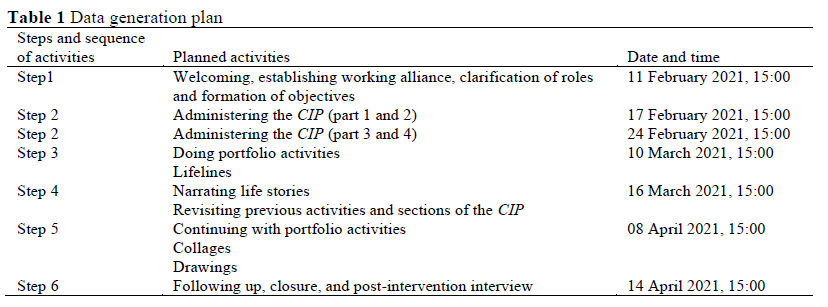
The intervention took place over a period of 7 weeks. Each session lasted approximately 50 to 60 minutes. The sessions were held at 15:00 after teaching and learning were completed. The sessions started in March 2021 and ended in April 2021. The sequence of steps used to generate data, the planned activities stipulated in the qualitative intervention, and the layout of the life-design-based intervention stages are shown in Table 1.
Data Analysis
Thematic data analysis, as proposed by Clarke and Braun (2017), was used to analyse the data. The six steps followed were familiarisation with the data, coding, searching for themes, reviewing themes, defining and naming themes, and writing the research report. Both inductive and deductive approaches were followed in identifying themes and sub-themes in the data. The deductive approach was used to code predetermined themes of career decision-making and adaptability whereas the inductive approach was used to code themes that emerged as participants' lived experiences.
Ethical Considerations
Ethical clearance for the research project was received from the university under which it was carried out (EDU153/20). Permission to gather data from the learners was received from the Mpumalanga Department of Education. The parents of the learners who participated in the project gave consent for their children to participate, and the learners provided assent before they could participate. Participation was voluntary, and participants could withdraw at any point in the process.
Findings (Results)
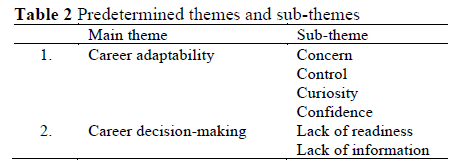
The themes that emerged were associated with the participants' lived experiences, their past and current career development, their future career aspirations, and the influence that the intervention had on their career decision-making and career adaptability. Four main themes emerged. The first two themes and sub-themes were predetermined, whereas the last two themes and sub-themes were identified inductively. The main themes and sub-themes that were identified are summarised in Tables 2 and 3.
Instances of participants' answers to questions that support their reflections and perceptions are presented below.
Deductively Identified Themes and Sub-themes
Theme 1: Career adaptability
Career adaptability is defined as "a psychological construct that denotes an individual's readiness and resources for coping with current and imminent vocational developmental tasks, occupational transitions and personal traumas" (Savickas, 2005:46). Four adaptability resources, also referred to as adapt-abilities (Johnston, 2018) are recognized, namely concern, control, curiosity, and confidence. All four resources were evident during the life-design intervention with the learners. In the next section, we present the resources in line with Kusyadi' s (2020) explanation, along with examples of learners' comments. Concern denotes the extent to which people think and care about their future and are involved in planning ahead and preparing their future careers. Such people are regarded as future-oriented. Participant (4;7;1;4-5): "I now want to study to become a psychologist so I can help people who suffer from depression and other mental sicknesses. Before I attended this programme, I did not know exactly what I wanted to do." Control refers to the extent to which people feel that they are responsible for managing their career path. It includes making personal decisions and being aware of building their careers. Participant (5;7;1;6-8): "At first, I was not sure about what I wanted to do after matric. However, after attending this project, I now know what I want and that it is within my power to achieve my aim. I have finally decided to be a skin doctor. I want to help people who have skin problems." Curiosity reflects the extent to which individuals explore different possibilities and information regarding the requirements and benefits of certain careers. Participant (11;7;2;45-50):
" When we started with this project, I did not know what I wanted to do for a career except being a traditional healer. After the research I started to take an interest in some of the study fields the researcher and I agreed upon and obtained more details about them. I still want to work with people, but I want to work in the field of nursing. However, I still want to find out more about other relatedfields of study as well'" Confidence refers to the extent of belief that individuals have about their ability to make informed career decisions. Confidence helps individuals in navigating and overcoming challenges when building their careers. Participant (8;7;3;70-71): "At the beginning of the programme I did not know exactly what I wanted to study for a career. Now I have decided that I will study law."
Theme 2: Career decision-making Sampson et al. (1992) maintain that decisions on career choice remain difficult, complicated, and challenging. They involve selecting an occupation, education programme, type of school, and work environment. The challenges of career decision-making are conceptualised as decision-making difficulties in the field of career guidance (Gati, Krausz & Osipow, 1996). Two challenges that emerged are a lack of readiness and information. The first relates to a lack of readiness regarding motivation to engage in the process of career decision-making (Gati et al., 1996).
Participant (7;1;1;15): I actually just do not know what I want to do after matric and about study options and am not motivated to find out more at this point but maybe you can assist me.
The second subtheme about difficulties in career decision-making relates to a lack of information about the self, which includes personal strengths and weaknesses.
Participant (2;1;2;31): My expectation is that you will help me investigate myself so that I know myself better, so that I know what I want in life and who I am.
Inductively Identified Themes and Sub-themes Theme 1: Sense of mastery Sense of mastery entails a situation where people feel that they have mastered certain skills and believe that they can build a career on them.
Subthemes
The health-enhancing power of participating in sport Participant (9;3): "When you participate in sport, you remain healthier than people who do not, and your physical structure looks good."
Healing power of music
Participant (3;7;4;84-86): "I enjoy making music so much. The sounds make me feel good and happier. I enjoy music more when I am stressed and tired."
Entrepreneurial/business orientation
Participant (12;5A;18): "My dream career is to become a businessman. I would like you to assist me get to get a CK (company key number) so I can start my own business."
Power of achieving goals enhances self-efficacy Participant (3;2;3;20): "By taking part in the intervention that was provided by the researcher, I have now gained confidence that I can become a musician."
Theme 2: Painful stories about the past Stories containing painful themes and events in participants' lives. These stories could help them to better construct their careers.
Negative influence of depression
Participant (4;5B;10): "I suffered depression and anxiety as a result of growing up without a father"'
Degrading effect of bullying
Participant (8;7;3;65-68): "I was a victim of bullying many times. I want to become a human rights lawyer to speakfor those who cannot speakfor themselves."
Impact of socio-economic factors Participant (3;7;4;76-79): "I lost both my parents a long time ago and my grandmother struggled to raise me. The poor conditions in which we live affected me to an extent that I lost confidence in myself but, since I attended this programme, I have gained my confidence and I see a better future'"
Lack of parental support
Participant (2;5B;5): "My parents do not support me in [almost] everything I try to do. They are overprotective and will not give me a chance to try new things."
Loss of loved ones
Participant (9;2;1;16-17): "In 2008 1 lost my father in a car accident and since then I was never sure if my career dream would come true."
Discussion
The aim of the study was to examine the influence of a life-design-intervention on the career adaptability and difficulties about career decision-making of learners who attended a semi-urban school. We posed the following research questions:
i. What were the main differences between the pre-and the post-intervention themes that emerged from the learners' (participants') narrative data?
ii. How did the intervention influence the learners' capacity for career decision-making?
These two questions are addressed sequentially below.
The Main Differences Between the Pre- and the Post-intervention Findings
The participants' statements revealed several differences between the themes and sub-themes prior to and after the intervention. During the pre-intervention interview most of the participants indicated that they experienced low career concern, control, curiosity, and confidence. Based on the themes and sub-themes that emerged from participants' post-intervention interviews, it can be deduced that their career adaptability had improved. Most of the participants started to indicate that they were focusing on educational trajectories and adopting a positive attitude to career decision-making (enhanced concern). Some of the participants were also beginning to take responsibility for the construction of their careers (control). Four of the participants indicated that they were exploring available alternatives to make career decisions that resonated with their personal goals (curiosity). Seven of the participants indicated that they had the capacity to deal successfully with challenges relating to career choices (confidence).
Themes and sub-themes that emerged during the post-intervention interview also revealed that most of the participants' career decision-making challenges had been resolved. Some of the participants indicated that they had been motivated to engage actively in the career decision-making process. Seven of the participants were able to make career decisions based on the information they had acquired about careers, themselves, their self-knowledge, their self-concept, and their career identity.
How did the Intervention Influence the Learners'
Capacity for Career Decision-making?
Adaptability
Although specifically addressing "learners' capacity for career decision-making", this research question also encompasses the concept of "career adaptability." In agreement with Hartung and Cadaret (2017) and Nota et al. (2016), we concur that improving individuals' career adaptability correlates positively with a reduction in their career indecision. At the beginning of the life-design-based intervention, during the pre-interview activity, all the participants indicated that they had not started planning for their future careers. When the intervention started, their concern was starting to grow. Only at the end of the intervention, during the post-intervention interview, did they indicate that their concern had grown and that they had started looking forward and focusing on educational and professional trajectories and adopting a positive attitude towards their future. This finding supports the findings of Nota et al. (2016) in a similar context. The findings in our study that show the development of participants' concerns about their careers because of the intervention correspond positively with findings by Che (2022), and Maree, Gerryts,
Fletcher and Olivier's (2019) who found that by increasing people's career adaptability resources, including career concern, is the central goal of career counselling.
During the pre-intervention interview, all the participants displayed a low sense of responsibility regarding the construction of their careers, as well as low or no sense of career control. Towards the end of the intervention, during the post-intervention interview, the participants started to indicate that because of the intervention their career control had increased. These findings correspond positively with those by Maree et al. (2019) and Maree and Symington (2015) regarding the use of career counselling based on group life-design principles to improve the employability of disadvantaged young adults.
In our study, the participants started to display career curiosity when they were involved in life-design activities. This finding corresponds positively with findings by Cadaret and Hartung (2021). In their study on the efficacy of group career construction with urban youth of colour, results indicate an increase in the participants' career curiosity following the intervention. The participants also indicated that the intervention had bolstered their capacity to deal successfully with several challenges regarding career choice. These findings suggest that the intervention helped to increase the participants' confidence and correspond positively with Cook and Maree's (2016) findings on the efficacy of career and self-construction to help Grade 11 learners manage career-related transitions.
Career decision-making
Career decision-making is part of a procedure during which people choose an occupation, education programme, type of school, or work environment (Sampson et al., 1992). Because decision-making about a career is a complex process, some people experience difficulties (career indecision) when they engage in the process (Penn & Lent, 2019). Such difficulties can be divided into three major categories - each associated with its own sub-categories. The first is a lack of readiness, the second a lack of information, and the third inconsistent information (Gati et al., 1996). In our study the participants displayed the first two categories of difficulties in career decisions, namely a lack of readiness and a lack of information, which are discussed below.
At the start of the life-design intervention, it became evident that the participants were not ready to engage in the decision-making process regarding their careers. When they began implementing the life-design intervention activities, they gathered information about different careers and career fields. They were also able to explore themselves, achieve a better understanding of their strengths and areas for development, and were increasingly motivated to start the career decision-making process. These findings correspond positively with those by Maree (2020a) in a study where career-construction counselling resulted in participants' improved career decision-making. However, they do not correspond positively with the findings by Di Fabio and Maree (2013) who found no difference in the pre- and postintervention scores of participants on a lack of readiness after the life-design intervention.
Almost all the participants indicated that they wanted the researchers to provide them with information about career fields and careers instead of them seeking information themselves. These findings support the findings of Albien and Naidoo (2017) in their study on deconstructing career myths and cultural stereotypes in a context of low-resourced township communities. During the life-design intervention activities, the participants were able to gain insight into themselves, their interests, strengths, and areas for growth. They were able to know and understand themselves better and to obtain information about different careers, career fields and the world of work. These findings correspond positively with those by Maree, Jordaan and Hartung (2022) in their study on group career-construction counselling with prospective university students from a disadvantaged background.
Inductively Identified Themes and Sub-themes
Sense of mastery
Yman, Helgadóttir, Kjellenberg and Nyberg (2023) found a strong positive correlation between participation in sport and better general health as well as increased physical activity levels. Likewise, participants indicated that they used music as a psychological resource and not only as a leisure activity. These findings correspond positively with those by Zanders (2012) who found that people intentionally listened to music to calm themselves and to relax. Most participants expressed a strong positive emotion about spending time and energy in entrepreneurial activities. They added that they planned to set up new business ventures at some point in the future (Thompson, 2009). The findings also correspond positively with those by Castillo and Fischer (2019) who found that entrepreneurial efficacy was a significant predictor of entrepreneurial intentions in their study on personal factors that predict entrepreneurial intentions in people with disabilities.
Rodinda and Eva (2023), in their study on the effects of self-efficacy on career decision-making in final-year students, found that students who had high levels of self-efficacy were prepared to invest considerable effort to attain their goals and could traverse the world of work with self-confidence, thus influencing their future career planning. The findings in our study also indicate that self-efficacy has the potential to positively influence learners' career decision-making.
Painful stories about the past
Maree (2020a) maintains that career-construction counselling helps people re-live and summarise their earliest stories, connect their present experiences, and construct new life themes in their career-lives. The findings of our study correspond strongly with Maree's (2020a) view that the intervention helped the participants re-experience their earliest stories and construct new life themes from them (Savickas, 2013; Stoltz, Hunt & Greenhill, 2023). Additionally, some of the participants came from a poor socio-economic background. - so poor that their background undermined their plans and dreams. However, despite these poor conditions, they became determined to work hard, especially academically, to ensure that they would one day be employed and improve their living conditions. These findings also correspond positively with those by Abdinoor (2020) in his study on the effect of gender and socio-economic categories on the self-efficacy on career decision-making and career adaptability of senior secondary school learners in northern Kenya.
Summarised Comments
In general, after the intervention, the participants displayed enhanced career decision-making as well as career adaptability. They felt empowered with the necessary knowledge to be able to make career decisions. The results of the research, therefore, suggest that the LDC effectively promoted participants' career decision-making.
Recommendations Recommendations for policy makers National departments of education could contemplate the incorporation of career counselling into schools during the early stages of education to empower learners to explore diverse career fields and become able to make informed choices regarding their subjects based on their desired career trajectories. To facilitate this, the Department of Education could prioritise the training and hiring of additional career counsellors, ensuring that all learners have access to career counselling throughout their formative school years. Moreover, it is crucial to provide continuous training for career counsellors, enabling them to stay updated on the latest developments in the dynamic world of work and careers. Policy makers could (for instance) explore the inclusion of LDC as a key component within school-based career counselling programmes. As part of this initiative, LO teachers could undergo comprehensive training in career counselling, encompassing life-design intervention. Equipping these teachers with the necessary skills will enable them to effectively support learners facing challenges in making informed career decisions.
Recommendations for practice
To enhance the effectiveness of their support, LO teachers and career counsellors could undergo training to assist learners in group settings and reach a broader audience. Additionally, career counsellors employing group-based strategies could complement these approaches with one-on-one sessions, allowing for a more in-depth exploration of individual learners' challenges about career decision-making. Expanding the scope of career counselling in schools, incorporating information about the self, such as identity, personal strengths, areas for growth, talents, and interests, is imperative. Moreover, it could encompass insight into the evolving world of work, recognising the contemporary requirement of technology skills across various professions (Cohen-Scali, Drabik-Podgórna, Podgórny, Duarte, Guichard, Aisenson, Di Fabio, Maree, Masdonati, Nota, Pouyaud, Ribeiro & Antonio, 2025).
Recommendations for future research Future researchers could investigate the factors contributing to difficulties in learners' career decision-making across diverse contexts within South African schools, with a specific focus on rural areas. To enhance the comprehensiveness of their research on the subjective and objective aspects of participants in career counselling, future researchers could employ a creative mix of qualitative and quantitative research approaches. Additionally, it is crucial for future researchers to assess the preparedness of LO teachers, evaluating both their knowledge and expertise in providing effective career counselling. Those lacking the requisite knowledge and expertise could benefit from attending targeted training programmes. Furthermore, when implementing life-design-based interventions, researchers could prioritise the inclusion of larger and more diverse participant groups, encompassing individuals from various socio-economic backgrounds.
Limitations of the Study
Firstly, both the school where the research was conducted and the participants were purposively chosen rather than randomly selected. Moreover, the research group was relatively small. A larger sample size would enhance diversity in terms of socioeconomic and cultural backgrounds, thereby increasing the transferability of the results to broader contexts. In addition, the subjective nature of the data sources and the interpretation and analysis processes introduced a potential challenge to the validity of participants' views and opinions.
Conclusion
The findings in our study indicate that life-design-based counselling for secondary school learners with career indecision may enhance their career adaptability resources, enabling them to gain a deeper understanding of careers, the self, and the world of work. Moreover, intervention may enhance participants' motivation to actively engage in their own career decision-making process. The positive outcomes of this intervention thus instil some confidence in its applicability to different groups of learners who share a similar context to that of those involved in the study. We argue that this research (although extremely limited in scope) contributes to the ongoing search for a feasible conceptual framework that can support reflection on individuals' career-lives and enhance their understanding of how change shapes their career paths and identities (Cohen-Scali et al., 2025).
Notesi . Published under a Creative Commons Attribution Licence.
Authors' Contributions
The manuscript was co-authored by the two authors. Dr Mahlangu was guided by Prof. Maree, who worked systematically with him to finalise and submit the manuscript, which is based on Dr Mahlangu's doctoral thesis.
Acknowledgement
We thank the learners for their participation in the study. We also express our appreciation to Mr Tim Steward for editing the text.
References
-
Abdinoor NM 2020. Socio-economic status, career decision-making self-efficacy, career maturity and gender with secondary school students in northern Kenya. International Journal of Multidisciplinary and Current Educational Research, 2(4):160-167. Available at https://www.ijmcer.com/wp-content/uploads/2023/07/IJMCER_S02401600167.pdf. Accessed 31 August 2026.
» https://www.ijmcer.com/wp-content/uploads/2023/07/IJMCER_S02401600167.pdf -
Abrahams F, Jano R & Van Lill B 2015. Factors influencing the career choice of undergraduate students at a historically disadvantaged South African university. Industry and Higher Education, 29(3):209-219.https://doi.org/10.5367/ihe.2015.0253
» https://doi.org/10.5367/ihe.2015.0253 -
Albien AJ 2020. Exploring processes of change in a life design career development intervention in socio- economically challenged youth. Journal of the National Institute for Career Education and Counselling, 45:6-14. https://doi.org/10.20856/jnicec.4502
» https://doi.org/10.20856/jnicec.4502 -
Albien AJ & Naidoo AV 2017. Deconstructing career myths and cultural stereotypes in a context of low resourced township communities [Special issue]. South African Journal of Education, 37(4):Art. # 1476, 12 pages. https://doi.org/10.15700/saje.v37n4a1476
» https://doi.org/10.15700/saje.v37n4a1476 - Bacanli F, Esici H & Özünlü MB 2013. Kariyer karar verme güçlüklerinin çeşitli değişkenlere göre incelenmesi [An examination of career decision- making difficulties according to several variables]. Turkish Psychological Counselling and Guidance Journal, 5(40):198-211.
-
Cadaret MC & Hartung PJ 2021. Efficacy of a group career construction interview with urban youth of colour. British Journal of Guidance & Counselling, 49(2):187-199. https://doi.org/1080/03069885.2020.1782347
» https://doi.org/1080/03069885.2020.1782347 - Castillo YA & Fischer JM 2019. Self-employment as career choice for people with disabilities: Personal factors that predict entrepreneurial intentions. Journal of Rehabilitation, 85(1):35-13.
-
Che J 2022. The influence of life design-based counselling on learners with career indecision from resource-constrained communities. PhD dissertation. Pretoria, South Africa: University of Pretoria. Available at https://repository.up.ac.za/handle/2263/85614. Accessed 31 August 2026.
» https://repository.up.ac.za/handle/2263/85614 -
Clarke V & Braun V 2017. Thematic analysis. The Journal of Positive Psychology, 12(3):297-298. https://doi.org/10.1080/17439760.2016.1262613
» https://doi.org/10.1080/17439760.2016.1262613 -
Cohen-Scali V, Drabik-Podgórna V, Podgórny M, Duarte ME, Guichard J, Aisenson G, Di Fabio A, Maree K, Masdonati J, Nota L, Pouyaud J, Ribeiro MA & Antonio DS 2025. New perspectives for life-design interventions in the anthropocene context. Australian Journal of Career Development, 34(1):5-17. https://doi.org/10.1177/10384162241307964
» https://doi.org/10.1177/10384162241307964 -
Cook A & Maree JG 2016. Efficacy of using career and self-construction to help learners manage career- related transitions. South African Journal of Education, 36(1):Art. # 1225, 11 pages. https://doi.org/10.15700/saje.v36n1a1225
» https://doi.org/10.15700/saje.v36n1a1225 -
Dean BA & Campbell M 2020. Reshaping work- integrated learning in post-COVID-19 world of work [Special issue]. International Journal of Work-Integrated Learning, 21(4):356-364. Available at https://files.eric.ed.gov/fulltext/EJ1271541.pdf. Accessed 31 August 2026.
» https://files.eric.ed.gov/fulltext/EJ1271541.pdf -
Devanshu D, Sandhu GG, Mittal H, Prajapati K & Kumar S 2023. Artificial intelligence based career development web counseling: A review. In Proceedings of the KILBY100 7th International Conference on Computing Sciences 2023 (ICCS 2023).https://doi.org/10.2139/ssrn.4490154
» https://doi.org/10.2139/ssrn.4490154 - Di Fabio A & Maree JG 2013. Career construction and life design: Heralding a new beginning to career counseling in the 21st century. In A Di Fabio & JG Maree (eds). Psychology of career counseling: New challenges for a new era. Hauppauge, NY: Nova Science.
- Gati I & Asher I 2001. The PIC model for career decision making: Prescreening, in-depth exploration, and choice. In FTL Leong & A Barak (eds). Contemporary models in vocational psychology: A volume in honour of Samuel H Osipow. Mahwa, NJ: Lawrence Erlbaum Associates.
-
Gati I, Krausz M & Osipow SH 1996. A taxonomy of difficulties in career decision making. Journal of Counseling Psychology, 43(4):510-526. https://doi.org/10.1037/0022-0167.43A510
» https://doi.org/10.1037/0022-0167.43A510 -
Ginevra MC, Di Maggio I, Nota L & Soresi S 2017. Stimulating resources to cope with challenging times and new realities: Effectiveness of a career intervention. International Journal of Educational Vocational Guidance, 17:77-96. https://doi.org/10.1007/s10775-016-9331-0
» https://doi.org/10.1007/s10775-016-9331-0 -
Grossen S, Grobler AA & Lacante M 2017. Repeated retention or dropout? Disputing Hobson's choice in South African township schools. South African Journal of Education, 37(2):Art. # 1367, 11 pages. https://doi.org/10.15700/saje.v37n2a1367
» https://doi.org/10.15700/saje.v37n2a1367 -
Guichard J 2009. Self-constructing. Journal of Vocational Behavior, 75(3):251-258. https://doi.org/10.1016/jjvb.2009.03.004
» https://doi.org/10.1016/jjvb.2009.03.004 -
Guichard J 2016. Une comparaison des apports des modèles de la construction de la carrière et de la construction de soi au life designing counseling [Life designing counselling: A comparison of the career construction and self-construction approaches]. Psychologie Française, 61(1):15-29. https://doi-org.uplib.idm.oclc.org/10.1016/j.psfr.2013.03.002
» https://doi-org.uplib.idm.oclc.org/10.1016/j.psfr.2013.03.002 -
Hartung PJ & Cadaret MC 2017. Career adaptability: Changing self and situation for satisfaction and success. In K Maree (ed). Psychology of career adaptability, employability and resilience. Cham, Switzerland: Springer. https://doi.org/10.1007/978-3-319-66954-0_2
» https://doi.org/10.1007/978-3-319-66954-0_2 -
Hartung PJ & Vess L 2016. Critical moments in career construction counselling. Journal of Vocational Behavior, 97:31-39. https://doi.org/10.1016/j.jvb.2016.07.014
» https://doi.org/10.1016/j.jvb.2016.07.014 - Holland JL 1997. Making vocational choices: A theory of vocational personalities and work environments (3rd ed). Odessa, FL: Psychological Assessment Resources.
-
Johnston CS 2018. A systematic review of the career adaptability literature and future outlook. Journal of Career Assessment, 26(1):3-30. https://doi.org/10.1177/1069072716679921
» https://doi.org/10.1177/1069072716679921 -
Kelly KR & Lee WC 2002. Mapping the domain of career decision problems. Journal of Vocational Behavior, 61(2):302-326. https://doi.org/10.1006/jvbe.2001.1858
» https://doi.org/10.1006/jvbe.2001.1858 -
Kirdök O 2018. Secondary school students' positive and negative perfectionism as a predictor of career development. Educational Research and Reviews, 13(20):696-703. https://doi.org/10.5897/ERR2018.3594
» https://doi.org/10.5897/ERR2018.3594 -
Kusyadi Y 2020. Career adaptability in various theories: Review through multicultural perspectives. JOMSIGN: Journal of Multicultural Studies in Guidance and Counseling, 4(1):14-27. Available at https://ejournal.upi.edu/index.php/JOMSIGN/article/view/21415/11916. Accessed 31 August 2026.
» https://ejournal.upi.edu/index.php/JOMSIGN/article/view/21415/11916 -
Mahlangu PP 2023. The effect of life-designed-based intervention on further education and training phase learners' career indecision. PhD dissertation. Pretoria, South Africa: University of Pretoria. Available at http://hdl.handlenet/2263/94706. Accessed 31 August 2026.
» http://hdl.handlenet/2263/94706 - Maree JG 2013. Counselling for career construction: Connecting life themes to construct life portraits: Turning pain into hope. Rotterdam, The Netherlands: Sense.
- Maree JG 2017. Career Interest Profile (CIP) version 6. Randburg, South Africa: JvR Psychometrics.
-
Maree JG 2019. Group career construction counseling: A mixed-methods intervention study with high school students. The Career Development Quarterly, 67(1):47-61. https://doi.org/10.1002/cdq.12162
» https://doi.org/10.1002/cdq.12162 -
Maree JG 2020a. Career construction counselling aimed at enhancing the narratability and career resilience of a young girl with a poor sense of self-worth. Early Child Development and Care, 190(16):2646-2662. https://doi.org/10.1080/03004430.2019.1622536
» https://doi.org/10.1080/03004430.2019.1622536 -
Maree JG 2020b. Innovating counseling for self- and career construction: Connecting conscious knowledge with subconscious insight. Cham, Switzerland: Springer. https://doi.org/10.1007/978-3-030-48648-8
» https://doi.org/10.1007/978-3-030-48648-8 -
Maree JG & Che J 2020. The effect of life design counselling on the self-efficacy of a learner from an environment challenged by disadvantages. Early Child Development and Care, 190(6):822-838. https://doi.org/10.1080/03004430.2018.1495629
» https://doi.org/10.1080/03004430.2018.1495629 -
Maree JG, Cook AV & Fletcher L 2018. Assessment of the value of group-based counselling for career construction. International Journal of Adolescence and Youth, 23(1):118-132. https://doi.org/10.1080/02673843.2017.1309324
» https://doi.org/10.1080/02673843.2017.1309324 -
Maree JG, Gerryts EW, Fletcher L & Olivier J 2019. Using career counselling with group life design principles to improve the employability of disadvantaged young adults. Journal of Psychology in Africa, 29(2):110-120. https://doi.org/10.1080/14330237.2019.1594646
» https://doi.org/10.1080/14330237.2019.1594646 -
Maree JG, Jordaan J & Hartung PJ 2022. Group career construction counseling with disadvantaged prospective university students. The Career Development Quarterly, 70(1):79-95. https://doi.org/10.1002/cdq.12285
» https://doi.org/10.1002/cdq.12285 -
Maree JG & Nortjé M 2022. Enhancing the sense of self of a mid-career woman through career construction counselling. International Journal for Educational and Vocational Guidance, 23:499-525. https://doi.org/10.1007/s10775-021-09520-0
» https://doi.org/10.1007/s10775-021-09520-0 -
Maree JG & Symington C 2015. Life design counselling effects on the career adaptability of learners in a selective independent school setting. Journal of Psychology in Africa, 25(2): 143-150. https://doi.org/10.1080/14330237.2015.1021531
» https://doi.org/10.1080/14330237.2015.1021531 - McMahon M 2010. Career counselling and storytelling: Constructing a 21st century narrative for practice. In H Ohlsson & H Borg (eds). Career development. New York, NY: Nova Science.
-
Naidoo AV, Visser M, De Wet M, Rabie S, Van Schalkwyk I, Boonzaier M, De Bruin G, Shirley L & Venter C 2019. A group-based career guidance intervention for South African high school learners from low-income communities. In JG Maree (ed). Handbook of innovative career counselling. Cham, Switzerland: Springer. https://doi.org/10.1007/978-3-030-22799-9
» https://doi.org/10.1007/978-3-030-22799-9 -
Nota L, Santilli S & Soresi S 2016. A life-designed-based online career intervention for early adolescents: Description and initial analysis [Special issue]. The Career Development Quarterly, 64(1):4-19. https://doi.org/10.1002/cdq.12037
» https://doi.org/10.1002/cdq.12037 -
Penn LT & Lent RW 2019. The joint roles of career decision self-efficacy and personality traits in the prediction of career decidedness and decisional difficulty. Journal of Career Assessment, 27(3):457-470. https://doi.org/10.177/1069072718758296
» https://doi.org/10.177/1069072718758296 -
Rawatlal KV 2022. Priorities in 21st century career counselling: Implications for counselling psychology training. African Journal of Career Development, 4(1):a59 https://doi.org/10.4102/ajcd.v4i1.59
» https://doi.org/10.4102/ajcd.v4i1.59 - Riessman CK 2008. Narrative methods for the human sciences. London, England: Sage.
-
Rodinda MR & Eva N 2023. The effect of self-efficacy on career decision-making in final year students. Indonesian Psychology Research, 5(1):34-42. https://doi.org/10.29080/ipr.v5i1.806
» https://doi.org/10.29080/ipr.v5i1.806 -
Sampson JP, Jr., Peterson GW, Lenz JG & Readon RC 1992. A cognitive approach to career services: Translating concepts into practice. The Career Development Quarterly, 41(1):67-74. https://doi.org/10.1002/j.2161-0045.1992.tb00360.x
» https://doi.org/10.1002/j.2161-0045.1992.tb00360.x -
Santilli S, Nota L & Hartung PJ 2019. Efficacy of a group career construction intervention with early adolescent youth. Journal of Vocational Behavior, 111:49-58. https://doi.org/10.1016/jjvb.2018.06.007
» https://doi.org/10.1016/jjvb.2018.06.007 -
Sathish AS, Rajkumar VS, Vijay V & Kathiravan C 2024. The significance of artificial intelligence in career progression and career pathway development. In A Khang (ed). AI-oriented competency framework for talent management in the digital economy: Models, technologies, applications, and implementation. Boca Raton, FL: CRC Press. https://doi.org/10.1201/9781003440901-2
» https://doi.org/10.1201/9781003440901-2 - Savickas ML 2005. The theory and practice of career construction. In SD Brown & RW Lent (eds). Career development and counseling: Putting theory and research to work. Hoboken, NJ: John Wiley & Sons.
-
Savickas ML 2012. Life design: A paradigm for career intervention in the 21st century. Journal of Counseling & Development, 90(1):13-19. https://doi.org/10.1111/j.1556-6676.2012.00002.x
» https://doi.org/10.1111/j.1556-6676.2012.00002.x - Savickas ML 2013. Career construction theory and practice. In SD Brown & RW Lent (eds). Career development and counseling: Putting theory and research to work (2nd ed). Hoboken, NJ: John Wiley & Sons.
- Savickas ML 2015. Life design counseling manual. Ravenna, OH: Author.
-
Savickas ML, Nota L, Rossier J, Dauwalder JP, Duarte ME, Guichard J, Soresi S, Van Esbroeck R & Van Vianen AEM 2009. Life designing: A paradigm for career construction in the 21st century. Journal of Vocational Behavior, 75(3):239-250. https://doi.org/10.1016/jjvb.2009.04.004
» https://doi.org/10.1016/jjvb.2009.04.004 -
Setlhare R, Wood L & Meyer L 2017. Exploring Group Life Design with teachers in the context of poverty related psychosocial challenges [Special issue]. South African Journal of Education, 37(4):Art. # 1493, 8 pages. https://doi.org/10.15700/saje.v37n4a1493
» https://doi.org/10.15700/saje.v37n4a1493 - Smith J, Ferns S, Kay J, Russell L, Marcus M, Wache D & Nielsen E 2019. The EDGE report: Enabling and evidencing enterprise and entrepreneurship through work-integrated learning. Australian Technology.
-
Stoltz KB, Hunt AN & Greenhill C 2023. Trauma informed use of the career construction interview. The Career Development Quarterly, 71(2): 135-146. https://doi.org/10.1002/cdq.12320
» https://doi.org/10.1002/cdq.12320 - Super DE 1990. A life-span, life-space approach to career development. In SD Brown & L Brooks (eds). Career choice and development: Applying contemporary theories to practice (2nd ed). San Francisco, CA: Jossey-Bass.
-
Thompson ER 2009. Individual entrepreneurial intent: Construct clarification and development of an internationally reliable metric. Entrepreneurship Theory and Practice, 33(3):669-694. https://doi.org/10.1111/j.1540-6520.2009.00321.x
» https://doi.org/10.1111/j.1540-6520.2009.00321.x -
Wang W & Siau K 2019. Artificial intelligence, machine learning, automation, robotics, future of work and future of humanity: A review and research agenda. Journal of Database Management, 30(1): 61-79. https://doi.org/10.4018/JDM.2019010104
» https://doi.org/10.4018/JDM.2019010104 -
Wessels CJJ & Diale BM 2017. Facebook as an instrument to enhance the career construction journeys of adolescent learners [Special issue]. South African Journal of Education, 37(4):Art. #1470, 12 pages. https://doi.org./10.15700/saje.v37n4a1470
» https://doi.org./10.15700/saje.v37n4a1470 -
Yang N, Yaung H, Noh H, Jang SH & Lee B 2017. The change of planned happenstance skills and its association with career-related variables during school-to-work transitions. International Journal of Educational Vocational Guidance, 17:19-38.https://doi.org/10.1007/s10775-016-9332-z
» https://doi.org/10.1007/s10775-016-9332-z -
Yman J, Helgadóttir B, Kjellenberg K & Nyberg G 2023. Associations between organised sports participation, general health, stress, screen-time= and sleep duration in adolescents. Acta Peadiatrica, 112(3):452-459. https://doi.org/10.1111/apa.16556
» https://doi.org/10.1111/apa.16556 -
Zanders ML 2012. The musical and personal biographies of adolescents with foster care experience. Qualitative Inquiries in Music Therapies, 7:71 -109. Available at https://www.researchgate.net/profile/Michael-Zanders/publication/339385823_The_Musical_and_Personal_Biographies_of_Adolescents_with_ Foster_Care_Experience/links/5e4e9e3392851c7f7f48ddea/The-Musical-and-Personal-Biographies-of-Adolescents-with-Foster-Care-Experience.pdf. Accessed 31 August 2026.
» https://www.researchgate.net/profile/Michael-Zanders/publication/339385823_The_Musical_and_Personal_Biographies_of_Adolescents_with_ Foster_Care_Experience/links/5e4e9e3392851c7f7f48ddea/The-Musical-and-Personal-Biographies-of-Adolescents-with-Foster-Care-Experience.pdf
Revised: 26 January 2026
Accepted: 9 March 2026
Published: 31 August 2026