Teacher candidates' non-cognitive skills and programme choices
Abstract
In the study reported on here we used a quantitative approach and aimed to describe the role of non-cognitive skills and demographic variables on teacher candidates' actual and aspired programme choices. The research sample comprised 596 teacher candidates studying at 7 teacher training departments at the Mersin University, Türkiye. Research data were obtained via the adjective-based personality scale (ABPS) developed in Türkiye by Bacanlı, İlhan and Aslan (2009). Personal information forms included a preference set to determine the aspirations of teacher candidates. Chi-square tests were implemented while exploring the relationship between aspired and enrolled programme choices and personality traits (used as a proxy for non-cognitive skills) and demographic variables. The findings show that personality traits and demographic variables had some effect on student teachers' choice of major subjects from particular programmes. However, the links and effects were not as strong and descriptive as shown in similar research in other countries. The results show a weak relationship between student teachers' aspirations, personality traits, and demographic variables. The relationships were observed mostly for pre-primary and Turkish language teacher candidates. The findings support the hypothesis that the strongest effect on students' choices of majors stems from neither their personality nor other variables; their choices probably stem from their test scores obtained in the centrally administered university entrance examination.
big-five personality traits; major choice; non-cognitive skills; teacher training
Introduction
In Türkiye, as in many other countries, students' programme choices and admission to higher education programmes, including faculties of education, are determined by scores related to cognitive skills (CS) (Berkant & Bahadır, 2019) but researchers argue that CS alone are not sufficient to be successful in education and the labour market - some non-cognitive skills (NCS) are also required (Anger & Heineck, 2010; Heckman & Rubinstein, 2001; Walker, 2020). Recent findings from countries with a high per capita gross domestic product (GDP) show evidence of rising returns to NCS (Edin, Fredriksson, Nybom & Öckert, 2022), however, research on the effect of NCS on students' choice of majors is scarce.
Education is one of the bases of development (Hanushek, Piopiunik & Wiederhold, 2019). To achieve quality education, it is important to understand which individuals want to become teachers, why they aspire to this profession, and whether they possess the necessary skills for teaching.
Although national documents indicate which non-cognitive skills student teachers should possess (Seferoğlu, 2004), practices that measure or predict NCS in candidate selection are quite new in most education systems.
In Türkiye, like in other Western countries, the choice of teacher training differs somewhat with regard to choosing majors. Literature suggests that student teachers differ from other students with regard to choice of majors in that they are motivated more by intrinsic factors such as interest in the profession. Extrinsic factors such as labour market outcomes are second in line (Eren, 2015; McLean, Taylor & Jimenez, 2019). Teachers entering the teaching profession in Türkiye are selected in a two-stage selection procedure. Firstly, candidates enter a centrally arranged written examination in which scores are obtained from multiple-choice questions related to general ability, culture, teaching formation, and field of teaching. Those who pass with a certain score are interviewed on their personal choices and CS. Questions like, Introduce yourself, Why do you want to be a teacher?, How do you measure student achievement?, et cetera are asked during such interviews, but a personality test is not administered. It might be argued that NCS should be determined in more sophisticated ways.
In this study we examined student teachers' programme choices and their aspirations in relation to their NCS proxied by their personality traits quantified through a big-five personality inventory. The hypothesis in this study was: Cognitive skills and demographic variables affect actual and aspired programme choices of teacher candidates in Türkiye. In the study NCS were proxied by personality traits. Personality traits imply some qualifications for persons who practice the teaching profession. However, although NCS may be useful or necessary for practitioners of the profession, candidates may ignore them when they evaluate their own capacity to be teachers. A model was developed to understand the contribution of these traits to teacher candidates' actual and aspired programme choices. In this model, the impact of candidates' actual programme choices and aspirations on each other were analysed. The sample was selected in one of the developing regions of Türkiye, a developing country.
Literature Review and Conceptual Framework
Skills and higher education (HE) demand
In this section, the concept "skills" and its relation with HE demand is reviewed. Secondly, sections concerning the reviews of NCS and personality traits which were assumed as a proxy to NCS are provided.
The concept, "skill", has two dimensions; cognitive skills (CS) and non-cognitive skills (NCS). CS are academic and technical skills that can be measured by standard exams. NCS are soft skills like perseverance, motivation, time preference, risk-taking behaviour, self-esteem, self-control, which cannot be measured easily. Still, studies show significant relationships between NCS and wage, school attendance, success at school, adolescent pregnancy, smoking habits, and delinquency (Anger & Heineck, 2010; Cunha & Heckman, 2007; Delaney, Harmon & Ryan, 2013; Heckman & Rubistein, 2001; Jacob, 2002; Krueger & Schkade, 2008; Somer & Goldberg, 1999).
Programme choice might be the most important decision made by students as this choice has an impact on school life, courses, social life, future expectations, the probability of employment, income, promotion, and other rewards (Humburg, 2013). Determinants of programme choice can be categorised into four groups (Bartolj & Polanec, 2012; Caner & Okten, 2010; Cavas, Cakiroglu, Cavas & Ertepinar, 2011; Delaney et al., 2013; Ergen, 2013; García-Valiñas, Muñiz-Pérez & Suárez-Pandiello, 2012; Jacob, 2002; Leppel, Williams & Waldauer, 2001; Wiswall & Zafar, 2015):
1) Individual factors: gender, race, ethnicity, return expectation, financial resources, CS and NCS, personality traits, risk aversion, academic scores, studying habits, political orientation, religious orientation;
2) Parental factors: income, education levels, family structure, employment status;
3) Social factors: role models, prestigious professions in society;
4) Factors related to the programme: quality of education, workload, employment opportunities, promotion and reward opportunities, social activities, guidance and publicity, return expectation, type of participation in the labour market, non-monetary preferences, probability of graduation.
Both CS (DesJardins & Bell, 2006; Lovenheim & Reynolds, 2011; Naylor & Smith, 2004) and NCS (Checchi, Fiorio & Leonardi, 2014; Filippin & Paccagnella, 2012) are strong determinants of HE demand and choice of major (Jacob, 2002). However, imperfect assessment of one's own skills puts investment in HE at risk (Ergen, 2013; García-Valiñas et al., 2012; Porter & Umbach, 2006). Traditional economic theories explain an individual's socio-economic success with higher CS (Anger & Heineck, 2010; Komarraju, Ramsey & Rinella, 2013; Schmitt, Keeney, Oswald, Pleskac, Billington, Sinha & Zorzie, 2009). Heckman, Stixrud and Urzua (2006), who discovered the intersection of economics and psychology, argue that NCS are at least as effective as CS on an individual's socio-economic success. Similarly, Van Loo and Toolsema (2005) suggest that almost all of the key skills which increase productivity and are welcomed by modern economies are NCS, like problem-solving skills, independence, verbal presentation/speaking skills, accuracy/attentiveness, and entrepreneurship/creativity.
Non-cognitive skills
NCS are skills that are difficult to define, demarcate and measure, and, unlike CS, NCS cannot be easily determined and scored through standard examinations. However, they increase productivity and affect socio-economic success (Heckman et al., 2006). Some NCS observed in the literature review were motivation, self-perception, self-control, study habits (Ransdell, Hawkins & Adams, 2001b), locus of control (Bowles, Gintis & Osborne, 2001), proactive thinking, introversion-extroversion (Hong, Horng, Lin & Chanlin, 2008), taste, preferences, risk-taking behaviour (Krueger & Schkade, 2008), locus of control and reciprocity (Anger & Heineck, 2010), assertiveness and competitiveness (Morton, 2011), self-productivity (Helmers & Patnam, 2011), tendency of violence and quarrelling (Howard, 2011), self-confidence (Filippin & Paccagnella, 2012), future orientedness (Delaney et al., 2013), empathy and ethical decision-making (Perkins, Burton, Dray & Elcock, 2013), autonomy (Humburg, 2013), creativity, self-efficiency, innovativeness, and persistence (Huber, Sloof & Van Praag, 2014).
Different approaches are used to measure NCS. The scholastic aptitude test (SAT) is used to measure CS for enrolment at universities in the United States of America (USA). In some states, in addition to CS, NCS are taken into account. In addition to other criteria, Harvard University evaluates compassion, curiosity, gratitude, grit, growth, mindset, perspective-taking, purpose, and self-control traits for admission (Wettje, Anderson & Weissbourd, 2020). The admission announcement of the University of Denver starts with "You are more than your grades", and requires applicants to complete a form in which the focus is on NCS (2020:para. 1). The number of countries and universities taking NCS into account has been growing steadily (Kulatunga-Moruzi & Norman, 2002).
A growing number of studies shows that NCS strongly impact individual's academic, economic, social, psychological, and physical well-being (Almlund, Duckworth, Heckman & Kautz, 2011; Borghans, Duckworth, Heckman & Ter Weel, 2008; Bowles et al., 2001; Lundborg, Nystedt & Rooth, 2014). Regarding academic success, research shows significant relationships between positive NCS like motivation, conscientiousness, empathy, ethical decision-making (Perkins et al., 2013), eagerness, diligence and tidiness (Cornwell, Mustard & Van Parys, 2013), locus of control, self-respect and professional ethics (Mendolia & Walker, 2014), openness to experience and conscientiousness (Almlund et al., 2011), self-discipline and studying habits (Duckworth & Seligman; 2005), self-efficacy, effort, pro-social behaviour and resilience (Rosen, Glennie, Dalton, Lennon & Bozick, 2010), school attendance, enrolment choice, academic success, successful graduation and willingness for education after graduation. NCS are not only important for general success; some studies show that NCS are among significant field-specific skills. For example, self-efficacy, self-concept, concern and self-belief have an impact on success in mathematics and English (Morony, Kleitman, Lee & Stankov, 2013; Stankov, Lee, Luo & Hogan, 2012) and the perseverance trait is a strong predictor of reading achievement, even for students who attend low-functioning schools in South Africa (Hofmeyr, 2021a).
Research also focuses on the consequences of programme choice and NCS relations. NCS were found to be more important than CS for academic success and graduation probability of female students in poor neighbourhoods, non-traditional students and minorities (Al-Sheeb, Hamouda & Abdella, 2019; Ardila, 2001; Borghans, Ter Weel & Weinberg, 2014; Lundberg, 2013; Ransdell, Hawkins & Adams, 2001a). King (2006) argues that due the importance of the NCS, they should be taken into account for admission to school, provision of financial aid, choice of programmes and courses, content development, and even design of the campus in order for universities to improve the functionality and quality of higher education. De Bruin (2007) also shows that certain personality traits act as predictors of readiness for self-directed learning, and HE institutions should facilitate environments in which these traits can be developed. NCS can also explain labour market outcomes like choice of profession, probability of admission to a profession, promotion, increase of income, increase in productivity, and inequalities that can't be explained by gender or race (Bowles et al., 2001; Fortin, 2008; Heckman & Rubinstein, 2001; Helmers & Patnam, 2011; Kuhn & Weinberger, 2005; Morton, 2011; Postlewaite & Silverman, 2006; Taylor, 2005; Weinberger, 2014).
Big-five/five factors personality traits model
Research by Borghans et al. (2008) has been the most cited research about economic and social returns of CS and NCS. This research claims that the big-five factors/five factors model (extraversion, agreeableness, conscientiousness, neuroticism, openness to experience) developed by Goldberg (1992) covers most NCS.
Personality is the sum of the individual's way of thinking, acting, feeling and behaving and the characteristics that distinguish the individual from other individuals (D'Souza & Saelee, 2014). Individuals' behaviour in different situations is explained by their continuous, interpersonal, emotional, motivational and experience-based interaction styles (McCrae & Costa, 1989). Resources of personality traits are discussed within a framework of biological, genetic, social and cultural factors in addition to personal experiences (D'Souza & Saelee, 2014; Merdan, 2013). Borghans et al. (2008) argue that individuals' personality traits are in a relationship with economics in terms of preferences because CS affect personality and personality affects CS. Individuals choose schools and professions according to both CS and personality traits to maximise their benefit/profit as rational actors. Personality inventories have been developed to measure personality traits. Big-five factors are adjective-based personality trait approximations. The big-five model, which is the most popular measurement and classification tool of personality traits has various versions, and each version has similar dimensions (Borghans et al., 2008; D'Souza & Saelee, 2014).
The history of studies to measure personality traits dates back to the 1930s. From an analysis of Webster's New International Dictionary, Allport and Odbert (1936) found 17,953 words describing personality traits which they reduced to 4,504 adjectives. Cattell (1946) grouped these adjectives as synonyms and antonyms and applied factor analysis. As a result of the factor analysis, 16 basic personality trait adjectives emerged. Goldberg grouped these adjectives into five dimensions and named them the big-five model (BFM): openness to experience, conscientiousness, extraversion, agreeableness, and neuroticism (OCEAN). These dimensions cover a wide range of individuals' emotional, interpersonal, experiential, attitudinal, and motivational characteristics (Costa & McCrae, 1992). According to Brunello and Schlotter (2011), the big five factors and opposites thereof are openness vs. closedness to experience, conscientiousness vs. lack of direction, extraversion vs. introversion, agreeableness vs. antagonism and neuroticism vs. emotional stability.
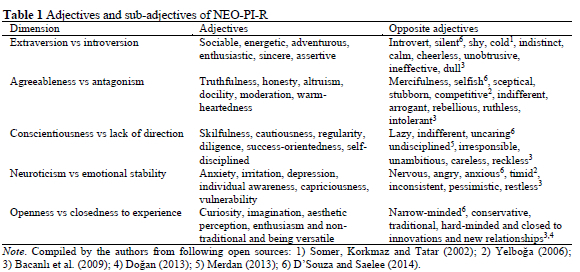
Based on BFM, Costa and McCrae (1992) developed the revised NEO personality inventory (NEO PI-R - neuroticism, extraversion, openness to experience, conscientiousness, agreeableness) which consists of six sub-adjectives for each dimension (see Table 1).
NEO-PI-R is the most preferred personality measurement instrument today (Borghans et al., 2008; D'Souza & Saelee, 2014). It has been successfully adapted into Dutch, German, Italian, Spanish, Slovak, Hebrew, Hungarian, Chinese, Filipino, Finnish, Polish and Russian, and validity and reliability studies show positive results. Similarly, Somer and Goldberg (1999) adapted NEO-PI-R into Turkish (Somer et al., 2002). This inventory consists of 187 items. A different 40-item adjective-based personality inventory in Turkish was developed by Bacanlı et al. (2009).
For teachers, studies show a significant relationship between discipline style and personality traits (Uğurlu, 2012); scoring technique and conscientiousness and openness to experience (Kopliman, 2007); motivation and job satisfaction and conscientiousness and openness to experience traits (Deniz, 2008; Oktay, 2007). Perera, Granziera and McIlveen (2018) identified four personality profiles (rigid, ordinary, well-adjusted and excitable) among teachers based on big-five data and show that personality traits have an impact on teaching self-efficacy, work engagement, and job satisfaction. Kim, Jörg and Klassen (2019) conducted a meta-analysis on the big-five personality domains and teachers' job effectiveness and burn-out and found that other than agreeableness, four traits have a positive impact on teachers' effectiveness and emotional stability, while extraversion and conscientiousness are negatively associated with burnout. Khalilzadeh and Khodi (2021) found another important impact of teachers' personality traits on students. Studies show that teachers' conscientiousness has a positive impact on students' intrinsic motivation and knowledge, but extraversion has a negative impact. Research evidence supports the significant impact of teachers' personality traits on teachers, students, and the education system. So, seeking favourable personality traits for effective teachers will enhance the quality of the selection process for teacher candidates and may prevent them from declining returns.
Methodology
Model
This research was a descriptive study aimed at determining whether significant relationships existed between CS, NCS, demographic variables and enrolled and aspired programme choices of student teachers at the Faculty of Education at the Mersin University in Türkiye. Programme choice was the dependent variable while CS, NCS, family background and individual variables were the independent variables.
The following equations were designed to be used to investigate these relationships:
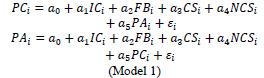
(PC: currently enrolled programme, PA: aspired programme choice, IC: individual characteristics, FB: family background, CS: cognitive skills, and NCS: non-cognitive skills). Within the scope of this research, enrolled programme refers to the programme for which the candidates were enrolled at the time and aspired programme choice (APC) refers to options that candidate teachers may aspire to study. The answers to the following question were used to determine their aspirations (of which only one choice could be selected): "If you have had enough opportunities (e.g. scholarship, loan, additional income, family approval, private course, additional course, guidance, etc.) which of the following would you have chosen?"
APC1. To study the same programme at the Mersin University,
APC2. To study a programme at the Mersin University but other than in the Faculty of Education,
APC3. To study another programme in the Faculty of Education at the Mersin University,
APC4. To study the same programme at a private university,
APC5. To study abroad,
APC6. To study the same programme at another university,
APC7. To study a programme in other than a faculty of education at another university,
APC8. To study the same programme in a faculty of education at another university,
APC9. To study another programme at a private university,
APC10. I would not have enrolled in HE.
Sample
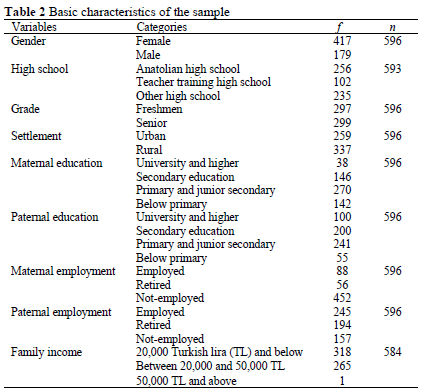
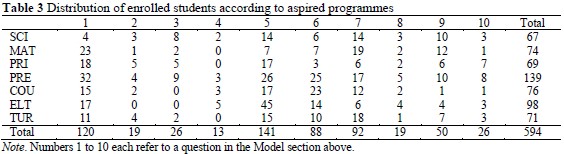
The research sample consisted of 596 teacher candidates (297 first- and 299 fourth-year students) from the Faculty of Education at the Mersin University in the 2015 to 2016 academic year (Table 2). According to Borghans et al. (2008), NCS are more open to development and change compared to CS in life span. Accordingly, NCS of the first and fourth years registered in the same programme may differ. That is why participants were chosen from different years. Participants from seven different programmes participated in the study: science teaching (SCI), mathematics teaching (MAT), primary school teaching (PRI), pre-primary school teaching (PRE), guidance and psychological counselling (COU), English language teaching (ELT), Turkish language teaching (TUR). Cochran's Q formula was used to determine the minimum number of participants in each programme (Table 3).
Studying abroad (n = 141) was the most preferred option for students from all programmes. The second option was studying the same programme at the Mersin University (n = 120) and the third option was studying a programme in other than a faculty of education at another university (n = 92). These findings imply that if students had enough opportunities (e.g. scholarship, loan, additional income, family approval, private course, additional course, guidance, etc.), their choices would have been different from their current choices.
Data Collection
The adjective-based personality scale (ABPS) was used to collect data about personality traits. ABPS was adapted from Goldberg's personality traits taxonomy by Bacanlı et al. (2009). Goldberg's five-factor personality traits taxonomy is the best known and accepted taxonomy in the literature (Bacanlı et al., 2009). Bacanlı et al. (2009) used direct oblimin rotations and principal component analysis methods to determine the factor structure of the test. The sociotrophy scale, reaction to conflicts scale, negative-positive emotion scale and trait anxiety inventory have been used to determine the concurrent validity of the scale. The test-re-test method (2-week interval) was used to evaluate reliability and Cronbach's alpha coefficient (between .73 and .89) was used to determine the internal consistency of the factors. The psychometric properties of the ABPS were found to be satisfactory and could be used to evaluate personality traits in undergraduate or graduate samples (Bacanlı et al., 2009).
In addition to NCS, data about other variables were collected using an information form that we had developed. The information form consists of two parts. The first part includes questions about demographic variables, family background and academic achievement. In the second part, a 10-choice question was used to determine the participants' aspired programme choices. For ethical procedures, we had permission from the developers of ABPS and the university. The data collection process took 2 months in the spring of 2016. Data were collected on a voluntary and availability basis.
Data Analysis
In Model 1, currently enrolled programme and aspired programme choices (PC and PA) are defined as dependent variables. PC takes the value (1) when the analysed programme corresponds with the programme in which the student is enrolled; otherwise, it takes the value (0). Likewise, PA takes value (1) when the aspired programme choice coincides with the option to the question shown in the Model section, and vice versa.
Independent variables of the model are scores of the personality trait test, which has five dimensions (openness to experience, conscientiousness, extraversion, agreeableness, and neuroticism), and variables related to education and family background (grade, day/evening shift, settlement, gender, parental education level, parental employment status, and high school graduated from). Although some questions were prepared to obtain university entrance examination (ÖSS) scores, ranks and undergraduate achievement scores (GPAs), participants did not carefully answer these questions - perhaps due to the so-called Lake Wobegon effect (Maxwell & Lopus, 1994); that is, they may have overestimated their academic performance or avoided accurate reporting to maintain a positive self-image. This left the model without any variables which approximates CS. PC and PA are also interchangeably entered in equations as independent variables.
Model 1 was originally planned to be analysed using logistic regression during the research design phase. However, due to inadequate CS data, estimation results yielded uninterpretable goodness-of-fit statistics. Therefore, Model 1 could not be approved empirically with the help of collected data, but it could still serve as a guide for correlation analysis. Because independent variables were categorical (0-1), parametric tests like t-test or analysis of variance (ANOVA) could not be performed. In order to test the relationships between programme choices and dependent variables, Pearson chi-square (χ2) tests were carried out independently.
Independent variables of Model 1 were further categorised for the sake of data analysis. The scores of the five factors that determine personality traits were obtained using a 7-point scale. Obtained scores were converted into three categories to create a meaningful category for the test. The score ranges are as follows: 1 = 1 to 3, 2 = 3 to 5, 3 = 5 to 7.
Data collected using the personal information form were quantified by allocating numerical values to categories. A numerical value of 1 to 7 was defined for each teacher training programme for the enrolled programme variable (PC). For example; 1 represents SCI programme and 7 represents TUR programme (see the Sample section above). The aspired programme variable (PA) was digitised by assigning values from 1 to 10 respectively for each option shown in the Model section. For the years variable, value 1 represents first and value 2 represents fourth years. For shift of education, value 1 represents students enrolled in daytime education, and value 2 represents students enrolled in evening education. For the gender variable, value 1 is for female and 2 is for male students. For the family settlement variable, 1 represents urban and 0 represents rural settlement areas. Regarding the educational status of the parents, 1 represents high school or HE and 0 represents lower than high school. For the parental employment status variable, 1 is for employed parents (public or private sector) and 0 is for non-employed or retired parents. For the variable for the type of high school graduate, value 1 shows that the student completed a selective (science and Anatolian) high school, and 0 if otherwise. The variable related to annual income is categorised numerically as well. Annual income categories are: 20,000 Turkish lira and below, between 20,000 TL and 50,000 TL, 50,000 TL and above. University entrance score, score type, ranking and GPA are numerical variables. However, enough data to analyse the effect of these variables on programme choice could not be collected using the data collection instrument. Results of the χ2 tests conducted to determine the relationship between the dependent and independent variables are presented in the findings section.
Results
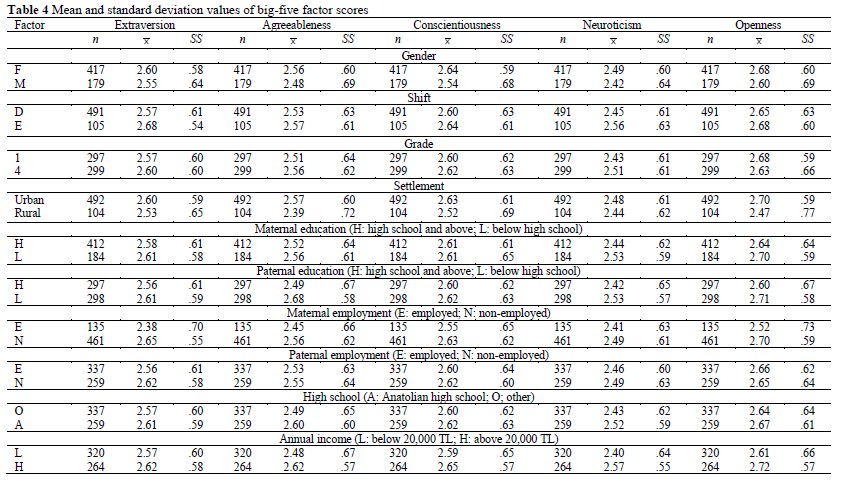
Arithmetic mean and standard deviation values were computed from the data collected from teachers via the ABPS scale and are provided in Table 4.
Table 4 indicates that the arithmetic mean and standard deviation values obtained from the sample are relatively similar. With a few exceptions, ABPS scores do not exhibit statistically significant differences across the independent variables. The arithmetic means and standard deviation scores of ABPS sub-dimensions (extraversion, agreeableness, conscientiousness, neuroticism, openness to experience) point out that the scores of the sample indicate the mean value. The ABPS scores are used as a substitute for the NCS of the sample. The ABPS sub-dimension scores in addition to the demographic and academic variables are considered variables that affect the candidates' programme choices.
Findings of χ2 Analysis According to Enrolled Programme
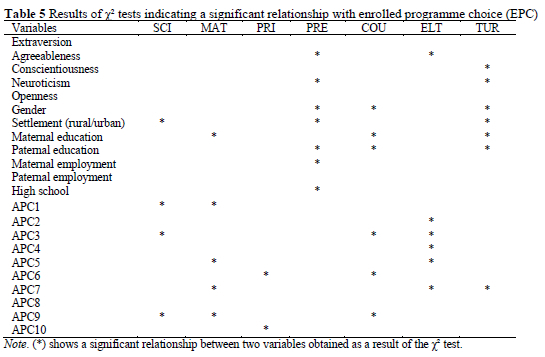
In this section, responses to the following questions are presented: "Is there a relationship between teacher candidates' enrolled programme choices (EPC) and their NCS (personality traits)" and "Is there a relationship between students' EPC and variables related to their individual, educational and family background?" The test results for science teaching (SCI), mathematics teaching (MAT), primary school teaching (PRI), pre-primary school teaching (PRE), guidance and psychological counselling (COU), English language teaching (ELT), and Turkish language teaching (TUR) are presented in Table 5.
Table 5 shows a significant relationship between EPC and the independent variables. There was a significant relationship between being enrolled in the SCI programme and family settlement, APC1, APC3 and APC9. The implication is that this programme was chosen by students from urban areas. A significant relationship was found between programme choices of students enrolled in the MAT programme, the maternal education variable, and APC1, APC5, APC7, APC9. The implication is that students whose maternal education was high school and above, choose the MAT programme. For the PRI programme, there was a significant relationship with APC6 and APC10. There was a significant relationship between being enrolled in the PRE programme and the agreeableness (62%) and neuroticism (54%) traits. So, it can be said these personality traits might affect the programme choice of the preschool teacher students. Also, there was a significant relationship between the programme choice of students and paternal education (51%), maternal employment (77%), gender and high school type. According to the findings, the PRE programme was chosen mostly by females who graduated from vocational school. A significant relationship was found between programme choice of students enrolled in the COU programme and three variables: gender (70%), maternal (70%) and paternal education (50%). Accordingly, this programme is preferred by females whose maternal education was lower than high school and whose paternal education was high school and above. Also, there was a significant relationship between being enrolled in the COU programme and APC3, APC6, APC9. There is a significant relationship between being enrolled in the ELT programme and the agreeableness trait (62%). Except for these, no significant relationship was found related to other personality traits and other variables. Significant relationships between being enrolled in the ELT programme and APC2, APC3, APC4, APC 5, APC7 were found. Moreover, according to the APBS scores, significant relationships existed between being enrolled in the TUR programme and conscientiousness (70%), neuroticism (54%), gender (70%), family settlement (83%), maternal education (70%), and paternal education (51%). These percentages mean that the TUR programme was preferred by females with high scores for the conscientiousness and neuroticism dimensions. Also, this programme was preferred by females whose maternal education was lower than high school and whose paternal education was high school and above. Finally, there was a significant relationship between choosing the TUR programme and APC7 (16%).
Relationship with the APC options means that if students would have had enough opportunities they would have preferred one of the APC options. The most preferred options for the study group (n = 596) were APC5 (n = 141), APC1 (n = 120), and APC7 (92). Students would prefer studying abroad, studying the same programme at the same university or studying a programme other than in a faculty of education at another university.
Findings of the χ2 Analysis According to Aspired Programme Choice
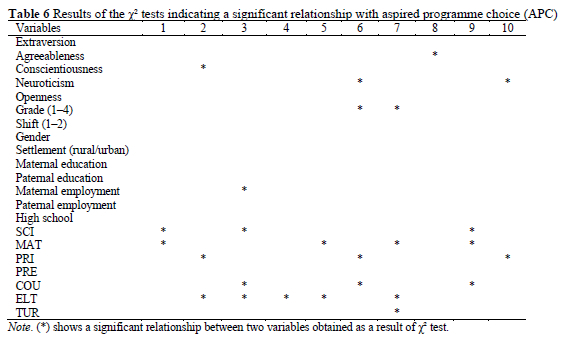
In this section, responses to the questions, "Is there a significant relationship between students' aspired programme choice and personality traits?" and "Is there a relationship between students' aspired programme choice and variables related to their individual, educational and family background?", are presented. An option set with 10 options was used to determine which option would have been chosen by students if they had been given enough opportunities. Students' choices were used to determine the relationship between aspired programme choice and enrolled programme, personality traits and other variables.
Table 6 presents the variables that indicated a significant relationship with aspired programme choices (APC). Significant relationships were found between APC1 (to study the same programme at the Mersin University) and being enrolled in the SCI and MAT programmes; secondly, between APC2 (to study a programme at the Mersin University other than in the Faculty of Education) and conscientiousness, and being enrolled in the ELT and PRI programme; thirdly, APC3 (to study another programme in the Faculty of Education at the Mersin University) and maternal education and being enrolled in the SCI, ELT and COU programmes. In the fourth instance, a significant relationship was found between APC4 (to study the same programme at a private university) and being enrolled in ELT; and in the fifth instance, between APC5 (to study abroad) and being enrolled in the MAT and ELT programmes. A significant relationship was found between APC6 (to study the same programme at another university) and neuroticism, being a first- or fourth-year student, being enrolled in primary school teaching and the counselling and guidance programme. Furthermore, a significant relationship was found between APC7 (to study a programme in other than a faculty of education at another university) and grade, being enrolled in the MAT, TUR and ELT programmes, as well as between APC8 (to study the same programme at a faculty of education at another university) and agreeableness. Significant relationships were also found between APC9 (to study another programme at a private university) and being enrolled in the SCI, MAT and COU programmes as well as between APC10 (I would not have enrolled in HE) and neuroticism and being enrolled in the PRI programme.
Discussion
The literature review reveals that the factors that affected HE students' choice of majors, of which the relative importance of NCS is one, have been researched in previous studies. Research findings related to South Africa were also addressed.
Socio-demographic variables like gender, family background, annual income, parental settlement, parental education, parental employment, cost of education and variables related to NCS had an effect on students' programme choices (Aliyev, 2008; Bartolj & Polanec, 2012; Beggs, Bantham & Taylor, 2008; Borghans et al., 2008; DesJardins & Bell, 2006; Ergen, 2013; Prakasam & Mukesh, 2019). Studies about demographic variables which effected or related to future teachers' occupation and programme choices show that the teaching occupation is preferred by students from lower-middle class families whose parental education is high school or lower than high school. Also, studies show that numerical programmes like mathematics and physics are preferred by males while pre-school, primary school and language teaching programmes are preferred by females (Akbayır, 2002; Ergen, 2013; Leppel et al., 2001; Sovansophal & Shimizu, 2019).
According to Heckman et al. (2006) CS and NCS can equally explain skills acquisition, market productivity and many different forms of behaviour. NCS are thus as important as CS in many ways. Personality traits are proxies of NCS. Studies related to personality traits, basically the big-five personality traits, show a significant relationship between personality traits and programme choice. Getzels and Jackson (1963) state that there is a surprising amount of diversity in teachers' personality traits when analysed according to gender, level of teaching service, and area of specialisation. Sayed and McDonald (2017) show that both extrinsic (future salary, bursaries, job security) and intrinsic factors (personality traits, beliefs, future goals) are important to enrol in a teacher training programme. Balsamo, Lauriola and Saggino (2012) found that extraversion and conscientiousness are predictors of programme choice of high school students. Similarly, Humburg (2013) found that extraversion, conscientiousness, neuroticism and autonomy affected students' programme choices. Even in some cases, NCS were more effective than cognitive abilities such as mathematical ability, linguistic ability and problem-solving ability in programme choice. Mendolia and Walker (2014) show that students with higher scores on internal locus of control, self-esteem, business ethics and conscientiousness are more likely to choose mathematics and science programmes while students with higher scores on openness to experience and creativity are more likely to choose linguistic programmes. Another study shows that the ELT programme is mostly chosen by students who describe themselves as agreeable and open to experience (Vural, 2019). Berkant and Bahadır (2019) show that students' personality traits, interests and abilities may have an effect on choosing HE programmes.
Some other studies show that personality traits are not just important for the teaching profession. Genç, Kaya and Genç (2007) found that personality traits like helpfulness and carefulness were more effective than academic achievement in the medical faculty. Similarly, Cavas et al. (2011) show that for engineering students, personal interest, curiosity, creativity and independence are as important as academic scores for career choice. Krueger and Schkade (2008) show that students who describe themselves as extravert prefer professions that require communication.
Morgan and De Bruin (2010) show several significant relationships between personality traits and burnout with personality explaining a sizeable degree of variance in burnout among university students in South Africa. Research in South Africa relates NCS as an important factor contributing to learning production (Hofmeyr, 2021b). This contribution might have been realised through teacher development. South Africa aims at providing quality education to all learners and ensuring a better future for all citizens for which qualified teachers are needed. According to Sayed and McDonald (2017), South Africa's teacher training system needs both top achievers and prospective teachers with personality traits like being zealous, inspired and creative to pursue studies in education. This study implies that being a top achiever in high school is not enough to becoming a good teacher. Also, Christiansen and Bertram (2019) states that teachers in South Africa might have developed more confidence in some areas. Therefore, the contribution of NCS may differ in relation to programme choices in teaching. Other research aimed to conduct a baseline study on personality traits of student teachers to assess the possible implications for an optimal person-environment fit or unfortunate misfit in the South African context shows a relationship between personality traits and enrolling in a teacher training programme. The study proves the usefulness of personality assessment in the selection of student teachers in other teacher training contexts, and the NEO-five factor inventory shows promise in this regard (Kok & Meyer, 2018).
Concerning literature in Türkiye, the effect of NCS on choosing a teacher training major was not a popular issue. Some researchers claim that NCS are not an important factor. The findings of our study indicate that the relative importance of NCS is low in both the actual and intended programme choices of Turkish teacher candidates. While some research findings emphasise the importance of intrinsic motivation factors for teacher candidates (such as Eren, 2015) others put forward factors such as employability, future earnings, and family background (Bozgeyikli, Görgülü & Boğazlıyan, 2023), which might be seen as related to extrinsic motivation factors.
Conclusion
As mentioned before, more and more literature proves the impact of personality traits on the choice of profession, partner and lifestyle, and for teachers' choice of programmes. The findings in this study on the sample from the Mersin University show that the teaching profession is preferred by students who come from lower-middle income families with low parental education. But, with regard to personality traits, in contrast to literature, there was a weak and sometimes no relationship between students' personality traits and both their enrolled programmes and their aspired programme choices.
Yazici and Yazici (2010) found that the main determinants in Turkish students' programme choices were job guarantees, domain-specific interest, and return expectation. Similarly, Akyıldız (2017) found that the three most important factors determining high school students' choices are job guarantees, social security and being beneficial to humanity. Because of the student admission system in Türkiye, academic scores and test scores are more important in programme choice. That is why students make their choices according to their academic achievements. As in other countries, quotas in Türkiye are determined by the Student Selection and Placement Center. Students with higher academic scores are more likely to be enrolled in programmes to which they aspire. But it is a risk for students from lower income status, minorities, and non-traditional students. They tend to make decisions based on their academic scores rather than incur the opportunity cost of taking a gap year due to their high level of risk aversion (Caner & Okten, 2010). This situation would lead to skill-school mismatch and in the case of teachers, ineffective teachers and ineffective investments in education.
Research findings support the assumptions about the relationship between demographic variables and programme choice, but the level of relationship between personality traits and programme choice is weaker than in similar studies. As a result, it can be said that academic scores and partial socio-economic variables are more important than interest or personality traits in student teachers' programme choices. These results show the necessity of a system revision for student admission.
Overall, this study contributes to the literature by adding evidence showing that NCS are not an explanatory factor in teacher candidates' actual and aspired major choices. In particular, students do not take their personality traits into account while choosing a teacher training programme as an HE pathway. On the other hand, from 2016, when a coup attempt was executed in Türkiye, teachers have been selected through interviews in addition to a centrally executed competitive examination. One might have expected the authorities to also have considered NCS while evaluating the competency of teacher candidates. Teacher selection procedures mostly ignore NCS in both written and oral examinations. Authorities should consider that when they ignore NCS in selection, teacher candidates also ignore evaluation of their NCS in major choices. In practice, this study reveals the importance of taking NCS into consideration for teacher selection procedures.
Limitations and Future Research Directions One of the limitations of this research is related to the model of the study. Although the model was proposed as shown in the methodology section (Model 1), collected data did not support a plausible model. This was partly due to inconsistent information gathered from subjects. Students in the Faculty of Education did not provide reliable information concerning their past and current CSs. This issue was related to the Lake Wobegon effect as students refrained from expressing their low achievement scores (Maxwell & Lopus, 1994). In order to overcome this deficiency by maintaining the objectives of the study, we followed a nonparametric analysis. However, this analysis did not provide estimated parameters justified within a model. More complex models and more reliable data covering CSs as well, are recommended to be employed by future researchers.
The sample in this study included teacher candidates enrolled at only one teacher training institute. The inclusion of students from other institutions would probably increase the generalisability of the study. Therefore, the results of the study represent the opinions of students from the Faculty of Education at the Mersin University. The Mersin University is generally preferred by students from the Mediterranean region, eastern Anatolia and the south-eastern Anatolia regions, from which the sample of the study was drawn. Socio-economic background and cultural similarities of the students have made the Mersin University a regional university (Gizir, 2010). The same research should be carried out with the same measurement instrument on different samples in order to make a comparison or generalisation.
The data in this study represent the opinions of teacher candidates before some important changes in the world and the country were experienced. No recent studies were published in relation to NCS and programme choices of teacher candidates. Türkiye, together with the rest of the world, survived the Coronavirus disease (COVID-19) pandemic. Other changes might have resulted from the earthquakes in February 2023 and economic troubles caused by high inflation. The effects of the pandemic may include a negative effect of HE students from low-income families (Aujeco, French, Ugalde Araya & Zafar, 2020). Another negative effect may be over-education (Hao & Wang, 2022). In Türkiye, like in most of Western countries, there is a strong relationship between extrinsic motivation and HE choices (Bozgeyikli et al., 2023). Concerning teacher candidates, however, career choices were positively related to their intrinsic motivation (Eren, 2015).
The sources of motivation might be an indicator of teacher candidates' personality traits. It is recommended that future research investigate whether NCS remain ineffective in influencing the major choices of teacher candidates in the aftermath of COVID-19, recent earthquakes, and ongoing economic crises. Overall, the findings suggest that decisions on higher education (HE) entrance are still primarily shaped by other factors.
The overall findings show that HE entrance examination scores and intrinsic motivation are most probably determining factors in the programme choices of teacher candidates in Türkiye.
Authors' Contributions
Both authors worked collaboratively.
Notesi. This article emanated from the Master of Arts (M.A.) thesis by Serpil Karakiraz (née Kalkan) submitted to the Mersin University Institute of Educational Sciences under supervision of the first author.
ii. Published under a Creative Commons Attribution Licence.
References
- Akbayır K 2002. Öğretmenlik mesleğine yönelmede ailenin ve branş seçiminde cinsiyetin rolü [The role of family in the orientation to profession and the role of gender in major choice]. Paper presented at V. National Education of Science and Mathematics Congress, Ankara, Türkiye, 16-18 September.
- Akyıldız M 2017. Fen lisesi öğrencilerinin meslek seçimini etkileyen faktörlerin ve meslek tercihlerinin Bulanık TOPSIS yöntemi ile incelenmesi [The examination of the factors affecting the career choices of science high school students and their career preferences using the Fuzzy TOPSIS method]. M.A. thesis. Yozgat, Türkiye: Yozgat Bozok University.
-
Aliyev P 2008. Beş faktörlü kişilik özellikleri ve cinsiyet rollerinin üniversite alan seçimi ile ilişkisinin incelenmesi [An investigation on relationships between university field preference and Five Factor Personality traits with sex roles]. Master's thesis. Istanbul, Türkiye: Istanbul University. Available at https://nek.istanbul.edu.tr/ekos/TEZ/43915.pdf. Accessed 20 May 2025.
» https://nek.istanbul.edu.tr/ekos/TEZ/43915.pdf -
Allport GW & Odbert HS 1936. Trait-names: A psycho-lexical study. Psychological Monographs, 47(1):i-171. https://doi.org/10.1037/h0093360
» https://doi.org/10.1037/h0093360 -
Almlund M, Duckworth AL, Heckman J & Kautz T 2011. Personality psychology and economics. In EA Hanushek, S Machin & L Woessmann (eds). Handbook of the economics of education (Vol. 4). Amsterdam, The Netherlands: Elsevier. https://doi.org/10.1016/B978-0-444-53444-6.00001-8
» https://doi.org/10.1016/B978-0-444-53444-6.00001-8 -
Al-Sheeb BA, Hamouda AM & Abdella GM 2019. Modeling of student academic achievement in engineering education using cognitive and non-cognitive factors. Journal of Applied Research in Higher Education, 11(2):178-198. https://doi.org/10.1108/JARHE-10-2017-0120
» https://doi.org/10.1108/JARHE-10-2017-0120 -
Anger S & Heineck G 2010. Do smart parents raise smart children? The intergenerational transmission of cognitive abilities. Journal of Population Economics, 23(3):1105-1132. https://doi.org/10.1007/s00148-009-0298-8
» https://doi.org/10.1007/s00148-009-0298-8 -
Ardila A 2001. Predictors of university academic performance in Colombia. International Journal of Educational Research, 35(4):411-117. https://doi.org/10.1016/S0883-0355(01)00038-6
» https://doi.org/10.1016/S0883-0355(01)00038-6 -
Aujeco EM, French J, Ugalde Araya MP & Zafar B 2020. The impact of COVID-19 on student experiences and expectations: Evidence from a survey. Journal of Public Economics, 191:104271. https://doi.org/10.1016/j.jpubeco.2020.104271
» https://doi.org/10.1016/j.jpubeco.2020.104271 -
Bacanlı H, İlhan T & Aslan S 2009. Beş faktör kuramına dayalı bir kişilik ölçeğinin geliştirilmesi: Sıfatlara Dayalı Kişilik Testi (SDKT) [Development of a personality scale based on Five Factor Theory: Adjective Based Personality Test (ABPT)]. Türk Eğitim Bilimleri Dergisi, 7(2):261-279. Available at https://dergipark.org.tr/tr/download/article-file/256271. Accessed 20 May 2025.
» https://dergipark.org.tr/tr/download/article-file/256271 -
Balsamo M, Lauriola M & Saggino A 2012. Personality and college major choice: Which come first? Psychology, 3(5):399-405. https://doi.org/10.4236/psych.2012.35056
» https://doi.org/10.4236/psych.2012.35056 -
Bartolj T & Polanec S 2012. College major choice and ability: Why is general ability not enough? Economics of Education Review, 31(6):996-1016. https://doi.org/10.1016/j.econedurev.2012.07.010
» https://doi.org/10.1016/j.econedurev.2012.07.010 - Beggs JM, Bantham JH & Taylor S 2008. Distinguishing the factors influencing college students' choice of major. College Student Journal, 42(2):381 -394.
-
Berkant HG & Bahadır S 2019. On ikinci sınıf öğrencilerinin yükseköğretim programı seçimlerini etkileyen faktörler ve öğretmenlik programlarını tercih etme durumları [Factors affecting twelfth grade students' higher education choices and their preferences for teacher education programs]. OPUS Uluslararası Toplum Araştırmaları Dergisi, 11(18):1897-1940. https://doi.org/10.26466/opus.567578
» https://doi.org/10.26466/opus.567578 -
Borghans L, Duckworth AL, Heckman JJ & Ter Weel B 2008. The economics and psychology of personality traits. Journal of Human Resources, 43(4):972-1059. https://doi.org/10.3368/jhr.43.4.972
» https://doi.org/10.3368/jhr.43.4.972 -
Borghans L, Ter Weel B & Weinberg BA 2014. People skills and the labor-market outcomes of underrepresented groups. ILR Review, 67(2):287-334. https://doi.org/10.1177/001979391406700202
» https://doi.org/10.1177/001979391406700202 -
Bowles S, Gintis H & Osborne M 2001. Incentive-enhancing preferences: Personality, behavior, and earnings. American Economic Review, 91(2):155-158. https://doi.org/10.1257/aer.91.2.155
» https://doi.org/10.1257/aer.91.2.155 -
Bozgeyikli H, Görgülü Z & Boğazlıyan EE 2023. Is motivation towards university sufficient? The three-way interaction among gender, socioeconomic status, and academic motivation on perceived employability. Higher Education Research & Development, 42(4):801-815. https://doi.org/10.1080/07294360.2022.2128076
» https://doi.org/10.1080/07294360.2022.2128076 -
Brunello G & Schlotter M 2011. Non cognitive skills and personality traits: Labour market relevance and their development in education & training systems (IZA Discussion Paper No. 5743). Available at https://ssrn.com/abstract=1858066. Accessed 20 November 2019.
» https://ssrn.com/abstract=1858066 -
Caner A & Okten C 2010. Risk and career choice: Evidence from Turkey. Economics of Education Review, 29(6):1060-1075. https://doi.org/10.1016/j.econedurev.2010.05.006
» https://doi.org/10.1016/j.econedurev.2010.05.006 -
Cattell RB 1946. Personality structure and measurement: II. The determination and utility of trait modality. British Journal of Psychology. General Section, 36(3):159-174. https://doi.org/10.1111/j.2044-8295.1946.tb01117.x
» https://doi.org/10.1111/j.2044-8295.1946.tb01117.x -
Cavas B, Cakiroglu J, Cavas P & Ertepinar H 2011. Turkish students' career choices in engineering: experience from Turkey [Special issue]. Science Education International, 22(4):274-281. Available at https://files.eric.ed.gov/fulltext/EJ962815.pdf. Accessed 20 May 2025.
» https://files.eric.ed.gov/fulltext/EJ962815.pdf -
Checchi D, Fiorio CV & Leonardi M 2014. Parents' risk aversion and children's educational attainment. Labour Economics, 30:164-175. https://doi.org/10.1016/j.labeco.2014.04.001
» https://doi.org/10.1016/j.labeco.2014.04.001 -
Christiansen I & Bertram C 2019. Early schooling teachers' learning from a formal teacher development programme in South Africa. International Journal of Educational Development, 66:78-87. https://doi.org/10.1016/j.ijedudev.2019.01.004
» https://doi.org/10.1016/j.ijedudev.2019.01.004 -
Cornwell C, Mustard DB & Van Parys J 2013. Noncognitive skills and the gender disparities in test scores and teacher assessments: Evidence from primary school. The Journal of Human Resources, 48(1):238-264. https://doi.org/10.3368/jhr.48.1.236
» https://doi.org/10.3368/jhr.48.1.236 -
Costa PT, Jr & McCrae RR 1992. The five-factor model of personality and its relevance to personality disorders. Journal of Personality Disorders, 6(4):343-359. https://doi.org/10.1521/pedi.1992.6.4.343
» https://doi.org/10.1521/pedi.1992.6.4.343 -
Cunha F & Heckman J 2007. The technology of skill formation. American Economic Review, 97(2):31-47. https://doi.org/10.1257/aer.97.2.31
» https://doi.org/10.1257/aer.97.2.31 -
De Bruin K 2007. The relationship between personality traits and self-directed learning readiness in higher education students. South African Journal of Higher Education, 21(2):228-240. Available at https://journals.co.za/doi/epdf/10.10520/EJC37330. Accessed 19 May 2025.
» https://journals.co.za/doi/epdf/10.10520/EJC37330 -
Delaney L, Harmon C & Ryan M 2013. The role of noncognitive traits in undergraduate study behaviours. Economics of Education Review, 32:181-195. https://doi.org/10.1016/j.econedurev.2012.07.009
» https://doi.org/10.1016/j.econedurev.2012.07.009 - Deniz N 2008. İlköğretimde çalışan sınıf öğretmenlerinin kişilik özellikleri ile iş tatminleri arasındaki ilişkinin incelenmesi (Sultanbeyli İlçesi Örneği) [An analysis of the relationship between primary classroom teachers' personality traits and job satisfaction (a sample from Sultanbeyli district)]. Master's thesis. Istanbul, Türkiye: Yeditepe University.
-
DesJardins SL & Bell A 2006. Using economic concepts to inform enrollment management [Special issue]. New Directions for Institutional Research, 2006(132):59-74. https://doi.org/10.1002/ir.196
» https://doi.org/10.1002/ir.196 -
Doğan T 2013. Beş faktör kişilik özellikleri ve öznel iyi oluş [The five factor personality traits and subjective well-being]. Doğuş Üniversitesi Dergisi, 14(1):56-64. Available at https://dergipark.org.tr/tr/download/article-file/2152064. Accessed 16 May 2025.
» https://dergipark.org.tr/tr/download/article-file/2152064 - D'Souza JB & Saelee S 2014. The Influence of personality traits in relation to choice of major in university. Paper presented at the World Business and Economics Research Conference, Auckland, New Zealand, 24-25 February.
-
Duckworth AL & Seligman MEP 2005. Self-discipline outdoes IQ in predicting academic performance of adolescents. Psychological Science, 16(12):939-944. https://doi.org/10.1111/j.1467-9280.2005.01641.x
» https://doi.org/10.1111/j.1467-9280.2005.01641.x -
Edin PA, Fredriksson P, Nybom M & Öckert B 2022. The rising return to noncognitive skill. American Economic Journal: Applied Economics, 14(2):78-100. https://doi.org/100.10.1257/app.20190199
» https://doi.org/100.10.1257/app.20190199 -
Eren A 2015. 'Not only satisfied and responsible, but also hopeful': Prospective teachers' career choice satisfaction, hope, and personal responsibility. Cambridge Journal of Education, 45(2):149-166. https://doi.org/10.1080/0305764X.2014.930417
» https://doi.org/10.1080/0305764X.2014.930417 -
Ergen H 2013. Uncertainties and risks determining individual demand for higher education: A sample from Mersin University. Education and Science, 38(169):433-446. Available at https://core.ac.uk/download/pdf/270294046.pdf. Accessed 16 May 2025.
» https://core.ac.uk/download/pdf/270294046.pdf -
Filippin A & Paccagnella M 2012. Family background, self-confidence and economic outcomes. Economics of Education Review, 31(5):824-834. https://doi.org/10.1016/j.econedurev.2012.06.002
» https://doi.org/10.1016/j.econedurev.2012.06.002 -
Fortin NM 2008. The gender wage gap among young adults in the United States: The importance of money versus people. Journal of Human Resources, 43(4):884-918. https://doi.org/10.3368/jhr.43.4.884
» https://doi.org/10.3368/jhr.43.4.884 -
García-Valiñas M, Muñiz-Pérez M & Suárez-Pandiello J 2012. Affective education and school choice: The Spanish case. Procedia Economics and Finance, 1:158-167. https://doi.org/10.1016/S2212-5671(12)00019-6
» https://doi.org/10.1016/S2212-5671(12)00019-6 -
Genç G, Kaya A & Genç M 2007. İnönü Üniversitesi tıp fakültesi öğrencilerinin meslek seçimini etkiyen faktörler [Factors affecting career choice of medical faculty students at Inonu University]. İnönü Üniversitesi Eğitim Fakültesi Dergisi, 8(14):49-63. Available at https://dergipark.org.tr/en/download/article-file/92343. Accessed 16 May 2025.
» https://dergipark.org.tr/en/download/article-file/92343 - Getzels JW & Jackson PW 1963. The teacher's personality and characteristics. In NL Gage (ed). Handbook of research on teaching. Chicago, IL: Rand McNally.
- Gizir C (ed.) 2010. Mersin Üniversitesi öğrenci profili [Student profile at Mersin University]. Mersin, Türkiye: Mersin Üniversitesi Sağlık, Kültür ve Spor Dairesi Başkanlığı Psikolojik Danışma ve Rehberlik Merkezi.
-
Goldberg LR 1992. The development of markers for the Big-Five factor structure. Psychological Assessment, 4(1):26-42. https://doi.org/10.1037/1040-3590A1.26
» https://doi.org/10.1037/1040-3590A1.26 -
Hanushek EA, Piopiunik M & Wiederhold S 2019. The value of smarter teachers: International evidence on teacher cognitive skills and student performance. Journal of Human Resources, 54(4):857-899. https://doi.org/10.3368/jhr.54A0317.8619R1
» https://doi.org/10.3368/jhr.54A0317.8619R1 -
Hao Z & Wang Y 2022. Education signaling, effort investments, and the market's expectations: Theory and experiment on China's higher education expansion. China Economic Review, 75:101848. https://doi.org/10.1016/j.chieco.2022.101848
» https://doi.org/10.1016/j.chieco.2022.101848 -
Heckman JJ & Rubinstein Y 2001. The importance of noncognitive skills: Lessons from the GED testing program. American Economic Review, 91(2):145-149. https://doi.org/10.1257/aer.9L2.145
» https://doi.org/10.1257/aer.9L2.145 - Heckman JJ, Stixrud J & Urzua S 2006. The effects of cognitive and noncognitive abilities on labor market outcomes and social behavior. Journal of Labor Economics, 24(3):411-482.
-
Helmers C & Patnam M 2011. The formation and evolution of childhood skill acquisition: Evidence from India. Journal of Development Economics, 95(2):252-266. https://doi.org/10.1016/jjdeveco.2010.03.001
» https://doi.org/10.1016/jjdeveco.2010.03.001 -
Hofmeyr H 2021a. Perseverance, passion and poverty: Examining the association between grit and reading achievement in high-poverty schools in South Africa. International Journal of Educational Development, 83:102376. https://doi.org/10.1016/j.ijedudev.2021.102376
» https://doi.org/10.1016/j.ijedudev.2021.102376 -
Hofmeyr H 2021b. The role of non-cognitive skills in educational production in South Africa. PhD thesis. Stellenbosch, South Africa: Stellenbosch University. Available at https://scholar.sun.ac.za/server/api/core/bitstreams/bc8e6310-6256-42bc-822b-48b35fae60e1/content. Accessed 15 May 2025.
» https://scholar.sun.ac.za/server/api/core/bitstreams/bc8e6310-6256-42bc-822b-48b35fae60e1/content -
Hong JC, Horng JS, Lin CL & Chanlin LJ 2008. Competency disparity between pre-service teacher education and in-service teaching requirements in Taiwan. International Journal of Educational Development, 28(1):4-20. https://doi.org/10.1016/j.ijedudev.2006.12.004
» https://doi.org/10.1016/j.ijedudev.2006.12.004 -
Howard LL 2011. Does food insecurity at home affect non-cognitive performance at school? A longitudinal analysis of elementary student classroom behavior. Economics of Education Review, 30(1):157-176. https://doi.org/10.1016/j.econedurev.2010.08.003
» https://doi.org/10.1016/j.econedurev.2010.08.003 -
Huber LR, Sloof R & Van Praag M 2014. The effect of early entrepreneurship education: Evidence from a field experiment. European Economic Review, 72:76-97. https://doi.org/10.1016/j.euroecorev.2014.09.002
» https://doi.org/10.1016/j.euroecorev.2014.09.002 - Humburg M 2013. The effect of the big five personality traits on college major choice: Evidence from a Dutch longitudinal youth cohort study. Paper presented at European Association of Labour Economists 25th Annual Conference, Turin, Italy, 19-21 September.
-
Jacob BA 2002. Where the boys aren't: Non-cognitive skills, returns to school and the gender gap in higher education. Economics of Education Review, 21(6):589-598. https://doi.org/10.1016/S0272-7757(01)00051-6
» https://doi.org/10.1016/S0272-7757(01)00051-6 -
Khalilzadeh S & Khodi A 2021. Teachers' personality traits and students' motivation: A structural equation modeling analysis. Current Psychology, 40(4):1635-1650. https://doi.org/10.1007/S12144-018-0064-8
» https://doi.org/10.1007/S12144-018-0064-8 -
Kim LE, Jörg V & Klassen RM 2019. A meta-analysis of the effects of teacher personality on teacher effectiveness and burnout. Educational Psychology Review, 31(1):163-195. https://doi.org/10.1007/s10648-018-9458-2
» https://doi.org/10.1007/s10648-018-9458-2 -
King JE 2006. Gender equity in higher education: 2006 (American Council on Education Working Paper). Washington, DC: American Council on Education Center for Policy Analysis. Available at https://www.acenet.edu/news-room/Pages/Gender-Equity-in-Higher-Education-2006.aspx. Accessed 12 April 2016.
» https://www.acenet.edu/news-room/Pages/Gender-Equity-in-Higher-Education-2006.aspx -
Kok R & Meyer L 2018. Towards an optimal person-environment fit: A baseline study of student teachers' personality traits. South African Journal of Education, 38(3):Art. #1409, 12 pages. https://doi.org/10.15700/saje.v38n3a1409
» https://doi.org/10.15700/saje.v38n3a1409 -
Komarraju M, Ramsey A & Rinella V 2013. Cognitive and non-cognitive predictors of college readiness and performance: Role of academic discipline. Learning and Individual Differences, 24:103-109. https://doi.org/10.1016/j.lindif.2012.12.007
» https://doi.org/10.1016/j.lindif.2012.12.007 -
Kopliman S 2007. Öğretmenlerin kişilik özelliklerinin öğrencilere not verme davranışları üzerindeki etkisi [The effect of teachers' personalities on their grading behaviors]. Master's thesis. Istanbul, Türkiye: Beykent University. Available at https://acikbilim.yok.gov.tr/bitstream/handle/20.500.12812/712828/yokAcikBilim_9005541.pdf?sequence=-1 & isAllowed=y. Accessed 10 May 2025.
» https://acikbilim.yok.gov.tr/bitstream/handle/20.500.12812/712828/yokAcikBilim_9005541.pdf?sequence=-1 & isAllowed=y -
Krueger AB & Schkade D 2008. Sorting in the labor market: Do gregarious workers flock to interactive jobs? The Journal of Human Resources, 43(4):859-883. https://doi.org/10.3368/jhr.43A859
» https://doi.org/10.3368/jhr.43A859 - Kuhn P & Weinberger C 2005. Leadership skills and wages. Journal of Labor Economics, 23(3):395-436.
-
Kulatunga-Moruzi C & Norman GR 2002. Validity of admissions measures in predicting performance outcomes: The contribution of cognitive and non-cognitive dimensions. Teaching and Learning in Medicine, 14(1):34–42. https://doi.org/10.1207/S15328015TLM1401_9
» https://doi.org/10.1207/S15328015TLM1401_9 -
Leppel K, Williams ML & Waldauer C 2001. The impact of parental occupation and socioeconomic status on choice of college major. Journal of Family and Economic Issues, 22(4):373-394. https://doi.org/10.1023/A:1012716828901
» https://doi.org/10.1023/A:1012716828901 - Lovenheim MF & Reynolds CL 2011. Changes in postsecondary choices by ability and income: Evidence from the National Longitudinal Surveys of Youth. Journal of Human Capital, 5(1):70-109.
- Lundberg S 2013. The college type: Personality and educational inequality. Journal of Labor Economics, 31(3):421-141.
-
Lundborg P, Nystedt P & Rooth DO 2014. Height and earnings: The role of cognitive and noncognitive skills. Journal of Human Resources, 49(1):141- 166. https://doi.org/10.3368/jhr.49.1.141
» https://doi.org/10.3368/jhr.49.1.141 - Maxwell NL & Lopus JS 1994. The Lake Wobegon effect in student self-reported data. The American Economic Review, 84(2):201-205.
-
McCrae RR & Costa PT, Jr 1989. Rotation to maximize the construct validity of factors in NEO Personality Inventory. Multivariate Behavioral Research, 24(1):107-124. https://doi.org/10.1207/s15327906mbr2401_7
» https://doi.org/10.1207/s15327906mbr2401_7 -
McLean L, Taylor M & Jimenez M 2019. Career choice motivations in teacher training as predictors of burnout and career optimism in the first year of teaching. Teaching and Teacher Education, 85:204-214. https://doi.org/10.1016/j.tate.2019.06.020
» https://doi.org/10.1016/j.tate.2019.06.020 -
Mendolia S & Walker I 2014. The effect of personality traits on subject choice and performance in high school: Evidence from an English cohort. Economics of Education Review, 43:47-65. https://doi.org/10.1016/j.econedurev.2014.09.004
» https://doi.org/10.1016/j.econedurev.2014.09.004 - Merdan E 2013. Beş faktör kişilik kuramı ile iş değerleri ilişkisinin incelenmesi: Bankacılık sektöründe bir araştırma [Investigation of the relationship between five-factor personality theory and job values: A study in the banking sector]. Gümüşhane Üniversitesi Sosyal Bilimler Entstitüsü Elektronik Dergisi, 4(7):141-159.
-
Morgan B & De Bruin K 2010. The relationship between the big five personality traits and burnout in South African university students. South African Journal of Psychology, 40(2): 182-191. https://doi.org/10.1177/008124631004000208
» https://doi.org/10.1177/008124631004000208 -
Morony S, Kleitman S, Lee YP & Stankov L 2013. Predicting achievement: Confidence vs self-efficacy, anxiety, and self-concept in Confucian and European countries. International Journal of Educational Research, 58:79-96. https://doi.org/10.1016/j.ijer.2012.11.002
» https://doi.org/10.1016/j.ijer.2012.11.002 -
Morton JM 2011. The non-cognitive challenge to a liberal egalitarian education. Theory and Research in Education, 9(3):233-250. https://doi.org/10.1177/1477878511419563
» https://doi.org/10.1177/1477878511419563 -
Naylor RA & Smith J 2004. Determinants of educational success in higher education. In G Johnes & J Johnes (eds). International handbook on the economics of education. Cheltenham, England: Edward Elgar Publishing. https://doi.org/10.4337/9781845421694.00016
» https://doi.org/10.4337/9781845421694.00016 -
Oktay H 2007. İlköğretim ve ortaöğretim kurumlarında çalışan öğretmenlerin motivasyonu ve kişilik özellikleri arasındaki ilişkinin incelenmesi [The relationship between motivation and personality characteristics of primary and high schools]. Master's thesis. Istanbul, Türkiye: Yeditepe University. Available at https://acikbilim.yok.gov.tr/bitstream/handle/20.500.12812/344444/yokAcikBilim_9003857.pdf7sequence=-1 & isAllowed=y. Accessed 8 May 2025.
» https://acikbilim.yok.gov.tr/bitstream/handle/20.500.12812/344444/yokAcikBilim_9003857.pdf7sequence=-1 & isAllowed=y -
Perera HN, Granziera H & McIlveen P 2018. Profiles of teacher personality and relations with teacher self-efficacy, work engagement, and job satisfaction. Personality and Individual Differences, 120:171-178. https://doi.org/10.1016/j.paid.2017.08.034
» https://doi.org/10.1016/j.paid.2017.08.034 -
Perkins A, Burton L, Dray B & Elcock K 2013. Evaluation of a multiple-mini-interview protocol used as a selection tool for entry to an undergraduate nursing programme. Nurse Education Today, 33(5):465-469. https://doi.org/10.1016/j.nedt.2012.04.023
» https://doi.org/10.1016/j.nedt.2012.04.023 -
Porter SR & Umbach PD 2006. College major choice: An analysis of person-environment fit. Research in Higher Education, 47(4):429-449. https://doi.org/10.1007/s11162-005-9002-3
» https://doi.org/10.1007/s11162-005-9002-3 -
Postlewaite A & Silverman D 2006. Non-cognitive skills, social success, and labor market outcomes. Available at https://www.sas.upenn.edu/~apostlew/paper/pdf/ns.pdf. Accessed 15 May 2020.
» https://www.sas.upenn.edu/~apostlew/paper/pdf/ns.pdf -
Prakasam GR & Mukesh GR 2019. Enrolment by academic discipline in higher education: Differential and determinants. Journal of Asian Business and Economic Studies, 26(2):265-285. https://doi.org/10.1108/JABES-12-2018-0104
» https://doi.org/10.1108/JABES-12-2018-0104 -
Ransdell S, Hawkins CM & Adams R 2001a. A reaction to the commentaries. International Journal of Educational Research, 35(4):427-432. https://doi.org/10.1016/S0883-0355(01)00040-4
» https://doi.org/10.1016/S0883-0355(01)00040-4 -
Ransdell S, Hawkins CM & Adams R 2001b. Predicting academic performance of college students in the United States and in Estonia. International Journal of Educational Research, 35(4):351-352. Available at https://eric.ed.gov/?id=EJ644247. Accessed 22 May 2025.
» https://eric.ed.gov/?id=EJ644247 -
Rosen JA, Glennie EJ, Dalton BW, Lennon JM & Bozick RN 2010. Noncognitive skills in the classroom: New perspectives on educational research. Research Triangle Park, NC: RTI Press. https://doi.org/10.3768/rtipress.2010.bk.0004.1009
» https://doi.org/10.3768/rtipress.2010.bk.0004.1009 -
Sayed Y & McDonald Z 2017. Motivation to become a Foundation Phase teacher in South Africa. South African Journal of Childhood Education, 7(1):a548. https://doi.org/10.4102/sajce.v7i1.548
» https://doi.org/10.4102/sajce.v7i1.548 -
Schmitt N, Keeney J, Oswald FL, Pleskac TJ, Billington AQ, Sinha R & Zorzie M 2009. Prediction of 4-year college student performance using cognitive and noncognitive predictors and the impact on demographic status of admitted students. Journal of Applied Psychology, 94(6): 1479-1497. https://doi.org/10.1037/a0016810
» https://doi.org/10.1037/a0016810 - Seferoğlu SS 2004. Öğretmen yeterlikleri ve mesleki gelişim [Teacher competencies and professional development]. Bilim ve Aklın Aydınlığında Eğitim, 58:40-45.
-
Somer O & Goldberg LR 1999. The structure of Turkish trait-descriptive adjectives. Journal of Personality and Social Psychology, 76(3):431-450. https://doi.org/10.1037/0022-3514.76.3.431
» https://doi.org/10.1037/0022-3514.76.3.431 -
Somer O, Korkmaz M & Tatar A 2002. Beş faktör kişilik envanteri'nin geliştirilmesi-1: Ölçek ve alt ölçeklerin oluşturulması [Development of Five Factor Personality Inventory-1: Development of scale and sub-scales]. Türk Psikoloji Dergisi, 17(49):21-33. Available at https://kutuphane.dogus.edu.tr/mvt/pdf.php. Accessed 5 May 2025.
» https://kutuphane.dogus.edu.tr/mvt/pdf.php -
Sovansophal K & Shimizu K 2019. Factors affecting students' choice of science and engineering majors in higher education of Cambodia. International Journal of Curriculum Development and Practice, 21(1):69-82. https://doi.org/10.18993/jcrdaen.21.1_69
» https://doi.org/10.18993/jcrdaen.21.1_69 -
Stankov L, Lee J, Luo W & Hogan DJ 2012. Confidence: A better predictor of academic achievement than self-efficacy, self-concept and anxiety? Learning and Individual Differences, 22(6):747-758. https://doi.org/10.1016/j.lindif.2012.05.013
» https://doi.org/10.1016/j.lindif.2012.05.013 - Taylor A 2005. What employers look for: The skills debate and the fit with youth perceptions. Journal of Education and Work, 18(2):201-218.
-
Uğurlu B 2012. Resmi liselerde çalışan öğretmenlerin kişilik özellikleri ile kullandıkları disiplin stilleri arasındaki ilişkinin incelenmesi [A study on the relationship between public high school teachers' personality traits and their discipline styles]. Master's thesis. Istanbul, Türkiye: Marmara University. Available at https://www.proquest.com/docview/2541305923?porigsite=gscholar& fromopenview=true& sourcetype=Dissertations%20& %20Theses. Accessed 2 May 2025.
» https://www.proquest.com/docview/2541305923?porigsite=gscholar& fromopenview=true& sourcetype=Dissertations%20& %20Theses -
University of Denver 2020. Admission standards: You're more than your grades. Available at https://www.du.edu/admission-aid/undergraduate/first-year-applicants/admission-standards. Accessed 15 May 2020.
» https://www.du.edu/admission-aid/undergraduate/first-year-applicants/admission-standards -
Van Loo JB & Toolsema B 2005. The empirical determination of key skills from an economic perspective. Education Economics, 13(2):207-221. https://doi.org/10.1080/09645290500031421
» https://doi.org/10.1080/09645290500031421 -
Vural H 2019. The relationship of personality traits with English speaking anxiety: A study on Turkish university students. Research in Educational Policy and Management, 1(1):55-74. https://doi.org/10.46303/repam.01.01.5
» https://doi.org/10.46303/repam.01.01.5 -
Walker I 2020. Heterogeneity in the returns to higher education. In S Bradley & C Green (eds). The economics of education: A comprehensive overview (2nd ed). London, England: Academic Press. https://doi.org/10.1016/C2017-0-02304-2
» https://doi.org/10.1016/C2017-0-02304-2 -
Weinberger CJ 2014. The increasing complementarity between cognitive and social skills. The Review of Economics and Statistics, 96(5):849-861. https://doi.org/10.1162/REST_a_00449
» https://doi.org/10.1162/REST_a_00449 -
Wettje S, Anderson TR & Weissbourd R 2020. Definitions of key character/non-cognitive terms and skills for use in admission. Cambridge, MA: Harvard Graduate School of Education. Available at https://mcc.gse.harvard.edu/resources-for-colleges/definitions-of-character-skills-admission. Accessed 15 July 2020.
» https://mcc.gse.harvard.edu/resources-for-colleges/definitions-of-character-skills-admission -
Wiswall M & Zafar B 2015. Determinants of college major choice: Identification using an information experiment. The Review of Economic Studies, 82(2):791-824. https://doi.org/10.1093/restud/rdu044
» https://doi.org/10.1093/restud/rdu044 -
Yazici S & Yazici A 2010. Students' choice of college major and their perceived fairness of the procedure: Evidence from Turkey. Educational Research and Evaluation, 16(4):371-382. https://doi.org/10.1080/13803611.2010.528196
» https://doi.org/10.1080/13803611.2010.528196 -
Yelboğa A 2006. Kişilik özellikleri ve iş performansı arasındaki ilişkinin incelenmesi [Examining the relationship between personality traits and job performance]. İş, Güç: Endüstri İlişkileri ve İnsan Kaynakları Dergisi, 8(2):196-217. Available at https://dergipark.org.tr/en/download/article-file/235602. Accessed 1 May 2025.
» https://dergipark.org.tr/en/download/article-file/235602
Revised: 12 September 2024
Accepted: 10 February 2025
Published: 31 May 2025