The mediating role of SDL in the relationship between self-efficacy and classroom management anxiety among pre-service teachers
Abstract
With this study I investigated the relationships between self-efficacy (SE), self-directed learning (SDL), and classroom management anxiety (CMA) among pre-service teachers, with a particular focus on the mediating role of SDL in the link between SE and CMA. I employed a relational survey model, and data were analysed using structural equation modelling (SEM). A stratified sampling method was used to select 565 pre-service teachers from the Faculty of Education at the Harran University, and the pedagogical formation programme in Turkey. Data were collected through validated scales measuring SE, SDL, and CMA. The findings indicate that both SE and SDL were negatively and significantly associated with CMA. Moreover, SDL partially mediated the relationship between SE and CMA, suggesting that higher SE contributes to reduced CMA through the enhancement of SDL ability. These results emphasise the importance of strengthening both SE and SDL skills in teacher education programmes. Theoretically, the study contributes to understanding how personal resources and learning capacities interact to reduce anxiety in classroom management. Practically, the findings highlight the need for targeted strategies in teacher education that foster SE and SDL in order to mitigate CMA and better prepare pre-service teachers for professional practice.
classroom management anxiety; pre-service teachers; self-directed learning; self-efficacy
Introduction
In today's world, knowledge has become a strategic power. In this regard, it is crucial to develop pre-service teachers into professionals who can harmonise professionalism and universal values (Dönmez & Özkul, 2020). SDL is a vital force in the professional growth of student teachers, and pedagogical practices need to be formulated to make students responsible for their own learning (Mentz & De Beer, 2019; Mentz & Oosthuizen, 2016). It is expected of teachers and students to be self-directed learners (Knowles, 1975).
Pre-service teachers who work in heterogeneous classrooms may face various challenges such as students' varied needs, inclusive class participation, and employing effective pedagogies (Jordan, Schwartz & McGhie-Richmond, 2009; Sharma & Nuttal, 2016). Teachers need to overcome these challenges by realising a feeling of obligation towards students with diverse needs and employing effective pedagogical strategies (Ernst & Rogers,
2009; Stanovich & Jordan, 1998).
In such an approach, the development of SDL among pre-service teachers not only affects classroom interaction positively but also provides scope for effective learning strategies for diverse students (Hiemstra & Brockett, 2012). Recent studies highlight the interconnectedness of teachers' SE, SDL, and CMA, presenting the argument that the integration of these variables provides a broader perspective for viewing teacher professional development (Duan, Bissaker & Xu, 2024). With this study I investigated the extent of SE, SDL, and CMA among pre-service teachers and their effects on professional growth and teacher-student relations. Unlike previous research, it is a significant contribution in that it brings SE, SDL, and CMA together in a single model, thereby elucidating how personal resources and learning orientations collectively mitigate anxiety in the classroom. The integrated perspective has theoretical insight as well as practice guidelines for teaching.
Self-efficacy
Self-efficacy (SE) refers to a person's perception of their capacity to coordinate and align their actions to realise the goals they have set, which influences strategies for coping with obstacles and regulates personal behaviour by influencing people's thoughts, feelings and actions (Bandura, 1993, 1997). SE is also a central belief system that not only directs individuals' expectancies of success but also effort, motivation, and hardiness (Bandura, 1986, 1997; Pajares, 2002). Individuals with high SE perceive challenging situations as a challenge to overcome and not as threat, using more active coping (Bandura, 1986). On the other hand, individuals with low SE avoid activity due to the fear of failure, have negative emotions such as anxiety, helplessness, and depression, and develop avoidance coping styles when confronted with the threat of failure (Scholz, Doña, Sud & Schwarzer, 2002).
SE beliefs also influence individuals' goal-setting, effort, and perseverance levels (Locke & Latham, 2006; Short & Rinehart, 1992). Low SE may lead individuals to set lower goals and exhibit avoidance behaviour that hinder their success (Bandura, 1997). Moreover, the level of SE determines individuals' tendency to engage in new experiences and to take risks.
Self-directed Learning
Self-directed learning (SDL) is a cornerstone element of adult learning and one of the key competences that prepare individuals to manage the shift in an ever-changing world. Much emphasis has rightly been placed on the fact that self-directed learning is primarily a process (Beckers, Dolmans, & Van Merriënboer, 2016; Brockett & Hiemstra, 1991; Knowles, 1975). As one of the aspects of lifelong learning, self-directed learning encourages critical thinking and knowledge renewal among individuals (Cadorin, Bortoluzzi & Palese, 2013; Qalehsari, Khaghanizadeh & Ebadi, 2017). Aspects of self-directed learning need to be supported by various factors such as awareness, motivation, determination of method, and relationships with others (Cadorin, Bressan & Palese, 2017). Conceptual complexity of this idea is a pervasive problem in both practice and scholarship (Candy, 1991; Garrison, 1997). Technological tools for learning may reduce conceptual complexity by optimisation in information choice and management (Qiu & Cui, 2024).
SDL enables one to determine their own learning needs and learn more autonomously. Personal characteristics and skills determine the process, and the power to regulate learning by consciousness, dispositions, and motivation significantly enhances student motivation (Behar-Horenstein, Beck & Su, 2018). Environmental factors and technology play a vital role in all learning processes. In computer-mediated and blended learning contexts, course management systems cater more effectively for individual study needs (Pepple, 2022). Software guidance support enables individuals to study better in advance (An, Xi, Yu & Zhang, 2022). SDL enables individuals to adapt to different conditions in the world through reflective study skills (Ng, 2025). However, such a process is not only an individual learning process but may also be a process with social interaction and mentoring support (Voskamp, Kuiper & Volman, 2022). Technology-enhanced settings have the potential to improve the efficiency of SDL activities through higher motivation and engagement among students (Qiu & Cui, 2024). Recently, it has been observed that self-regulated learning may also significantly increase learning success through processes such as help-seeking, goal setting, monitoring, and reflection.
Classroom Management Anxiety
Some time is required to master the complex power structures in a classroom environment and internalise professional conduct (Veenman, 1984). Unless teachers can set instructional approaches congruent with the subject matter they handle, they will be least capable of fulfilling their mandates. The less capable people are, the more anxious they feel. When they fail to conduct themselves well, classroom management anxiety (CMA) increases (Roehrig, Pressley & Talotta, 2002; Stokking, Leenders, De Jong & Van Tartwijk, 2003).
New teachers face two issues: implementation and transition shock (Veenman, 1984). That is proof of the disparity between the ideal that has been built in teacher education and the real world of a classroom where these ideals have not yet been achieved (Friedman, 2003). This state leads to additional stress and anxiety and leads to adjustment issues - a persisting problem in most teacher preparation programmes across the country. In fact, first-year teachers experience this problem in bridging theory and practice (Stokking et al., 2003; Veenman, 1984). I have identified that novice teachers become demotivated, lose their idealism and commitment towards the profession during the first few years of teaching and tend to quit the teaching profession (Kesbiç, Korlu, Gencer, Terzi & Arik, 2024).
Specifically, elementary school teachers face acclimatisation challenges during their first years due to struggles with classroom management and job dissatisfaction (Ingersoll, 2001). Studies show that job dissatisfaction, classroom management issues, and inadequate support are the main reasons for teacher turnover (Everton, Turner, Hargreaves & Pell, 2007). Numerous researchers point out that issues encountered by teachers early in their teaching careers are usually linked to classroom management (Haser, 2010).
Despite heightened interest in SE, SDL, and CMA, relatively few studies assess the interrelationships thereof in teacher education holistically and examine their dynamics within a concomitant framework, which are critical to foster theoretical and practical knowledge (Davis, Baker, Osborn & Overstreet, 2024). These concerns may negatively affect teaching, and it is critical to understand and address pre-service teachers' concerns regarding classroom management to foster their professional growth.
Relationships between SE, SDL and CMA
Pre-service teachers need effective strategies to manage their anxiety levels and develop their SE. Self-efficacy is a strong predictor of pre-service teachers' classroom management skills and their ability to manage students' behaviour (Purniningtyas, Fauziati & Rochsantiningsih, 2024). Future teachers' ability to manage their anxiety levels not only benefits their teaching skills but also the development of strategies that will make classroom environments more effective. It has been observed that SE levels help teachers develop better relationships with students, reduce problematic behaviour in the classroom, and make the classroom environment safer and more productive.
Classroom management issues that teachers face require the organisation of classroom environments in such a way that they will support students' learning processes. They involve the management of student behaviour, creating a safe learning environment, and improving academic performance (Evertson & Weinstein, 2006). In this case, how teachers' SE levels affect classroom management competence and student behaviour is a decisive factor. Teachers with high SE are more effective in improving their students' behaviour and increasing their success.
In addition, it has been observed that teachers with high anxiety levels generally have low SE levels (Larson & Daniels, 1998). In order to reduce the negative effects of anxiety on classroom management and to enable teachers to manage the classroom more effectively, it is necessary to increase their SE. Bandura (1997) states that individuals with low SE tend to avoid difficulties and that this situation can further increase teachers' struggles with classroom management. For this reason, it is of great importance to develop appropriate educational strategies so that teachers can manage their anxiety levels and develop their SE. As a result, teachers' ability to manage their anxiety levels is directly related to their ability to develop SDL skills.
Research Purpose
The purpose with this research was to examine the relationships between pre-service teachers' SE, SDL, and CMA, and to explore the mechanisms through which these variables interact within the context of teacher education.
The research questions are as follows:
1) What are the levels of pre-service teachers' SE, CMA, and SDL, and how do these levels vary across demographic or educational characteristics?
2) What are the direct and indirect relationships among pre-service teachers' SE, CMA, and SDL, and how do these relationships contribute to understanding their professional development?
Within the scope of the second research question, three hypotheses (H1-H2-H3) regarding the significance of the model and one hypothesis (H4) regarding the significance of the mediation effects in the model were tested.
H1: Pre-service teachers' SE levels significantly predict CMA.
H2: Pre-service teachers' SE levels significantly predict SDL.
H3: Pre-service teachers' SDL levels significantly predict CMA.
H4: SDL plays a mediating role between pre-service teachers' SE levels and CMA.
Method
Research Model
To investigate whether and how the levels of pre-service teachers' SE, SDL, and CMA change together, a relational survey model was preferred. Relational research aims to establish causal relationships by determining the relationships between two or more variables (Creswell, 2014; Fraenkel & Wallen, 2009). In such studies, the explanatory (predictive) power of the variables to one another is determined as the relationships between the variables are examined (Büyüköztürk, Kiliç Çakmak, Akgün, Karadeniz & Demirel, 2017).
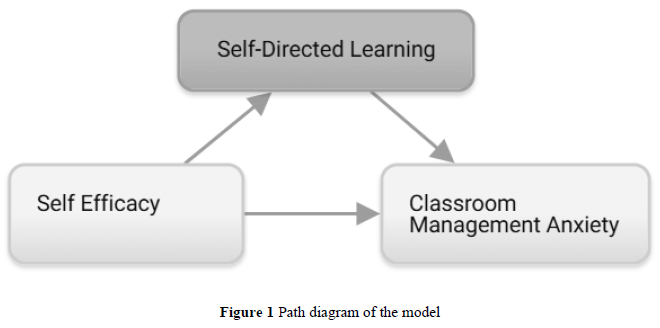
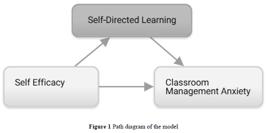
In this study, structural equation modelling (SEM) was used to determine the predictive relationships between pre-service teachers' SE, SDL, and CMA. SEM is a statistical method used to test the model developed by hypotheses and simultaneously evaluate the associated variables (Boysan, 2006; Kline, 2016; Vieira, 2011). The strong theoretical foundation of a model helps in defining and constructing the structure for SEM (Byrne, 2016). To test the research model shown in Figure 1, path analysis was conducted using the observed variables.
Population and Sample
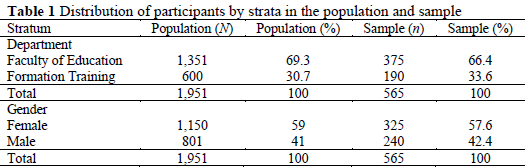
The population of this study comprised 1,951 pre-service teachers studying at the Harran University in Türkiye. Several factors were considered in determining the sample size: the methodological approach of the research, the research model, the number of independent variables to be examined simultaneously, the data analysis methods to be used, the accepted confidence level, and the tolerable margin of error (Büyüköztürk et al., 2017). The stratified sampling method was preferred from the non-random sampling techniques. Data were stratified based on gender and department characteristics to represent the population. In stratified sampling, the representation ratio in the sample is determined based on the proportion of each stratum in the population (Fraenkel, Wallen & Hyun, 2012). Considering the minimum sample size and potential missing or invalid data, data collection tools were distributed to a total of 750 teachers. A total of 185 data collection instruments that were incomplete or incorrectly completed were excluded from the analysis. The final analysis was conducted on 565 valid responses. The distribution of participants in the population and sample by strata are presented in Table 1.
When examining the distribution of the sample based on department and gender (Table 1), it is clear that the representation ratios of department and gender in the sample were similar to those in the population. For the sample to accurately represent the population, the proportions of various groups in the sample should align with those in the population (Bryman, 2007). In the sample, 240 participants (42.4%) were male and 325 (57.6%) were female. Additionally, 375 participants (66.4%) were from the Faculty of Education, while 190 participants (33.6%) were from the Formation Training department.
Data Collection Tools
Ethical approval for the study was obtained from the Harran University Social and Human Sciences Ethics Committee. The first section of the study included demographic information (gender, department, and branch).
In the second section, the SE scale, developed by Schwarzer and Jerusalem (1995) and adapted into Turkish by Aypay (2010), was used. The general SE scale was developed to measure people's beliefs and feelings about their own control over events. The scale includes two dimensions and 10 items. The Cronbach's alpha coefficient was determined to be .83. Confirmatory factor analysis (CFA) results supported good model fit: x2/df = 2.31, RMSEA = .062, SRMR = .033, CFI = .95, TLI = .94.
In the third section, the SDL scale, developed by Lounsbury, Levy, Park, Gibson and Smith (2009) and adapted into Turkish by Demircioglu, Öge, Fuçular, Çevik, Nazligül and Özçelik (2018), was employed. SDL can measure SDL in different cultures. The scale's factor structure was internally consistent. This scale is unidimensional and includes 10 items. The Cronbach's alpha coefficient was reported as .85. CFA results supported good model fit: x2/df = 2.75, RMSEA = .065, SRMR = .049, CFI = .95, TLI = .95.
In the fourth section, the CMA scale, developed by Özkul and Dönmez (2019), was used. The scale includes three dimensions and 23 items. These dimensions measure the time management, motivation and communication concerns of prospective teachers. The Cronbach's alpha coefficient was calculated as .96. CFA results indicated a satisfactory model fit: x2/df = 3.64, RMSEA = .079, SRMR = .048, CFI = .93, TLI = .92.
Data Analysis
During the analysis process, descriptive analyses (ic and SD) were conducted sequentially. Subsequently, the structural equation model (SEM) was employed to examine the relationships among pre-service teachers' SE, SDL, and CMA. In this context, three hypotheses (H1-H2-H3) regarding the significance of the model and one hypothesis (H4) regarding the significance of the mediation effects in the model were tested. The effect of one variable on another variable can be mediated by another variable (Meydan & §eçen, 2015; Preacher & Hayes, 2008:879).
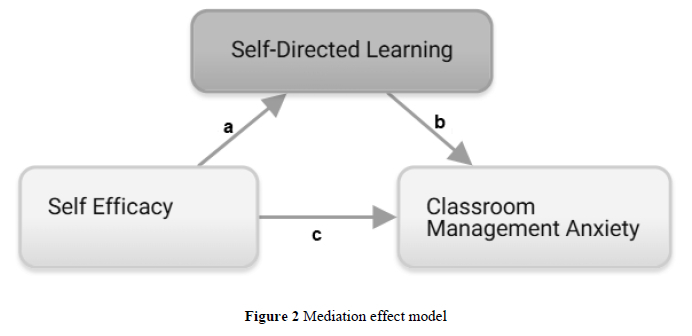
Baron and Kenny (1986) indicate that certain procedural steps should be followed to analyse the mediation effect. In this context, the mediation effect model is shown in Figure 2.
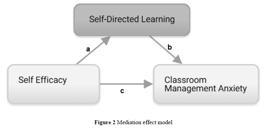
According to Figure 2, the conditions (assumptions) of the mediation effect are that the effects of all three variables (a, b, c) on the variable in the direction of the arrow should be significant. The addition of the mediator variable to the model is expected to result in either the non-significance of the relationship between the independent and dependent variables (full mediation effect) or a decrease in the level of significance (partial mediation effect). The Sobel test was used to assess the mediation effect (Sobel, 1982). The Sobel test is calculated using the unstandardised regression coefficients (B) of the variables and their standard error values.
Normality Analysis
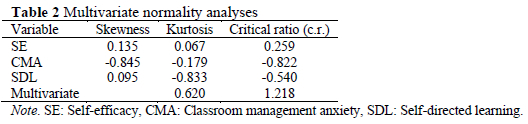
Verifying the normality assumption is considered a requirement for multivariate techniques. The multivariate skewness and kurtosis values for this study are presented in Table 2.
Table 2 shows the multivariate kurtosis value as 0.620, and the multivariate c.r. value as 1.218. According to Byrne (2016), if the c.r. value is less than 5, the dataset demonstrates multivariate normality. This finding shows that the data exhibit multivariate normal distribution.
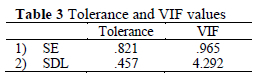
Another important aspect is determining multicollinearity among the variables. To this end, variance inflation factors (VIF) and tolerance values were calculated as is presented in Table 3.
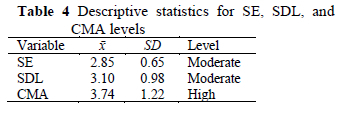
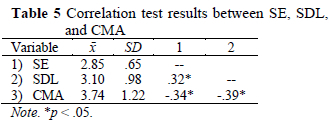
Table 4 shows that the SE score of the prospective teachers was calculated as x = 2.85 (SD = 0.65), and the SDL score was calculated as x = 3.10 (SD = 0.98) - both variables at a medium level. The CMA score was calculated as x = 3.74 (SD = 1.22) - prospective teachers' CMA levels were high. The correlation test results conducted to determine the relationships between the variables are given in Table 5.
Table 3 shows that the VIF values were below 10 and the tolerance values were above 0.2. These findings indicate the absence of multicollinearity or multivariate collinearity issues (Can, 2013; Field, 2018).
Findings
Pre-service Teachers' SE, SDL, and CMA Levels
The results of the descriptive statistics are presented in Table 4.
The findings in Table 5 show that the relationships between all three variables were significant. The level and direction of the relationships were positive and moderately related to pre-service teachers' SE and SDL (R = .32), and SE and CMA (R = -.34), and SDL and CMA (R = -.39) were both negatively and moderately related.
Testing the Model Hypotheses
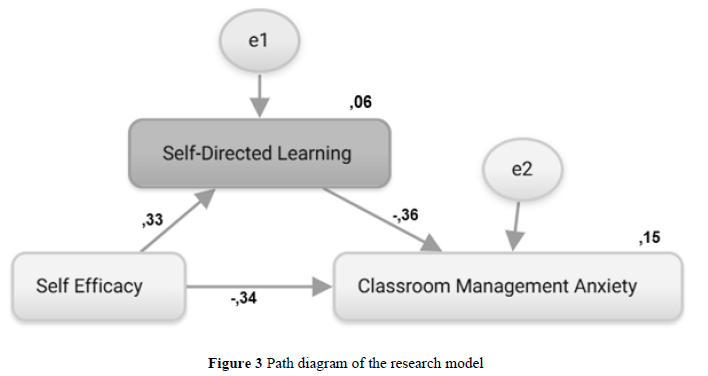
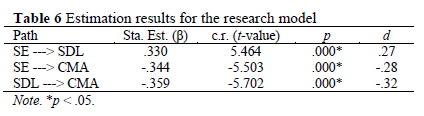
The path diagram and estimation results for the research model are presented in Figure 3 and Table 6.
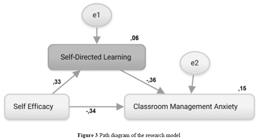
Table 6 shows that the t-values exceeded the critical value of 1.96 in absolute terms, and all paths drawn in the model were significant. In the model, SE had a direct positive effect on SDL (β = .330; t = 5.464; p < .05); SE had a direct negative effect on CMA (β = -.344; t = -5.503; p < .05); and SDL had a direct negative effect on CMA (β = -.359; t = -5.702; p < .05). Pre-service teachers' SE explained 6% of the variance in SDL, while SE and SDL together explained 15% of the variance in CMA. The relationship between SE and SDL had a weak positive effect size (d = 0.27), the relationship between SE and CMA had a weak negative effect size (d = -0.28), and the relationship between SDL and CMA had a moderate negative effect size (d = -0.32).
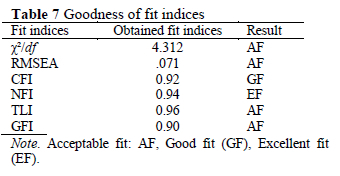
One of the criteria for determining whether the SEM developed using path analysis was acceptable is the goodness of fit indices (Kline, 2016). The goodness of fit indices of the research model are presented in Table 7.
From the information in Table 7 it is clear that the data fit of the research model was achieved. Based on the findings, three hypotheses (H1-H2-H3) regarding the significance of the model were accepted.
Testing the Mediation Effect Hypothesis
A simple regression analysis was conducted to determine the mediating effect of SDL, and the Sobel test was performed to assess the significance of the indirect effect of SDL on CMA. The analysis results are presented in Table 8.
According to Table 8, the mediating role of SDL was statistically significant, Sobel (z) = -4.642; SE = .013;p < .05 (Poacher & Leonardelli, 2001).
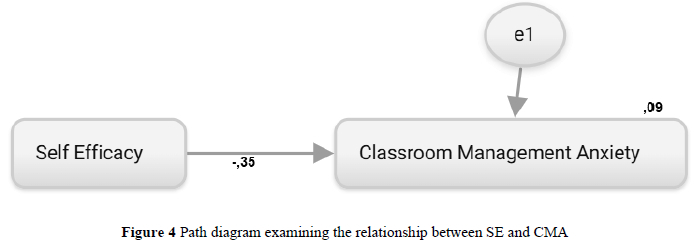
SDL would later be added to the model to determine its mediating effect. The path diagram showing the effect of SE on CMA is presented in Figure 4, and the estimated values are shown in Table 9.
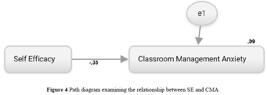
According to Table 9 there was a significant negative relationship between SE and CMA (β = -.351; p < .05). To determine the mediating effect, the SDL variable was added to this path diagram.
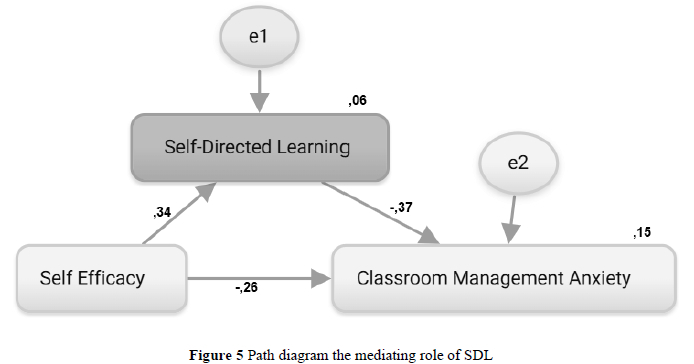
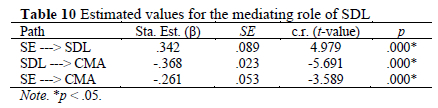
The path diagram showing the mediating role of SDL in the effect of SE on CMA, and the estimated values thereof are presented in Figure 5 and Table 10 respectively.
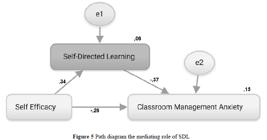
As shown in Table 10, by adding SDL as a mediating variable to the model, the significance level of the relationship between SE and CMA decreased (β = -.351 β = -.261). This indicates that SDL had a partial mediating effect. SE had a direct effect on CMA, but it also influenced CMA through SDL.
Discussion
Theoretical Implications
The hypothesis that pre-service teachers' SDL is at a moderate level suggests that SDL may vary depending on several factors. SDL is a multidimensional process that includes the ability of an individual to define, direct and evaluate their own learning (Behar-Horenstein et al., 2018). Although this process is based on personal characteristics such as motivation and learning strategies, it can also be affected by external factors such as environmental and technological factors (Pepple, 2022; Voskamp et al., 2022). The fact that pre-service teachers demonstrated these skills at a moderate level indicates that they faced some difficulties in meeting their individual learning needs and benefiting from environmental resources (Li, Yang & Hu, 2022).
Pre-service teachers' SE levels are powerful predictors of their CMA. Teachers with greater SE show greater job commitment (Guskey, 1984) and more effective classroom management skills (Woolfolk & Hoy, 1990). SE influences individuals' decisions, motivation, and actions. Individuals with high SE exert greater effort and time to accomplish tasks and make a greater effort to overcome obstacles, whereas individuals with low SE exert lesser effort and attempt to avoid performing tasks (Schunk, Hanson & Cox, 1987).
SE levels in pre-service teachers significantly predict their SDL. It has been said that, when SE levels are high, candidates are more able to regulate the learning process and choose learning strategies more consciously (Voskamp et al., 2022).
Additionally, developing SDL skills may also increase student teachers' educational attainment and make them more effective at responding sensitively to variations in learning needs (Hiemstra & Brockett, 2012; Li et al., 2022).
Practical Implications
Pre-service teachers registered high levels of CMA. This concurs with findings that being a teacher ranks among the most anxiety-prone professions (Heflin & Bullock, 1999). Teachers are faced with adversity in their relationships with students, classroom problems, and unwanted behaviour (Vossekuil, Fein, Reddy, Borum & Modzeleski, 2002). This is a sign that violence and negativity in schools are aversive to teachers. If the educators lack the required know-how and expertise in their field, they cannot manage the classroom, which result in anxiety. This, in turn, might lead to burnout as well as demotivation. Moreover, it is linked with the teacher training system. Dönmez (2017) clarifies that a majority of the teachers graduate from schools that are not specifically focussed on teacher training and that pedagogical formation education is of a low quality. Scott, Alter and Hirn (2011) also add the importance of good practice in the control of students' behaviour.
Pre-service teachers' SDL levels significantly predict their concerns about classroom management. Monahan, Marino and Miller (1996) state that teachers are worried about not being able to answer students' questions. In an effective education process, teachers need to plan lessons according to students' learning processes. However, teachers' inadequate preparation for the education process can negatively affect the classroom environment and increase teachers' anxiety. Sharma and Nuttal (2016) identified several causes of teacher anxiety, including a lack of knowledge and skills, resource deficiencies, an inability to deal with students lacking self-care skills, declining academic performance, and increasing workloads. It is emphasised that the strategies that teachers use to manage negative behaviour in the classroom should be addressed in teacher training programmes (Stoughton, 2007). In this context, it is crucial for teacher education programmes to be designed in a way that provides opportunities for pre-service teachers to observe and apply effective classroom management strategies to improve classroom effectiveness. Teachers' continuous development and taking charge of their own learning processes are essential for managing anxiety and improving SE. In this regard, the development of SDL skills among pre-service teachers will not only aid their individual growth but also assist them in providing effective learning strategies to their students.
Policy/Practice Implications
Pre-service teachers' SE mediates the relationship between SDL and CMA. Teachers' SE has a significant influence on their mental and emotional well-being. Pre-service teachers' SE is effective in dealing with negative problems such as stress and anxiety (Tsouloupas, Carson, Matthews, Grawitch & Barber, 2010). However, most people of different ages and societal backgrounds have made stress and anxiety their way of life, and they generate emotional, not to mention physical, problems (Skaalvik & Skaalvik, 2010). Teachers need to possess appropriate strategies for managing their anxiety and enhancing their SE. It is of paramount importance in this case to equip teacher training programmes with competencies that enable SDL, which has become a requirement in the rapidly changing modern-day information landscape. However, transmission pedagogy that is not conducive to SDL dominates most classrooms and learning environments (Mentz & De Beer, 2019; Mentz & Oosthuizen, 2016). It is, therefore, important to establish how the anxiety and SE levels of educators may be connected to competencies that promote SDL in learners. As Knowles (1975) indicates, SDL is a process in which individuals establish learning objectives and learning strategies, and diagnose learning needs. Classroom management and teachers' anxiety levels are crucial for enabling students to perform better in classroom environments. Teachers with high SE are more effective at modifying students' behaviour and their accomplishments (Bandura, 1997). In this regard, SDL supports the development of pre-service teachers' SE levels and, at the same time, efficiently manages their CMA. SDL is thus a significant mechanism in reducing teacher anxiety and enhancing SE. As such, SDL skills development may directly contribute to improving teachers' classroom management competence and emotional well-being.
Limitations
This study was aimed at pre-service teachers in specific contexts, and the generalisability of the findings might be restricted. Future research might include in-service teachers or multiple regions to help increase external validity. The study was also based on self-report measures, which are subject to personal bias or contextual influences. Despite these limitations, the study contributes towards an understanding of the interplay between SDL, SE, and CMA and provides a stepping stone for further exploration within teacher education programmes.
Conclusion
The findings of this study show that pre-service teachers possess moderate SE, SDL, and CMA. The results also show that SE predicts SDL and CMA strongly. As SDL plays a critical role in teacher education, it is necessary to incorporate proper strategies and training modules designed to strengthen teachers' SE and reduction of anxiety. Also, SDL skills development may be a means of enhancing classroom management practices, reducing anxiety, and enhancing overall teacher performance. These results are theoretically contributory to the study of SDL in teacher training because they illustrate how teachers' self-efficacy impacts the engagement of teachers in SDL and classroom practice. This highlights the importance of the inclusion of SE-oriented practices in SDL models and offers justification for future research to examine testing interventions that optimise classroom management and independent learning abilities.
Notesi. Published under a Creative Commons Attribution Licence.
References
-
An F, Xi L, Yu J & Zhang M 2022. Relationship between technology acceptance and self-directed learning: Mediation role of positive emotions and technological self-efficacy. Sustainability, 14(16):10390. https://doi.org/10.3390/su141610390
» https://doi.org/10.3390/su141610390 -
Aypay A 2010. Genel Öz Yeterlik Olçegi'nin (GÖYÖ) Türkce'ye uyarlama çaliçmasi [The adaptation study of General Self-Efficacy (GSE) Scale to Turkish]. inönü Üniversitesi Egitim Fakültesi, 11(2):113-132. Available at https://dergipark.org.tr/en/download/article-file/92265. Accessed 31 October 2025.
» https://dergipark.org.tr/en/download/article-file/92265 -
Bandura A 1986. The explanatory and predictive scope of self-efficacy theory. Journal of Social & Clinical Psychology, 4(3):359-373. https://doi.org/10.1521/jscp.1986.4.3.359
» https://doi.org/10.1521/jscp.1986.4.3.359 -
Bandura A 1993. Perceived self-efficacy in cognitive development and functioning. Educational Psychologist, 28(2):117-148. https://doi.org/10.1207/s15326985ep2802_3
» https://doi.org/10.1207/s15326985ep2802_3 - Bandura A 1997. Self-efficacy: The exercise of control. New York, NY: W. H. Freeman.
-
Baron RM & Kenny DA 1986. The moderator-mediator variable distinction in social psychological research: Conceptual, strategic, and statistical considerations. Journal of Personality and Social Psychology, 51(6):1173-1182. https://doi.org/10.1037/0022-3514.51.6.1173
» https://doi.org/10.1037/0022-3514.51.6.1173 -
Beckers J, Dolmans D & Van Merriënboer J 2016. e-portfolios enhancing students' self-directed learning: A systematic review of influencing factors. Australasian Journal of Educational Technology, 32(2):32-46. https://doi.org/10.14742/ajet.2528
» https://doi.org/10.14742/ajet.2528 -
Behar-Horenstein LS, Beck DE & Su Y 2018. An initial validation study of the self-rating scale of self-directed learning for pharmacy education. American Journal of Pharmaceutical Education, 82(3):280-286. https://doi.org/10.5688/ajpe6251
» https://doi.org/10.5688/ajpe6251 - Boysan M 2006. Çok örneklemli yapisal eşitlik modelleri [Multi-sample structural equation models]. Master's thesis. Van, Türkiye: Van Yüzüncü Yil University.
- Brockett RG & Hiemstra R 1991. Self-direction in adult learning: Perspectives on theory, research and practice (Vol. 2). London, England: Routledge.
-
Bryman A 2007. Barriers to integrating quantitative and qualitative research. Journal of Mixed Methods Research, 1(1):8-22. https://doi.org/10.1177/2345678906290531
» https://doi.org/10.1177/2345678906290531 - Büyüköztürk Ş, Kiliç Çakmak E, Akgün ÖE, Karadeniz Ş & Demirel F 2017. Bilimsel araşttrma yöntemleri [Scientific research methods]. Ankara, Türkiye: Pegem Academy.
-
Byrne BM 2016. Structural equation modeling with AMOS: Basic concepts, applications, and programming (3rd ed). London, England: Routledge. Available at https://2024.sci-hub.se/6246/ff1297a5a36ecf2c7206266459a8ef34/byme2016.pdf. Accessed 31 October 2025.
» https://2024.sci-hub.se/6246/ff1297a5a36ecf2c7206266459a8ef34/byme2016.pdf -
Cadorin L, Bortoluzzi G & Palese A 2013. The Self-Rating Scale of Self-directed Learning (SRSSDL): A factor analysis of the Italian version. Nurse Education Today, 33(12):1511-1516. https://doi.Org/10.1016/j.nedt.2013.04.010
» https://doi.Org/10.1016/j.nedt.2013.04.010 -
Cadorin L, Bressan V & Palese A 2017. Instruments evaluating the self-directed learning abilities among nursing students and nurses: A systematic review of psychometric properties. BMC Medical Education, 17:229. https://doi.org/10.1186/s2909-017-1072-3
» https://doi.org/10.1186/s2909-017-1072-3 - Can A 2013. SPSS ile bilimsel araşttrma sürecinde nicel veri analizi [Quantitative data analysis in the scientific research process with SPSS]. Ankara, Türkiye: Pegem Academy.
- Candy PC 1991. Self-direction for lifelong learning. A comprehensive guide to theory and practice. San Francisco, CA: Jossey-Bass.
- Creswell JW 2014. Research design: Qualitative, quantitative, and mixed methods approaches (4th ed). Thousand Oaks, CA: Sage.
-
Davis CR, Baker CN, Osborn J & Overstreet S 2024. Understanding teacher self-efficacy to address students' social-emotional needs in the COVID-19 pandemic. Urban Education, 59(8):2427-2457. https://doi.org/10.1177/00420859221099834
» https://doi.org/10.1177/00420859221099834 -
Demircioglu ZI, Öge B, Fuçular EF, Çevik T, Nazligül MD & Özçelik E 2018. Reliability, validity and Turkish adaptation of Self-Directed Learning Scale (SDLS). International Journal of Assessment Tools in Education, 5(2):235-247. https://doi.org/10.21449/ijate.401069
» https://doi.org/10.21449/ijate.401069 - Dönmez B 2017. Saygin ögretmen yetiştirme ve istihdami üzerine düçünceler [Thoughts on teacher training and employment]. Egitime Baktş, 13(41):22-41.
-
Dönmez B & Özkul R 2020. Ögretmen andinin ögretmenlik mesleki degerlerinin kazandirilmasina katkisi [Contribution of teacher oath to teaching professional values]. Milli Egitim, 49(227):345-370. Available at https://dergipark.org.tr/en/download/article-file/1232294. Accessed 30 October 2025.
» https://dergipark.org.tr/en/download/article-file/1232294 -
Duan S, Bissaker K & Xu Z 2024. Correlates of teachers' classroom management self-efficacy: A systematic review and meta-analysis. Educational Psychology Review, 36:43. https://doi.org/10.1007/s10648-024-09881-2
» https://doi.org/10.1007/s10648-024-09881-2 -
Ernst C & Rogers MR 2009. Development of the Inclusion Attitude Scale for High School Teachers. Journal of Applied School Psychology, 25(3):305-322. https://doi.org/10.1080/15377900802487235
» https://doi.org/10.1080/15377900802487235 -
Everton T, Turner P, Hargreaves L & Pell T 2007. Public perceptions of the teaching profession. Research Papers in Education, 22(3):247-265. https://doi.org/10.1080/02671520701497548
» https://doi.org/10.1080/02671520701497548 - Evertson CM & Weinstein CS 2006. Classroom management as a field of inquiry. In CM Evertson & CS Weinstein (eds). Handbook of classroom management: Research practice and contemporary issues. London, England: Routledge.
- Field A 2018. Discovering statistics using IBM SPSS statistics (5th ed). Newbury Park, CA: Sage.
- Fraenkel JR & Wallen NE 2009. How to design and evaluate research in education (7th ed). San Francisco, CA: McGraw-Hill.
- Fraenkel JR, Wallen NE & Hyun HH 2012. How to design and evaluate research in education (8th ed). San Francisco, CA: McGraw-Hill.
- Friedman IA 2003. Self-efficacy, stress, and burnout among educators. Journal of Educational Research, 96(6):305-315.
-
Garrison DR 1997. Self-directed learning: Toward a comprehensive model. Adult Education Quarterly, 48(1):18-33. https://doi.org/10.1177/074171369704800103
» https://doi.org/10.1177/074171369704800103 -
Guskey TR 1984. The influence of change in instructional effectiveness upon the affective characteristics of teachers. American Educational Research Journal, 21(2):245-259. https://doi.org/10.3102/00028312021002245
» https://doi.org/10.3102/00028312021002245 -
Haser C 2010. Learning to teach in the national curriculum context. European Journal of Teacher Education, 33(3):293-307. https://doi.org/10.1080/02619761003713894
» https://doi.org/10.1080/02619761003713894 -
Heflin LJ & Bullock LM 1999. Inclusion of students with emotional/behavioral disorders: A survey of teachers in general and special education. Preventing School Failure: Alternative Education for Children and Youth, 43(3):103-111. https://doi.org/10.1080/10459889909603310
» https://doi.org/10.1080/10459889909603310 -
Hiemstra R & Brockett RG 2012. Reframing the meaning of self-directed learning: An updated model. Paper presented at the Adult Education Research Conference. Available at https://newprairiepress.org/aerc/2012/papers/22. Accessed 27 February 2025.
» at https://newprairiepress.org/aerc/2012/papers/22 - Ingersoll RM 2001. Teacher turnover, teacher shortages, and the organization of schools. Educational Evaluation and Policy Analysis, 23(4):199-213.
-
Jordan A, Schwartz E & McGhie-Richmond D 2009. Preparing teachers for inclusive classrooms. Teaching and Teacher Education, 25(4):535-542. https://doi.org/10.1016/j.tate.2009.02.010
» https://doi.org/10.1016/j.tate.2009.02.010 -
Kesbiç K, Korlu Ö, Gencer EG, Terzi GN & Arik BM 2024. Egitim izleme raporu 2024 [Education monitoring report 2024]. Istanbul, Türkiye: Egitim Reformu Giriçimi. Available at https://www.egitimreformugirisimi.org/egitim-izleme-raporu-2024. Accessed 27 February 2025.
» https://www.egitimreformugirisimi.org/egitim-izleme-raporu-2024 -
Kline RB 2016. Principles and practice of structural equation modeling (4th ed). New York, NY: The Guilford Press. Available at https://dl.icdst.org/pdfs/files4/befc0f8521c770249dd18726a917cf90.pdf. Accessed 31 October 2025.
» https://dl.icdst.org/pdfs/files4/befc0f8521c770249dd18726a917cf90.pdf - Knowles M 1975. Self-directed learning: A guide for learners and teachers. Chicago, IL: Follett Publishing.
-
Larson LM & Daniels JA 1998. Review of the counseling self-efficacy literature. The Counseling Psychologist, 26(2):179-218. https://doi.org/10.1177/0011000098262001
» https://doi.org/10.1177/0011000098262001 -
Li J, Yang D & Hu Z 2022. Wuhan college students' self-directed learning and academic performance: Chain-mediating roles of optimism and mental health. Frontiers in Psychology, 12:757496. https://doi.org/10.3389/fpsyg.2021.757496
» https://doi.org/10.3389/fpsyg.2021.757496 -
Locke EA & Latham GP 2006. New directions in goalsetting theory. Current Directions in Psychological Science, 15(5):265-268. https://doi.org/10.1111/j.1467-8721.2006.00449.x
» https://doi.org/10.1111/j.1467-8721.2006.00449.x -
Lounsbury JW, Levy JJ, Park SH, Gibson LW & Smith R 2009. An investigation of the construct validity of the personality trait of self-directed learning. Learning and Individual Differences, 19(4):411-418. https://doi.org/10.1016/j.lindif.2009.03.001
» https://doi.org/10.1016/j.lindif.2009.03.001 -
Mentz E & De Beer J 2019. The use of Cultural-Historical Activity Theory in researching the affordances of indigenous knowledge for self-directed learning. In J de Beer (ed). The decolonisation of the curriculum project: The affordances of indigenous knowledge for self-directed learning. Cape Town, South Africa: AOSIS. https://doi.org/10.4102/aosis.2019.BK133.03
» https://doi.org/10.4102/aosis.2019.BK133.03 -
Mentz E & Oosthuizen I (eds.) 2016. Self-directed learning research: An imperative for transforming the educational landscape. Cape Town, South Africa: AOSIS. https://doi.org/10.4102/aosis.sdlr.2016.03
» https://doi.org/10.4102/aosis.sdlr.2016.03 - Meydan CH & Şeşen H 2015. Yapisal eşitlik modellemesi AMOS uygulamalari [Structural equation modeling AMOS applications]. Ankara, Türkiye: Seçkin Yayinevi.
- Monahan RG, Marino SB & Miller R 1996. Teacher attitudes toward inclusion: Implications for teacher education in schools 2000. Education, 117(2):316-320.
-
Ng PT 2025. Learning in an era of uncertainty in Singapore: Diversity, lifelong learning, inspiration and paradigm shift. Educational Research for Policy and Practice, 24:121-127. https://doi.org/10.1007/s10671-023-09348-1
» https://doi.org/10.1007/s10671-023-09348-1 -
Özkul R & Dönmez B 2019. Classroom management concerns: A scale development study. inönü University Journal of the Faculty of Education, 20(3):673-694. https://doi.org/10.17679/inuefd.521575
» https://doi.org/10.17679/inuefd.521575 -
Pajares F 2002. Overview of social cognitive theory and of self-efficacy. Available at https://people.wku.edu/richard.miller/banduratheory.pdf. Accessed 27 February 2025.
» https://people.wku.edu/richard.miller/banduratheory.pdf -
Pepple DG 2022. An ecological perspective of student engagement through digital technology: Practical application and implications. British Educational Research Journal, 48(6):1216-1231. https://doi.org/10.1002/berj.3823
» https://doi.org/10.1002/berj.3823 -
Preacher KJ & Hayes A 2008. Asymptotic and resampling strategies for assessing and comparing indirect effects in multiple mediator models. Behavior Research Methods, 40(3):879-891. https://doi.org/10.3758/brm.40.3.879
» https://doi.org/10.3758/brm.40.3.879 -
Preacher KJ & Leonardelli JG 2001. Calculation for the Sobel test: An interactive calculation tool for mediation tests. Available at http://quantpsy.org/sobel/sobel.htm. Accessed 27 February 2025.
» http://quantpsy.org/sobel/sobel.htm -
Purniningtyas A, Fauziati E & Rochsantiningsih D 2024. Enhancing classroom management self-efficacy through teacher professional education program: An explorative study. Voice of English Language Education Society, 8(3):656-669. https://doi.org/10.29408/veles.v8i3.27532
» https://doi.org/10.29408/veles.v8i3.27532 -
Qalehsari MQ, Khaghanizadeh M & Ebadi A 2017. Lifelong learning strategies in nursing: A systematic review. Electronic Physician, 9(10):5541-5550. https://doi.org/10.19082/5541
» https://doi.org/10.19082/5541 -
Qiu Z & Cui Y 2024. Probabilistic graph model based recommendation algorithm for material selection in self-directed learning. Sage Open, 14(2):1 -16. https://doi.org/10.1177/21582440241241981
» https://doi.org/10.1177/21582440241241981 - Roehrig AD, Pressley M & Talotta DA (eds.) 2002. Stories of beginning teachers: First year challenges and beyond. Notre Dame, IN: University of Notre Dame Press.
-
Scholz U, Doña BG, Sud S & Schwarzer R 2002. Is general self-efficacy a universal construct? Psychometric findings from 25 countries. European Journal of Psychological Assessment, 18(3):242-251. https://doi.org/10.1027/1015-5759.18.3.242
» https://doi.org/10.1027/1015-5759.18.3.242 - Schunk DH, Hanson AR & Cox PD 1987. Peer-model attributes and children's achievement behaviors. Journal of Educational Psychology, 79(1):54-61.
- Schwarzer R & Jerusalem M 1995. Generalized self-efficacy scale. In J Weinman, S Wright & M Johnston (eds). Measures in health psychology: A user's portfolio. Causal and control beliefs. Windsor, England: Nfer-Nelson.
-
Scott TM, Alter PJ & Hirn RG 2011. An examination of typical classroom context and instruction for students with and without behavioral disorders. Education and Treatment of Children, 34(4):619-641. https://doi.org/10.1353/etc.2011.0039
» https://doi.org/10.1353/etc.2011.0039 -
Sharma U & Nuttal A 2016. The impact of training on pre-service teacher attitudes, concerns, and efficacy towards inclusion. Asia-Pacific Journal of Teacher Education, 44(2):142-155. https://doi.org/10.1080/1359866X.2015.1081672
» https://doi.org/10.1080/1359866X.2015.1081672 -
Short PM & Rinehart JS 1992. School Participant Empowerment Scale: Assessment of level empowerment within the school environment. Educational and Psychological Measurement, 52(4):951-960. https://doi.org/10.1177/0013164492052004018
» https://doi.org/10.1177/0013164492052004018 -
Skaalvik EM & Skaalvik S 2010. Teacher self-efficacy and teacher burnout: A study of relations. Teaching and Teacher Education, 26(4):1059-1069. https://doi.org/10.1016/j.tate.2009.11.001
» https://doi.org/10.1016/j.tate.2009.11.001 -
Sobel ME 1982. Asymptotic confidence intervals for indirect effects in structural equations models. Sociological Methodology, 13:290-312. https://doi.org/10.2307/270723
» https://doi.org/10.2307/270723 -
Stanovich PJ & Jordan A 1998. Canadian teachers' and principals' beliefs about inclusive education as predictors of effective teaching in heterogeneous classrooms. The Elementary School Journal, 98(3):221-238. https://doi.org/10.1086/461892
» https://doi.org/10.1086/461892 -
Stokking K, Leenders F, De Jong J & Van Tartwijk J 2003. From student to teacher: Reducing practice shock and early dropout in the teaching profession. European Journal of Teacher Education, 26(3):329-350. https://doi.org/10.1080/0261976032000128175
» https://doi.org/10.1080/0261976032000128175 -
Stoughton EH 2007. "How will I get them to behave?": Pre service teachers reflect on classroom management. Teaching and Teacher Education, 23(7):1024-1037. https://doi.org/10.1016/j.tate.2006.05.001
» https://doi.org/10.1016/j.tate.2006.05.001 -
Tsouloupas CN, Carson RL, Matthews R, Grawitch MJ & Barber LK 2010. Exploring the association between teachers' perceived student misbehaviour and emotional exhaustion: The importance of teacher efficacy beliefs and emotion regulation. Educational Psychology, 30(2):173-189. https://doi.org/10.1080/01443410903494460
» https://doi.org/10.1080/01443410903494460 -
Veenman S 1984. Perceived problems of beginning teachers. Review of Educational Research, 54(2):143-178. https://doi.org/10.2307/1170301
» https://doi.org/10.2307/1170301 - Vieira AL 2011. Interactive LISREL in practice: Getting started with a SIMPLIS approach. London, England: Springer.
-
Voskamp A, Kuiper E & Volman M 2022. Teaching practices for self-directed and self-regulated learning: Case studies in Dutch innovative secondary schools. Educational Studies, 48(6):772-789. https://doi.org/10.1080/03055698.2020.1814699
» https://doi.org/10.1080/03055698.2020.1814699 - Vossekuil B, Fein RA, Reddy M, Borum R & Modzeleski W 2002. The final report and findings of the safe school initiative: Implications for the prevention of school attacks in the United States. Collingdale, PA: Diane Publishing.
-
Woolfolk AE & Hoy WK 1990. Prospective teachers' sense of efficacy and beliefs about control. Journal of Educational Psychology, 82(1):81-91. https://doi.org/10.1037/0022-0663.82.1.81
» https://doi.org/10.1037/0022-0663.82.1.81
Revised: 10 September 2025
Accepted: 20 October 2025
Published: 24 November 2025