Civic education teachers' role in transformation during the COVID-19 pandemic
Abstract
The coronavirus disease (COVID-19) pandemic impacted the educational system. Teachers faced significant challenges adapting to online teaching and digitalisation that happened rapidly during the pandemic. With this research we aimed to analyse teachers' role in transformation in online teaching during the COVID-19 pandemic. We adopted a qualitative research method where the sample was selected using the purposive sampling technique. Data were collected through interviews, learning documents, and observations. Data were analysed in 6 stages: preparing and organising data, exploring and coding the data, building descriptions and themes, representing findings, interpreting findings, and validating the results obtained. The results revealed that the teachers performed as technologists, designers, and facilitators during the COVID-19 pandemic. These roles demonstrate the complexity of a teacher's role in online teaching. We provide information on change and teachers' roles in transformation in response to the pandemic. The results of this study are expected to provide information and contribute to policymakers' increasing teacher competence for sustainable education development. These results are expected to provide information and contribute to policymakers' increasing teacher competence as technologists for sustainable education development.
COVID-19 pandemic; online learning; teacher's roles; transformation
Introduction
In March 2020, hundreds of schools in Indonesia were closed due to the Covid-19 pandemic. The aim with this restriction was to protect students, teachers, and educational staff from being exposed to the virus. Indonesia's school closures have led to an abrupt shift to remote learning which posed learning challenges for 68.8 million students. A study by the World Bank found that these changes lead to an estimated learning loss of between 0.9 to 1.2 years and a decline in literacy competence of 25 to 35 points on reading scores in the Program for International Student Assessment (PISA) tests until June 2021. This was the first ever global crisis that impacted the socio-cultural, economic, political, and educational aspects (Bozkurt & Sharma, 2020). Some regions also imposed restrictions on a wide scale. The pandemic had a significant impact on the world of education (Carrillo & Flores, 2020; Joshi, Vinay & Bhaskar, 2020). For example, face-to-face learning had drastically changed into virtual learning that relied mainly on technology. The widespread closure of schools during this pandemic impacted the transformation of the teaching process, especially in the fields of technology and digitisation (McFarlane, 2019; Selwyn, 2012).
Schools were required to maintain continuity of the teaching and learning process while keeping the teachers, students, and staff free from health problems related to COVID-19. This obviously led to rapid changes and progress in digitalising schools (Hodges, Moore, Lockee, Trust & Bond, 2020). Schools had to convert the face-to-face learning process to virtual, online learning. Teachers and students communicated and interacted using monitors or smartphone screens. Changes in education profoundly affected and influenced teachers' thinking and actions (Noor, Md Isa & Mazhar, 2020).
Teachers are professional agents of change in control of making choices and decisions that affect the achievement of education goals and school development (Bakkenes, Vermunt & Wubbels, 2010; Eteläpelto, Vähäsantanen, Hökkä & Paloniemi, 2013). During the COVID-19 pandemic, teachers faced significant challenges adapting to online teaching while maintaining communication with students (Carrillo & Flores, 2020). Online learning challenged teachers to create an interactive, inspirational, fun and interesting learning environment to motivate students to participate actively (König, Jäger-Biela & Glutsch, 2020). They needed to prepare engaging lessons and facilitate students' learning within restricted online learning conditions.
Several studies on the implementation of online learning have been conducted because online learning is considered to be more flexible, interactive, and futuristic (Goodyear, Salmon, Spector, Steeples & Tickner, 2001; Joshi et al., 2020; Ko & Rossen, 2017; Wang & Liu, 2020). However, teaching online requires more capital and preparation than face-to-face teaching in a traditional classroom (Tessaro, Murugan & Persinger, 2015). The extra practices involve time, class management, and the ability to communicate virtually (Easton, 2003; Loveland & Texas, 2007), and require improvements and adjustments related to pedagogical practices (Dabbagh & Bannan-Ritland, 2005; Munna & Shaikh, 2020; Swan, 2001). Moreover, Hodges et al. (2020) and Young and Duncan (2014) note that teachers often find students to be passive in online learning and that the quality of their knowledge is lower than in face-to-face education. However, Bawane and Spector (2009) state that the competencies needed to teach online and those needed to teach face-to-face are not substantially different. With this study we aimed to identify the teachers' transformation roles in online teaching during the COVID-19 pandemic based on this description.
Research Question
What is teachers' transformation role in online learning, such as during the COVID-19 pandemic?
Literature Review
Support for teachers' roles in transformation in virtual classes and the shift in the teaching paradigm is a significant challenge in teacher education. Transformational teaching is based on the idea that instructional objectives and competencies are more important than delivering information (Fuglei, 2021). Transformative learning is a theory of change considered uniquely mature and based on human communication (Taylor, 2016).
As implementers of interdisciplinary education, teachers play an essential role in transforming and implementing sustainable education (Andic & Vorkapic, 2017). Teachers with definite knowledge will be ready to steer the changing nature of the world and equip their students with crucial, sustainable knowledge, skills, and personalities (Potter-Nelson & O'Neil, 2019). Teachers are essential agents of change and must develop students' knowledge and abilities to do their work more efficiently. Teachers must be able to design and plan interactive learning, which includes appropriate media, learning strategies, and assessments to achieve learning objectives (Rolf, 2021). Also, they act as facilitators to support classroom empowerment (Gongalves, Parker, Luguetti & Carbinatto, 2020). Being a teacher means being ready to face challenges and develop and keep updating their skills to manage and effect change in the classroom (Green & Collett, 2021; Poom-Valickis, Saarits, Sikka, Talts & Veisson, 2013). Teachers face three critical problems, namely, change, uncertainty, and increasing problem complexity (Payong, 2011). Therefore, teacher empowerment is a crucial requirement in the efforts to strengthen the quality of education (Sumaryanta, Mardapi, Sugiman & Herawan, 2019).
COVID-19 has changed the education sector dramatically with the emergence of distinctive electronic learning (e-learning), where teaching is conducted remotely and on digital platforms (Du Plessis, 2020; Li & Lalani, 2020). Online teaching preparation and practice through the learning community can be an essential vehicle for developing teachers' competence. The continued advancement of online teacher interactions for professional use reflects the growing feeling among teachers about it being a meaningful and rewarding professional activity (Lantz-Andersson, Lundin & Selwyn, 2018). The role of teachers in professional training can be classified into four sections, namely, one for field knowledge, one for pedagogical content knowledge, one for teaching practice in schools, and one for emotional support (Van Bommel, Randahl, Liljekvist & Ruthven, 2020).
The integration of technology in education is often interwoven with the theoretical frameworks and models that address and focus on individual levels of competence and teachers' knowledge. One such framework, which has had quite an impact over the last 15 years, is the technological pedagogical content knowledge (TPACK) framework (Mishra & Koehler, 2006). The use of technology in education can increase a teacher's knowledge and skills. Emphasis on the primary role of TPACK was consistent with how teachers and education management view digital technology in educational practice (Roumbanis Viberg, Forslund Frykedal & Sofkova Hashemi, 2019).
The use of digital technology has spread widely in schools and communities (Jedeskog, 2005). Digital technology refers to the use of computers and technology-assisted methods to support learning within academies or schools (Ilomäki & Lakkala, 2018). The integration of technology in school activities has contributed significantly to teaching and learning (Jahnke, Bergström, Márell-Olsson, Häll & Kumar, 2017). Technology is responsible for changing the thinking and the concept of distance between the student and the teacher and allows students to learn at any time and from anywhere (Beldarrain, 2006; Gray, 2007). At the same time, the integration of digital technology in schools has been recognised as a complex process that involves multiple aspects, such as computer facilities at schools, internet access, technicians' , and teachers' skills. Some researchers have reported that digitalisation creates difficulty in achieving school sustainability (Aesaert, Van Braak, Van Nijlen & Vanderlinde, 2015; Lindqvist, 2015). Technology is based on a learning approach that enables students to build their knowledge profile through providing and supporting resources related to their context and practice (Bolldén, 2016; Mlotshwa, Tunjera & Chigona, 2020).
The applied technology reinforces and reproduces previous practices rather than developing newer ones (Glover, Hepplestone, Parkin, Rodger & Irwin, 2016). Digitalisation will fail to improve student learning if it is not rooted in pedagogical methods (Genlott & Grönlund, 2016). Focusing on aspects of the technology itself does not cause changes and developments in educational practice. Several researchers suggest that change and support must arise in multiple layers of the organisation (Blau & Shamir-Inbal, 2017; Díazy & Berrocoso, 2020; Petersen, 2014; Vanderlinde & Van Braak, 2010; Zhang, 2010). Schools can be strategic in managing resources, structures, and activities to support teachers' practices and systems as well as establishing pedagogical and organisational objectives that drive digital development and education (Pettersson, 2018). Future research should focus on teachers' competencies and strengthening good pedagogy (Islam & Grönlund, 2016).
Method
The sample in this study was selected using the purposive sampling technique (Campbell, Greenwood, Prior, Shearer, Walkem, Young, Bywaters & Walker, 2020). Twenty-nine civic education teachers (12 men [41%] and 17 women [59%]) at junior high school level who participated online in in-service teacher professional education (PPG DalJab) during the COVID-19 pandemic participated in the study. The teachers were between 30 and 45 years old and have had on average been working for a period of 5 to 10 years. We applied a qualitative case study approach in this study. The data were collected through interviews, observations, and lesson plan documents during teaching practice. Semi-structured interviews were conducted online and recorded with 19 respondents because they had the same background regarding teaching experience, culture, and education level. Semi-structured interviews were selected because they obtain more profound information about implementing online learning without being limited by the researcher's perspective (Johnson & Christensen, 2013). Semi-structured interviews helped to get more detailed and in-depth information from the participants (Creswell, 2012). Questions for the interviews were developed by creating question indicators concerning the research topic. Each indicator was developed into four or five questions. Sample questions are: (1) How did you mitigate learning during the pandemic?; (2) How can technology support remote learning?; (3) How did you adapt to the new online platform for learning?, et cetera. Interviews were conducted twice. The first round took around 3 hours at the beginning of teaching practice after transferring to school in the first week and the second took place later on during teaching practice. In addition, we also collected data through participants' teaching plan documents. We collected three lesson plans for each participant using Google Drive. Documents are an excellent source of textual data in qualitative research (Creswell, 2012). This learning planning collection was performed to explore and collect more detailed and contextual information about the teaching activities.
The data were analysed qualitatively during six stages, adopted from Creswell, (2012), namely, 1) preparing and organising data, 2) exploring and coding data, 3) developing descriptions and themes, 4) representing findings, 5) interpreting findings, and 6) validating the accuracy of findings. First of all, the data were collected and organised in a file folder. This file folder contained recorded interview data, lesson plans, and observations. Text data, such as documents and questionnaires, were arranged separately from the interview data. The interview data obtained were transcribed into text data. All the data were then organised according to the issues and ideas. After organising the data, we conducted a preliminary analysis of all the data through careful reading to obtain an overview of the online teaching practices performed by teachers. With this analysis we aimed to facilitate coding to reduce text databases into themes or categories (Creswell, 2012; Johnson & Christensen, 2013). Reduced or sorted data were grouped based on the similarities and then labelled to build a specific theme. Furthermore, the themes obtained were analysed and re-analysed to gain valuable findings from the research to answer the research question of teachers' transformation role in online learning during the COVID-19 pandemic. The trustworthiness of the findings was validated using triangulation and linked to other research related to teachers' roles in online learning.
Results
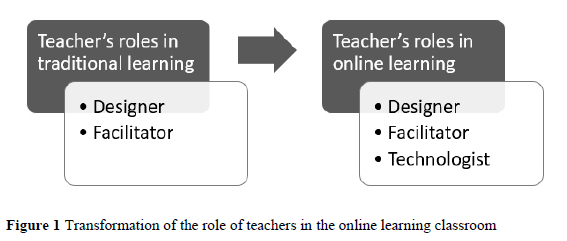
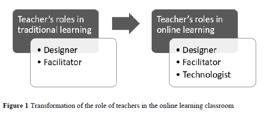
The COVID-19 pandemic changed and compelled every student and teacher to develop rapidly, become active, and adapt to the teaching and learning process as the need arose. School closures and widespread restrictions on interaction forced teachers to change their views and habits from face-to-face learning to online learning. This unavoidable change raised several challenges that needed to be resolved post-haste. These findings reveal that teacher transformation in online teaching extends to being a technologist, designer, and facilitator (cf. Figure 1).
Technologists
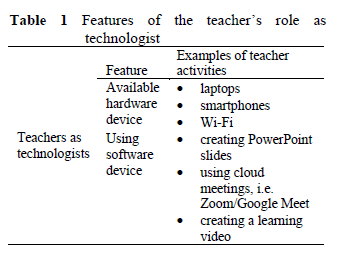
During the COVID-19 pandemic, digitalising schools through information technology required adaptation and resolution in the teaching and learning process. Technology plays a significant role in online learning. Technology, especially internet access, is required for implementing online learning. With this study it was found that, in online education, the teacher acts as a technologist. The observations and documents suggested that all participants already had hardware devices such as laptops and smartphones as their primary electronic devices. These electronic devices are the main assets for the implementation of online learning. Also, the document analysis indicated that teachers used software devices in their online learning, such as video editing, YouTube, PowerPoint, and virtual labs. The use of the software is represented in several learning activities such as using PowerPoint, uploading assignments to Google Drive, using cloud meeting applications such as Google Meet and Zoom, and creating interactive learning videos. Table 1 shows the features of a technologist.
The roles of teachers as technologists could be described through their own comments:
... make slide material presentation with PowerPoint about 10 slides before teaching (interview, AKN).
. make learning videos so that students are interested in taking part in learning (interview, DY). use google drive to share materials and collect assignments (interview, UTK).
... since the pandemic, I installed internet network in my home. It is very important to support remote class (interview, JK).
The pandemic brings me to new situations and competencies. I could create digital resources and media for learning (interview, RS).
In a nutshell, four activities revealed the roles of teachers as technologists in online teaching programmes, namely, 1) basic computer operations such as creating, editing, and uploading documents, 2) creating and editing learning videos, 3) accessing and sharing learning web pages related to the material to be taught, and 4) using online collaboration media such as Google Drive. Online learning must be attractive with precise, clear, and interactive delivery, where its success depends on the teacher's network and mastery of information technology.
Designer
Teachers act as designers when they create lesson plans. Lesson plans consist of learning objectives, implementation stages, media, and assessment to measure the learning objectives. Based on the document and interview analysis, the teachers considered various factors in designing learning activities: time, network availability, internet quota, student conditions, student workload, and appropriate activities to ensure that learning runs effectively and efficiently. Also, teachers planned the lessons as simply as possible because of limited time. Several examples of the participants' opinions are presented below.
We consider time allocation, student condition, electronic devices, and internet networks availability held by students (interview, HKE). We make lesson plans as simple as possible because of the time constraints and the availability of the student internet quotas (interview, TR). We frequently use discussion and project methods in teaching online (interview, WI). We coordinate the pupils to be ready to learn because online learning tends to make them bored (interview, ANM).
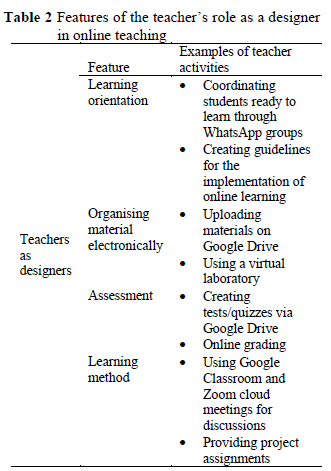
The findings also indicate four main teacher activities, namely, 1) learning orientation, 2) organising material electronically, 3) doing online assessment, and 4) using learning methods.
The results from the analysis are presented in Table 2.
Facilitator
In online learning, the success of education depends on the students themselves. Teachers have realised that they cannot guide students directly when learning occurs online.
The diverse conditions of students and the undertaking of online learning pose a challenge for us to facilitate students' learning (interview, FMT). Online learning is relatively challenging for us to guide students directly (interview, IK). We realise that online learning is significantly different from face-to-face learning (interview, MM).
Both communication text and verbal are an essential factor between teacher and student during an online learning classroom (interview, WI).
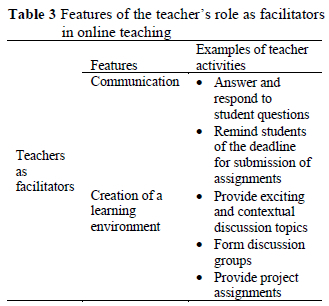
This study shows that, by implementing learning, the teacher played a more critical role as a facilitator who assisted students to develop knowledge. This is obviously a challenging task for teachers to undertake. The teacher' s role as facilitator can be noted across several activities: providing learning resources, monitoring progress, encouraging students to resolve problems, providing project assignments and argumentative discussion topics, and creating an engaging learning atmosphere.
The analysis results also reveal two crucial aspects when the teacher acted as facilitators: how to communicate and develop an appropriate learning environment (cf. Table 3). As a facilitator, communication between teachers and students in an online learning environment is extensively dependent on the text and audio quality. Audio-visuals are only used when the learning process occurs using the Google Meet or Zoom platforms. Communication can be carried out using text via chats, forum discussions, and electronic mail (email) to respond to answers and provide feedback.
Discussion
Online learning enables teachers and students to continue their education throughout their lives and to develop abilities under any circumstances (Mirke, Cakula & Tzivian, 2019). This study reveals that teachers in online teaching practice have taken up the roles of designers, facilitators, and technologists.
Designer
As designers, teachers were challenged to design virtual and online learning that remained active, creative, and fun. The teachers realised that online learning eliminated interaction because each participant was located in a different place. Online learning brought a paradigm shift from didactic teaching to learning transformation (Kalantzis & Cope, 2010). The interactions that arose were designed to satisfy the students' needs and to achieve their learning objectives. Therefore, learning design is crucial to support the success of the teaching process in virtual classrooms (Bennett & Lockyer, 2004; Martin, Budhrani, Kumar & Ritzhaupt, 2019). In online learning, the instructional design developed by teachers focuses on student activities such as discussions and project assignments. The focus has shifted in the learning step where the students must be active in chats and discussion forums related to the material being taught. Learning designs that focus on student activities prepare and motivate students to study in virtual classrooms (Ko & Rossen, 2017; Martin, Budhrani & Wang, 2019; Pollanen, 2007). The issue of distance can be overcome by increasing the interactions between students and content, students and teachers, and students and their class fellows (Menchaca & Bekele, 2008; Moore & Kearsley, 2012). In other words, teachers have attempted to make the online learning environment and atmosphere as attractive as possible so that students can efficiently receive the learning materials and continue participating in learning.
Based on the interviews, the teachers realised that online student learning was very different from face-to-face learning. During the pandemic, the context of student independence became critical. Developing students' mental function depends on the natural strengths of the students (i.e., memory, attention, perception, and response to learning stimuli) and the sociocultural strengths (i.e., concept development, logical reasoning, and decision-making) (Howe, 2002). The context revolves around the teachers' role - as facilitators, they bridge the students' knowledge gaps through teaching and learning. Facilitating knowledge is complex and requires creativity (Allen, 2016). Teachers must be able to communicate and develop an appropriate learning environment to bridge students' knowledge gaps and experiences with the knowledge learned in school. Online teaching and learning encourage students to build meaningful knowledge and information during the learning process and provide lifelong learning opportunities (Mirke et al., 2019). Theoretically, the power of constructivism emphasises learning as a personal process for understanding and building active and interpretive meanings (Garrison & Cleveland-Innes, 2005). Connectivism theory accepts technology as a major part of the learning process. Connectedness gives opportunities to make choices in the learning process (Downes, 2012; Siemens, 2004).
Facilitator
As facilitator, the teacher's approach to communicating is crucial in making students comfortable and preventing boredom during online learning. Teachers, as key actors, are required to redesign their work, shifting from a traditional teacher-led processes towards the facilitation of student-driven learning in authentic environments (Kunnari, Tuomela & Jussila 2021). Communication in an online learning environment is quite different and primarily conducted in textual forms, such as making announcements, providing topics in discussion forums, and giving responses.
Quick response is a form of two-way communication where there is concern from the participants. This encourages students to continue being enthusiastic and to participate in online learning.
Technologist
The success of online learning relies heavily on digital technology. The Cambridge Dictionary (2023) defines a technologist as someone who works with a particular technology. The teacher's role as technologist is clear in their use of different hardware devices (computers, laptops, smartphones) and software (instructional videos, three-dimensional form [3D] animation, interactive PowerPoints, Google Classroom, and Google Drive for teaching). Teachers must manage the online learning system that they use themselves. Several participants responded that there was much to be learned and improved concerning the use of learning technology. They reported the need to learn video editing, prepare online questions, and solve technology-related problems in learning. In distance learning, skills and knowledge related to digital technology are much needed, such as the use of a laptop, smartphone, software, synchronisation and non-synchronisation devices, operating systems, learning systems, and web browsers (Bolldén, 2016; Martin, Budhrani & Wang, 2019; Swan, 2001).
The role of technologist emerged because the COVID-19 pandemic changed the face-to-face learning mode into online learning. In this case, teachers must possess good digital literacy and skills in order for students to keep up with the times and be competitive. Furthermore, being a technologist or technician turns out to be appropriate and supports digital-based 21st-century learning. We expect this study to provide information for developers of teacher education about the shift or transformation of teachers.
Conclusion
Lockdown restrictions during the pandemic have led to the beginning of reformation and digitalisation of education on a large scale in a short time. Online learning challenges teachers and students to continue learning throughout their lives and to develop their abilities under any circumstances. Teachers involved in online teaching practices during the COVID-19 pandemic have emphasised their roles as designers, facilitators, and technologists. These roles have added complexities and challenges to the positions of teachers. They must continue facilitating and designing students activities for the online learning classroom. Teachers must operate and apply technology to allow students to build their knowledge by providing and supporting resources related to context and practice. This study provides a comprehensive picture of the roles of teachers in online teaching practices. The factors highlighted in the study need to be considered for all education components towards achieving educational goals for sustainable development. Future research on teachers' digital literacy is required to support their role as technologists.
Authors' Contributions
Triyanto wrote the manuscript and provided the data. BH validated the data and RDH conducted the data analysis. All authors reviewed the final manuscript.
Notesi. Published under a Creative Commons Attribution Licence.
Acknowledgement
This research was funded by Sebelas Maret University, Indonesia.
References
-
Aesaert K, Van Braak J, Van Nijlen D & Vanderlinde R 2015. Primary school pupils' ICT competences: Extensive model and scale development. Computers & Education, 81:326-344. https://doi.org/10.1016/j.compedu.2014.10.021
» https://doi.org/10.1016/j.compedu.2014.10.021 -
Allen D 2016. The resourceful facilitator: Teacher leaders constructing identities as facilitators of teacher peer groups. Teachers and Teaching, 22(1):70-83. https://doi.org/10.1080/13540602.2015.1023029
» https://doi.org/10.1080/13540602.2015.1023029 -
Andic D & Vorkapic ST 2017. Teacher education for sustainability: The awareness and responsibility for sustainability problems. Journal of Teacher Education for Sustainability, 19(2):121-137. https://doi.org/10.1515/jtes-2017-0018
» https://doi.org/10.1515/jtes-2017-0018 -
Bakkenes I, Vermunt JD & Wubbels T 2010. Teacher learning in the context of educational innovation: Learning activities and learning outcomes of experienced teachers. Learning and Instruction, 20(6):533-548. https://doi.org/10.1016/J.LEARMNSTRUC.2009.09.001
» https://doi.org/10.1016/J.LEARMNSTRUC.2009.09.001 -
Bawane J & Spector JM 2009. Prioritization of online instructor roles: Implications for competency-based teacher education programs. Distance Education, 30(3):383-397. https://doi.org/10.1080/01587910903236536
» https://doi.org/10.1080/01587910903236536 -
Beldarrain Y 2006. Distance education trends: Integrating new technologies to foster student interaction and collaboration. Distance Education, 27(2):139-153. https://doi.org/10.1080/01587910600789498
» https://doi.org/10.1080/01587910600789498 -
Bennett S & Lockyer L 2004. Becoming an online teacher: Adapting to a changed environment for teaching and learning in higher education. Educational Media International, 41(3):231-248. https://doi.org/10.1080/09523980410001680842
» https://doi.org/10.1080/09523980410001680842 -
Blau I & Shamir-Inbal T 2017. Digital competences and long-term ICT integration in school culture: The perspective of elementary school leaders. Education and Information Technologies, 22(3):769-787. https://doi.org/10.1007/s10639-015-9456-7
» https://doi.org/10.1007/s10639-015-9456-7 -
Bolldén K 2016. Teachers' embodied presence in online teaching practices. Studies in Continuing Education, 38(1):1-15. https://doi.org/10.1080/0158037X.2014.988701
» https://doi.org/10.1080/0158037X.2014.988701 -
Bozkurt A & Sharma RC 2020. Editorial: Emergency remote teaching in a time of global crisis due to CoronaVirus pandemic. Asian Journal of Distance Education, 15(1):i-vi. Available at http://asianjde.com/ojs/index.php/AsianJDE/article/view/447/297. Accessed 31 December 2023.
» http://asianjde.com/ojs/index.php/AsianJDE/article/view/447/297 -
Cambridge Dictionary 2023. Technologist. Available at https://dictionary.cambridge.org/dictionary/english/technologist. Accessed 31 December 2023.
» https://dictionary.cambridge.org/dictionary/english/technologist -
Campbell S, Greenwood M, Prior S, Shearer T, Walkem K, Young S, Bywaters D & Walker K 2020. Purposive sampling: Complex or simple? Research case examples. Journal of Research in Nursing, 25(8):652-661. https://doi.org/10.1177/1744987120927206
» https://doi.org/10.1177/1744987120927206 -
Carrillo C & Flores MA 2020. COVID-19 and teacher education: A literature review of online teaching and learning practices. European Journal of Teacher Education, 43(4):466-487. https://doi.org/10.1080/02619768.2020.1821184
» https://doi.org/10.1080/02619768.2020.1821184 - Creswell JW 2012. Educational research: Planning, conducting, and evaluating quantitative and qualitative research (4th ed). Boston, MA: Pearson.
- Dabbagh N & Bannan-Ritland B 2005. Online learning: Concepts, strategies, and application. Upper Saddle River, NJ: Pearson Education.
-
Díazy MJS & Berrocoso JV 2020. Perfiles docentes en el contexto de la transformación digital de la escuela [Teacher profiles in a context of digital transformation at school]. Bordón. Revista de Pedagogía, 72(1):151-173. https://doi.org/10.13042/Bordon.2020.72965
» https://doi.org/10.13042/Bordon.2020.72965 -
Downes S 2012. Creating the connectivist course. Available at https://www.downes.ca/cgi-bin/page.cgi?post=57750. Accessed 31 December 2023.
» https://www.downes.ca/cgi-bin/page.cgi?post=57750 -
Du Plessis P 2020. Implications of Covid-19 on the management of school financial resources in quintile 5 public schools [Special issue]. South African Journal of Education, 40(4):Art. #2043, 9 pages. https://doi.org/10.15700/saje.v40n4a2043
» https://doi.org/10.15700/saje.v40n4a2043 -
Easton SS 2003. Clarifying the instructor's role in online distance learning. Communication Education, 52(2):87-105. https://doi.org/10.1080/03634520302470
» https://doi.org/10.1080/03634520302470 -
Eteläpelto A, Vähäsantanen K, Hökkä P & Paloniemi S 2013. What is agency? Conceptualizing professional agency at work. Educational Research Review, 10:45-65. https://doi.org/10.1016/J.EDUREV.2013.05.001
» https://doi.org/10.1016/J.EDUREV.2013.05.001 - Fuglei M 2021. How transformational teaching helps students evolve.
-
Garrison DR & Cleveland-Innes M 2005. Facilitating cognitive presence in online learning: Interaction is not enough. American Journal of Distance Education, 19(3):133-148. https://doi.org/10.1207/s15389286ajde1903_2
» https://doi.org/10.1207/s15389286ajde1903_2 -
Genlott AA & Grönlund Á 2016. Closing the gaps -Improving literacy and mathematics by ict-enhanced collaboration. Computers & Education, 99:68-80. https://doi.org/10.1016/j.compedu.2016.04.004
» https://doi.org/10.1016/j.compedu.2016.04.004 -
Glover I, Hepplestone S, Parkin HJ, Rodger H & Irwin B 2016. Pedagogy first: Realising technology enhanced learning by focusing on teaching practice [Special issue]. British Journal of Educational Technology, 47(5):993-1002. https://doi.org/10.1111/bjet.12425
» https://doi.org/10.1111/bjet.12425 -
Gongalves LL, Parker M, Luguetti C & Carbinatto M 2020. The facilitator's role in supporting physical education teachers' empowerment in a professional learning community. Sport, Education and Society, 27(3):272-285. https://doi.org/10.1080/13573322.2020.1825371
» https://doi.org/10.1080/13573322.2020.1825371 -
Goodyear P, Salmon G, Spector JM, Steeples C & Tickner S 2001. Competences for online teaching: A special report. Educational Technology Research and Development, 49(1):65-72. https://doi.org/10.1007/BF02504508
» https://doi.org/10.1007/BF02504508 -
Gray SL 2007. Teacher as technician: Semi-professionalism after the 1988 Education Reform Act and its effect on conceptions of pupil identity. Policy Futures in Education, 5(2):194-203. https://doi.org/10.2304/pfie.2007.5.2.194
» https://doi.org/10.2304/pfie.2007.5.2.194 -
Green L & Collett K 2021. Teaching thinking in South African schools : Selected school leaders' perceptions. South African Journal of Education, 41(2):Art. #1893, 13 pages. https://doi.org/10.15700/saje.v41n2a1893
» https://doi.org/10.15700/saje.v41n2a1893 -
Hodges C, Moore S, Lockee B, Trust T & Bond A 2020. The difference between emergency remote teaching and online learning. Available at https://er.educause.edu/articles/2020/3/the-difference-between-emergency-remote-teaching-and-online-learning. Accessed 31 December 2023.
» https://er.educause.edu/articles/2020/3/the-difference-between-emergency-remote-teaching-and-online-learning - Howe AC 2002. Engaging children in science (3rd ed). Upper Saddle River, NJ: Prentice Hall.
-
Ilomäki L & Lakkala M 2018. Digital technology and practices for school improvement: Innovative digital school model. Research and Practice in Technology Enhanced Learning, 13(1):25. https://doi.org/10.1186/S41039-018-0094-8
» https://doi.org/10.1186/S41039-018-0094-8 -
Islam MS & Grönlund Ä 2016. An international literature review of 1:1 computing in schools. Journal of Educational Change, 17(2):191-222. https://doi.org/10.1007/s10833-016-9271-y
» https://doi.org/10.1007/s10833-016-9271-y -
Jahnke I, Bergström P, Märell-Olsson E, Häll L & Kumar S 2017. Digital Didactical Designs as research framework: iPad integration in Nordic schools. Computers & Education, 113:1-15. https://doi.org/10.1016/j.compedu.2017.05.006
» https://doi.org/10.1016/j.compedu.2017.05.006 - Jedeskog G 2005. Ch@nging school: Implementation of ICT in Swedish school, campaigns and experiences 1984-2004. Uppsala, Sweden: Uppsala University.
- Johnson RB & Christensen LB 2013. Educational research: Quantitative, qualitative, and mixed approaches (5th ed). Thousand Oaks, CA: Sage.
-
Joshi A, Vinay M & Bhaskar P 2020. Online teaching amidst COVID-19 in India: An outlook. Asian Journal of Distance Education, 15(2): 105-111. https://doi.org/10.5281/zenodo.4294477
» https://doi.org/10.5281/zenodo.4294477 -
Kalantzis M & Cope B 2010. The teacher as designer: Pedagogy in the new media age. E-Learning and Digital Media, 7(3):200-222. https://doi.org/10.2304/elea.2010.7.3.200
» https://doi.org/10.2304/elea.2010.7.3.200 - Ko S & Rossen S 2017. Teaching online: A practical guide (4th ed). London, England: Routledge.
-
König J, Jäger-Biela DJ & Glutsch N 2020. Adapting to online teaching during COVID-19 school closure: Teacher education and teacher competence effects among early career teachers in Germany. European Journal of Teacher Education, 43(4):608-622. https://doi.org/10.1080/02619768.2020.1809650
» https://doi.org/10.1080/02619768.2020.1809650 -
Kunnari I, Tuomela V & Jussila J 2021. Teacher-facilitators' job-crafting: Making meaning and relevance in authentic learning environments. International Journal of Management, Knowledge and Learning, 10:115-126. https://doi.org/10.53615/2232-5697.10.115-126
» https://doi.org/10.53615/2232-5697.10.115-126 -
Lantz-Andersson A, Lundin M & Selwyn N 2018. Twenty years of online teacher communities: A systematic review of formally-organized and informally-developed professional learning groups. Teaching and Teacher Education, 75:302-315. https://doi.org/10.1016/j.tate.2018.07.008
» https://doi.org/10.1016/j.tate.2018.07.008 - Li C & Lalani F 2020. The rise of online learning during the COVID-19 pandemic.
-
Lindqvist MJPH 2015. Gaining and sustaining TEL in a 1:1 laptop initiative: Possibilities and challenges for teachers and students. Computers in the Schools, 32(1):35-62. https://doi.org/10.1080/07380569.2015.1004274
» https://doi.org/10.1080/07380569.2015.1004274 -
Loveland KA & Texas A 2007. Student evaluation of teaching (SET) in Web-based classes : Preliminary findings and a call for further research. The Journal of Educators Online, 4(2):1-18. Available at https://files.eric.ed.gov/fulltext/EJ907746.pdf. Accessed 31 December 2023.
» https://files.eric.ed.gov/fulltext/EJ907746.pdf -
Martin F, Budhrani K, Kumar S & Ritzhaupt A 2019. Award-winning faculty online teaching practices: Roles and competencies. Online Learning, 23(1):184-205. https://doi.org/10.24059/olj.v23i1.1329
» https://doi.org/10.24059/olj.v23i1.1329 -
Martin F, Budhrani K & Wang C 2019. Examining faculty perception of their readiness to teach online. Online Learning, 23(3):97-119. https://doi.org/10.24059/olj.v23i3.1555
» https://doi.org/10.24059/olj.v23i3.1555 -
McFarlane AE 2019. Devices and desires: Competing visions of a good education in the digital age. British Journal of Educational Technology, 50(3):1125-1136. https://doi.org/10.1111/bjet.12764
» https://doi.org/10.1111/bjet.12764 -
Menchaca MP & Bekele TA 2008. Learner and instructor identified success factors in distance education. Distance Education, 29(3):231-252. https://doi.org/10.1080/01587910802395771
» https://doi.org/10.1080/01587910802395771 -
Mirke E, Cakula S & Tzivian L 2019. Measuring teachers-as-learners' digital skills and readiness to study online for successful e-learning experience. Journal of Teacher Education for Sustainability, 21(2):5-16. https://doi.org/10.2478/jtes-2019-0013
» https://doi.org/10.2478/jtes-2019-0013 -
Mishra P & Koehler MJ 2006. Technological Pedagogical Content Knowledge: A framework for teacher knowledge. Teachers College Record, 108(6):1017-1054. https://doi.org/10.1111/j.1467-9620.2006.00684.x
» https://doi.org/10.1111/j.1467-9620.2006.00684.x -
Mlotshwa N, Tunjera N & Chigona A 2020. Integration of MOODLE into the classroom for better conceptual understanding of functions in Mathematics. South African Journal of Education, 40(3):Art. #1570, 14 pages. https://doi.org/10.15700/10.15700/saje.v40n3a1570
» https://doi.org/10.15700/10.15700/saje.v40n3a1570 - Moore M & Kearsley G 2012. Distance education: A systems view of online learning (3rd ed). Belmont, CA: Cengage Learning.
-
Munna AS & Shaikh MSI 2020. Pedagogies and practice: Online teaching during COVID-19. International Journal of Humanities and Innovation (IJHI), 3(4):132-138. Available at https://repository.uwtsd.ac.uk/id/eprint/1861/1/Pedagogies%20and%20practice-%20online%20teaching%20during%20COVID%2019.pdf. Accessed 31 December 2023.
» https://repository.uwtsd.ac.uk/id/eprint/1861/1/Pedagogies%20and%20practice-%20online%20teaching%20during%20COVID%2019.pdf -
Noor S, Md Isa FM & Mazhar FF 2020. Online teaching practices during the COVID-19 pandemic. Educational Process: International Journal, 9(3):169-184. https://doi.org/10.22521/edupij.2020.93.4
» https://doi.org/10.22521/edupij.2020.93.4 - Payong MR 2011. Sertifikasi profesi guru: Konsep dasar, problematika, dan implementasinya [Teacher professional certification: Basic concepts, problems, and its implementation]. Jakarta, Indonesia: PT Indeks.
-
Petersen AL 2014. Teachers' perceptions of principals' ICT leadership. Contemporary Educational Technology, 5(4):302-315. https://doi.org/10.30935/cedtech/6132
» https://doi.org/10.30935/cedtech/6132 -
Pettersson F 2018. Digitally competent school organizations - Developing supportive organizational infrastructures. Seminar.net: International Journal of Media, Technology and Lifelong Learning, 14(2):132-143. https://doi.org/10.7577/seminar.2976
» https://doi.org/10.7577/seminar.2976 -
Pollanen M 2007. Improving learner motivation with online assignments. MERLOT Journal of Online Learning and Teaching, 3(2):203-213. Available at https://jolt.merlot.org/vol3no2/pollanen.pdf. Accessed 31 December 2023.
» https://jolt.merlot.org/vol3no2/pollanen.pdf - Poom-Valickis K, Saarits I, Sikka H, Talts L & Veisson M 2013. Professional education of teachers' problems and perspectives. The Estonian case. Journal of Teacher Education and Training, 3:1523.
-
Potter-Nelson EM & O'Neil JK 2019. Role of teachers on education for sustainable development. In W Leal Filho (ed). Encyclopedia of sustainability in higher education. Cham, Switzerland: Springer. https://doi.org/10.1007/978-3-319-63951-2_226-1
» https://doi.org/10.1007/978-3-319-63951-2_226-1 -
Rolf E 2021. Teachers as designers: Analyses of pedagogical patterns and their use. PhD dissertation. Stockholm, Sweden: Stockholm University. Available at https://www.diva-portal.org/smash/get/diva2:1602928/FULLTEXT01.pdf. Accessed 31 December 2023.
» https://www.diva-portal.org/smash/get/diva2:1602928/FULLTEXT01.pdf -
Roumbanis Viberg A, Forslund Frykedal K & Sofkova Hashemi S 2019. Teacher educators' perceptions of their profession in relation to the digitalization of society. Journal of Praxis in Higher Education, 1(1):87-110. https://doi.org/10.47989/kpdc80
» https://doi.org/10.47989/kpdc80 -
Selwyn N 2012. Education in a digital world: Global perspectives on technology and education. New York, NY: Routledge. https://doi.org/10.4324/9780203108178
» https://doi.org/10.4324/9780203108178 - Siemens G 2004. Connectivism: A learning theory for the digital age. International Journal of Instructional Technology & Distance Learning, 2(1).
-
Sumaryanta, Mardapi D, Sugiman & Herawan T 2019. Community-based teacher training: Transformation of sustainable teacher empowerment strategy in Indonesia. Journal of Teacher Education for Sustainability, 21(1):48-66. https://doi.org/10.2478/jtes-2019-0004
» https://doi.org/10.2478/jtes-2019-0004 -
Swan K 2001. Virtual interaction: Design factors affecting student satisfaction and perceived learning in asynchronous online courses. Distance Education, 22(2):306-331. https://doi.org/10.1080/0158791010220208
» https://doi.org/10.1080/0158791010220208 - Taylor EW 2016. Teacher transformation: A transformative learning perspective. Italian Journal of Educational Research, 15:17-26.
-
Tessaro LWE, Murugan NJ & Persinger MA 2015. Bacterial growth rates are influenced by cellular characteristics of individual species when immersed in electromagnetic fields. Microbiological Research, 172:26-33. https://doi.org/10.1016/j.micres.2014.12.008
» https://doi.org/10.1016/j.micres.2014.12.008 -
Van Bommel J, Randahl AC, Liljekvist Y & Ruthven K 2020. Tracing teachers' transformation of knowledge in social media. Teaching and Teacher Education, 87:102958. https://doi.org/10.1016/j.tate.2019.102958
» https://doi.org/10.1016/j.tate.2019.102958 -
Vanderlinde R & Van Braak J 2010. The e-capacity of primary schools: Development of a conceptual model and scale construction from a school improvement perspective. Computers & Education, 55(2):541-553. https://doi.org/10.1016/j.compedu.2010.02.016
» https://doi.org/10.1016/j.compedu.2010.02.016 -
Wang Y & Liu Q 2020. Effects of online teaching presence on students' interactions and collaborative knowledge construction. Journal of Computer Assisted Learning, 36(3):370-382. https://doi.org/10.1111/jcal.12408
» https://doi.org/10.1111/jcal.12408 -
Young S & Duncan HE 2014. Online and face-to-face teaching : How do student ratings differ ? MERLOT Journal of Online Learning and Teaching, 10(1):70-79. Available at https://jolt.merlot.org/vol10no1/young_0314.pdf. Accessed 31 December 2023.
» https://jolt.merlot.org/vol10no1/young_0314.pdf -
Zhang J 2010. Technology-supported learning innovation in cultural contexts. Educational Technology Research and Development, 58:229-243. https://doi.org/10.1007/s11423-009-9137-6
» https://doi.org/10.1007/s11423-009-9137-6
Revised: 11 June 2023
Accepted: 6 October 2023
Published: 31 December 2023