Impact evaluation of Foundation Science Centre programme on Grade 8 learners' science performance in South Africa
Abstract
Science centres are viewed globally as unique institutions, contributing to science education. In the study reported on here we focused on the impact of the Palabora Foundation Science Centre on the academic performance of Grade 8 learners. The study was guided by the pragmatic paradigm, mixed research design, mixed research approach, and the science centre impact model (SCIM). A total of 50 Grade 8 learners and 2 tutors participated in this study. Interviews, questionnaires, and pre-post tests were used for data collection. The thematic data analysis method and the Statistical Product and Service Solutions (SPSS) data analysis method were used to analyse qualitative and quantitative data respectively. The results of both interviews and questionnaires revealed that science centres like the Palabora Foundation Science Centre have a strong impact on the academic performance of learners and the learners are now positive towards attending science centres to acquire more knowledge about science. The findings of this study may contribute immensely in improving the attitudes of learners towards science, their academic performance, and increase the number of learners who select science as major subject. It is recommended that communities should be motivated to support the learning of science in science centres and a similar study should be conducted.
academic performance; impact; learners; Palabora Foundation; science; science centre; tutors
Introduction and Background of the Study
A science centre provides unofficial educational knowledge in science, technology, engineering and mathematics (STEM) by offering reciprocal shows and demonstrations and reciprocal schedules (Brown, 2019). Science centres supplement the school curriculum and by offering beneficial immediate learning knowledge, learners' skills and understanding of science are expanded (Trautmann & Monjero, 2019). According to Cape Town Science Centre (2016), science centres provide youths with opportunities for constructive learning during and after school hours, prepare them for careers in science and technology and support teachers in the formal education sector. Merzagora (2017) emphasises that science centres influence young people's career choices, strengthen science learning, enhance interest in science, augment motivation to learn science, and increase confidence in science. A large percentage of adolescents and adults of all cultures attend science centres across Europe, Asia, North America, Australia, and Africa (Chung, Tyan & Lee, 2019). Many science centres introduce girls to engineering, a career field in which females are significantly underrepresented (Kekelis & Sammet, 2017).
There are more than 2,500 interactive science centres in 90+ countries worldwide, receiving over 310 million visitors per year (Cape Town Science Centre, 2016). Science centres can change learners' attitudes towards science and the learning of science. Merzagora (2017) suggests that science centres provide learning environments intended to promote more positive attitudes towards science and develop basic skills for science. Learners' achievement may, therefore, be positively influenced by more positive attitudes towards science (Tetzner & Becker, 2018). Many studies revealed that learners and adults pursue their lifelong interest in science through various community resources such as libraries, science centres, and the internet (Achiam & Selberg, 2017; Anderson & Hadlaw, 2018). Merzagora (2017) states that science centres enhance the processes of democratic governance, create awareness of the importance of science and technology in society and serve as a place of lifelong learning. South Africa is currently among the countries that attract over a million visitors per year to science centres (Cape Town Science Centre, 2016).
One of the science centres in South Africa is called Palabora Foundation Science Centre (PFSC). The Foundation was established by Palabora Mining Company (PMC) in 1986 to assist the people who live about 50 km around the town of Phalaborwa in the Limpopo province to be self-sustaining in the sphere of education, skills and enterprise development, and health of the community (Open Africa, 2017). One of the education programmes offered by the Palabora Foundation is the science centre programme. The aim of the programme is to assist schools and learners to improve their academic performances in mathematics and science (Palabora Foundation, 2017). Per annum, the Palabora Foundation supports about 700 Grade 8 to Grade 12 learners in the Ba-Phalaborwa Municipality to achieve excellent grades in Matric (Palabora Foundation, 2017). Before the Palabora Foundation launched its learner support programme, only a handful of learners from the Phalaborwa district used to obtain the necessary results annually to proceed to tertiary education to pursue scientific and engineering careers (Palabora Foundation, 2017). There are many reasons for this poor performance, such as a lack of resources like science laboratories, a shortage of qualified teachers, overcrowded classes, and science teachers who struggle to teach effectively (Palabora Foundation, 2017).
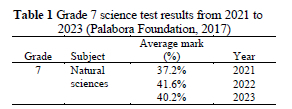
To start the journey with the science centre programme at Grade 8, Grade 7 learners write a selection test in November of every year. However, the Department of Education (2024) revealed that the average test results have always been below 50%, particularly in natural sciences as is shown in Table 1:
Table 1 shows the poor academic performance of learners in science in the primary schools in Phalaborwa. Achiam, Simony and Lindow (2016) assert that very few learners choose science in Grade 10 due to poor academic performance in the Senior Phase (Grade 7 to 9), which contributes to the scarcity of scientists in South Africa.
Literature Review and Theoretical Framework specifies
Many studies reveal that science centres have a significant role to play in society (Achiam & Solberg, 2017; Science Centre World Summit [SCWS], 2017). Clayton (2017) suggests that science centres provide effective informal science education because many science centres have well-equipped laboratories to perform research activities. This suggests that science centres have enough teaching and learning equipment while there is a shortage in many schools. Science centres contribute immensely to the comprehension of science and motivate learners to advance their interests outside of school (Becker, 2017). As mentioned, Merzagora (2017) emphasises that science centres enhance the processes of democratic governance and consciousness of the significance of science and technology on society and serve as a place of lifelong learning. Kekelis and Sammet (2017) point out that science centres help the youth and parents to make connections between STEM activities and careers.
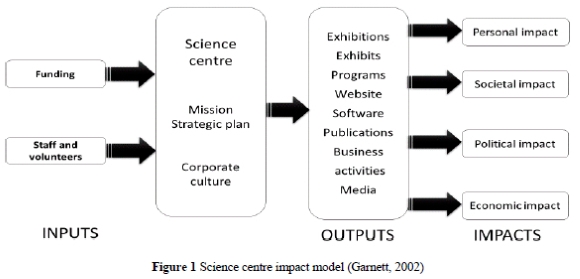
Our study was guided by the science centre impact model (see Figure 1), which was developed by Robin Garnett in 2002.
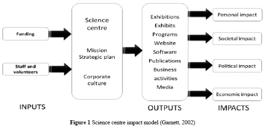
The SCIM shows that a science centre, with its mission, strategic plan, and corporate structure is dependent on funding, staff, and volunteers for its daily functioning. The impact of science centres can be divided into four main types, namely, personal, societal, political, and economic.
Personal impact
The personal impact is mostly in the cognitive, psychomotor, and affective domains. They include fostering creativity, and motivation and developing a positive attitude towards science as an outcome of learning, interaction, and experience in science centres. The personal impact of a science centre is defined as the change that occurs in individuals as a result of their contact with a science centre. It includes factors such as science learning through non-formal means, the scope for free choice and lifelong learning, changed attitudes towards science or its appreciation, and formation of career choice. Youth programmes at science centres have encouraged participants to pursue careers in science teaching (Banerjee, 2017). Visiting science centres fosters critical thinking and problem-solving skills, which are vital for success in a world that is becoming more and more dependent on technology (Suwono, Rofi'Ah, Saefi & Fachrunnisa, 2023). The statement is supported by Bandelli (2014), Baniyamin and Rashid (2016) and Buckler (2015) who suggest that learners enjoy visits to museums and that such visits increased interest and enjoyment of post-visit activities.
Societal impact
The societal impact of a science centre is defined as the effect that a science centre has on groups of people, organisations, and on the built and natural environment (Virtue, 2024). Examples of societal impact are realising community leisure activities, creating science awareness, developing scientific temper in society, and promoting the use of improved scientific practices and technological tools to increase productivity and profitability of the individuals and community.
The Department of Science and Innovation (DSI) approved a national plan for a network of science centres in South Africa that promote science and technology literacy among young people and the general public, contribute to the enhancement of learner participation and performance in STEM, identify and nurture youth talent and potential in STEM and provide career education in STEM-based disciplines (South African Agency for Science and Technology Advancement [SAASTA], n.d.).
Political impact
The political impact of a science centre is its influence on government policies and priorities (laws, local regulations, urban planning decisions by the municipality, et cetera.). It has an impact on all levels of government and political leadership who consider and promote the development of science centres as an essential parameter of social and regional development. Science centres have not published reports about the ways they have or have not been able to influence the government. Achiam and Solberg (2017) argue that science centres do not want to publicise the means they use to gain government support.
Economic impact
The economic impact of a science centre is the direct and indirect effect it has on employment and the local economy. It includes factors such as local/regional/international tourism, income brought to the science centre by visitors, income brought into the community by visitors, and job creation for staff (particularly for the youth). Science centres provide opportunities outside the formal classroom for both children and adults, in order to "satisfy intellectual curiosity, provide relaxation and enjoyment and to facilitate the gaining of knowledge" (Hannan, Reddy & Juan, 2016:2).
Research Questions
This study was guided by the following main research question: What is the impact of the Palabora Foundation Science Centre programme on Grade 8 learners' science performance?
The following sub-questions also guided this study:
• What is the impact of the Palabora Foundation Science Centre on learners' performance in science?
• What are the perceptions of learners towards the Palabora Foundation science programme?
• Which strategies may be applied to enhance the Palabora Foundation Science Centre programme on Grade 8 learners' science performance?
The Hypothesis of the Study This quantitative study was guided by the following hypothesis: The Foundation Science Centre Programme has a positive impact on Grade 8 learners' science performance in South Africa.
Research Methodology
Research methodology is the path a researcher takes to conduct a research. It is a group of strategies that researchers in a specific field use to reach a credible, valid, and reliable understanding of phenomena, events, processes, or issues at various levels (Rahi, 2017). This study was based on an inductive approach, which aims to explore new phenomena. An inductive approach was, therefore, preferred for this study because we conducted interviews to explore the impact of the PFSC programme on Grade 8 learners' science performance.
Research Paradigm
This study was based on a pragmatist or mixed methods paradigm, which is a combination of positivistic and constructive research paradigms. A pragmatist paradigm is a constructivist paradigm that uses mixed methods in the research and focuses on what works in the research questions under investigation (Bobbitt, 2018).
Research Approach
This study was also based on the mixed method research approach, which is generally defined as a combination of qualitative and quantitative approaches (Denzin & Lincoln, 2017). Creswell and Poth (2018) indicate that qualitative researchers stress the socially constructed nature of reality, the intimate relationships between the researcher and what is studied, and the situational constraints that shape inquiry. Jackson (2017) describes the quantitative approach as a formal, objective, and systematic process in which numerical data are used to obtain information about the phenomenon under investigation.
Research Design
This study was also based on an exploratory sequential mixed method design. This implies that we first conducted the qualitative component of the study by using individual interviews and thereafter conducted the quantitative component using questionnaires. The exploratory design was preferred because it assists researchers in considering the research questions from different perspectives, which increases the quality of research results (Creswell & Poth, 2018).
Population and Sampling
The population of this study was science tutors and learners participating in the science centre programme. A sample is a subset of the population selected to participate in a study (Creamer, 2018). A purposive sampling method was used to select the sample for the study, which consisted of two science tutors. Simple random sampling was used to select 50 Grade 8 learners to participate in this study. Due to the large number of the learner population (N = 250), a computer-aided random selection was used to do the selection.
Data Collection
Data collection is the precise, systematic gathering of information relevant to the sub-problems of the research using methods such as interviews, participant observation, focus group discussions, narratives, and case histories (Creswell & Creswell, 2018). The data collection methods used in the study were interviews, questionnaires and a science test.
Interviews
To ensure a good initial relationship in this study, we held a meeting with the two tutors to introduce the study and to request them to participate in the study. We strived to establish a cordial atmosphere so that the interviewees could feel secure and have the confidence to speak freely. In this study, we used a semi-structured interview to generate data from the science tutors. An interview schedule was used to conduct the individual interviews. An interview schedule is a list of questions that guide the interviewer through the interview (Bradley, 2021). The interview schedule offered a framework and sequence for the questions and helped us to maintain some consistency across interviews with participants. We explained and discussed the practical aspects of the study such as the interview venue, the time that may be devoted to the interview, and the use of a tape recorder with the tutors. The interviews with the two science tutors were completed in 2 days.
Questionnaire
Closed-ended questionnaires were used to collect quantitative data from the Grade 8 learners. A questionnaire is a printed document that contains instructions, questions, and statements that are compiled to obtain answers from the respondents (Creswell & Poth, 2018). We designed and administered semi-structured questionnaires to 50 Grade 8 learners. We preferred to use questionnaires in this research because questionnaires are approximately economical in their creation and administration, have similar questions for all subjects, ensure anonymity, may produce data more rapidly, and may provide the respondents with adequate time to think through their answers. The questionnaire used for the learners was based on the research questions.
Science test
A science test was also used to collect data in this study. The purpose of the science test was to explore how the learners understand the subject matter or content of science. We used the results of the science test to design the interview and questionnaire questions. The responses to the interview questions and questionnaire covered all the research questions and assisted us in resolving the research problem. The tests consisted of 36 questions and the duration of each test was 2 hours.
Data Analysis
Bradley (2021) defines data analysis as a process of examining and interpreting data in order to derive meaning, gain understanding and develop empirical knowledge. The data collected in this study were analysed qualitatively and quantitatively. The thematic data analysis method was used to analyse and interpret the qualitative data collected through the individual interviews with interviewees. The data were transcribed verbatim and then coded. Coding refers to the provision of a distinctive name to a particular group of data to distinguish it from the other collected data (Cohen, Manion & Morrison, 2018). We grouped all the responses from the interview transcriptions following the questions in the interview schedule.
The Statistical Product and Service Solutions (SPSS) computer program was used for the analysis of the data collected through the questionnaires. The findings were communicated in statistical language and described through descriptive statistics. A /-test was also performed to determine any significant differences in learner performance at the beginning and at the end of the learning. The results of the study were interpreted by using the /-test at p < 0.05 level of significance and by comparing the means. According to the /-test result, there was a significant impact on the performance of Grade 8 learners as their performance had improved significantly after having attended the programme at the centre. The learners' performance in the post-test was significantly higher than their performance in the pre-test.
The finding confirms that a science centre like the PFSC has a huge influence on the academic achievement of learners and that effective teaching of science takes place at the science centre and that learners' attitudes towards science are positive. This finding supported the hypothesis of the study: The Foundation Science Centre Programme has a positive impact on Grade 8 learners' science performance in South Africa.
Findings of the Study
The tutors are referred to as participants A and B. The descriptions of the participant's feelings and thoughts are presented in narrative form, supported by evidence mostly in the form of quotations from the interview transcripts. This is in line with Creswell and Creswell's (2018) assertion that this detailed approach is necessary to obtain a complete understanding of the setting to accurately reflect on the complexities of human behaviour. The findings presented in this section are divided into four sections: demographic information, findings from interviews with the tutors, questionnaires administered to the learners, and pre-post-testing of Grade 8 learners.
Demographic Information of the Tutors
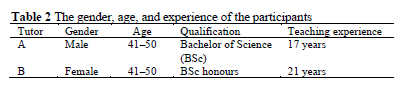
The gender, age, qualifications, and experience of the research participants are presented in this section. Table 2 illustrates the demographic information of the tutors.
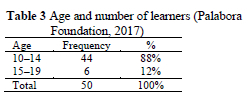
The two participants were mature and experienced science tutors with 17 and 21 years' experience respectively. Tutor A held a BSc degree and specialised in mathematics and biology. Tutor B held a BSc honours degree with mathematics and physical science as major subjects. The demographic information of the learners is shown in Table 3.
Table 3 illustrates the demographic information of the Grade 8 learners from surrounding schools that used the Palabora Foundation Science Centre and also participated in the study by writing a science test. Table 3 indicates that 88% of the learners were between the ages of 10 and 14 years and 12% were between 15 and 19 years of age. Thirty-eight learners were from public schools and only 12 learners were from local private schools.
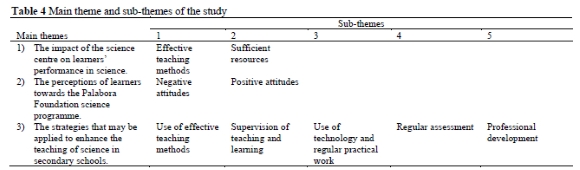
Findings from Interviews with Tutors The centre had five science tutors and only two tutors participated in the study. The findings are presented in three main themes according to the three sub-questions, and nine sub-themes as shown in Table 4.
Main theme 1: What is the impact of the science centre on learners' performance in science?
The first main theme that emerged from the data analysis was the impact of the science centre on learners' performance in science. Under this main theme, two sub-themes emerged, namely effective teaching methods and sufficient resources, which are discussed below.
Sub-theme 1: The science centre uses effective teaching methods
An analysis of the participants' responses revealed that the impact of the science centre on the learners was very strong because the learners' performance was greatly improved by the many benefits of the PFSC programme. This view was confirmed by Tutor A who emphasised that the PFSC promotes the use of effective teaching methods by tutors. Tutor B confirmed this view by saying: "In the science centre, a learner-centred approach is used, there are extra teaching lessons for clearing misconceptions, experiments, and some investigations are done, and learners attend lessons during school holidays and learners are having more one-on-one time with tutors."
Sub-theme 2: The Science centre has sufficient resources
Tutor A said: "The benefits for learners for attending science lessons at Palabora Science Centre are that a learner-centred approach is used, there are available resources such as the internet, library, and laboratory, and reinforcement materials are provided." Tutor B said: "Learners have access to e-learning [electronic learning], the centre has available resources such as laboratory and there are extra teaching lessons and practical investigations that are done."
The responses above reveal that the tutors at the science centre used effective teaching methods such as experiments and investigations and that sufficient teaching and learning resources were available. This finding is in line with the theoretical framework of this study, namely the SCIM developed by Robin Garnett in 2002. The SCIM indicates that science centres have a personal impact because of the cognitive development through nonformal means, changed attitudes towards science and the adoption of an effective method of science in day-to-day activities. The SCIM also revealed sufficient teaching and learning resources because the income for the science centre was from a variety of sources including government, donors, visitors, and internal and external business enterprises.
The science centre produces a large number of outputs for its clients or visitors such as exhibitions, programmes, and a website. The impact of the science centre on learners' performance in science is supported by Clayton (2017) who asserts that science centres provide effective informal science education because many science centres have well-equipped laboratories where research activities take place. According to Kekelis and Sammet (2017), science centres help the youth and parents to make connections between STEM activities and careers.
Main theme 2: What are the perceptions of learners towards the science programme?
The second main theme that emerged from the data analysis was the perceptions of learners towards the science programme. Under this main theme, two sub-themes emerged, namely negative attitudes and positive attitudes, which are discussed below.
Sub-theme 1: Negative attitudes
This sub-theme revealed that the learners had negative attitudes towards the learning of science.
Tutor A confirmed this as follows: "Most learners have a negative attitude towards science. They will always say that their parents have forced them to come and attend lessons at the centre."
Sub-theme 2: Positive attitudes
The findings revealed that the negative attitudes were temporary as the learners had developed positive attitudes later. This opinion was supported by Tutor A: "The learners start enjoying science as time goes by because they learn at their own pace. They become enthusiastic/excited about the programme after some time. They also participate fully during the practical lessons. The science centre organises different speakers to come and motivate the learners." Tutor B on the other hand, indicated that
[s]ome learners show a lot of interest and enthusiasm towards the programme as they interact with tutors and other learners. Their attendance is always good even during the school holidays and the availability of resources brings positive minds in the learners.
The responses above reveal that the learners had different attitudes towards science. Some learners had positive attitudes while others had negative attitudes towards the science centre. The above responses are in line with the SCIM. According to the SCIM, attitudes towards science change, and learners had either positive or negative attitudes towards science centres.
The perceptions of learners towards the science programme are confirmed by Anderson and Hadlaw (2018) who indicate that science centres increase people's interests and attitudes concerning science. Trautmann and Monjero (2019) indicate that science centres contribute immensely to the comprehension of science and motivate learners to advance their interests outside of school, while Anderson and Hadlaw (2018) indicate that more positive attitudes towards science may positively influence learners' academic performance.
Main theme 3: Which strategies may be applied to enhance the teaching of science in secondary schools?
The third main theme that emerged from the data was about the strategies that may be applied to enhance the teaching of science in secondary schools. Under this main theme, five sub-themes emerged, namely the use of effective teaching methods, supervision of teaching and learning and regular assessment, use of technology and regular practical work, and teacher professional development.
Sub-theme 1: Use of relevant teaching methods The analysis of the findings revealed that the best strategy for improving the teaching of science in secondary schools was the use of relevant teaching methods. This strategy was supported by Tutor A who said that "teachers should first develop a subject improvement plan, perform experiments and build concepts and not just to teach, do revisions with the learners, ensure that there are relevant material and do item analysis after each formal task has been administered to identify errors and misconceptions held by learners" Tutor B said that
teachers should ensure the use of a pacesetter, come up with a way to take learners to nearby science centres during school holidays and vacations to keep pace with other learners, use practical work as an integral part of the programme at school to prepare learners for real science world.
Sub-theme 2: Supervision of teaching and learning This strategy was confirmed by Tutor A who said that "the Departmental Head (DH) should ensure that teaching and learning of science takes place by paying class visits and providing the necessary support'' Tutor A was supported by Tutor B who said that the "Departmental Head and the school management team (SMT) should ensure that teaching and learning of science takes place by conducting classroom visits and by making resources available''
Sub-theme 3: Regular assessment
The findings of the study revealed regular assessment for the enhancement of science instruction and learning, which was confirmed by Tutor A who recommended regular assessment: "Teachers should use previous exam papers to assess learners' knowledge and provide learners with copies of exam guidelines'' Tutor A was supported by Tutor B who emphasised that
[t]eachers should use previous exam papers as well as other resources as part of informal assessment, provide learners with copies of exam guidelines, ensure that informal tasks include word questions on all cognitive and difficulty levels, and give learners problem-solving questions which involve graphs in every knowledge area, for example, using graph papers when necessary.
Sub-theme 4: Use of technology and regular practical work
The findings revealed that schools should improve science teaching by using modern technology in the teaching of science. This view was emphasised by Tutor A who said: "To improve the teaching of science, teachers should encourage the use of calculators and conduct experiments and many other practical investigations'' Tutor A's remark was confirmed by Tutor B who said that "teachers should ensure that a science learner has a scientific calculator and can use it for various calculations.' According to Evans, Nicolaisen, Tougaard and Achiam (2020) virtual experimentation provided through interactive computer-based simulations has proven to have a positive impact on students' evolving skills, attitudes, and conceptual understanding.
Sub-theme 5: Teacher professional development This theme revealed that science teachers should attend regular teacher professional development workshops to enhance the instruction and learning of science. This view was supported by Tutor A, who emphasised that "the Department of Basic Education (Curriculum advisors) should always workshop educators on how to teach problemsolving in science.'
The responses of Tutor A and Tutor B revealed five strategies that may be applied to enhance the PFSC programme on Grade 8 learners' science performance, namely the use of relevant teaching methods, regular assessment, supervision of teaching and learning, use of technology, regular practical work and teacher professional development. According to the findings, teachers should always assess learners using various forms of assessment, always monitor the work of teachers and learners, and always use modern technology in science. Teachers should involve learners in experiments or practical work, and the curriculum advisors should always conduct workshops for science teachers.
These strategies comply with the theory of this study, namely the SCIM. According to the SCIM, science teaching and learning can be improved by non-formal science learning, lifelong learning of science, development of skills, changing attitudes towards science, family learning, motivation and interest, professional development of tutors, and using effective teaching methods of science.
Findings from Learner Questionnaires
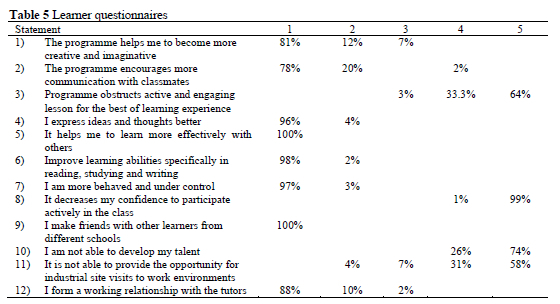
In this section we focus on the findings of the questionnaires administered to 50 Grade 8 learners at the Palabora Science Centre (see Table 5 below). The responses range from 1 (Strongly agree), 2 (Agree), 3 (Neutral), 4 (Disagree) and 5 (Strongly disagree).
Findings from the Tests
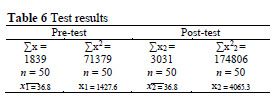
In this section we present the data that were collected by means of science tests written by Grade 8 learners (see Table 6).
Data in this study were also collected using two science tests consisting of 36 questions answered by 50 Grade 8 learners who attend PFSC. The data were analysed through SPSS by applying statistical measures. A t-test was performed to determine whether any significant difference eXisted in learner performance at the beginning of learning and at the end of learning. We interpreted the results of the study by using the t-test at the p < 0.05 level of significance and by comparing the means.
According to the t-test result, there is a significant impact on the performance of Grade 8 learners because after having attended the programme at the centre, their performance had improved significantly. The finding confirms that a science centre like the PFSC has a huge influence on the academic achievement of learners, that effective teaching of science takes place at science centres and that learners' attitudes towards science become positive.
Discussion of Results
An analysis of data revealed that the PFSC programme has a strong impact on the academic performance of Grade 8 learners. This is because a learner-centred approach, effective teaching methods that enable the learners to understand science content very well, eXtra teaching lessons, eXperiments, and investigations are used at the centre. Weimer (2011) confirms this finding and asserts that in the learner-centred approach, the learners and teachers share the focus, but the learners are more in control of their learning. An analysis of data also revealed that science centres have a strong impact on learner performance because they have enough teaching and learning resources such as teXtbooks, the internet, a library, and a laboratory. Instructional materials play a crucial role in facilitating effective teaching and learning processes by providing visual aids, hands-on eXperiences, and interactive resources to enhance students' understanding of educational concepts (Miremba, 2024). David (2014), who emphasise that those resources enhance the academic performance of learners in the eXaminations, supports this view.
The findings also revealed that science centres create positive attitudes of learners towards science because they become motivated, enthusiastic and eXcited and they enjoy science by participating in practical activities at their own pace. The findings also revealed four main functions of science tutors, namely teaching science using various teaching methods, using many teaching and learning resources, creating a favourable learning environment, and improving the academic performance of learners. Duit and Tesch (2018) confirm that the role of the science teacher is to use effective teaching and learning methods to teach science because it contributes to the high performance of learners.
The findings from the questionnaires were in line with the theory of this study, which is the SCIM. According to the model, science centres have a personal impact which includes a positive attitude towards science, motivation, and interest in learning science. This theory is supported by the International Science Centre & Science Museum Day (n.d.), which emphasises that science centres increase visitors' knowledge and understanding of science, provide memorable learning experiences which can have a lasting impact on attitudes and behaviour, promote inter-generational learning, and promote trust and understanding between the public and the scientific community.
According to Ezeobi (2017), science teachers need to be conversant in modern innovative teaching strategies and be encouraged to employ these strategies in their teaching. These strategies include guided discovery, concept mapping, co-operative learning, problem-solving, and constructivism. Duit and Tesch (2018) recommend seven strategies for improving the effective teaching and learning of science in secondary schools. The seven strategies build on the ideas that learners bring to lessons, help them to direct their learning, use models to support understanding, support learners to retain and retrieve knowledge, use practical work purposefully and as part of a learning sequence, develop scientific vocabulary and support learners to read and write about science and use structured feedback.
Recommendations of the Study
In this section we focus on the recommendations that may be applied to enhance the PFSC programme on Grade 8 learners' science performance. Given the negative attitudes of learners about learning science and their poor academic achievement in science in the schools, two main recommendations are made for the improvement of practice and future research. The first recommendation is the improvement of practice. The results of this study revealed that many learners were negative about learning science and attending science centres. Therefore, we recommend that the Department of Basic Education (DBE) motivates communities to support the learning of science at science centres. We also recommend that the DBE should arrange and conduct effective teacher professional development workshops of science to improve teaching and learner performance in science.
The DBE should also provide sufficient teaching and learning resources to schools. Due to the shortage of science teachers in many schools, it is also recommended that the DBE should employ more science teachers. The principals, deputy principals, and departmental heads, with the assistance of curriculum advisors, should join hands to support teachers in teaching science to improve instruction and learner performance. It is also recommended that the DBE should ensure that more science centres are established in the Limpopo province to enhance the academic achievement of learners in science. The second recommendation study is about further research. The results of this study disclosed that many learners were negative towards attending science centres. It is, therefore, important to investigate the challenges that science tutors experience at the learning centres, and to change the attitudes of learners, parents, and educators towards attending science centres.
The findings of such research will motivate parents and educators to encourage learners to attend science centres and will also encourage the government to provide the necessary support to all the science centres. The results of such studies may be vital in enhancing the teaching and learning of science, not only in the Limpopo province but in South Africa as a whole.
Conclusion
With this study we aimed to investigate the impact of the PFSC programme on Grade 8 learners' science performance. Individual interviews, questionnaires, and tests were used to collect data from science tutors and learners. The thematic data analysis method and SPSS were used to analyse the data qualitatively and quantitatively. This study revealed the following major findings:
• The science centre had a strong impact on the academic performance of learners. After having received lessons for a particular period, they performed extremely well during the post-test. The tutors at the centre used effective teaching methods that enabled the learners to understand science content very well. This implies that learners who attended science centres possess more science knowledge and skills than learners who did not attend science centres.
• Many learners were positive towards learning science and attending the science centres; the learners perceived the PFSC as the perfect place for science. This indicates that many learners attend science centres.
• Various teaching and learning strategies used by the tutors at the PFSC may contribute to the achievement and performance of learners in secondary schools, namely, the use of effective teaching methods, supervision of teaching and learning, regular practical work and assessment, use of technology and teacher professional development. Therefore, PFSC is one of the academic institutions of science with high academic science performance of learners in South Africa.
These findings are in line with the theory of this study, namely, the SCIM, which shows that a science centre, with its mission, strategic plan, and corporate structure is dependent on funding, staff, and volunteers for its daily functioning. The findings of this study may contribute immensely to improving the attitudes of learners towards science, improving the academic performance of the learners, and increasing the number of learners who select science as major subject. The findings of the study may also assist teachers in improving the implementation of science curricula in schools.
Authors' Contributions
NNM wrote the manuscript and provided the data. MPR conducted the data analysis.
Notesi. This article is based on the master's thesis of NN Moshokoa.
ii. Published under a Creative Commons Attribution Licence.
References
-
Achiam M, Simony L & Lindow BEK 2016. Objects prompt authentic scientific activities among learners in a museum programme. International Journal of Science Education, 38(6):1012-1035. https://doi.org/10.1080/09500693.2016.1178869
» https://doi.org/10.1080/09500693.2016.1178869 -
Achiam M & Selberg J 2017. Nine meta-functions for science museums and science centres. Museum Management and Curatorship, 32(2):123-143. https://doi.org/10.1080/09647775.2016.1266282
» https://doi.org/10.1080/09647775.2016.1266282 -
Anderson K & Hadlaw J 2018. The Canada Science and Technology Museum. Technology and Culture, 59(3):781-786. https://doi.org/10.1353/tech.2018.0066
» https://doi.org/10.1353/tech.2018.0066 - Bandelli A 2014. Assessing scientific citizenship through science centre visitor studies. Journal of Science Communication, 13(1):1-3.
-
Banerjee PA 2017. Students enjoy science at school, but most still don't see it as a career. Available at https://theconversation.com/students-enjoy-science-at-school-but-most-still-dont-see-it-as-a-career-option-71211#:~:text=Yet%20research%20from%20large%20scale%20national%20surveys%20conducted,did%20not%20consider%20pursuing%20it%20as%20a%20career. Accessed 12 August 2025.
» https://theconversation.com/students-enjoy-science-at-school-but-most-still-dont-see-it-as-a-career-option-71211#:~:text=Yet%20research%20from%20large%20scale%20national%20surveys%20conducted,did%20not%20consider%20pursuing%20it%20as%20a%20career -
Baniyamin N & Rashid MM 2016. Understanding science centre engagement in nurturing visitor interest and curiosity. Procedia - Social and Behavioral Sciences, 222:235-243. https://doi.org/10.1016/j.sbspro.2016.05.152
» https://doi.org/10.1016/j.sbspro.2016.05.152 -
Becker K 2017. Choosing and using digital games in the classroom: A practical guide. Cham, Switzerland: Springer. https://doi.org/10.1007/978-3-319-12223-6
» https://doi.org/10.1007/978-3-319-12223-6 -
Bobbitt Z 2018. Types of sampling methods (with examples). Available at https://www.statology.org/sampling-methods/. Accessed 24 April 2023.
» https://www.statology.org/sampling-methods/ -
Bradley A 2021. What is the most important instrument in qualitative research? Available at https://www.digglicious.com/admission-essay-guides/what-is-the-most-important-instrument-in-qualitative-research. Accessed 15 December 2022.
» https://www.digglicious.com/admission-essay-guides/what-is-the-most-important-instrument-in-qualitative-research -
Brown K 2019. Museums and local development: An introduction to museums, sustainability and well-being. Museum International, 71(3-4):1-13. https://doi.org/10.1080/13500775.2019.1702257
» https://doi.org/10.1080/13500775.2019.1702257 -
Buckler CS 2015. The role of science centres in increasing the public understanding of science. Dimensions. Available at https://www.astc.org/astc-dimensions/the-role-of-science-centers-in-increasing-the-public-understanding-of-science/. Accessed 11 August 2025.
» https://www.astc.org/astc-dimensions/the-role-of-science-centers-in-increasing-the-public-understanding-of-science/ -
Cape Town Science Centre 2016. Science centres. Available at http://www.ctsc.org.za/. Accessed 11 July 2018.
» http://www.ctsc.org.za/ -
Chung N, Tyan I & Lee SJ 2019. Eco-innovative museums and visitors' perceptions of corporate social responsibility [Special issue]. Sustainability, 11(20):5744. https://doi.org/10.3390/su11205744
» https://doi.org/10.3390/su11205744 -
Clayton S 2017. Zoos and aquaria as informal learning environments for climate change communication. In Oxford research encyclopedia of climate science. Oxford, England: Oxford University Press. https://doi.org/10.1093/acrefore/9780190228620.013.394
» https://doi.org/10.1093/acrefore/9780190228620.013.394 - Cohen L, Manion L & Morrison K 2018. Research methods in education (8th ed). London, England: Routledge.
- Creamer EG 2018. An introduction to fully integrated mixed methods research. Thousand Oaks, CA: Sage.
- Creswell JW & Creswell JD 2018. Research design: Qualitative, quantitative, and mixed methods approach (5th ed). Thousand Oaks, CA: Sage.
- Creswell JW & Poth CN 2018. Qualitative inquiry & research design: Choosing among five approaches (4th ed). Thousand Oaks, CA: Sage.
-
David NM 2014. Determinants of poor academic performance of secondary school students in Sumbawanga District, Tanzania. MA dissertation. Morogoro, Tanzania: Sokoine University of Agriculture. Available at https://www.suaire.sua.ac.tz/server/api/core/bitstreams/975a6ba0-5227-4c9f-88e3-1d083a085ae7/content. Accessed 11 August 2025.
» https://www.suaire.sua.ac.tz/server/api/core/bitstreams/975a6ba0-5227-4c9f-88e3-1d083a085ae7/content - Denzin NK & Lincoln YS (eds.) 2017. The Sage handbook of qualitative research (5th ed). Los Angeles, CA: Sage.
- Department of Education 2024. 2014-2016 Report of Lulekani Circuit. Phalaborwa, South Africa: Lulekani Circuit.
- Duit R & Tesch M 2018. On the role of experiment in science teaching and learning and the reality of instructional practice. Hannover, Germany: University of Hannover.
- Evans HJ, Nicolaisen LB, Tougaard S & Achiam M 2020. Museums beyond neutrality. Journal Nordic Museology, 29(2):19-25.
-
Ezeobi GO 2017. Improving the quality of basic science teaching and learning through educational reforms in junior secondary schools. Journal of Science Education and Allied Discipline, 2(1):1 -11. Available at https://www.researchgate.net/publication/326368764_Improving_the_Quality_of_Basic_Science_Teaching_and_Learning_through_Educational_Reforms_in_Junior_Secondary_Schools. Accessed 10 August 2025.
» https://www.researchgate.net/publication/326368764_Improving_the_Quality_of_Basic_Science_Teaching_and_Learning_through_Educational_Reforms_in_Junior_Secondary_Schools - Garnett R 2002. The impact of science centres/museums on their surrounding communities: Summary report. ECSITE.
-
Hannan S, Reddy V & Juan A 2016. Science engagement framework and youth into science strategy: Science awareness spaces in South Africa. Available at https://repository.hsrc.ac.za/bitstream/handle/20.500.11910/9611/Download.pdf?sequence=1&isAllowed=y. Accessed 13 August 2025.
» https://repository.hsrc.ac.za/bitstream/handle/20.500.11910/9611/Download.pdf?sequence=1&isAllowed=y -
International Science Centre & Science Museum Day n.d. Addressing the SDGs in science centers. Available at http://www.iscsmd.org/sdgs-in-science-centers/. Accessed 20 April 2023.
» http://www.iscsmd.org/sdgs-in-science-centers/ -
Jackson EA 2017. Media review: Practical research methods: A user-friendly guide to mastering research techniques and projects. Journal of Mixed Methods Research, 11(3):417-418. https://doi.org/10.1177/1558689816668103
» https://doi.org/10.1177/1558689816668103 -
Kekelis L & Sammet K 2017. Stem careers + Families: Learning centres and museums. San Diego, CA: STEM Next. Available at https://stemnext.org/wp-content/uploads/2019/03/Case-Study-Learning-from-Museum-and-Centers.pdf. Accessed 10 August 2025.
» https://stemnext.org/wp-content/uploads/2019/03/Case-Study-Learning-from-Museum-and-Centers.pdf -
Merzagora M 2017. Science centres and science engagement activities as research facilities: Blurring the frontiers between knowledge production and knowledge sharing. Journal of Science Communication, 16(2):E. https://doi.org/10.22323Z2.16020501
» https://doi.org/10.22323Z2.16020501 -
Miremba BK 2024. Role of instructional materials in students' academic performance. Research Invention Journal of Current Research in Humanities and Social Sciences, 3(2):24-27. Available at https://www.researchgate.net/publication/382004589. Accessed 10 August 2025.
» https://www.researchgate.net/publication/382004589 -
Open Africa 2017. Palabora Foundation. Available at https://openafrica.org/participant/Palabora-Foundation/. Accessed 21 April 2023.
» https://openafrica.org/participant/Palabora-Foundation/ -
Palabora Foundation 2017. Education programmes. Available at https://pafound.org/programmes/education/. Accessed 14 March 2024.
» https://pafound.org/programmes/education/ -
Rahi S 2017. Research design and methods: A systematic review of research paradigms, sampling issues and instruments development. International Journal of Economics & Management Sciences, 6(2):403. https://doi.org/10.4172/2162-6359.1000403
» https://doi.org/10.4172/2162-6359.1000403 -
Science Centre World Summit 2017. Tokyo protocol: On the role of science centres and science museums worldwide in support of the United Nations Sustainable Development Goals. Available at https://scws2017.org/_assets/docs/TokyoProtocoLpdf. Accessed 13 May 2019.
» https://scws2017.org/_assets/docs/TokyoProtocoLpdf -
South African Agency for Science and Technology Advancement n.d. Science centres. Available at https://www.saasta.ac.za/science-centres/. Accessed 9 August 2025.
» https://www.saasta.ac.za/science-centres/ -
Suwono H, Rofi'Ah NL, Saefi M & Fachrunnisa R 2023. Interactive socio-scientific inquiry for promoting scientific literacy, enhancing biological knowledge, and developing critical thinking. Journal of Biological Education, 57(5): 944-959. https://doi.org/10.1080/00219266.2021.2006270
» https://doi.org/10.1080/00219266.2021.2006270 -
Tetzner J & Becker M 2018. Think positive? Examining the impact of optimism on academic achievement in early adolescents. Journal of Personality, 86(2):283-295. https://doi.org/10.1111/jopy.12312
» https://doi.org/10.1111/jopy.12312 - Trautmann C & Monjero K 2019. Science centres in Africa. Informal Learning Review, 154:3-10.
-
Virtue 2024. Social impact: Definition and examples 2024. Available at https://www.virtueimpact.com/post/social-impact-definition-and-examples-2024. Accessed 9 August 2025.
» https://www.virtueimpact.com/post/social-impact-definition-and-examples-2024 -
Weimer M 2011. Ten benefits of getting students to participate in classroom discussions. Faculty Focus, 15 February. Available at https://www.facultyfocus.com/articles/teaching-and-learning/10-benefits-of-getting-students-to-participate-in-classroom-discussions/. Accessed 4 May 2016.
» https://www.facultyfocus.com/articles/teaching-and-learning/10-benefits-of-getting-students-to-participate-in-classroom-discussions/
Revised: 13 February 2025
Accepted: 24 March 2025
Published: 31 August 2025