The mediating effect of teacher collegiality on the relationship between calling and teacher efficacy
Abstract
In this study I investigated the relationship between sense of calling and efficacy among South Korean early childhood teachers, and whether this relationship was mediated by teacher collegiality. A total of 228 South Korean early childhood teachers completed 3 questionnaires regarding calling, teacher efficacy, and teacher collegiality. The results demonstrate that calling had positive relationships with teacher efficacy and collegiality. In addition, collegiality partially mediated this relationship. These results indicate that an increase in the sense of calling enhances teacher efficacy when an environment of cooperation is created.
calling; early childhood teachers; South Korea; teacher collegiality; teacher efficacy
Introduction
Teacher efficacy is a teacher's belief in his or her ability to teach and guide learners (Bandura, Freeman & Lightsey, 1999; Schwarzer & Hallum, 2008; Tschannen-Moran & Woolfolk Hoy, 2001). It is the main factor leading to learners' successful learning and development and is the driving force for teachers to grow as professionals. Teachers with high efficacy are more likely to remain in the profession for a long duration owing to a greater passion and a higher level of commitment (Kim, AY 2012; Tschannen-Moran & Woolfolk Hoy, 2001). Therefore, teacher efficacy is the means to evaluate teachers' performance. Studies on Korean teachers found that teachers perceived their role in the learning process to be important (Maistry & Parker, 2010). Efficacy has a positive effect on improving learner's learning performance (Mosoge, Challens & Xaba, 2018) and is also an important variable explaining professionalism (Chi & Kim, 2017; Lee, B 2018; Lee, KR & Moon, 2013). Teachers with high efficacy have a high belief in their teaching ability; hence, they provide high-quality education to develop learners and themselves through reflective thinking.
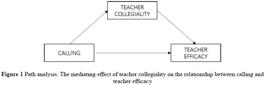
Therefore, in this study I examined the factors affecting teacher efficacy using the teacher's sense of calling as the personal factor and teacher collegiality as the environmental factor. In addition, I examined whether teacher collegiality, a predicting variable for efficacy, mediates the relationship between calling and efficacy.
Theoretical Framework
Teacher efficacy is a multi-dimensional, complex concept. It is a perceptual factor that varies with the teacher's environment, subject, and context. Therefore, environmental elements must be examined multi-laterally (Bandura, 1986; Kleinsasser, 2014).
Early childhood teachers must have specialised knowledge, skills, the correct attitude, and values, such as a sense of calling, which are as important as cognitive-level professionalism in the development of a teacher's professionalism (Mayes & Ferrin, 2001). Moreover, a sense of calling has been proposed as a variable to explain teacher efficacy (Cha & Yoon, 2016).
Several researchers have defined the term "calling" as the need to find life's purpose and meaning in one's work with a sense of vocation (Dik & Duffy, 2009:427; Jang & Lee, 2014:260). According to studies on calling, teachers with a greater sense of calling give meaning to their work and have a high level of efficacy, job satisfaction, life satisfaction, and happiness (Duffy, Bott, Allan, Torrey & Dik, 2012). A teacher's sense of calling is an internal variable that positively affects personality, professionalism, job satisfaction, efficacy, and life satisfaction, and serves as a standard for professionalism (Mayes & Ferrin, 2001). Since a teacher's sense of calling is based on a sense of purpose and responsibility, a high sense of calling would have a positive impact on their performance, even in challenging times. In other words, the greater a teacher's sense of calling, the higher the teacher's efficacy.
Furthermore, efficacy is affected by environmental factors. A study with teachers in South Africa highlighted that even though the coronavirus disease (COVID-19) pandemic negatively affected their well-being, the support they received from their peers kept their efficacy strong, maintaining professionalism (Clasquin-Johnson & Ebrahim, 2024). As such, studies in various countries show that teachers' cooperative organisational climate has a positive effect on their efficacy (Hao, Yu & Fu, 2024; Kim, YH 2021; Rangraje, Van der Merwe, Urbani & Van der Walt, 2005; Samuelsson, 2018; Ware & Kisanlas, 2007). Collegiality, too, is an environmental factor, which predicts efficacy in early childhood teachers. In a rapidly changing society, knowledge is constantly produced and restructured, which requires both individual and collective intelligence, and efforts based on cooperation. Teacher collegiality is conceptualised as teachers working together to improve learners' educational outcomes by improving classroom instruction or by making school operations more efficient (Organisation for Economic Co-operation and Development [OECD], 2020; Park, Song & Lee, 2016).
The cooperative relationship between teachers is an important variable influencing their professional development (Samuelsson, 2018; Woo, 2003). Teacher efficacy can be increased by enhancing educational competence by learning and implementing new teaching strategies through cooperation (Cantrell & Callaway, 2008; Kim, YH 2021). Several studies (Kim, YH 2021; Meyer, Richter & Hartung-Beck, 2022; Reeves, Pun & Chung, 2017; Shah, 2012) report that teacher collegiality experiences are emotional support in the process of reflection with fellow teachers, which increases efficacy and job satisfaction.
Therefore, the Minister of Education of South Korea encourages "collaborating with fellow teachers" for child-centred and play-centred curricula. Teachers can achieve their educational goals while seeking solutions for curriculum implementation from their colleagues. In addition, increasing the level of teacher innovation (Çoban & Athasoy, 2020) changes teaching practice (Ching & Hursh, 2014) and promotes school innovation and professional development (Blömeke, Nilsen & Scherer, 2021). In particular, the mutual cooperative relationship between teachers is an important factor in reviewing teaching behaviour and seeking better action plans. Teacher collegiality is significant in that teachers continue to practice appropriate forms of cooperation in school and class situations, developing their expertise, promoting the effectiveness of school education, and positively leading the direction of school education.
However, teachers with a high sense of calling are expected to show a friendly attitude toward others due to the pro-social motive inherent in the sense of calling. These pro-social attitudes and behaviour lead to improved peer relationships. Office workers with a sense of calling were found to be more interested in their co-workers' duties and in helping them (Jung & Lee, 2017; Moon & Lee, 2020). Considering the results of previous studies, a sense of calling and organisational citizenship behaviour (OCB) are positively related (Park, Sohn & Ha, 2016). Teachers with a greater sense of calling are expected to cooperate with fellow teachers and voluntarily assist the organisation (Bunderson & Thompson, 2009). Hence, a teacher's calling helps form collegiality and a sense of responsibility among fellow teachers. Early childhood education (ECE) institutions are often small and mostly have female teachers and staff members (Choi, H, Cho & Kwon, 2014). Hence, they are believed to have a relationship-oriented organisational culture (Choi, H et al., 2014).
Given the bi-directional relationships between organisational members, it may be inferred that teacher collegiality has a relationship with calling and efficacy. Hence, early childhood teachers with a high sense of calling will be able to develop into better professionals through giving meaning to work and cooperative relationships with fellow teachers even in difficult situations
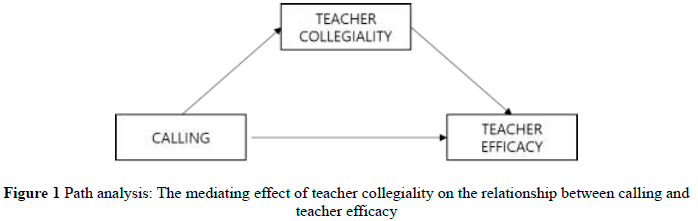
Therefore, I examined the relationship between teacher efficacy and the sense of calling, which recently became a standard for professionalism in the teaching profession. In addition, I examined whether teacher collegiality, a predicting variable for teacher efficacy, mediates the relationship between calling and efficacy. The research questions and research model are as follows: 1. What are the correlations between the sense of calling, teacher efficacy, and teacher collegiality of early childhood teachers in South Korea? 2. What are the mediating effects of teacher collegiality on the relationship between the calling and efficacy of early childhood teachers? (see Figure 1).
Methods
Research Procedure and Sample
This study was a causal-comparative study among quantitative research types that verified the influence of teacher collegiality in the relationship between teachers' sense of calling and teacher efficacy. For this purpose, the causal relationship was analysed using quantitative data collected through a survey. A possible limitation might be that it is not possible to understand and explain in depth the various meanings and contexts of variables that can affect teacher efficacy. However, it has the advantage of being able to objectively identify the relationship between sense of calling and teacher collegiality variables that affect teacher efficacy.
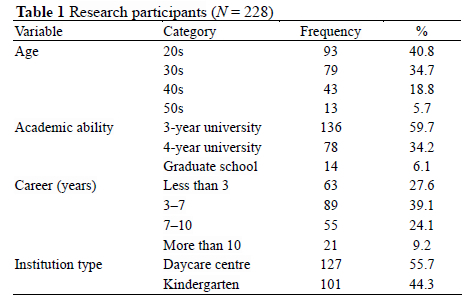
The survey was administered to 228 active early childhood teachers who agreed to participate in the study from May 24 to June 11, 2021. The completed questionnaires were collected by mail or in person. Table 1 refers to the background of the participants. Among the teachers who completed questionnaire, 136 (59.7%) were 3-year college graduates, 78 (34.2%) were 4-year college graduates, and 14 (6.1%) had a master's degree. Most teachers (89; 39.1%) had work experience of 3 to 7 years, followed by 63 (27.6%) with less than 3 years' experience, 55 (24.1%) with 7 to 10 years' experience and 21 (9.2%) with more than 10 years' experience. Regarding the type of institution, 127 teachers (55.7%) worked at daycare centres and 101 teachers (44.3%) were kindergarten teachers.
Measures
Calling
To measure calling, the calling and vocation questionnaire (CVQ) developed by Dik, Eldridge, Steger and Duffy (2012) was adapted from English to Korean by Shim and Yoo (2012) and the K-CVQ scale, validated by experts, was used. The K-CVQ consists of 24 items, with 12 items each for the calling-seeking scale and the calling existence scale. In this study, the calling existence scale was used. This scale consists of four items each for three sub-factors: transcendental calling, purpose/meaning, and pro-social orientation. The scores were measured on a 5-point Likert scale. The higher the score, the higher the sense of calling. The overall reliability of this scale is 0.87.
Teacher efficacy
To measure teacher efficacy, the Korean version of the teacher efficacy scale was used. The science teaching efficacy belief instrument (STEBI), developed by Riggs and Enochs (1990), was revised and supplemented by BR Lee (1998) to suit South Korean early childhood teachers' context. This scale consists of 25 items, comprising 12 items for general teaching efficacy and 13 items for personal teaching efficacy. The results were marked on a 5-point Likert scale. The higher the scores, the higher the teaching efficacy. The overall reliability coefficient (Cronbach's α) of the scale is 0.74.
Teacher collegiality
For teacher collegiality measurement I used a modification of the teacher collegiate scale (TCS) developed by Shah (2011) and modified by Kwon and Kim (2013). The sub-variables of teacher collegiality are knowledge/information sharing, mutual reliability, common sense of purpose, sense of responsibility, and autonomy, with 19 items. It was measured on a 5-point Likert scale. Its overall reliability coefficient (Cronbach's α) is 0.88.
Data Analysis
In this study, data were analysed using the IBM SPSS 26.0 program. Frequency analysis was conducted on the participants' general background, and the means and standard deviations were calculated to examine early childhood teachers' sense of calling, teacher efficacy, and perception of teacher cooperation. The reliability of the study tool was analysed by calculating Cronbach's α coefficient, and Pearson's product-moment correlation coefficients were obtained to examine the correlations between individual variables. Mediating effects were analysed by conducting regression analysis according to the three-step principle of Baron and Kenny (1986) and Sobel tests were conducted to verify the significance of the mediating effects.
Results
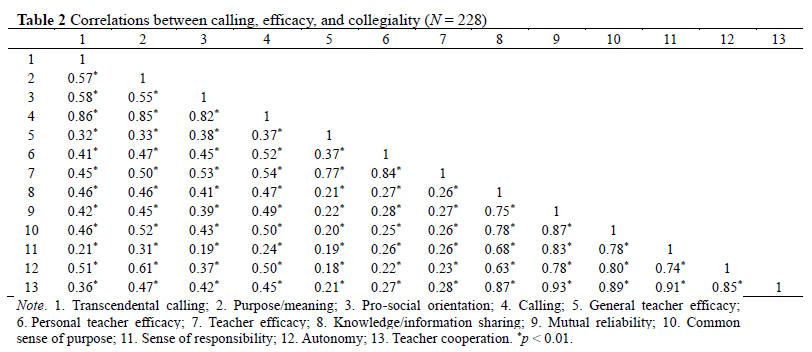
Correlation between Calling, Efficacy, and Collegiality of Early Childhood Teachers The correlation between early childhood teachers' calling, efficacy, and collegiality was examined, and the results are shown in Table 2. There were significant positive correlations between calling and efficacy (r = 0.54, p < 0.01), calling and collegiality (r = 0.45, p < 0.01), and efficacy and collegiality (r = 0.44, p < 0.01). On reviewing the relationships between the sub-factors of calling and efficacy, significant positive correlations were found; hence, teachers with a greater sense of calling had higher levels of efficacy. Similarly, on reviewing the relationships between the sub-factors of calling and collegiality, significant positive correlations were found; hence, teachers with a greater sense of calling had higher levels of collegiality. The relationships between the sub-factors of efficacy and collegiality, too, showed significant positive correlations; hence, teachers with higher levels of efficacy had higher levels of collegiality.
The Mediating Effect of Cooperation on the Relationship between Calling and Efficacy Before examining the mediating effect of teacher cooperation on the relationship between calling and efficacy, the basic assumption of the regression model was examined. According to the results, the Durbin-Watson value was 1.65-1.96 and the Variance Inflation Factor (VIF) value ranged from 1.41-2.28, indicating that there was no problem with multicollinearity (Baron & Kenny, 1986).
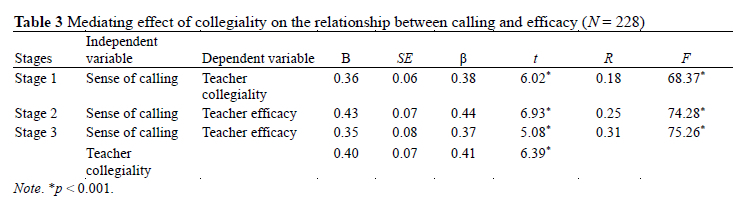
According to the results of the mediating effect of teacher cooperation in Table 3 in the first stage, the effect of the independent variable on the mediating variable was analysed and the results indicate that calling had a significant effect on teacher cooperation (β = 0.38, p < 0.001). Hence, the greater the sense of calling, the higher the level of cooperation. In addition, the explanatory power of calling to explain teacher cooperation was 18% (F = 68.37, p < 0.001). This satisfied the basic assumption of the first stage that the independent variable explained the mediating variable.
In the second stage, the effect of the independent variable on the dependent variable was analysed. This indicated that the greater the sense of calling, the higher the teacher efficacy (β = 0.44, p < 0.001); the degree to which calling explained efficacy was 25% (F = 74.28, p < 0.001). This indicates that it was a suitable regression model. This satisfied the basic assumption of the second stage that the independent variable explained the dependent variable. In stage 3, sense of calling, an independent variable, and teacher cooperation, a mediating variable, were input simultaneously to examine their effects on teacher efficacy, a dependent variable. The explanatory power of calling and teacher cooperation to explain teacher efficacy was 31%, which was higher than the explanatory power of calling to explain efficacy (F = 75.26, p < 0.001). When calling and cooperation were simultaneously input, the value of the standardisation coefficient β of the effect of calling on efficacy decreased (0.44 - 0.37). This indicated that the effect of the independent variable decreased significantly, indicating that teacher cooperation had a partial mediating effect on the relationship between calling and efficacy in early childhood teachers. According to the Sobel test conducted to verify the significance of the mediating effect, z = 4.13 (p < 0.001). Since the mediating effect was considered significant in cases where the result value was greater than 1.96 or smaller than -1.96 (Baron & Kenny, 1986), teacher cooperation demonstrated a partial mediating effect on the relationship between calling and efficacy in early childhood teachers.
Discussion
This study was conducted to establish whether calling was a leading variable for efficacy in early childhood teachers and whether teacher collegiality mediated the relationship between calling and efficacy. The results and implications of each research question are set out below.
Calling showed positive correlations with teacher efficacy and collegiality. Hence, the greater the sense of calling, the higher the levels of teacher efficacy and collegiality. Teachers with a greater sense of calling give meaning to their work and have higher levels of efficacy and job satisfaction (Bullough & Hall-Kenyon, 2012; Duffy et al., 2012), which leads to greater life satisfaction (Duffy et al., 2012; Jang & Lee, 2014; Jeong & Lee, 2018; Steger, Pickering, Shin & Dik, 2010).
Calling and collegiality had a significant positive correlation. No previous study has reported a direct positive relationship between calling and teacher cooperation. However, studies have shown a positive relationship between calling and OCB (altruistic behaviour) (Park, Sohn, et al., 2016), hence, it can be assumed that teachers with a greater sense of calling would have a higher tendency to cooperate with fellow teachers and voluntarily assist the organisation (Bunderson & Thompson, 2009). Due to the pro-social motive inherent in the sense of calling, teachers with a greater sense of calling are friendly toward others. This pro-social attitude and behaviour help form teacher collegiality and smooth colleague relationships. In particular, a sense of calling increases job satisfaction, pursues the meaning of work and an other-oriented life (Cha & Yoon, 2016; Lips-Wiersma, 2002), and shows a significant relationship with teacher collegiality. Since the sense of calling pursues the value of working for others and contributes to social responsibility (Lips-Wiersma, 2002), teacher cooperation activities should be used to promote a sense of vocation.
Teacher efficacy and collegiality had a significant positive correlation. This result is consistent with previous studies indicating that teachers with extensive experience working with other teachers have higher confidence in their teaching ability (Soon-Hyung & Kim, 2014). In addition, cooperation with teachers and support from colleagues affect efficacy (Choi & Kang, 2019). Hence, the sense of efficacy is highly related to cooperative teacher-teacher relationships and supportive organisational climate.
Early childhood teachers' sense of calling was highly related with their sense of efficacy, while collegiality was found to mediate calling and efficacy, which suggests that teachers with a sense of calling can increase their efficacy through cooperative relationships with other teachers. Although calling may be diminished by heavy workloads or other reasons, efficacy can be maintained at a high level if cooperative relationships continue. This is consistent with research showing that early childhood teacher's efficacy increases when they recognise the importance of their sense of calling and trust-based cooperative relationships with fellow teachers (Ryu & Kang, 2015). Additionally, a cooperative organisational culture encourages early childhood teachers' sense of calling, enabling them to adapt to the organisation and continue teaching with confidence despite job-related difficulties (Colarelli & Bishop, 1990).
Considering these results, measures to strengthen calling and develop a cooperative organisational climate are needed to improve efficacy. Calling and collegiality are starting points for professionalism, job satisfaction and efficacy (Blömeke et al., 2021; Cantrell & Callaway, 2008; Mayers & Ferrin, 2001). In this study, I explained how a teacher's sense of calling affects a teacher's efficacy and the importance of collegiality. Hence, it is necessary to explore the role of teacher collegiality in addition to living a calling, job engagement, efficacy, and grit (Duffy et al., 2012; Jeong & Lee, 2018; Lee, HW 2020), which were identified as important mediating variables in the existing relationship between calling and efficacy.
Conclusion
In this study I aimed to examine the relationship between the sense of calling and the efficacy of early childhood teachers and confirm the mediating role of teacher efficacy in the relationship between the sense of calling and teacher efficacy. A significant relationship between teachers' sense of calling and collegiality, which has not been studied before, was confirmed. Early childhood teachers with a high sense of vocation showed a high sense of efficacy, and the cooperative relationship between teachers mediated the relationship between calling and efficacy. In particular, teacher collegiality played a meaningful role in the relationship between calling and efficacy. It increased the level of teacher innovation (.Çoban & Athasoy, 2020), and changed teaching practices (Ching & Hursh, 2014), school innovation, and teacher expertise (Blömeke et al., 2021). Hence, a sense of calling should be promoted by strengthening teacher collegiality.
Since most of the organisational members of ECE institutions are women who value interpersonal relationships (Choi, H et al., 2014), efficacy could be enhanced by promoting cooperative relationships based on trust. In ECE institutions, teachers are important human resources who share practical knowledge and experience (Schaufeli & Greenglass, 2001). Teachers grow while they teach and conduct research with their fellow teachers (Soon-Hyung & Kim, 2014). Therefore, cooperation among teachers promotes communication and expertise sharing to improve their professionalism (Goddard, Goddard & Tschannen-Moran, 2007). Through cooperative relationships, teachers could access new knowledge and test new teaching methods with the support of fellow teachers (Epstein & Willhite, 2015; Muchena & Moalisi, 2018; Park, Song, et al., 2016). Although studies on factors predicting cooperative relationships among early childhood teachers are relatively limited, Ryu and Kang (2015) proved that the higher a teachers' emotional intelligence, the higher the level of cooperative relationships among early childhood teachers. Teachers who engage in self-encouragement can share the organisation's vision with colleagues and form mutually cooperative relationships. With this study I suggest that, in addition to the factors mentioned above, devotion to one's job could have positive effects on forming cooperative relationships. The Ministry of Education should support teachers to participate in cooperative activities and develop teaching competencies by enacting policies related to teacher cooperation activities. For example, it is necessary to devise measures, such as providing temporal and material support or compensation, to encourage teachers to actively participate in professional cooperative activities, such as joint project classes and learning community management.
This study was based on the quantitative measurement of each variable through a survey. In subsequent studies, it would be necessary to conduct additional studies on individual and organisational variables that affect the development of teacher efficacy through in-depth interviews with teachers to overcome the limitations of quantitative research. In addition, teachers' cooperation is promoted by exchanging professional knowledge and information. Therefore, the Ministry of Education should continue to promote administrative support for the operation of a learning community in which teachers can freely communicate and cooperate with each other.
Notesi. Published under a Creative Commons Attribution Licence.
References
- Bandura A 1986. Social foundation of thought and action: A social-cognitive view. Englewood Cliffs, NJ: Prentice-Hall.
-
Bandura A, Freeman WH & Lightsey R 1999. Self-efficacy: The exercise of control. Journal of Cognitive Psychotherapy, 13(2):158-166. https://doi.org/10.1891/0889-8391.13.2.158
» https://doi.org/10.1891/0889-8391.13.2.158 -
Baron RM & Kenny DA 1986. The moderator-mediator variable distinction in social psychological research: Conceptual, strategic, and statistical considerations. Journal of Personality and Social Psychology, 51(6):1173-1182. https://doi.org/10.1037/0022-3514.51.6.1173
» https://doi.org/10.1037/0022-3514.51.6.1173 - Blömeke S, Nilsen T & Scherer R 2021. School innovativeness is associated with enhanced teacher collaboration, innovative classroom practices, and job satisfaction. Journal of Educational Psychology, 113(8):1645-1667.
- Bullough RV, Jr & Hall-Kenyon KM 2012. On teacher hope, sense of calling, and commitment to teaching. Teacher Education Quarterly, 39(2):7-27.
-
Bunderson JS & Thompson JA 2009. The call of the wild: Zookeepers, callings, and the double-edged sword of deeply meaningful work. Administrative Science Quarterly, 54(1):32-57. https://doi.org/10.2189/asqu.2009.54.1.32
» https://doi.org/10.2189/asqu.2009.54.1.32 -
Cantrell SC & Callaway P 2008. High and low implementers of content literacy instruction: Portraits of teacher efficacy. Teaching and Teacher Education, 24(7):1739-1750. https://doi.org/10.1016/j.tate.2008.02.020
» https://doi.org/10.1016/j.tate.2008.02.020 - Cha JJ & Yoon GJ 2016. The effects of calling on life satisfaction of early childhood pre-service teachers: The mediating effect of career decision-making self-efficacy. The Journal of Eco-Early Childhood Education, 15(4):93-112.
- Chi SA & Kim JE 2017. An analysis of the relationship among early childhood teachers' teacher professionalism, teaching efficacy, psychological burn-out and personality traits. Early Childhood Education Research & Review, 21(5):5-32.
-
Ching CC & Hursh AW 2014. Peer modeling and innovation adoption among teachers in online professional development. Computers & Education, 73:72-82. https://doi.org/10.1016/jxompedu.2013.12.011
» https://doi.org/10.1016/jxompedu.2013.12.011 -
Choi H, Cho S & Kwon Y 2014. The effect of organizational culture and job satisfaction on childcare teachers' intention to change jobs. Family and Environment Research, 52(4):405-414. https://doi.org/10.6115/fer.2014.035
» https://doi.org/10.6115/fer.2014.035 -
Choi J & Kang W 2019. Sustainability of cooperative professional development: Focused on teachers' efficacy. Sustainability, 11(3):585. https://doi.org/10.3390/su11030585
» https://doi.org/10.3390/su11030585 -
Clasquin-Johnson MG & Ebrahim HB 2024. Self-efficacy and well-being of female teacher educators for early childhood care and education during COVID-19. South African Journal of Education, 44(1):Art. #2354, 9 pages. https://doi.org/10.15700/saje.v44n1a2354
» https://doi.org/10.15700/saje.v44n1a2354 -
Çoban Ö & Atasoy R 2020. Relationship between distributed leadership, teacher collaboration and organizational innovativeness. International Journal of Evaluation and Research in Education, 9(4):903-911. https://doi.org/10.11591/ijere.v9i4.20679
» https://doi.org/10.11591/ijere.v9i4.20679 -
Colarelli SM & Bishop RC 1990. Career commitment: Functions, correlates, and management. Group & Organization Management, 15(2):158-176. https://doi.org/10.1177/105960119001500203
» https://doi.org/10.1177/105960119001500203 -
Dik BJ & Duffy RD 2009. Calling and vocation at work: Definitions and prospects for research and practice. The Counseling Psychologist, 37(3):424-150. https://doi.org/10.1177/0011000008316430
» https://doi.org/10.1177/0011000008316430 -
Dik BJ, Eldridge BM, Steger MF & Duffy RD 2012. Development and validation of the Calling and Vocation Questionnaire (CVQ) and Brief Calling scale (BCS). Journal of Career Assessment, 20(3):242-263. https://doi.org/10.1177/1069072711434410
» https://doi.org/10.1177/1069072711434410 -
Duffy RD, Bott EM, Allan BA, Torrey CL & Dik BJ 2012. Perceiving a calling, living a calling, and job satisfaction: Testing a moderated, multiple mediator model. Journal of Counseling Psychology, 59(1):50-59. https://doi.org/10.1037/a0026129
» https://doi.org/10.1037/a0026129 -
Epstein A & Willhite GL 2015. Teacher efficacy in an early childhood professional development school. International Electronic Journal of Elementary Education, 7(2): 189-198. Available at https://iejee.com/index.php/IEJEE/article/view/74/72. Accessed 24 February 2025.
» https://iejee.com/index.php/IEJEE/article/view/74/72 -
Goddard YI, Goddard RD & Tschannen-Moran M 2007. A theoretical and empirical investigation of teacher collaboration for school improvement and student achievement in public elementary schools. Teacher College Record, 109(4):877-896. https://doi.org/10.1177/016146810710900401
» https://doi.org/10.1177/016146810710900401 -
Hao S, Yu D & Fu L 2024. Organizational climate of kindergartens and teacher professional learning: Mediating effect of teachers' collective efficacy and moderating effect of mindfulness in teaching. Frontiers in Psychology, 15:1287703. https://doi.org/10.3389/fpsyg.2024.1287703
» https://doi.org/10.3389/fpsyg.2024.1287703 -
Jang JY & Lee JY 2014. The relationship between perceiving a calling and life satisfaction: The mediating effects of work meaning, living a calling, life meaning, and job satisfaction. Korean Journal of Counseling, 15(1):259-278. https://doi.org/10.15703/kjc.15.1.201402.259
» https://doi.org/10.15703/kjc.15.1.201402.259 - Jeong HK & Lee JY 2018. Relationship between teacher's calling spirit, self-efficacy, job commitment, and life satisfaction. The Journal of Research in Education, 31(2):175-196.
-
Jung H & Lee H 2017. Mediating effect of calling in the relationship between spiritual leadership of leader and organizational citizenship behavior recognized by staff of lifelong learning institutions. Journal of Lifelong Learning Society, 13(1):131-156. https://doi.org/10.26857/jlls.2017.02.13.1.131
» https://doi.org/10.26857/jlls.2017.02.13.1.131 - Kim AY 2012. Teacher efficacy: The key factor of teacher professionalism. Korean Journal of Educational Psychology, 26(1):63-84.
-
Kim YH 2021. The structural relationship among the technology teacher's cooperation, efficacy and satisfaction: Multi-group analysis between Korea and U.S. Practical Educational Research, 27(3):81-99. https://doi.org/10.29113/skpaer.2021.27.3.04
» https://doi.org/10.29113/skpaer.2021.27.3.04 -
Kleinsasser RC 2014. Teacher efficacy in Teaching and Teacher Education. Teaching and Teacher Education, 44:168-179. https://doi.org/10.1016/j.tate.2014.07.007
» https://doi.org/10.1016/j.tate.2014.07.007 - Kwon SH & Kim DK 2013. A study on development and validity of the teacher collaboration scale. Journal of Educational Administration, 31:109-132.
- Lee B 2018. The effect of teacher efficacy on kindergarten teachers' professionalism: Focusing on the moderating effect of teacher commitment and professional learning environment. EdD dissertation. Gwangju, South Korea: Chonnam National University.
- Lee BR 1998. The relationship among organizational climate, job satisfaction and teacher's sense of efficacy in the kindergartens. MEd thesis. Seoul, South Korea: Ewha Womans University.
- Lee HW 2020. The mediating effect of early childhood teacher's grit on the relationship between calling and job satisfaction. Journal of Children's Media & Education, 19(3):103-121.
- Lee KR & Moon HJ 2013. Effects of infant care teacher's knowledge of infant development, teaching efficacy and professional learning environment to developmental levels for teacher's professionalism. Korean Journal of Child Education and Care, 13(3):163-182.
-
Lips-Wiersma M 2002. The influence of spiritual "meaning-making" on career behavior. Journal of Management Development, 21(7):497-520. https://doi.org/10.1108/02621710210434638
» https://doi.org/10.1108/02621710210434638 -
Maistry SM & Parker K 2010. Teacher efficacy: An investigation of Economics teachers. Africa Education Review, 7(2):376-401. https://doi.org/10.1080/18146627.2010.515425
» https://doi.org/10.1080/18146627.2010.515425 -
Mayes C & Ferrin SE 2001. Spiritually committed public school teachers: Their beliefs and practices concerning religious expression in the classroom. Religion & Education, 28(1):75-94. https://doi.org/10.1080/15507394.2001.10012275
» https://doi.org/10.1080/15507394.2001.10012275 -
Meyer A, Richter D & Hartung-Beck V 2022. The relationship between principal leadership and teacher collaboration: Investigating the mediating effect of teachers' collective efficacy. Educational Management Administration & Leadership, 50(4):593-612. https://doi.org/10.1177/1741143220945698
» https://doi.org/10.1177/1741143220945698 -
Moon JY & Lee JH 2020. The effects of leader's organizational citizenship behavior (OCB) on subordinates' interpersonal citizenship behavior (ICB) and job stress: Leader-member exchange (LMX) as a mediating variable. Journal of the Korea Academia-Industrial Cooperation Society, 21(5):230-239. https://doi.org/10.5762/KAIS.2020.21.5.230
» https://doi.org/10.5762/KAIS.2020.21.5.230 -
Mosoge MJ, Challens BH & Xaba MI 2018. Perceived collective teacher efficacy in low performing schools. South African Journal of Education, 38(2):Art. # 1153, 9 pages. https://doi.org/10.15700/saje.v38n2a1153
» https://doi.org/10.15700/saje.v38n2a1153 -
Muchena KC & Moalisi WTS 2018. Teacher efficacy and classroom management in Africa: A meta-analysis. The Independent Journal of Teaching and Learning, 13(2):26-35. Available at https://journals.co.za/doi/epdf/10.10520/EJC-12222406b7. Accessed 23 February 2025.
» https://journals.co.za/doi/epdf/10.10520/EJC-12222406b7 -
Organisation for Economic Co-operation and Development 2020. TALIS 2018 results: Teachers and school leaders as valued professionals (Vol. II). Paris, France: OECD Publishing. https://doi.org/10.1787/19cf08df-en
» https://doi.org/10.1787/19cf08df-en -
Park J, Sohn YW & Ha YJ 2016. South Korean salespersons' calling, job performance, and organizational citizenship behavior: The mediating role of occupational self-efficacy. Journal of Career Assessment, 24(3):415-128. https://doi.org/10.1177/1069072715599354
» https://doi.org/10.1177/1069072715599354 - Park JH, Song IB & Lee JY 2016. The impact of teacher collaboration as a learning activity on teaching practices. The Journal of Korean Teacher Education, 33(1):243-265.
- Rangraje A, Van der Merwe A, Urbani G & Van der Walt JL 2005. Efficacy of teachers in a number of selected schools in the KwaZulu-Natal province of South Africa. South African Journal of Education, 25(1):38-43.
-
Reeves PM, Pun WH & Chung KS 2017. Influence of teacher collaboration on job satisfaction and student achievement. Teaching and Teacher Education, 67:227-236. https://doi.org/10.1016/j.tate.2017.06.016
» https://doi.org/10.1016/j.tate.2017.06.016 - Riggs IM & Enochs LG 1990. Toward the development of an efficacy belief instrument for elementary teachers. Science Education, 74(6):625-637.
- Ryu KH & Kang S 2015. Analysis of structural model of emotional intelligence, co-teachers' cooperative relationship, parent-teacher cooperative relationship, and teacher's efficacy. Journal of Early Childhood Education & Educare Welfare, 19(2):203-225.
-
Samuelsson K 2018. Teacher collegiality in context of institutional logics: A conceptual literature review [Special issue]. Professions & Professionalism, 8(3):e2030. https://doi.org/10.7577/pp.2030
» https://doi.org/10.7577/pp.2030 -
Schaufeli WB & Greenglass ER 2001. Introduction to special issue on burnout and health. Psychology & Health, 16(5):501-510. https://doi.org/10.1080/08870440108405523
» https://doi.org/10.1080/08870440108405523 -
Schwarzer R & Hallum S 2008. Perceived teacher self-efficacy as a predictor of job stress and burnout: Mediation analysis. Applied Psychology, 57(s1 ):152-171. https://doi.org/10.1111/j.1464-0597.2008.00359.x
» https://doi.org/10.1111/j.1464-0597.2008.00359.x -
Shah M 2011. The dimensionality of teacher collegiality and the development of teacher collegiality scale. International Journal of Education, 3(2):1-20. https://doi.org/10.5296/ije.v3i2.958
» https://doi.org/10.5296/ije.v3i2.958 -
Shah M 2012. The importance and benefits of teacher collegiality in schools - a literature review. Procedia - Social and Behavioral Sciences, 46:1242-1246. https://doi.org/10.1016/j.sbspro.2012.05.282
» https://doi.org/10.1016/j.sbspro.2012.05.282 - Shim YR & Yoo SK 2012. Development and validation of the Korean version of the calling and vocation questionnaire (CVQ-K). The Korean Journal of Counselling and Psychotherapy, 24(4):847-872.
-
Soon-Hyung K & Kim D 2014. The structural relationship among collective teacher efficacy, personal teacher efficacy and teacher-collaboration. The Journal of Korean Teacher Education, 31(2):161-180. https://doi.org/10.24211/tjkte.2014.31.2.161
» https://doi.org/10.24211/tjkte.2014.31.2.161 -
Steger MF, Pickering NK, Shin JY & Dik BJ 2010. Calling in work: Secular or sacred? Journal of Career Assessment, 18(1):82-96. https://doi.org/10.1177/1069072709350905
» https://doi.org/10.1177/1069072709350905 -
Tschannen-Moran M & Woolfolk Hoy A 2001. Teacher efficacy: Capturing an elusive construct. Teaching and Teacher Education, 17(7):783-805. https://doi.org/10.1016/S0742-051X(01)00036-1
» https://doi.org/10.1016/S0742-051X(01)00036-1 -
Ware H & Kisantas A 2007. Teacher and collective efficacy beliefs as predictors of professional commitment. The Journal of Education Research, 100(5):303-310. https://doi.org/10.3200/JOER.100.5.303-310
» https://doi.org/10.3200/JOER.100.5.303-310 - Woo JH 2003. The study of co-teaching method for effective inclusion. Journal of Special Education & Rehabilitation Science, 42(2):141 -170.
Revised: 13 October 2024
Accepted: 11 January 2025
Published: 28 February 2025