The effectiveness of augmented reality application among students with special needs
Abstract
The positive effects of augmented reality (AR) in the educational environment is considered to improve students' learning process. Therefore, the positivity of AR tools on student learning is considered as the research motivation. The quasi-experimental study was a pre-test/post-test control-group design where 24 students with special needs who were randomly divided into 2 groups, participated. Significant positive results of AR tools in enhancing student attitudes were obtained. We concluded that AR technology has a significant influence on students and that it can undoubtedly contribute to the learning process of students with special needs.
augmented reality; special needs; students; traditional classroom
Introduction
A shift towards the active development and implementation of evidence-based practice has been notable in the quest to enhance the attitudes of students with special needs (who have divergent characteristics) with regard to their learning and development (Jdaitawi & Kan'an, 2022; Kellems, Eichelberger, Cacciatore, Jensen, Frazier, Simons & Zaru, 2020; Makoelle & Burmistrova, 2020). The development of the students from one level to the next is accompanied by increasing academic requirements and expectations (Akçayır & Akçayır, 2017; Alqarni, 2021; Billingsley, Thomas & Webber, 2018; Jdaitawi, Al-Mutawa, Musallam & Talafha, 2014; Jdaitawi, Maya-Panorama, Nawafleh, Nabrawi, Talafha & Mohd, 2013; Jdaitawi, Rasheed, Gohari, Raddy, Aydin, Abas, Hasan & Khatiry, 2020; Weng, Otanga, Christianto & Chu, 2020). Although great efforts have been made with regard to special needs settings, learning challenges, such as teaching approaches, services provided, and teachers' lack of experience to identify students with special educational needs, still abound in academic settings (Alnahdi, Saloviita & Elhadi, 2019; Binmahfooz, 2019; De Milander, Schall, De Bruin & Smuts-Craft, 2020).
The education literature highlights the importance of innovative technology tools to enhance students' learning and their achievements through developing methods to deliver new courses (Alqarni, 2021; Jdaitawi, 2019, 2020; Kellems, Cacciatore & Osborne, 2019; Khan, Johnston & Ophoff, 2019). AR has been suggested as an innovative tool to improve teaching and learning opportunities and students' attitudes and their success (Alqarni, 2021; Kellems et al., 2019; Weng et al., 2020).
Although AR studies have been implemented in special needs settings (Kellems et al., 2020), research focusing on the use of AR interventions and the attitudes of students with special needs has yet to be conducted extensively, as the results and recommendations presented in the literature are still inconclusive (Alqarni, 2021; Yuen, Yaoyuneyong & Johnson, 2011). Hence, with our study, which was the first of its kind, we contribute to the literature as we examined the attitudes of students using AR techniques.
Overview Theories
Several learning theories related to learning and technology are often used to describe education/learning via technology. Such theories are Bandura and Walters' social learning theory (1977), constructivism (Merriam & Bierema, 2013), Siemens' connectivism (2005), and the cognitive theory of multimedia learning (CTML) developed by Mayer (2021). In our study we mainly applied Siemens' connectivism (2005), Mayer's CTML (2021) and computer-supported collaborative learning (CSCL).
According to Siemens (2005), connectivism refers to a learning theory catering for the digital age, depicting the way in which internet technologies like apps and online platforms pave the way for learning and sharing of information. Connectivism is essentially a learning theory that considers networked information technologies as the core of the learning process, with learning having the possibility to be networked through social and technological means (Siemens, 2005). In addition, it has several notable principles: learning refers to a process involving the combination of specialised nodes or information sources, it involves a combination of learning information and technology of which the combination and connections need to be enhanced for the promotion of ongoing learning. Furthermore, there is a need for the information to be examined prior to the adaption thereof as it is a skill to be applied prior to learning.
According to Mayer (2021), CTML is a novel multimedia learning instruction with its hypothesis based on the fact that multimedia instructional messages are created in a way that the human mind functions and as such, there is a higher likelihood of learning taking place (Mayer, 2021). Moreover, the CTML is based on two fundamental principles, namely, a dual assumption of a human information processing system with the inclusion of dual channels of visual/pictorial and auditory/verbal processing, and an active processing assumption in that active learning involves coordinated groups of cognitive processing during learning. Hence the CTML indicates that several channels are used to bring about active learning.
On the other hand, CSCL refers to a framework that represents the way in which students collaborate with the help of computers (Stahl & Hakkarainen 2021), which was developed based on the activity theory, also referred to as the German and Marxist framework. The latter provides a description of human activity using a lens through which the interrelationship of individuals, subjects, objectives, and operations are viewed as a way in which internalised sub-conscious processes are brought about to achieve the objective. In this regard, the cognitive tools utilised have a mediating effect on learning, which includes digital interfaces (Engeström, 1987; Leontiev, 1978; Nardi, 1996; Scavarelli, Arya & Teather, 2021; Stahl & Hakkarainen, 2021).
By adopting the above-mentioned theories, information and skills may be learnt inside and outside the classroom. We applied connectivism, CTML as well as the CSCL framework for learning and understanding new information or to support learning via a more experiential model such as AR technology.
Related Works on Augmented Reality in Special Education
Literature on AR applications show the positive role of AR in enhancing learning among students with special needs (Cakir & Korkmaz, 2019; Lorenzo, Gómez-Puerta, Arráez-Vera & Lorenzo-Lledó, 2019). Some studies show that the learning experiences of adults with special needs were improved when AR technology was used to display educational material (Benda, Ulman & Smejkalová, 2015; Smith, Cihak, Kim, McMahon & Wright, 2016). In addition, researchers highlight the potential of AR technology in enhancing positive educational outcomes (Chiu, DeJaegher & Chao, 2015). Chiu et al. (2015) explored how combining physical and virtual experiences into AR enhances science learning among students. They found that AR experiences positively affected science learning. In the same vein, Rahman, Mailok and Husain (2020) revealed that AR applications enhanced students' motivation and interest in the learning process. Badilla-Quintana, Sepulveda-Valenzuela and Arias (2020) also show that AR technology positively enhance students' achievement and knowledge retention. Moreover, McMahon, Cihak, Wright and Bell (2016) tested AR technology in a science course among students to measure the students' ability to define several sets of science vocabulary. McMahon et al. (2016) found that AR technology enhances students' knowledge of new science vocabulary.
Literature on AR for special needs (Kellems et al., 2020; Walker, McMahon, Rosenblatt & Arner, 2017) remains scarce and findings on the effectiveness of interventions remain mixed and inconclusive (Kellems et al., 2020; Savelsbergh, Prins, Rietbergen Fechner, Vaessen, Draijer & Bakker, 2016). As such, we aimed to identify the effectiveness of using AR in enhancing the attitudes of students with special needs. The research objective of our study was determined by the following research questions:
1) Do the total post-test scores regarding the learning attitudes of students with special needs differ significantly after the use of AR technology?
2) Do the post-test mean scores regarding learning attitudes differ significantly compared to the pre-test score of the experimental group?
Methods
Research Design
A quasi-experimental pre-test-post-test design with an experimental and a control group was employed in this study. The survey method was used to determine respondents' attitudes (Creswell, 2012; Sirakaya & Cakmak, 2018).
Study Participants
Twenty-four Grade 6 male students between the ages of 11 and 13 in a public primary school in Jordan participated in this study. All the participating students experienced learning, reading and writing challenges, and were experienced in technological instruction. Students were randomly divided into an experimental (n = 12) and a control group (n = 12).
Study Procedures
AR application was developed based on the science textbook acquisitions activity of a sixth grade class. Feedback and opinions regarding the AR activities were obtained from a number of field experts during the development of the application. In the experimental group the activities were restructured in the classroom environment and the students applied practical technology activities. In the control group the students were taught using traditional teaching practices. At the first meeting, all participants were informed of the study goals. All students completed the pre-test instrument. Once the AR activities had been concluded, students in the experimental and the control groups all completed the post-test instrument to measure their attitudes.
Data Collection
We used a learning-outcomes test to measure learning attitudes among the participating special needs students. The study tool was adopted from previous literature (Küçük, Yılmaz, Baydas & Göktaş, 2014). This scale was used to identify the knowledge and experience of students with special needs. Students' attitudes were gauged using a 5-point Likert scale ranging from 1, strongly disagree, to 5, strongly agree, on 11 items. The survey's reliability and validity were established in previous studies (Küçük et al., 2014). The Cronbach alpha value for the survey in this study was 0.73.
Data Analysis
Several statistical tests such as descriptive statistics, a paired sample t-test as well as ANOVA were used to investigate the possible differences between the study groups.
Study Results
Do the Total Post-test Scores regarding the Learning Attitudes of Students with Special Needs Differ Significantly After the Use of AR Technology?
An independent sample t-test was used based on the 0.05 level to determine the statistical difference in the learning attitudes of the students in the two groups on the learning attitudes pre-test. Insignificant differences in the t-test were noticed on the students' pre-test attitudes scores (see Table 1). The ANOVA test analysis was then conducted to determine the differences in the students' learning attitudes post-test scores in the two groups. Significant effects were found for students in the experimental group (see Table 2). Students in the experimental group achieved higher mean learning attitudes scores (M = 3.20; SD = .304) compared to their counter parts in the control group (M = 2.78; SD = .527).
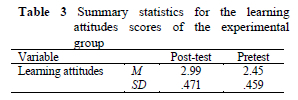
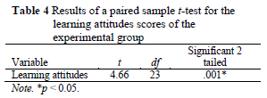
Do the Post-test Mean Scores regarding Learning Attitudes Differ Significantly Compared to the Pre-test Score of the Experimental Group? A paired sample t-test indicated an increase in the post-test mean scores on learning attitudes of the experimental group (M = 2.99; SD = .471) compared to the pre-test mean score (M = 2.45, SD = .459). The overall mean scores were compared using a paired sample t-test and a significant mean score difference of .544 was found (see Tables 3 and 4).
Discussion
In this study we examined the importance of AR technology in enhancing the learning attitudes of students with special needs. The results show that students positively enhanced their learning attitudes through implementing AR as an effective tool in their learning. The students' use of AR technology had a significant effect on their attitudes towards learning. Using AR technology as a learning tool is effective in the development of students' learning and thoughts as opposed to the use of traditional learning. The latter simply expounds on the main idea based on the textbook activities and culminates in the assignation of assignments. Using AR technology facilitates an effective interactive and proactive educational environment (Sirakaya & Cakmak, 2018). The findings show that using AR assisted students in developing positive thoughts about science topics and enhanced their attitudes towards their learning environment (Alqarni, 2021). Several learning theories such as connectivism, CTML and the CSCL framework support the finding that the use of technology enhances student learning (Hammad, Khan, Safieddine & Ahmed, 2020; Leung, Zulkernine & Isah, 2018; Marougkas, Troussas, Krouska & Sgouropoulou, 2023).
Literature (Cakir & Korkmaz, 2019; Delello, 2014) supports the premise that AR tools enhance students' interests in learning topics, increase their attention, as well as enhance the teaching-learning processes (Cakir & Korkmaz, 2019; Hsu, 2017; Ibili & Şahin, 2013; Tian, Endo, Urata, Mouri & Yasuda, 2014). The results of our study indicate that AR effectively enhanced the learning attitudes of students with special needs, which confirms the result of other studies in which it was found that AR entertained students and directed their learning attention (Persefoni & Tsinakos, 2015; Pradibta, 2018).
In addition, AR technology helps to familiarise learners with the activities and facilitates their participation, which proved to ease students' learning and attitudes, and enhanced their understanding of content material, which finally affects their capabilities (Alqarni, 2021; Blattgerste, Renner & Pfeiffer, 2019; Çimer, 2012; Kellems et al., 2020). Literature also shows that AR results in flexible instruction design to enhance students' communication and social skills, and enriches meaningful learning and transference of knowledge as well as improvement of problem-solving (Cakir & Korkmaz, 2019; Kellems et al., 2020). The investigation and findings of our study are thus justified.
Implications
The findings in our study show that using instructional AR tools leads to enhanced learning outcome levels of students with learning disabilities. This result has several notable implications for researchers and practitioners. It extends the limited database on the use of AR technology for students with special needs. The teaching method is effective in enhancing students' direction. Literature confirms that AR enhances the learning of special education students. The results from our study show that students with special needs may achieve optimum results when using an AR instruction method as it seems to be beneficial for them. Literature abounds with studies that indicate support for AR in special education (e.g., Stultz, 2017), despite the fact that variables and findings are dated. The use of AR with students with special needs requires more study and in-depth examination. In this study the emphasis is on students with special needs, and as such, the results of this study cannot be generalised beyond this group of students.
Furthermore, the study results extend empirical findings on the combined instruction of AR design in the school context. With further study individualised and effective academic instruction for students with special needs may be supported.
Our study contributes to the examination of instruction using AR as a direct method with students with special needs, and the examination of the effects of AR technology on the learning attitudes of students with special needs, which have largely not been studied widely. The study results indicate the importance of integrating students with special needs in general education classes with the assumption that it is important for them to receive varied instruction that may generate the expected outcomes. In this regard, there is a need to identify effective instructional techniques in order to facilitate optimised learning among students with special needs. Lastly, the findings in our study show that students' learning was effectively enhanced through the use of AR instruction.
Study Limitations and Suggestions
It is noteworthy to document the limitations of this study for the purposes of future studies. Firstly, the study was limited to a small sample. A larger study sample should be used in future studies. Secondly, a quantitative method was implemented as the data collection instrument. We suggest that several collection instruments should be used in future studies.
Conclusion
In this study we conducted an investigation into the use of AR technology in enhancing the learning attitudes among students with special needs in the sixth grade. Based on the findings, the use of AR technology is effective in achieving positive results in the students' outcomes. However, further studies are needed to confirm the results and to contribute evidence concerning the examined variables and their role in enhancing the learning of students with special needs.
Authors' Contributions
All authors contributed to the article and approved the final version.
Notesi. Published under a Creative Commons Attribution Licence.
Acknowledgement
The study was funded by the Najran University.
References
-
Akçayır M & Akçayır G 2017. Advantages and challenges associated with augmented reality for education: A systematic review of the literature. Educational Research Review, 20:1-11. https://doi.org/10.1016/j.edurev.2016.11.002
» https://doi.org/10.1016/j.edurev.2016.11.002 -
Alnahdi GH, Saloviita T & Elhadi A 2019. Inclusive education in Saudi Arabia and Finland: Pre-service teachers' attitude. Support for Learning, 34(1):71-85. https://doi.org/10.1111/1467-9604.12239
» https://doi.org/10.1111/1467-9604.12239 -
Alqarni T 2021. Comparison of augmented reality and conventional teaching on special needs students' attitudes towards science and their learning outcomes. Journal of Baltic Science Education, 20(4):558-572. https://doi.org/10.33225/jbse/21.20.558
» https://doi.org/10.33225/jbse/21.20.558 -
Badilla-Quintana MG, Sepulveda-Valenzuela E & Arias MS 2020. Augmented reality as a sustainable technology to improve academic achievment in students with and without special educational needs [Special issue]. Sustainability, 12(19):8116. https://doi.org/10.3390/su12198116
» https://doi.org/10.3390/su12198116 - Bandura A & Walters R 1977. Social learning theory. Englewood Cliffs, NJ: Prentice-Hall.
-
Benda P, Ulman M & Smejkalová M 2015. Augmented reality as a working aid for intellectual disabled persons for work in horticulture. Agris On-line Papers in Economic and Informatics, 7(4):31 -37. https://doi.org/10.22004/ag.econ.231890
» https://doi.org/10.22004/ag.econ.231890 -
Billingsley GM, Thomas CN & Webber JA 2018. Effects of student choice of instructional method on the learning outcomes of students with comorbid learning and emotional/behavioral disabilities. Learning Disability Quarterly, 41(4):213-226. https://doi.org/10.1177/0731948718768512
» https://doi.org/10.1177/0731948718768512 -
Binmahfooz S 2019. Saudi special education preservice teachers' perspective towards inclusion. PhD dissertation. Tampa, FL: University of South Florida. Available at https://www.proquest.com/docview/22501961737porigsite=gscholar&fromopenview=true&sourcetype=Dissertations%20&%20Theses. Accessed 9 May 2025.
» https://www.proquest.com/docview/22501961737porigsite=gscholar&fromopenview=true&sourcetype=Dissertations%20&%20Theses -
Blattgerste J, Renner P & Pfeiffer T 2019. Augmented reality action assistance and learning for cognitively impaired people: A systematic literature review. In PETRA '19: Proceedings of the 12th ACM International Conference on PErvasive Technologies Related to Assistive Environments. New York, NY: Association for Computing Machinery. https://doi.org/10.1145/3316782.3316789
» https://doi.org/10.1145/3316782.3316789 -
Cakir R & Korkmaz O 2019. The effectiveness of augmented reality environments on individuals with special education needs. Education and Information Technologies, 24:1631-1659. https://doi.org/10.1007/s10639-018-9848-6
» https://doi.org/10.1007/s10639-018-9848-6 -
Chiu JL, DeJaegher CJ & Chao J 2015. The effects of augmented virtual science laboratories on middle school students' understanding of gas properties. Computers & Education, 85:59-73. https://doi.org/10.1016/j.compedu.2015.02.007
» https://doi.org/10.1016/j.compedu.2015.02.007 -
Çimer A 2012. What makes biology learning difficult and effective: Students' views. Educational Research and Reviews, 7(3):61-71. https://doi.org/10.5897/ERR11.205
» https://doi.org/10.5897/ERR11.205 - Creswell JW 2012. Educational research: Planning, conducting, and evaluating quantitative and qualitative research (4th ed). Boston, MA: Pearson.
-
Delello JA 2014. Insights from pre-service teachers using science-based augmented reality. Journal of Computers in Education, 1 (4):295-311. https://doi.org/10.1007/s40692-014-0021-y
» https://doi.org/10.1007/s40692-014-0021-y -
De Milander M, Schall R, De Bruin E & Smuts-Craft M 2020. Prevalence of ADHD symptoms and their association with learning-related skills in Grade 1 children in South Africa. South African Journal of Education, 40(3):Art. #1732, 7 pages. https://doi.org/10.15700/saje.v40n3a1732
» https://doi.org/10.15700/saje.v40n3a1732 - Engeström Y 1987. Learning by expanding: An activity-theoretical approach to developmental research. Helsinki, Finland: University of Helsinki.
-
Hammad R, Khan Z, Safieddine F & Ahmed A 2020. A review of learning theories and models underpinning technology-enhanced learning artefacts. World Journal of Science Technology and Sustainble Development, 17(4):341-354. https://doi.org/10.1108/WJSTSD-06-2020-0062
» https://doi.org/10.1108/WJSTSD-06-2020-0062 -
Hsu TC 2017. Learning English with augmented reality: Do learning styles matter? Computer & Education, 106:137-149. https://doi.org/10.1016/j.compedu.2016.12.007
» https://doi.org/10.1016/j.compedu.2016.12.007 -
Ibili E & Şahin S 2013. Artırılmış gerçeklik ile interaktif 3D geometri kitabı yazılımın tasarımı ve geliştirilmesi: ARGE3D [Software design and development of an interactive 3D geometry book using augmented reality: ARG3D]. Afyon Kocatepe Üniversitesi Fen ve Mühendislik Bilimleri Dergisi, 13:1-8. https://doi.org/10.5578/fmbd.6213
» https://doi.org/10.5578/fmbd.6213 -
Jdaitawi M 2019. The effects of flipped classroom strategy on students learning outcomes. International Journal of Instruction, 12(3):665-680. https://doi.org/10.29333/iji.2019.12340a
» https://doi.org/10.29333/iji.2019.12340a -
Jdaitawi M 2020. Does flipped learning promote positive emotions in science education7 A comparison between traditional and flipped classroom approaches. The Electronic Journal of e-learning, 18(6):516-524. https://doi.org/10.34190/JEL.18.6.004
» https://doi.org/10.34190/JEL.18.6.004 -
Jdaitawi MT, Al-Mutawa AA, Musallam F & Talafha F 2014. Stress and psychological strain among university lecturers in Saudi Arabia. Global Conference on Business and Finance Proceedings, 9(1):361-368. Available at https://www.researchgate.net/profile/Mariette-Frazer-2/publication/343601160_OMNICHANNEL_RETAILING_THE_MERGING_OF_THE_ONLINE_AND_OFF-LINE_ENVIRONMENT/links/5f33a4d4458515b72918503f/OMNICHANNEL-RETAILING-THE-MERGING-OF-THE-ONLINE-AND-OFF-LINE-ENVIRONMENT.pdf#page=384. Accessed 9 May 2025.
» https://www.researchgate.net/profile/Mariette-Frazer-2/publication/343601160_OMNICHANNEL_RETAILING_THE_MERGING_OF_THE_ONLINE_AND_OFF-LINE_ENVIRONMENT/links/5f33a4d4458515b72918503f/OMNICHANNEL-RETAILING-THE-MERGING-OF-THE-ONLINE-AND-OFF-LINE-ENVIRONMENT.pdf#page=384 -
Jdaitawi MT & Kan'an AF 2022. A decade of research on the effectiveness of augmented reality on students with special disability in higher education. Contemporary Educational Technology, 14(1):ep332. https://doi.org/10.30935/cedtech/11369
» https://doi.org/10.30935/cedtech/11369 -
Jdaitawi M, Maya-Panorama, Nawafleh A, Nabrawi I, Talafha F & Mohd A 2013. Students' perspectives on university experiences; The role of protective factors in students' lives. International Education Studies, 6(7):239-246. https://doi.org/10.5539/ies.v6n7p239
» https://doi.org/10.5539/ies.v6n7p239 -
Jdaitawi M, Rasheed A, Gohari M, Raddy Y, Aydin M, Abas A, Hasan A & Khatiry A 2020. The determinants of leisure attitudes: Mediating effect of self-efficacy among students from science, engineering and medicine colleges. Journal of Turkish Science Education, 17(2):242-252. https://doi.org/10.36681/tused.2020.24
» https://doi.org/10.36681/tused.2020.24 -
Kellems RO, Cacciatore G & Osborne K 2019. Using an augmented reality-based teaching strategy to teach mathematics to secondary students with disabilities. Career Development and Transition for Exceptional Individuals, 42(4):253-258. https://doi.org/10.1177/2165143418822800
» https://doi.org/10.1177/2165143418822800 -
Kellems RO, Eichelberger C, Cacciatore G, Jensen M, Frazier B, Simons K & Zaru M 2020. Using video-based instruction via augmented reality to teach mathematics to middle school students with learning disabilities. Journal of Learning Disabilities, 53(4):277-291. https://doi.org/10.1177/0022219420906452
» https://doi.org/10.1177/0022219420906452 -
Khan T, Johnston K & Ophoff J 2019. The impact of an augmented reality application on learning motivation of students [Special issue]. Advanced in Human-Computer Interaction, 2019:1-14. https://doi.org/10.1155/2019/7208494
» https://doi.org/10.1155/2019/7208494 -
Küçük S, Yılmaz RM, Baydas Ö & Göktaş Y 2014. Augmented Reality Applications Attitude Scale in secondary schools: Validity and reliability study. Education and Science, 39(176):383-392. https://doi.org/10.15390/EB.2014.3590
» https://doi.org/10.15390/EB.2014.3590 - Leontiev A 1978. O desenvolvimento do psiquismo [The development of the psyche]. Lisboa, Portugal: Livros Horizonte.
-
Leung T, Zulkernine F & Isah H 2018. The use of virtual reality in enhancing interdicplinary research and education. [Preprint]. https://doi.org/10.48550/arXiv.1809.08585
» https://doi.org/10.48550/arXiv.1809.08585 -
Lorenzo G, Gómez-Puerta M, Arráez-Vera G & Lorenzo-Lledó A 2019. Preliminary study of augmented reality as an instrument for improvement of social skills in children with autism spectrum disorder. Education and Information Technologies, 24:181 -204. https://doi.org/10.1007/S10639-018-9768-5
» https://doi.org/10.1007/S10639-018-9768-5 -
Makoelle TM & Burmistrova V 2020. Funding inclusive education for equity and social justice in South African schools [Special issue]. South African Journal of Education, 40(4):Art. #2037, 9 pages. https://doi.org/10.15700/saje.v40n4a2037
» https://doi.org/10.15700/saje.v40n4a2037 -
Marougkas A, Troussas C, Krouska A & Sgouropoulou C 2023. Virutal reality in education: A review of learning theories, approaches and metholdogies for the last decade. Electronics, 12(13):2832. https://doi.org/10.3390/electronics12132832
» https://doi.org/10.3390/electronics12132832 - Mayer RE 2021. Multimedia learning (3rd ed). Cambridge, England: Cambridge University Press.
-
McMahon DD, Cihak DF, Wright RE & Bell SM 2016. Augmented reality for teaching science vocabulary to postsecondary education students with intellectual disabilities and autism. Journal of Research on Technology in Education, 48(1):38-56. https://doi.org/10.1080/15391523.2015.1103149
» https://doi.org/10.1080/15391523.2015.1103149 - Merriam SB & Bierema LL 2013. Adult learning: Linking theory and practice. San Francisco, CA: Jossey-Bass.
- Nardi BA (ed.) 1996. Context and consciousness: Activity theory and human-computer interaction. Cambridge, MA: The MIT Press.
-
Persefoni K & Tsinakos A 2015. Use of augmented reality in terms of creativity in school learning. In MN Giannakos, M Divitini, OS Iversen & P Koulouris (eds). Proceedings of the Workshop of Making as a Pathway to Foster Joyful Engagement and Creativity in Learning (Make2Learn). CEUR Workshop Proceedings. Available at https://ceur-ws.org/Vol-1450/Make2Learn2015_proceedings.pdf#page=49. Accessed 10 May 2025.
» https://ceur-ws.org/Vol-1450/Make2Learn2015_proceedings.pdf#page=49 -
Pradibta H 2018. Augmented reality: Daily prayers for preschooler student. International Journal of Interactive Mobile Technologies, 12(1):151-159. https://doi.org/10.3991/ijim.v12i1.7269
» https://doi.org/10.3991/ijim.v12i1.7269 -
Rahman NA, Mailok R & Husain NM 2020. Mobile augmented reality learning application for students with learning disabilities. International Journal of Academic Research in Business & Social Sciences, 10(2):133-141. https://doi.org/10.6007/UARBSS/v10-i2/6896
» https://doi.org/10.6007/UARBSS/v10-i2/6896 -
Savelsbergh ER, Prins GT, Rietbergen C, Fechner S, Vaessen BE, Draijer JM & Bakker A 2016. Effects of innovative science and mathematics teaching on student attitudes and achievement: A meta-analytic study. Educational Research Review, 19:158-172. https://doi.org/10.1016/j.edurev.2016.07.003
» https://doi.org/10.1016/j.edurev.2016.07.003 -
Scavarelli A, Arya A & Teather RJ 2021. Virtual reality and augmented reality in social learning space: A literature review. Virtual Reality, 25:257-277. https://doi.org/10.1007/s10055-020-00444-8
» https://doi.org/10.1007/s10055-020-00444-8 -
Siemens G 2005. Connectivism: A learning theory for the digital age. International Journal of Instructional Technology & Distance Learning, 2:3-10. Available at http://www.itdl.org/Journal/Jan_05/article01.htm. Accessed 2 May 2025.
» http://www.itdl.org/Journal/Jan_05/article01.htm -
Sirakaya M & Cakmak E 2018. Investigating student attitudes towards augmented reality. Malaysian Online Journal of Educational Technology, 6(1):30-14. Available at https://files.eric.ed.gov/fulltext/EJ1165447.pdf. Accessed 14 February 2020.
» https://files.eric.ed.gov/fulltext/EJ1165447.pdf -
Smith CC, Cihak DF, Kim B, McMahon DD & Wright R 2016. Examining augmented reality to improve navigation skills in postsecondary students with intellectual disability. Journal of Special Education Technology, 32(1):3-11. https://doi.org/10.1177/0162643416681159
» https://doi.org/10.1177/0162643416681159 -
Stahl G & Hakkarainen K 2021. Theories of CSCL. In Ul Cress, C Rosé, AF Wise & J Oshima (eds). International handbook of computer-supported collaborative learning. Cham, Switzerland: Springer. https://doi.org/10.1007/978-3-030-65291-3_2
» https://doi.org/10.1007/978-3-030-65291-3_2 -
Stultz SL 2017. Computer-assisted mathematics instruction for students with specific learning disabilities: A review of the literature. Journal of Special Education Technology, 32(4):210-219. https://doi.org/10.1177/0162643417725881
» https://doi.org/10.1177/0162643417725881 -
Tian K, Endo M, Urata M, Mouri K & Yasuda T 2014. Multi-viewpoint smartphone AR-based learning system for astronomical observation. International Journal of Computer Theory and Engineering, 6(5):396-100. https://doi.org/10.7763/IJCTE.2014.V6.897
» https://doi.org/10.7763/IJCTE.2014.V6.897 -
Walker Z, McMahon DD, Rosenblatt K & Arner T 2017. Beyond Pokémon: Augmented reality is a universal design for learning tool. Sage Open, 7(4):1 -8. https://doi.org/10.1177/2158244017737815
» https://doi.org/10.1177/2158244017737815 -
Weng C, Otanga S, Christianto SM & Chu RJC 2020. Enhancing student's biology learning by using augmented reality as a learning supplement. Journal of Educational Computing Research, 58(4):747-770. https://doi.org/10.1177/0735633119884213
» https://doi.org/10.1177/0735633119884213 -
Yuen SCY, Yaoyuneyong G & Johnson E 2011. Augmented reality: An overview and five directions for AR in education. Journal of Educational Technology Development and Exchange (JETDE), 4(1):119-140. https://doi.org/10.18785/jetde.0401.10
» https://doi.org/10.18785/jetde.0401.10
Revised: 11 September 2023
Accepted: 13 March 2025
Published: 31 May 2025