The study of the relationship between 21st-century learner skills, individual innovativeness and epistemological beliefs of teacher candidates by structural equation modelling
Abstract
The aim of the study reported on here was to build a structural model of the relationship between 21st-century learner skills, individual innovativeness and epistemological beliefs. Data of the study were collected with three different scales, namely, the 21st-Century Learner Skills Scale, the Epistemological Beliefs Scale, and the Individual Innovativeness Scale. The population of the study constituted 627 teacher candidates studying at Mersin University during the summer term of 2016 to 2017. After the data collection process, Structural Equation Modelling was applied through the LISREL program to determine what kind of model was established among the scales. According to the results, an increase of 1 unit in the Individual Innovativeness Scales leads to an increase of 0.51 units in the 21st-Century Learner Skills Scale, while an increase of 1 unit in the Epistemological Beliefs Scale results in an increase of 0.34 units in the 21st-Century Learner Skills Scale.
21st-century learner skills; epistemological beliefs; individual innovativeness; Structural Equation Modelling
Introduction
It is a known fact that over the last century, knowledge and scientific developments have changed societies at an extraordinary pace. These developments are not static but continuing increasingly; therefore, social knowledge, science, technology, social life and human behaviour are constantly changing, and it is not difficult to predict that this change will continue. It is of necessity that education, playing a key role in producing scientific knowledge and transferring it to the society, should also adapt to these changes. Educational organisations are responsible for both raising the human power of the age and transferring the developments of the age to the new generations - a cyclical process. The leading position of countries in social change is directly related to how well this process works in the education systems.
In this sense, it is a fact that teachers are behind good education. Along with changing world conditions, it is necessary for teachers to have qualifications appropriate to those conditions. It has become compulsory for teachers to learn new information continuously, to be aware that this information may change, and to acquire appropriate skills. Therefore, the teacher's view of knowledge, the ability to use it and their openness to changes are some of the basic factors that determine teachers' qualifications. In this study, the 21st-century learning skills, innovativeness, and epistemological beliefs that are features that a good teacher candidate should possess, and the kind of relationship among these features were discussed and examined.
Theoretical/Conceptual Framework
The 21st-century skills have been explained in various ways in four main sources (Orhan-Göksün, 2016). The Organisation for Economic Co-operation and Development defines 21st-century skills as skills and competencies that young people should have to be effective workers and citizens in the information society of the century. The American Association of School Librarians (AASL) has made various judgements that could create a holistic view about 21st-century learners. AASL standards regard face-to-face information sharing as well as technology. Four different skills, resources and material usage areas have been identified within the AASL standards framework:
• research, critical thinking and knowledge acquisition
• determining the results, making decisions, adapting information to new situations and creating new knowledge
• participating in an ethical and productive way as part of a democratic society and sharing knowledge
• learners' use of skills, resources and materials for personal and aesthetic development.
Wagner (2008) relates 21st-century skills under seven headings:
• critical thinking and problem solving,
• intersystem and interpersonal cooperation and leadership,
• mental agility and adaptation,
• entrepreneurship and taking initiative,
• effective verbal and written communication,
• access to information and analysing it,
• curiosity and imagination.
Trilling and Fadel (2009) examine the skills of learning in the 21st-century in three main groups, each with several subgroups. The main groups are listed as "learning and innovation skills", "digital literacy skills" and "career and life skills."
With reference to the above, some common conclusions regarding 21st-century learner skills can be reached. 21st-century learners are skilled in researching, learning, acquiring knowledge and thinking critically; being a pioneer in cultural and social change; the ability to make decisions, solve problems and determine the results; are open to innovation, and able to adapt information to new situations and produce information (AASL, 2018; Fadel, 2008; Trilling & Fadel, 2009; Wagner,
2008).
As stated above, 21st-century skills can be divided into three main groups: learning and innovation skills, digital literacy skills and career and life skills. In our examination of 21st-century skills, it became clear that these skills were taught at various institutions. Mersin University is one of the institutions that provides this kind of trainings in Turkey. An examination of these showed that different activities for teacher candidates under the themes of instructional technologies, augmented reality applications in education, language learning in distance education, entrepreneurship, international cooperation (Erasmus), were taught. Besides these activities, the university hosts a Technopark, Incubation and Entrepreneurship Centre (Mersin Technology Development Zone). The technoscope supports many innovative ideas and practices (Mersin University, 2014). Moreover, the university provides different opportunities for the citizens in the city to develop 21st-century skills through foreign language courses for university students, effective communication seminars for local people, robotic coding education for primary school students, innovative thinking seminars for municipal employees, digital literacy courses for high school students, and computer assisted statistics and applied instructional technologies for academics (Mersin Üniversitesi, 2019).
An investigation into teaching in South Africa revealed similar activities aimed at gaining 21st-century skills: teaching teachers 21st-century skills and ensuring that they practice them in their classrooms (Pearson, n.d.), upgrading teachers' mobile learning skills (Skills Portal, n.d.), artificial intelligence and application design for university students (21CSkills, 2019), and robotic coding for primary school students (CRSP DSGN, 2019) are
some of them. The higher the quality of education in schools, the easier it is for the 21st-century skills to be introduced thus, education has an import role in transforming society.
Due to education's role to move the societies forward culturally, changes taking place in the world need to be conveyed to the society through education. Changes to carry societies forward are also directly related to innovation. Education can be said to be responsible to make societies adopt desired innovations. Teachers are expected to adopt these innovations in order to initiate the desired changes (Şahin & Asian, 2008). Rogers (2003) describes the concept of innovation as an idea, practice or object that is perceived as new by the individual or society. Hurt, Joseph and Cook (1977) define innovativeness as a willingness to innovation and change (cited by Kiliger & Odabas.i, 2010). Demirel and Segkin (2008) define innovativeness as changing, taking risks, and more importantly, getting out of what is already known. Being innovative in individual terms pertains to adopting innovations. According to Kiliger (2011), individual innovativeness refers to the willingness of the individual for innovation, adopting it and having a positive opinion of it as well as using or benefiting from it. Rogers (2003) has developed a five-step model, suggesting that everyone can have a different level of innovativeness. According to the proposed model, people in society are described in terms of whether they are innovative or not:
1) Innovators: They love trying new ideas and taking risks in addition to having a vision.
2) Pioneers (Early Adopters): Providing information to the other members of the society about innovations and leading them.
3) Interrogators (Early Majority): Acting cautiously on innovations.
4) Sceptics (Late Majority): A sceptical and timid attitude towards innovation, expecting the majority of society to adopt innovation.
5) Traditionalists (Laggards): Those approaching change with prejudice tend to adopt the innovations last, and wait for the others to try and see its results before they adopt innovation.
According to Rogers, this distribution shows the characteristics of the normal distribution curve, of which 2.5% are innovators and 13.5% are early adopters. Sixteen percent of society thus consists of individuals who are open to innovation. These open-to-innovation individuals are the pioneers of social change (Kiliger & Odabas.i, 2010). In this sense, it is very important that teacher candidates are innovative individuals in terms of leading the change and development of societies.
Innovations occurring in society reflect as new information to individuals. Individuals' views of information are related to their epistemological beliefs. Epistemological beliefs are a person's beliefs about the nature of the knowledge and learning (Schommer, 1990). In other words, it is one's subjective beliefs about what information is and how knowledge and learning processes take place (Deryakulu, 2004). As a result of studies on how knowledge develops in people, Schommer (1990) revealed that epistemological beliefs show a four-factor independent structure. These are
1) learning ability is innate,
2) information is specific and simple,
3) learning is at a rapid pace or not,
4) information is precise.
Knowing the epistemological beliefs of teacher candidates is very important. These beliefs will affect their teaching methods and techniques used in their teaching as well as the relationship they will establish with their students. It will also affect their classroom management to a great extent (Öngen, 2003). Besides, the approach to knowledge is also important in terms of being innovative and learning new skills.
As the ones who will move societies forward, teacher candidates' skills of the age, adoption of the innovations and vision of knowledge underlying the innovations are the most important features that determine teacher qualifications. These features refer to the qualities of the teacher who have been adapted to the requirements of the age and can transfer them to future generations. It can be said that teacher candidates will become qualified teachers of the age provided that they are aware of the fact that knowledge can change and develop, that they know that these can bring about innovations, and that they have cognitive skills to manage them. From this point of view, it was examined what kind of structure these variables have among each other. For this purpose, the main problem statement of the study was: What is the relationship between 21st-century learner skills, individual innovativeness and epistemological beliefs of teacher candidates?
Methodology
In this study, the relationship between 21st-century learner skills, individual innovativeness and epistemological beliefs and the kind of model that exists between these variables were examined. The relational survey, which aims to reveal how variables relate to each other (Gliner, Morgan & Leech, 2015), was used in this study. At the end of the study, the structural model formed by three variables and the relationship between them were shown.
Population and Sample
The population of the study constituted of teacher candidates studying at Mersin University during the summer term of 2016 to 2017. The sample was selected by means of the easily-accessed sampling technique of the improbable sampling method. There are various opinions in the literature on the minimum number of observations required for structural equation modelling. Although it is stated that a sample of 150 to 200 people will be sufficient in various sources, 420 (Wolf,
Harrington, Clark & Miller, 2013) or 600 (Muthén & Muthén, 2002) should be considered for general acceptance. Six hundred and twenty-two of the 932 teacher candidates studying in the summer term agreed to complete the scale, and thus constituted the sample of the study. As a result of examining the normality and the multivariate statistical analysis, the data from the normal distribution were removed and the study was conducted with data from 627 participants. The sampling technique was simple random sampling. Of the 627 teachers in the sample, 464 were female (74%) and 163 were male (26%). Fifty-five (8.8%) of the teacher candidates who participated in the study were born in 1980 and earlier while 572 (91.2%) were born in 1981 and later. As for their departments, 399 (63.6%) were in Social Sciences, 125 (19.9%) in Science, 55 (8.8%) in Health Science and 48 (7.7%) in Fine Arts.
Data Collection Process
The data for the study were collected from volunteer candidates in Mersin University Faculty of Education in the summer term of 2017. Teacher candidates were given three different scales at once. It took about 10 to 15 minutes to complete the scales. The data were collected in 10 days.
Limitations
This research was limited to teacher candidates studying at Mersin University in Turkey. The research was conducted in 2016 to 2017. Although 21st-century skills are very extensive, in the research, 21st-century learner skills were modelled with two different variables - the Individual Innovativeness Scale and the Epistemological Beliefs Scale.
Data Collection Tools
Information on data collection tools is provided in this section.
21st-century Learner Skills Scale The 21st-Century Learner Skills Scale was developed by Orhan Göksün and Kurt (2017). The scale consists of four factors (cognitive skills, autonomous skills, cooperation and flexibility skills, and innovativeness skills) and 31 items. The first factor, cognitive skills, describe how knowledge is processed and coded in the cognitive processes and being aware of the products as a result of the operations during cognitive processes. Autonomic skills explain the autonomous learning skills resulting from the integration of self-management, self-control, individual or group work skills. Cooperation and flexibility skills indicate extending the activity success and learning environments based on cooperation and making them more flexible. Innovativeness skills refer to adaptation to new technologies. The total variance of the scale was calculated as 34.75% and internal consistency coefficient as .892 (Orhan Göksün & Kurt, 2017). The internal consistency coefficient of this study was calculated as .886.
Individual Innovativeness Scale
The Individual Innovativeness Scale was developed in order to assess the innovativeness of individuals in general terms. The original form of the scale was developed by Hurt et al. (1977) and was adapted to Turkish by Kiliger and Odabaşi (2010). The internal consistency coefficient of the scale was 0.82 and the test-retest reliability was 0.87. According to the scores calculated on the scale, individuals can be categorised in terms of innovativeness. According to this, individuals are interpreted as Innovators if the calculated score is over 80 points, as Pioneers (Early Adopters) between 69 and 80 points, as Interrogators (Early Majority) between 57 and 68 points, as Sceptics (Late Majority) between 46 and 56 points and as Traditionalists (Laggards) below 46 points. Individuals who score above 68 are considered as highly innovative, while individuals who score below 64 are regarded as low in innovation (Kiliger & Odabaşi, 2010). The internal consistency coefficient of the scale was calculated as .762 in this study.
Epistemologica! Beliefs Scale
The Epistemological Beliefs Scale was developed by Schommer (1990). The English version of this scale consists of four factors (1 - Information is simple, 2 - Information is precise, 3 - Learning occurs fast, and 4 - Learning is innate); a five-point Likert type with 63 items. It was adapted to Turkish by Deryakulu and Büyüköztürk (2005). As a result of item and factor analysis, Deryakulu and Büyüköztürk (2005) proposed three factors (1 -belief that learning depends on the effort, 2 - belief that learning depends on the ability and 3 - belief that only one truth exists), and 35 items. High scores from this scale show undeveloped/immature epistemological beliefs while low scores indicate developed/mature epistemological beliefs. Individuals who score between 34 and 68 are regarded as "highly developed"; between 68 and 112 as "developed"; 112 and 146 as "underdeveloped"; between 146 and 170 as "undeveloped" with regard to epistemological beliefs. The internal consistency coefficient calculated for the whole scale was 0.71 (Deryakulu & Büyüköztürk, 2005). The internal consistency coefficient of the scale was calculated as .836 in this study.
Data Analysis
Data for the study were collected with three different scales. Descriptive statistics and evidence of normality are presented in Table 1. Structural Equation Modelling was applied through the LISREL program to determine what kind of model the scales establish between each other. The skewness and kurtosis values of the scales are shown in Table 1.
When Table 1 is examined, it is understood that teacher candidates have a high level of mean scores (X = 116.9) for the 21st-Century Learner Skills Scale. The mean scores of the teacher candidates from the Individual Innovation Scale (X = 63.19) shows that their level of innovativeness remains low. The scores obtained from the Epistemological Beliefs Scale (X = 126.60) indicate that the epistemological beliefs of teacher candidates were at an underdeveloped level in scientific terms.
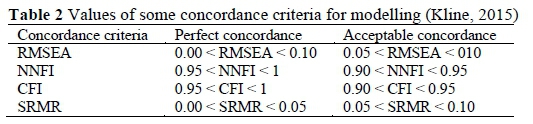
When the Z skewness scores of the scales were examined, it was found that the scores ranged from -1.96 to +1.96 and showed normal distribution. The concordance values that are referenced in the Structural Equation Modelling are shown in Table 2.
Results and Findings
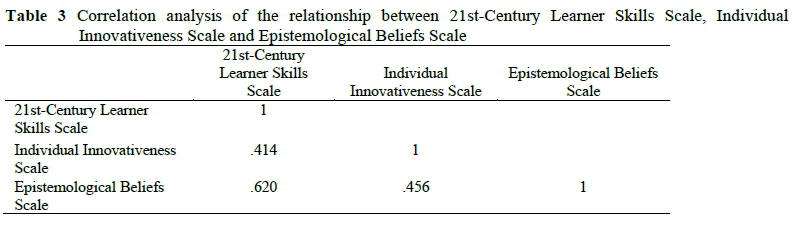
Before the model was constructed, Pearson correlation coefficient values between the three variables were examined because the data about the distribution of the scales was normal. The correlation coefficient values obtained for the variables are shown in Table 3.
When Table 3 is examined, there is a moderately positive relationship between the 21st-century Learner Skills Scale and Epistemological Beliefs Scale (r = .620, p < .01). Similarly, there is a moderately positive relationship between the 21st-century Learner Skills Scale and the Individual Innovativeness Scale (r = .414; p < .01). There is also a moderately positive relationship between the Individual Innovativeness Scale and the Epistemological Beliefs Scale (r =. 456; p < .01). As can be understood from the results, there is a positive and significant relationship between all three scales.
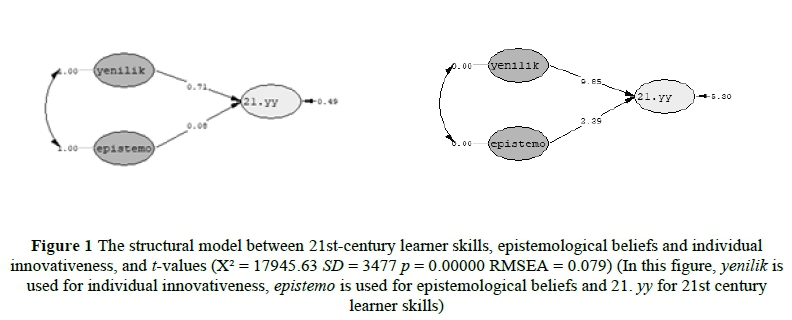
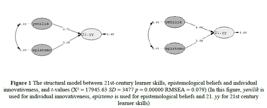
Various models among the three scales were tested. Firstly, the model between learning skills and individual innovation was tested to determine which of the 21st-century skills were considered as the basic variable and the implicit dependent variables. While specifying the modelling, a model was tested without regarding the sub-factors in the scales. The model hypotheses and values based on the total score are presented in Figure 1 below.
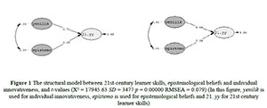
Hypothesis 1: As epistemological belief increases, so do the 21st-century learner skills.
Hypothesis 2: As individual innovativeness increases, so do the 21st-century learner skills.
When model 1 fit indices are examined, it can be stated that, considering the path schema through the structural model, low level path coefficients are obtained when predicting the 21st-century learner skills with individual innovativeness and epistemological beliefs. According to these results, individual innovativeness (β = 0.71, p < .01) directly predicted 21st-century learner skills significantly, however the impacts of epistemological beliefs on 21st-century learner skills were not significant. When model fit indices are examined, it can be seen that the structural model cannot be validated.
Table 4 covers the standardised values for the model. As seen in Figure 1, X2 = 17945.00 and SD = 3477. When these values were compared to each other, the X2/SD ratio was 5.16. When the model was evaluated according to X2/SD ratio (X2/SD = 17945/3477 = 5.16), the fit can be said to be good. For this model, the RMSEA value was calculated as 0.079 and other fit values as NFI = 0.86, NNFI = 0.90, SRMR = 0.12, CFI = 0.90, GFI = 0.61 and AGFI = 0.59.
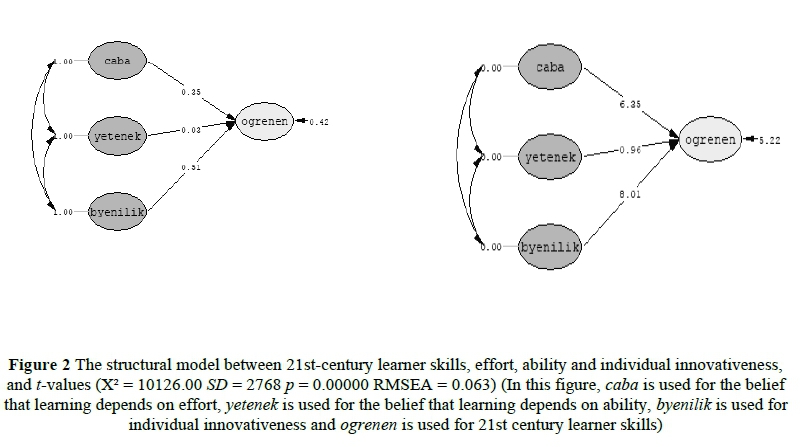
Table 5 shows that individual innovativeness predicts the model but epistemological beliefs do not verify the model. Then, for the case in which 21st-century learner skills are taken as implicit dependent variable, the model was built between the belief that learning depends on effort and the belief that learning depends on ability, which are sub-factors of the epistemological beliefs scale, and individual innovativeness. The model hypotheses and the standardised test results are given in Figure 2.
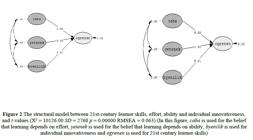
Hypothesis 1: As the belief that learning depends on the effort increases, so do the 21st-century learner skills.
Hypothesis 2: As the belief that learning depends on the ability increases, so do the 21st-century learner skills.
Hypothesis 3: As individual innovativeness increases, so do the 21st-century learner skills.
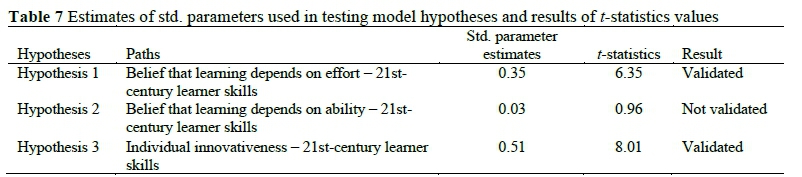
When the fit indices in Figure 2 are examined, it can be stated that, considering the path schema through the structural model, moderate level path coefficients are obtained when predicting the 21st-century learner skills with individual innovativeness and the belief that learning depends on effort. In other words, it can be interpreted that individual innovativeness and the belief that learning depends on effort positively predict 21st-century learner skills. According to these results, individual innovativeness (β = 0.51, p < .01) and the belief that learning depends on effort (β = 0.35, p < .01) directly predicted 21st-century learner skills of teacher candidates but the impacts of the belief that learning depends on ability was nor significant. When the t values for this model are examined, it is clear that the parameter values are significant at the level of 0.01 because they are over 2.56. It can be accepted that the model constructed according to theoretical structure and fit indices is confirmed; however, the t value of ability to learn is not significant.
Table 6 includes the standardised values for the model. As seen in Figure 2, X2 = 10126.00 and SD = 2768. When these values were compared, the X2/SD ratio was found as 3.65. When the model is evaluated according to X2/SD ratio (X2/SD = 10126/2768 = 3.65), the fit can be said to be good. For this model, the RMSEA value was calculated as 0.063 and other fit values as NFI = 0.88, NNFI = 0.92, SRMR = 0.078, CFI = 0.92, GFI = 0.71 and AGFI = 0.70.
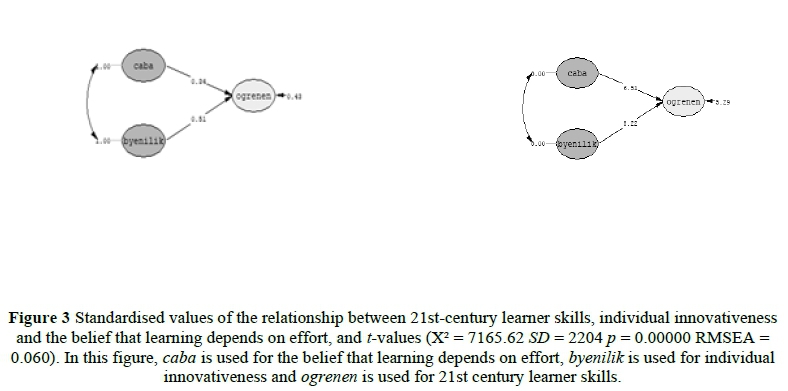
As a result of the modelling in Table 7, the effort dimension of the epistemological belief and the individual innovativeness predict the model, however, the belief that learning depends on ability fails to predict the model. The following hypotheses, standardised values and t-values are given below in relation to the model in which the individual innovativeness and the belief that learning depends on effort are taken as independent implicit variables, and the 21st-century learner skills are determined as dependent implicit variable.
Hypothesis 1: As the belief that learning depends on the effort increases, so do the 21st-century learner skills.
Hypothesis 3: As individual innovativeness increases, so do the 21st-century learner skills.
When the fit indices in Figure 3 are examined, it can be stated that, considering the path schema through the structural model, moderate level path coefficients can be stated to be obtained when predicting the 21st-century learner skills with individual innovativeness and the belief that learning depends on effort. In other words, it can be interpreted that individual innovativeness and the belief that learning depends on effort positively predict 21st-century learner skills. The results show that individual innovativeness (β = 0.51, p < .01) and the belief that the learning depends on the effort (β = 0.34, p < .01) directly predicted the 21st-century learner skills of teacher candidates significantly. When the t values for this model are examined, it is seen that the parameter values are significant at the level of 0.01 because they are over 2.56. It can be accepted that the model constructed according to theoretical structure and fit indices is confirmed.
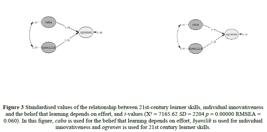
Table 8 covers the standardised values for the model. As seen in Figure 3, X2 = 7165.62 and SD = 2204. When these values were compared, X2/SD ratio was found as 3.25. When the model is evaluated according to X2/SD ratio (X2/SD = 7165.62/2204 = 3.25), the fit can be said to be good. For this model, the RMSEA value was calculated as 0.060 and other fit values as NFI = 0.90, NNFI = 0.94, SRMR = 0.063, CFI = 0.94, GFI = 0.76 and AGFI = 0.74.
From Table 9 it is clear that the relationship of the 21st-century learner skills with individual innovativeness and the belief that learning depends on the effort is statistically significant, and thus the hypothesis is validated. It is clear from the connections in the model that there is a significant positive relationship between 21st-century learner skills, individual innovativeness and the belief that learning depends on effort. With reference to these values, the regression equation for the model can be as follows:
21st-century learner skills = 0.51 individual innovativeness + 0.34 belief that learning depends on effort
According to the results from Equation 1, it can be expressed that 1 unit increase in individual innovativeness leads to an increase of 0.51 units in 21st-century learner skills, while 1 unit increase in the belief that learning depends on effort, results in an increase of 0.34 units in the 21st-century learner skills.
In order to strengthen the fitted SEM model, a multiple regression model of 21st-century learner skills, individual innovativeness and belief that learning depends on effort was made. Firstly, the Durbin Watson analysis, one of the preliminary assumptions of the multiple regression model, was performed. The results of the analysis are shown in Table 10.
The Durbin-Watson test is a statistic used to check the prerequisite for the independence of error terms and indicates whether the model has autocorrelation. In this study, the Durbin Watson value was found to be 1.832. The fact that the value found in the Durbin-Watson test was close to 2 indicates no autocorrelation in the measurement (Kalayci, 2009). This result shows that there is no autocorrelation among the variables used in the study and multiple regression can be performed. The tests to determine whether the multiple regression model was significant, are presented below.
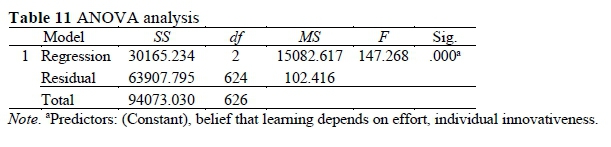
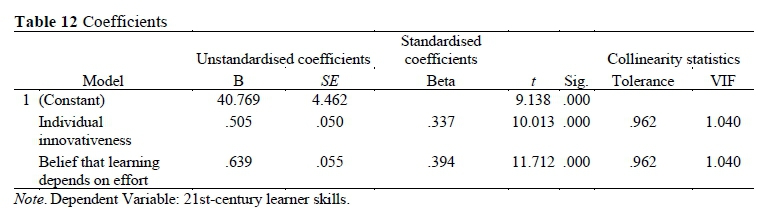
The ANOVA results in Table 11 were found to be significant (p = .000). The analyses performed to test whether there was multicollinearity, are presented in Table 12. VIF value should be less than 5 and tolerance value should be greater than 0.20 to avoid multicollinearity. It can be said that the measurements that meet this condition do not include multicollinearity problems (Kalayci, 2009). As a result of the measurements, it was concluded that the VIF value (1.040) was less than 5 and the tolerance value (0.962) was greater than 0.20. As a result, it was understood that the measurements made in this study do not include multicollinearity. As a result of multiple regression, individual innovativeness and the belief that learning depends on effort, predict 21st-century skills at 321 level. It can be said that this result supports the fitted SEM.
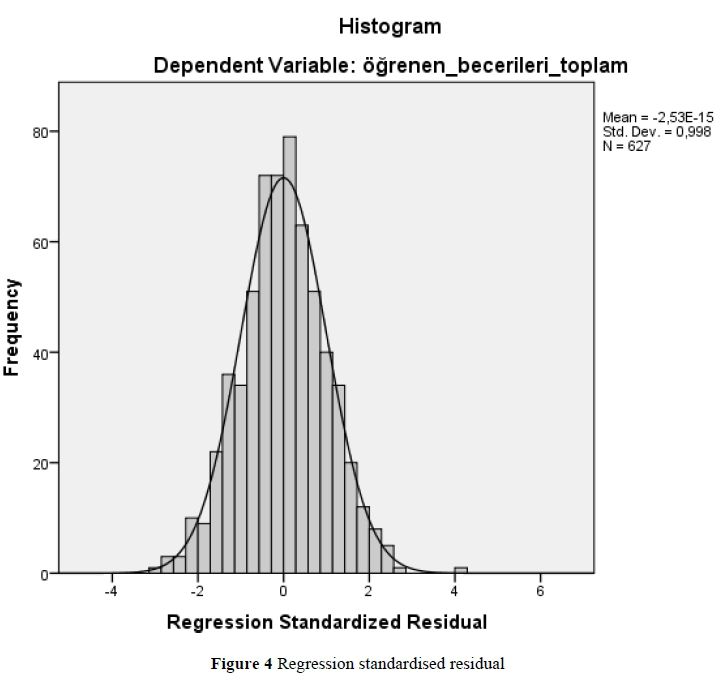
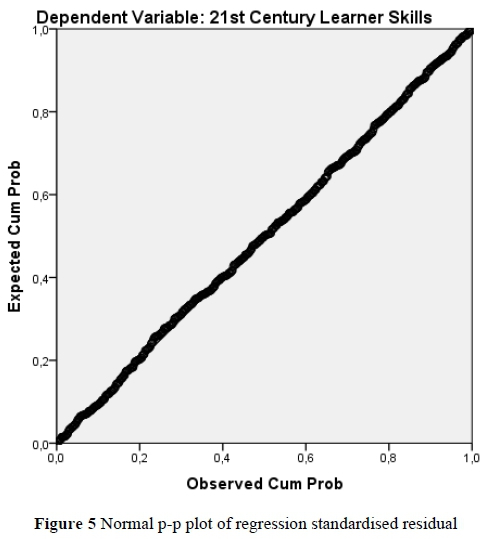
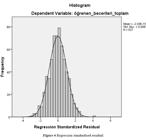
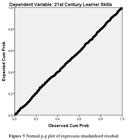
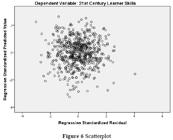
In addition, residual plots are given below to support the compatibility of the multiple regression model with fitted SEM.
Residual plot analysis was performed to determine whether residual values violate the fit of the model (Kalayci, 2009). It can be stated that if the residual plot values are greater than (- + 3.29), they violate the model and if the value is greater than (- + 2.58) the model does not deteriorate much (§en, 2016). In Figures 4, 5 and 6, residual plot values were found to be within (- + 2.58) limits and did not negatively affect the fit of the model. These results suggest that the multiple regression model supports fitted SEM.
Discussion and Conclusion
As time and people change, teachers that will educate the people of the future must change. In this study, 21st-century skills and individual innovativeness were considered as the main skills that teachers should have, and epistemological beliefs are thought to be directly related to these two variables. Because these variables arise with the transformation of the knowledge, it can be said that people's perspectives on knowledge will be effective in gaining these skills. At the end of the study, the model confirmed these relations.
According to the total scores obtained from the measurement tools in the analysis results, teacher candidates achieved a mean score of (X = 116.96) on the 21st-century Learner Skills Scale. This score is considered to be high in terms of 21st-century skills (Orhan-Göksün, 2016). Teacher candidates think that they have a high level of 21st-century skills, however, the points are lower than the maximum of 155 points. Teacher candidates cannot be said to have 21st-century skills at the highest level, in this respect, findings of the study are quite similar to the findings (X = 122.76) of Orhan-Göksün (2016). Teacher candidates of two different universities received scores close to each other.
When the scores of the teacher candidates from the Individual Innovativeness Scale were examined, it was revealed that their innovation levels were generally low (X = 63.19). According to similar research, the individual innovativeness scores of teacher candidates were found as follows: (X = 63.99) by Korucu and Olpak (2015), (X = 66.11) by Cuhadar, Bülbül and Ilgaz (2013), (X = 64.95) by Şahin-izmirli and Gürbüz (2017). In addition, it was determined that 55.1% of the teacher candidates in this study were interrogators in terms of innovativeness attributes. Teacher candidate's innovativeness was very limited at 2.9%. It was found in other studies that the majority of the teacher candidates were interrogators and very few were innovative (Cuhadar et al., 2013; Korucu & Olpak, 2015; Şahin-Ízmirli & Gürbüz, 2017). These studies about the innovative characteristics of the teacher candidates are in line with the theoretical structure that Rogers (2003) developed.
When the responses of the teacher candidates to the Epistemological Beliefs Scale were examined, it was found that the teacher candidates' epistemological beliefs were underdeveloped (X = 126.60). In similar studies, the epistemological beliefs of teacher candidates were determined as (X = 120.05) by Şahin-Taskin (2012), (X = 114.84) by Biger, Er and Özel (2013), and (X = 121.54) by Bayrak, Cinar, Coban and Coskuner (2013). The different studies returned similar results, which confirm that teacher candidates generally have underdeveloped epistemological beliefs.
When the relationship between the measurement tools was examined, it was revealed that they had a moderately positive relationship with each other. All three measurement tools have a positive relationship with each other. Since the variables of the study were not used before, this study was the first to discuss the variables together. When the relationship between the measurement tools used in this research and other variables was examined, Şahin-Taskin (2012) found a moderately positive relationship between the belief that learning depends on effort (which is a sub-factor of the Epistemological Beliefs Scale) and deep learning. Similarly, Biger et al. (2013) revealed a moderately positive relationship between the belief that learning depends on effort and progressivism, re-constructionism, and existentialism, considered as contemporary philosophies in the field. Teacher candidates' beliefs about effort-based learning had a positive relationship with the understanding of deep learning and contemporary educational philosophies, which can be interpreted that teacher candidates believe that efforts should be made on new and difficult topics.
When the studies conducted about individual innovativeness of teacher candidates with different variables were examined, Cuhadar et al. (2013) found a moderately positive relationship between individual innovativeness and techno pedagogical education efficiency. On the other hand, Şahin-izmirli and Gürbüz (2017) stated that there was no relationship between individual innovativeness and problem solving. More research is needed on individual innovativeness.
As a result of the Structural Equation Modelling with the 21st-Century Learner Skills Scale, the Individual Innovativeness Scale and the Epistemological Beliefs Scale that the total scores of the measurement tools could not form a model for predicting each other. Although the 21st-century learner skills, individual innovativeness, and beliefs about knowledge were related to each other, a significant model could not be established. As the Individual Innovativeness Scale appears in the significant model, it can be said that the difference results from the epistemological beliefs. This may be because the sub-dimensions of the Epistemological Beliefs Scale measure the different points of view towards knowledge and also that there may be a lack of total integrity of the results. Literature has shown that the epistemological beliefs of teacher candidates from different departments differ (Aksan & Sözer, 2007; Deryakulu & Büyüköztürk, 2005; Eroglu & Güven
2006; Tümkaya, 2012). It can be said that the different points of view towards knowledge has prevented the formation of a model from the total scores.
As a result of the analysis among the sub-dimensions, it was revealed that the 21st-century learner skills are predicted with the individual innovativeness and the epistemological belief that learning depends on the effort, which forms the most suitable model. It is obviously necessary to be open to innovations in order to acquire 21st-century learner skills. Along with changing social conditions, it is evident that individuals who can adapt to these conditions can be 21st-century learners (Orhan-Göksün, 2016). In other words, people need to develop and change themselves to be innovative. This is consistent with the other aspect of the model, which is the belief that learning depends on effort, because individuals need to learn new information and practise them in life to change and innovate themselves. The belief that learning depends on effort gets important at this point. Twenty-first century learners are those who constantly strive to change, transform and innovate themselves. This is inevitable in order to adapt to changing conditions.
Aksan and Sözer (2007) emphasise in their study that the students who have more developed epistemological beliefs about effort-based learning adopted both a more reasoning approach to what the problem was, how to solve it and how this solution will work, and a more evaluative approach during the problem-solving process. They concluded that the students were more likely to exhibit the attitude of comparing the result in the problem-solving process with what they thought should be. Similarly, Ílhan, Demir and Arslan (2013) found a positive relationship between the attitude towards computer-assisted learning and the belief that learning depends on effort. Karatas. (2011) revealed that there was a positive relationship between inner motivation and the belief that learning depends on effort and also that the belief that learning depends on effort significantly predicts problem-solving skills.
From the research results it can be stated that there is a positive relationship between the knowledge and skills of people and the belief that the learning depends on effort. The effort to achieve the knowledge requires change and such a change along with knowledge can be said to enable 21st-century learner skills to be acquired.
As a result, it is necessary to make suggestions for both practice and further research.
Suggestions for practice will be given first. Firstly, how the curriculum is arranged and how teacher candidates are trained to gain 21st-century skills are important. It is also essential to prepare programmes in accordance with 21st-century skills, since the programme determines what and how to develop students' skills. In addition, students should be encouraged to develop these skills in order to make an effort for learning. Although today's students are described as generation Z, a certain effort is required to gain knowledge and skills. In this respect, students should be enabled to make efforts; to reveal the importance of the learning realised as a result of the effort and to reinforce this behaviour. Students should be taught the importance of effort in implementing 21st-century skills.
For further researches, studies can be conducted on the relationship between 21st-century skills and other skills such as coding, effective communication, and digital and technological competencies that students are expected to have in the future. The relationship between 21st-century skills and critical thinking and creativity can also be investigated. Furthermore, the relationship between 21st-century skills and language learning and communication skills can also be examined.
Authors' Contributions
Ramazan Karatepe conducted the empirical study and collected data and cenk Akay undertook the literature review. Both authors undertook the statistical analyses and reviewed the final manuscript.
Notesi. Published under a Creative Commons Attribution Licence.
Acknowledgement
We wish to thank Assoc. Prof. Dr Nezaket Bilge Uzun for the statistical assistance that she provided for this research.
References
-
21CSkills 2019. 21CSkillspopular courses. Courses on the cutting edge of technology. Available at https://21cskills.africa/courses. Accessed 11 October 2020.
» https://21cskills.africa/courses -
Aksan N & Sözer MA 2007. Üniversite ögrencilerinin epistemolojik inanjlari ile problem fözme becerileri arasindaki ili§kiler [The relationships among epistemological beliefs and problem solving skills of university students]. Ahi Evran Üniversitesi Ktrsehir Egitim Fakiiltesi Dergisi, 8(1):31-50. Available at https://app.trdizin.gov.tr/documentViewer/viewer.xhtml?ext=pdf&path=iszyC6h_XyiCkvthyLGCVb7 GboeFR1t2e3uca8xyPWES2uQ3ndJq8jsWwNYu5 RssBLuP7VU93F_Q_43Cmy21R6Q_OmQ1285Y ml7A37pfGEo=. Accessed 7 October 2020.
» https://app.trdizin.gov.tr/documentViewer/viewer.xhtml?ext=pdf& path=iszyC6h_XyiCkvthyLGCVb7 GboeFR1t2e3uca8xyPWES2uQ3ndJq8jsWwNYu5 RssBLuP7VU93F_Q_43Cmy21R6Q_OmQ1285Y ml7A37pfGEo= -
American Association of School Librarians 2018. AASL standards framework for learners. Chicago, IL: Author. Available at http://standards.aasl.org/wp-content/uploads/2017/11/AASL-Standards-Framework-for-Learners-pamphlet.pdf. Accessed 9 October 2020.
» http://standards.aasl.org/wp-content/uploads/2017/11/AASL-Standards-Framework-for-Learners-pamphlet.pdf -
Bayrak E, Çinar V, Çoban B & Coşkuner Z 2013. Beden egitimi ve spor yüksekokulu ögretmen adaylari ile Egitim Fakültesi ögretmen adaylarinin bilimsel epistemolojik inanflarinin farkli değişkenler afisindan incelenmesi (Firat Üniversitesi örneği) [Prospective teachers of physical education and sport schools and Faculty of Education student teachers scientific epistemological beliefs in terms of different variables comparison of (Example of Firat University)]. The Journal of Academic Social Science Studies, 6(2):1817-1828. Available at https://acikerisim.firat.edu.tr/xmlui/bitstream/handle/11508/9145/A9%20BEDEN%20E%c4%9e%c4 %b0T%c4%b0M%c4%b0%20VE%20SPOR%20Y %c3%9cKSEKOKULU%20%c3%96%c4%9eRET MEN%20ADAYLARI%20%c4%b0LE%20E%c4 %9e%c4%b0T%c4%b0M%20FAK%c3%9cLTES%c4%b0%20%c3%96%c4%9eRETMEN%20ADAYLA RININ%20B%c4%b0L%c4%b0MSEL%20EP%c4%b0STEMOLOJ%c4%b0K%20%c4%b0NA N%c3%87LARININ%20FARKLI%20DE%c4%9e %c4%b0%c5%9eKE.pdf?sequence=1&isAllowed=y. Accessed 6 October 2020.
» https://acikerisim.firat.edu.tr/xmlui/bitstream/handle/11508/9145/A9%20BEDEN%20E%c4%9e%c4 %b0T%c4%b0M%c4%b0%20VE%20SPOR%20Y %c3%9cKSEKOKULU%20%c3%96%c4%9eRET MEN%20ADAYLARI%20%c4%b0LE%20E%c4 %9e%c4%b0T%c4%b0M%20FAK%c3%9cLTES%c4%b0%20%c3%96%c4%9eRETMEN%20ADAYLA RININ%20B%c4%b0L%c4%b0MSEL%20EP%c4%b0STEMOLOJ%c4%b0K%20%c4%b0NA N%c3%87LARININ%20FARKLI%20DE%c4%9e %c4%b0%c5%9eKE.pdf?sequence=1& isAllowed=y -
Biger B, Er H & Özel A 2013. Ögretmen adaylarinin epistemolojik inanglari ve benimsedikleri egitim felsefeleri arasindaki ili§ki [The relationship between the epistemological beliefs and educational philosophies of the teacher candidates adopted]. Egitimde Kuram ve Uygulama [Journal of Theory and Practice in Education], 9(3):229-242. Available at https://d1wqtxts1xzle7.cloudfront.net/33221952/% 28THE_RELATIONSHIP_BETWEEN_THE_EPI STEMOLOGICAL_BELIEF S_AND.pdf? 1394855 002=&response-content-disposition=inline%3B+filename%3DTHE_RELATIONSHIP_BETWEEN_THE_EPISTEMOLO.pdf &Expires=1602247085&Signature=O8aqPtxjWlTDir9guBkVC1WtoRKcTWXFUEl~yjE5~mT-WT1 sNnNOcdgfpvQP8DRtasybtCFT~5MTyRL7 MZy s082XEvC~2H6aJ7xiB5 VWUoPBERbJuyFx 0EkIwq3uFCcSr~OyA~UnWn3Swc5cIH6IGeGDr mgpBSGDVSs1GrsBNK7NCF~klr56q8yGWlfXL B6g5ewQ30ZPaAyykMeLwo06IpR4nrx~LGTMRqAla1L8rCmBT7EyH9QaS2-dmmPsnr0E1ukKQh2rAD2GJv7XpBHfzAdUA2l Gy355bJ6erKKlVQdAr4814Fh0ghE9ek29UV1y95 AE6JiGdSkwzRZ8pz1BAA__&Key-Pair- Id=APKAJLOHF5GGSLRBV4ZA. Accessed 5 October 2020.
» https://d1wqtxts1xzle7.cloudfront.net/33221952/% 28THE_RELATIONSHIP_BETWEEN_THE_EPI STEMOLOGICAL_BELIEF S_AND.pdf? 1394855 002=& response-content-disposition=inline%3B+filename%3DTHE_RELATIONSHIP_BETWEEN_THE_EPISTEMOLO.pdf & Expires=1602247085& Signature=O8aqPtxjWlTDir9guBkVC1WtoRKcTWXFUEl~yjE5~mT-WT1 sNnNOcdgfpvQP8DRtasybtCFT~5MTyRL7 MZy s082XEvC~2H6aJ7xiB5 VWUoPBERbJuyFx 0EkIwq3uFCcSr~OyA~UnWn3Swc5cIH6IGeGDr mgpBSGDVSs1GrsBNK7NCF~klr56q8yGWlfXL B6g5ewQ30ZPaAyykMeLwo06IpR4nrx~LGTMRqAla1L8rCmBT7EyH9QaS2-dmmPsnr0E1ukKQh2rAD2GJv7XpBHfzAdUA2l Gy355bJ6erKKlVQdAr4814Fh0ghE9ek29UV1y95 AE6JiGdSkwzRZ8pz1BAA__& Key-Pair- Id=APKAJLOHF5GGSLRBV4ZA -
CRSP DSGN 2019. Low cost educational robotics toy (LCERT): Affordable educational STEM resources for every classroom. Available at https://www.crspdsgn.com/lcert. Accessed 5 October 2020.
» https://www.crspdsgn.com/lcert - Çuhadar C, Bülbül T & Ilgaz G 2013. Öğretmen adaylarinin bireysel yenilikgilik özellikleri ile teknopedagojik egitim yeterlikleri arasindaki iliškinin incelenmesi [Examining the relationship between teacher candidates' individual innovativeness characteristics and techno-pedagogical education competencies]. ilkögretim Online, 12(3):797-807.
-
Demirel Y & Segkin Z 2008. Bilgi ve bilgi paylaşmunin yenilikgilik üzerine etkileri [The impact of knowledge and knowledge sharing on innovation]. Ç.Ü. Sosyal Bilimler Enstitüsü Dergisi, 17(1):189-202. Available at https://dergipark.org.tr/en/download/article-file/50419. Accessed 5 October 2020.
» https://dergipark.org.tr/en/download/article-file/50419 - Deryakulu D 2004. Epistemolojik inanglar [Epistemological beliefs]. In Y Kuzgun & D Deryakulu (eds). Egitimde bireyselfarkliliklar [Individual differencies in education]. Ankara, Turkey: Nobel Yayin Dagitim.
-
Deryakulu D & Büyüköztürk Ş 2005. Epistemolojik inang ölgeginin faktör yapisinin yeniden incelenmesi: Cinsiyet ve ögrenim görülen program türüne göre epistemolojik inanglarin karšilaštmlmasi [The re-examination of the epistemological beliefs questionnaire' s factor structure: Comparing epistemological beliefs in terms of gender and program type]. Eurasian Journal of Educational Research, 18:57-71. Available at https://www.researchgate.net/profile/Deniz_Deryakulu2/publication/285660584_The_re-examination_of_the_epistemological_beliefs_questionnaire's_factor_structure_Comparing_epistemolo gical_beliefs_in_terms_of_gender_and_program_type/links/5732fef408ae9f741b25cd70/The-re-examination-of-the-epistemological-beliefs-questionnaires-factor-structure-Comparing-epistemological-beliefs-in-terms-of-gender-and-program-type.pdf. Accessed 5 October 2020.
» https://www.researchgate.net/profile/Deniz_Deryakulu2/publication/285660584_The_re-examination_of_the_epistemological_beliefs_questionnaire's_factor_structure_Comparing_epistemolo gical_beliefs_in_terms_of_gender_and_program_type/links/5732fef408ae9f741b25cd70/The-re-examination-of-the-epistemological-beliefs-questionnaires-factor-structure-Comparing-epistemological-beliefs-in-terms-of-gender-and-program-type.pdf -
Eroglu SE & Güven K 2006. Üniversite ögrencilerinin epistemolojik inanglarinin bazi degi§kenler agisindan incelenmesi [Examining the epistemological beliefs of university students in terms of some variables]. Selquk Universitesi Sosyal Bilimler Enstitüsü Dergisi, 16:295-312. Available at https://app.trdizin.gov.tr/documentViewer/viewer.xhtml?ext=pdf&path=iszyC6h_XyiCkvthyLG CVUkgwyV6ND6ZYdujVfQWmLwMdzjtKhfK8rpVCV ntkUzKU6Vcl_qzBXCjXH6j02rwrtawenBfR309-n9oyX3861k=. Accessed 28 September 2020.
» https://app.trdizin.gov.tr/documentViewer/viewer.xhtml?ext=pdf& path=iszyC6h_XyiCkvthyLG CVUkgwyV6ND6ZYdujVfQWmLwMdzjtKhfK8rpVCV ntkUzKU6Vcl_qzBXCjXH6j02rwrtawenBfR309-n9oyX3861k= -
Fadel C 2008. 21st century skills: How can you prepare students for the new global economy? [PowerPoint presentation]. Available at https://www.oecd.org/site/educeri21st/40756908.pdf. Accessed 9 October 2020.
» https://www.oecd.org/site/educeri21st/40756908.pdf - Gliner JA, Morgan GA & Leech NL 2015. Uygulamada arastirma yöntemleri: Desen ve analizi bütünlestiren yaklasim [Research methods in applied settings: An approach that integrates pattern and analysis]. Translated by S Turan. Ankara, Turkey: Nobel Yayinevi.
-
Hurt HT, Joseph K & Cook CD 1977. Scales for the measurement of innovativeness. Human Communication Research, 4(1):58-65. https://doi.org/10.1111/j.1468-2958.1977.tb00597.x
» https://doi.org/10.1111/j.1468-2958.1977.tb00597.x -
Ilhan M, Demir S & Arslan S 2013. Ögretmen adaylarinin bilgisayar destekli egitime yönelik tutumlari ile epistemolojik inangari arasindaki ilişkinin incelenmesi [An investigation of the relationship between teacher cadidates attitudes towards computer assisted instruction and their epistemological beliefs]. Egitim Teknolojisi Kuram ve Uygulama [Educational Technology: Theory and Practice], 3(2):1-22. Available at https://www.researchgate.net/profile/Seyfi_Arslan/publication/301621246_OGRETMEN_ADA YLARININ_BILGISAYAR_DESTEKLI_EGITIME_YO NELIK_TUTUMLARI_ILE_EPISTEMOLOJIK_I NANCARI_ARASINDAKI_ILISKININ_INCELENMESI/links/571df61208aefa648899807c.pdf. Accessed 27 September 2020.
» https://www.researchgate.net/profile/Seyfi_Arslan/publication/301621246_OGRETMEN_ADA YLARININ_BILGISAYAR_DESTEKLI_EGITIME_YO NELIK_TUTUMLARI_ILE_EPISTEMOLOJIK_I NANCARI_ARASINDAKI_ILISKININ_INCELENMESI/links/571df61208aefa648899807c.pdf - Kalayci Š 2009. Qoklu dogrusal regresyon modeli [Multiple linear regression model]. In Š Kalayci (ed). SPSS uygulamali qok degiskenli istatistik teknikleri [SPSS applied multivariate statistical techniques] (4th ed). Ankara, Turkey: Asil Yayin Dagitim.
-
Karataš H 2011. Üniversite ögrencilerinin epistemolojik inanglari, ögrenme yaklašimlari ve problem gözme becerilerinin akademik motivasyonu yordama gücü [The prediction of academic motivation using university students' epistemological beliefs, learning strategies and problem solving skills]. PhD thesis. Istanbul, Turkey: Yildiz Technical University. Available at http://dspace.yildiz.edu.tr/xmlui/bitstream/handle/1/174/0075972.pdf?sequence=1&isAllowed=y. Accessed 27 September 2020.
» http://dspace.yildiz.edu.tr/xmlui/bitstream/handle/1/174/0075972.pdf?sequence=1& isAllowed=y -
Kilçer K 2011. Bilgisayar ve ögretim teknolojileri egitimi ögretmen adaylarinin bireysel yenilikcilik profilleri [Individual innovativeness profiles of prospective teachers in computer education and instructional technology]. PhD thesis. Eski§ehir, Turkey: Anadolu Üniversitesi Egitim Bilimleri Enstitüsü. Available at http://libra.anadolu.edu.tr/tezler/2011/1080608.pdf. Accessed 21 September 2020.
» http://libra.anadolu.edu.tr/tezler/2011/1080608.pdf -
Kilicer K & Odabaşi HF 2010. Bireysel Yenilikcilik Öljegi (BYÖ): Türkceye uyarlama, gecerlik ve güvenirlik calişmasi [Individual Innovativeness Scale (IS): The study of adaptation to Turkish, validity and reliability]. Hacettepe Üniversitesi Egitim Fakültesi Dergisi [Hacettepe University Journal of Education], 38:150-164. Available at https://dergipark.org.tr/en/download/article-file/87448. Accessed 26 September 2020.
» https://dergipark.org.tr/en/download/article-file/87448 - Kline RB 2015. Principles and practice of structural equation modeling. New York, NY: The Guilford Press.
-
Korucu AT & Olpak YZ 2015. Ögretmen adaylarinin bireysel yenilikcilik özelliklerinin farkli degişkenler acisindan incelenmesi [Examination of teacher candidates individual innovativeness properties from the different variables]. Egitim Teknolojisi Kuram ve Uygulama, 5(1):111-127. Available at https://www.researchgate.net/profile/Agah_Korucu/publication/275223 916_Ogretmen_Adaylarinin_B ireysel_Yenilikcilik_Ozelliklerinin_Farkli_Degiske nler_Acisindan_Incelenmesi/links/57e4ee2808ae06 097a0de74c/Oegretmen-Adaylarinin-Bireysel-Yenilikcilik-Oezelliklerinin-Farkli-Degiskenler-Acisindan-Incelenmesi.pdf. Accessed 21 September 2020.
» https://www.researchgate.net/profile/Agah_Korucu/publication/275223 916_Ogretmen_Adaylarinin_B ireysel_Yenilikcilik_Ozelliklerinin_Farkli_Degiske nler_Acisindan_Incelenmesi/links/57e4ee2808ae06 097a0de74c/Oegretmen-Adaylarinin-Bireysel-Yenilikcilik-Oezelliklerinin-Farkli-Degiskenler-Acisindan-Incelenmesi.pdf -
Mersin University 2014. Mersin Teknoloji Geliştirmi Bölgesi [Mersin Technology Development Zone (Technoscope)]. Available at http://www.technoscope.com.tr/en/home.aspx. Accessed 21 September 2020.
» http://www.technoscope.com.tr/en/home.aspx -
Mersin Üniversitesi 2019. Continuing Education Application and Research Center. Available at http://mersin.edu.tr/academic/continuing-education-application-and-research-center. Accessed 21 September 2020.
» http://mersin.edu.tr/academic/continuing-education-application-and-research-center -
Muthén LK & Muthén BO 2002. How to use a Monte Carlo study to decide on sample size and determine power. Structural Equation Modeling: A Multidisciplinary Journal, 9(4):599-620. https://doi.org/10.1207/S15328007SEM0904_8
» https://doi.org/10.1207/S15328007SEM0904_8 - Öngen D 2003. Epistemolojik inanclar ile problem Cözme stratejileri arasindaki ilişkiler: Egitim fakültesi ögrencileri üzerine bir calima [Relationships between epistemological beliefs and problem solving strategies. A study on faculty of education students]. Egitim Arastirmalari Dergisi, 3(13):155-162.
-
Orhan-Göksün D 2016. Ögretmen adaylarinin 21. yy. Ögrenen becerileri ve 21. yy. Ögreten becerileri arasindaki ilişki [The relationship between 21st century learner skills use and 21st century teacher skills use]. PhD thesis. Eskişehir, Turkey: Anadolu Üniversitesi Egitim Bilimleri Enstitüsü. Available at http://libra.anadolu.edu.tr/tezler/2016/384724.pdf. Accessed 21 September 2020.
» http://libra.anadolu.edu.tr/tezler/2016/384724.pdf -
Orhan Göksün D & Kurt AA 2017. Ögretmen adaylarinin 21. yy. Ögrenen becerileri kullanimlari ve 21. yy. Ögreten becerileri kullanimlari arasindaki ili§ki [The relationship between pre-service teachers' use of 21st century learner skills and 21st century teacher skills]. Egitim ve Bilim [Education and Science], 42(190):107-130. https://doi.org/10.15390/EB.2017.7089
» https://doi.org/10.15390/EB.2017.7089 -
Pearson n.d. About 21st century skills. Available at https://za.pearson.com/tvet-and-higher-education/Technical-vocational-education-training/professional-development/21st-century-skills.html. Accessed 16 September 2020.
» https://za.pearson.com/tvet-and-higher-education/Technical-vocational-education-training/professional-development/21st-century-skills.html - Rogers EM 2003. Diffusion of innovations (5th ed). New York, NY: Free Press.
-
Sahin S & Aslan N 2008. Ilkögretim okul yöneticilerinin stratejik planlamaya ilişkin görüşleri üzerine nitel bir calişma (Gaziantep Ili Örnegi) [A qualitative study on the opinions of secondary school principals regarding strategic planning]. Gaziantep Üniversitesi Sosyal Bilimler Dergisi, 7(1):172-189. Available at https://pdfs.semanticscholar.org/0f36/efe624e0b049b92ceb77e7ccf76d5e24b23e.pdf. Accessed 16 August 2020.
» https://pdfs.semanticscholar.org/0f36/efe624e0b049b92ceb77e7ccf76d5e24b23e.pdf -
Sahin-lzmirli Ö & Gürbüz O 2017. An investigation of the relationship between the individual innovativeness and problem solving skills of teacher candidates: The case of Canakkale Onsekiz Mart University. SDU International Journal of Educational Studies, 4(1):29-43. Available at https://dergipark.org.tr/en/download/article-file/303316. Accessed 15 August 2020.
» https://dergipark.org.tr/en/download/article-file/303316 -
Şahin-Taşkm C 2012. Epistemolojik inanclar: Ögretmen adaylarinin ögrenme yaklaşimlanni yordayici bir degi§ken [Epistemological beliefs: A predictor of preservice teachers' learning approaches]. Mustafa Kemal Üniversitesi Sosyal Bilimler Enstitüsü Dergisi [Mustafa Kemal University Journal of Social Sciences Institute], 9(19):273-285. Available at http://www.pegem.net/dosyalar/dokuman/139232-20140210165649-15.pdf. Accessed 15 August 2020.
» http://www.pegem.net/dosyalar/dokuman/139232-20140210165649-15.pdf -
Schommer M 1990. Effects of beliefs about the nature of knowledge on comprehension. Journal of Educational Psychology, 82(3):498-504. https://doi.org/10.1037/0022-0663.82.3.498
» https://doi.org/10.1037/0022-0663.82.3.498 -
Sen S 2016. Regresyon [Regression]. Available athttps://sedatsen.files.wordpress.com/2016/11/8-sunum.pdf. Accessed 15 August 2020.
» https://sedatsen.files.wordpress.com/2016/11/8-sunum.pdf -
Skills Portal n.d. Mobile teaching for the 21st century teacher. Available at https://www.skillsportal.co.za/train/training_provid ers/course/continuing-education-university-pretoria/mobile-teaching-21st-0. Accessed 15 September 2020.
» https://www.skillsportal.co.za/train/training_provid ers/course/continuing-education-university-pretoria/mobile-teaching-21st-0 - Trilling B & Fadel C 2009. 21st century skills: Learning for life in our times: Learning for life in our times. San Francisco, CA: John Wiley & Sons.
- Tümkaya S 2012. Üniversite ögrencilerinin epistemolojik inanclarinin cinsiyet, sinif, egitim alani, akademik başari ve ögrenme stillerine göre incelenmesi [The investigation of the epistemological beliefs of university students according to gender, grade, fields of study, academic success and their learning styles]. Kuram ve UygulamadaEgitim Bilimleri, 12(1):75-95.
- Wagner T 2008. The global achievement gap: Why even our best schools don't teach the new survival skills our children need-and what we can do about it. New York, NY: Basic Books.
-
Wolf EJ, Harrington KM, Clark SL & Miller MW 2013. Sample size requirements for structural equation models: An evaluation of power, bias, and solution propriety. Educational and Psychological Measurement, 73(6):913-934. https://doi.org/10.1177/0013164413495237
» https://doi.org/10.1177/0013164413495237
Revised: 29 October 2019
Accepted: 12 December 2019
Published: 31 December 2020.