Compulsory guests of Türkiye: A meta-synthesis study on teachers' experiences with refugee students
Abstract
In recent years, the number of refugees in Türkiye has increased significantly due to the wars in Syria, Afghanistan and Ukraine. This situation has brought about social, political, economic and educational problems. The issue of refugee education is 1 of the most important of these problems. With the research reported on here we aimed to draw new conclusions by combining qualitative studies on the experiences of teachers in public schools where refugee children are educated and to reveal similar and different aspects of teachers' experiences. We also aimed to provide theoretical assistance to teachers who teach or will teach refugee students. In this research, which is based on the meta-synthesis method, we examined 51 studies (19 postgraduate theses, 32 scientific articles) that met the inclusion criteria. The findings show that teachers found the education they had received on refugee education quite inadequate. It was revealed that teachers experienced burnout due to this inadequacy and did not want refugee students in their classes because it resulted in difficulty in classroom management. We also determined that refugee children were constantly stigmatised by Turkish students and their parents, and that this situation triggered an environment of conflict. As a result, anti-refugee political discourse has increased in Türkiye. Teachers are demanding that policymakers amend policies to improve economic conditions and solve problems related to refugees.
education of refugees; forced migration; meta-synthesis; refugee students
Introduction
Migration is an individual, group, or mass movement from one settlement to another. Evaluation of these displacement movements in terms of migration diversity show that they do not only involve a physical change of place but also an important indicator of change in social structure (Genç & Seyyar, 2010). Migration is a collective act of social change that affects both the society in the receiving country and the society in the sending country. However, migration and the experience of living in another country usually lead to changes in initial plans. Therefore, the intentions of migrants when they start migrating indicate very little about their current behaviour (Castles & Miller, 2008). People who come to a country for permanent residence are called immigrants, while people who are forced to leave a country due to war or religious or political reasons are called refugees (Merriam-Webster's dictionary, 2012). This small difference is important in terms of the reasons for migration, the form of the migration movement, and its results. Refugees experience many problems in their movements and settling in a new place. They worry about their past lives, including culture, language, family, and friends. They also experience a loss of activity and social identity (Vaynshtok, 2001). Therefore, mass migration movements create many problems for refugees that need to be resolved. All this is true for refugees in Türkiye from Syria, Ukraine and Afghanistan.
In the first years of the civil war that started in Syria in 2011, migration movements towards Türkiye took place in cities close to the Syrian-Turkish border. Examining migration to Türkiye from the perspective of international migration theories, it provides an idea about the reasons for migration and the ways in which migration mobility occurs. Therefore, this examination offers researchers the opportunity to make objective inferences about the possible results of migration. Considering that migrants use their own preferences in terms of whether to migrate or not despite the pressure, these migrations can be evaluated within the scope of "impelled migrations" (Petersen, 1958:261). Considering that the number of Syrian, Ukrainian and Afghan refugees in Türkiye is much higher than other groups, the main driving force of those migrating to Türkiye is the civil war, while the most attractive force is the desire to reach a safe region. The pioneer refugees settled in cities close to the border in the early years due to their kinship relations with the Turks living in the border provinces. Ravenstein (1889) states that migrations were mostly made over short distances but could also take place over long distances in parallel with industrialisation. Therefore, the initial migration to the provinces close to the Syrian border were directed to cities such as Istanbul and Kocaeli in Türkiye, where economic life was more active. For this reason, the population in the border cities gradually moved towards the big cities. In the long term, the network of relations developed thanks to the pioneer refugees led to the emergence of regional structures of certain refugee groups in the big cities (Yagan & Aksit, 2021). The established migration networks were effective in helping refugees find jobs (De Villiers & Weda, 2017).
Due to its cultural compatibility with neighbouring countries and its geographical location, Türkiye is regarded as an important place for people and communities migrating for different reasons, hosting many people and providing settlement opportunities. Türkiye has hosted many people since 2011, especially due to the turmoil and war in Syria. Since July 2024, 3,105,539 people (of which 1,561,283 [49.7%] were children younger than 18) have fled the war in Syria and are trying to hold on to life in Türkiye (Refugees Association, 2025). Similar reports state that Türkiye is the country hosting the most refugees (European Asylum Support Office, 2021), not only to Syrian refugees, but also to hundreds of thousands of Afghans who fled the Taliban government after the United States (US) withdrew from Afghanistan and many Ukrainians who fled the war in Ukraine. Considering that 21,817,061 of the Turkish population are children younger than 18 (Turkish Statistical Institute, 2025), the ratio of Syrian children to Turkish children is approximately 16%. These figures make the education policy for refugee children much more important. Education plays an important role in helping refugees and their children adapt to the country of settlement by enabling them to acquire the skills necessary to enter the workforce (PISA, 2013). Therefore, refugee children are provided with many educational opportunities in Türkiye. In addition to official education programmes, education courses are arranged for Syrians through public education centres in many areas, including the teaching of Turkish. According to the Ministry of National Education ([MoNE], 2020), the primary school enrolment rate of Syrian children of school-going age in Türkiye has reached 96.30%, compared to 61% for refugees globally. The education of refugee children is important in all countries that accept refugees, including Türkiye. This is an issue that needs to be emphasised politically and socially. In the early stages of migration, the expectation was that refugees would stay in Türkiye temporarily. For this reason, no long-term policies were developed for refugees. However, at this point, it had become necessary to produce effective policies for the inclusion and integration of refugee children into the Turkish education system (Saner, 2020). In this context, it was planned to close temporary education centres (TECs) and enrol refugee children in the Turkish education system (MoNE, 2017).
With the gradual inclusion of the Syrian population in formal education, many problems that negatively affected the quality of education have come to light. Teachers who were raised in a single language and a single culture faced various problems. Refugee students studied the same curriculum as their Turkish peers without knowing Turkish well. Therefore, they inevitably failed academically (Biçer & Alan, 2022). Teachers had to ensure the academic development of these students with different cultures and languages in their classes. They also had to help refugee students adapt to the new society in which they lived. In this process, teachers play a critical part in the cultural adaptation, language skills, academic development, and socialisation of refugee students, both in humanitarian terms and in terms of social policy (Şeker & Aslan, 2015). However, teachers who did not have sufficient knowledge and skills on how to provide education in multicultural classrooms struggled with many problems, which has attracted the attention of many researchers (Amaç, 2021; Sarıer, 2020; Yagan & Aksit, 2021). There has been an increase in the number of qualitative studies focusing on teachers' experiences in refugee education. We wanted to synthesise the studies conducted on the teachers who play an important part in the education of refugees in Türkiye to determine whether these studies produced a common discourse.
Theoretical Framework
People migrate primarily for reasons of security and economic concerns, political pressure, ecological events, cultural/social pressure or the desire to receive quality education (Crisp, 1999; Lee, 1966; Mabogunje, 1970; Petersen, 1958; Ravenstein, 1885, 1889; Stouffer, 1940; Wallerstein, 2017), and they experience many problems during and after migration. One of the main problems faced by refugee communities in their adopted countries is the prejudiced attitudes of the local people. When these prejudices exceed a certain threshold, they may lead to the emergence of hostile feelings, especially between minority and majority groups. Such negative feelings can take social conflicts to dangerous levels, as was seen in examples of Black-White conflict in the United States of America (Güney, 2015). One of the factors in the emergence and continuation of prejudice is feelings of aggression triggered by disappointment. This aggression is sometimes directed at minority groups and not at the real source of the problem. For example, the heavy defeat in World War I and the deep economic and social crises that the country experienced easily convinced the German people to hold the Jews responsible for all these crises (Güney, 2015). Thus, the people' s anger was directed at the Jews, who were declared scapegoats. Scapegoating is a concept in which individuals unfairly accuse an individual or group, usually with less power, of being responsible for their own problems (Macionis, 2017).
Relative deprivation is another reason for the emergence of intergroup aggression. Relative deprivation indicates the difference between the current situation (reality) and the desired situation (expectation). Davies (1962) examined this concept in detail in his famous J-curve hypothesis. He argues that revolutions were more likely to occur when a sharp reversal occurred shortly after a long period of targeted economic and social development. People become suspicious that ground gained with great effort would be lost, and their mood becomes revolutionary.
One of the most important studies published on the nature of intergroup relations and discriminatory practices is Gordon Allport' s famous contact theory. Allport (1954) states that the basis of intergroup conflict is the lack of communication between groups and suggests that contact provided under appropriate conditions will eliminate these problems. Allport states that the positive effects of intergroup contact will occur under four conditions: the groups have equal status, common goals are determined, cooperation between groups exists, and the support of the authority emerges as law and tradition for this relationship. A harmonious relationship between the majority group and the minority group will ensure that minority problems disappear as destabilising factors. Therefore, constructive dialogue between groups and the participation of all groups in management becomes reassuring in the long run (Ataöv, 1996).
The Robbers Cave experiments conducted by Muzafer Sherif (1956) and his colleagues are among the most important studies conducted to explain the conditions under which prejudice and discriminatory behaviour emerge. Sherif believes that conflicts occur between groups competing for scarce resources and that ethnocentrism increases (Hogg & Vaughan, 2017). With the realistic conflict theory they put forward, Sherif and his colleagues argue that, as Allport claims, establishing contact between groups alone would not be sufficient to eliminate conflict between groups. According to them, in order to eliminate conflict between groups, group members should work together to achieve real and interesting goals (Sherif, 1956, 2010).
Our Study
The number of refugees is increasing rapidly worldwide and will continue to do so, which results in social problems. This situation may be directly related to the concept of relative deprivation, which was developed to reveal the reasons for the emergence of intra-group aggression. The period of relative prosperity experienced in Europe, especially in the second half of the 20th century and in Türkiye in the early 21st century, has shown a decreasing trend in recent years. The economic problems experienced on a global scale have caused disappointment in all societies. With this disappointment experienced in Western societies and in Türkiye, there has been a significant increase in votes of far-right parties, especially those who attribute this economic collapse to the refugee problem. The situation has rekindled debates about whether foreigners should be deported or integrated. However, it is obvious that it is not easy to send millions of refugees away from their adopted countries. In this case, the most rational solution would be to focus on how to best adapt these people to the countries they migrate to. The examination of studies conducted in different countries shows that the main issues are actually very similar. Refugees experience adaptation problems and try to develop solutions for these problems in many countries such as Germany (Aksoy, 2010), Sweden (Kılıç, 2017), the United Kingdom (Evans & Liu, 2018), Australia (Wrench, Soong, Paige & Garrett, 2018), Spain, and Ireland (Rodríguez-Izquierdo & Darmody, 2019).
Despite all the negativity, schools are places of hope for refugee youths as they act as a balancing factor in refugees children's lives and provide them with new interactions or opportunities in a safe environment (Matthews, 2008). Education is seen as an important actor in enduring adaptation problems and providing refugees with confidence and greater certainty (Dündar, 2019). Taylor and Sidhu (2012) argue that the needs of refugee students are often overlooked - not only by policymakers but also by scholars who research migration and multicultural education. With this study we examined the hypothesis that different groups coming together for common goals will resolve these problems. This idea is a fundamental assumption of contact theory and realistic conflict theory. We focused on whether teachers showed resistance or not. We tried to bring together the experiences of teachers working with refugee students in almost every region of Türkiye in order to reveal the similarities and differences to those found in the theses and articles we examined and to develop common discourse. Many studies have been done on the linguistic, cultural, academic and administrative problems experienced by teachers in the education of refugee children, in short, their knowledge and experiences. It is thought that combining these studies with the meta-synthesis method and re-synthesising their findings and results within a critical framework would contribute to the production of effective policies on this issue. The aim with this study was to bring together theses and articles conducted in different regions, levels, and conditions. In this way, we hoped that this would serve to develop a more holistic and comprehensive perspective and action plan that would reveal the problems experienced throughout the country.
Process
Research Design
This study was a meta-synthesis study that offered the opportunity to combine and deconstruct qualitative study findings and to analyse and synthesise them in depth. Meta-synthesis is to produce a new and integrative interpretation by using important findings and evaluations in qualitative studies as data (Finfgeld, 2003). Therefore, meta-synthesis is not a simple review of studies in the field but a methodological method of developing new knowledge based on an interpretative analysis of existing qualitative research findings (Aspfors & Fransson, 2015). With meta-synthesis one analyses the qualitative results/interpretations of previous studies, thus allowing for their reinterpretation (Dinçer, 2018).
Data Collection Procedures
To implement meta-synthesis, an optimal number of qualitative studies conducted in a particular field is required. The qualitative studies to be included in the application should be sufficient to explain the problem or concept being studied and should be at a level that would allow the development of a theory (Polat & Ay, 2016). These levels were divided into steps before determining which studies would be included in the research. A review of the literature shows many suggestions regarding these steps (Noah, 2017; Noblit & Hare, 1988; Sandelowski & Barroso, 2007). Considering these suggestions, the following stages were followed in determining and collecting the studies to be included:
• Determination of the work area
• Detection of keywords
• Performing the scan
• Evaluation of studies according to these criteria by determining exclusion criteria
• Deciding on the studies to be evaluated
This study included qualitative studies examining the experiences of teachers who educate refugee children in Türkiye. The keywords were "foreign student, refugee student", and "refugee education." In addition, Web of Science, Google Scholar, Education Resources Information Center (Eric), Scopus, Taylor & Francis Online Journals, ProQuest and Dergipark were used as databases. As a result of the search, 149 studies on the education of foreign/refugee children (students) in Türkiye were found. Weed (2005) suggests that four or five studies will be sufficient for meta-synthesis. However, Noah (2017) states that more studies might enhance understanding of the field of study in a broad way. Exclusion and inclusion criteria were determined in order to conduct a detailed analysis and to limit the number of studies included. Studies were selected in line with the inclusion criteria, taking the recommendations of experts (Finfgeld, 2003; Noah, 2017; Thomas & Harden, 2008; Weed, 2005) in the literature into account. The inclusion criteria were the following:
• Research in the field of educational science
• Research on teachers who teach refugee children,
• Research on public schools,
• Research using qualitative methods,
• Research conducted between 2010 and 2021,
• Master's and doctoral theses, or full-text scientific articles,
• Research conducted in Türkiye.
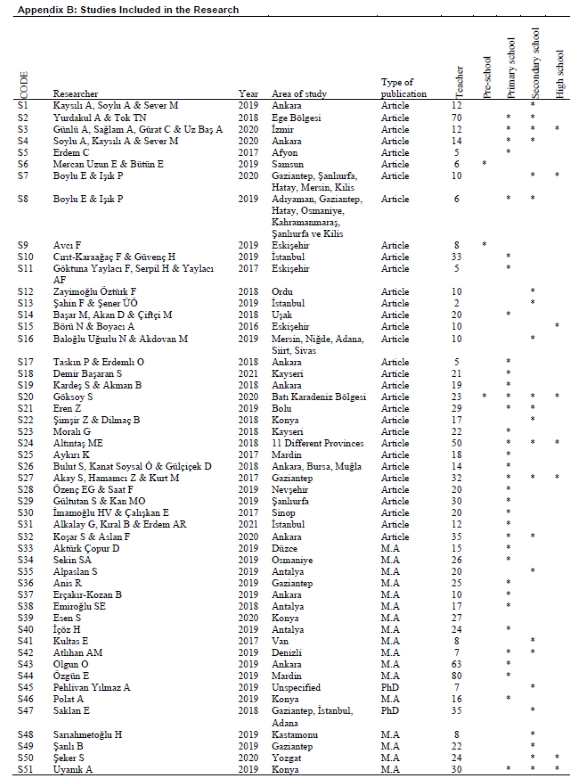
From the literature, 149 studies (96 postgraduate theses and 53 scientific articles) on the education of refugee children were identified. At the beginning of the study, we determined that 66 studies did not comply with the first criterion, 14 studies were not qualitative, and finally, 18 of the remaining 69 studies did not comply with the second and third criteria. As a result, a total of 51 studies, including 19 postgraduate theses (17 master' s and two doctoral theses) and 32 scientific articles met the above-mentioned criteria. The 51 studies that met the inclusion criteria (indicated by an asterisk in the bibliography) are listed in Appendix A and B. The participants in the studies included for investigation in this research were from different provinces in all regions of Türkiye. A total of 1,029 teachers were interviewed in 51 studies. Three of the studies were conducted with preschool teachers, 33 with primary school teachers, 23 with secondary school teachers, and eight with high school teachers.
This study was the first study conducted using the meta-synthesis design. Therefore, this process presented difficulties and learning opportunities. In order to increase the reliability and validity of the meta-synthesis study, we were careful to clearly explain the purpose of the study, the data collection process, and the other stages of the study. The descriptive characteristics of the studies determined through purposeful sampling, data collection procedures, and inclusion and exclusion criteria were clearly reported. We conducted a thematic synthesis after reading the included studies several times. The thematic synthesis was conducted separately by the three researchers (triangulation), and a checklist was created for codes and subthemes. These were then compared and consensus was reached. Reading and coding the studies took approximately 6 months. After the data analysis, a peer review was requested from an expert academic in the field of qualitative research. We tried not to include our own biases and assumptions. In addition, direct quotes from the relevant studies were included to increase the credibility of the research (Glesne, 2011; Maxwell, 2018; Merriam, 2015; Patton, 2018; Sandelowski & Barroso, 2007; Suri, 2011).
Analysis of the Data
The thematic synthesis method, one of the meta-synthesis approaches developed by Thomas and Harden, was used in this study. This method is also regarded as an analysis technique that may be used in different types of qualitative compilations rather than an independent compilation method (Gümüş, 2018). This analysis method consists of three stages (Thomas & Harden, 2008), namely, 1) coding (detailed coding of the studies included in the research), 2) creating themes (arranging codes under similar headings to form descriptive themes), and creating analytical sub-themes (creating abstract and analytical sub-themes in the context of themes and the codes they cover). Following these stages, the main points emphasised by the study participants and their evaluations were coded separately for each study in the first step. For the next step, the descriptive theme stage, opinions were taken from three experts. Thereafter, all the codes were read again to find and create themes. These themes were finalised by again consulting three experts. In the third stage, which was an intuitive process, the identified codes and themes were examined in depth and an attempt was made to draw inferences. This stage was where the research themes were considered critically, allowing for the emergence of more abstract and analytical themes (Gümüş, 2018). Six themes, 15 sub-themes, and 50 codes were finally created.
The themes were language and communication, adaptation, discrimination, teacher experiences, psychological effects, and the education system. The included theses and articles were coded as S1, S2, ... S51 to make them easier to synthesise. In addition, the opinions of teachers in the studies included in the meta-synthesis are presented as direct quotations, interpretations, and synthesis methods. When quoting directly, the opinion of the participating teacher in the cited study is given with the code of that study.
Findings
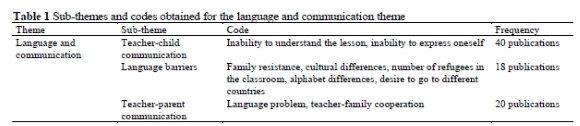
In this section, the findings obtained from the analysis conducted to determine the experiences of teachers who taught refugee students are discussed. Six themes and 15 sub-themes related to 50 codes are examined in the content analysis. The theme, "language and communication", has three separate sub-themes, namely teacher-child communication, language barriers, and teacher-parent communication, which are presented in Table 1.
In all the studies examined, we found that the greatest difficulty for the teachers who taught refugee students was language and communication. The students could not express themselves, thus they could not communicate. One teacher reacted as follows: "I observe that they cannot understand the lesson and do not get along with their friends due to a serious language problem" (S16).
Under the sub-theme, language barriers, the greatest obstacle experienced by participating teachers was the language learning of refugee students:
Families see language learning as cultural corruption, and they are reluctant to have their children educated at school (S23).
The fact that they are used to reading the text from right to left causes us problems while teaching Turkish (S13).
Parent communication was another problematic situation experienced by teachers teaching refugee students. It was stated that communication with parents was not possible due to the language barrier. For this reason, it was stated that healthy information exchange with families regarding students' behaviour in school and their academic development could not be provided: "In general, parents are very indifferent. I didn' t see their parents coming to school. They remain uninterested" (S36).
The sub-themes and codes identified under the theme, "integration", are presented in Table 2.
Teachers who participated in the studies stated that refugee students had adaptation problems in some subjects, and they carried out inclusive education environments and integration studies to overcome these problems. The following is a sample statements from this theme: "I am not really in favour of refugee students taking classes in the same class as Turkish students. Because they can't fully understand and perceive the subjects, that's why they disrupt the order of the lesson a lof (S4).
In the sub-theme of living together, it was found that the codes of inclusive education environments and integration were mentioned in eight theses and six articles. In the studies examined, it was stated by the teachers that the codes identified on the harmony of refugee students made a positive contribution. The ideas of the teachers about the sub-theme of living together are given below.
Since the children could not express themselves verbally when they first arrived, I tried to offer them educational environments enriched with sports so that they could participate in the environment with a sense of achievement. You know, when it comes to games, children already participate more easily. As a result, I observed that they were able to acquire the language more easily while playing. (S33)
We determined that barriers, the last sub-theme under the harmony theme, were mentioned together with codes on society' s perspective, fear of assimilation, parental apathy, economic difficulties, and age difference in classes. It is thought that these codes were important findings for the adaptation of refugee students. The following is a direct quote on this sub-theme: "First of all, Turkish families have prejudices. It' s like they' re all sick people who should never be approached. That' s how they see Syrians. Although I try to fix it, this behaviour flares up from time to time^ (S46).
The sub-themes and codes determined in the context of the discrimination theme are indicated in Table 3.
The teachers who participated in the studies stated that refugee students were labelled with words such as Syrian, nasty, thief, and terrorist, which resulted in grouping and exclusion.
Syrians in my class are sometimes discriminated against by other students. Students mostly humiliate and exclude Syrian students with adjectives such as 'Syrian ', 'Dirty Syrian. ' In this case, the Syrian student can complain to the teacher, saying, 'My teacher, he/she called me Syrian' , because other students use it as an insult even though they know that their Syrian identity is not bad. (S24)
In the sub-theme, grouping, achievement and ethnicity emerged as codes. The participating teachers' opinions on the grouping sub-theme are presented below.
There is a lot of grouping among refugee students, especially among Syrian and Afghan students. It is seen that they are sitting next to their friends who are of their race in the classroom, and they are walking with the friends of their race in the schoolyard. (S34)
Under exclusion, the last sub-theme of the discrimination theme, peer exclusion and adult attitude emerged as codes. We thought that these codes were important in understanding the discriminatory behaviour faced by refugee students.
Local families do not want their children to attend classes with refugee children. They do not want refugees because they think that they can transmit diseases and that they are not clean enough (S20).
The sub-themes and codes determined under the theme, teacher experiences, are presented in Table 4.
Two sub-themes were determined for the theme, teacher experiences, namely classroom management and professional qualification, which is clear from the following: "They had no toilet habits; they never wiped their hands; they did not wash. I tried so hard to fix these situations; now they have learned to be clean and honest. I brought these habits to these children" (S45).
The codes from the sub-theme, professional qualification, were lack of information and equipment, need for in-service training, and translator students. From the studies examined, we observed that the most common problems faced by teachers under professional qualifications were caused by language. The following provides an example of the teachers' opinions on the sub-theme, professional qualification: "f I have sufficient knowledge, I can make the lesson enjoyable. However, I do not believe I have the necessary knowledge and experience to educate refugee students" (S4).
The sub-themes and codes under the theme, psychological effects, are given in Table 5.
The teachers who participated in the studies stated that reasons such as war and migration, and loss of relatives created a noticeable difference in behaviour among refugee students, which is seen in the following:
We have some problems with Syrian students. Children are introverted. We have problems with communication. Since they come from a war environment, they can show different reactions to different events. When there is a sudden loud noise, the child suddenly shuts himself down and does not speak at all. (S31)
Under the sub-theme, psycho-social effects, lack of confidence, self-isolation, the tendency to violence, and psychological support, were mentioned in almost all studies. In this sub-theme, the focus was on teachers' approaches to students. Identifying the differences in the behaviour of refugee students is important in this regard. A participant in S18 said the following: "When my student first came to me, she/he wanted to be alone in a corner; she/he was crying all the time; she/he didn' t understand what I was saying; these were hard times" (S18).
The sub-themes and codes determined for the theme, education system, are given in Table 6.
Participating teachers mentioned some important situations under the sub-theme, support, to increase the quality of state education. Under the sub-theme, deficiencies, unfulfilled requests by administrators/authorities were mentioned. The teachers stated that they needed in-service training and materials to improve their teaching of refugee students.
It was not enough. It would be better to have hands-on training. We tried to provide education for foreign students without encountering any foreign students before. We did not see the practice. We saw the theory. They say that it will happen like this, but it certainly doesn't. Real life is different... (S39)
In the sub-theme, deficiencies, the codes in-service training, quantification and evaluation, materials and infrastructure, programme and regulation were mentioned throughout. This sub-theme is important in terms of exemplifying the structural conditions of the education system in the education of refugee students.
They said that you will only provide education with this infrastructure, but they did not make any arrangements. We only had a seminar once. We hoped that this seminar would be a guide for us. But then we only listened to each other's problems. It didn't contribute anything. (S4)
Discussion and Conclusion
The civil war that started in Syria in 2011 has led to a large influx of refugees into Türkiye from 2014. Although Türkiye has hosted various migration movements in the past, this was the first time that the country encountered migration of this magnitude and diversity. It soon became clear that the state and civil organisations were not sufficiently prepared. With the Temporary Protection Law promulgated in 2016 and the definition of Syrian refugees as "individuals under temporary protection status", academic studies on refugees had gained momentum. In our study, we did an in-depth analysis of 19 postgraduate theses and 32 academic articles in which the circumstance of refugees in Türkiye between 2010 and 2021 were discussed. In these studies the integration of refugees into educational processes and the difficulties encountered in this process were examined in detail. These studies show that teachers had a critical responsibility, shaped by uncertainty and a lack of planning, to integrate refugee students into the education system during this period.
The findings of the study clearly show that one of the most fundamental difficulties that teachers faced in the integration of refugee students into the educational process was the language barrier. Bernstein's (1960) theory of linguistic codes draws attention to the relationship between language use and educational success. Bernstein argues that students' linguistic differences can negatively affect their academic performance. This lack of mother-tongue education may cause poor reading ability (Vos & Fouché, 2021). The inability of students with low Turkish proficiency to actively participate in lessons lead to social exclusion and intra-group separation. This situation revealed that teachers faced serious difficulties in ensuring harmony in the classroom. In addition, language proficiency problems were not limited to students. They also created significant difficulties in communication with parents. Teachers emphasised that refugee parents' lack of command of Turkish made school-parent cooperation difficult. In this context, we observed that Turkish teachers significantly differed with regard to the language and communication problems experienced with refugee students. Teachers stated that most refugee students' economic situations were poor. For this reason, refugee parents were reluctant to send their children to school. They also wanted their children to work and contribute to the household economy. Therefore, they did not care enough about their children' s education. From the theses and articles that we examined, we found that a small number of teachers tried to overcome these obstacles with empathy and patience, while the majority exhibited a more reluctant approach to this process. We determined that these differences in attitudes negatively affected the adaptation process of refugee students into the education system.
Negative attitudes towards refugees in Turkish society complicate the students' adaptation. Local people regard refugee children as a threat to the quality of education that their own children receive. Teachers also said that parents often complained that refugees negatively affected harmony in the classroom. Teachers frequently express their observations of discriminatory behaviour faced by refugee students. We found that ethnic separation among refugee students has become more evident over time. For example, it is stated that Turkish students rather accepted Syrian students of Turkmen origin than Syrian students of Arab origin. This separation might be due to the discourse that students are exposed to at home (Saklan, 2018). Goffman (2018) emphasises that stigmatisation is a negative form of classification that emerges because of interaction between individuals or groups. Stigmatisation may cause individuals to associate themselves with socially undesirable characteristics which could lead to discriminatory behaviour against these individuals. Refugee students are often labelled negatively as dirty, thief, or terrorist, and this deepens the separation between refugees and Turkish students.
Such discriminatory attitudes and exclusionary behaviour in schools sometimes lead to physical conflict. Teachers are affected by this chaotic environment in different ways, and their pedagogical approaches are divided into three main groups. The first group is those who fulfil their duties without discrimination, adhering to professional ethics. The second group is those who attach importance to professional ethics but change their attitudes according to environmental factors. The third group is teachers who ignore refugee students and disregard their existence. In the theses and articles examined we found that most teachers resorted under the third group. These different approaches resulted in the formation of diverse attitudes and perceptions in educational environments. In our study, we understood that teachers were not hopeful about solving these problems. This situation is clearly revealed from the direct quotes in the findings section. Teachers shared many of the problems expressed by the parents. In this context, the various roles that teachers take as members of society, such as parents and colleagues, and the effects of these roles on their professional lives should be taken into consideration. Studies show that teachers expressed that they needed to take a stand against negative discourse towards refugees. However, the same teachers stated that, being mothers or fathers, they shared the concerns of society (Yağan, 2020a). The necessity of establishing a balance between the realities of society and professional ethics is critical for teachers to effectively cope with the challenges in their personal and professional lives.
Allport's (1954) theory of intergroup conflict provides an important framework to explain this situation. Allport states that a lack of interaction between groups can pave the way for the reinforcement of hostile attitudes. The positive effects of intergroup contact will occur under four conditions. Groups have equal status, common goals are determined, there is cooperation between groups, and there is support from the authority that emerges as law and tradition for this relationship. When evaluated in this context, it is thought that sharing common educational areas with Turkish and refugee students would contribute positively to the adaptation process. It is stated that restricting educational opportunities increases the risk of cultural marginalisation of refugee communities, and this situation makes it more difficult for teachers to manage classroom dynamics (Sheikh & Anderson, 2018). Sherif and his colleagues, who examined the nature of intergroup conflict, advanced Allport' s theory and stated that to eliminate intergroup conflict, group members should come together to achieve real and interesting goals (Sherif, 2010). However, under current conditions, it is seen that the basic principles put forward by Allport and Sherif are insufficient in presenting the integration policies implemented against refugees in Türkiye and the world.
Economic pressures and intense migration movements deepen social divisions and lead to differences in attitudes in educational institutions. The increasing refugee population due to mass migration after 2014 and the economic crisis triggered by the coronavirus disease (COVID-19) pandemic that started in 2020 have led to refugees being branded as scapegoats by teachers and a large part of society. The shrinking economic conditions have caused the local population to exhibit discriminatory behaviour against refugees. This has further complicated the dynamics within the classroom. The significant increase in the voting rates of far-right parties that promise to deport refugees from Türkiye and many countries of the world, especially in Europe, is noteworthy. If precautions are not taken, we face the risk of this situation turning into serious conflict. Indeed, the violent anti-refugee actions that took place in European countries with relatively high income, especially in England, Italy, and France in the summer of 2024, are a clear example of this. Therefore, the effectiveness of economic conditions in reducing the risk of conflict between groups should never be ignored. If the task of assimilating refugees is given to schools alone without taking these conditions into account, failure is inevitable. Althusser (2014) argues that the most important and useful ideological apparatus of the state before the Enlightenment was the church. However, according to him, since the value of religion in the eyes of society decreased after the Enlightenment, this role is now taken by educational institutions. Since the monopoly of states on information has been broken thanks to developing mass communication tools (internet, social media, etc.), education is again the most effective apparatus of ideological dissemination in society. Schools have thus become the most useful ideological apparatus of the state. Therefore, the role of schools in eliminating all these conflicts and developing an inclusive perspective in the eyes of society should be reconsidered.
As a result, when we examined teachers' statements about the problems they had experienced with refugee students, we found that they actually expressed a deep sense of helplessness. One of the two main reasons that give rise to this feeling of helplessness is that teachers, as the rest of society, have economic concerns. The second reason is that they do not receive sufficient training on how to deal with this situation. Superficial in-service training presented in short periods result in teachers feeling inadequate about working with refugee students and their families. For this reason, they must develop instant solutions to problems in the classroom and try to eliminate their lack of knowledge with individual efforts. While Burns and Lawrie (2015) emphasise that teacher training is generally inadequate in emergency situations, Ring and West (2015) state that the necessary training in the refugee context is often incomplete. Amaç (2021) and Sarıer (2020) state that teachers complain about the inadequacy of the education they had received. It is stated that similar negative attitudes were also observed among school administrators (Yağan, 2020b). This situation causes teachers to feel helpless in inclusive education practices. This helplessness increases the feeling of burnout in teachers and leads to negative attitudes. Supporting the professional development of teachers and increasing their development opportunities stands out as a fundamental element that will strengthen the overall success of the education system.
Data Availability
The data that support the findings of this study are available from the corresponding author upon reasonable request.
Authors' Contributions
All authors contributed equally in the preparation of the article. All authors reviewed the final manuscript.
Notesi. Published under a Creative Commons Attribution Licence.
References
-
Aksoy E 2010. Almanya'da yaşayan üçüncü kuşak Türk öğrencilerin kimlik algılamaları ve buna bağlı olarak karşılaştıkları ayrımcılık sorunları [Identity perceptions of third generation Turkish students living in Germany and the discrimination problems of discrimination they faced there]. Hacettepe Üniversitesi Türkiyat Araştırmaları Dergisi (HÜTAD), 12(12):7-38. Available at https://dergipark.org.tr/en/download/article-file/640116. Accessed 25 August 2025.
» https://dergipark.org.tr/en/download/article-file/640116 - Allport G 1954. The nature of prejudice. Cambridge, MA: Addison-Wesley.
- Althusser L 2014. İdeoloji ve devletin ideolojik aygıtları [Ideology and ideological state apparatuses]. İstanbul, Türkiye: İthaki.
-
Amaç Z 2021. Kapsayıcı eğitim ve ilkokul öğretmenleri: Sistematik bir inceleme [Inclusive education and primary school teachers: A systematic review]. Elektronik Eğitim Bilimleri Dergisi, 10(19):74-97. Available at https://dergipark.org.tr/en/download/article-file/1588494. Accessed 25 August 2025.
» https://dergipark.org.tr/en/download/article-file/1588494 -
Aspfors J & Fransson G 2015. Research on mentor education for mentors of newly qualified teachers: A qualitative meta-synthesis. Teaching and Teacher Education, 48:75-86. https://doi.org/10.1016/j.tate.2015.02.004
» https://doi.org/10.1016/j.tate.2015.02.004 - Ataöv T 1996. Çatışmaların kaynağı olarak ayrımcılık [Discrimination as a source of conflict]. Ankara, Türkiye: AÜ SBF İnsan Hakları Merkezi.
-
Bernstein B 1960. Language and social class. The British Journal of Sociology, 11(3):271-276. https://doi.org/10.2307/586750
» https://doi.org/10.2307/586750 -
Biçer N & Alan Y 2022. Service-based learning experiences of pre-service Turkish teachers: Language teaching to Syrian refugees. South African Journal of Education, 42(3):Art. #2111, 11 pages. https://doi.org/10.15700/saje.v42n3a2111
» https://doi.org/10.15700/saje.v42n3a2111 -
Burns M & Lawrie J (eds.) 2015. Where it's needed most: Quality professional development for all teachers. New York, NY: Inter-Agency Network for Education in Emergencies (INEE). Available at https://inee.org/sites/default/files/resources/Where_Its_Needed_Most_-_Teacher_Professional_Development__2015_LowRes.pdf. Accessed 26 August 2025.
» https://inee.org/sites/default/files/resources/Where_Its_Needed_Most_-_Teacher_Professional_Development__2015_LowRes.pdf - Castles S & Miller MJ 2008. Göçler çağı: Modern dünyada uluslararası göç hareketleri [The age of migrations: International migration movements in the modern world]. İstanbul, Türkiye: Istanbul Bilgi Universitesi Yayinlari.
-
Crisp J 1999. Policy challenges of the new diasporas: Migrant networks and their impact on asylum flows and regimes (Working Paper No. 7). Geneva, Switzerland: Policy Research Unit, UNHCR. Available at https://www.refworld.org/reference/research/unhcr/1999/en/87279. Accessed 26 August 2025.
» https://www.refworld.org/reference/research/unhcr/1999/en/87279 -
Davies JC 1962. Toward a theory of revolution. American Sociological Review, 27(1):5-19. https://doi.org/10.2307/2089714
» https://doi.org/10.2307/2089714 -
De Villiers R & Weda Z 2017. Zimbabwean teachers in South Africa: A transient greener pasture. South African Journal of Education, 37(3):Art. # 1410, 9 pages. https://doi.org/10.15700/saje.v37n3a1410
» https://doi.org/10.15700/saje.v37n3a1410 -
Dinçer S 2018. Content analysis in for educational science research: Meta-analysis, meta-synthesis, and descriptive content analysis. Bartın University Journal of Faculty of Education, 7(1):176-190. https://doi.org/10.14686/buefad.363159
» https://doi.org/10.14686/buefad.363159 -
Dündar A 2019. Impact of physical education lesson on adaptation of Syrian refugee school age children in Turkey. World Journal of Education, 9(1):266-273. https://doi.org/10.5430/wje.v9n1p266
» https://doi.org/10.5430/wje.v9n1p266 -
European Asylum Support Office 2021. EASO asylum report 2021: Annual report on the situation of asylum in the European Union. Luxembourg: Publications Office of the European Union. Available at https://euaa.europa.eu/sites/default/files/EASO-Asylum-Report-2021.pdf. Accessed 26 August 2025.
» https://euaa.europa.eu/sites/default/files/EASO-Asylum-Report-2021.pdf -
Evans M & Liu Y 2018. The unfamiliar and the indeterminate: Language, identity and social integration in the school experience of newly-arrived migrant children in England. Journal of Language, Identity & Education, 17(3):152-167. https://doi.org/10.1080/15348458.2018.1433043
» https://doi.org/10.1080/15348458.2018.1433043 -
Finfgeld DL 2003. Metasynthesis: The state of the art- so far. Qualitative Health Research, 13(7):893-904. https://doi.org/10.1177/1049732303253462
» https://doi.org/10.1177/1049732303253462 - Genç Y & Seyyar A 2010. Sosyal hizmet terimleri: Ansiklopedik sosyal pedegojik çalışma sözlüğü [Social service terms: Encyclopedic social pedagogical work dictionary]. Sakarya, Türkiye: Sakarya Kitabevi.
- Glesne C 2011. Becoming qualitative researchers: An introduction to qualitative research. Translated by A Ersoy & P Yalçınoğlu. Ankara, Türkiye: Pegem.
- Goffman E 2018. Örselenmiş kimliğin idare edilişi üzerine notlar [Notes on the management of traumatized identity]. Ankara, Türkiye: Heretik Yayınları
-
Gümüş S 2018. Nitel araştırmaların sistematik derlemesi: Meta sentez [Systematic review of qualitative research: Meta synthesis]. In K Beycioğlu, N Özer & Y Kondakçı (eds). Eğitim yönetiminde araştırma. Ankara, Türkiye: Pegem Akademi. https://doi.org/10.14527/9786052415054
» https://doi.org/10.14527/9786052415054 - Güney S 2015. Sosyal psikoloji [Social psychology]. İstanbul, Türkiye: Nobel Yayıncılık.
- Hogg MA & Vaughan GM 2017. Sosyal psikoloji [Social psychology]. Ankara, Türkiye: Ütopya Yayınevi.
-
Kılıç S 2017. Mülteci krizi bağlamında İsveç'in göçmen bütünleşme politikasının değerlendirilmesi [Assessing the immigrant integration policy of Sweden in the context of refugee crisis]. Ankara Avrupa Çalışmaları Dergisi, 16(2):85-120. https://doi.org/10.1501/Avraras_0000000254
» https://doi.org/10.1501/Avraras_0000000254 -
Lee ES 1966. A theory of migration. Demography, 3(1):47-57. https://doi.org/10.2307/2060063
» https://doi.org/10.2307/2060063 -
Mabogunje AL 1970. Systems approach to a theory of rural-urban migration. Geographical Analysis, 2(1):1-18. https://doi.org/10.1111/j.1538-4632.1970.tb00140.x
» https://doi.org/10.1111/j.1538-4632.1970.tb00140.x - Macionis JJ 2017. Sosyoloji [Sociology]. İstanbul, Türkiye: Nobel Yayıncılık.
-
Matthews J 2008. Schooling and settlement: Refugee education in Australia. International Studies in Sociology of Education, 18(1):31-45. https://doi.org/10.1080/09620210802195947
» https://doi.org/10.1080/09620210802195947 - Maxwell JA 2018. Nitel arastirma tasarimi: Etkileşimli bir yaklaşım [Qualitative research design: An interactive approach]. Translated by M Çelikbaş. Ankara, Türkiye: Nobel Akademik Yayincilik.
- Merriam SB 2015. Qualitative research: A guide for pattern and application. Translated by S Turan. Ankara, Türkiye: Nobel.
- Merriam-Webster's dictionary 2012. Springfield, MA: Merriam-Webster.
-
Ministry of National Education 2020. Hayat boyu öğrenme [Lifelong learning] [PowerPoint presentation]. Available at https://hbogm.meb.gov.tr/meb_iys_dosyalar/2020_01/27110237_OCAK_2020internet_BulteniSunu.pdf. Accessed 6 April 2021.
» https://hbogm.meb.gov.tr/meb_iys_dosyalar/2020_01/27110237_OCAK_2020internet_BulteniSunu.pdf -
Noah PD, Jr. 2017. A systematic approach to the qualitative meta-synthesis. Issues in Information Systems, 18(2):196-205. https://doi.org/10.48009/2_iis_2017_196-205
» https://doi.org/10.48009/2_iis_2017_196-205 -
Noblit GW & Hare RD 1988. Meta-ethnography: Synthesizing qualitative studies. Newbury Park, CA: Sage. https://doi.org/10.4135/9781412985000
» https://doi.org/10.4135/9781412985000 - Patton MQ 2018. Nitel araştırma ve değerlendirme yöntemleri [Qualitative research & evaluation methods] (2nd ed). Translated by M Bütün & S Beşir Demir. Ankara, Türkiye: Pegem Akademi.
-
Petersen W 1958. A general typology of migration. American Sociological Review, 23(3):256-266. https://doi.org/10.2307/2089239
» https://doi.org/10.2307/2089239 -
PISA 2013. Göçmen öğrenciler eğitim sistemleri ile ilgili bize ne söyleyebilirler? [What can immigrant students tell us about their education system?]. Available at http://pisa.meb.gov.tr/wp-content/uploads/2013/11/pisa-bulteniekim. Accessed 6 April 2021.
» http://pisa.meb.gov.tr/wp-content/uploads/2013/11/pisa-bulteniekim -
Polat S & Ay O 2016. Meta-sentez: Kavramsal bir çözümleme [Meta-synthesis: A conceptual analysis]. Eğitimde Nitel Araştırmalar Dergisi, 4(2):52-64. https://doi.org/10.14689/issn.2148-2624.1.4c2s3m
» https://doi.org/10.14689/issn.2148-2624.1.4c2s3m -
Ravenstein EG 1885. The laws of migration. Journal of the Statistical Society of London, 48(2):167-235. https://doi.org/10.2307/2979181
» https://doi.org/10.2307/2979181 -
Ravenstein EG 1889. The laws of migration. Journal of The Royal Statistical Society, 52(2):241-305. https://doi.org/10.2307/2979333
» https://doi.org/10.2307/2979333 -
Refugees Association 2025. Türkiye 'deki Suriyeli Sayısı Mayıs 2025 [Number of Syrians in Turkey, May 2025]. Available at https://multeciler.org.tr/turkiyedeki-suriyeli-sayisi/. Accessed 18 August 2025.
» https://multeciler.org.tr/turkiyedeki-suriyeli-sayisi/ -
Ring HR & West AR 2015. Teacher retention in refugee and emergency settings: The state of the literature. The International Education Journal: Comparative Perspectives, 14(3):106-121. Available at https://files.eric.ed.gov/fulltext/EJ1086716.pdf. Accessed 18 August 2025.
» https://files.eric.ed.gov/fulltext/EJ1086716.pdf -
Rodríguez-Izquierdo RM & Darmody M 2019. Policy and practice in language support for newly arrived migrant children in Ireland and Spain. British Journal of Educational Studies, 67(1):41-57. https://doi.org/10.1080/00071005.2017.1417973
» https://doi.org/10.1080/00071005.2017.1417973 - Saklan E 2018. Türkiye'deki Suriyeli eğitim çağı çocuklarının eğitim süreçleri üzerine bir çözümleme [An analysis on the education processes of Syrian children of education age in Turkey]. Doctoral thesis. Ankara, Türkiye: Ankara University.
- Sandelowski M & Barroso J 2007. Handbook for synthesizing qualitative research. New York, NY: Springer.
-
Sarıer Y 2020. Türkiye'de mülteci öğrencilerin eğitimi üzerine bir meta-sentez çalışması: Sorunlar ve çözüm önerileri [Student education for refugees in Turkey on the meta-synthesis study: Problems and solution suggestions]. Eğitimde Yeni Yaklaşımlar Dergisi, 3(1):80-111. Available at https://dergipark.org.tr/en/download/article-file/1048451. Accessed 18 August 2025.
» https://dergipark.org.tr/en/download/article-file/1048451 -
Şeker BD & Aslan Z 2015. Refugee children in the educational process: An social psychological assessment. Kuramsal Eğitimbilim Dergisi, 8(1):86-105. https://doi.org/10.5578/keg.8234
» https://doi.org/10.5578/keg.8234 -
Sheikh M & Anderson JR 2018. Acculturation patterns and education of refugees and asylum seekers: A systematic literature review. Learning and Individual Differences, 67:22-32. https://doi.org/10.1016/j.lindif.2018.07.003
» https://doi.org/10.1016/j.lindif.2018.07.003 - Sherif M 1956. Experiments in group conflict. Scientific American, 195(5):54-59.
- Sherif M 2010. The robbers cave experiment: Intergroup conflict and cooperation [Orig. pub. as Intergroup conflict and group relations]. Middletown, CT: Wesleyan University Press.
-
Stouffer SA 1940. Intervening opportunities: A theory relating mobility and distance. American Sociological Review, 5(6):845-867. https://doi.org/10.2307/2084520
» https://doi.org/10.2307/2084520 -
Suri H 2011. Purposeful sampling in qualitative research synthesis. Qualitative Research Journal, 11(2):63-75. https://doi.org/10.3316/QRJ1102063
» https://doi.org/10.3316/QRJ1102063 -
Taylor S & Sidhu RK 2012. Supporting refugee students in schools: What constitutes inclusive education? International Journal of Inclusive Education, 16(1):39-56. https://doi.org/10.1080/13603110903560085
» https://doi.org/10.1080/13603110903560085 -
Thomas J & Harden A 2008. Methods for the thematic synthesis of qualitative research in systematic reviews. BMC Medical Research Methodology, 8:45. https://doi.org/10.1186/1471-2288-8-45
» https://doi.org/10.1186/1471-2288-8-45 -
Turkish Statistical Institute 2025. İstatistiklerle çocuk, 2024 [Child with statistics, 2024]. Available at https://data.tuik.gov.tr/Bulten/Index?p=Istatistiklerle-Cocuk-2024-54197. Accessed 18 April 2025.
» https://data.tuik.gov.tr/Bulten/Index?p=Istatistiklerle-Cocuk-2024-54197 -
Vaynshtok O 2001. Facilitating learning and transition among the refugee population. Adult Learning, 13(1):26-28. https://doi.org/10.1177/104515950101200407
» https://doi.org/10.1177/104515950101200407 -
Vos E & Fouché N 2021. Language as contextual factor of an education system: Reading development as a necessity [Special issue]. South African Journal of Education, 41(Suppl. 1):Art. #1831, 13 pages. https://doi.org/10.15700/saje.v41ns1a1831
» https://doi.org/10.15700/saje.v41ns1a1831 - Wallerstein I 2017. Kapitalist dünya ekonomisinde hane yapıları ve emek gücü oluşumu. Irk, ulus, sınıf [Household structures and labor force formation in the capitalist world economy. Race, nation, class]. İstanbul, Türkiye: Metis.
-
Weed M 2005. "Meta interpretation": A method for the interpretive synthesis of qualitative research. Forum: Qualitative Social Research, 6(1):Art. 37. https://doi.org/10.17169/fqs-6.1.508
» https://doi.org/10.17169/fqs-6.1.508 -
Wrench A, Soong H, Paige K & Garrett R 2018. Building spaces of hope with refugee and migrant-background students. International Journal of Inclusive Education, 22(11):1197-1212. https://doi.org/10.1080/13603116.2017.1420251
» https://doi.org/10.1080/13603116.2017.1420251 -
Yağan E 2020a. Çakışan öyküler - çatışan beklentiler: Türk ve yabancı öğrencilerin ortak deneyimleri ve gelecek beklentilerinin incelenmesi (İstanbul Pendik'te yapılan karma çalışma, 2019) [Coinsiding stories - conflicting expectations: The analysis of common experiences and future expectations of Turkish and foreign students in Turkey (Mixed study in Istanbul Pendik, 2019)]. Doctoral dissertation. İstanbul, Türkiye: Maltepe University. Available at https://www.proquest.com/docview/3161889029?pq-origsite=gscholar&fromopenview=true&sourcetype=Dissertations%20&%20Theses. Accessed 13 August 2025.
» https://www.proquest.com/docview/3161889029?pq-origsite=gscholar&fromopenview=true&sourcetype=Dissertations%20&%20Theses -
Yağan E 2020b. War, refugees and Syrians through the eyes of school principals: A metaphor analysis. International Journal of Eurasian Education and Culture, 5(10):1382-1436. Available at https://www.researchgate.net/profile/Ersin-Yagan/publication/344439188_War_Refugees_and_Syrians_Through_the_Eyes_of_School_Principals_A_Metaphor_Analysis/links/5f759aca92851c14bca41d6b/War-Refugees-and-Syrians-Through-the-Eyes-of-School-Principals-A-Metaphor-Analysis.pdf. Accessed 13 August 2025.
» https://www.researchgate.net/profile/Ersin-Yagan/publication/344439188_War_Refugees_and_Syrians_Through_the_Eyes_of_School_Principals_A_Metaphor_Analysis/links/5f759aca92851c14bca41d6b/War-Refugees-and-Syrians-Through-the-Eyes-of-School-Principals-A-Metaphor-Analysis.pdf -
Yagan E & Aksit B 2021. Can we live together? Discrimination in the context of education in Turkey: A mixed-methods research. Eurasian Journal of Educational Research, 94:233-264. Available at https://www.researchgate.net/publication/351006435_Can_we_Live_Together_Discrimination_in_the_Context_of_Education_in_Turkey_A_Mixed-_Methods_Research. Accessed 13 August 2025.
» https://www.researchgate.net/publication/351006435_Can_we_Live_Together_Discrimination_in_the_Context_of_Education_in_Turkey_A_Mixed-_Methods_Research
Revised: 14 April 2025
Accepted: 27 June 2025
Published: 31 August 2025
http://mjer.penpublishing.net/files/10/sayi/sayi_126/mjerv11i22-115617..pdf#page=105
İçöz H 2019. İlkokullarda yabancı uyruklu öğrencilerle ilgili karşılaşılan sorunlar [Problems regarding foreign students in primary schools]. Master's thesis. Antalya, Türkiye: Akdeniz University. Available at http://dspace.akdeniz.edu.tr/bitstream/handle/123456789/4806/T05985.pdf7sequence=1&isAllowed=y. Accessed 10 August 2025.
İmamoğlu HV & Çalışkan E 2017. Yabancı uyruklu öğrencilerin devlet okullarında ilkokul eğitimine dair öğretmen görüşleri: Sinop ili örneği [Opinions of teachers on the primary education of foreign students in public schools: The case of Sinop province]. Karabük Üniversitesi Sosyal Bilimler Enstitüsü Dergisi, 7(2):529-546. Available at https://dergipark.org.tr/tr/download/article-file/374280. Accessed 5 August 2025.
Kardeş S & Akman B 2018. Suriyeli mültecilerin eğitimine yönelik öğretmen görüşleri [Teachers' views on the education of Syrian refugees]. İlköğretim Online, 17(3):1224-1237. https://doi.org/10.17051/ilkonline.2018.466333
Kaysılı A, Soylu A & Sever M 2019. Exploring major roadblocks on inclusive education of Syrian refugees in school settings. Turkish Journal of Education, 8(2):109-128. https://doi.org/10.19128/turje.496261
Koşar S & Aslan F 2020. İlkokul ve ortaokula devam eden göçmen çocukların eğitim sorunlarına yönelik okul yöneticilerinin görüşleri [Views of school administrators on the education problems of migrant children in primary and secondary school]. Uluslararası Türkçe Edebiyat Kültür Eğitim (TEKE) Dergisi, 9(4):1799-1831. Available at https://dergipark.org.tr/en/download/article-file/1498112. Accessed 9 August 2025.
Kultas E 2017. Türkiye'de bulunan eğitim çağındaki Suriyeli mültecilerin eğitimi sorunu (Van ili örneği) [The problem of education of Syrian refugees of educational age in Turkey (Van province example)]. Master's dissertation. Van, Türkiye: Yüzüncü Yıl University.
Mercan Uzun E & Bütün E 2019. Okul öncesi eğitim kurumlarındaki Suriyeli sığınmacı çocukların karşılaştıkları sorunlar hakkında öğretmen görüşleri [Teachers' views on the problems faced by Syrian refugee children in pre-school education institutions]. Uluslararası Erken Çocukluk Eğitim Çalışmaları Dergisi, 1(1):72-83. Available at http://ijeces.hku.edu.tr/en/download/article-file/155147. Accessed 9 August 2025.
Moralı G 2018. Suriyeli mülteci çocuklara Türkçenin yabancı dil olarak öğretiminde karşılaşılan sorunlar [The problems faced in teaching Turkish as a foreign language to Syrian refugee children]. OPUS - Uluslararası Toplum Araştırmaları Dergisi, 8(15):1426-1449. https://doi.org/10.26466/opus.443945
Olgun O 2019. Geçici koruma statüsündeki Suriye kökenli öğrencilerin eğitim sistemine uyum sorunları: Ankara-Altındağ ilçesi örneği [Problems of adaptation to the education system of Syrian students under temporary protection status: The case of Ankara-Altındağ district]. Master's dissertation. Ankara, Türkiye: Ankara Hacı Bayram Veli University. Özenç EG & Saat F 2019. Sınıf öğretmenlerinin Suriyeli öğrencilerin eğitiminde karşılaştığı sorunlar [The problems classroom teachers encounter in the education of Syrian students]. International Journal of Active Learning, 4(2):60-74. Available at https://dergipark.org.tr/en/download/article-file/912084. Accessed 8 August 2025.
Özgün E 2019. İlkokul öğretmenlerinin Suriyeli öğrencilerin akademik başarı ve okul ortamı uyumuna ilişkin gözlemlerinin incelenmesi [Analsıs of observatıons of primary school teachers on academic achievement and school environment adaptation of Syrian students]. Master's thesis. Konya, Türkiye: Necmettin Erbakan University. Available at https://www.proquest.com/docview/26040106737pq-origsite=gscholar&fromopenview=true&sourcetype=Dissertations%20&%20Theses. Accessed 8 August 2025.
Polat A 2019. Yabancılara (Suriyeli göçmen çocuklara) okuma yazma öğretimi sürecine ilişkin sınıf öğretmenlerinin görüşleri [Primary teachers' perspectives on teaching reading and writing process to foreigners (Syrian immigrant children)]. Master's thesis. Konya, Türkiye: Necmettin Erbakan University. Available at https://www.proquest.com/docview/26040115477pq-origsite=gscholar&fromopenview=true&sourcetype=Dissertations%20&%20Theses. Accessed 8 August 2025.
Pehlivan Yılmaz A 2019. Sosyal bilgiler dersinde kültüre duyarlı eğitim uygulamaları: Mülteci öğrencilerle etkileşim [Culturally sensitive educational practices in social studies: Interaction with refugee students]. PhD thesis. Tepebaşı, Türkiye: Anadolu University.
Şahin F & Şener ÜÖ 2019. Geçici Koruma Altındaki Suriyeli öğrencilerin eğitim süreçlerindeki dil ve iletişim sorunları: İstanbul Fatih örneği [Language and communication problems of Syrian students who are under temporary protection in education: Fatih sample]. Avrasya Sosyal ve Ekonomi Araştırmaları Dergisi, 6(9):66-85. Available at https://dergipark.org.tr/en/download/article-file/846400. Accessed 5 August 2025.
Saklan E 2018. Türkiye'deki Suriyeli eğitim çağı çocuklarının eğitim süreçleri üzerine bir çözümleme [An analysis of the educational processes of Syrian school-age children in Turkey]. Doctoral thesis. Ankara, Türkiye: Ankara University.
Şanlı B 2019. Türkiye'deki Suriyeli çocukların eğitime ve sosyal bilgiler dersine entegrasyonları hakkında sosyal bilgiler öğretmenlerinin görüşleri [Opinions of social studies teachers about the integration of Syrian children into education and social studies lessons in Turkey]. Master's dissertation. Bolu, Türkiye: Bolu Abant İzzet Baysal University.
Sarıahmetoğlu H 2019. Yabancı uyruklu öğrencilerin eğitim sistemine uyumunda karşılaşılan sorunlar ve çözüm önerileri [Problems and solutions in the adaptation of foreign students to the education system]. Master's thesis. Merkez, Türkiye: Kastamonu University.
Şeker S 2020. Mülteci öğrencilerin karşılaştığı eğitim sorunları: Yozgat ili örneği [Educational problems faced by refugee students: Yozgat province example]. Master's thesis. Yozgat, Türkiye: Yozgat Bozok University.
Sekin SA 2019. Sığınmacı öğrencilerin eğitim öğretim sürecinde karşılaştıkları sorunlar [Problems that asylum seeker students encounter in the education process]. Master's dissertation. Rize, Türkiye: Recep Tayyip Erdoğan University.
Şimşir Z & Dilmaç B 2018. Yabancı uyruklu öğrencilerin eğitim gördüğü okullarda öğretmenlerin karşılaştığı sorunlar ve çözüm önerileri [Problems teachers face and solution proposals in the schools where the foreign students are educated]. İlköğretim Online, 17(2):1116-1134. https://doi.org/10.17051/ilkonline.2018.419647
Soylu A, Kaysılı A & Sever M 2020. Mülteci çocuklar ve okula uyum: Öğretmenlerin kültüre duyarlılıkları üzerinden bir çözümleme [Refugee children and school adjustment: An analysis through cultural responsivities of the teachers]. Eğitim ve Bilim, 45(201):313-334. https://doi.org/10.15390/EB.2020.8274
Taskın P & Erdemlı O 2018. Education for Syrian refugees: Problems faced by teachers in Turkey. Eurasian Journal of Educational Research, 75:155-178. https://doi.org/10.14689/ejer.2018.75.9
Uyanık A 2019. Mülteci öğrencilerin eğitim gördüğü okullardaki rehberlik ihtiyaçlarının rehber öğretmen görüşlerine göre incelenmesi [Research on the guidance needs of refugee students according to school counsellors]. Master's dissertation. Konya, Türkiye: Necmettin Erbakan University. Available at https://www.proquest.com/docview/2544866076?fromopenview=true&pq-origsite=gscholar&sourcetype=Dissertations%20&%20Theses. Accessed 5 August 2025.
Yurdakul A & Tok TN 2018. Öğretmen gözüyle mülteci/göçmen öğrenci [Migrant/refugee student from the view of teachers]. Adnan Menderes Üniversitesi Eğitim Fakültesi Eğitim Bilimleri Dergisi, 9(2):46-58.
Zayimoğlu Öztürk F 2018. Mülteci öğrencilere sunulan eğitim-öğretim hizmetinin sosyal bilgiler öğretmen görüşlerine göre değerlendirilmesi [Evaluation of educational service provided for refugee students according to social studies teachers' opinions]. Anadolu Journal of Educational Sciences International, 8(1):52-79. https://doi.org/10.18039/ajesi.393879