Altering students' attitude towards learning mathematics through project-based learning: A mathematics project
Abstract
Project-based learning (PBL) is increasingly recognised as a transformative alternative to traditional, instructor-centred education, fostering positive student attitudes towards learning. However, public schools in Pakistan largely adhere to conventional teaching methods, contributing to poor mathematics achievement and negative student attitudes. In this study we explored the potential of PBL to enhance attitudes and mathematics performance among students in Pakistani public schools. Grounded in constructivist learning theory, which emphasises active, experiential learning, we employed a quasi-experimental design in this study. The experimental group received PBL-based instruction, while the control group was taught using traditional methods. Pre-intervention and post-intervention assessments were conducted for both groups to measure attitudes and achievement. Quantitative data were collected through an attitude scale and an achievement test, and qualitative insights were gathered via structured interviews. Statistical analysis of the quantitative data, using the Wilcoxon signed-rank test and independent sample f-test, revealed a significant improvement in the experimental group's attitudes toward mathematics learning (z = -4.570,p < .001) and achievement (p < .001). Thematic analysis of qualitative data further highlighted that PBL positively influenced students' perceptions and success in mathematics while receiving favourable feedback from both teachers and students. These findings underscore the potential of PBL to improve mathematics instruction and student outcomes in primary education. Future research should examine the applicability of PBL across diverse school settings, grade levels, and age groups to establish its broader efficacy in varied educational contexts.
achievement; instructional strategies; maths attitudes; project-based learning
Introduction
In recent years, the declining quality of mathematics education in Pakistani public schools has become a pressing concern, primarily due to students' pervasive negative attitudes toward the subject. These attitudes have been identified as a significant contributor to poor academic performance and suboptimal learning outcomes. The continued reliance on traditional, teacher-centred instructional methods has exacerbated this issue by limiting student engagement and reinforcing negative perceptions about mathematics. In these classrooms, students are often passive recipients of knowledge rather than active participants in the learning processes. This approach fails to address individual needs and interests, further deepening students' aversion towards subjects such as mathematics.
Research consistently highlights the impact of these attitudes on learning outcomes. Kazmi (2019) notes that science education in Pakistan, particularly in public schools, yields unacceptably low learning outcomes, largely attributable to students' negative attitudes. Similarly, Hannula (2002) and Mughal, Asad and Adams (2021) emphasise that the persistence of conventional teaching approaches in public schools has perpetuated poor educational quality and further diminished students' perceptions about mathematics. Negative attitudes toward mathematics are often identified as a root cause of academic failure (Mazana, Montero & Casmir, 2019). Parental and teacher pressure to master complex topics such as calculus and geometry has also negatively influenced students' attitudes (Awan, Hussain & Anwar, 2017).
National reports further highlight the severity of the problem. Alif Ailaan's (2017:3) report, "Powering Pakistan for the 21st Century", underscores the dismal state of mathematics and science education nationwide. Data from the national education assessment system reveal that, on average, fourth-grade students scored only 433 out of 1,000 points in mathematics. Furthermore, most students demonstrated poor performance in mathematics and geometry. These findings are symptomatic of a broader issue: public school classrooms often marginalise students' knowledge, individuality, and interests due to the teacher-centred nature of instruction (Khaliq, Alam & Mushtaq, 2015), further contributing to negative attitudes towards mathematics.
As a foundational discipline for scientific investigation and development, mathematics demands a range of cognitive skills, including abstract, inductive, deductive, and computational reasoning (Hu, Gong, Lai & Leung, 2018). Primary education aims to cultivate numeracy and arithmetic skills (Genc & Erbas, 2019; Pangrazi & Beighle, 2019), yet negative attitudes toward mathematics hinder the development of these essential abilities. Chaudhry, Malik and Rafiq (2019) highlight that students' disposition toward mathematics is pivotal in their academic success. Since the 1960s, educators have recognised that positive attitudes toward mathematics are critical for academic achievement (Iji, Abah & Anyor, 2017). Empirical evidence also supports the connection between students' positive attitudes and higher mathematical competence (Zhang, Zhao & Kong, 2019).
To assess these attitudes, researchers have used various instruments to measure students' engagement, self-belief in mathematical abilities, and perceptions of the usefulness of the subject (Asempapa & Brooks, 2022; Mutohir, Lowrie & Patahuddin, 2018). These measures reveal that students' perspectives on mathematics significantly influence their engagement and success (Sen, 2022). Alarmingly, one-third of students report no interest in mathematics, with fear rather than curiosity dominating their attitudes (Vu & Feinstein, 2017). Negative attitudes often stem from anxiety about mathematics' precision, logical requirements, and problem-solving demands (Abramovich, Grinshpan & Milligan, 2019), which impede students' willingness to engage and learn. Fostering positive attitudes is critical to overcoming these barriers and improving mathematics education outcomes.
To address the challenges of negative student attitudes toward mathematics, project-based learning (PBL) offers a pedagogical approach that combines hands-on and mind-on activities, facilitating deeper comprehension and long-term retention of mathematical concepts (France, 2015). PBL actively engages students in their learning process, transforming negative attitudes by making mathematics more relevant and enjoyable (Rehman, Huang, Batool, Andleeb & Mahmood, 2024). It fosters critical skills such as problem-solving, critical thinking, and collaboration, which are essential for academic success and future career readiness (Virtue & Hinnant-Crawford, 2019). For instance, Wolpert-Gawro (2016) demonstrates that PBL encourages students to embrace challenges in mathematics rather than avoid them, leading to improved confidence and resilience. Moreover, PBL enables students to absorb mathematical concepts better, retain them for longer, and effectively apply their knowledge to real-world scenarios. The long-term impact of this teaching method lies in its ability to transform students' learning processes and enhance their academic performance (Holmes & Hwang, 2016).
Mathematics Education in Pakistan
The Trends in International Mathematics and Science Study (TIMSS), a global standardised assessment, underscores the critical state of mathematics education in Pakistan. As the first South Asian country to participate in TIMSS, Pakistan's results reveal a troubling reality: fourth-grade Pakistani students rank at the bottom in global math and science proficiency (TIMSS, 2019). Among the 58 predominantly high-income nations assessed, Pakistan's performance is particularly concerning. Only 27% of Pakistani students met the lowest international benchmark in mathematics, demonstrating a basic understanding of fundamental concepts such as addition, subtraction, multiplication, and division. Furthermore, only 8% of students achieved the intermediate benchmark, while only 1% reached the high standard. These findings highlight a systemic issue in mathematics education, emphasising the urgent need for innovative pedagogical approaches, such as PBL, to improve students' proficiency and engagement in mathematics.
In Finland, where students consistently excel in the Programme for International Student Assessment (PISA) exams, formal mathematics instruction does not begin until the seventh grade. Instead, students gain an early understanding through hands-on projects and experiential learning (Boaler, Chen, Williams & Cordero, 2016). Finland's emphasis on learning by doing represents a paradigm shift from traditional teaching methods. Rather than merely providing formulas and expecting students to apply them, educators in Finland encourage students to explore mathematical concepts independently and solve problems creatively.
In contrast, Pakistan's education system faces numerous systemic challenges, including limited funding, inefficient programme implementation, and inadequate teacher training (Halai & Durrani, 2020). As a result, conventional teaching methods dominate classrooms, hindering student engagement and academic performance. Mathematics is widely regarded as a critical tool for developing cognitive and analytical abilities; historically, societies have placed immense value on mastering mathematics as a pathway to intellectual growth (Khan, Malik & Janjua, 2019). However, many Pakistani students struggle with mathematics due to a lack of motivation, often perceiving the subject as either uninteresting or excessively challenging. Children may disengage entirely when complex concepts like algebra, arithmetic, or geometry are introduced prematurely (Almulla, 2020).
The Alif Ailaan (2017) report reveals alarming statistics: only 2.3% of primary school students demonstrated proficiency in basic mathematical operations, and this number declined to 1.1% by matriculation. These findings underscore the urgent need for reforms in educational policy and classroom practices. Key issues include low-quality curriculum materials, substandard solution manuals, and teaching methods that exceed students' developmental capacity. Consequently, students are ill-prepared to master foundational concepts, leading to cumulative learning gaps (Rehman, Zhang, Mahmood & Alam, 2021). Teachers, too, are ill-equipped; many lack the necessary expertise, resist innovative teaching strategies, and cling to outdated practices (Ashraf & Ashraf, 2015; Khan et al., 2019). Furthermore, limited research exists on the impact of PBL in primary schools within Pakistan, as most studies focus on higher education and teachers' perceptions. This gap highlights the need to explore how PBL could transform mathematics education for younger, low-achieving students in Pakistan.
Problem Statement
The persistent reliance on conventional, teacher-centred pedagogies in Pakistani public schools has contributed to low levels of student engagement, suboptimal learning outcomes, and negative attitudes toward mathematics. Addressing these issues requires an innovative approach that shifts the focus from passive to active learning. In this study we investigated whether PBL could improve students' attitudes towards mathematics and enhance their academic performance:
1) Is there any statistically significant difference in the pre- and post-test mean scores of experimental and control group students from the "Math Attitude Scale"?
2) Is there any statistically significant difference in the achievement and problem-solving skills of experimental and control group students from the "Math Achievement Test?
a) What is the effect of PBL on low achievers of experimental and control group students?
3) How do teachers and students perceive PBL implementation in mathematics classrooms?
Contribution of the Study
This study contributes to the growing PBL research by demonstrating its applicability in resource-constrained classrooms. In many developing countries, including Pakistan, where technology-oriented teaching tools are unavailable due to financial and infrastructural limitations, PBL offers an alternative methodology for improving mathematics instruction. By focusing on hands-on, student-centred learning, PBL fosters critical thinking, collaboration, and problem-solving skills, which are essential for success in the 21st century (Virtue & Hinnant-Crawford, 2019).
The study findings hold significant implications for policymakers, curriculum developers, and educators. Policymakers can use the results to advocate for systemic reforms integrating PBL into national education policies. On the other hand, teachers may gain insight into how PBL impacts student learning, identify challenges in its implementation, and adapt their instructional strategies accordingly. Furthermore, this research highlights how PBL can be leveraged in low-resource settings, making it a viable and impactful approach to improving mathematics education in developing nations.
Literature review
History of PBL
Since the 1990s, PBL has become increasingly prevalent across diverse educational disciplines (Saad & Zainudin, 2022). Originating from John Dewey' s principle of learning through doing, PBL was first applied in medical and engineering education during the 1970s (Österman & Brâting, 2019). In this approach, students design, solve problems, and make decisions (Krajcik & Blumenfeld, 2005). Instead of directly imparting content, teachers act as facilitators in the learning process (Jones, 1997). PBL integrates knowledge acquisition with professional skills development by addressing real-world problems and promoting active, interactive, and collaborative learning environments (Clouston & Whitcombe, 2005; Duch, Groh & Allen, 2001). This method has been shown to enhance critical and analytical thinking (Kek & Huijser, 2011). Research indicates that PBL outperforms traditional teaching methods (Alrahlah, 2016; Dochy, Segers, Van den Bossche & Gijbels, 2003; Morales-Mann & Kaitell, 2001) by equipping students with the ability to locate information, solve problems, make decisions, and collaborate effectively (Godejord, 2007). Additionally, PBL helps students consolidate prior knowledge and assimilate new concepts (Cullen, Richardson & O'Brien, 2004).
PBL and academic achievement
Research consistently demonstrates that students achieve better outcomes when engaged in a PBL environment (Almulla, 2020). When implemented effectively, the benefits of PBL far outweigh the challenges that instructors face in adopting and applying it in classrooms (Gay, Sahjat & Hamid, 2022). PBL has shown significant success across various curricular domains, fostering student interest and engagement in meaningful, real-world tasks (Turcotte, Rodriguez-Meehan & Stork, 2022). Active participation in these tasks enhances students' understanding of the material, leading to improved academic performance (Han, Rosli, Capraro & Capraro, 2016). Specifically, PBL has been found to elevate mathematics proficiency levels, with longitudinal data revealing substantial advancements in student performance in mathematics over time (Han et al., 2016).
However, achieving these gains requires a deliberate and sustained effort, particularly in contexts like Pakistan, where traditional, teacher-centred methods are entrenched. Transitioning to PBL poses challenges for both instructors and students, as it demands a shift in pedagogical practices and cognitive processes. Students accustomed to conventional instruction may initially struggle to adapt to the inquiry-based nature of PBL. Similarly, teachers may require time and support to refine their application of PBL, as mastery is unlikely on the first attempt.
Despite these challenges, the long-term benefits of PBL are evident when implemented consistently and systematically. Rima and Marwa (2022) emphasise that PBL is most effective when integrated into the curriculum as a regular, reliable instructional strategy rather than an isolated activity. Over time, both teachers and students become more comfortable with this approach, resulting in improved classroom performance. Moreover, PBL fosters positive shifts in students' attitudes and motivation, equipping them with the skills necessary for sustained academic success (Gay et al., 2022).
Learning Mathematics through PBL
PBL effectively connects curriculum to real-world applications, fostering a deeper understanding of academic concepts and enhancing problem-solving, communication, collaboration, and critical-thinking skills in mathematics (Chen & Yang, 2019). Students realise the practical importance of geometry through PBL (Han et al., 2016). Teachers can use pre-made curricula, design their PBL methods, or incorporate PBL in broader school campaigns (Mughal et al., 2021).
It is crucial to address obstacles in conceptual learning at secondary levels and employ pedagogical solutions to help students overcome them (Chaudhry et al., 2019). Pakistan's mathematics classes often lack depth in student learning, and there is a need to focus on the challenges and opportunities in mathematics education (Mughal et al., 2021). PBL can help students develop 21st-century skills.
According to Pakistan' s mathematics curriculum revisions emphasise engaging activities and social learning (Ministry of Federal Education and Professional Training, Government of Pakistan, 2018). Effective early teaching and learning are essential for long-lasting cognitive development (Ramesh, 2022). PBL helps students apply mathematics skills daily (Almazroui, 2023). Prosperous countries on PISA and TIMSS tests highlight problem-solving as a vital component of mathematics education (Eriksson, Helenius & Ryve, 2019).
PBL promotes critical thinking, problem-solving, and collaboration in mathematics. These skills are crucial for students majoring in mathematics (Apriliyanto, Dewi & Riyadi, 2018). Appropriate learning models can foster creativity and engagement (Abdullah, Tarmizi & Abu, 2010). However, poorly designed mathematics activities can harm motivation and interest (Papadakis, Kalogiannakis & Zaranis, 2021). Unfortunately, teachers often focus on drills, neglecting creativity (Lavidas, Apostolou & Papadakis, 2022).
PBL has been shown to benefit students' curiosity, engagement, problem-solving, critical thinking, and communication skills. Appropriate teaching techniques are essential to maintaining student motivation in mathematics (Mughal et al., 2021). Emphasising the real-world relevance of mathematics can motivate students and broaden their future job prospects (Kwietniewski, 2017). Additionally, teachers' academic motivation significantly affects their teaching practices (Karakose, Polat, Yirci, Tülübaş, Papadakis, Ozdemir & Demirkol, 2023).
Constructivist theory
The social constructivist approach is closely aligned with PBL, highlighting the importance of student agency, collaboration, and guided learning (Perry, 2020). PBL promotes active engagement in real-world projects, fostering the development of transferable skills and enhancing interpersonal learning (Dolmans, 2019; Kolb, 1984; Nguyen, 2017). This educational method is transformative, leading to long-term knowledge retention and a commitment to democratic values (Mielikäinen, 2022). Gardner' s theory of multiple intelligences complements PBL by acknowledging eight distinct types of intelligence among students (Owens & Hite, 2022). The variety of activities in PBL caters to diverse learning preferences (Radkowitsch, Sailer, Fischer, Schmidmaier & Fischer, 2022). Kolb' s experiential learning theory (ELT) underpins PBL, emphasising children' s natural curiosity and engagement with their environment (Sevgül & Yavuzcan, 2022). ELT advocates for a meaningful learning environment with strong real-world connections (Rajabzadeh, Mehrtash & Srinivasan, 2022). Students develop a sense of belonging when working towards shared goals (Sevgül & Yavuzcan, 2022). PBL supports meaningful learning by building on prior knowledge and involving students in projects of global significance (Sheppard, 2022).
Methodology
To address the research questions comprehensively, a mixed-method design was employed, combining both quantitative and qualitative approaches. Specifically, a quasi-experimental design was used for the quantitative component to assess the impact of the intervention on students' attitudes and achievement. For the qualitative component, a qualitative approach was adopted to explore teachers' and students' perceptions of PBL. The integration of these methods allowed for a more holistic understanding of the research problem.
The mixed-method design was chosen because it combines the strengths of both quantitative and qualitative approaches, enabling a robust data analysis. While quantitative data revealed statistical significance in student attitudes and achievement changes, it did not elucidate the underlying reasons for these changes. The qualitative data provided deeper insights into how and why PBL influences these outcomes, offering a richer perspective on the experiences and perceptions of teachers and students (Hirose & Creswell, 2023). Moreover, this design helped contextualise the intervention' s impact and addressed the complexities of educational change over time (Cresswell, 2014).
According to Cresswell (2014), six research designs are commonly associated with the mixed-method approach, each guiding the researcher in structuring the study. The choice of design depends on whether quantitative and qualitative data are collected concurrently or sequentially and the relative weight assigned to each data type. A concurrent embedded design was adopted for this study, and data were collected simultaneously. The quantitative method served as the primary data source in this approach, providing evidence about students' achievements, skills, and attitudes. The qualitative method was embedded within the primary process, offering supplementary insights and contextual depth (Cresswell, 2014).
This methodology ensured that both numerical outcomes and experiential perspectives were captured, enabling the researcher to better understand the necessity and impact of the intervention programme. The combination of these approaches yielded a comprehensive dataset, enhancing the validity and applicability of the findings.
Data Collection Process
To address the research questions, we used a non-equivalent control group pre-/post-test design involving one experimental and one control group. This design facilitated a comparative analysis to assess the impact of the intervention. The study was conducted in a government school with multiple sections for each grade level. Due to the school's fixed schedule constraints, a non-random sampling technique was employed to select two sections of fifth-grade students. One section, comprising 35 students, was designated as the experimental group, while the other section, which also had 35 students, served as the control group. To ensure comparability, the two groups were matched based on characteristics such as the number of students, prior achievement levels, and content exposure.
Ethical considerations were carefully addressed throughout the study. Informed consent was obtained from all participants who provided written permission to participate. Additionally, the consent process and ethical protocols were reviewed and approved by the relevant ethics committee, ensuring compliance with ethical research standards.
Sampling and Group Allocation
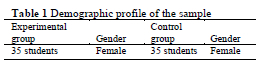
Prior to the intervention, the homogeneity of the fifth-grade mathematics students was confirmed. Both groups were randomly assigned: 5-B served as the experimental group, while 5-A acted as the control group. We assessed all relevant variables, including collaborative, critical-thinking, and problem-solving skills for both groups before the intervention (see Table 1). The study was conducted in an all-girls school for several reasons. In Pakistan, girls' and boys' schools are separate due to cultural norms and educational policies. Additionally, girls are often observed to have weaker mathematics performance than boys. Therefore, focusing on a girls' school provided an opportunity to explore the potential benefits of PBL specifically for female students, aiming to address their unique challenges in mathematics learning and to improve their attitudes and achievements in the subject.
Pre-test Measurement
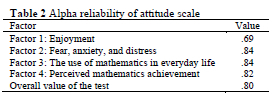
Before the intervention, a pre-test was administered to measure 21st-century skills in both groups. To assess students' attitudes toward mathematics, we used the mathematics attitude scale, originally developed by Aladağ (2005) and later updated by Eskici, Ilgaz and Aricak (2017). This scale evaluates four aspects: enjoyment of mathematics, fear, anxiety, distress, application of mathematics in everyday life, and perceived mathematics achievement (see Table 2).
Intervention Details
PBL was used as instructional approach to teach mathematics content to the experimental group. Customised lesson plans and modules focussing on measurements of angles, geometry, and decimal concepts were created. In contrast, the control group received instruction through traditional teaching methods using the same content. The intervention lasted 6 weeks, with each week comprising 5 hours of instruction for a total of 30 class hours. Audio-visual aids were prepared for classroom activities, and the experimental group of students worked in five groups of six girls per session.
Assessment Methods
Teachers assessed students in the experimental group using worksheets and projects at the end of each session, following the operational stages outlined by the Buck Institute (Kaptan & Korkmaz, 2001). In the control group, standard tests and quizzes were used for assessment.
Post-test Measurement
After the intervention, both groups completed the mathematics attitude, creativity, and problem-solving test as a post-test. During the project work, students in the experimental group were observed to evaluate their engagement and collaboration with peers and within groups.
Qualitative Data Collection
After the intervention, interviews were conducted with teachers and students who participated in the PBL activities. All participants signed consent forms, and their names were kept confidential and used only for research purposes. We maintained a friendly and comfortable environment during the interview sessions. Two mathematics teachers involved in the intervention were selected for interviews to understand the qualitative aspects of the study. A convenient sampling technique was used to select 10 students who voluntarily participated in the interview sessions to share their perspectives about PBL.
Mathematics achievement test
In collaboration with mathematics specialists, teachers, and other stakeholders, we developed a mathematics achievement test as part of the PBL training and intervention. To ensure validity and reliability, experts reviewed and approved the test before data collection. The content for the test and accompanying project was drawn from three chapters of the Grade 5 mathematics teacher's handbook. Guided by Bloom's taxonomy, the test was constructed to encompass a range of cognitive domains. The final test comprised 30 items, including 20 questions addressing knowledge, comprehension, application, analysis, synthesis, and evaluation, and 10 questions designed to assess students' problem-solving skills in mathematics.
An item analysis was performed using the ITEMAN tool, following established guidelines (Ramadhan, Mardapi, Prasetyo & Utomo, 2019). The analysis revealed a difficulty index ranging from 0.33 to 0.85 and a discrimination index between 0.31 and 0.82. Based on Heri's (2016) criteria, items with a difficulty index of 0.31 to 0.89 and a discrimination value of at least 0.22 were deemed high quality. Consequently, all 30 items were retained in the final test version. Further evaluation indicated a reliability coefficient of 0.79, confirming the test's suitability for assessing mathematical achievement. The mathematics achievement test was selected for this study because prior research demonstrated its effectiveness for evaluating students' mathematics skills as in objectives of the study.
Both quantitative and qualitative methods were employed to analyse the collected data. For the quantitative analysis, the pre-test and post-test scores of the experimental and control groups were compared to evaluate the intervention's impact. The Wilcoxon signed-rank test was used to analyse data from the mathematics attitude scale, while the independent sample /-test was used to assess differences in performance on the mathematics achievement test. Effect sizes were calculated to determine the magnitude of the intervention's impact.
For the qualitative analysis, thematic analysis was applied to interviews with teachers and students, identifying recurring patterns and key themes related to the implementation of PBL. Additionally, observation notes from the experimental group were analysed to assess student engagement, collaboration, and the practical application of PBL principles. This comprehensive approach provided a deeper understanding of how PBL influenced both student attitudes and academic performance in mathematics.
Results
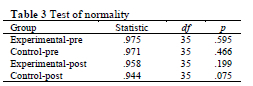
To determine whether the data were normally distributed, the Shapiro-Wilk test was conducted for both the pre-test and post-test scores of the experimental and control groups. This test is particularly suitable for small sample sizes and provides a robust assessment of normality. The results of the Shapiro-Wilk test are summarised in Table 3. A p-value greater than .05 indicates that the data do not significantly deviate from a normal distribution, suggesting that the data can be considered normally distributed.
Effect of PBL on Students' Attitude towards
Mathematics Learning
The first research question focused on the impact of PBL on students' attitudes toward mathematics learning. Results from an attitude measure before and after the session indicated a statistically significant change in participants' attitudes.
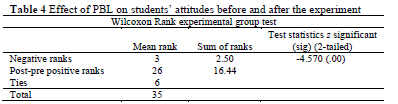
Before conducting the Wilcoxon signed-rank test, the normality of the data distribution was assessed using the Shapiro-Wilk test. The results in Table 3 indicate that the data did not follow a normal distribution for any groups (p > .05), justifying non-parametric methods for further analysis. Table 4 displays the changes in primary school students' attitudes towards mathematics learning before and after participating in the experimental group. The Wilcoxon signed-rank test, a non-parametric method, was employed to compare two distinct sets of scores generated by the same individuals. This test is particularly useful when evaluating changes in scores across different time points or when individuals are exposed to multiple conditions simultaneously. The primary objective of this study was to ascertain whether a significant shift took place in participants' attitudes toward mathematics learning before and after the intervention.
After the intervention, the findings demonstrate a statistically significant positive change in students' attitudes in the problem-based learning (PBL) group. Z-values of the z-test statistic were used to determine whether the Wilcoxon signed-rank test showed a significant deviation from zero. The z-value (z = -4.570) indicates a notable difference. Furthermore, the p-value of .00, less than .05, also signifies a significant difference. The effect size was also calculated using the Pearson product-moment correlation coefficient, yielding an r-value of -0.77. According to the r-value, the effect size ranges were defined as follows: .10 - < 0.3 (small effect), .30 - < .5 (moderate effect), and >= .5 (significant impact). This r-value of -.77 shows a substantial effect on the students' attitudes after the intervention. The results of this test substantiated that PBL positively influenced students' attitudes toward mathematics learning.
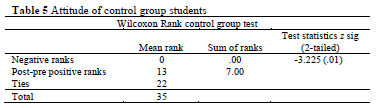
Table 5 presents the results of the attitude scale, which was used to assess students' attitudes towards mathematics learning. The control group received instruction through traditional teaching methods. Attitude data were collected from students before and after the teaching intervention using a questionnaire. Due to the non-parametric nature of the data, the Wilcoxon signed-rank test was applied in the Statistical Package for the Social Sciences (SPSS). The z-value (z = -3.225b) and p-value (p = .01) were higher than .00, indicating no significant change in students' attitudes following the traditional teaching method. The effect size was calculated as r = -.54, indicating a minimal difference.
Effect of PBL on Students' Mathematics
Achievements
The second research question was on the effectiveness of PBL in enhancing students' academic achievement and problem-solving skills. An accomplishment exam was created to measure students' performance in mathematics. This exam included 30 questions, carefully selected and designed based on the standards-based learning objectives (SLO) of the mathematics curriculum. Achievement data were collected from both the experimental and control groups before the intervention. The same test, with the sequence of questions altered, was administered after the intervention. Data were analysed using SPSS, and because the data for this research question were parametric, a t-test was applied. A preliminary analysis compared the mean scores from the pre-test and post-test between the experimental and control groups to determine whether a significant change took place in either group' s average score due to the intervention.
Table 6 represents the results of the t-test scores of the experimental and control groups. The mean value of the experimental group before the intervention was (12.46) and after the intervention, it was (25.54). On the other hand, the mean value of the control group before the experiment was (11.80) and after studying with the traditional teaching method, the mean scores increased to (16.94). It shows that the mean value increased in both cases, but the mean value increased more in the experimental group, taught using PBL, than in the group where the traditional teaching method was used for teaching mathematics. The p-value was (p = .421) before the intervention. As this is greater than .05, there was no significant difference between the experimental and control groups before the intervention. After the intervention, the p-value (p = .00) shows a considerable difference. Because the p-value is smaller than .05, a significant difference is depicted in the experimental and control group after the intervention (see Table 5 for details).
To check the difference in the mean scores between the control and experimental groups before and after the experiment, an independent sample t-test was applied.
Table 7 displays the results of the independent sample t-test, indicating that the mean value for the experimental group was 12.46 and for the control group 11.80, suggesting no difference between the groups before the intervention. The t-value of .809 and the p-value of 4.22 further confirm that there was no significant difference between the groups. This indicates that, before the intervention, both the experimental and control groups performed similarly in terms of achievement and problem-solving skills. The p-value of 4.22, being much higher than 0.005, confirms the lack of significant difference between the experimental and control groups before the treatment.
Table 8 shows the results of the independent sample t-test, where the experimental group had a mean score of 25.54, compared to 16.94 for the control group, indicating a substantial difference after the intervention. The t-value of 8.284 and a p-value of .000 demonstrate a significant difference between the groups. This suggests that the experimental group, which was taught using PBL, outperformed the control group in terms of achievement and problem-solving skills. PBL was thus identified as a highly effective instructional method for teaching mathematics at the primary level. Cohen's d-value of 1.82 indicates a large effect size, highlighting the significant difference between the group taught with PBL and the group taught using traditional methods.
Additionally, a paired sample t-test was conducted to compare the pre- and post-test scores of the experimental group, as outlined by Cohen, Manion and Morrison (2017). The effect size was calculated to assess the impact of the intervention on the experimental group.
Table 9 shows the results of the paired sample t-test. The paired sample t-test is used when the researcher wants to determine the difference in the mean scores of the experimental group. The mean scores reveal a highly significant difference, as indicated by a p-value smaller than .05 (p = .005), demonstrating a statistically significant difference in the mean scores of the experimental group. The table shows that the scores of the experimental group improved considerably after the intervention. The achievements of the students in the experimental group in the test were enhanced after the intervention. It indicates that students who learnt used PBL improved their scores on mathematics tests. The effect size of our study was evaluated using Pearson's correlation coefficient r (0.7), which represents a large effect size.
Effect of PBL on Low Achievers
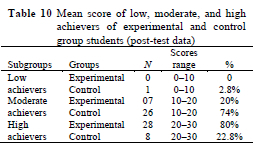
To check the percentage of students from the control and experimental groups a descriptive statistical analysis was done. The student rating was calculated using SPSS. According to their scores on the post-test achievement test students were categorised into three categories, namely, low, moderate, and high achievers.
Table 10 presents the scores of the experimental and control group students on the achievement test, categorising them as low achievers (0-10), moderate achievers (10-20), and high achievers (20-30). The results reveal notable differences between the groups following the intervention. Among the experimental group, no students fell into the low-achiever category, whereas one student (2.8%) in the control group was categorised as a low achiever. Seven students (20%) from the experimental group and 26 (74%) from the control group were represented in the moderate category. Conversely, the high achiever group included 28 students (80%) from the experimental group and only eight (22.8%) from the control group. These findings indicate that most high-performing students were from the experimental group exposed to PBL. Furthermore, 74% of students in the control group remained moderate achievers after learning through traditional teaching methods. These results highlight the effectiveness of PBL in enhancing student achievement, as most students in the experimental group performed well on the achievement test.
Teachers' and Students' Perceptions of PBL Interview data were analysed using thematic analysis to uncover participants' perceptions of PBL activities. To maintain objectivity and minimise bias, we relied solely on transcribed interviews during the analysis. Thematic patterns emerging from the interviews with teachers and students provided rich insights into the perceived benefits and challenges of PBL.
Teachers' perceptions
Teachers unanimously identified PBL as an effective approach to teaching mathematics at the primary level. One teacher described PBL as a transformative method, stating: "PBL transforms the traditional classroom into a dynamic learning environment where students are at the center of the learning process."
Teachers emphasised the shift from teacher-centred to student-centred learning, highlighting the collaborative nature of PBL. This aligns with MacMath, Sivia and Britton' s (2017) assertion that PBL fosters learning by doing and encourages child-centred education. Another teacher remarked: "PBL allows students to work independently, encouraging them to take an active role in their education."
Collaborative learning emerged as a key theme, with teachers noting that students were more engaged and enthusiastic when working on projects that interested them. One teacher observed: "Students are more invested in their work when it's relevant to their interests, and they get to collaborate with their peers."
Furthermore, teachers highlighted the positive effects of PBL on classroom dynamics, discipline, and teacher-student relationships. As one teacher explained: "PBL fosters a better teacher-student relationship and improves classroom dynamics. "
Teachers also noted that PBL enabled students to apply their knowledge to real-world scenarios, enhancing both understanding and skills development.
Students' perceptions
Students expressed enthusiasm for learning mathematics through PBL, citing increased motivation and opportunities for group collaboration - previously uncommon experiences. One student said: "For the first time, I shared my opinion with my classmates; they valued my ideas, and we worked effectively in groups?"
However, some students reported challenges, particularly anxiety about presenting their work. One participant stated: "I am not proficient at speaking, so it was difficult to convey the messages to audiences. As a result, I was generally afraid to present the project because I was not confident in my work"
Low achievers' perceptions
We conducted follow-up interviews with five low-achieving students after the intervention. These students described a significant positive impact of PBL on their learning experience. One student commented:
Math was never my favorite subject; I always scored low on math tests, so I was considered dull and poor. I think PBL is the best technique for students like me who do not do well on math tests; I don't know how, but PBL involves me in the learning process.
These response illustrates how PBL can engage students who previously struggled with mathematics, fostering a sense of inclusion and improved attitudes towards learning.
Discussion and Conclusion
With this study we concluded that while no statistically significant difference was observed in the post-test attitudes of the control group, the experimental group demonstrated a marked improvement in attitudes toward mathematics learning due to the implementation of PBL. This aligns with other research that underscores the effectiveness of PBL in fostering positive student attitudes towards learning. For instance, Mazana et al. (2019) note that PBL encourages a more favourable disposition toward mathematics. Similarly, Akın (2009) found comparable outcomes in studies involving the fractions sub-learning domain for fifth-grade mathematics and the natural numbers sub-learning domain for fourth-grade mathematics courses.
Other studies, including those by Kwietniewski (2017), Reid-Brown (2017) and Tseng, Chang, Lou and Chen (2013), also highlight statistically significant positive differences in student attitudes when PBL is integrated into the curriculum. Shin (2018) further corroborates these findings, demonstrating that PBL substantially enhances students' attitudes towards mathematics courses. Liu (2003) observed that after an 18-week PBL intervention, students exhibited more positive attitudes and a better grasp of mathematical concepts, suggesting that the long-term application of PBL is critical for effectively reshaping students' attitudes and promoting effective learning. Moreover, Zahroh, Darmayanti, Choirudin, Soebagyo and Nalarsih (2023) emphasise that PBL improves student attitudes and enhances their problem-solving and critical-thinking abilities.
The findings of this study reinforce the idea that students' positive attitudes toward mathematics can be cultivated through PBL, which prioritises active, student-centred learning. As Rehman, Zhang, Mahmood, Fareed and Batool (2023) suggest, effective teaching strategies like PBL significantly impact students' engagement and academic success. This study demonstrates that students progressed from moderate to high achievement levels when PBL was implemented, supporting Kies' (2018) assertion that PBL can uncover and develop latent abilities in students.
PBL's practical, hands-on approach enables students to explore subjects in depth, surpassing the limitations of traditional classroom instruction. Students engaged in PBL are better prepared to address real-world challenges, devise innovative solutions, and contribute effectively beyond the classroom (Yustina, Syafii & Vebrianto, 2020). Almulla (2020) further highlights that this method enhances academic performance while equipping students with essential life skills.
In conclusion, our study underscores the transformative potential of PBL in mathematics education, shifting from teacher-centred to student-centred approaches. This transition fosters a more engaging and effective learning environment, improving student attitudes and academic outcomes. Future research should examine the long-term impacts of PBL on attitudes and performance across diverse subjects, grade levels, and educational contexts to expand its applicability and effectiveness.
Implications of the Study
This study offers several implications for educators, policymakers, and researchers. The findings suggest that PBL can significantly enhance students' attitudes toward mathematics and boost academic performance. Educators should consider integrating PBL into their teaching to create more engaging and effective learning environments. Training in designing and implementing PBL activities can equip teachers to foster deeper student engagement and improved learning outcomes. The study highlights the need for professional development programmes that prepare teachers to implement PBL effectively. Policymakers should prioritise investments in teacher training, curriculum development, and classroom resources to support the adoption of PBL in schools. Such efforts can bridge the gap between traditional and innovative pedagogical practices, enabling systemic educational improvements. Future research should explore the long-term impact of PBL on student attitudes, academic performance, and skills development. Investigating the effectiveness of PBL across diverse subjects, educational levels, and institutional contexts, such as public versus private schools, can provide valuable insights into its broader applicability. Moreover, addressing limitations such as the non-generalisability of findings through random sampling and incorporating participants from varied regions and cultural backgrounds can enhance the robustness of future studies. Additionally, research comparing the effectiveness of PBL among different student demographics and educational settings can yield actionable insights for educators and policymakers. By identifying contextual factors that influence PBL's success, future studies can inform strategies to adapt and optimise PBL for diverse learning environments.
Authors' Contributions
NR: made significant contributions to the conception and design of the study, writing, data collection, analysis, and interpretation. XH: provided valuable insights into the conceptualisation of the theoretical framework, resources, supervision, validation, and proofreading. AM: data analysis, writing original draft, review, and editing. All authors read and approved the final manuscript.
Notesi. This article is based on the Doctor of Philosophy (PhD) thesis by Doctor Nadia Rehman, submitted at the Shaanxi Normal University.
ii. Published under a Creative Commons Attribution Licence.
Acknowledgement
We want to express our gratitude to everyone who contributed to this research. Their dedication, expertise, and unwavering support have been instrumental in the success of this research.
References
-
Abdullah NI, Tarmizi RA & Abu R 2010. The effects of Problem Based Learning on mathematics performance and affective attributes in learning statistics at form four secondary level. Procedia -Social and Behavioral Sciences, 8:370-376. https://doi.org/10.1016/j.sbspro.2010.12.052
» https://doi.org/10.1016/j.sbspro.2010.12.052 -
Abramovich S, Grinshpan AZ & Milligan DL 2019. Teaching mathematics through concept motivation and action learning. Education Research International, 2019:3745406. https://doi.org/10.1155/2019/3745406
» https://doi.org/10.1155/2019/3745406 - Ailaan A 2017. Pakistan district education ranking 2017. Islamabad, Pakistan: Author.
- Akın P 2009. İlköğretim 5. sınıf Matematik dersi için probleme dayalı öğrenme yönteminin öğrenci başarısına etkisi [The impact of problem-based learning methods on student achievement in 5th grade mathematics]. Master's thesis. İzmir, Türkiye: Ege University.
- Aladağ S 2005. The effect of project-based learning approach in teaching mathematics to the academic achievements and attitudes in primary education. Master's thesis. Ankara, Türkiye: Gazi University.
-
Almazroui KM 2023. Project-based learning for 21 st-century skills: An overview and case study of moral education in the UAE. The Social Studies, 114(3):125-136. https://doi.org/10.1080/00377996.2022.2134281
» https://doi.org/10.1080/00377996.2022.2134281 -
Almulla MA 2020. The effectiveness of the project-based learning (PBL) approach as a way to engage students in learning. Sage Open, 10(3):1-15. https://doi.org/10.1177/2158244020938702
» https://doi.org/10.1177/2158244020938702 - Alrahlah A 2016. How effective the problem-based learning (PBL) in dental education. A critical review. The Saudi Dental Journal, 28(4):155-161. https://doi.org/10.1016/j.sdentj.2016.08.003
-
Apriliyanto B, Dewi RS & Riyadi 2018. Perception of teachers in Math learning using Problem Based Learning model. Pancaran Pendidikan FKIP, 7(1):143-150. https://doi.org/10.25037/pancaran.v7i1.144
» https://doi.org/10.25037/pancaran.v7i1.144 -
Asempapa RS & Brooks GP 2022. Factor analysis and psychometric evaluation of the mathematical modeling attitude scale for teachers of mathematics. Journal of Mathematics Teacher Education, 25:131-161. https://doi.org/10.1007/s10857-020-09482-0
» https://doi.org/10.1007/s10857-020-09482-0 -
Ashraf I & Ashraf F 2015. Reasons for low performance of teachers: A study of government schools operating in Bahawalpur city, Pakistan. International Journal of Academic Research in Progressive Education & Development, 4(2):94-106. https://doi.org/10.6007/IJARPED/v4-i2/1764
» https://doi.org/10.6007/IJARPED/v4-i2/1764 - Awan RN, Hussain H & Anwar N 2017. Effects of problem based learning on students' critical thinking skills, attitudes towards learning and achievement. Journal of Educational Research, 20(2):28-41.
-
Boaler J, Chen L, Williams C & Cordero M 2016. Seeing as understanding: The importance of visual mathematics for our brain and learning. Journal of Applied & Computational Mathematics, 5(5):1-6. https://doi.org/10.4172/2168-9679.1000325
» https://doi.org/10.4172/2168-9679.1000325 -
Chaudhry AQ, Malik M & Rafiq N 2019. Attitude of students towards learning mathematics at elementary level. Journal of Elementary Education, 29(1):109-120. Available at http://111.68.103.26/journals/index.php/jee/article/viewFile/1895/795. Accessed 23 February 2025.
» http://111.68.103.26/journals/index.php/jee/article/viewFile/1895/795 -
Chen CH & Yang YC 2019. Revisiting the effects of project-based learning on students' academic achievement: A meta-analysis investigating moderators. Educational Research Review, 26:71 -81. https://doi.org/10.1016/j.edurev.2018.11.001
» https://doi.org/10.1016/j.edurev.2018.11.001 -
Clouston TJ & Whitcombe SW 2005. An emerging person centred model for problem-based learning. Journal of Further and Higher Education, 29(3):265-275. https://doi.org/10.1080/03098770500166926
» https://doi.org/10.1080/03098770500166926 - Cohen L, Manion L & Morrison K 2017. Research methods in education (8th ed). London, England: Routledge.
- Cresswell T 2014. Place: An introduction. Chichester, England: John Wiley & Sons Ltd.
-
Cullen J, Richardson S & O'Brien R 2004. Exploring the teaching potential of empirically-based case studies. Accounting Education, 13(2):251-266. https://doi.org/10.1080/09639280420001676648
» https://doi.org/10.1080/09639280420001676648 -
Dochy F, Segers M, Van den Bossche J & Gijbels D 2003. Effects of problem-based learning: A meta-analysis. Learning and Instruction, 13(5):533-568. https://doi.org/10.1016/S0959-4752(02)00025-7
» https://doi.org/10.1016/S0959-4752(02)00025-7 -
Dolmans DHJM 2019. How theory and design-based research can mature PBL practice and research. Advances in Health Sciences Education, 24(5):879-891. https://doi.org/10.1007/s10459-019-09940-2
» https://doi.org/10.1007/s10459-019-09940-2 - Duch BJ, Groh SE & Allen DE (eds.) 2001. The power of problem-based learning: A practical "how to "for teaching undergraduate courses in any discipline. Sterling, VA: Stylus Pub.
-
Eriksson K, Helenius O & Ryve A 2019. Using TIMSS items to evaluate the effectiveness of different instructional practices. Instructional Science, 47:1-18. https://doi.org/10.1007/s11251-018-9473-1
» https://doi.org/10.1007/s11251-018-9473-1 -
Eskici M, Ilgaz G & Aricak OT 2017. Development of Mathematics Course Attitude Scale: A preliminary study of validity & reliability. Universal Journal of Educational Research, 5(12A):63-70. Available at https://files.eric.ed.gov/fulltext/EJ1165509.pdf. Accessed 23 February 2025.
» https://files.eric.ed.gov/fulltext/EJ1165509.pdf - France T 2015. Project-based learning in a high school pre-engineering program: Findings on student achievement (RTP, Strand 3). In 2015 ASEE Annual Conference & Exposition.
-
Gay S, Sahjat S & Hamid F 2022. Efektivitas pembelajaran fisika menggunakan model pembelajaran pdeode dan model PBL terhadap hasil belajar siswa kelas vii di SMP Negeri 5 Kota Ternate pada materi kalor [The effectiveness of physics learning using PDEODE and PBL learning models on learning outcomes of seventh-grade students at SMP Negeri 5 Ternate City on heat materials]. Edukasi - JurnalPendidikan, 20(1):112-125. https://doi.org/10.33387/j.edu.v20i1.4484
» https://doi.org/10.33387/j.edu.v20i1.4484 -
Genc M & Erbas AK 2019. Secondary mathematics teachers' conceptions of mathematical literacy. International Journal of Education in Mathematics, Science and Technology, 7(3):222-237. Available at https://files.eric.ed.gov/fulltext/EJ1223953.pdf. Accessed 23 February 2025.
» https://files.eric.ed.gov/fulltext/EJ1223953.pdf -
Godejord PA 2007. Perspectives on project-based teaching and "blended learning" to develop ethical awareness in students. eLearning Papers, 6:1 -12. Available at https://www.slideshare.net/slideshow/godejord-presentation/940666. Accessed 23 February 2025.
» https://www.slideshare.net/slideshow/godejord-presentation/940666 -
Halai A & Durrani N 2020. School education system in Pakistan. In PM Sarangapani & R Pappu (eds). Handbook of education systems in South Asia. Singapore: Springer. https://doi.org/10.1007/978-981-13-3309-5_17-1
» https://doi.org/10.1007/978-981-13-3309-5_17-1 -
Han S, Rosli R, Capraro MM & Capraro RM 2016. The Effect of Science, Technology, Engineering and Mathematics (STEM) project based learning (PBL) on students' achievement in four mathematics topics [Special issue]. Journal of Turkish Science Education, 13:3-29. https://doi.org/10.12973/tused.10168a
» https://doi.org/10.12973/tused.10168a -
Hannula MS 2002. Attitude towards mathematics: Emotions, expectations and values. Educational Studies in Mathematics, 49(1):25-46. https://doi.org/10.1023/A:1016048823497
» https://doi.org/10.1023/A:1016048823497 - Heri R 2016. Validiatas reabilitas & karkteristik butir Yogyakarta [Reliability validity & characteristics of Yogyakarta items]. Yogyakarta, Indonesia: Parama Publishing.
-
Hirose M & Creswell JW 2023. Applying core quality criteria of mixed methods research to an empirical study. Journal of Mixed Methods Research, 17(1):12-28. https://doi.org/10.1177/15586898221086346
» https://doi.org/10.1177/15586898221086346 -
Holmes VL & Hwang Y 2016. Exploring the effects of project-based learning in secondary mathematics education. The Journal of Educational Research, 109(5):449-463. https://doi.org/10.1080/00220671.2014.979911
» https://doi.org/10.1080/00220671.2014.979911 -
Hu X, Gong Y, Lai C & Leung FKS 2018. The relationship between ICT and student literacy in mathematics, reading, and science across 44 countries: A multilevel analysis. Computers & Education, 125:1-13. https://doi.org/10.1016/j.compedu.2018.05.021
» https://doi.org/10.1016/j.compedu.2018.05.021 -
Iji CO, Abah JA & Anyor JW 2017. Impact of Cloud Services on students' attitude towards mathematics education in public universities in Benue State, Nigeria. International Journal of Research in Education and Science (IJRES), 3(1):228-244. Available at https://hal.science/hal-01440794/. Accessed 22 February 2025.
» https://hal.science/hal-01440794/ -
Jones A 1997. Recent research in learning technological concepts and processes. In MJ de Vries & A Tamir (eds). Shaping concepts of technology: From philosophical perspective to mental images. Dordrecht, The Netherlands: Springer. https://doi.org/10.1007/978-94-011-5598-4_8
» https://doi.org/10.1007/978-94-011-5598-4_8 -
Kaptan F & Korkmaz H 2001. Fen eğitiminde probleme dayalı öğrenme yaklaşımı [Problem-based learning in science education]. Hacettepe Üniversitesi Eğitim Fakültesi Dergisi, 20(20): 185-192. Available at https://dergipark.org.tr/en/download/article-file/87967. Accessed 22 February 2025.
» https://dergipark.org.tr/en/download/article-file/87967 -
Karakose T, Polat H, Yirci R, Tülübaş T, Papadakis S, Ozdemir TY & Demirkol M 2023. Assessment of the relationships between prospective mathematics teachers' classroom management anxiety, academic self-efficacy beliefs, academic amotivation and attitudes toward the teaching profession using structural equation modelling [Special issue]. Mathematics, 11(2):449. https://doi.org/10.3390/math11020449
» https://doi.org/10.3390/math11020449 -
Kazmi A 2019. Teaching and learning mathematics in Karachi's low-cost private schools. Ed.D thesis. London, England: University College London. Available at https://discovery.ucl.ac.uk/id/eprint/10083537/. Accessed 22 February 2025.
» https://discovery.ucl.ac.uk/id/eprint/10083537/ -
Kek M & Huijser H 2011. Exploring the combined relationships of student and teacher factors on learning approaches and self-directed learning readiness at a Malaysian university. Studies in Higher Education, 36(2):185-208. https://doi.org/10.1080/03075070903519210
» https://doi.org/10.1080/03075070903519210 -
Khaliq S, Alam MT & Mushtaq M 2015. An experimental study to investigate the effectiveness of project-based learning (PBL) for teaching science at elementary level. International Journal of Academic Research in Progressive Education & Development, 4(1):44-56. https://doi.org/10.6007/IJARPED/v4-i1/1434
» https://doi.org/10.6007/IJARPED/v4-i1/1434 -
Khan MN, Malik SA & Janjua SY 2019. Total Quality Management practices and work-related outcomes: A case study of higher education institutions in Pakistan. International Journal of Quality & Reliability Management, 36(6): 864-874. https://doi.org/10.1108/IJQRM-04-2018-0097
» https://doi.org/10.1108/IJQRM-04-2018-0097 -
Kies A 2018. The impact of project-based learning in the secondary classroom. MEd thesis. Orange City, IA: Northwestern College. Available at https://nwcommons.nwciowa.edu/cgi/viewcontent.cgi?article=1100&context=education_masters. Accessed 22 February 2025.
» https://nwcommons.nwciowa.edu/cgi/viewcontent.cgi?article=1100&context=education_masters -
Kolb B 1984. Functions of the frontal cortex of the rat: A comparative review. Brain Research Reviews, 8(1):65-98. https://doi.org/10.1016/0165-0173(84)90018-3
» https://doi.org/10.1016/0165-0173(84)90018-3 - Krajcik JS & Blumenfeld PC 2005. Project-based learning. In RK Sawyer (ed). The Cambridge handbook of the learning sciences. Cambridge, England: Cambridge University Press.
-
Kwietniewski KM 2017. Literature review of project based learning. MSEd thesis. Buffalo, NY: State University of New York College at Buffalo. Available at https://digitalcommons.buffalostate.edu/cgi/viewcontent.cgi?article=1001&context=careereducation_theses. Accessed 22 February 2025.
» https://digitalcommons.buffalostate.edu/cgi/viewcontent.cgi?article=1001&context=careereducation_theses -
Lavidas K, Apostolou Z & Papadakis S 2022. Challenges and opportunities of mathematics in digital times: Preschool teachers' views. Education Sciences, 12(7):459. https://doi.org/10.3390/educsci12070459
» https://doi.org/10.3390/educsci12070459 -
Liu M 2003. Enhancing learners ' cognitive skills through multimedia design. Interactive Learning Environments, 11(1):23-39. https://doi.org/10.1076/ilee.11.1.23.13686
» https://doi.org/10.1076/ilee.11.1.23.13686 -
MacMath S, Sivia A & Britton V 2017. Teacher perceptions of Project Based Learning in the secondary classroom. Alberta Journal of Educational Research, 63(2):175-192. https://doi.org/10.11575/ajer.v63i2.56345
» https://doi.org/10.11575/ajer.v63i2.56345 -
Mazana YM, Montero CS & Casmir RO 2019. Investigating students' attitude toward learning mathematics. International Electronic Journal of Mathematics Education, 14(1):207-231. https://doi.org/10.29333/iejme/3997
» https://doi.org/10.29333/iejme/3997 -
Mielikäinen M 2022. Towards blended learning: Stakeholders' perspectives on a project-based integrated curriculum in ICT engineering education. Industry and Higher Education, 36(1):74-85. https://doi.org/10.1177/0950422221994471
» https://doi.org/10.1177/0950422221994471 -
Ministry of Federal Education and Professional Training, Government of Pakistan 2018. National education policy framework 2018. Islamabad: Author. Available at https://mofept.gov.pk/SiteImage/Policy/National%20Eductaion%20Policy%20Framework%202018%20Final.pdf. Accessed 28 February 2025.
» https://mofept.gov.pk/SiteImage/Policy/National%20Eductaion%20Policy%20Framework%202018%20Final.pdf -
Morales-Mann ET & Kaitell CA 2001. Problem-based learning in a new Canadian curriculum. Journal of Advanced Nursing, 33(1):13-19. https://doi.org/10.1046/j.1365-2648.2001.01633.x
» https://doi.org/10.1046/j.1365-2648.2001.01633.x -
Mughal SH, Asad MM & Adams D 2021. Goals of the national mathematics curriculum of Pakistan: Educators' perceptions and challenges toward achievement. International Journal of Educational Management, 35(1):159-172. https://doi.org/10.1108/IJEM-04-2020-0203
» https://doi.org/10.1108/IJEM-04-2020-0203 -
Mutohir TC, Lowrie T & Patahuddin SM 2018. The development of a student survey on attitudes towards mathematics teaching-learning processes. Journal on Mathematics Education, 9(1):1 -14. https://doi.org/10.22342/jme.9.1.4193.1-14
» https://doi.org/10.22342/jme.9.1.4193.1-14 -
Nguyen TT 2017. Developing important life skills through Project-based Learning: A case study. The Normal Lights, 11(2):109-142. https://doi.org/10.56278/tnl.v11i2.529
» https://doi.org/10.56278/tnl.v11i2.529 -
Österman T & Brâting K 2019. Dewey and mathematical practice: Revisiting the distinction between procedural and conceptual knowledge. Journal of Curriculum Studies, 51(4):457-470. https://doi.org/10.1080/00220272.2019.1594388
» https://doi.org/10.1080/00220272.2019.1594388 -
Owens AD & Hite RL 2022. Enhancing student communication competencies in STEM using virtual global collaboration project based learning. Research in Science & Technological Education, 40(1):76-102. https://doi.org/10.1080/02635143.2020.1778663
» https://doi.org/10.1080/02635143.2020.1778663 - Pangrazi RP & Beighle A 2019. Dynamic physical education for elementary school children (19th ed). San Francisco, CA: Pearson Education.
-
Papadakis S, Kalogiannakis M & Zaranis N 2021. Teaching mathematics with mobile devices and the Realistic Mathematical Education (RME) approach in kindergarten. Advances in Mobile Learning Educational Research, 1(1):5-18. https://doi.org/10.25082/AMLER.2021.01.002
» https://doi.org/10.25082/AMLER.2021.01.002 -
Perry SB 2020. Project-based learning. In R Kimmons & 5 Caskurlu (eds). The students' guide to learning design and research. Provo, UT: EdTech Books. https://doi.org/10.59668/10
» https://doi.org/10.59668/10 -
Radkowitsch A, Sailer M, Fischer MR, Schmidmaier R & Fischer F 2022. Diagnosing collaboratively: A theoretical model and a simulation-based learning environment. In F Fischer & A Opitz (eds). Learning to diagnose with simulations: Examples from teacher education and medical education. Cham, Switzerland: Springer. https://doi.org/10.1007/978-3-030-89147-3_10
» https://doi.org/10.1007/978-3-030-89147-3_10 -
Rajabzadeh AR, Mehrtash M & Srinivasan S 2022. Multidisciplinary problem-based learning (MPBL) approach in undergraduate programs. In ME Auer & T Tsiatsos (eds). New realities, mobile systems and applications: Proceedings of the 14th IMCL Conference (Vol. 411). Cham, Switzerland: Springer. https://doi.org/10.1007/978-3-030-96296-8_41
» https://doi.org/10.1007/978-3-030-96296-8_41 -
Ramadhan S, Mardapi D, Prasetyo ZK & Utomo HB 2019. The development of an instrument to measure the higher order thinking skill in physics. European Journal of Educational Research, 8(3):743-751. https://doi.org/10.12973/eu-jer.8.3.743
» https://doi.org/10.12973/eu-jer.8.3.743 -
Ramesh S 2022. The political economy of human behaviour and economic development: Psychology and economic development. Cham, Switzerland: Palgrave Macmillan. https://doi.org/10.1007/978-3-031-12666-6
» https://doi.org/10.1007/978-3-031-12666-6 -
Rehman N, Huang X, Batool S, Andleeb I & Mahmood A 2024. Assessing the effectiveness of Project-Based Learning: A comprehensive meta-analysis of student achievement between 2010 and 2023. ASR: Chiang Mai University Journal of Social Sciences and Humanities, 11(2):e2024015. https://doi.org/10.12982/CMUJASR.2024.015
» https://doi.org/10.12982/CMUJASR.2024.015 -
Rehman N, Zhang W, Mahmood A & Alam F 2021. Teaching physics with interactive computer simulation at secondary level. Cadernos de Educação Tecnologia e Sociedade, 14(1):127-141. https://doi.org/10.14571/brajets.v14.n1.127-141
» https://doi.org/10.14571/brajets.v14.n1.127-141 -
Rehman N, Zhang W, Mahmood A, Fareed MZ & Batool S 2023. Fostering twenty-first century skills among primary school students through math project-based learning. Humanities and Social Sciences Communications, 10:424. https://doi.org/10.1057/s41599-023-01914-5
» https://doi.org/10.1057/s41599-023-01914-5 -
Reid-Brown CA 2017. Project-based learning: Investigating self-directed learning readiness skills and content knowledge retention in an urban Jamaican high school eighth grade integrated science cohort. PhD dissertation. Miami, FL: Florida International University. https://doi.org/10.25148/etd.FIDC001950
» https://doi.org/10.25148/etd.FIDC001950 -
Rima BA & Marwa B 2022. The Use of Project Based learning and its effects on student's critical thinking: The case of EFL third year students at MOHEMED BOUDIAF University department of English language. MA Linguistics dissertation. M'Sila, Algeria: University of Mohamed Boudiaf. Available at https://repository.univ-msila.dz/server/api/core/bitstreams/a87cf0c5-69a0-411c-9322-8b7f453c7b57/content. Accessed 22 February 2025.
» https://repository.univ-msila.dz/server/api/core/bitstreams/a87cf0c5-69a0-411c-9322-8b7f453c7b57/content -
Saad A & Zainudin S 2022. A review of Project-Based Learning (PBL) and Computational Thinking (CT) in teaching and learning. Learning and Motivation, 78:101802. https://doi.org/10.1016/j.lmot.2022.101802
» https://doi.org/10.1016/j.lmot.2022.101802 -
Sen EO 2022. Middle school students' engagement in mathematics and learning approaches: Structural equation modelling. Pedagogical Research, 7(2):em0124. https://doi.org/10.29333/pr/11908
» https://doi.org/10.29333/pr/11908 -
Sevgül Ö & Yavuzcan HG 2022. Learning and evaluation in the design studio. Gazi University Journal of Science Part B: Art, Humanities, Design and Planning, 10(1):43-53. Available at https://dergipark.org.tr/en/download/article-file/2326963. Accessed 22 February 2025.
» https://dergipark.org.tr/en/download/article-file/2326963 -
Sheppard SLR 2022. A curriculum development for 21st century learners: Using Project Based Learning to teach the Four Cs required for today and tomorrow's workforce. MACI thesis. Westerville, OH: Otterbein University. Available at https://digitalcommons.otterbein.edu/stu_master/99/. Accessed 22 February 2025.
» https://digitalcommons.otterbein.edu/stu_master/99/ -
Shin MH 2018. Effects of project-based learning on students' motivation and self-efficacy. English Teaching, 73(1):95-114. https://doi.org/10.15858/engtea.73.L201803.95
» https://doi.org/10.15858/engtea.73.L201803.95 - Trends in International Math and Science Study (TIMSS)-TIMSS Participating Countries 2019. Washington, DC: National Center for Education Statistics.
-
Tseng KH, Chang CC, Lou SJ & Chen WP 2013. Attitudes towards science, technology, engineering and mathematics (STEM) in a project-based learning (PjBL) environment. International Journal of Technology and Design Education, 23:87-102. https://doi.org/10.1007/s10798-011-9160-x
» https://doi.org/10.1007/s10798-011-9160-x -
Turcotte N, Rodriguez-Meehan M & Stork MG 2022. This school is made for students: Students' perspectives on PBL. Journal of Formative Design in Learning, 6(1):53-62. https://doi.org/10.1007/s41686-022-00066-0
» https://doi.org/10.1007/s41686-022-00066-0 -
Virtue EE & Hinnant-Crawford BN 2019. "We're doing things that are meaningful": Student perspectives of project-based learning across the disciplines [Special issue]. Interdisciplinary Journal of Problem-Based Learning, 13(2). https://doi.org/10.7771/1541-5015.1809
» https://doi.org/10.7771/1541-5015.1809 -
Vu P & Feinstein S 2017. An exploratory multiple case study about using game-based learning in STEM classrooms. International Journal of Research in Education and Science, 3(2):582-588. https://doi.org/10.21890/ijres.328087
» https://doi.org/10.21890/ijres.328087 -
Wolpert-Gawron H 2016. DIY Project Based Learning for math and science. New York. NY: Routledge. https://doi.org/10.4324/9781315709598
» https://doi.org/10.4324/9781315709598 -
Yustina, Syafii W & Vebrianto R 2020. The effects of blended learning and Project-Based Learning on pre-service biology teachers' creative thinking through online learning in the COVID-19 pandemic. Jurnal Pendidikan IPA Indonesia, 9(3):408-420. https://doi.org/10.15294/jpii.v9i3.24706
» https://doi.org/10.15294/jpii.v9i3.24706 -
Zahroh U, Darmayanti R, Choirudin, Soebagyo RI & Nalarsih RT 2023. Project-based learning training and assistance for prospective high school teachers. Jurnal Inovasi dan Pengembangan Hasil Pengabdian Masyarakat, 1(2):115-121. https://doi.org/10.61650/jip-dimas.v1i2
» https://doi.org/10.61650/jip-dimas.v1i2 -
Zhang J, Zhao N & Kong QP 2019. The relationship between math anxiety and math performance: A meta-analytic investigation. Frontiers in Psychology, 10:1613. https://doi.org/10.3389/fpsyg.2019.01613
» https://doi.org/10.3389/fpsyg.2019.01613
Revised: 8 July 2024
Accepted: 23 November 2024
Published: 28 February 2025